
Improving the Efficiencies of Copper Pyrometallurgy Through Exergy Assessment

 ,
, 
Abstract
1. Introduction
2. Copper Pyrometallurgy Operations
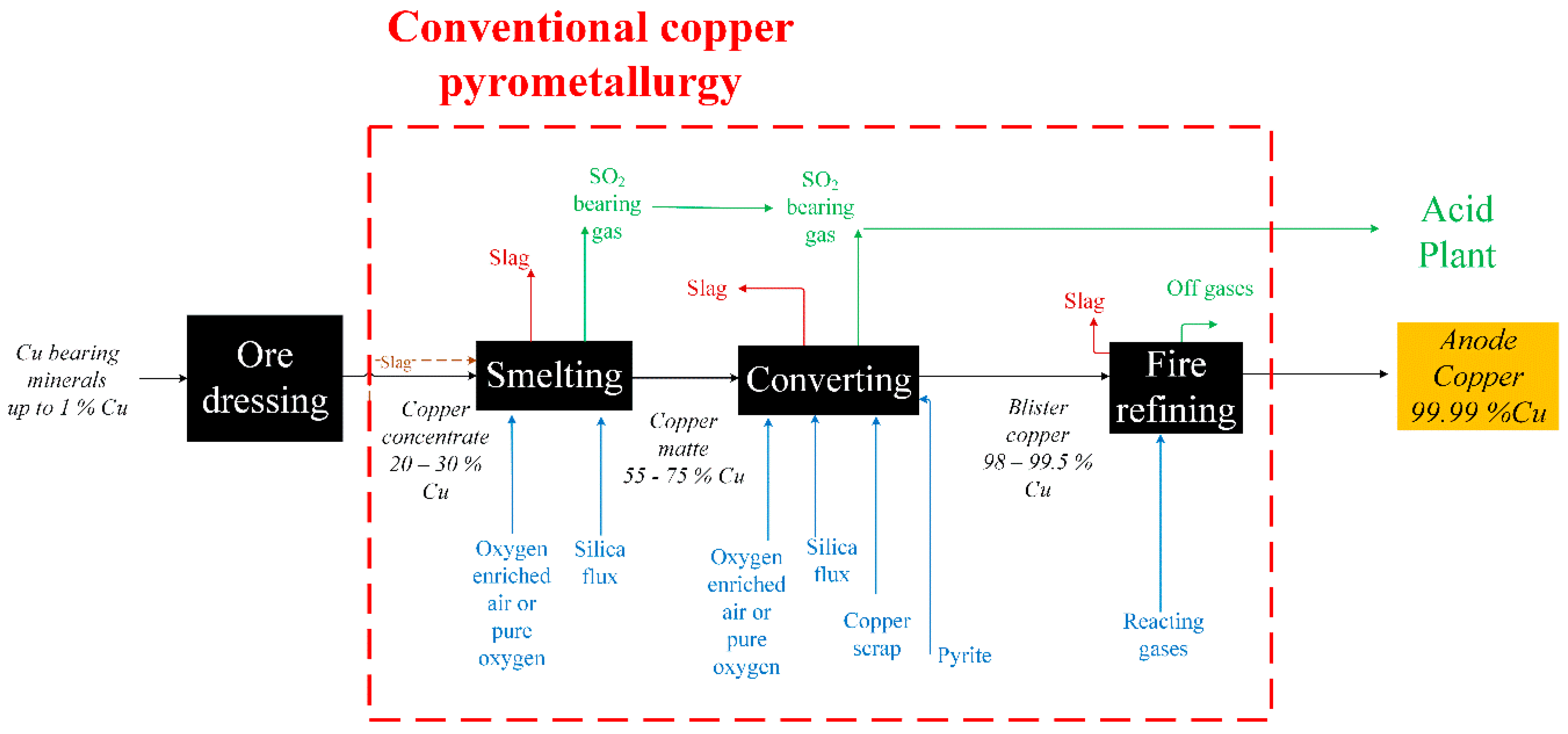
2.1. Description of Copper Processing Stages
2.2. Technologies in Use
3. Exergy Analysis
3.1. Methodology
3.2. Study Cases
4. Results and Discussion
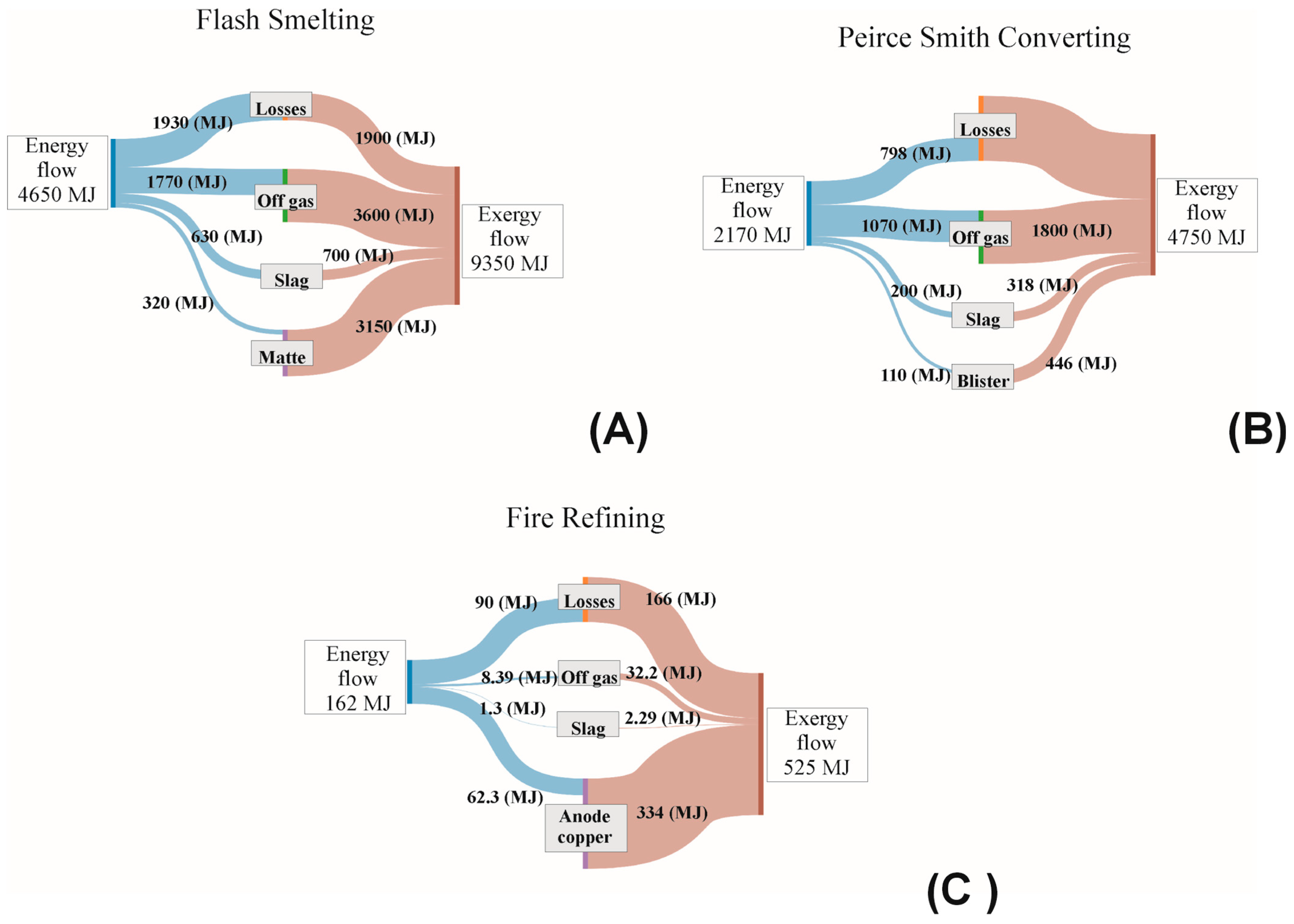
4.1. Flash Smelting Analysis
4.2. Converting Operation
- ◦
- Toxic SO2 is liberated, and this constitutes a serious health and environmental risk;
- ◦
- As SO2 mixes with the surrounding air, it dilutes, making its capture more difficult. This reduces the efficiency of acid plant production;
- ◦
- As major gas volume is produced, the entropy of the off gases increases, so when the energy content in such gases is partially recovered, their energy quality decreases, making it harder to recover the energy stored in them.
4.3. Fire Refining
- ◦
- Oxygen enrichment in the blast;
- ◦
- Air preheating;
- ◦
- Matte grade;
- ◦
- Mineralogy (feedstock).
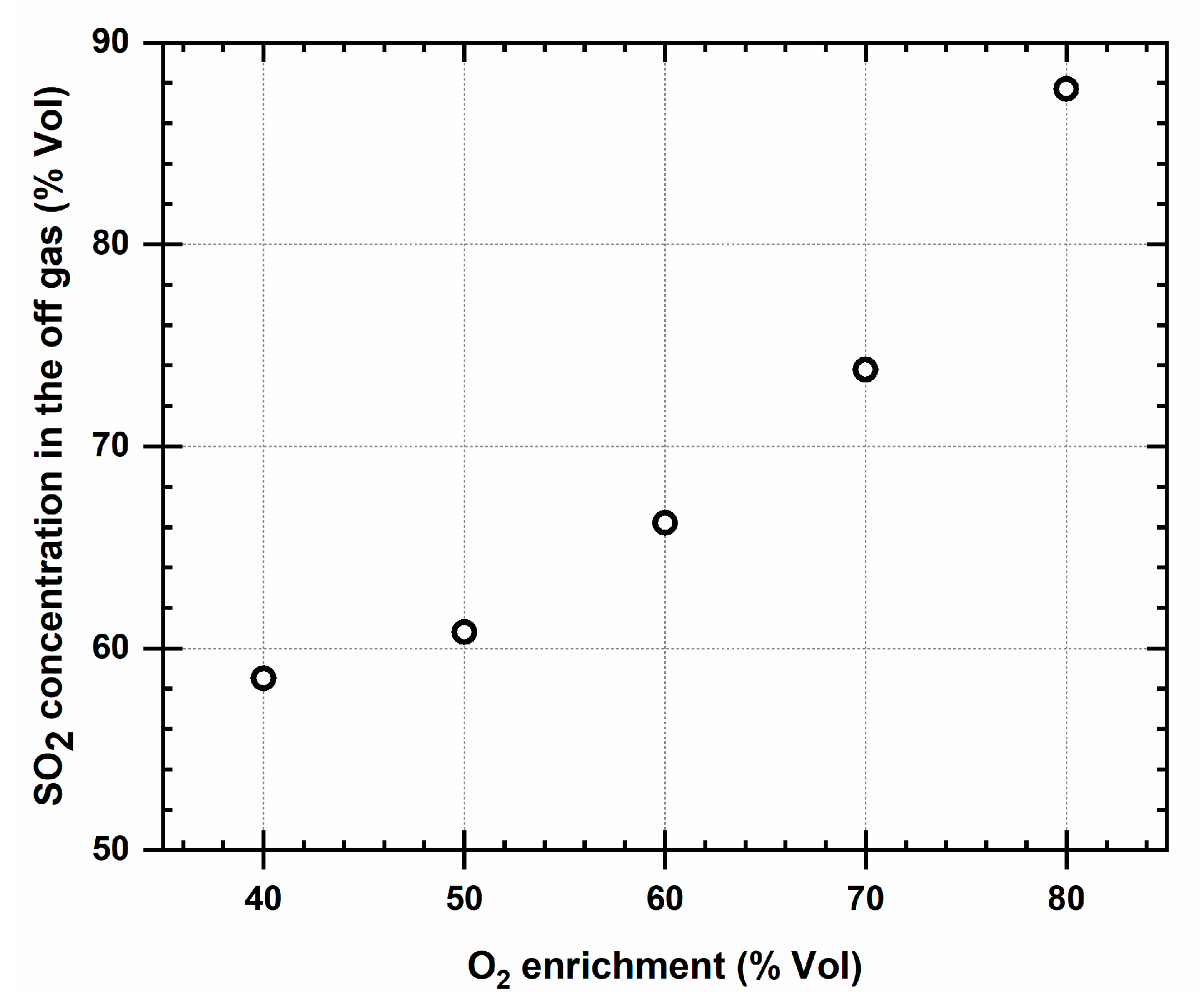
4.4. Effect of Oxygen Enrichment in the Blast
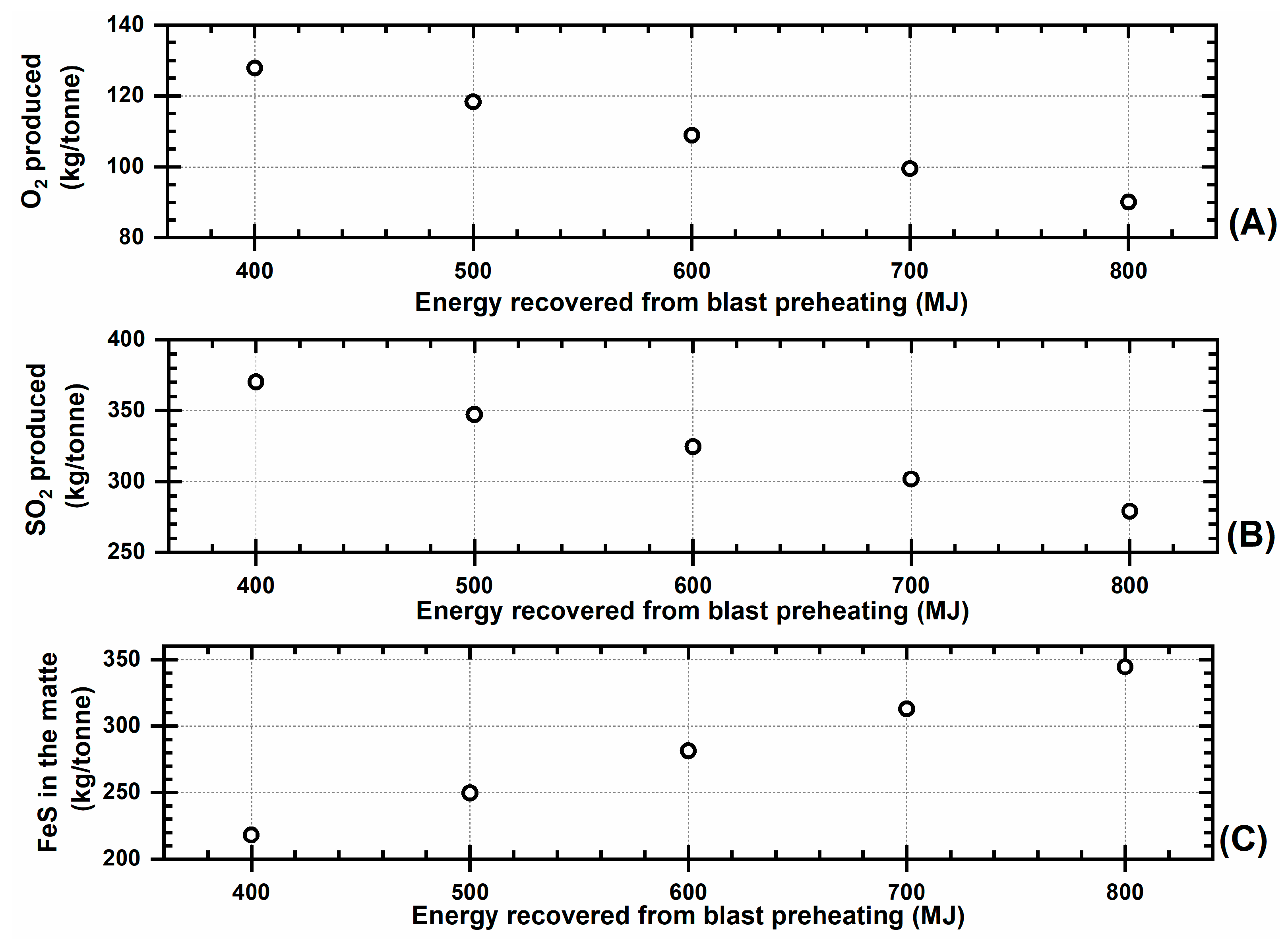
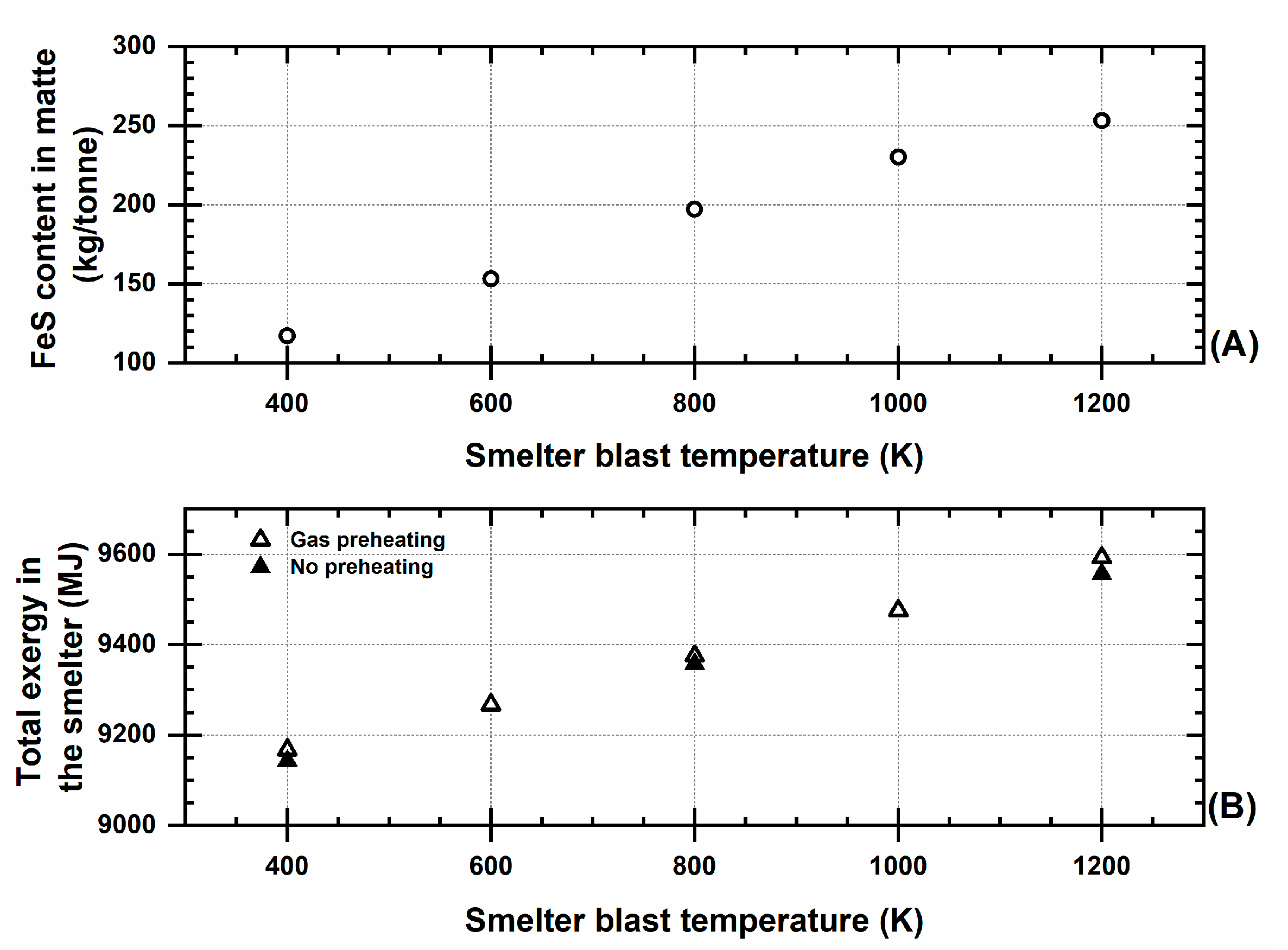
4.5. Effect of Gas Preheating
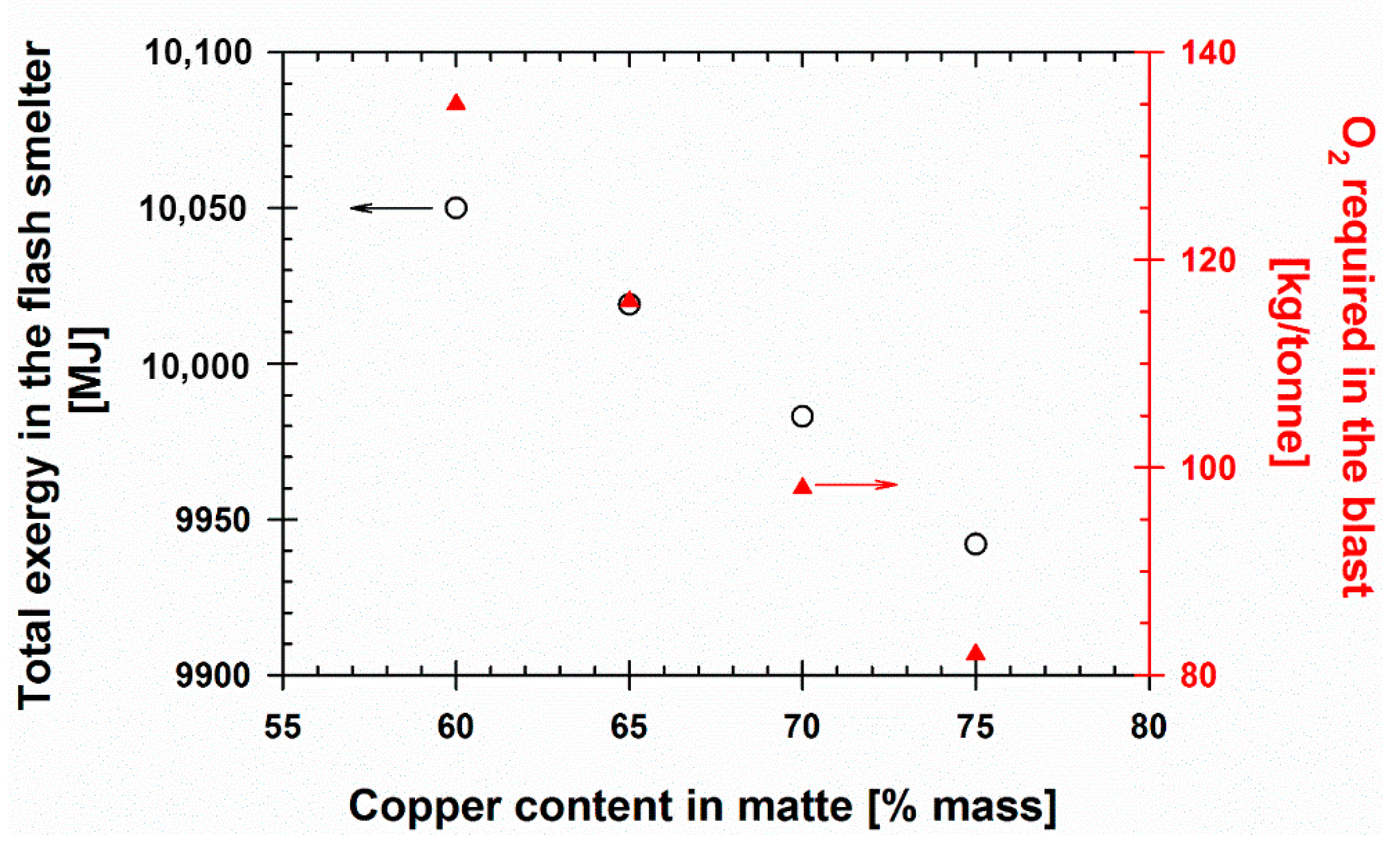
4.6. Effect of Matte Grade
4.7. Effect of Mineral Composition in the Process Feedstock
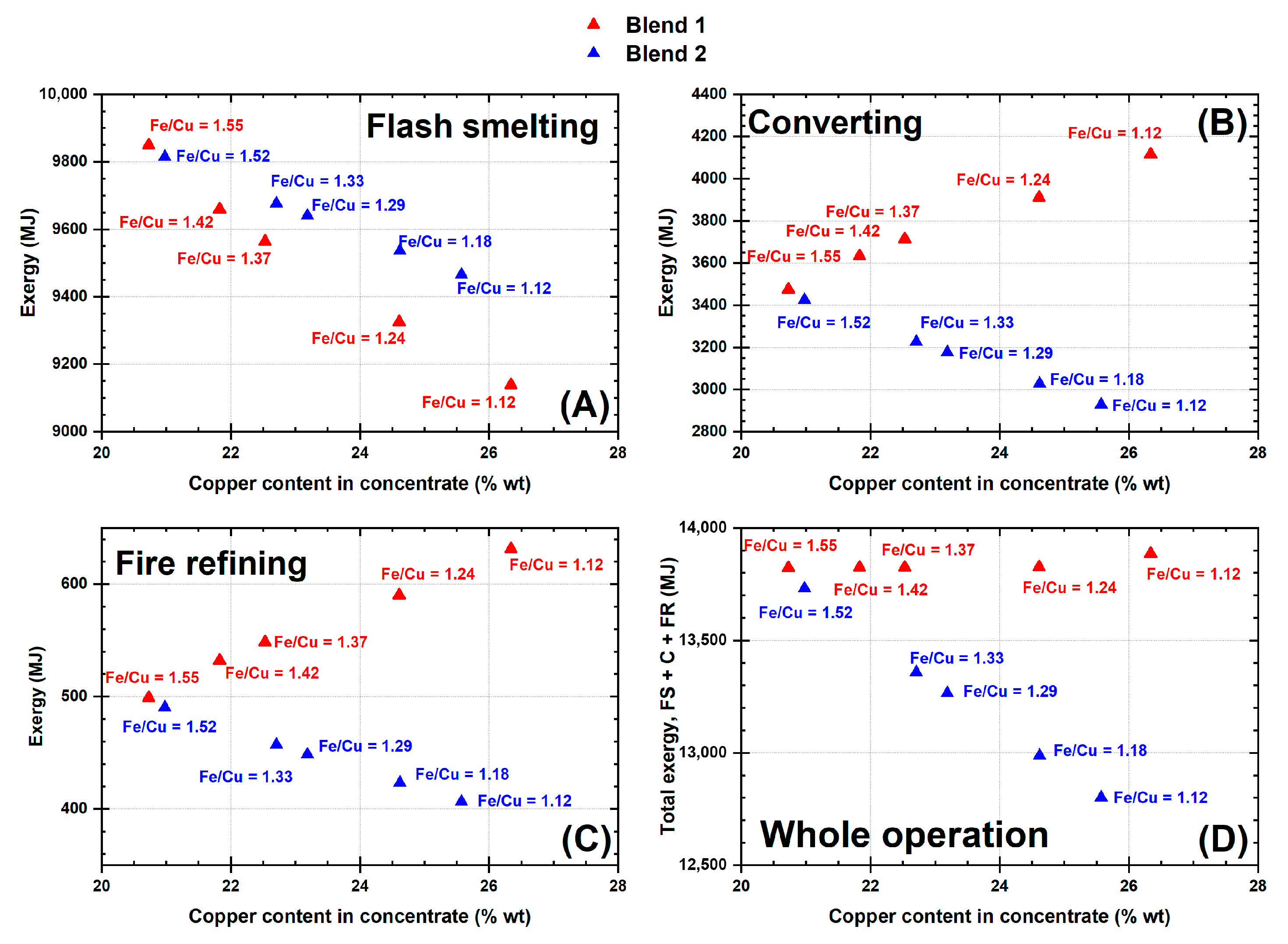
4.8. General Discussion
5. Concluding Remarks
- ◦
- Decrease the Fe/Cu mass ratio in the initial mineral feedstock. Via this, higher initial copper contents in the concentrates fed to the copper refining operations would result in the increased overall efficiency of the copper-making process.
- ◦
- Recycle copper anode scrap in the smelter rather than in the converting unit. It is customary to add scrap to the converter for temperature control purposes, not to improve energy usage efficiency. However, by adding copper scrap to the smelter, the initial iron content would dilute, enhancing the elimination of iron. It is necessary to run trials to evaluate how much scrap can be added to the smelter without making the smelting operation more expensive economically wise.
- ◦
- Use oxygen-enriched air with at least 40% Vol of oxygen enrichment. By virtue of this, the volume of off gases would be reduced while obtaining more concentrated SO2 gas to ease its capture and to decrease its footprint. Heat losses to the off gas stream should decrease as the relative amount of nitrogen would dilute.
- ◦
- Decrease the use of fuels to preheat the smelter blast as much as possible. It was shown that using additional gas to preheat the blast into the smelter is not really required. The blast can be heated directly from the heat released by the exothermic oxidation reactions taking place in the flash smelter. Additional fuel gas only adds to harmful gaseous emissions, increasing the footprint associated with copper making.
- ◦
- Recover as much energy as possible from the off gases streams. It was discussed that process gases carry significant amounts of heat. The recovery of such wasted energy would increase the energy efficiency of the copper-making operation while reducing the environmental impacts associated with copper refining.
Author Contributions
Funding
Data Availability Statement
Acknowledgments
Conflicts of Interest
Appendix A

| Species | State | A | B | C | D | Temperature Interval |
|---|---|---|---|---|---|---|
| As2S3 | s | 179.100 | −220.754 | −18.089 | 252.715 | 298–450 |
| s | 105.646 | 36.447 | 0.000 | 0.000 | 450–585 | |
| l | 185.000 | 0.000 | 0.000 | 0.000 | 585–2000 | |
| As2O3 | s | 88.052 | 72.668 | −11.414 | 0.000 | 298–585 |
| l | 152.716 | 0.000 | 0.000 | 0.000 | 585–734 | |
| As2S2 | s | 82.956 | 37.363 | 0.000 | 0.000 | 298–580 |
| l | 146.440 | 0.000 | 0.000 | 0.000 | 580–700 | |
| As4O6 | s | 70.040 | 406.685 | 0.000 | 0.000 | 298–582 |
| l | 305.432 | 0.000 | 0.000 | 0.000 | 582–670 | |
| As2O6 | ||||||
| Sb2S3 | s | 101.844 | 60.529 | −0.002 | 0.011 | 298–823 |
| l | 167.360 | 0.000 | 0.000 | 0.000 | 823–1200 | |
| Sb4O6 | s | 0.000 | 0.000 | 0.000 | 0.000 | 298–300 |
| Sb2O3 | s | 118.307 | −8.354 | −12.771 | 35.442 | 298–879 |
| s | −749.204 | 1299.103 | 1146.336 | −513.903 | 879–928 | |
| l | 180.000 | 0.000 | 0.000 | 0.000 | 928–4000 | |
| Bi2S3 | s | 109.830 | 41.003 | 0.000 | 0.000 | 298–1050 |
| l | 209.200 | 0.000 | 0.000 | 0.000 | 1050–1200 | |
| ZnS | s | 48.676 | 5.760 | −4.119 | 0.003 | 298–1293 |
| s | 49.751 | 4.488 | −4.551 | −0.005 | 1293–2100 | |
| l | 67.000 | 0.000 | 0.000 | 0.000 | 2100–3000 | |
| ZnO | s | 47.584 | 3.903 | −7.504 | 1.279 | 298–2250 |
| l | 67.000 | 0.000 | 0.000 | 0.000 | 2250–4000 | |
| PbS | s | 60.962 | −18.814 | −6.261 | 13.382 | 298–1386.5 |
| l | 67.000 | 0.000 | 0.000 | 0.000 | 1386.5–3000 | |
| PbO | s | 45.179 | 12.887 | −2.887 | −0.013 | 298–1159 |
| l | 64.998 | 0.000 | 0.000 | 0.000 | 1159–2000 | |
| FeS2 | s | 72.387 | 8.850 | −11.428 | 0.001 | 298–1500 |
| FeS | s | −273.270 | 779.182 | 81.241 | 0.000 | 298–411 |
| s | 72.358 | 0.000 | 0.000 | 0.000 | 411–598 | |
| s | 94.584 | −83.667 | 1.410 | 47.944 | 598–1465 | |
| l | 62.551 | 0.000 | 0.000 | 0.000 | 1465–3000 | |
| FeO | s | 50.278 | 3.651 | −1.941 | 8.234 | 298–600 |
| s | 30.849 | 46.228 | 11.694 | −19.278 | 600–900 | |
| s | 90.408 | −38.021 | −83.811 | 15.358 | 900–1300 | |
| s | 153.698 | −82.062 | −374.814 | 21.975 | 1300–1650 | |
| l | 68.199 | 0.000 | 0.000 | 0.000 | 1650–5000 | |
| Fe3O4 | s | 475.215 | −873.665 | −120.520 | 800.730 | 298–850 |
| s | 49.827 | 72.534 | 855.536 | 0.000 | 850–1870 | |
| l | 213.384 | 0.000 | 0.000 | 0.000 | 1870–2000 | |
| FeO*SiO2 | s | 92.592 | 42.677 | −14.100 | 0.000 | 298–1413 |
| FeAsS | s | 62.886 | 40.585 | 1.423 | 0.000 | 298–500 |
| SiO2 | s | 58.082 | −0.033 | −14.259 | 28.221 | 298–847 |
| s | 58.873 | 10.071 | 0.117 | 0.000 | 847–1079 | |
| s | 72.735 | 1.331 | −41.288 | −0.013 | 1079–1996 | |
| l | 85.772 | 0.000 | 0.000 | 0.000 | 1996–3000 | |
| Cu | s | 21.988 | 15.303 | −0.736 | −14.437 | 100–400 |
| s | 26.013 | −0.110 | −1.725 | 2.800 | 400–800 | |
| s | 44.407 | −29.417 | −23.841 | 16.090 | 800–1357.77 | |
| l | 31.400 | 0.000 | 0.000 | 0.000 | 1357.77–6000 | |
| Cu2O | s | 64.550 | 17.581 | −6.393 | −0.001 | 298–1517 |
| l | 99.900 | 0.000 | 0.000 | 0.000 | 1517–4000 | |
| Cu2S | s | 53.438 | 76.459 | −0.117 | 2.456 | 298–376 |
| s | 112.140 | −30.973 | −0.046 | 0.147 | 376–717 | |
| s | 85.019 | 0.000 | 0.000 | 0.000 | 717–1402 | |
| l | 83.680 | 0.000 | 0.000 | 0.000 | 1402–2000 | |
| CuS | s | 43.671 | 20.136 | −2.102 | −0.005 | 298–1000 |
| CuSO4 | s | 38.676 | 252.380 | −1.588 | −148.155 | 298–500 |
| s | 100.848 | 102.751 | −33.107 | −47.162 | 500–800 | |
| s | 149.213 | 11.265 | −67.612 | 0.049 | 800–2000 | |
| CuFeS2 | s | 86.985 | 53.555 | −5.607 | 0.000 | 298–830 |
| s | −1441.974 | 1844.977 | 0.000 | 0.000 | 830–930 | |
| s | 172.464 | 0.000 | 0.000 | 0.000 | 930–1200 | |
| O2 | g | 22.060 | 20.887 | 1.621 | −8.207 | 298–700 |
| g | 29.793 | 7.910 | −6.194 | −2.204 | 700–1200 | |
| g | 34.859 | 1.312 | −14.140 | 0.163 | 1200–2500 | |
| SO2 | g | 29.134 | 37.222 | 0.058 | −2.885 | 50–500 |
| g | 54.779 | 3.350 | −24.745 | −0.241 | 500–5000 |
| Reaction | [kJ] |
|---|---|
| As2S3 + 9/2 O2 = As2O3 + 3 SO2 | −1452.533 |
| As2S3 + O2 = As2S2 + SO2 | −275.241 |
| As2S3 + 9/2 O2 = 1/2 As4O6 + 3 SO2 | −1396.587 |
| Sb2S3 + 9/2 O2 = 1/2 Sb4O6 + 3 SO2 | −1296.296 |
| Sb2S3 + 9/2 O2 = Sb2O3 + 3 SO2 | −1393.968 |
| Bi2S3 + 9/2 O2 = 1/2 Bi2O6 + 3 SO2 | −1151.284 |
| ZnS + 3/2 O2 = ZnO + SO2 | −444.312 |
| PbS + 3/2 O2 = PbO + SO2 | −416.574 |
| FeS2+ O2 = FeS + SO2 | −226.984 |
| FeO + 1/6 O2 = 1/3 Fe3O4 | −104.563 |
| FeO + SiO2 = FeO*SiO2 | 23.343 |
| FeAsS + 1/2 O2 = 1/2 As2S2 + FeO | −260.834 |
| FeS + 3/2 O2 = FeO + SO2 | −462.411 |
| FeAsS + 9/4 O2 = 1/4 As4O6 + FeO + SO2 | −850.567 |
| FeAsS + 9/4 O2 = 1/2 As2O3 + FeO + SO2 | −849.480 |
| Cu + 1/4 O2 = 1/2 Cu2O | −85.300 |
| CuFeS2 + 1/2 O2 = 1/2 Cu2S + FeS + 1/2 SO2 | −99.454 |
| CuS + 1/2 O2 = 1/2 Cu2S + 1/2 SO2 | −132.154 |
| 2 CuSO4 + 3 FeS2 = Cu2S + 3 FeS + 4 SO2 | 485.538 |
| Species | [kJ/mole] | [kJ/mole] |
|---|---|---|
| As2S3 | 2713.35 | −95.46 |
| As2O3 | 412.9 | −580.71 |
| As2S2 | 2063.18 | −138.58 |
| As4O6 | ||
| As2O6 | ||
| Sb2S3 | 2523.44 | −173.75 |
| Sb4O6 | ||
| Sb2O3 | 2523.44 | −173.75 |
| Bi2S3 | 2230.31 | −140.68 |
| ZnS | 744.08 | −202.22 |
| ZnO | 20.52 | −320.71 |
| PbS | 740.69 | −98.77 |
| PbO | 45.16 | −189.24 |
| FeS2 | 1440.37 | −150.72 |
| FeS | 883.56 | −100.48 |
| FeO | 127.34 | −251.63 |
| Fe3O4 | 127.38 | −1011.53 |
| FeO*SiO2 | 277.08 | −1338.94 |
| FeAsS | 1427.63 | −50.24 |
| SiO2 | 3.13 | −854.94 |
| Cu | 134.25 | 0 |
| Cu2O | 123.53 | −146.96 |
| Cu2S | 789.3 | −86.25 |
| CuS | 692.31 | −48.99 |
| CuSO4 | 86.89 | −662.35 |
| CuFeS2 | 1534.44 | −190.9 |
| O2 | 3.97 | 0 |
| SO2 | 310.41 | −300.61 |
| Element | [kJ/mole] |
|---|---|
| Sb | 438.02 |
| As | 493.83 |
| Bi | 274.92 |
| Cu | 134.25 |
| Fe | 376.99 |
| Pb | 232.41 |
| O2 | 3.97 |
| Si | 854.10 |
| S | 607.05 |
| Zn | 339.25 |
| Concentrate | |
|---|---|
| Species | Wt% |
| CuFeS2 | 30.50 |
| CuS | 8.50 |
| Cu2S | 17.00 |
| CuO | 0.01 |
| FeS2 | 33.80 |
| FeAsS | 0.01 |
| ZnS | 1.28 |
| PbS | 0.03 |
| SiO2 | 3.57 |
| Al2O3 | 4.29 |
| As2S3 | 0.84 |
| Sb2S3 | 0.15 |
| Bi2S3 | 0.02 |
| Matte | |
| Species | Wt% |
| Cu2S | 72.34 |
| FeS | 26.80 |
| FeAsS | 0.01 |
| ZnS | 0.74 |
| PbS | 0.02 |
| Sb2S3 | 0.05 |
| Bi2S3 | 0.04 |
| Blister | |
| Species | Wt% |
| Cu | 96.00 |
| CuO | 3.00 |
| PbO | 0.10 |
| Sb2S3 | 0.14 |
| Bi2S3 | 0.13 |
| ZnS | 0.21 |
| Others | 0.42 |
| Mineral blend 1 (CuFeS2 + FeS2) | |||||||||||||||
|---|---|---|---|---|---|---|---|---|---|---|---|---|---|---|---|
| Species | Weight (kg) | Fe/Cu | Cu (%) | Weight (kg) | Fe/Cu | Cu (%) | Weight (kg) | Fe/Cu | Cu (%) | Weight (kg) | Fe/Cu | Cu (%) | Weight (kg) | Fe/Cu | Cu (%) |
| CuFeS2 | 598.0 | 1.56 | 20.42 | 630.0 | 1.45 | 21.81 | 650.0 | 1.40 | 22.50 | 710.0 | 1.24 | 24.23 | 760.0 | 1.12 | 25.94 |
| CuO | 0.1 | 0.1 | 0.1 | 0.1 | 0.1 | ||||||||||
| FeS2 | 302.0 | 270.0 | 250.0 | 190.0 | 140.0 | ||||||||||
| FeAsS | 0.1 | 0.1 | 0.1 | 0.1 | 0.1 | ||||||||||
| ZnS | 10.8 | 10.8 | 10.8 | 10.8 | 10.8 | ||||||||||
| PbS | 0.3 | 0.3 | 0.3 | 0.3 | 0.3 | ||||||||||
| SiO2 | 35.7 | 35.7 | 35.7 | 35.7 | 35.7 | ||||||||||
| Al2O3 | 42.9 | 42.9 | 42.9 | 42.9 | 42.9 | ||||||||||
| As2S3 | 8.4 | 8.4 | 8.4 | 8.4 | 8.4 | ||||||||||
| Sb2S3 | 1.5 | 1.5 | 1.5 | 1.5 | 1.5 | ||||||||||
| Bi2S3 | 0.2 | 0.2 | 0.2 | 0.2 | 0.2 | ||||||||||
| Mineral blend 2 (CuFeS2 + Cu2S +FeS2) | |||||||||||||||
| Species | Weight (kg) | Fe/Cu | Cu (%) | Weight (kg) | Fe/Cu | Cu (%) | Weight (kg) | Fe/Cu | Cu (%) | Weight (kg) | Fe/Cu | Cu (%) | Weight (kg) | Fe/Cu | Cu (%) |
| CuFeS2 | 490.0 | 1.52 | 20.87 | 390.0 | 1.33 | 22.68 | 397.0 | 1.29 | 23.13 | 376.0 | 1.18 | 24.49 | 362.0 | 1.12 | 25.40 |
| Cu2S | 50.0 | 115.0 | 118.0 | 145.0 | 163.0 | ||||||||||
| CuO | 0.1 | 0.1 | 0.1 | 0.1 | 0.1 | ||||||||||
| FeS2 | 360.0 | 395.0 | 385.0 | 379.0 | 375.0 | ||||||||||
| FeAsS | 0.1 | 0.1 | 0.1 | 0.1 | 0.1 | ||||||||||
| ZnS | 10.8 | 10.8 | 10.8 | 10.8 | 10.8 | ||||||||||
| PbS | 0.3 | 0.3 | 0.3 | 0.3 | 0.3 | ||||||||||
| SiO2 | 35.7 | 35.7 | 35.7 | 35.7 | 35.7 | ||||||||||
| Al2O3 | 42.9 | 42.9 | 42.9 | 42.9 | 42.9 | ||||||||||
| As2S3 | 8.4 | 8.4 | 8.4 | 8.4 | 8.4 | ||||||||||
| Sb2S3 | 1.5 | 1.5 | 1.5 | 1.5 | 1.5 | ||||||||||
| Bi2S3 | 0.2 | 0.2 | 0.2 | 0.2 | 0.2 | ||||||||||
References
- Elshkaki, A.; Graedel, T.E.; Ciacci, L.; Reck, B.K. Copper Demand, Supply, and Associated Energy Use to 2050. Glob. Environ. Change 2016, 39, 305–315. [Google Scholar] [CrossRef]
- Hunt, C.; Romero, J.; Jara, J.; Lagos, G. Copper Demand Forecasts and Predictions of Future Scarcity. Resour. Policy 2021, 73, 102123. [Google Scholar] [CrossRef]
- He, R.; Small, M.J. Forecast of the U.S. Copper Demand: A Framework Based on Scenario Analysis and Stock Dynamics. Environ. Sci. Technol. 2022, 56, 2709–2717. [Google Scholar] [CrossRef]
- Norgate, T.; Jahanshahi, S. Low Grade Ores—Smelt, Leach or Concentrate? Miner. Eng. 2010, 23, 65–73. [Google Scholar] [CrossRef]
- Alexander, C.; Johto, H.; Lindgren, M.; Pesonen, L.; Roine, A. Comparison of Environmental Performance of Modern Copper Smelting Technologies. Clean. Environ. Syst. 2021, 3, 100052. [Google Scholar] [CrossRef]
- Davenport, W.G.; Biswas, A.K.; King, M.; Schlesinger, M. Extractive Metallurgy of Copper; Elsevier: Amsterdam, The Netherlands, 2002; ISBN 978-0-08-044029-3. [Google Scholar]
- Moskalyk, R.R.; Alfantazi, A.M. Review of Copper Pyrometallurgical Practice: Today and Tomorrow. Miner. Eng. 2003, 16, 893–919. [Google Scholar] [CrossRef]
- Coursol, P.; Mackey, P.J.; Kapusta, J.P.T.; Valencia, N.C. Energy Consumption in Copper Smelting: A New Asian Horse in the Race. JOM 2015, 67, 1066–1074. [Google Scholar] [CrossRef]
- Abadías Llamas, A.; Valero Delgado, A.; Valero Capilla, A.; Torres Cuadra, C.; Hultgren, M.; Peltomäki, M.; Roine, A.; Stelter, M.; Reuter, M.A. Simulation-Based Exergy, Thermo-Economic and Environmental Footprint Analysis of Primary Copper Production. Miner. Eng. 2019, 131, 51–65. [Google Scholar] [CrossRef]
- Drielsma, J.A.; Russell-Vaccari, A.J.; Drnek, T.; Brady, T.; Weihed, P.; Mistry, M.; Simbor, L.P. Mineral Resources in Life Cycle Impact Assessment—Defining the Path Forward. Int. J. Life Cycle Assess 2016, 21, 85–105. [Google Scholar] [CrossRef]
- Ignatenko, O.; Van Schaik, A.; Reuter, M.A. Exergy as a Tool for Evaluation of the Resource Efficiency of Recycling Systems. Miner. Eng. 2007, 20, 862–874. [Google Scholar] [CrossRef]
- Alvarado, S. Long Term Energy-Related Environmental Issues of Copper Production. Energy 2002, 27, 183–196. [Google Scholar] [CrossRef]
- Barati, M.; Esfahani, S.; Utigard, T.A. Energy Recovery from High Temperature Slags. Energy 2011, 36, 5440–5449. [Google Scholar] [CrossRef]
- Alvarado, S.; Iribarne, J. Minimum Energy Requirements in Industrial Processes: An Application of Exergy Analysis. Energy 1990, 15, 1023–1028. [Google Scholar] [CrossRef]
- Díaz-Damacillo, L.; Reyes, F.; Ingalls, A.; Méndez, C.; Plascencia, G. Mass Transfer Model for the De-Oxidation of Molten Copper. JOM 2017, 69, 980–986. [Google Scholar] [CrossRef]
- Kapusta, J.P.T. JOM World Nonferrous Smelters Survey, Part I: Copper. JOM 2004, 56, 21–27. [Google Scholar] [CrossRef]
- Kapusta, J.P.T.; Watt, L. The 2019 Copper Smelting Survey; Canadian Institute of Mining, Metallurgy and Petroleum: Westmount, QC, Canada, 2019. [Google Scholar]
- Klaasen, B.; Jones, P.-T.; Durinck, D.; Dewulf, J.; Wollants, P.; Blanpain, B. Exergy-Based Efficiency Analysis of Pyrometallurgical Processes. Metall. Mater. Trans. B 2010, 41, 1205–1219. [Google Scholar] [CrossRef]
- Morris, D.R.; Steward, F.R.; Szargut, J. Technological Assessment of Chemical Metallurgical Processes. Can. Metall. Q. 1994, 33, 289–295. [Google Scholar] [CrossRef]
- Morris, D.R.; Szargut, J. Standard Chemical Exergy of Some Elements and Compounds on the Planet Earth. Energy 1986, 11, 733–755. [Google Scholar] [CrossRef]
- Morris, D.R.; Steward, F.R. Exergy Analysis of a Chemical Metallurgical Process. Metall. Trans. B 1984, 15, 645–654. [Google Scholar] [CrossRef]
- Kotas, T.J. The Exergy Method of Thermal Plant Analysis, POD ed.; Exergon Publ. Company: London, UK, 2012; ISBN 978-1-908341-89-1. [Google Scholar]
- Roine, A. HSC Chemistry 10; Outokumpu Research Oy: Helsinki, Finland, 2006. [Google Scholar]
- Pineda, J.A.; Plascencia, G. Exergy in Copper Converting and Its Relation to SO2 Emissions. J. Sustain. Metall. 2016, 2, 265–272. [Google Scholar] [CrossRef]
- Szargut, J. Chemical Exergies of the Elements. Appl. Energy 1989, 32, 269–286. [Google Scholar] [CrossRef]
- Newman, C.J.; Collins, D.N.; Weddick, A.J. Recent Operation and Environmental Control in the Kennecott Smelter; The Minerals, Metals and Materials Society: Warrendale, PA, USA, 1999. [Google Scholar]
- Queneau, P.E. Oxygen Technology and Conservation. Metall. Trans. B 1977, 8, 357–369. [Google Scholar] [CrossRef]
- Queneau, P.E. Coppermaking in the Eighties—Productivity in Metal Extraction from Sulfide Concentrates. JOM 1981, 33, 38–46. [Google Scholar] [CrossRef]
- Rankin, W.J. Sustainability—The Role of Mineral Processing and Extractive Metallurgy. Miner. Process. Extr. Metall. 2017, 126, 3–10. [Google Scholar] [CrossRef]
- Liu, L.; Xiang, D.; Cao, H.; Li, P. Life Cycle Energy Consumption and GHG Emissions of the Copper Production in China and the Influence of Main Factors on the above Performance. Processes 2022, 10, 2715. [Google Scholar] [CrossRef]
- Hong, J.; Chen, Y.; Liu, J.; Ma, X.; Qi, C.; Ye, L. Life Cycle Assessment of Copper Production: A Case Study in China. Int. J. Life Cycle Assess 2018, 23, 1814–1824. [Google Scholar] [CrossRef]
- Norgate, T.E.; Jahanshahi, S.; Rankin, W.J. Assessing the Environmental Impact of Metal Production Processes. J. Clean. Prod. 2007, 15, 838–848. [Google Scholar] [CrossRef]
- Norgate, T.; Haque, N. Energy and Greenhouse Gas Impacts of Mining and Mineral Processing Operations. J. Clean. Prod. 2010, 18, 266–274. [Google Scholar] [CrossRef]




| Mineral Species | wt % | wt % | wt % | wt %o | wt % |
|---|---|---|---|---|---|
| Blend 1: CuFeS2 + FeS2 | |||||
| B11 | B12 | B13 | B14 | B15 | |
| CuFeS2 | 59.8 | 63.0 | 65.0 | 71.0 | 76.0 |
| CuO | 0.01 | 0.01 | 0.01 | 0.01 | 0.01 |
| FeS2 | 30.2 | 27.0 | 25.0 | 19.0 | 14.0 |
| FeAsS | 0.01 | 0.01 | 0.01 | 0.01 | 0.01 |
| ZnS | 1.08 | 1.08 | 1.08 | 1.08 | 1.08 |
| PbS | 0.03 | 0.03 | 0.03 | 0.03 | 0.03 |
| SiO2 | 3.57 | 3.57 | 3.57 | 3.57 | 3.57 |
| Al2O3 | 4.29 | 4.29 | 4.29 | 4.29 | 4.29 |
| As2S3 | 0.84 | 0.84 | 0.84 | 0.84 | 0.84 |
| Sb2S3 | 0.15 | 0.15 | 0.15 | 0.15 | 0.15 |
| Bi2S3 | 0.02 | 0.02 | 0.02 | 0.02 | 0.02 |
| Fe/Cu | 1.55 | 1.42 | 1.37 | 1.24 | 1.12 |
| Blend 2: CuFeS2 + FeS2 + Cu2S | |||||
| B21 | B22 | B23 | B24 | B25 | |
| CuFeS2 | 49.0 | 39.0 | 39.7 | 37.6 | 36.2 |
| Cu2S | 5.0 | 11.5 | 11.8 | 14.5 | 16.3 |
| CuO | 0.01 | 0.01 | 0.01 | 0.01 | 0.01 |
| FeS2 | 36.0 | 39.5 | 38.5 | 37.9 | 37.5 |
| FeAsS | 0.01 | 0.01 | 0.01 | 0.01 | 0.01 |
| ZnS | 1.08 | 1.08 | 1.08 | 1.08 | 1.08 |
| PbS | 0.03 | 0.03 | 0.03 | 0.03 | 0.03 |
| SiO2 | 3.57 | 3.57 | 3.57 | 3.57 | 3.57 |
| Al2O3 | 4.29 | 4.29 | 4.29 | 4.29 | 4.29 |
| As2S3 | 0.84 | 0.84 | 0.84 | 0.84 | 0.84 |
| Sb2S3 | 0.15 | 0.15 | 0.15 | 0.15 | 0.15 |
| Bi2S3 | 0.02 | 0.02 | 0.02 | 0.02 | 0.02 |
| Fe/Cu | 1.52 | 1.33 | 1.29 | 1.18 | 1.11 |
| MASS BALANCE [kg] | |||||||
|---|---|---|---|---|---|---|---|
| INPUT [kg] | OUTPUT [kg] | ||||||
| Concentrate Silica flux Air Oxygen (excess) | 1000.00 48.00 1053.91 316.30 | Matte (grade 63) Slag Off gases Mass lost due to handling | 449.08 310.46 1350.46 308.21 | ||||
| TOTAL | 2418.21 | TOTAL | 2418.21 | ||||
| ENERGY BALANCE [MJ] | |||||||
| INPUT [MJ] | OUTPUT [MJ] | ||||||
| Concentrate Air + Oxygen Heat of reaction | 751.23 1002.29 2893.76 | Matte (grade 63) Slag Off gases Heat loses | 319.69 630.57 1765.07 1932.52 | ||||
| TOTAL | 4647.28 | TOTAL | 4647.85 | ||||
| EXERGY BALANCE [MJ] | |||||||
| INPUT [MJ] | OUTPUT [MJ] | ||||||
| Physical | Chemical | Total | Physical | Chemical | Total | ||
| Concentrate Air + Oxygen | 680.22 1200.00 | 7371.76 97.00 | 8051.98 1297.00 | Matte (grade 63) Slag Off gases | 193.17 161.62 947.60 | 2459.57 538.54 2653.34 | 2652.74 700.16 3600.94 |
| TOTAL | 9348.98 | TOTAL | 6953.84 | ||||
| MASS BALANCE [kg] | |||||||
|---|---|---|---|---|---|---|---|
| INPUT [kg] | OUTPUT [kg] | ||||||
| Matte Silica flux Air Oxygen (excess) | 449.08 40.89 328.63 75.58 | Blister Slag Off gases Mass lost due to handling | 154.80 178.59 323.00 237.79 | ||||
| TOTAL | 894.18 | TOTAL | 894.18 | ||||
| ENERGY BALANCE [MJ] | |||||||
| INPUT [MJ] | OUTPUT [MJ] | ||||||
| Matte Silica flux Air + Oxygen Heat of reaction | 319.69 59.49 623.80 1169.89 | Blister Slag Off gases Heat loses | 109.81 199.20 1065.20 798.66 | ||||
| TOTAL | 2172.87 | TOTAL | 2172.87 | ||||
| EXERGY BALANCE [MJ] | |||||||
| INPUT [MJ] | OUTPUT [MJ] | ||||||
| Physical | Chemical | Total | Physical | Chemical | Total | ||
| Matte Silica flux Air + O2 | 680.22 37.66 1000.00 | 2471.40 469.00 97.00 | 3151.62 506.66 1097.00 | Blister Slag Off gases | 84.27 123.37 947.60 | 362.21 195.32 852.43 | 446.48 318.69 1800.03 |
| TOTAL | 4755.28 | TOTAL | 2565.20 | ||||
| MASS BALANCE [kg] | |||||||
|---|---|---|---|---|---|---|---|
| INPUT [kg] | OUTPUT [kg] | ||||||
| Blister Natural gas Air | 153.30 0.23 5.41 | Anode copper Slag Off gases Mass lost due to handling | 143.14 2.21 7.92 5.67 | ||||
| TOTAL | 158.94 | TOTAL | 158.94 | ||||
| ENERGY BALANCE [MJ] | |||||||
| INPUT [MJ] | OUTPUT [MJ] | ||||||
| Blister Natural gas + air Heat of reaction | 109.81 5.00 49.75 | Anode copper Slag Off gases Heat loses | 62.43 1.30 8.39 92.44 | ||||
| TOTAL | 164.56 | TOTAL | 164.56 | ||||
| EXERGY BALANCE [MJ] | |||||||
| INPUT [MJ] | OUTPUT [MJ] | ||||||
| Physical | Chemical | Total | Physical | Chemical | Total | ||
| Blister Natural gas + Air | 84.27 30.00 | 362.21 50.00 | 446.48 80.00 | Anode copper Slag Off gases | 32.13 0.81 5.17 | 302.24 1.48 18.02 | 334.37 2.29 23.19 |
| TOTAL | 526.48 | TOTAL | 359.85 | ||||
Disclaimer/Publisher’s Note: The statements, opinions and data contained in all publications are solely those of the individual author(s) and contributor(s) and not of MDPI and/or the editor(s). MDPI and/or the editor(s) disclaim responsibility for any injury to people or property resulting from any ideas, methods, instructions or products referred to in the content. |
© 2025 by the authors. Licensee MDPI, Basel, Switzerland. This article is an open access article distributed under the terms and conditions of the Creative Commons Attribution (CC BY) license (https://creativecommons.org/licenses/by/4.0/).
Share and Cite
Ruiz-Ruiz, D.M.; Ramírez-Ramírez, L.J.; Almaraz-Gómez, A.; Bautista-Aguilar, A.H.; Chacón-Nava, J.G.; Plascencia, G. Improving the Efficiencies of Copper Pyrometallurgy Through Exergy Assessment. Thermo 2025, 5, 58. https://doi.org/10.3390/thermo5040058
Ruiz-Ruiz DM, Ramírez-Ramírez LJ, Almaraz-Gómez A, Bautista-Aguilar AH, Chacón-Nava JG, Plascencia G. Improving the Efficiencies of Copper Pyrometallurgy Through Exergy Assessment. Thermo. 2025; 5(4):58. https://doi.org/10.3390/thermo5040058
Chicago/Turabian StyleRuiz-Ruiz, Diana Marel, Luis Jesús Ramírez-Ramírez, Aarón Almaraz-Gómez, Ayrton Homero Bautista-Aguilar, José Guadalupe Chacón-Nava, and Gabriel Plascencia. 2025. "Improving the Efficiencies of Copper Pyrometallurgy Through Exergy Assessment" Thermo 5, no. 4: 58. https://doi.org/10.3390/thermo5040058
APA StyleRuiz-Ruiz, D. M., Ramírez-Ramírez, L. J., Almaraz-Gómez, A., Bautista-Aguilar, A. H., Chacón-Nava, J. G., & Plascencia, G. (2025). Improving the Efficiencies of Copper Pyrometallurgy Through Exergy Assessment. Thermo, 5(4), 58. https://doi.org/10.3390/thermo5040058