1. Introduction
Over the last decade, the use of conducting polymers (CPs) has strongly emerged as a valid tool for designing a new generation of functional platforms aimed at improving the interface with biological systems [
1]. Indeed, CPs uniquely combine electrical conductivity and biocompatibility, contributing to the development of efficient communication and interaction interfaces between living tissues and synthetic scaffolds, medical devices, or implants [
2].
To date, electronic materials from inorganic sources, such as gold (Au), platinum (Pt), and silicon (Si), have been demonstrated as capable of being readily manufactured as two-dimensional (2D) platforms (e.g., plates, electrodes). These materials typically exhibit rigid mechanical behavior that limits their ability to properly transfer biochemical/mechanical signals to cells [
3]. Moreover, electrical conductivity in inorganic materials is supported by the flow of free electrons, which behave differently at the tissue interface compared to biological tissues [
4]. Conversely, living tissues inherently rely on ion transport-driven mechanisms that activate electrochemical processes and signal propagation, which are necessary for accurate recording of biological signals and physiological function due to their highly complex organization [
5].
In this context, CPs are a specific class of polymers that are not intrinsic electrical insulators but exhibit surprising electrical properties without compromising other unique features, such as mechanical stiffness, flexibility and processability [
6,
7]. Compared to other organic materials, CPs uniquely conduct both ions and electrons, depending on the synthesis conditions employed. Moreover, depending on electrolytic conditions, applied electrical forces and chemical structural properties, CPs can undergo reversible doping/de-doping processes, which significantly modulate their conductive state and strongly influence the biological response at the interface with in vitro cells and living tissues [
8].
A major advantage of CPs also concerns the opportunity of processing them in combination with other polymers endowed with peculiar properties (i.e., electric, piezoelectric, etc.), enabling the fabrication of multifunctional, electrically conductive platforms that can act as transducers [
9]. Consequently, several studies have shown that the structural and morphological properties of CP-based scaffolds—i.e., porosity at different scales, anisotropy, transport properties, mechanical response—are not compromised by the addition of CPs compared to monocomponent polymeric systems devoid of conductive phases [
10,
11]. Moreover, a mixture of CPs with synthetic polymers with hydrogel-like behavior can offer an intriguing solution for the fabrication of multiphase biomaterials combining water-absorption capability, soft mechanical properties and in vitro biocompatibility with electrical conductivity. Such systems can satisfy multiple functional requirements in the biomedical field, ranging from disease monitoring to tissue repair and/or regeneration.
Hence, this work proposes the fabrication of composite nanofibers by the electrospinning of polyvinyl alcohol (PVA) blended with synthesized polyaniline (PANI). Previous studies on PVA electrospun fibers loaded with inorganic conductive materials, like graphene or MXenes, have recently led to the development of nanostructured platforms with improved mechanical properties and electrical conductivity [
12,
13]. However, some chemical features, such as the hydrophobic nature of inorganic phases, often hinder homogeneous dispersion of charged phases in aqueous polymer solutions, negatively affecting biocompatibility [
14]. As an alternative, PVA nanofibers have been processed by integrating different CPs to improve electroconductive properties, including poly(3,4-ethylenedioxythiophene):poly(styrene sulphonate) (PEDOT:PSS) [
15] or polypyrrole (PPy) [
16,
17], but show adverse responses in terms of biocompatibility. More recently, PVA electrospun fibers loaded with PANI have also been proposed by using a conductive/non-conductive polymer phase ratio close to 1:1. However, this strategy has been demonstrated to be unsuitable for biomedical applications, being preferentially addressed to the fabrication of humidity sensors [
18] or smart devices for other applications [
19].
To overcome these limitations, this work proposes a significant reduction in the relative amount of conductive phases by selecting PANI in two different forms: (a) doped emeraldine base (dPANI-EB) and (b) short PANI nanofibers (dPANI-NFs) synthesized via a rapid mixing method. Synthesis conditions and material characterization (i.e., structural, morphological and electrical properties) were optimized to ensure the fabrication of nano-fibrous composite scaffolds suitable for biomedical use. Furthermore, preliminary in vitro studies were performed on a human neuroblastoma cell line (SH-SY5Y) to validate the biocompatibility of dPANI-EB-and dPANI-NFs embedded into PVA nanofibers within an in vitro brain-like microenvironment.
2. Materials and Methods
2.1. Materials
Polyaniline (emeraldine base, PANI-EB, Mw ≈ 10,000 g/mol), aniline, ammonium persulphate (APS, ≥98.0%), hydrochloric acid (HCl, 37% w/w), chloroauric acid (HAuCl4), camphor sulphonic acid (CSA, ≥98.0%), ammonium hydroxide (NH4OH, 30%), dimethylformamide (DMF, ≥98.5%), polyvinyl alcohol (PVA, Mw ≈ 85,000–124,000 g/mol, medium viscosity, fully hydrolyzed), and citric acid (CA, ≥99.5%) were purchased from Sigma-Aldrich (Milan, Italy) and used as received.
2.2. Nanocomposites Preparation
2.2.1. PANI-NF Synthesis
PANI nanofibers (PANI-NFs) were synthesized according to our previous work [
20]. Briefly, 600 µL of aniline monomer and 360 mg of APS were dissolved in two distinct 20 mL HCl (1 M) solutions. These solutions were then poured rapidly into a 50 mL glass beaker and left to react for 2 h without stirring. The synthesized PANI was dispersed in a 40 mL NH
4OH (0.1 M) solution for 30 min to promote the de-doping of fibers (with a solution color change to blue). The obtained solution was filtered, washed with deionized water, and dried under vacuum in an oven at 100 °C overnight.
2.2.2. Preparation of PANI Solutions
Two different CSA-doped PANI forms were prepared—i.e., dPANI-EB and dPANI-NF—starting from commercial PANI-EB and synthesized PANI-NFs, respectively. The general procedure [
21] consisted of dispersing 100 mg of PANI (PANI-EB or PANI-NFs) in 10.5 mL of DMF containing 160 mg of CSA under a magnetic stirrer at 40 °C overnight. In the case of dPANI-NFs, an ultrasonication step was performed for 3 h (sonication amplitude: 75; power: 40 W) at room temperature.
2.2.3. PVA/PANI Nanocomposites Preparation
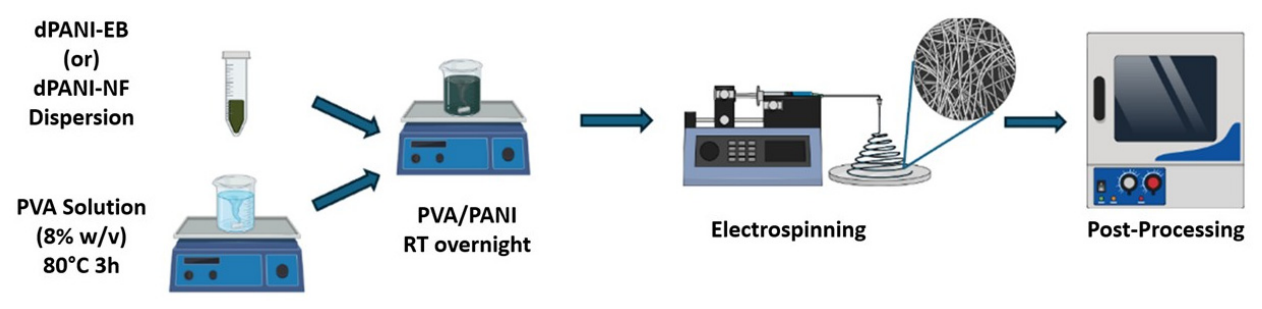
Electrospun nanofibrous scaffolds were fabricated using a blend of PVA with dPANI-EB or dPANI-NF dispersions as reported in
Figure 1. Briefly, 1 mL of the homogeneous PANI dispersion obtained after the ultrasonication step was rapidly added to 9 mL of a hot aqueous solution of PVA (8%
w/
v) under constant stirring until a homogeneous dispersion was obtained. Performing this step immediately after ultrasonication of the PANI dispersion ensures the stability of nanoparticles, limiting aggregate formation within the PVA fibers. Then, CA (0.5%
w/
v) was incorporated into the mixture as a crosslinking agent [
22] to enhance the water resistance and structural stability of the resulting fibers via esterification reactions occurring during a subsequent thermal post-treatment step.
Electrospinning was carried out under the following conditions: a voltage of 21 kV, a flow rate of 1.0 mL/h, and a needle-to-collector distance of 240 mm. To promote crosslinking between PVA and CA, the electrospun fibers were subjected to a thermal treatment at 150 °C for 15 min. A summary of sample types prepared is reported in
Table 1.
2.3. Characterization
2.3.1. Morphological Characterization
The morphology and fiber size distribution of the electrospun scaffolds were examined using a field-emission scanning electron microscope (FE-SEM, QuantaFEG 200, FEI, Eindhoven, The Netherlands) operating at an accelerating voltage of 10 kV. Before imaging, samples were coated with a thin Pd–Au layer (≈15–20 nm thick) using a sputtering system operating at 20 kV for 30 s to enhance surface conductivity. Quantitative analysis of mean fiber diameters and structural irregularities was performed using ImageJ software (ImageJ 1.8, NIH, Bethesda, MD, USA).
2.3.2. Physical/Chemical Characterization
Attenuated-Total Reflectance–Fourier Transform Infrared (ATR-FTIR) spectroscopy was used for the structural analysis of the electrospun PVA samples. ATR-FTIR spectra were acquired using a Perkin Elmer Spectrum 100 (Milan, Italy) in the range of 4000–400 cm−1 with a resolution of 4 cm−1 and 32 scans.
The hydrophilicity of the electrospun nanofibers was evaluated by water contact angle (WCA) measurements using a video camera equipped measurement system (OCA20, Dataphysics, Bergamo, Italy). Five measurements were performed for each sample using a single water droplet (volume: 5 µL). All measurements were performed at time zero to eliminate the influence of perfusion flow through the membrane. Contact angle data were reported as mean value ± standard deviation.
2.3.3. Electrical Conductivity Measurements
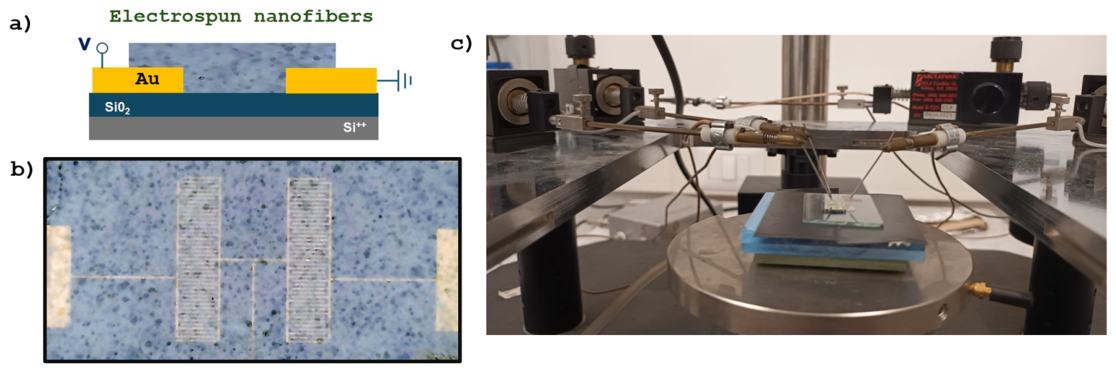
Electrical measurements were performed in air using a two-probe configuration. PVA/dPANI-EB and PVA/dPANI-NF films (thickness ≈ 1 µm) were deposited on silicon/silicon dioxide (Si/SiO
2) substrates equipped with gold electrodes having an interdigitated geometry (
Figure 2a,b). For all samples, the channel width (W) to length (L) ratio was set to 550 [
23,
24]. To reliably assess their electrical properties, samples were mounted in a Signatone probe station, where micro-manipulators equipped with metallic tips were carefully used to electrically contact the active channels (
Figure 2c). The probe station terminals were then connected to a Keithley 2612A dual channel source-meter, and current–voltage (I–V) curves were recorded by varying the applied voltage from 0 to +30 V and then backward. A voltage step of 200 mV was applied, corresponding to a final scan rate of 1 V/s. The background current noise level of the experimental set-up was approximately 0.1 nA at a maximum applied voltage of 30 V. Hence, the minimum measurable conductivity value for the samples considered was approximately 710
−11 S/cm. All samples investigated in this study exhibited conductivity above this threshold.
2.3.4. In Vitro Studies
Cell Lines and Chemicals
The immortalized human neuroblastoma cell line (SH-SY5Y, HTB-11, cat. no. CRL2266™) was obtained from ATCC® (Manassas, VA, USA). Dulbecco’s Modified Eagle GlutaMAX™ Medium, phenol red-free Dulbecco’s Modified Eagle Medium (low glucose), fetal bovine serum (FBS), L-glutamine (L-Glu, 200 mM), antibiotic/antimycotic solution (10,000 U Penicillin and 10 mg Streptomycin per mL, 100×), non-essential amino acids solution (NEAA, 50×), trypsin-EDTA solution (0.25% w/v), phosphate-buffered saline (PBS), and absolute ethanol (EtOH, BioUltra, for molecular biology, ≥99.8%,) were from Sigma (Milan, Italy). Alamar Blue® was from Bio-Rad Laboratories S.r.l. (Milan, Italy). Ultrapure water (dH2O, ρ > 18.2 MΩ·cm at 25 °C) was used for all experiments.
SH-SY5Y Culture Maintenance
SH-SY5Y cells were adopted as an in vitro model for evaluating the cytocompatibility of PVA/dPANI-EB and PVA/dPANI-NFs. SH-SY5Y cells were grown in DMEM-glutamax medium supplemented with 10% (v/v) FBS, 2 mM L-Glu, 1% (v/v) antibiotic/antimycotic solution, and 1% (v/v) NEAA and incubated at 37 °C in a humidified atmosphere containing 5% CO2 and 95% air for three weeks. The cell medium was replaced every 2–3 days. SH-SY5Y cells between passages five and six were used for the in vitro studies.
SH-SY5Y Culture Maintenance
Biocompatibility of PVA-Based Electrospun Nanofibers
Prior to cell seeding, PVA-based electrospun nanofibers were sterilized by incubation in 70% (
v/
v) EtOH supplemented with 10% (
v/
v) penicillin/streptomycin solution in dH
2O for 2 h under ultraviolet (UV) irradiation. Subsequently, the nanofibers were washed with 10 mM PBS, to remove excess EtOH, and left to dry under a laminar flow hood. The biocompatibility of PVA-based films was evaluated by direct contact assay according to ISO 10993-5:2009 [
25]. Upon reaching confluence, cells were detached using 0.25% (
w/
v) trypsin-EDTA, and a cell suspension (1·10
4 cells/well) was seeded onto the PVA, PVA/dPANI-EB and PVA/dPANI-NFs. SH-SY5Y cells grown on tissue culture polystyrene plates were used as the control. Cytocompatibility was assessed using the Alamar Blue
® (AB) assay for up to 14 days. At each time point, AB reagent (10% (
v/
v)) was prepared in phenol red-free DMEM, added to each cell-seeded sample, and incubated at 37 °C and 5% CO
2. After 4 h of incubation, 100 µL of AB-containing medium was transferred to a 96-well plate, and the absorbance at 570 and 600 nm was recorded with a microplate spectrophotometer (VICTOR X3, 156 PerkinElmer, Milan, Italy). Data were collected from three independent experiments performed in triplicate and are expressed as means ± standard error mean (S.E.M.) with respect to the control (PVA = 100%).
3. Results
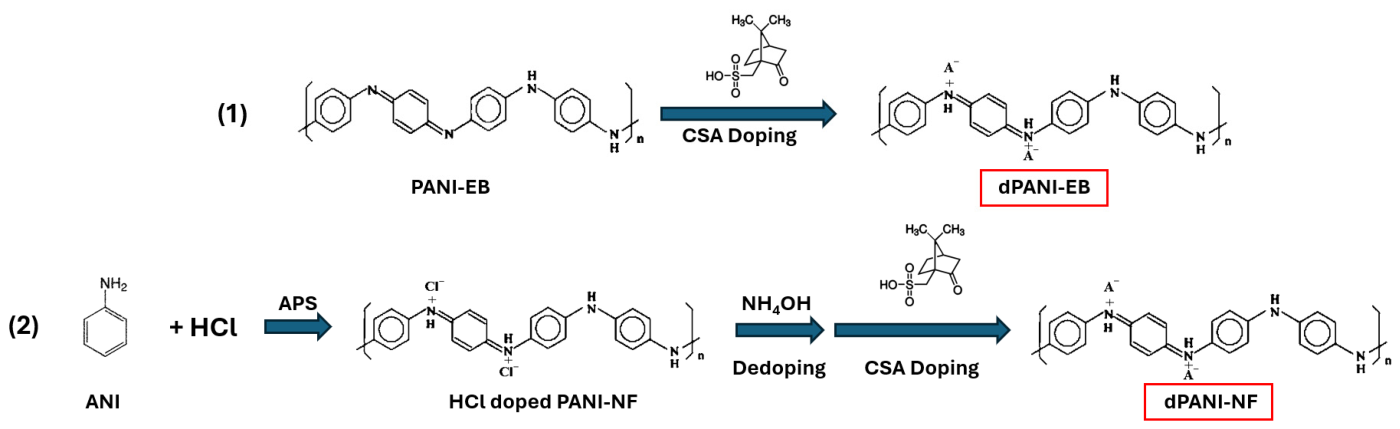
Two different CSA-doped PANI typologies were used to fabricate the PVA/PANI nanocomposite fibers. The employed synthetic routes are schematized in
Figure 3. From a chemical point of view, the PANI typologies are equivalent, while the main difference lies in their morphology, which is globular in the dPANI-EB system and nanofibrillar in dPANI-NFs (synthesized as in our previous work [
15]). Therefore, the study carried out on the electrospun PVA/dPANI nanocomposites allows us to understand the effect of different conductive phase morphologies on the electrical and cytotoxic behavior of the PVA matrix.
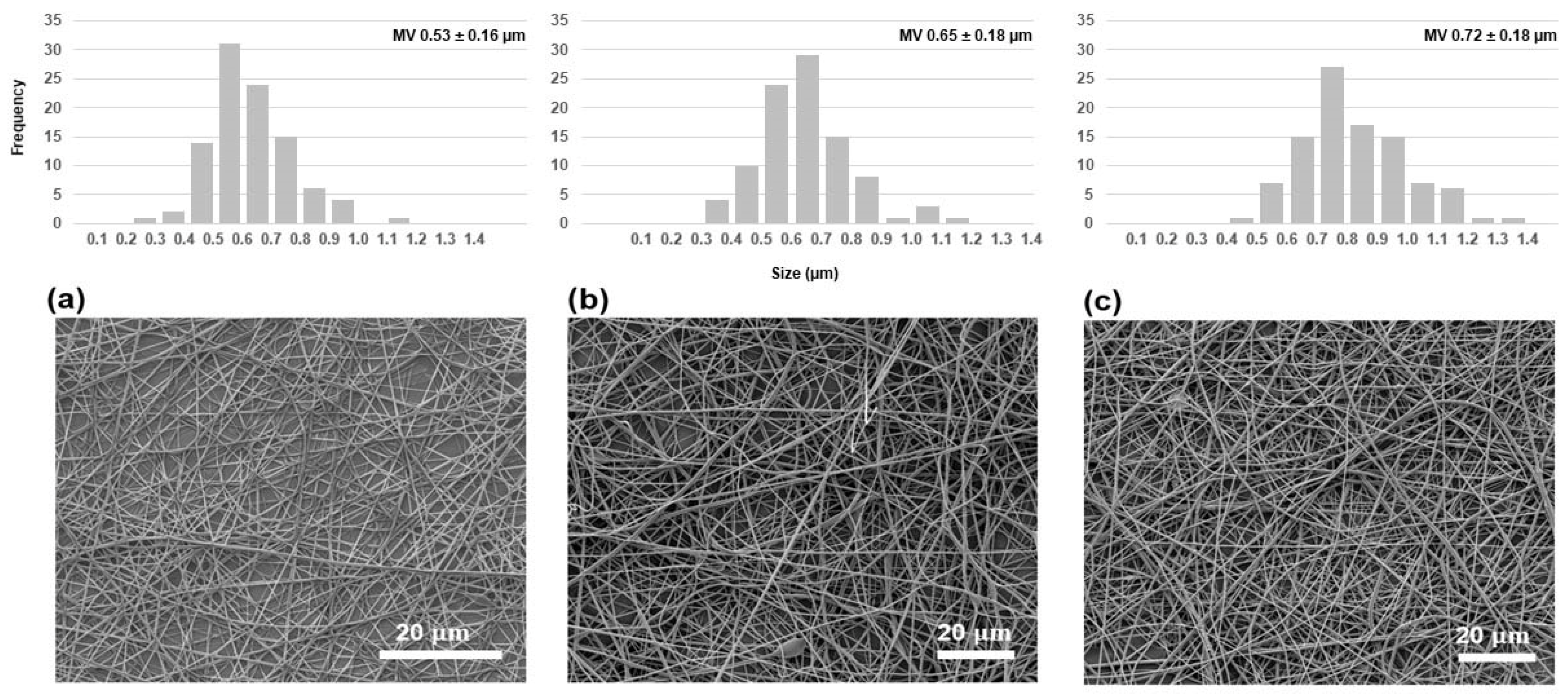
SEM image analysis showed a slight variation in the average fiber diameters associated with the presence of PANI within the PVA matrix (
Figure 4). Neat PVA fibers exhibited an average diameter of 0.53 ± 0.16 µm. The incorporation of dPANI-NFs and dPANI-EB induced an increase in the average diameter to 0.72 ± 0.18 µm and 0.65 ± 0.18 µm, respectively. These findings suggest that the most pronounced variation is observable in the case of dPANI-NF incorporation, probably due to their different shape. Despite the differences in diameter, all electrospun nanofibers displayed a uniform morphology without the evident formation of beads or defects.
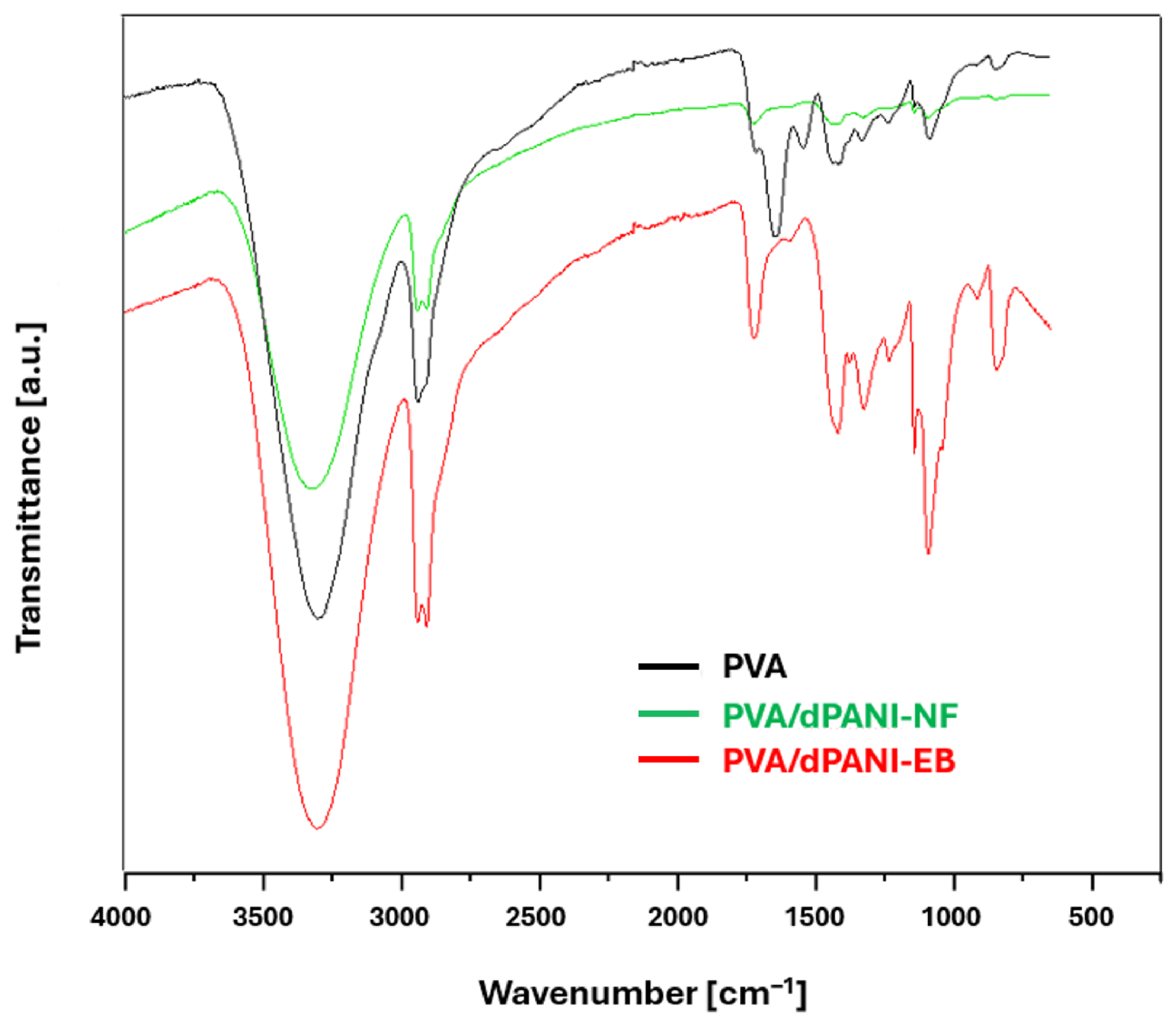
ATR-FTIR spectra of PVA-based electrospun nanofibers are reported in
Figure 5. The PVA spectrum (black curve) shows characteristic absorption bands in the range 3550–3200 cm
−1, attributed to -OH stretching vibrations involved in hydrogen bonds, at 2980 and 2800 cm
−1 corresponding to -C–H stretching, and at 1710 cm
−1 related to -C=O stretching of aliphatic ester groups in CA-crosslinking bonds. PVA nanocomposite spectra exhibit nearly identical characteristic absorption bands, with slight shifts, indicating a successful integration of PANI phases, especially for the dPANI-EB ones (red curve).
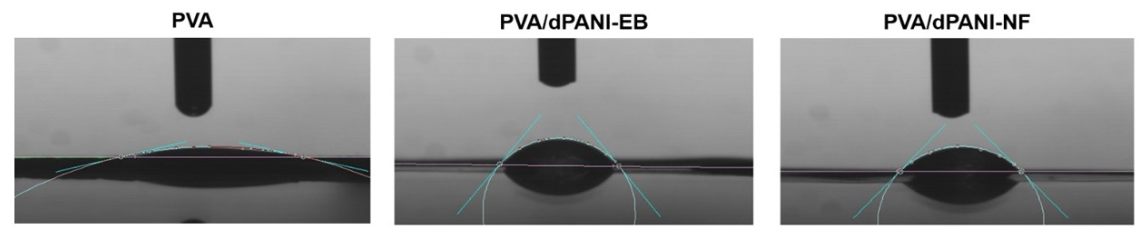
The hydrophilic properties of the electrospun nanofibers were evaluated by wettability measurements. The representative images are shown in
Figure 6. Neat PVA nanofibers exhibited a water contact angle of 15.3 ± 1.0°, confirming their high hydrophilicity which lead to a rapid absorption of the dispensed water droplet into the fibrous networks. The hydrophilic character was retained in the PVA nanocomposites, although an increase in the static water contact angle was observed. Specifically, static contact angle values of 49.5 ± 1.0° and 44.2 ± 1.0° were measured for PVA/dPANI-EB and PVA/dPANI-NF nanofibers, respectively, with slightly higher values attributable to the greater tendency of dPANI-EB to be exposed on the fiber surface.
Electrical properties of all samples considered in this work were tested in air by performing two-probe IV measurements on pure PVA, PVA/dPANI-EB and PVA/dPANI-NF nanofibers under the application of voltages from 0 to +30 V and backward. Indeed, for nanostructured compounds, it is important to check for the possible presence of hysteretic phenomena that could be associated with specific physical mechanisms affecting the overall charge transport phenomena.
For electrical characterization, in addition to considering the PVA/dPANI-EB and PVA/dPANI-NF samples synthesized according to the standard procedure previously described, we also analyzed complementary samples prepared through the same protocol but without the use of the crosslinking agent (CA) during the electrospinning process. This category of samples, in fact, could be of great interest for applications that strictly require the channel to be maintained in a liquid environment. Regardless of the synthesis protocol, the conducting properties of all the compounds investigated were monitored for a period of about three months. During this period, the samples were stored in controlled ambient conditions and moved to the testing laboratory for the time (approximately 30 min) strictly necessary.
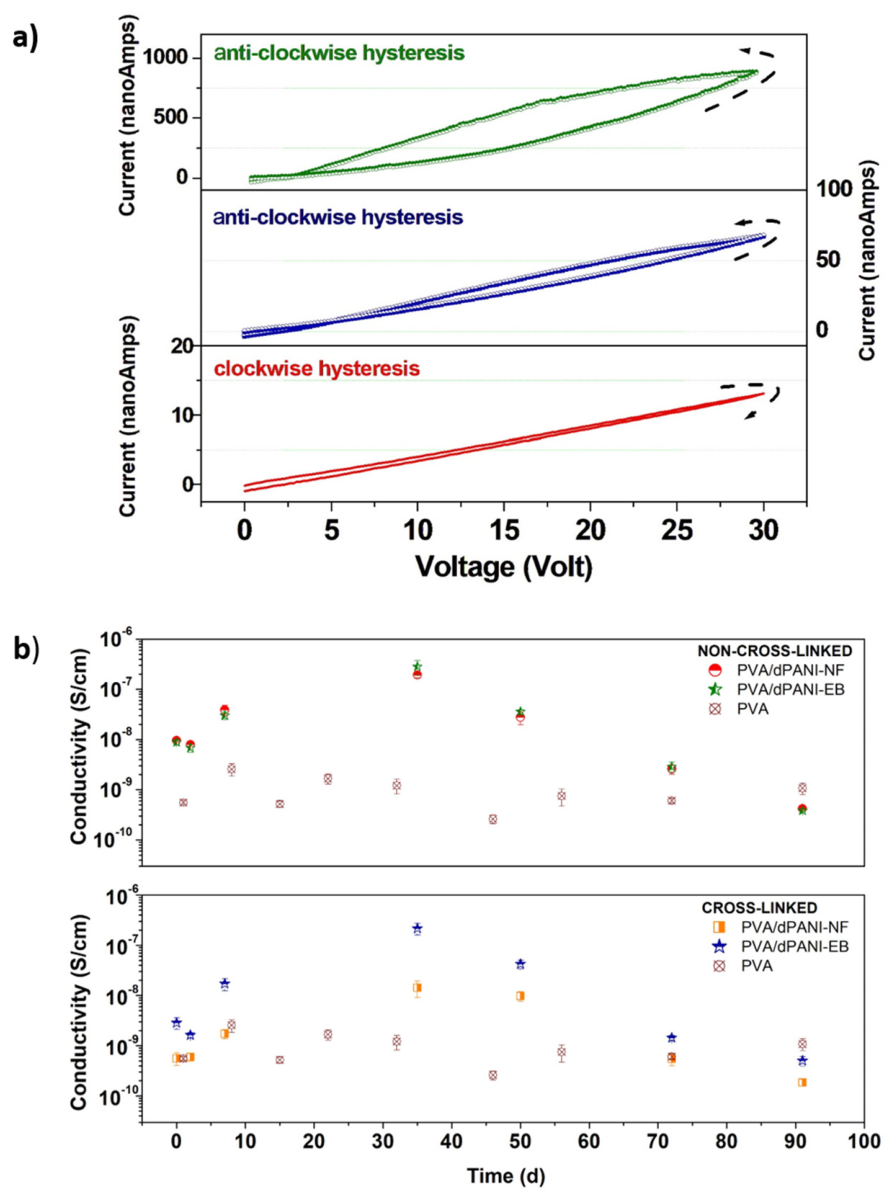
Comparative electrical characterization of PVA/dPANI-EB and PVA/dPANI-NF nanofibers revealed that they exhibited IV curves featuring largely variable current magnitudes over time, with maximum values varying by more than two orders of magnitude. In this regard,
Figure 7a shows three exemplificative IV curves recorded over different test runs for the same PVA/dPANI-NF channel. These measurements clearly demonstrate that the larger the currents are, the less linear the final behavior of IV curves. For tests showing enhanced maximum currents (up to a few microampere), anticlockwise hysteresis effects were observed, meaning that the current values acquired during the forward sweep of the applied voltage (from 0 to +30 V) were lower than those measured during the backward scan (from +30 to 0 V). This phenomenon is fully compatible with the hypothesis that, under these conditions, an enhanced density of ionic species, particularly protons, moves along the channel in parallel with electronic charges. Overall, this suggests that the conducting properties of the samples analyzed here were strongly influenced by their degree of hydration which determines the emergence of a marked interplay between electronic and protonic conducting phenomena. It was observed that this phenomenon was basically driven by the range of humidity the samples experienced during the period several hours preceding the test. Conversely, when the PVA/dPANI-EB and PVA/dPANI-NF samples were found in lower conductivity states (i.e., maximum currents did not exceed 10 nA), all IV curves displayed a simple linear behavior throughout the applied voltage range with the presence of clockwise hysteresis (i.e., the current values measured in the forward scan were higher than those recorded in the backward one). As is well known, this feature can be ascribed to the progressive immobilization of the electronic charges during the measurement. Significantly, in full agreement with recent results we achieved using the same experimental set up, all the measurements performed in this study on neat PVA nanofibers show this same electrical behavior featuring linear IV curves and clockwise hysteresis [
13].
Figure 7b provides an overview of the evolution of electrical conductivity (σ) over time, as observed for all the samples. All the data in this plot are mean values obtained from at least four channels of the same type, with error bars representing their related standard deviations. Conductivity was always estimated from the forward scan of IV curves by performing a fitting based on Ohm’s law in the voltage range where the current most closely followed a linear behavior.
While the initial σ values were lower than 10
−8 S/cm, with only slight differences among the various samples,
Figure 7b reveals that the observed trends were characteristic of each sample. Over time, indeed, PVA/dPANI-EB and PVA/dPANI-NFs exhibited a similar behavior, with a conductivity increase during the first 30/40 days followed by a monotonously decaying linear trend.
For PVA/PANI nanocomposites, all conductivity values estimated in this study were between around 1·10
−10 and 3·10
−7 S/cm. Conversely, the electronic conductivity estimated for pure PVA nanofibers displayed a different behavior, with a very mild decaying trend over time and maximum σ value achieved during the first week of the experiment. As shown in
Figure 7b, the largest conductivity ((2.5 ± 0.7) 10
−9 S/cm) of pure PVA nanofibers was much lower (at least two orders of magnitude) than the best values estimated for PVA/dPANI-EB and PVA/dPANI-NF samples.
Moreover, it was observed that PVA/dPANI-EB and PVA/dPANI-NFs deposited without the use of the crosslinking agent were characterized by comparable maximum conductivity values (between 2 and 3·10
−7 S/cm). Meanwhile, for cross-linked samples, PVA/dPANI-EB channels tended to preserve similar conductivity values compared to their non-cross-linked counterparts. For PANI-NFs, σ results were reduced by about one order of magnitude. This could be due to the crosslinking effect on the spatial distribution of dispersed phases as a function of sizes and factors. During the crosslinking, globular EB phases tend to be better packed than needle-like PANI-NF ones, promoting more frequent contacts among adjacent particles and thus forming more efficient electroconductive pathways. This scenario confirms that the differences in the electrical response of PVA/dPANI-EB and PVA/dPANI-NF channels are mainly related to the diverse capability of the polyaniline species contained in these compounds to increase the density of mobile electronic charges to protonation processes induced by humidity incorporation [
26].
Finally, it was noticed that, after about 90 days, the conductivity values of PVA/dPANI-EB and PVA/dPANI-NF samples remarkably decreased, becoming comparable to those values of the pure PVA nanofibers. This phenomenon could be tentatively explained by a progressive dehydration effect leading to a strong attenuation of the charge transport properties of the investigated samples, which ultimately remain mainly governed by the PVA host matrix.
To validate the
in vitro use of electroconductive fibers, human SH-SY5Y neuroblastoma cells, a well-established in vitro model for neural and brain-related studies, were employed, and the biocompatibility of PVA-based electrospun conductive nanofibers was evaluated. Direct cytotoxicity was evaluated using the Alamar Blue
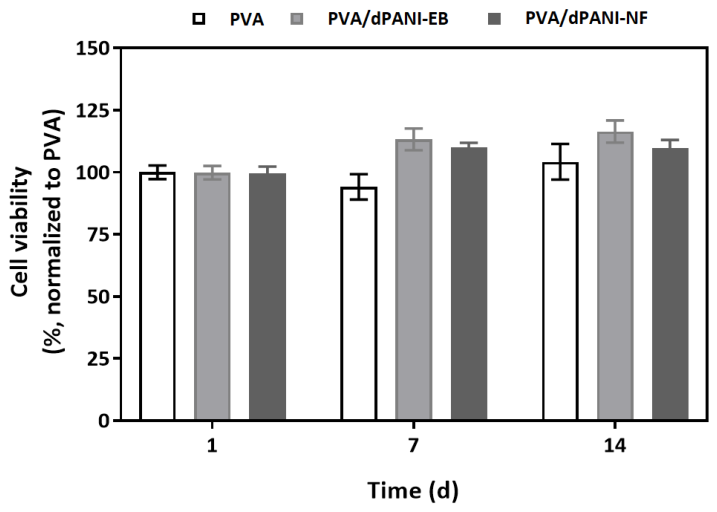
® assay according to ISO 10993-5:2009 standard guidelines. All tested conductive nanofibers exhibited good biocompatibility, with no evidence of cytotoxic effects throughout the experimental period (
Figure 8). SH-SY5Y cells cultured directly on the nanofiber’s surfaces maintained high viability for up to 14 days (
Figure 8), indicating that the substrates provide a stable and supportive environment for cell survival. Although slight differences in cell proliferation between PVA/dPANI-EB and PVA/dPANI-NF nanofibers were observed starting from day 7, these variations were not statistically significant (
p > 0.05). These findings are consistent with previous studies showing that electrospun PANI-based nanofibers, particularly after appropriate post-processing treatments such as isopropanol washing, sustain SH-SY5Y cell viability and proliferation at levels comparable to standard tissue culture substrates [
27]. Moreover, these results are in line with experimental evidence from recent studies that confirmed a favorable in vitro response of electrospun PANI-based nanofibers with other cell types, including fibroblasts [
28], myoblasts [
29] and osteoblasts [
30].
4. Discussion
PANI is a conductive polymer that has been extensively explored for brain-related applications in different forms, ranging from scaffolds for neural tissue regeneration to smart platforms for brain–machine interfaces. This is mainly due to its intrinsic ability to transfer electrical signals without significantly affecting their chemical stability in vitro and in vivo [
31]. In recent years, PANI has been widely combined with other synthetic polymers to confer electrical properties to otherwise dielectric matrices—e.g., polystyrene [
32], poly(ethylene oxide) (PEO) [
33], polymethyl methacrylate (PMMA) [
34], nylon-6 [
35], poly(vinylidene difluoride) [
36], poly(lactic acid) (PLA) [
37], poly-(ε-caprolactone) (PCL) [
38] and polyacrylonitrile [
39]—which are suitable for supporting neural stem cell growth and maturation under electrical stimulation.
Herein, the proposed study provides a proof of principle for the use of PVA-based electrospun nanofibers loaded with either dPANI-EB or dPANI-NFs as bioactive platforms for neural applications, although further investigation will be required to fully validate their ability in promoting neuronal differentiation, neurite extension, and electrically-mediated cellular responses. Unlike many synthetic polymers that behave as electrical insulators (i.e., conductivities lower than 10
−14 S/cm), it has been verified herein that PVA-based electrospun nanofibers possess an inherent capability to promote charge transfer through ion mobility, owing to their hydrogel-like behavior. Due to this intrinsic ionic conductivity, the presence of PANI phases further enhances the electrical conductivity of PVA nanofibers by up to three orders of magnitude compared to unloaded systems. Compared with other studies on electrospun fibers for brain applications, the amount of PANI used in this work was drastically reduced—approximately 1.25%
w/
w in PVA. This amount represents a compromise to confer detectable electrical/proton conductivity, while maintaining full in vitro biocompatibility. In this context, the use of the electrospinning technique allows confinement of the electroconductive phases within matrices with a higher surface-to-volume ratio, in agreement with experimental evidence reported in previous studies [
2,
40]. Indeed, this strategy minimizes the cytotoxic effects reported in several studies [
41] while enabling the use of the fibers in brain-related applications where the detection of mild-intensity electrical signals is required (i.e., biosensing). For instance, PVA-based electrospun nanofibers loaded with PANI may be employed to fabricate highly sensitive biosensors capable of detecting current variations in the sub-nanoampere range. Such sensitivity is essential for monitoring changes in membrane potential in diseased cells (i.e., tumors), which significantly differ from those of healthy cells. These specific properties can also be exploited to develop flexible patches for wearable electronic devices, combining well-recognized elastic mechanical properties [
13] and electrical conductivity with unique self-healing capabilities. The latter can be achieved by exploiting dynamic chemical bonds—i.e., hydrogen bonds between hydroxyl groups (-OH)—which can spontaneously reform upon re-contact of the material surfaces. From this perspective, future investigation should be supported by more sensitive testing systems capable of measuring electrical signal variations in aqueous environments, where only very low voltages (<1 V) can be applied. In this way, the opportunity to collect more information about kinetic parameters related to mechanisms of ionic/electronic transport through the fibrous structure will be enabled. In a recent study, we demonstrated that PVA cross-linked fibers present a pronounced deformation under tensile loads in the elastic regime, and the addition of conductive fillers tends to increase the fiber rigidity [
13]. Herein, we have confirmed the stability of cross-linked and non-cross-linked PVA fibers in terms of chemical and physical properties as a function of PANI phases used, to validate their use for in vitro culture. As a next step, a systematic investigation of the mechanical response of cross-linked and non-cross-linked fibers as a function of PANI filler properties (i.e., particle size, shape factor, relative amount) should be performed to correlate mechanical response to electroconductivity. This information could be further studied in combination with mechanical response under controlled wet conditions to quantify the effective performance of PANI-loaded nanofibers, either as electroactive coatings for microelectrodes or as components of flexible patches. This will allow for validation of their ability to monitor changes in biochemical signal levels under external conditions that mimic those of the brain microenvironment.
5. Conclusions
In this work, two different forms of doped PANI, i.e., globular (dPANI-EB) and nanofibers (dPANI-NFs), were incorporated into PVA electrospun nanofibers and the resulting effects on the nanocomposite properties were investigated. The results demonstrated that the electroconductive properties of the final nanocomposite can be improved without relevantly altering the morphology of the fibers network. Maximum electrical conductivities achieved with dPANI-EB and dPANI-NF additives exceeded those estimated for neat PVA nanofibers by more than two orders of magnitude, ranging from 1·10−10 to 3·10−7 S/cm, while fiber diameters slightly increased from 0.53 ± 0.16 µm to 0.72 ± 0.18 µm. Overall, the specific electrical features observed in the current–voltage measurements suggest that PANI incorporation into the PVA matrix enhances the interplay between electronic and protonic conduction phenomena, making the electrical response of these samples much more dependent on their degree of hydration compared to pure PVA nanofibers. Moreover, a slight decay in the fiber conductivity (from 10−7 to 10−8 S/cm2) in the presence of dPANI-NFs also suggests a negative contribution of crosslinking on the packing ability, especially of needle-like phases, due to a reduction in contacts between adjacent particles, thus limiting charge transport.
Preliminary in vitro studies performed on a human neuroblastoma cell line (SH-SY5Y) confirmed the biocompatibility of PVA/PANI nanocomposites, supporting cell viability and proliferation. Overall, the findings discussed in this study may be useful for designing innovative platforms and/or biotextile coatings that can be used as functional interfaces with electroactive tissues, such as the brain. These interfaces can record small changes in biochemical signals in the cell microenvironment, allowing the effects on functional activity of damaged or pathological tissues to be monitored.





 ,
,