


Wild Boar Management and Environmental Degradation: A Matter of Ecophysiology—The Italian Case
Abstract
1. Introduction
2. Materials and Methods
2.1. Study Area and Data Collection
2.2. Data Analyses
3. Results
3.1. The Causes of Wild Boar Spread in Italy
3.1.1. Restocking and Management
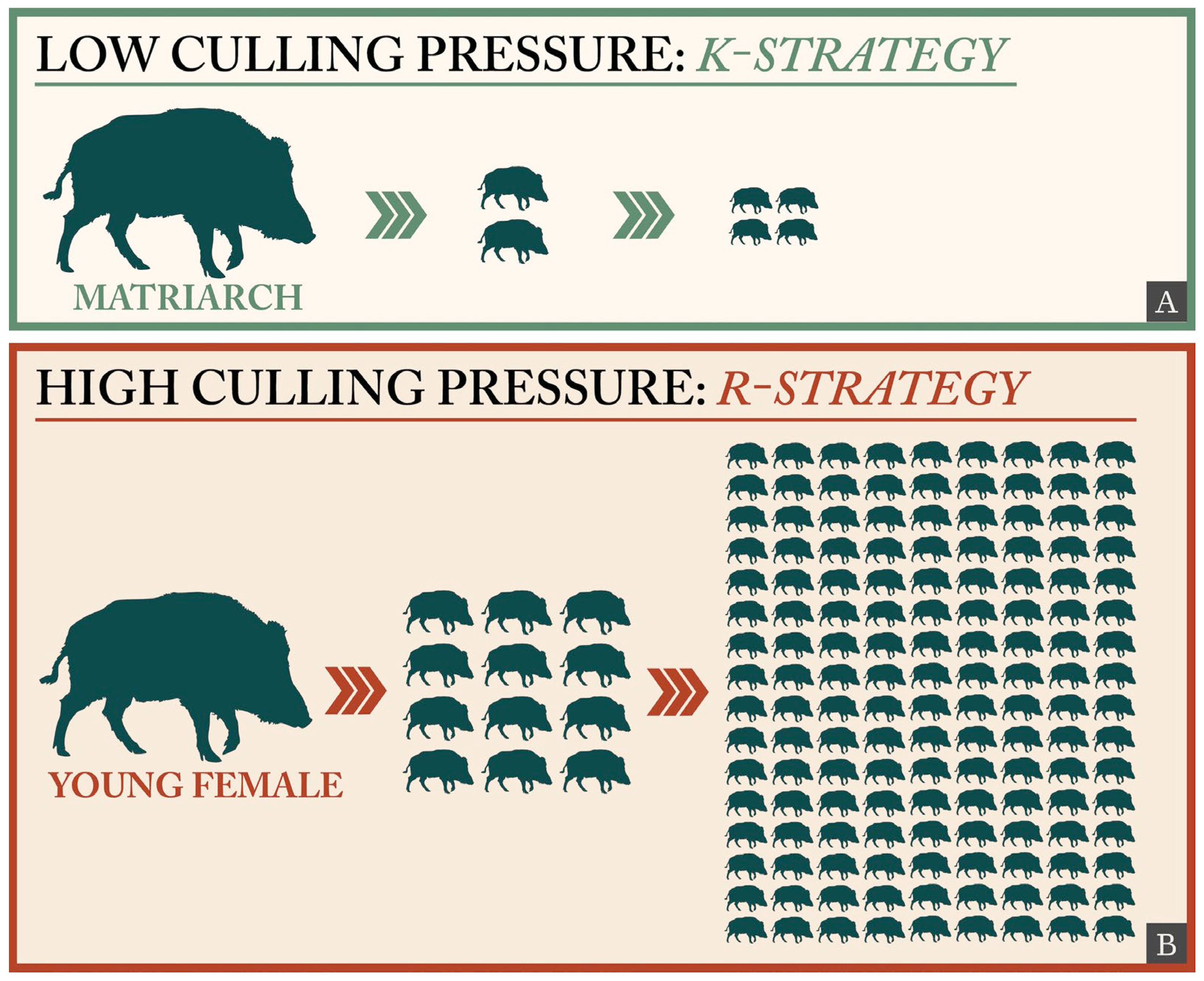
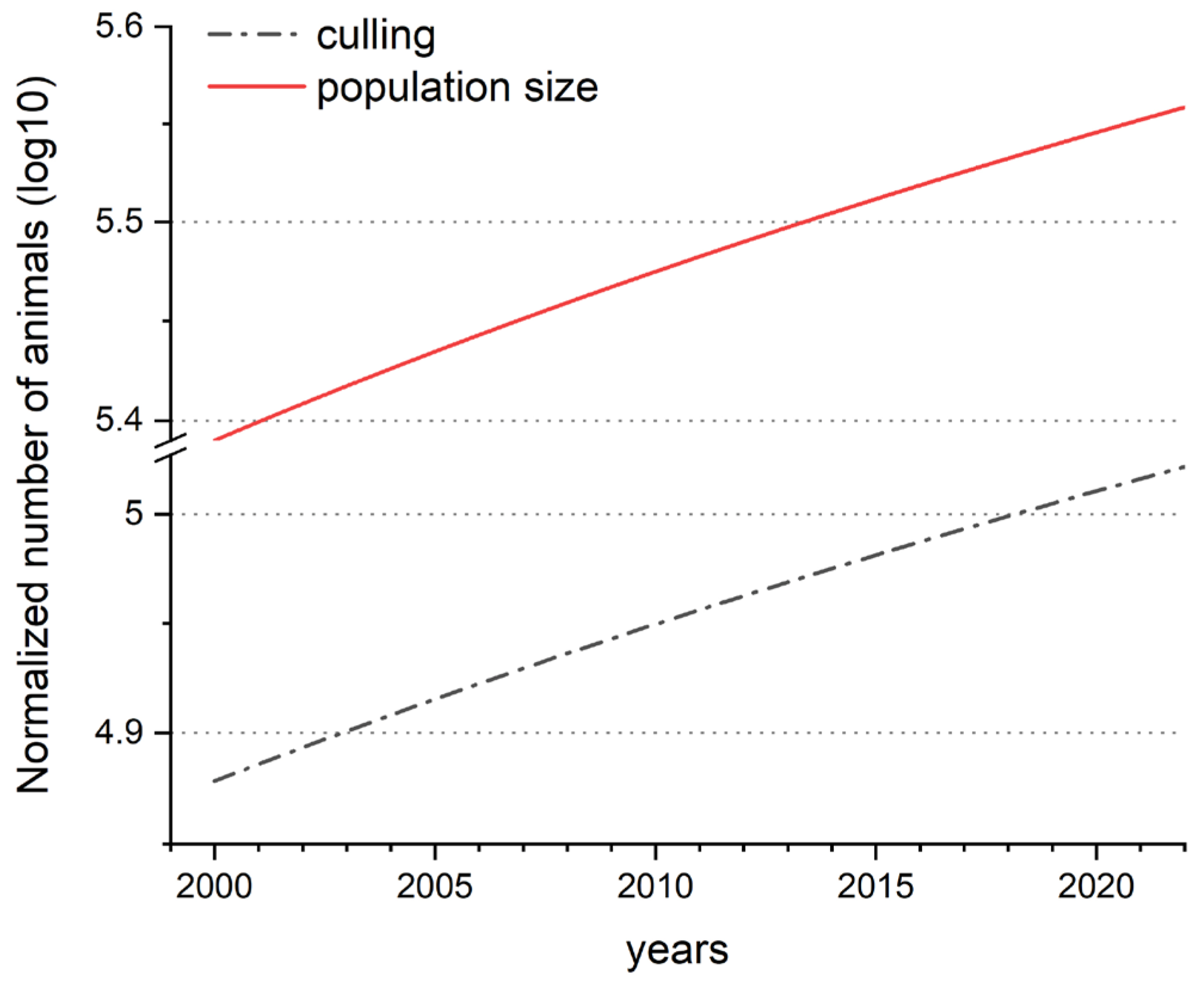
3.1.2. Population Biology
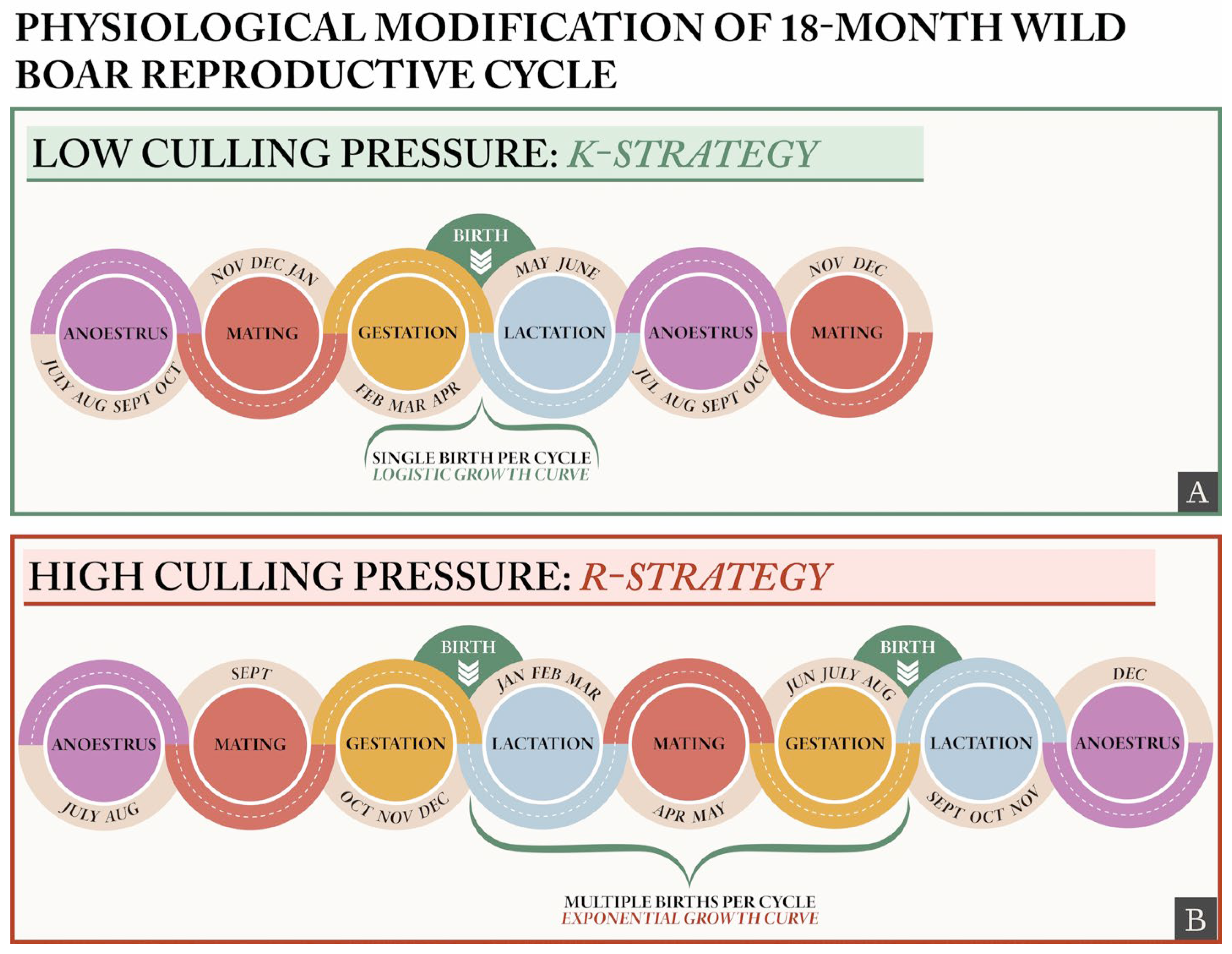
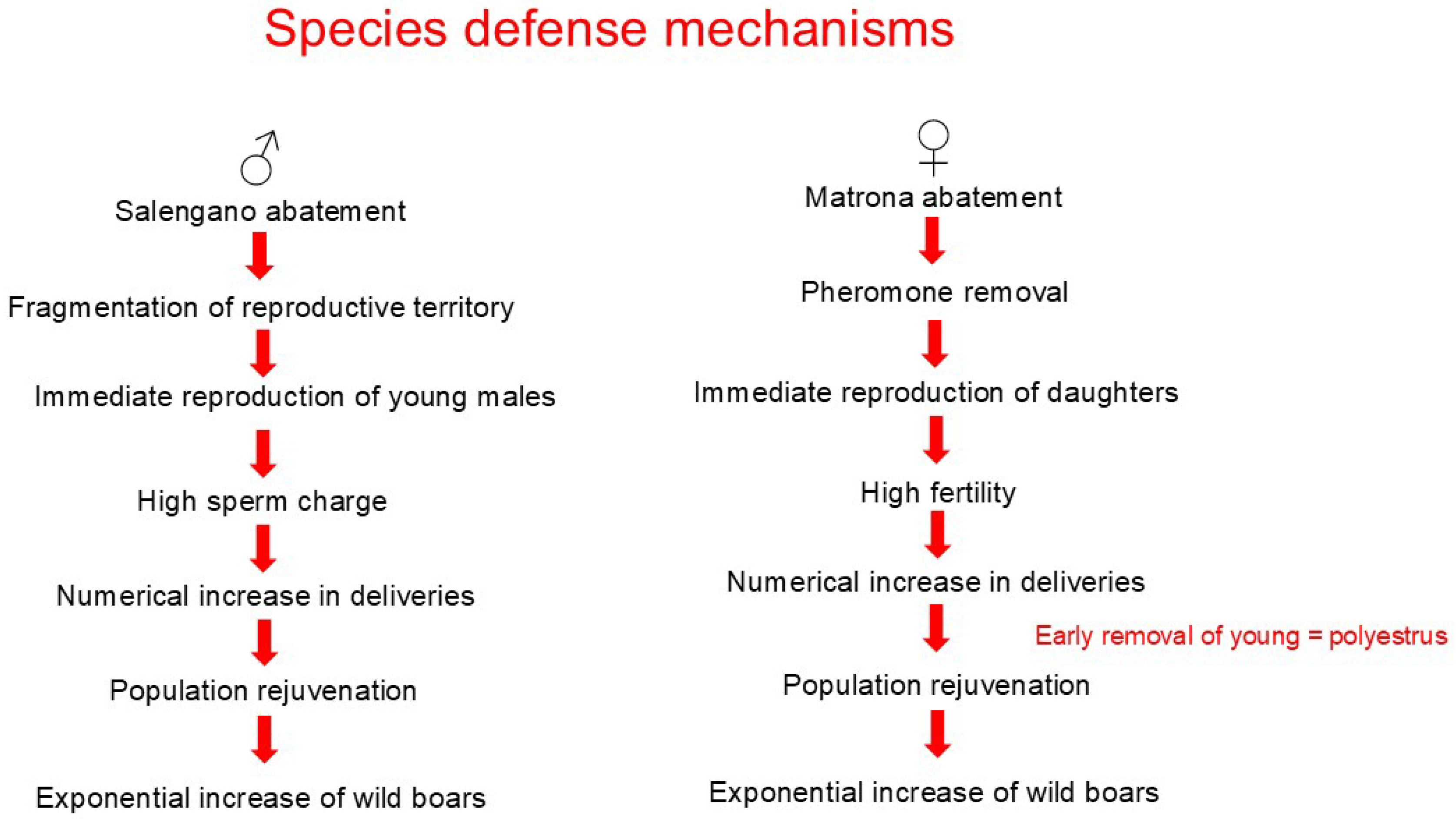
3.1.3. Reproductive Physiology: Pheromonal Regulation
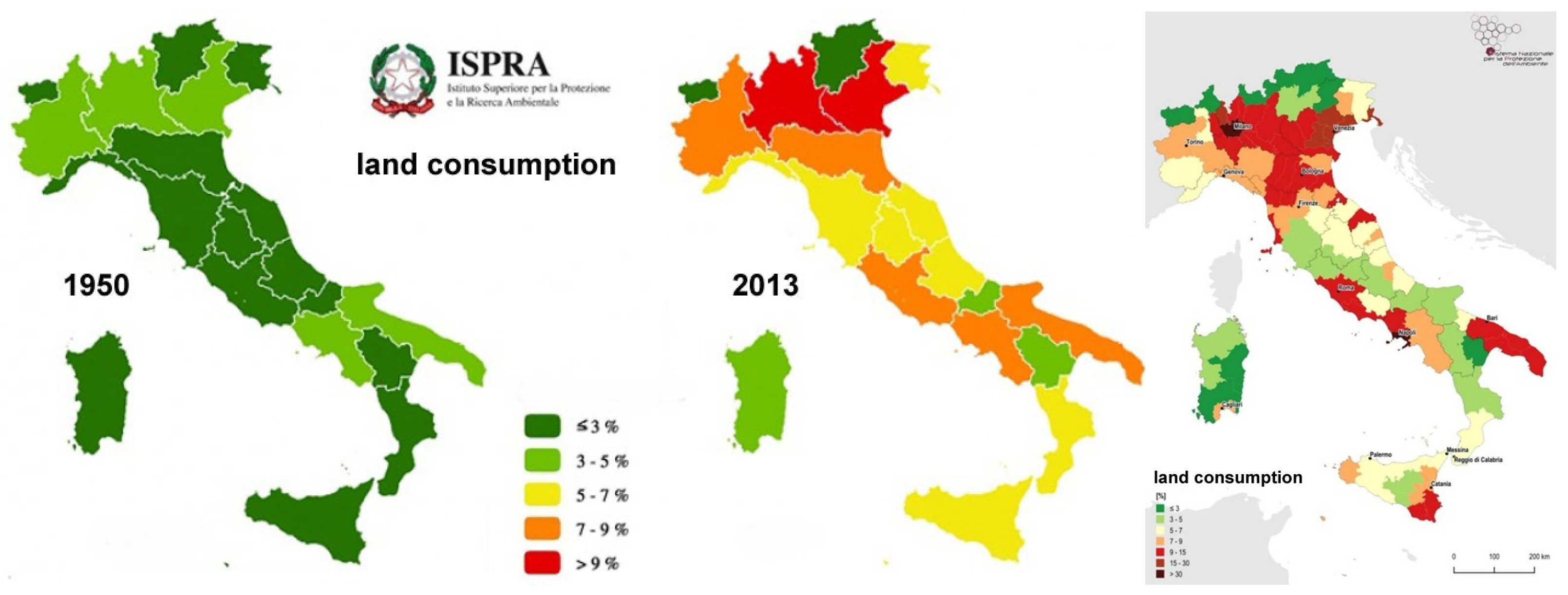
3.2. The Environmental Factors
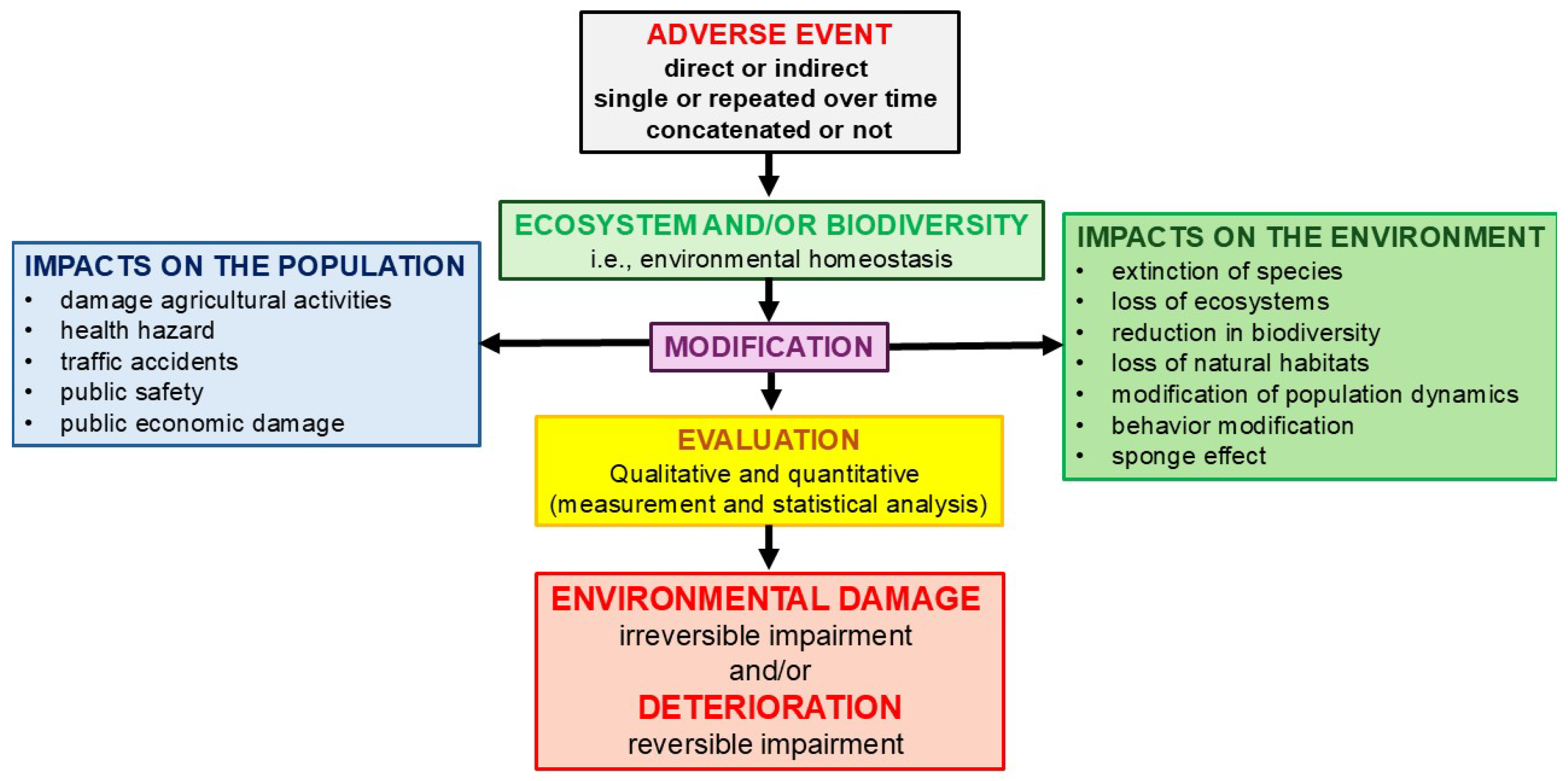
3.3. The Environmental Damage Model
4. Discussion
4.1. The Causes of Emergency
4.1.1. The Remote Causes: “Restocking”
4.1.2. Proximate Causes: Management
4.2. Population Biology
4.3. Environmental Factors
4.4. Chemical Communication
4.5. The Environmental Damage Model
5. Conclusions
Funding
Institutional Review Board Statement
Informed Consent Statement
Data Availability Statement
Conflicts of Interest
References
- National Geographic Society. Wild Boar, Facts and Information. National Geographic. 2023. Available online: https://www.nationalgeographic.com/animals/mammals/facts/wild-boar (accessed on 6 May 2025).
- Warnell School of Forestry & Natural Resources University of Georgia. Center for Invasive Species and Ecosystem Health. 2018. Available online: https://warnell.uga.edu/about/centers-labs/center-invasive-species-and-ecosystem-health (accessed on 2 January 2025).
- National Invasive Species Council Secretariat. National Invasive Species Information Center (NISIC). Available online: http://www.invasivespeciesinfo.gov/ (accessed on 6 May 2025).
- Monaco, A.; Franzetti, B.; Pedrotti, L.; Toso, S. Linee Guida per La Gestione Del Cinghiale. Min. Politiche Agricole e Forestali—Ist. Naz. Fauna Selvatica. ISPRA Ambiente. 2003. Available online: https://www.isprambiente.gov.it/contentfiles/00006600/6683-linee-guida-gestione-cinghiale.pdf (accessed on 6 May 2025).
- Monaco, A.; Carnevali, L.; Toso, S. Linee Guida per la Gestione del Cinghiale (Sua Scrofa) Nelle Area Protette. Ministero dell’Ambiente, ISPRA. 2010. Available online: https://www.isprambiente.gov.it/contentfiles/00004300/4315-cinghiale-ii-edizione.pdf (accessed on 6 May 2025).
- Carnevali, L.; Pedrotti, L.; Riga, F.; Toso, S. Banca Dati Ungulati: Status, distribuzione, consistenza, gestione e prelievo venatorio delle popolazioni di Ungulati in Italia.Rapporto 2001–2005. Biol. Cons. Fauna 2009, 117, 1–168. [Google Scholar]
- Massei, G.; Kindberg, J.; Licoppe, A.; Gačić, D.; Šprem, N.; Kamler, J.; Baubet, E.; Hohmann, U.; Monaco, A.; Ozoliņš, J.; et al. Wild boar populations up, numbers of hunters down? A review of trends and implications for Europe. Pest Manag. Sci. 2015, 71, 492–500. [Google Scholar] [CrossRef]
- ISPRA. Al 2021 Stimato un Milione e Mezzo di Cinghiali in Italia in Sette Anni, Abbattimento Aumentato del 45% Danni All’ Agricoltura per 120 Milioni di € Abruzzo e Piemonte Le Regioni Piu’ Colpite. ISPRA Ambiente. 2023. Available online: https://www.isprambiente.gov.it/files2023/area-stampa/comunicati-stampa/comunicatocinghiali-1.pdf (accessed on 6 May 2025).
- Piano Straordinario di Catture, Abbattimento e Smaltimento dei Cinghiali (Sus scrofa) e Azioni Strategiche per l’Elaborazione dei Piani di Eradicazione nelle Zone di Restrizione da Peste Suina Africana (PSA). Commissario Straordinario alla Peste Suina Africana 2023–2028. Available online: https://www.salute.gov.it/new/sites/default/files/imported/C_17_pubblicazioni_3357_allegato.pdf (accessed on 2 January 2025).
- Massei, G.; Toso, S. Biologia e Gestione del Cinghiale; Istituto Nazionale per la Fauna Selvatica: Bologna, Italy, 1993. Available online: https://www.isprambiente.gov.it/files/pubblicazioni/documenti-tecnici/6651_DOC_TEC_5.pdf (accessed on 6 May 2025).
- Iacopi, M. Il Cinghiale Nell’araldica. Societa’ Italiana di Studi Araldici. 2011. Available online: https://www.socistara.it/studi/ (accessed on 2 January 2025).
- Ghigi, A. I Mammiferi d’Italia considerati nei loro rapporti coll’agricoltura. Natura 1917, 8, 85–137. [Google Scholar]
- Ghigi, A. La Vita Degli Animali. II Mammiferi ed Uccelli Sedentari Delle Terre Continentali; UTET: Milano, Italy, 1950. [Google Scholar]
- Paoloni, M. Cinghiali: Sono 2,3 Mln in Italia con Vittime e Danni. Coldiretti. 2022. Available online: https://www.coldiretti.it/economia/cinghiali-sono-23-mln-in-italia-con-vittime-e-danni (accessed on 6 May 2025).
- Monaco, A.; Carnevali, L.; Riga, F.; Toso, S. Il cinghiale sull’arco alpino: Status e gestione delle popolazioni. Rep. Cent. Ecol. Alp. 2006, 38, 5–23. [Google Scholar]
- Jarolímek, J.; Vaněk, J.; Ježek, M.; Masner, J.; Stočes, M. The telemetric tracking of wild boar as a tool for field crops damage limitation. Plant Soil Environ. 2014, 60, 418–425. [Google Scholar] [CrossRef]
- Verhulst, P.-F. Recherches mathématiques sur la loi d’accroissement de la population. In Nouveaux Mémoires de l’Académie Royale Des Sciences et Belles-Lettres de Bruxelles; Académie Royale de Bruxelles: Bruxelles, Belgium, 1845; Volume 18, pp. 1–45. [Google Scholar] [CrossRef]
- Mazzatenta, A. Il Buono, il Brutto e Cattivo—Le ragioni biologiche della diffusione del cinghiale e i problemi giuridici annessi. In Diffusione del Cinghiale, Tra Ragioni Biologiche e Problemi Giuridici; Consiglio dell’Ordine degli Avvocati di Vasto e Comune di Vasto: Vasto, Italy, 2019. [Google Scholar]
- Mazzatenta, A. Cinghiale, è Ora di Cambiare. Torino; Tavolo Animali & Ambiente. 2020. Available online: https://youtu.be/1PgryCmGS0s?si=QX-ywXiVbfUKQhep (accessed on 5 June 2025).
- Mazzatenta, A. Emergenza Cinghiali: Danno Ambientale, Agrario ed Economico. Audizione alla 9ª Commissione Permanente, Agricoltura e Produzione Agroalimentare, Senato della Repubblica Italiana, Seduta n. 248 del 20 Aprile 2021. 2021. Available online: https://www.senato.it/application/xmanager/projects/leg18/attachments/documento_evento_procedura_commissione/files/000/338/301/Prof._MAZZATENTA.pdf (accessed on 6 May 2025).
- Danni Causati All’ Agricoltura Dall’ Eccessiva Presenza della Fauna Selvatica (N. 337). Senato della Repubblica—Procedura: Affari Assegnati XVIII Legislatura. Available online: www.senato.it/leg/18/BGT/Schede/ProcANL/ProcANLscheda42532.htm (accessed on 6 May 2025).
- Mazzatenta, A. “Emergenza Cinghiali”: Danno Ambientale, Agrario ed Economico. Audizione Commissione Agricoltura della Camera dei Deputati della Repubblica Italiana 20 Ottobre 2021. Available online: https://comunicazione.camera.it/archivio-prima-pagina/18-24307 (accessed on 6 May 2025).
- Keveme, E.B. Pheromonal influences on the endocrine regulation of reproduction. Trends Neurosci. 1983, 6, 381–384. [Google Scholar] [CrossRef]
- Mazzatenta, A.; Cellerino, A. I feromoni. In Trattato di Sessuologia Medica; Edra: Palm Beach, FL, USA, 2017; ISBN 978-88-214-2911-8. [Google Scholar]
- Mazzatenta, A.; Fiorito, S.; Guadagnini, R.; Genovese, S.; Valentini, A.; Bonadiman, F.; Guadagnini, S.; Epifano, F.; Mollica, A. The Evanescent Bouquet of Individual Bear Fingerprint. Animals 2023, 13, 220. [Google Scholar] [CrossRef]
- Delcroix, I.; Mauget, R.; Signoret, J.P. Existence of Synchronization of Reproduction at the Level of the Social Group of the European Wild Boar (Sus scrofa). Reproduction 1990, 89, 613–617. [Google Scholar] [CrossRef]
- Carluccio, A.; Contri, A.; Amendola, S.; De Angelis, E.; De Amicis, I.; Mazzatenta, A. Male Isolation: A Behavioral Representation of the Pheromonal ‘Female Effect’ in Donkey (Equus asinus). Physiol. Behav. 2013, 118, 1–7. [Google Scholar] [CrossRef] [PubMed]
- Apollonio, M.; Randi, E.; Toso, S. The Systematics of the Wild Boar (Sus scrofa L.) in Italy. Bolletino Zool. 1988, 55, 213–221. [Google Scholar] [CrossRef]
- Scandura, M.; Fabbri, G.; Caniglia, R.; Iacolina, L.; Mattucci, F.; Mengoni, C.; Pante, G.; Apollonio, M.; Mucci, N. Resilience to Historical Human Manipulations in the Genomic Variation of Italian Wild Boar Populations. Front. Ecol. Evol. 2022, 10, 833081. [Google Scholar] [CrossRef]
- Ma, W.; Miao, Z.; Novotny, M.V. Role of the Adrenal Gland and Adrenal-Mediated Chemosignals in Suppression of Estrus in the House Mouse: The Lee-Boot Effect Revisited. Biol. Reprod. 1998, 59, 1317–1320. [Google Scholar] [CrossRef]
- Quirós-Fernández, F.; Marcos, J.; Acevedo, P.; Gortázar, C. Hunters serving the ecosystem: The contribution of recreational hunting to wild boar population control. Eur. J. Wildl. Res. 2017, 63, 57. [Google Scholar] [CrossRef]
- Pommerening, A.; Muszta, A. Methods of modelling relative growth rate. For. Ecosyst. 2015, 2, 5. [Google Scholar] [CrossRef]
- OriginLab Corporation. OriginPro, version 2022; OriginLab Corporation: Northampton, MA, USA, 2022.
- The Jamovi Project. Jamovi, version 2.2; Jamovi Team: Sydney, Australia, 2021. Available online: https://www.jamovi.org/ (accessed on 6 May 2025).
- Mazzarone, V.; Ferretti, M.; Mattioli, L. Report Sulla Gestione degli Ungulati in Toscana: “La Gestione degli Ungulati in Toscana dal 2000 al 2022”; Regione Toscana: Firenze, Italy, 2023. [Google Scholar]
- Rapporti Direttive Natura (2013–2018). Sintesi Dello Stato di Conservazione Delle Specie e Degli Habitat di Interesse Comunitario e Delle Azioni di Contrasto Alle Specie Esotiche di Rilevanza Unionale in Italia. Available online: www.isprambiente.gov.it/it/pubblicazioni/rapporti/rapporti-direttive-natura-2013-2018 (accessed on 6 May 2025).
- ISPRA. Report: Land Consumption, Territorial Dynamics and Ecosystem Services. ISPRA Ambiente; 2025. Available online: www.isprambiente.gov.it/en/archive/ispra-events/2023/10/presentation-of-the-report-201cland-consumption-territorial-dynamics-and-ecosystem-services201d (accessed on 6 May 2025).
- Il Consumo di Suolo. ISPRA Istituto Superiore per la Protezione e la Ricerca Ambientale. Available online: http://www.consumosuolo.isprambiente.it/ (accessed on 6 May 2025).
- Vetter, S.G.; Puskas, Z.; Bieber, C.; Ruf, T. How climate change and wildlife management affect population structure in wild boars. Sci. Rep. 2020, 10, 7298. [Google Scholar] [CrossRef]
- Peltoniemi, O.; Tanskanen, T.; Kareskoski, M. One health challenges for pig reproduction. Mol. Reprod. Dev. 2023, 90, 420–435. [Google Scholar] [CrossRef] [PubMed]
- Regione Toscana. Risultati di Applicazione della Legge Regionale N. 10 del 9 Febbraio 2016, Legge Obiettivo per La Gestione degli Ungulati in Toscana. 2018. Available online: https://raccoltanormativa.consiglio.regione.toscana.it/articolo?urndoc=urn:nir:regione.toscana:legge:2016-02-09;10 (accessed on 8 May 2025).
- Amministrazione Provinciale di Catanzaro. Piano Faunistico-Venatorio. Catanzaro. Assessorato Caccia e Pesca; 2013. Available online: https://www.yumpu.com/it/document/view/15059960/1-piano-faunistico-venatorio-completo-provincia-di-catanzaro#google_vignette (accessed on 6 May 2025).
- Sales, J.; Kotrba, R. Meat from Wild Boar (Sus scrofa L.): A Review. Meat Sci. 2013, 94, 187–201. [Google Scholar] [CrossRef]
- Goedbloed, D.J.; van Hooft, P.; Megens, H.-J.; Langenbeck, K.; Lutz, W.; Crooijmans, R.P.; van Wieren, S.E.; Ydenberg, R.C.; Prins, H.H. Reintroductions and Genetic Introgression from Domestic Pigs Have Shaped the Genetic Population Structure of Northwest European Wild Boar. BMC Genet. 2013, 14, 43. [Google Scholar] [CrossRef]
- Iacolina, L.; Pertoldi, C.; Amills, M.; Kusza, S.; Megens, H.-J.; Bâlteanu, V.A.; Bakan, J.; Cubric-Curik, V.; Oja, R.; Saarma, U.; et al. Author Correction: Hotspots of Recent Hybridization Between Pigs and Wild Boars in Europe. Sci. Rep. 2019, 9, 20187. [Google Scholar] [CrossRef]
- Meier, R.; Ryser-Degiorgis, M. Wild Boar and Infectious Diseases: Evaluation of the Current Risk to Human and Domestic Animal Health in Switzerland: A Review. Schweiz Arch. Tierheilkd 2018, 160, 443–460. [Google Scholar] [CrossRef] [PubMed]
- Rogoll, L.; Güttner, A.-K.; Schulz, K.; Bergmann, H.; Staubach, C.; Conraths, F.J.; Sauter-Louis, C. Seasonal Occurrence of African Swine Fever in Wild Boar and Domestic Pigs in EU Member States. Viruses 2023, 15, 1955. [Google Scholar] [CrossRef]
- Kruszyński, M.; Śróda, K.; Juszkiewicz, M.; Siuda, D.; Olszewska, M.; Woźniakowski, G. Nine Years of African Swine Fever in Poland. Viruses 2023, 15, 2325. [Google Scholar] [CrossRef] [PubMed]
- Soede, N.M.; Kemp, B. Expression of Oestrus and Timing of Ovulation in Pigs. J. Reprod. Fertil. Suppl. 1997, 52, 91–103. [Google Scholar]
- Kemp, B.; Soede, N.M.; Langendijk, P. Effects of Boar Contact and Housing Conditions on Estrus Expression in Sows. Theriogenology 2005, 63, 643–656. [Google Scholar] [CrossRef]
- Pedersen, L.J.; Heiskanen, T.; Damm, B.I. Sexual Motivation in Relation to Social Rank in Pair-Housed Sows. Anim. Reprod. Sci. 2003, 75, 39–53. [Google Scholar] [CrossRef] [PubMed]
- Pedersen, L.J. Sexual Behaviour in Female Pigs. Horm. Behav. 2007, 52, 64–69. [Google Scholar] [CrossRef] [PubMed]
- Servanty, S.; Gaillard, J.; Carole, T.; Serge, B.; Eric, B. Pulsed Resources and Climate-Induced Variation in the Reproductive Traits of Wild Boar Under High Hunting Pressure. J. Anim. Ecol. 2009, 78, 1278–1290. [Google Scholar] [CrossRef]
- Isotti, R.; Focardi, S.; Fanfani, A.; Toso, S. Gli Ungulati della Tenuta Presidenziale di Castelporziano. Accad. Naz. Delle Sci. Detta Dei Quaranta 2001, 26, 187–199. Available online: https://www.researchgate.net/publication/301287748_Gli_ungulati_della_Tenuta_Presidenziale_di_Castelporziano (accessed on 6 May 2025).
- Caunu, A.; Scandura, M.; Merli, E.; Chirichella, R.; Bottero, E.; Chianucci, F.; Cutini, A.; Apollonio, M. Reproductivephenology and conception synchrony in a natural wild boar population. Hystrix Ital. J. Mammal. 2015, 26, 77–84. Available online: http://www.italian-journal-of-mammalogy.it/pdf-77172-13325?filename=13325.pdf (accessed on 2 January 2025).
- Festa-Bianchet, M.; Apollonio, M. Exploitative wildlife management as a selective pressure for the life-history evolution of large mammals. In Animal Behavior and Wildlife Conservation; Island Press: Washington, DC, USA, 2003; pp. 191–207. Available online: https://www.researchgate.net/publication/304460326_Exploitative_wildlife_management_as_a_selective_pressure_for_the_life-history_evolution_of_large_mammals (accessed on 6 May 2025).
- Garel, M.; Cugnasse, J.-M.; Maillard, D.; Gaillard, J.-M.; Hewison, A.J.; Dubray, D. Selective harvesting and habitat loss produce long-term life history changes in a mouflon population. Ecol. Appl. 2007, 17, 1607–1618. [Google Scholar] [CrossRef]
- Escribano, D.; Contreras-Jodar, A.; López-Arjona, M.; Cerón, J.J.; Fàbrega, E.; Aymerich, P.; Dalmau, A. Changes in cortisol and cortisone in hair of pigs reared under heat stress conditions. Front. Vet. Sci. 2023, 10, 1156480. [Google Scholar] [CrossRef]
- Conover, D.O.; Munch, S.B. Sustaining fisheries yields over evolutionary time scales. Science 2002, 297, 94–96. [Google Scholar] [CrossRef]
- Toïgo, C.; Servanty, S.; Gaillard, J.; Brandt, S.; Baubet, E. Disentangling natural from hunting mortality in an intensively hunted wild boar population. J. Wildl. Manag. 2008, 72, 1532–1539. [Google Scholar] [CrossRef]
- McClintock, M.K. Menstrual synchrony and suppression. Nature 1971, 229, 244–245. [Google Scholar] [CrossRef] [PubMed]
- McClintock, M.K. On the nature of mammalian and human pheromones. Ann. N. Y. Acad. Sci. 1998, 855, 390–392. [Google Scholar] [CrossRef]
- Mazzatenta, A.; Mazzatenta, D.; Cellerino, A. Pheromonal regulation of male sexuality. In Hormonal Therapy for Male Sexual Dysfunction; Wiley: Hoboken, NJ, USA, 2011; pp. 11–27. [Google Scholar] [CrossRef]
- Beach, F.A.; Jordan, L. Effects of sexual reinforcement upon the performance of male rats in a straight runway. J. Comp. Physiol. Psychol. 1956, 49, 105–110. [Google Scholar] [CrossRef]
- Brown, R.E. Sexual arousal, the Coolidge effect and dominance in the rat (Rattus norvegicus). Anim. Behav. 1974, 22, 634–637. [Google Scholar] [CrossRef]
- Van Der Lee, S.; Boot, L.M. Spontaneous Pseudopregnancy in Mice. Acta Physiol. Pharmacol. Neerl. 1956, 5, 213–215. [Google Scholar]
- Zaĭtsev, V.A. Sinkhronizatsiia povedeniia i individual’nye distantsii v gruppakh kabanov (Sus scrofa L.). Zhurnal Obs. Biol. 1992, 53, 243–257. (In Russian) [Google Scholar]
- McGlone, J.J.; Devaraj, S.; Garcia, A. A novel boar pheromone mixture induces sow estrus behaviors and reproductive success. Appl. Anim. Behav. Sci. 2019, 219, 104832. [Google Scholar] [CrossRef]
- Aviles-Rosa, E.O.; Surowiec, K.; McGlone, J. Identification of Faecal Maternal Semiochemicals in Swine (Sus scrofa) and their Effects on Weaned Piglets. Sci. Rep. 2020, 10, 5349. [Google Scholar] [CrossRef] [PubMed]
- Governo: Esercito in Campo Contro 2,3 Mln di Cinghiali. Coldiretti. 2023. Available online: http://www.coldiretti.it/economia/governo-esercito-in-campo-contro-23-mln-di-cinghiali (accessed on 6 May 2025).
- National Feral Swine Damage Management Program. Available online: https://www.aphis.usda.gov/operational-wildlife-activities/feral-swine/program (accessed on 6 May 2025).
- Beasley, J.C.; Lavelle, M.J.; Keiter, D.A.; Pepin, K.M.; Kilgo, J.C.; VerCauteren, K.C. Invasive Wild Pigs in North America: Research Methods for Wild Pigs. USDA Forest Service, Southern Research Station. 2020. Available online: https://www.srs.fs.usda.gov/pubs/chap/Chap_2020_kilgo.pdf (accessed on 6 May 2025).
- Schlottman, J. Activity Patterns and Behavioral Modifications of Feral Swine in North America and Eurasian Boar in Europe. Texas A&M Natural Resources Institute. 2021. Available online: https://nri.tamu.edu/blog/2021/march/activity-patterns-and-behavioral-modifications-of-feral-swine-in-north-america-and-eurasian-boar-in-europe/ (accessed on 6 May 2025).
- Vercauteren, K.; Beasley, J.; Mayer, J.; Strickland, B.; Roloff, G.; Ditchkoff, S. Invasive Wild Pigs in North America: Ecology, Impacts, and Management; CRC Press: Boca Raton, FL, USA, 2020; Available online: https://www.researchgate.net/publication/341489322 (accessed on 6 May 2025).
- Groom, M.J.; Meffe, G.K.; Carroll, C.R. Principles of Conservation Biology, 3rd ed.; Sinauer Associates: Sunderland, MA, USA, 2006; ISBN 978-0-87893-518-5. [Google Scholar]
- Hunter, M.L. Fundamentals of Conservation Biology; Blackwell Science: Oxford, UK, 1996; ISBN 978-0-86542-371-8. [Google Scholar]
- Cianfaglione, K. A Retrospective and Interview with Dr. Kevin Cianfaglione—Editorial Board Member of Conservation. Conservation 2023, 3, 319–333. [Google Scholar] [CrossRef]
- Kamieniarz, R.; Jankowiak, Ł.; Fratczak, M.; Panek, M.; Wojtczak, J.; Tryjanowski, P. The relationship between hunting methods and the sex, age and body mass of wild boar sus scrofa. Animals 2020, 10, 2345. [Google Scholar] [CrossRef] [PubMed]
- Sodeikat, G.; Pohlmeyer, K. Escape movements of family groups of wild boar Sus scrofa influenced by drive hunts in Lower Saxony, Germany. Wildl. Biol. 2003, 9, 43–49. [Google Scholar] [CrossRef]
- Cianfaglione, K. An Editorial to Introduce the New Journal Wild: Issues, Approaches, Ideas and Proposals. Wild 2024, 1, 30–38. [Google Scholar] [CrossRef]
- Cianfaglione, K. Editorial from the New Editor in Chief, Open Questions and Outlooks for the Future. J. Zool. Bot. Gard. 2022, 3, 714–724. [Google Scholar] [CrossRef]





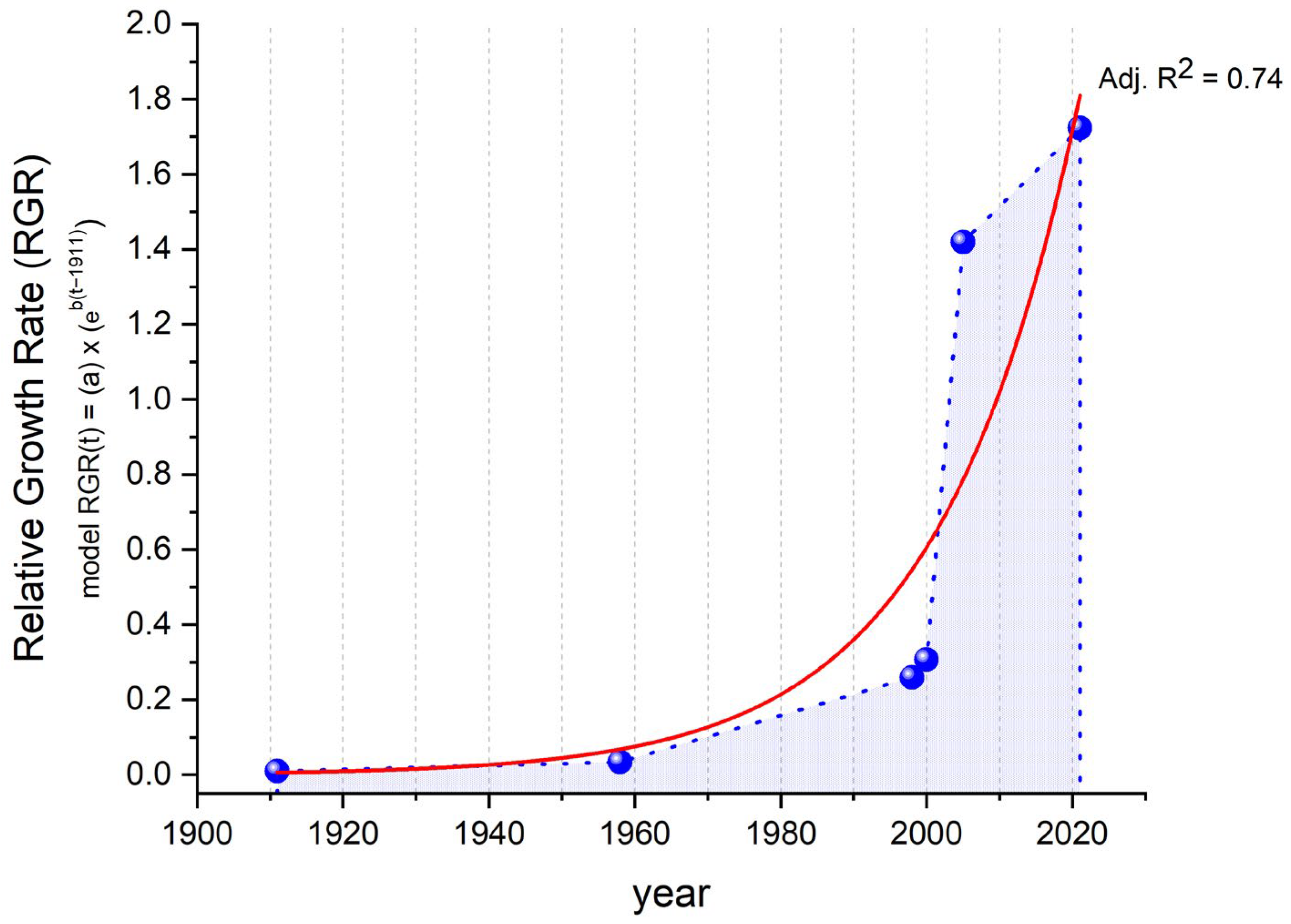
| Interval Year | Intercept | Slope |
|---|---|---|
| 1911–1958 | −1.00 | 5.29 × 10⁻⁴ |
| 1958–1998 | −10.99 | 0.0056 |
| 1998–2000 | −46.89 | 0.0236 |
| 2000–2005 | −444.84 | 0.2226 |
| 2005–2021 | −36.68 | 0.0190 |
| Compound | Behavioral Function | Secretion Site/Origin |
|---|---|---|
| 3-methylbutanoic acid | sexual/alarm | anal glands, sweat glands |
| 4-methylphenol | sexual/appeasing | urine, anal secretions |
| methyl heptadecanoate | appeasing | sebaceous secretions |
| pentanoic acid | alarm | feces, anal glands |
| methyl octadecanoate | appeasing | sebaceous secretions |
| methyl 13-methyltetradecanoate | sexual | genital secretions |
| 13-octadecanoic acid, methyl ester | appeasing | sebaceous secretions |
| methyl 12-methyltetradecanoate | sexual | genital secretions |
| methyl octadeca-9,12-dienoate | appeasing | sebaceous secretions |
| methyl pentadecanoate | sexual | genital secretions |
| tetradecanoic acid (myristic acid) | appeasing | sebaceous glands |
| methyl 14-methylpentadecanoate | appeasing/social signaling | sebaceous glands, possibly skin lipids |
| pentadecanoic acid | appeasing | sebaceous glands |
| methyl 14-methylhexadecanoate | appeasing | sebaceous glands |
| hexadecanoic acid | appeasing | sebaceous glands |
| methyl 15-methylhexadecanoate | appeasing | sebaceous glands |
| 1H-indole | sexual/inhibitory | feces, intestinal secretions |
| hexadecan-1-ol | sexual | skin secretions |
| 3-methylindole (skatole) | sexual/inhibitory | feces, anal glands |
| methyl (Z)-octadec-9-enoate | sexual | genital secretions |
| methyl (9Z,12Z,15Z)-octadeca-9,12,15-trienoate | sexual | genital secretions |
| methyl (Z)-heptadec-10-enoate | sexual | genital secretions |
| 1,3-dihydroindol-2-one | sexual/inhibitory | feces, possibly skin secretions |
Disclaimer/Publisher’s Note: The statements, opinions and data contained in all publications are solely those of the individual author(s) and contributor(s) and not of MDPI and/or the editor(s). MDPI and/or the editor(s) disclaim responsibility for any injury to people or property resulting from any ideas, methods, instructions or products referred to in the content. |
© 2026 by the author. Licensee MDPI, Basel, Switzerland. This article is an open access article distributed under the terms and conditions of the Creative Commons Attribution (CC BY) license.
Share and Cite
Mazzatenta, A. Wild Boar Management and Environmental Degradation: A Matter of Ecophysiology—The Italian Case. Conservation 2026, 6, 9. https://doi.org/10.3390/conservation6010009
Mazzatenta A. Wild Boar Management and Environmental Degradation: A Matter of Ecophysiology—The Italian Case. Conservation. 2026; 6(1):9. https://doi.org/10.3390/conservation6010009
Chicago/Turabian StyleMazzatenta, Andrea. 2026. "Wild Boar Management and Environmental Degradation: A Matter of Ecophysiology—The Italian Case" Conservation 6, no. 1: 9. https://doi.org/10.3390/conservation6010009
APA StyleMazzatenta, A. (2026). Wild Boar Management and Environmental Degradation: A Matter of Ecophysiology—The Italian Case. Conservation, 6(1), 9. https://doi.org/10.3390/conservation6010009