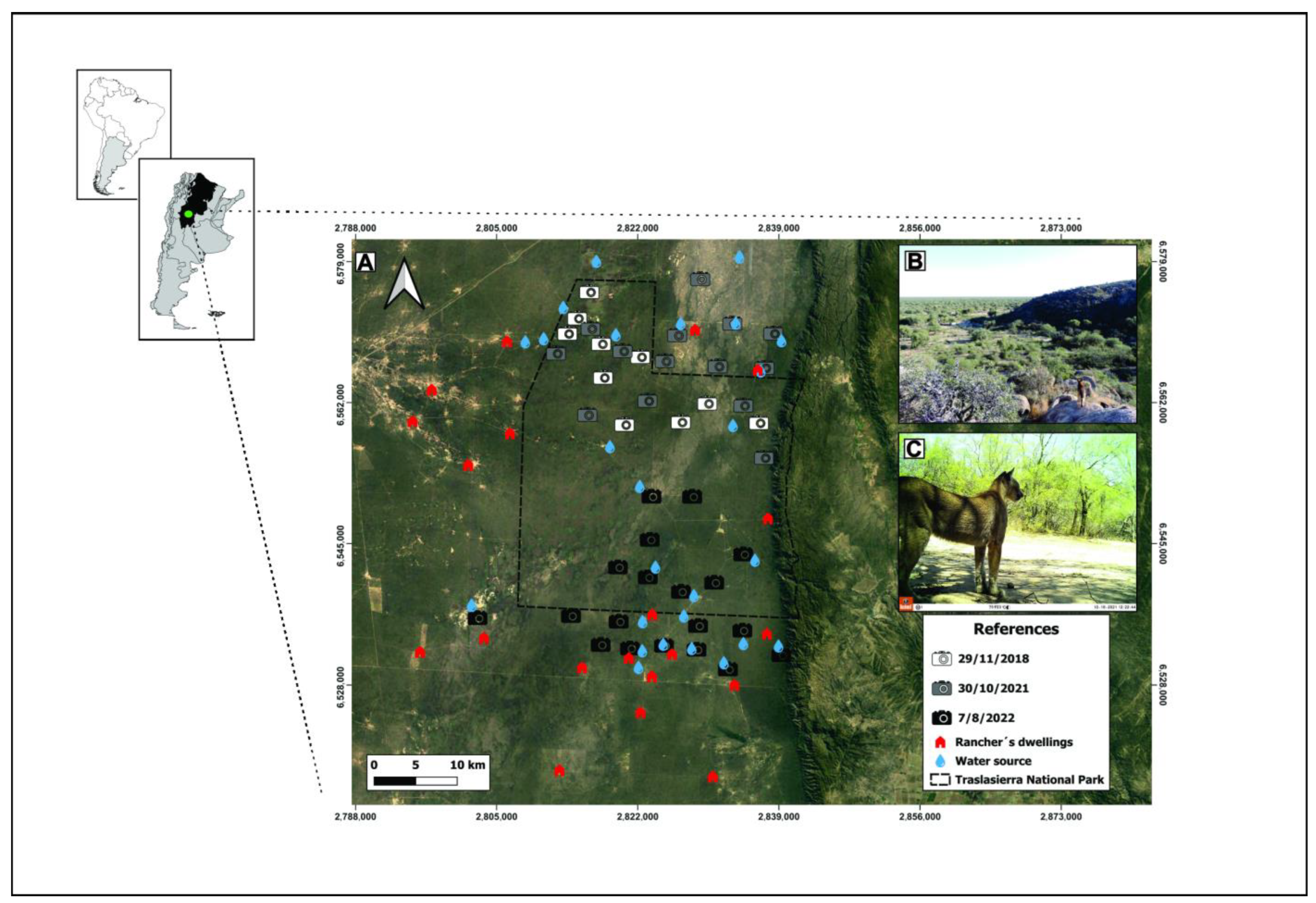



Human–Puma Conflict in the Dry Chaco: Species’ Occupancy and Ranchers’ Perception Before and After the Creation of a Protected Area


Abstract
1. Introduction
2. Methodology
2.1. Study Area
2.2. Ecological Sampling Design
2.3. Ecological Data Analysis
2.4. Sociological Surveys
2.5. Sociological Analysis
3. Results
3.1. Puma Occupancy
3.2. Intensity of Spatial Use by Puma
3.3. Ranchers’ Perceptions of Puma Predation
4. Discussion
5. Conclusions
Supplementary Materials
Author Contributions
Funding
Institutional Review Board Statement
Informed Consent Statement
Data Availability Statement
Acknowledgments
Conflicts of Interest
References
- Nyhus, P.J. Human—Wildlife conflict and coexistence. Annu. Rev. Environ. Resour. 2016, 41, 143–171. [Google Scholar] [CrossRef]
- Dickman, A.; Marchini, S.; Manfredo, M. The human dimension in addressing conflict with large carnivores. In Key Topics in Conservation Biology; Macdonald, D., Willis, K., Eds.; Wiley-Blackwell: Oxford, UK, 2013; Volume 2, pp. 110–126. [Google Scholar] [CrossRef]
- Graham, K.; Beckerman, A.P.; Thirgood, S. Human-predator-prey conflicts: Ecological correlates, prey losses and patterns of management. Biol. Conserv. 2005, 122, 159–171. [Google Scholar] [CrossRef]
- Wolf, C.; Ripple, W.J. Prey depletion as a threat to the world’s large carnivores. R. Soc. Open Sci. 2016, 3, 160252. [Google Scholar] [CrossRef]
- Zimmermann, A. First global summit on human–wildlife conflict and coexistence. Oryx 2023, 57, 417–418. [Google Scholar] [CrossRef]
- Engel, M.T.; Vaske, J.J.; Marchini, S.; Bath, A.J. Knowledge about big cats matters: Insights for conservationists and managers. Wildl. Soc. Bull. 2017, 41, 398–404. [Google Scholar] [CrossRef]
- Brenner, L.J.; Metcalf, E.C. Beyond the tolerance/intolerance dichotomy: Incorporating attitudes and acceptability into a robust definition of social tolerance of wildlife. Hum. Dimens. Wildl. 2020, 25, 259–267. [Google Scholar] [CrossRef]
- Corcoran, W.; Fisher, B. Life with big cats: Local perceptions of big cat species. Anim. Conserv. 2022, 25, 467–479. [Google Scholar] [CrossRef]
- Rossi, L.; Scuzzarella, C.M.; Angelici, F.M. Extinct or perhaps surviving relict populations of big cats: Their controversial stories and implications for conservation. In Problematic Wildlife II; Angelici, F., Rossi, L., Eds.; Springer: Cham, Switzerland, 2020; pp. 393–417. [Google Scholar] [CrossRef]
- Sunquist, M.; Sunquist, F. Wild Cats of the World; University of Chicago Press: Chicago, IL, USA, 2017. [Google Scholar]
- Pia, M.V.; Renison, D.; Mangeaud, A.; De Angelo, C.; Haro, J.G. Occurrence of top carnivores in relation to land protection status, human settlements and rock outcrops in the high mountains of central Argentina. J. Arid Environ. 2013, 91, 31–37. [Google Scholar] [CrossRef]
- Ripple, W.J.; Estes, J.A.; Beschta, R.L.; Wilmers, C.C.; Ritchie, E.G.; Hebblewhite, M.; Berger, J.; Elmhagen, B.; Letnic, M.; Nelson, M.P.; et al. Status and ecological effects of the world’s largest carnivores. Science 2014, 343, 1241484. [Google Scholar] [CrossRef]
- Ghoddousi, A.; Soofi, M.; Hamidi, A.K.; Lumetsberger, T.; Egli, L.; Khorozyan, I.; Kiabi, B.H.; Waltert, M. Assessing the role of livestock in big cat prey choice using spatiotemporal availability patterns. PLoS ONE 2016, 11, e0153439. [Google Scholar] [CrossRef]
- Woodroffe, R.; Ginsberg, J.R. Edge effects and the extinction of populations inside protected areas. Science 1998, 280, 2126–2128. [Google Scholar] [CrossRef]
- Meena, V.; Jhala, Y.V.; Chellam, R.; Pathak, B. Implications of diet composition of Asiatic lions for their conservation. J. Zool. 2011, 284, 60–67. [Google Scholar] [CrossRef]
- Long, H.; Mojo, D.; Fu, C.; Wang, G.; Kanga, E.; Oduor, A.M.; Zhang, L. Patterns of human–wildlife conflict and management implications in Kenya: A national perspective. Hum. Dimens. Wildl. 2020, 25, 121–135. [Google Scholar] [CrossRef]
- Castaño-Uribe, C.; Lasso, C.A.; Hoogesteijn, R.; Diaz-Pulido, A.; Payán, E. Conflicto entre Felinos y Humanos en América Latina; Alexander von Humboldt Institute Press: Bogotá, Colombia, 2017. [Google Scholar]
- Cavalcanti, M.C.; Marchini, A.; Zirnmerrnann, A.; Gese, E.M.; Macdonald, D.W. Jaguars, livestock and people in Brazil: Realities and perceptions behind the conflic. In The Biology and Conservation of Wild Felids; Macdonald, D., Loveridge, A., Eds.; Oxford University Press: Oxford, UK, 2010; pp. 383–402. Available online: https://digitalcommons.unl.edu/icwdm_usdanwrc/918 (accessed on 12 April 2024).
- Guerisoli, M.M.; Luengos Vidal, E.; Caruso, N.; Giordano, A.J.; Lucherini, M. Puma-livestock conflicts in the Americas: A review of the evidence. Mammal Rev. 2021, 51, 228–246. [Google Scholar] [CrossRef]
- Quiroga, V.A.; Boaglio, G.I.; Noss, A.J.; Di Bitetti, M.S. Critical population status of the jaguar (Panthera onca) in the Argentine Chaco: Camera-trap surveys suggest recent collapse and imminent regional extinction. Oryx 2014, 48, 141–148. [Google Scholar] [CrossRef]
- Quiroga, V.A.; Noss, A.J.; Paviolo, A.; Boaglio, G.I.; Di Bitetti, M.S. Puma density, habitat use and conflict with humans in the Argentine Chaco. J. Nat. Conserv. 2016, 31, 9–15. [Google Scholar] [CrossRef]
- Gallardo, G.; Pacheco, L.F.; Rios, R.S.; Jiménez, J.E. Predation of livestock by puma (Puma concolor) and culpeo fox (Lycalopex culpaeus): Numeric and economic perspectives. Therya 2020, 11, 359–373. [Google Scholar] [CrossRef]
- Nanni, A.S.; Teel, T.; Lucherini, M. Predation on livestock and its influence on tolerance toward pumas in agroecosystems of the Argentine Dry Chaco. Hum. Dimens. Wildl. 2020, 26, 429–444. [Google Scholar] [CrossRef]
- Gil-Fernández, M.; Peña-Mondragón, J.L.; Gómez-Hoyos, D.A.; Escobar-Lasso, S.; Marchini, S.; Carrillo, E. Attention matters: A preliminary assessment of ranchers’ attitudes towards big cats in Costa Rica. Trees For. People 2023, 13, 100408. [Google Scholar] [CrossRef]
- IUCN. IUCN SSC Guidelines on Human-Wildlife Conflict and Coexistence; IUCN Press: Gland, Switzerland, 2023. [Google Scholar]
- Costa, T. Environmental paradoxes: Perceptions of the environment in the Argentinian Southern Chaco. J. Contemp. Archaeol. 2022, 8, 325–341. [Google Scholar] [CrossRef]
- Nielsen, C.; Thompson, D.; Kelly, M.; Lopez-Gonzalez, C.A. Puma concolor. IUCN Red List Threat. Species 2015, e.T18868A97216466. [Google Scholar] [CrossRef]
- De Angelo, C.; Llanos, R.; Guerisoli, M.M.; Varela, D.; Valenzuela, A.E.J.; Pía, M.V.; Monteverde, M.; Reppucci, J.I.; Lucherini, M.; D’Agostino, R.; et al. Puma concolor. In Categorización 2019 de los Mamíferos de Argentina Según su Riesgo de Extinción; SAyDS–SAREM, Ed.; Lista Roja de los Mamíferos de Argentina: Buenos Aires, Argentina, 2019. [Google Scholar]
- LaBarge, L.R.; Evans, M.J.; Miller, J.R.; Cannataro, G.; Hunt, C.; Elbroch, L.M. Pumas (Puma concolor) as ecological brokers: A review of their biotic relationships. Mammal Rev. 2022, 52, 360–376. [Google Scholar] [CrossRef]
- Pia, M.V. Trophic interactions between puma and endemic culpeo fox after livestock removal in the high mountains of central Argentina. Mammalia 2013, 77, 273–283. [Google Scholar] [CrossRef]
- Llanos, R.; Travaini, A. Diet of puma (Puma concolor) in sheep ranches of central Patagonia (Argentina). J. Arid Environ. 2020, 177, 104145. [Google Scholar] [CrossRef]
- Karandikar, H.; Serota, M.W.; Sherman, W.C.; Green, J.R.; Verta, G.; Kremen, C.; Middleton, A.D. Dietary patterns of a versatile large carnivore, the puma (Puma concolor). Ecol. Evol. 2022, 12, e9002. [Google Scholar] [CrossRef]
- Vargas Melgarejo, L.M. Sobre el concepto de percepción. Alteridades 1994, 4, 47–53. Available online: https://alteridades.izt.uam.mx/index.php/Alte/article/view/588 (accessed on 20 April 2024).
- Ingold, T. The Perception of the Environment: Essays on Livelihood, Dwelling & Skill; Routledge Press: New York, NY, USA, 2000. [Google Scholar]
- Shahi, K.; Aryal, S.; Blon, R.K.; Khanal, G. Examining livestock depredation and the determinants of people’s attitudes towards snow leopards in the Himalayas of Nepal. Oryx 2023, 57, 489–496. [Google Scholar] [CrossRef]
- Cocimano, M.A.; Nanni, A.S.; Izquierdo, A.E. Co-building knowledge on human–puma conflict: A case study in a village of the Argentine Puna ecoregion. Hum. Dimens. Wildl. 2022, 27, 360–379. [Google Scholar] [CrossRef]
- Costa, T.; Manzano-García, J.; Mignino, J. Human–puma (Puma concolor (Linnaeus, 1771)) relations in the Dry Chaco of Córdoba, Argentina. Anthropozoologica 2022, 57, 241–253. [Google Scholar] [CrossRef]
- Manzano-García, J.; Costa, T.; Mignino, J. ¿El bicho se caza o es de casa?: Dicotomía entre el consumo y mascotismo de fauna silvestre en el Chaco Seco de la Provincia de Córdoba. Mundo Antes 2023, 17, 215–246. [Google Scholar] [CrossRef]
- Dickman, A.J. Complexities of conflict: The importance of considering social factors for effectively resolving human-wildlife conflict. Anim. Conserv. 2010, 13, 458–466. [Google Scholar] [CrossRef]
- Sharma, P.; Chettri, N.; Wangchuk, K. Human-wildlife conflict in the roof of the world: Understanding multidimensional perspectives through a systematic review. Ecol. Evol. 2021, 11, 11569–11586. [Google Scholar] [CrossRef]
- Reyes-García, V.; Cámara-Leret, R.; Halpern, B.S.; O’Hara, C.; Renard, D.; Zafra-Calvo, N.; Díaz, S. Biocultural vulnerability exposes threats of culturally important species. Proc. Natl. Acad. Sci. USA 2023, 120, e2217303120. [Google Scholar] [CrossRef]
- Zimmermann, A.; McQuinn, B.; Macdonald, D.W. Levels of conflict over wildlife: Understanding and addressing the right problem. Conserv. Sci. Pract. 2020, 2, e259. [Google Scholar] [CrossRef]
- Cabido, M.; Zeballos, S.R.; Zak, M.; Carranza, M.L.; Giorgis, M.A.; Cantero, J.J.; Acosta, A.T. Native woody vegetation in central Argentina: Classification of Chaco and Espinal forests. Appl. Veg. Sci. 2018, 21, 298–311. [Google Scholar] [CrossRef]
- Karlin, M.S.; Karlin, U.O.; Coirini, R.O.; Reati, G.J.; Zapata, R.M. El Chaco Árido; Universidad Nacional de Córdoba Press: Córdoba, Argentina, 2013. [Google Scholar]
- Cáceres, D.M.; Tapella, E.; Cabrol, D.A.; Estigarribia, L. Land use change and commodity frontiers: Perceptions, values, and conflicts over the appropriation of nature. Case Stud. Environ. 2020, 4, 1223610. [Google Scholar] [CrossRef]
- Nichols, J.D.; Karanth, K.U.; O’Connell, A.F. Science, conservation, and camera traps. In Camera Traps in Animal Ecology: Methods and Analyses; O’Connell, A.F., Ed.; Springer Press: New York, NY, USA, 2011; pp. 45–56. [Google Scholar]
- Niedballa, J.; Sollmann, R.; Courtiol, A.; Wilting, A. camtrapR: An R package for efficient camera trap data management. Methods Ecol. Evol. 2016, 7, 1457–1462. [Google Scholar] [CrossRef]
- Vieider, F.M. Bayesian Estimation of Decision Models. 2024. Available online: https://fvieider.quarto.pub/bstats/ (accessed on 22 April 2024).
- Hsieh, T.C.; Ma, K.H.; Chao, A. iNEXT: An R package for rarefaction and extrapolation of species diversity (Hill numbers). Methods Ecol. Evol. 2016, 7, 1451–1456. [Google Scholar] [CrossRef]
- Jost, J. Partial Differential Equations; Springer New Press: New York, NY, USA, 2007. [Google Scholar]
- Chao, A.; Gotelli, N.J.; Hsieh, T.C.; Sander, E.L.; Ma, K.H.; Colwell, R.K.; Ellison, A.M. Rarefaction and extrapolation with Hill numbers: A framework for sampling and estimation in species diversity studies. Ecol. Monogr. 2014, 84, 45–67. [Google Scholar] [CrossRef]
- Fiske, I.; Chandler, R. Unmarked: An R package for fitting hierarchical models of wildlife occurrence and abundance. J. Stat. Softw. 2011, 43, 1–23. [Google Scholar] [CrossRef]
- Oksanen, J.; Simpson, G.; Blanchet, F.; Kindt, R.; Legendre, P.; Minchin, P.; O’Hara, R.; Solymos, P.; Stevens, M.; Szoecs, E.; et al. Community Ecology Package, version 2.6-4; CRAN: Vienna, Austria, 2022. Available online: https://CRAN.R-project.org/package=vegan (accessed on 15 May 2024).
- Venables, W.; Ripley, B. Modern Applied Statistics with S, 4th ed.; Springer: New York, NY, USA, 2002. [Google Scholar]
- Bartoń, K. MuMIn: Multi-Model Inference, version 1.47.1; CRAN: Vienna, Austria, 2022.
- International Society of Ethnobiology. International Society of Ethnobiology Code of Ethics (with 2008 Additions). International Society of Ethnobiology, 2006. Available online: http://ethnobiology.net/code-of-ethics/ (accessed on 12 April 2024).
- Bernard, H.R. Research Methods in Anthropology: Qualitative and Quantitative Approaches; Oxford University Press: Oxford, UK, 2006. [Google Scholar]
- Lucherini, M.; Merino, M.J. Perceptions of human–carnivore conflicts in the high Andes of Argentina. Mt. Res. Dev. 2008, 28, 81–85. [Google Scholar] [CrossRef]
- Wegge, P.; Odden, M.; Pokharel, C.P.; Storaas, T. Predator-prey relationships and responses of ungulates and their predators to the establishment of protected areas: A case study of tigers, leopards and their prey in Bardia National Park, Nepal. Biol. Conserv. 2009, 142, 189–202. [Google Scholar] [CrossRef]
- Jansen, C.; Leslie, A.J.; Cristescu, B.; Teichman, K.J.; Martins, Q.E. Leopards living at the farmland-protected area interface prefer wild prey but consume high biomass of livestock. Afr. J. Ecol. 2023, 61, 1023–1029. [Google Scholar] [CrossRef]
- Novaro, A.J.; Funes, M.C.; Walker, R.S. An empirical test of source-sink dynamics induced by hunting. J. Appl. Ecol. 2005, 42, 910–920. [Google Scholar] [CrossRef]
- Stier, A.C.; Samhouri, J.F.; Novak, M.; Marshall, K.N.; Ward, E.J.; Holt, R.D.; Levin, P.S. Ecosystem context and historical contingency in apex predator recoveries. Sci. Adv. 2016, 2, e1501769. Available online: https://www.science.org/doi/10.1126/sciadv.1501769 (accessed on 28 May 2024). [CrossRef]
- Khorozyan, I.; Waltert, M. A global view on evidence-based effectiveness of interventions used to protect livestock from wild cats. Conserv. Sci. Pract. 2021, 3, e317. [Google Scholar] [CrossRef]
- Bogezi, C.; van Eeden, L.M.; Wirsing, A.J.; Marzluff, J.M. Ranchers’ perspectives on participating in non-lethal wolf-livestock coexistence strategies. Front. Conserv. Sci. 2021, 2, 683732. [Google Scholar] [CrossRef]
- Loveridge, A.J.S.W.; Wang, S.W.; Frank, L.; Seidensticker, J. People and wild felids: Conservation of cats and management of conflicts. In Biology and Conservation of Wild Felids; Macdonald, D.W., Loveridge, A.J., Eds.; Oxford University Press: Oxford, UK, 2010; pp. 161–198. [Google Scholar]
- Ontiveros, Y.; Cappa, F.M.; Andino, N.; Campos, C.M.; Borghi, C.E.; Giannoni, S.M. Mammal and bird diversity in a system of protected areas in Argentina. Biodiversity 2022, 23, 61–71. [Google Scholar] [CrossRef]
- Law, E.A.; Macchi, L.; Baumann, M.; Decarre, J.; Gavier-Pizarro, G.; Levers, C.; Mastrangelo, M.E.; Murray, F.; Müller, D.; Piquer-Rodríguez, M.; et al. Fading opportunities for mitigating agriculture–environment trade-offs in a South American deforestation hotspot. Biol. Conserv. 2021, 262, 109310. [Google Scholar] [CrossRef]
- Nanni, A.S.; Ghoddousi, A.; Romero-Muñoz, A.; Baumann, M.; Burton, J.; Camino, M.; Decarre, J.; Martello, F.; Regolin, A.L.; Kuemmerle, T. Mapping opportunities and barriers for coexistence between people and pumas in the Argentine Dry Chaco. Divers. Distrib. 2024, 30, e13920. [Google Scholar] [CrossRef]
- Ballejo, F.; Plaza, P.; Di Virgilio, A.; Lucherini, M.; Gaspero, P.; Guerisoli, M.; Novaro, A.; Funes, M.; Lambertucci, S. Desentrañando las interacciones negativas entre humanos, mamíferos carnívoros y rapaces en América del Sur. Ecol. Austral 2022, 32, 620–637. [Google Scholar] [CrossRef]
- Sillero-Zubiri, C.; Caruso, F.; Chen, Y.; Christidi, D.; Eshete, G.; Sanjeewani, N.; Mathe, L.; Pierre, M.A. From conflict to coexistence: The challenges of the expanding human–wildlife interface. Oryx 2023, 57, 409–410. [Google Scholar] [CrossRef]



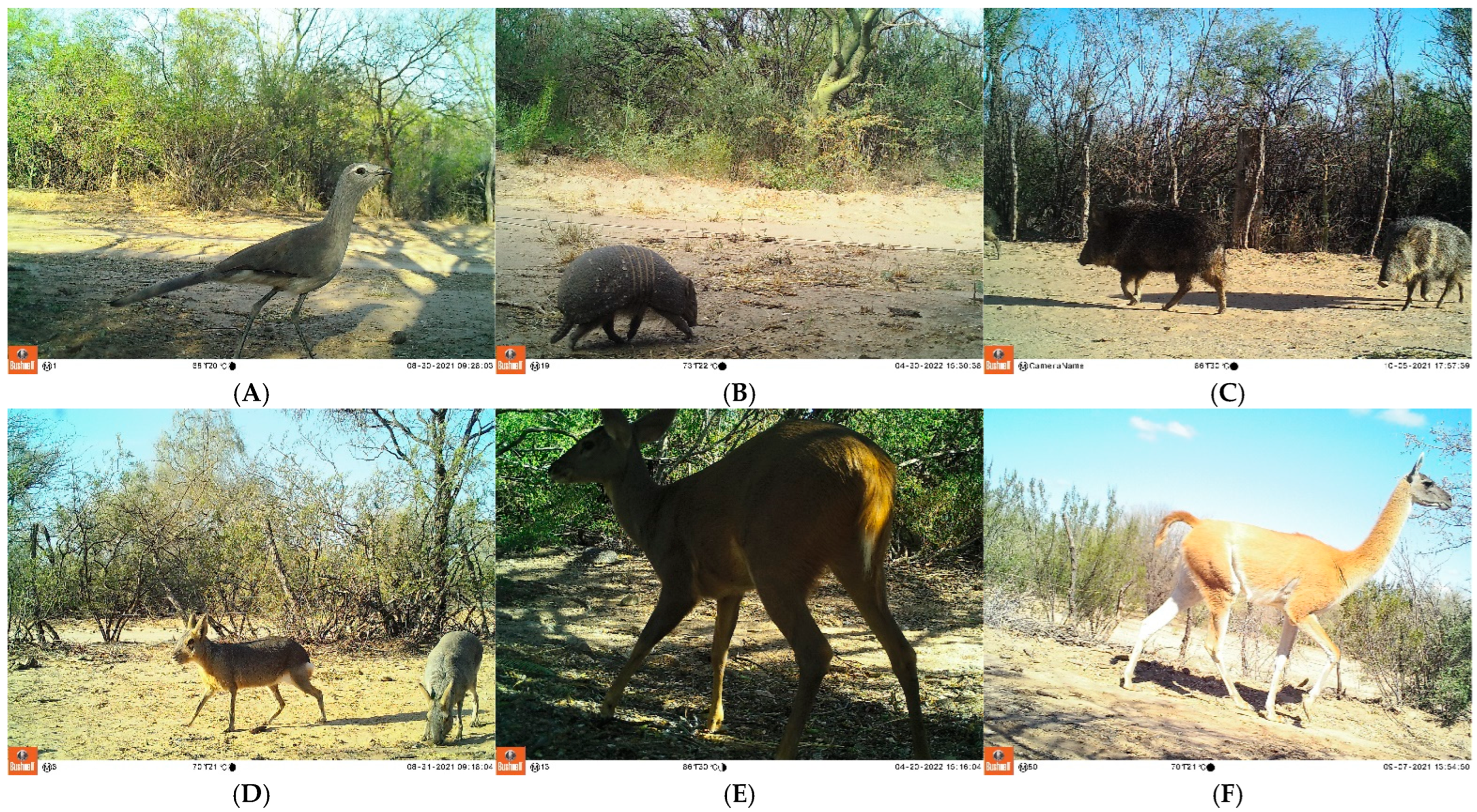
| Animal Class | Scientific Names | Common Name |
|---|---|---|
| Bird | Chunga burmeisteri | Chuña |
| Bird | Nothoprocta cinerascens | Inambú montaraz |
| Bird | Eudromia elegans | Martineta |
| Bird | Rhea americana | Ñandú |
| Mammal | Dolichotis salinicola | Conejo del palo |
| Mammal | Mazama gouazoubira | Corzuela |
| Mammal | Lama guanicoe | Guanaco |
| Mammal | Sus scrofa | Jabalí * |
| Mammal | Lepus europaeus | Liebre europea * |
| Mammal | Dolichotis patagonum | Mara |
| Mammal | Catagonus wagneri | Pecarí quimelero |
| Mammal | Pecari tajacu | Pecarí de collar |
| Mammal | Chaetophractus sp. | Quirquincho |
| Mammal | Microcavia jayat | Cuis |
| Mammal | Tolypeutes matacus | Mataco bola |
| Mammal | Lagostomus maximus | Vizcacha |
| Reptile | Salvator rufescens | Iguana |
| Reptile | Chelonoidis chilensis | Tortuga |
| MODELS | ELPD | k | Δ ELPD | SE ELPD | Elpd Weight | R_Hat | Min_n_eff |
|---|---|---|---|---|---|---|---|
| occupancy term (ψ) | |||||||
| 2018 | |||||||
| ~1~1 | −16.19 | 2.35 | 0 | 0 | 0.21 | 1 | 32,622.40 |
| ~1~dist_ranch | −16.24 | 2.95 | 0.05 | 0.56 | 0.21 | 0.99 | 40,679.15 |
| ~1~dist_wat | −16.50 | 3.1 | 0.3 | 0.84 | 0.18 | 1 | 39,900.26 |
| ~1~dist_ranch + dist_water + q0 + q1 | −16.83 | 4.59 | 0.64 | 0.78 | 0.15 | 1 | 42,510.69 |
| ~1~q1 | −16.90 | 3.71 | 0.71 | 1.03 | 0.15 | 1 | 38,727.71 |
| ~1~q0 | −17.64 | 3.96 | 1.45 | 0.8 | 0.1 | 1 | 36,574.42 |
| 2021 | |||||||
| ~1~1 | −59.19 | 3.3 | 0 | 0 | 0.14 | 0.99 | 35,091.20 |
| ~1~P_NP | −59.33 | 3.92 | 0.13 | 0.89 | 0.13 | 1 | 36,367.59 |
| ~1~dist_ranch | −59.45 | 4.5 | 0.25 | 1.54 | 0.12 | 1 | 33,788.92 |
| ~1~occu_C | −59.63 | 4.25 | 0.43 | 1.13 | 0.11 | 0.99 | 27,212.99 |
| ~1~dens_C | −59.68 | 4.3 | 0.45 | 1.1 | 0.11 | 1 | 38,844.84 |
| ~1~dens_C + occu_C | −59.77 | 4.41 | 0.53 | 1.31 | 0.11 | 1 | 34,264.89 |
| ~1~q1 | −59.79 | 4.34 | 0.58 | 0.64 | 0.1 | 0.99 | 30,754.88 |
| ~1~q0 | −60.24 | 4.33 | 1.03 | 0.38 | 0.08 | 1 | 34,961.03 |
| ~1~dist_wat | −60.33 | 4.46 | 1.12 | 0.33 | 0.08 | 0.99 | 36,960.88 |
| 2022 | |||||||
| ~1~q0 | −47.42 | 2.44 | 0 | 0 | 0.19 | 1 | 35,327.34 |
| ~1~occu_C | −48.05 | 2.06 | 0.63 | 2.07 | 0.14 | 1 | 34,713.27 |
| ~1~dens_C | −48.50 | 2.8 | 1.08 | 1.64 | 0.11 | 1 | 33,917.52 |
| ~1~P_PN | −48.56 | 2.34 | 1.13 | 1.78 | 0.11 | 1 | 35,033.11 |
| ~1~dens_C + Occu_C | −48.56 | 3.2 | 1.14 | 1.97 | 0.11 | 1 | 37,588.45 |
| ~1~1 | −49.16 | 2 | 1.74 | 1.73 | 0.08 | 1 | 29,468.81 |
| ~1~dist_ranch + dist_wat + q0 + q1 + dens_C + occu_C + P_NP | −49.19 | 5.96 | 1.76 | 1.41 | 0.08 | 1 | 38,774.09 |
| Models | k | AICc | ΔAICc | wi | Cum_wi |
|---|---|---|---|---|---|
| 2018 (unprotected sites) | |||||
| q1 | 2 | 16.82 | 0.00 | 0.68 | 0.68 |
| q0 | 2 | 20.34 | 3.52 | 0.12 | 0.80 |
| D_ranch | 2 | 20.35 | 3.52 | 0.12 | 0.92 |
| NULL | 1 | 21.41 | 4.59 | 0.07 | 0.99 |
| D_water | 2 | 24.53 | 7.71 | 0.01 | 1.00 |
| 2021 (6 protected and 7 unprotected sites) | |||||
| NULL | 2 | 68.30 | 0.00 | 0.30 | 0.30 |
| D_ranch | 3 | 68.88 | 0.58 | 0.22 | 0.52 |
| Occu_C | 3 | 70.74 | 2.43 | 0.09 | 0.61 |
| P_NP | 3 | 70.74 | 2.43 | 0.09 | 0.70 |
| Dens_C | 3 | 70.74 | 2.43 | 0.09 | 0.79 |
| 2022 (8 protected and 9 unprotected sites) | |||||
| q0 | 2 | 50.22 | 0.00 | 0.31 | 0.31 |
| Occu_C | 2 | 50.25 | 0.03 | 0.31 | 0.62 |
| Dens_C | 2 | 51.44 | 1.22 | 0.17 | 0.79 |
| P_NP | 2 | 52.31 | 2.09 | 0.11 | 0.90 |
| NULL | 2 | 54.02 | 3.81 | 0.05 | 0.95 |
| Explanatory Variable | Parameter Estimate ± SE | CL | |
|---|---|---|---|
| Lower | Upper | ||
| 2018 | |||
| Intercept | −1.83 ± 0.89 | −4.26 | −0.50 |
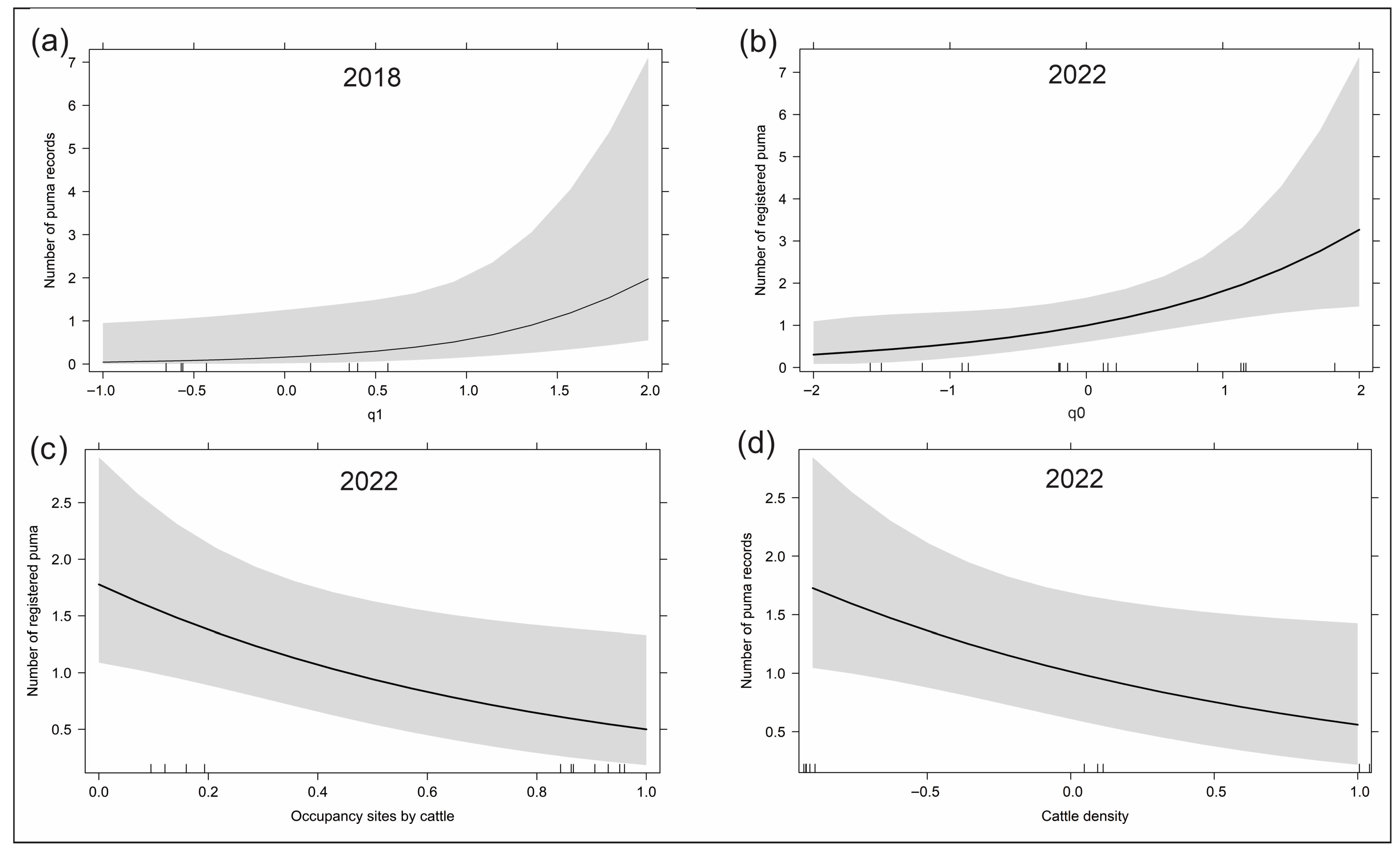
| q1 | 1.26 ± 0.49 | 0.38 | 2.45 |
| 2022 | |||
| Intercept | −0.00 ± 0.26 | −0.57 | 0.46 |
| q0 | 0.59 ± 0.24 | 0.13 | 1.08 |
| Intercept | 0.58 ± 0.25 | 0.04 | 1.03 |
| Occu_C | −1.27 ± 0.56 | −2.52 | −0.27 |
| Intercept | 0.01 ± 0.26 | −0.56 | 0.48 |
| Dens_C | −0.59 ± 0.29 | −1.22 | −0.08 |
| Causes of Livestock Loss | Puma Predation | Drought | Theft | Accident | Disease |
|---|---|---|---|---|---|
| Importance (scale from 1 to 5) | 5 | 3 | 1 | 1 | 1 |
| Average % of livestock loss before park creation | 10 | 5 | 1 | 1 | 1 |
| Average % of livestock loss the year after livestock removal from the park (2020) | 25 | 5 | 1 | 1 | 1 |
| Average % of livestock loss after the first year of livestock removal from the park (2021/22) | 12 | 5 | 1 | 1 | 1 |
| Average % of tolerance of livestock loss | 1.35 | 5 | 0 | 1 | 1 |
Disclaimer/Publisher’s Note: The statements, opinions and data contained in all publications are solely those of the individual author(s) and contributor(s) and not of MDPI and/or the editor(s). MDPI and/or the editor(s) disclaim responsibility for any injury to people or property resulting from any ideas, methods, instructions or products referred to in the content. |
© 2025 by the authors. Licensee MDPI, Basel, Switzerland. This article is an open access article distributed under the terms and conditions of the Creative Commons Attribution (CC BY) license (https://creativecommons.org/licenses/by/4.0/).
Share and Cite
Barri, F.R.; Costa, T.; Manzano-García, J.; Cappa, F. Human–Puma Conflict in the Dry Chaco: Species’ Occupancy and Ranchers’ Perception Before and After the Creation of a Protected Area. Conservation 2025, 5, 78. https://doi.org/10.3390/conservation5040078
Barri FR, Costa T, Manzano-García J, Cappa F. Human–Puma Conflict in the Dry Chaco: Species’ Occupancy and Ranchers’ Perception Before and After the Creation of a Protected Area. Conservation. 2025; 5(4):78. https://doi.org/10.3390/conservation5040078
Chicago/Turabian StyleBarri, Fernando R., Thiago Costa, Jessica Manzano-García, and Flavio Cappa. 2025. "Human–Puma Conflict in the Dry Chaco: Species’ Occupancy and Ranchers’ Perception Before and After the Creation of a Protected Area" Conservation 5, no. 4: 78. https://doi.org/10.3390/conservation5040078
APA StyleBarri, F. R., Costa, T., Manzano-García, J., & Cappa, F. (2025). Human–Puma Conflict in the Dry Chaco: Species’ Occupancy and Ranchers’ Perception Before and After the Creation of a Protected Area. Conservation, 5(4), 78. https://doi.org/10.3390/conservation5040078