Article

Assessing Genetic Diversity, Connectivity, and Demographic Parameters of Neotropical Otters (Lontra annectens) in Northern Costa Rica


Department of Fish and Wildlife Sciences, University of Idaho, Moscow, ID 83844, USA
*
Author to whom correspondence should be addressed.
Conservation 2026, 6(1), 16; https://doi.org/10.3390/conservation6010016
Submission received: 19 November 2025 / Revised: 2 January 2026 / Accepted: 25 January 2026 / Published: 2 February 2026

Abstract

The recent recognition of the Neotropical otter (Lontra annectens) as a distinct species highlights the need to evaluate its genetic status and connectivity across fragmented tropical habitats. We analyzed genetic diversity, population structure, and recent demographic patterns of L. annectens from two contrasting regions in northern Costa Rica—Tortuguero National Park (TNP) and the Sarapiquí River Basin (SRB). Non-invasive fecal and anal-gland secretion samples collected during 2021–2022 were genotyped at ten nuclear DNA microsatellite loci. Genetic diversity was moderate across regions (mean allelic richness [AR] = 3.98–4.03, observed heterozygosity [Ho] = 0.52–0.58), expected heterozygosity [He] = 0.62–0.65) with no significant inter-regional differences. Bayesian clustering, principal component analysis, and pairwise FST (0.002) supported a near-panmictic population. Kinship analyses detected localized clusters of related individuals, suggesting weak but non-random structuring, while contemporary migration estimates indicated low-frequency, asymmetric gene flow from SRB to TNP. Bottleneck tests revealed signatures of recent demographic contraction in both regions, particularly in TNP. These findings demonstrate limited yet ongoing connectivity among riverine subpopulations and emphasize that increasing habitat fragmentation could erode this exchange. Maintaining hydrological corridors and monitoring genetically vulnerable subpopulations should be conservation priorities to preserve gene flow and long-term viability of L. annectens in northern Costa Rica.

1. Introduction

Genetic diversity is a fundamental component of biodiversity, supporting the adaptability, resilience, and long-term viability of natural populations [1,2]. High levels of genetic variation enhance a population’s ability to respond to environmental changes, resist pathogens, and maintain reproductive success under variable conditions [3]. Conversely, reduced genetic diversity limits adaptive potential and increases extinction risk, especially in small or isolated populations where genetic drift and inbreeding are more pronounced [4,5]. These stochastic processes contribute to the random loss of alleles, progressively eroding genetic variation over time [6]. Additionally, habitat loss and fragmentation further amplify these effects by disrupting gene flow, increasing differentiation among subpopulations, and creating physical and ecological barriers to dispersal [7,8]. As a result, fragmented populations often experience reduced allelic richness and an increased fixation of deleterious alleles, thereby diminishing their capacity for adaptive evolution [5].
The strong correlation between genetic diversity and connectivity highlights the importance of reducing habitat fragmentation, as functional gene flow among populations helps counteract the negative effects of drift and inbreeding [9,10]. Thus, conservation strategies should focus on maintaining genetic connectivity and preventing genetic erosion through habitat restoration, population monitoring, and interventions such as assisted gene flow [2,11]. Populations with limited connectivity are particularly susceptible to stochastic loss of genetic variability, which constrains their adaptive capacity [12,13]. Moreover, low diversity reduces the likelihood of retaining beneficial alleles linked to disease resistance and climate adaptation, further elevating extinction risk [14,15,16].
A primary concern for small populations is the occurrence of genetic bottlenecks, which exacerbate genetic erosion by reducing allelic diversity and increasing inbreeding [17]. Genetic bottlenecks arise when a population undergoes a drastic size reduction, leading to the survival of only a fraction of its original members and a subsequent loss of genetic diversity [5]. Loss of rare alleles and declining heterozygosity heighten vulnerability to inbreeding, further endangering individual and population fitness [9,15]. Identifying genetic bottlenecks is particularly crucial for species with limited distributions or low densities, as genetic stochasticity disproportionately affects these populations [10,18]. Additionally, evaluating bottleneck events provides critical insights into demographic history, enabling conservationists to anticipate long-term genetic consequences and implement targeted interventions [5,15].
Over the past decade, the Global Otter Conservation Strategy has underscored the importance of genetic research for evaluating demographic trends and connectivity across all otter species [19,20].
The Neotropical otter (L. annectens Major 1897), formerly classified as L. longicaudis annectens and recently elevated to species status [21], is a solitary carnivore and a key predator in tropical freshwater ecosystems [22]. It inhabits a wide range of aquatic environments, including rivers, lagoons, and coastal wetlands, with a distribution spanning from northern Mexico through Central America to the western Andes of South America [21,23]. According to the International Union for Conservation of Nature (IUCN) Red List, the species is classified as Near Threatened, reflecting an ongoing decline [24]. Historically, the species suffered substantial losses due to intensive hunting for the global fur trade, resulting in local extinctions across parts of its range [22,25]. Sustained anthropogenic pressures are projected to drive a population decline of ≥20% over the next 30 years [26]), underscoring its vulnerability and the urgent need for targeted conservation measures.
Recent microsatellite-based studies have assessed genetic diversity within the Lontra genus. For example, L. annectens in central (Ho = 0.50, He = 0.62; [27]) and southern Mexico (Ho = 0.59, He = 0.67; [28]) exhibits moderate diversity, comparable to L. longicaudis from Argentina’s Lower Paraná River Delta (Ho = 0.56, He = 0.52; [29]). Yet, L. annectens displays higher diversity than L. longicaudis populations in degraded southern Brazilian rivers (Ho = 0.32, He = 0.70; [30]), though lower than Brazilian populations from the Maquiné Valley (Ho = 0.83, He = 0.73; [31]). Although recent studies have improved our understanding of Neotropical otter genetics, substantial knowledge gaps persist regarding diversity and connectivity across river systems in Central America. Additional research focusing on genetic parameters in this region is crucial to clarify these patterns and support effective conservation strategies.
This study is the first evaluation of genetic diversity and population structure in L. annectens across distinct river systems in Costa Rica. We examine populations from the Sarapiquí River Basin—specifically the Sarapiquí and Puerto Viejo Rivers—and from Tortuguero National Park, located within the Reventazón River Basin, focusing on the Tortuguero River and Caño Palma Stream. Our objectives were to: (a) identify patterns of population genetic structure both within and among basins; (b) assess levels of genetic variation within and among genetic groups; (c) examine contemporary gene flow and movement patterns within and among basins or genetic groups; (d) test for evidence of recent bottlenecks; and (e) assess site fidelity through seasonal recaptures to evaluate spatial permanency and long-term habitat use.
We hypothesized that major rivers—specifically the Sarapiquí, Puerto Viejo, and Tortuguero rivers—would significantly influence population genetic structure and connectivity within the Sarapiquí River Basin and Tortuguero National Park. Furthermore, due to its well-connected stream network and minimal human disturbance, we expected that otters in Tortuguero National Park would exhibit higher levels of genetic diversity. In contrast, we hypothesized that genetic groups or populations inhabiting areas with greater anthropogenic impact would exhibit signatures of recent genetic bottlenecks. Finally, we hypothesized that Neotropical otters would show strong site fidelity, consistently using the same locations across seasons, indicating space-use patterns and long-term philopatry. We assessed our hypotheses by analyzing fecal DNA collected using non-invasive genetic sampling, which allowed us to maximize sample sizes because capturing otters can be challenging and time-consuming [32,33]. Our findings will inform ongoing and future conservation and management strategies by offering essential baseline data about the status of Neotropical otter populations within Costa Rica.

2. Materials and Methods

2.1. Study Area

Our study was conducted in two ecologically important regions of northern Costa Rica: the Sarapiquí and Puerto Viejo rivers, located within the SRB, and the Tortuguero River and Caño Palma Stream, situated in TNP within the Reventazón River Basin. The SRB lies on Costa Rica’s northern Caribbean slope and drains an area of 2793 km2 [34]. It maintains relatively stable temperatures between 26 °C and 28 °C year-round, receives up to 5 m of annual rainfall [35], and spans elevations from 10 m to 2896 m [36]. The region supports extensive banana and pineapple plantations for export, livestock farming, and tourism [37]. In contrast, TNP covers 76,316 km2 along the northeastern Caribbean region, with elevations ranging from sea level to 311 m [38]. Temperatures range from 25 °C to 30 °C, and annual precipitation reaches approximately 6.4 m [39]. Local economies depend on fishing, subsistence agriculture, livestock farming, and tourism [40,41]. Ecologically, the two regions differ considerably. TNP is dominated by Tropical Wet Forest and a highly connected hydrological network [38], while the SRB has undergone extensive landscape modification due to agricultural expansion and human development [34]. These contrasting environmental and anthropogenic conditions shape the distinct ecological dynamics of each region (Figure 1).

2.2. Fecal DNA Collection and Extraction

We conducted non-invasive fecal DNA sampling of Neotropical otters by collecting fresh feces (<24 h old) and gland secretions (hereinafter referred to as “jellies”) for genetic analysis. Sampling was carried out during two distinct periods: May–August 2021 and March–May 2022. Fecal samples were collected from latrines located along logs and boulders of the primary drainages and tributaries within the SRB and TNP. To optimize sample collection, we employed terrestrial walking surveys, motorboats, rafts and kayaks, depending on the accessibility of riverbanks. The selection of optimal fecal samples for genetic analyses was based on morphological characteristics, including texture, color, and odor, which served as indicators of freshness. All sampling procedures were conducted under research permits R-031-2021-OT-CONAGEBIO and R-025-2022-OT-CONAGEBIO.
Fecal samples were collected using a sterile, disposable foam-tipped swab (Puritan Medical Products Company LLC, Guilford, ME, USA), which was gently rubbed over fresh feces or jellies. Each swab was then placed into a 2 mL screw-top tube containing 1.5 mL of ATL lysis buffer from the DNeasy® Qiagen Blood and Tissue Kit (Qiagen Inc., Hilden, Germany; [42]). This method has been demonstrated to effectively capture epithelial cells from the mucus layer covering otter feces, facilitating high-quality DNA extraction [43,44,45,46]. Samples were stored at room temperature for three to five months before DNA extraction at the Laboratory for Ecological, Evolutionary, and Conservation Genetics (LEECG) at the University of Idaho (Moscow, ID, USA).
DNA extractions were conducted in a dedicated low-quantity DNA processing room at the University of Idaho’s LEECG. This facility is specifically designed for non-invasive genetic research and provides a controlled environment that minimizes the risk of contamination when working with low-concentration DNA samples. DNA extraction was conducted from fecal samples obtained from each foam-tipped swab utilizing the QIAamp® DNA Stool Mini Kit (Qiagen Inc., Hilden, Germany), following a modified version of the manufacturer’s protocol. To monitor potential contamination, a negative control was included in each extraction batch [47]. All purified DNA samples were stored at −20 °C until further analyses. A comprehensive description of the fecal DNA collection and extraction protocols is available in [46].

2.3. Microsatellite Amplification and Genotyping

An initial screening of Neotropical otter samples was performed using polymerase chain reaction (PCR) amplification at twelve nuclear DNA microsatellite loci. These loci were originally developed for Eurasian (Lutra lutra) and North American (L. canadensis) otters [48,49,50,51]. To assess the suitability of these markers, we evaluated their allelic variation and calculated probabilities of identity for both unrelated individuals and siblings [52]. Furthermore, PCR amplification success and genotyping accuracy were examined to ensure the reliability of selected loci [53]. Following microsatellite screening, loci RIO06 and RIO07 [51] were excluded due to poor amplification performance and inconsistent genotyping results. The remaining ten nuclear DNA microsatellite loci were combined into a single multiplex PCR (Table S1), labeled with fluorescent dyes (RIO01-FAM, RIO02-NED, RIO04-FAM, RIO08-PET, RIO13-NED, RIO16-PET [51]; RIO03-FAM [48]; RIO11-VIC, RIO12-NED [49]; Lut453-VIC [50]). PCR reaction components and thermal cycling conditions are detailed in the Supplementary Material.
Negative and positive controls were included in each batch of reactions to test for contamination and reagent quality. We visualized PCR products using an Applied Biosystems 3130xl capillary machine (Applied Biosystems Inc., Foster City, CA, USA) with GeneScan 500 LIZ (Applied Biosystems Inc.), size standard, and genotypes were identified using GENEMAPPER v6.0 (Applied Biosystems, Carlsbad, CA, USA).
To enhance quality control in PCR and minimize genotyping errors, we employed a multi-tube approach [54]. Initially, all samples were amplified in duplicate. Low-quality samples that failed to amplify at a minimum of 40% of the attempted PCRs (≥8 loci out of 20, which is 10 loci × 2 reps each) were discarded, while those meeting this threshold were retained for further analysis. For each qualifying sample, additional PCR replicates were performed until a consensus genotype was established, or a maximum of six replicates per sample and locus was reached. Consensus genotypes were determined by comparing replicate profiles using a custom Microsoft Access-based application developed for genotype comparison and consensus genotype calling. To confirm heterozygous genotypes, each allele had to be observed in at least two independent PCR replicates, whereas a minimum of three replicates was required to validate homozygous genotypes [53]. To verify individual identification and assess the discriminatory power of the ten microsatellite loci, we calculated the cumulative probabilities of identity for both unrelated individuals (P(ID)) and siblings (P(ID)sibs) using GenAlEx v6.5 [55]. Analyses followed the methodology described in [52]. Samples that did not achieve a PIDsibs < 0.01 were excluded from further analyses [56]. A minimum of six loci were required to reliably distinguish between unrelated individuals. Additionally, genotyping error (allelic dropout, ADO; false allele, FA) rates were estimated by identifying discrepancies in genotypes across PCR replicates [57]. Rates of ADO were calculated exclusively from heterozygous loci, whereas FA rates were estimated across all consensus genotypes. The presence of null alleles was assessed using MICRO-CHECKER v2.2.3 [58].

2.4. Genetic Diversity Analysis

We assessed deviations from Hardy–Weinberg equilibrium (HWE) among microsatellite loci by calculating the inbreeding coefficient (FIS) and examined linkage disequilibrium (LDE) between pairs of loci using the R package genepop v1.2.2 [59]. To account for multiple comparisons, false discovery rate (FDR) adjustments were applied using the Benjamini–Hochberg correction [60]. Additionally, we calculated standard genetic diversity indices, including the number of alleles (Na), observed heterozygosity (Ho), and expected heterozygosity (He), were estimated for each locus and across all loci using GenAlEx [55]. Allelic richness (AR) and private allelic richness (PAR) were calculated employing the rarefaction method implemented in HP-RARE v1.0 [61]. We tested for significant differences in AR, Ho, and He among populations using the Kruskal–Wallis rank-sum test. Statistical analyses were performed in base R v4.5.0 [62]. Data visualization and multi-panel figure layouts were performed using the R packages ggplot2 v3.5.2 [63] and patchwork v1.3.0 [64]. Unless indicated otherwise, results are presented as mean ± standard error (SE).

2.5. Population Structure Analysis

Genetic differentiation between TNP and SRB was evaluated using the FST fixation index [65], calculated in FST-FREENA with the exclusion of null alleles (ENA) correction method, and incorporating 1000 bootstrap iterations in FREENA software v1.0 [66]. The analysis involved a comparison of FST estimates both before and after correcting for null alleles. To further explore genetic structure, we also conducted a non-model-based multivariate analysis using Principal Component Analysis (PCA), implemented in the R packages adegenet v2.1.11 [67] and ade4 v 1.7-23 [68]. PCA plot visualization was performed using ggplot2 v3.5.2 [63]. In addition, we employed an aspatial Bayesian clustering algorithm to infer genetic structure using the STRUCTURE v2.3.4 program [69]. STRUCTURE analyses were conducted under the admixture model with correlated allele frequencies. We ran 10 independent replicates per K (ranging from 1 to 10), with a burn-in of 50,000 iterations followed by 1,000,000 Markov Chain Monte Carlo (MCMC). The most likely number of genetic clusters (K) was determined using the log-likelihood and ΔK methods [70] and visualized in the R package pophelper v2.3.1 [71]. We then estimated individual ancestry and admixture using the R package tess3r v1.1.0 [72], which employs maximum likelihood estimation to determine genome proportions from K ancestral populations [73]. This approach also integrates geographic coordinates to account for spatial autocorrelation in ancestry coefficients [74], allowing individual admixture proportions (Q-matrix) to vary across the landscape [72,75]. The values of K were evaluated within a range of 1 to 10, and the optimal K value was determined by implementing a cross-validation (CV) procedure.

2.6. Migration Estimates

We estimated contemporary migration rates (m) between and within sampling locations using BayesAss v3.0.5 [76]. The model assumes that individuals in the dataset may be migrants from one of the last three generations, and it estimates the fraction of individuals in each population that are migrants per generation. In addition, it considers information from private alleles to detect gene flow over recent generations [77] and does not assume Hardy–Weinberg equilibrium among populations [78]. BayesAss estimated m as the proportion of individuals in population i whose ancestry originates from population j, allowing the quantification of both resident and immigrant proportions within each population [79]. We conducted preliminary tests to adjust mixing parameters (range 0.2–0.6; a = 0.5, m = 0.5, f = 0.7). Then, we executed 10 independent Markov Chain Monte Carlo (MCMC) iterations with different seed values, comprising 10 million iterations, a 1 million iteration burn-in, and sampling every 1000 iterations. The convergence of MCMC performances and effective sample sizes (ESS) was evaluated using Tracer v1.7.2 [80]. Fine-scale migration rates were estimated for each region, with the TNP population subdivided into the Tortuguero River (TR) and Caño Palma Station (CPS), and the SRB population comprising the Puerto Viejo River (PVR) and Sarapiquí River (SR).
Additionally, we employed ML-RELATE [81] to estimate relatedness coefficients (r) and classify the pedigree relationships among Neotropical otter dyads (i.e., pairwise comparisons) sampled within and between the TNP and SRB regions. ML-RELATE applies a maximum-likelihood framework to assign dyads to one of four relationship categories: unrelated (U), half-siblings (HS), full-siblings (FS), or parent–offspring (PO). Relatedness coefficients (r) were estimated within the following thresholds: r ≤ 0.20 for unrelated individuals, 0.21 ≤ r ≤ 0.35 for half-siblings, 0.36 ≤ r ≤ 0.49 for full-siblings, and r ≥ 0.50 for first-order relationships (i.e., parent–offspring). Pairwise heatmaps of migration rates (m) and relatedness coefficients (r) were generated using the R package reshape2 v1.4.4 [82] and visualized with ggplot2 v3.5.2 [63]. Multi-panel figure arrangements were constructed using the patchwork package v1.3.0 [64] in R v4.5.0 [62].

2.7. Bottleneck Estimations

We used BOTTLENECK v1.2.02 [83] to detect genetic bottleneck signatures in Neotropical otter populations across each study system. This software evaluates deviations from the mutation–drift equilibrium by testing for heterozygote excess [83,84]. To determine whether our populations exhibited an excess of heterozygosity, we applied three different mutation models: Infinite Allele Model (IAM), Two Phase Model (TPM), and Stepwise Mutation Model (SMM). We set parameters for the TPM at 1000 iterations, with a proportion of 70% for SMM and 30% for IAM. We evaluated the statistical significance of heterozygosity excess using the Wilcoxon signed-rank test [84]. False discovery rate (FDR) adjustments were applied to account for multiple comparisons using the Benjamini–Hochberg correction [60]. We also calculated M-ratio values [85] across all microsatellite loci using R v4.5.0 [62]. This method estimates the ratio of the observed number of alleles to the overall range of allelic sizes, based on the assumption that the ratio is expected to decrease in correlation with a recent population decline due to the random loss of rare alleles [86]. An M-ratio below the critical value (Mc = 0.68) indicates a genetic bottleneck [85].

3. Results

3.1. Microsatellite Amplification and Genotyping Analyses

A total of 174 fecal samples were collected (feces [n = 132], jellies [n = 42]), along primary drainages and tributaries within TNP (n = 85) and the SRB (n = 89). Nuclear DNA (nDNA) amplification across 10 microsatellite loci yielded a success rate of 41%, resulting in 72 successfully genotyped samples. The cumulative mean genotyping error rates were 0.002 for false alleles and 0.138 for allelic dropout. Per-locus error rates ranged from 0.05 to 0.24, with an average of 0.14 across loci at both sites. Cumulative P(ID) and P(ID)sibs estimates across all 10 loci were 1.6 × 10⁻⁸ and 4.8 × 10⁻⁴, respectively, whereas all combinations of six loci were used for P(ID) (3.3 × 10⁻⁴) and P(ID)sibs (1.0 × 10⁻²) to reach the threshold (p < 0.01), confirming the high-resolution power of this microsatellite panel for individual identification of Neotropical otters.
Analysis in GenAlEx identified 25 unique multilocus genotypes, corresponding to 25 distinct individuals—11 from TNP and 14 from the SRB. Recaptures were recorded for 11 individuals across multiple sampling events (Table S5). In TNP, nine individuals were recaptured: six were detected on two separate occasions, while the remaining three were recaptured on two, four, and eight occasions, respectively. Notably, four individuals were recaptured across both the 2021 and 2022 sampling seasons in TNP, indicating strong temporal site fidelity. Linear displacement distances in TNP varied considerably, ranging from 0.09 km to a maximum of 5.15 km, with a mean distance of 1.48 km (Figure S4). In contrast, recaptures in the SRB were less frequent, with only two individuals recaptured during the 2022 season and none in 2021. Displacement in the SRB was characterized by short distances between recaptures, ranging from 0.19 km in the Sarapiquí River to 1.14 km in the Puerto Viejo River, suggesting restricted spatial movement (Figure S5).

3.2. Genetic Diversity Analysis

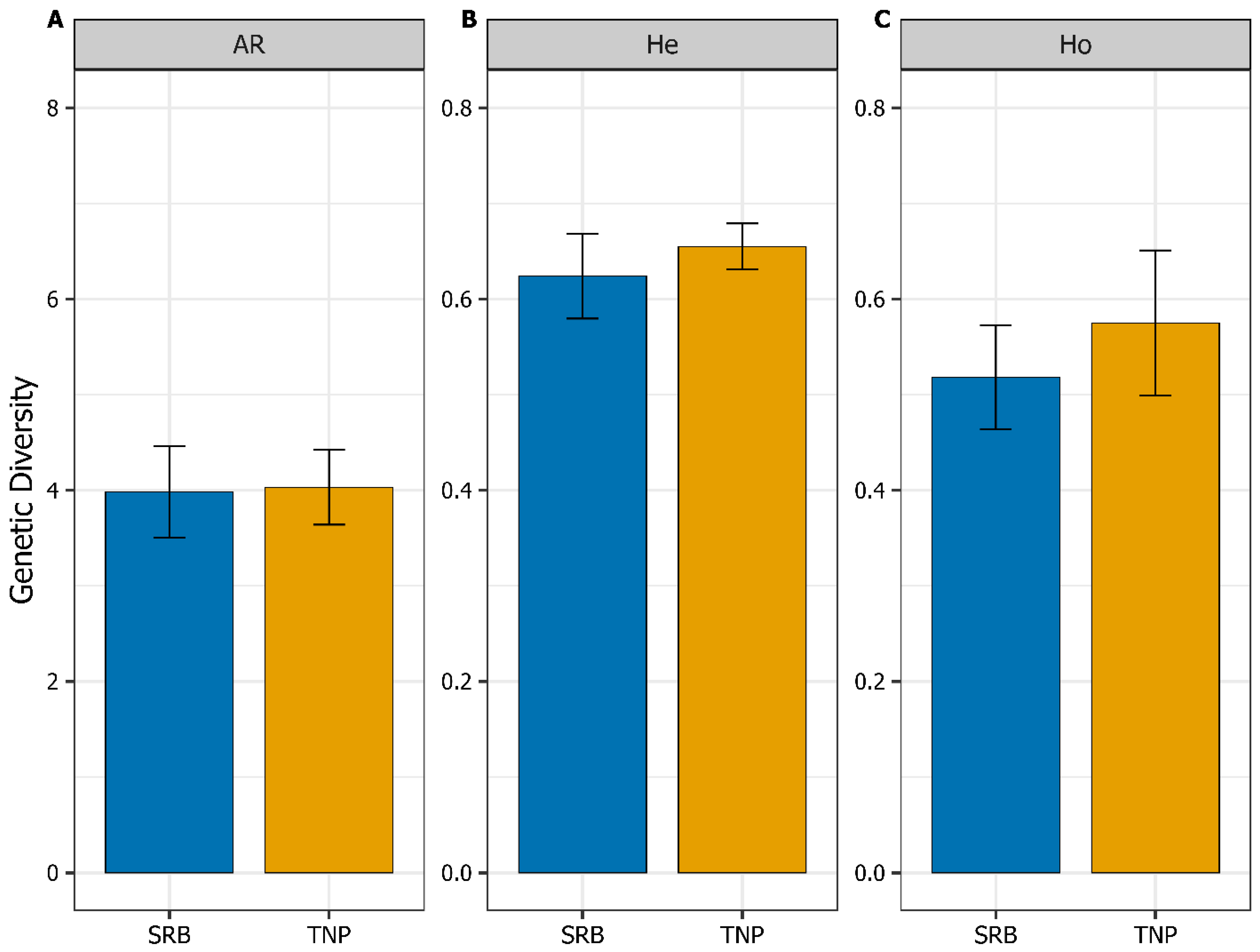
Neotropical otters in Costa Rica exhibited moderate genetic diversity across all microsatellite loci analyzed. Overall, Na was 5 ± 0.67, with a rarefied AR of 4.93 ± 0.64. Mean values on Ho and He were 0.54 ± 0.05 and 0.65 ± 0.03, respectively. All ten microsatellite loci were polymorphic, with Na ranging from 3 to 7 in TNP and from 2 to 7 in SRB. Mean Na was slightly higher in SRB (4.30 ± 0.56) than in TNP (4.00 ± 0.42). Conversely, private allelic richness was marginally greater in TNP (0.88 ± 0.31) compared to SRB (0.83 ± 0.30; Table S2). Although mean values for AR (4.03 ± 0.39), Ho (0.58 ± 0.08), and He (0.65 ± 0.02) were slightly higher in TNP than in SRB (AR: 3.98 ± 0.48; Ho: 0.52 ± 0.05; He: 0.62 ± 0.04), the Kruskal–Wallis rank-sum tests revealed no statistically significant differences between the two regions based on AR2 = 0.00, df = 1, p = 1.000), He2 = 0.02, df = 1, p = 0.879), and Ho2 = 0.47, df = 1, p = 0.494; Figure 2).
Microsatellite loci exhibited low to moderate inbreeding coefficients (FIS), with limited evidence of deviations from Hardy–Weinberg equilibrium (HWE) or linkage disequilibrium (LD). The mean FIS was 0.17 ± 0.11 for the TNP population and 0.20 ± 0.06 for the SRB population, with values ranging from −0.06 to 0.71 across loci and sampling localities (Table S2). MICROCHECKER identified the potential presence of null alleles at locus RIO01 in the TNP population and at loci RIO01 and RIO02 in the SRB population. Deviations from HWE were not consistently significant across populations. Locus RIO01 displayed a significant deviation from HWE in the TNP population (p = 0.034), whereas locus RIO02 exhibited a marginally significant deviation in the SRB population (p = 0.054), based on Benjamini–Hochberg corrected p-values. As neither locus deviated from HWE in both populations, RIO01 and RIO02 were retained for all subsequent analyses. No significant LD was detected between any pair of loci following Benjamini–Hochberg correction, suggesting that all loci are genetically independent.

3.3. Population Genetic Structure Analysis

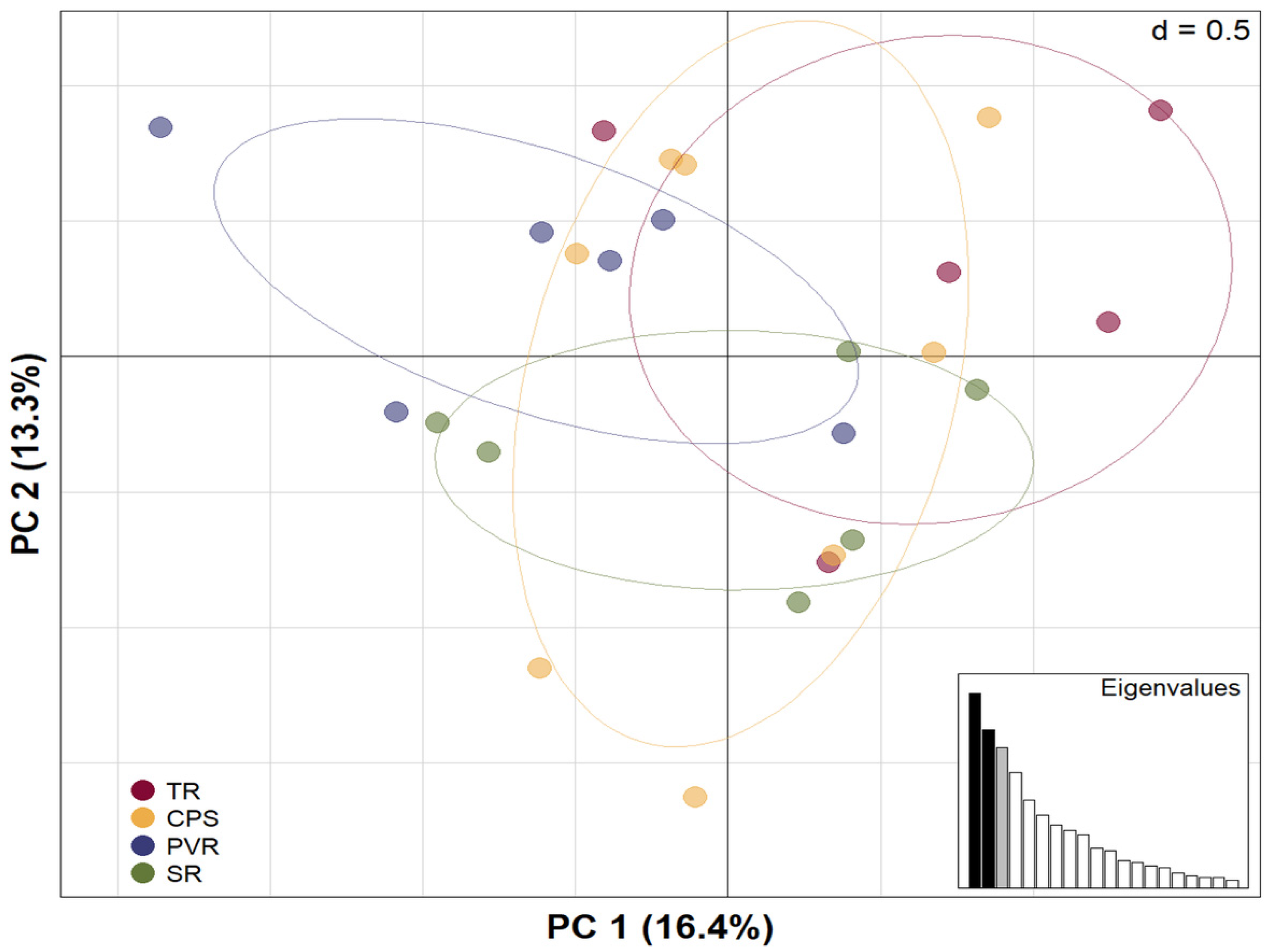
Genetic structure analyses revealed no genetic differentiation between sampling areas of Neotropical otter populations in northern Costa Rica. The FST estimate between the TNP and SRB was low (FST without-ENA = 0.0006 [95% CI: −0.02 to 0.02]; FST using-ENA = 0.002 [95% CI: −0.01 to 0.02]). In both cases, the confidence intervals overlapped zero, indicating no statistically significant genetic differentiation between the two regions. Similarly, principal component analysis (PCA) revealed no clear genetic clustering by region, with individuals from all four subpopulations exhibiting substantial overlap along the first two principal components, which explained 16.4% and 13.3% of the total genetic variance (Figure 3). In addition, Bayesian clustering analysis in STRUCTURE identified a single genetic cluster (K = 1; Figure S1a) as the most likely model based on the most suitable mean log-likelihood value (mean Ln P(D) = −612.5 ± 4.16 SD), compared to lower values for K = 2 (−626.68 ± 6.96 SD) and K = 3 (−635.06 ± 7.75 SD) among all tested K values (Table S3). Individual assignment plots revealed uniformly admixed ancestry across all clusters and sampling sites (Figure S1b). Similarly, TESS3r cross-validation test decreased progressively from K = 1 to K = 10 without a clear inflection point (Figure S2a), reinforcing the interpretation that a single genetic cluster (K = 1) most accurately reflects the underlying population structure in this system (Figure S2b).

3.4. Migration Estimates

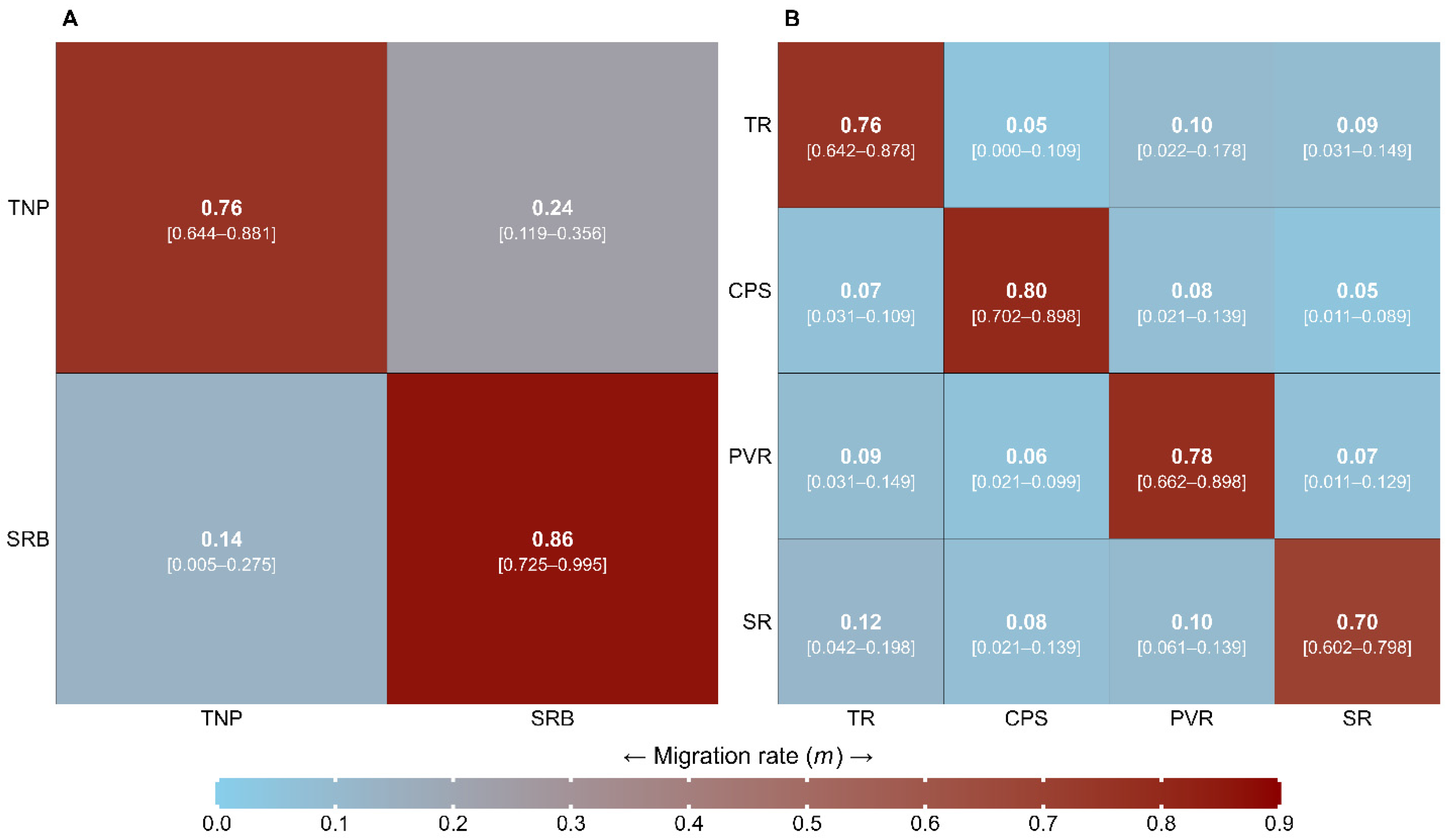
Bayesian and relatedness analyses revealed moderate gene flow and occasional shared kinship among Neotropical otter populations in TNP and SRB. BayesAss estimated that 76% of individuals sampled in TNP were residents, while 24% displayed recent ancestry from SRB, indicating a moderate level of recent gene flow into TNP. In contrast, SRB demonstrated a higher proportion of resident individuals at 86.4%, coupled with a lower proportion of individuals with ancestry from TNP at 13.6% (Figure 4). At a finer spatial resolution, otter individuals associated with distinct river reaches within each region exhibited strong site fidelity, with resident ancestry values ranging from 0.700 to 0.800. Estimated migration rates among these reaches were consistently low (0.05–0.12). Notably, the highest proportions of non-resident ancestry were identified in movements from TR to PVR (10%) and from SR to TR at 12%. BayesAss analysis revealed a limited number of recent migrants among subpopulations in northern Costa Rica.
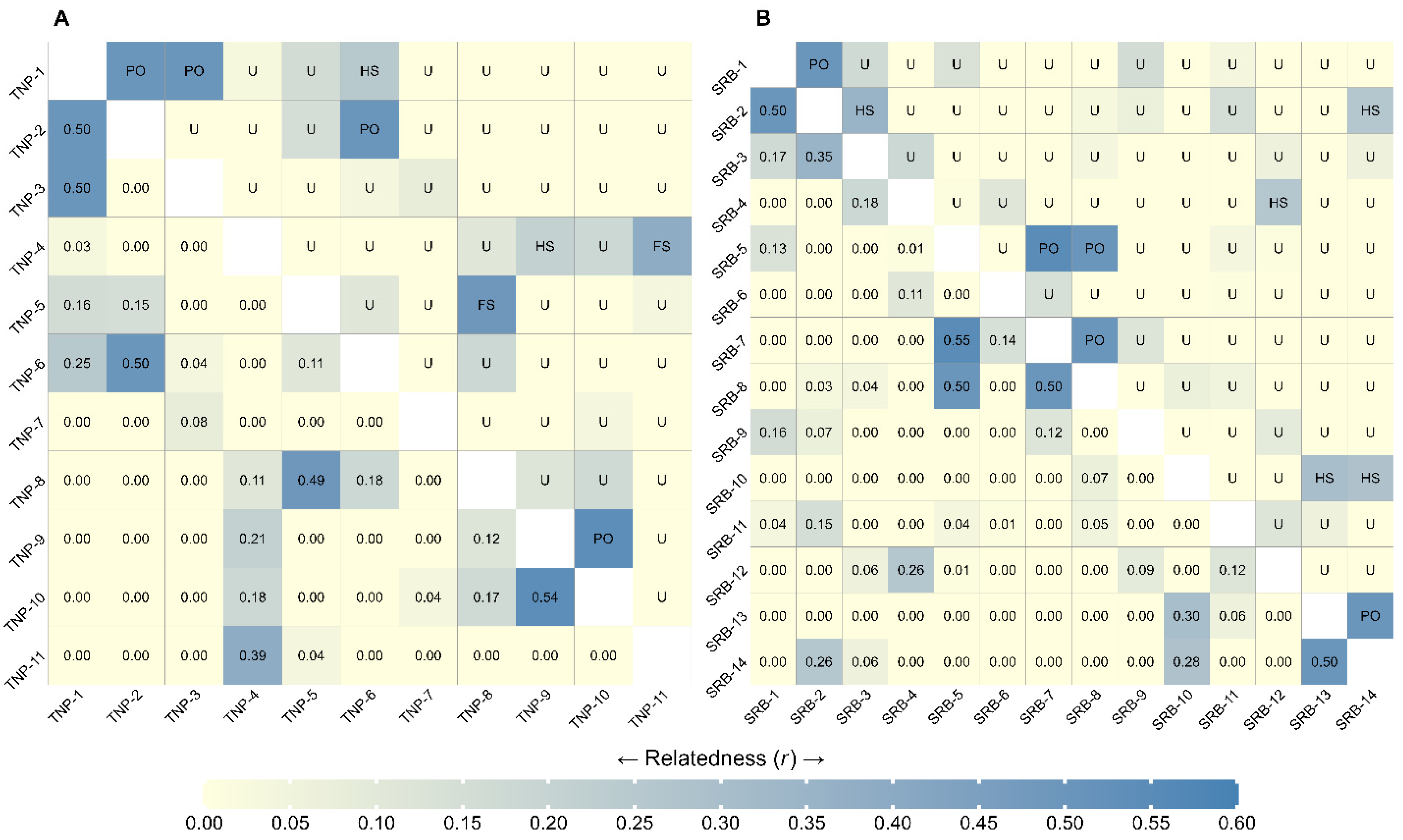
Out of the 300 unique pairwise dyads assessed in ML-RELATE, nine dyads (3%) achieved the PO threshold (r ≥ 0.50): four from TNP and five from SRB. In addition, two dyads (0.66%) were classified as FS (0.39 ≤ r ≤ 0.49) within TNP, while seven dyads (2.3%) fell into the HS category (0.21 ≤ r ≤ 0.35): two from TNP and five from SRB (Figure 5). Surprisingly, we detected multiple kinship links spanning the two regions. Specifically, three FS pairs (r = 0.37–0.46) and fourteen HS dyads (r = 0.13–0.32) connected individuals from TNP and SRB (Figure S3), supporting occasional inter-regional gene flow.

3.5. Bottleneck Estimations

Estimates from heterozygosity-excess tests revealed significant departures from mutation–drift equilibrium in both regions. The Wilcoxon signed-rank test under the TPM revealed significant heterozygosity excess in both TNP (p = 0.0019) and the SRB (p = 0.0048) populations, indicating recent departures from mutation–drift equilibrium. Complementary, analyses using the IAM and SMM produced consistent results, particularly for TNP. In SRB, significant heterozygosity excess was detected under IAM but not under SMM (Table 1), suggesting a less pronounced bottleneck signal under strict stepwise mutation assumptions. In addition, mean M-ratio values were 0.324 for TNP and 0.415 for SRB, both below the critical threshold of 0.68, consistent with the occurrence of recent genetic bottlenecks in both populations.

4. Discussion

4.1. Genetic Diversity Analysis

Genetic diversity estimates for L. annectens in TNP and the SRB were similar, despite the differing ecological conditions and varying levels of anthropogenic pressure in these regions. Both regions exhibited moderate levels of heterozygosity (TNP: Ho = 0.58, He = 0.65; SRB: Ho = 0.52, He = 0.62) and similar allelic richness (AR = 4.03 and 3.98, respectively). We hypothesized that otter populations in TNP, which is characterized by a well-connected stream network and minimal disturbance, would exhibit greater genetic diversity compared to those in the more altered SRB. However, the observed results did not fully support this hypothesis, as genetic diversity was only marginally higher in TNP and remained relatively comparable between regions with no statistically significant differences. This finding suggests that L. annectens may retain moderate genetic diversity even in human-altered landscapes, likely due to the permeability of riparian corridors and landscape features that facilitate functional connectivity and gene flow across fragmented habitats [87,88].
When considered within a broader spatial context, the observed genetic diversity levels of otter populations in Costa Rica (mean Ho = 0.54, He = 0.65) are consistent with findings reported for both undisturbed and human-impacted habitats throughout Mesoamerica. For example, comparable levels of genetic diversity were found in the undisturbed Lacantún River in southern Mexico (mean Ho = 0.55, He = 0.64; [28]) and in otter populations in impacted river basins in central Mexico (mean Ho = 0.50, He = 0.62; [27]) using different loci. This genetic variability aligns with observations reported for other semi-aquatic mustelid populations facing demographic pressures, such as the endangered giant otter, Pteronura brasiliensis (mean Ho = 0.57, He = 0.62; [89]), and the near-threatened Eurasian otter (mean Ho = 0.56, He = 0.66; [90]). Such comparative results support the notion that riparian species with semi-aquatic lifestyles may experience less genetic erosion due to enhanced linear connectivity along waterways, even in disturbed environments [91].
Despite the apparent stability of genetic diversity across both conserved and disturbed landscapes, such patterns should be interpreted cautiously, as temporal lags may influence genetic responses to habitat fragmentation [7,92]. Empirical and simulation studies have demonstrated that genetic demographic parameters often exhibit delayed responses to recent environmental changes, particularly when population decline or reduced gene flow has occurred within a limited number of generations [93,94]. In the case of L. annectens, which has an estimated generation length of 9.43 years [24], this relatively extended reproductive timescale may contribute to generational delays that obscure the genetic consequences of recent habitat loss. Additionally, the effects of these time lags can hide early indicators of genetic decline, thus postponing the recognition of isolation, inbreeding, and loss of alleles [7,92]. Consequently, although current measures of genetic diversity appear moderate, they may not accurately predict future genetic trends for otter populations under sustained anthropogenic stress.

4.2. Population Genetic Structure

Genetic analyses indicate that Neotropical otter populations in northern Costa Rica exhibit weak spatial genetic differentiation, consistent with high connectivity facilitated by the region’s hydrological landscape. Population analysis showed no genetic structure between TNP and SRB, as reflected by low FST values (FST without-ENA = 0.0006; FST using-ENA = 0.002). This outcome was further supported by a PCA, which revealed substantial genetic overlap among the four sampled subpopulations, with no clear evidence of clustering. Additionally, Bayesian clustering methods implemented in STRUCTURE and TESS3r also identified K = 1 as the most likely number of genetic clusters, reinforcing the conclusion of negligible population structuring. Collectively, these findings suggest a near-panmictic population structure of L. annectens in this region of northern Costa Rica. Comparable results have been reported in other regions where this species occurs, such as southern Mexico, and in European populations of the Eurasian otter in Poland and Slovakia, where dense networks of freshwater habitats promote long-distance dispersal and gene flow across extensive spatial scales [28,95].
Genetic differentiation (FST) among Neotropical otter populations varies considerably across Mesoamerican hydrological systems, illustrating how environmental connectivity and human disturbance influence gene flow. In northern Costa Rica, the nearly panmictic genetic structure between TNP and the SRB reflects the region’s high precipitation, continuous waterways, and coastal linkages that facilitate dispersal and sustain genetic exchange [35]. Similarly, in the Lacandón rainforest of southeastern Mexico, the species exhibited very low differentiation (FST = 0.000–0.019) among adjacent rivers situated within a humid tropical matrix of wetlands and short inter-river distances that maintain hydrological continuity [28]. Conversely, populations in central Veracruz displayed significantly higher differentiation (FST = 0.047–0.053) among the Actopan, La Antigua, and Jamapa basins, where rivers are separated by volcanic foothills and impacted by deforestation, agriculture, and pollution [27]. Collectively, these regional comparisons highlight that hydrological continuity, rainfall patterns, and river basin integrity are fundamental determinants of dispersal and genetic connectivity in semiaquatic carnivores [96,97]. Consequently, preserving riparian corridors and mitigating fragmentation remain essential to sustaining gene flow and long-term population resilience [10,97].
We hypothesized that major rivers, specifically the Sarapiquí, Puerto Viejo, and Tortuguero, would influence population genetic structure between regions; however, the absence of distinct genetic clusters suggests that these rivers function as dispersal corridors rather than barriers to gene flow. This interpretation aligns with the dendritic configuration and seasonal dynamics of northern Costa Rica’s hydrological systems [98,99], which likely facilitates movement during flooding events and reduces opportunities for spatial genetic subdivision [95,96]. The observed genetic homogeneity between TNP and SRB underscores the ecological importance of maintaining hydrological connectivity and riparian vegetation to sustain functional gene flow and minimize the effects of genetic drift and inbreeding in small or fragmented populations. Furthermore, these findings emphasize the need for long-term genetic monitoring to detect early signs of isolation and allelic erosion [100,101]. Such efforts are particularly vital for semi-aquatic carnivores like L. annectens, whose demographic and genetic viability depend on intact and continuous freshwater networks.
Importantly, the near-panmictic pattern inferred from FST, PCA, STRUCTURE, and TESS3r reflects genetic processes operating over historical or long-term timescales, integrating gene flow across multiple generations [5,7,15]. In contrast, BayesAss and bottleneck analyses are sensitive to more recent, short-term demographic dynamics, including contemporary dispersal asymmetry and recent reductions in effective population size [76,77,83,84,85]. Consequently, genetic homogeneity may persist despite directional migration and localized demographic instability, particularly in systems characterized by historically high connectivity that is increasingly influenced by recent anthropogenic disturbance [7,9,10]. Collectively, these findings highlight that population connectivity in L. annectens is dynamic and temporally layered, shaped by processes operating across multiple timescales.

4.3. Migration Estimates

Contemporary gene flow between TNP and SRB populations, assessed using BayesAss, revealed sustained but low migration rates, with an estimated one to two migrants per generation across most sampling areas. Although numerically limited, such levels of connectivity are biologically meaningful for small wild populations such as L. annectens, which typically produce only two to three offspring per litter [102]. In this context, even infrequent gene flow can buffer against the deleterious effects of genetic drift and inbreeding, thereby supporting long-term population viability and adaptive potential [103,104,105]. Similar dynamics have been observed in other species, where long-distance dispersal during low-density periods has facilitated genetic recovery [106].
The directional asymmetry in migration rates, particularly the disproportionate gene flow from the Sarapiquí River (SR) toward TR, CPS, and PVR, suggests that SR may function as a source population. The predominance of gene flow from SRB into TNP is consistent with source–sink dynamics, whereby more disturbed river systems may export dispersers toward more stable or protected habitats [27,28]. Higher anthropogenic pressure and lower site fidelity in the SRB, combined with the strong hydrological connectivity and continuity of riparian corridors within northern Costa Rica’s river networks [96,99], likely facilitate asymmetric dispersal into TNP. In contrast, the high site fidelity and habitat stability within TNP may limit reciprocal emigration, reinforcing the observed directional pattern of recent gene flow. This pattern aligns with source–sink dynamics reported in L. annectens populations from southern Mexico [28] and is consistent with findings in other semi-aquatic carnivores, such as the North American otter [107], Eurasian otter [95], and the European mink (Mustela lutreola; [108]), where tributaries serve as both refugia and dispersal corridors. In addition, the ~78 km linear distance between TNP and the SRB highlights the ecological significance of landscape connectivity, as gene flow persists despite substantial geographic separation. Yet, recent anthropogenic modifications within the SRB, including agricultural expansion, hydrological disruptions, and stream channelization, may increasingly jeopardize the integrity of these dispersal pathways [34,109].
We hypothesized that Neotropical otters would exhibit strong site fidelity, consistently using the same locations across seasons, and this hypothesis was partially supported. Kinship and recapture data revealed spatially cohesive familial groups and repeated site use in TNP, including four PO and two FS dyads, characterized by short mean displacement distances (1.48 km) and high interannual recapture frequencies. These patterns are consistent with natal philopatry and territorial fidelity and align with established behavioral trends in semi-aquatic carnivores, in which home range stability and localized kin clustering reflect strong site fidelity [31,110]. In contrast, otters in the SRB exhibited lower recapture rates and fewer signs of site fidelity, suggesting greater mobility or dispersal, potentially driven by anthropogenic disturbances. However, genotyping success was lower in SRB (36%) than in TNP (51%), which may have constrained the detection of recaptured individuals. Consequently, although the observed spatial patterns are consistent with expected ecological responses to habitat disruption, methodological limitations related to detection probability and sample size should be considered when interpreting these results. Future studies incorporating broader spatial coverage or longer temporal sampling will further refine migration estimates and strengthen statistical inference.
Inter-regional kinship links, including three FS and fourteen HS dyads identified between TNP and SRB, suggest occasional long-distance dispersal (>100 km) through hydrological networks. Such rare movements likely contribute to maintaining metapopulation connectivity and may account for the weak genetic differentiation observed between regions, a pattern consistent with documented long-range dispersal in other Lontra and Lutra species [28,95,111]. While individuals within TNP exhibited strong site fidelity, patterns in SRB might indicate greater dispersal flexibility, potentially in response to habitat modification and altered river connectivity. Collectively, these findings highlight the behavioral adaptability of L. annectens, which appears capable of balancing local site attachment with effective, although infrequent, dispersal across increasingly fragmented freshwater habitats, a strategy observed in other otter populations inhabiting anthropogenic landscapes [27,112]. However, given the geographic distance and limited sample size, these kinship links should be interpreted cautiously as indicators of historical or rare contemporary gene flow rather than evidence of direct sibling movement [81].

4.4. Bottleneck Estimations

Multiple lines of genetic evidence suggest that both the TNP and SRB populations of L. annectens have undergone recent genetic bottlenecks. The Wilcoxon signed-rank test under the TPM revealed significant heterozygosity excess in both TNP (p = 0.00195) and SRB (p = 0.00488), indicating departures from mutation–drift equilibrium and suggesting recent reductions in effective population size [84,85]. Consistent with this pattern, M-ratio analyses yielded values below the critical threshold (Mc = 0.68) for both populations, indicating allelic loss associated with demographic contraction [85,106]. Taken together, these complementary signals suggest that, despite currently moderate levels of genetic diversity, both populations have experienced recent reductions in genetic variation that may compromise their long-term adaptive potential [18,113]. Because BOTTLENECK and M-ratio capture demographic change across different temporal scales, detecting recent heterozygosity excess versus longer-term allelic erosion, respectively, their combined application provides a more comprehensive assessment of recent and historical population contractions in microsatellite datasets.
Contrary to our initial hypothesis, the SRB population, despite being more heavily impacted by anthropogenic disturbance, exhibited weaker signals of recent genetic bottlenecks compared to the TNP population. The stronger bottleneck signal observed in TNP likely reflects a more recent or severe population decline, while the weaker signal in SRB, particularly under the SMM, may indicate historical contraction followed by partial genetic recovery, possibly driven by low levels of immigration [114,115]. This interpretation is consistent with our migration and relatedness analyses, which detected occasional dispersal and kinship links between regions, suggesting that even limited gene flow may buffer against more severe bottleneck effects [116].
In contrast to our results, [27] reported no evidence of recent bottlenecks in any of the central Mexican basins evaluated, underscoring the spatial heterogeneity in demographic histories within L. annectens. This discrepancy also highlights the importance of employing multiple models and complementary statistical approaches, as bottleneck detection can be highly sensitive to underlying assumptions and mutation models [117,118]. Such geographic variation also illustrates how regional landscape contexts—ranging from intact riverine networks to highly modified basins—can shape the demographic history and resilience of populations [6,7].
Moreover, it is also plausible that genetic patterns observed in Costa Rica may reflect a cryptic demographic bottleneck, which is a genetic contraction not necessarily accompanied by detectable demographic collapse [84,119]. Reference [84] noted that such bottlenecks may arise from skewed sex ratios or polygynous mating systems, where a small number of individuals disproportionately contribute to the gene pool [84,120]. In polygamous species like river otters, dominant males often monopolize reproduction, thereby reducing the number of effective genetic breeders relative to the census size [120,121]. This scenario may be particularly relevant in TNP, where the combined effects of demographic decline and behavioral mating dynamics likely contribute to the strong bottleneck signature [106,118,119]. Taken together, the evidence points to a complex interplay between demographic history, mating behavior, and connectivity in shaping the genetic landscape of these populations [122]. Collectively, these findings emphasize the vulnerability of both populations to demographic and genetic erosion and underscore the value of multimodel inference in detecting and interpreting recent genetic disturbances.

4.5. Methodological Considerations

Noninvasive genotyping from fecal DNA provides a critical avenue for studying rare or cryptic carnivores in tropical ecosystems where direct sampling is infeasible. Nevertheless, low DNA yield, allelic dropout, and genotyping errors are well-recognized challenges that can compromise data integrity when working with noninvasive samples [47]. To address these limitations, we implemented a stringent quality-control framework based on a multi-tube PCR approach, consensus genotype construction, and conservative P(ID)sibs thresholds, thereby minimizing genotyping error and ensuring robust individual identification. These procedures align with current best-practice recommendations for noninvasive genetic monitoring of threatened mammals, which emphasize replication, explicit error assessment, and validation of individual genotypes [123,124]. Additionally, in humid Neotropical environments, where DNA degradation is accelerated, such conservative protocols are particularly important for producing reproducible and interpretable datasets [46]. Collectively, this approach establishes one of the most rigorous microsatellite-based reference frameworks for Lontra annectens in Central America and provides a standardized baseline for future spatial or temporal genetic comparisons.
Despite the robustness of the applied quality-control procedures, several data constraints inherent to noninvasive fecal sampling warrant careful consideration. The relatively low proportion of successfully identified individuals compared to the total number of collected samples reflects a deliberate trade-off between maximizing sample inclusion and ensuring genotypic reliability, rather than methodological inefficiency, as conservative filtering is widely recommended when working with low-quality DNA sources [47,57]. While this approach increases confidence in retained genotypes, it may reduce statistical power to detect subtle population structure, rare kin relationships, or weak demographic signals, particularly in datasets characterized by limited sample sizes or marker numbers [9,117]. In addition, the use of a moderate number of microsatellite loci—although common in noninvasive carnivore studies—can constrain resolution in relatedness inference and bottleneck detection under recent or moderate demographic perturbations [117,118]. Furthermore, spatial variability in DNA preservation and amplification success, driven by environmental conditions such as humidity, temperature, and sample exposure time [46], may lead to uneven representation among sampling locations. Such heterogeneity should be considered when interpreting estimates of connectivity or migration [47]. Together, these constraints underscore the importance of evaluating results in the context of data quality rather than sample quantity alone. Future research incorporating expanded marker sets, genomic approaches, and temporal replication will further refine and validate the patterns identified here.
To strengthen inference despite these constraints, we integrated multiple complementary analytical approaches—including FST, PCA, STRUCTURE, TESS3r, BayesAss, ML-RELATE, and demographic bottleneck tests—allowing genetic processes to be evaluated across both evolutionary and ecological timescales. The combined use of BOTTLENECK [83,125] and M-ratio analyses [85] facilitates detection of both recent and historical reductions in effective population size, providing important context for the observed patterns of genetic diversity. Although each method relies on specific assumptions, including mutation–drift equilibrium, comparative application helps mitigate individual model limitations [117]. Recent syntheses indicate that multi-test frameworks improve the reliability of bottleneck detection in small or data-limited populations, particularly when the locus number is modest [2,9]. In dynamic tropical watersheds, such integrative analyses can provide early warning signals of demographic contraction that may precede detectable declines in census size. Accordingly, the consistency observed across neutrality and demographic tests supports the overall robustness of the inferred patterns and establishes a methodological foundation for continued genetic monitoring of L. annectens and other semiaquatic carnivores in Mesoamerica.
Beyond its immediate findings, this study contributes one of the few regionally integrated genetic baselines for freshwater carnivores in Central America. Although microsatellite markers are increasingly supplemented by genomic approaches, they remain a cost-effective and transferable tool in data-limited regions [126,127]. Our results bridge a critical gap between ecological monitoring and population genetics by providing empirically validated estimates of connectivity, relatedness, and demographic stability for L. annectens. These data serve as calibration points for future genomic, environmental DNA (eDNA), or temporally replicated sampling efforts. Moreover, the bottleneck signals detected through heterozygosity-excess and M-ratio analyses [9,125] highlight the need for longitudinal monitoring to distinguish transient stochastic variation from sustained demographic decline. The limited power of such tests under moderate sampling or locus numbers [118] further reinforces the importance of expanding this baseline through broader marker panels and temporal replication. In a region undergoing rapid land-use and hydrological change, the methodological framework presented here provides a durable foundation for advancing conservation-genetic research and adaptive management across Central American riverine ecosystems.

5. Conclusions

The recent taxonomic elevation of L. annectens to full species status [21] highlights the urgent need to protect its evolutionary potential across increasingly fragmented tropical landscapes. Genetic diversity strengthens species resilience, enabling populations to adapt to environmental change and emerging threats [5,128]. For semi-aquatic mammals, particularly those occupying linear and fragmented habitats, long-term viability depends not only on local demographic stability but also on sustained access to genetically diverse mates [122]. Within the unique biogeographic and evolutionary context of Central American taxa [91], conservation strategies must therefore prioritize the preservation of evolutionary potential alongside ecological integrity, particularly in regions undergoing rapid environmental transformation and infrastructure development.
Fragmentation of freshwater ecosystems remains a major threat to the genetic viability of semi-aquatic species. Anthropogenic barriers such as roads, dams, and deforestation disrupt natural dispersal routes, reducing gene flow and accelerating genetic erosion [94,96]. For L. annectens, increasing isolation within disconnected riverscapes may reduce mate availability, skew reproductive success, and heighten inbreeding risk—factors that jeopardize the persistence of small or declining populations [31,110,129]. Moreover, reduced connectivity undermines demographic rescue effects, particularly for peripheral or sink populations, thereby elevating extinction risk [130,131]. Empirical studies in other taxa have shown that even low levels of immigration can mitigate bottleneck signals and restore genetic variation, reinforcing the importance of dispersal corridors [114,115]. In this context, the restoration and protection of riparian connectivity must be central to conservation planning, especially in biodiversity-rich areas such as TNP and the SRB. Ensuring the functional continuity of these habitats is essential to support movement, reproduction, and gene flow among fragmented populations.
To safeguard the long-term viability of L. annectens, conservation strategies must incorporate advanced genetic monitoring and spatially explicit modeling. Emerging genomic tools, such as reduced-representation sequencing (e.g., RADseq) and single-nucleotide polymorphism (SNP)-based panels, provide enhanced resolution for detecting fine-scale population structure, recent bottlenecks, and subtle connectivity patterns often missed by traditional microsatellite markers [122,132]. These genomic approaches, when combined with careful spatial design, can help detect early signatures of genetic erosion and provide a basis for adaptive management [116]. Equally important is the implementation of robust spatial and temporal sampling frameworks capable of capturing early signals of genetic erosion, including declines in effective population size, reproductive skew, and incipient bottlenecks [24,100]. Integrated monitoring approaches that combine genetic, demographic, and landscape data can help identify priority areas for connectivity restoration and inform the design of effective dispersal corridors [133]. Ultimately, conservation efforts must move beyond static, site-based protection toward adaptive, process-oriented frameworks that preserve both functional connectivity and evolutionary potential. Only through the sustained maintenance of genetic integrity and ecological linkages can L. annectens be effectively conserved in the face of accelerating environmental change.

Supplementary Materials

The following supporting information can be downloaded at: https://www.mdpi.com/article/10.3390/conservation6010016/s1, Figure S1: STRUCTURE results and Evanno method outputs; Figure S2: TESS3r cross-validation and admixture plots; Figure S3: Pairwise relatedness matrix (ML-RELATE); Figure S4: Spatial distribution of recaptures in Tortuguero National Park (TNP); Figure S5: Spatial distribution of recaptures in Sarapiquí River Basin (SRB); Table S1: Nuclear microsatellite loci and multiplex PCR design; Table S2: Genetic diversity metrics per locus and population; Table S3: STRUCTURE summary statistics (K = 1–5); Table S4: Pairwise relatedness estimates among individuals; Table S5: Capture–recapture and individual identification data.

Author Contributions

Conceptualization, M.S.-P. and L.P.W.; methodology, M.S.-P., L.P.W. and J.A.; funding acquisition, M.S.-P. and L.P.W.; software, M.S.-P.; visualization, M.S.-P.; formal analysis, M.S.-P.; investigation, M.S.-P. and L.P.W.; resources, L.P.W. and J.A.; data curation, M.S.-P.; writing—original draft M.S.-P.; writing—review and editing, M.S.-P., L.P.W., J.A., and J.L.R.; supervision, L.P.W., J.A., and J.L.R. All authors have read and agreed to the published version of the manuscript.

Funding

This research was funded by the Fulbright–García Robles Program and the Consejo Nacional de Ciencia y Tecnología (CONACyT) through a doctoral scholarship (#809860) awarded to the first author. Additional funding for fieldwork and laboratory analyses was provided by the Rufford Small Grants Foundation (Grant No. ID-33423-1), Idea Wild, Sigma Xi, the Explorers Club Exploration Fund (EFG), the Laboratory for Ecological, Evolutionary and Conservation Genetics (LEECG), and the Curt Berklund Graduate Research Scholar Award from the Department of Fish and Wildlife Sciences, College of Natural Resources, University of Idaho.

Institutional Review Board Statement

All fieldwork and genetic sampling were carried out in accordance with Costa Rican legal and ethical standards, as authorized by the National Commission for the Management of Biodiversity (CONAGEBIO) under permits R-031-2021-OT- CONAGEBIO (approval on 9 July 2021) and R-025-2022-OT- CONAGEBIO (approval on 1 June 2022).

Data Availability Statement

The original contributions presented in this study are included in the article/Supplementary Material. Further inquiries can be directed to the corresponding author.

Acknowledgments

We are grateful to the National System of Conservation Areas (SINAC) of the Ministry of Environment and Energy of Costa Rica and the CONAGEBIO for authorizing research permits required for sample collection. We are especially thankful to the Canadian Organization for Tropical Education and Rainforest Conservation and the staff of the Caño Palma Biological Station, including C. Foale, M. Arias, E. Khazan, L. Woudstra, M. Hughes, and volunteers, for their support in collecting Lontra annectens fecal samples. We also acknowledge La Tirimbina Biological Reserve, La Selva Research Station, and Bijagual Ecological Reserve, as well as M. García, E. Rojas, O. Vargas, C. Acuña, D. Brenes, G. Salazar, and P. Foster for their invaluable assistance in the Sarapiquí River Basin.

Conflicts of Interest

The authors declare no conflicts of interest.

References

  1. Allendorf, F.W.; Luikart, G.; Aitken, S.N. Conservation and the Genetics of Populations, 2nd ed.; Wiley-Blackwell: Chichester, UK, 2013; ISBN 978-0-470-67146-7. [Google Scholar]
  2. Hoban, S.; Archer, F.I.; Bertola, L.D.; Bragg, J.G.; Breed, M.F.; Bruford, M.W.; Coleman, M.A.; Ekblom, R.; Funk, W.C.; Grueber, C.E.; et al. Global Genetic Diversity Status and Trends: Towards a Suite of Essential Biodiversity Variables (EBVs) for Genetic Composition. Biol. Rev. 2022, 97, 1511–1538. [Google Scholar] [CrossRef] [PubMed]
  3. Reed, D.H.; Frankham, R. Correlation Between Fitness and Genetic Diversity. Conserv. Biol. 2003, 17, 230–237. [Google Scholar] [CrossRef]
  4. Mhemmed, G.; Kamel, H.; Chedly, A. Does Habitat Fragmentation Reduce Genetic Diversity and Subpopulation Connectivity? Ecography 2008, 31, 751–756. [Google Scholar] [CrossRef]
  5. Frankham, R.; Bradshaw, C.J.A.; Brook, B.W. Genetics in Conservation Management: Revised Recommendations for the 50/500 Rules, Red List Criteria and Population Viability Analyses. Biol. Conserv. 2014, 170, 56–63. [Google Scholar] [CrossRef]
  6. Hughes, A.R.; Inouye, B.D.; Johnson, M.T.J.; Underwood, N.; Vellend, M. Ecological Consequences of Genetic Diversity. Ecol. Lett. 2008, 11, 609–623. [Google Scholar] [CrossRef]
  7. Keyghobadi, N. The Genetic Implications of Habitat Fragmentation for Animals. Can. J. Zool. 2007, 85, 1049–1064. [Google Scholar] [CrossRef]
  8. Collier, N.; Gardner, M.; Adams, M.; McMahon, C.R.; Benkendorff, K.; Mackay, D.A. Contemporary Habitat Loss Reduces Genetic Diversity in an Ecologically Specialized Butterfly. J. Biogeogr. 2010, 37, 1277–1287. [Google Scholar] [CrossRef]
  9. Peery, M.Z.; Kirby, R.; Reid, B.N.; Stoelting, R.; Doucet-Bëer, E.; Robinson, S.; Vásquez-Carrillo, C.; Pauli, J.N.; Palsbøll, P.J. Reliability of Genetic Bottleneck Tests for Detecting Recent Population Declines. Mol. Ecol. 2012, 21, 3403–3418. [Google Scholar] [CrossRef]
  10. Rudnick, D.; Ryan, S.J.; Beier, P.; Cushman, S.A.; Dieffenbach, F.; Epps, C.; Gerber, L.R.; Hartter, J.N.; Jenness, J.S.; Kintsch, J.; et al. The Role of Landscape Connectivity in Planning and Implementing Conservation and Restoration Priorities; Issues in Ecology; Ecological Society of America: Washington, DC, USA, 2012; pp. 1–27. [Google Scholar]
  11. Peixoto, M.G.C.D.; Carvalho, M.R.S.; Egito, A.A.; Steinberg, R.S.; Bruneli, F.Â.T.; Machado, M.A.; Santos, F.C.; Rosse, I.C.; Fonseca, P.A.S. Genetic Diversity and Population Genetic Structure of a Guzerá (Bos indicus) Meta-Population. Animals 2021, 11, 1125. [Google Scholar] [CrossRef]
  12. Knaepkens, G.; Bervoets, L.; Verheyen, E.; Eens, M. Relationship Between Population Size and Genetic Diversity in Endangered Populations of the European Bullhead (Cottus gobio): Implications for Conservation. Biol. Conserv. 2004, 115, 403–410. [Google Scholar] [CrossRef]
  13. Bouzat, J.L. Conservation Genetics of Population Bottlenecks: The Role of Chance, Selection, and History. Conserv. Genet. 2010, 11, 463–478. [Google Scholar] [CrossRef]
  14. Garner, A.; Rachlow, J.L.; Hicks, J.F. Patterns of Genetic Diversity and Its Loss in Mammalian Populations. Conserv. Biol. 2005, 19, 1215–1221. [Google Scholar] [CrossRef]
  15. Ellegren, H.; Galtier, N. Determinants of Genetic Diversity. Nat. Rev. Genet. 2016, 17, 422–433. [Google Scholar] [CrossRef] [PubMed]
  16. Linløkken, A.N. Genetic Diversity in Small Populations. In Genetic Diversity and Disease Susceptibility; Liu, Y., Ed.; InTech: London, UK, 2018; pp. 43–55. ISBN 978-1-78984-201-2. [Google Scholar]
  17. Leroy, G.; Carroll, E.L.; Bruford, M.W.; DeWoody, J.A.; Strand, A.; Waits, L.; Wang, J. Next-Generation Metrics for Monitoring Genetic Erosion Within Populations of Conservation Concern. Evol. Appl. 2018, 11, 1066–1083. [Google Scholar] [CrossRef]
  18. Willi, Y.; Kristensen, T.N.; Sgrò, C.M.; Weeks, A.R.; Ørsted, M.; Hoffmann, A.A. Conservation Genetics as a Management Tool: The Five Best-Supported Paradigms to Assist the Management of Threatened Species. Proc. Natl. Acad. Sci. USA 2022, 119, e2105076119. [Google Scholar] [CrossRef]
  19. Duplaix, N.; Savage, M. The Global Otter Conservation Strategy; IUCN/SSC Otter Specialist Group: Salem, OR, USA, 2018. [Google Scholar]
  20. Rheingantz, M.L.; Santiago-Plata, V.M.; Trinca, C.S. The Neotropical Otter Lontra longicaudis: A Comprehensive Update on the Current Knowledge and Conservation Status of This Semiaquatic Carnivore. Mamm. Rev. 2017, 47, 291–305. [Google Scholar] [CrossRef]
  21. de Ferran, V.; Vieira Figueiró, H.; Trinca, C.S.; Hernández-Romero, P.C.; Lorenzana, G.P.; Gutiérrez-Rodríguez, C.; Koepfli, K.-P.; Eizirik, E. Genome-Wide Data Support Recognition of an Additional Species of Neotropical River Otter (Mammalia, Mustelidae, Lutrinae). J. Mammal. 2024, 105, 534–542. [Google Scholar] [CrossRef]
  22. Larivière, S. Lontra longicaudis. Mamm. Species 1999, 1, 1–5. [Google Scholar] [CrossRef]
  23. Van Zyll de Jong, C.G. A Systematic Review of the Nearctic and Neotropical River Otters (Genus Lutra, Mustelidae, Carnivora); Life Sciences Contributions No. 80; Royal Ontario Museum: Toronto, ON, Canada, 1972; pp. 1–104. [Google Scholar]
  24. Rheingantz, M.L.; Rosas-Ribeiro, P.; Gallo-Reynoso, J.P.; Fonseca da Silva, V.C.; Wallace, R.; Utreras, V.; Hernández-Romero, P. Lontra longicaudis (Amended Version of 2021 Assessment). The IUCN Red List of Threatened Species 2022, e.T12304A219373698. Available online: https://www.iucnredlist.org/species/12304/219373698 (accessed on 10 June 2025).
  25. Brack-Egg, A. Situación actual de las nutrias (Lutrinae: Mustelidae) en el Perú. In Proceedings of the First Working Meeting of the Otter Specialist Group; Duplaix, N., Ed.; Otters: Morges, Switzerland, 1978; pp. 76–84. [Google Scholar]
  26. Pacifici, M.; Santini, L.; Di Marco, M.; Baisero, D.; Francucci, L.; Grottolo Marasini, G.; Visconti, P.; Rondinini, C. Generation Length for Mammals. Nat. Conserv. 2013, 5, 89–94. [Google Scholar] [CrossRef]
  27. Latorre-Cardenas, M.C.; Gutiérrez-Rodríguez, C.; Rico, Y. Estimating Genetic and Demographic Parameters Relevant for the Conservation of the Neotropical Otter, Lontra longicaudis, in Mexico. Conserv. Genet. 2020, 21, 719–734. [Google Scholar] [CrossRef]
  28. Ortega, J.; Navarrete, D.; Maldonado, J.E. Non-Invasive Sampling of Endangered Neotropical River Otters Reveals High Levels of Dispersion in the Lacantún River System of Chiapas, Mexico. Anim. Biodivers. Conserv. 2012, 35, 59–69. [Google Scholar] [CrossRef]
  29. Trigila, A.P.; Gómez, J.J.; Cassini, M.H.; Túnez, J.I. Genetic Diversity in the Neotropical River Otter, Lontra longicaudis (Mammalia, Mustelidae), in the Lower Delta of Paraná River, Argentina and Its Relation with Habitat Suitability. Hydrobiologia 2016, 768, 287–298. [Google Scholar] [CrossRef]
  30. Weber, L.I.; Hildebrand, C.G.; Ferreira, A.; Pedarassi, G.; Levy, J.A.; Colares, E.P. Microsatellite Genotyping from Faeces of Lontra longicaudis from Southern Brazil. Iheringia Ser. Zool. 2009, 99, 5–11. [Google Scholar] [CrossRef]
  31. Trinca, C.S.; Jaeger, C.F.; Eizirik, E. Molecular Ecology of the Neotropical Otter (Lontra longicaudis): Non-Invasive Sampling Yields Insights into Local Population Dynamics. Biol. J. Linn. Soc. 2013, 109, 932–948. [Google Scholar] [CrossRef]
  32. Hájková, P.; Zemanová, B.; Roche, K.; Hájek, B. An Evaluation of Field and Noninvasive Genetic Methods for Estimating Eurasian Otter Population Size. Conserv. Genet. 2009, 10, 1667–1681. [Google Scholar] [CrossRef]
  33. Lerone, L.; Mengoni, C.; Di Febbraro, M.; Krupa, H.; Loy, A. A Noninvasive Genetic Insight into the Spatial and Social Organization of an Endangered Population of the Eurasian Otter (Lutra lutra, Mustelidae, Carnivora). Sustainability 2022, 14, 1943. [Google Scholar] [CrossRef]
  34. Anderson, E.P.; Pringle, C.M.; Freeman, M.C. Quantifying the Extent of River Fragmentation by Hydropower Dams in the Sarapiquí River Basin, Costa Rica. Aquat. Conserv. Mar. Freshw. Ecosyst. 2008, 18, 408–417. [Google Scholar] [CrossRef]
  35. Sánchez, K.; Jiménez, F.; Velásquez, S.; Piedra, M.; Romero, E. Metodología de Análisis Multicriterio Para la Identificación de Áreas Prioritarias de Manejo del Recurso Hídrico en la Cuenca del Río Sarapiquí, Costa Rica; CATIE: Turrialba, Costa Rica, 2004; pp. 88–95. [Google Scholar]
  36. Rojas, N.; Alfaro, M.; Solano, J.; Araya, C.; Villalobos, V. Estudio de Las Cuencas Hidrográficas de Costa Rica: Análisis Biofísico, Climatológico y Socioeconómico; Instituto Meteorológico Nacional: San José, Costa Rica, 2011. [Google Scholar]
  37. Mayorga, M. A Water-Based Education and Monitoring Program for the Conservation of the Sarapiquí River, Costa Rica. Ph.D. Thesis, University of Wisconsin–Stevens Point, Stevens Point, WI, USA, 2005. [Google Scholar]
  38. Arroyo-Arce, S.; Guilder, J.; Salom-Pérez, R. Habitat Features Influencing Jaguar Panthera onca (Carnivora: Felidae) Occupancy in Tortuguero National Park, Costa Rica. Rev. Biol. Trop. 2014, 62, 1449–1458. [Google Scholar] [CrossRef]
  39. Vanlangendonck, N.; Nuñez, G.; Chaves, A.; Gutiérrez-Espeleta, G.A. New Route of Investigation for Understanding the Impact of Human Activities on the Physiology of Non-Human Primates. J. Primatol. 2015, 4, 123. [Google Scholar] [CrossRef]
  40. Ling, F. Diagnóstico de la Situación Actual de Los Recursos Naturales en Los Sitios Críticos del Corredor Biológico Mesoamericano, Sección Tortuguero; Fondo Nacional de Financiamiento Forestal (FONAFIFO): San José, Costa Rica, 2002. [Google Scholar]
  41. Bermúdez, A.F.; Hernández, H.C. Plan de Manejo del Parque Nacional Tortuguero; Ministerio del Ambiente y Energía, Sistema Nacional de Áreas de Conservación, Área de Conservación Tortuguero: San José, Costa Rica, 2004; p. 149.
  42. Velli, E.; Fabbri, E.; Galaverni, M.; Mattucci, F.; Mattioli, L.; Molinari, L.; Caniglia, R. Ethanol Versus Swabs: What Is a Better Tool to Preserve Faecal Samples for Non-Invasive Genetic Analyses? Hystrix 2019, 30, 24–29. [Google Scholar] [CrossRef]
  43. Lampa, S.; Gruber, B.; Henle, K.; Hoehn, M. An Optimisation Approach to Increase DNA Amplification Success of Otter Faeces. Conserv. Genet. 2008, 9, 201–210. [Google Scholar] [CrossRef]
  44. Klütsch, C.F.C.; Thomas, P.J. Improved Genotyping and Sequencing Success Rates for North American River Otter (Lontra canadensis). Eur. J. Wildl. Res. 2018, 64, 16. [Google Scholar] [CrossRef]
  45. Buglione, M.; Petrelli, S.; Troiano, C.; Notomista, T.; Petrella, A.; De Riso, L.; Poerio, L.; Cascini, V.; Bartolomei, R.; Fulgione, D. Spatial Genetic Structure in the Eurasian Otter (Lutra lutra) Meta-Population from Its Core Range in Italy. Contrib. Zool. 2020, 90, 70–92. [Google Scholar] [CrossRef]
  46. Santiago-Plata, M.; Solem, A.; Adams, J.; Rachlow, J.L.; Sullivan, J.; Waits, L.P. Optimizing Fecal DNA Collection and Storage Techniques for Noninvasive Genetic Sampling of River Otters. Wildl. Soc. Bull. 2025, 49, e1612. [Google Scholar] [CrossRef]
  47. Waits, L.P.; Paetkau, D. Noninvasive Genetic Sampling Tools for Wildlife Biologists: A Review of Applications and Recommendations for Accurate Data Collection. J. Wildl. Manag. 2005, 69, 1419–1433. [Google Scholar] [CrossRef]
  48. Beheler, A.S.; Fike, J.A.; Murfitt, L.M.; Rhodes, O.E.; Serfass, T.S. Development of Polymorphic Microsatellite Loci for North American River Otters (Lontra canadensis) and Amplification in Related Mustelids. Mol. Ecol. Notes 2004, 4, 56–58. [Google Scholar] [CrossRef]
  49. Beheler, A.S.; Fike, J.A.; Dharmarajan, G.; Rhodes, O.E.; Serfass, T.L. Ten New Polymorphic Microsatellite Loci for North American River Otters (Lontra canadensis) and Their Utility in Related Mustelids. Mol. Ecol. Notes 2005, 5, 602–604. [Google Scholar] [CrossRef]
  50. Dallas, J.F.; Piertney, S.B. Microsatellite Primers for the Eurasian Otter. Mol. Ecol. 1998, 7, 1248–1251. [Google Scholar]
  51. Mowry, R.A.; Gompper, M.E.; Beringer, J.; Eggert, L.S. River Otter Population Size Estimation Using Noninvasive Latrine Surveys. J. Wildl. Manag. 2011, 75, 1625–1636. [Google Scholar] [CrossRef]
  52. Waits, L.P.; Luikart, G.; Taberlet, P. Estimating the Probability of Identity Among Genotypes in Natural Populations: Cautions and Guidelines. Mol. Ecol. 2001, 10, 249–256. [Google Scholar] [CrossRef]
  53. Wultsch, C.; Waits, L.P.; Kelly, M.J. Noninvasive Individual and Species Identification of Jaguars (Panthera onca), Pumas (Puma concolor) and Ocelots (Leopardus pardalis) in Belize, Central America Using Cross-Species Microsatellites and Faecal DNA. Mol. Ecol. Resour. 2014, 14, 1171–1182. [Google Scholar] [CrossRef]
  54. Taberlet, P. Reliable Genotyping of Samples with Very Low DNA Quantities Using PCR. Nucleic Acids Res. 1996, 24, 3189–3194. [Google Scholar] [CrossRef] [PubMed]
  55. Peakall, R.; Smouse, P.E. GenAlEx 6.5: Genetic Analysis in Excel. Population Genetic Software for Teaching and Research—An Update. Bioinformatics 2012, 28, 2537–2549. [Google Scholar] [CrossRef] [PubMed]
  56. Lonsinger, R.C.; Adams, J.R.; Waits, L.P. Evaluating Effective Population Size and Genetic Diversity of a Declining Kit Fox Population Using Contemporary and Historical Specimens. Ecol. Evol. 2018, 8, 12011–12021. [Google Scholar] [CrossRef] [PubMed]
  57. Pompanon, F.; Bonin, A.; Bellemain, E.; Taberlet, P. Genotyping Errors: Causes, Consequences and Solutions. Nat. Rev. Genet. 2005, 6, 847–859. [Google Scholar] [CrossRef]
  58. Van Oosterhout, C.; Hutchinson, W.F.; Wills, D.P.M.; Shipley, P. MICRO-CHECKER: Software for Identifying and Correcting Genotyping Errors in Microsatellite Data. Mol. Ecol. Notes 2004, 4, 535–538. [Google Scholar] [CrossRef]
  59. Rousset, F. GENEPOP’007: A Complete Re-Implementation of the GENEPOP Software for Windows and Linux. Mol. Ecol. Resour. 2008, 8, 103–106. [Google Scholar] [CrossRef]
  60. Benjamini, Y.; Hochberg, Y. Controlling the False Discovery Rate: A Practical and Powerful Approach to Multiple Testing. J. R. Stat. Soc. Ser. B Methodol. 1995, 57, 289–300. [Google Scholar] [CrossRef]
  61. Kalinowski, S.T. Hp-Rare 1.0: A Computer Program for Performing Rarefaction on Measures of Allelic Richness. Mol. Ecol. Notes 2005, 5, 187–189. [Google Scholar] [CrossRef]
  62. R Core Team. R: A Language and Environment for Statistical Computing; R Foundation for Statistical Computing: Vienna, Austria, 2025; Available online: https://www.R-project.org/ (accessed on 21 June 2025).
  63. Wickham, H. ggplot2: Elegant Graphics for Data Analysis; Springer: New York, NY, USA, 2016. [Google Scholar]
  64. Pedersen, T. patchwork: The Composer of Plots, R Package Version 1.3.0.9000; 2025. Available online: https://patchwork.data-imaginist.com (accessed on 8 July 2025).
  65. Weir, B.S. Genetic Data Analysis II, 2nd ed.; Sinauer Associates: Sunderland, MA, USA, 1996; ISBN 0-87893-902-4. [Google Scholar]
  66. Chapuis, M.-P.; Estoup, A. Microsatellite Null Alleles and Estimation of Population Differentiation. Mol. Biol. Evol. 2007, 24, 621–631. [Google Scholar] [CrossRef]
  67. Jombart, T. Adegenet: A R Package for the Multivariate Analysis of Genetic Markers. Bioinformatics 2008, 24, 1403–1405. [Google Scholar] [CrossRef] [PubMed]
  68. Dray, S.; Dufour, A.-B. The Ade4 Package: Implementing the Duality Diagram for Ecologists. J. Stat. Softw. 2007, 22, 1–20. [Google Scholar] [CrossRef]
  69. Pritchard, J.K.; Stephens, M.; Donnelly, P. Inference of Population Structure Using Multilocus Genotype Data. Genetics 2000, 155, 945–959. [Google Scholar] [CrossRef] [PubMed]
  70. Evanno, G.; Regnaut, S.; Goudet, J. Detecting the Number of Clusters of Individuals Using the Software STRUCTURE: A Simulation Study. Mol. Ecol. 2005, 14, 2611–2620. [Google Scholar] [CrossRef]
  71. Francis, R.M. Pophelper: An R Package and Web App to Analyse and Visualize Population Structure. Mol. Ecol. Resour. 2017, 17, 27–32. [Google Scholar] [CrossRef]
  72. Caye, K.; Jay, F.; Michel, O.; François, O. Fast Inference of Individual Admixture Coefficients Using Geographic Data. Ann. Appl. Stat. 2018, 12, 586–608. [Google Scholar] [CrossRef]
  73. Agostini, G.; Loy, A.; Gentile, G.; Giovacchini, S.; De Sanctis, C.; Mirone, E.; Papaleo, L.; Petrella, A.; D’Alessio, N.; Colangelo, P. A Non-Invasive Genetics Insight into Population Structure and Recolonization Dynamics of the Eurasian Otter (Lutra lutra) at the Boundary of Its Italian Core Range. Mamm. Biol. 2025, 105, 355–369. [Google Scholar] [CrossRef]
  74. Rato, C.; Deso, G.; Renet, J.; Delaugerre, M.J.; Marques, V.; Mochales-Riaño, G. Colonization Routes Uncovered in a Widely Introduced Mediterranean Gecko, Tarentola mauritanica. Sci. Rep. 2023, 13, 16681. [Google Scholar] [CrossRef]
  75. Guinto, D.; Cross, M.; Lipps, G.; Lee, Y.; Kingsbury, B.; Earl, D.; Dempsey, C.; Hinson, J.; Jordan, M. Conservation Genetic Analysis of Blanding’s Turtles Across Ohio, Indiana, and Michigan. Diversity 2023, 15, 668. [Google Scholar] [CrossRef]
  76. Wilson, G.A.; Rannala, B. Bayesian Inference of Recent Migration Rates Using Multilocus Genotypes. Genetics 2003, 163, 1177–1191. [Google Scholar] [CrossRef]
  77. Yamamichi, M.; Innan, H. Estimating the Migration Rate from Genetic Variation Data. Heredity 2012, 108, 362–363. [Google Scholar] [CrossRef]
  78. Anderson, C.S.; Prange, S.; Gibbs, H.L. Origin and Genetic Structure of a Recovering Bobcat (Lynx rufus) Population. Can. J. Zool. 2015, 93, 889–899. [Google Scholar] [CrossRef]
  79. Suárez-Montes, P.; Chávez-Pesqueira, M.; Núñez-Farfán, J. Life History and Past Demography Maintain Genetic Structure, Outcrossing Rate, Contemporary Pollen Gene Flow of an Understory Herb in a Highly Fragmented Rainforest. PeerJ 2016, 4, e2764. [Google Scholar] [CrossRef] [PubMed]
  80. Rambaut, A.; Drummond, A.J.; Xie, D.; Baele, G.; Suchard, M.A. Posterior Summarization in Bayesian Phylogenetics Using Tracer 1.7. Syst. Biol. 2018, 67, 901–904. [Google Scholar] [CrossRef] [PubMed]
  81. Kalinowski, S.T.; Wagner, A.P.; Taper, M.L. ML-Relate: A Computer Program for Maximum Likelihood Estimation of Relatedness and Relationship. Mol. Ecol. Notes 2006, 6, 576–579. [Google Scholar] [CrossRef]
  82. Wickham, H. Reshaping Data with the reshape Package. J. Stat. Softw. 2007, 21, 1–20. [Google Scholar] [CrossRef]
  83. Piry, S.; Luikart, G.; Cornuet, J.M. BOTTLENECK: A Computer Program for Detecting Recent Reductions in the Effective Population Size Using Allele Frequency Data. J. Hered. 1999, 90, 502–503. [Google Scholar] [CrossRef]
  84. Luikart, G.; Sherwin, W.B.; Steele, B.M.; Allendorf, F.W. Usefulness of Molecular Markers for Detecting Population Bottlenecks via Monitoring Genetic Change. Mol. Ecol. 1998, 7, 963–974. [Google Scholar] [CrossRef]
  85. Garza, J.C.; Williamson, E.G. Detection of Reduction in Population Size Using Data from Microsatellite Loci. Mol. Ecol. 2001, 10, 305–318. [Google Scholar] [CrossRef]
  86. Sharma, S.P.; Ghazi, M.G.; Katdare, S.; Dasgupta, N.; Mondol, S.; Gupta, S.K.; Hussain, S.A. Microsatellite Analysis Reveals Low Genetic Diversity in Managed Populations of the Critically Endangered Gharial (Gavialis gangeticus) in India. Sci. Rep. 2021, 11, 5627. [Google Scholar] [CrossRef]
  87. Jenkins, C.N.; Giri, C. Protection of Mammal Diversity in Central America. Conserv. Biol. 2008, 22, 1037–1044. [Google Scholar] [CrossRef] [PubMed]
  88. Cushman, S.A.; McKelvey, K.S.; Hayden, J.; Schwartz, M.K. Gene Flow in Complex Landscapes: Testing Multiple Hypotheses with Causal Modeling. Am. Nat. 2006, 168, 486–499. [Google Scholar] [CrossRef] [PubMed]
  89. Pickles, R.S.A.; Groombridge, J.J.; Rojas, V.D.Z.; Van Damme, P.; Gottelli, D.; Ariani, C.V.; Jordan, W.C. Genetic Diversity and Population Structure in the Endangered Giant Otter, Pteronura brasiliensis. Conserv. Genet. 2012, 13, 235–245. [Google Scholar] [CrossRef]
  90. Randi, E.; Davoli, F.; Pierpaoli, M.; Pertoldi, C.; Madsen, A.B.; Loeschcke, V. Genetic Structure in Otter (Lutra lutra) Populations in Europe: Implications for Conservation. Anim. Conserv. 2003, 6, 93–100. [Google Scholar] [CrossRef]
  91. Gutiérrez-García, T.A.; Vázquez-Domínguez, E. Consensus Between Genes and Stones in the Biogeographic and Evolutionary History of Central America. Quat. Res. 2013, 79, 311–324. [Google Scholar] [CrossRef]
  92. Epps, C.W.; Keyghobadi, N. Landscape Genetics in a Changing World: Disentangling Historical and Contemporary Influences and Inferring Change. Mol. Ecol. 2015, 24, 6021–6040. [Google Scholar] [CrossRef]
  93. Landguth, E.L.; Cushman, S.A.; Schwartz, M.K.; McKelvey, K.S.; Murphy, M.; Luikart, G. Quantifying the Lag Time to Detect Barriers in Landscape Genetics. Mol. Ecol. 2010, 19, 4179–4191. [Google Scholar] [CrossRef]
  94. Banks, S.C.; Cary, G.J.; Smith, A.L.; Davies, I.D.; Driscoll, D.A.; Gill, A.M.; Lindenmayer, D.B.; Peakall, R. How Does Ecological Disturbance Influence Genetic Diversity? Trends Ecol. Evol. 2013, 28, 670–679. [Google Scholar] [CrossRef]
  95. Pagacz, S. The Effect of a Major Drainage Divide on the Gene Flow of a Semiaquatic Carnivore, the Eurasian Otter. J. Mammal. 2016, 97, 1164–1176. [Google Scholar] [CrossRef][Green Version]
  96. Hughes, J.M.; Schmidt, D.J.; Finn, D.S. Genes in Streams: Using DNA to Understand the Movement of Freshwater Fauna and Their Riverine Habitat. BioScience 2009, 59, 573–583. [Google Scholar] [CrossRef]
  97. Davis, C.D.; Epps, C.W.; Flitcroft, R.L.; Banks, M.A. Refining and Defining Riverscape Genetics: How Rivers Influence Population Genetic Structure. WIREs Water 2018, 5, e1269. [Google Scholar] [CrossRef]
  98. McClearn, D.; Arroyo-Mora, J.P.; Castro, E.; Coleman, R.C.; Espeleta, J.F.; García-Robledo, C.; Gilman, A.; González, J.; Joyce, A.T.; Kuprewicz, E.; et al. The Caribbean Lowland Evergreen Moist and Wet Forests. In Costa Rican Ecosystems; Kappelle, M., Ed.; University of Chicago Press: Chicago, IL, USA, 2016; pp. 555–608. ISBN 978-0-226-12161-1. [Google Scholar]
  99. Pringle, C.M.; Anderson, E.P.; Ardón, M.; Bixby, R.J.; Connelly, S.; Duff, J.H.; Jackman, A.P.; Paaby, P.; Ramírez, A.; Small, G.E.; et al. Rivers of Costa Rica. In Costa Rican Ecosystems; Kappelle, M., Ed.; University of Chicago Press: Chicago, IL, USA, 2016; pp. 621–655. ISBN 978-0-226-12161-1. [Google Scholar]
  100. Cleary, K.A.; Sanfiorenzo, A.; Waits, L.P. Genetics as a Tool for Biodiversity Conservation: Examples from Central America. In Central American Biodiversity: Conservation, Ecology, and a Sustainable Future; Huettmann, F., Ed.; Springer: New York, NY, USA, 2015; pp. 573–602. ISBN 978-1-4939-2207-9. [Google Scholar]
  101. Leoncini, F.; Semenzato, P.; Di Febbraro, M.; Loy, A.; Ferrari, C. Come Back to Stay: Landscape Connectivity Analysis for the Eurasian Otter (Lutra lutra) in the Western Alps. Biodivers. Conserv. 2023, 32, 653–669. [Google Scholar] [CrossRef]
  102. Gallo-Reynoso, J.P. Evaluación del riesgo de extinción de Lontra longicaudis de acuerdo al numeral 5–7 de la NOM-059-ECOL-2001. In Método de Evaluación del Riesgo de Extinción de Las Especies Silvestres en México (MER); Sánchez, Ó., Medellín, R., Aldama, A., Goettsch, B., Soberón, J., Tambutti, M., Eds.; Instituto Nacional de Ecología (INE–SEMARNAT), Comisión Nacional para el Conocimiento y Uso de la Biodiversidad (CONABIO): México, Mexico, 2007; pp. 61–90. ISBN 978-968-817-857-7. [Google Scholar]
  103. Slatkin, M. Gene Flow and the Geographic Structure of Natural Populations. Science 1987, 236, 787–792. [Google Scholar] [CrossRef] [PubMed]
  104. Mills, L.S.; Allendorf, F.W. The One-Migrant-per-Generation Rule in Conservation and Management. Conserv. Biol. 1996, 10, 1509–1518. [Google Scholar] [CrossRef]
  105. Waples, R.S.; England, P.R. Estimating Contemporary Effective Population Size on the Basis of Linkage Disequilibrium in the Face of Migration. Genetics 2011, 189, 633–644. [Google Scholar] [CrossRef] [PubMed]
  106. Busch, J.D.; Waser, P.M.; DeWoody, J.A. Recent Demographic Bottlenecks Are Not Accompanied by a Genetic Signature in Banner-Tailed Kangaroo Rats (Dipodomys spectabilis). Mol. Ecol. 2007, 16, 2450–2462. [Google Scholar] [CrossRef]
  107. Jeffress, M.R.; Paukert, C.P.; Whittier, J.B.; Sandercock, B.K.; Gipson, P.S. Scale-Dependent Factors Affecting North American River Otter Distribution in the Midwest. Am. Midl. Nat. 2011, 166, 177–193. [Google Scholar] [CrossRef]
  108. Lodé, T.; Peltier, D. Genetic Neighbourhood and Effective Population Size in the Endangered European Mink Mustela lutreola. Biodivers. Conserv. 2005, 14, 251–268. [Google Scholar] [CrossRef]
  109. Girres, J.-F.; Prunier, D.; Rodriguez, T.; Pottier, A.; Léonard, E.; Audic, V.; Hellard, M.; Magnaudet, J.-A. Analysis of the Spatial Extension of Pineapple Monocultures in Northern Costa Rica Using Heterogeneous Geographic Data. Adv. Cartogr. GIScience ICA 2023, 4, 9. [Google Scholar] [CrossRef]
  110. Quaglietta, L.; Fonseca, V.C.; Hájková, P.; Mira, A.; Boitani, L. Fine-Scale Population Genetic Structure and Short-Range Sex-Biased Dispersal in a Solitary Carnivore, Lutra lutra. J. Mammal. 2013, 94, 561–571. [Google Scholar] [CrossRef]
  111. Blundell, G.M.; Ben-David, M.; Groves, P.; Bowyer, R.T.; Geffen, E. Characteristics of Sex-Biased Dispersal and Gene Flow in Coastal River Otters: Implications for Natural Recolonization of Extirpated Populations. Mol. Ecol. 2002, 11, 289–303. [Google Scholar] [CrossRef] [PubMed]
  112. de Almeida, R.L.; Ramos-Pereira, M.J. Influence of Water Quality on the Occurrence of the Neotropical Otter (Lontra longicaudis) in a Human-Altered River Basin. Mar. Freshw. Res. 2018, 69, 122–133. [Google Scholar] [CrossRef]
  113. England, P.R.; Osler, G.H.R.; Woodworth, L.M.; Montgomery, M.E.; Briscoe, A.; Frankham, R. Effects of Intense Versus Diffuse Population Bottlenecks on Microsatellite Genetic Diversity and Evolutionary Potential. Conserv. Genet. 2003, 4, 595–604. [Google Scholar] [CrossRef]
  114. Keller, L.F.; Jeffery, K.J.; Arcese, P.; Beaumont, M.A.; Hochachka, W.M.; Smith, J.N.M.; Bruford, M.W. Immigration and the Ephemerality of a Natural Population Bottleneck: Evidence from Molecular Markers. Proc. R. Soc. Lond. B Biol. Sci. 2001, 268, 1387–1394. [Google Scholar] [CrossRef] [PubMed]
  115. Whitehouse, A.M.; Harley, E.H. Post-Bottleneck Genetic Diversity of Elephant Populations in South Africa Revealed Using Microsatellite Analysis. Mol. Ecol. 2001, 10, 2139–2149. [Google Scholar] [CrossRef]
  116. Garant, D.; Forde, S.E.; Hendry, A.P. The Multifarious Effects of Dispersal and Gene Flow on Contemporary Adaptation. Funct. Ecol. 2007, 21, 434–443. [Google Scholar] [CrossRef]
  117. Williamson-Natesan, E.G. Comparison of Methods for Detecting Bottlenecks from Microsatellite Loci. Conserv. Genet. 2006, 6, 551–562. [Google Scholar] [CrossRef]
  118. Hoban, S.M.; Mezzavilla, M.; Gaggiotti, O.E.; Benazzo, A.; Van Oosterhout, C.; Bertorelle, G. High Variance in Reproductive Success Generates a False Signature of a Genetic Bottleneck in Populations of Constant Size: A Simulation Study. BMC Bioinform. 2013, 14, 309. [Google Scholar] [CrossRef]
  119. Kettle, C.J.; Ennos, R.A.; Jaffré, T.; Gardner, M.; Hollingsworth, P.M. Cryptic Genetic Bottlenecks during Restoration of an Endangered Tropical Conifer. Biol. Conserv. 2008, 141, 1953–1961. [Google Scholar] [CrossRef]
  120. Kataria, R.S.; Kathiravan, P.; Bulandi, S.S.; Pandey, D.; Mishra, B.P. Microsatellite-Based Genetic Monitoring to Detect Cryptic Demographic Bottleneck in Indian Riverine Buffaloes (Bubalus bubalis). Trop. Anim. Health Prod. 2010, 42, 849–855. [Google Scholar] [CrossRef]
  121. Kumar, S.L.; Singh, R.; Gurao, A.; Saini, S.; Vohra, V.; Niranjan, S.K.; Kataria, R.S. Genetic Cryptic Demographic Mode Shift Analysis in Buffaloes of Odisha Using STR Markers Shows an Absence of Recent Bottleneck. J. Livest. Biodivers. 2022, 12, 30–36. [Google Scholar]
  122. Lampa, S.; Mihoub, J.-B.; Gruber, B.; Klenke, R.; Henle, K. Non-Invasive Genetic Mark-Recapture as a Means to Study Population Sizes and Marking Behaviour of the Elusive Eurasian Otter (Lutra lutra). PLoS ONE 2015, 10, e0125684. [Google Scholar] [CrossRef]
  123. Forgacs, D.; Wallen, R.L.; Boedeker, A.L.; Derr, J.N. Evaluation of Fecal Samples as a Valid Source of DNA by Comparing Paired Blood and Fecal Samples from American Bison (Bison bison). BMC Genet. 2019, 20, 22. [Google Scholar] [CrossRef] [PubMed]
  124. Schultz, A.J.; Strickland, K.; Cristescu, R.H.; Hanger, J.; De Villiers, D.; Frère, C.H. Testing the Effectiveness of Genetic Monitoring Using Genetic Non-invasive Sampling. Ecol. Evol. 2022, 12, e8459. [Google Scholar] [CrossRef]
  125. Cornuet, J.M.; Luikart, G. Description and Power Analysis of Two Tests for Detecting Recent Population Bottlenecks from Allele Frequency Data. Genetics 1996, 144, 2001–2014. [Google Scholar] [CrossRef] [PubMed]
  126. Supple, M.A.; Shapiro, B. Conservation of Biodiversity in the Genomics Era. Genome Biol. 2018, 19, 131. [Google Scholar] [CrossRef]
  127. Hauser, S.S.; Athrey, G.; Leberg, P.L. Waste Not, Want Not: Microsatellites Remain an Economical and Informative Technology for Conservation Genetics. Ecol. Evol. 2021, 11, 15800–15814. [Google Scholar] [CrossRef] [PubMed]
  128. Clarke, S.H.; Lawrence, E.R.; Matte, J.; Gallagher, B.K.; Salisbury, S.J.; Michaelides, S.N.; Koumrouyan, R.; Ruzzante, D.E.; Grant, J.W.A.; Fraser, D.J. Global Assessment of Effective Population Sizes: Consistent Taxonomic Differences in Meeting the 50/500 Rule. Mol. Ecol. 2024, 33, e17353. [Google Scholar] [CrossRef]
  129. Ribas, C.; Cunha, H.A.; Damasceno, G.; Magnusson, W.E.; Solé-Cava, A.; Mourão, G. More than Meets the Eye: Kinship and Social Organization in Giant Otters (Pteronura brasiliensis). Behav. Ecol. Sociobiol. 2016, 70, 61–72. [Google Scholar] [CrossRef]
  130. Schwartz, M.K.; Tallmon, D.A.; Luikart, G. Review of DNA-based Census and Effective Population Size Estimators. Anim. Conserv. 1998, 1, 293–299. [Google Scholar] [CrossRef]
  131. Cristescu, R.; Sherwin, W.B.; Handasyde, K.; Cahill, V.; Cooper, D.W. Detecting Bottlenecks Using BOTTLENECK 1.2.02 in Wild Populations: The Importance of the Microsatellite Structure. Conserv. Genet. 2010, 11, 1043–1049. [Google Scholar] [CrossRef]
  132. Demir, E. Microsatellite-Based Bottleneck Analysis and Migration Events Among Four Native Turkish Goat Breeds. Arch. Anim. Breed. 2024, 67, 353–360. [Google Scholar] [CrossRef]
  133. Thomas, N.E.; Chadwick, E.A.; Bruford, M.W.; Hailer, F. Spatio-Temporal Changes in Effective Population Size in an Expanding Metapopulation of Eurasian Otters. Evol. Appl. 2025, 18, e70067. [Google Scholar] [CrossRef]
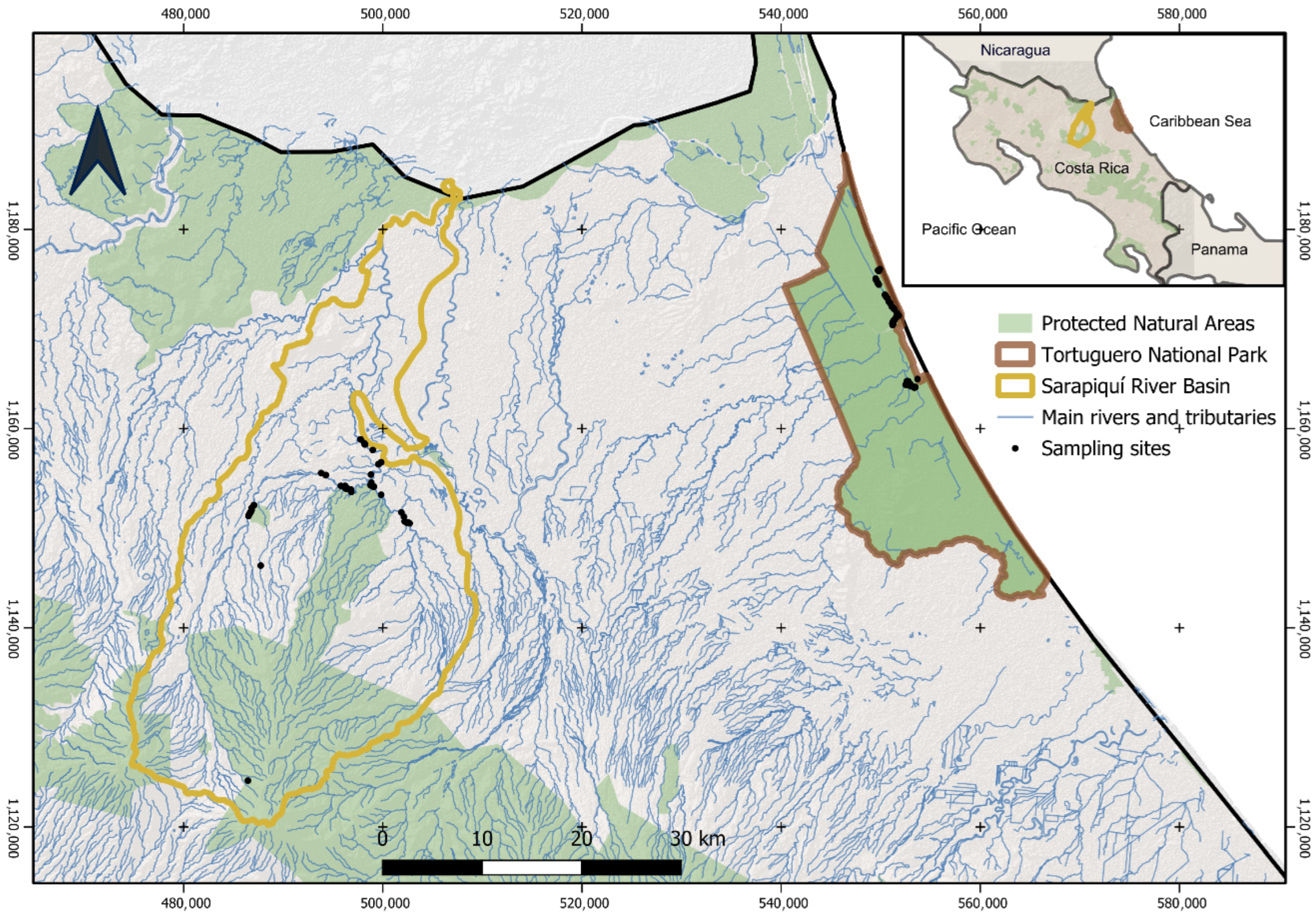
Figure 1. Map of the study area showing sampling locations for Neotropical otter (L. annectens) sampling areas within Tortuguero National Park (TNP) and the Sarapiquí River Basin (SRB), Costa Rica. Black dots represent sample distribution at each site.
Conservation 06 00016 g001
Figure 2. Genetic diversity (mean ±SE) of Neotropical otter (L. annectens) populations from Tortuguero National Park (TNP) and the Sarapiquí River Basin (SRB). Genetic diversity estimates were derived from 10 polymorphic microsatellite loci genotyped from 72 fecal samples collected between 2021 and 2022. Panel (A) shows rarefied allelic richness (AR), panel (B) shows expected heterozygosity (He), and panel (C) shows observed heterozygosity (Ho).
Conservation 06 00016 g002
Figure 3. Principal component analysis (PCA) of Neotropical otters (L. annectens) based on multilocus genotypes from 10 microsatellite loci. Individuals were sampled from four subpopulations between 2021 and 2022: Tortuguero River (TR) and Caño Palma Stream (CPS) within Tortuguero National Park (TNP), and Sarapiquí River (SR) and Puerto Viejo River (PVR) within the Sarapiquí River Basin (SRB). The first two principal components explain 16.4% and 13.3% of the total genetic variance. Ellipses represent 95% confidence intervals around the group centroids. The inset on the lower right displays the eigenvalues corresponding to each principal component.
Conservation 06 00016 g003
Figure 4. Estimated rates of contemporary migration based on BayesAss for Neotropical otter (L. annectens) populations. Panel (A) shows inter-region migration rates between the two main populations: Tortuguero National Park (TNP) and the Sarapiquí River Basin (SRB). Panel (B) shows finer-scale, intra-region migration among subpopulations: within TNP (Tortuguero River [TR], Caño Palma Stream [CPS]) and SRB (Puerto Viejo River [PVR], Sarapiquí River [SR]). Migration rates (m) are shown as directional estimates from source (rows) to destination (columns), with darker shading indicating higher rates. Values in brackets represent the 95% confidence intervals.
Conservation 06 00016 g004
Figure 5. ML-RELATE pairwise relatedness heatmaps for the Neotropical otter (L. annectens) sampled in northern Costa Rica. Lower-triangle cells show the estimated relatedness coefficient (r), while upper-triangle cells indicate inferred relationship categories— PO (parent–offspring), FS (full-siblings), HS (half-siblings), and U (unrelated). Diagonal cells are blank. Panel (A) corresponds to the Tortuguero National Park (TNP) population and panel (B) to the Sarapiquí River Basin (SRB) population. Estimates are based on multilocus genotypes at 10 nuclear microsatellite loci.
Conservation 06 00016 g005
Table 1. Results of the BOTTLENECK analysis for Neotropical otter (L. annectens) populations sampled across Tortuguero National Park (TNP) and the Sarapiquí River Basin (SRB). The table shows the observed and expected numbers of loci with heterozygosity excess under the assumption of mutation–drift equilibrium. Results are presented for each mutation model and population: Infinite Allele Model (IAM), Two-Phase Mutation Model (TPM), and Stepwise Mutation Model (SMM). Statistical significance of heterozygosity excess was evaluated using the Wilcoxon signed-rank test, with p-values adjusted for multiple comparisons using the Benjamini–Hochberg correction (p = 0.05).
PopulationHeterozygote ExcessIAMTPMSMM
Tortuguero NPExpected5.805.925.93
Observed1098
p value0.000490.001950.00684
Sarapiquí RBExpected5.535.705.84
Observed988
p value0.000490.004880.21582
Disclaimer/Publisher’s Note: The statements, opinions and data contained in all publications are solely those of the individual author(s) and contributor(s) and not of MDPI and/or the editor(s). MDPI and/or the editor(s) disclaim responsibility for any injury to people or property resulting from any ideas, methods, instructions or products referred to in the content.