
Reactive Oxygen and Carbonyl Species: Dual Regulators of Abiotic Stress Signaling and Tolerance in Plants

 ,
,  , and
, and 
Abstract
1. Introduction
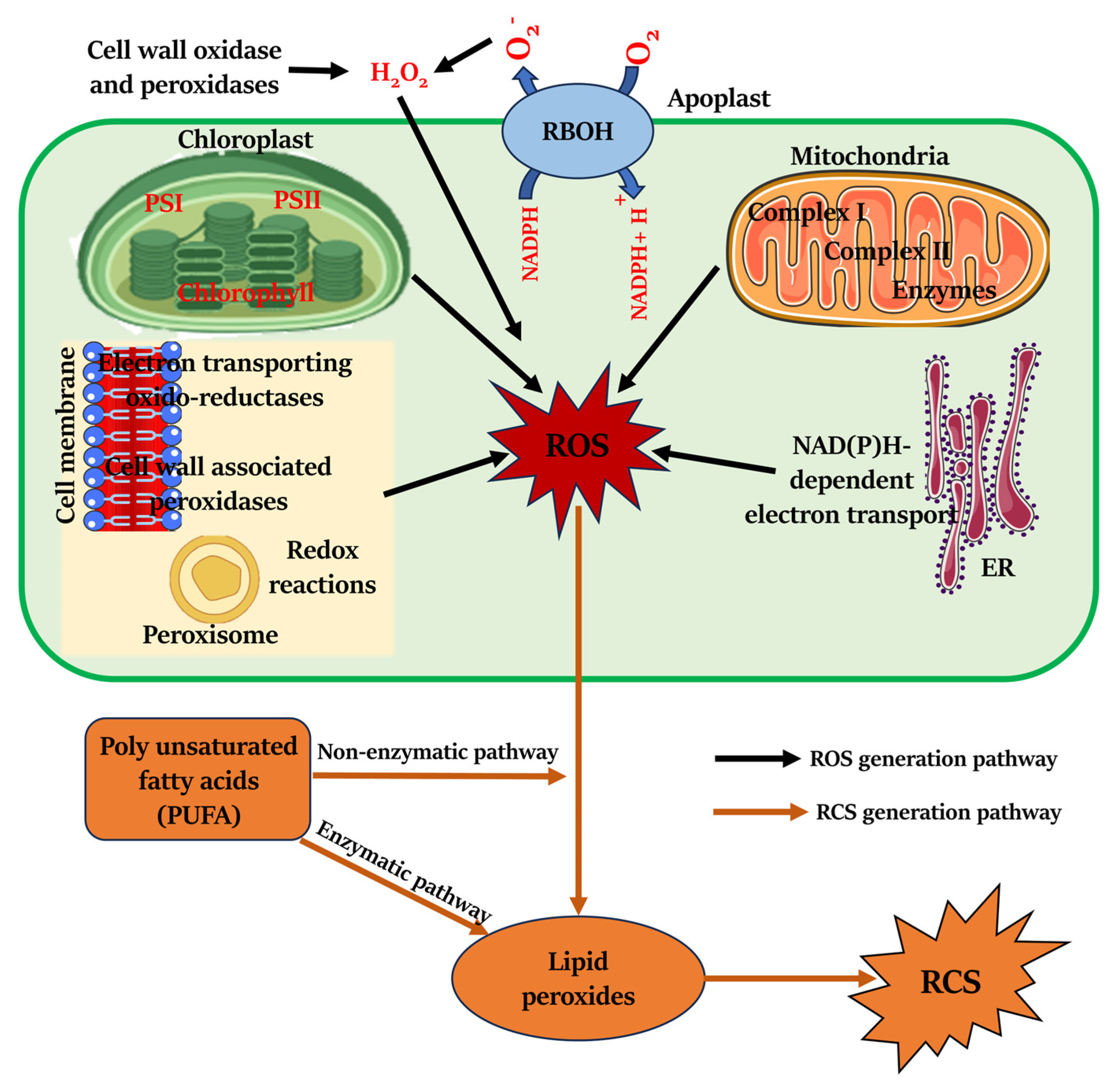
2. ROS and RCS Production in Plants
2.1. Generation of ROS in Plants
2.2. Generation of RCS in Plants
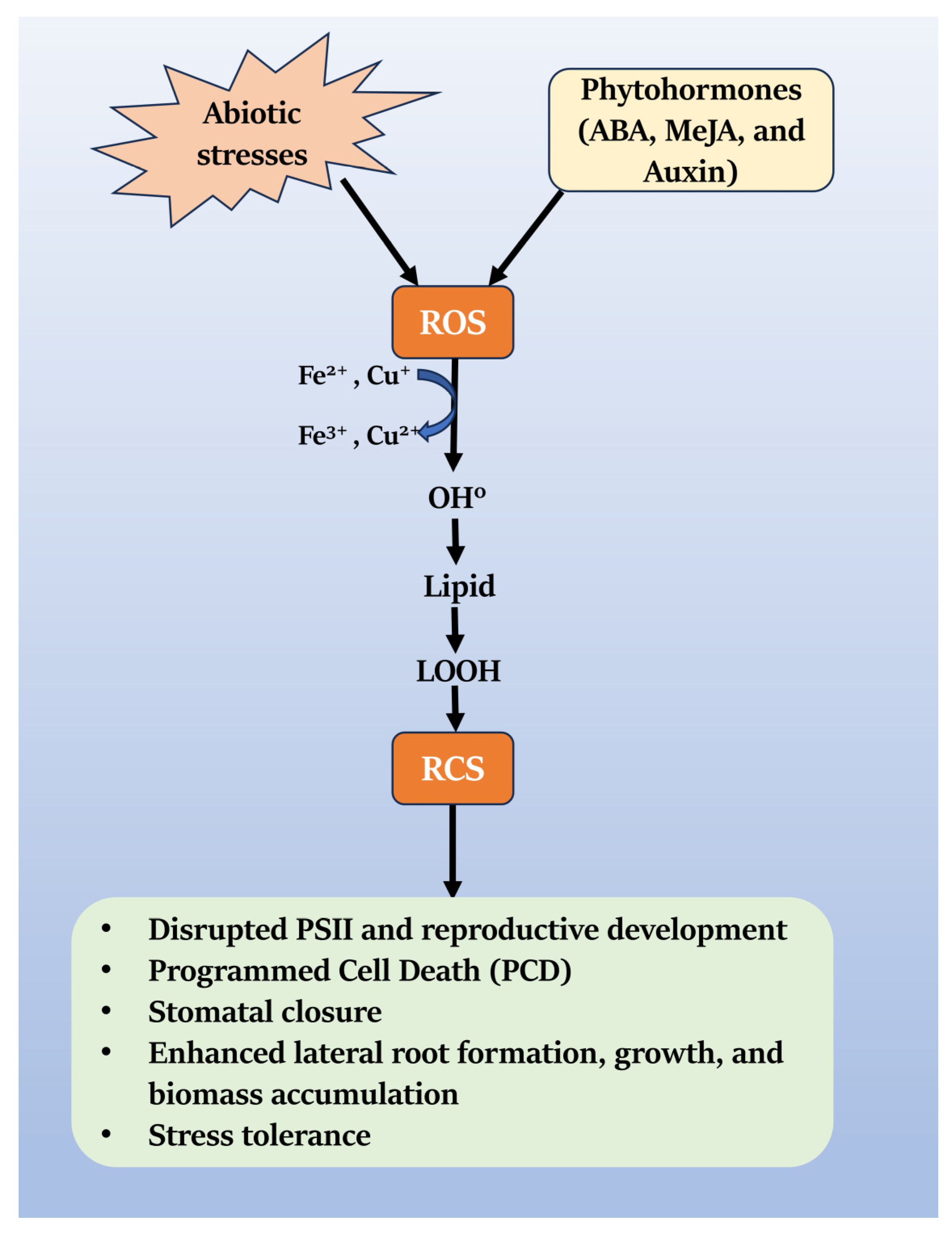
3. Role of ROS and RCS in Abiotic Stress Responses
3.1. Dual Role of ROS in Abiotic Stress Signaling
3.2. ROS-Mediated Mechanisms and Plant Responses Across Abiotic Stresses
3.3. Dual Role of RCS in Signaling, Toxicity, and Abiotic Stress Responses

| Stresses | Plant Species | RCS Generated | Targets (Protein/Lipid) | Effects/Functional Roles | References |
|---|---|---|---|---|---|
| Salinity | Arabidopsis thaliana | Acrolein, HNE, HHE | Reactive carbonyl species from PUFA oxidation in chloroplasts and mitochondria, and these RCS modify protein thiols for redox signaling at low levels but cause irreversible protein damage at high levels. | Lipid-derived RCS activate antioxidant defenses and stress tolerance in plants, while being detoxified by enzymes such as aldo-keto reductases. | [20] |
| Eutrema parvulum | Acrolein, HNE, HHE | RCS mainly target membrane PUFAs to form toxic aldehydes and modify key antioxidant proteins via Michael addition, Schiff base formation, and cysteine oxidation. | Exhibited toxicity at high levels but act as stress signals at low levels, activating antioxidant defense, ROS signaling, and ion homeostasis, especially in halophytes. | [20] | |
| Oryza sativa | MDA | Membrane lipids, cellular proteins. | Inhibited germination, seedling growth, and biomass. | [76] | |
| Drought | Arabidopsis thaliana | MDA, (E)-2-hexenal and (E)-2-butenal | PUFA-derived lipid peroxidation products (RSLVs, oxylipins, MDA) target membrane lipids and oxidatively modify proteins, including photosystem II components. | Activated stress-responsive genes through HSFA1-dependent and independent pathways to enhance heat tolerance. | [77] |
| Heat | Triticum aestivum | MDA, acrolein | Heat-shock proteins, photosystem II proteins (OEC33, PSII core proteins). | Protein aggregation, altered redox signaling, inactivation of oxygen-evolving complex, reduced photosynthesis. | [14] |
| Oryza sativa | MDA, HNE, HHE | Lipid membranes, chloroplast proteins. | Membrane destabilization, reduced photosynthesis, oxidative damage, decreased photosynthetic efficiency. | [14] | |
| Arabidopsis thaliana | MDA, acrolein, HNE and HHE | Pollen proteins, reproductive enzymes. | Protein carbonylation, reduced pollen viability, impaired fertilization, reduced seed set and cell death. | [78] | |
| Drought and heat | Arabidopsis thaliana | MDA | Thylakoid/PSII proteins (D1), membrane lipids, TFs and redox proteins. | Stress-combination-specific gene expression, dominant stomatal closure, impaired PSII repair, and activation of key stress TF families. | [54] |
| Oryza sativa | MDA | Photosynthetic machinery, reproductive tissues (spikelets), reproductive sensitivity noted; lipid membranes. | Reprogrammed gene expression during spikelet development and combined drought-heat disrupts metabolism, seed filling, and yield. | [54] |
4. Crosstalk Between ROS and RCS in Stress Signaling
5. Research Gaps and Future Perspectives
Author Contributions
Funding
Institutional Review Board Statement
Informed Consent Statement
Data Availability Statement
Conflicts of Interest
References
- Zhu, J.-K. Abiotic Stress Signaling and Responses in Plants. Cell 2016, 167, 313–324. [Google Scholar] [CrossRef]
- Praveen, A.; Dubey, S.; Singh, S.; Sharma, V.K. Abiotic Stress Tolerance in Plants: A Fascinating Action of Defense Mechanisms. 3 Biotech 2023, 13, 102. [Google Scholar] [CrossRef]
- Munns, R.; Tester, M. Mechanisms of Salinity Tolerance. Annu. Rev. Plant Biol. 2008, 59, 651–681. [Google Scholar] [CrossRef]
- Ullah, F.; Ali, S.; Siraj, M.; Akhtar, M.S.; Zaman, W. Plant Microbiomes Alleviate Abiotic Stress-Associated Damage in Crops and Enhance Climate-Resilient Agriculture. Plants 2025, 14, 1890. [Google Scholar] [CrossRef]
- Oshunsanya, S.O.; Nwosu, N.J.; Li, Y. Abiotic Stress in Agricultural Crops Under Climatic Conditions. In Sustainable Agriculture, Forest and Environmental Management; Jhariya, M.K., Banerjee, A., Meena, R.S., Yadav, D.K., Eds.; Springer: Singapore, 2019; pp. 71–100. [Google Scholar]
- Wang, R.; Li, J.; Liang, Y. Role of ROS Signaling in the Plant Defense against Vascular Pathogens. Curr. Opin. Plant Biol. 2024, 81, 102617. [Google Scholar] [CrossRef] [PubMed]
- Sood, M. Reactive Oxygen Species (ROS): Plant Perspectives on Oxidative Signalling and Biotic Stress Response. Discov. Plants 2025, 2, 187. [Google Scholar] [CrossRef]
- Hossain, M.A.; Bhattacharjee, S.; Armin, S.-M.; Qian, P.; Xin, W.; Li, H.-Y.; Burritt, D.J.; Fujita, M.; Tran, L.-S.P. Hydrogen Peroxide Priming Modulates Abiotic Oxidative Stress Tolerance: Insights from ROS Detoxification and Scavenging. Front. Plant Sci. 2015, 6, 420. [Google Scholar] [CrossRef]
- Niu, L.; Liao, W. Hydrogen Peroxide Signaling in Plant Development and Abiotic Responses: Crosstalk with Nitric Oxide and Calcium. Front. Plant Sci. 2016, 7, 230. [Google Scholar] [CrossRef] [PubMed]
- Anjum, N.A.; Sofo, A.; Scopa, A.; Roychoudhury, A.; Gill, S.S.; Iqbal, M.; Lukatkin, A.S.; Pereira, E.; Duarte, A.C.; Ahmad, I. Lipids and Proteins—Major Targets of Oxidative Modifications in Abiotic Stressed Plants. Environ. Sci. Pollut. Res. 2015, 22, 4099–4121. [Google Scholar] [CrossRef]
- Sharma, P.; Jha, A.B.; Dubey, R.S.; Pessarakli, M. Reactive Oxygen Species, Oxidative Damage, and Antioxidative Defense Mechanism in Plants under Stressful Conditions. J. Bot. 2012, 2012, 217037. [Google Scholar] [CrossRef]
- Waszczak, C.; Carmody, M.; Kangasjärvi, J. Reactive Oxygen Species in Plant Signaling. Annu. Rev. Plant Biol. 2018, 69, 209–236. [Google Scholar] [CrossRef]
- Mueller, M.J. Archetype Signals in Plants: The Phytoprostanes. Curr. Opin. Plant Biol. 2004, 7, 441–448. [Google Scholar] [CrossRef]
- Mano, J. Reactive Carbonyl Species: Their Production from Lipid Peroxides, Action in Environmental Stress, and the Detoxification Mechanism. Plant Physiol. Biochem. 2012, 59, 90–97. [Google Scholar] [CrossRef]
- Sultana, M.S.; Yamamoto, S.; Biswas, M.S.; Sakurai, C.; Isoai, H.; Mano, J. Histidine-Containing Dipeptides Mitigate Salt Stress in Plants by Scavenging Reactive Carbonyl Species. J. Agric. Food Chem. 2022, 70, 11169–11178. [Google Scholar] [CrossRef]
- Sultana, M.S.; Sakurai, C.; Biswas, M.S.; Szabados, L.; Mano, J. Accumulation of Reactive Carbonyl Species in Roots as the Primary Cause of Salt Stress-induced Growth Retardation of Arabidopsis thaliana. Physiol. Plant. 2024, 176, e14198. [Google Scholar] [CrossRef]
- Liang, X.; Qian, R.; Wang, D.; Liu, L.; Sun, C.; Lin, X. Lipid-Derived Aldehydes: New Key Mediators of Plant Growth and Stress Responses. Biology 2022, 11, 1590. [Google Scholar] [CrossRef]
- Islam, M.M.; Ye, W.; Matsushima, D.; Rhaman, M.S.; Munemasa, S.; Okuma, E.; Nakamura, Y.; Biswas, M.S.; Mano, J.; Murata, Y. Reactive Carbonyl Species Function as Signal Mediators Downstream of H2O2 Production and Regulate [Ca2+]Cyt Elevation in ABA Signal Pathway in Arabidopsis Guard Cells. Plant Cell Physiol. 2019, 60, 1146–1159. [Google Scholar] [CrossRef]
- Sonmez, M.C.; Yirmibesoglu, S.S.S.; Ozgur, R.; Uzilday, B.; Turkan, I. Roles of Reactive Carbonyl Species (RCS) in Plant Response to Abiotic Stress. In ROS Signaling in Plants; Corpas, F.J., Palma, J.M., Eds.; Methods in Molecular Biology; Springer: New York, NY, USA, 2024; Volume 2798, pp. 101–130. [Google Scholar]
- Yalcinkaya, T.; Uzilday, B.; Ozgur, R.; Turkan, I.; Mano, J. Lipid Peroxidation-Derived Reactive Carbonyl Species (RCS): Their Interaction with ROS and Cellular Redox during Environmental Stresses. Environ. Exp. Bot. 2019, 165, 139–149. [Google Scholar] [CrossRef]
- Biswas, M.S.; Fukaki, H.; Mori, I.C.; Nakahara, K.; Mano, J. Reactive Oxygen Species and Reactive Carbonyl Species Constitute a Feed-forward Loop in Auxin Signaling for Lateral Root Formation. Plant J. 2019, 100, 536–548. [Google Scholar] [CrossRef] [PubMed]
- Zhou, X.; Joshi, S.; Patil, S.; Khare, T.; Kumar, V. Reactive Oxygen, Nitrogen, Carbonyl and Sulfur Species and Their Roles in Plant Abiotic Stress Responses and Tolerance. J. Plant Growth Regul. 2022, 41, 119–142. [Google Scholar] [CrossRef]
- Swain, B.; Sahoo, L.; Tiwari, V.; Kumar, C.; Joshi, N.C.; Singh, P.K.; Shweta; Singh, A.; Yadav, D. Reactive Oxygen Species: Their Generation and Signalling during Abiotic Stress in Plants. In Soil Health and Nutrition Management; Joshi, N.C., Leustek, T., Singh, P.K., Eds.; CABI: New York, NY, USA, 2025; pp. 169–181. [Google Scholar]
- Zheng, C.; Chen, J.-P.; Wang, X.-W.; Li, P. Reactive Oxygen Species in Plants: Metabolism, Signaling, and Oxidative Modifications. Antioxidants 2025, 14, 617. [Google Scholar] [CrossRef]
- Zorov, D.B.; Juhaszova, M.; Sollott, S.J. Mitochondrial Reactive Oxygen Species (ROS) and ROS-Induced ROS Release. Physiol. Rev. 2014, 94, 909–950. [Google Scholar] [CrossRef]
- Mittler, R.; Vanderauwera, S.; Gollery, M.; Van Breusegem, F. Reactive Oxygen Gene Network of Plants. Trends Plant Sci. 2004, 9, 490–498. [Google Scholar] [CrossRef]
- Foyer, C.H.; Noctor, G. Redox Sensing and Signalling Associated with Reactive Oxygen in Chloroplasts, Peroxisomes and Mitochondria. Physiol. Plant. 2003, 119, 355–364. [Google Scholar] [CrossRef]
- Wang, P.; Liu, W.; Han, C.; Wang, S.; Bai, M.; Song, C. Reactive Oxygen Species: Multidimensional Regulators of Plant Adaptation to Abiotic Stress and Development. J. Integr. Plant Biol. 2024, 66, 330–367. [Google Scholar] [CrossRef]
- Sachdev, S.; Ansari, S.A.; Ansari, M.I.; Fujita, M.; Hasanuzzaman, M. Abiotic Stress and Reactive Oxygen Species: Generation, Signaling, and Defense Mechanisms. Antioxidants 2021, 10, 277. [Google Scholar] [CrossRef]
- Yamane, K.; Taniguchi, M.; Miyake, H. Salinity-Induced Subcellular Accumulation of H2O2 in Leaves of Rice. Protoplasma 2012, 249, 301–308. [Google Scholar] [CrossRef]
- Mignolet-Spruyt, L.; Xu, E.; Idänheimo, N.; Hoeberichts, F.A.; Mühlenbock, P.; Brosché, M.; Van Breusegem, F.; Kangasjärvi, J. Spreading the News: Subcellular and Organellar Reactive Oxygen Species Production and Signalling. EXBOTJ 2016, 67, 3831–3844. [Google Scholar] [CrossRef] [PubMed]
- Huang, L.; Liu, Y.; Wang, X.; Jiang, C.; Zhao, Y.; Lu, M.; Zhang, J. Peroxisome-Mediated Reactive Oxygen Species Signals Modulate Programmed Cell Death in Plants. Int. J. Mol. Sci. 2022, 23, 10087. [Google Scholar] [CrossRef] [PubMed]
- Sandalio, L.M.; Collado-Arenal, A.M.; Romero-Puertas, M.C. Deciphering Peroxisomal Reactive Species Interactome and Redox Signalling Networks. Free Radic. Biol. Med. 2023, 197, 58–70. [Google Scholar] [CrossRef] [PubMed]
- Jeevan Kumar, S.P.; Rajendra Prasad, S.; Banerjee, R.; Thammineni, C. Seed Birth to Death: Dual Functions of Reactive Oxygen Species in Seed Physiology. Ann. Bot. 2015, 116, 663–668. [Google Scholar] [CrossRef] [PubMed]
- Mittler, R. Oxidative Stress, Antioxidants and Stress Tolerance. Trends Plant Sci. 2002, 7, 405–410. [Google Scholar] [CrossRef]
- Heyno, E.; Mary, V.; Schopfer, P.; Krieger-Liszkay, A. Oxygen Activation at the Plasma Membrane: Relation between Superoxide and Hydroxyl Radical Production by Isolated Membranes. Planta 2011, 234, 35–45. [Google Scholar] [CrossRef] [PubMed]
- Singh, S.K.; Husain, S.M. A Redox-Based Superoxide Generation System Using Quinone/Quinone Reductase. ChemBioChem 2018, 19, 1657–1663. [Google Scholar] [CrossRef]
- Apel, K.; Hirt, H. REACTIVE OXYGEN SPECIES: Metabolism, Oxidative Stress, and Signal Transduction. Annu. Rev. Plant Biol. 2004, 55, 373–399. [Google Scholar] [CrossRef]
- Sies, H.; Berndt, C.; Jones, D.P. Oxidative Stress. Annu. Rev. Biochem. 2017, 86, 715–748. [Google Scholar] [CrossRef]
- Biswas, M.S.; Mano, J. Lipid Peroxide-Derived Reactive Carbonyl Species as Mediators of Oxidative Stress and Signaling. Front. Plant Sci. 2021, 12, 720867. [Google Scholar] [CrossRef]
- Matsui, K. Green Leaf Volatiles: Hydroperoxide Lyase Pathway of Oxylipin Metabolism. Curr. Opin. Plant Biol. 2006, 9, 274–280. [Google Scholar] [CrossRef] [PubMed]
- Mosblech, A.; Feussner, I.; Heilmann, I. Oxylipins: Structurally Diverse Metabolites from Fatty Acid Oxidation. Plant Physiol. Biochem. 2009, 47, 511–517. [Google Scholar] [CrossRef]
- Vliegenthart, J.F. Enzymic and Non Enzymic Oxidation of Polyunsaturated Fatty Acids. Chem. Ind. 1979, 10, 241–251. [Google Scholar]
- Grosch, W. Reactions of Hydroperoxides-Products of Low Molecular Weight. In Autoxidation of Unsaturated Lipids; Chan, H.W.-S., Ed.; Academic Press: Cambridge, MA, USA, 1987; pp. 95–139. [Google Scholar]
- Triantaphylidès, C.; Krischke, M.; Hoeberichts, F.A.; Ksas, B.; Gresser, G.; Havaux, M.; Van Breusegem, F.; Mueller, M.J. Singlet Oxygen Is the Major Reactive Oxygen Species Involved in Photooxidative Damage to Plants. Plant Physiol. 2008, 148, 960–968. [Google Scholar] [CrossRef] [PubMed]
- Farmer, E.E.; Davoine, C. Reactive Electrophile Species. Curr. Opin. Plant Biol. 2007, 10, 380–386. [Google Scholar] [CrossRef]
- Mano, J.; Biswas, M.S.; Sugimoto, K. Reactive Carbonyl Species: A Missing Link in ROS Signaling. Plants 2019, 8, 391. [Google Scholar] [CrossRef]
- Esterbauer, H.; Schaur, R.J.; Zollner, H. Chemistry and Biochemistry of 4-Hydroxynonenal, Malonaldehyde and Related Aldehydes. Free Radic. Biol. Med. 1991, 11, 81–128. [Google Scholar] [CrossRef]
- Noctor, G.; Reichheld, J.-P.; Foyer, C.H. ROS-Related Redox Regulation and Signaling in Plants. Semin. Cell Dev. Biol. 2018, 80, 3–12. [Google Scholar] [CrossRef]
- Pei, Z.-M.; Murata, Y.; Benning, G.; Thomine, S.; Klüsener, B.; Allen, G.J.; Grill, E.; Schroeder, J.I. Calcium Channels Activated by Hydrogen Peroxide Mediate Abscisic Acid Signalling in Guard Cells. Nature 2000, 406, 731–734. [Google Scholar] [CrossRef] [PubMed]
- Tsukagoshi, H.; Busch, W.; Benfey, P.N. Transcriptional Regulation of ROS Controls Transition from Proliferation to Differentiation in the Root. Cell 2010, 143, 606–616. [Google Scholar] [CrossRef]
- Torres, M.A.; Jones, J.D.G.; Dangl, J.L. Reactive Oxygen Species Signaling in Response to Pathogens. Plant Physiol. 2006, 141, 373–378. [Google Scholar] [CrossRef] [PubMed]
- Baxter, A.; Mittler, R.; Suzuki, N. ROS as Key Players in Plant Stress Signalling. J. Exp. Bot. 2014, 65, 1229–1240. [Google Scholar] [CrossRef]
- Zandalinas, S.I.; Fichman, Y.; Devireddy, A.R.; Sengupta, S.; Azad, R.K.; Mittler, R. Systemic Signaling during Abiotic Stress Combination in Plants. Proc. Natl. Acad. Sci. USA 2020, 117, 13810–13820. [Google Scholar] [CrossRef]
- Smékalová, V.; Doskočilová, A.; Komis, G.; Šamaj, J. Crosstalk between Secondary Messengers, Hormones and MAPK Modules during Abiotic Stress Signalling in Plants. Biotechnol. Adv. 2014, 32, 2–11. [Google Scholar] [CrossRef]
- Sewelam, N.; Jaspert, N.; Van Der Kelen, K.; Tognetti, V.B.; Schmitz, J.; Frerigmann, H.; Stahl, E.; Zeier, J.; Van Breusegem, F.; Maurino, V.G. Spatial H2O2 Signaling Specificity: H2O2 from Chloroplasts and Peroxisomes Modulates the Plant Transcriptome Differentially. Mol. Plant 2014, 7, 1191–1210. [Google Scholar] [CrossRef]
- Ravi, B.; Foyer, C.H.; Pandey, G.K. The Integration of Reactive Oxygen Species (ROS) and Calcium Signalling in Abiotic Stress Responses. Plant Cell Environ. 2023, 46, 1985–2006. [Google Scholar] [CrossRef] [PubMed]
- Rhaman, M.S.; Shirazy, B.J.; Kadri, O.; Jahan, I.; Shaiek, O.; Ye, W.; Brestic, M.; Farooq, M.; Murata, Y. Stomatal Signaling under Drought: Integrating Hormonal Pathways for Crop Resilience. Plant Cell Rep. 2025, 44, 259. [Google Scholar] [CrossRef]
- Cruz De Carvalho, M.H. Drought Stress and Reactive Oxygen Species: Production, Scavenging and Signaling. Plant Signal. Behav. 2008, 3, 156–165. [Google Scholar] [CrossRef]
- Qiao, M.; Hong, C.; Jiao, Y.; Hou, S.; Gao, H. Impacts of Drought on Photosynthesis in Major Food Crops and the Related Mechanisms of Plant Responses to Drought. Plants 2024, 13, 1808. [Google Scholar] [CrossRef]
- Mittler, R.; Blumwald, E. The Roles of ROS and ABA in Systemic Acquired Acclimation. Plant Cell 2015, 27, 64–70. [Google Scholar] [CrossRef] [PubMed]
- Choudhury, F.K.; Rivero, R.M.; Blumwald, E.; Mittler, R. Reactive Oxygen Species, Abiotic Stress and Stress Combination. Plant J. 2017, 90, 856–867. [Google Scholar] [CrossRef]
- Chung, J.; Zhu, J.; Bressan, R.A.; Hasegawa, P.M.; Shi, H. Reactive Oxygen Species Mediate Na+ -induced SOS1 mRNA Stability in Arabidopsis. Plant J. 2008, 53, 554–565. [Google Scholar] [CrossRef]
- Julkowska, M.M.; Testerink, C. Tuning Plant Signaling and Growth to Survive Salt. Trends Plant Sci. 2015, 20, 586–594. [Google Scholar] [CrossRef] [PubMed]
- Ohama, N.; Sato, H.; Shinozaki, K.; Yamaguchi-Shinozaki, K. Transcriptional Regulatory Network of Plant Heat Stress Response. Trends Plant Sci. 2017, 22, 53–65. [Google Scholar] [CrossRef] [PubMed]
- Medina, E.; Kim, S.-H.; Yun, M.; Choi, W.-G. Recapitulation of the Function and Role of ROS Generated in Response to Heat Stress in Plants. Plants 2021, 10, 371. [Google Scholar] [CrossRef]
- Driedonks, N.; Xu, J.; Peters, J.L.; Park, S.; Rieu, I. Multi-Level Interactions Between Heat Shock Factors, Heat Shock Proteins, and the Redox System Regulate Acclimation to Heat. Front. Plant Sci. 2015, 6, 999. [Google Scholar] [CrossRef]
- Kidokoro, S.; Shinozaki, K.; Yamaguchi-Shinozaki, K. Transcriptional Regulatory Network of Plant Cold-Stress Responses. Trends Plant Sci. 2022, 27, 922–935. [Google Scholar] [CrossRef]
- Qi, W.; Sun, W.; Ma, L.; Li, X.; Liu, H.; Yang, C.; Wei, Z. Pathways Related to ROS Production, Clearance, and Signal Transduction during Cold Response in Brassica napus L. with Strong Cold Resistance. Phyton 2025, 94, 739–762. [Google Scholar] [CrossRef]
- Clemens, S.; Ma, J.F. Toxic Heavy Metal and Metalloid Accumulation in Crop Plants and Foods. Annu. Rev. Plant Biol. 2016, 67, 489–512. [Google Scholar] [CrossRef]
- Singh, S.; Parihar, P.; Singh, R.; Singh, V.P.; Prasad, S.M. Heavy Metal Tolerance in Plants: Role of Transcriptomics, Proteomics, Metabolomics, and Ionomics. Front. Plant Sci. 2016, 6, 1143. [Google Scholar] [CrossRef] [PubMed]
- Delaix, C.L.; Tomiozzo, A.; Weber, G.; Lima-Melo, Y.; Vargas, A.N.D.; Margis-Pinheiro, M.; Trenz, T.S. Interplay among Hormones, Antioxidants, and Redox Signaling in Abiotic Stress Responses. Environ. Exp. Bot. 2025, 229, 106081. [Google Scholar] [CrossRef]
- Jozefczak, M.; Remans, T.; Vangronsveld, J.; Cuypers, A. Glutathione Is a Key Player in Metal-Induced Oxidative Stress Defenses. Int. J. Mol. Sci. 2012, 13, 3145–3175. [Google Scholar] [CrossRef]
- Biswas, M.S.; Mano, J. Lipid Peroxide-Derived Short-Chain Carbonyls Mediate Hydrogen Peroxide-Induced and Salt-Induced Programmed Cell Death in Plants. Plant Physiol. 2015, 168, 885–898. [Google Scholar] [CrossRef]
- Yin, L.; Mano, J.; Wang, S.; Tsuji, W.; Tanaka, K. The Involvement of Lipid Peroxide-Derived Aldehydes in Aluminum Toxicity of Tobacco Roots. Plant Physiol. 2010, 152, 1406–1417. [Google Scholar] [CrossRef]
- Khan, F.H.; Nakashima, Y.; Nakamura, T.; Nakamura, Y.; Hirai, Y.; Hoque, M.A.; Rhaman, M.S.; Munemasa, S.; Mano, J.; Murata, Y. Involvement of Reactive Carbonyl Species in Inhibition of Germination and Seedling Growth by Salt Stress in Rice. Biosci. Biotechnol. Biochem. 2025, 89, 1106–1113. [Google Scholar] [CrossRef]
- Yamauchi, Y.; Hasegawa, A.; Mizutani, M.; Sugimoto, Y. Chloroplastic NADPH-dependent Alkenal/One Oxidoreductase Contributes to the Detoxification of Reactive Carbonyls Produced under Oxidative Stress. FEBS Lett. 2012, 586, 1208–1213. [Google Scholar] [CrossRef]
- Lundsgaard-Nielsen, V. The Effect of Heat Stress on Reproduction in Arabidopsis Thaliana, Camelina Sativa, and Oryza Sativa: A Carbonyl-Targeted Proteomics Approach. Ph.D. Thesis, University of Toronto, Toronto, ON, Canada, 2017. [Google Scholar]
- Islam, M.M.; Ye, W.; Matsushima, D.; Munemasa, S.; Okuma, E.; Nakamura, Y.; Biswas, S.; Mano, J.; Murata, Y. Reactive Carbonyl Species Mediate ABA Signaling in Guard Cells. Plant Cell Physiol. 2016, 57, 2552–2563. [Google Scholar] [CrossRef]
- Rhaman, M.S.; Nakamura, T.; Nakamura, Y.; Munemasa, S.; Murata, Y. The Myrosinases TGG1 and TGG2 Function Redundantly in Reactive Carbonyl Species Signaling in Arabidopsis Guard Cells. Plant Cell Physiol. 2020, 61, 967–977. [Google Scholar] [CrossRef] [PubMed]
- Jahan, I.; Islam, M.M.; Nakamura, T.; Nakamura, Y.; Munemasa, S.; Mano, J.; Murata, Y. Reactive Carbonyl Species Function Downstream of Reactive Oxygen Species in Chitosan-induced Stomatal Closure. Physiol. Plant. 2025, 177, e70094. [Google Scholar] [CrossRef] [PubMed]
- Bao, L.; Wang, W.; Li, M.; Liu, J.; Liu, J.; Alifu, G.; Wang, D.; Liang, X.; Mao, T.; Zhai, Y. Reactive Oxygen Species–Post Translational Modifications–Central Carbon Metabolism Regulatory Loop: Coordination of Redox Homeostasis and Carbon Flux Allocation in Plants under Abiotic Stress. Front. Plant Sci. 2025, 16, 1637328. [Google Scholar] [CrossRef] [PubMed]
- Munemasa, S.; Hossain, M.A.; Nakamura, Y.; Mori, I.C.; Murata, Y. The Arabidopsis Calcium-Dependent Protein Kinase, CPK6, Functions as a Positive Regulator of Methyl Jasmonate Signaling in Guard Cells. Plant Physiol. 2011, 155, 553–561. [Google Scholar] [CrossRef]
- Islam, M.M.; Ye, W.; Akter, F.; Rhaman, M.S.; Matsushima, D.; Munemasa, S.; Okuma, E.; Nakamura, Y.; Biswas, M.S.; Mano, J.; et al. Reactive Carbonyl Species Mediate Methyl Jasmonate-Induced Stomatal Closure. Plant Cell Physiol. 2020, 61, 1788–1797. [Google Scholar] [CrossRef]
- Foyer, C.H.; Hanke, G. ROS Production and Signalling in Chloroplasts: Cornerstones and Evolving Concepts. Plant J. 2022, 111, 642–661. [Google Scholar] [CrossRef]
- Lee, K.P.; Kim, C. Photosynthetic ROS and Retrograde Signaling Pathways. New Phytol. 2024, 244, 1183–1198. [Google Scholar] [CrossRef] [PubMed]
- Van Veen, E.; Küpers, J.J.; Gommers, C.M.M. Plastids in a Pinch: Coordinating Stress and Developmental Responses Through Retrograde Signalling. Plant Cell Environ. 2025, 48, 6897–6911. [Google Scholar] [CrossRef] [PubMed]
- Pancheri, T.; Baur, T.; Roach, T. Singlet-Oxygen-Mediated Regulation of Photosynthesis-Specific Genes: A Role for Reactive Electrophiles in Signal Transduction. Int. J. Mol. Sci. 2024, 25, 8458. [Google Scholar] [CrossRef]
- Wrzaczek, M.; Brosché, M.; Kangasjärvi, J. ROS Signaling Loops—Production, Perception, Regulation. Curr. Opin. Plant Biol. 2013, 16, 575–582. [Google Scholar] [CrossRef] [PubMed]
- Noctor, G.; Foyer, C.H. Intracellular Redox Compartmentation and ROS-Related Communication in Regulation and Signaling. Plant Physiol. 2016, 171, 1581–1592. [Google Scholar] [CrossRef]


Disclaimer/Publisher’s Note: The statements, opinions and data contained in all publications are solely those of the individual author(s) and contributor(s) and not of MDPI and/or the editor(s). MDPI and/or the editor(s) disclaim responsibility for any injury to people or property resulting from any ideas, methods, instructions or products referred to in the content. |
© 2026 by the authors. Licensee MDPI, Basel, Switzerland. This article is an open access article distributed under the terms and conditions of the Creative Commons Attribution (CC BY) license.
Share and Cite
Rhaman, M.S.; Rehman, S.U.; Jahan, I.; Shirazy, B.J.; Chakrobortty, J.; Galib, M.A.A.; Akter, R.; Farzana, S.; Xie, Y. Reactive Oxygen and Carbonyl Species: Dual Regulators of Abiotic Stress Signaling and Tolerance in Plants. Stresses 2026, 6, 23. https://doi.org/10.3390/stresses6020023
Rhaman MS, Rehman SU, Jahan I, Shirazy BJ, Chakrobortty J, Galib MAA, Akter R, Farzana S, Xie Y. Reactive Oxygen and Carbonyl Species: Dual Regulators of Abiotic Stress Signaling and Tolerance in Plants. Stresses. 2026; 6(2):23. https://doi.org/10.3390/stresses6020023
Chicago/Turabian StyleRhaman, Mohammad Saidur, Shams Ur Rehman, Israt Jahan, Bir Jahangir Shirazy, Jotirmoy Chakrobortty, Md. Asadulla Al Galib, Rojina Akter, Sumaiya Farzana, and Yanjie Xie. 2026. "Reactive Oxygen and Carbonyl Species: Dual Regulators of Abiotic Stress Signaling and Tolerance in Plants" Stresses 6, no. 2: 23. https://doi.org/10.3390/stresses6020023
APA StyleRhaman, M. S., Rehman, S. U., Jahan, I., Shirazy, B. J., Chakrobortty, J., Galib, M. A. A., Akter, R., Farzana, S., & Xie, Y. (2026). Reactive Oxygen and Carbonyl Species: Dual Regulators of Abiotic Stress Signaling and Tolerance in Plants. Stresses, 6(2), 23. https://doi.org/10.3390/stresses6020023