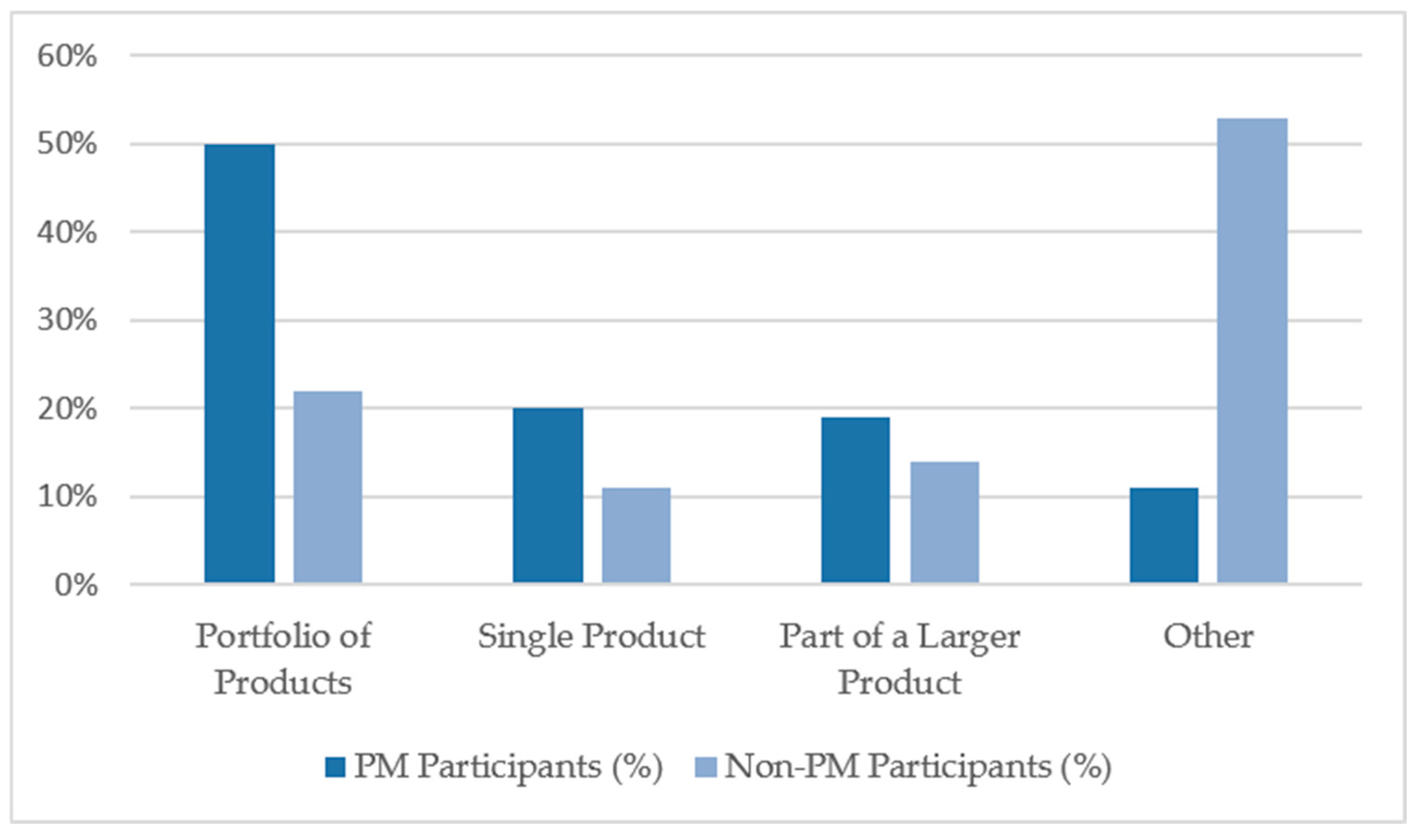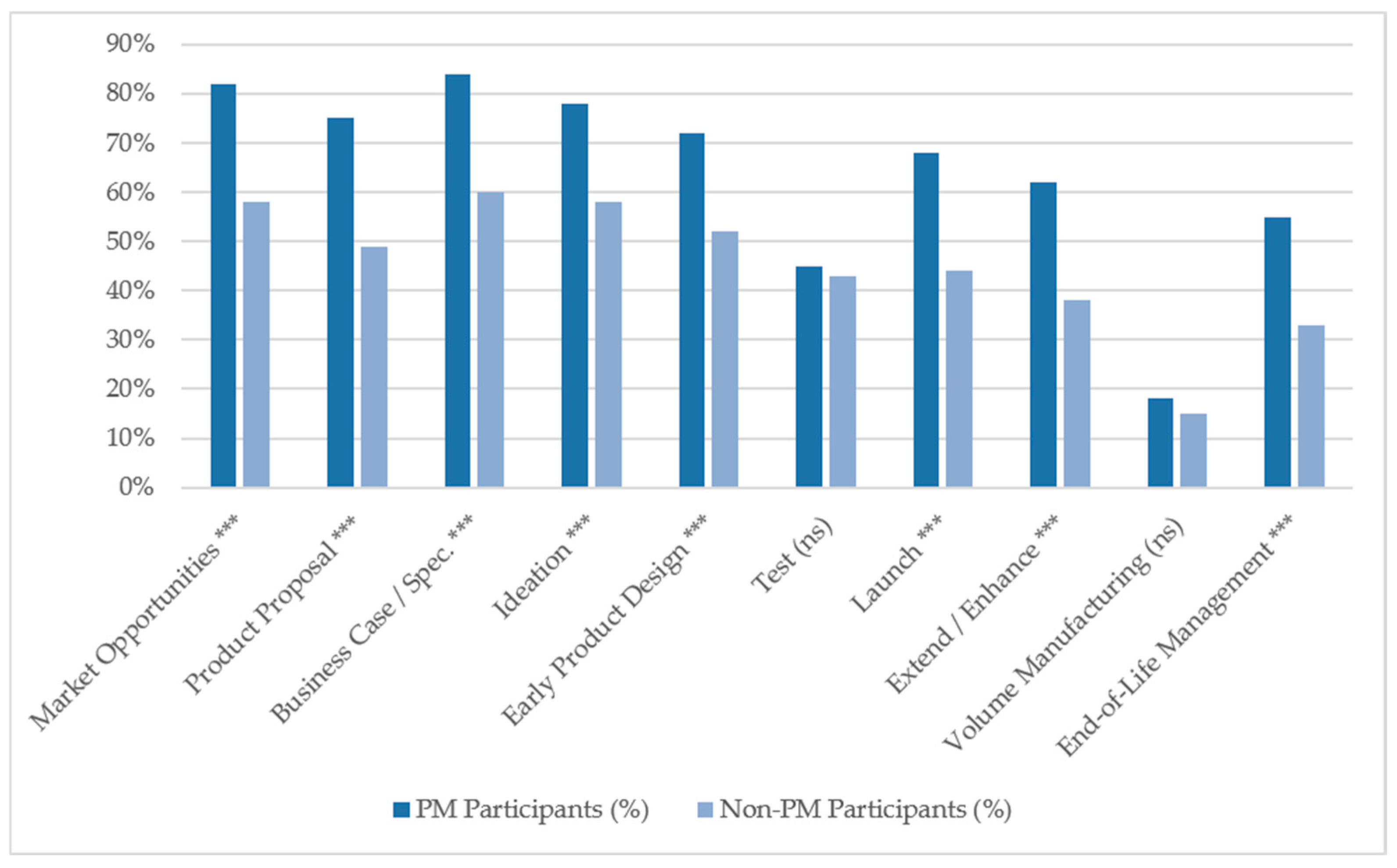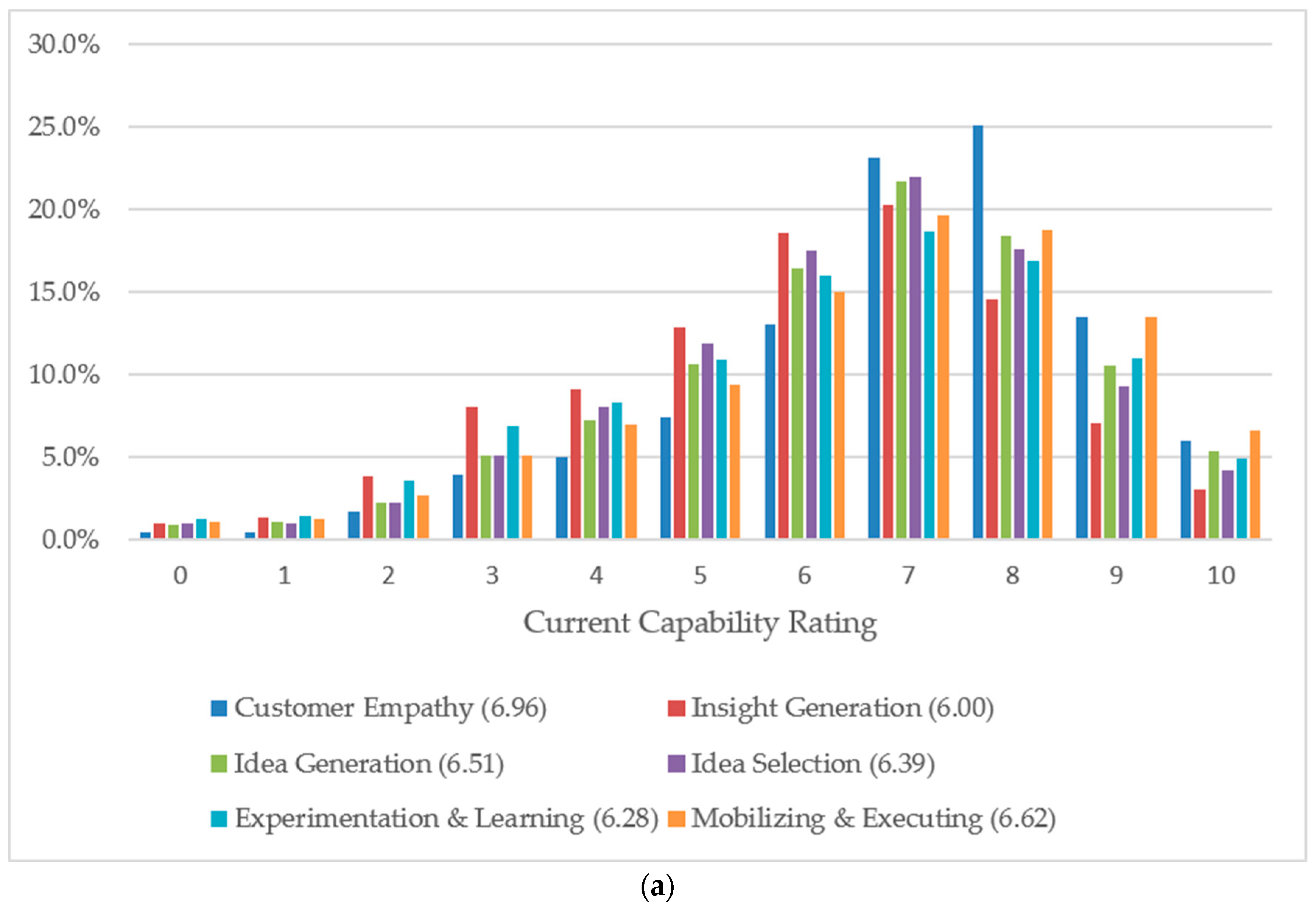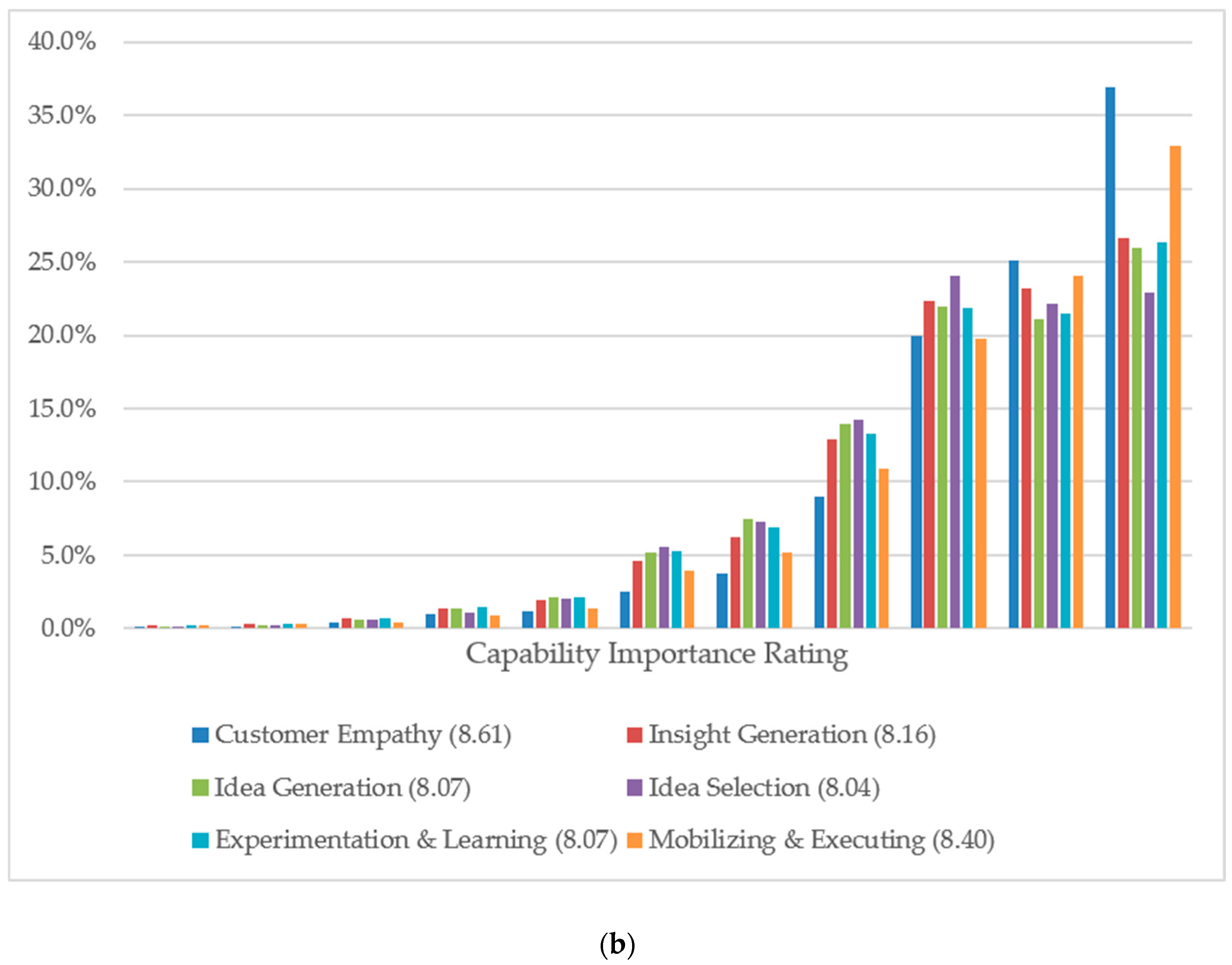

Innovation Proficiency and Barriers to Its Development by Product Managers and Their Teams

 ,
,
Abstract
1. Introduction
2. Materials and Methods
- How would you rate your team’s capability in [innovation capability]? (0–10 scale with 0 = low and 10 = high);
- How important is this [innovation capability] to your team? (0–10 scale with 0 = low and 10 = high);
- How might you improve this [innovation capability]? (open-ended response).
2.1. The Dataset
2.2. Research Methods
3. Capability and Importance Rating Analysis Results
3.1. Differences in Innovation Capability Assessment by Role and Experience
3.1.1. Differences Between PMs and Their Teammates
3.1.2. Experience and Scope Managed as Differentiators
3.1.3. Differences by Business Model and Industry
4. Barriers for PMs and Their Teams to Improving Innovation Proficiency
4.1. Overarching Themes from Product Managers and Their Teams
- Customer centricity and external orientation (43.3%).
- Time, capacity and resource constraints (23.2%).
- Data and evidence-based decision making (22.0%).
- Training and skill development (21.1%).
- Structured processes and frameworks (20.9%).
- Cross-functional collaboration (15.1%).
- Agility (11.9%).
- Culture and leadership (11.9%)
4.1.1. Customer Centricity and External Orientation
4.1.2. Time, Capacity and Resource Constraints
4.1.3. Data and Evidence-Based Decision Making
4.1.4. Training and Development
4.1.5. Structured Processes and Frameworks
4.1.6. Cross-Functional Collaboration
4.1.7. Agility
4.1.8. Culture and Leadership
4.2. Differences in Themes by Role and Industry
4.2.1. PMs vs. Their Teammates
4.2.2. Market Strategy and Industry-Based Differences
5. Evolution of Innovation Capabilities over Time
6. Discussion
6.1. Challenges to Achieving Customer Centricity
6.2. A Need for Process Formalization
6.3. New Technology Offers Hope
Author Contributions
Funding
Institutional Review Board Statement
Informed Consent Statement
Data Availability Statement
Acknowledgments
Conflicts of Interest
Abbreviations
| PM | Product Manager |
| KPI | Key Performance Indicators |
| OKR | Objectives and Key Results |
| AI | Artificial Intelligence |
Appendix A
- A.
- Survey Introduction: The following six questions help your team assess how it currently brings a service or product successfully to market and are designed to start useful conversations within your organization.
- Customer Empathy.
- Insight Generation.
- Idea Generation.
- Combining and Refining Ideas (Simplified to Idea Selection in this paper).
- Experimentation and Learning.
- Mobilizing and Executing.
- B.
- Setup for Each of the Innovation Capability Question Sets
- (1)
- Customer Empathy: Customer Empathy is about understanding customer and user needs (whether internal or external) and then creating shared understanding of those needs throughout the team.
- (2)
- Insight Generation: Insight Generation is about making sense of all the information you have gathered about your customer: results of practical experiments, direct observation of the use of your product or of competitors’ products, customer interviews, inputs from your sales organization, customer market research, user reviews, and other forms of direct evidence (as opposed to opinion).
- (3)
- Idea Generation: Idea Generation is about generating a broad range of ideas to address the insights you have uncovered. Teams that innovate well regularly practice good concept generation skills: deferring judgment and debate, striving for quantity, including everyone in the process, creating wild and unusual ideas, and being visual when possible.
- (4)
- Combining and Refining Ideas (Idea Selection): Once you have generated a wide range of ideas, you have to do something with them. Generally, you cannot just select one option but need to engage in an exercise of combining and refining those options to create superior ideas or solutions.
- (5)
- Experimentation and Learning: It is easy to get caught in long discussions about ideas, but the best way to evaluate them is to make them concrete. This can be done in the form of storyboards, rough physical prototypes or wireframes, that allow the team to more clearly visualize the possibilities and allow team members to share the work with others outside the team for input.
- (6)
- Mobilizing and Executing: When an experiment verifies with solid evidence that an idea/prototype works, and that idea has potential to go big (and is consistent with your team’s values, long term goals, and standards of performance), effective teams quickly mobilize the organization and concentrate resources to pursue the opportunity.
| 1 | B2C (Business-to-Consumer): A business selling directly to individual consumers. B2B (Business-to-Business): A business selling to another business. C2C (Consumer-to-Consumer): Transactions between two or more consumers, often through a third-party platform. B2B2C (Business-to-Business-to-Consumer): A business providing to another business, which then offers it to the final consumer. Government entities include G2G (Government-to-Government): Transactions between government agencies or departments, B2G (Business-to-Government): A business selling products or services to a government entity, such as a defense contractor. G2B (Government-to-Business): The government providing services or information to businesses, G2C (Government-to-Consumer): The government providing services directly to citizens. |
References
- Assink, M. (2006). Inhibitors of disruptive innovation capability: A conceptual model. European Journal of Innovation Management, 9(2), 215–233. [Google Scholar] [CrossRef]
- Beckman, S. L. (2020). To frame or reframe: Where might design thinking research go next? California Management Review, 62(2), 144–162. [Google Scholar] [CrossRef]
- Beckman, S. L., & Barry, M. (2007). Innovation as a learning process: Embedding design thinking. California Management Review, 50(1), 25–56. [Google Scholar] [CrossRef]
- Bento, F., Tagliabue, M., & Lorenzo, F. (2020). Organizational silos: A scoping review informed by a behavioral perspective on systems and networks. Societies, 10(3), 56. [Google Scholar] [CrossRef]
- Bijmolt, T. H. A., Leeflang, P. S. H., Block, F., Eisenbeiss, M., Hardie, B. G. S., & Saffert, P. (2010). Analytics for customer engagement. Journal of Service Researchrvice Research, 13(3), 341–356. [Google Scholar] [CrossRef]
- Binsaeed, R. H., Yousaf, Z., Grigorescu, A., Chitescu, R. I., Nassani, A., & Samoila, A. (2023). Customer engagement and customer relationship management capabilities’ effects on innovation performance and customer Distrust’ s moderating role. Sustainability, 15(12), 9475. [Google Scholar] [CrossRef]
- Brailas, A. (2025). Artificial intelligence in qualitative research: Beyond outsourcing data analysis to the machine. Psychology International, 7(3), 78. [Google Scholar] [CrossRef]
- Carlgren, L., Elmquist, M., & Rauth, I. (2016). The challenges of using design thinking in industry—Experiences from five large firms. Creativity and Innovation Management, 25(3), 344–362. [Google Scholar] [CrossRef]
- Christensen, C. M., Hall, T., Dillon, K., & Duncan, D. S. (2016). Know your customers’ ‘jobs to be done’. Harvard Business Review, 94(9), 54–62. [Google Scholar]
- Cullather, S. (2024). Trends in the experience economy: A global perspective. Nasdaq. Available online: https://www.nasdaq.com/articles/trends-in-the-experience-economy-a-global-perspective (accessed on 3 April 2026).
- Dalsace, F., Bonnet, D., & Lange, K. (2026). Customer centricity: Digital technology and leadership to the rescue. Business Horizons, 69(2), 217–227. [Google Scholar] [CrossRef]
- Doropoulos, S., Karapalidou, E., Charitidis, P., Karakeva, S., & Vologiannidis, S. (2025). Beyond manual media coding: Evaluating large language models and agents for news content analysis. Applied Sciences, 15(14), 8059. [Google Scholar] [CrossRef]
- Dorst, K. (2011). The core of ‘design thinking’ and its application. Design Studies, 32(6), 521–532. [Google Scholar] [CrossRef]
- Dzombak, R., & Beckman, S. (2019). Unpacking capabilities underlying design process. International Journal of Engineering Education, 36(2), 574–585. [Google Scholar]
- Ebert, C. (2007). The impacts of software product management. Journal of Systems and Software, 80(6), 850–861. [Google Scholar] [CrossRef]
- Ebert, C., & Brinkkemper, S. (2014). Software product management—An industry evaluation. Journal of Systems and Software, 95, 10–18. [Google Scholar] [CrossRef]
- Fichtler, T., Grigoryan, K., Koldewey, C., & Dumitrescu, R. (2023, November 22–24). Towards a data-driven product management—Concepts, advantages, and future research. 2023 IEEE International Conference on Technology Management, Operations and Decisions (ICTMOD) (pp. 1–6), Rabat, Morocco. [Google Scholar] [CrossRef]
- Fricker, S. A. (2012). Software product management. In A. Madche, A. Botzenhardt, & L. Neer (Eds.), Software for people: Innovations in sharing, length, and quality of life (1st ed., pp. 53–81). Springer. [Google Scholar] [CrossRef]
- Gama, F., & Magistretti, S. (2025). Artificial intelligence in innovation management: A review of innovation capabilities and a taxonomy of AI applications. Journal of Product Innovation Management, 42(1), 76–111. [Google Scholar] [CrossRef]
- Gnanasambandam, C., Harrysson, M., Srivastava, S., & Srivathsan, V. (2018). The product management talent dilemma. High Tech Practice. McKinsey & Co. [Google Scholar]
- Gorchels, L. (2000). The product manager’s handbook: The complete product management resource. McGraw-Hill. [Google Scholar]
- Griffin, A., & Hauser, J. R. (1993). The voice of the customer. Marketing Science, 12(1), 1–27. [Google Scholar] [CrossRef]
- Hemel, C. V. D., & Rademakers, M. F. (2016). Building customer-centric organizations: Shaping factors and Barriers. Journal of Creating Value, 2(2), 211–230. [Google Scholar] [CrossRef]
- Hoyer, W. D., Kroschke, M., Schmitt, B., Kraume, K., & Shankar, V. (2020). Transforming the customer experience through new technologies. Journal of Interactive Marketing, 51, 57–71. [Google Scholar] [CrossRef]
- Jaworski, B. J., & Kohli, A. K. (1993). Market orientation: Antecedents and consequences. Journal of Marketing, 57, 53–70. [Google Scholar] [CrossRef]
- Kittlaus, H.-B. (2022). Software product management: The ISPMA-compliant study guide and handbook (2nd ed.). Springer. [Google Scholar] [CrossRef]
- Knudsen, M. P., von Zedtwitz, M., Griffin, A., & Barczak, G. (2023). Best practices in new product development and innovation: Results from PDMA’s 2021 global survey. Journal of Product Innovation Management, 40(3), 257–275. [Google Scholar] [CrossRef]
- Kolb, D. A. (1984). Experiential learning: Experience as the source of learning and development. Prentice Hall. [Google Scholar]
- Kumar, V. (2013). 101 Design methods a structured approach for driving innovation in your organisation. John Wiley & Sons. [Google Scholar]
- Lee, J.-Y. (2019). Designing customer-centric organization structures: Toward the fluid marketing. In R. W. Palmatier, C. Moorman, & J.-Y. Lee (Eds.), Handbook on customer centricity (pp. 108–132). Edward Elgar Publishing. [Google Scholar]
- Lemon, K. N., & Verhoef, P. C. (2016). Understanding customer experience throughout the customer journey. Journal of Marketing, 80(6), 69–96. [Google Scholar] [CrossRef]
- Liedtka, J. (2018). Why design thinking works. Harvard Business Review, 96(5), 72–79. [Google Scholar]
- Lin, J.-Y., & Chen, C.-C. (2025). Driving innovation through customer relationship management—A data-driven approach. Sustainability, 17(8), 3663. [Google Scholar] [CrossRef]
- Lysonski, S. (1985). A boundary theory investigation of the product manager’s role. Journal of Marketing, 49(1), 26. [Google Scholar] [CrossRef]
- Magistretti, S., Ardito, L., & Messeni Petruzzelli, A. (2021). Framing the microfoundations of design thinking as a dynamic capability for innovation: Reconciling theory and practice. Journal of Product Innovation Management, 38, 645–667. [Google Scholar] [CrossRef]
- Maglyas, A., Nikula, U., & Smolander, K. (2013). What are the roles of software product managers? An empirical investigation. Journal of Systems and Software, 86(12), 3071–3090. [Google Scholar] [CrossRef]
- Maglyas, A., Nikula, U., Smolander, K., & Fricker, S. A. (2017). Core software product management activities. Journal of Advances in Management Research, 14(1), 23–45. [Google Scholar] [CrossRef]
- Mahajan, P. (2024). Artificial intelligence in product management. International Journal of Computer Trends and Technology, 72(6), 84–93. [Google Scholar] [CrossRef]
- Mann, R., Ellen, S., Matthew, S., & Holub, J. T. (2024). How the world’s best hotels deliver exceptional customer experience. McKinsey & Co. Available online: https://www.mckinsey.com/industries/travel/our-insights/how-the-worlds-best-hotels-deliver-exceptional-customer-experience (accessed on 3 April 2026).
- Masoud, R., & Basahel, S. (2023). The effects of digital transformation on firm performance: The role of customer experience and IT innovation. Digital, 3, 109–126. [Google Scholar] [CrossRef]
- Mayer, S., & Schwemmle, M. (2025). The impact of design thinking and its underlying theoretical mechanisms: A review of the literature. Creativity and Innovation Management, 34(1), 78–110. [Google Scholar] [CrossRef]
- Morgan, T., Obal, M., & Anokhin, S. (2018). Customer participation and new product performance: Towards the understanding of the mechanisms and key contingencies. Research Policy, 47(2), 498–510. [Google Scholar] [CrossRef]
- Nagaraj, V. (2022). How product managers use senseshaping to drive the front-end of digital product innovation: The five senseshaping practices presented here can help product managers recognize, interpret, and respond appropriately to new information in the front-end of dig. Research Technology Management, 65(2), 29–40. [Google Scholar] [CrossRef]
- Pine, B. J. (2026). The transformation economy: Guiding customers to achieve their aspirations (1st ed.). Harvard Business Review Press. [Google Scholar]
- Pine, B. J., & Gilmore, J. H. (2011). The experience economy. Harvard Business Review Press. [Google Scholar]
- Prahalad, C. K., & Ramaswamy, V. (2004). Co-creation experiences: The next practice in value creation. Journal of Interactive Marketing, 18(3), 5–14. [Google Scholar] [CrossRef]
- Prescott, M. R., Yeager, S., Ham, L., Saldana, C. D. R., Serrano, V., Narez, J., Paltin, D., Delgado, J., Moore, D. J., & Montoya, J. (2024). Comparing the efficacy and efficiency of human and generative AI: Qualitative thematic analyses corresponding author. JMIR AI, 3, e54482. [Google Scholar] [CrossRef]
- Quach, S., Thaichon, P., Lee, J.-Y., Weaven, S., & Palmatier, R. W. (2019). Toward a theory of outside-in marketing: Past, present, and future. Industrial Marketing Management, 89, 107–128. [Google Scholar]
- Rekonen, S., & Hassi, L. (2018). Impediments for experimentation in novice design teams. International Journal of Design Creativity and Innovation, 6(3–4), 235–255. [Google Scholar] [CrossRef]
- Rylander Eklund, A., Navarro Aguiar, U., & Amacker, A. (2022). Design thinking as sensemaking: Developing a pragmatist theory of practice to (Re) introduce sensibility. Journal of Product Innovation Management, 39, 24–43. [Google Scholar] [CrossRef]
- Sandberg, B., & Aarikka-Stenroos, L. (2014). What makes it so difficult? A systematic review on barriers to radical innovation. Industrial Marketing Management, 43(8), 1293–1305. [Google Scholar] [CrossRef]
- Schoemaker, P. J. H., Heaton, S., & Teece, D. (2018). Innovation, dynamic capabilities, and leadership. California Management Review, 61(1), 15–42. [Google Scholar] [CrossRef]
- Shah, D., Rust, R. T., Parasuraman, A., Staelin, R., & Day, G. S. (2006). The path to customer centricity. Journal of Service Research, 9(2), 113–124. [Google Scholar] [CrossRef]
- Springer, O., & Miler, J. (2022). A comprehensive overview of software product management challenges. Empirical Software Engineering, 27(106), 1–38. [Google Scholar] [CrossRef]
- Teece, D. J. (2007). Explicating dynamic capabilities: The nature and microfoundations of (sustainable) enterprise performance. Strategic Management Journal, 28(13), 1319–1350. [Google Scholar] [CrossRef]
- Thomke, S. H. (2020). Experimentation works: The surprising power of business experiments. Harvard Business Review Press. [Google Scholar]
- Tyagi, R. K., & Sawhney, M. S. (2010). High-performance product management: The impact of structure, process, competencies, and role definition. Journal of Product Innovation Management, 27(1), 83–96. [Google Scholar] [CrossRef]
- Ulwick, A. W. (2005). What customers want: Using outcome-driven innovation to create breakthrough products and services. McGraw Hill. [Google Scholar]
- Ulwick, A. W. (2016). Jobs to be done: Theory to practice. Strategyn. [Google Scholar]
- Vargo, S. L., & Lusch, R. F. (2017). Service-dominant logic 2025. International Journal of Research in Marketing, 34(1), 46–67. [Google Scholar] [CrossRef]
- Walls, A. R., Okumus, F., Wang, Y. R., & Kwun, D. J. W. (2011). An epistemological view of consumer experiences. International Journal of Hospitality Management, 30(1), 10–21. [Google Scholar] [CrossRef]
- Witkowski, A., & Wodecki, A. (2025). Where does AI play a major role in the new product development and product management process? Management review quarterly. Springer International Publishing. [Google Scholar] [CrossRef]
- Yin, R. K. (2015). Qualitative research from start to finish. Guilford Publications. [Google Scholar]



| Innovation Capability | Description |
|---|---|
| Customer Empathy | Developing a shared, deep qualitative and quantitative understanding of customer needs, goals, and context through curious, open-ended inquiry. |
| Insight Generation | Synthesizing diverse customer data to frame and re-frame customer problem statements and validate new opportunities for offering improvement. |
| Idea Generation | Creating a wide range of potential solutions through inclusive, judgment-free brainstorming, external inspiration, and deliberate exploration before converging on a single concept. |
| Idea Selection | Combining, improving, and prioritizing ideas using clear evaluation criteria tied to the desired customer experience, supported by collaboration and open debate. |
| Experimentation and Learning | Turning ideas into tangible tests (storyboards, prototypes, or pilots), identifying key assumptions, and rapidly iterating based on feedback to refine both solutions and understanding. |
| Mobilizing and Executing | Engaging and motivating a cross-functional team to design, develop and deliver new customer offerings, navigating organizational resistance, creating roadmaps and metrics. |
| Capability | PMs | PM Teammates | PMs + Teammates | Other |
|---|---|---|---|---|
| (a) Current Capability | ||||
| Customer Empathy | 6.36 (1.84) | 6.97 (1.08) | 6.73 (1.37) | 6.90 (1.41) |
| Insight Generation | 5.44 (1.93) | 5.96 (1.27) | 5.78 (1.43) | 5.82 (1.45) |
| Idea Generation | 6.19 (1.93) | 6.53 (1.16) | 6.38 (1.36) | 6.42 (1.49) |
| Idea Selection | 5.84 (1.83) | 6.39 (1.20) | 6.18 (1.38) | 6.28 (1.43) |
| Experimentation and Learning | 5.66 (2.07) | 6.28 (1.28) | 6.01 (1.52) | 6.24 (1.55) |
| Mobilizing and Executing | 6.19 (2.05) | 6.59 (1.27) | 6.41 (1.50) | 6.45 (1.53) |
| (b) Capability Importance | ||||
| Customer Empathy | 8.38 (1.60) | 8.61 (0.89) | 8.50 (1.06) | 8.46 (1.18) |
| Insight Generation | 8.04 (1.68) | 8.13 (0.99) | 8.09 (1.13) | 7.93 (1.34) |
| Idea Generation | 7.90 (1.80) | 8.04 (0.98) | 7.96 (1.20) | 7.89 (1.30) |
| Idea Selection | 7.84 (1.77) | 8.03 (0.94) | 7.94 (1.18) | 7.82 (1.34) |
| Experimentation and Learning | 7.91 (1.87) | 8.04 (1.00) | 7.97 (1.23) | 7.94 (1.35) |
| Mobilizing and Executing | 8.38 (1.72) | 8.42 (0.89) | 8.35 (1.24) | 8.18 (1.30) |
| Capability | H | p | PM vs. TM | PM vs. Other | TM vs. Other |
|---|---|---|---|---|---|
| (a) Current Capability | |||||
| Customer Empathy | 39.95 | <0.001 *** | TM > PM *** | Other > PM *** | ns |
| Insight Generation | 26.69 | <0.001 *** | TM > PM *** | Other > PM *** | ns |
| Idea Generation | 5.88 | 0.053 ns | TM > PM * | ns | ns |
| Idea Selection | 34.49 | <0.001 *** | TM > PM *** | Other > PM *** | ns |
| Experimentation and Learning | 38.10 | <0.001 *** | TM > PM *** | Other > PM *** | ns |
| Mobilizing and Executing | 9.45 | 0.009 ** | TM > PM *** | ns | ns |
| (b) Capability Importance | |||||
| Customer Empathy | 35.41 | <0.001 *** | TM > PM *** | Other > PM *** | TM > Other ** |
| Insight Generation | 22.28 | <0.001 *** | TM > PM *** | ns | TM > Other *** |
| Idea Generation | 4.04 | 0.132 ns | ns | ns | ns |
| Idea Selection | 8.18 | 0.017 * | TM > PM ** | ns | TM > Other * |
| Experimentation and Learning | 0.76 | 0.685 ns | ns | ns | ns |
| Mobilizing and Executing | 13.57 | 0.001 ** | ns | PM > Other ** | TM > Other *** |
| Industry | Customer Empathy | Insight Generation | Idea Generation | Idea Selection | Exp. and Learning | Mobilizing and Executing | n |
|---|---|---|---|---|---|---|---|
| Information | 6.84 | 5.91 | 6.49 | 6.28 | 6.17 | 6.65 | 886 |
| Mining/Oil and Gas | 6.70 | 5.73 | 6.65 | 6.38 | 6.43 | 6.30 | 164 |
| Finance and Insurance | 6.57 | 5.86 | 6.29 | 6.24 | 5.92 | 6.38 | 281 |
| Retail Trade | 6.45 | 5.98 | 6.21 | 5.73 | 6.26 | 6.45 | 62 |
| Manufacturing | 6.58 | 5.65 | 6.20 | 6.12 | 5.96 | 6.37 | 521 |
| Prof./Scientific | 6.34 | 5.31 | 6.16 | 5.84 | 5.69 | 6.07 | 163 |
| Utilities | 6.00 | 4.98 | 5.79 | 5.47 | 5.38 | 5.64 | 47 |
| Health Care | 6.60 | 4.66 | 5.32 | 5.26 | 4.83 | 5.83 | 53 |
| Capability | Highest | Lowest | Δ |
|---|---|---|---|
| Experimentation and Learning | Mining/Oil and Gas | Health Care | 1.60 |
| Insight Generation | Retail Trade | Health Care | 1.32 |
| Idea Generation | Mining/Oil and Gas | Health Care | 1.33 |
| Mobilizing and Executing | Information | Utilities | 1.01 |
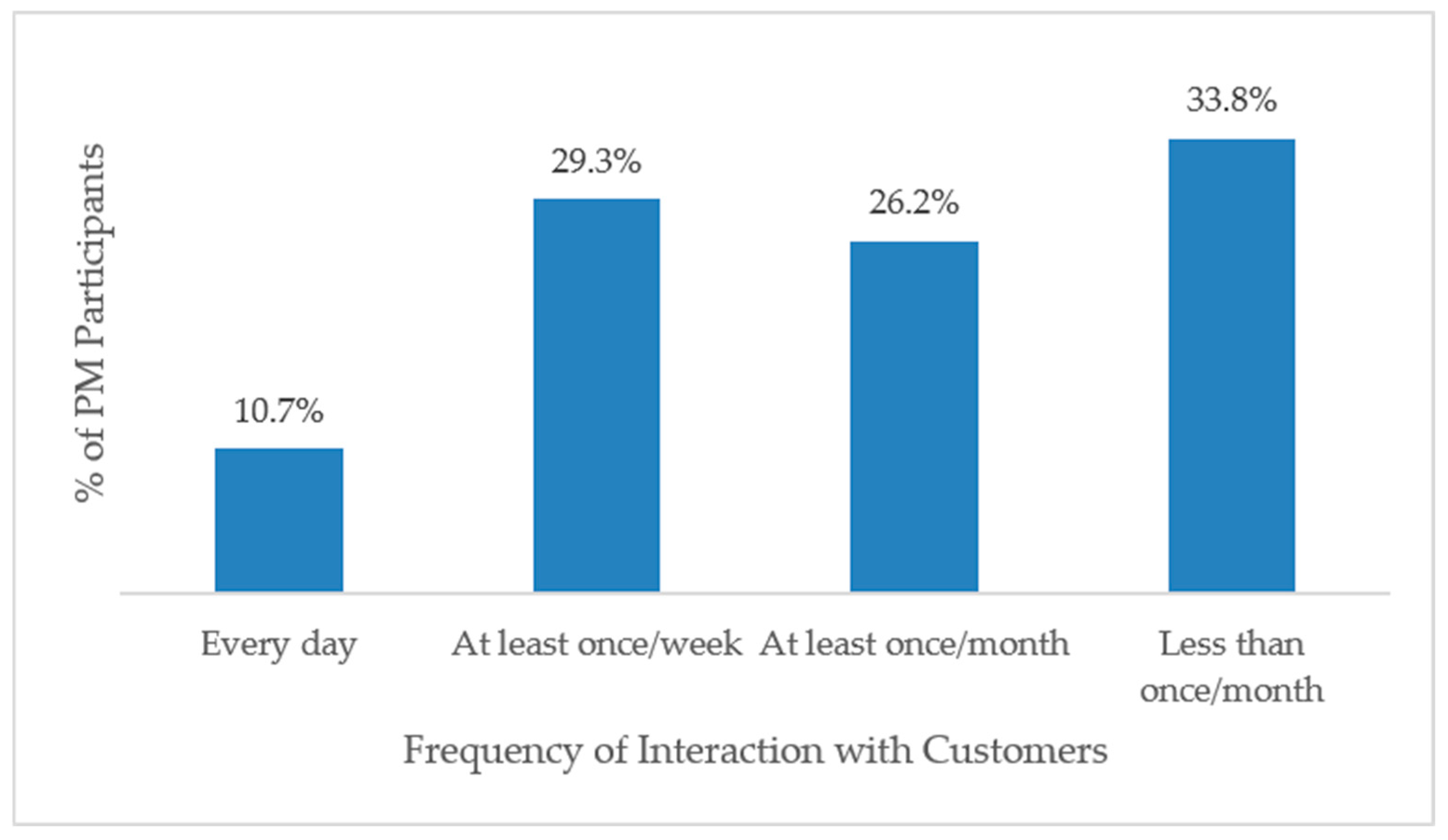
| Capability | Every Day | At Least Once/Week | At Least Once/Month | Less Than Once/Month | Kruskal–Wallis | Spearman ρ |
|---|---|---|---|---|---|---|
| Customer Empathy | 6.93 | 6.98 | 6.72 | 6.28 | *** | −0.146 *** |
| Insight Generation | 6.00 | 5.88 | 5.73 | 5.51 | ** | −0.083 *** |
| Idea Generation | 6.51 | 6.48 | 6.30 | 6.13 | ** | −0.078 *** |
| Idea Selection | 6.17 | 6.26 | 6.13 | 5.97 | * | −0.059 ** |
| Experimentation and Learning | 6.22 | 6.13 | 6.00 | 5.88 | ns | −0.058 ** |
| Mobilizing and Executing | 6.45 | 6.56 | 6.32 | 6.39 | ns | −0.041 ns |
| Total Score | 38.27 | 38.29 | 37.19 | 36.17 | *** | −0.109 * |
| Market Type | n | Daily | ≥Weekly | ≥Monthly | <Monthly | High- Frequency (Daily + Weekly) | Mean Score (1-Daily, 4 = Less than Once/Month) |
|---|---|---|---|---|---|---|---|
| B2G | 119 | 19.3% | 36.1% | 20.2% | 24.4% | 55.5% | 2.50 |
| Other | 120 | 18.3% | 32.5% | 15.8% | 33.3% | 50.8% | 2.67 |
| B2B | 443 | 12.4% | 32.7% | 25.5% | 29.3% | 45.1% | 2.74 |
| B2C | 633 | 10.4% | 29.9% | 26.4% | 33.3% | 40.3% | 2.83 |
| G2G | 265 | 5.7% | 29.1% | 32.5% | 32.8% | 34.7% | 2.92 |
| B2B2C | 147 | 7.5% | 24.5% | 32.7% | 35.4% | 32.0% | 2.96 |
| C2C | 224 | 8.9% | 17.9% | 22.8% | 50.4% | 26.8% | 3.15 |
| Theme | Highest Frequency of Mentions | Lowest Frequency of Mentions |
|---|---|---|
| Customer centricity and external orientation (p < 0.001) | Prof./Scientific (45.7%) Manufacturing (44.9%) | Healthcare (39.9%) Utilities (39.9%) |
| Data and evidence-based decision making (p < 0.001) | Information (17.4%) Finance (17.5%) | Mining/Oil and Gas (12.8%) Prof./Scientific (13.4%) |
| Training and skill development (p < 0.001) | Mining/Oil and Gas (26.4%) | Information (18.1%) Finance (17.9%) |
| Structured processes and frameworks (p = 0.003) | Healthcare (20.6%) Utilities (20.2%) | — |
| Cross-functional collaboration (p < 0.001) | — | Prof./Scientific (11.5%) |
| Culture and leadership (p = 0.019) | Utilities (11.2%) | — |
| Capability | 2016 | 2017 | 2018 | 2019 | 2020 | 2021 | 2022 | 2023 | 2024 | ρ | Sig. |
|---|---|---|---|---|---|---|---|---|---|---|---|
| Customer Empathy | 6.65 | 6.87 | 6.74 | 6.94 | 7.02 | 6.62 | 6.95 | 7.00 | 7.18 | +0.650 | ns |
| Insight Generation | 5.70 | 5.95 | 5.76 | 5.84 | 6.03 | 5.70 | 5.95 | 5.99 | 6.15 | +0.617 | ns |
| Idea Generation | 6.33 | 6.51 | 6.48 | 6.52 | 6.50 | 6.22 | 6.40 | 6.49 | 6.56 | +0.217 | ns |
| Idea Selection | 6.15 | 6.24 | 6.21 | 6.32 | 6.29 | 6.16 | 6.31 | 6.41 | 6.58 | +0.750 | * |
| Experimentation and Learning | 5.87 | 6.16 | 6.23 | 6.32 | 6.20 | 6.02 | 6.09 | 6.38 | 6.24 | +0.450 | ns |
| Mobilizing and Executing | 6.40 | 6.59 | 6.51 | 6.47 | 6.48 | 6.36 | 6.45 | 6.45 | 6.75 | +0.067 | ns |
Disclaimer/Publisher’s Note: The statements, opinions and data contained in all publications are solely those of the individual author(s) and contributor(s) and not of MDPI and/or the editor(s). MDPI and/or the editor(s) disclaim responsibility for any injury to people or property resulting from any ideas, methods, instructions or products referred to in the content. |
© 2026 by the authors. Licensee MDPI, Basel, Switzerland. This article is an open access article distributed under the terms and conditions of the Creative Commons Attribution (CC BY) license.
Share and Cite
Beckman, S.L.; Chen, A.G.; Chou, C.; Gu, C.Z.; Jiang, N.; Zhu, L. Innovation Proficiency and Barriers to Its Development by Product Managers and Their Teams. Businesses 2026, 6, 33. https://doi.org/10.3390/businesses6020033
Beckman SL, Chen AG, Chou C, Gu CZ, Jiang N, Zhu L. Innovation Proficiency and Barriers to Its Development by Product Managers and Their Teams. Businesses. 2026; 6(2):33. https://doi.org/10.3390/businesses6020033
Chicago/Turabian StyleBeckman, Sara L., Amy G. Chen, Christopher Chou, Charles Zhou Gu, Nick Jiang, and Lingyue Zhu. 2026. "Innovation Proficiency and Barriers to Its Development by Product Managers and Their Teams" Businesses 6, no. 2: 33. https://doi.org/10.3390/businesses6020033
APA StyleBeckman, S. L., Chen, A. G., Chou, C., Gu, C. Z., Jiang, N., & Zhu, L. (2026). Innovation Proficiency and Barriers to Its Development by Product Managers and Their Teams. Businesses, 6(2), 33. https://doi.org/10.3390/businesses6020033