Skip to Content

Businesses

Businesses is an international, peer-reviewed, open access journal on business published quarterly online by MDPI.

Get Alerted

Add your email address to receive forthcoming issues of this journal.

All Articles (248)

  • Article
  • Open Access

The continuing proliferation and diversification of management system standards (MSSs) intensify the need for integration approaches that extend beyond common clause structures, aligned documents, and combined audits. Organizations increasingly manage requirements concerning quality, environment, occupational health and safety, energy, information security, business continuity, compliance, innovation, asset management, artificial intelligence, and sustainable development. Although the ISO Harmonized Structure improves formal compatibility, it does not itself provide the managerial logic needed to reconcile competing objectives and embed heterogeneous requirements in organizational processes. For organizations operating a management system against two or more MSSs, this conceptual paper argues that quality, understood not as one standardized subsystem but as a logic of quality-oriented governance, provides a foundation for such integration. Based on a structured conceptual synthesis of 53 academic and authoritative sources, this paper combines IMS research with systems theory, institutional decoupling, organizational capability, and excellence-model perspectives. It distinguishes formal integration from functional integration and introduces system coherence/reduced suboptimization as an explicit explanatory mechanism between the degree of management system integration and organizational performance. Quality culture and the process approach are conceptualized as complementary expressions of quality-oriented governance; the process approach also has a dual role as both an antecedent of integration and a construct shaped by quality culture. The model further recognizes partial mediation, contextual moderation, and diminishing returns when additional integration generates coordination costs or bureaucracy. Construct boundaries, composite versus reflective specifications, and organizational-level aggregation requirements are clarified to support future empirical validation. The proposed framework explains how quality-oriented governance can translate a growing portfolio of MSS and sustainability requirements into coherent routines, reduce the risk that improvement of individual subsystems undermines the whole, and support sustained organizational success.

Businesses

29 September 2026
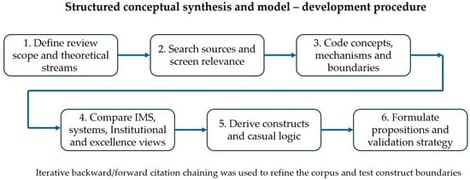
Structured conceptual synthesis and model development procedure. Source: authors’ own work.
  • Article
  • Open Access

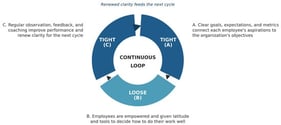
Organizations face a persistent tension between the need to hold employees accountable for results and the need to grant them the autonomy that fuels motivation, learning, and innovation. This conceptual paper theoretically develops and formalizes the tight–loose–tight (TLT) framework, a sequenced and cyclical approach to resolving this tension at the level of the individual employee. In the first tight phase, leaders and employees establish clear goals, expectations, and metrics that connect individual aspirations to organizational objectives. In the loose phase, leaders grant employees autonomy over how the work is accomplished, consistent with self-determination theory. In the final tight phase, leaders inspect what they expect through regular observation, feedback, and coaching, which then feeds forward into renewed clarity at the start of the next cycle. The framework integrates goal-setting theory, self-determination theory, and feedback and coaching research into a single dynamic process model, and it is distinguished from prior tight and loose constructs in the literature on organizational excellence, participative leadership, and national culture. Five research propositions are developed, together with guidance on measurement and research design, a rule that fixes each phase transition at the opening of the cycle, criteria for scoring cycle fidelity, and the condition under which the framework would be refuted. The framework’s application in an AI-enabled workplace is also considered. Implications for managers, limitations, and future research are discussed.

Businesses

21 September 2026

The continuous loop of tight–loose–tight.
  • Article
  • Open Access

The increasing adoption of machine learning models in corporate valuation has substantially improved predictive accuracy but at the cost of interpretability, a critical limitation in regulated financial environments. This study investigates whether SHAP (Shapley Additive Explanations) can systematically enhance the transparency of XGBoost based valuation models and examines whether the resulting insights extend those of classical linear regression. An empirical analysis was conducted on a cross-sectional dataset of U.S. publicly listed firms (2018), including more than 200 financial indicators. After systematic preprocessing and a hybrid feature selection procedure combining XGBoost importance, mutual information, and correlation based filtering, both an OLS regression and an XGBoost model were trained and validated. XGBoost achieved substantially higher predictive performance (R2 = 0.654 vs. 0.364), while SHAP values provided transparent global and local explanations of model decisions. Both models consistently identified earnings before tax and EV to sales as primary value drivers; however, SHAP additionally showed nonlinear effects, threshold behaviors, and context dependent interactions, particularly for EBITDA margin, share buybacks, and asset based indicators, that remain undetectable in linear models. These findings confirm that SHAP significantly enhances model transparency and generates economically meaningful insights beyond classical regression, supporting its application in auditable, regulatory compliant financial modeling.

Businesses

14 September 2026

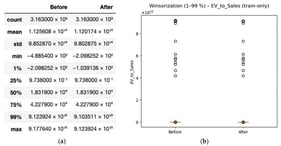
Before and after comparison of winsorization for the variable EV_to_Sales (1st–99th percentile, applied on training data only): (a) summary statistics before and after winsorization; (b) distributional comparison showing the reduction in extreme values through percentile-based capping.
  • Article
  • Open Access

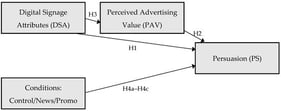
Digital signage is increasingly used in retail spaces, enabling contextually relevant forms of commercial communication. Despite its widespread adoption, relatively little research has examined how contextual variables influence the persuasive effectiveness of digital signage, particularly in developing markets. To address this gap, this study examines how digital signage attributes, advertising value and contextual advertising are associated with consumer persuasion. A conceptual model was developed integrating Advertising Value Theory and Congruity Theory to explain how context-aware communication functions within interactive retail environments. Data were collected from 200 shoppers at a South African shopping mall under three advertising conditions: no contextual content, a contextual advertisement referencing local news, or a promotional advertisement referencing local products. Consumer persuasion was analysed using linear regression and comparative statistics. The results indicate that digital signage attributes positively influence consumer persuasion. However, perceived advertising value of the content was not significantly associated with persuasion. In contrast, persuasion was higher when advertising content was contextually aligned with the surrounding environment. No significant differences in persuasion were found between local news and promotional conditions. These findings highlight the importance of contextual alignment between message and environment in shaping persuasive outcomes and demonstrate how context-aware digital signage functions as an adaptive interactive marketing touchpoint in which message, medium, and context contribute to persuasive communication.

Businesses

9 September 2026

Conceptual model of hypothesised relationships. Author’s conceptualisation.

Highly Accessed Articles

News & Conferences

Latest Issues

Open for Submission

Journal Sections

XFacebookLinkedIn
Businesses - ISSN 2673-7116