
The Rise of the Grocerant: Reviewing Consumer, Strategic, and Operational Perspectives


Abstract
1. Introduction
2. Materials and Methods
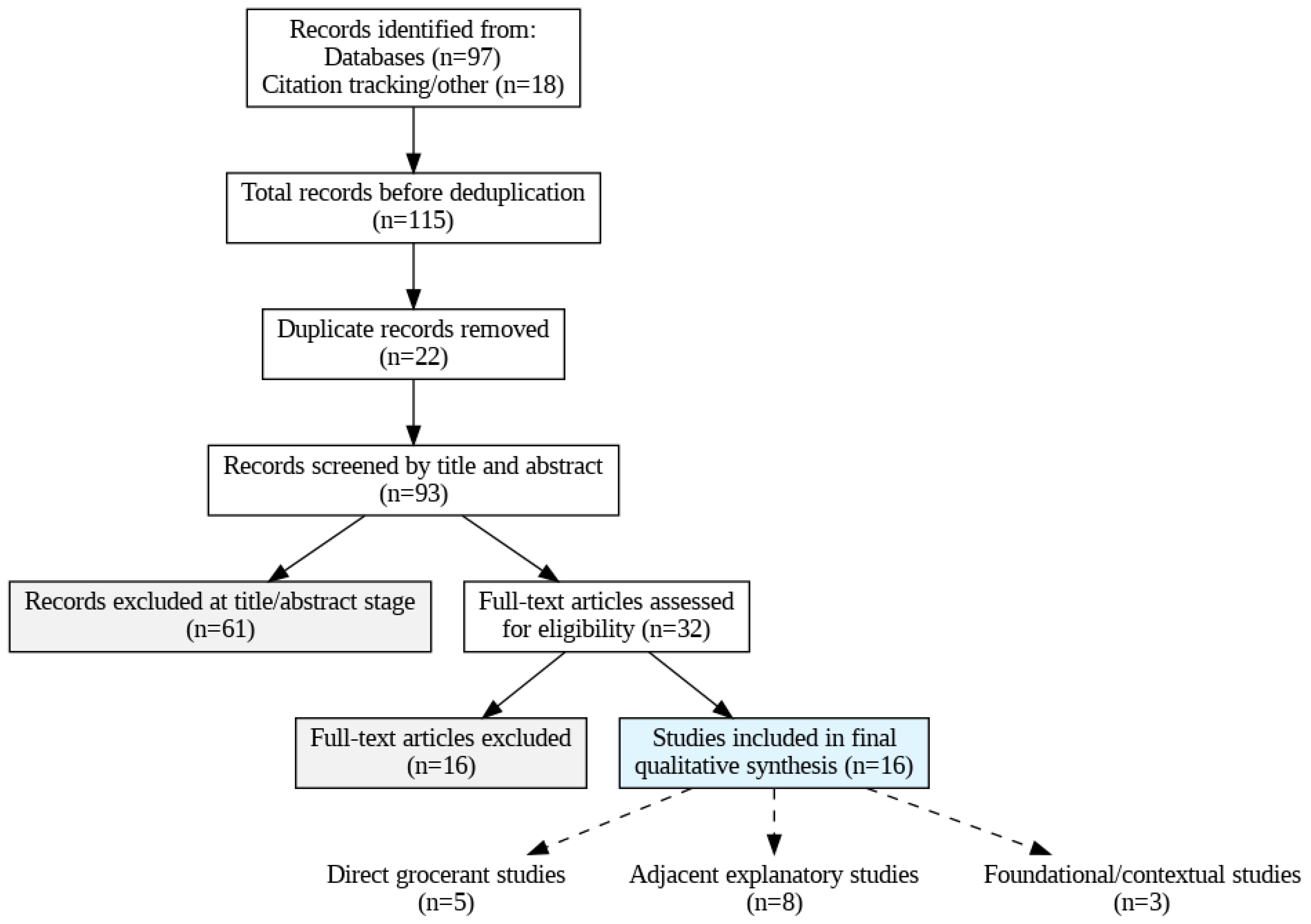
2.1. Review Design
2.2. Search Strategy
- Grocerant;
- “grocery restaurant hybrid”;
- “supermarket restaurant”;
- “retail restaurant hybrid”;
- “in-store dining” grocery;
- “prepared foods” retail;
- “ready-to-eat” supermarket;
- “customer experience” grocerant;
- “brand experience” grocerant;
- “retail format innovation” grocery;
- “competitive convergence” retail;
- “digital food retailing” grocery.
2.3. Inclusion and Exclusion Criteria
- They directly examined grocerants in a retail or consumer context;
- They addressed grocery–foodservice hybridity, including in-store dining or hybrid retail formats;
- They investigated consumer experience, value, branding, or behavior in food retail settings in ways clearly relevant to grocerants;
- They provided foundational theoretical insight into retail format innovation, one-stop shopping, convenience, or competitive convergence;
- They offered strong adjacent relevance in areas such as prepared foods, retail food environments, or digital food retailing.
- Focused exclusively on restaurant settings with no retail connection;
- Addressed grocery retail with no prepared-food, dining, or hybrid-format dimension;
- Lacked sufficient conceptual relevance to grocerants;
- Were purely promotional, journalistic, or non-analytical;
- Were duplicate records across search platforms.
2.4. Screening Process
2.5. Data Extraction and Coding
- Author(s) and year;
- Article title;
- Journal/source;
- Country or context;
- Literature type (direct grocerant, adjacent, or foundational);
- Theoretical lens;
- Research method;
- Key constructs or variables;
- Principal findings;
- Relevance to grocerants;
- Limitations and identified gaps.
- Customer experience and in-store dining;
- Perceived value, healthiness, and behavioral outcomes;
- Branding, loyalty, and trust;
- Retail innovation, convergence, and operational extension through prepared foods and digitalization.
2.6. Methodological Limitations of the Review
3. Conceptualizing the Grocerant
3.1. Defining the Grocerant
3.2. Distinguishing Grocerants from Related Formats
3.2.1. Grocerants Versus Supermarket Deli or Prepared-Food Counters
3.2.2. Grocerants Versus Restaurants
3.2.3. Grocerants Versus Convenience-Store Foodservice
3.2.4. Grocerants Versus Food Halls and Specialty Food Markets
3.3. Grocerants as Hybrid Formats
3.4. Functional and Experiential Dimensions of the Concept
3.5. Grocerants as Brand and Relationship Spaces
3.6. A Working Definition for This Review
3.7. Implications of the Concept
4. Customer Experience and In-Store Dining
4.1. Customer Experience as a Core Explanatory Lens
4.2. The Transformation of Grocery Retail into a Dining Environment
4.3. Product Experience, Uniqueness, and Hedonic Motivations
4.4. The Role of the Store Environment and Service Encountered
4.5. Functional Convenience and Experiential Value as Interacting Forces
4.6. In-Store Dining as a Behavioral Outcome
4.7. Implications of the Customer Experience Literature
5. Perceived Value, Food Healthiness, and Behavioral Intentions
5.1. Perceived Value as a Central Outcome
5.2. Food Healthiness as a Distinguishing Evaluative Dimension
5.3. Satisfaction and Revisit Intention
5.4. Emotional, Social, and Symbolic Dimensions of Value
5.5. Customer Engagement Beyond Repeat Patronage
5.6. The Interaction Between Healthiness, Trust, and Loyalty
5.7. Tensions in the Value Proposition
5.8. Implications of the Behavioral-Outcome Literature
6. Branding, Trust, and Loyalty
6.1. Grocerants as Brand Experience Environments
6.2. From Transactional Satisfaction to Relational Loyalty
6.3. The Role of Trust in Grocerant Relationships
6.4. Emotional and Social Pathways to Loyalty
6.5. Brand Experience as Strategic Differentiation
6.6. Interconnections Among Experience, Value, Trust, and Loyalty
6.7. Limits of the Current Branding Literature
6.8. Implications for Understanding Grocerants
7. Grocerants as Retail Format Innovation and Competitive Convergence
7.1. Retail Format Innovation as a Theoretical Lens
7.2. One-Stop Shopping and Shopping-Time Economizing
7.3. Competitive Convergence Between Grocery Retail and Restaurants
7.4. Hybridization as Response to Market Pressure
7.5. Comparisons with Analogous Hybrid Formats
7.6. Strategic Implications for Grocery Retailers
7.7. Operational Implications Embedded in Strategic Innovation
7.8. Grocerants and the Future of Retail Transformation
8. Prepared Foods, Food Environments, and Digitalization
8.1. Prepared Foods as the Operational Foundation of Grocerants
8.2. Freshness, Quality, and the Credibility of Meal Substitution
8.3. Grocerants Within the Retail Food Environment
8.4. Health, Sustainability, and the Food Environment Dimension
8.5. Digitalization and the Evolution of the Grocerant Model
8.6. Omnichannel Grocerants and Operational Integration
8.7. Operational Blind Spots in the Current Literature
9. Theoretical Lenses and Methodological Trends in Grocerant Research
9.1. Dominant Theoretical Lenses in Grocerant Research
9.1.1. Micro-Level (Consumer-Centric) Frameworks
9.1.2. Macro-Level (Strategic and Environmental) Frameworks
9.2. Theoretical Fragmentation and Conceptual Immaturity
9.3. Methodological Dominance of Consumer-Focused Empirical Studies
9.4. Underrepresentation of Strategic and Operational Methods
- Which grocerant models are most operationally sustainable?
- How do grocerants affect basket size, cross-selling, and profitability?
- What labor and supply-chain capabilities are required?
- How does performance differ across retail formats or national markets?
9.5. Limited Comparative and Cross-Context Research
9.6. Need for Mixed-Methods and Longitudinal Designs
9.7. Implications for the Development of the Field
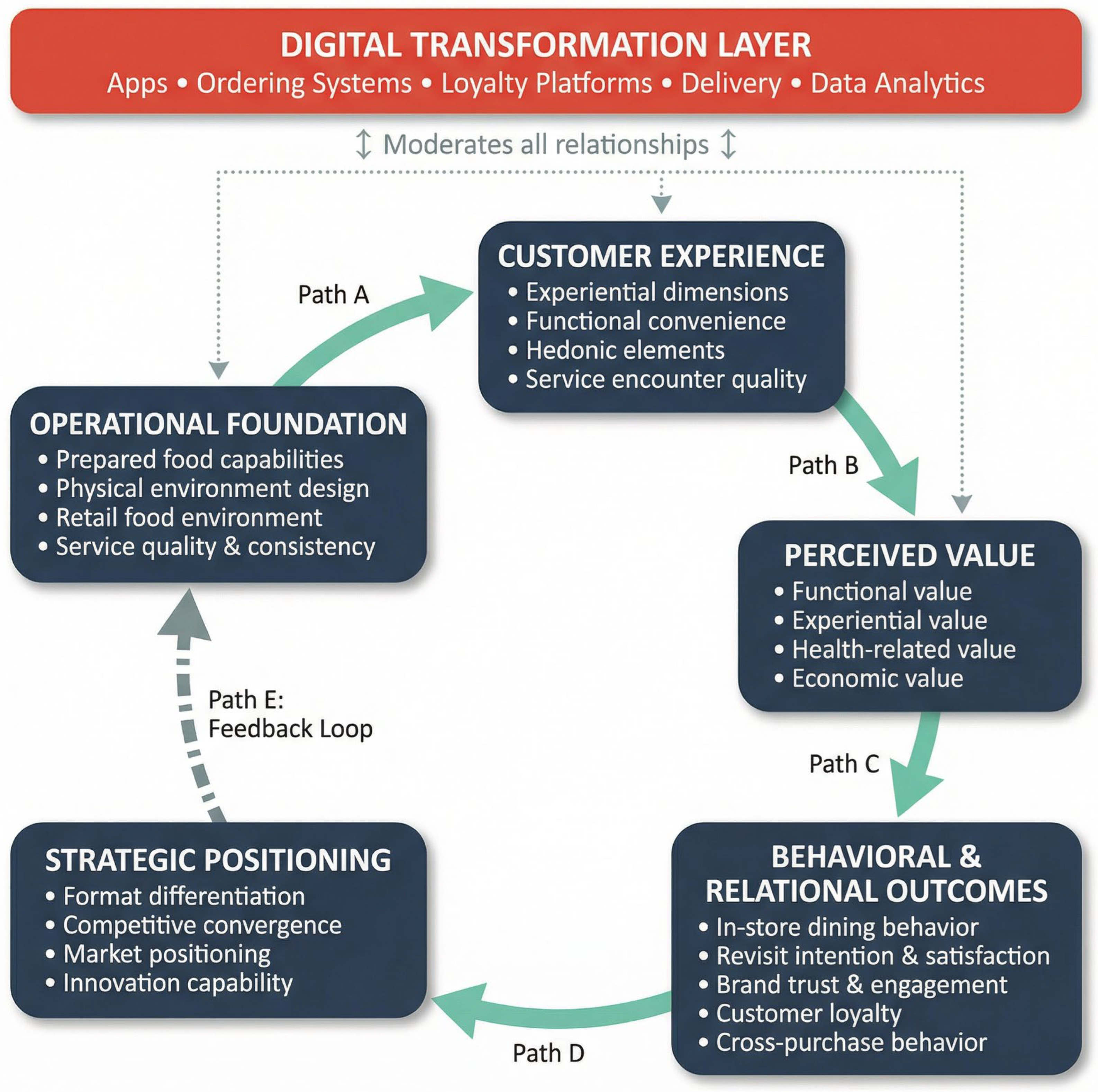
10. An Integrative Framework and Research Agenda
10.1. Introduction: The Need for Theoretical Integration
10.2. Core Components of the Integrative Framework
10.2.1. Component 1: Operational Foundation
- Prepared food capabilities: This include sourcing strategies, in-store or centralized preparation systems, menu development, quality standards, freshness management, and food safety protocols.
- Physical environment design: This includes the store layout, spatial allocation between grocery and foodservice zones, seating arrangements, visual merchandising, lighting, temperature, and sensory atmosphere.
- Retail food environment characteristics: This includes the product assortment breadth and depth, accessibility, choice architecture, point-of-purchase information, and interaction design
- Service quality and consistency: This includes labor models, staff training, service protocols, operational reliability, and execution standards across time and locations.
10.2.2. Component 2: Customer Experience Layer
- Experiential dimensions: This includes sensory engagement (sight, smell, taste, sound, and touch), affective responses (pleasure, arousal, and emotional connection), cognitive interpretation (meaning-making and categorization), and behavioral immersion (exploration, interaction, and participation).
- Functional convenience: This includes time-saving efficiency, one-stop shopping utility, task consolidation, immediacy of meal access, and reduction of the meal-planning burden.
- Hedonic elements: This includes novelty and variety-seeking satisfaction, aesthetic appreciation of the food presentation and environment, social interaction opportunities, and the perceived uniqueness of the offering.
- Service encounter quality: This includes staff expertise and helpfulness, responsiveness to customer needs, the personalization of interaction, and the trustworthiness of service delivery.
10.2.3. Component 3: Value Formation Mechanisms
- Perceived functional value: This includes convenience benefits, time savings, effort reduction, task integration (grocery plus meal), accessibility, and instrumental utility in solving food-related problems.
- Perceived experiential value: This includes the enjoyment and pleasure derived from the visit, atmospheric quality, aesthetic appeal, social engagement, and the overall attractiveness of the consumption experience.
- Perceived health value: This includes healthiness perceptions based on freshness cues, ingredient visibility, organic or natural positioning, nutritional transparency, and trust in food sourcing and preparation practices.
- Perceived economic value: This includes price-quality ratio assessment, value-for-money judgments, cost savings relative to restaurant dining, and overall affordability relative to alternative meal solutions.
10.2.4. Component 4: Behavioral and Relational Outcomes
- In-store dining behavior: This includes the willingness to consume prepared meals within the retail environment rather than taking them home, including the frequency, duration, and social context of in-store consumption.
- Revisit intention and actual return behavior: This includes the likelihood and frequency of repeat patronage, habitual incorporation into meal routines, and resistance to competitive alternatives.
- Brand trust and engagement: This includes confidence in the retailer’s food quality, authenticity, and reliability, and active engagement with the grocerant brand through participation, co-creation, and advocacy.
- Customer loyalty: This includes attitudinal commitment to the format, behavioral consistency across occasions, resistance to switching, and share-of-wallet allocation to the grocerant.
- Cross-purchase behavior: This includes the tendency to combine grocery shopping with prepared meal purchase in single trips, and the increasing basket size and retailer revenue per visit.
10.2.5. Component 5: Strategic Positioning and Competitive Effects
- Format differentiation: This includes the grocerant’s distinctiveness relative to conventional supermarkets, its hybrid identity that combines retail and foodservice logics, and its ability to occupy a unique position in consumers’ cognitive maps.
- Competitive convergence dynamics: This includes the grocerant’s role in blurring traditional boundaries between grocery retail, restaurants, convenience stores, and meal delivery platforms; its competitive threat to established foodservice formats; and its vulnerability to competitive response.
- Market positioning strength: This includes the grocerant’s ability to capture specific meal occasions, its attractiveness to target consumer segments, and its defensibility against imitation or substitution.
- Innovation capability and strategic renewal: This includes the capacity to evolve the format through operational improvement, digital integration, assortment innovation, and experiential enhancement.
10.3. Dynamic Relationships Within the Framework
10.3.1. Path A: Operational Capabilities → Customer Experience
10.3.2. Path B: Customer Experience → Perceived Value
10.3.3. Path C: Perceived Value → Behavioral Outcomes
10.3.4. Path D: Behavioral Outcomes → Strategic Positioning
10.3.5. Path E: Strategic Positioning → Operational Investment (Feedback Loop)
10.4. The Moderating Role of Digital Transformation
10.4.1. Digital Infrastructure Moderates Operational Capabilities
10.4.2. Digital Touchpoints Enhance Customer Experience
10.4.3. Digital Data Strengthens Value Delivery
10.4.4. Omnichannel Integration Extends Strategic Reach
10.4.5. Theoretical Implications of Digital Moderation
10.5. Theoretical Contributions of the Framework
10.5.1. Contribution 1: Hybrid Format Logic
10.5.2. Contribution 2: Multi-Level Value Creation
10.5.3. Contribution 3: Dynamic Evolution and Feedback Loops
10.5.4. Contribution 4: Digital Transformation as a Systemic Moderator
10.6. Research Gaps Revealed by the Framework
10.6.1. Operational Foundation Gaps
10.6.2. Customer Experience Gaps
10.6.3. Value Formation Gaps
10.6.4. Behavioral and Relational Outcome Gaps
10.6.5. Strategic Positioning Gaps
10.6.6. Digital Integration Gaps
10.6.7. Cross-Cutting and Methodological Gaps
10.7. Future Research Agenda: Priority Questions and Approaches
- Quantitative Format Differentiation and Taxonomy: As noted, the current literature struggles to empirically distinguish grocerants from adjacent formats like supermarket delis, food halls, and in-store cafes. Future research must develop quantitative taxonomic models based on operational metrics (e.g., floor space allocation, labor ratios, and SKU counts) and consumer usage data to statistically differentiate these formats and track their respective life cycles.
- Empirical Validation of Hypothesized Systemic Pathways: The integrative framework proposes theoretical links between operational inputs, customer experience, perceived value, and strategic positioning. Future studies should employ longitudinal, quasi-experimental, or mixed-methods designs to empirically test these propositions. Crucially, research must validate whether stated revisit intentions actually translate into share-of-wallet and long-term behavioral loyalty.
- Operational Sustainability and Financial Performance: The operational dimension remains the most critical blind spot. Future research must rigorously investigate the economic viability of grocerant models. Priority areas include analyzing cost structures (labor, waste management, and supply chain logistics), calculating actual profitability compared to traditional grocery formats, and assessing the environmental footprint of these perishable-heavy operations.
- Cross-Market and Cross-Cultural Generalizability: Given the current concentration of evidence in specific Asian and US markets, research must expand globally. Comparative studies should examine how cultural norms regarding food-away-from-home, urban density, and differing regulatory environments moderate grocerant adoption, success, and strategic implementation across diverse national contexts.
10.8. From Fragmentation to Integration
11. Managerial Implications
11.1. Implications for Grocery Retailers
11.2. Implications for Brand Strategy
11.3. Implications for Competitive Strategy
11.4. Implications for Operations Management
- Prepared-food assortment discipline: Meal offerings should reflect local demand, daypart patterns, and perceived freshness.
- Quality consistency: Repeat patronage depends on reliability in taste, appearance, and availability.
- Waste management: Prepared foods create spoilage risk and require better forecasting than shelf-stable groceries.
- Labor capability: Grocerants may require employees with foodservice, merchandising, and customer-interaction skills.
- Layout integration: The transition between shopping and dining zones should feel seamless rather than awkward or disconnected.
11.5. Implications for Digital Strategy
11.6. Implications for Foodservice Operators
11.7. Implications for Public Health and Policy
12. Conclusions
Author Contributions
Funding
Data Availability Statement
Conflicts of Interest
References
- Aranda, E., Martín, V. J., & Santos, J. (2018). Competitive convergence in retailing. Economic Research-Ekonomska Istraživanja, 31(1), 206–227. [Google Scholar] [CrossRef]
- Bae, H.-J., Chae, M.-J., & Ryu, K. (2010). Consumer behaviors towards ready-to-eat foods based on food-related lifestyles in Korea. Nutrition Research and Practice, 4(4), 332. [Google Scholar] [CrossRef] [PubMed]
- Challoumis, C., Eriotis, N., & Vasiliou, D. (2025). The role of pressure groups in Greek economic structure. World, 6(4), 150. [Google Scholar] [CrossRef]
- Gauri, D. K., Jindal, R. P., Ratchford, B., Fox, E., Bhatnagar, A., Pandey, A., Navallo, J. R., Fogarty, J., Carr, S., & Howerton, E. (2021). Evolution of retail formats: Past, present, and future. Journal of Retailing, 97(1), 42–61. [Google Scholar] [CrossRef]
- Ham, S., Lee, K.-S., Koo, B., Kim, S., Moon, H., & Han, H. (2021). The rise of the grocerant: Patrons’ in-store dining experiences and consumption behaviors at grocery retail stores. Journal of Retailing and Consumer Services, 62, 102614. [Google Scholar] [CrossRef]
- Jeon, H. M., & Yoo, S. R. (2021). The relationship between brand experience and consumer-based brand equity in grocerants. Service Business, 15(2), 369–389. [Google Scholar] [CrossRef]
- Kim, S., Ham, S., Moon, H., Chua, B.-L., & Han, H. (2019). Experience, brand prestige, perceived value (functional, hedonic, social, and financial), and loyalty among GROCERANT customers. International Journal of Hospitality Management, 77, 169–177. [Google Scholar] [CrossRef]
- Lang, M., & Hooker, N. H. (2013). An empirical test of experiential shopping in food retailing. British Food Journal, 115(5), 639–652. [Google Scholar] [CrossRef]
- Messinger, P. R., & Narasimhan, C. (1997). A model of retail formats based on consumers’ economizing on shopping time. Marketing Science, 16(1), 1–23. [Google Scholar] [CrossRef]
- Ming-Sung Cheng, J., Blankson, C., Sutikno, B., & Wang, M. C.-H. (2009). Hybrid convenience stores–the changing role of convenience stores in Taiwan. Asia Pacific Journal of Marketing and Logistics, 21(3), 417–432. [Google Scholar] [CrossRef]
- Park, J. L. (1998). The proposition of fresh prepared foods: Retail practices and systemwide implications. Applied Economic Perspectives and Policy, 20(2), 435–447. [Google Scholar] [CrossRef]
- Reynolds, J., Howard, E., Cuthbertson, C., & Hristov, L. (2007). Perspectives on retail format innovation: Relating theory and practice. International Journal of Retail & Distribution Management, 35(8), 647–660. [Google Scholar] [CrossRef]
- Terblanche, N. S. (2018). Revisiting the supermarket in-store customer shopping experience. Journal of Retailing and Consumer Services, 40, 48–59. [Google Scholar] [CrossRef]
- US Foods. (n.d.). The rise of the grocerant: How restaurant grocery store hybrids are changing the food service industry. Available online: https://www.usfoods.com/tools-tips-and-ideas/articles-and-publications/articles/meet-the-mash-up-of-a-grocery-and-restaurant (accessed on 13 April 2026).
- Wang, Y., & Coe, N. M. (2021). Platform ecosystems and digital innovation in food retailing: Exploring the rise of Hema in China. Geoforum, 126, 310–321. [Google Scholar] [CrossRef]
- Watkins, E., Ten Brink, P., Schweitzer, J.-P., Rogissart, L., & Nesbit, M. (2016). Policy mixes to achieve absolute decoupling: An ex ante assessment. Sustainability, 8(6), 528. [Google Scholar] [CrossRef]
- Winkler, M. R., Zenk, S. N., Baquero, B., Steeves, E. A., Fleischhacker, S. E., Gittelsohn, J., Leone, L. A., & Racine, E. F. (2020). A model depicting the retail food environment and customer interactions: Components, outcomes, and future directions. International Journal of Environmental Research and Public Health, 17(20), 7591. [Google Scholar] [CrossRef] [PubMed]
- Yoo, S. R., Lee, S. W., & Jeon, H. M. (2020). The role of customer experience, food healthiness, and value for revisit intention in GROCERANT. Sustainability, 12(6), 2359. [Google Scholar] [CrossRef]
- Yu, W., He, M., Han, X., & Zhou, J. (2022). Value acquisition, value co-creation: The impact of perceived organic grocerant value on customer engagement behavior through brand trust. Frontiers in Psychology, 13, 990545. [Google Scholar] [CrossRef] [PubMed]



| Component | Specification |
|---|---|
| Review objective | To identify, screen, and synthesize the academic literature on grocerants and closely related hybrid retail–foodservice formats, with emphasis on consumer, strategic, and operational perspectives. |
| Review design | PRISMA-informed semi-systematic literature review. |
| Databases searched | Scopus; Web of Science; Google Scholar; ScienceDirect; Emerald Insight; SpringerLink; Wiley Online Library; ABI/INFORM. |
| Supplementary search techniques | Backward citation tracking; forward citation tracking; reference-list screening of key articles; targeted search of the adjacent literature on food retailing, prepared foods, retail innovation, and digital food retail. |
| Core search terms | “grocerant”; “grocery restaurant hybrid”; “supermarket restaurant”; “retail restaurant hybrid”. |
| Consumer-focused search terms | “customer experience”; “revisit intention”; satisfaction; loyalty; “brand experience”; “brand equity”; “perceived value”; trust; engagement. |
| Operational/food-related search terms | “prepared foods”; “ready-to-eat”; “fresh prepared foods”; “in-store dining”; “food healthiness”; “retail food environment”. |
| Strategic search terms | “retail format innovation”; “competitive convergence”; “one-stop shopping”; convenience; hybridization. |
| Digital search terms | “digital food retailing”; omnichannel; “platform ecosystems”; delivery integration; click-and-collect. |
| Example Boolean combinations | (grocerant OR “grocery restaurant hybrid” OR “supermarket restaurant”) AND (“customer experience” OR satisfaction OR loyalty OR “revisit intention”); (“prepared foods” OR “ready-to-eat”) AND grocery AND retail; (“retail format innovation” OR “competitive convergence”) AND grocery. |
| Time period covered | 2000–2026. |
| Language | English. |
| Document types included | Peer-reviewed journal articles; relevant conceptual papers; high-relevance review articles; selected foundational studies from the adjacent literature. |
| Document types excluded | News stories; blogs; trade articles; promotional materials; magazine pieces; non-analytical commentary; inaccessible records with insufficient bibliographic information. |
| Inclusion criterion 1 | Studies directly examining grocerants as a retail or consumer context. |
| Inclusion criterion 2 | Studies on grocery–foodservice hybridization, including in-store dining, prepared-food retail, or related hybrid formats. |
| Inclusion criterion 3 | Studies addressing customer experience, value, branding, trust, or behavioral outcomes in food retail settings with clear relevance to grocerants. |
| Inclusion criterion 4 | Foundational studies on retail format innovation, convenience, one-stop shopping, or competitive convergence that help explain grocerants conceptually. |
| Inclusion criterion 5 | Studies on prepared foods, retail food environments, and digital food retail where the relevance to grocerants is explicit and analytically useful. |
| Exclusion criterion 1 | Restaurant-only studies with no grocery-retail or hybrid-format relevance. |
| Exclusion criterion 2 | Grocery retail studies with no prepared-food, dining, or hybrid-service dimension. |
| Exclusion criterion 3 | Articles lacking clear conceptual or empirical relevance to grocerants. |
| Exclusion criterion 4 | Duplicate records retrieved across databases. |
| Exclusion criterion 5 | Non-peer-reviewed practitioner content used only for background context rather than core analysis. |
| Screening stages | Identification; deduplication; title screening; abstract screening; full-text eligibility assessment; final thematic inclusion. |
| Selection logic | Priority was given to direct grocerant studies; where the direct literature was limited, the adjacent literature was included if it made a clear theoretical, empirical, or contextual contribution to understanding grocerants. |
| Final analytical focus | Consumer perspectives; strategic/format innovation perspectives; operational/prepared-food and digitalization perspectives. |
| Author (Year) | Study | Context | Main Focus | Method/Design | Main Contribution to Grocerant Literature | Literature Type |
|---|---|---|---|---|---|---|
| Yoo et al. (2020) | The Role of Customer Experience, Food Healthiness, and Value for Revisit Intention in GROCERANT | Korea/grocerant consumers | Customer experience, food healthiness, value, revisit intention | Empirical consumer study | Establishes experience and food healthiness as major drivers of value and revisit intention in grocerants | Direct grocerant |
| Ham et al. (2021) | The rise of the grocerant: Patrons’ in-store dining experiences and consumption behaviors at grocery retail stores | Grocery retail dining setting | In-store dining, product experience, satisfaction, uniqueness-related motives | Empirical consumer study | Shows how product experience and satisfaction shape in-store dining behavior at grocery retail stores | Direct grocerant |
| Jeon and Yoo (2021) | The relationship between brand experience and consumer-based brand equity in grocerant | Grocerant context | Brand experience, brand equity, loyalty | Empirical branding study | Extends grocerant research into branding and loyalty outcomes | Direct grocerant |
| Kim et al. (2019) | Experience, brand prestige, perceived value (functional, hedonic, social, and financial), and loyalty among GROCERANT customers | Grocerant consumers | Experience economy, brand prestige, multidimensional perceived value, loyalty | Empirical consumer study | Applies experience economy theory to grocerants; links staged experiences to brand prestige and four value dimensions (functional, hedonic, social, financial) | Direct grocerant |
| Yu et al. (2022) | Value acquisition, value co-creation: The impact of perceived organic grocerant value on customer engagement behavior through brand trust | Organic grocerant context | Organic value, emotional value, social value, trust, engagement | Empirical consumer study | Highlights the role of trust and emotional/social value in shaping customer engagement | Direct grocerant extension |
| Lang and Hooker (2013) | An empirical test of experiential shopping in food retailing | Food retailing | Experiential shopping, satisfaction | Empirical study | Provides theoretical support for treating grocerants as experiential food-retail environments | Adjacent |
| Terblanche (2018) | Revisiting the supermarket in-store customer shopping experience | Supermarket retail | Store environment, assortment, staff interaction | Empirical retail study | Identifies in-store variables relevant to grocerant atmosphere and service design | Adjacent |
| Messinger and Narasimhan (1997) | A model of retail formats based on consumers’ economizing on shopping time | General retail formats | Convenience, one-stop shopping, shopping-time economizing | Theoretical model | Provides a foundational explanation for the convenience logic underlying grocerants | Foundational |
| Reynolds et al. (2007) | Perspectives on retail format innovation: Relating theory and practice | Retail innovation literature | Retail format innovation | Conceptual paper | Frames grocerants as a case of retail format innovation | Foundational |
| Aranda et al. (2018) | Competitive convergence in retailing | Retail distribution | Sector convergence, hybrid formats | Analytical/conceptual retail study | Supports the interpretation of grocerants as products of grocery–restaurant convergence | Adjacent strategic |
| Ming-Sung Cheng et al. (2009) | Hybrid convenience stores: The changing role of convenience stores in Taiwan | Taiwan/convenience-store retail | Hybrid retail acceptance | Empirical study | Offers comparative evidence on hybrid retail evolution and consumer acceptance | Analogous hybrid format |
| Bae et al. (2010) | Consumer behaviors towards ready-to-eat foods based on food-related lifestyles in Korea | Korea/ready-to-eat foods | Lifestyle and ready-to-eat food behavior | Consumer study | Provides background for the prepared-food demand that supports grocerant development | Adjacent operational/consumer |
| Winkler et al. (2020) | A model depicting the retail food environment and customer interactions | Retail food environment | Retail actors, business models, customer interaction | Conceptual model | Broadens grocerants into food-environment and public-health discussion | Adjacent environmental |
| Wang and Coe (2021) | Platform ecosystems and digital innovation in food retailing: Exploring the rise of Hema in China | China/digital food retail | Platform ecosystems, digital innovation, online–offline integration | Case study | Provides a basis for understanding future omnichannel grocerant development | Adjacent digital |
| Park (1998) | “The Proposition of Fresh Prepared Foods: Retail Practices and Systemwide Implications” | Fresh prepared-food retail | Prepared-food systems, retail practices | Review/conceptual source | Draws attention to the operational infrastructure needed for prepared-food retail formats | Adjacent operational |
| US Foods (n.d.) | The Grocerant: A Restaurant Grocery Store Hybrid | Industry definition | Definition and market framing | Industry source | Useful for practical definition of the grocerant concept | Contextual/non-core |
Disclaimer/Publisher’s Note: The statements, opinions and data contained in all publications are solely those of the individual author(s) and contributor(s) and not of MDPI and/or the editor(s). MDPI and/or the editor(s) disclaim responsibility for any injury to people or property resulting from any ideas, methods, instructions or products referred to in the content. |
© 2026 by the authors. Licensee MDPI, Basel, Switzerland. This article is an open access article distributed under the terms and conditions of the Creative Commons Attribution (CC BY) license.
Share and Cite
Recio-Román, A.; Recio-Menéndez, M.; Román-González, M.V. The Rise of the Grocerant: Reviewing Consumer, Strategic, and Operational Perspectives. Businesses 2026, 6, 34. https://doi.org/10.3390/businesses6020034
Recio-Román A, Recio-Menéndez M, Román-González MV. The Rise of the Grocerant: Reviewing Consumer, Strategic, and Operational Perspectives. Businesses. 2026; 6(2):34. https://doi.org/10.3390/businesses6020034
Chicago/Turabian StyleRecio-Román, Almudena, Manuel Recio-Menéndez, and María Victoria Román-González. 2026. "The Rise of the Grocerant: Reviewing Consumer, Strategic, and Operational Perspectives" Businesses 6, no. 2: 34. https://doi.org/10.3390/businesses6020034
APA StyleRecio-Román, A., Recio-Menéndez, M., & Román-González, M. V. (2026). The Rise of the Grocerant: Reviewing Consumer, Strategic, and Operational Perspectives. Businesses, 6(2), 34. https://doi.org/10.3390/businesses6020034