Article

Innovation Proficiency and Barriers to Its Development by Product Managers and Their Teams

by
Sara L. Beckman
1,*,
Amy G. Chen
2,
Christopher Chou
3,
Charles Zhou Gu
3,
Nick Jiang
4 and
Lingyue Zhu
5
1
Haas School of Business, University of California, Berkeley, CA 94720, USA
2
Computer Science, College of Letters and Sciences, University of California, Berkeley, CA 94720, USA
3
Electrical Engineering and Computer Sciences, and Haas School of Business, University of California, Berkeley, CA 94720, USA
4
Computer Science and Philosophy, University of California, Berkeley, CA 94720, USA
5
Computer Science and Data Science, University of California, Berkeley, CA 94720, USA
*
Author to whom correspondence should be addressed.
Businesses 2026, 6(2), 33; https://doi.org/10.3390/businesses6020033
Submission received: 4 April 2026 / Revised: 28 April 2026 / Accepted: 2 June 2026 / Published: 12 June 2026

Abstract

Innovation proficiency is widely recognized as essential to organizational competitiveness; yet, how product managers and their teams develop these proficiencies across organizational contexts remains understudied. This study examines six innovation proficiencies—Customer Empathy, Insight Generation, Idea Generation, Idea Selection, Experimentation and Learning, and Mobilizing and Executing—using a longitudinal dataset of 15,842 survey responses collected across 1066 organizations over nine years (2016–2024). Responses were analyzed using descriptive statistics, nonparametric group comparisons, correlation analysis, reliability testing, longitudinal analysis, and systematic qualitative theme extraction from nearly 50,000 responses. Insight Generation is consistently the lowest-rated proficiency despite being ranked high in importance. Organization-weighted analysis finds significant, but modest, improvement in just one of the six proficiencies (Idea Selection) over the study period and positive but non-significant trends in the others. Qualitative analysis identifies customer centricity, lack of formalized processes and data-based decision making as persistent challenges over time. These findings suggest that improvement of innovation practices depends not only on Product Managers and their teams, but on organization-wide infrastructure changes to facilitate and support their innovation work.

1. Introduction

Product managers and their teams play a central role in the innovation activities of organizations as they design, develop and deliver new products, services and customer experiences. Research on the roles of product managers describes how they engage in strategic planning and roadmapping, create business cases that define product vision, strategy and evolution (Maglyas et al., 2017) and ensure alignment between corporate goals and product direction (Fricker, 2012). They bridge business needs and technical feasibility to orchestrate development of high-level technical requirements that create value for both customers and the business (Ebert & Brinkkemper, 2014; Maglyas et al., 2017) and translate strategic plans into actionable backlogs (Kittlaus, 2022). They plan and facilitate execution of “go-to-market” strategies including, in some cases, determining product value and pricing strategies (Gnanasambandam et al., 2018) and oversee release planning, product deployment and end-of-life management (Maglyas et al., 2013; Fricker, 2012). In short, they have responsibilities across the entire product lifecycle from early research and ideation through deployment, support and obsolescence (Gorchels, 2000).
Product management roles have evolved since their origin as brand managers at Procter and Gamble in 1931 (Gorchels, 2000). Over time the role has become more formalized with the articulation of core activities and frameworks that distinguish the role from that of project managers (Tyagi & Sawhney, 2010; Ebert & Brinkkemper, 2014). Implementation of agile software development practices forced a reconciliation between the strategic roles product managers continue to own and the short-term tactical execution of the development process subsumed by a “product owner” (Kittlaus, 2022).
The evolution of the role continues today as product managers strive to add entirely new skillsets in both applying AI to their own work and using AI to enhance offerings to their customers and users (Witkowski & Wodecki, 2025; Mahajan, 2024). A broader stage sets the context for this ongoing evaluation. AI and other technologies have enabled an economic shift from a focus on making goods and delivering services to creating additional value through designing experiences and guiding transformations (Pine & Gilmore, 2011; Pine, 2026). The underlying macroeconomic trend toward experience-based value creation is supported by studies showing shifts in spending from goods (things) to experiences (Mann et al., 2024) and a growing experience-based market (Cullather, 2024).
Use of new technologies enables the transformation of entire customer experiences from pre-transaction to post-transaction, not just the use of a product itself (Hoyer et al., 2020; Masoud & Basahel, 2023). But, as Assink (2006, p. 216) asserted twenty years ago, “Technical innovation does not create value directly; all it does is create change in processes, functionality or utility. It is the extent to which internal operations or external customers value a change, that leverage is created.” Identifying possibilities for creating new value for customers requires that firms engage customers in every part of their business systems, enabling them to co-create value through continuous dialog (Prahalad & Ramaswamy, 2004). “Service-dominant” logic describes such “value cocreation [as occurring] through resource integration and service exchange, coordinated by shared institutional arrangements that define nested and overlapping service ecosystems” (Vargo & Lusch, 2017, p. 49).
At a tangible level, service-dominant logic and value co-creation demand embedding appreciation for the entire customer experience throughout the design and development process. This involves mapping the customers’ multichannel journey, customer experience measurement, and accounting for the broader delivery system including the partner ecosystem involved (Lemon & Verhoef, 2016). It requires knowing how, where and why customers are emotionally, intellectually and spiritually engaged (Walls et al., 2011). Christensen et al.’s (2016) jobs-to-be-done (JtBD) framework urges organizations to discover not only the functional jobs their customers and users seek to complete, but the social and emotional ones as well. Ulwick’s (2005, 2016) parallel outcome-driven innovation framework operationalizes the JtBD that Christensen outlines by identifying metrics to associate with the outcomes achieved by accomplishing any given job.
In short, technology today is enabling an architectural shift from goods and services to delivering experiences and transformations at scale. To take advantage of that shift, firms will need to adopt customer-focused frameworks or tools like service-dominant co-creation logic, JtBD and outcome-driven innovation. Product managers and their teams, already deeply involved in innovation work, will be central to this evolution. Yet, there is a paucity of research about the innovation proficiency of product managers.
The literature is clear that product managers play a critical role as orchestrators of innovation engaging in both upstream activities on the “front end” of innovation as well as downstream lifecycle management, go-to-market execution and tactical support of existing products (Gorchels, 2000). It identifies three organizational pillars that drive innovation success of product managers: individual competencies, formalized marketing processes, clear role definition and minimization of organizational siloes (Tyagi & Sawhney, 2010). It finds that institutionalization of empowered product management roles significantly improves product success rates (Ebert, 2007), but that product managers frequently face challenges with shifting priorities that force them into reactive mode (Springer & Miler, 2022).
The limited research that has been accomplished to date, while making an important contribution to our understanding of product management, has had relatively small scale. In-depth, interview-based research captured 10–15 individuals or organizations (Springer & Miler, 2022; Ebert & Brinkkemper, 2014). Medium scale empirical studies used surveys to capture around 200 responses (Tyagi & Sawhney, 2010; Maglyas et al., 2013). A larger scale longitudinal study captured 178 projects in the telecommunications sector over a three-year period (Ebert, 2007). The only large-scale reports with hundreds of responses come from practitioner organizations such as Pragmatic Marketing and Product Collective that tend to focus on elements such as salary, strategy and time allocation.
This paper aims to fill the gap through an analysis of 15,842 responses representing 1066 organizations to an assessment of six innovation proficiencies—Customer Empathy, Insight Generation, Idea Generation, Idea Selection, Experimentation and Learning, and Mobilizing and Executing—by participants in a Product Management executive program and their invited teammates between 2016 and 2024. For each innovation proficiency the respondent assesses their current performance and the importance of that proficiency and responds to an open-ended question about what is needed to improve their team’s performance.
In short, the analysis aims to shed light on the question: Are organizations, and more specifically product managers and their teams, equipped for the more complex experience- and transformation-based co-creation innovation work that technology is enabling in today’s world?

2. Materials and Methods

This research draws on data from a survey administered to participants in a Product Management executive education program from 2016 to 2024, and to the team members they invited. The survey was originally designed as a diagnostic tool to help managers assess and later discuss how their teams employ innovation capabilities in their day-to-day work where the term capability is used in its practitioner sense, referring to the demonstrated ability of product teams to perform specific innovation-relevant activities, rather than in the technical sense employed in the strategic management and dynamic capabilities literature (Teece, 2007; Schoemaker et al., 2018). Repeated administration of this instrument across a large, diverse set of organizations has created a longitudinal view into how innovation proficiency has been developed and valued in practice over time. Participants join the executive program on their own or by initiative of their managers or learning and development organizations and then invite as many team members as they wish to participate in the assessment.
The choice of which innovation capabilities to assess was grounded in experiential learning theory-based models of innovation as a learning process (Beckman & Barry, 2007; Kolb, 1984; Beckman, 2020; Dzombak & Beckman, 2019). These capabilities map directly into design thinking frameworks, particularly as articulated in Kumar’s work in which Customer Empathy translates to Know Context and Know People, Insight Generation to Frame Insights, Idea Generation to Explore Concepts, Idea Selection to Frame Solutions, and Experimentation and Learning along with Mobilizing and Executing to Realize Offerings (Kumar, 2013). The six capabilities also map broadly onto the sensing, seizing and transforming architecture of dynamics capabilities theory (Teece, 2007; Schoemaker et al., 2018) with Customer Empathy and Insight Generation corresponding to sensing, Idea Generation, Idea Selection and Experimentation and Learning aligning with seizing, and Mobilizing and Executing mapping to transforming. Survey instrument elements are defined in Table 1 and more fully articulated in the Appendix A.
For each innovation capability, respondents answered three questions:
  • How would you rate your team’s capability in [innovation capability]? (0–10 scale with 0 = low and 10 = high);
  • How important is this [innovation capability] to your team? (0–10 scale with 0 = low and 10 = high);
  • How might you improve this [innovation capability]? (open-ended response).
This structure allows evaluation of performance and comparison of perceived capability and perceived importance across industries and roles. The open-ended responses provide qualitative insight into how participants and their teams describe the barriers to improving their innovation capabilities and actions they would like to see their teams take to improve.

2.1. The Dataset

The dataset was generated over a nine-year period from 2016 to 2024 after which the assessment was altered to provide different insights to participants. It includes 15,842 responses with sufficient data to be usable. Two responses were removed due to lack of identifying data such as company or industry. For a few questions, data was not collected across all nine years, and not all responses were complete. For all analyses included in this paper, number of respondents is clearly indicated. All participants in the program were invited but not required to complete the survey. The final participant response rate was 91%. Participants nominate their teammates to complete the assessment, and we do not have records of the numbers invited relative to the number responding. This introduces potential bias in our results if non-respondents represent a significantly different view. Of the total number of responses, 3692 (23%) were provided by program participants and the remaining 12,150 (77%) by their invited teammates.
Participants represent 1066 unique organizations with a mean of 3.6 participants per organization over the nine years. The top five industries represented by number of participants include Information (34.4%), Manufacturing (20.6%), Mining/Oil and Gas Extraction (14.7%), Finance and Insurance (9.9%) and Professional, Scientific and Technical Services (6.0%). The breakdown of participants by industry type includes B2C (32.7%), B2B (22.1%), Government-related (G2G, G2B, G2C) (13%), C2C (11.3%), B2B2C (7.9%), B2G (6.3%) and Other (6.7%).1 This breadth of participation allows findings to be generalized across a range of organizational contexts rather than reflecting the practices of a single industry or market structure.
Note that 74% of the participants in the program come from the United States with the remainder from scattered locations around the world including Canada, South America, Europe, the Middle East, India, Australia, Japan and China. Due to the anonymized nature of the dataset, we cannot match the geographic homes of the participants with the survey data, so cannot provide analyses that distinguish location.
Not all the participants in the program are product managers (PMs): 2311 (63%) hold product management-related titles identified through a keyword search on respondent-provided titles and/or report having product management experience in a question asking for years of PM experience. In addition, 52 team members identified as product managers yielding a total of 2363 respondents with PM experience (PMs). The remaining 1381 program participants (Non-PM participants) include roles that frequently interface with PMs such as engineers, architects, program and project managers, sales and account executives (Lysonski, 1985; Maglyas et al., 2013; Springer & Miler, 2022) and roles that represent organizational leadership who either manage PMs or can leverage frameworks and skills associated with PM practice.
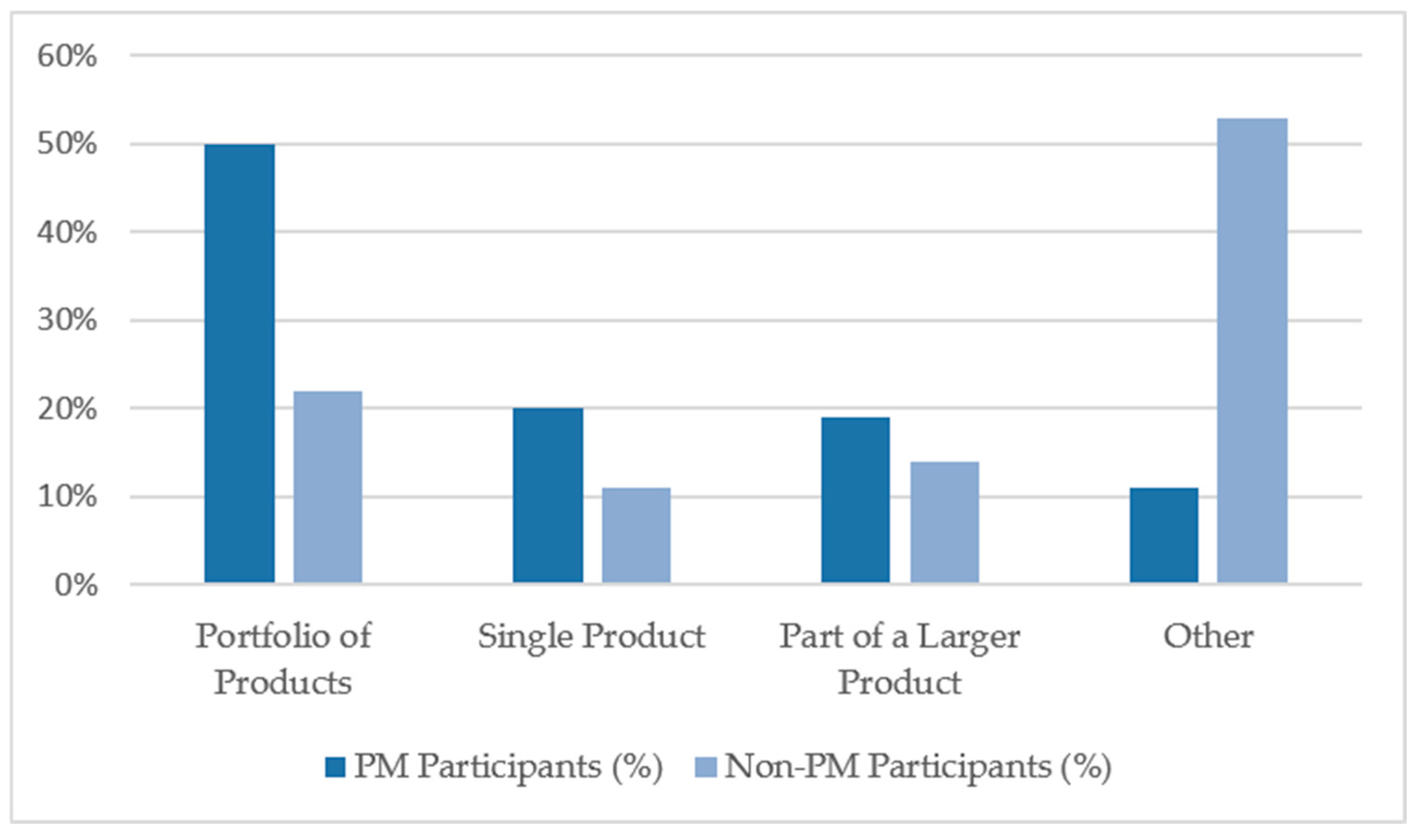
The product management population differs significantly from the Non-PM participant population along two dimensions. First, their scope of oversight differs. Nearly 90% of PMs report managing a portfolio of products, a single product or part of a larger product while nearly 53% of the Non-PM participants respond that they manage something else (Figure 1). The scope-managed differences between them are all statistically significant (p < 0.0125 Bonferroni-corrected post hoc). The scope difference suggests that PMs have more direct accountability for design and delivery of new products or customer experiences than their Non-PM colleagues and thus might be more representative of the development and use of innovation capabilities on the front lines of that work.
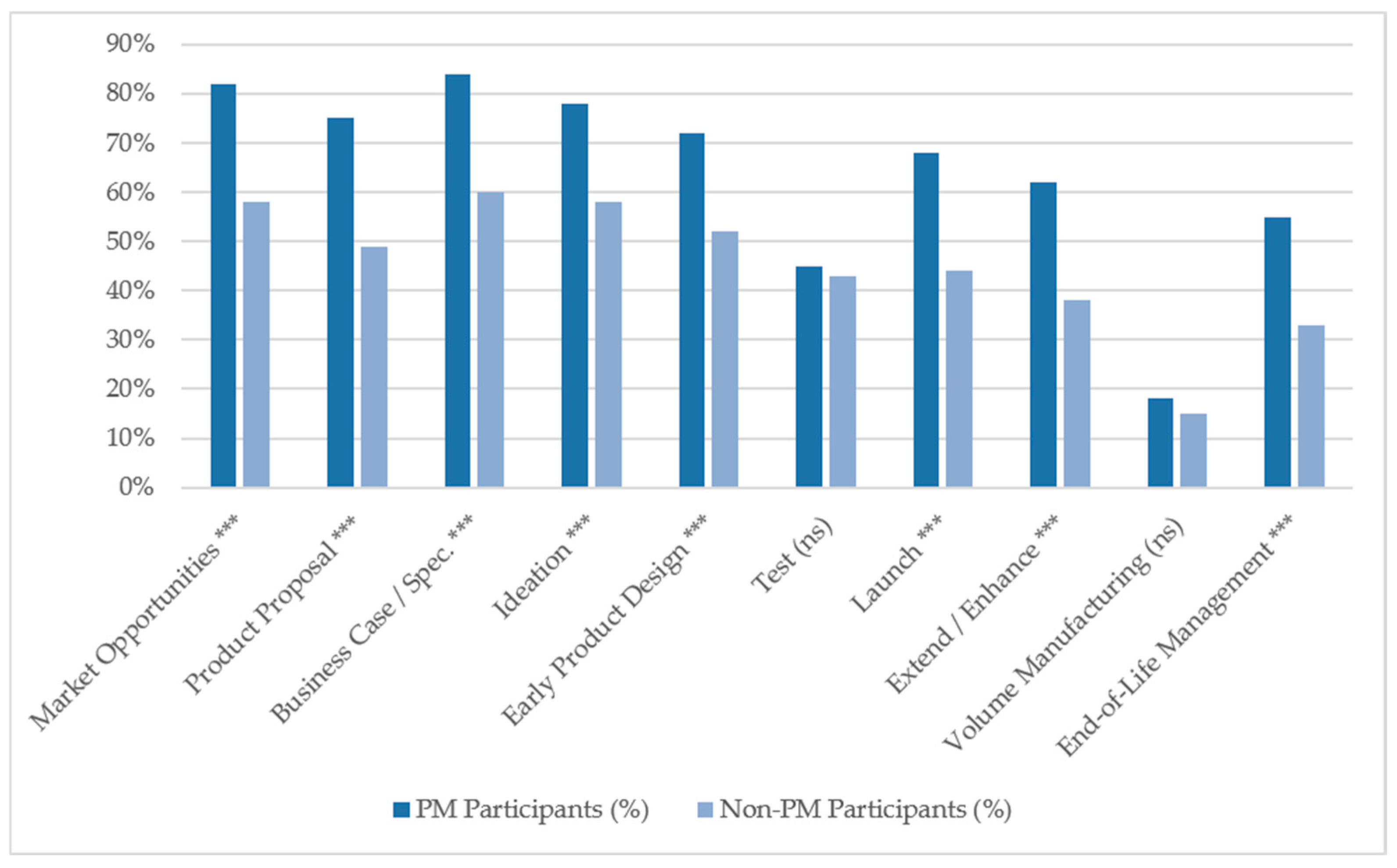
Differences between PMs and Non-PM participants also show up in their participation in the product lifecycle (Figure 2). PMs are strongly represented and statistically significantly more likely to report engagement in the front-end activities in the product lifecycle: identifying market opportunities, creating product proposals, formulating business cases, ideation and early product design (p < 0.005 Bonferroni corrected, identified with *** in Figure 2). While less strongly represented, they also show up as statistically significantly more likely to report engagement in launch, extending or enhancing products and end-of-life management than Non-PM participants (p < 0.005 Bonferroni corrected, identified with *** in Figure 2). This mirrors descriptions of PM roles in both academic and practitioner literature (e.g., Maglyas et al., 2013; Fricker, 2012). The only categories in which there is no significant difference between the groups are in test and volume manufacturing (identified with ns for not significant in Figure 2). Test is a highly cross-functional activity, often housed in engineering and technical functions that have, for example, responsibility for building Minimum Viable Products that are used to evaluate technical viability as well as customer desirability (Thomke, 2020). Volume manufacturing is uniformly low across the two groups, reflecting the industry makeup of the participant group that is more focused on software and services.
Because PM-experienced respondents and Non-PM participants differ systematically on these dimensions, the analyses that follow treat them separately. A third category encompassing the teammates of the PM participants will also be included in the analyses (PM Teammates).

2.2. Research Methods

The analyses of the Likert-scale questions associated with evaluating the current status and importance of each innovation capability employed nonparametric methods including Kruskal–Wallis and Mann–Whitney U, as the Likert items are ordinal, not interval. Bonferroni correction with varied correction factors (e.g., dividing by 3 for three-group comparisons) was used and thresholds are reported for each analysis. Wilcoxon signed-rank tests were used to compare paired capability and importance ratings within respondent groups, and Spearman rank correlations were used to assess temporal trends in annual mean scores.
To address potential bias from unequal organizational representation, all primary analyses were conducted using organization-weighted means, in which each organization contributes one mean per capability regardless of the number of participants representing that organization. The dataset contains substantial variation in organizational participation, with the ten largest organizations accounting for approximately 33% of all responses. These organizations are concentrated in the technology and financial services sectors and rate their capabilities consistently above the dataset average. Participant-weighted and organization-weighted results are compared and, where they diverge materially, organization-weighted results are reported as primary.
Analysis of the qualitative responses to the question as to how innovation capabilities might be improved has been performed in multiple ways over time. The current corpus of responses analyzed includes nearly 50,000 usable responses from PM participants and their teammates. Non-PM participants and their teammates were not included in the qualitative response analysis as the research objective is to focus on the challenges facing those most involved in innovating new products, services and experience, PMs and their teams.
The qualitative analysis proceeded in two phases. In the first phase, a subset of approximately 12,000 responses collected through 2020 was analyzed using AI-assisted topic modeling employing GPT-4 with the Gibbs Sampling Dirichlet Multinomial Mixture (GSDMM) algorithm, a sparse topic model well-suited to short-text corpora (Yin, 2015). The prompting protocol for that phase instructed the model to identify semantically coherent clusters of improvement suggestions at the innovation-capability level, constrained to produce no more than five themes per capability, with representative verbatim quotes for each. A team of two human coders then independently reviewed model-assigned cluster labels and representative quotes, resolving disagreements through consensus discussion; inter-rater agreement was calculated using Cohen’s κ, yielding acceptable reliability (κ > 0.70 across capabilities).
In the second phase, keyword frequency analysis was applied to the full corpus of nearly 50,000 usable responses, operationalizing the themes identified in Phase 1 as structured keyword dictionaries. This phase was facilitated by Claude Sonnet (Anthropic) and used to validate and extend theme frequencies. Prompts specified that the model should (a) apply a fixed set of eight theme labels derived from Phase 1, (b) flag responses as belonging to one or more themes when keyword density exceeded a defined threshold, and (c) return a confidence flag when theme assignment was ambiguous. The convergence of the two analytical approaches on the same dominant themes provides cross-method validation of the findings (Prescott et al., 2024; Doropoulos et al., 2025; Brailas, 2025).
Participant confidentiality was protected throughout the analysis by removing all personally identifiable information such as names and company references from the dataset. Quantitative data was analyzed at the industry level using coded identifiers. These approaches were approved by the IRB.

3. Capability and Importance Rating Analysis Results

For each of the six innovation capabilities, respondents were asked to evaluate their current capability and the importance of that capability on a scale from 0 = low to 10 = high. A Cronbach’s α analysis confirms that all six items contribute meaningfully to the construct and that using a six-item composite score is a reliable unidimensional scale (current capability scale α = 0.849 and importance scale α = 0.862). A correlation analysis shows that the six capabilities are related (range of correlations ρ = 0.38–0.52) but not so highly correlated as to be redundant, thus justifying treating them as distinct dimensions and using a composite score to capture the broader construct. Factor analysis yielded a single eigenvalue above 1.0 (λ = 3.43) explaining approximately 49% of variance with no second factor meeting the conventional threshold, thus providing no support for a multi-factor structure.
Table 2a summarizes the means and standard deviations for each capability for PMs, PMs’ Teammates, PMs + Teammates and Other (Non-PM related) respondents. Table 2b summarizes the means and standard deviations for the importance scores. Note that the Insight Generation capability is significantly lower than each of the other five capabilities (Wilcoxon signed-rank, all p < 0.001, Bonferroni corrected) and is nearly a full point lower than Customer Empathy, a finding explored further in analysis of qualitative responses.
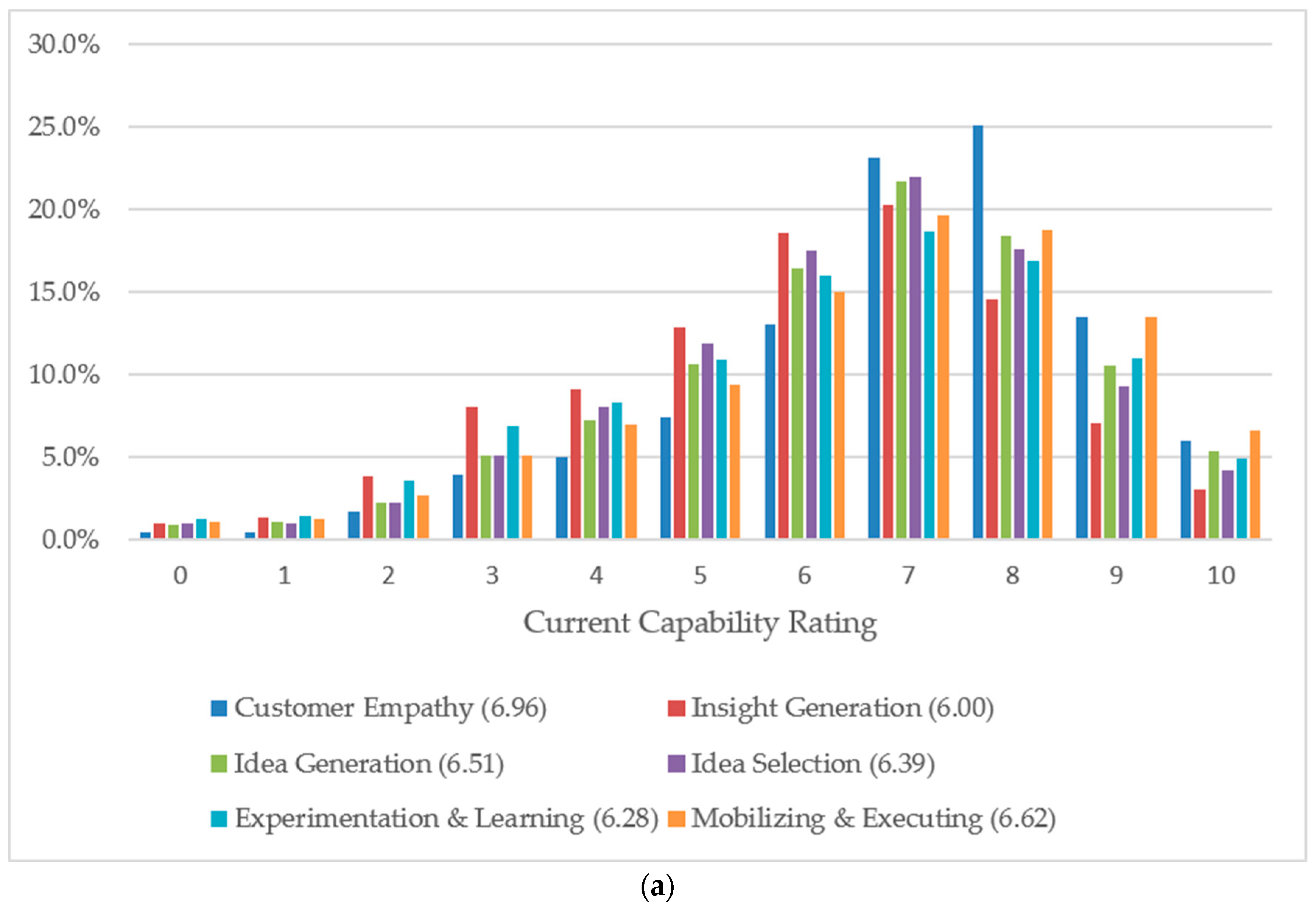
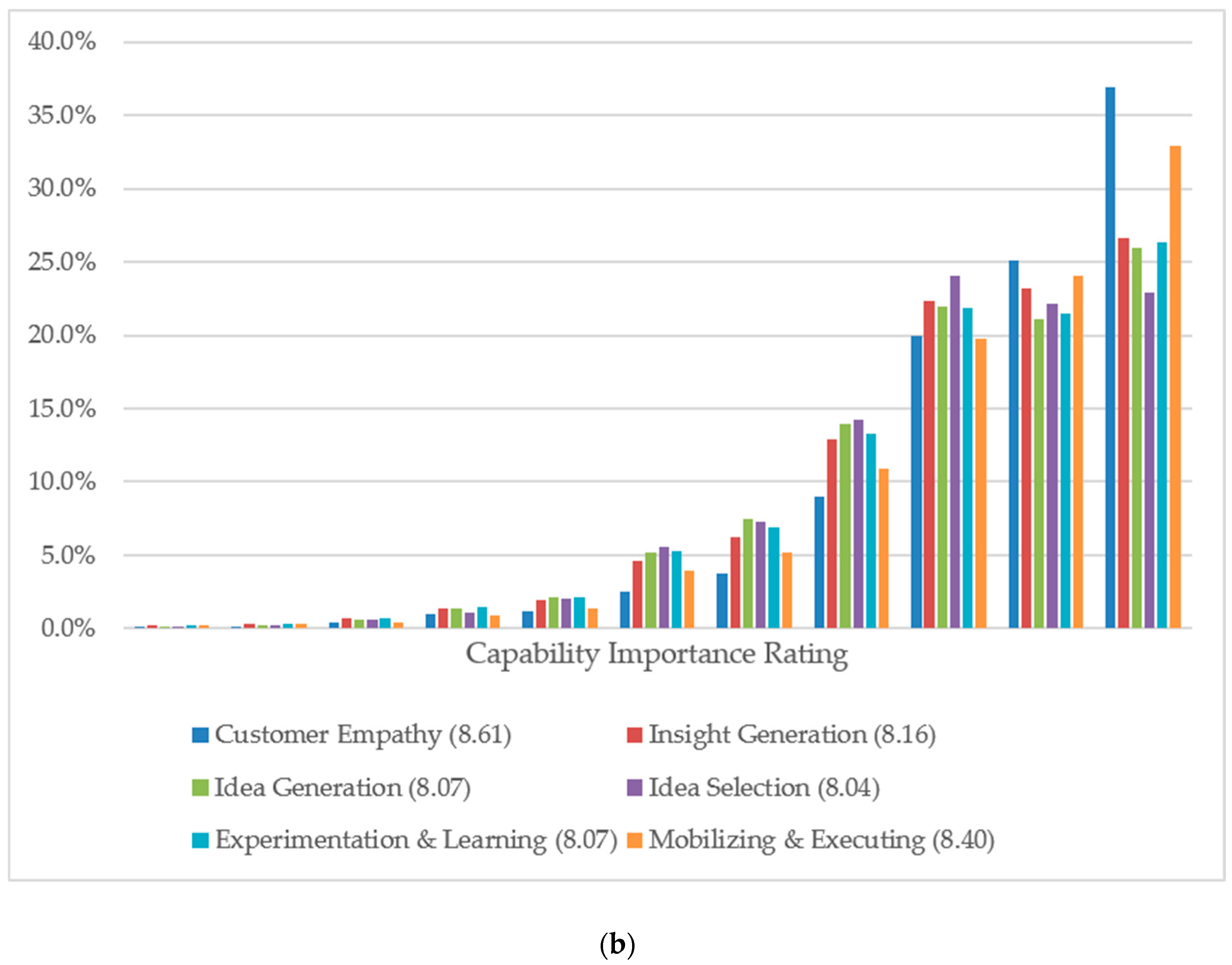
Figure 3a,b shows the distribution of responses. Evaluation of current capability is centered around 6–7 while importance ratings center around eight, and both include responses that range from 0 to 10. For each sub-population, PMs, PMs’ Teammates and Other, and for every capability, importance ratings are statistically significantly higher (by 1.5–2 points) than current capability ratings (all p < 0.001) suggesting that all three groups perceive a gap between what they can do and what they believe matters.
Shared across the dataset are the uniformly low ratings of the Insight Generation capability and the persistent gap between perceived capability and importance. Now we turn to sources of difference in evaluation of both capability and importance.

3.1. Differences in Innovation Capability Assessment by Role and Experience

3.1.1. Differences Between PMs and Their Teammates

PMs consistently rate their team’s current capability lower than do their PM Teammates and all differences are significant (Table 3a). This finding is furthered in an analysis at the team level. Across 1701 teams, PMs rate their team’s current capability significantly lower than their own teammates rate the same team on every single capability (all p < 0.001). The gap ranges from −0.25 for Idea Generation to −0.42 for Customer Empathy and Insight Generation. Roughly 50–55% of PMs rate their team below the teammate consensus, so it is not a small subset of unusually self-critical PMs driving the average. Individual PMs also have a more critical view of Customer Empathy, Insight Generation, Idea Selection and Experimentation and Learning than do their Non-PM colleagues (Other). PM Teammates, however, are indistinguishable from Others. This could reflect greater PM awareness of proficiency shortfalls, higher aspirational standards, or differential exposure to competitive benchmarks.
The groups are more aligned on the importance of innovation capabilities (Table 3b). Idea Generation and Experimentation and Learning show no significant differences in importance ratings. Interestingly, PM’s Teammates rate the importance of Customer Empathy, Insight Generation and Idea Selection higher than both the PMs and Others. Later analyses provide some evidence that PM Teammates feel disconnected from the activities associated with these capabilities. Others rate Mobilizing and Executing below both PMs and PM Teammates, reflecting the distance they have from the NPD process itself.

3.1.2. Experience and Scope Managed as Differentiators

Years of PM experience have essentially no relationship with capability ratings. Only two capabilities reach significance (Experimentation and Learning: ρ = −0.049, p = 0.024; Mobilizing and Executing: ρ = −0.052, p = 0.017), and both are negative, meaning that slightly more experienced PMs rate their team’s capability marginally lower. Importance ratings show no relationship with experience at all.
Scope managed, whether of a portfolio of products, a single product, part of a larger product or something else (other), also has limited effect on capability ratings and none on importance ratings. The single exception is in Experimentation and Learning where managers of a single product rate their capability higher than do managers of portfolios of products (p = 0.004). Together, these findings suggest that managers overseeing multiple projects or with more PM experience rate capabilities lower than their more junior or less experienced colleagues. The concurrence on importance, however, indicates that there is some normative consensus across different levels of PM experience and scope.

3.1.3. Differences by Business Model and Industry

There are no statistically significant differences in either current capability or importance ratings by business type (B2B, B2C, etc.) for any of the six capabilities (Kruskal–Wallis, all p > 0.12 for importance, all p > 0.18 for current capability). This suggests that the relative strengths and weaknesses of innovation capabilities are largely invariant with market structure. Whether a PM is designing products for consumers, businesses, governments or platforms connecting peers, the patterns of where teams feel strongest and weakest are the same. The capability gaps represented by this data, may thus reflect something about PM practice and training rather than industry structure-specific context.
At the industry level, however, there are significant differences (Table 4). NAICS industry codes were used to categorize companies, and analysis was performed on the eight industries that had at least 40 participants in the program to yield 2177 PM responses. All six capabilities differ significantly across industries based on a Kruskal–Wallis test (all p = 0.005) but after applying a Bonferroni correction for the 28 pairwise comparisons (α = 0.00180) two significant clusters emerge: Healthcare and Utilities consistently rated lowest, and Information and Mining/Oil and Gas rated highest.
The most significant pairwise gaps are shown in Table 5 (Δ = difference between highest- and lowest-scoring industry on each capability.). On the low end, Healthcare falters in Insight Generation (4.66), Idea Generation (5.32), and Experimentation and Learning (4.83). Utilities is lowest in Mobilizing and Executing (5.64). The regulated nature of both industries may contribute to lack of development of innovation capabilities.
On the other end, the Retail Trade industry leads in Insight Generation (5.98) and the Information industry leads in Mobilizing and Executing (6.65). In contrast, the Mining/Oil and Gas industry leads in Idea Generation (6.65) and Experimentation and Learning (6.43). The difference in strengths may be explained by the highly different contexts: software-driven versus resource-intensive extraction operations.
Now we turn to the qualitative data to understand what suggestions PMs and their teammates have for improving the situation.

4. Barriers for PMs and Their Teams to Improving Innovation Proficiency

4.1. Overarching Themes from Product Managers and Their Teams

Keyword analysis of responses from Product Managers and their teams to the question “how might you improve [this innovation capability]?” yielded eight overarching themes. Numbers in parentheses represent the percentage of responses addressing each issue. Percentages will add to over 100%, as a single response could address multiple themes.
  • Customer centricity and external orientation (43.3%).
  • Time, capacity and resource constraints (23.2%).
  • Data and evidence-based decision making (22.0%).
  • Training and skill development (21.1%).
  • Structured processes and frameworks (20.9%).
  • Cross-functional collaboration (15.1%).
  • Agility (11.9%).
  • Culture and leadership (11.9%)
These themes match well with prior work using LDA and manual coding methods in which customer focus, organizational barriers and lack of structured processes emerged as high level themes with subthemes capturing the elements reported here.

4.1.1. Customer Centricity and External Orientation

The value of customer centricity is discussed in both scholarly and managerial literature, which also acknowledges challenges associated with embedding a customer-centered mindset including culture, structure, processes, information systems and financially oriented metrics (Quach et al., 2019; Shah et al., 2006; Jaworski & Kohli, 1993; Binsaeed et al., 2023). The theme of insufficient connection to customers, users and the market showed up strongly throughout the six innovation capabilities, not just in Customer Empathy or Insight Generation.
PMs and their teammates emphasize the need for a fundamental mindset shift from internal priorities and “our ideas” to customer benefit and external value. Frustrated by overreliance on intermediaries such as sales teams that filter customer input before it reaches the product team, they seek more direct contact to connect firsthand with customer and user experiences. They want to enhance that contact to “move from collecting feature requests to understanding the root problem.” And they want to meet with a wider representation of their customer set to better “understand the rest of the world they live in”. In a broader sense, they also seek to more tightly connect organizational purpose to authentic customer value.
For Insight Generation, a crucial step in determining which problems will be tackled for which customers and users, respondents showed less depth of understanding of what doing so might entail than showed up for other innovation capabilities. Their comments tended to refocus on Customer Empathy and understanding and less on the concrete ways in which they might seek patterns, trends and other interesting nuggets from that data.
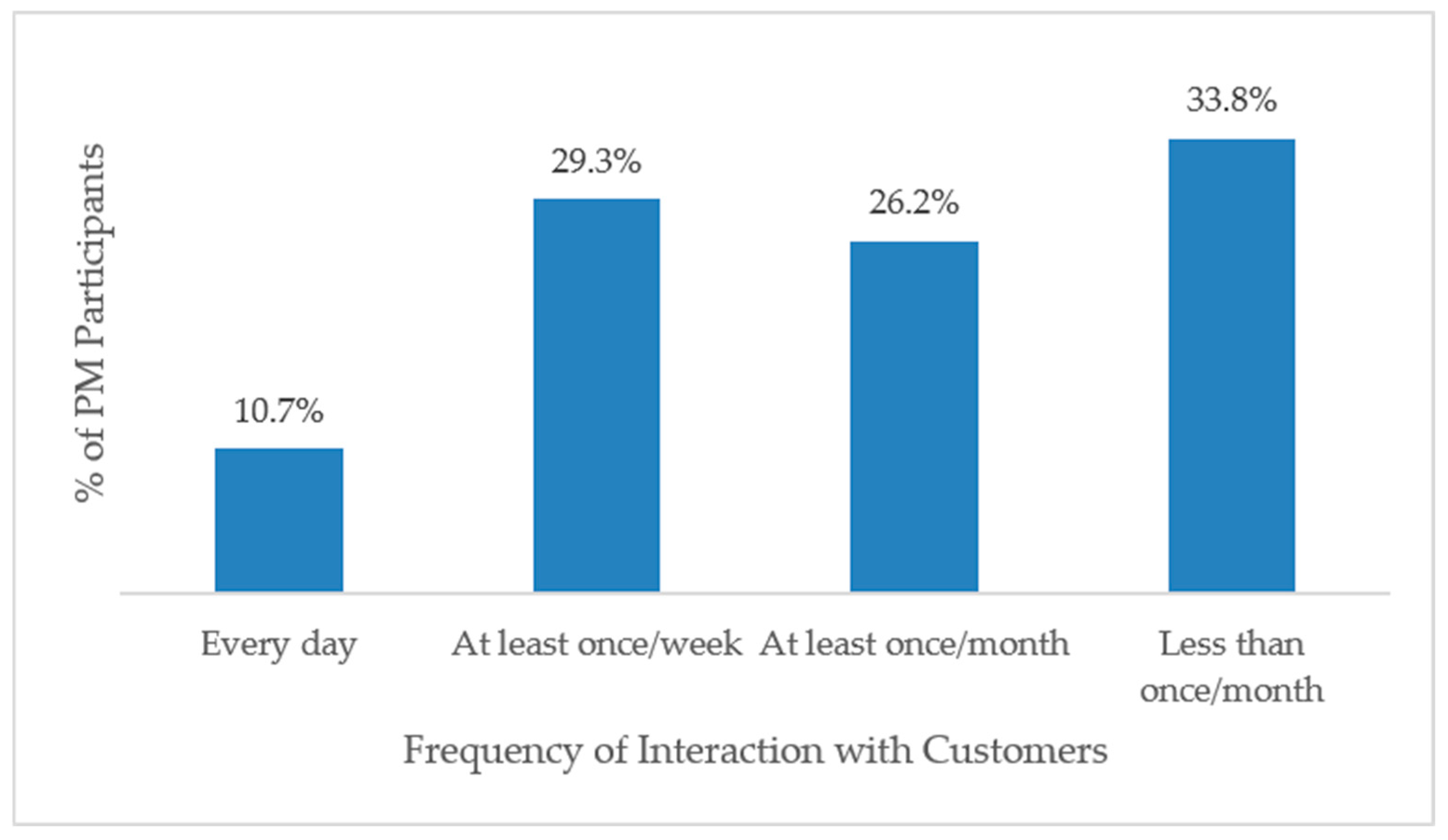
Lack of customer engagement shows up concretely in how much product managers interact with customers or users. When asked how often they interact with customers—every day, at least once a week, at least once a month and less than once a month—over one-third of them replied that they interact with customers less than once a month and 60% interact with customers at most once per month (Figure 4).
Five of the six innovation capabilities show statistically significant differences by interaction frequency, all indicating that increased contact is associated with higher rated innovation capabilities (Table 6). Only Mobilizing and Executing did not show statistically significant differences. Meeting with customers every day and once a week were statistically indistinguishable from one another (p = 0.658) on innovation capability performance, but both rated significantly higher than monthly (p = 0.007 **) and less-than-monthly contact (p < 0.001 ***). In short, allowing PMs (and their teams) to interact more often with customers and users appears to enhance overall innovation proficiency.
Frequency of engagement varies widely with market strategy (Table 7). Frequency of interaction by B2G PMs with customers stands out as statistically significantly higher than B2B2C (p < 0.001), G2G (p < 0.001) and B2C (p = 0.002). On the other hand, frequency of customer interactions for C2C PMs is statistically significantly lower than B2G (p < 0.001), B2B (p < 0.001), B2C (p < 0.001) and G2G (p = 0.002).

4.1.2. Time, Capacity and Resource Constraints

Time, capacity and resource constraints are the second most common theme in the PM/Team Member responses. Teams know what they need to do but report lacking the organizational slack to do it. The theme appears most acutely in Customer Empathy, Idea Generation, and Experimentation and Learning. In some cases, PMs, seek additional specifically focused resources, e.g., “We need enough people dedicated to UX research and product management—a regular cadence of prioritizing that work with those dedicated roles.” In other cases, they are simply seeking time with their teams to engage in innovation practices: “It’s more about finding the time in our schedules to do this, vs. improving our brainstorm practice” because we are challenged by “working on multiple workstreams at the same time and keeping up with constantly moving priorities”. At a meta level they spoke about the need for protection from management to take the time needed: “Leadership needs to signal that experimentation is protected from quarterly pressure. Right now, every experiment gets cut first.”

4.1.3. Data and Evidence-Based Decision Making

PMs and their teammates emphasized the need to integrate diverse sources of customer information, both quantitative and qualitative, to generate more actionable insights. As one PM explained, “We need to get better at combining the what from our analytics with the why from our user research.” Others noted that “the real insights are in connecting the dots between usage data, survey feedback, and market research.” Many attributed this gap to fragmented data access, lack of contextual depth, and weak integration mechanisms: “We get tons of customer feedback. The main thing we struggle with is prioritizing it.” To counter this fragmentation, respondents stressed the importance of centralized, shared knowledge systems, from feedback dashboards to journey-map libraries, that make customer information transparent and accessible across functions. “We need a better way of aggregating users’ issues and comments,” one respondent wrote. “Right now, it’s really difficult to tell how many customers are affected by a certain problem and how serious it is.” Such systems, they argued, not only improve efficiency but also counteract “data hoarding” and democratize knowledge, enabling distributed teams to make insights more actionable.

4.1.4. Training and Development

While building a data infrastructure to support customer-informed decision-making showed up as important to respondents, they also spoke to the need to develop the analytical and creative competencies to use that infrastructure. Comments often focused on sensemaking activities, Customer Empathy and Insight Generation. Respondents sought “Training frontliners on how to connect with customers, how to process feedback, and how to approach concerns with short and effective action” because the concept of sensemaking “is not formally used in our organization. Training is required before we can expect the team to do it well.” But they also declared a need for better facilitation skills and more modern methods to replace “legacy processes [that rely on] outdated skills.”

4.1.5. Structured Processes and Frameworks

The need for structured processes and frameworks shows up across all capabilities, suggesting the need for repeatable, institutionalized approaches to replace more ad hoc efforts. Many were concrete in their suggestions: On Customer Insight, they suggest frameworks to ensure customer insights are consistently captured, searchable, and translated into actionable strategies, including standardized templates for documenting feedback, closed-loop processes for returning insights to customers, and integrating quantitative data (Key Performance Indicators (KPIs), product instrumentation) with qualitative feedback. For Insight Generation, they propose adopting standard artifacts such as journey maps, empathy maps, and service blueprints as mandatory starting points for projects to systematically organize and generate insights. They describe Idea Generation as too informal or perfunctory and call for “making the process more methodical, but without killing its creativity.” For Idea Selection, they want explicit, customer-centered evaluation frameworks: “Use data to power our decisions, not the louder or stronger voice in the room.” They propose documenting decision criteria and rationales to avoid repetitive debate and ensure alignment. For Experimentation and Learning they advocate for explicitly defining assumptions and hypotheses before testing, “tying experiments to overall strategy more explicitly”, and setting success criteria that go beyond functional performance. For Mobilizing and Executing they seek clearer priorities, goals and roadmaps “with incremental deliveries that demonstrate the quick wins”.

4.1.6. Cross-Functional Collaboration

PMs and their teams say that functional silos effectively filter crucial information by, for example, constraining customer access: “Sales and key account managers control all interactions with customers… they do not want product managers to engage directly”. Structural friction also arises from divided ownership: “My role is product management and I own the products, but I am not in charge of R&D, which complicates things sometimes.” The siloes can also lead to biased or incompletely informed decisions: “[Idea Selection] is done as a standalone activity by the Product Manager or Architect, so it can become slanted.” As one PM summarized, “Involving a wider team to refine an idea can help address all the gaps. Currently, this process happens within a core group of decision makers.”

4.1.7. Agility

The agility theme highlights respondents’ desire to make learning a continuous, rhythmic part of product development rather than a periodic or project-based activity. They want to transform customer interaction and experimentation into constant, high-frequency loops that fuel every stage of the product lifecycle. A major inhibitor to continuous learning is the high cost and slow pace of testing new ideas. Many respondents described development processes that shift “into production mode too quickly” without sufficient prototyping, storyboarding, or early validation. To sustain a learning cadence, they called for lightweight frameworks and tools that enable rapid, low-cost experimentation: “Provide better frameworks (IT/technology and infrastructure) to allow greater flexibility and tooling to support experimentation.” They advocated for environments that encourage early failure and quick iteration moving away from rigid approval processes toward a culture of “build, test, learn.”

4.1.8. Culture and Leadership

Even when structural barriers are addressed, deep-seated cultural norms often constrain collaboration and openness. Respondents recognize the value of diverse perspectives but describe persistent hierarchies that limit inclusive participation. Brainstorming and idea refinement are frequently confined to a narrow circle of “engineering and product,” excluding marketing, sales, quality, and customer-support functions that hold critical customer knowledge. PMs call for broader involvement to “push the limits on what is achievable” and for “more opportunities for everyone to contribute ideas, even if they can’t attend every meeting.”
However, hierarchical norms and leadership behaviors often undermine these ambitions. “Big product decisions are driven by business priorities from leadership, who have less insight on the customer experience.” Another participant noted, “Ideas were dictated by management, and teams are asked to execute without having much input… all the ideas have to be approved by a plethora of managers who believe they are the smartest in the room.” Such dynamics stifle experimentation and force PMs to navigate political, rather than customer-driven, decision landscapes.
To counteract these dynamics, respondents emphasize psychological safety and open dialog. They call for an environment where curiosity is rewarded, and debate is constructive rather than defensive: “We quickly spiral into judgment and debate during brainstorming. We need to stay curious and understand the use case without jumping to solutioning.”

4.2. Differences in Themes by Role and Industry

Just as with earlier results, PMs differ from their teammates and themes differ by industry.

4.2.1. PMs vs. Their Teammates

PMs differ from their teammates on six of the eight themes, mirroring the quantitative findings that PMs rate the innovation capabilities lower than do their teammates. The pattern is consistent: PMs emphasize more structured and analytical framings of the problem to be tackled for the customers and users, while teammates emphasize resource constraints more. PMs mention customer centricity, data and evidence, cross-functional collaboration, and agility more than their teammates do and articulate structured improvement pathways. Structured processes and culture/leadership do not differ significantly between the two groups but show up as shared concerns regardless of role.

4.2.2. Market Strategy and Industry-Based Differences

As for the innovation capability and importance ratings there are no statistically significant differences between market structures (e.g., B2B, B2C) in the qualitative themes. The barriers articulated and the improvements they seek are largely the same. This finding contrasts with those from a review of the literature on radical innovation which identified different internal barriers to innovation by B2C and B2B companies (Sandberg & Aarikka-Stenroos, 2014). In their work, while both B2B and B2C companies saw a restrictive mindset as problematic, B2C organizations highlighted lack of discovery competencies (roughly parallel to Customer Empathy and Insight Generation) while B2B companies emphasized lack of incubation competences (roughly parallel to Idea Generation, Idea Selection and Experimentation and Learning). The focus of that work on radical innovation may explain the difference.
At the industry level, however, there were significant differences in the frequency of mentions of themes. The two industries with the lowest overall capability scores (Healthcare and Utilities) included less customer-centric language and placed more emphasis on both structured processes and changes in leadership and culture. This suggests that these industries may be at an earlier stage of development of innovation capabilities.
Other significant differences by theme are shown in Table 8. The Mining/Oil and Gas industry stands out for being both low in mentions of data and evidence-based decision making and high in training and skill development, possibly a reflection of both the complexity of the industry and its more recent adoption of product management roles and skills. The Professional/Scientific industry also stands out as high in customer centricity, but low in mentions of cross-functional collaboration and data-based decision making. This could be due to the small teams used in and analytical orientation of consultancies and other professional services, requiring less investment in those areas. The Information and Finance industries lead in data-driven decision making, perhaps due to the heavy emphasis on software and data analytics in their offerings.

5. Evolution of Innovation Capabilities over Time

Participant-weighted analysis of annual mean scores shows positive trends for five of six capabilities over the nine years of the study. However, this analysis is sensitive to the organizational composition of the sample. When each organization is weighted equally regardless of size the positive trends weaken substantially and only Idea Selection retains a statistically significant positive trend (ρ = +0.75, p = 0.020). The other five capabilities show positive but non-significant trends (Table 9). Importance ratings show no significant trends under either weighting approach. These results indicate that the positive trends visible in the participant-weighted analysis generally reflect the increasing dominance of high-capability organizations in later cohorts rather than uniform capability improvement across the PM population.
A within-organization analysis of 93 organizations appearing in three or more survey years provides a more robust picture, since it tracks each organization against its own prior performance. Between 50% (on Mobilizing and Executing) and 65% (on Insight Generation) of these organizations show positive individual trends, and 8–15% show individually significant upward trends. None show negative trends on average, providing evidence that genuine capability improvement is occurring within at least half of the organizations over time, even if not across the entire population.
Trends in the qualitative response analysis are not subject to the same organizational concentration bias since theme frequencies are relatively stable across the high-performing and lower-performing organizations. The core improvement themes of customer centricity, process formalization, and data-driven decision making have remained essentially unchanged across nine years, suggesting they are persistent barriers to proficiency improvement. Significant upward trends include rising cross-functional collaboration concerns, growing skill development demands, and the increased use of AI and Objectives and Key Results (OKR) vocabulary.
Cross-functional collaboration mentions are rising (ρ = +0.77, p = 0.002), growing from 19.1% of responses in 2016 to a peak of 23.1% in 2023 with organizations increasingly identifying siloed structures and the absence of cross-functional teaming. This may reflect a general migration to agile and cross-functional team structures that are increasing awareness of the benefits or need for these changes.
Training and skill development mentions are also rising (ρ = +0.88, p = 0.002), growing from 12.6% of responses in 2016 to a peak of 18.0% in 2023. This is consistent with the maturing of the PM profession, possibly leading respondents to identify capability development through training as a lever rather than rely solely on organizational process change. Mentions of Insight Generation skill development in particular are rising (ρ = +0.67, p = 0.048), from 13.2% to 15.0%, with respondents increasingly framing its improvement as a skill development challenge rather than a tooling or process challenge alone.
Time and resource constraints, on the other hand, are declining slightly (ρ = −0.68, p = 0.042), from 24.1% in 2016 to 21.7% in 2024. This could result from the slight increase in capability ratings which may improve capacity. Or it may simply reflect that other themes have grown, reducing mentions of time and capacity constraints.
Two new themes are emerging in the longitudinal analysis. AI and machine learning mentions are rising (ρ = +0.85, p = 0.004), from near zero in 2016 to 0.6% in 2024. The percentage is small, but the trend is significant and the 2024 uptick specifically reflects generative AI entering the vocabulary. AI is beginning to appear in product teams’ articulation of how they would improve their capabilities, primarily in Insight Generation responses. OKR and goal framework mentions in Mobilizing and Executing responses are also rising (ρ = +0.77, p = 0.016), from 21.3% to 28.8%, consistent with broader organizational adoption of OKR vocabulary over this period.

6. Discussion

The findings in this paper are sobering in that they replicate, at a broader scope and scale, the persistence of significant structural barriers to improving innovation proficiency. Perceived proficiency does not increase with level of experience or scope managed. This is consistent with a structural rather than individual explanation: the challenges span the organization and cannot be addressed by individual skill development alone. Organization-weighted analysis provides no evidence of improvement in five of the six innovation proficiencies over the nine years of the study; Idea Selection alone shows improvement, albeit modest, during that time. Qualitative responses show that three major challenges—customer centricity, process formalization, and data-driven decision making—have remained essentially unchanged across nine years, a finding with robust support in existing literature.

6.1. Challenges to Achieving Customer Centricity

The value of customer centricity and paths to achieving it are well documented (Shah et al., 2006; Lee, 2019). Barriers to product managers engaging in customer centric work identified in this paper are echoed in findings that product managers spend only 14% of their time interacting with customers (Tyagi & Sawhney, 2010) and are not customer-oriented (Springer & Miler, 2022), that firms in general lack discovery competences (Sandberg & Aarikka-Stenroos, 2014) and that customer-focused mindsets clash with organizational culture (Carlgren et al., 2016).
Frequent interaction throughout the design, development and delivery cycle is seen as a critical success factor for service-dominant design and co-creation (Prahalad & Ramaswamy, 2004; Vargo & Lusch, 2017). The finding in this paper that more frequent interaction with customers leads to higher innovation proficiency is echoed by others for both new product development success (Griffin & Hauser, 1993; Morgan et al., 2018) and innovation more generally (Binsaeed et al., 2023).
Some of the barriers to engaging more fully with customers are related to industry structure. B2G PMs, for example, have the most contact, likely due to the intensive project nature of much of their work and C2C PMs the least perhaps reflecting the mediated, platform-scale nature of their business. But there are important structural barriers to further customer interaction that broadly persist in this study, and have been identified in other literature over time: (1) organizational silos that inhibit access (Shah et al., 2006; Dalsace et al., 2026; Hemel & Rademakers, 2016), a challenge that stretches beyond innovation and product management (Bento et al., 2020), and (2) lack of shared data systems to integrate and analyze customer data across the organization (Bijmolt et al., 2010; Lemon & Verhoef, 2016; Springer & Miler, 2022). Development of Customer Relationship Management (CRM) capabilities, enabled by CRM systems that consolidate customer data across organizational boundaries, shows promise for improvement (Binsaeed et al., 2023; Lin & Chen, 2025; Dalsace et al., 2026).
These constraints are exacerbated by broader organizational issues. PM roles often are not clearly defined and communicated in the organization (Springer & Miler, 2022) and unsupportive organizational structures including hierarchical arrangement of lines of authority, communication and designation of rights and responsibilities in the organization limit change (Sandberg & Aarikka-Stenroos, 2014).

6.2. A Need for Process Formalization

Training and skill development challenges, described by Springer and Miler (2022) as producing “unqualified team members”, show up regularly in the product management literature (Ebert, 2007; Ebert & Brinkkemper, 2014; Gnanasambandam et al., 2018). More broadly the innovation literature identifies lack of competence in discovery (Customer Empathy and Insight Generation), incubation (Idea Generation, Idea Selection and Experimenting to Learn) and acceleration and commercialization (Mobilizing and Executing) (Sandberg & Aarikka-Stenroos, 2014). The design thinking literature describes difficulties in acquiring related skills (Carlgren et al., 2016; Rekonen & Hassi, 2018).
At a higher level, however, it is a lack of structured processes and frameworks that hinder skill development and consistent application (Magistretti et al., 2021). Design thinking research finds that its impact depends on different enabling conditions at the organizational and individual levels: organizational structure for process formalization, and protected experiential learning for skill development (Mayer & Schwemmle, 2025). Research on new product development processes shows that best-practice firms are distinguished not by having more capable individuals but by integrating innovation strategy across all levels of the organization, providing structural support for people and teams, and using formal processes consistently (Knudsen et al., 2023).
The need for more formal process development is particularly evident in Insight Generation. The low ratings for Insight Generation are consistent with a broader body of evidence that framing and reframing or making sense of what has been observed and constructing a problem statement that opens a productive solution space is among the most cognitively demanding and least well-practiced activities in innovation work. The literature characterizes this as the core challenge of design thinking (Dorst, 2011; Rylander Eklund et al., 2022), noting that the dominance of converging mindsets among business practitioners causes teams to minimize time in framing and move prematurely to solutions (Beckman, 2020).
The qualitative data in this study shows respondents redirecting Insight Generation improvement suggestions toward customer access, rather than toward the synthesis and sense-making work that constitutes proper Insight Generation. This suggests that many PM teams have not yet developed a clear mental model of what this capability requires, perhaps due to the tacit, experiential nature of the required skills (Rekonen & Hassi, 2018) or to the ease of collecting product-centric data relative to understanding of customer behavior (Dalsace et al., 2026). While these capabilities have historically been difficult to formalize and teach, increased use of AI shows the possibility of improving Insight Generation by facilitating more structured synthesis processes and data-driven decision making (Nagaraj, 2022; Witkowski & Wodecki, 2025).

6.3. New Technology Offers Hope

The tools and methods described in the qualitative responses are largely behavioral and methodological. The absence of technology as a perceived barrier suggests that respondents are not saying they lack the right software. Instead, they say they lack time, process and organizational permission. Liedtka (2018) makes a parallel argument for design thinking practices falling short. A practitioner facing an individual skill deficit would ask for training or better tools. A practitioner facing an organizational barrier asks for slack, process, and leadership support, three salient themes in the qualitative analysis. This finding reinforces the literature on innovation (Sandberg & Aarikka-Stenroos, 2014), design thinking (Carlgren et al., 2016) and product management (Tyagi & Sawhney, 2010) that organizational infrastructure issues are significant barriers to improvement.
But there are signals of a changing landscape, led by a few industries and evolving technologies. Aggregate data shows improvement across all capabilities driven by the higher-performing Information and Financial Services industries. Within-organization analysis tracking each organization against its own prior performance shows 50% to 65% of organizations with positive individual trends across capabilities. Improvement is therefore real, even as it is modest and uneven.
The nascent emergence of AI in this study as a mechanism to improve innovation proficiency in part by enabling more data-driven decision making, signals a potential positive future direction, supported by the recent literature (Masoud & Basahel, 2023). A literature review capturing how AI is used by product managers across the product lifecycle shows that it is predominantly used in the early stages of the process (Witkowski & Wodecki, 2025), by enabling a more constant flow of customer insights (Dalsace et al., 2026). While AI adoption applied to innovation more generally is also in the early days, it shows promise for “replacing, reinforcing and revealing”, but there still remain structural barriers to its use (Gama & Magistretti, 2025).
Other research highlights challenges including the need for better understanding of what data-driven product management might entail. They speak to filling gaps in integrated data systems, analytical skills and structured processes (Fichtler et al., 2023). And they address the organizational culture changes that will be needed to properly leverage new technologies such as Customer Relationship Management systems (Lin & Chen, 2025).
The dogged persistence of organizational and structural barriers to improving customer centricity, process formalization and data-driven decision making begs for further investigation into not just the existence of the barriers, but with deeper exploration of the reasons for their persistence. Paths to that understanding may come from unpacking the reasons why PMs and their teammates see their innovation proficiency and barriers to improving it differently. Or it may come from understanding why some industries outperform or show more improvement over time than others. Insight Generation deserves special attention, including to the education system that prepares product managers and their teams for doing framing and reframing work. Without deeper understanding, overcoming the significant barriers to improving innovation proficiency will continue to limit the ability of organizations to rapidly and intentionally embed rapidly advancing technologies to create the novel customer experiences and transformations that define the next stages on the progression of value creation for customers and users.

Author Contributions

Conceptualization, S.L.B.; methodology, S.L.B., A.G.C., C.C., C.Z.G., N.J. and L.Z.; software, A.G.C., C.C., C.Z.G., N.J. and L.Z.; validation, S.L.B., A.G.C., C.C., C.Z.G., N.J. and L.Z.; formal analysis, S.L.B., A.G.C., C.C., C.Z.G., N.J. and L.Z.; investigation, S.L.B.; resources, S.L.B.; data curation, S.L.B., A.G.C., C.C., C.Z.G., N.J. and L.Z.; writing—original draft preparation, S.L.B.; writing—review and editing, A.G.C., C.C., C.Z.G., N.J. and L.Z.; visualization, S.L.B., A.G.C., C.C., C.Z.G., N.J. and L.Z.; supervision, S.L.B.; project administration, S.L.B.; funding acquisition, S.L.B. All authors have read and agreed to the published version of the manuscript.

Funding

This research received no external funding.

Institutional Review Board Statement

Ethical review and approval were waived for this study due to the use of fully anonymous surveys with no identifiable personal data, which meets the exemption criteria under 45 CFR 46.104(d)(2)(i).

Informed Consent Statement

Verbal informed consent was obtained from the participants. The rationale for utilizing verbal consent was used because the survey was embedded in an executive education program, and all participants are provided with clear written information about the purpose, voluntary nature, and use of their responses before starting the survey. Completion and submission of the survey serves as their verbal informed consent.

Data Availability Statement

The datasets presented in this article are not readily available because the anonymity of the companies and respondents cannot be guaranteed when shared, even with removal of names from the dataset. Inquiries about the dataset can be sent to beckman@berkeley.edu.

Acknowledgments

We are grateful to the Executive Education staff who support the Product Management Program and the personnel there who administer the Qualtrics survey through which we collected this data. We also appreciate the Undergraduate Research Apprentice Program that makes student engagement in research possible. During the preparation of this manuscript/study, the author(s) used Claude Sonnet 4.6 for the purposes of reproducing the analytics previously completed with Python 3.9.20 and 3.8.6, Pandas 2.2.2, NumPy 1.26.4, Matplotlib 3.9.2, SciPy 1.12.0, Scikit-learn 1.1.3, and Seaborn 0.13.2. The authors have reviewed and edited the output and take full responsibility for the content of this publication.

Conflicts of Interest

The authors declare no conflicts of interest. The funders had no role in the design of the study; in the collection, analyses, or interpretation of data; in the writing of the manuscript; or in the decision to publish the results.

Abbreviations

The following abbreviations are used in this manuscript:
PMProduct Manager
KPIKey Performance Indicators
OKRObjectives and Key Results
AIArtificial Intelligence

Appendix A

Here is the content of the survey setup and questions.
A.
Survey Introduction: The following six questions help your team assess how it currently brings a service or product successfully to market and are designed to start useful conversations within your organization.
In responding, think of innovation broadly. It can mean inventing the next big thing, and it can also mean improving and optimizing existing product lines. It can mean finding new business models, and it can also mean re-invention or subtle tweaks to an existing model. It can mean serving new emerging markets, and it can also mean finding better ways to serve existing markets.
The six questions are about
  • Customer Empathy.
  • Insight Generation.
  • Idea Generation.
  • Combining and Refining Ideas (Simplified to Idea Selection in this paper).
  • Experimentation and Learning.
  • Mobilizing and Executing.
We will present each of these six questions with a brief explanation, ask you how your team does today, ask where you would like your team to go in the future, and provide a chance for some open-ended discussion.
B.
Setup for Each of the Innovation Capability Question Sets
Because the intention of the survey was educational, each innovation capability was briefly described before the three questions to rate the current capability, identify the importance of that capability and provide thoughts about how to improve the capability. Here are the introductions for each capability.
(1)
Customer Empathy: Customer Empathy is about understanding customer and user needs (whether internal or external) and then creating shared understanding of those needs throughout the team.
(2)
Insight Generation: Insight Generation is about making sense of all the information you have gathered about your customer: results of practical experiments, direct observation of the use of your product or of competitors’ products, customer interviews, inputs from your sales organization, customer market research, user reviews, and other forms of direct evidence (as opposed to opinion).
(3)
Idea Generation: Idea Generation is about generating a broad range of ideas to address the insights you have uncovered. Teams that innovate well regularly practice good concept generation skills: deferring judgment and debate, striving for quantity, including everyone in the process, creating wild and unusual ideas, and being visual when possible.
(4)
Combining and Refining Ideas (Idea Selection): Once you have generated a wide range of ideas, you have to do something with them. Generally, you cannot just select one option but need to engage in an exercise of combining and refining those options to create superior ideas or solutions.
(5)
Experimentation and Learning: It is easy to get caught in long discussions about ideas, but the best way to evaluate them is to make them concrete. This can be done in the form of storyboards, rough physical prototypes or wireframes, that allow the team to more clearly visualize the possibilities and allow team members to share the work with others outside the team for input.
(6)
Mobilizing and Executing: When an experiment verifies with solid evidence that an idea/prototype works, and that idea has potential to go big (and is consistent with your team’s values, long term goals, and standards of performance), effective teams quickly mobilize the organization and concentrate resources to pursue the opportunity.

Note

1
B2C (Business-to-Consumer): A business selling directly to individual consumers. B2B (Business-to-Business): A business selling to another business. C2C (Consumer-to-Consumer): Transactions between two or more consumers, often through a third-party platform. B2B2C (Business-to-Business-to-Consumer): A business providing to another business, which then offers it to the final consumer. Government entities include G2G (Government-to-Government): Transactions between government agencies or departments, B2G (Business-to-Government): A business selling products or services to a government entity, such as a defense contractor. G2B (Government-to-Business): The government providing services or information to businesses, G2C (Government-to-Consumer): The government providing services directly to citizens.

References

  1. Assink, M. (2006). Inhibitors of disruptive innovation capability: A conceptual model. European Journal of Innovation Management, 9(2), 215–233. [Google Scholar] [CrossRef]
  2. Beckman, S. L. (2020). To frame or reframe: Where might design thinking research go next? California Management Review, 62(2), 144–162. [Google Scholar] [CrossRef]
  3. Beckman, S. L., & Barry, M. (2007). Innovation as a learning process: Embedding design thinking. California Management Review, 50(1), 25–56. [Google Scholar] [CrossRef]
  4. Bento, F., Tagliabue, M., & Lorenzo, F. (2020). Organizational silos: A scoping review informed by a behavioral perspective on systems and networks. Societies, 10(3), 56. [Google Scholar] [CrossRef]
  5. Bijmolt, T. H. A., Leeflang, P. S. H., Block, F., Eisenbeiss, M., Hardie, B. G. S., & Saffert, P. (2010). Analytics for customer engagement. Journal of Service Researchrvice Research, 13(3), 341–356. [Google Scholar] [CrossRef]
  6. Binsaeed, R. H., Yousaf, Z., Grigorescu, A., Chitescu, R. I., Nassani, A., & Samoila, A. (2023). Customer engagement and customer relationship management capabilities’ effects on innovation performance and customer Distrust’ s moderating role. Sustainability, 15(12), 9475. [Google Scholar] [CrossRef]
  7. Brailas, A. (2025). Artificial intelligence in qualitative research: Beyond outsourcing data analysis to the machine. Psychology International, 7(3), 78. [Google Scholar] [CrossRef]
  8. Carlgren, L., Elmquist, M., & Rauth, I. (2016). The challenges of using design thinking in industry—Experiences from five large firms. Creativity and Innovation Management, 25(3), 344–362. [Google Scholar] [CrossRef]
  9. Christensen, C. M., Hall, T., Dillon, K., & Duncan, D. S. (2016). Know your customers’ ‘jobs to be done’. Harvard Business Review, 94(9), 54–62. [Google Scholar]
  10. Cullather, S. (2024). Trends in the experience economy: A global perspective. Nasdaq. Available online: https://www.nasdaq.com/articles/trends-in-the-experience-economy-a-global-perspective (accessed on 3 April 2026).
  11. Dalsace, F., Bonnet, D., & Lange, K. (2026). Customer centricity: Digital technology and leadership to the rescue. Business Horizons, 69(2), 217–227. [Google Scholar] [CrossRef]
  12. Doropoulos, S., Karapalidou, E., Charitidis, P., Karakeva, S., & Vologiannidis, S. (2025). Beyond manual media coding: Evaluating large language models and agents for news content analysis. Applied Sciences, 15(14), 8059. [Google Scholar] [CrossRef]
  13. Dorst, K. (2011). The core of ‘design thinking’ and its application. Design Studies, 32(6), 521–532. [Google Scholar] [CrossRef]
  14. Dzombak, R., & Beckman, S. (2019). Unpacking capabilities underlying design process. International Journal of Engineering Education, 36(2), 574–585. [Google Scholar]
  15. Ebert, C. (2007). The impacts of software product management. Journal of Systems and Software, 80(6), 850–861. [Google Scholar] [CrossRef]
  16. Ebert, C., & Brinkkemper, S. (2014). Software product management—An industry evaluation. Journal of Systems and Software, 95, 10–18. [Google Scholar] [CrossRef]
  17. Fichtler, T., Grigoryan, K., Koldewey, C., & Dumitrescu, R. (2023, November 22–24). Towards a data-driven product management—Concepts, advantages, and future research. 2023 IEEE International Conference on Technology Management, Operations and Decisions (ICTMOD) (pp. 1–6), Rabat, Morocco. [Google Scholar] [CrossRef]
  18. Fricker, S. A. (2012). Software product management. In A. Madche, A. Botzenhardt, & L. Neer (Eds.), Software for people: Innovations in sharing, length, and quality of life (1st ed., pp. 53–81). Springer. [Google Scholar] [CrossRef]
  19. Gama, F., & Magistretti, S. (2025). Artificial intelligence in innovation management: A review of innovation capabilities and a taxonomy of AI applications. Journal of Product Innovation Management, 42(1), 76–111. [Google Scholar] [CrossRef]
  20. Gnanasambandam, C., Harrysson, M., Srivastava, S., & Srivathsan, V. (2018). The product management talent dilemma. High Tech Practice. McKinsey & Co. [Google Scholar]
  21. Gorchels, L. (2000). The product manager’s handbook: The complete product management resource. McGraw-Hill. [Google Scholar]
  22. Griffin, A., & Hauser, J. R. (1993). The voice of the customer. Marketing Science, 12(1), 1–27. [Google Scholar] [CrossRef]
  23. Hemel, C. V. D., & Rademakers, M. F. (2016). Building customer-centric organizations: Shaping factors and Barriers. Journal of Creating Value, 2(2), 211–230. [Google Scholar] [CrossRef]
  24. Hoyer, W. D., Kroschke, M., Schmitt, B., Kraume, K., & Shankar, V. (2020). Transforming the customer experience through new technologies. Journal of Interactive Marketing, 51, 57–71. [Google Scholar] [CrossRef]
  25. Jaworski, B. J., & Kohli, A. K. (1993). Market orientation: Antecedents and consequences. Journal of Marketing, 57, 53–70. [Google Scholar] [CrossRef]
  26. Kittlaus, H.-B. (2022). Software product management: The ISPMA-compliant study guide and handbook (2nd ed.). Springer. [Google Scholar] [CrossRef]
  27. Knudsen, M. P., von Zedtwitz, M., Griffin, A., & Barczak, G. (2023). Best practices in new product development and innovation: Results from PDMA’s 2021 global survey. Journal of Product Innovation Management, 40(3), 257–275. [Google Scholar] [CrossRef]
  28. Kolb, D. A. (1984). Experiential learning: Experience as the source of learning and development. Prentice Hall. [Google Scholar]
  29. Kumar, V. (2013). 101 Design methods a structured approach for driving innovation in your organisation. John Wiley & Sons. [Google Scholar]
  30. Lee, J.-Y. (2019). Designing customer-centric organization structures: Toward the fluid marketing. In R. W. Palmatier, C. Moorman, & J.-Y. Lee (Eds.), Handbook on customer centricity (pp. 108–132). Edward Elgar Publishing. [Google Scholar]
  31. Lemon, K. N., & Verhoef, P. C. (2016). Understanding customer experience throughout the customer journey. Journal of Marketing, 80(6), 69–96. [Google Scholar] [CrossRef]
  32. Liedtka, J. (2018). Why design thinking works. Harvard Business Review, 96(5), 72–79. [Google Scholar]
  33. Lin, J.-Y., & Chen, C.-C. (2025). Driving innovation through customer relationship management—A data-driven approach. Sustainability, 17(8), 3663. [Google Scholar] [CrossRef]
  34. Lysonski, S. (1985). A boundary theory investigation of the product manager’s role. Journal of Marketing, 49(1), 26. [Google Scholar] [CrossRef]
  35. Magistretti, S., Ardito, L., & Messeni Petruzzelli, A. (2021). Framing the microfoundations of design thinking as a dynamic capability for innovation: Reconciling theory and practice. Journal of Product Innovation Management, 38, 645–667. [Google Scholar] [CrossRef]
  36. Maglyas, A., Nikula, U., & Smolander, K. (2013). What are the roles of software product managers? An empirical investigation. Journal of Systems and Software, 86(12), 3071–3090. [Google Scholar] [CrossRef]
  37. Maglyas, A., Nikula, U., Smolander, K., & Fricker, S. A. (2017). Core software product management activities. Journal of Advances in Management Research, 14(1), 23–45. [Google Scholar] [CrossRef]
  38. Mahajan, P. (2024). Artificial intelligence in product management. International Journal of Computer Trends and Technology, 72(6), 84–93. [Google Scholar] [CrossRef]
  39. Mann, R., Ellen, S., Matthew, S., & Holub, J. T. (2024). How the world’s best hotels deliver exceptional customer experience. McKinsey & Co. Available online: https://www.mckinsey.com/industries/travel/our-insights/how-the-worlds-best-hotels-deliver-exceptional-customer-experience (accessed on 3 April 2026).
  40. Masoud, R., & Basahel, S. (2023). The effects of digital transformation on firm performance: The role of customer experience and IT innovation. Digital, 3, 109–126. [Google Scholar] [CrossRef]
  41. Mayer, S., & Schwemmle, M. (2025). The impact of design thinking and its underlying theoretical mechanisms: A review of the literature. Creativity and Innovation Management, 34(1), 78–110. [Google Scholar] [CrossRef]
  42. Morgan, T., Obal, M., & Anokhin, S. (2018). Customer participation and new product performance: Towards the understanding of the mechanisms and key contingencies. Research Policy, 47(2), 498–510. [Google Scholar] [CrossRef]
  43. Nagaraj, V. (2022). How product managers use senseshaping to drive the front-end of digital product innovation: The five senseshaping practices presented here can help product managers recognize, interpret, and respond appropriately to new information in the front-end of dig. Research Technology Management, 65(2), 29–40. [Google Scholar] [CrossRef]
  44. Pine, B. J. (2026). The transformation economy: Guiding customers to achieve their aspirations (1st ed.). Harvard Business Review Press. [Google Scholar]
  45. Pine, B. J., & Gilmore, J. H. (2011). The experience economy. Harvard Business Review Press. [Google Scholar]
  46. Prahalad, C. K., & Ramaswamy, V. (2004). Co-creation experiences: The next practice in value creation. Journal of Interactive Marketing, 18(3), 5–14. [Google Scholar] [CrossRef]
  47. Prescott, M. R., Yeager, S., Ham, L., Saldana, C. D. R., Serrano, V., Narez, J., Paltin, D., Delgado, J., Moore, D. J., & Montoya, J. (2024). Comparing the efficacy and efficiency of human and generative AI: Qualitative thematic analyses corresponding author. JMIR AI, 3, e54482. [Google Scholar] [CrossRef]
  48. Quach, S., Thaichon, P., Lee, J.-Y., Weaven, S., & Palmatier, R. W. (2019). Toward a theory of outside-in marketing: Past, present, and future. Industrial Marketing Management, 89, 107–128. [Google Scholar]
  49. Rekonen, S., & Hassi, L. (2018). Impediments for experimentation in novice design teams. International Journal of Design Creativity and Innovation, 6(3–4), 235–255. [Google Scholar] [CrossRef]
  50. Rylander Eklund, A., Navarro Aguiar, U., & Amacker, A. (2022). Design thinking as sensemaking: Developing a pragmatist theory of practice to (Re) introduce sensibility. Journal of Product Innovation Management, 39, 24–43. [Google Scholar] [CrossRef]
  51. Sandberg, B., & Aarikka-Stenroos, L. (2014). What makes it so difficult? A systematic review on barriers to radical innovation. Industrial Marketing Management, 43(8), 1293–1305. [Google Scholar] [CrossRef]
  52. Schoemaker, P. J. H., Heaton, S., & Teece, D. (2018). Innovation, dynamic capabilities, and leadership. California Management Review, 61(1), 15–42. [Google Scholar] [CrossRef]
  53. Shah, D., Rust, R. T., Parasuraman, A., Staelin, R., & Day, G. S. (2006). The path to customer centricity. Journal of Service Research, 9(2), 113–124. [Google Scholar] [CrossRef]
  54. Springer, O., & Miler, J. (2022). A comprehensive overview of software product management challenges. Empirical Software Engineering, 27(106), 1–38. [Google Scholar] [CrossRef]
  55. Teece, D. J. (2007). Explicating dynamic capabilities: The nature and microfoundations of (sustainable) enterprise performance. Strategic Management Journal, 28(13), 1319–1350. [Google Scholar] [CrossRef]
  56. Thomke, S. H. (2020). Experimentation works: The surprising power of business experiments. Harvard Business Review Press. [Google Scholar]
  57. Tyagi, R. K., & Sawhney, M. S. (2010). High-performance product management: The impact of structure, process, competencies, and role definition. Journal of Product Innovation Management, 27(1), 83–96. [Google Scholar] [CrossRef]
  58. Ulwick, A. W. (2005). What customers want: Using outcome-driven innovation to create breakthrough products and services. McGraw Hill. [Google Scholar]
  59. Ulwick, A. W. (2016). Jobs to be done: Theory to practice. Strategyn. [Google Scholar]
  60. Vargo, S. L., & Lusch, R. F. (2017). Service-dominant logic 2025. International Journal of Research in Marketing, 34(1), 46–67. [Google Scholar] [CrossRef]
  61. Walls, A. R., Okumus, F., Wang, Y. R., & Kwun, D. J. W. (2011). An epistemological view of consumer experiences. International Journal of Hospitality Management, 30(1), 10–21. [Google Scholar] [CrossRef]
  62. Witkowski, A., & Wodecki, A. (2025). Where does AI play a major role in the new product development and product management process? Management review quarterly. Springer International Publishing. [Google Scholar] [CrossRef]
  63. Yin, R. K. (2015). Qualitative research from start to finish. Guilford Publications. [Google Scholar]
Figure 1. Scope of product oversight by group (PM response rate of 88%, Non-PM response rate of 41%, percentages sum to 100% within each group).
Businesses 06 00033 g001
Figure 2. Participation in product lifecycle stages by group (PM response rate of 59%, Non-PM response rate of 26%).
Businesses 06 00033 g002
Figure 3. (a) Percentage of responses for each innovation capability rating (mean). (b) Percentage of response for each innovation importance rating (mean).
Businesses 06 00033 g003aBusinesses 06 00033 g003b
Figure 4. Frequency of interaction between PMs and customers (n = 2115 PM participants with valid responses).
Businesses 06 00033 g004
Table 1. Survey instrument innovation capabilities descriptions.
Innovation CapabilityDescription
Customer EmpathyDeveloping a shared, deep qualitative and quantitative understanding of customer needs, goals, and context through curious, open-ended inquiry.
Insight GenerationSynthesizing diverse customer data to frame and re-frame customer problem statements and validate new opportunities for offering improvement.
Idea GenerationCreating a wide range of potential solutions through inclusive, judgment-free brainstorming, external inspiration, and deliberate exploration before converging on a single concept.
Idea SelectionCombining, improving, and prioritizing ideas using clear evaluation criteria tied to the desired customer experience, supported by collaboration and open debate.
Experimentation and LearningTurning ideas into tangible tests (storyboards, prototypes, or pilots), identifying key assumptions, and rapidly iterating based on feedback to refine both solutions and understanding.
Mobilizing and ExecutingEngaging and motivating a cross-functional team to design, develop and deliver new customer offerings, navigating organizational resistance, creating roadmaps and metrics.
Table 2. (a) Current capability—mean (SD), scale 0–10. (b) Importance—mean (SD by organization), scale 0–10. (Calculated with organization-weighted means to which each of the 1066 organizations in the sample contributes one mean per capability regardless of participant count.).
CapabilityPMsPM TeammatesPMs + TeammatesOther
(a) Current Capability
Customer Empathy6.36 (1.84)6.97 (1.08)6.73 (1.37)6.90 (1.41)
Insight Generation5.44 (1.93)5.96 (1.27)5.78 (1.43)5.82 (1.45)
Idea Generation6.19 (1.93)6.53 (1.16)6.38 (1.36)6.42 (1.49)
Idea Selection5.84 (1.83)6.39 (1.20)6.18 (1.38)6.28 (1.43)
Experimentation and Learning5.66 (2.07)6.28 (1.28)6.01 (1.52)6.24 (1.55)
Mobilizing and Executing6.19 (2.05)6.59 (1.27)6.41 (1.50)6.45 (1.53)
(b) Capability Importance
Customer Empathy8.38 (1.60)8.61 (0.89)8.50 (1.06)8.46 (1.18)
Insight Generation8.04 (1.68)8.13 (0.99)8.09 (1.13)7.93 (1.34)
Idea Generation7.90 (1.80)8.04 (0.98)7.96 (1.20)7.89 (1.30)
Idea Selection7.84 (1.77)8.03 (0.94)7.94 (1.18)7.82 (1.34)
Experimentation and Learning7.91 (1.87)8.04 (1.00)7.97 (1.23)7.94 (1.35)
Mobilizing and Executing8.38 (1.72)8.42 (0.89)8.35 (1.24)8.18 (1.30)
Table 3. (a) Tests of statistical difference between populations in current capability. (Kruskal–Wallis H on organization-level means (3 groups: PMs, PM Teammates, Other); post hoc Mann–Whitney U with Bonferroni correction (α = 0.0167 for 3 pairwise comparisons per capability). * p < 0.05, ** p < 0.01, *** p < 0.001, ns = not significant). (b) Tests of statistical difference between populations in importance (Kruskal–Wallis H on organization-level means (3 groups: PMs, PM Teammates, Other); post hoc Mann–Whitney U with Bonferroni correction (α = 0.0167 for 3 pairwise comparisons per capability). * p < 0.05, ** p < 0.01, *** p < 0.001, ns = not significant).
CapabilityHpPM vs. TMPM vs. OtherTM vs. Other
(a) Current Capability
Customer Empathy39.95<0.001 ***TM > PM ***Other > PM ***ns
Insight Generation26.69<0.001 ***TM > PM ***Other > PM ***ns
Idea Generation5.880.053 nsTM > PM *nsns
Idea Selection34.49<0.001 ***TM > PM ***Other > PM ***ns
Experimentation and Learning38.10<0.001 ***TM > PM ***Other > PM ***ns
Mobilizing and Executing9.450.009 **TM > PM ***nsns
(b) Capability Importance
Customer Empathy35.41<0.001 ***TM > PM ***Other > PM ***TM > Other **
Insight Generation22.28<0.001 ***TM > PM ***nsTM > Other ***
Idea Generation4.040.132 nsnsnsns
Idea Selection8.180.017 *TM > PM **nsTM > Other *
Experimentation and Learning0.760.685 nsnsnsns
Mobilizing and Executing13.570.001 **nsPM > Other **TM > Other ***
Table 4. Capability assessment by industry. (Organization-weighted means. Cell shading from high (dark blue) to low (light blue) across all cells, scale 0–10. n = number of PM participant responses for that industry. Industries ordered by mean capability score (descending)).
IndustryCustomer EmpathyInsight GenerationIdea GenerationIdea SelectionExp. and LearningMobilizing and Executingn
Information6.845.916.496.286.176.65886
Mining/Oil and Gas6.705.736.656.386.436.30164
Finance and Insurance6.575.866.296.245.926.38281
Retail Trade6.455.986.215.736.266.4562
Manufacturing6.585.656.206.125.966.37521
Prof./Scientific6.345.316.165.845.696.07163
Utilities6.004.985.795.475.385.6447
Health Care6.604.665.325.264.835.8353
Table 5. Gaps in industry development of innovation capabilities.
CapabilityHighestLowestΔ
Experimentation and LearningMining/Oil and GasHealth Care1.60
Insight GenerationRetail TradeHealth Care1.32
Idea GenerationMining/Oil and GasHealth Care1.33
Mobilizing and ExecutingInformationUtilities1.01
Table 6. Innovation capability scores by frequency of customer interaction (Kruskal–Wallis tests on four frequency groups; Spearman ρ computed on the ordinal frequency variable (1 = daily, 4 = less than monthly; negative ρ indicates higher frequency associated with higher capability). * p < 0.05, ** p < 0.01, *** p < 0.001, ns = not significant).
CapabilityEvery DayAt Least Once/WeekAt Least Once/MonthLess Than Once/MonthKruskal–WallisSpearman ρ
Customer Empathy6.936.986.726.28***−0.146 ***
Insight Generation6.005.885.735.51**−0.083 ***
Idea Generation6.516.486.306.13**−0.078 ***
Idea Selection6.176.266.135.97*−0.059 **
Experimentation and Learning6.226.136.005.88ns−0.058 **
Mobilizing and Executing6.456.566.326.39ns−0.041 ns
Total Score38.2738.2937.1936.17***−0.109 *
Table 7. Frequency of interaction with customers by market structure (shading indicates lowest (darker) to highest frequency (lighter)).
Market TypenDaily≥Weekly≥Monthly<MonthlyHigh-
Frequency
(Daily + Weekly)
Mean Score (1-Daily, 4 = Less than Once/Month)
B2G11919.3%36.1%20.2%24.4%55.5%2.50
Other12018.3%32.5%15.8%33.3%50.8%2.67
B2B44312.4%32.7%25.5%29.3%45.1%2.74
B2C63310.4%29.9%26.4%33.3%40.3%2.83
G2G2655.7%29.1%32.5%32.8%34.7%2.92
B2B2C1477.5%24.5%32.7%35.4%32.0%2.96
C2C2248.9%17.9%22.8%50.4%26.8%3.15
Table 8. Significant differences in theme mentions by industry. (Chi-square tests on theme mention proportions across the eight industries with n ≥ 40. Only themes with significant differences are shown. — indicates no notable extreme for that theme.).
ThemeHighest Frequency of MentionsLowest Frequency of Mentions
Customer centricity and external orientation (p < 0.001)Prof./Scientific (45.7%)
Manufacturing (44.9%)
Healthcare (39.9%)
Utilities (39.9%)
Data and evidence-based decision making (p < 0.001)Information (17.4%)
Finance (17.5%)
Mining/Oil and Gas (12.8%)
Prof./Scientific (13.4%)
Training and skill development (p < 0.001)Mining/Oil and Gas (26.4%)Information (18.1%)
Finance (17.9%)
Structured processes and frameworks (p = 0.003)Healthcare (20.6%)
Utilities (20.2%)
Cross-functional collaboration (p < 0.001)Prof./Scientific (11.5%)
Culture and leadership (p = 0.019)Utilities (11.2%)
Table 9. Organization-weighted annual capability means and temporal trends. (Organization-weighted annual means: each organization contributes one mean per year. Spearman ρ computed on nine annual means (2016–2024). * p < 0.05, ns = not significant.).
Capability201620172018201920202021202220232024ρSig.
Customer Empathy6.656.876.746.947.026.626.957.007.18+0.650ns
Insight Generation5.705.955.765.846.035.705.955.996.15+0.617ns
Idea Generation6.336.516.486.526.506.226.406.496.56+0.217ns
Idea Selection6.156.246.216.326.296.166.316.416.58+0.750*
Experimentation and Learning5.876.166.236.326.206.026.096.386.24+0.450ns
Mobilizing and Executing6.406.596.516.476.486.366.456.456.75+0.067ns
Disclaimer/Publisher’s Note: The statements, opinions and data contained in all publications are solely those of the individual author(s) and contributor(s) and not of MDPI and/or the editor(s). MDPI and/or the editor(s) disclaim responsibility for any injury to people or property resulting from any ideas, methods, instructions or products referred to in the content.