1. Introduction
Humans are the only creatures that can maintain a fully upright posture. This makes it possible to carry objects whose weight can significantly load the lower body. Although muscle activity during quiet standing has been the subject of numerous studies, knowledge of the influence of external loading on body balance and muscle dynamics remains limited. In particular, the information on muscle synergies remains unclear. Posture is not considered a static state but rather an automatic neural behavior that adapts to the specific demands of each task [
1,
2]. Postural adaptation refers to the ability to maintain a stable body position under static loading (e.g., external weight or force) by regulating muscle activity and the center of pressure (CoP) through automatic and voluntary control strategies [
3]. When maintaining a position against an external force, isometric muscle contractions are often activated, in which the length of the muscle does not change but force is generated.
Automatic postural responses are characterized by adaptively combining a limited set of stereotypical muscle synergies [
4,
5,
6,
7]. To maintain static or dynamic balance, the body employs either a distal-to-proximal “ankle strategy” or a proximal-to-distal “hip strategy”, depending on the ground surface characteristics [
4]. Analyzing sixteen muscles of the spine and lower limbs, Gelsy Torres-Oviedo and Lena H. Ting [
8] found that only six or even fewer synergies are sufficient for the body to respond effectively to balance disturbances. Through a common neural strategy for muscle coordination, complex postural control is simplified biomechanically by a small number of fixed muscle synergies that adapt flexibly to each situation. Monte et al. [
9] also explained that a large part of the variation in EMG signals during isometric force generation and maintenance of upright posture were due to several muscle synergies. This suggests a causal relationship between postural adaptation and isometric muscle work: the brain mediates stability through modular coordination structures (synergies) that adjust muscle activity according to external loading and static standing conditions. This work is directly relevant to understanding how isometric efforts contribute to maintaining balance and adapting to loading, as they are essential components of postural stability strategies [
9].
Muscle activity and postural adaptation are directly proportional [
10]. Paillard et al. [
10] demonstrated that coactivation (joint activity of antagonistic muscle groups) is used during postural adaptation to new balance conditions, i.e., muscles are activated together to maintain posture under disturbances/external forces stably. This mechanism is important because isometric efforts typically involve a high degree of muscle coactivation for joint and trunk stability [
11].
External static loading leads to a change in muscle strategies for balance stability [
12]. The research of Donath et al. [
12] has shown that with increased external loading (e.g., added weights), the CoP changes and requires increased muscle activity and adaptation to maintain balance. This indirectly supports the idea that sustained static loading leads to adaptation in muscle strategies and coordination [
13]. Through a mathematical analysis of variability, Krishnamoorthy et al. [
14] demonstrated that strong synergistic muscle group effects (defined as M-modes) act to stabilize the CoP during quiet standing.
Boonstra et al. [
15] offered valuable insights by employing a mathematical approach to differentiate between direct and indirect muscular connections—the former arising from common spinal neural pathways—during quiet standing.
Research into the mechanisms underlying postural adaptation under external loading has yielded diverse insights into how the central nervous system maintains balance. Costello et al. [
13] demonstrated that supplemental weighting during quiet standing significantly increases the CoP fluctuations. This suggests that while the postural system intensifies its corrective efforts to maintain stability, the overall quality of balance is compromised. The biomechanical shifts associated with heavy loads were further elucidated by Atwells et al. [
16]. Their analysis of the sagittal plane revealed a pronounced forward trunk lean, accompanied by significant angular adjustments in the ankle, hip, and craniovertebral joints. These findings indicate that the body employs a systematic structural rearrangement of segments to compensate for the shifting center of gravity.
Ongoing biomedical data processing and analysis in research areas such as healthcare and sport is a complex task, often limited by competing objectives and many practical constraints. Thus, the application of different mathematical approaches becomes more frequently used. During the last decade, the mathematical method intercriteria analysis (ICrA) has emerged as a contemporary analytical framework for identifying and quantifying pairwise relationships in complex datasets [
17]. Fundamentally, ICrA focuses on identifying pairs of criteria that display consonance (positive or negative) or dissonance relations, providing a basis for further analysis. Since its introduction, the approach has been systematically improved to increase its methodological rigor, computational reliability, and applicability across diverse scientific areas [
18,
19,
20,
21,
22].
ICrA has progressively established itself as a valuable decision-making instrument in the fields of biomedicine and physiological data analysis. It has been implemented in the assessment of dependencies across heterogeneous clinical datasets. Applications include studies involving patients diagnosed with colorectal carcinomas [
23]; multiple myelomas or melanomas [
24,
25]; Behterev’s disorders [
26]; motor dysfunction in specific neurodegenerative diseases [
27]; and cardiac arrhythmias [
28]. In addition, the method has proven particularly effective in the analysis of electromyographic (EMG) data [
29,
30,
31,
32], enabling deeper insight into neuromuscular coordination and facilitating the refinement of experimental methodologies.
The concept of muscle synergies is introduced as a theoretical framework for understanding postural control. However, the application of ICrA in the present study enables assessment of relational dependencies between muscles, which we interpret as muscle coupling indicators of functional coordination rather than latent muscle synergies.
Muscle coordinated activation patterns underlie the control of human movements, including fundamental tasks such as maintaining quiet standing. The present study aimed to assess the influence of increasing load on ground reaction forces and lower limb muscle coupling reorganization in young healthy men using, for the first time, the advantages of the ICrA approach.
This research might be valuable in sports practice, especially in the context of training under progressive external loading. Knowledge of how the central nervous system adapts synchronous muscle firing to preserve postural stability could be used in the development of more efficient strength and balance training protocols.
2. Materials and Methods
2.1. Equipment and Experimental Protocol
Twenty-five healthy male students gave their written informed consent to participate in the conducted experiments. They reported no prior injuries and were athletic students with low, moderate, and high training from the National Sports Academy “Vassil Levski”, Sofia, Bulgaria. Individuals with acute infections or signs of fatigue were not included in the experiment. The men also declared, according to pre-given instructions, that they had not taken any medications or substances on the day of the measurement, so as not to compromise the study. All subjects had a mean age of 23 ± 2 years; an average height of 180 ± 3 cm; and a mean body mass of 79.5 ± 10 kg. Each participant received detailed information about the purpose and procedures of the study. The experimental protocol was reviewed and approved by the Scientific Council of the Institute of Biophysics and Biomedical Engineering in Sofia, Bulgaria. Furthermore, the study was conducted in accordance with the ethical standards outlined in the Declaration of Helsinki for medical research involving human subjects, as established by the World Medical Association.
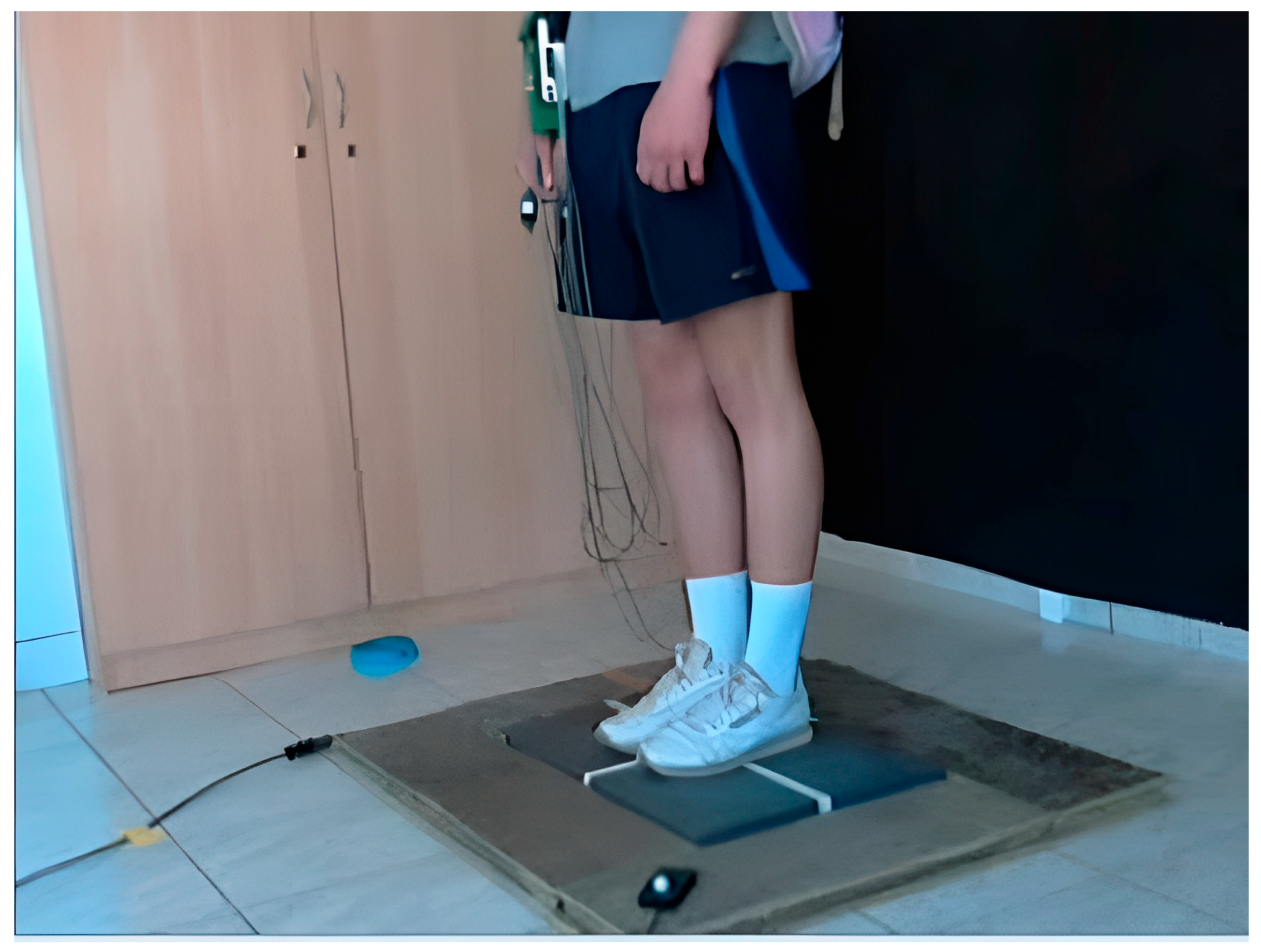
The experiments were conducted in a laboratory room. During the measurements, each subject stood on a tensometric platform (
Figure 1), a Bertec model (USA, Ohio, Columbus) with dimensions 600 mm (width), 400 mm (length), and 50 mm (height), operating at a sampling frequency of 1 kHz.
The three components of the ground reaction force (GRF) were recorded as follows: Rx (+left and −right), Ry (+forward and −backward), and Rz (+upward and −downward). Surface electromyographic (EMG) activity was collected from six superficial muscles: medial head of m. gastrocnemius lateralis (GAL); lateral head of m. gastrocnemius medialis (GAM), rectus femoris (RF); and vastus lateralis (VL) from quadriceps femoris; m. biceps femoris (BF); and m. semitendinosus (ST). Data acquisition was performed using the telemetric system Telemyo 2400G2, Noraxon Inc (Scottsdale, AZ, USA). All signals were monitored online and stored as ASCII files for subsequent offline analysis together with the synchronized ground reaction force data.
The reference electrode was positioned at the caput fibulae. EMG signals were obtained using “Skintact-premier” (Leonhard Lang GmbH, Innsbruck, Austria) F-301 Ag/AgCl disposable 3 cm diameter electrodes. Some rules were followed when placing the electrodes—the skin was cleaned and dried with alcohol, and conductive gel was applied to improve signal conductivity. Electrode positioning followed the recommendations of the SENIAM project (
http://www.seniam.org/, accessed on 10 March 2026), with electrodes aligned parallel to the muscle fiber direction. The frequency of sampling was set at 1500 Hz. Each motor task lasted 30 s. All recordings were performed on the right leg. Further EMG processing was carried out using custom-developed MATLAB 2011B software.
The initial task served as a reference condition and was performed without any additional load. The participant stood on his own feet, stepped on the force platform, and remained quiet while standing for 30 s. EMG signals and ground reaction force components were synchronously recorded.
The subject then stepped off the platform, a two kilogram weight was added to the backpack, and the subject assumed the same position marked on the platform while a new 30 s timeout was taken. This was repeated until the weight passed through 5, 10, 15, 17, and 20 kg.
All EMG signals and force platform data were analyzed using a custom MATLAB program. EMG signal processing included selecting a visually determined artifact-free time interval. The signals were filtered using Butterworth high-pass (cut-off 20 Hz, order 4) and low-pass (cut-off 300 Hz, order 4) filters. The filtered EMG signals were then full-wave rectified, smoothed over 10 samples, and their mean values were calculated within the selected interval.
Although each recording lasted 30 s, a 10 s interval was visually selected for analysis to ensure the absence of artifacts across all EMG channels and the ground reaction force components Rx, Ry, and Rz.
Surface EMG signals were normalized within subjects using mean value normalization to minimize intersubject variability related to electrode position, subcutaneous tissue, and individual neuromuscular characteristics [
33,
34]. For each muscle and each subject, the EMG signal amplitude was divided by the mean value recorded across the seven experimental loads. Ground reaction force (GRF) values were normalized to the subject’s body weight to ensure comparability across participants [
35].
Normalized data were used for subsequent intercriteria analysis of each load and each subject separately.
2.2. Intercriteria Analysis
Atanassov et al. developed an ICrA method to identify correlation relations among a set of criteria [
17]. The mathematical tool, involving index matrices (IMs) and intuitionistic fuzzy sets (IFS), can help uncover both known and unknown correlation dependencies. Originally conceptualized to determine dependency patterns among criteria used to characterize a set of objects, ICrA differs substantially from traditional correlation analysis. Rather than comparing absolute numerical values, the method operates through relational operators (“<, >, =”) applied to object evaluations under specific criteria. This comparative logic enhances computational efficiency and reduces methodological constraints associated with classical statistical techniques. Beyond calculating degrees of agreement and disagreement between criteria, ICrA uniquely introduces a quantified measure of uncertainty, thereby providing a more nuanced interpretation of intercriteria relationships. Furthermore, the method is particularly suitable for analysis involving a limited number of criteria per subject and demonstrates adaptability to datasets of different data dimensions.
Initially, ICrA requires datasets of multiple objects (
O1, …,
Om) evaluated against various criteria (
C1, …,
Cn), presented in the form of an index matrix, where
eC1,O1, …,
eCn,Om are the corresponding elements.
| | O1 | … | Oi | … | Om |
| C1 | eC1,O1 | … | eC1,Oi | … | eC1,Om |
| … | … | … | … | … | … |
| Ck | eCk,O1 | … | eCk,Oi | … | eCk,Om |
| … | … | … | … | … | … |
| Cn | eCn,O1 | … | eCn,Oi | … | eCn,Om |
If
is defined as the number of cases in which relations
R(
eCk,Oi,
eCk,Oj) and
R(
eCl,Oi,
eCl,Oj) are simultaneously satisfied, and if
also represents those cases in which
R(
eCk,Oi,
eCk,Oj) and
(
eCl,Oi,
eCl,Oj) are jointly met, it is clear that the total number of possible pairwise comparisons among the
n criteria is
. Therefore,
For each
k and
l that satisfies the rules
and
, we can define two counters as follows:
The intuitionistic fuzzy pair with values between 0 and 1, is an intuitionistic fuzzy evaluation of the relation between the criteria Ck and Cl. Thus, the initial IM can be converted into a new IM that includes only the relations between the criteria, presenting the degrees of correspondence, non-correspondence, and uncertainty.
The last step of the algorithm is to classify the obtained relations between the criteria as positive (PCo) or negative (NCo) consonance or dissonance, depending on the threshold values for μ and ν. If 0 ≤ α ≤ 1 and 0 ≤ β ≤ 1 are numbers such that α + β ≤ 1, the two criteria Ck and Cl are in PCo when > α and < β; NCo, as observed when < β and > α; and dissonance, if otherwise.
Defaulted PCo and NCo in ICrA occur when the
µ-value is in the interval (0.75; 1.00] and [0.00; 0.25], respectively, while the dissonance appeared when the
µ-value is in the interval (0.25; 0.75]. Further details on the
µ-value scale are given in [
18]. Since the threshold values can be user-defined according to the specifics of the research, in this study, we use the “thirds” scale from Angelova et al. [
22] as an enhanced approach to setting thresholds, with α = 0.67 and β = 0.33. This “thirds”-based scale preserves symmetry and maintains consistency with the earlier “quarters”-based symmetric framework proposed in [
18]. When the difference between α and β decreases, this leads to an increase in the number of pairs classified as being in consonance. The choice of the values 0.67 for α and 0.33 for β represents a good compromise between the two extremes—having too few or too many pairs representing PCo or NCo relations. While the approach of Atanassov et al. is based on dividing the interval [0.00, 1.00] into “quarters,” here a scale of “thirds”, where 0.67 corresponds approximately to two-thirds and 0.33 to one-third, is used. Thus, PCo occurs when
> 2/3 and
< 1/3, while NCo occurs when
> 1/3 and
< 2/3. Dissonance is observed when both μ and ν are below 2/3, but their sum lies in the range [2/3, 1]. Uncertainty can be found when both μ and ν are below 2/3, and their sum is also less than 2/3.
3. Results
The influence of different posterior loads on muscle coupling was calculated using
µ-biased ICrAData v 2.9 algorithm. The software is freely available and can be downloaded from:
http://intercriteria.net/software/ (accessed on 16 March 2026). The correlations between the six investigated muscles were calculated for each level of loading (one unloaded and six loaded). The seven input matrices for ICrA, corresponding to the loading levels of 0 kg, 2 kg, 5 kg, 10 kg, 15 kg, 17 kg, and 20 kg, were constructed identically:
Criteria in the intercriteria matrix are the six muscles.
Twenty-five subjects are the objects.
Matrix elements are the processed and normalized EMG data.
A separate matrix is formed for each load, enabling a comparative analysis of changes in muscle interactions depending on the level of loading.
Table 1 summarizes the muscle pairs that show PCo correlations. All other criterion pairs remaining in dissonance are not shown to present only the significant results.
As can be seen from
Table 1, seven (GAL–GAM, RF–VL, BF–ST, VL–BF, RF–BF, RF–ST, and VL–ST) out of a total of thirty muscle pairs exhibit PCo. GAL and GAM appear in the only pair GAL–GAM, while each of the RF (RF–VL, RF–BF, and RF–ST), VL (RF–VL, VL–BF, and VL–ST), BF (BF–ST, VL–BF, and RF–BF), and ST (BF–ST, RF–ST, and VL–ST) muscles appear in three criteria pairs. It is clearly observed that the interaction between RF and VL stands out as mandatory at all six load trials, as well as for the one without load. The other interactions are observed mainly for trials with heavy weights, namely 17 and 20 kg. The remaining twenty-three muscle pairs show dissonance for all seven trials. NCo is not detected for any of the studied pairs.
Also, ICrA allows subject-specific analysis. Thus, the approach is tested to examine the relations between the load, the six muscle activities, and the three components of the ground reaction forces. Twenty-five matrices were separately constructed across the seven trials, one for each subject. In the initial index matrices, the objects are the quiet standing loading conditions (tr1 to tr7); the criteria are the load (W), the six muscle activities (GAL, GAM, RF, VL, BF, ST), and the three ground reaction force components (Rx, Ry, Rz); and the matrix elements are processed and normalized EMG data and the three GRF components.
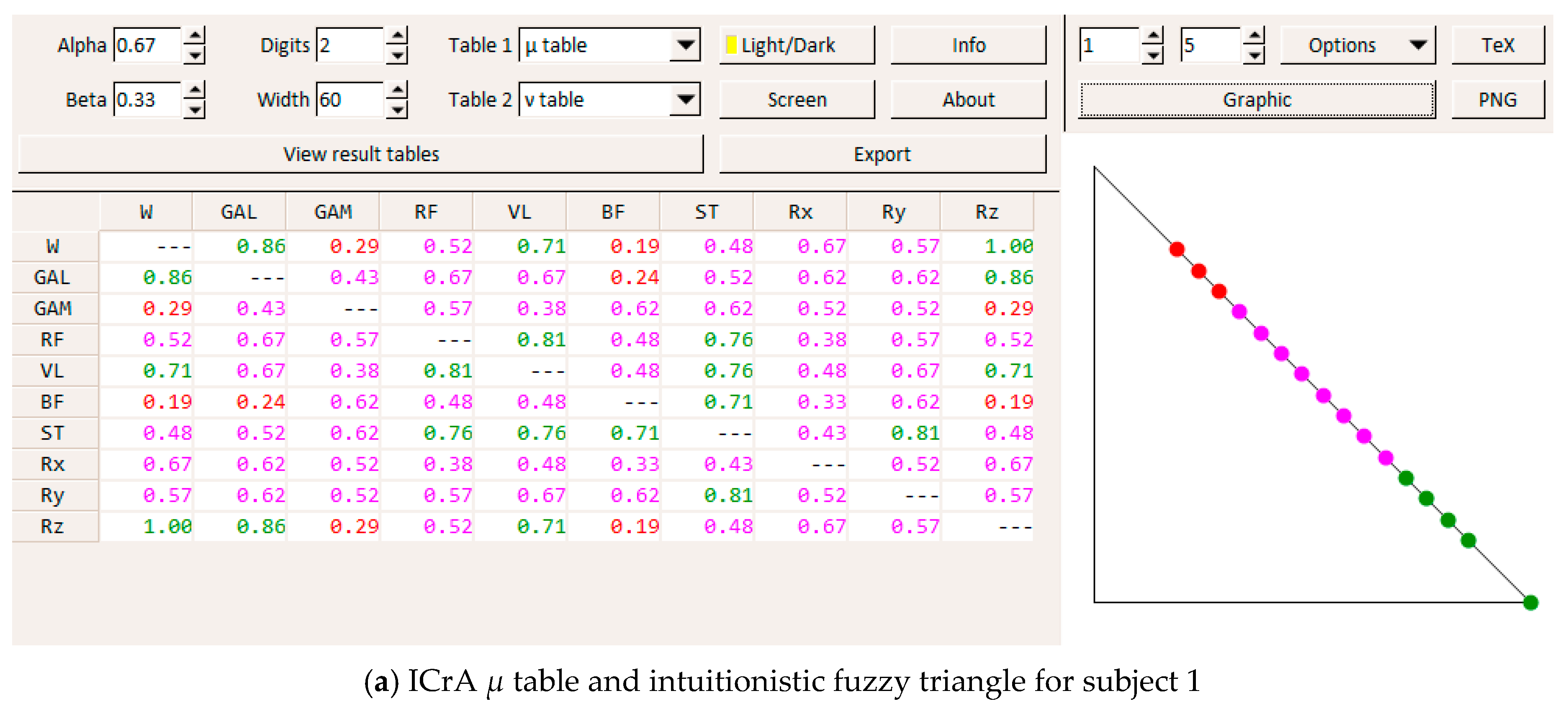
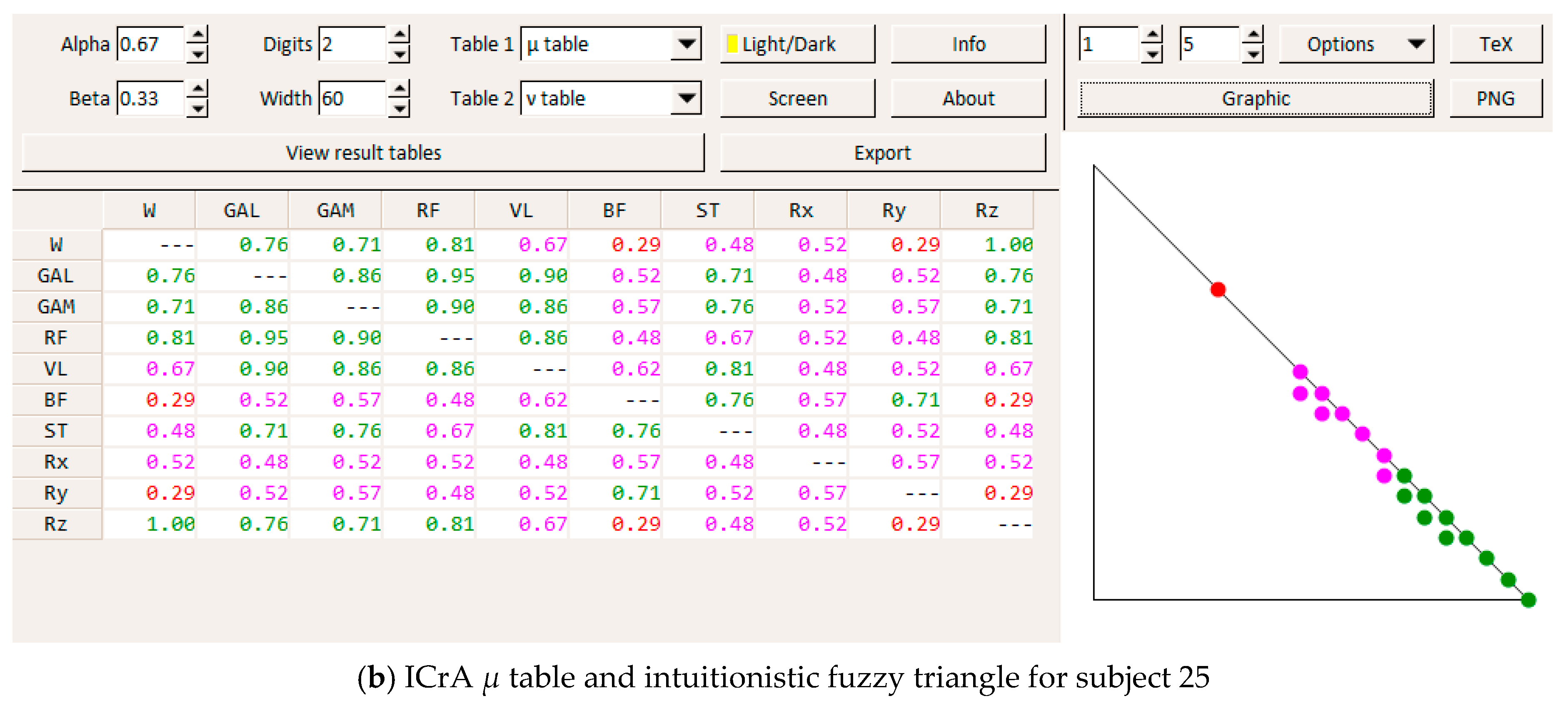
Figure 2 shows both the numerical and geometric interpretative results of the intuitionistic fuzzy triangle after ICrA application for subjects 1 and 25. Green and red colors show PCo or NCo, respectively, while magenta indicates dissonance. As can be seen from
Figure 2a,b, the results vary with the subject-specific characteristics and manner of posture control.
The results for the twenty-five participating volunteers were collected, and only those presented PCo relations are summarized in
Table 2.
Nine out of forty-five criteria pairs (W–Rz, RF–VL, BF–ST, W–GAL, GAL–GAM, GAL–Rz, W–GAM, GAM–Rz, and RF–Rz) can be distinguished, as they were observed in more than half of the subjects who participated in the research.
For clarity,
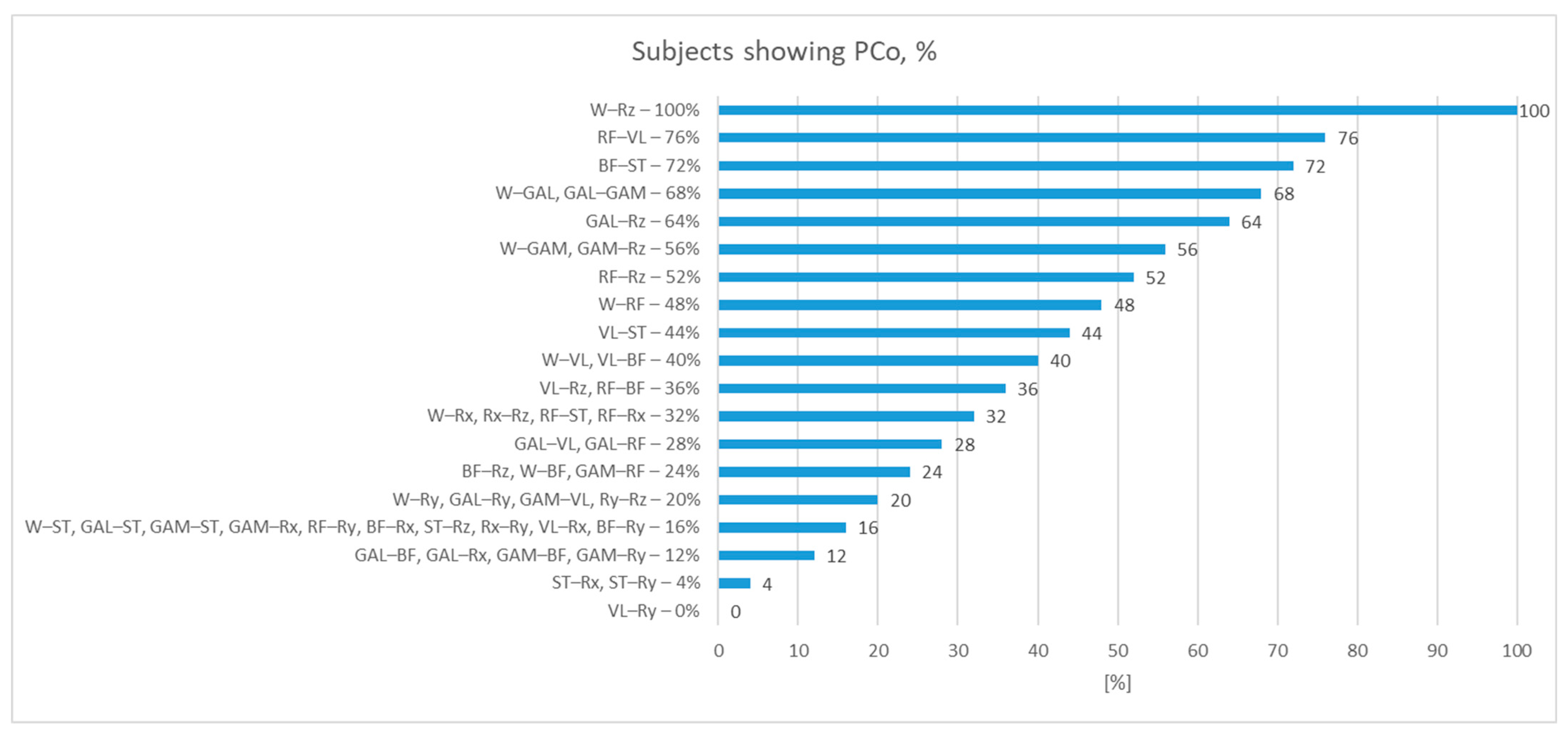
Figure 3 is presented here. Summarized in
Table 2, the results show the proportion of subjects demonstrating PCo relations for each criterion pair. As can be seen from
Table 2 and
Figure 3, PCo for the remaining thirty-six pairs was found in less than half of the participants, with numbers ranging from twelve to zero, and for this reason, they will not be further considered. These pairs include muscle–muscle, weight–muscle, weight–Rx/Ry, muscle–GRF, and GRF–GRF interactions.
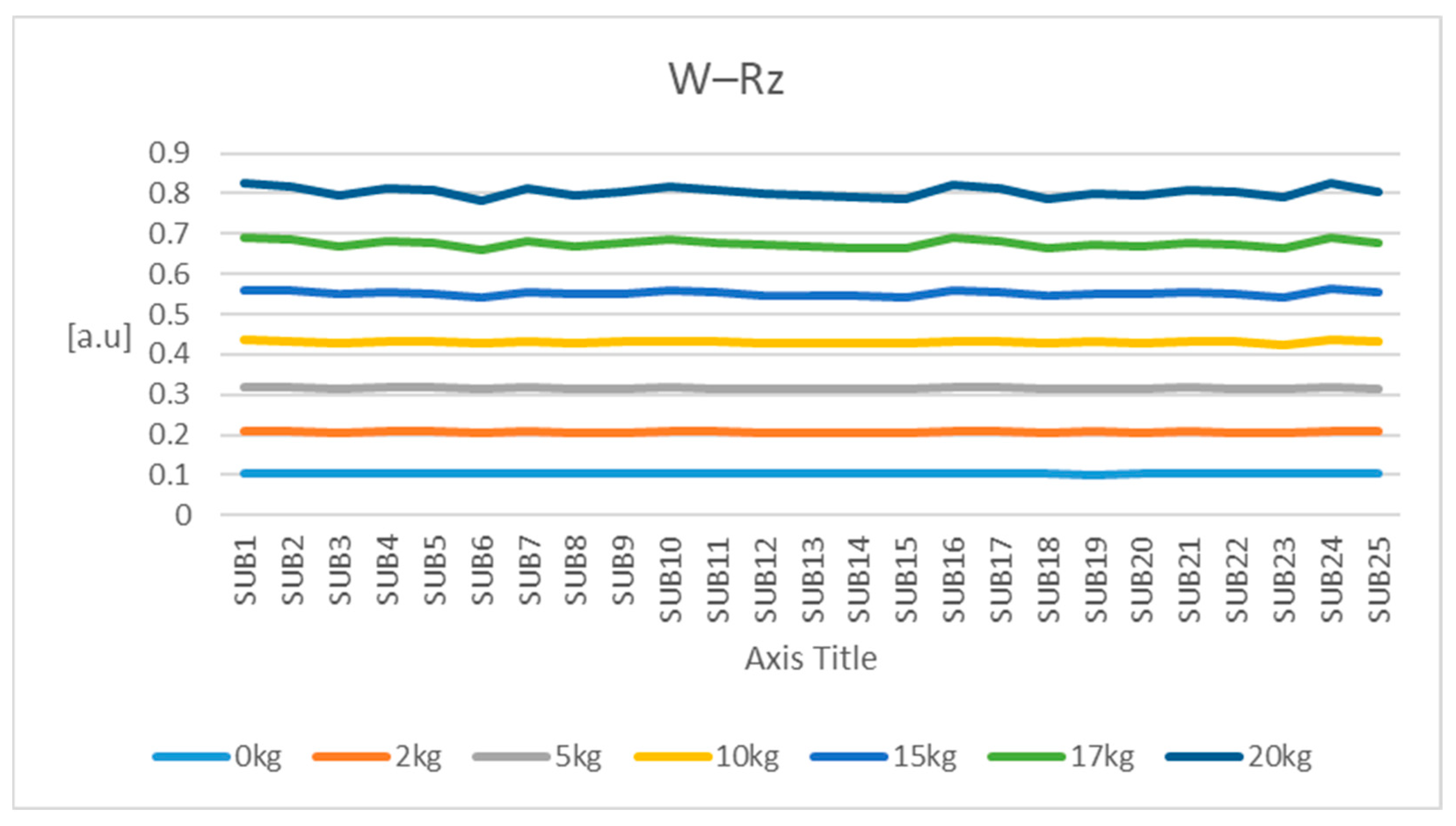
Figure 4 shows the stable relation between W–Rz, which is detected for all twenty-five subjects (SUB1 to SUB25).
The identified significant ICrA dependencies are discussed in detail in the Discussion section.
4. Discussion
Presented in
Table 1, the results show that only seven (RF–VL, RF–BF, VL–BF, BF–ST, GAL–GAM, RF–ST, and VL–ST) out of the thirty muscle pairs studied under different load conditions show PCo relation. The RF–VL is observed for all levels of loading, including one without a load. That is why the RF–VL can be distinguished as the most stable and non-dependent of the load pair in the interval 0–20 kg. The BF–ST pair is classified as semi-stable, as it was absent in only two load conditions (0 kg and 5 kg). Its interactions were consistently observed primarily at higher loads (17 kg and 20 kg).
The RF and VL from the stable RF—VL pair function as primary knee extensors [
36]. Their innervation comes from n. femoralis. The nervous system activates them to provide collective knee stability, preventing unwanted flexion. Unlike the vastus lateralis, which is a monoarticular muscle and acts only on the knee, the rectus femoris also crosses the hip joint and functions as a hip flexor. When carrying a backpack, the center of gravity shifts posteriorly [
16]. The body often compensates for this by slightly tilting the torso forward. In this position, the RF serves a dual role: stabilizing the knee and controlling the position of the pelvis relative to the hip. Krishnamoorthy et al. [
37] identified a specific M-mode involving the co-contraction of the vastus lateralis, rectus femoris, and biceps femoris, which emerged in response to high-difficulty tasks. In contrast to their findings,
Table 1 shows that a stable RF–VL interaction persists, both without load and with loads up to 20 kg. This load-independent stability of the RF–VL pair suggests a pre-programmed internal model for knee stabilization. Furthermore, it indicates that human movement relies not on the individual control of each muscle but on the activation of stable, low-level modules. These modules are subsequently scaled and adapted by higher control centers to meet specific task requirements, supporting the theory of hierarchical control where lower-level synergies remain fixed while higher-level ones adapt [
38].
Both muscles, BF and ST, are part of the hamstring group and act as biarticular stabilizers. The observed coactivation of this pair, predominantly at higher loads, likely controls anteroposterior movement and contributes to medial stabilization. The BF is located on the outer, posterior side, and the ST is located on the inner, posterior side of the thigh [
36]. The muscles control hip and knee stability, as they are extensors of the hip joint and flexors of the knee joint. These muscles are antagonists to the found here stable muscle pair RF–VL at the knee joint. The muscles provide knee stability in a certain way under different conditions [
39]. The pair BF–ST is semi-stable compared to the antagonistic stable pair RF–VL. As shown in
Table 1, its occurrence is sporadic at lower weights (0–5 kg), whereas a consistent pattern emerges at higher weights, ranging between 10 and 20 kg.
Here, the RF–BF, RF–ST, and VL–ST muscle pairs can be grouped and discussed together, since the interactions occur in the anterior and posterior femoral muscles, driving the knee joints simultaneously, but in opposite directions [
36]. Studies on knee joints show that the isolated work of the muscle, the quadriceps femoris, causes destabilizing anterior displacement and internal rotation of the tibia. This effect is significantly neutralized by co-contraction of the hamstrings in the range of 15° to 80° flexion at low load levels, and at high loads, it also covers these range with 0–15°. Thus, it provides synergistic action at the anterior cruciate ligament and has a significant effect on maintaining knee stability [
39]. These pairs interact primarily at heavier weights, specifically 17 and 20 kg. The emergence of antagonistic coactivations (e.g., RF–BF and RF–ST) at 17–20 kg loads indicate a transition from an efficiency-based strategy to a stiffness-based strategy. The observed transition toward coactivation of antagonistic pairs at higher load levels can be interpreted as a functional compensatory strategy. As noted by Humphrey and Reed [
40], muscle coactivation increases joint stiffness, providing greater mechanical stability in response to increased postural demand. In our study, this suggests that the central nervous system prioritizes postural security over energy efficiency as the external weight reaches critical levels.
The remaining two criterion pairs, namely VL–BF and GAL–GAM, are observed at two weights each; however, these weights differ. The VL–BF pair appears at higher loads (10 and 20 kg), whereas the GAL–GAM pair is observed only at the beginning of the experiment (without added load) and at the maximum load of 20 kg.
The VL–BF interaction appears in a monoarticular muscle of the anterior thigh, acting in the knee joint, and a biarticular muscle of the posterior thigh acting in the hip and knee joints. In the knee, the two muscles are antagonists [
36]. Animal studies reveal that the BF has functional subunits that can be differentially activated [
41]. In cats, for example, the posterior (caudal) sector of the biceps femoris is responsible for knee flexion, while the anterior (rostral) portion is focused on pelvic extension.
Concerning the GAL–GAM relation, the application of additional weight results in an anteroposterior shift in the mean position of the center of pressure towards the forefoot [
42]. This is a specific biomechanical compensatory mechanism aimed at counteracting the torque generated by the load, which tends to shift the overall center of mass posteriorly. As a result, the lower leg muscles must generate a greater plantar flexion moment to maintain postural stability.
The trends in
Table 1 indicate a hierarchical organization of muscle coordination patterns. The stable consonance observed in pairs like RF–VL suggests they function as a functional unit for postural stability regardless of the size of external loading, while semi-stable and load-dependent interactions (BF–ST, VL–BF, etc.) reflect the dynamic adaptation of the body to changing mechanical conditions. When focusing on the results in
Table 2, a permanent relation between external load and vertical GRF (W–Rz) can be observed, with PCo found in 100% of participants. Increasing load is associated with a proportional rise in the amplitude of the vertical ground reaction force (
Figure 4), confirming its role as a primary biomechanical marker of adaptation.
Going deeper into detail for the W–Rz pair, in quiet standing, the vertical ground reaction force should not be treated as a constant equal to body weight. It exhibits characteristic oscillations around the average value of the total body mass [
43]. The ground reaction is the sum of the static weight and the dynamic component due to the acceleration of the common center of mass [
44]. The introduction of additional weight to the system leads to an increase in the amplitude of dynamic oscillations within the framework of postural control [
43]. The increase in the total mass generates more significant inertial forces, which are provoked even by minimal physiological processes, such as breathing and heartbeats. The greater mass increases the moment of inertia of the body, which makes its control more difficult and requires a higher degree of neuromuscular coordination. To maintain stability, the amplitude of vertical GRF must increase proportionally to the added mass. This is a necessary condition for generating sufficient corrective moments to compensate for the destabilizing forces. The observed 100% consonance between W and Rz across all participants, together with the identified GAM–Rz and GAL–Rz relationships, suggests the involvement of feedback control mechanisms in postural regulation. As the external load increases, a modulation of sensory feedback gain is likely to occur, drawing on proprioceptive and vestibular inputs. This process, known as sensory reweighting, enables the central nervous system to adaptively shift the relative weighting of various sensory sources. Such adjustment is critical for maintaining the center of mass within the base of support, countering the posterior displacement induced by the backpack load.
Such a significant relation was observed neither for the W–Rx nor for the W–Ry pair. The dependence between W and Rx is observed in the PCo in 32% of subjects, whereas the W–Ry relation occurs in only 20% (
Figure 3).
Other load-related interactions, including W–GAL and W–GAM, demonstrate moderate PCo relation. The results in
Table 2 and
Figure 3 show PCo relations in 68% and 56% of the participants, indicating enhanced activation of the gastrocnemius muscles with increasing load. In addition, several muscle–muscle and muscle–GRF component relations show moderate stability in more than half of the participants. Notably, RF–VL (76%) and BF–ST (72%) reflect consistent muscle coupling within the anterior and posterior thigh muscle groups, respectively, while GAL–GAM (68%) indicates coordinated activation between the medial and lateral heads of the gastrocnemius. The relations between muscle activity and vertical force, such as GAL–Rz (56%), GAM–Rz (56%), and RF–Rz (52%), further underline their contribution to the postural control.
Overall, the high degree of positive consonance suggests that most subjects (13–19) employ stable neuromuscular coordination patterns, characterized by the synchronized activation of lower leg and thigh muscles to preserve balance under loading.
When W–GAL and W–GAM are in the focus of investigation, together with pairs GAL–Rz (64%), GAM–Rz (56%), and GAL–GAM (68%), the systematic review by Walsh and Low [
42] supports the hypothesis that the application of external loading leads to a statistically significant increase in GRF and peak plantar pressures compared to non-loading conditions. The authors’ analysis found that the most pronounced changes occur in the vertical and anteroposterior directions, while the mediolateral indicators remain relatively stable. The addition of inertial mass to the human body increases total inertia, necessitating the generation of greater corrective forces to maintain static balance [
43,
44]. Any anteroposterior deviation of the center of gravity in the presence of additional loading requires a higher degree of muscle activation to counteract the increasing destabilizing moment. A high degree of correlation was observed between the severity of the external loading (respectively, the increase in vertical ground reaction) and the intensity of myoelectric activity of the mm. gastrocnemii [
45]. The data indicate that both heads of the gastrocnemius (medial and lateral) exhibit high sensitivity to changes in the mechanical demands of the environment. The medialis and lateralis heads of m. gastrocnemius have a high capacity for generating force and demonstrates dynamic modulation when the center of mass is shifted (e.g., when leaning forward), requiring a greater ankle torque. The authors indicate that while m. soleus provides the baseline tonus during minimal sway; the medial and lateral heads of the gastrocnemius are activated intensively when the postural challenge exceeds the functional threshold of the soleus.
The appearance of RF–VL and BF–ST interactions for 19 and 18 from 25 participants was logically expected. It is worth noting that the results from
Table 2 reveal that the two criterion pairs are mainly in PCo when the individual subject interactions were analyzed. Due to their thorough explanation, according to the results from
Table 1, the two muscle pairs will not be discussed again.
The RF–Rz pair is borderline, showing PCo in 52% of the subjects (
Figure 3). The vertical ground reaction (Rz) during standing is not a constant quantity but a dynamic parameter that increases proportionally to the added external mass and the inertial forces generated by it [
43,
44]. During loading and subsequent forward bending of the torso [
16], the rectus femoris is activated as a biarticular stabilizer that simultaneously fixes the knee joint and regulates the position of the pelvis. This specific neuromuscular strategy directly modulates the values of Rz. Through RF-controlled corrective moments, the body generates the necessary dynamic forces to compensate for destabilizing oscillations and maintain the center of pressure in the stability zone.
For some of the pairs and subjects’ single relations in NCo are identified. The remaining criteria pairs, including muscle–muscle, weight–muscle, weight–Rx/Ry GRF, muscle–GRF, and GRF–GRF interactions, mainly exhibit dissonance, indicating selective and task-specific neuromuscular coordination of the subjects.
Adaptation to external static load exhibits a distinctly individual-specific nature. Only nine out of the 45 pairs examined demonstrate consistency in more than 50% of the participants, while the remaining relationships show high individual variability. In conclusion, the adaptive response is characterized by a consistent biomechanical reaction—marked by an increase in Rz—integrated with selective and functionally justified muscle coordination. At higher loads, increased co-contraction of the thigh muscles is observed, along with a dominant ankle strategy and an enhanced role of the m. gastrocnemius.
The study involved twenty-five young, trained male subjects. This relatively small sample size limits the generalizability of the findings and precludes the direct application of results to females, sedentary individuals, or middle-aged and older populations. Although the subjects were comparatively homogeneous, variations in age, anthropometric characteristics, and physical fitness may influence postural control. Only quiet standing under different levels of external load was analyzed. Therefore, the results cannot be directly extrapolated to dynamic postural strategies. Six muscles were examined (GAL, GAM, RF, VL, BF, and ST), whereas some key postural muscles were not assessed, since most of which cannot be measured using surface EMG. EMG data were normalized to the average EMG value of each muscle for each subject rather than to maximal isometric contraction. Additionally, the range of external loading was limited. The lack of comparison of ICrA with other established methods for assessing adaptive mechanisms of the nervous system under varying load conditions is another limitation of the current study. However, this approach offers a new perspective on the intrinsic dependencies between physiological parameters that established methods may overlook. Nevertheless, mentioned above limitations, the study provides valuable insights into neuromuscular adaptation to static external loading, highlighting the need for future research incorporating broader muscle and kinematic analyses, dynamic tasks, and larger, stratified samples.
The findings of this study may have possible implications for sports practice, especially in the optimization of training under progressive external loading. Understanding how the central nervous system reorganizes muscle coupling to maintain postural stability can support the design of more effective strength and balance training programs. The identified stability of the RF–VL muscle pair and the dependence between load and gastrocnemius activity highlight the key importance for improving lower limb control and knee joint stability. Additionally, the observed increase in antagonist coactivation at higher loads suggests the need for training strategies that enhance coordinated muscle function under stress. The presence of subject-specific synergy patterns further emphasizes the importance of individualized training approaches.