1. Introduction
The countermovement jump (CMJ) is commonly performed during competition in many sports, including but not limited to performing a jump shot or rebound in basketball, jumping to secure or disrupt a pass in American football, or jumping to complete a volleyball spike. It is therefore used by practitioners during training to improve not only vertical jump and related in-game performances, but also to monitor lower limb strength, power adaptations, and neuromuscular fatigue [
1,
2,
3]. Performance during the CMJ is mostly assessed using jump height (JH), or the vertical displacement achieved between the instant the feet leave the ground and the highest position of the body center of mass (COM). However, JH and its kinematic and kinetic predictors, such as impulse, take-off velocity, and peak lower limb power output [
4] fail to provide information related to an athlete’s neuromusculoskeletal strategies driving the observed performance.
Because JH and related predictors only tell part of the story, strategy variables obtained from ground reaction forces (GRFs), such as peak and average force production and the rate of change in GRF production (i.e., yank, sometimes called rate of force development), have received much attention in the literature to explain CMJ performance outcomes and stretch-shortening cycle function. While joint-specific variables like joint angular power and work [
5,
6,
7] have received considerably less attention, they can provide deeper insight into the strategies that influence the function and efficiency of the stretch-shortening cycle, a common training target for practitioners and athletes [
8,
9]. Ultimately, researchers and practitioners should consider placing greater emphasis on joint kinetic output when seeking to more fully understand strategies and drivers of CMJ performance [
10].
If joint kinetic variables are to be used to better understand CMJ strategy, it is also important to determine how they change when jumps are performed at maximal versus submaximal effort. Although maximum CMJ height is achieved by using a countermovement that maximizes joint kinetic output [
11,
12], athletes frequently complete CMJs in competition at a submaximal effort level (i.e., not seeking maximum jump height) to match the demands of the overall task. Joint-specific strategies also appear to vary across submaximal and maximal jump performances. Prior research showed in arm-swing jumps that as jump height increased from low to maximal JH conditions, hip work increased markedly, whereas ankle work increased only slightly [
13], suggesting a shift in the distribution of lower-limb joint work contributions across jump intensities. Similarly, other research reported that across a range of prescribed jump heights (i.e., 25%, 50%, 75%, 100%), increases in total eccentric and concentric joint work were associated with increases in JH, with greater concentric contributions at the knee, followed by the ankle and hip for all jump heights [
6]. Together, these studies show that the way in which individuals organize and strategize lower limb joint work during CMJs at various effort prescriptions requires further investigation. Given the previous research, it is unclear how verbally prescribed perceived effort influences concentric joint work contributions. In addition, it remains to be determined whether a prescribed effort level equates to a proportional performance outcome or change in joint kinetic outputs (i.e., whether a prescribed reduction in effort corresponds with a similar reduction in CMJ performance).
The next logical step related to the study of perceived effort levels during the CMJ is to investigate potential differences in performance and joint kinetic output across a range of perceived efforts. Therefore, the purpose of this study was to compare various levels of perceived effort (PE) with respect to JH and lower limb joint work contributions during the concentric phase of CMJs. We hypothesized that (1) decreasing PE would reduce jump height and total lower limb work, and (2) the general pattern of relative joint work contributions would remain similar across PE conditions.
2. Materials and Methods
2.1. Participants
A convenience sample of twenty-four recreationally active individuals (12 males and 12 females) was included in this study (
Table 1). We could not find related published data from which an appropriate sample size could be determined. As such, our sample size was determined via an a priori sample size estimate (G*Power v 3.1.9.7) for a one-way repeated-measures within-factors test, using a proposed effect size of 0.3, a 5% error probability, power (1-β) of 0.9, and a correlation among repeated measures of 0.5. Although this estimate returned 22 participants for adequate power, thirty total participants completed the study to ensure adequate power, with six being excluded from statistical analysis due to data processing issues stemming from poor marker tracking. All participants were required to be recreationally active, without lower extremity injury at the time of data collection, and not be pregnant or think they were pregnant. Individuals who did not meet these criteria were excluded. This study was approved by the Institutional Review Board at the location of data collection, and each participant provided written informed consent to the research team prior to participation.
2.2. Instrumentation
Three-dimensional (3D) kinematic and GRF data were obtained using a 12-camera motion capture system (Vantage V5 cameras; Vicon Motion Systems, Ltd., Oxford, UK; 200 Hz) and a dual force platform system (OPT464508; Advanced Mechanical Technology, Inc., Watertown, MA, USA; 2000 Hz). Reflective markers (14 mm diameter) were placed using a custom marker set. Markers were placed bilaterally over the following anatomical landmarks: acromion process, iliac crest, anterior superior iliac spine, posterior superior iliac spine, greater trochanter, lateral and medial epicondyles of the knee, lateral and medial condyles of the tibia, lateral and medial malleoli, calcaneus, and the first and fifth metatarsals. Individual markers were placed on the C7 vertebrae, T12 vertebrae, sterno-clavicular notch, and xiphoid process. These markers were used to define a five-segment model consisting of the trunk, pelvis, and right thigh, leg, and foot segments. This marker configuration was based on commonly used anatomical landmarks for lower-limb biomechanical modeling and was applied consistently across all participants and effort conditions.
2.3. Experimental Protocol
Each participant completed a single laboratory session. Age, mass, height, and sex were recorded at the beginning of each visit. Participants were instructed to arrive for their session with clothing appropriate for motion capture testing (i.e., spandex shorts/pants and shirt, athletic footwear, etc.). Proper attire was provided for testing if the participants did not have the necessary clothing. Participants completed a standardized warm-up made up of five minutes on a cycle ergometer at a self-selected pace, followed by ten bodyweight squats, ten squat jumps, and twenty alternating walking lunges.
A static calibration trial was collected with participants in a standardized anatomical position prior to dynamic testing. Following calibration, the iliac crest markers were removed for the movement trials. Participants completed five sets of three CMJ trials, totaling fifteen trials. Sets one and five were performed at maximum effort (PE100), while sets two, three, and four were performed at perceived effort levels of 25% (PE25), 50% (PE50), and 75% (PE75), presented in a counterbalanced order across participants. CMJ trials were performed with the participants holding their hands akimbo (placed on their hips). Approximately one minute of rest was provided between trials, and approximately two minutes of rest was provided between efforts. Participants were allowed practice jumps prior to each submaximal effort set to allow them to become accustomed to the PE level they were being asked to perform. These practice jumps served as a brief familiarization procedure to help participants interpret and reproduce the prescribed percentage effort levels before the recorded trials. Before each jump, participants were instructed to stand motionless with each foot on a force platform. A research team member would then remind them of the effort level they were to perform, followed by a “3, 2, 1, go!” cue to begin the CMJ. For PE100 trials, participants were instructed to “jump as fast and as high as possible”. For submaximal PE trials, participants were instructed to jump as fast as possible while seeking to put forth 25%, 50%, or 75% of their maximal effort. Other than those instructions, participants were allowed to perform the CMJ and its landing with their preferred strategy. The PE conditions were prescribed consistent verbal instructions, practice jumps, counterbalanced condition order, and standardized rest intervals. No external JH or performance feedback was provided, as participants were instructed to perform each jump at the level they personally perceived to match the prescribed effort condition. Monitoring of the prescribed PE levels was based on researcher supervision and participant self-assessment, and trials were discarded and repeated where the participant did not return to a stable standing position after landing, or if the participant felt that the CMJ was not performed at the specified level of perceived effort based on their performance of the practice jumps.
2.4. Data Processing
Raw data were exported to the Visual3D biomechanical software suite (v6 Professional; HAS-Motion, Inc., Germantown, MD, USA), where model construction, kinematic calculations, and inverse dynamics calculations were performed. The raw kinematic data were used to construct a five-segment model consisting of the trunk, pelvis, and right thigh, leg, and foot segments. Marker trajectories and GRF data were then smoothed using a low-pass Butterworth digital filter with cut-off frequencies of 12 Hz and 50 Hz, respectively [
5]. Segment and joint kinematics were then computed from the filtered marker trajectories. A Cardan rotational sequence (X-y-z) was used for 3D segmental and joint angular computations of the trunk segment and the hip, knee, and ankle joints, and the right-hand rule was used for rotational polarity [
14].
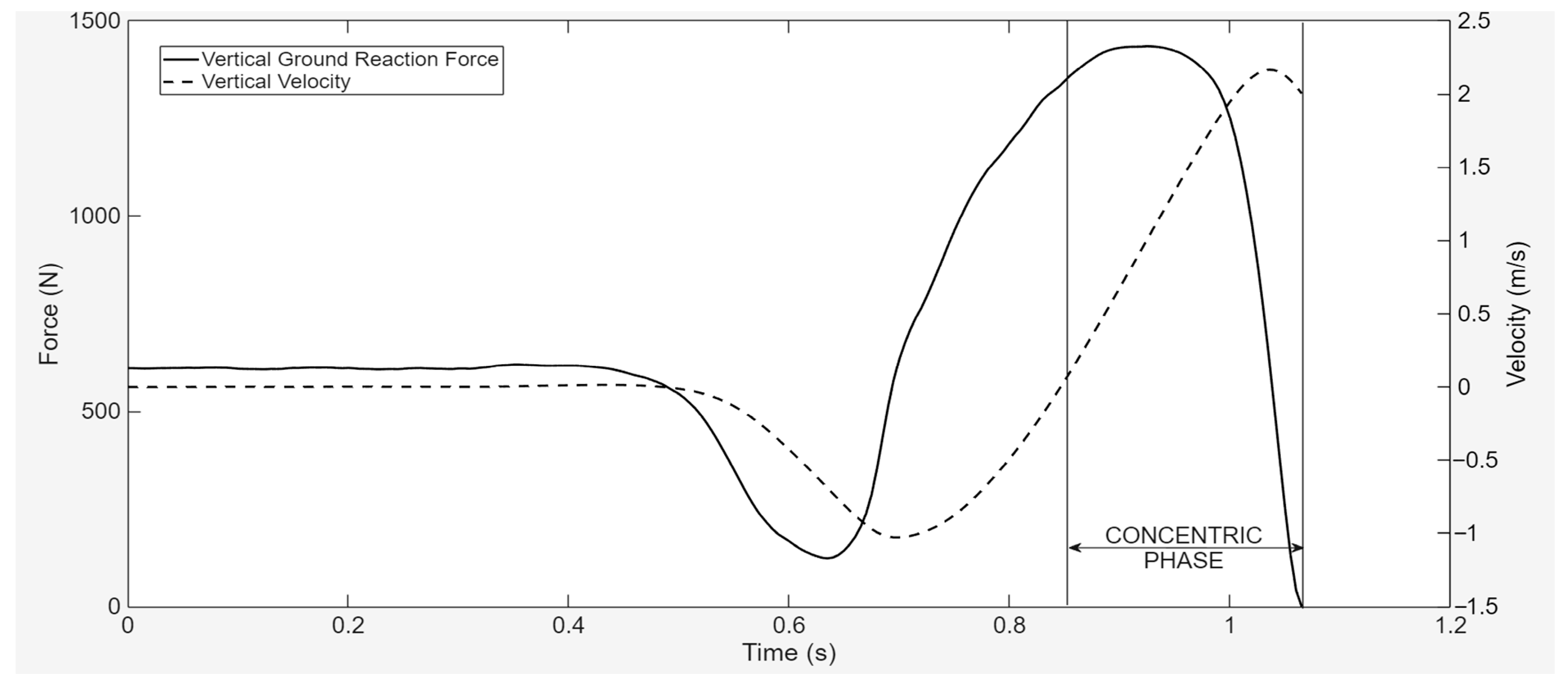
The vertical GRF data from each force platform were summed to determine the total vertical GRF acting at the system COM. Vertical COM velocity was calculated as the time derivative of the vertical COM position of the pelvis segment, as the pelvis COM is a suitable surrogate for the total body COM [
15]. Vertical GRF and vertical COM velocity were then used to identify the concentric sub-phase of the CMJ [
16]. Specifically, this phase was defined as the time between the lowest vertical position (i.e., when vertical COM velocity crossed zero with a positive slope) and takeoff (i.e., vertical GRF < 20 N). A graphical representation of the CMJ concentric phase is provided in
Figure 1. Vertical CMJ height was calculated as the square of vertical COM velocity at takeoff divided by two times the acceleration due to gravity. The pelvis was used as a surrogate for COM only for identifying the concentric phase and calculating jump height, while joint kinetics were calculated from the linked-segment model and synchronized GRF data. Net internal joint moments at the hip, knee, and ankle were calculated using Newtonian inverse dynamics, with moments resolved in the coordinate system of the joint’s proximal segment. Joint angular powers were calculated as the dot product of the sagittal plane net internal joint moments and the corresponding joint angular velocities. Joint angular work was then calculated as the time integral of the joint powers, using the trapezoidal rule, during the concentric sub-phase of the CMJ. The negative joint power magnitudes for all joints during the concentric sub-phase were trivial, and as a result, the absolute value of the joint powers was used to obtain joint work. Total lower limb joint work during the concentric sub-phase was calculated as the sum of the hip, knee, and ankle joint work values [
17]. Individual joint contributions to the total positive lower extremity work magnitudes were calculated during the concentric sub-phase, with contributions defined as the individual net joint work divided by the total lower limb joint work value [
18]. All joint work data were obtained from the right limb. This approach assumes the body can be modeled as linked rigid segments and that the resulting values represent net internal joint kinetics of the modeled limb.
2.5. Statistical Analysis
Mean values were calculated across trials and participants for each variable. Values from the submaximal effort jumps were divided by the maximal effort jump to determine whether outcomes were proportional to PE. JH, W
total, ankle contributions (%
ankle), hip contributions (%
hip), and knee contributions (%
knee) were all compared across PE levels using one-way repeated measures analyses of variance (ANOVA) and a probability level of 5% (α = 0.05) [
5]. Sex was not included as a factor in the primary analysis because previous research has reported similar GRF characteristics, temporal durations, and relative joint kinetic output between males and females during the jumping portion of the CMJ [
19,
20]. The second set of maximum effort jump trials was compared only to the first set using a paired-samples
t-test to ensure that there was no accumulation of fatigue during testing. The assumption of local sphericity was examined with Mauchly’s test of sphericity. A violation of sphericity (α < 0.10) was corrected with Huynh–Feldt when epsilon was greater than or equal to 0.75 and with Greenhouse-Geisser when epsilon was less than 0.75 [
21]. The Sidak correction was used to control for the familywise error rate of the post hoc comparisons. Effect sizes were reported using partial eta squared (
) with the following scale used to describe the magnitude differences: negligible < 0.01 ≤ small < 0.06 ≤ medium < 0.14 ≤ large [
22].
3. Results
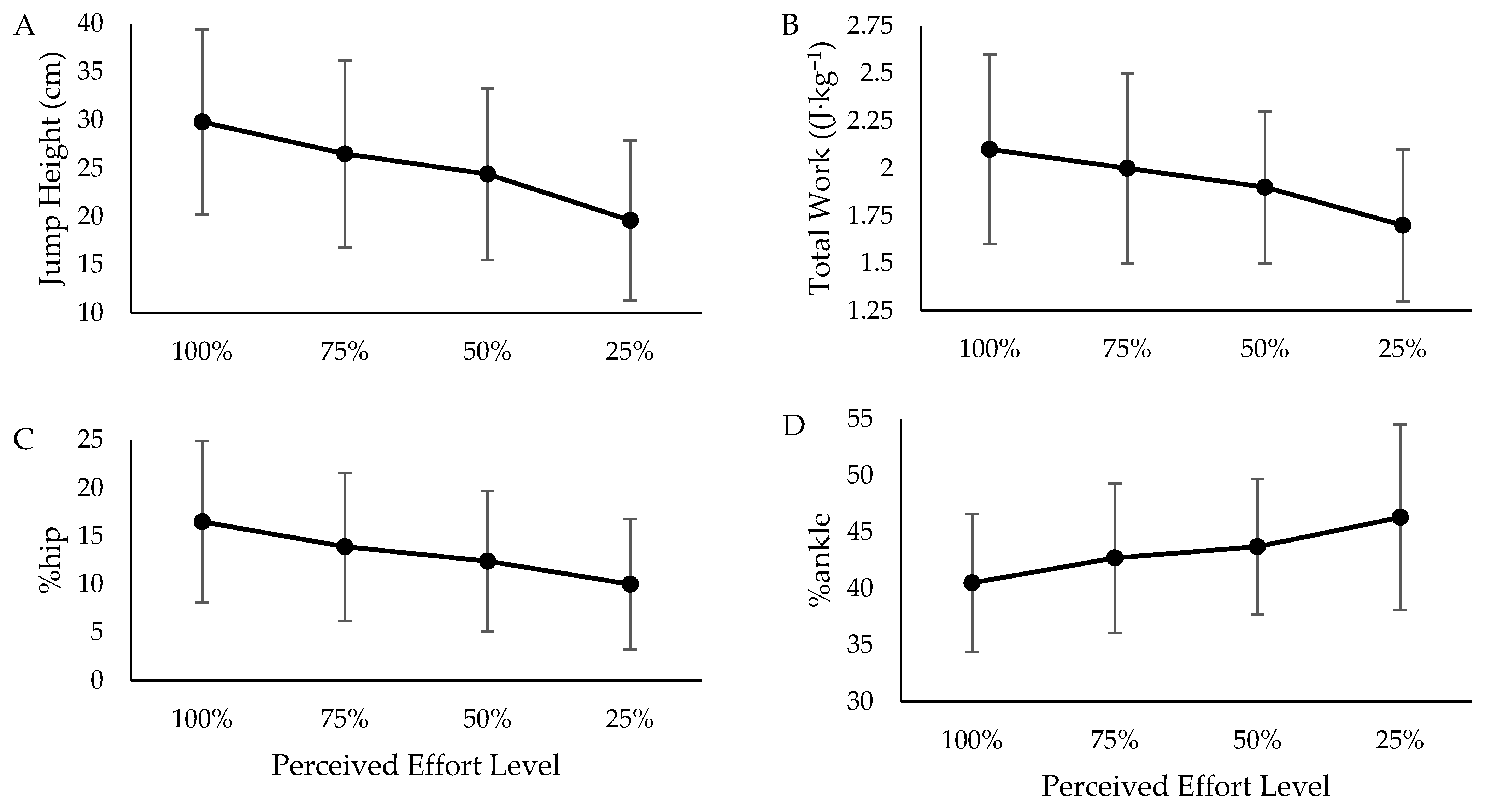
Data are presented as group means ± standard deviations with 95% confidence intervals where appropriate. There were no significant differences detected between the first and last sets of maximum effort jumps for any of the variables of interest (p > 0.10). The omnibus ANOVA tests detected significant differences among effort conditions for JH (F[3, 69] = 63.08; p < 0.01; = 0.48, = 0.73), Wtotal (F[3, 69] = 42.36, p < 0.01, = 0.62, = 0.65), %ankle (F[3, 69] = 20.70, p < 0.01, = 0.67, = 0.47), and %hip, (F[3, 69] = 24.21, p < 0.01, = 0.84, = 0.51). There were no significant differences among effort conditions for %knee (F[3, 69] = 0.47, p = 0.67, , = 0.02).
Post hoc comparisons revealed that JH and W
total were significantly different across all perceived effort levels. Specifically, the greatest JH occurred during PE
100, and the lowest performance was for PE
25. The %
hip increased as perceived effort level increased, with the greatest contributions occurring during PE
100 and the lowest contributions occurring during PE
25. There was no difference in %
hip between PE
50 and PE
75 conditions. The %
ankle decreased as perceived effort increased, with the greatest contributions occurring during PE
25 and the lowest contributions occurring during PE
100. No differences were found between PE
50 and PE
75 conditions. No significant differences were found for %
knee among all PE levels (
Table 2). These condition-specific patterns are also illustrated in
Figure 2.
4. Discussion
The purpose of this study was to compare differences in total lower limb joint work contributions during the concentric phase of CMJs at various levels of PE. These results partially support our first hypothesis in that JH and Wtotal decreased alongside PE. However, JH and Wtotal did not change proportionately to the PE condition. In partial support of our second hypothesis, reductions in PE were enough to stimulate changes in joint-specific work contributions by increasing %ankle and decreasing %hip. In contrast, %knee did not change across PE conditions and JH and Wtotal did not decrease proportionally to decreases in PE for PE75, PE50, and PE25. We observed that for PE75, PE50, and PE25, CMJ performance was ~89%, ~82%, and ~66% of PE100 JH, respectively. Ultimately, the current sample’s effort-based CMJ performances did not match the expected performance output.
Other studies investigating maximal and submaximal CMJs have often controlled performance output through the use of external targets, such as overhead goals during CMJ trials [
13,
23]. In those externally constrained conditions, greater jump performances were associated with greater countermovement depth, particularly increased hip flexion, and, in arm-swing jumps, greater hip work as performance approached maximum. In contrast, the present study examined the effects of verbally prescribed PE rather than externally constrained jump height. This distinction is important as it allowed us to not only analyze how a change in effort may affect joint-specific strategies, but also whether participants could match the intended effort with proportional performance output. Therefore, the mismatch between prescribed PE and observed CMJ output should not be interpreted as a failure to control jump performance, as performance output was intentionally unconstrained. Rather, this mismatch reflects the central purpose of the study: to determine how verbally prescribed PE relates to CMJ performance and joint kinetic outcomes.
Although participants were able to modulate performance across the prescribed effort conditions, the observed changes were not proportional to the requested percentages. This suggests that percentage-based perceived effort instructions may not provide a highly precise representation of intended mechanical output during the CMJ. Participants may have been able to distinguish broad differences between maximal and clearly submaximal jumping, while differentiating between more specific effort levels (i.e., 25–75%) likely involved greater subjective interpretation. Because PE was based on internal judgment rather than objective external targets, some degree of between-participant variability in how these effort levels were interpreted and reproduced should be expected. Although the reliability of PE scaling was not formally assessed in the present study, these findings suggest that in the present sample, percentage-based effort instructions may be more effective for producing general differences in jumping output than eliciting precise proportional changes in performance.
In addition to variability between participants, some degree of intra-individual variability across repeated trials at the same prescribed effort level should also be considered. While participants completed practice jumps prior to each submaximal condition and mean values were calculated across repeated trials, the present study did not directly quantify within-session repeatability of the prescribed PE levels. As a result, it is possible that some participants were more consistent than others in reproducing 25%, 50%, and 75% effort across repetitions. Familiarization, learning, and fatigue effects may also have influenced performance, although the use of practice jumps, counterbalanced ordering of the submaximal conditions, and comparison of the first and final maximal effort sets were intended to reduce these influences. Importantly, the maximal-effort jumps performed at the beginning and end of the testing session were not significantly different, suggesting that fatigue did not measurably affect CMJ performance across the testing session. Nonetheless, these factors should be considered when interpreting the precision of effort-based CMJ prescriptions.
The general contributions of the joints to the total lower limb concentric work were ordered as knee > ankle > hip during the PE
100 condition. This contrasts with other research investigating joint-specific strategy, with the typical order of knee > hip > ankle during maximum effort CMJs [
5,
6,
18]. One possible reason for this difference could be that participants in those studies utilized an arm swing during CMJ trials, while participants in this study did not. Arm swing likely contributed to the greater JH reported in the previously mentioned studies [
24]. This may have occurred in part through greater hip-related work [
25] and a deeper countermovement [
26]. The discrepancy between the current and previous work could also be due in part to the fact that we were focused on the overall amount of the joint work (i.e., absolute sum of positive and negative) during the concentric phase of the CMJ as opposed to removing the negative portions of the concentric joint work. We thought this would be appropriate because the magnitudes of negative joint work were trivial (i.e., near zero) during this phase, and ignoring those works seemed contrary to the goal of understanding the lower body’s “kinetic output.”
As PE decreased, the %
ankle increased such that during the PE
25 condition, it was the leading contributor to lower limb work during the concentric phase (
Table 1). A similar shift in joint-specific strategy during lower-height or submaximal jumping has been reported previously [
23]. In that study, the lower jump conditions were characterized by greater reliance on distal-joint contribution, whereas higher jump conditions involved progressively greater hip work. One possible explanation is that lower PE may have involved a shallower countermovement and less proximal-segment involvement, which could reduce hip contribution and increase the relative contribution of the ankle during concentric propulsion. This interpretation is broadly consistent with studies showing that arm swing can alter lower-extremity torque, power, and work, including greater hip-related contribution and greater total lower-extremity work during jumping [
24,
25,
26]. These results, along with those from the current study, suggest that individuals may begin to alter their CMJ strategy to rely more on the ankle joint when performing CMJs at submaximal effort.
The relatively large standard deviations observed across conditions also suggest that participants did not respond uniformly to the same verbal effort instructions, which may reflect meaningful individual differences in movement strategy selection. Some individuals may have reduced performance primarily through smaller countermovements and reduced hip involvement, whereas others may have used different coordination strategies to achieve the prescribed effort level. From a practical perspective, these findings suggest that verbally prescribed submaximal effort may influence both CMJ output and the joint-specific strategy used to produce that output. However, the mismatch between prescribed effort and observed performance suggests that effort cues should not be assumed to provide precise control over submaximal CMJ output. Collectively, these findings extend prior work on submaximal jumping by showing that verbally prescribed PE alters concentric lower limb joint work contributions and does not correspond linearly to mechanical output during the CMJ.
Several limitations should be considered when interpreting these findings. First, the generalizability of the present findings is limited. The sample consisted of recreationally active individuals performing a constrained CMJ without arm swing in a laboratory setting, so these results may not fully generalize to trained athletic populations or to sport-specific jumping tasks performed with more natural movement strategies. Although the marker set was applied consistently across all conditions, the use of a custom five-segment model may limit direct comparison with studies using different marker configurations. Additionally, although previous CMJ research supported combining males and females for the present analysis, the study was not designed to evaluate sex-specific responses to prescribed PE. Second, the strength of the hip, knee, and ankle muscles was not measured. Differences in strength among these muscles could potentially explain the joints’ general influence on joint-specific CMJ strategies. Analysis of these factors could also provide further insight into how practitioners should, for example, go about improving the JH of a knee-dominant jumper. Third, the akimbo jump style used in this study may have influenced movement strategy. Although this restriction to the CMJ is commonly used and recommended to isolate lower body output, it may be that some participants did not have well-refined strategies for akimbo-style CMJs. Inclusion of arm swing trials at each effort level could help determine the potential likelihood of whether their joint-specific CMJ strategy is consistent across CMJ styles. Finally, our inclusion of positive and negative joint work during the concentric phases may limit direct comparison with previous studies that excluded negative work during that phase. However, because negative joint work magnitudes during the concentric phase were trivial, we believe this approach better reflects the collective amount of kinetic output produced during concentric propulsion.