Article

Adaptive Changes in Lower-Limb Muscle Activations During Repeated Trip-like Perturbations in Young Adults


by
Sara Mahmoudzadeh Khalili
and
Feng Yang
*
Department of Kinesiology and Health, Georgia State University, Atlanta, GA 30303, USA
*
Author to whom correspondence should be addressed.
Biomechanics 2026, 6(1), 31; https://doi.org/10.3390/biomechanics6010031
Submission received: 4 February 2026 / Revised: 8 March 2026 / Accepted: 11 March 2026 / Published: 13 March 2026

Abstract

Background: Falls are a leading cause of injury and mortality worldwide. Higher physical activity levels in young adults may increase exposure to fall-related situations. Understanding their neuromuscular adaptations is critical for balance control research and perturbation-based training. This study examined proactive and reactive adaptations in lower-limb muscle activity during repeated simulated trips among young adults. Methods: Twenty participants experienced five treadmill-induced standing-trips. Bilateral electromyography (EMG) activities of the rectus femoris (RF), vastus lateralis (VL), tibialis anterior (TA), medial gastrocnemius (MG), and biceps femoris (BF) were recorded. Muscle activity magnitude at perturbation onset (ON), EMG peak amplitude, and time-to-peak from ON were extracted and compared across trials. Results: Proactive activation at ON increased across trials in TA and RF on the recovery side (p = 0.012–0.023) and in TA, VL, and BF on the stance side (p = 0.002–0.034). Reactive peak amplitudes decreased in RF, VL, and BF on the recovery side (p < 0.001–0.014) and in RF, VL, and BF on the stance side (p < 0.001–0.016). Time-to-peak shortened in MG, RF, VL, and BF on the recovery side (p < 0.001–0.030) and in RF, VL, TA, and BF on the stance side (p < 0.001–0.050). Conclusions: Repeated simulated trips elicited proactive adaptations in muscle activity and reactive changes in time-to-peak, which may suppress the need for increased reactive muscle activations to recover balance post-perturbation over trials in young adults. The findings augment our understanding of the intercorrelation between proactive and reactive adaptations to repeated perturbations.

1. Introduction

Falls remain a major cause of injury and mortality worldwide [1]. Falls also lead to a fear of falling, increased dependency, reduced physical activity and mobility, and substantial healthcare costs [2], which are projected to reach over $100 billion by 2030 [3]. Compared to older adults, young adults tend to engage in higher levels of physical activity [4], which may increase their risk of falls [5]. Previous research has identified slips and trips as the most common triggers of falls and the leading causes of fall-related injuries in both young [6] and older adults [7]. Young adults experience approximately 0.5 slips and 0.5 trips per week [8]. It is therefore crucial to develop interventions that strengthen resistance to falls after a postural perturbation for both young and older adults.
Perturbation-based balance training (PBT) has been employed as a training paradigm to improve fall resilience [9,10,11]. This training repeatedly exposes individuals to destabilizing events, such as slips or trips, in a controlled and safe environment [12]. Participants refine their anticipatory and reactive neuromuscular responses, developing more efficient strategies to withstand balance threats through repeated exposure to postural disturbances [13,14]. The most common strategy is to take an effective recovery step to restore balance. Examining how PBT protocol can optimize these rapid neuromuscular responses is therefore vital to advancing our understanding and informing the design of PBT treatments.
Previous work has highlighted that the lower-limb muscles are particularly critical for recovery from trip perturbations [15]. Our recent study demonstrated that trip-like PBT, utilizing backward surface translations, enhanced proactive integrated electromyography (EMG) activity and reduced reactive integrated EMG in healthy young adults, indicating earlier muscle recruitment and a decreased need for reactive contractions [16]. These findings suggest that neuromuscular plasticity is a key mechanism underlying PBT’s effectiveness in improving recovery responses. Specifically, neuromuscular plasticity enhances the timing and coordination of muscle activation following repeated exposure to perturbations [17].
Despite growing evidence, limited research has systematically examined how repeated trip-like standing perturbations influence proactive and reactive muscle activity from other spatial and temporal domains. Examining the EMG magnitude provides insight into the intensity of neuromuscular responses, reflecting how forcefully muscles are activated to restore stability following perturbations. Meanwhile, assessing time-to-peak activation offers important temporal information about how rapidly the neuromuscular system reacts, indicating the efficiency of muscle coordination and the timing of corrective responses. Together, these parameters provide complementary insights into the intensity and timing of muscle activation, which are crucial for understanding how individuals adapt their proactive and reactive strategies in response to repeated perturbation exposures.
While fall prevention has primarily focused on older and clinical populations [9,18,19], young adults also face fall risks in occupational, recreational, and athletic environments. Investigating their neuromuscular adaptations can provide comprehensive and essential insights into the generalizability of PBT and the fundamental processes of reactive balance control, thereby guiding the development of fall-prevention strategies for populations at higher risk.
The present study, therefore, aimed to examine neuromuscular adaptations to repeated treadmill-induced standing-trip perturbations in healthy young adults, focusing on bilateral lower-extremity muscle activity at perturbation onset (ON), peak muscle activation amplitude from ON to the first recovery step touchdown (TD), and time-to-peak from perturbation ON to the EMG peak. Muscle activity before the perturbation ON enables the neuromuscular system to generate rapid corrective forces proactively. After the ON, a higher peak muscle activation provides the force needed to stabilize the body, and a shorter time-to-peak reflects more efficient neuromuscular recruitment [20,21], both of which quantify the reactive responses to perturbations. Collectively, these parameters capture how the nervous system and muscles cooperate to regain balance following a postural perturbation.
We hypothesized that repeated perturbations would increase muscle activation amplitude before ON, while decreasing peak EMG activation from ON to TD and the duration from ON to the instant of peak EMG, reflecting a shift toward proactive neuromuscular control strategies to maintain balance across later perturbation trials. Our findings are expected to shed light on the neuromuscular mechanisms underlying PBT’s modulation of these responses. Additionally, by highlighting how young adults adapt to repeated trips, our findings could inform the design of targeted fall-prevention programs that promote rapid, efficient neuromuscular responses across the lifespan.

2. Materials and Methods

2.1. Participants

Twenty healthy young adults (aged 18–45 years) participated in this single-session practice-effect study examining immediate adaptations to repeated trip perturbations (Table 1). An a priori power analysis was conducted using pilot data from four participants. Based on an observed effect size for peak tibialis anterior (TA) activity in the recovery leg (Kendall’s W = 0.063 or Cohen’s f = 0.26), a repeated-measures analysis of variance (ANOVA, F-test) in G*Power 3.1.9.7 (Kiel University, Kiel, Germany) (α = 0.05, β = 0.20) indicated that 19 participants were required to detect differences across trials. Accordingly, 20 participants were included in the study to account for any data loss due to technical malfunctions. Eligibility criteria included: (1) no history of acute or chronic neurological or musculoskeletal conditions; (2) no lower extremity fractures within the past six months; (3) no prior experience with PBT; and (4) not currently pregnant. All participants provided written informed consent before participation. The Institutional Review Board approved the study protocol.

2.2. Experimental Protocol

Each session began with a five-minute walking period as a warm-up. Anthropometric data were then collected, and 26 reflective markers were affixed to key anatomical points according to the Helen Hayes configuration [22]. A separate marker was also attached to the treadmill belt to monitor its movement during perturbations.
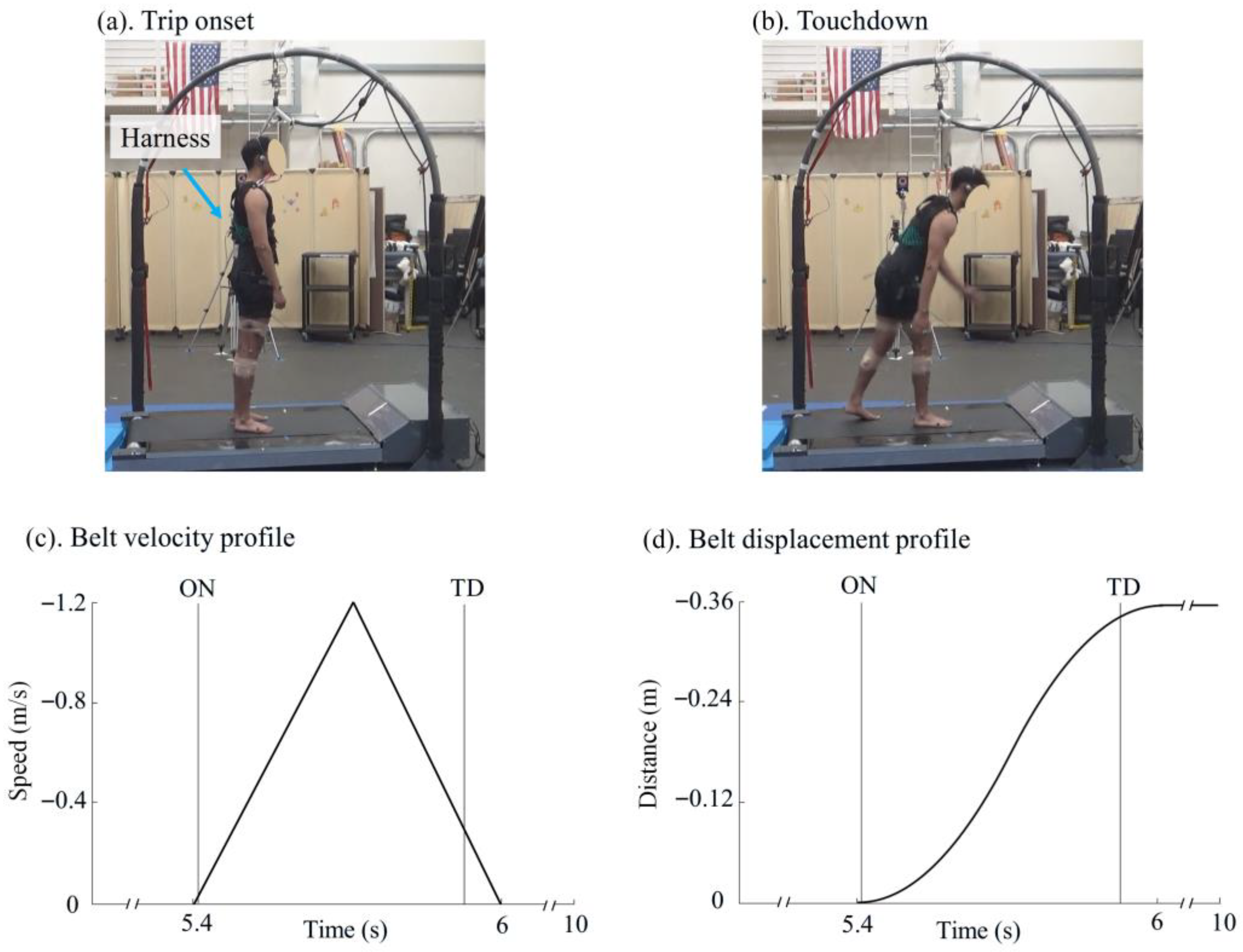
To assess muscle activity, surface EMG electrodes (Delsys, Natick, MA, USA) were placed bilaterally on five major lower-limb muscles: rectus femoris (RF), vastus lateralis (VL), biceps femoris (BF), TA, and medial gastrocnemius (MG). Skin areas were prepped by shaving (if needed) and cleaning with alcohol pads to ensure optimal electrode contact and minimize noise. Electrodes were further secured using a layer of pre-wrap and medical tape to maintain placement during the session. Participants were then fitted with a fall-arrest safety harness, which was connected to an overhead arch via adjustable ropes (Figure 1). The setup was designed to allow unrestricted movement while providing safety in the event of a loss of balance.
Next, participants stepped onto the ActiveStep treadmill (Simbex, Lebanon, NH, USA). They began with three 10 s quiet standing trials, during which no perturbations were introduced. Before the next set of trials, participants were told that a backward movement of the belt might occur at any time and that they needed to try to maintain a standing posture on perturbed trials. During the following three standing trials, no perturbations were induced. The first trip was introduced without warning on the next trial, and four additional trips followed (T1–T5). Each trip was standardized, with the treadmill belt moving backward over 0.6 s for 0.36 m and reaching a peak velocity of 1.2 m/s (Figure 1). During the first 0.3 s, the belt accelerated at 4 m/s2, followed by deceleration at 4 m/s2 over the remaining 0.3 s.

2.3. Data Reduction and Analysis

The analysis focused on the five simulated standing trip trials. Marker paths were filtered using fourth-order, zero-lag, and low-pass Butterworth filters at marker-specific cutoff frequencies (between 4.5 and 9.0 Hz, determined through a residual analysis) [23]. This approach allowed appropriate separation of signal and noise for each marker, given the higher accelerations of distal segments during perturbation recovery. The filtered marker paths were used to determine the timing of ON and TD. ON was identified as the moment when the anteroposterior position of the treadmill belt-marker fell three standard deviations below its baseline mean. The forward step following the ON was defined as the recovery step, while the opposite leg was the stance leg. TD of the recovery foot was extracted from foot kinematics and confirmed with video recordings to ensure accuracy (Figure 1). Muscle activity at the instant of ON was used to capture proactive (anticipatory) responses, while responses occurring after ON were considered reactive (compensatory) adjustments.
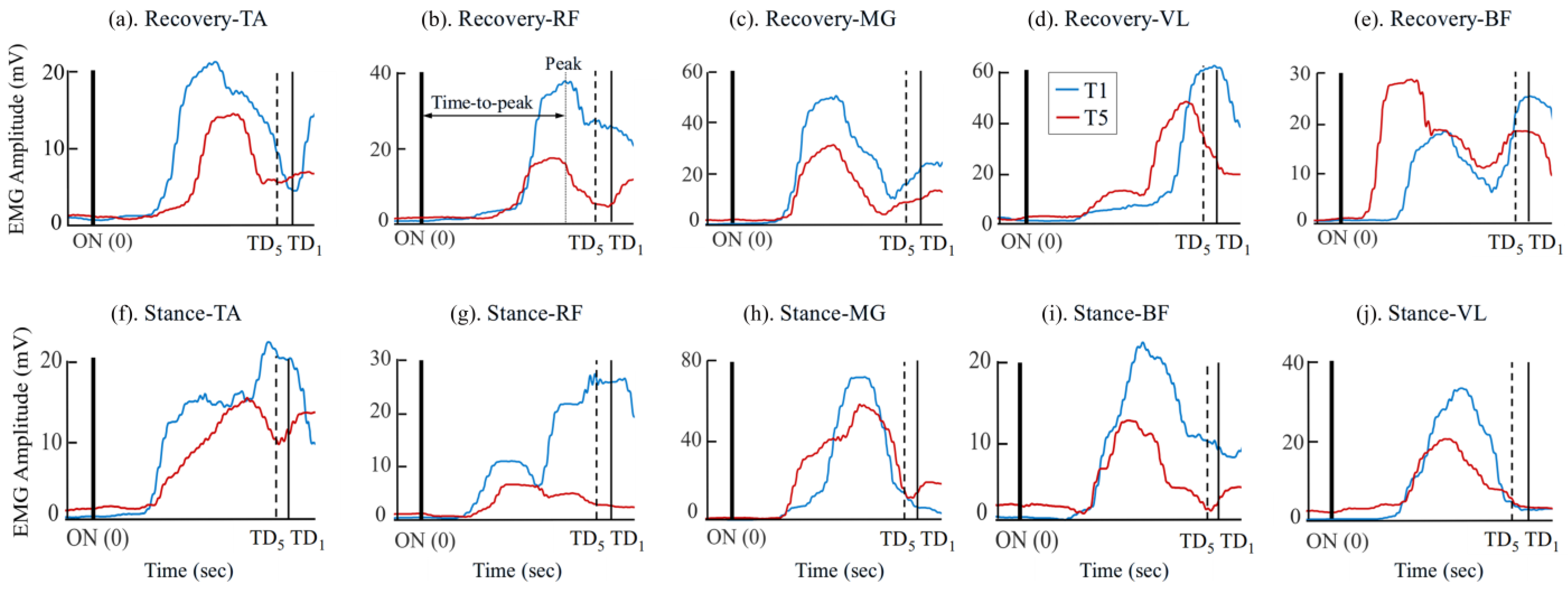
Surface EMG signals were bandpass-filtered with cutoff frequencies of 30–450 Hz, notch-filtered at 60 Hz, and then low-pass filtered at 50 Hz, followed by the 100 ms moving window Root Mean Square (RMS) calculation [24]. One outcome measure was the EMG magnitude (mV) at ON, which was calculated as the instantaneous RMS muscle activation amplitude at ON, quantifying proactive muscle engagement. Other outcome measures included peak EMG, defined as the highest amplitude between ON and TD (mV), and time-to-peak, calculated as the interval from ON to the time instant of peak EMG (s) (Figure 2). These outcomes were assessed for both the recovery and stance legs.

2.4. Statistical Analyses

To evaluate adaptive changes across repeated trip exposures, outcome measures were analyzed for both overall trends (T1 through T5) and between each pair of adjacent trials (T1–T2, T2–T3, T3–T4, T4–T5). Moreover, the outcome measures were compared between T1 and T5. Data distributions were assessed for normality using the Shapiro–Wilk test. In this study, all outcome measures violated the normality assumption; therefore, non-parametric analyses were adopted. A Friedman test was used to compare differences across trials. Effect sizes, expressed as Kendall’s W, were reported. The significance level was set at α = 0.05 for the main effect test. For any significant main effect of the trial, the Wilcoxon signed-rank test was used for pairwise comparisons. Specifically, five post hoc pairwise comparisons (T1–T2, T2–T3, T3–T4, T4–T5, and T1–T5) were performed with Bonferroni correction. The adjusted significance level was 0.01 (=0.05/5). All statistical analyses were performed using SPSS Statistics 29.0 (IBM Corp., Armonk, NY, USA).

3. Results

3.1. Proactive Muscle Activity at ON

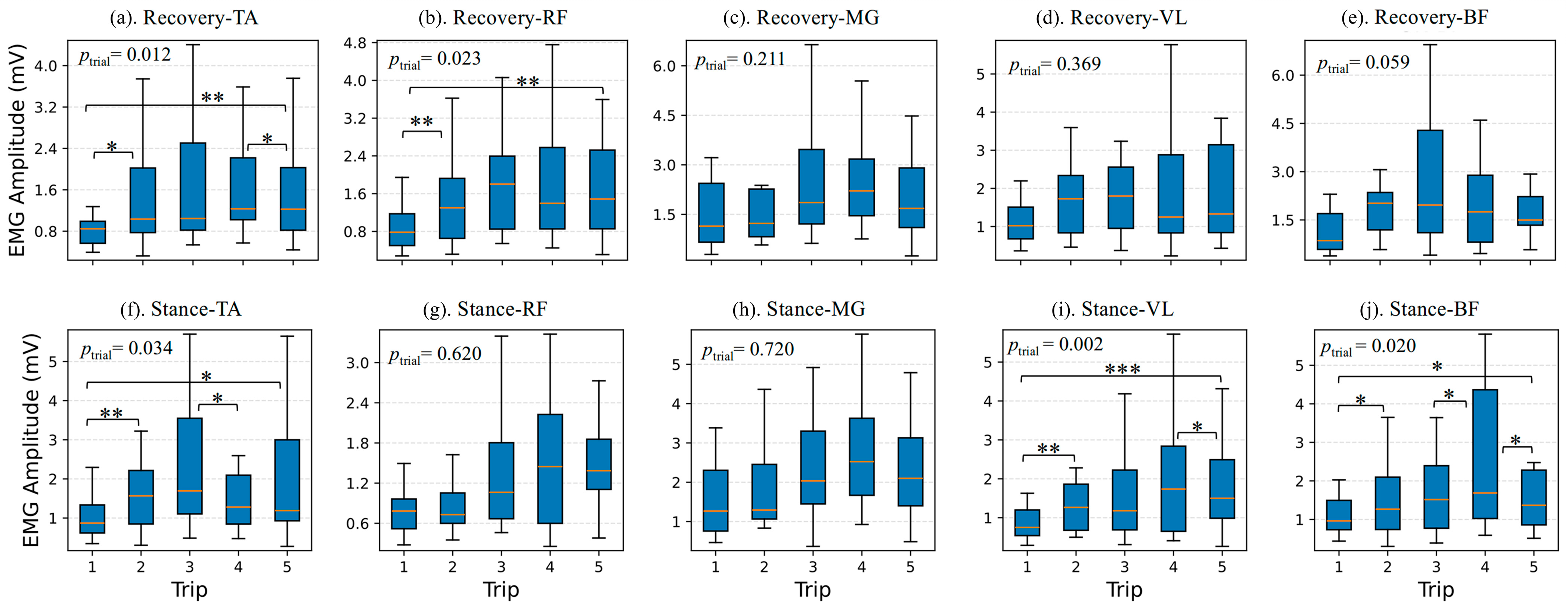
Instantaneous EMG magnitude at ON in the recovery leg increased significantly across trials for the TA (p = 0.012, W = 0.160; Figure 3a), with greater activation in T2 (p = 0.014) and T5 (p = 0.005) than T1, and lower activation in T5 (p = 0.046) than T4. Also, RF showed an overall significant trial effect (p = 0.023, W = 0.141; Figure 3b), with increased activation in T2 (p = 0.009) and T5 (p = 0.004) compared to T1. The changes were not significant for other muscle groups.
The EMG magnitude at ON in the stance leg showed significant trial effects for multiple muscles. For TA, the overall changes were significant (p = 0.034, W = 0.130; Figure 3f), with pairwise comparisons indicating greater values at T2 (p = 0.004) and T5 (p = 0.017) compared to T1, while the value at T4 (p = 0.046) was lower than at T3. VL also demonstrated a significant main trial effect (p = 0.002, W = 0.206; Figure 3i), with larger activation on T2 (p = 0.004) and T5 than on T1 (p < 0.001), and T5 (p = 0.011) than T4. Finally, BF showed significant trial effects (p = 0.020, W = 0.146; Figure 3j). The pairwise analysis revealed that activation increased from T1 to T2 (p = 0.032), T1 to T5 (p = 0.022), and T3 to T4 (p = 0.014). The BF activation decreased from T4 to T5 (p = 0.014).

3.2. Reactive Muscle Activity over the Period from ON to TD

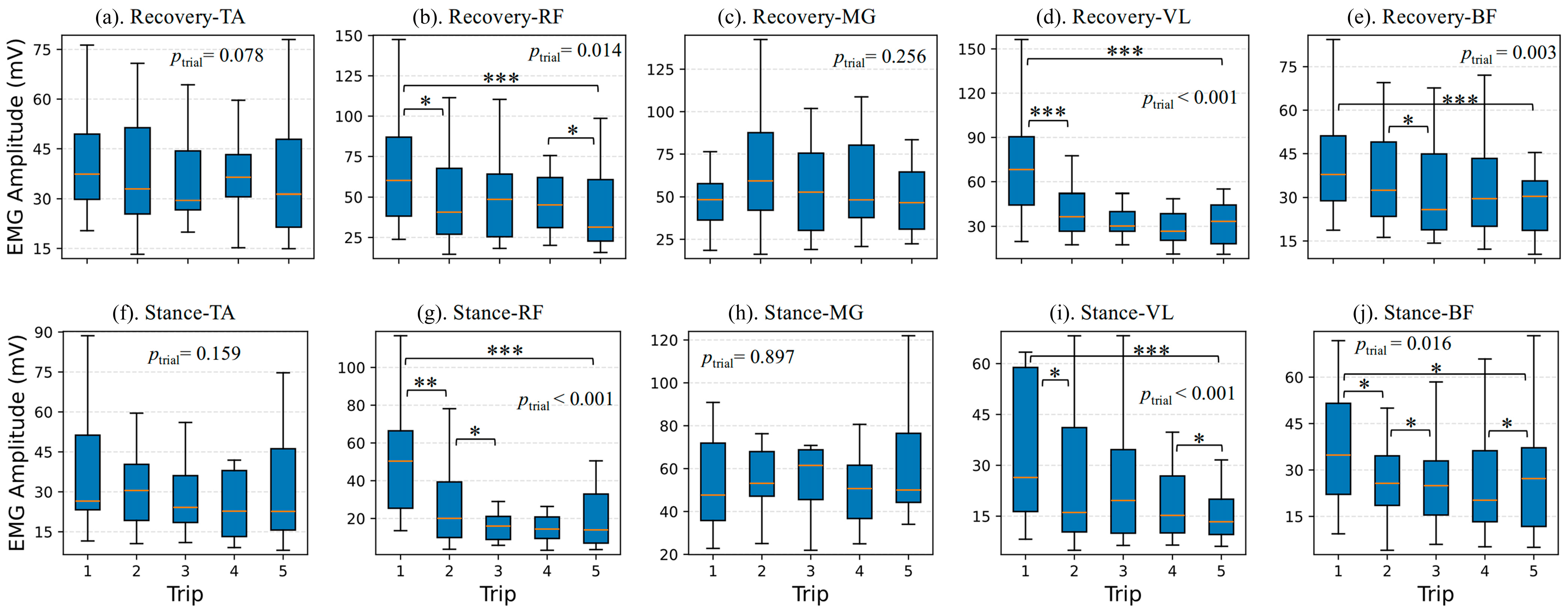
Peak EMG amplitude over the interval between ON and TD on the recovery leg declined significantly in RF (p = 0.014, W = 0.155; Figure 4b), with pairwise analyses showing decreases from T1 to T2 (p = 0.011) and T5 (p < 0.001), and from T4 to T5 (p = 0.011); in VL (p < 0.001, W = 0.327; Figure 4d), with decreases from T1 to T2 (p = 0.001), and to T5 (p < 0.001); and in BF (p = 0.003, W = 0.204; Figure 4e), with decrease from T1 to T5 (p < 0.001) and increase from T2 to T3 (p = 0.046).
Peak EMG amplitude in the stance leg dropped significantly in RF (p < 0.001, W = 0.306; Figure 4g), with pairwise comparisons indicating a decrease from T1 to T2 (p = 0.002) and T5 (p < 0.001), and from T2 to T3 (p = 0.032); in VL (p < 0.001, W = 0.292; Figure 4i), with pairwise comparisons showing a decrease from T1 to T2 (p = 0.011) and T5 (p < 0.001), and from T4 to T5 (p = 0.038); and in BF (p = 0.016, W = 0.152; Figure 4j), with pairwise comparisons exhibiting a decrease from T1 to T2 (p = 0.017) and T5 (p = 0.014), from T2 to T3 (p = 0.046), and an increase from T4 to T5 (p = 0.038).
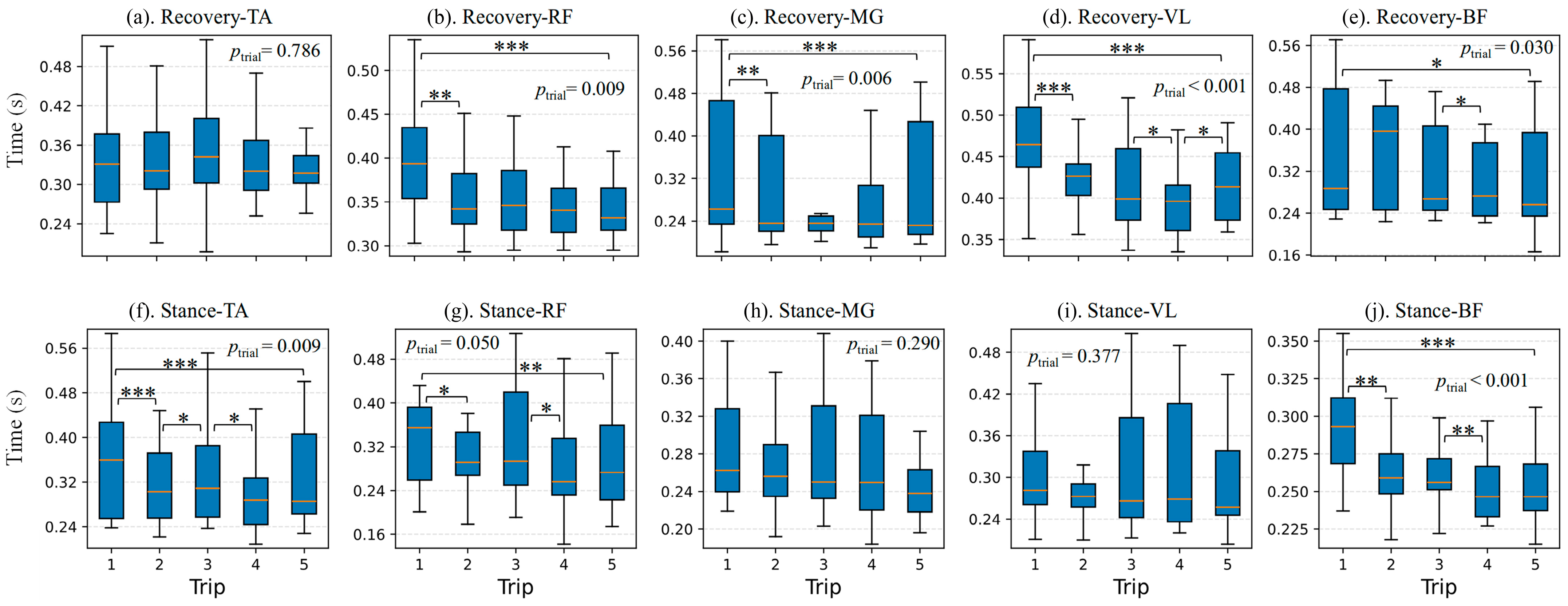
Time-to-peak EMG (from ON to peak EMG) significantly shortened in multiple muscles in the recovery leg, reflecting earlier peak activations over repeated trials. Significant changes were observed in MG (p = 0.006, W = 0.179; Figure 5c), with earlier peaks in T2 (p = 0.003) and T5 (p = 0.001) compared to T1. For RF, a significant trial-related overall difference was detected (p = 0.009, W = 0.169; Figure 5b). Post hoc tests revealed that the EMG reached peak earlier on T2 (p = 0.005) and T5 (p = 0.001) than on T1. Similarly, time-to-peak of the VL showed a significant trial effect (p < 0.001, W = 0.320; Figure 5d), with earlier peaks in T2 (p < 0.001) and T5 (p < 0.001) compared to T1, T4 (p = 0.022) than T3. The time-to-peak for VL increased in T5 (p = 0.014) in comparison to T4. BF illustrated a significant overall change (p = 0.030, W = 0.134; Figure 5e), with earlier peaks in T5 versus T1 (p = 0.017) and in T4 than T3 (p = 0.011).
The time-to-peak in the stance leg declined significantly in TA (p = 0.009, W = 0.168; Figure 5f). Post hoc pairwise comparisons showed a decrease from T1 to T2 (p < 0.001) and to T5 (p = 0.001), from T3 to T4 (p = 0.050), and from T2 to T3 (p = 0.029) for this muscle. The time-to-peak for RF also showed significant trial-associated reductions (p = 0.050, W = 0.119; Figure 5g), with pairwise comparisons indicating a decrease from T1 to T2 (p = 0.016) and to T5 (p = 0.002), and from T3 to T4 (p = 0.026). Similar overall trial-related changes were also observed in BF (p < 0.001, W = 0.366; Figure 5j), with pairwise analysis indicating shortened times from T1 to T2 (p = 0.003) and from T3 to T4 (p = 0.003), as well as from T1 to T5 (p < 0.001).

4. Discussion

The present study investigated how repeated treadmill-induced trip-like standing perturbations influence neuromuscular adaptations in healthy young adults, focusing on the lower limb muscle activity at ON, peak muscle activation, and the time-to-peak. The findings suggest that repeated standing trip-like perturbations modulate these muscle responses in ways that may improve the efficiency of proactive and reactive balance control. Our results support the hypothesis that repeated trip-like perturbations induce increasing proactive EMG activations, thereby reducing the demand for reactive muscular control to recover balance in subsequent trials.
Muscle activity at ON reflects the ability of the neuromuscular system to detect and respond to perturbation. In this study, repeated perturbation exposures resulted in an increased EMG amplitude at ON, indicating enhanced early responsiveness (Figure 3). Our finding is consistent with previous studies, reporting that the timely activation of support limb muscles, particularly those generating hip extension and knee flexion moments, such as BF, plays a key role in counteracting forward body rotation after tripping [15]. In the recovery leg, increased activation of the RF and TA at ON likely facilitated hip flexion and ankle dorsiflexion, respectively, enabling the leg to react to the trip-like perturbation and prepare for a well-coordinated recovery step. Meanwhile, increased activation in the stance limb muscles, such as the VL, BF, and TA, may have stabilized the supporting leg by maintaining knee extension, assisting hip extension, and controlling ankle/shank rotation, respectively, providing a reliable base that allowed the recovery leg to prepare for a rapid and effective forward step immediately after the trip. Together, these proactive responses at ON across both limbs reflect improved interlimb coordination, enabling participants to anticipate the perturbation and prepare both the stance and recovery legs for rapid, coordinated action to initiate and execute the recovery step. Our previous study also revealed that this early, proactive muscular control may improve dynamic stability at ON against forward balance loss and facilitate stability control afterwards [16].
During the reactive phase following the perturbation, the VL and RF helped maintain knee extension on the stance leg, while BF contributed to hip extension, jointly stiffening the joints to provide a stable support base. This stabilization enabled the recovery leg to initially perform knee flexion (BF) to take off from the belt and later knee extension (RF, VL) to recontact the belt more efficiently, enabling rapid limb placement during the forward recovery step. As indicated above, a quick and effective recovery step is crucial for reestablishing balance and preventing a fall after a postural disruption. The coordination between recovery and stance legs ensures a successful recovery step. The reduction in reactive peak EMG across the five trips is likely resulting from multiple factors, including proactive adaptation, changes in mechanical demands, and improved pre-perturbation posture [20], suggesting a combination of neuromuscular and biomechanical adjustments. This adaptive scaling of muscle output suggests that the motor system refines its response patterns to meet the mechanical demands of recovery while minimizing unnecessary muscle contractions, which could compromise movement efficiency [20]. Our findings align with a study examining the effects of trip-based PBT using treadmill belt acceleration in older adults, which also reported reductions in peak muscle activation [20]. This suggests that, despite differences in muscle fiber composition and recovery strategies between young and older adults, the trip-based PBT paradigm can elicit comparable neuromuscular adaptations. The observed reduction in peak muscle activation may reflect increased familiarity with the backward belt translation, allowing the neuromuscular system to generate the required forces more efficiently.
Successful recovery from a trip requires muscles to be activated with the appropriate magnitude and at the right time [25]. The time-to-peak EMG activation from perturbation ON represents the efficiency of neuromuscular recruitment once a muscle has been engaged. Our finding of reduced time-to-peak with repeated perturbations suggests that the neuromuscular system can initiate corrective muscle activation much earlier, which may reduce the required EMG amplitude and support more efficient reactive balance control. However, more work is needed to test this postulation, as the actual force production and electromechanical delay were not measured. In the recovery leg, a shorter time-to-peak in RF, VL, BF, and MG likely promotes rapid hip flexion, knee extension, and ankle plantarflexion, enabling faster leg clearance and placement during the recovery step. In the stance leg, decreased time-to-peak in RF, BF, and TA enhances hip stabilization, knee extension, and ankle dorsiflexion control, stiffening the supporting limb to provide a reliable base for the recovery leg. These muscle-specific temporal adaptations demonstrate that repeated exposure to trip-like perturbations enhances the speed and coordination of reactive corrective responses, enabling the muscles to reach peak activation more quickly, stabilize the center of mass, and execute an effective recovery step following the perturbation [26].
Although fall prevention research has primarily focused on older adults, our results show that young adults also adapt to perturbations through specific neuromuscular mechanisms. These adaptations provide a neuromechanical explanation for how PBT reduces fall risk across the lifespan. Specifically, the combination of greater muscle activity at ON, decreased peak responses, and earlier time-to-peak suggests that PBT enhances both the responsiveness and efficiency of the neuromuscular system in counteracting postural disturbances. Importantly, these findings extend the relevance of PBT beyond older populations to younger individuals in occupational or athletic contexts where trip hazards and dynamic balance challenges are common [27]. Investigating healthy young adults provides critical insights into baseline neuromuscular adaptability, which can inform the optimization and transfer of treadmill-based perturbation paradigms to populations at higher risk of falls. Therefore, this study serves as an essential first step toward the broader application of standing, treadmill-based, trip-like PBT protocols for fall prevention across different age groups and functional capacities.
Although our results indicated that proactive neuromuscular adaptive strategies could reduce the demand for reactive neuromuscular control to recover balance after a trip-like perturbation, it is worth noting that our participants were healthy young adults. Hence, our findings may not apply to older adults or individuals with movement disorders, as they may be affected by age- or disease-related declines in physical function. Given that older adults and individuals with movement dysfunctions also face a heightened risk of falls [28], it is clinically meaningful to examine the relationship between proactive and reactive neuromuscular controls in preventing falls following a balance loss. A sound understanding of such relationships would provide valuable information for designing and deploying PBT as a fall-prevention treatment across various populations.
This study has several limitations. First, muscle activation was examined using a treadmill-based paradigm with backward surface translation, which may not fully replicate overground tripping scenarios. Yet, treadmill-based perturbations offer precise control over timing and intensity, enabling consistent induction of trip-like responses. Given the increasing clinical use of treadmills capable of inducing slips and trips, this paradigm remains a valid and practical model for studying neuromuscular adaptations to perturbations. Second, five perturbation trials were induced in the protocol. Therefore, it remains unknown how leg muscle activations adaptively change across additional perturbation trials. Third, limiting the analysis to peak EMG amplitude and time-to-peak may not fully capture the temporal structure, coordination, or spatial distribution of muscle activation underlying neuromuscular adaptation. Fourth, EMG amplitudes were not normalized because the maximal voluntary contraction reference data were not collected in this study. This lack of reference to the muscles’ maximum capacities can limit the interpretability of absolute amplitude values, particularly for comparisons across muscles and participants within a functional context, since absolute EMG values can be affected by individual physiological differences and measurement-related factors. Finally, only the lower limb muscles were selected in the present study. How the trunk or upper-extremity muscles, which could also play a pivotal role in preventing falls, adapt to repeated postural disturbance is unclear. More studies are needed to address these limitations.

5. Conclusions

Repeated trip-like perturbations elicited measurable adaptations in muscle activity in young adults. The increased proactive EMG amplitude and shortened reactive time-to-peak EMG could lower the demand for EMG amplitude during the reactive phase to recover balance after a trip-like perturbation. These neuromuscular changes suggest enhanced responsiveness and recruitment efficiency during balance recovery. Our findings provide mechanistic insight into the benefits of PBT and underscore its potential as a targeted intervention for reducing fall risk across diverse populations.

Author Contributions

Conceptualization, F.Y.; methodology, F.Y. and S.M.K.; software, F.Y.; validation, F.Y.; formal analysis, F.Y. and S.M.K.; investigation, S.M.K.; resources, F.Y.; data curation, F.Y.; writing—original draft preparation, F.Y. and S.M.K.; writing—review and editing, F.Y. and S.M.K.; visualization, S.M.K.; supervision, F.Y.; project administration, F.Y. All authors have read and agreed to the published version of the manuscript.

Funding

This research received no external funding.

Institutional Review Board Statement

The study was conducted in accordance with the Declaration of Helsinki and approved by the Institutional Review Board of Georgia State University (protocol code H24163 and date of approval 19 October 2024).

Informed Consent Statement

Informed consent was obtained from all subjects involved in the study.

Data Availability Statement

Data supporting the findings of this study will be available upon reasonable request to the corresponding author.

Acknowledgments

The authors thank Diané Brown and Caroline Simpkins for assisting with the data collection process and are grateful to all subjects for their participation.

Conflicts of Interest

The authors declare that they have no known competing financial interests or personal relationships that could have appeared to influence the work reported in this paper.

Abbreviations

The following abbreviations are used in this manuscript:
BFBiceps femoris
EMGElectromyography
MGMedial gastrocnemius
ONPerturbation onset
PBTPerturbation-based balance training
Q1First quartile
Q3Third quartile
RFRectus femoris
RMSRoot mean square
SPSSStatistical package for the social sciences
TTrip
TATibialis anterior
TDRecovery foot touchdown
VLVastus lateralis

References

  1. Kakara, R. Nonfatal and fatal falls among adults aged ≥65 years—United States, 2020–2021. Morb. Mortal. Wkly. Rep. 2023, 72, 938–943. [Google Scholar] [CrossRef] [PubMed]
  2. Stevens, J.A.; Corso, P.S.; Finkelstein, E.A.; Miller, T.R. The costs of fatal and non-fatal falls among older adults. Inj. Prev. 2006, 12, 290–295. [Google Scholar] [CrossRef]
  3. Houry, D.; Florence, C.; Baldwin, G.; Stevens, J.; McClure, R. The CDC Injury Center’s response to the growing public health problem of falls among older adults. Am. J. Lifestyle Med. 2016, 10, 74–77. [Google Scholar] [CrossRef]
  4. Westerterp, K.R.; Meijer, E.P. Physical activity and parameters of aging: A physiological perspective. J. Gerontol. Ser. A Biol. Sci. Med. Sci. 2001, 56, 7–12. [Google Scholar] [CrossRef]
  5. Heijnen, M.J.H.; Rietdyk, S. Falls in young adults: Perceived causes and environmental factors assessed with a daily online survey. Hum. Mov. Sci. 2016, 46, 86–95. [Google Scholar] [CrossRef]
  6. Timsina, L.R.; Willetts, J.L.; Brennan, M.J.; Marucci-Wellman, H.; Lombardi, D.A.; Courtney, T.K.; Verma, S.K. Circumstances of fall-related injuries by age and gender among community-dwelling adults in the United States. Public Libr. Sci. ONE 2017, 12, e0176561. [Google Scholar] [CrossRef]
  7. Cai, Y.; Leveille, S.G.; Andreeva, O.; Shi, L.; Chen, P.; You, T. Characterizing fall circumstances in community-dwelling older adults: A mixed methods approach. J. Gerontol. Ser. A 2023, 78, 1683–1691. [Google Scholar] [CrossRef]
  8. Cho, H.; Heijnen, M.J.; Craig, B.A.; Rietdyk, S. Falls in young adults: The effect of sex, physical activity, and prescription medications. Public Libr. Sci. ONE 2021, 16, e0250360. [Google Scholar] [CrossRef]
  9. Pai, Y.-C.; Bhatt, T.; Yang, F.; Wang, E.; Kritchevsky, S. Perturbation training can reduce community-dwelling older adults’ annual fall risk: A randomized controlled trial. J. Gerontol. Ser. A Biomed. Sci. Med. Sci. 2014, 69, 1586–1594. [Google Scholar] [CrossRef] [PubMed]
  10. Mahmoudzadeh Khalili, S.; Yang, F. Meta-analysis on effects of trip-based perturbation training reducing fall risk. Clin. Biomech. 2025, 124, 106470. [Google Scholar] [CrossRef] [PubMed]
  11. Schoeneberg, B.; McNeal, B.; Reisner, J.; Friesen, A.; Reed, T.; Goodwin, J.F. The Efficacy of Perturbation-Based Balance Training Among Older Adults: A Systematic Review. Phys. Occup. Ther. Geriatr. 2024, 42, 339–355. [Google Scholar] [CrossRef]
  12. McCrum, C.; Bhatt, T.S.; Gerards, M.H.; Karamanidis, K.; Rogers, M.W.; Lord, S.R.; Okubo, Y. Perturbation-based balance training: Principles, mechanisms and implementation in clinical practice. Front. Sports Act. Living 2022, 4, 1015394. [Google Scholar] [CrossRef]
  13. Bhatt, T.; Wang, T.Y.; Yang, F.; Pai, Y.C. Adaptation and generalization to opposing perturbations in walking. Neuroscience 2013, 246, 435–450. [Google Scholar] [CrossRef]
  14. Wang, T.-Y.; Bhatt, T.; Yang, F.; Pai, Y.C. Adaptive control reduces trip-induced forward gait instability among young adults. J. Biomech. 2012, 45, 1169–1175. [Google Scholar] [CrossRef]
  15. Pijnappels, M.; Bobbert, M.F.; Van Dieën, J.H. Control of support limb muscles in recovery after tripping in young and older subjects. Exp. Brain Res. 2005, 160, 326–333. [Google Scholar] [CrossRef] [PubMed]
  16. Mahmoudzadeh Khalili, S.; Brown, D.; Simpkins, C.; Yang, F. Adaptation to repeated backward surface translations in healthy young adults: A kinematic elucidation of trip-based perturbation training for preventing falls. Gait Posture 2026, 125, 110066. [Google Scholar] [CrossRef] [PubMed]
  17. Torres-Oviedo, G.; Macpherson, J.M.; Ting, L.H. Muscle synergy organization is robust across a variety of postural perturbations. J. Neurophysiol. 2006, 96, 1530–1546. [Google Scholar] [CrossRef]
  18. Faria, J.O.; Favretto, M.E.; Bezerra, I.S.; Santos, T.F.; Lemos, T.W.; Junqueira, E.B.; Santiago, P.R.; Moraes, R. Effect of a Perturbation-Based Balance Training Session on Adaptive Locomotor Response in Older Adults with a History of Falls. Mot. Control. 2024, 29, 37–52. [Google Scholar] [CrossRef]
  19. Brown, D.; Simpkins, C.; Yang, F. A systematic review of perturbation-based balance training on reducing fall risk among individuals with stroke. Clin. Biomech. 2023, 109, 106078. [Google Scholar] [CrossRef]
  20. Phu, S.; Sturnieks, D.L.; Song, P.Y.H.; Lord, S.R.; Okubo, Y. Neuromuscular adaptations to perturbation-based balance training using treadmill belt accelerations do not transfer to an obstacle trip in older people: A cross-over randomised controlled trial. Hum. Mov. Sci. 2024, 97, 103273. [Google Scholar] [CrossRef]
  21. Chambers, A.J.; Cham, R. Slip-related muscle activation patterns in the stance leg during walking. Gait Posture 2007, 25, 565–572. [Google Scholar] [CrossRef] [PubMed]
  22. Tabakin, D. A Comparison of 3D Gait Models Based on the Helen Hayes Hospital Marker Set. Master Thesis, University of Cape Town, Cape Town, South Africa, 2000. [Google Scholar]
  23. Winter, D.A. Biomechanics and Motor Control of Human Movement; John Wiley and Sons: Hoboken, NJ, USA, 2009. [Google Scholar]
  24. Türkmen, M.C.; Çelik, H.; Yalçın, A.İ.; Topuz, S. Comparative Analysis of Standing Postural Control and Perturbation-Induced Muscle Activity in Transtibial and Transfemoral Amputees. J. Clin. Med. 2025, 14, 8737. [Google Scholar] [CrossRef]
  25. Siragy, T.; Russo, Y.; Young, W.; Lamb, S.E. Comparison of over-ground and treadmill perturbations for simulation of real-world slips and trips: A systematic review. Gait Posture 2023, 100, 201–209. [Google Scholar] [CrossRef]
  26. Zhu, R.T.-L.; Lyu, P.Z.; Li, S.; Tong, C.Y.; Ling, Y.T.; Ma, C.Z.H. How does lower limb respond to unexpected balance perturbations? New insights from synchronized human kinetics, kinematics, muscle electromyography (EMG) and mechanomyography (MMG) data. Biosensors 2022, 12, 430. [Google Scholar] [CrossRef] [PubMed]
  27. Court-Brown, C.; Clement, N.D.; Duckworth, A.D.; Biant, L.C.; McQueen, M.M. The changing epidemiology of fall-related fractures in adults. Injury 2017, 48, 819–824. [Google Scholar] [CrossRef] [PubMed]
  28. Kalache, A.; Fu, D.; Yoshida, S.; Al-Faisal, W.; Beattie, L.; Chodzko-Zajko, W.; Fu, H.; James, K.; Kalula, S.; Krishnaswamy, B. World Health Organisation Global Report on Falls Prevention in Older Age; World Health Organization: Geneva, Switzerland, 2007. [Google Scholar]
Figure 1. Still images illustrate two key moments during recovery from a trip perturbation-induced forward balance loss on the ActiveStep treadmill: (a) perturbation onset (ON) and (b) recovery step touchdown (TD). Participants wore safety harnesses attached to an overhead arch for protection. The ON is defined as the moment when the belt marker’s anteroposterior position drops by three standard deviations below the baseline average, indicating the initiation of the perturbation. The TD is identified when the heel of the recovery leg first recontacts the treadmill belt. Also shown are the profiles of treadmill belt (c) velocity and (d) displacement during the standardized trip-like perturbation. The perturbation is generated by rapidly moving the belt backward over 0.6 s, reaching a peak posterior velocity of 1.2 m/s backward and a total displacement of 0.36 m. During the first 0.3 s, the belt accelerates at 4 m/s2, followed by deceleration at the same rate for the remaining 0.3 s. Each standing-perturbation trial lasts approximately 10 s, with the perturbation occurring in the middle of the trial at a random time point. Vertical lines in (c,d) indicate the timing of ON and TD.
Biomechanics 06 00031 g001
Figure 2. Representative electromyography (EMG) profile of (a) tibialis anterior (TA), (b) rectus femoris (RF), (c) medial gastrocnemius (MG), (d) vastus lateralis (VL), and (e) biceps femoris (BF) on the recovery side and (f) TA, (g) RF, (h) MG, (i) BF, and (j) VL on the stance side of a participant (ID: 120723FK) over the first (T1) and last (T5) trips. The vertical lines indicate trip perturbation onset (ON), recovery step touchdown (TD) for T1 (TD1), and TD for T5 (TD5), respectively. Also shown in (b) are the definitions of the peak EMG signal and the time-to-peak for T1. The peak EMG magnitude is determined as the maximum EMG amplitude between ON and TD (the dotted line). The time in seconds elapsed from ON to the moment of peak EMG amplitude is the time-to-peak (the horizontal arrow).
Biomechanics 06 00031 g002
Figure 3. Box-and-whisker plots of the electromyography (EMG) magnitude in millivolts (mV) at perturbation onset (ON) across five trips for five lower-limb muscles of both legs, including tibialis anterior (TA), rectus femoris (RF), medial gastrocnemius (MG), vastus lateralis (VL), and biceps femoris (BF) on the recovery (ae) and stance (fj) sides. Boxes represent the interquartile range (Q1–Q3), the line inside the box is the median value, and whiskers indicate the data range. pₜᵣᵢₐₗ is the main trial effect from the Friedman test; significant main effects are followed by Wilcoxon signed-rank post hoc tests. * p < 0.05; ** p < 0.01; *** p < 0.001.
Biomechanics 06 00031 g003
Figure 4. Box-and-whisker plots of peak electromyography (EMG) amplitude in millivolts (mV) across five trips for five lower-limb muscles of both legs, including tibialis anterior (TA), rectus femoris (RF), medial gastrocnemius (MG), vastus lateralis (VL), and biceps femoris (BF) on the recovery (ae) and stance (fj) sides. Peak EMG magnitude is defined as the maximum EMG amplitude between perturbation onset and recovery step touchdown. Boxes represent the interquartile range (Q1–Q3), the line inside the box is the median value, and whiskers indicate the data range. pₜᵣᵢₐₗ is the main trial effect from the Friedman test; significant main effects are followed by Wilcoxon signed-rank post hoc tests. * p < 0.05; ** p < 0.01; *** p < 0.001.
Biomechanics 06 00031 g004
Figure 5. Box-and-whisker plots of time-to-peak (second) electromyography (EMG) across five trips for five lower-limb muscles of both legs, including tibialis anterior (TA), rectus femoris (RF), medial gastrocnemius (MG), vastus lateralis (VL), and biceps femoris (BF) on the recovery (ae) and stance (fj) sides. Peak EMG magnitude is defined as the maximum EMG amplitude between perturbation onset and recovery step touchdown. Time-to-peak represents the interval from perturbation onset to the peak EMG magnitude. Boxes represent the interquartile range (Q1–Q3), the line inside the box is the median value, and whiskers indicate the data range. pₜᵣᵢₐₗ is the main trial effect from the Friedman test; significant main effects are followed by Wilcoxon signed-rank post hoc tests. * p < 0.05; ** p < 0.01; *** p < 0.001.
Biomechanics 06 00031 g005
Table 1. Demographic information of all 20 participants.
VariableMeanStandard DeviationMinimumMaximum
Age (years)26.355.942043
Body mass (kg)74.2417.2151.60124.40
Body height (m)1.720.091.551.87
Sex (male/female)12/8---
Disclaimer/Publisher’s Note: The statements, opinions and data contained in all publications are solely those of the individual author(s) and contributor(s) and not of MDPI and/or the editor(s). MDPI and/or the editor(s) disclaim responsibility for any injury to people or property resulting from any ideas, methods, instructions or products referred to in the content.