Article

Exploration of Achilles Tendon Loading Symmetry in Female Recreational Runners

1
Department of Health Professions, University of Wisconsin-La Crosse, La Crosse, WI 54601, USA
2
Gundersen Sports Medicine, La Crosse, WI 54601, USA
*
Author to whom correspondence should be addressed.
Biomechanics 2026, 6(1), 9; https://doi.org/10.3390/biomechanics6010009
Submission received: 5 September 2025 / Revised: 5 January 2026 / Accepted: 7 January 2026 / Published: 9 January 2026

Abstract

Background/Objectives: Running is associated with increased Achilles Tendon (AT) loading and cross-sectional area (CSA). Achilles tendinopathy is a common unilateral injury. Differences in AT loading variables between dominant and non-dominant lower extremities while running have not been characterized. This study examined the AT loading variables between dominant and non-dominant lower extremities in healthy recreational runners. Methods: Twenty-four females ran at 3.3 m/s (11.88 km/hr) on an instrumented treadmill. Achilles Tendon CSA (AT-CSA) was measured from ultrasound images. Kinematic and kinetic data were used as input into a musculoskeletal model. Paired t-tests examined inter-limb differences in peak vertical ground reaction force, Achilles Tendon-related loading variables (AT force, AT-CSA, AT stress), total gastrocnemius force, soleus force, foot strike angle, and stance time. Results: No differences were shown between dominant and non-dominant lower extremities in stance time, vertical ground reaction force, gastrocnemius and soleus force, AT force, AT-CSA, or AT stress. Foot strike angle was different between limbs (p = 0.015); however, the absolute difference was about 2°. Conclusions: These data indicated that AT loading was similar between dominant and non-dominant lower extremities in healthy female recreational runners. While some asymmetry can be expected during a bilateral task such as running, runners displayed differences in AT force and stress less than 18%. These data may assist clinicians in the assessment and management of runners recovering from AT tendinopathy.

1. Introduction

The Achilles Tendon (AT) is prone to overuse injuries in runners [1], as tissues need to adapt to the loading [2]. During running, repetitive forces lead to tissue remodeling, resulting in changes to both the mechanical and viscoelastic properties of the tendon to enhance its response to loading [3]. One way to assess these adaptations in the AT is by measuring the cross-sectional area (CSA) of the tendon. Body weight normalized AT-CSA were similar between female runners and non-runners but greater in male runners [4]. Male and female runners have been reported to experience similar running season reductions in AT-CSA [5]. Achilles Tendon CSA is reported greater on the more symptomatic limb in those with AT pain [6]. Currently, there is a lack of comprehensive studies that investigate any differences in AT loading between the dominant and non-dominant limbs during running activities. Additionally, there has been no thorough examination of the CSA of the AT in runners, which raises important questions about potential asymmetries that could impact performance or injury risk. Understanding these factors is crucial for developing targeted training and rehabilitation strategies for athletes.
Among recreational runners, one of the highest reported musculoskeletal running-related injuries is Achilles tendinopathy, with a prevalence of 10–19% [1,7]. Achilles tendinopathy is characterized by pain localized in the AT, which may or may not be accompanied by histological changes indicative of tendon degradation. Such changes are believed to be the result of variance in typical loading patterns, inappropriate loading volume, or inappropriate loading frequency [8]. Symptoms of Achilles tendinopathy are typically experienced unilaterally, though bilateral changes may be present [9]. While there are many theories to explain why symptoms occur unilaterally, one hypothesis is that asymmetrical properties of the tendon may be due to differences in limb dominance.
One study examined the AT mechanical and morphological properties between the dominant and non-dominant lower extremity of young, athletic males who were not participating in sports requiring asymmetrical loading [2]. The findings showed that the dominant AT had a significantly higher Young’s Modulus and length compared to the non-dominant side. The authors concluded that these inter-limb differences may be attributed to a slightly increased loading profile to the dominant lower extremity based on foot preference. Consequently, the muscles of the dominant lower extremity would be loaded more than those of the non-dominant lower extremity. As a muscle is subjected to load, it transmits the force to the tendon [10], leading to mechanical and morphological adaptations over time [11]. Therefore, if the muscles of the dominant lower extremity are under increased load, it is possible that the associated tendinous changes could also be more pronounced. In the presence of such asymmetrical loading, the development of unilateral symptoms may arise, or the tendon may adapt, as evidenced by differing mechanical properties. As a result, one might anticipate differences in peak AT stress within the dominant limb during running, leading to AT stress asymmetry.
Furthermore, studies investigating mechanical and morphological properties of the AT in patients with symptomatic Achilles tendinopathy have demonstrated inter-limb asymmetries [6,12]. However, given the retrospective nature of these studies, it is not possible to infer causation from these findings but characterizing expected amounts of asymmetry in AT loading may help better inform clinicians regarding the symptomatic impact that symptoms may have and facilitate the understanding of potential factors contributing to the development of Achilles tendinopathy, as well as the resolution of such impairment. Therefore, the aim of this study was to investigate the differences in AT loading variables between the dominant and non-dominant lower extremity in running in healthy recreational runners.

2. Materials and Methods

Twenty-four female participants (age: 21.8 ± 1.94 years; mass: 65.8 ± 9.02 kg; height: 170.7 ± 7.74 cm) were included in the study. A total of 3 out of 24 runners (12.5%) stated their left limb was the dominant side based on desired preference in kicking a ball toward a goal. This has been a described method to assess limb dominance [13]. Our original sample size estimation was based on between-group differences in Achilles Tendon stress reported previously [14], which are not directly applicable to the present within-subject design. Because reliable estimates of the expected paired inter-limb effect size and within-subject correlation are not available, the current investigation should be considered exploratory with respect to inter-limb comparisons. Accordingly, statistical results were interpreted descriptively, and emphasis was placed on reporting effect sizes and confidence intervals rather than solely on hypothesis testing. Inclusion criteria were running at least 10 miles per week for fitness, college-aged, and previous treadmill running experience. Exclusion criteria include recent history of lower extremity injury, and Achilles tendinopathy or surgery within the past year that may influence running mechanics.
Upon arrival for data collection, each participant was required to complete an informed consent form and an injury report, as well as identify their dominant lower extremity, determined by their preferred leg for kicking a ball. Height and weight data were then measured. Participants changed into tight fitting clothing (spandex shorts and sports bra) and standardized running shoes (Zealot; Saucony, Boston, MA, USA) to prevent biomechanical running differences resulting from variations in clothing or footwear. These shoes are classified in the neutral category, have a stack height with the heel of 25–26 mm, and forefoot of 21–22 mm providing a drop of 4 mm. No participants reported running using foot orthoses.
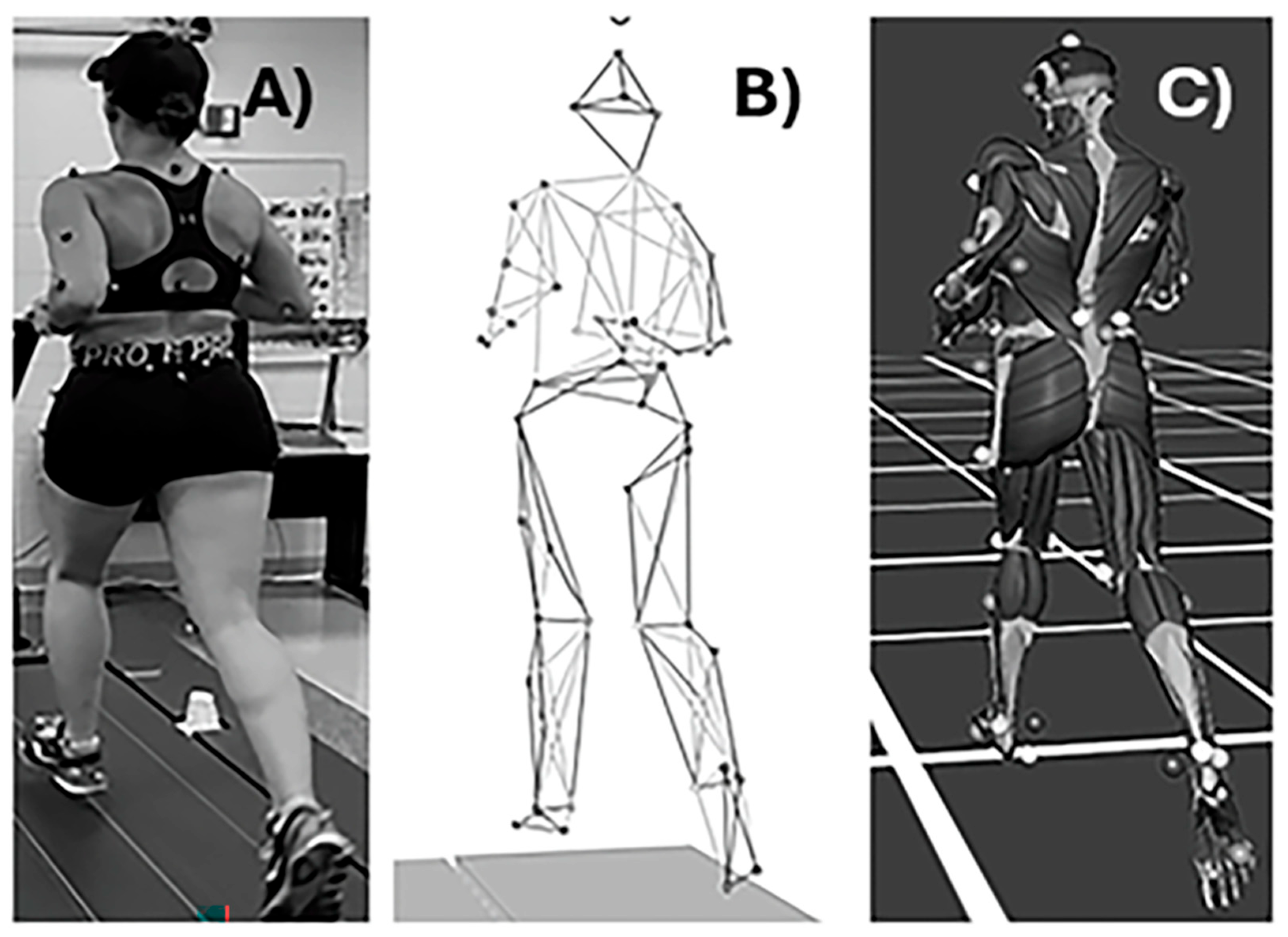
Prior to data collection, a warm-up was performed at a self-selected jogging pace for three minutes to stabilize running kinematics [15]. Kinematics were collected at 180 Hz using a 10-camera three-dimensional motion analysis system (Motion Analysis Corp., Rohnert Park, CA, USA). Kinetics data were collected at 1800 Hz using a split-belt instrumented treadmill (Treadmetrix, Park City, UT, USA). Following the warm-up period, the treadmill speed was set to 3.3 m/s, and the participant ran for 3 min. Kinetics and kinematics were recorded for 30 s at this speed (Figure 1).
Upon completing the running trial, ultrasound imaging of their AT was performed. This was performed after the running trial to ensure each participant was warmed up and experienced the same duration of running stimulus at the target speed. Participants positioned themselves in prone on a treatment table for an ultrasound image of their AT on both the dominant and non-dominant lower extremity. To ensure clear imaging, the participant’s ankle was passively dorsiflexed to a 90° neutral position using a goniometer. One researcher passively held the participant’s ankle in this position against their anterior thigh and applied ultrasound gel (Aquasonic Clear, Fairfield, NJ, USA) overlying the participant’s AT. AT-CSA was then measured by taking a transverse ultrasound image 10 cm proximal to the calcaneal insertion on the posterior aspect of the shank between the medial and lateral malleoli perpendicular to the AT. A GE LOGIQ Ultrasound (Waukesha, WI, USA) and a ML6-15 probe were used to complete these steps, which were then repeated on the contralateral AT. This location was chosen to facilitate since it is repeatable and enhances contact between the probe and tendon to avoid the anisotropy effect [16].
Kinematic and kinetic data from the treadmill force plate were filtered with a 15 Hz low pass Butterworth filter [17] and used as input in the Human Body Model (HBM) software, a 16-segment musculoskeletal model (Version 3.32.1, Motek Medical, Amsterdam, The Netherlands) with 46 degrees of freedom (DOF) to estimate muscular forces. The subtalar and ankle joint was modeled with 1 DOF. The knee joint was modeled as a hinge joint with 1 DOF. The hip joint was modeled with 3 DOF. The trunk was modeled with 3 DOF and divided into linked sections of the mid-trunk and thorax. The shoulders had 6 DOF in relation to the thorax. The pelvis also had 6 DOF occupying all three dimensions relative to the ground. The elbow and wrists joints each had 2 DOF. The knee and ankle joint centers were determined using specific marker placements, and hip centers were calculated based on Bell et al. [18]. The Levenberg–Marquardt algorithm optimized the model pose [19], and inertial properties were based on de Leva et al. [20]. The model included 300 muscle tendon units, with parameters derived from Delp et al. [21]. Muscle forces were estimated using static optimization relative to measured joint moments [19], and a recurrent neural model addressed the quadratic programming challenge [22]. Viscoelastic properties were not included. Muscle forces matched reports from OpenSim during gait with similar parameters [23]. Only the sum of the gastrocnemius and soleus were used in a custom written AT model determining AT force using MATLAB R2023a (version 9.14.0.2306882), The MathWorks, Inc., Natick, MA, USA). Further details of the AT model used in this investigation have been reported in previous studies [14,24,25].
Five consecutive steps from each lower extremity were processed during stance using 25 N vertical force threshold from the end of the 3 min sampling period. Reliability using an intraclass correlation coefficient from 5 right footsteps from a subsample of 10 runners yielded an Intraclass Correlation Coefficient > 0.9 for AT force; therefore, mean data of 5 steps per limb was used to represent outcome variable. Marker data on the foot were read into MATLAB to calculate foot strike angles relative to the ground based on Altman and Davis [26]. Foot strike angles were determined as the angle in degrees between the vector connecting the marker on the heel and the second digit of the foot along the anteroposterior axis relative to the ground. A rearfoot strike classification was >8°, midfoot was −1.6° to 8°, and forefoot was <−1.6° [26]. All participants in this investigation were classified as rearfoot strikers with <1° difference between limbs.
The ultrasound images of the Achilles Tendon from both the dominant and non-dominant lower extremities of each participant were analyzed using ImageJ software (Version 1.54g, Wayne Rasband, National Institutes of Health, Bethesda, MD, USA) to measure the CSA in cm2. Two independent examiners performed three measurements of the CSA on each image. The average of these three measurements was calculated and compared to the average of the second investigator. The intraclass correlation coefficient (ICC) of these means between investigators was determined to be 0.97, as computed using SPSS 29.0 (IBM Corporation, Armonk, NY, USA). The coefficient of variation was slightly higher for one investigator, 23.7% higher than the second 20.7%; however, a paired bootstrap comparison indicated that this difference was not statistically significant (mean difference = 3.0%, 95% CI −0.7 to 6.6%, p = 0.11). Therefore, the final data set utilized the average CSA obtained from both researchers. Intra-rater reliability was not assessed in this investigation.
AT force and average AT-CSA were utilized to assess AT stress during the stance phase for each lower extremity. These measurements were obtained using MATLAB (Version R2023a). An average of five steps per lower extremity was calculated for peak vertical ground reaction force (vGRF), AT loading variables (including AT force, AT-CSA, and AT stress), total gastrocnemius force, soleus force, foot strike angle, and stance duration. All force measures (peak vGRF, AT force, gastrocnemius force, and soleus force) were scaled to each participant’s body weight (BW). Achilles Tendon force was calculated by taking the sum of the total medial and lateral gastrocnemius force and soleus force. AT stress in MPa was calculated by dividing the AT force by the AT-CSA. The mean response from both dominant and non-dominant leg across all five steps for each variable was employed to quantify asymmetry. Percent asymmetry was calculated using Equation (1) [27].
%   A s y m m e t r y = | d o m i n a n t   l e g n o n d o m i n a n t   l e g | d o m i n a n t   l e g + n o n d o m i n a n t   l e g 2     100 %
Paired samples t-tests assessed limb differences, with alpha set at 0.05 and effect size measured using Cohen’s d. The Cohen’s d benchmarks for effect size were 0.2 as small, 0.5 as medium, and 0.8 as large [28]. Statistical analyses were performed using SPSS 29.0 (IBM Corporation, Armonk, NY, USA).

3. Results

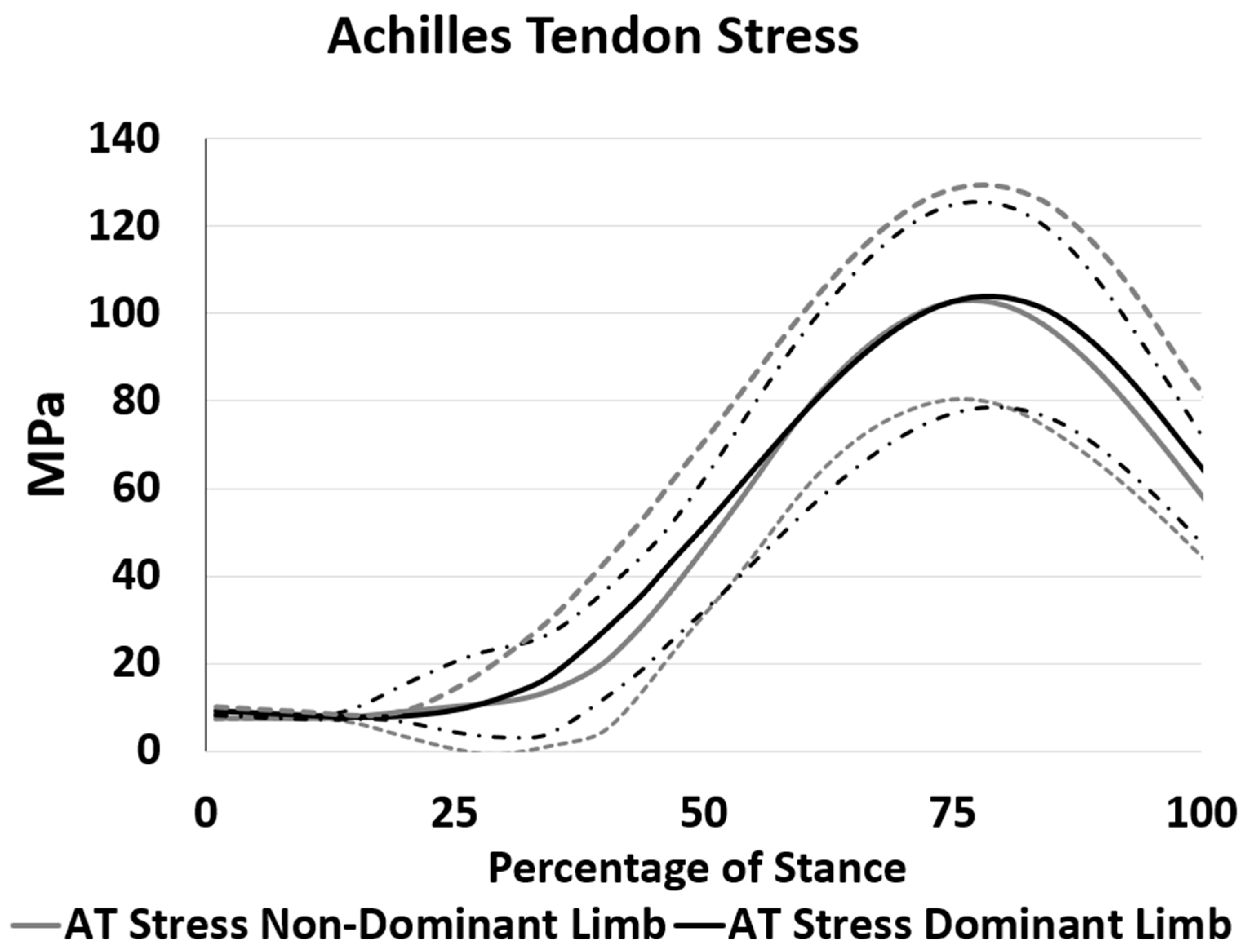
Table 1 depicts the means, standard deviations, p-values, effect sizes, 95% confidence intervals (CI), and percent differences. No significant differences were observed in stance time (p = 0.448), peak vGRF (p = 0.138), gastrocnemius force (p = 0.077), soleus force (p = 0.484), AT force (p = 0.455), AT-CSA (p = 0.490), or AT stress (p = 0.453) between the dominant and non-dominant lower extremity (Table 1). Foot strike angle was the only variable that showed a statistically significant difference (p = 0.015) between the limbs, albeit with a moderate effect size and an absolute difference in slightly more than 2°. The effect sizes for all other variables were also small to moderate (Table 1). The similarity of peak AT loading is depicted in Figure 2 by ensemble-average curves of the dominant and non-dominant lower extremity during the stance phase of running. The AT stress curve is representative of the calculated loading variables when these are presented as a time series, while also accounting for each participant’s unique CSA. AT force is the sum of gastrocnemius and soleus force, and force was divided by each participant’s measured AT-CSA to calculate AT stress.

4. Discussion

The primary objective of this study was to examine whether AT loading variables differ between the dominant and non-dominant lower extremities in healthy female recreational runners. Asymmetrical mechanical loading has been implicated in the presence of Achilles tendinopathy, as highlighted by Radovanović et al. [12], who reported differences in tendon properties and loading between symptomatic and asymptomatic limbs in affected patients. Asymmetry has been shown to be a contributing factor to injury when considering prevention and treatment in this population. While this underscores the importance of limb asymmetry in tendinopathy, this study focused specifically on healthy runners and did not assess tendinopathy directly.
These results did not support the hypothesis that significant asymmetrical differences exist in AT loading variables between dominant and non-dominant limbs in healthy female recreational runners. There were no significant differences in stance time, vGRF, total gastrocnemius force, soleus force, AT force, AT-CSA, or AT stress between limbs, with all showing small effect sizes. The only statistically significant difference was observed in foot strike angle. However, the absolute difference was about 2° and both limbs consistently exhibited a rearfoot strike pattern.
The lack of significant asymmetry in AT loading variables aligns with findings from Corrigan et al. [6], who also reported no differences in peak tendon force, average loading rate, or impulse between symptomatic and asymptomatic limbs in runners with Achilles tendinopathy. Both studies employed controlled, standardized running speeds, which may contribute to the observed symmetry. However, despite the lack of asymmetry in measures of AT loads during running, Corrigan et al. [6] did find differences in measures of tendon structure and function. Thus, standardized running speeds may not be sufficient enough to detect potential biomechanical asymmetries that may contribute to the development of Achilles tendinopathy. Other running speeds can be examined to see if symmetry changes across speed. For example, research by Willy et al. [29] and Liu et al. [30] suggests that increasing task difficulty or running speed can elevate inter-limb asymmetry. Willy et al. [29] reported greater asymmetry with more demanding activities, while Liu et al. [30] observed increased asymmetry in plantarflexion angle and velocity at higher speeds. Since this study maintained a constant running speed (3.3 m/s), this may explain the minimal asymmetry observed. Future studies should explore the impact of varying speeds, inclines, or task complexity on AT loading asymmetry.
Although a small but significant difference in foot strike angle was detected between limbs, its clinical relevance is questionable given the low magnitude of difference (<1 degree). All runners were classified as utilizing a rearfoot strike pattern. Previous work by Almonroeder et al. [31] demonstrated that non-rearfoot strike runners experience higher AT impulse and loading rates compared to rearfoot strikers. Thus, if a runner exhibited a meaningful asymmetry in foot strike pattern between limbs, it could potentially lead to greater AT loading and altered injury risk on the non-rearfoot strike limb. However, such a scenario was not observed in this cohort, and further research may be necessary that considers both factors simultaneously. While no statistically significant differences were found, percent asymmetries in peak gastrocnemius and soleus muscle forces (19.8% and 8.2%, respectively) exceeded cutoff values proposed by Vannatta et al. [32] for identifying meaningful limb asymmetry (6.75% for gastrocnemius, 3.00% for soleus). This suggests that some degree of muscle force asymmetry may be present even in the absence of statistical significance, warranting further investigation into what level of asymmetry is clinically relevant for injury risk or performance.
Consistent with Kernozek et al. [33], the present study reported no difference in AT CSA between limbs, even though NRFS runners are generally exposed to greater AT loading. Other studies [33,34,35], similarly report no CSA differences between habitual rearfoot and non-rearfoot strikers, suggesting that increased AT loading does not necessarily translate to increased CSA, though other tendon properties may be affected. Other factors, such as tendon hysteresis and loading rate, may also influence AT health. Lower hysteresis is associated with better energy return, while higher hysteresis may increase tendon strain and risk of degeneration [36,37,38]. Loading rate and cumulative load are also relevant, with higher loading rates potentially enhancing tendon elasticity [39], though the relationship between cumulative load and tendon damage is complex and influenced by fatigue [40,41]. There is limited research on how inter-limb asymmetry affects these variables, highlighting the need for further study.
The present study showed that healthy female recreational runners exhibit minimal AT loading asymmetry between dominant and non-dominant limbs under a standardized running condition. Small inter-limb differences may be typical and not necessarily indicative of injury risk. However, the clinical significance of these asymmetries remains unclear, especially at higher running speeds or with increased task demands. Further, limb dominance was determined by the runner self-identifying the limb that they intended to kick a ball with toward a goal. Certainly, there have been other methods of determining limb dominance or limb preference and actual kicking was not performed [13,42]. However, there has been no agreed-upon convention of limb dominance that we are aware of specific to running on a treadmill or for distance running, a continuous bilateral task. Certainly, there are other motor tasks that may result in greater limb dominance or preference as discussed in other investigations. When we used the limb that provided the greatest AT force in running, only a single runner was reclassified with this approach, making our findings nearly identical to those presented. Nonetheless, since minimal differences were observed between limbs, no matter how one defines dominance this would not affect the magnitude of asymmetries observed. Considering this, we suggest future research should focus on examining the effects of varied running speeds and incline and exploring the relationship between asymmetry magnitude and injury risk or performance outcomes. Understanding these factors may help clinicians better assess and manage runners at risk for Achilles tendinopathy.
Although minimal inter-limb asymmetries were observed in AT loading among healthy female recreational runners, inter-limb differences may still be present in individuals with AT tendinopathy. These asymmetries may result from residual neuromuscular inhibition or altered motor control following injury, which can reduce force generation in the affected limb [43]. Asymmetries may also result from structural differences in tendon properties such as variations in CSA, stiffness, or collagen organization [44]. These speculative mechanisms may explain asymmetries in symptomatic populations and provide directions for future research examining the biomechanical factors influencing AT loading.
There are several limitations of this study to be considered before extrapolating the results to populations of interest. One limitation of the methodology is the use of an instrumented treadmill to measure AT loading rather than also including overground running. Although the participants were not specifically asked which surface they typically run on, it can be assumed that a mix of both treadmill running and overground running occur across the various participants. AT loading may differ when running is performed on a treadmill rather than overground [45]. As this study solely utilized an instrumented treadmill to measure AT loading variables, the results may be best extrapolated to female recreational runners utilizing a treadmill rather than overground running.
Since running speed was standardized on a treadmill for all participants it is possible that asymmetry was reduced. In recreational running, it is common for runners to choose a self-selected preferred running speed, which may vary throughout the running session, rather than maintaining a fixed pace the entire time. However, previous research suggests that joint kinematics at the hip, knee, ankle, and metatarsophalangeal joints may change at various running speeds [30]. Therefore, if the participant’s self-selected running pace during recreational running differs greatly from the 3.3 m/s that was performed in the study, their joint kinematics may have, in turn, been altered during the study from their typical presentation, which may have altered the results. Perhaps, asymmetries at other running speeds should be further examined.
Standardized footwear has been used to control for the myriad of different running shoe types with various absorption properties and features [46,47]. The shoes used were fairly conventional neutral running shoes that were likely quite similar to each runner’s recreational running shoes. We are not certain of how this may have affected our participants’ AT loading, as some have suggested that running in standardized shoes may influence some ground reaction force characteristics, such as loading rate [48].
One must take caution in extrapolating these results to non-rearfoot strike runners. While Achilles tendinopathy is most common in non-rearfoot strike runners [49], the majority of the participants in this study presented with a rearfoot strike pattern. Therefore, the results of this study would be best generalizable to female runners with a rearfoot strike pattern only. Forefoot runners have different AT loading profiles in running [31,33].
Future research should examine the influence of various running speeds and inclines and if such findings are similar in overground running or running in more ecological valid settings. Other future work may also include the use of non-rearfoot strike runners as well as male participants. The present study examined solely AT loading asymmetry in a controlled lab setting in female rearfoot strike running on a treadmill.

5. Conclusions

AT loading was similar between dominant and non-dominant lower extremities in healthy female recreational runners. While some asymmetry can be expected due to CSA and muscle force output between limbs, runners displayed an AT force and stress percent asymmetry of less than 18% (AT force was 9.96 ± 7.01% and AT stress was 17.95 ± 13.34%. This data may be useful in assisting clinicians in assessing and managing runners recovering from AT tendinopathy.

Author Contributions

Conceptualization, T.W.K., C.N.V. and D.R.; methodology, T.W.K.; software, T.W.K. and D.R.; validation, T.W.K., D.R. and C.N.V.; formal analysis, T.W.K., K.C.W., K.H. and S.S.; investigation, T.W.K., K.C.W., K.H. and S.S.; resources, T.W.K.; data curation, T.W.K., K.C.W., K.H. and S.S.; writing—original draft preparation, T.W.K., K.C.W., K.H. and S.S.; writing—review and editing, T.W.K., C.N.V. and D.R.; supervision, T.W.K.; project administration, T.W.K.; funding acquisition, T.W.K. and C.N.V. All authors have read and agreed to the published version of the manuscript.

Funding

This research was funded by University of Wisconsin-La Crosse Graduate Studies (#24-TK-08) and the Gundersen Medical Foundation (#2018-CNV/TK-08).

Institutional Review Board Statement

The study was conducted in accordance with the Declaration of Helsinki and approved by the Institutional Review Board for the Protection of Rights and Welfare of Human Subjects participating in research at the University of Wisconsin—La Crosse (#24-TK-06) on 18 July 2024.

Informed Consent Statement

Informed consent was obtained from all subjects involved in the study.

Data Availability Statement

Data will not be publicly available.

Acknowledgments

Thanks to Maria Turco and Meghan Fraiser who helped with the project.

Conflicts of Interest

The authors declare no conflicts of interest. The funders had no role in the design of the study; in the collection, analyses, or interpretation of data; in the writing of the manuscript; or in the decision to publish the results.

References

  1. Francis, P.; Whatman, C.; Sheerin, K.; Hume, P.; Johnson, M.I. The Proportion of Lower Limb Running Injuries by Gender, Anatomical Location and Specific Pathology: A Systematic Review. J. Sports Sci. Med. 2019, 18, 21–31. [Google Scholar]
  2. Bohm, S.; Mersmann, F.; Marzilger, R.; Schroll, A.; Arampatzis, A. Asymmetry of Achilles Tendon Mechanical and Morphological Properties between Both Legs. Scand. J. Med. Sci. Sports 2015, 25, e124–e132. [Google Scholar] [CrossRef] [PubMed]
  3. Kjaer, M. Role of Extracellular Matrix in Adaptation of Tendon and Skeletal Muscle to Mechanical Loading. Physiol. Rev. 2004, 84, 649–698. [Google Scholar] [CrossRef]
  4. Westh, E.; Kongsgaard, M.; Bojsen-Moller, J.; Aagaard, P.; Hansen, M.; Kjaer, M.; Magnusson, S.P. Effect of Habitual Exercise on the Structural and Mechanical Properties of Human Tendon, in Vivo, in Men and Women. Scand. J. Med. Sci. Sports 2008, 18, 23–30. [Google Scholar] [CrossRef] [PubMed]
  5. Sponbeck, J.K.; Hunter, I.; Neves, K.A.; Swanson, D.C.; Swanson, D.A.; Johnson, A.W. Achilles Tendon Single Bout and Season Long Adaptations during Early and Late Collegiate Cross-Country Season. Phys. Ther. Sport 2021, 47, 114–119. [Google Scholar] [CrossRef]
  6. Corrigan, P.; Hornsby, S.; Pohlig, R.T.; Willy, R.W.; Cortes, D.H.; Silbernagel, K.G. Tendon Loading in Runners with Achilles Tendinopathy: Relations to Pain, Structure, and Function during Return-to-Sport. Scand. J. Med. Sci. Sports 2022, 32, 1201–1212. [Google Scholar] [CrossRef]
  7. Baart, A.M.; Terink, R.; Naeff, M.; Naeff, E.; Mensink, M.; Alsma, J.; Witteman, B.J.M.; Zwerver, J. Factors Associated with Lower Limb Tendinopathy in a Large Cohort of Runners: A Survey with a Particular Focus on Nutrition. BMJ Open Sport. Exerc. Med. 2023, 9, e001570. [Google Scholar] [CrossRef]
  8. Cook, J.L.; Rio, E.; Purdam, C.R.; Docking, S.I. Revisiting the Continuum Model of Tendon Pathology: What Is Its Merit in Clinical Practice and Research? Br. J. Sports Med. 2016, 50, 1187–1191. [Google Scholar] [CrossRef]
  9. Abat, F.; Alfredson, H.; Cucchiarini, M.; Madry, H.; Marmotti, A.; Mouton, C.; Oliveira, J.M.; Pereira, H.; Peretti, G.M.; Romero-Rodriguez, D.; et al. Current Trends in Tendinopathy: Consensus of the ESSKA Basic Science Committee. Part I: Biology, Biomechanics, Anatomy and an Exercise-Based Approach. J. Exp. Orthop. 2017, 4, 18. [Google Scholar] [CrossRef]
  10. Fukunaga, T.; Kawakami, Y.; Kubo, K.; Kanehisa, H. Muscle and Tendon Interaction during Human Movements. Exerc. Sport. Sci. Rev. 2002, 30, 106–110. [Google Scholar] [CrossRef] [PubMed]
  11. Lazarczuk, S.L.; Maniar, N.; Opar, D.A.; Duhig, S.J.; Shield, A.; Barrett, R.S.; Bourne, M.N. Mechanical, Material and Morphological Adaptations of Healthy Lower Limb Tendons to Mechanical Loading: A Systematic Review and Meta-Analysis. Sports Med. 2022, 52, 2405–2429. [Google Scholar] [CrossRef]
  12. Radovanović, G.; Bohm, S.; Arampatzis, A.; Legerlotz, K. In Achilles Tendinopathy the Symptomatic Tendon Differs from the Asymptomatic Tendon While Exercise Therapy Has Little Effect on Asymmetries-An Ancillary Analysis of Data from a Controlled Clinical Trial. J. Clin. Med. 2023, 12, 1102. [Google Scholar] [CrossRef]
  13. van Melick, N.; Meddeler, B.M.; Hoogeboom, T.J.; Nijhuis-van der Sanden, M.W.G.; van Cingel, R.E.H. How to Determine Leg Dominance: The Agreement between Self-Reported and Observed Performance in Healthy Adults. PLoS ONE 2017, 12, e0189876. [Google Scholar] [CrossRef]
  14. Lyght, M.; Nockerts, M.; Kernozek, T.W.; Ragan, R. Effects of Foot Strike and Step Frequency on Achilles Tendon Stress During Running. J. Appl. Biomech. 2016, 32, 365–372. [Google Scholar] [CrossRef] [PubMed]
  15. Paquette, M.R.; Melaro, J.A.; Smith, R.; Moore, I.S. Time to Stability of Treadmill Running Kinematics in Novel Footwear with Different Midsole Thickness. J. Biomech. 2024, 164, 111984. [Google Scholar] [CrossRef] [PubMed]
  16. Koivunen-Niemelä, T.; Parkkola, K. Anatomy of the Achilles Tendon (Tendo Calcaneus) with Respect to Tendon Thickness Measurements. Surg. Radiol. Anat. 1995, 17, 263–268. [Google Scholar] [CrossRef]
  17. Ertman, B.; Klaeser, M.; Voie, L.; Gheidi, N.; Vannatta, C.N.; Rutherford, D.; Kernozek, T.W. Alterations in Achilles Tendon Stress and Strain across a Range of Running Velocities. J. Sports Sci. 2023, 41, 495–501. [Google Scholar] [CrossRef]
  18. Bell, A.L.; Pedersen, D.R.; Brand, R.A. A Comparison of the Accuracy of Several Hip Center Location Prediction Methods. J. Biomech. 1990, 23, 617–621. [Google Scholar] [CrossRef]
  19. van den Bogert, A.J.; Geijtenbeek, T.; Even-Zohar, O.; Steenbrink, F.; Hardin, E.C. A Real-Time System for Biomechanical Analysis of Human Movement and Muscle Function. Med. Biol. Eng. Comput. 2013, 51, 1069–1077. [Google Scholar] [CrossRef]
  20. de Leva, P. Adjustments to Zatsiorsky-Seluyanov’s Segment Inertia Parameters. J. Biomech. 1996, 29, 1223–1230. [Google Scholar] [CrossRef]
  21. Delp, S.L.; Loan, J.P.; Hoy, M.G.; Zajac, F.E.; Topp, E.L.; Rosen, J.M. An Interactive Graphics-Based Model of the Lower Extremity to Study Orthopaedic Surgical Procedures. IEEE Trans. Biomed. Eng. 1990, 37, 757–767. [Google Scholar] [CrossRef]
  22. Xia, Y.; Feng, G. An Improved Neural Network for Convex Quadratic Optimization with Application to Real-Time Beamforming. Neurocomputing 2005, 64, 359–374. [Google Scholar] [CrossRef]
  23. Falisse, A.; Van Rossom, S.; Gijsbers, J.; Steenbrink, F.; van Basten, B.J.H.; Jonkers, I.; van den Bogert, A.J.; De Groote, F. OpenSim Versus Human Body Model: A Comparison Study for the Lower Limbs During Gait. J. Appl. Biomech. 2018, 34, 496–502. [Google Scholar] [CrossRef]
  24. Kernozek, T.; Gheidi, N.; Ragan, R. Comparison of Estimates of Achilles Tendon Loading from Inverse Dynamics and Inverse Dynamics-Based Static Optimisation during Running. J. Sports Sci. 2017, 35, 2073–2079. [Google Scholar] [CrossRef]
  25. Pohlman, C.; Pardee, A.; Friedman, M.; Rutherford, D.; Vannatta, C.N.; Kernozek, T.W. Effects of Body Weight Support in Running on Achilles Tendon Loading. Int. J. Sports Med. 2023, 44, 913–918. [Google Scholar] [CrossRef]
  26. Altman, A.R.; Davis, I.S. A Kinematic Method for Footstrike Pattern Detection in Barefoot and Shod Runners. Gait Posture 2012, 35, 298–300. [Google Scholar] [CrossRef]
  27. Stiffler-Joachim, M.R.; Lukes, D.H.; Kliethermes, S.A.; Heiderscheit, B.C. Lower Extremity Kinematic and Kinetic Asymmetries during Running. Med. Sci. Sports Exerc. 2021, 53, 945–950. [Google Scholar] [CrossRef]
  28. McGough, J.J.; Faraone, S.V. Estimating the Size of Treatment Effects. Psychiatry 2009, 6, 21–29. [Google Scholar] [PubMed]
  29. Willy, R.W.; Brorsson, A.; Powell, H.C.; Willson, J.D.; Tranberg, R.; Grävare Silbernagel, K. Elevated Knee Joint Kinetics and Reduced Ankle Kinetics Are Present During Jogging and Hopping After Achilles Tendon Ruptures. Am. J. Sports Med. 2017, 45, 1124–1133. [Google Scholar] [CrossRef] [PubMed]
  30. Liu, Q.; Chen, H.; Song, Y.; Alla, N.; Fekete, G.; Li, J.; Gu, Y. Running Velocity and Longitudinal Bending Stiffness Influence the Asymmetry of Kinematic Variables of the Lower Limb Joints. Bioengineering 2022, 9, 607. [Google Scholar] [CrossRef] [PubMed]
  31. Almonroeder, T.; Willson, J.D.; Kernozek, T.W. The Effect of Foot Strike Pattern on Achilles Tendon Load during Running. Ann. Biomed. Eng. 2013, 41, 1758–1766. [Google Scholar] [CrossRef]
  32. Vannatta, C.N.; Blackman, T.; Kernozek, T.W. Kinematic and Muscle Force Asymmetry in Healthy Runners: How Do Different Methods Measure Up? Gait Posture 2023, 103, 159–165. [Google Scholar] [CrossRef]
  33. Kernozek, T.W.; Knaus, A.; Rademaker, T.; Almonroeder, T.G. The Effects of Habitual Foot Strike Patterns on Achilles Tendon Loading in Female Runners. Gait Posture 2018, 66, 283–287. [Google Scholar] [CrossRef]
  34. Kubo, K.; Miyazaki, D.; Tanaka, S.; Shimoju, S.; Tsunoda, N. Relationship between Achilles Tendon Properties and Foot Strike Patterns in Long-Distance Runners. J. Sports Sci. 2015, 33, 665–669. [Google Scholar] [CrossRef]
  35. Zhang, X.; Deng, L.; Xiao, S.; Li, L.; Fu, W. Sex Differences in the Morphological and Mechanical Properties of the Achilles Tendon. Int. J. Environ. Res. Public. Health 2021, 18, 8974. [Google Scholar] [CrossRef]
  36. Farris, D.J.; Trewartha, G.; McGuigan, M.P. Could Intra-Tendinous Hyperthermia during Running Explain Chronic Injury of the Human Achilles Tendon? J. Biomech. 2011, 44, 822–826. [Google Scholar] [CrossRef]
  37. Finni, T.; Vanwanseele, B. Towards Modern Understanding of the Achilles Tendon Properties in Human Movement Research. J. Biomech. 2023, 152, 111583. [Google Scholar] [CrossRef]
  38. Lichtwark, G.A.; Wilson, A.M. In Vivo Mechanical Properties of the Human Achilles Tendon during One-Legged Hopping. J. Exp. Biol. 2005, 208, 4715–4725. [Google Scholar] [CrossRef]
  39. Rosario, M.V.; Roberts, T.J. Loading Rate Has Little Influence on Tendon Fascicle Mechanics. Front. Physiol. 2020, 11, 255. [Google Scholar] [CrossRef]
  40. Firminger, C.R.; Asmussen, M.J.; Cigoja, S.; Fletcher, J.R.; Nigg, B.M.; Edwards, W.B. Cumulative Metrics of Tendon Load and Damage Vary Discordantly with Running Speed. Med. Sci. Sports Exerc. 2020, 52, 1549–1556. [Google Scholar] [CrossRef]
  41. Van Hooren, B.; van Rengs, L.; Meijer, K. Per-Step and Cumulative Load at Three Common Running Injury Locations: The Effect of Speed, Surface Gradient, and Cadence. Scand. J. Med. Sci. Sports 2024, 34, e14570. [Google Scholar] [CrossRef] [PubMed]
  42. Leung, A.; Dyke, J.; Zarzycki, R.; Lawrence, J.T.; Ganley, T.; Greenberg, E. Rethinking Lower Extremity Limb Dominance: A Comparison of Performance-Based and Self-Selected Measures. Sports Health 2025, 19417381251343085. [Google Scholar] [CrossRef]
  43. Rio, E.; Kidgell, D.; Moseley, G.L.; Gaida, J.; Docking, S.; Purdam, C.; Cook, J. Tendon Neuroplastic Training: Changing the Way We Think about Tendon Rehabilitation: A Narrative Review. Br. J. Sports Med. 2016, 50, 209–215. [Google Scholar] [CrossRef]
  44. Finnamore, E.; Waugh, C.; Solomons, L.; Ryan, M.; West, C.; Scott, A. Transverse Tendon Stiffness Is Reduced in People with Achilles Tendinopathy: A Cross-Sectional Study. PLoS ONE 2019, 14, e0211863. [Google Scholar] [CrossRef]
  45. Willy, R.W.; Halsey, L.; Hayek, A.; Johnson, H.; Willson, J.D. Patellofemoral Joint and Achilles Tendon Loads During Overground and Treadmill Running. J. Orthop. Sports Phys. Ther. 2016, 46, 664–672. [Google Scholar] [CrossRef]
  46. Milner, C.E.; Ferber, R.; Pollard, C.D.; Hamill, J.; Davis, I.S. Biomechanical Factors Associated with Tibial Stress Fracture in Female Runners. Med. Sci. Sports Exerc. 2006, 38, 323–328. [Google Scholar] [CrossRef] [PubMed]
  47. Davis, I.S.; Bowser, B.J.; Mullineaux, D.R. Greater Vertical Impact Loading in Female Runners with Medically Diagnosed Injuries: A Prospective Investigation. Br. J. Sports Med. 2016, 50, 887–892. [Google Scholar] [CrossRef]
  48. Hunter, J.G.; Smith, A.M.B.; Sciarratta, L.M.; Suydam, S.; Shim, J.K.; Miller, R.H. Standardized Lab Shoes Do Not Decrease Loading Rate Variability in Recreational Runners. J. Appl. Biomech. 2020, 36, 340–344. [Google Scholar] [CrossRef]
  49. Wearing, S.C.; Davis, I.S.; Brauner, T.; Hooper, S.L.; Horstmann, T. Do Habitual Foot-Strike Patterns in Running Influence Functional Achilles Tendon Properties during Gait? J. Sports Sci. 2019, 37, 2735–2743. [Google Scholar] [CrossRef]
Figure 1. (A) Retroreflective markers placed on participants running on an instrumented treadmill, (B) kinematic marker tracking and link segment model used, and (C) musculoskeletal modeling based on kinematic and kinetic data.
Biomechanics 06 00009 g001
Figure 2. Ensemble average (thick lines) and standard deviation (dashed lines) for Achilles Tendon stress (MPa) between dominant and non-dominant lower extremities during the stance phase of running. Zero percent represents foot strike and 100% represents toe off.
Biomechanics 06 00009 g002
Table 1. Mean and standard deviation for non-dominant and dominant lower extremity, p value, effect size, 95% confidence interval (CI), percent asymmetry, and percent difference for foot strike angle, stance time, peak vGRF, gastrocnemius (gastroc) force, soleus force, AT force, AT cross-sectional area (CSA), and AT stress in running. Units: BW is Body Weight.
VariableNondominant LEDominant LEp ValueEffect Size95% CIPercent Asymmetry
Foot Strike Angle (°)24.59 ± 8.0322.55 ± 8.530.0150.48−0.285–1.95319.63 ± 32.49
Stance time (s)0.21 ± 0.010.21 ± 0.020.4480.03−0.0003–0.0052.45 ± 1.81
vGRF (BW)2.24 ± 0.232.23 ± 0.210.1380.230.0039–0.0573.05 ± 1.99
Gastros Force
(BW)
1.80 ± 0.551.69 ± 0.570.0770.300.063–0.3219.8 ± 12.50
Solens Force (BW)5.08 ± 1.135.09 ± 0.970.4840.010.092–0.538.20 ± 6.41
AT Force (BW)6.69 ± 1.646.71 ± 1.500.4550.230.047–0.7129.96 ± 7.01
AT CSA (cm2)0.42 ± 0.090.42 ± 0.010.4900.01−0.008–0.03313.46 ± 12.05
AT Stress (MPa)104.2 ± 21.7104.7 ± 23.60.4530.02−33.0–77.417.95 ± 13.34
Note: Effect sizes are based on Cohen’s d where 0.2 is considered small, 0.5 is medium, and 0.8 is large.
Disclaimer/Publisher’s Note: The statements, opinions and data contained in all publications are solely those of the individual author(s) and contributor(s) and not of MDPI and/or the editor(s). MDPI and/or the editor(s) disclaim responsibility for any injury to people or property resulting from any ideas, methods, instructions or products referred to in the content.