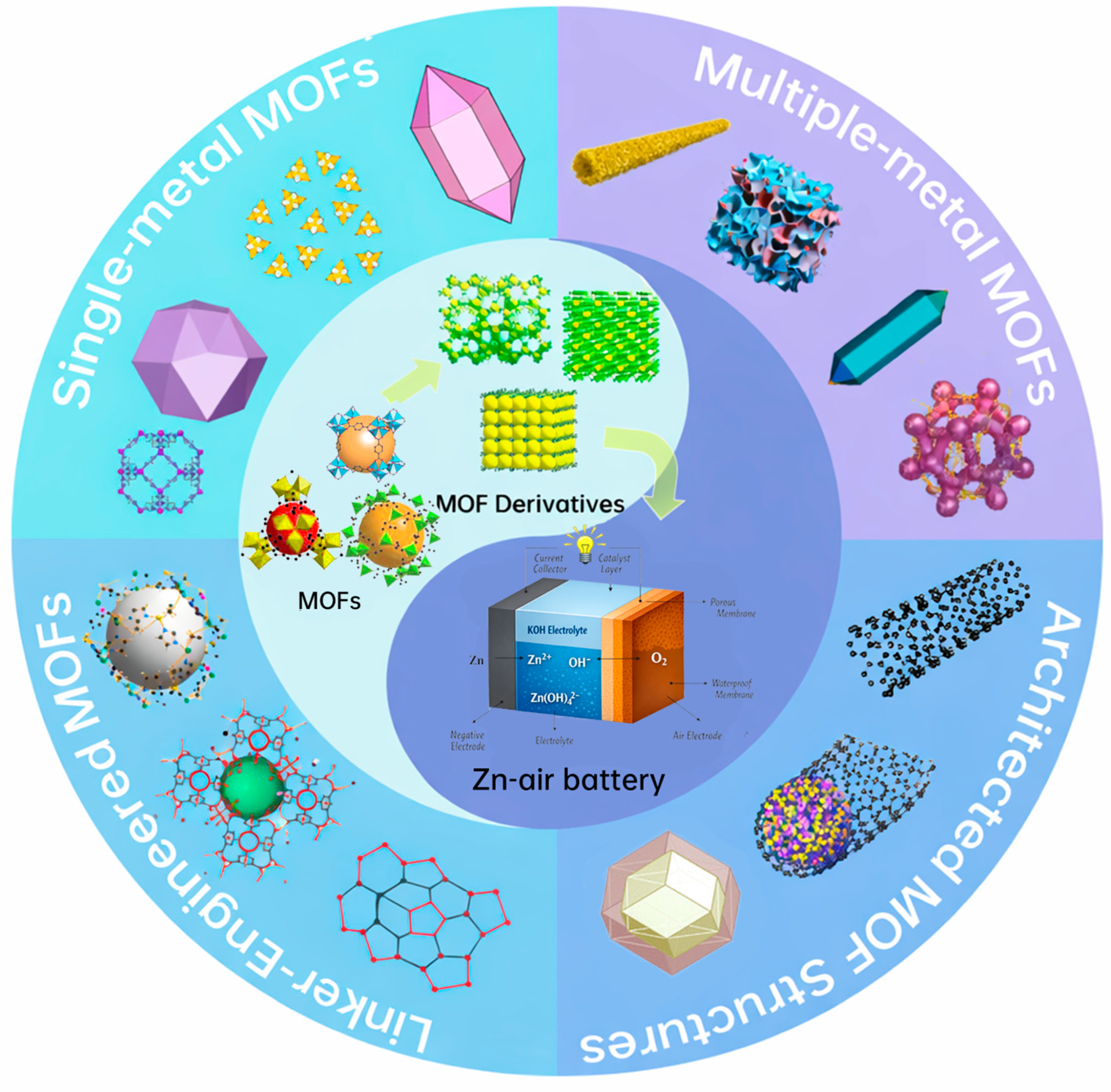

Metal–Organic Framework-Derived Electrocatalysts for Rechargeable Zinc–Air Batteries

 ,
, 
Abstract
1. Introduction
2. Characteristics of MOF-Based Electrocatalysts
2.1. Key Characteristics of MOFs in Electrocatalysis
2.2. Structure–Property Relationships of MOF-Derived Catalysts
- (1)
- Pore Structure for Facilitated Mass Transport: Hierarchical porosity in MOF-derived catalysts ensures efficient mass transport of reactants and intermediates. In OER applications, well-designed pores can reduce the overpotential and optimize oxygen gas diffusion.
- (2)
- Metal Dispersion and Active Sites: The uniform distribution of metal nodes within MOFs enables superior utilization of active sites. This uniformity can be preserved in derived catalysts, ensuring enhanced reaction kinetics. For instance, nanoscale metal particles generated during pyrolysis exhibit significant improvements in intrinsic catalytic activity due to their high surface-to-volume ratio.
- (3)
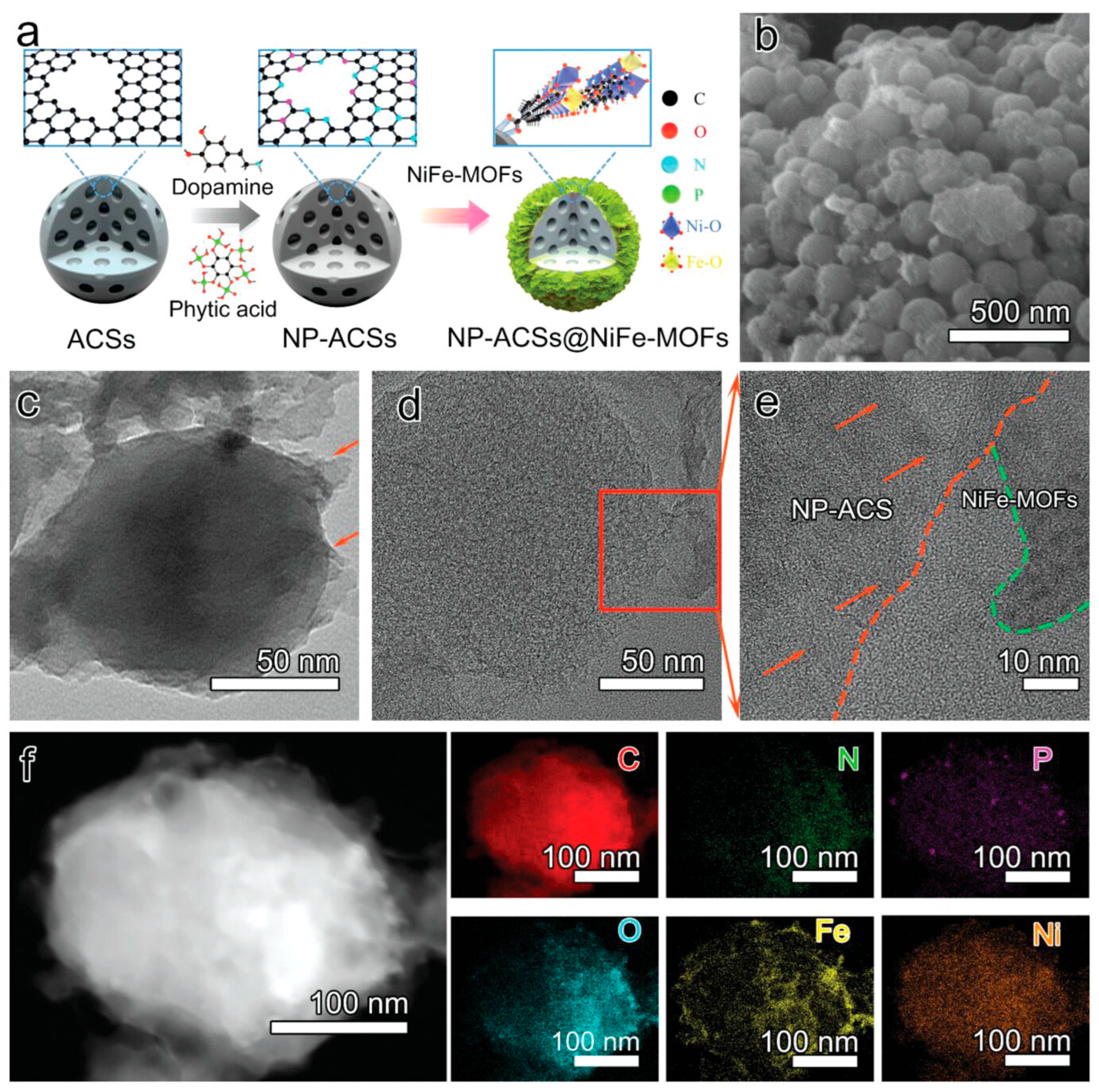
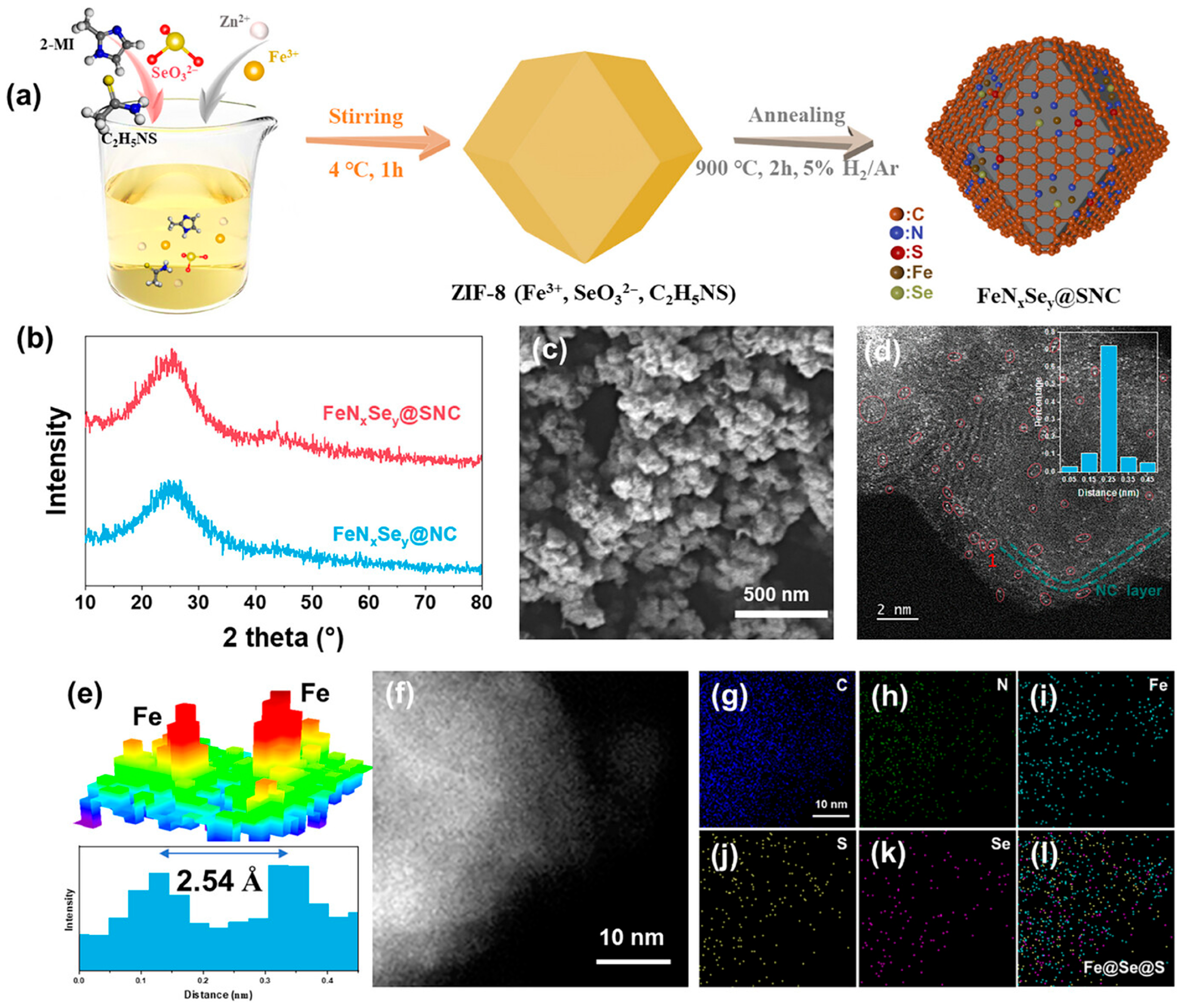
- Heteroatom Doping and Electronic Structure Optimization: Introducing heteroatoms (e.g., N, P, or S) during synthesis or transformation can alter the local electronic structure around the active sites, optimizing the adsorption energy of intermediates. For example, nitrogen doping enables favorable redistribution of charge density, enhancing ORR and OER performance with improved selectivity and durability.
- (4)
- Dynamic Evolution and Stability during High-Temperature Processing: Controlling the pyrolysis conditions (e.g., temperature, atmosphere) ensures the formation of thermally stable derivatives with optimal structures. Retaining the hierarchical order and preventing metal particle agglomeration are critical strategies to enhance long-term performance under typical electrocatalytic conditions.
2.3. Applications in OER and ORR
3. Synthesis Strategies for MOF-Derived Electrocatalysts
3.1. Annealing Route for Transforming MOFs into Electrocatalysts
- (1)
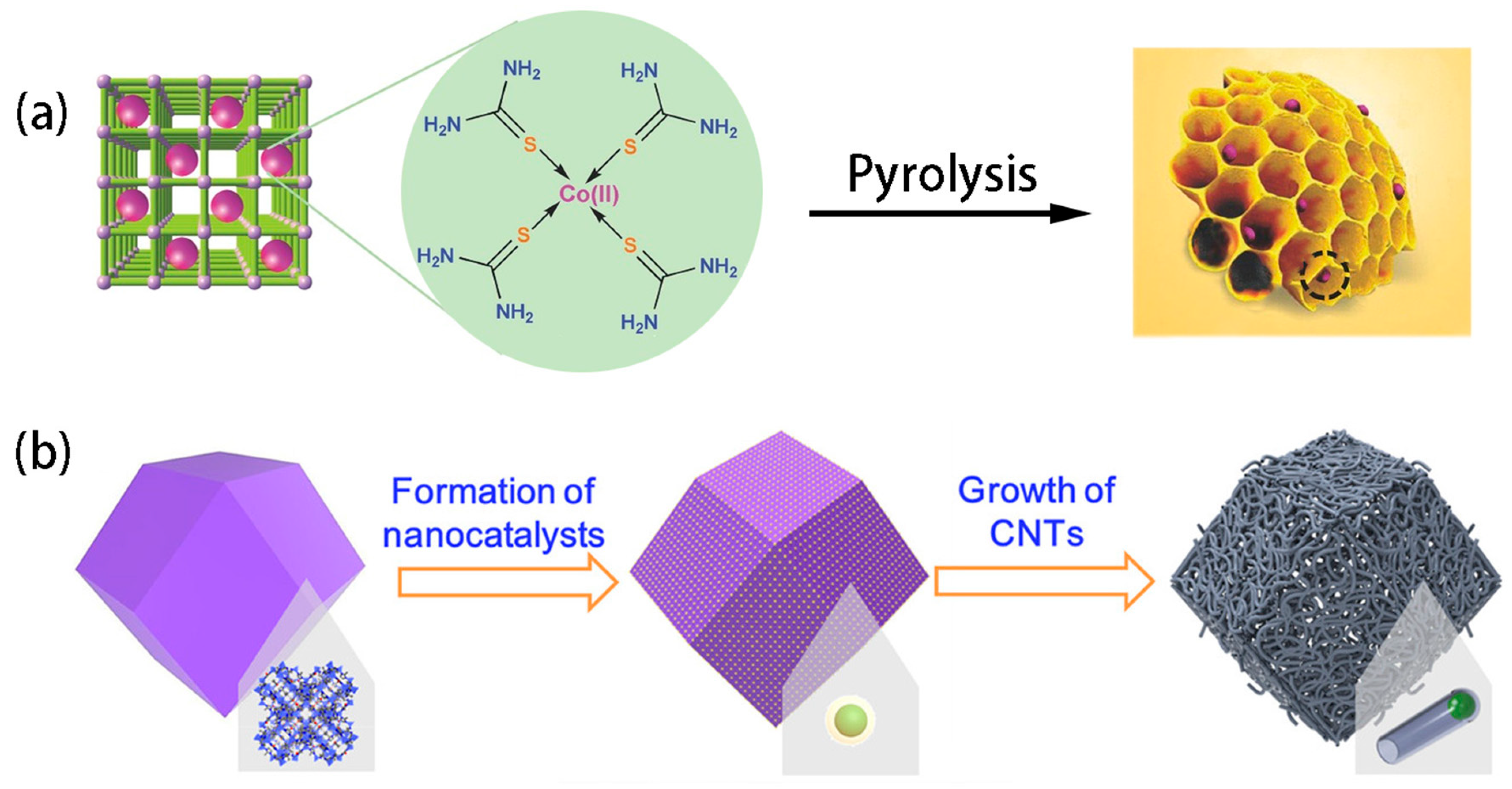
- Traditional thermal decomposition
- (2)
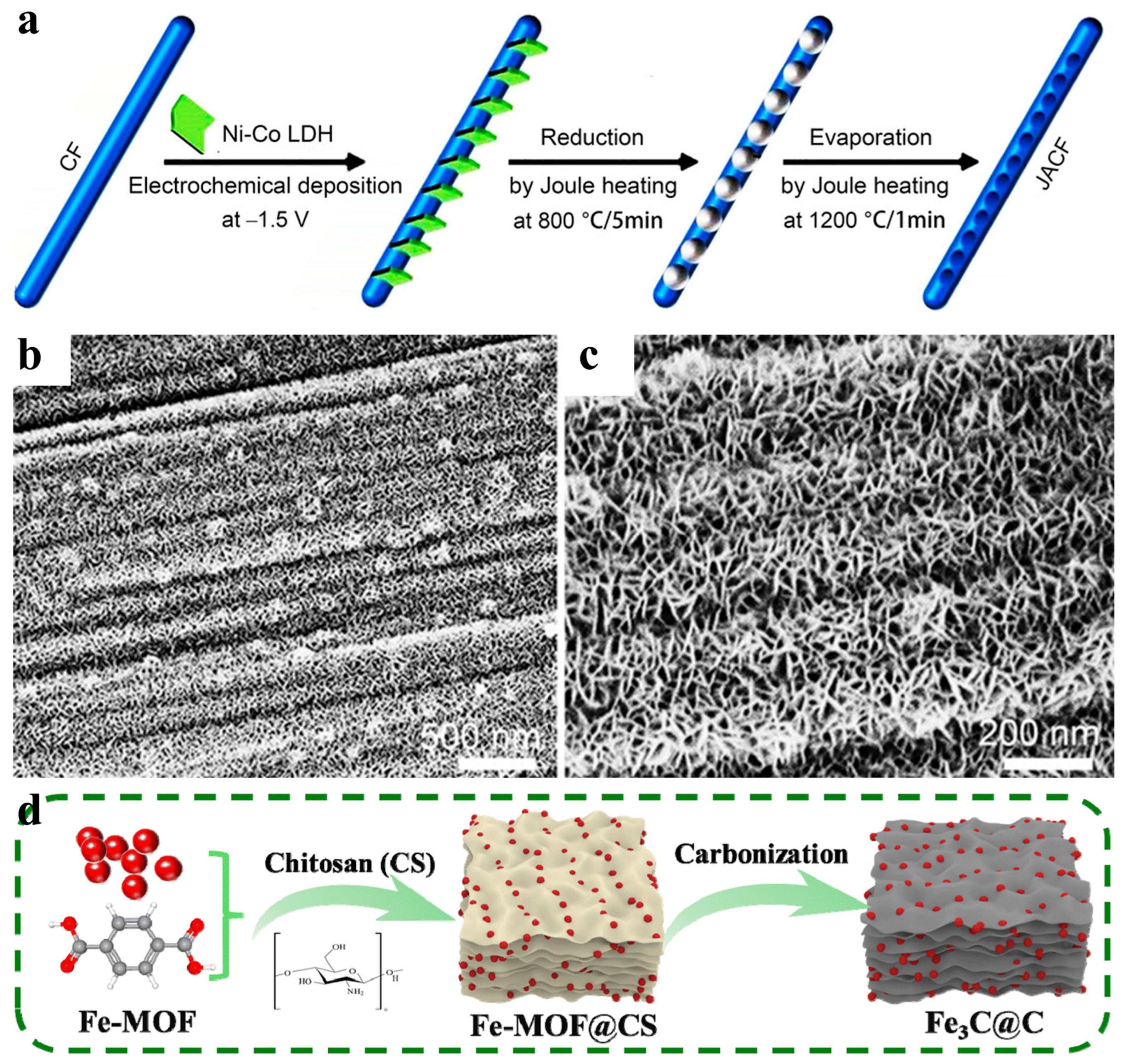
- Joule heating decomposition
- (3)
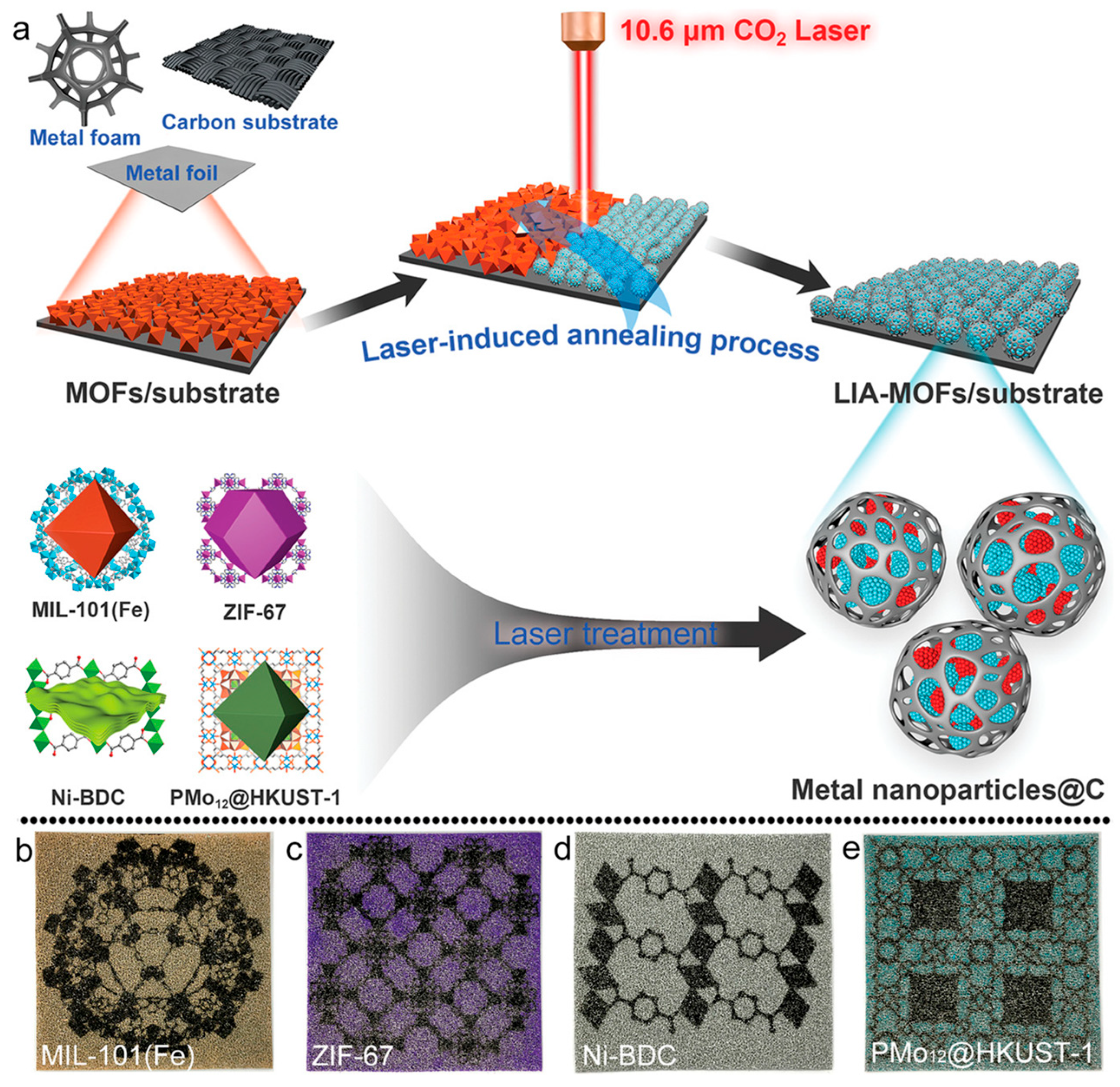
- Laser sintering technology
3.2. Doping and Functionalization
3.3. Hybridization with Other Materials
3.4. Templating and Nanostructure Control
3.5. Atomic Layer Deposition and Post-Synthetic Modifications
4. Performance Metrics in ZABs
5. Conclusions and Future Challenges
Funding
Data Availability Statement
Conflicts of Interest
Abbreviations
| AC-TEM | Aberration-corrected transmission electron microscopy |
| ALD | Atomic layer deposition |
| CNTs | Carbon nanotubes |
| ECSA | Electrochemical surface area |
| EDS | Energy-dispersive X-ray spectroscopy |
| HAADF-STEM | High-angle annular dark-field scanning transmission electron microscopy |
| HER | Hydrogen evolution reaction |
| M–N–C | Metal–nitrogen–carbon |
| MOFs | Metal–organic frameworks |
| OER | Oxygen evolution reaction |
| ORR | Oxygen reduction reaction |
| RHE | Reversible hydrogen electrode |
| SACs | Single-atom catalysts |
| SEM | Scanning electron microscopy |
| TEM | Transmission electron microscopy |
| XRD | X-ray diffraction |
| ZABs | Zinc–air batteries |
| ZIF | Zeolitic imidazolate framework |
References
- Al Bostami, R.D.; Al Othman, A.; Tawalbeh, M.; Olabi, A.G. Advancements in zinc-air battery technology and water-splitting. Energy Nexus 2025, 17, 100387. [Google Scholar] [CrossRef] [Scilit]
- Guo, X.; He, G. Opportunities and challenges of zinc anodes in rechargeable aqueous batteries. J. Mater. Chem. A 2023, 11, 11987–12001. [Google Scholar] [CrossRef] [Scilit]
- Leong, K.W.; Wang, Y.; Ni, M.; Pan, W.; Luo, S.; Leung, D.Y.C. Rechargeable Zn-air batteries: Recent trends and future perspectives. Renew. Sustain. Energy Rev. 2022, 154, 111771. [Google Scholar] [CrossRef] [Scilit]
- Caramia, V.; Bozzini, B. Materials science aspects of zinc–air batteries: A review. Mater. Renew. Sustain. Energy 2014, 3, 28. [Google Scholar] [CrossRef] [Scilit]
- Phuc, N.H.H.; Anh Tu, T.; Cam Loc, L.; Xuan Viet, C.; Thi Thuy Phuong, P.; Tri, N.; Van Thang, L. A Review of Bifunctional Catalysts for Zinc-Air Batteries. Nanoenergy Adv. 2023, 3, 13–47. [Google Scholar] [CrossRef] [Scilit]
- Shao, W.; Yan, R.; Zhou, M.; Ma, L.; Roth, C.; Ma, T.; Cao, S.; Cheng, C.; Yin, B.; Li, S. Carbon-Based Electrodes for Advanced Zinc-Air Batteries: Oxygen-Catalytic Site Regulation and Nanostructure Design. Electrochem. Energy Rev. 2023, 6, 11. [Google Scholar] [CrossRef] [Scilit]
- Nazir, G.; Rehman, A.; Lee, J.-H.; Kim, C.-H.; Gautam, J.; Heo, K.; Hussain, S.; Ikram, M.; AlObaid, A.A.; Lee, S.-Y.; et al. A Review of Rechargeable Zinc–Air Batteries: Recent Progress and Future Perspectives. Nano-Micro Lett. 2024, 16, 138. [Google Scholar] [CrossRef] [Scilit]
- Liu, X.; Yuan, Y.; Liu, J.; Liu, B.; Chen, X.; Ding, J.; Han, X.; Deng, Y.; Zhong, C.; Hu, W. Utilizing solar energy to improve the oxygen evolution reaction kinetics in zinc–air battery. Nat. Commun. 2019, 10, 4767. [Google Scholar] [CrossRef] [Scilit]
- Li, S.; Liu, Z.; Wei, X.; Wu, H.; Mei, H.; Liu, J. Advanced Strategies for Suppressing the Self-Corrosion of the Anode in Al–Air Batteries. Metals 2025, 15, 760. [Google Scholar] [CrossRef] [Scilit]
- Zeng, F.; Zhu, K.; Guo, X.; Li, H.; Qiu, H.; Tang, J. Analysis of the adsorption characteristics of SF6 and its decomposition products in ZIF-67: Based on GCMC and DFT. J. Phys. D Appl. Phys. 2023, 57, 105501. [Google Scholar] [CrossRef] [Scilit]
- Wang, L.; Zhang, Y.; Li, X.; Xie, Y.; He, J.; Yu, J.; Song, Y. The MIL-88A-Derived Fe3O4-Carbon Hierarchical Nanocomposites for Electrochemical Sensing. Sci. Rep. 2015, 5, 14341. [Google Scholar] [CrossRef] [Scilit]
- Huang, S.; Wu, Y.; Fu, J.; Xin, P.; Zhang, Q.; Jin, Z.; Zhang, J.; Hu, Z.; Chen, Z. Hierarchical CoFe LDH/MOF nanorods array with strong coupling effect grown on carbon cloth enables efficient oxidation of water and urea. Nanotechnology 2021, 32, 385405. [Google Scholar] [CrossRef] [Scilit]
- Chang, G.; Zhou, Y.; Wang, J.; Zhang, H.; Yan, P.; Wu, H.B.; Yu, X.-Y. Dynamic Reconstructed RuO2/NiFeOOH with Coherent Interface for Efficient Seawater Oxidation. Small 2023, 19, 2206768. [Google Scholar] [CrossRef] [Scilit]
- Yu, K.; Zhang, J.; Hu, Y.; Wang, L.; Zhang, X.; Zhao, B. Ni Doped Co-MOF-74 Synergized with 2D Ti3C2Tx MXene as an Efficient Electrocatalyst for Overall Water-Splitting. Catalysts 2024, 14, 184. [Google Scholar] [CrossRef] [Scilit]
- Xue, Y.; Guo, Y.; Zhang, Q.; Xie, Z.; Wei, J.; Zhou, Z. MOF-Derived Co and Fe Species Loaded on N-Doped Carbon Networks as Efficient Oxygen Electrocatalysts for Zn-Air Batteries. Nano-Micro Lett. 2022, 14, 162. [Google Scholar] [CrossRef] [Scilit]
- Li, S.; Xie, Y.; Feng, C.; Hassan, A.; Wang, J. Nitrogen-Rich Porous Carbon Nanotubes Coated Co/Mo2N Composites Derived from Metal-Organic Framework as Efficient Bifunctional Oxygen Electrocatalysts. Catalysts 2023, 13, 801. [Google Scholar] [CrossRef] [Scilit]
- Panchariya, D.K.; Rai, R.K.; Anil Kumar, E.; Singh, S.K. Core–Shell Zeolitic Imidazolate Frameworks for Enhanced Hydrogen Storage. ACS Omega 2018, 3, 167–175. [Google Scholar] [CrossRef] [Scilit] [PubMed]
- Chen, C.; Shen, L.; Wang, B.; Lu, X.; Raza, S.; Xu, J.; Li, B.; Lin, H.; Chen, B. Environmental applications of metal–organic framework-based three-dimensional macrostructures: A review. Chem. Soc. Rev. 2025, 54, 2208–2245. [Google Scholar] [CrossRef] [Scilit] [PubMed]
- Furukawa, H.; Cordova, K.E.; O’Keeffe, M.; Yaghi, O.M. The Chemistry and Applications of Metal-Organic Frameworks. Science 2013, 341, 1230444. [Google Scholar] [CrossRef] [Scilit] [PubMed]
- Lu, X.F.; Fang, Y.; Luan, D.; Lou, X.W.D. Metal–Organic Frameworks Derived Functional Materials for Electrochemical Energy Storage and Conversion: A Mini Review. Nano Lett. 2021, 21, 1555–1565. [Google Scholar] [CrossRef] [Scilit]
- Lu, Z.; Li, Y.; Zhang, L.; Wang, Y. Hierarchically Scaled NiCo Layered Double Hydroxide Derived from Metal-Organic Frameworks as Efficient Free-Standing Electrode for Oxygen Evolution Reaction. J. Alloys Compd. 2025, 1027, 180665. [Google Scholar] [CrossRef] [Scilit]
- Liu, J.; Zhou, M.; Jin, K.; Li, J.; Meng, F.; Wei, X. Beyond metal–air battery, emerging aqueous metal–hydrogen peroxide batteries with improved performance. Battery Energy 2024, 3, 20230049. [Google Scholar] [CrossRef] [Scilit]
- Xu, X.; Sun, H.; Jiang, S.P.; Shao, Z. Modulating metal–organic frameworks for catalyzing acidic oxygen evolution for proton exchange membrane water electrolysis. SusMat 2021, 1, 460–481. [Google Scholar] [CrossRef] [Scilit]
- Xu, X.; Pan, Y.; Zhong, Y.; Shi, C.; Guan, D.; Ge, L.; Hu, Z.; Chin, Y.-Y.; Lin, H.-J.; Chen, C.-T.; et al. New Undisputed Evidence and Strategy for Enhanced Lattice-Oxygen Participation of Perovskite Electrocatalyst through Cation Deficiency Manipulation. Adv. Sci. 2022, 9, 2200530. [Google Scholar] [CrossRef] [Scilit]
- Chai, L.; Li, R.; Sun, Y.; Zhou, K.; Pan, J. MOF-derived Carbon-Based Materials for Energy-Related Applications. Adv. Mater. 2025, 37, e2413658. [Google Scholar] [CrossRef] [Scilit]
- Furukawa, H.; Ko, N.; Go, Y.B.; Aratani, N.; Choi, S.B.; Choi, E.; Yazaydin, A.Ö.; Snurr, R.Q.; O’Keeffe, M.; Kim, J.; et al. Ultrahigh Porosity in Metal-Organic Frameworks. Science 2010, 329, 424–428. [Google Scholar] [CrossRef] [Scilit] [PubMed]
- Zhou, J.; Ke, T.; Steinke, F.; Stock, N.; Zhang, Z.; Bao, Z.; He, X.; Ren, Q.; Yang, Q. Tunable Confined Aliphatic Pore Environment in Robust Metal-Organic Frameworks for Efficient Separation of Gases with a Similar Structure. J. Am. Chem. Soc. 2022, 144, 14322–14329. [Google Scholar] [CrossRef] [Scilit] [PubMed]
- Wang, Y.; Li, L.; Dai, P.; Yan, L.; Cao, L.; Gu, X.; Zhao, X. Missing-node directed synthesis of hierarchical pores on a zirconium metal-organic framework with tunable porosity and enhanced surface acidity via a microdroplet flow reaction. J. Mater. Chem. A 2017, 5, 22372–22379. [Google Scholar] [CrossRef] [Scilit]
- Zhuang, L.; Ge, L.; Liu, H.; Jiang, Z.; Jia, Y.; Li, Z.; Yang, D.; Hocking, R.K.; Li, M.; Zhang, L.; et al. A Surfactant-Free and Scalable General Strategy for Synthesizing Ultrathin Two-Dimensional Metal-Organic Framework Nanosheets for the Oxygen Evolution Reaction. Angew. Chem.—Int. Ed. 2019, 58, 13565–13572. [Google Scholar] [CrossRef] [Scilit]
- Zhong, H.; Ly, K.H.; Wang, M.; Krupskaya, Y.; Han, X.; Zhang, J.; Zhang, J.; Kataev, V.; Büchner, B.; Weidinger, I.M.; et al. A Phthalocyanine-Based Layered Two-Dimensional Conjugated Metal-Organic Framework as a Highly Efficient Electrocatalyst for the Oxygen Reduction Reaction. Angew. Chem. Int. Ed. 2019, 58, 10677–10682. [Google Scholar] [CrossRef] [Scilit]
- Wang, H.-F.; Chen, L.; Pang, H.; Kaskel, S.; Xu, Q. MOF-derived electrocatalysts for oxygen reduction, oxygen evolution and hydrogen evolution reactions. Chem. Soc. Rev. 2020, 49, 1414–1448. [Google Scholar] [CrossRef] [Scilit] [PubMed]
- Sun, N.; Shah, S.S.A.; Lin, Z.; Zheng, Y.-Z.; Jiao, L.; Jiang, H.-L. MOF-Based Electrocatalysts: An Overview from the Perspective of Structural Design. Chem. Rev. 2025, 125, 2703–2792. [Google Scholar] [CrossRef] [Scilit]
- Chen, C.; Tuo, Y.; Lu, Q.; Lu, H.; Zhang, S.; Zhou, Y.; Zhang, J.; Liu, Z.; Kang, Z.; Feng, X.; et al. Hierarchical trimetallic Co-Ni-Fe oxides derived from core-shell structured metal-organic frameworks for highly efficient oxygen evolution reaction. Appl. Catal. B—Environ. 2021, 287, 119953. [Google Scholar] [CrossRef] [Scilit]
- Zhao, Y.; Lu, X.F.; Wu, Z.-P.; Pei, Z.; Luan, D.; Lou, X.W. Supporting Trimetallic Metal-Organic Frameworks on S/N-Doped Carbon Macroporous Fibers for Highly Efficient Electrocatalytic Oxygen Evolution. Adv. Mater. 2023, 35, 2207888. [Google Scholar] [CrossRef] [Scilit] [PubMed]
- Xie, X.; Shang, L.; Xiong, X.; Shi, R.; Zhang, T. Fe Single-Atom Catalysts on MOF-5 Derived Carbon for Efficient Oxygen Reduction Reaction in Proton Exchange Membrane Fuel Cells. Adv. Energy Mater. 2022, 12, 2102688. [Google Scholar] [CrossRef] [Scilit]
- Xu, Q.; Jiang, H.; Li, Y.; Liang, D.; Hu, Y.; Li, C. In-situ enriching active sites on co-doped Fe-Co4N@N-C nanosheet array as air cathode for flexible rechargeable Zn-air batteries. Appl. Catal. B—Environ. 2019, 256, 117893. [Google Scholar] [CrossRef] [Scilit]
- Hu, L.; Hu, Y.; Liu, R.; Mao, Y.; Balogun, M.S.; Tong, Y. Co-based MOF-derived Co/CoN/Co2P ternary composite embedded in N- and P-doped carbon as bifunctional nanocatalysts for efficient overall water splitting. Int. J. Hydrogen Energy 2019, 44, 11402–11410. [Google Scholar] [CrossRef] [Scilit]
- Vijayakumar, E.; Ramakrishnan, S.; Sathiskumar, C.; Yoo, D.J.; Balamurugan, J.; Noh, H.S.; Kwon, D.; Kim, Y.H.; Lee, H. MOF-derived CoP-nitrogen-doped carbon@NiFeP nanoflakes as an efficient and durable electrocatalyst with multiple catalytically active sites for OER, HER, ORR and rechargeable zinc-air batteries. Chem. Eng. J. 2022, 428, 131115. [Google Scholar] [CrossRef] [Scilit]
- Yan, L.; Wang, H.; Shen, J.; Ning, J.; Zhong, Y.; Hu, Y. Formation of mesoporous Co/CoS/Metal-N-C@S, N-codoped hairy carbon polyhedrons as an efficient trifunctional electrocatalyst for Zn-air batteries and water splitting. Chem. Eng. J. 2021, 403, 126385. [Google Scholar] [CrossRef] [Scilit]
- Chen, X.; Ma, D.-D.; Chen, B.; Zhang, K.; Zou, R.; Wu, X.-T.; Zhu, Q.-L. Metal-organic framework-derived mesoporous carbon nanoframes embedded with atomically dispersed Fe-Nx active sites for efficient bifunctional oxygen and carbon dioxide electroreduction. Appl. Catal. B—Environ. 2020, 267, 118720. [Google Scholar] [CrossRef] [Scilit]
- Suresh, P.; Shakina, J.; Pandian, M.S.; Tharmaraj, P.; Kamaraj, J.J.J.J. Cost-effective bimetallic MOF electrocatalyst with dual-linker strategy for enhanced oxygen and hydrogen evolution reactions. Mater. Sci. Eng. B 2025, 321, 118510. [Google Scholar] [CrossRef] [Scilit]
- Xiao, L.; Yang, J.-M.; Huang, G.-Y.; Zhao, Y.; Zhu, H.-B. Construction of efficient Mn-N-C oxygen reduction electrocatalyst from a Mn(II)-based MOF with N-rich organic linker. Inorg. Chem. Commun. 2020, 118, 107982. [Google Scholar] [CrossRef] [Scilit]
- Wang, R.; Dong, X.-Y.; Du, J.; Zhao, J.-Y.; Zang, S.-Q. MOF-Derived Bifunctional Cu3P Nanoparticles Coated by a N,P-Codoped Carbon Shell for Hydrogen Evolution and Oxygen Reduction. Adv. Mater. 2018, 30, 1703711. [Google Scholar] [CrossRef] [Scilit] [PubMed]
- Tian, R.; Wang, F.; Zou, C.; Pei, Z.; Guo, X.; Yang, H. Modulating organic ligands to construct 2D-3D-hybrid porous P-doped metal-organic frameworks electrocatalyst for overall water splitting. J. Alloys Compd. 2023, 933, 167670. [Google Scholar] [CrossRef] [Scilit]
- Moularas, C.; Gemenetzi, A.; Deligiannakis, Y.; Louloudi, M. Nanoplasmonics in Catalysis for Energy Technologies: The Concept of Plasmon-Assisted Molecular Catalysis (PAMC). Nanoenergy Adv. 2024, 4, 25–44. [Google Scholar] [CrossRef] [Scilit]
- Liu, J.; Shen, A.; Wei, X.; Zhou, K.; Chen, W.; Chen, F.; Xu, J.; Wang, S.; Dai, L. Ultrathin wrinkled N-doped carbon nanotubes for noble-metal loading and oxygen reduction reaction. ACS Appl. Mater. Interfaces 2015, 7, 20507–20512. [Google Scholar] [CrossRef] [Scilit]
- Liu, J.; Shen, A.; Wei, X.; Wang, S.; Zhou, K.; Xu, J. Homogenous core-shell nitrogen-doped carbon nanotubes for the oxygen reduction reaction. ChemElectroChem 2015, 2, 1892–1896. [Google Scholar] [CrossRef] [Scilit]
- Chen, L.; Fang, J.; Lin, J.; Zhao, M.; Liu, Y.; Zhou, J.E.; Wu, Y.; Lin, X. The progress and promise for metal-organic framework-mediated synthesis of lithium-ion battery cathode materials. Mater. Futures 2025, 4, 032101. [Google Scholar] [CrossRef] [Scilit]
- Lin, X.; Lin, J.; Lu, X.; Tan, X.; Li, H.; Mai, W.; Luo, Y.; Wu, Y.; Chen, S.; Yang, C.; et al. Vacancy-engineered LiMn2O4 embedded in dual-heteroatom-doped carbon via metal-organic framework-mediated synthesis towards longevous lithium ion battery. Mater. Futures 2025, 4, 025101. [Google Scholar] [CrossRef] [Scilit]
- Hu, Y.; Dai, L.; Li, B.; Yu, C.; Li, Z. Synergistic catalytic mechanism and performance regulation strategies between nanoparticles/clusters and single-atom sites. Mater. Futures 2025, 4, 032102. [Google Scholar] [CrossRef] [Scilit]
- Zhang, G.-X.; Yang, H.; Feng, W.-C.; Wang, Q.-J.; Chen, H.-Y.; Shakouri, M.; Chen, S.-Q.; Pang, H. Controllable morphological transformations of nickel metal-organic frameworks for nickel-zinc batteries. Rare Met. 2025, 44, 2976–2985. [Google Scholar] [CrossRef] [Scilit]
- Fang, G.; Bao, S.-X.; Zhou, G.-X.; Ge, C.-C. Activity regulation and applications of metal-organic framework-based nanozymes. Rare Met. 2024, 43, 900–914. [Google Scholar] [CrossRef] [Scilit]
- Shi, B.-C.; Jin, M.; Zou, Y.; Wang, S.; Nie, Y.; Yao, D.; Tang, Y.-J. Cathodic electrodeposition activation of NiFe-based metal-organic frameworks for enhanced oxygen evolution reaction. Rare Met. 2025, 44, 10144–10154. [Google Scholar] [CrossRef] [Scilit]
- Deng, Z.-W.; Liu, Y.; Lin, J.; Chen, W.-X. Rational design and energy catalytic application of high-loading single-atom catalysts. Rare Met. 2024, 43, 4844–4866. [Google Scholar] [CrossRef] [Scilit]
- Qian, Y.; Hu, Z.; Ge, X.; Yang, S.; Peng, Y.; Kang, Z.; Liu, Z.; Lee, J.Y.; Zhao, D. A metal-free ORR/OER bifunctional electrocatalyst derived from metal-organic frameworks for rechargeable Zn-Air batteries. Carbon 2017, 111, 641–650. [Google Scholar] [CrossRef] [Scilit]
- Fang, C.; Tang, X.; Yi, Q. Adding Fe/dicyandiamide to Co-MOF to greatly improve its ORR/OER bifunctional electrocatalytic activity. Appl. Catal. B—Environ. 2024, 341, 123346. [Google Scholar] [CrossRef] [Scilit]
- Hussain, I.; Zhang, K. MOF-derived scaffolds as electrode materials: A mini-review. Nanoscale 2024, 16, 15515–15528. [Google Scholar] [CrossRef] [Scilit]
- Gu, J.; Huang, J.; Jin, Z.; Wei, T. Multidimensional engineering of ZIF-8-based electrocatalysts for carbon dioxide reduction: A mini review. Chem. Commun. 2025, 61, 13015–13034. [Google Scholar] [CrossRef] [Scilit]
- Lee, K.J.; Lee, J.H.; Jeoung, S.; Moone, H.R. Transformation of Metal-Organic Frameworks/Coordination Polymers into Functional Nanostructured Materials: Experimental Approaches Based on Mechanistic Insights. Acc. Chem. Res. 2017, 50, 2684–2692. [Google Scholar] [CrossRef] [Scilit]
- Liu, J.; Ma, B.; Chen, Z.; Wei, X. Novel strategies for low overpotential metal–air batteries. Chem. Commun. 2025, 61, 14340–14353. [Google Scholar] [CrossRef] [Scilit]
- Ma, B.; Hong, D.; Wei, X.; Liu, J. Breaking the Polarization Bottleneck: Innovative Pathways to High-Performance Metal–Air Batteries. Batteries 2025, 11, 315. [Google Scholar] [CrossRef] [Scilit]
- Zhang, G.; Wan, Y.; Ma, X.; Wen, X.; Wang, X.; Shi, X.; Zhang, L.; Ma, L. An underwater superoleophobic Fe, Co, Ni-MOF@GO composite membrane with photo-induced persulfate-activation self-cleaning for efficient separation of crude oil/water emulsion. J. Environ. Chem. Eng. 2025, 13, 115840. [Google Scholar] [CrossRef] [Scilit]
- Jin, X.; Shan, Y.; Sun, F.; Pang, H. Applications of Transition Metal (Fe, Co, Ni)-Based Metal-Organic Frameworks and their Derivatives in Batteries and Supercapacitors. Trans. Tianjin Univ. 2022, 28, 446–468. [Google Scholar] [CrossRef] [Scilit]
- Lin, J.; Xu, C.; Lu, M.; Lin, X.; Ali, Z.; Zeng, C.; Xu, X.; Luo, Y. Trimetallic Metal-Organic Framework Nanoframe Superstructures: A Stress-Buffering Architecture Engineering of Anode Material toward Boosted Lithium Storage Performance. Energy Environ. Mater. 2023, 6, e12284. [Google Scholar] [CrossRef] [Scilit]
- Taffa, D.H.; Balkenhohl, D.; Amiri, M.; Wark, M. Minireview: Ni-Fe and Ni-Co Metal-Organic Frameworks for Electrocatalytic Water-Splitting Reactions. Small Struct. 2023, 4, 2200263. [Google Scholar] [CrossRef] [Scilit]
- Ma, N.; Zhang, Y.; Wang, Y.; Zhao, J.; Liang, B.; Xiong, Y.; Luo, S.; Huang, C.; Fan, J. Curvature effects regulate the catalytic activity of Co@N4-doped carbon nanotubes as bifunctional ORR/OER catalysts. J. Colloid Interface Sci. 2024, 654, 1458–1468. [Google Scholar] [CrossRef] [Scilit]
- Wang, Z.; Sun, L.; Li, W.; Qin, J.; Li, Y.; Wang, Y. Indirect heteroatom doping of TMN4 single atom catalysts for bifunctional ORR/OER electrocatalysis: A DFT study. Mater. Today Commun. 2025, 48, 113505. [Google Scholar] [CrossRef] [Scilit]
- Zhang, W.; Jiang, X.; Zhao, Y.; Carne-Sanchez, A.; Malgras, V.; Kim, J.; Kim, J.H.; Wang, S.; Liu, J.; Jiang, J.-S.; et al. Hollow carbon nanobubbles: Monocrystalline MOF nanobubbles and their pyrolysis. Chem. Sci. 2017, 8, 3538–3546. [Google Scholar] [CrossRef] [Scilit]
- Deng, L.; Liu, X.; Chen, C.; Wang, L.; Liu, F.; Zhang, J. Ni-Co alloys via controlled pyrolysis of NiCo-MOF as heterogeneous hydrogenation catalysts. New J. Chem. 2024, 48, 8620–8630. [Google Scholar] [CrossRef] [Scilit]
- Zhou, Q.; Yan, R.; Zhang, Y.; Lei, C. Cobalt and zinc nanoparticles from pyrolysis of their MOF precursors exhibiting potent organophosphorus hydrolase-mimicking activities. Chem. Commun. 2024, 60, 8216–8219. [Google Scholar] [CrossRef] [Scilit]
- Hegazy, S.; Ibrahim, H.H.; Weckman, T.; Hu, T.; Tuomikoski, S.; Lassi, U.; Honkala, K.; Srivastava, V. Synergistic pyrolysis of Cellulose/Fe-MOF Composite: A Combined experimental and DFT study on dye removal. Chem. Eng. J. 2025, 504, 158654. [Google Scholar] [CrossRef] [Scilit]
- Wezendonk, T.A.; Santos, V.P.; Nasalevich, M.A.; Warringa, Q.S.E.; Dugulan, A.I.; Chojecki, A.; Koeken, A.C.J.; Ruitenbeek, M.; Meima, G.; Islam, H.-U.; et al. Elucidating the Nature of Fe Species during Pyrolysis of the Fe-BTC MOF into Highly Active and Stable Fischer-Tropsch Catalysts. ACS Catal. 2016, 6, 3236–3247. [Google Scholar] [CrossRef] [Scilit]
- Zhu, Q.-L.; Xia, W.; Akita, T.; Zou, R.; Xu, Q. Metal-Organic Framework-Derived Honeycomb-Like Open Porous Nanostructures as Precious-Metal-Free Catalysts for Highly Efficient Oxygen Electroreduction. Adv. Mater. 2016, 28, 6391–6398. [Google Scholar] [CrossRef] [Scilit]
- Meng, J.; Niu, C.; Xu, L.; Li, J.; Liu, X.; Wang, X.; Wu, Y.; Xu, X.; Chen, W.; Li, Q.; et al. General Oriented Formation of Carbon Nanotubes from Metal–Organic Frameworks. J. Am. Chem. Soc. 2017, 139, 8212–8221. [Google Scholar] [CrossRef] [Scilit]
- Guo, Z.; Liu, Z.; Zhang, J.; Luo, J.; Tao, X.-S.; Ding, J.; Han, X.; Liu, W.-D.; Liu, R.; Chen, Y.; et al. Joule Heating Ultrafast Synthesis. ACS Appl. Energy Mater. 2025, 8, 9926–9937. [Google Scholar] [CrossRef] [Scilit]
- Zhao, Z.; Sun, J.; Li, X.; Qin, S.; Li, C.; Zhang, Z.; Li, Z.; Meng, X. Engineering active and robust alloy-based electrocatalyst by rapid Joule-heating toward ampere-level hydrogen evolution. Nat. Commun. 2024, 15, 7475. [Google Scholar] [CrossRef] [Scilit]
- Li, S.; Zhao, Y.; Shi, P.; Zhou, J.; Long, J.; Cao, N.; Liu, J.; Meng, F. Joule Heating Activation of Template-Mediated Carbon Fibers with Significantly Enhanced Capacitive Performance. Adv. Eng. Mater. 2023, 25, 2300402. [Google Scholar] [CrossRef] [Scilit]
- Zhao, Y.; Liu, H.; Li, S.; Chen, P.; Jiang, S.; Liu, J.; Meng, F. Rapid joule-heating activation boosted capacitive performance of carbon fibers. Compos. Commun. 2022, 34, 101263. [Google Scholar] [CrossRef] [Scilit]
- Wang, B.; Zheng, M.; Guo, J.; Ma, X.; Jiang, S.; Wei, M.; Chen, L. Self-supporting Fe3C@C composites derived from MOF/chitosan films for electromagnetic interference shielding and Joule heating. J. Mater. Chem. A 2025, 13, 42229–42238. [Google Scholar] [CrossRef] [Scilit]
- Xu, L.; Liu, J.; Chen, P.; Wang, Z.; Tang, D.; Liu, X.; Meng, F.; Wei, X. High-power aqueous Zn-H2O2 batteries for multiple applications. Cell Rep. Phys. Sci. 2020, 1, 100027. [Google Scholar] [CrossRef] [Scilit]
- Dehghani, A.; Sambyal, P.; Arjmand, M. Flexible rubber-based nanocomposite with superior electromagnetic interference shielding and joule heating. Carbon 2025, 238, 120180. [Google Scholar] [CrossRef] [Scilit]
- Ma, J.; Wang, M.; Fei, G.; Kang, Y.; Guo, L.; Zhu, Y.; Wang, H.; Wu, F.; Bai, Y.; Cui, P.; et al. Dynamic Pyrolysis of Silver-Enhanced Conductive Porous Membranes: Mechanistic Insights into Electromagnetic Shielding, Joule Heating and Photothermal Efficiency. Adv. Fiber Mater. 2025, 7, 962–976. [Google Scholar] [CrossRef] [Scilit]
- Li, Y.; Wu, H.; Zhang, J.; Lu, Q.; Han, X.; Zheng, X.; Deng, Y.; Hu, W. Rapid synthesis of doped metal oxidesviaJoule heating for oxygen electrocatalysis regulation. J. Mater. Chem. A 2023, 11, 10267–10276. [Google Scholar] [CrossRef] [Scilit]
- Zhestkij, N.A.; Efimova, A.S.; Kenzhebayeva, Y.; Povarov, S.A.; Alekseevskiy, P.V.; Rzhevskiy, S.S.; Shipilovskikh, S.A.; Milichko, V.A. Grayscale to Multicolor Laser Writing Inside a Label-Free Metal-Organic Frameworks. Adv. Funct. Mater. 2024, 34, 2311235. [Google Scholar] [CrossRef] [Scilit]
- Mutlu, S.; Ortaç, B.; Karatutlu, A.; Gorkan, T.; Durgun, E.; Söyler, D.; Söylemez, S.; Arsu, N.; Savaskan Yılmaz, S. Engineering of the High-Power Laser-Induced Synthesis of Ni-Based Metal-Organic Framework: Investigation of its Optical Properties, Computational Methodology, Electrocatalytic Performances, and Glucose-Sensing Ability. Adv. Mater. Technol. 2025, 10, 2401245. [Google Scholar] [CrossRef] [Scilit]
- Guo, S.; Gao, M.; Zhang, W.; Liu, F.; Guo, X.; Zhou, K. Recent Advances in Laser-Induced Synthesis of MOF Derivatives. Adv. Mater. 2023, 35, 2303065. [Google Scholar] [CrossRef] [Scilit]
- Lipovka, A.; Garcia, A.; Abyzova, E.; Fatkullin, M.; Song, Z.; Li, Y.; Wang, R.; Rodriguez, R.D.; Sheremet, E. Laser Processing of Emerging Nanomaterials for Optoelectronics and Photocatalysis. Adv. Opt. Mater. 2024, 12, 2303194. [Google Scholar] [CrossRef] [Scilit]
- Huang, D.; Guo, S.; Chen, P.; Liu, Y.; Wang, Z.; Ding, Y.; Li, H.; Wu, H.; Ma, Z.; Jiang, H.; et al. Instant Writing of Conductive Interface on MOF Single Crystal by Ultrafast Laser. Adv. Sci. 2025, 12, e00711. [Google Scholar] [CrossRef] [Scilit]
- Tang, Y.-J.; Zheng, H.; Wang, Y.; Zhang, W.; Zhou, K. Laser-Induced Annealing of Metal–Organic Frameworks on Conductive Substrates for Electrochemical Water Splitting. Adv. Funct. Mater. 2021, 31, 2102648. [Google Scholar] [CrossRef] [Scilit]
- Xu, J.; Wang, R.; Jiang, H.; Liu, X.; An, L.; Jin, S.; Deng, B.; Wu, W.; Cheng, G.J. Magnetically Aligned Ultrafine Cobalt Embedded 3D Porous Carbon Metamaterial by One-Step Ultrafast Laser Direct Writing. Adv. Sci. 2021, 8, 2102477. [Google Scholar] [CrossRef] [Scilit] [PubMed]
- Wang, X.; Kang, Z.; Wang, D.; Zhao, Y.; Xiang, X.; Shang, H.; Zhang, B. Electronic structure regulation of the Fe-based single-atom catalysts for oxygen electrocatalysis. Nano Energy 2024, 121, 109268. [Google Scholar] [CrossRef] [Scilit]
- Zong, L.; Li, P.; Lu, F.; Wang, C.; Fan, K.; Li, Z.; Wang, L. Assembling Amorphous Metal-Organic Frameworks onto Heteroatom-Doped Carbon Spheres for Remarkable Bifunctional Oxygen Electrocatalysis. Adv. Funct. Mater. 2023, 33, 2301013. [Google Scholar] [CrossRef] [Scilit]
- Peng, Y.; Bai, Y.; Liu, C.; Cao, S.; Kong, Q.; Pang, H. Applications of metal-organic framework-derived N, P, S doped materials in electrochemical energy conversion and storage. Coord. Chem. Rev. 2022, 466, 214602. [Google Scholar] [CrossRef] [Scilit]
- Chen, S.; Chen, S.; Zhang, B.; Zhang, J. Bifunctional Oxygen Electrocatalysis of N, S-Codoped Porous Carbon with Interspersed Hollow CoO Nanoparticles for Rechargeable Zn-Air Batteries. ACS Appl. Mater. Interfaces 2019, 11, 16720–16728. [Google Scholar] [CrossRef] [Scilit]
- Xia, C.; Chen, H.; Wang, D.; Ding, S. Secondary sulfidation-engineered Co/N–graphene catalyst for boosted ORR/OER bifunctionality in zinc–air batteries. Electrochim. Acta 2025, 543, 147607. [Google Scholar] [CrossRef] [Scilit]
- Liu, D.; Srinivas, K.; Ma, F.; Yu, H.; Zhang, Z.; Wang, M.; Wu, Y.; Chen, Y. Fe species anchored N, S-doped carbon as nonprecious catalyst for boosting oxygen reduction reaction. J. Alloys Compd. 2023, 937, 168496. [Google Scholar] [CrossRef] [Scilit]
- Yue, C.; Zhang, N.; Zhu, Z.; Chen, P.; Meng, F.; Liu, X.; Wei, X.; Liu, J. Multi-Strategy Architecture of High-Efficiency Electrocatalysts for Underwater Zn-H2O2 Batteries with Superior Power Density of 442 mW cm−2. Small 2022, 18, 2106532. [Google Scholar] [CrossRef] [Scilit]
- Zhao, S.-H.; Pan, Y. Principles of coordination structure design of single-atom catalysts in electrocatalytic oxygen reduction reaction. Rare Met. 2025, 44, 2900–2920. [Google Scholar] [CrossRef] [Scilit]
- Xu, H.-M.; Zhu, H.-R.; Huang, C.-J.; Zhang, Z.-J.; Shuai, T.-Y.; Zhan, Q.-N.; Li, G.-R. Recent advances in Fe-N-C- and Co-N-C-based materials as bifunctional electrocatalysts for oxygen reduction and oxygen evolution. Sci. China Chem. 2024, 67, 1137–1160. [Google Scholar] [CrossRef] [Scilit]
- Yang, Z.; Liu, L.; Rao, X.; Jin, Z.; Sun, J.; Zhu, Y.; Zhang, S. Deprotonation effect doubles active site density in Fe-N4-C catalyst for oxygen reduction electrocatalysis. Chin. Chem. Lett. 2025, 36, 111440. [Google Scholar] [CrossRef] [Scilit]
- Xu, H.-M.; Yue, K.-H.; Zhang, H.-C.; Gong, X.-Q.; Zheng, S.-L.; Yin, M.-H.; Xia, G.-H.; Li, G.-R. Paired Fe Single-Atoms Coordinated by N and Se as Oxygen Electrocatalysts for High-Performance Zinc-Air Battery. Small 2025, 21, e07379. [Google Scholar] [CrossRef] [Scilit]
- Nazir, M.A.; Javed, M.S.; Islam, M.; Assiri, M.A.; Hassan, A.M.; Jamshaid, M.; Najam, T.; Shah, S.S.A.; Rehman, A.u. MOF@graphene nanocomposites for energy and environment applications. Compos. Commun. 2024, 45, 101783. [Google Scholar] [CrossRef] [Scilit]
- Zhang, X.; Zhang, S.; Tang, Y.; Huang, X.; Pang, H. Recent advances and challenges of metal-organic framework/graphene-based composites. Compos. Part B—Eng. 2022, 230, 109532. [Google Scholar] [CrossRef] [Scilit]
- Kumar, S.; Siddharth; Ahlawat, R.; Rani, G.; Devi, J.; Kamboj, A. In situ synthesis of RGO and CNT-templated diamond-shaped Fe-based metal-organic frameworks: Exploring their remarkable photocatalytic and antioxidant properties. Inorg. Chem. Commun. 2025, 171, 113589. [Google Scholar] [CrossRef] [Scilit]
- Yang, L.; Cao, L.; Huang, R.; Hou, Z.-W.; Qian, X.-Y.; An, B.; Xu, H.-C.; Lin, W.; Wang, C. Two-Dimensional Metal-Organic Layers on Carbon Nanotubes to Overcome Conductivity Constraint in Electrocatalysis. ACS Appl. Mater. Interfaces 2018, 10, 36290–36296. [Google Scholar] [CrossRef] [Scilit] [PubMed]
- Dai, Z.; Long, Z.; Shi, C.; Wu, C.; Qiao, H.; Wang, K. Porous MOFs-Zinc Cobaltite/Carbon Composite Nanofibers for High Lithium Storage. Adv. Electron. Mater. 2022, 8, 2100592. [Google Scholar] [CrossRef] [Scilit]
- Zhong, R.; Zhi, C.; Wu, Y.; Liang, Z.; Tabassum, H.; Zhang, H.; Qiu, T.; Gao, S.; Shi, J.; Zou, R. Atomic Fe-N4 sites on electrospun hierarchical porous carbon nanofibers as an efficient electrocatalyst for oxygen reduction reaction. Chin. Chem. Lett. 2020, 31, 1588–1592. [Google Scholar] [CrossRef] [Scilit]
- Liu, G.; Yu, X.; Zhou, F.; Yan, K.; Yin, L.; Zhuang, C.; Wang, Y.; Tian, D. Hierarchical 2D/1D MOFs/electrospun ZIF-67 modified carbon nanofibers heterostructure electrode for high-performance asymmetric supercapacitor. J. Colloid Interface Sci. 2025, 678, 120–133. [Google Scholar] [CrossRef] [Scilit]
- Liu, C.; Sun, Q.; Lin, L.; Wang, J.; Zhang, C.; Xia, C.; Bao, T.; Wan, J.; Huang, R.; Zou, J.; et al. Ternary MOF-on-MOF heterostructures with controllable architectural and compositional complexity via multiple selective assembly. Nat. Commun. 2020, 11, 4971. [Google Scholar] [CrossRef] [Scilit]
- Lee, S.; Lee, G.; Oh, M. MOF-on-MOF Growth: Inducing Naturally Nonpreferred MOFs and Atypical MOF Growth. Acc. Chem. Res. 2024, 57, 3113–3125. [Google Scholar] [CrossRef] [Scilit]
- Gu, Z.; Zhang, W.; Pan, T.; Shen, Y.; Qin, P.; Zhang, P.; Li, X.; Liu, L.; Li, L.; Fu, Y.; et al. Anisotropic MOF-on-MOF Growth of Isostructural Multilayer Metal-Organic Framework Heterostructures. Research 2021, 2021, 9854946. [Google Scholar] [CrossRef] [Scilit]
- Yang, Y.; Lou, J.; Zhao, Y.; Wei, J.; Zhou, Y.; Zhang, C.; Wu, M.; Zhang, Y.; Wang, Q.; Wang, L.; et al. Ice-templating co-assembly of dual-MOF superstructures derived 2D carbon nanobelts as efficient electrocatalysts. Chem. Eng. J. 2023, 477, 146900. [Google Scholar] [CrossRef] [Scilit]
- Li, J.; Lu, S.; Huang, H.; Liu, D.; Zhuang, Z.; Zhong, C. ZIF-67 as Continuous Self-Sacrifice Template Derived NiCo2O4/Co,N-CNTs Nanocages as Efficient Bifunctional Electrocatalysts for Rechargeable Zn–Air Batteries. ACS Sustain. Chem. Eng. 2018, 6, 10021–10029. [Google Scholar] [CrossRef] [Scilit]
- Fu, Z.; Zhuo, H.; Liu, X.; Li, W.; Song, H.; Shi, Z.; Feng, L.; Jin, T.; Chen, W.; Chen, Y. Fe/Co Bimetal-Containing Carbon Prepared from a 2D Metalloporphyrin-Based MOF for the Optimal ORR/OER Bifunction and Its Application in Zn–Air Batteries. ACS Appl. Energy Mater. 2025, 8, 1051–1059. [Google Scholar] [CrossRef] [Scilit]
- Guo, C.; Guo, J.; Zhang, Y.; Wang, D.; Zhang, L.; Guo, Y.; Ma, W.; Wang, J. Synthesis of core–shell ZIF-67@Co-MOF-74 catalyst with controllable shell thickness and enhanced photocatalytic activity for visible light-driven water oxidation. CrystEngComm 2018, 20, 7659–7665. [Google Scholar] [CrossRef] [Scilit]
- Xu, H.-M.; Zhu, H.-R.; Zhang, Z.-J.; Huang, C.-J.; Shuai, T.-Y.; Zhan, Q.-N.; Li, G.-R. Co/Co3O4 Heterojunctions Encased in Porous N-Doped Carbon Nanocapsules for High-Performance Cathode of Rechargeable Zinc–Air Batteries. Inorg. Chem. 2024, 63, 3702–3711. [Google Scholar] [CrossRef] [Scilit] [PubMed]
- Doustkhah, E.; Hassandoost, R.; Khataee, A.; Luque, R.; Assadi, M.H.N. Hard-templated metal-organic frameworks for advanced applications. Chem. Soc. Rev. 2021, 50, 2927–2953. [Google Scholar] [CrossRef] [Scilit]
- Wang, S.; Luo, L.; Wu, A.; Wang, D.; Wang, L.; Jiao, Y.; Tian, C. Recent advances in tailoring zeolitic imidazolate frameworks (ZIFs) and their derived materials based on hard template strategy for multifunctional applications. Coord. Chem. Rev. 2024, 498, 215464. [Google Scholar] [CrossRef] [Scilit]
- Tzeng, Y.-Z.; Chang, C.-J.; Yang, M.-C.; Tsai, M.-J.; Teramura, K.; Tanaka, T.; Lee, H.V.; Juan, J.C.; Wu, J.-Y.; Lin, Y.-C. Zn-based metal-organic frameworks as sacrificial agents for the synthesis of Zn/ZSM-5 catalysts and their applications in the aromatization of methanol. Catal. Today 2021, 375, 70–78. [Google Scholar] [CrossRef] [Scilit]
- Li, Z.; Liu, Z.; Liu, J.; Tong, H.; Du, M.; Li, Y.; Chai, Z.; Zhao, Y. Molten salt strategy: A universal approach for constructing high-performance bifunctional carbon-based electrocatalysts for zinc–air batteries. Dalton Trans. 2025, 54, 11676–11693. [Google Scholar] [CrossRef] [Scilit] [PubMed]
- Jia, D.; Shen, Z.; Zhou, W.; Li, Y.; He, J.; Jiang, L.; Wei, Y.; He, X. Ultrahigh N-doped carbon with hierarchical porous structure derived from metal-organic framework for high-performance zinc ion hybrid capacitors. Chem. Eng. J. 2024, 485, 149820. [Google Scholar] [CrossRef] [Scilit]
- Ren, J.; Huang, Y.; Zhu, H.; Zhang, B.; Zhu, H.; Shen, S.; Tan, G.; Wu, F.; He, H.; Lan, S.; et al. Recent progress on MOF-derived carbon materials for energy storage. Carbon Energy 2020, 2, 176–202. [Google Scholar] [CrossRef] [Scilit]
- Jayaramulu, K.; Dubal, D.P.; Nagar, B.; Ranc, V.; Tomanec, O.; Petr, M.; Datta, K.K.R.; Zboril, R.; Gomez-Romero, P.; Fischer, R.A. Ultrathin Hierarchical Porous Carbon Nanosheets for High-Performance Supercapacitors and Redox Electrolyte Energy Storage. Adv. Mater. 2018, 30, 1705789. [Google Scholar] [CrossRef] [Scilit]
- Liu, Y.; Chen, Z.; Li, Z.; Zhao, N.; Xie, Y.; Du, Y.; Xuan, J.; Xiong, D.; Zhou, J.; Cai, L.; et al. CoNi nanoalloy-Co-N4 composite active sites embedded in hierarchical porous carbon as bi-functional catalysts for flexible Zn-air battery. Nano Energy 2022, 99, 107325. [Google Scholar] [CrossRef] [Scilit]
- Song, C.; Zhang, X.; Zhang, W.; Pu, Y.; Liu, Y. Porous N-Doped Carbon Nanospheres as Highly Efficient ORR Electrocatalysts in Zn-Air Battery. Ind. Eng. Chem. Res. 2025, 64, 20943–20950. [Google Scholar] [CrossRef] [Scilit]
- Kim, T.; Seo, J.; Jang, H.; Noh, D.; Kim, K.; Choi, J.; Kim, J.; Jiong, S.; Choi, W. Bifacially coated trimetallic oxide nanoparticles on N-doped hollow carbon spheres synthesized via rapid thermal manufacturing as bifunctional electrocatalysts for long-lifetime zinc–air batteries. Carbon 2025, 245, 120787. [Google Scholar] [CrossRef] [Scilit]
- Zhou, Z.; Xu, L.; Ding, Y.; Xiao, H.; Shi, Q.; Li, X.; Li, A.; Fang, G. Atomic layer deposition meets metal–organic frameworks. Prog. Mater. Sci. 2023, 138, 101159. [Google Scholar] [CrossRef] [Scilit]
- Loh, A.; Trudgeon, D.P.; Li, X.; Liu, M.-C.; Kong, L.-B.; Walsh, F.C. Selection of oxygen reduction catalysts for secondary tri-electrode zinc-air batteries. Sci. Rep. 2022, 12, 6696. [Google Scholar] [CrossRef] [Scilit]
- Chen, J.; Qiu, C.; Zhang, L.; Wang, B.; Zhao, P.; Zhao, Y.; Wang, H.; Yang, G.; Sun, A.; Fan, J.; et al. Wood-derived Fe cluster-reinforced asymmetric single-atom catalysts and weather-resistant organohydrogel for wide-temperature flexible Zn-air batteries. Energy Environ. Sci. 2024, 17, 4746–4757. [Google Scholar] [CrossRef] [Scilit]
- Liu, T.; Lei, C.; Lv, L.; Fan, M.; Li, C.; Wang, H.; Yan, D.; Wan, H.; Wang, H. Modulating a1g-b1g-orbital occupied states of planar square-coordinated cobalt single-atom electrocatalyst for oxygen evolution reaction and rechargeable Zn-air batteries. J. Colloid Interface Sci. 2026, 704, 139352. [Google Scholar] [CrossRef] [Scilit] [PubMed]
- Wang, D.; Li, X.; Ren, P.; Wei, Y.; Li, R.; Chen, Y.; Wang, W.; Yang, P.; Chen, Z. Asymmetric N, P-coordinated Co single-atom catalyst for efficient oxygen reduction reaction in Zn-air batteries. Appl. Catal. B—Environ. 2025, 375, 125436. [Google Scholar] [CrossRef] [Scilit]
- Su, J.; Wan, Y.; Feng, L.; Huang, D.; Kai Chu, H.; Zhang, X.; Geng, X.; Wang, Y.; Zhong, R.; Zou, R. “One-Stone, Two-Birds”: Zinc-Rich Metal-Organic Frameworks as Precursors for High-Entropy Zn-Air Battery Electrocatalysts with Hierarchical Pore Structures. Angew. Chem.—Int. Ed. 2025, 64, 2413826. [Google Scholar] [CrossRef] [Scilit]
- Zhao, C.; Jin, Y.; Du, X.; Du, W. In situ prepared amorphous FeCoO-Polyaniline/multiwalled carbon nanotube nanohybrids as efficient oxygen evolution catalysts for rechargeable Zn-air batteries. J. Power Sources 2018, 399, 337–342. [Google Scholar] [CrossRef] [Scilit]
- Xin, R.; Zhao, H.; Liu, Y.; Yuan, Y.; Liu, S.; Li, D.; Yang, M.; Liu, B.; Ding, S.; Lin, Z. Homologous Mott-Schottky Electrocatalysts Enable Record Cycling Stability in Zn-Air Battery and Water Splitting. Adv. Funct. Mater. 2026, e2524205. [Google Scholar] [CrossRef] [Scilit]
- Zhao, Z.; Yu, W.; Shang, W.; He, Y.; Ma, Y.; Zhang, Z.; Tan, P. Revealing the effects of conductive carbon materials on the cycling stability of rechargeable Zn-air batteries. Int. J. Energy Res. 2022, 46, 7694–7703. [Google Scholar] [CrossRef] [Scilit]
- Qing, B.; Liu, Y.; Yang, D.; Yang, M.; Liu, B.; Chen, H.; Li, H. Decrypting Synergy of Alloy & Metal Nanoparticles Within Nitrogen-Doped Carbon Nanosheets for Zn-Air Batteries with Ultralong Cycling Stability. Small Methods 2025, 9, e2524205. [Google Scholar] [CrossRef] [Scilit]
- Liu, Q.; Wang, Q.; Tan, Y.; Zhu, L.; Jiang, Z.; Chen, M.; Wang, J.; Li, Y.; Lei, Y.; Zhang, Y.; et al. Multi-TpyCo2+-based conductive supramolecular hydrogels constructed by “bridge bonds” for rechargeable Zn-air batteries with ultrastable cycling stability over 1100 h. J. Mater. Chem. A 2022, 10, 13305–13314. [Google Scholar] [CrossRef] [Scilit]
- Li, X.; Liu, Y.; Chen, H.; Yang, M.; Yang, D.; Li, H.; Lin, Z. Rechargeable Zn-Air Batteries with Outstanding Cycling Stability Enabled by Ultrafine FeNi Nanoparticles-Encapsulated N-Doped Carbon Nanosheets as a Bifunctional Electrocatalyst. Nano Lett. 2021, 21, 3098–3105. [Google Scholar] [CrossRef] [Scilit] [PubMed]
- Zhu, Z.; Jin, L.; Zhou, M.; Fu, K.; Meng, F.; Wei, X.; Liu, J. Single-cell-array biomass-templated architecture of hierarchical porous electrocatalysts for Zn–air and Zn–H2O2 batteries. Chem. Commun. 2023, 59, 4356–4359. [Google Scholar] [CrossRef] [Scilit] [PubMed]
- Zhou, M.; Fu, K.; Xing, Y.; Liu, J.; Meng, F.; Wei, X.; Liu, J. 500-mW cm−2 underwater Zn-H2O2 batteries with ultrafine edge-enriched electrocatalysts. Sci. China Mater. 2024, 67, 2908–2914. [Google Scholar] [CrossRef] [Scilit]
- Chen, Y.; Ji, S.; Zhao, S.; Chen, W.; Dong, J.; Cheong, W.-C.; Shen, R.; Wen, X.; Zheng, L.; Rykov, A.I.; et al. Enhanced oxygen reduction with single-atomic-site iron catalysts for a zinc-air battery and hydrogen-air fuel cell. Nat. Commun. 2018, 9, 5422. [Google Scholar] [CrossRef] [Scilit]
- Pu, Y.; Lu, N.; Jian, F.; Wang, Y.; Tang, H. ZIF-8-derived Fe/P/N-co-doped carbon as efficient electrocatalysts for oxygen reduction reaction and zinc–air batteries. Catal. Sci. Technol. 2025, 15, 501–505. [Google Scholar] [CrossRef] [Scilit]
- Qu, Q.; Mao, Y.; Ji, S.; Liao, J.; Dong, J.; Wang, L.; Wang, Q.; Liang, X.; Zhang, Z.; Yang, J.; et al. Engineering the Lewis Acidity of Fe Single-Atom Sites via Atomic-Level Tuning of Spatial Coordination Configuration for Enhanced Oxygen Reduction. J. Am. Chem. Soc. 2025, 147, 6914–6924. [Google Scholar] [CrossRef] [Scilit] [PubMed]
- Li, Y.; Wang, H.; Chen, C.; Xie, X.; Yang, Y.; Tan, X.; Jiang, K.; Chen, N.; Zhang, H.; Li, Z. Ten thousand hours stable zinc air batteries via Fe and W dual atom sites. Nat. Commun. 2025, 16, 8085. [Google Scholar] [CrossRef] [Scilit] [PubMed]
- Duan, X.; Ren, S.; Pan, N.; Zhang, M.; Zheng, H. MOF-derived Fe,Co@N–C bifunctional oxygen electrocatalysts for Zn–air batteries. J. Mater. Chem. A 2020, 8, 9355–9363. [Google Scholar] [CrossRef] [Scilit]
- Li, T.; Zhang, D.; Zhang, Y.; Yang, D.; Li, R.; Yu, F.; Zhong, K.; Su, X.; Song, T.; Jiao, L.; et al. A pH-dependent microkinetic modeling guided synthesis of porous dual-atom catalysts for efficient oxygen reduction in Zn–air batteries. Energy Environ. Sci. 2025, 18, 4949–4961. [Google Scholar] [CrossRef] [Scilit]
- Li, Y.W.; Zhang, W.J.; Li, J.; Ma, H.Y.; Du, H.M.; Li, D.C.; Wang, S.N.; Zhao, J.S.; Dou, J.M.; Xu, L. Fe-MOF-Derived Efficient ORR/OER Bifunctional Electrocatalyst for Rechargeable Zinc-Air Batteries. ACS Appl. Mater. Interfaces 2020, 12, 44710–44719. [Google Scholar] [CrossRef] [Scilit]
- Cao, L.; Li, Z.-h.; Gu, Y.; Li, D.-h.; Su, K.-m.; Yang, D.-j.; Cheng, B.-w. Rational design of N-doped carbon nanobox-supported Fe/Fe2N/Fe3C nanoparticles as efficient oxygen reduction catalysts for Zn–air batteries. J. Mater. Chem. A 2017, 5, 11340–11347. [Google Scholar] [CrossRef] [Scilit]
- Liu, L.; Hu, Z.; Wang, M.; Ma, J.; Chen, Z.; Ning, X.; Yuan, D. Ultrathin NiFe-LDH nanosheets strongly coupled with MOFs-derived hybrid carbon nanoflake arrays as a self-supporting bifunctional electrocatalyst for flexible solid Zn-air batteries. J. Alloys Compd. 2022, 925, 166665. [Google Scholar] [CrossRef] [Scilit]
- Wang, M.; Gao, P.; Li, D.; Wu, X.; Yang, M.; Li, Z.; Shen, Y.; Hu, X.; Liu, Y.; Chen, Z. Cu/Fe dual atoms catalysts derived from Cu-MOF for Zn-air batteries. Mater. Today Energy 2022, 28, 101086. [Google Scholar] [CrossRef] [Scilit]
- Yu, T.; Xu, H.; Jin, Z.; Zhang, Y.; Qiu, H.-J. Noble metal-free high-entropy oxide/Co-N-C bifunctional electrocatalyst enables highly reversible and durable Zn-air batteries. Appl. Surf. Sci. 2023, 610, 155624. [Google Scholar] [CrossRef] [Scilit]
- Ren, J.-T.; Yuan, G.-G.; Weng, C.-C.; Yuan, Z.-Y. Rationally Designed Co3O4–C Nanowire Arrays on Ni Foam Derived From Metal Organic Framework as Reversible Oxygen Evolution Electrodes with Enhanced Performance for Zn–Air Batteries. ACS Sustain. Chem. Eng. 2017, 6, 707–718. [Google Scholar] [CrossRef] [Scilit]
- Fu, K.; Ma, B.; Liu, J.; Zhou, M.; Xing, Y.; Wei, X.; Meng, F.; Liu, J. In situ green architecture of the 3D FeZn-N-C based electrocatalyst for efficient oxygen reduction. Chem. Commun. 2024, 60, 10366–10369. [Google Scholar] [CrossRef] [Scilit]
- Senthil Raja, D.; Anand, P.; Ting, Y.-C.; Lu, S.-Y. Iron-Doped CoNi-MOF-Derived Carbon Coated CoNi Alloy Nanoparticles as Bifunctional Oxygen Electrocatalysts for Rechargeable Zinc–Air Batteries. Small 2026, 22, e10809. [Google Scholar] [CrossRef] [Scilit]
- Liu, J.; Ye, Q.; Wu, Y.; Chen, J.; Ge, Y.; Zhang, L.; Abazari, R.; Qian, J. Short-range electronic engineering by coupling Fe phthalocyanines with MOF-derived N,S-doped carbon nanorods for oxygen reduction. Sci. China Chem. 2025, 68, 1859–1868. [Google Scholar] [CrossRef] [Scilit]
- Lee, Y.J.; Kim, C.J.; Jeong, K.; Jang, Y.J.; Ahn, S.H.; Lim, J.B.; Jang, H.; Park, S.-K. Macro-to-micro level modulation of MOF-derived Fe single-atom catalysts with CNT for high-performance Zn–air batteries. Chem. Eng. J. 2025, 517, 164406. [Google Scholar] [CrossRef] [Scilit]
- Yu, Z.; Si, C.; LaGrow, A.P.; Tai, Z.; Caliebe, W.A.; Tayal, A.; Sampaio, M.J.; Sousa, J.P.S.; Amorim, I.; Araujo, A.; et al. Iridium–Iron Diatomic Active Sites for Efficient Bifunctional Oxygen Electrocatalysis. ACS Catal. 2022, 12, 9397–9409. [Google Scholar] [CrossRef] [Scilit]
- Chen, R.; Li, Y.; Liu, J.; Hu, Z.; Hu, Q.; Fan, X. Design, mechanisms, and applications of iron-based metal-organic frameworks derived electrocatalysts for zinc-air batteries. J. Energy Storage 2026, 142, 119482. [Google Scholar] [CrossRef] [Scilit]
- Geng, P.; Ji, B.; Guo, Y.; Xiao, C.; Wan, J.; Li, C.M. MOF-derived transition metal phosphides for rechargeable batteries. Chem. Eng. J. 2025, 516, 164033. [Google Scholar] [CrossRef] [Scilit]



| Catalyst | Precursor MOF Type | ORR@E1/2 (V) | OER@ 10 mA cm−2 (V) | Pmax (mW·cm−2) | Tafel (mV dec−1) | Ref. |
|---|---|---|---|---|---|---|
| ZIF-67/nori-800 | ZIF-67/nori | 0.85 | 1.46 | 284 | 82 | [139] |
| Bean-pod-like ZnCo/N-C | ZIF-67/Spirulina | 0.90 | 1.57 | 363 | 67.1 | [140] |
| Fe-SAs/NPS-HC | ZIF-8 + poly | 0.912 | - | 195 | 36 | [141] |
| Fe/P/N co-doped C | ZIF-8 | 0.88 | - | 157.5 | - | [142] |
| Fe1-N4SO2/N-C | ZIF-8 with Fe precursor | 0.91 | - | 282.4 | - | [143] |
| Fe,W-N-C | Phthalocyanine-based MOFs | 0.90 | 1.56 | 252- | 87 | [144] |
| NiCo2O4/Co,N-CNTs nanocages | ZIF-67 | 0.862 | 1.569 | 173.7 | 60 | [113] |
| Fe, Co@N-C | ZIF-8/67 | 0.896 | 1.60 | 150 | 72 | [145] |
| Fe2Co1-N-C | Fe-Co | 0.882 | - | 234 | 60 | [146] |
| CoMoN@NCNTs | ZIF-8 | 0.85 | 1.63 | 146.0 | 76.5 | [15] |
| FeS/Fe3C@NS-C | Fe-MOF | 0.78 | 1.52 | 90.9 | 94 | [147] |
| Fe-N-CNBs | Non-MOF | 0.875 | - | 257 | 71.4 | [148] |
| NiFe-LDH@Co-NC/CC | Co-MOF | 0.77 | - | 52.91 | 47.91 | [149] |
| Cu/Fe/N–CNS | Cu-MOF | 0.91 | - | 76.4 | 66 | [150] |
| AlNiCoFeCrMoV@CoNC | ZIF | 0.65 | 1.484 | 162 | 61.5 | [151] |
| Co3O4-C-NA/NF | ZIF-67 | 0.83 | 1.54 | 118 | 90 | [152] |
| FeNxSey@SNC | ZIF-8 | 0.92 | 1.58 | 307 | 72.1 | [101] |
| FeZn–N–C | MOF-5 | 0.87 | - | 294 | 57 | [153] |
| Fe-CoNi@C | CoNi-MOF | 0.71 | 1.54 | 307.7 | 61.8 | [154] |
| ZTB-NSCR-FePc | Pillar-layer MOF | 0.89 | - | 198.9 | 40.7 | [155] |
| FeSA@NC/CNT | ZIF-8 | 0.87 | 1.60 | 188 | 69 | [156] |
| IrFe@NC | ZIF-8@IrFe | 0.92 | 1.58 | 113.9 | 63 | [157] |
Disclaimer/Publisher’s Note: The statements, opinions and data contained in all publications are solely those of the individual author(s) and contributor(s) and not of MDPI and/or the editor(s). MDPI and/or the editor(s) disclaim responsibility for any injury to people or property resulting from any ideas, methods, instructions or products referred to in the content. |
© 2026 by the authors. Licensee MDPI, Basel, Switzerland. This article is an open access article distributed under the terms and conditions of the Creative Commons Attribution (CC BY) license.
Share and Cite
Zhong, S.; Liu, Z.; Li, X.; Meng, F.; Wei, X.; Liu, J. Metal–Organic Framework-Derived Electrocatalysts for Rechargeable Zinc–Air Batteries. Nanoenergy Adv. 2026, 6, 7. https://doi.org/10.3390/nanoenergyadv6010007
Zhong S, Liu Z, Li X, Meng F, Wei X, Liu J. Metal–Organic Framework-Derived Electrocatalysts for Rechargeable Zinc–Air Batteries. Nanoenergy Advances. 2026; 6(1):7. https://doi.org/10.3390/nanoenergyadv6010007
Chicago/Turabian StyleZhong, Shiqi, Zhiqiang Liu, Xiaolong Li, Fancheng Meng, Xiangfeng Wei, and Jiehua Liu. 2026. "Metal–Organic Framework-Derived Electrocatalysts for Rechargeable Zinc–Air Batteries" Nanoenergy Advances 6, no. 1: 7. https://doi.org/10.3390/nanoenergyadv6010007
APA StyleZhong, S., Liu, Z., Li, X., Meng, F., Wei, X., & Liu, J. (2026). Metal–Organic Framework-Derived Electrocatalysts for Rechargeable Zinc–Air Batteries. Nanoenergy Advances, 6(1), 7. https://doi.org/10.3390/nanoenergyadv6010007