Review

Graphene-Based Memristive and Photomemristive Nanosensors for Energy-Efficient Information Processing


Institute of Microelectronics Technology and High-Purity Materials of the Russian Academy of Sciences, 6, Academician Ossipyan Str., Chernogolovka 142432, Moscow Region, Russia
Nanoenergy Adv. 2026, 6(1), 6; https://doi.org/10.3390/nanoenergyadv6010006
Submission received: 29 December 2025 / Revised: 16 January 2026 / Accepted: 30 January 2026 / Published: 9 February 2026
(This article belongs to the Special Issue Innovative Materials for Renewable and Sustainable Energy Systems)

Abstract

The emergence of advanced low-dimensional materials of the graphene family opens up unique opportunities for energy-efficient and fast processing of electrical and optical signals in a wide spectral range from ultraviolet to infrared. Non-volatile resistive states in memristors based on two-dimensional (2D) crystals, 1D nanoribbons, and 0D quantum dots are accessible for control by light and an electric field due to polarization and rearrangement of sp2-sp3 hybridization of carbon atoms, as well as due to photoinduced phase transitions. Two-dimensional materials possess unique structural and electronic properties required for the development of highly efficient nanoenergy memristor devices for low-energy information technology. This article discusses memristors and photomemristors based on graphene, graphene oxide, diamane, and chalcogenide semiconductors such as MoS2, WSe2, MoS2−xOx, which are structurally similar to graphene and have a 2D layered structure. Memristors based on graphene and graphene oxide, bigraphene, and diamane, fabricated using localized electron irradiation, exhibit nonlinear behavior and well-controlled memristive states associated with sp2-sp3 transitions of carbon atoms under low-power conditions. The review highlights the dual role of graphene as an active material and electrode, as well as the redox control mechanism. Due to a well-controlled redox process, graphene-based devices exhibit the dynamic behavior required for neuromorphic computing directly in the sensor, reducing the energy and time costs associated with data processing. Neuromorphic computing in a photomemristor-based sensor enables the creation of a compact nano-energy system for real-time information recognition in a wide spectral range, similar to biological vision, for use in self-driving cars, personalized medicine, and other applications.

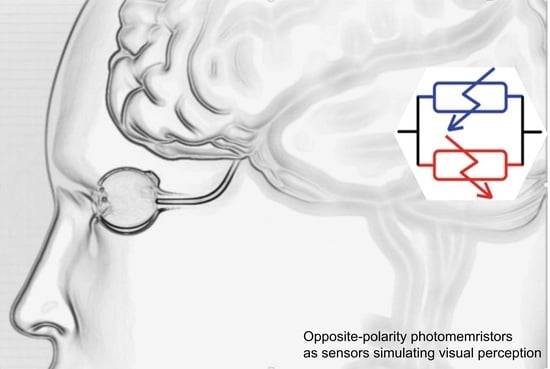
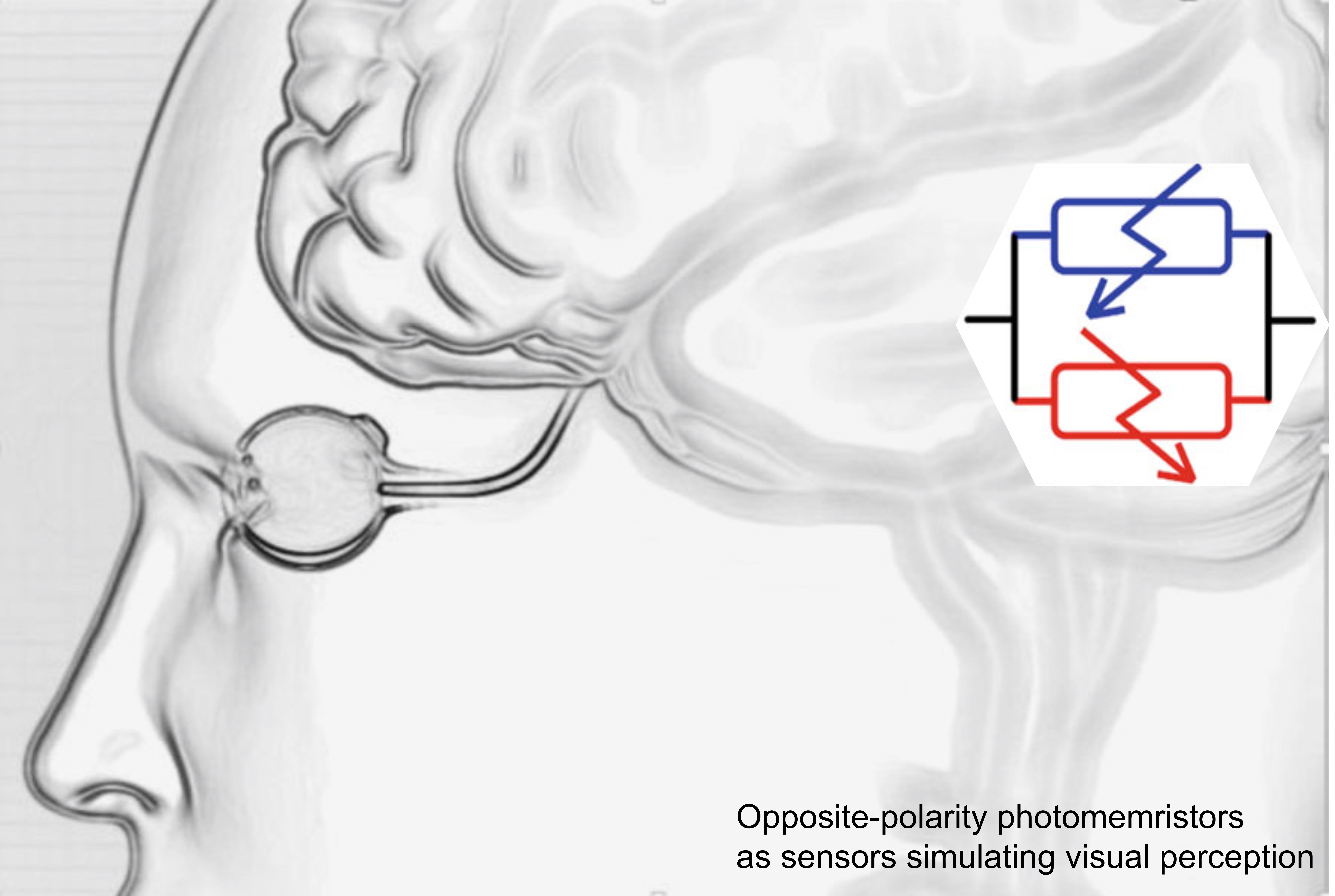
Graphical Abstract

1. Introduction

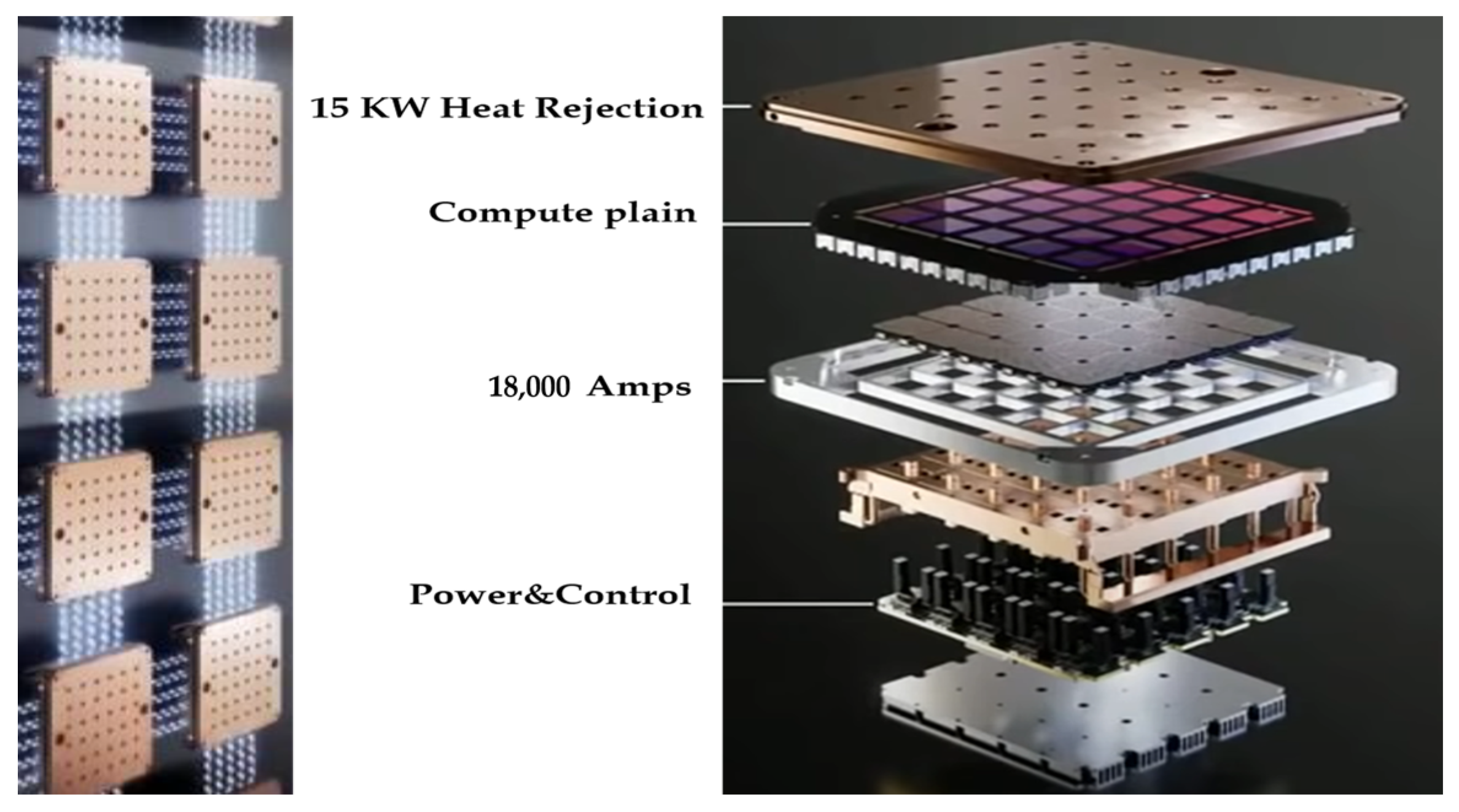
Energy-efficient processing of big data is currently becoming a key parameter determining the ability of artificial intelligence (AI) systems to obtain information, especially when performing information recognition tasks in real time. In 2021, Tesla introduced an artificial intelligence system for autopilot based on an advanced transistor processor, DOJO, for detecting and recognizing visual information on the road in real time [1]. The processor, manufactured using 7 nm CMOS technology with a set of 3000 D1 boards (Figure 1), performs 1.1 EFLOPs (~1018 operations per second) and consumes 45 MW [2], which is comparable to the electricity generation of a modern power plant.
The annual power consumption of the power generated, for example, by all power plants in the Unified Energy System of Russia, is ~160,000 MW [3]. These data indicate the extremely high energy consumption of modern computing systems when processing big data and the need to develop a more energy-efficient component base and architecture for visual information processing systems using artificial intelligence.
Classical von Neumann computing architecture faces significant challenges, including latency and high-power consumption when transferring data between memory and the processor [4]. Computing systems are severely constrained in power consumption due to cooling issues and the widespread use of mobile computing devices [5]. Even at the relatively old 45 nm complementary metal oxide semiconductor (CMOS) node, the cost of multiplying two numbers is orders of magnitude lower than that of accessing them from memory [6]. The current approaches, such as the use of hundreds of processors in parallel (for example, graphics processing units [7] or application-specific processors [8,9] that are custom-designed for specific applications, are unlikely to fully solve the data movement problem.
In the von Neumann architecture, the memory hierarchy can be divided into three levels based on response time [4]. The first level is the registers and caches within the central processing unit (CPU), which is realized by static random-access memory (SRAM) technology made of logic transistors with a typical six-transistor (6 T) configuration. SRAM is the fastest memory with a typical read/write time of less than 1 ns and unlimited endurance, but has low area density due to the 6 T cell configuration. The second level is main memory utilizing dynamic random-access memory (DRAM), where the DRAM cell has a 1-transistor 1-capacitor (1T1C) structure. DRAM has a much higher area density than SRAM because of the 1T1C cell structure, but it needs periodic refreshing because of the charge loss in the capacitor. Both SRAM and DRAM are volatile memories where the information will be lost once the power is off. The third level of the memory hierarchy is storage, including solid-state drives (SSDs) and hard disk drives (HDDs). Therefore, non-volatility is required to avoid data loss when the power is off. Three-dimensional NAND flash memory technology is currently the dominant non-volatile memory technology for data storage applications due to its high density and low cost.
The performance of modern big data processing systems is limited by the process of transferring data between the CPU and memory due to three main factors [6,10,11]: high energy consumption, in which more than 50% of the power consumption is on data movement; low bandwidth, where the bandwidth inside the memory chip is 100 times greater than the bus between CPU and memory unit (DRAM and SSD); and high latency, where memory access to storage in the SSD or HDD is much slower than that of SRAM or DRAM. There are a few promising approaches to overcome this data transfer bottleneck [4]. One approach is to develop new embedded non-volatile memory (eNVM) technologies to replace DRAM and SRAM for certain applications. The leading emerging eNVM technologies include spin-transfer torque magnetic random-access memory (STT-MRAM), phase change random-access memory (PCRAM or PCM), resistive random-access memory (ReRAM), and ferroelectric field-effect transistors (Fe-FETs). Another approach is to develop new computing architectures near or in the memory, such as neuromorphic computing, to avoid or minimize frequent memory access. Emerging non-volatile memories such as ReRAM, PCM, and Fe-FETs are good candidates for neuromorphic computing applications because of their small cell size and potential to store multiple synaptic weights.
In-memory computing has become a promising architecture that allows computing operations to be performed within memory arrays and overcomes the limitations of classical architecture. The memristor proposed by Leon Chua [12,13,14] has attracted considerable attention in recent years as a key component for in-memory computing due to its simpler two-electrode structure, which allows for high-density arrays, fast response time, and the ability to mimic biological synapses for the development of neuromorphic computing and efficient solution of problems related to artificial intelligence. Memristor nanostructures have been demonstrated in a number of studies [15,16,17,18,19,20,21,22,23,24,25]. Quasi-one-dimensional ZnO nanorods doped with Li, Fe (Mn) have been shown to possess memristor properties, demonstrating two charge states controlled in an electric field [15] and two spin states controlled in a magnetic field [16]. Hysteresis in the magnetization curves of doped ZnO nanorods with changing magnetic fields indicates the formation of two non-volatile ferromagnetic spin states that persist up to room temperature and can be switched with very low energy consumption. This allows the non-volatile charge and spin states to be recorded and read out in electric and magnetic fields, respectively [17]. Memristive properties have been shown to arise naturally in nanoscale systems in which solid-state electron and ion transport are coupled under the influence of an external bias voltage [18] and are observed in many nanoscale electronic devices [19,20,21,22,23,24,25] that involve the motion of charged atoms and particles, particularly in titanium dioxide-based memristors [18]. Among these devices, memristor arrays based on 2D materials have emerged as particularly promising candidates for next-generation in-memory computing to implement array- and system-level neuromorphic computing due to their exceptional performance, which stems from the unique structural and optoelectronic properties of layered low-dimensional materials.
This review aims to survey the development of memristors and photomemristors based on graphene-family materials, which are structurally similar to graphene and are known for their 2D layered structure capable of rapidly transforming under external forces, with a particular emphasis on the underlying mechanisms (e.g., sp2-sp3 hybridization, photoinduced phase transitions, and interfacial redox reactions) and their application towards in-sensor neuromorphic vision. Significant findings from the author’s collaborative work are discussed in detail to illustrate these principles, as well as competing mechanisms and systems being explored in this rapidly developing area of efficient and fast big data processing.

2. Machine Vision Technology

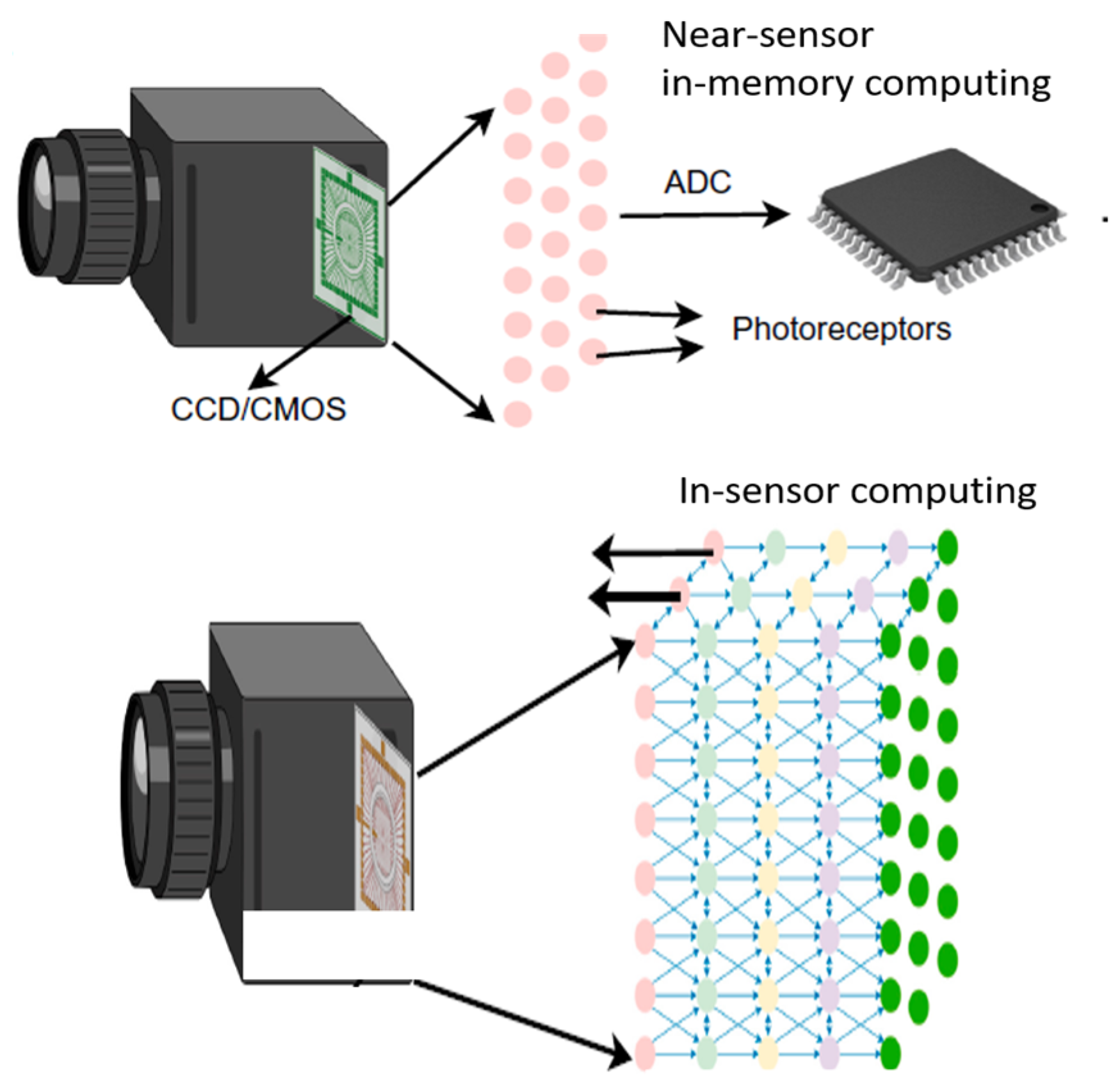
Conventional machine vision technology is based on the von Neumann digital architecture, in which the sensor, memory, and computing units are separated. Sensors generate large amounts of visual data. Moving this data between sensors, memory, and processor, often redundant for a specific recognition task, results in high power consumption and long latencies. Memristors and photomemristors with non-volatile memory, capable of performing computations in memory near the sensor (Figure 2, top) and computations inside the sensor (Figure 2, bottom), make it possible to combine memory and processor, as well as sensor, memory, and processor, to create more energy-efficient, compact, and fast machine vision systems.

3. Graphene-Based Memristive Nanostructures

Memristive nanostructures based on graphene and related materials have been demonstrated in a number of studies [26]. It has been shown that memristive states can be formed in nanostructures based on graphene/graphene oxide [27,28] as well as bigraphene/diamane [29], which are well controlled by changing the sp3-sp2 hybridization of carbon atoms in an electric field at relatively low bias voltages (<1 V), which is very promising for energy-efficient computing and biocompatible heteromorphic systems.
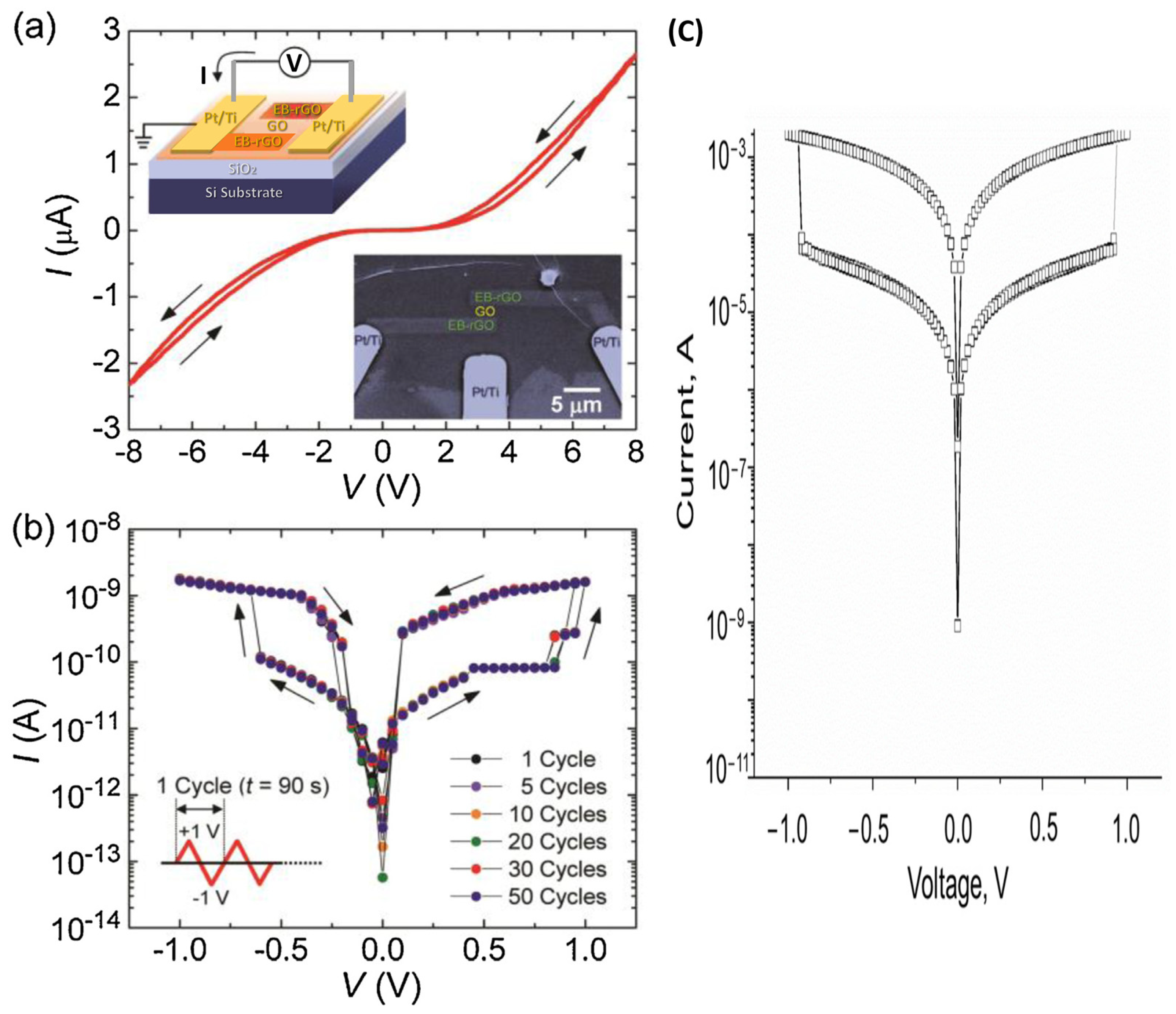
Memristive heterostructures, composed of reduced graphene oxide (rGO) with different degrees of reduction, were demonstrated through a simple method of “direct electron-beam writing” on graphene oxide (GO) [28]. Irradiation with an electron beam at various doses and accelerating voltages made it possible to define high- and low-conductivity GO areas. The electron-beam-reduced graphene oxide (EB-rGO)/GO heterostructure clearly exhibited a nonlinear behavior and a well-controlled resistive switching characteristic at a low operating voltage range (Figure 3).
EB-rGO/GO/EB-rGO heterostructures were fabricated by a one-step process using “direct electron-beam writing” of GO, which had been spin-coated onto the Pt prepatterned SiO2/Si substrate (Figure 3a). Electron-beam irradiation resulted in electron-stimulated reduction in GO (i.e., formation of EB-rGO), and the conductivity of EB-rGO could be controlled by changing the irradiation dose of the electron beam. The laterally arrayed two-dimensional memristive heterostructure was created by local reduction in GO through “direct electron-beam writing” of EB-rGO stripes. The device clearly showed stable resistive-switching with a high-resistance states/low-resistance states ratio by two orders of magnitude at low operating-voltage ranges of 0.8–0.9 V over many cycles (Figure 3b). The results provide a new avenue for the non-thermal and non-lithographic fabrication process without masking (i.e., local electron-beam reduction in GO), particularly in search of prospective low-dimensional electronic device schemes such as brain-like low-power memristive and neuromorphic computation systems.
Memristor heterostructures composed of bilayer graphene and 2D diamond (diamane) were demonstrated based on the bigraphene-diamane structural phase transition locally formed in LGS/bigraphene/PMMA under electron beam irradiation [30]. It was found that electron beam irradiation resulted in nonlinear charge carrier transport behavior and a significant increase in the resistance of bigraphene, which was attributed to the bigraphene-diamane structural phase transition due to the formation of sp3-carbon bonds in hydrogen-treated bigraphene, as predicted [31]. Hydrogen atoms on both sides initiate the “adhesion” of carbon atoms located one above the other in adjacent layers. C2H diamane has been shown to be more stable than CH graphane and has a direct band gap of 3.12 eV (2.94 eV) [31]. It was shown that the resistive switching of the bigraphene/diamane nanostructure is well controlled using low bias voltage (0.9 V) (Figure 3c). The resistive switching behavior was attributed to the migration of oxygen-related groups, leading to the restoration of sp2 carbon bonds in the bilayer graphene [29]. The nanostructures exhibit resistive switching from a high-resistance state (HRS) to a low-resistance state (LRS) with an HRS/LRS ratio of more than an order of magnitude (Figure 3c) and good reproducibility of HRS and LRS. This correlates well with the decrease in conductivity of nanostructures with sp2-carbon bonds upon the formation of sp3 bonds in them [32].
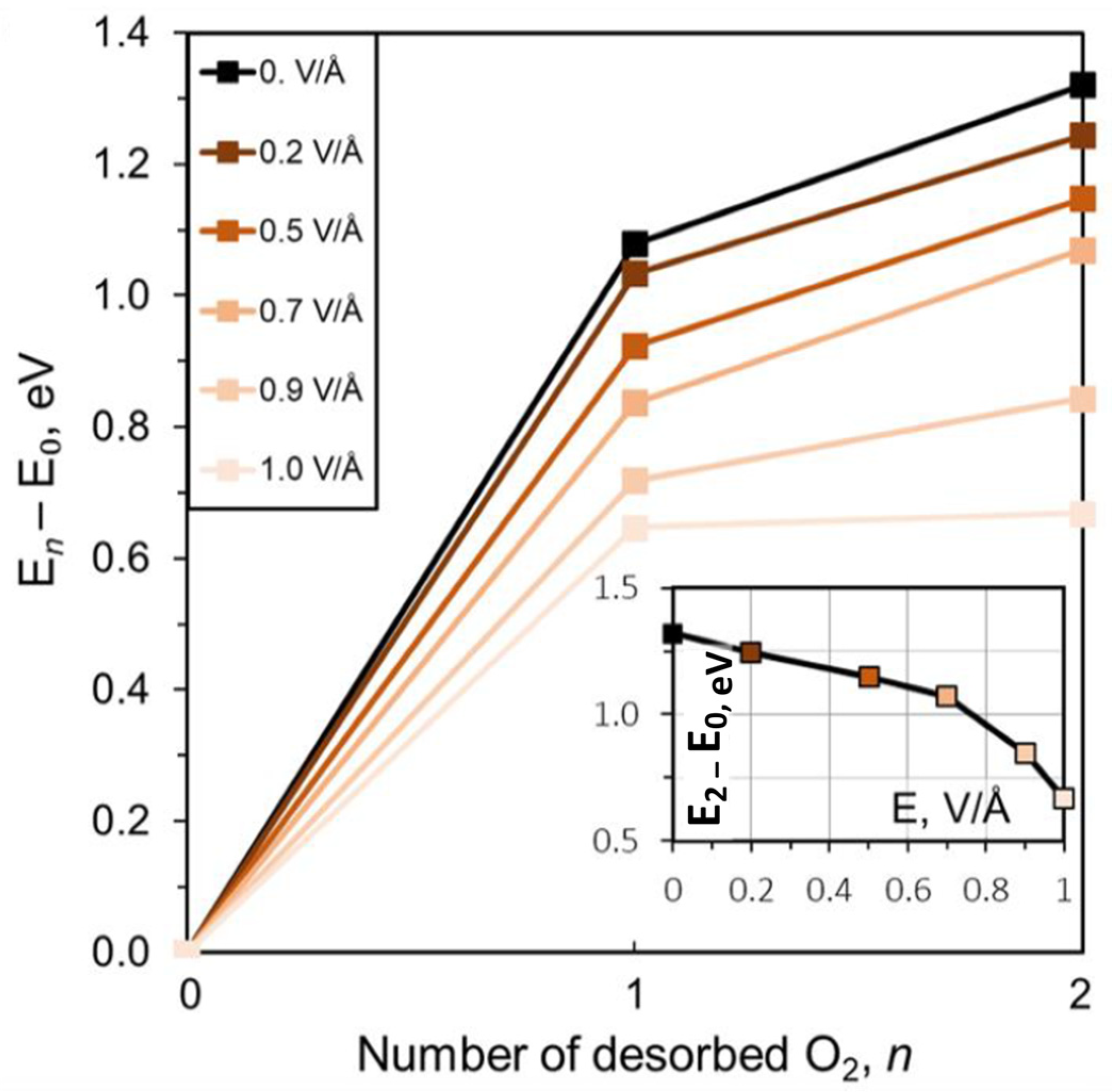
Modeling of the bigraphene-diamane nanostructure in an electric field shows that a 1 nm wide diamane layer is thermodynamically stable, and an electric field of ~107 V/cm2 leads to a decrease in the splitting barrier [29]. In an electric field of ~108 V/cm2, the barrier decreases by a factor of two (Figure 4). The reaction of C-O bonds to an electric field is explained by their high polarity.
This correlates well with the obtained experimental data, which indicate nanocluster formation of diamane and switching of structures at voltages of the order of 1 V (Figure 3c). The diamane layer < 1 nm is exfoliated into bilayer graphene. At a layer width of >1 nm, the barrier for splitting diamond clusters increases from 0.7 eV/O2 to 2.4 eV/O2. These data indicate the possibility of controlling memristive states in bigraphene/diamane structures of 1 nm in size.
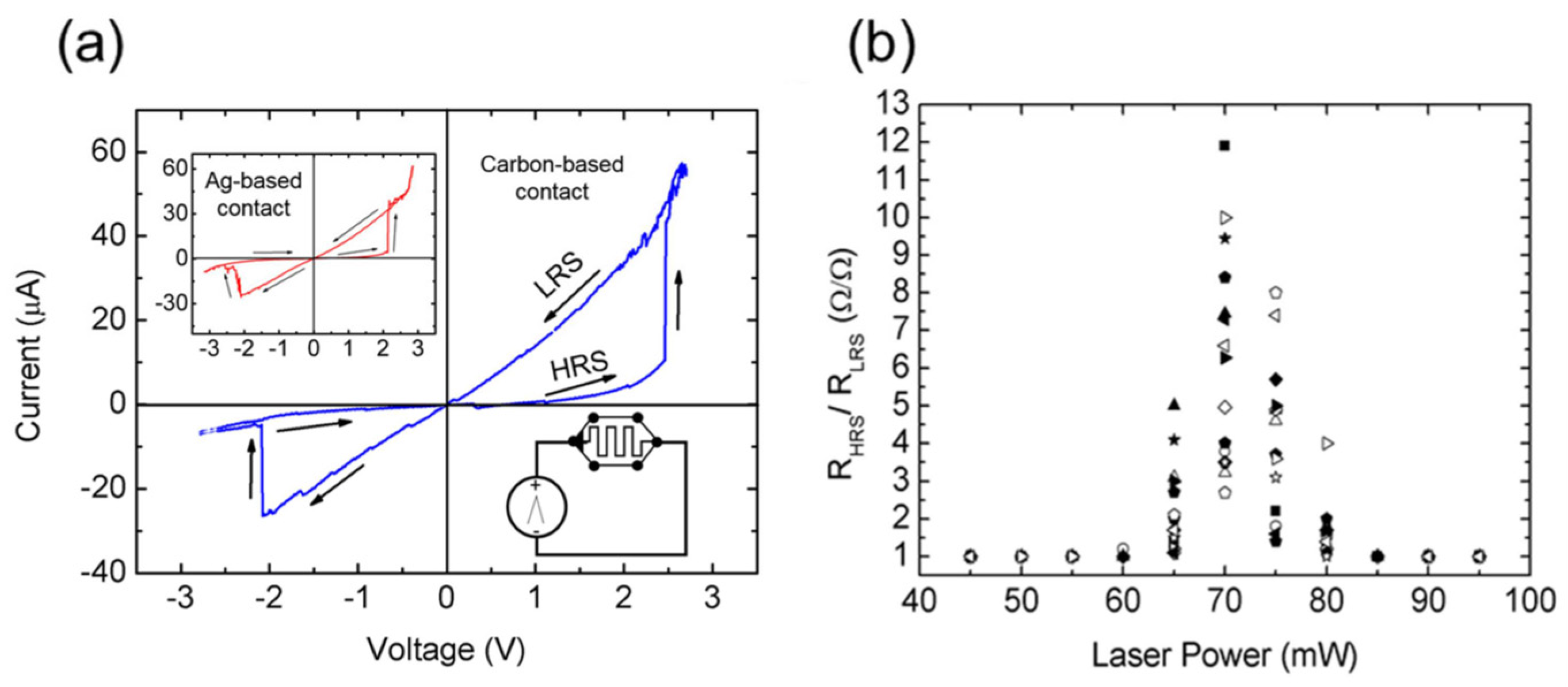
GO-based memristors fabricated by local laser-assisted photothermal reduction were also demonstrated [33]. Typical current-voltage characteristics are shown in Figure 5a for a memristor lithographed at a laser power of 70 mW.
As can be seen, the device exhibits the characteristic features of a bipolar memristor, corresponding to a closed hysteresis loop. Figure 5a identifies two resistive states of the device, exhibiting an initial-cycle resistance of R = 896 kΩ and R = 75 kΩ in the high- and low-resistance states, respectively. The top inset of Figure 5a shows an example of another device with a silver electrode. As can be seen, the device exhibits similar memristor hysteresis. This contact independence of the memristor resistance indicates that the underlying resistive switching mechanism is not related to metal electrodes and is explained by the drift of oxygen-containing functional groups changing the local stoichiometry of the r-GO layer. Low-resistance conductive pathways are formed in the bulk of the material when sp3 domains are converted to sp2 carbon domains. The sp3 domains can be restored by reverse polarity, and these mechanisms are likely triggered by dissipative effects and maintained by an electric field.
The resistance ratio of GO memristors fabricated at different laser powers is shown in Figure 5b. The highest resistance ratio, measured in the high- and low-resistance states of a GO memristor array formed by laser lithography, was observed for devices fabricated at laser powers ranging from 65 mW to 75 mW. These results showed that after adjusting the intensity of the photothermal process, the devices exhibited pronounced and stable memristor resistance. Thus, this fabrication technique may represent a high-performance approach for creating memristor circuits. A lateral Pt/GO/rGO memristor fabricated using direct laser writing technology, with rGO and platinum as electrodes and GO as the functional material, demonstrated ultralow power consumption of 200 nW and typical synaptic behavior [34].
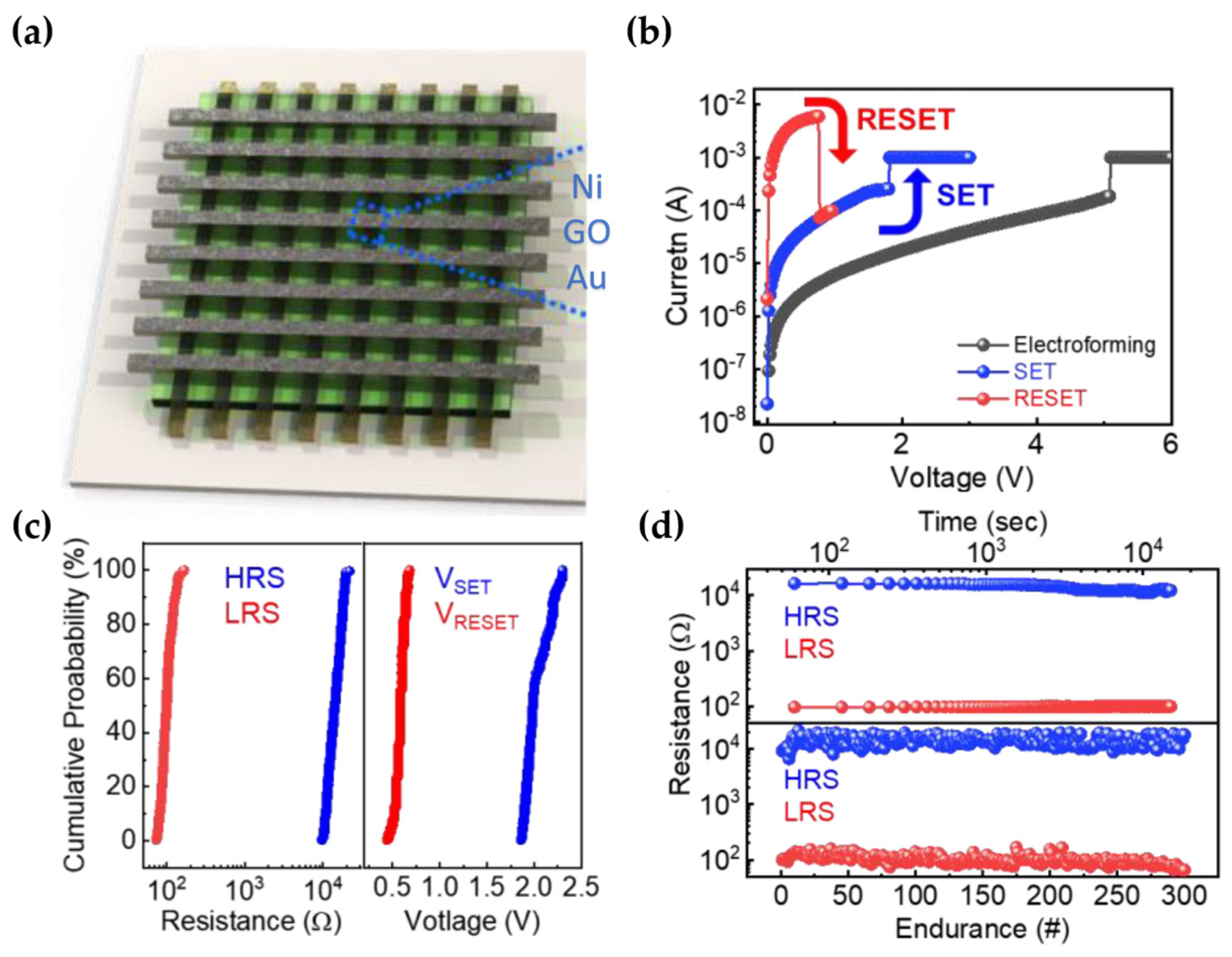
Using a GO nanosheet-based memristor, the feasibility of a non-volatile logic-in-memory circuit that enables normally off in-memory computing was demonstrated [35]. The fabricated GO based memristor showed unipolar resistive switching with an on/off ratio (>102), reliable endurance, retention, and uniform resistive switching due to its pure film characteristics (Figure 6). Based on its temperature- and area-dependent resistance characteristics, the operational principle of the Ni/GO/Au memristor was associated with the reversible formation and rupture of the Ni filament.
Using the GO-based memristor, it was possible to implement basic Boolean functions such as NOT, NOR, OR, AND, and NAND logic gates using the MAGIC logic architecture [35]. These results demonstrate that the GO-based memristor can be used to implement a much more complex, integrated logic-in-memory circuit. The memristive logic-in-memory circuits using the MAGIC architecture have two main advantages compared to conventional complementary metal oxide semiconductor (CMOS) logic circuits. First are the non-volatile characteristics of the memristor device, which enable logic computation and memory function on the same device. This logic-in-memory operation can realize the standardized logic circuit with ultralow dynamic power and a short interconnection delay compared to CMOS circuits. The extended length of the global interconnection in the advanced very large-scale integrated circuit (VLSI) is detrimental to the CMOS circuits, leading to an increase in dynamic power consumption and RC delay [36]. Moreover, the non-volatile logic-in-memory circuit can achieve the static power consumption of 0 W during standby mode, whereas the CMOS circuits composed of the volatile transistor suffer from the subthreshold leakage current. The second is a sequential cascading operation with reconfigurability. The memristive logic-in-memory circuit can implement logic circuits with a much smaller area compared to the CMOS circuit, in which logic circuits depend on the specific gate topology to realize a specific logic function. Thus, the GO-based memristive logic-in-memory circuit can overcome the limitations of conventional von Neumann architecture and efficiently perform large-scale data processing for Internet of Things and AI applications.

4. Photomemristive Nanosensors

4.1. Photomemristor

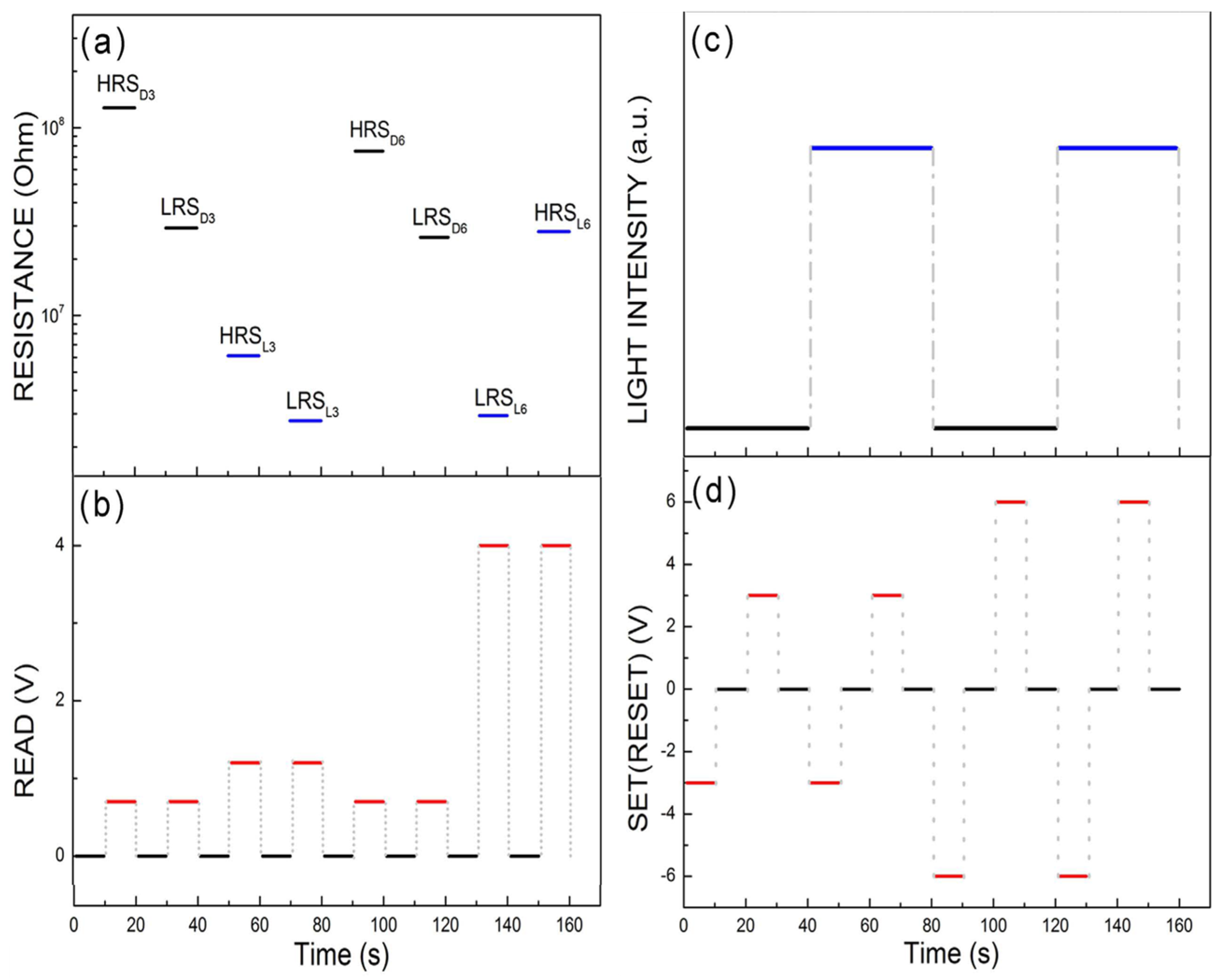
In 2016, a MoS2-based photomemristor was proposed that allows photodetection, as well as recording and reading of photomemristive states in the photodetector itself [37]. The formed HRS and LRS are energy-independent and are controlled by light under bias voltage (Figure 7).
The memristor polarized at 3 V exhibits the four states, which are read as HRSD3, LRSD3, HRSL3, and LRSL3, while the memristor polarized at 6 V shows the other four states HRSD6, LRSD6, HRSL6, and LRSL6, which can be read in the dark or under white light (Figure 7a–d). A nanosensor based on photomemristors can detect and process optical signals in the sensor itself, similar to the processing of visual information in the retina of the eye [38,39,40]. This allows for a significant increase in energy efficiency and the speed of processing optical information, as well as the creation of compact autonomous neuromorphic broadband nanosensors similar to biological vision.

4.2. Biological Detection and Processing of Visual Information

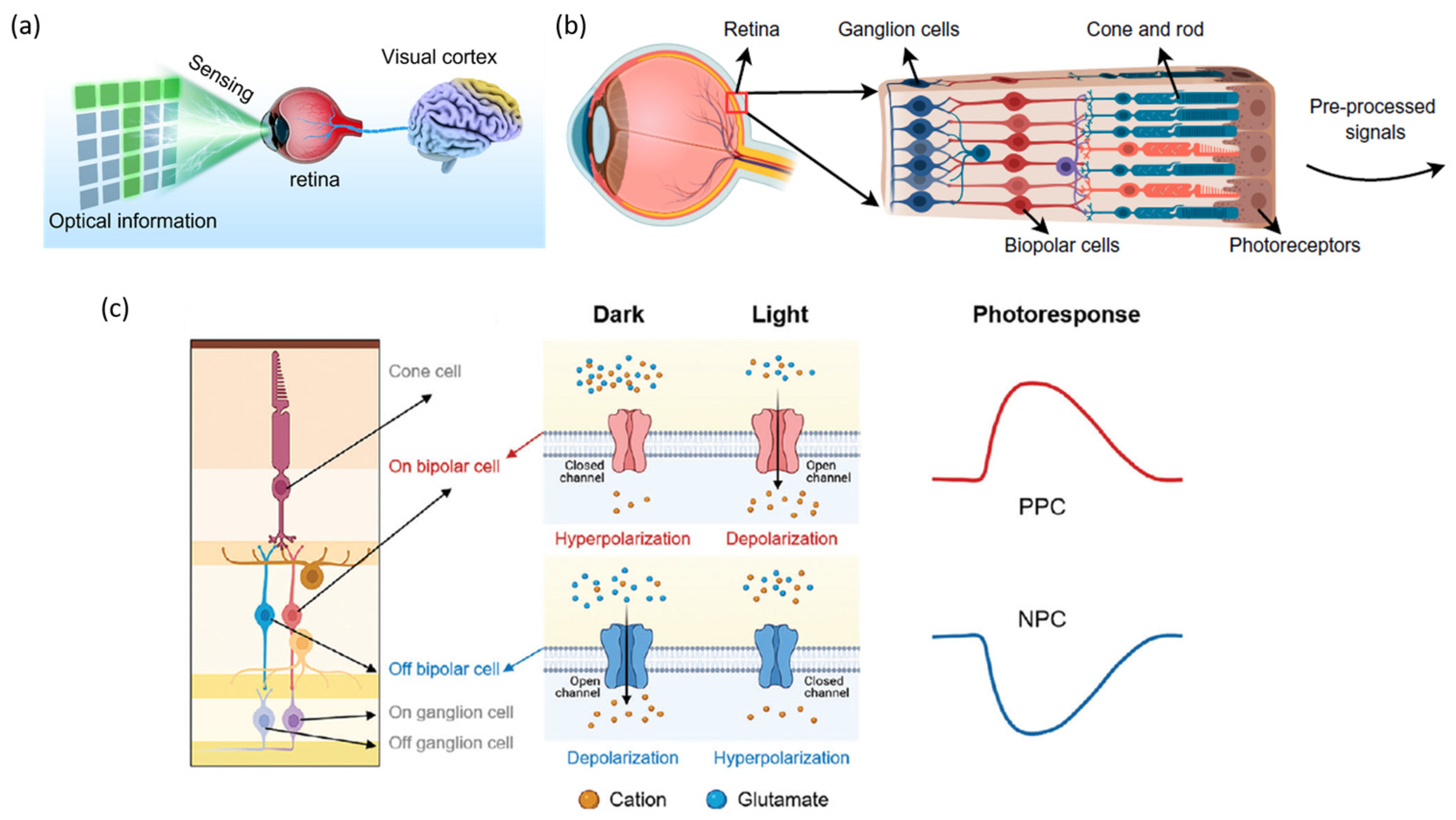
Detection and preprocessing of optical information in the biological vision system occur in the retina of the eye, which is photosensitive and can detect visible light, translate optical signals into electrical signals, and process them before transmitting them to the visual cortex of the brain (Figure 8). The retina consists of ganglion cells, bipolar cells, cones, rods, and photoreceptors, which generate signals for classifying and recognizing images.
An important feature of the biological retina is the bipolar photoresponse of bipolar cells. Depolarization of cells by light leads to a change in the sign of the photoresponse. This allows controlling the optimal photosensitivity of the retina for effective recognition of objects under different illumination conditions.

4.3. Graphene/Chalcogenide Nanosensors

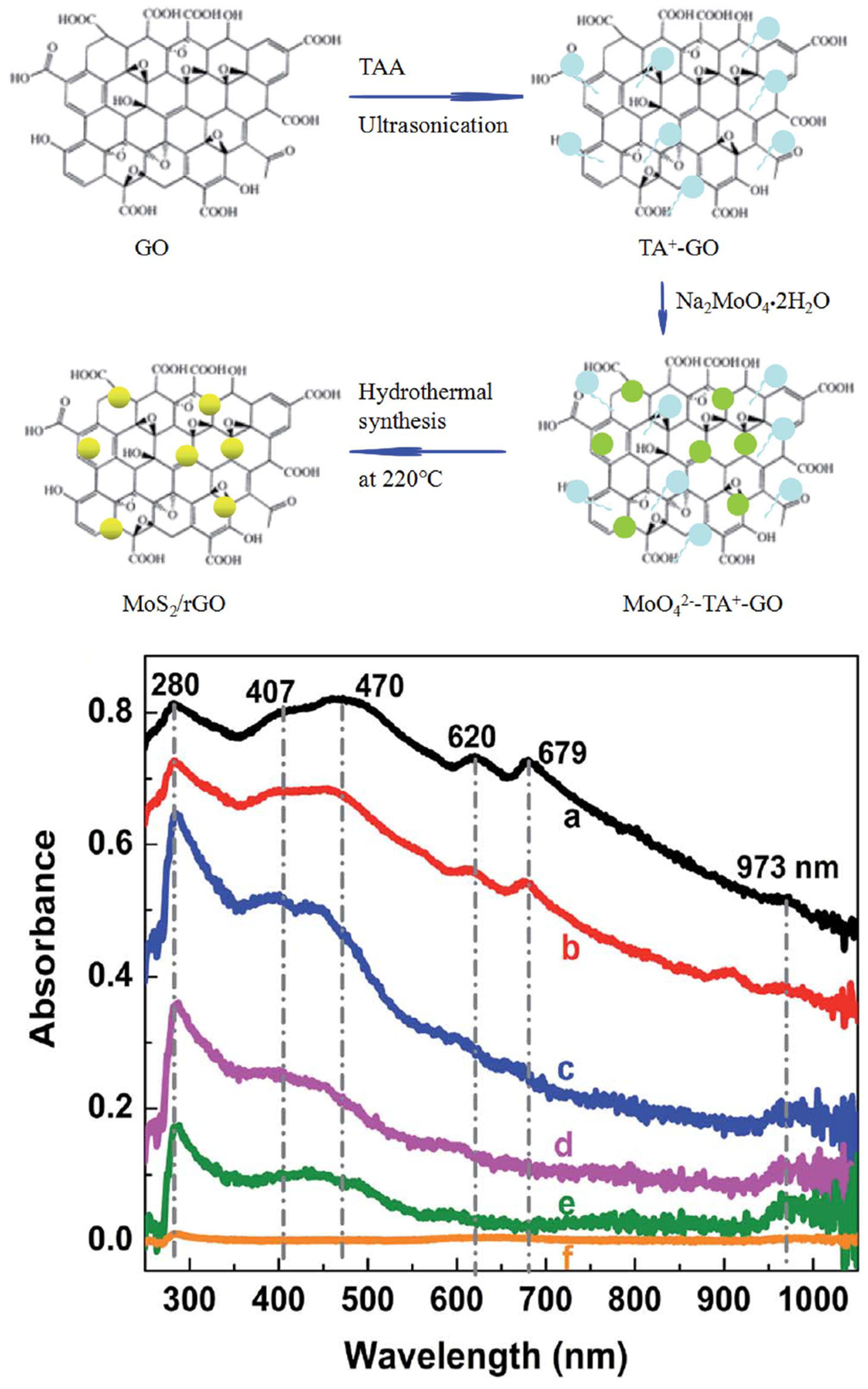
Nanosensors based on 2D/0D graphene/chalcogenide crystals have high sensitivity over a wide spectral range. MoS2/GO nanostructures absorb light from ultraviolet (UV) to infrared (IR) radiation [41]. The quantization effects in self-assembled MoS2/rGO composite structures obtained by ultrasound-assisted hydrothermal synthesis depend on the degree of GO reduction and the size of quantum dots (QDs) of these crystals, which leads to a change in light absorption in the range from 280 to 973 nm (Figure 9).
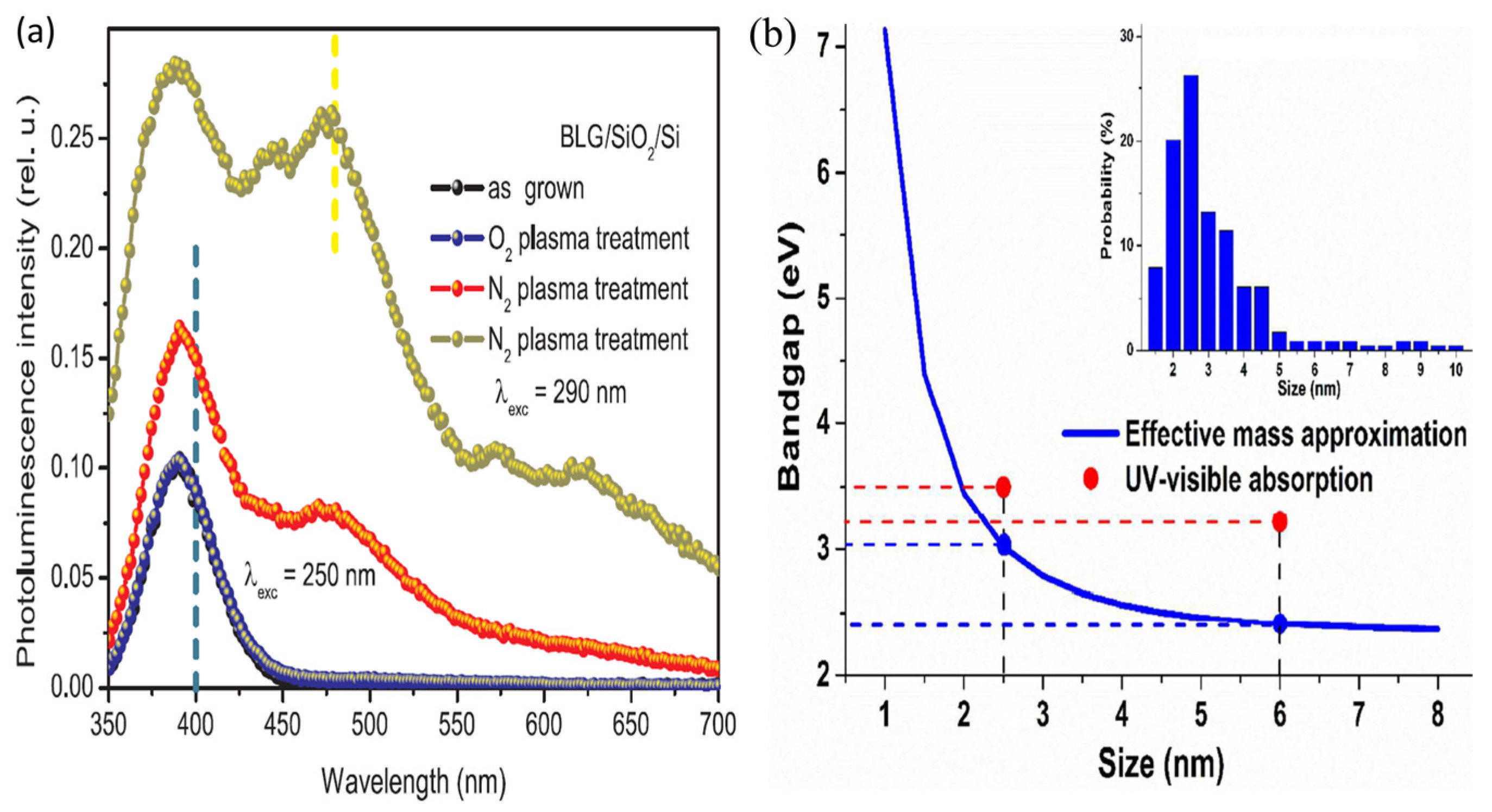
Functionalization of bilayer graphene by plasma treatment leads to the formation of QDs with broadband absorption and luminescence at 390, 475, and 610–620 nm [42] (Figure 10a).
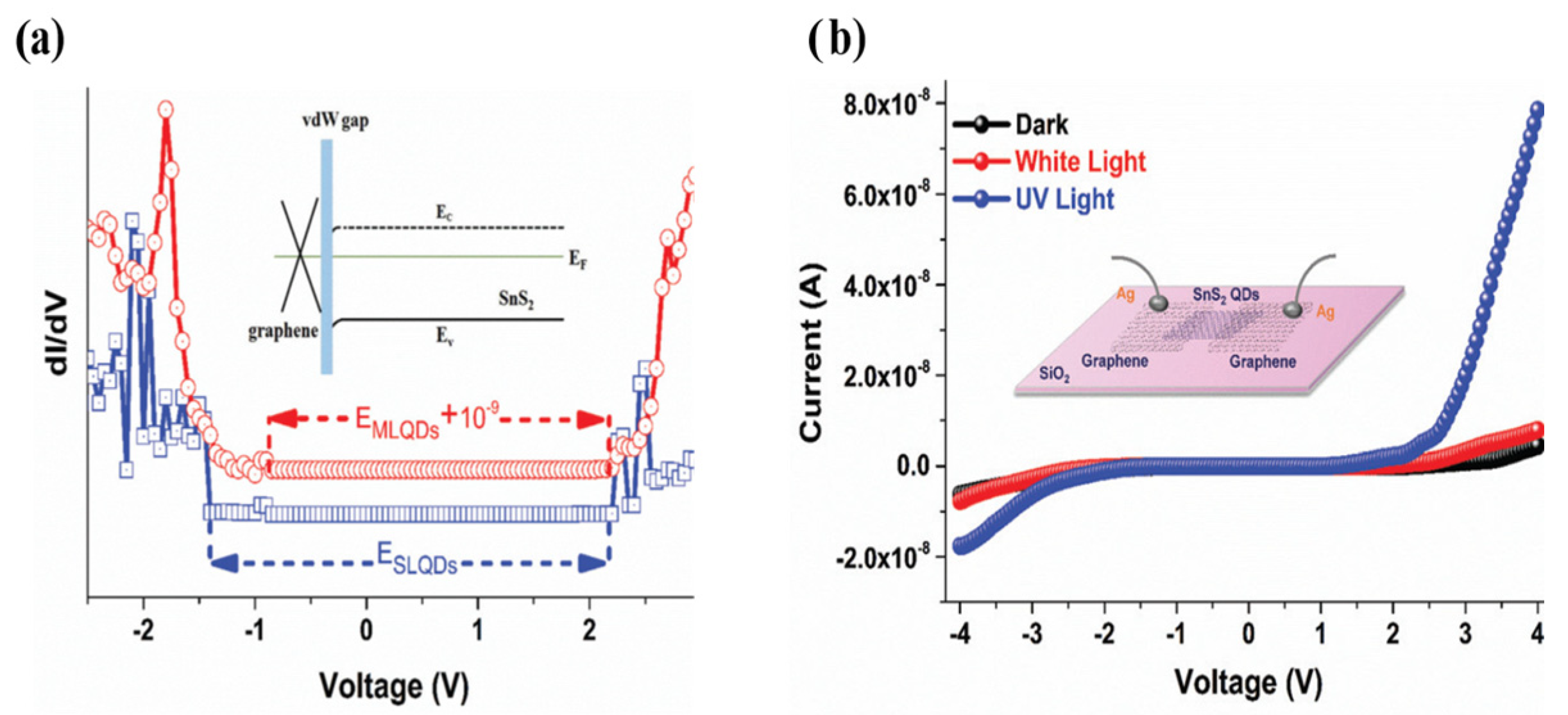
The use of SnS2 QDs with sizes from 6 to 2.5 nm makes it possible to expand the absorption region by increasing the band gap of the QDs from 2.25 to 3.5 eV, respectively, estimated in the effective mass approximation and obtained from the UV-visible spectra (Figure 10b). To control the band gap of layered quantum dots (LQDs) of different sizes deposited on a substrate, the dI/dV—V spectra of graphene/LQDs/graphene structures were measured. The graphene template was prepared to produce a sharp probe tip, which provides a locally strong electric field with voltage applied across the van der Waals gap (vdW) [44] between the graphene probe and the LQD. This allows the band gap of the LQDs to be estimated using current-imaging-tunneling spectroscopy [45,46]. Figure 11a shows the tunneling current spectra of SnS2 multilayer QDs (MLQDs) and single-layer QDs (SLQDs) on the substrate with different QD sizes obtained using graphene probes.
The band gap of 5–7 nm MLQDs and 2–4 nm SLQDs estimated from the dI/dV—V spectra were 3.20 and 3.55 eV, respectively, which are in good agreement with the absorption data of QD dispersion [43]. The current-voltage characteristics of the graphene/SnS2/graphene photosensor under white and UV light show that the photocurrent in the structure with 2–4 nm SLQDs (Eg = 3.5 eV) is generated under UV light and is not generated under white light (Figure 11b). This indicates the generation of electron–hole pairs in SLQDs only under UV excitation. This makes it possible to produce a selective UV photodetector that is not sensitive to visible radiation. The efficiency of charge carrier photogeneration calculated based on the power law of the MLQD photodetector under UV light is significantly higher than the efficiency of the device under visible light [43]. The obtained results show that the LQDs obtained by liquid-phase exfoliation exhibit well-controlled and tunable bandgap absorption over a wide wavelength range. LQDs obtained by an inexpensive exfoliation and deposition method from solution onto various substrates at room temperature can be used to create highly efficient photodetectors and multiband optoelectronic devices. A graphene/SnxSy based optoelectronic sensor with asymmetric geometry, high sensitivity of 35 A W−1 and high detectivity of 3.4 × 1011 cm Hz1/2 W−1 was demonstrated [50].
The uniqueness of 2D crystals and layered quantum dots lies in the absence of dangling bonds on the surface, which allows them to be combined, unlike 3D crystals, with well-developed silicon CMOS technology. When growing AII BVI and AIII BV optical 3D materials on silicon, the different lattice parameters of their lattices cause electrically active defects in the interface region, which prevent the production of films with the required optoelectronic properties. The integration of CMOS integrated circuits with graphene and PbS quantum dots enables the creation of a broadband image sensor with high resolution and sensitivity in the UV, visible, and IR ranges from 300 nm to 2 μm [51].
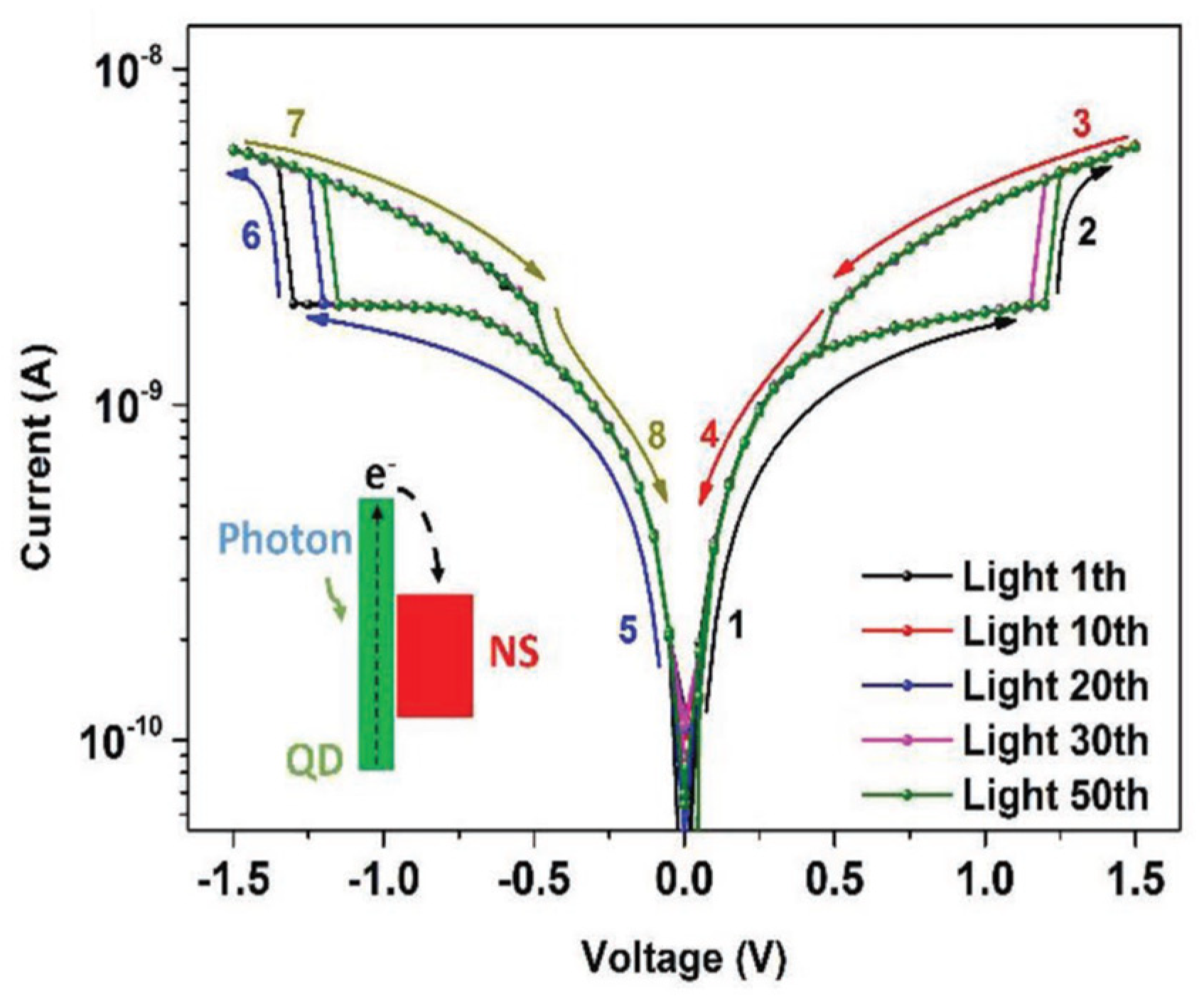
In addition to absorption in a wide range of wavelengths, 2D crystals exhibit ultrafast photoinduced phase transitions. For example, the reversible photoinduced structural transition in 2D MoS2 from the 2H semiconductor phase to the 1T metallic phase occurs in the femtosecond range [52]. Control of structural transitions in 2D MoS2 nanosheets (NS) with 0D QDs (MoS2 QDNS) (Figure 12) allows the creation of intelligent photomemristor sensors for ultrafast processing of visual information.
The distribution of QDs controls the channels of switching photoresistive states by light, the wavelength of which allows exciting charge carriers in QDs of a certain size and implementing a photoinduced structural transition [53].

4.4. Near-Sensor Computing

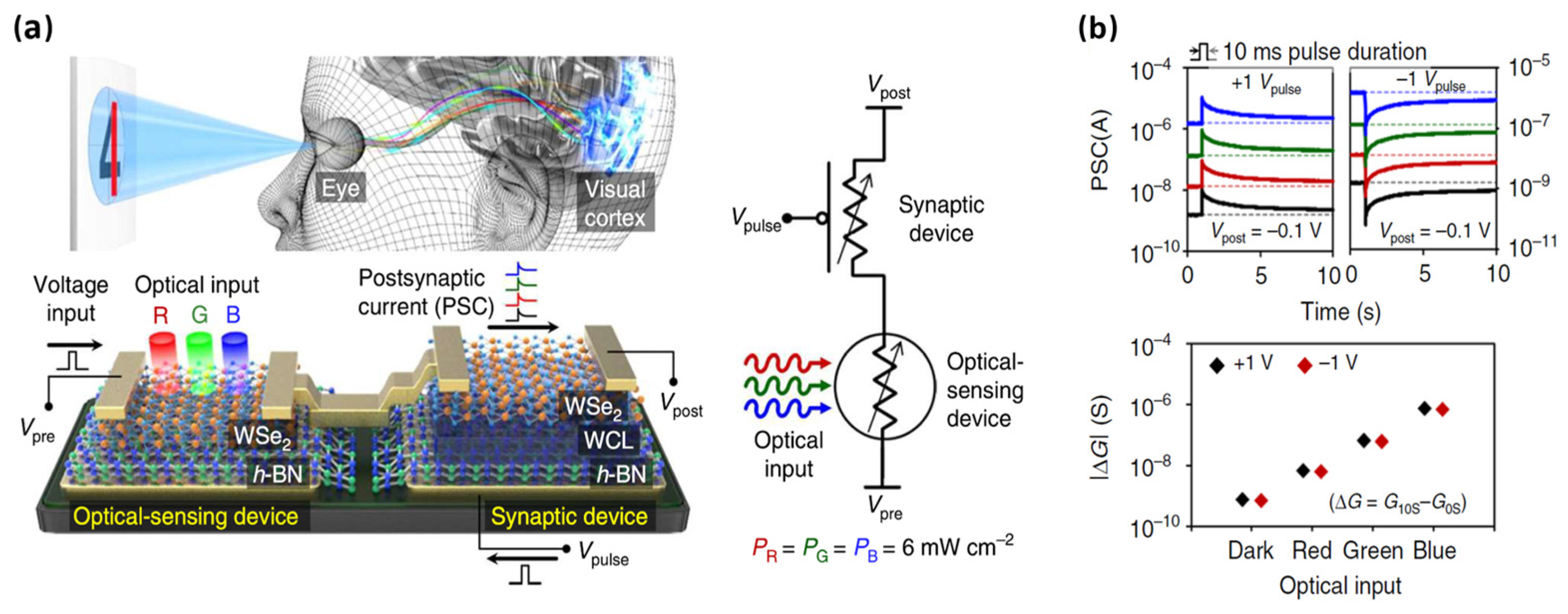
Researchers from Sungkyunkwan University, Hanyang University, the University of California, and Stanford University have demonstrated an h-BN/WSe2 optic-neural synaptic device that implements both synaptic and optical sensing functions [54]. This device mimics the color and mixed-color pattern recognition capabilities of the human vision system when embedded in an optoneural network (Figure 13).
An optic-neural synaptic device was fabricated by integrating a synaptic device with an optical sensor based on the h-BN/WSe2 heterostructure, which is capable of performing computations near the sensor (Figure 13a). The operation of the vdW synaptic device is based on the trapping or detrapping of electrons in the weight control layer (WCL) on h-BN, which modulates the WSe2 channel conductivity (weight of the synapse). The resistance of the h-BN/WSe2 photodetector is modulated depending on the wavelength of the incident radiation (Figure 13b). The synaptic device exhibits a near-linear weight update trajectory while providing a large number of stable conductance states with a variation of less than 1% per state. The device operates with low 0.3 V pulse voltages and consumes only 66 fJ per pulse [54]. This, therefore, facilitates the demonstration of accurate and energy-efficient color and mixed-color pattern recognition. This work is an important step towards creating neural networks that incorporate neural perception and learning capabilities to recognize more complex images.

4.5. In-Sensor Computing

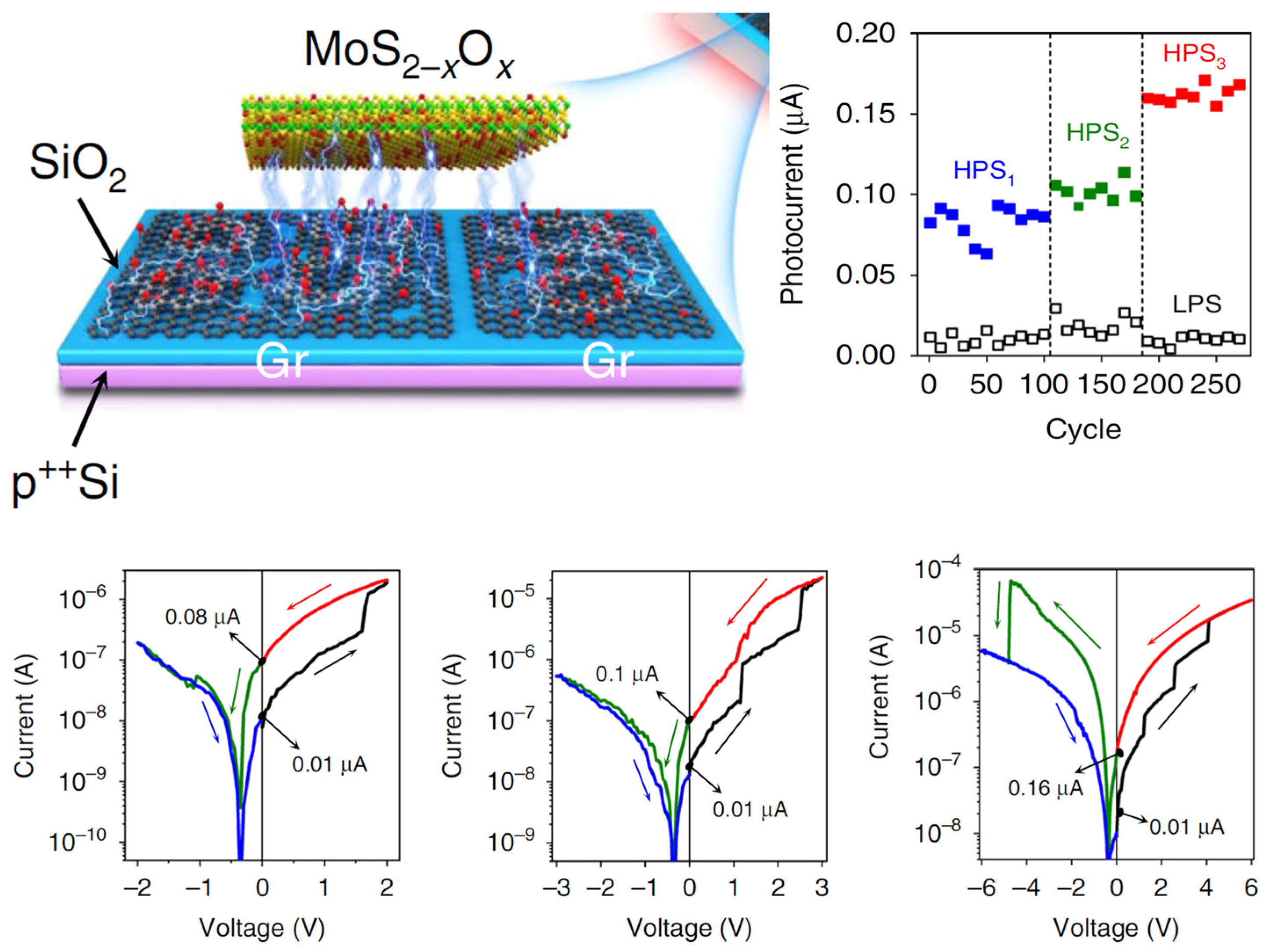
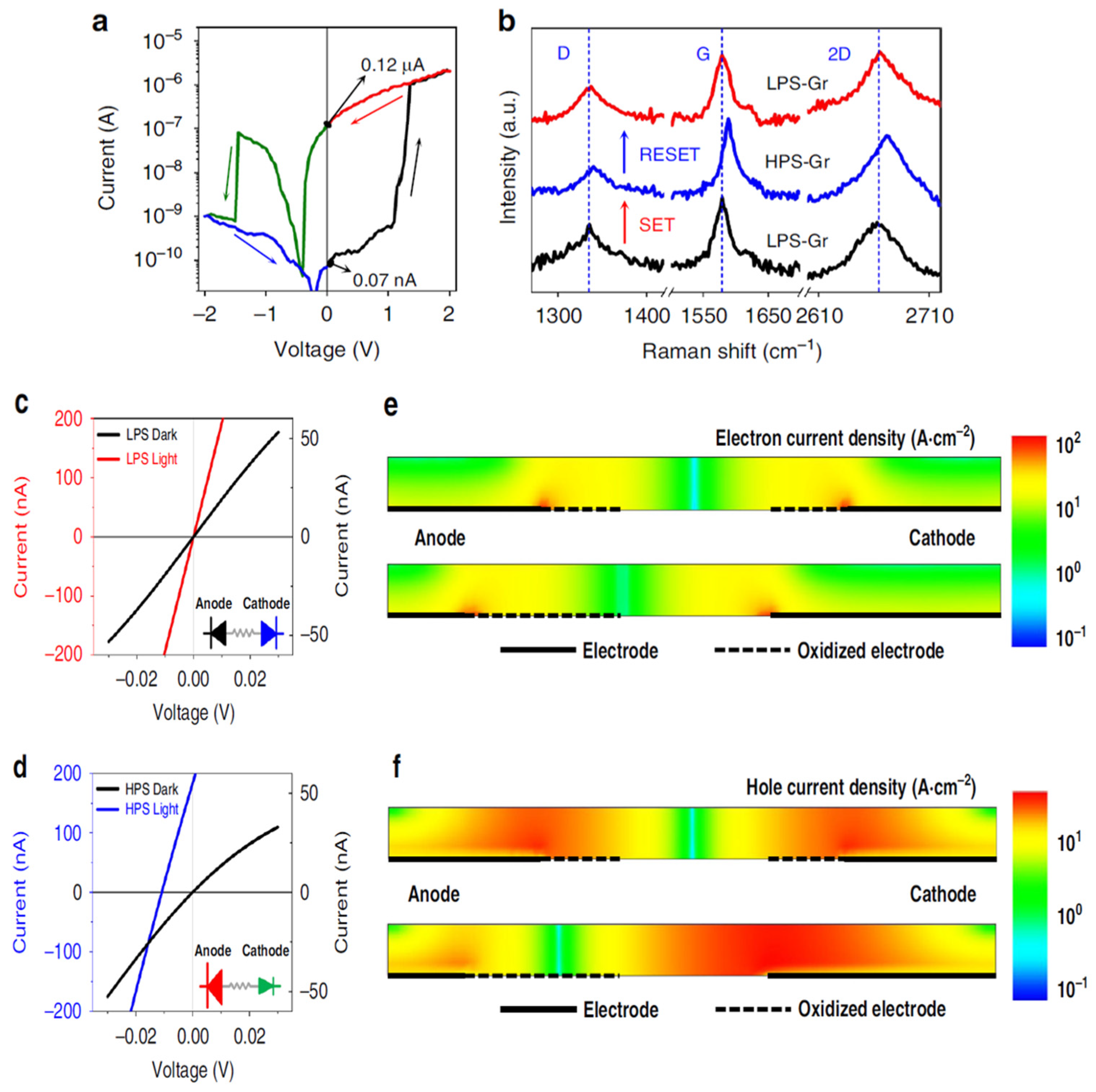
An original approach to processing visual information was proposed by a group of researchers from the Hangzhou Institute of Advanced Studies, the Shanghai Institute of Technical Physics, the Institute of Intelligent Machines, and the Institute of Microelectronics Technology [55]. The possibility of forming and controlling non-volatile photoconductance states in low-dimensional structures by exciting them with light in an electric field, which leads to a change in mem-photoconductivity and mem-photosensitivity, was demonstrated. The non-volatile photoresponse states in the G/MoS2−xOx/G photomemristor made it possible to form them without a very large change in resistance, similar to analog ones, with multiple states that can be read optically at zero bias voltage. Graphene/MoS2−xOx/Graphene (G/M/G) photomemristor structures were fabricated using MoS2 nanocrystals (NCs) and CVD-grown graphene as electrodes. MoS2 NCs were obtained by the liquid-phase exfoliation (LPE) method. The MoS2 NCs were oxidized during deposition to form a p-type MoS2−xOx thin film in contact with graphene electrodes with asymmetric geometry (area ratio (SC2:SC1) ≈ 3.5, MoS2−xOx thickness ≈ 200 nm) [55]. Figure 14 shows the G/M/G nanostructure with asymmetric electrodes and the switching characteristics of the multilevel photoresponse under different bias voltages.
When a two-terminal asymmetric G/M/G photomemristor was illuminated with white light (~56 mW cm−2), a photovoltaic effect with a photocurrent (IL) to dark current (ID) ratio of ~103 was observed [50,55]. Figure 14 (bottom left to right) shows the I-V switching characteristics of the photocurrent from 0.29 to 1.23 μA at a SET voltage of 1.60 V during a voltage sweep from 0 to 2 V. When the bias voltage changes from 2 V to −2 V, the device switches from the high photoresponse state (HPS) to the low photoresponse state (LPS) at a RESET voltage of −1.05 V, demonstrating non-volatile photoresponse memory. Interestingly, the device generates photocurrent without bias voltage due to the asymmetric G/M/G contacts, which allows reading different values of LPS (0.01 μA) and HPS1 (0.08 μA) without bias voltage. Increasing the voltage to 2.45 V and 4.05 V results in sequential switching of HPS at 0 V bias to 0.1 μA and 0.16 μA, respectively. Figure 14 (top right) shows the photocurrent reading data at 0 V bias voltage with a photocurrent on/off ratio of about 10 for hundreds of cycles.
To investigate the switching mechanism of the non-volatile photoresponse states, the optoelectronic properties of the photomemristor and the Raman spectra of the photomemristor nanostructure were investigated, and TCAD modeling was performed. Figure 15a shows the current-voltage characteristics of the nanostructure.
The photocurrent switches from LPS to HPS at a SET voltage of ~1.2 V and from HPS to LPS at a RESET voltage of ~−1 V. Figure 15b shows the cathode Raman modes measured when the device was switched from LPS to HPS. The ID/IG ratio decreased from 0.51 to 0.33, and the positions of the G and 2D bands exhibit redshifts of 9 cm−1 and 7 cm−1, respectively. This change in the Raman modes indicates the reduction in graphene [56,57]. After the RESET operation, the ID/IG ratio increased to 0.49. In this case, a blue shift in the G and 2D bands was observed, demonstrating the oxidation process [56,57,58]. The increase (decrease) in the photocurrent of the photomemristor nanostructure is accompanied by the reduction (oxidation) of the cathode electrodes, indicating that the photosensitive switching is correlated with reversible redox reactions at the MoS2−xOx/G interface. Such a reversible redox process at a given potential is observed only under illumination. Resistive switching in the dark requires a higher voltage of ~12 V [55]. Reversible oxidation (reduction) of graphene (graphene oxide) leads to a finer tuning of the reversible photoresponse due to a decrease (increase) in the mobility of charge carriers by more than an order of magnitude [56]. In addition, the conductivity of CVD graphene decreases as the oxidation state increases. This changes the collection efficiency of photoexcited carriers at the cathode and anode.
The relationship between the photoresponse states and the redox process on graphene electrodes was investigated by TCAD simulations (Figure 15e,f). The G/M/G nanostructure is represented as two back-to-back Schottky diodes connected in series (Figure 15c,d). With an increase (decrease) in the effective contact size, the resistance of the corresponding diode decreases (increases) [50]. The dark current is symmetric with the symmetric oxidation state of the cathode and anode (Figure 15c, black curve). When the bias voltage is 0, the current density of the anode and cathode have the same values with opposite polarity (upper current density distribution map in Figure 15e,f) under illumination. Thus, the photocurrent is 0 (Figure 15c, red curve), which corresponds to the LPS of the G/M/G nanostructure. Upon applying a positive bias voltage, oxygen vacancies ( V O + )  migrate from MoS2−xOx to the cathode and from the anode to MoS2−xOx, leading to reduction and oxidation of the cathode and anode, respectively. Under illumination, the electron-hole current density of the anode and cathode simulated in TCAD shows different values with opposite polarity (Figure 15e,f). In this case, the photocurrent is ~170 nA (Figure 15d, blue curve), which corresponds to the HPS G/M/G structure. The obtained experimental results and the conducted simulations demonstrate that the redox processes of graphene electrodes are very effective for controlling the photoresponse states in a photomemristor sensor at low bias voltages. The MoS2−xOx photomemristor with geometrically similar gold electrodes does not exhibit photoresponse switching at low electric fields [55], indicating the importance of the mechanism associated with the redox processes of graphene electrodes. It should be noted that the redox-mediated mechanism requires the presence of oxygen vacancies and ions  ( V O +  and  O ) near the interface for the reduction and oxidation processes, respectively. Memristors based on unoxidized MoS2 with gold electrodes have also been demonstrated [37,53]. It has been shown that memristor states can be controlled by other mechanisms related to electric polarization or structural phase transitions, which have the advantage of fast switching of resistive states at higher bias voltages (1.4–6 V). It is known that reversible phase transitions in MoS2 from the semiconducting 2H phase to the metallic 1T phase occur in femtoseconds [52]. Resistive switching in MoS2−xOx memristors with graphene electrodes is observed at lower bias voltages and electric fields, which allows control of many states formed as a result of graphene redox processes due to the migration of point defects to the interface, which control the band gap of graphene oxide and its electrical properties [55].
It should be noted that oxygen vacancies  ( V O + ) in MoS2−xOx participate in the redox process of graphene oxide/graphene electrodes when an electric field is applied to the structure, migrating to the MoS2−xOx/electrodes interfaces for reduction. At the same time, the opposite graphene electrode, which is asymmetric in geometry [50], is oxidized due to the migration of interstitial oxygen ( O ) towards it. However, the resistive switching mechanism associated with the abrupt formation of bulk highly conductive filaments (channels) with higher currents due to vacancy formation can occur at higher electric fields, which is more energy-consuming and poorly controllable for the desired multi-state memristor, similar to a synapse with analog states.
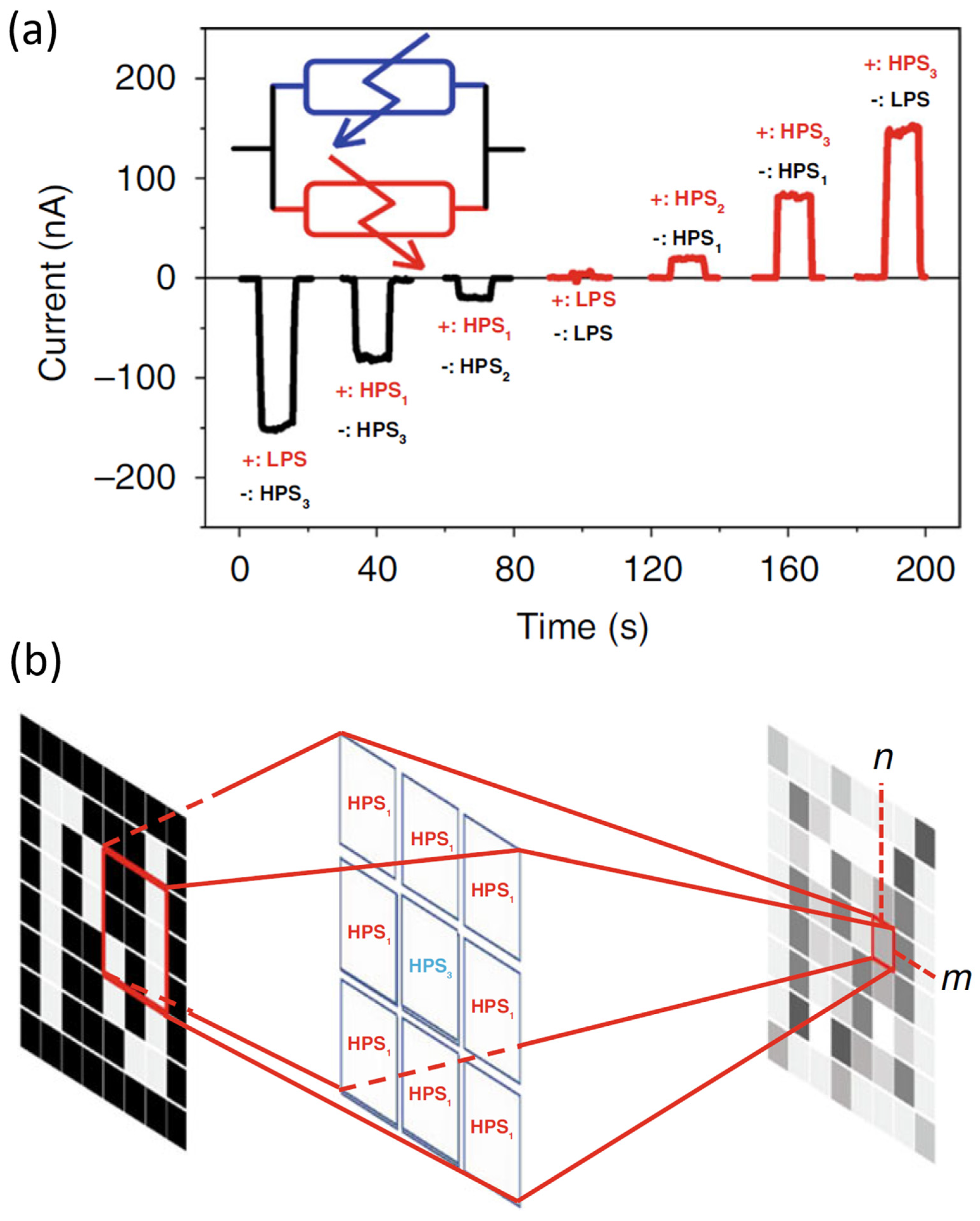
Figure 16 shows 7 distinguishable photoresponse states of the photomemristor array.
Using these seven states, two types of neuromorphic vision functions can be emulated: image preprocessing and a classifier. Mimicking the neuromorphic vision preprocessing function of the human retina can speed up subsequent perceptual tasks and improve image recognition speed. The G/M/G photomemristors are combined into a 3 × 3 array, which allows simulating the biological receptive field (RF) of the human retina controlled by different photoresponse states. Summing all photocurrents from each photomemristor in the emulated arrays performs a matrix-vector multiplication operation as follows:
I m , n = i , j 3,3 R i , j × P i , j m , n
where  R i , j  is the photoresponse matrix for different types of kernels,  P i , j m , n  is the vector of the optical signal of the input image,  I m , n  is the output vector representing the dynamic current of the input signal.
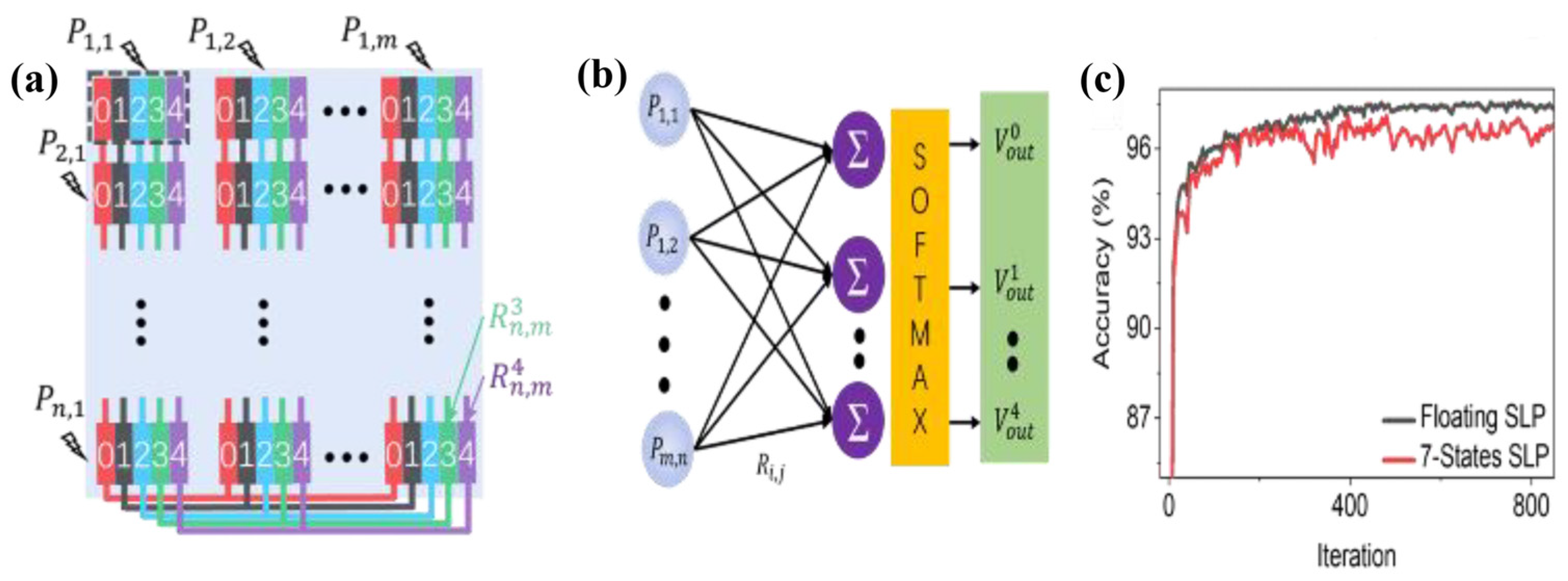
The operating principle of the classifier based on a photomemristor sensor with an integrated optoelectronic neural network is shown in Figure 17.
Each cell of the photoreceiver arrays consists of five sets of photomemristors corresponding to five classes (k = 0, 1, 2, 3, 4). Summing all photocurrents from a cell with the same class from the emulated arrays performs the matrix-vector multiplication operation as follows:
I k   = i , j m , n R i , j k × P i , j
where  R i , j k  is the photosensitivity matrix for class k P i , j  is the optical signal vector of the input image, as shown in Figure 17, and the output current  I k  is the input to the activation function. The network consists of SLP along with SoftMax functions. SLP is a supervised learning algorithm that classifies the input images into 5 classes. The input layer of such an SLP captures a 28 × 28 pixel image of numbers 0, 1, 2, 3, 4 from the MNIST dataset, and the fully connected (FC) layer consists of 768 × 10 neurons. SLP is trained offline using 30,596 images of the training set with a batch size of 64 and 4000 iterations, yielding a final output probability that classifies the input images in the test set (5139 images) into 5 classes with an accuracy of 97.66%. The weights in the FC layer are discretized to account for 7 photoresponse states. After discretization, the accuracy is about 96.44%, which is 1.22% lower than that of the original SLP. The non-volatile photosensitivity matrix based on two-terminal photomemristors can be used for simultaneous perception and classification of input images with high accuracy. This points to the potential for energy-efficient, non-volatile intra-sensor computing using photomemristors.

5. Conclusions and Prospects

Graphene-based nanosensors with memristive and photomemristive properties, possessing unique structural and electronic characteristics, represent a new class of energy-efficient and intelligent bio-like optoelectronic devices. Nanosensors based on graphene-family nanocrystals are sensitive in a wide UV-IR range and can be used for broadband information processing. The surface of 2D graphene crystals is free of dangling bonds, allowing them to be integrated into CMOS technology at relatively low temperatures, creating the defect-free interface needed for high-performance optoelectronics.
The feasibility of using low-dimensional crystals produced by cost-effective solution-based methods to fabricate memristor arrays suitable for neuromorphic applications has been demonstrated in various studies. Electron and laser irradiation technologies enable the scalable fabrication of graphene oxide/graphene and bigraphene/diamane nanostructures using a simplified, single-step local beam irradiation process that includes graphene oxide reduction and bigraphene-diamane structural phase transition.
Studies of resistive switching mechanisms in graphene/graphene oxide and bigraphene/diamane-based memristors demonstrate the effectiveness of controlling sp3-sp2 hybridization of carbon atoms to switch resistive states with low energy consumption, regardless of the electrode material, which is a promising direction for the development of energy-efficient and fast analog memristive devices.
An h-BN/WSe2-based optic-neural synaptic device, implementing both synaptic and optical sensing functions, can mimic the color and mixed-color pattern recognition capabilities of human vision. Optical synaptic devices, fabricated by integrating a synaptic device with an optical sensor, are capable of performing computations near the sensor. Operating with low pulse voltages of 0.3 V, such synaptic devices consume very low power (in the fJ range) per pulse and are capable of demonstrating energy-efficient color and mixed-color pattern recognition. However, the multielectrode heterostructure of such a device may limit the scalability, density, and resolution of such sensor arrays.
Nanosensors based on two-electrode graphene/MoS2−xOx/graphene photomemristors demonstrate the feasibility of scalable fabrication of sensor arrays with high pixel density. Controlling redox processes on graphene electrodes enables the manipulation of multiple photomemristor states with low power consumption. The simple and compact structure of the photomemristor device provides an efficient imitation of the retina, allowing signals to be detected and processed directly within the sensor itself. Photomemristor nanosensors with embedded neural networks enable the detection, storage, and processing of visual information within the sensor, similar to biological vision, enabling the creation of autonomous, energy-efficient artificial neuromorphic vision based on biocompatible memristive graphene materials and nanostructures.

Funding

This research was funded by the Russian Science Foundation, grant number 23-49-00159.

Data Availability Statement

No new data were created or analyzed in this study. Data sharing is not applicable to this article.

Acknowledgments

Work on the experimental facilities of the Institute of Microelectronics Technology of the Russian Academy of Sciences was carried out and supported within the framework of state assignment No. 075-00296-26-00.

Conflicts of Interest

The author declares no conflicts of interest.

References

  1. Tesla Dojo Technology. Available online: https://web.archive.org/web/20211012184319/https://tesla-cdn.thron.com/static/SBY4B9_tesla-dojo-technology_OPNZ0M.pdf (accessed on 12 October 2021).
  2. Tesla Unveils New Dojo Supercomputer So Powerful It Tripped the Power Grid. Available online: https://electrek.co/2022/10/01/tesla-dojo-supercomputer-tripped-power-grid/ (accessed on 1 October 2022).
  3. Unified Energy System of Russia: Interim Results. Available online: https://www-pub.iaea.org/MTCD/Publications/PDF/CNPP-2021/countryprofiles/Russia/Russia.htm (accessed on 1 January 2020).
  4. Si, M.; Cheng, H.Y.; Ando, T.; Hu, G.; Ye, P.D. Overview and outlook of emerging non-volatile memories. MRS Bull. 2021, 46, 946–958. [Google Scholar] [CrossRef]
  5. Sebastian, A.; Le Gallo, M.; Khaddam-Aljameh, R.; Eleftheriou, E. Memory devices and applications for in-memory computing. Nat. Nanotechnol. 2020, 15, 529–544. [Google Scholar] [CrossRef] [PubMed]
  6. Horowitz, M. Computing’s energy problem (and what we can do about it). In Proceedings of the International Solid-State Circuits Conference (ISSCC), San Francisco, CA, USA, 9–13 February 2014; pp. 10–14. [Google Scholar]
  7. Keckler, S.W.; Dally, W.J.; Khailany, B.; Garland, M.; Glasco, D. GPUs and the future of parallel computing. IEEE Micro 2011, 31, 7–17. [Google Scholar] [CrossRef]
  8. Jouppi, N.P.; Young, C.; Patil, N.; Patterson, D.; Agrawal, G.; Bajwa, R.; Bates, S.; Bhatia, S.; Boden, N.; Borchers, A.; et al. In-datacenter performance analysis of a tensor processing unit. In Proceedings of the International Symposium on Computer Architecture (ISCA), Toronto, ON, Canada, 24–28 June 2017; pp. 1–12. [Google Scholar]
  9. Sze, V.; Chen, Y.-H.; Yang, T.-J.; Emer, J.S. Efficient processing of deep neural networks: A tutorial and survey. Proc. IEEE 2017, 105, 2295–2329. [Google Scholar] [CrossRef]
  10. DeBoer, S. Memory Technology: The Core to Enable Future Computing Systems. In Proceedings of the IEEE Symposium on VLSI Technology, Honolulu, HI, USA, 18–22 June 2018; pp. 3–6. [Google Scholar] [CrossRef]
  11. Salahuddin, S.; Ni, K.; Datta, S. The era of hyper-scaling in electronics. Nat. Electron. 2018, 1, 442. [Google Scholar] [CrossRef]
  12. Chua, L. Memristor-the missing circuit element. IEEE Trans. Circuit Theory 1971, 18, 507–519. [Google Scholar] [CrossRef]
  13. Chua, L.O.; Kang, S.M. Memristive devices and systems. Proc. IEEE 1976, 64, 209–223. [Google Scholar] [CrossRef]
  14. Chua, L.O. How we predicted the memristor. Nat. Electron. 2018, 1, 322. [Google Scholar] [CrossRef]
  15. Panin, G.N.; Baranov, A.N.; Kononenko, O.V.; Dubonos, S.V.; Kang, T.W. Resistance switching induced by an electric field in ZnO:Li, Fe nanowires. In AIP Conference Proceedings, Proceedings of the Physics of Semiconductors: 28th International Conference on the Physics of Semiconductors, Vienna, Austria, 24–28 July 2006; American Institute of Physics: College Park, MD, USA, 2007; Volume 893, pp. 743–744. [Google Scholar] [CrossRef]
  16. Panin, G.N.; Baranov, A.N.; Kang, T.W.; Kononenko, O.V.; Dubonos, S.V.; Min, S.K.; Kim, H.J. Electrical and Magnetic Properties of Doped ZnO Nanowires. MRS Proc. 2006, 957, 406. [Google Scholar] [CrossRef]
  17. Wang, L.; Yang, C.; Wen, J.; Gai, S.; Peng, Y. Overview of emerging memristor families from resistive memristor to spintronic memristor. J. Mater. Sci. Mater. Electron. 2015, 26, 4618–4628. [Google Scholar] [CrossRef]
  18. Strukov, D.; Snider, G.; Stewart, D.; Williams, R.S. The missing memristor found. Nature 2008, 453, 80–83. [Google Scholar] [CrossRef]
  19. Waser, R.; Aono, M. Nanoionics-based resistive switching memories. Nat. Mater. 2007, 6, 833–840. [Google Scholar] [CrossRef] [PubMed]
  20. Scott, J.C.; Bozano, L.D. Nonvolatile memory elements based on organic materials. Adv. Mater. 2007, 19, 1452–1463. [Google Scholar] [CrossRef]
  21. Zhitenev, N.B.; Sidorenko, A.; Tennant, D.M.; Cirelli, R.A. Chemical modification of the electronic conducting states in polymer nanodevices. Nat. Nanotechnol. 2007, 2, 237–242. [Google Scholar] [CrossRef] [PubMed]
  22. Jeong, D.S.; Schroeder, H.; Waser, R. Coexistence of bipolar and unipolar resistive switching behaviors in a Pt/TiO2/Pt stack. Electrochem. Solid State Lett. 2007, 10, G51–G53. [Google Scholar] [CrossRef]
  23. Beck, A.; Bednorz, J.G.; Gerber, C.; Rossel, C.; Widmer, D. Reproducible switching effect in thin oxide films for memory applications. Appl. Phys. Lett. 2000, 77, 139–141. [Google Scholar] [CrossRef]
  24. Hamaguchi, M.; Aoyama, K.; Asanuma, S.; Uesu, Y.; Katsufuji, T. Electric-field induced resistance switching universally observed in transition-metal-oxide thin films. Appl. Phys. Lett. 2006, 88, 142508. [Google Scholar] [CrossRef]
  25. Richter, C.A.; Stewart, D.R.; Ohlberg, D.A.A.; Williams, R.S. Electrical characterization of Al/AlOx/molecule/Ti/Al devices. Appl. Phys. Mater. Sci. Process. 2005, 80, 1355–1362. [Google Scholar] [CrossRef]
  26. Hui, F.; Grustan-Gutierrez, E.; Long, S.; Liu, Q.; Ott, A.K.; Ferrari, A.C.; Lanza, M. Graphene and Related Materials for Resistive Random Access Memories. Adv. Electron. Mater. 2017, 3, 1600195. [Google Scholar] [CrossRef]
  27. Panin, G.N.; Kapitanova, O.O.; Lee, S.W.; Baranov, A.N.; Kang, T.W. Resistive Switching in Al/Graphene Oxide/Al Structure. Jpn. J. Appl. Phys. 2011, 50, 070110. [Google Scholar] [CrossRef]
  28. Kapitanova, O.O.; Emelin, E.V.; Dorofeev, S.G.; Evdokimov, P.V.; Panin, G.N.; Lee, Y.; Lee, S. Direct patterning of reduced graphene oxide/graphene oxide memristive heterostructures by electron-beam irradiation. J. Mater. Sci. Technol. 2020, 38, 237. [Google Scholar] [CrossRef]
  29. Emelin, E.V.; Cho, H.D.; Korepanov, V.I.; Varlamova, L.A.; Klimchuk, D.O.; Erohin, S.V.; Larionov, K.V.; Kim, D.Y.; Sorokin, P.B.; Panin, G.N. Resistive switching in bigraphene/diamane nanostructures formed on a La3Ga5SiO14 substrate using electron beam irradiation. Nanomaterials 2023, 13, 2978. [Google Scholar] [CrossRef]
  30. Emelin, E.V.; Cho, H.D.; Korepanov, V.I.; Varlamova, L.A.; Erohin, S.V.; Kim, D.Y.; Sorokin, P.B.; Panin, G.N. Formation of Diamane Nanostructures in Bilayer Graphene on Langasite under Irradiation with a Focused Electron Beam. Nanomaterials 2022, 12, 4408. [Google Scholar] [CrossRef]
  31. Chernozatonskii, L.A.; Sorokin, P.B.; Kvashnin, A.G.; Kvashnin, D.G. Diamond-like C2H nanolayer, diamane: Simulation of the structure and properties. JETP Lett. 2009, 90, 134–138. [Google Scholar] [CrossRef]
  32. Goldsmith, B.R.; Coroneus, J.G.; Khalap, V.R.; Kane, A.A.; Weiss, G.A.; Collins, P.G. Conductance-controlled point functionalization of single-walled carbon nanotubes. Science 2007, 315, 77–81. [Google Scholar] [CrossRef]
  33. Romero, F.J.; Toral-Lopez, A.; Ohata, A.; Morales, D.P.; Ruiz, F.G.; Godoy, A.; Rodriguez, N. Laser-Fabricated Reduced Graphene Oxide Memristors. Nanomaterials 2019, 9, 897. [Google Scholar] [CrossRef]
  34. Chen, M.; Wan, Z.; Dong, H.; Chen, Q.; Gu, M.; Zhang, Q. Direct laser writing of graphene oxide for ultra-low power consumption memristors in reservoir computing for digital recognition. Natl. Sci. Open 2022, 1, 20220020. [Google Scholar] [CrossRef]
  35. Kim, Y.; Jeon, S.-B.; Jang, B.C. Graphene Oxide-Based Memristive Logic-in-Memory Circuit Enabling Normally-Off Computing. Nanomaterials 2023, 13, 710. [Google Scholar] [CrossRef]
  36. Matsunaga, S.; Hayakawa, J.; Ikeda, S.; Miura, K.; Endoh, T.; Ohno, H.; Hanyu, T. MTJ-Based Nonvolatile Logic-in-Memory Circuit, Future Prospects and Issues. In Proceedings of the 2009 Design, Automation & Test in Europe Conference & Exhibition, Nice, France, 20–24 April 2009; pp. 433–435. [Google Scholar]
  37. Wang, W.; Panin, G.; Fu, X.; Zhang, L.; Ilanchezhiyan, P.; Pelenovich, V.O.; Fu, D.; Kang, T.W. MoS2 memristor with photoresistive switching. Sci. Rep. 2016, 6, 31224. [Google Scholar] [CrossRef] [PubMed]
  38. Panin, G.N. Low-dimensional layered light-sensitive memristive structures for energy-efficient machine vision. Electronics 2022, 11, 619. [Google Scholar] [CrossRef]
  39. Panin, G.N. Optoelectronic dynamic memristor systems based on two-dimensional crystals. Chaos Solitons Fractals 2021, 142, 110523. [Google Scholar] [CrossRef]
  40. Panin, G.N.; Kapitanova, O.O. Photomemristor structures based on 2D crystals for biocompatible information sensor systems. Nanobiotechnol. Rep. 2021, 16, 706–721. [Google Scholar] [CrossRef]
  41. Wang, W.; Kapitanova, O.O.; Ilanchezhiyan, P.; Xi, S.; Panin, G.N.; Fu, D.; Kang, T.W. Self-assembled MoS2/rGO nanocomposites with tunable UV-IR absorption. RSC Adv. 2018, 8, 2410–2417. [Google Scholar] [CrossRef]
  42. Kovaleva, N.N.; Chvostova, D.; Potucek, Z.; Cho, H.D.; Fu, X.; Fekete, L.; Pokorny, J.; Bryknar, Z.; Kugel, K.I.; Dejneka, A.; et al. Efficient green emission from edge states in graphene perforated by nitrogen plasma treatment. 2D Mater. 2019, 6, 045021. [Google Scholar] [CrossRef]
  43. Fu, X.; Ilanchezhiyan, P.; Kumar, G.M.; Cho, H.D.; Zhang, L.; Chan, A.S.; Lee, D.J.; Panin, G.N.; Kang, T.W. Tunable UV-visible absorption of SnS2 layered quantum dots produced by liquid phase exfoliation. Nanoscale 2017, 9, 1820–1826. [Google Scholar] [CrossRef]
  44. Pierucci, D.; Henck, H.; Avila, J.; Balan, A.; Naylor, C.H.; Patriarche, G.; Dappe, Y.J.; Silly, M.G.; Sirotti, F.; Johnson, A.T.C.; et al. Band Alignment and Minigaps in Monolayer MoS2-Graphene van der Waals Heterostructures. Nano Lett. 2016, 16, 4054–4061. [Google Scholar] [CrossRef]
  45. Hamers, R.J.; Tromp, R.M.; Demuth, J.E. Surface Electronic Structure of Si (111)-(7×7) Resolved in Real Space. Phys. Rev. Lett. 1986, 56, 1972. [Google Scholar] [CrossRef] [PubMed]
  46. Panin, G.; Díaz-Guerra, C.; Piqueras, J. Characterization of charged defects in CdxHg1−x Te and Cd Te crystals by electron beam induced current and scanning tunneling spectroscopy. Appl. Phys. Lett. 1998, 72, 2129–2131. [Google Scholar] [CrossRef][Green Version]
  47. Shi, Y.; Kim, K.K.; Reina, A.; Hofmann, M.; Li, L.-J.; Kong, J. Work function engineering of graphene electrode via chemical doping. ACS Nano 2010, 4, 2689–2694. [Google Scholar] [CrossRef]
  48. Shimada, T.; Ohuchi, F.S.; Parkinson, B.A. Work Function and Photothreshold of Layered Metal Dichalcogenides. Jpn. J. Appl. Phys. 1994, 33, 2696–2698. [Google Scholar] [CrossRef]
  49. Rout, C.S.; Joshi, P.D.; Kashid, R.V.; Joag, D.S.; More, M.A.; Simbeck, A.J.; Washington, M.; Nayak, S.K.; Late, D.J. Enhanced field emission properties of doped graphene nanosheets with layered SnS2. Appl. Phys. Lett. 2014, 105, 043109. [Google Scholar] [CrossRef]
  50. Fu, X.; Li, T.; Li, Q.; Hao, C.; Zhang, L.; Fu, D.; Wang, J.; Xu, H.; Gu, Y.; Zhong, F.; et al. Geometry-asymmetric photodetectors from metal–semiconductor–metal van der Waals heterostructures. Mater. Horiz. 2022, 9, 3095–3101. [Google Scholar] [CrossRef]
  51. Goossens, S.; Navickaite, G.; Monasterio, C.; Gupta, S.; Piqueras, J.J.; Pérez, R.; Burwell, G.; Nikitskiy, I.; Lasanta, T.; Galán, T.; et al. Broadband image sensor array based on graphene–CMOS integration. Nat. Photon. 2017, 11, 366–371. [Google Scholar] [CrossRef]
  52. Guo, Y.; Sun, D.; Ouyang, B.; Raja, A.; Song, J.; Heinz, T.F.; Brus, L.E. Probing the dynamics of the metallic-to-semiconducting structural phase transformation in MoS2 crystals. Nano Lett. 2015, 15, 5081−5088. [Google Scholar] [CrossRef]
  53. Fu, X.; Zhang, L.; Cho, H.D.; Kang, T.W.; Fu, D.; Lee, D.; Lee, S.W.; Li, L.; Qi, T.; Chan, A.S.; et al. Molybdenum disulfide nanosheet/quantum dot dynamic memristive structure driven by photoinduced phase transition. Small 2019, 15, e1903809. [Google Scholar] [CrossRef] [PubMed]
  54. Seo, S.; Jo, S.-H.; Kim, S.; Shim, J.; Oh, S.; Kim, J.-H.; Heo, K.; Choi, J.-W.; Choi, C.; Oh, S.; et al. Artificial optic-neural synapse for colored and color-mixed pattern recognition. Nat. Commun. 2018, 9, 5106. [Google Scholar] [CrossRef] [PubMed]
  55. Fu, X.; Li, T.; Cai, B.; Miao, J.; Panin, G.N.; Ma, X.; Wang, J.; Jiang, X.; Li, Q.; Dong, Y.; et al. Graphene/MoS2−xOx/graphene photomemristor with tunable non-volatile responsivities for neuromorphic vision processing. Light Sci. Appl. 2023, 12, 39. [Google Scholar] [CrossRef]
  56. Mulyana, Y.; Uenuma, M.; Ishikawa, Y.; Uraoka, Y. Reversible oxidation of graphene through ultraviolet/ozone treatment and its nonthermal reduction through ultraviolet irradiation. J. Phys. Chem. C 2014, 118, 27372–27381. [Google Scholar] [CrossRef]
  57. Kwon, S.; Lee, E.-S.; Seo, H.; Jeon, K.-J.; Hwang, C.; Kim, Y.-H.; Park, J.Y. Reversible oxidation states of single layer graphene tuned by electrostatic potential. Surf. Sci. 2013, 612, 37–41. [Google Scholar] [CrossRef]
  58. Kapitanova, O.O.; Panin, G.N.; Cho, H.D.; Baranov, A.N.; Kang, T.W. Formation of self-assembled nanoscale graphene/graphene oxide photomemristive heterojunctions using photocatalytic oxidation. Nanotechnology 2017, 28, 204005. [Google Scholar] [CrossRef]
Figure 1. DOJO D1 processor board (25 chips) with 15 kW power consumption (right). D1 board set (left) [1].
Nanoenergyadv 06 00006 g001
Figure 2. Machine vision technology with in-memory computing near the sensor using photoreceptors and an analog-to-digital converter (ADC) (top) and in-sensor computing (bottom).
Nanoenergyadv 06 00006 g002
Figure 3. (a) Current-voltage characteristics (without forming voltage) of the lateral memristive heterostructure EB-rGO/GO/EB-rGO obtained by electron beam irradiation with with D = 200 mA s/cm2 at Ee = 3 keV [28]. The upper and lower insets in (a) show the schematic of the I-V measurement and SEM image of the fabricated EB-rGO/GO/EB-rGO memristor. (b) Current-voltage characteristics of the memristive heterostructure after applying the forming voltage (20 V, 15 min) for 1–50 switching cycles. (c) Current-voltage characteristics of the Al/Cr/bigraphene/diamane/bigraphene/Al/Cr nanostructure on the La3Ga5SiO14 (LGS) substrate formed by electron beam irradiation of bigraphene [29].
Nanoenergyadv 06 00006 g003
Figure 4. Dependence of the barrier to cleavage of diamane during desorption of one or two oxygen groups on the applied electric field. Insert—dependence of the barrier on the electric field during desorption of two oxygen groups [29].
Nanoenergyadv 06 00006 g004
Figure 5. Electrical performance of a laser-reduced GO memristor memristor (Plaser = 70 mW, L = 2.2 mm, W = 1 mm). (a) Current-voltage characteristic of a memristor showing the characteristic signature of memristance. The voltage has been scanned from −3 V to 3 V with a voltage step of 10 mV. The scanning rate was adjusted to 2 V/s. The top inset of the figure shows an example of another device fabricated with Ag-based contacts. (b) Ratio of the resistance measured in the HRS and LRS of a set of laser-lithographed graphene oxide memristors fabricated at different laser powers (15 devices for each laser power). The resistance was extracted in the range [−1, 1] V of the current-voltage characteristics. The memristors were of identical dimensions with an effective length of 2.2 mm and a width of 1 mm [33].
Nanoenergyadv 06 00006 g005
Figure 6. (a) Schematic illustration of the Ni/GO/Au memristor array. (b) Typical I-V characteristics, (c) operational switching uniformity of HRS/LRS and SET/RESET voltages of GO-based memristor, and (d) its cycling endurance and retention characteristics [35].
Nanoenergyadv 06 00006 g006
Figure 7. Operation of the MoS2 memristor polarized at different voltages in the dark or under white light excitation. (a) High and low resistance states obtained by using the SET/RESET operations at −3 V/+3 V and −6 V/+6 V (d) in the dark (HRSD3, LRSD3 and HRSD6, LRSD6) and under white light (HRSL3, LRSL3, LRSL6, and HRSL6). (b) Pulse voltage reading chart. The resistive states are read out at 0.7 V (HRSD3, LRSD3, HRSD6, and LRSD6), 1.2 V (HRSL3 and LRSL3), and 4 V (LRSL6 and HRSL6) in the dark (D) or under white light excitation (L). (c) The diagram of excitation by white light pulses. SET/RESET, and the READ operation is controlled by pulses of light off (black) (HRSD3, LRSD3, HRSD6, and LRSD6) and on (blue) (HRSL3, LRSL3, HRSL6, and LRSL6) [37].
Nanoenergyadv 06 00006 g007
Figure 8. (a) Detection and processing of optical information in the retina and visual cortex. (b) The retina of the eye consists of ganglion cells, bipolar cells, cones, rods, and photoreceptors. (c) Hyperpolarization and depolarization of retinal bipolar cells in the dark and in the light result in a bipolar photoresponse (positive photocurrent (PPC) and negative photocurrent (NPC)).
Nanoenergyadv 06 00006 g008
Figure 9. Schematic representation of ultrasound-assisted hydrothermal synthesis of self-assembled MoS2/rGO composite (top) and UV-IR absorption spectra of MoS2/rGO composites (bottom) obtained at different spin speeds: (a) 3500 rpm, (b) 5000 rpm, (c) 6500 rpm, (d) 8000 rpm, (e) 9500 rpm, and (f) 11,000 rpm [41].
Nanoenergyadv 06 00006 g009
Figure 10. (a) Photoluminescence spectra of bi-graphene transferred onto a SiO2/Si substrate and treated in nitrogen or oxygen plasma. The spectra were obtained by exciting the structure with light with λexc = 250 nm or 290 nm [42]. (b) The dependence of the SnS2 QD bandgap on the QD size, obtained in the effective-mass approximation (blue line) and the bandgap obtained from UV-visible spectra (red sphere). The inset shows the QD size distribution obtained from 11,000 rpm suspension and the bandgap of the QDs calculated from the effective mass approximation [reproduced from [43] with permission from the Royal Society of Chemistry].
Nanoenergyadv 06 00006 g010
Figure 11. (a) Tunneling current spectra of SnS2 MLQDs (red) and SnS2 SLQDs (blue) with LQDs transverse sizes of 5–7 nm and 2–4 nm, respectively, using graphene probes. The spectra are shifted relative to each other for a clear presentation of the data. The inset shows the band diagram of the SnS2/graphene structure with a van der Waals gap (the work functions of graphene and SnS2 are 4.66 eV [47] and 5.2 eV [48,49], respectively). (b) Current-voltage characteristics of the graphene/SnS2 SLQDs/graphene photosensor with SLQDs sizes of 2–4 nm in the dark and under white and ultraviolet light. The inset schematically shows a selective, visible-blind UV photodetector [Reproduced from [43] with permission from the Royal Society of Chemistry].
Nanoenergyadv 06 00006 g011
Figure 12. Current-voltage characteristics of the MoS2 QDNS structure with graphene electrodes for 50 cycles in logarithmic scale in the light. The inset shows the scheme of the photoexcited electron transfer process [53].
Nanoenergyadv 06 00006 g012
Figure 13. Integration of the h-BN/WSe2 optic-neural synaptic device (ONS). (a) Schematic of the human optic nerve system, the h-BN/WSe2 synaptic device integrated with h-BN/WSe2 photodetector, and the simplified electrical circuit for the ONS device. Here, the light sources were dot lasers with wavelengths of 655 nm (red), 532 nm (green), and 405 nm (blue) with a fixed power density (P) of 6 mWcm−2 for all wavelengths. (b) Excitatory and inhibitory postsynaptic current characteristics and extracted conductance changes in the h-BN/WSe2 ONS device under different light conditions (no light and RGB) [54].
Nanoenergyadv 06 00006 g013
Figure 14. Schematic representation of the MoS2−xOx structure with graphene electrodes of different contact areas (top left) and multi-level photoresponse switching characteristics under bias voltage (bottom). Endurance of photoresponse states (HPS1, HPS2, HPS3, and LPS) over hundreds of switching cycles (measured at 0 V bias voltage) (top right) [55].
Nanoenergyadv 06 00006 g014
Figure 15. (a) Current-voltage characteristics of the G/M/G device with binary switching of photoresponse with voltage variation. (b) Raman spectra showing the evolution of redox reactions on the graphene electrodes when switching between HPS and LPS. Dark/photo current of the G/M/G device simulated by TCAD for LPS (c) and HPS (d). The insets in (c,d) show the qualitative device model for LPS and HPS, respectively. (e) Electron current density distribution of LPS (top) and HPS (bottom) under illumination simulated by TCAD. (f) Hole current density distribution of LPS (top) and HPS (bottom) simulated by TCAD [55].
Nanoenergyadv 06 00006 g015
Figure 16. (a) Photocurrent in a photomemristor sensor with different sets of photomemristors for different photoresponse states (HPS1, HPS2, HPS3, and LPS). Inset: Schematic diagram of the photomemristors with opposite polarity. (b) 3 × 3 photomemristor array with integrated sense-memory-compute architecture [55].
Nanoenergyadv 06 00006 g016
Figure 17. Schematic illustration of the single-layer perceptron (SLP) photomemristor array for classifier emulation. All photomemristors of the same class (color) are connected in parallel to obtain the output current for the activation function (a). Schematic diagram of the SLP neural network architecture (b). Accuracy of the SLP classifier during training with floating-point weights and 7-level photoresponse state (c) [55].
Nanoenergyadv 06 00006 g017
Disclaimer/Publisher’s Note: The statements, opinions and data contained in all publications are solely those of the individual author(s) and contributor(s) and not of MDPI and/or the editor(s). MDPI and/or the editor(s) disclaim responsibility for any injury to people or property resulting from any ideas, methods, instructions or products referred to in the content.