
Article

Cellulose-Based Sustainable Photo-Triboelectric Hybrid Nanogenerator for High-Performance Energy Harvesting and Smart Control Systems

1
Hebei Key Laboratory of Micro-Nano Precision Optical Sensing and Measurement Technology, School of Intelligent Sensing and Optoelectronic Engineering, Northeastern University at Qinhuangdao, Qinhuangdao 066003, China
2
College of Information Science and Engineering, Northeastern University, Shenyang 110801, China
*
Authors to whom correspondence should be addressed.
Nanoenergy Adv. 2026, 6(1), 1; https://doi.org/10.3390/nanoenergyadv6010001
Submission received: 27 November 2025 / Revised: 17 December 2025 / Accepted: 19 December 2025 / Published: 23 December 2025
(This article belongs to the Special Issue Hybrid Energy Storage Systems Based on Nanostructured Materials)

Abstract

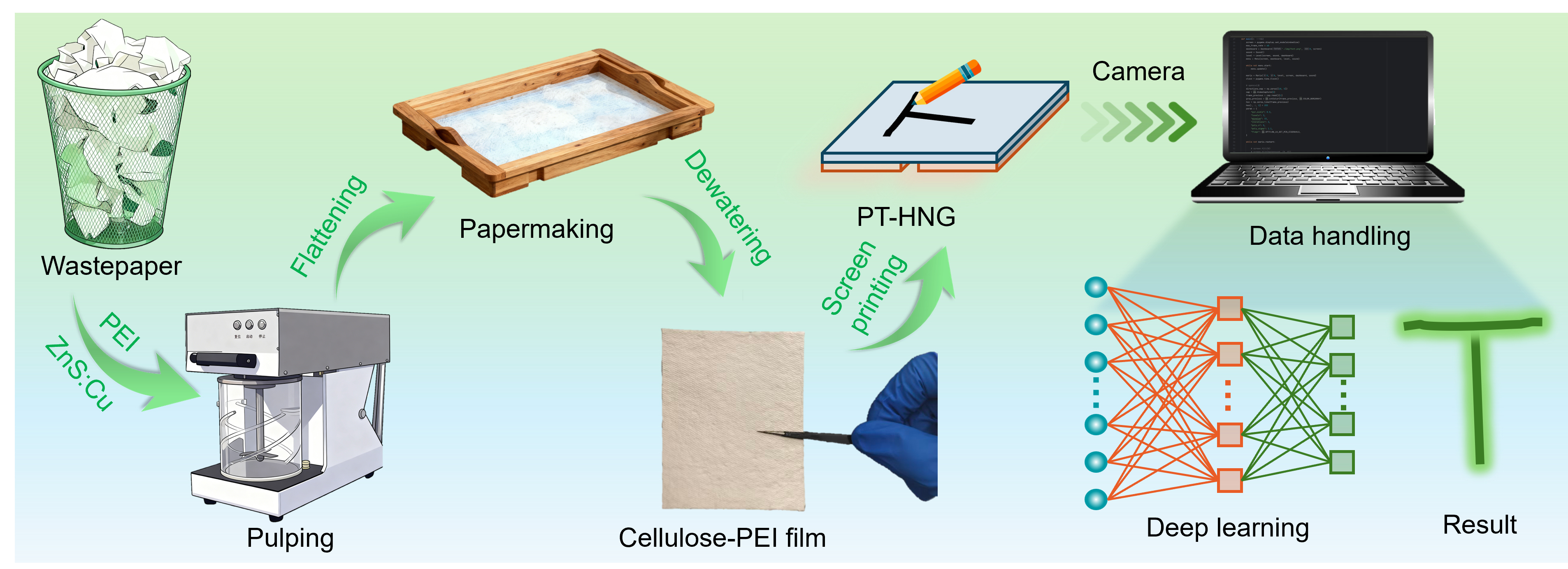
With the advancement of Internet of Things (IoT) technology, flexible sensors with dual optoelectronic sensing modes have emerged as a research hotspot for next-generation smart devices, further driving the urgent demand for environmentally friendly functional materials. Here, we innovatively integrated wastepaper recycling technology with a polyethyleneimine (PEI)-assisted pulping strategy to develop a novel cellulose-based sustainable photo-triboelectric hybrid nanogenerator (PT-HNG). Based on the working mechanism of a freestanding triboelectric nanogenerator (TENG), the PT-HNG can directly convert pressure stimuli into electrical energy and triboelectrification-induced electroluminescence (TIEL) signals. It achieves luminescence brightness of 0.06 mW cm−2 (3.84 cd m−2) and simultaneously delivers excellent electrical output performance (172.4 V, 6.36 μA, 43.7 nC) under sliding motion. More importantly, compatible with existing industrial papermaking processes, the PT-HNG is scalable for large-scale production. By combining PT-HNG with deep learning algorithms, a handwritten e-book system based on trajectory recognition was constructed, with a recognition accuracy of up to 95.5%. In addition, real-time intelligent control of PowerPoint presentations via PT-HNG was demonstrated. This study provides a new pathway for converting wastepaper into intelligent products and presents a novel idea for the interdisciplinary integration of the circular economy and advanced electronic technology.

Graphical Abstract

1. Introduction

With the rapid development of the IoT, flexible sensors have been widely used in various fields, including human–computer interaction, smart homes, and robotics, emerging as core components of the next generation intelligent terminals [1,2,3,4,5]. However, the current development of flexible sensors still faces multiple key constraints: on one hand, traditional flexible sensors often rely on external circuits or battery power, limiting their adaptability to long-term use in complex environments [6,7]; on the other hand, as human–computer interaction advances towards precision and intuitiveness, the sole reliance on electrical sensing modes lacks visually perceptible feedback (e.g., color and luminescence), which hinders the achievement of efficient and intuitive interactive experiences and fails to cater to the high efficiency requirements of scenarios such as intelligent wearable tactile feedback, real-time emergency rescue monitoring, and robotic skin interaction [8,9]. Consequently, flexible sensors that combine optical and electrical sensing functions have become a prominent research focus [10,11,12].
In recent years, triboelectrification-induced electroluminescence (TIEL) has emerged as a novel energy conversion and optical response technology that enables the direct conversion of weak mechanical stimuli into visual optical signals [13,14,15,16]. Compared to mechanoluminescence (ML) [17,18,19] with its extremely high triggering pressure and electroluminescence (EL) [20,21,22] requiring high driving voltage, TIEL offers advantages including low excitation threshold, high responsiveness, and excellent stability. These characteristics endow it with significant application potential in fields such as flexible electronic skin [23], human–computer interaction interfaces [24], and self-powered visual sensors [25]. The underlying mechanism of TIEL lies in the synergistic effect of triboelectrification and EL: when two materials with different triboelectric polarities come into contact, separate, or slide relative to each other, dynamic changes in charge distribution induce an alternating electric field inside the luminescent layer. This excites electrons in the luminescent material to undergo energy level transitions and release photons, generating an optical signal output synchronized with mechanical stimulation [26,27,28]. Moreover, triboelectric nanogenerators (TENGs) have emerged as efficient devices capable of converting mechanical energy into electrical energy [29,30,31,32,33,34,35,36]. Given that both TIEL and TENGs can be triggered by triboelectrification, there is a promising avenue to achieve high-performance tribo-induced devices operating in optical-electrical dual modes by simultaneously harnessing the abundant tribo-charges generated. To date, a hybrid strategy integrating triboelectrification, electrostatic induction, and EL effects based on TIEL and TENG technologies has garnered significant attention. This innovation holds substantial potential for advancing high-performance flexible sensors with integrated optoelectronic sensing capabilities [37,38,39]. Nevertheless, the widespread application of these devices is hindered by their limited sensitivity and efficiency. More critically, the current reliance on petroleum-derived synthetic polymers as substrate materials exacerbates environmental concerns due to their non-degradable nature and significant pollution risks [40,41,42,43]. Consequently, the development of high-performance optoelectronic hybrid devices based on renewable natural polymers has become an urgent research priority.
As a natural polymer material, cellulose possesses excellent polarizability and triboelectric activity due to its abundant hydroxyl groups in the molecular structure. It also has intrinsic advantages, including renewability, biodegradability, and biocompatibility, and has been proven to be an ideal flexible electronic substrate for replacing petroleum-derived materials [44,45,46,47]. Driven by global dual-carbon goals and circular economy strategies, the high-value utilization of waste resources has emerged as a core pathway to address the conflict between resource scarcity and environmental pollution [48]. Notably, cellulose is abundant in various daily-use papers, and wastepaper, as one of the largest urban recyclable wastes, has an annual global recycling volume of 250 million tons [49]. Recycling one ton of wastepaper can save 17 trees and 7000 gallons of water, while reducing carbon dioxide emissions by 320 kg [50,51]. Converting wastepaper into high-performance functional materials will significantly enhance the ecological and economic value of resource recycling. Cellulose is a natural biodegradable polysaccharide, under the action of microorganisms, it can be decomposed into non-toxic products such as water and carbon dioxide by cellulase, which meets the European EN 13432 standard (at least 90% of the components are converted into non-toxic products within 6 months). At the end of their service life, cellulose-based electronic devices, packaging materials, etc., can be naturally degraded or incinerated without toxic heavy metal residues. Compared with traditional plastics and silicon-based materials, they can significantly reduce electronic waste pollution [52,53]. However, most wastepaper is currently only regenerated into ordinary packaging paper or cultural paper via traditional pulping processes, failing to exploit the structural potential of cellulose-based materials fully.
In this work, a novel cellulose-based sustainable photo-triboelectric hybrid nanogenerator (PT-HNG) was developed by innovatively leveraging wastepaper recycling technology and integrating a polyethyleneimine (PEI)-assisted pulping strategy, which is compatible with current industrial papermaking processes and exhibits large-scale production feasibility. Benefiting from the synergistic effect of triboelectrification, electrostatic induction, and EL, PT-HNG with a contact area of 5 cm2 achieves outstanding optical output (0.06 mW cm−2, 3.84 cd m−2) and electrical output (172.4 V, 6.36 μA, 43.7 nC) under sliding motion simultaneously. By combining PT-HNG with deep learning algorithms, a handwritten e-book system based on trajectory recognition was constructed, enabling real-time direct upload of handwritten trajectories to terminal devices with a recognition accuracy of up to 95.5%. In addition, real-time intelligent control of PowerPoint presentations via PT-HNG was demonstrated, which holds significant potential for future intelligent office applications. This study establishes a novel pathway for transforming wastepaper into intelligent products through high-value resource utilization, thereby facilitating the practical application of hybrid nanogenerator in human–computer interaction and IoT terminals.

2. Materials and Methods

2.1. Materials

The pulp raw material was derived from the waste paper generated during the laboratory’s daily operation (commercial A4 printing paper); ZnS:Cu particles were supplied by Keyan Phosphor Technology Co., Ltd. (Shanghai, China); PEI (MW~10000, 99 wt%) was purchased from Aladdin Biochemical Technology Co., Ltd. (Shanghai, China); silver paste (70 wt% Ag) was purchased from Shenzhen Sunflower Electronic Materials Co., Ltd. (Shenzhen, China); friction materials (Fluorinated Ethylene Propylene, Polytetrafluoroethylene, Poly(vinylidene fluoride), Polyimide, Polyethylene Terephthalate, Thermoplastic Polyurethane, Polyamide 66) were obtained from Wanyu New Materials Co., Ltd. (Wenzhou, China); and all film materials had a thickness of 0.1 mm.

2.2. Preparation of PT-HNG

Wastepaper was torn into fragments of approximately 1 cm × 1 cm in size, soaked in deionized water for 2 h, and then mashed using a pulping machine for 1 h. During the pulping process, a decolorizing agent was added to bleach the pulp, yielding cellulose pulp. A predetermined amount of PEI was dissolved in deionized water to prepare a PEI solution, which was then added to the cellulose pulp at the required mass fraction. After a predetermined amount of ZnS:Cu particles was added, the mixture was stirred uniformly. The mixed pulp was dried at 80 °C for 30 min to prepare cellulose-PEI film with a basis weight of 80 g m−2 and a thickness of 1 mm.
A 200-mesh polyester wire mesh was used as the template, and silver paste (Ag/TPU) was selected as the electrode material. Via screen printing technology, electrodes were printed on a 5 × 5 cm2 cellulose-PEI film, with an electrode width of 2.2 cm and an electrode gap of 0.6 cm. The average thickness of the electrode layer was approximately 50 μm. After annealing at 100 °C for 20 min, PT-HNG was finally obtained.

2.3. Characterization and Measurement

All SEM and EDS images were captured using a field emission scanning electron microscope (Nova Nano 450, FEI, Hillsboro, OR, USA); an LCR meter (E4980AL, Agilent, Santa Clara, CA, USA) was used to detect the dielectric constant of the triboelectric electrode over the frequency range of 20 Hz to 1 MHz at room temperature; an assembly of a linear motor (E1250, LinMot, Zurich, Switzerland) and a pressure sensor (M5, Mark-10, New York, NY, USA) was used to test the optical emission and electrical output of the device; the TIEL spectrum was observed with a spectrometer equipped with a vertically arranged optical fiber collimating lens (Nova, Idea Optics, Shanghai, China); the electrical output was measured using a programmable electrometer (6514, Keithley, Cleveland, OH, USA); and TIEL emission was observed with an oscilloscope (TBS 1000C, Tektronix, Beaverton, OR, USA) connected to a silicon photodetector (AM-F10, Keshengda, Suzhou, China).
COMSOL Multiphysics Simulation: In the simulation, the lengths of PT-HNG, FEP, and the electrode were 50 mm, 22 mm, and 22 cm, respectively, with a thickness of 1 mm and an electrode gap of 6 mm; surface charge densities were set as +20 µC m−2 on the cellulose-PEI film and −20 µC m−2 on the FEP film to form complementary triboelectric pairs. The entire structure was encapsulated in a grounded cubic air domain with 1 m edge lengths to mimic ambient conditions. Material permittivities were defined as air (ε = 1.0), FEP (ε = 2.1), and Ag electrodes (ε = 1.68) in the computational model. The bottom electrode of PT-HNG was set to ground, and the top electrode of FEP was set to floating potential to simulate the open-circuit voltage measurement scenario. Finally, the electric potential information was obtained through calculation.

3. Results and Discussion

3.1. Structure and Characterization of PT-HNG

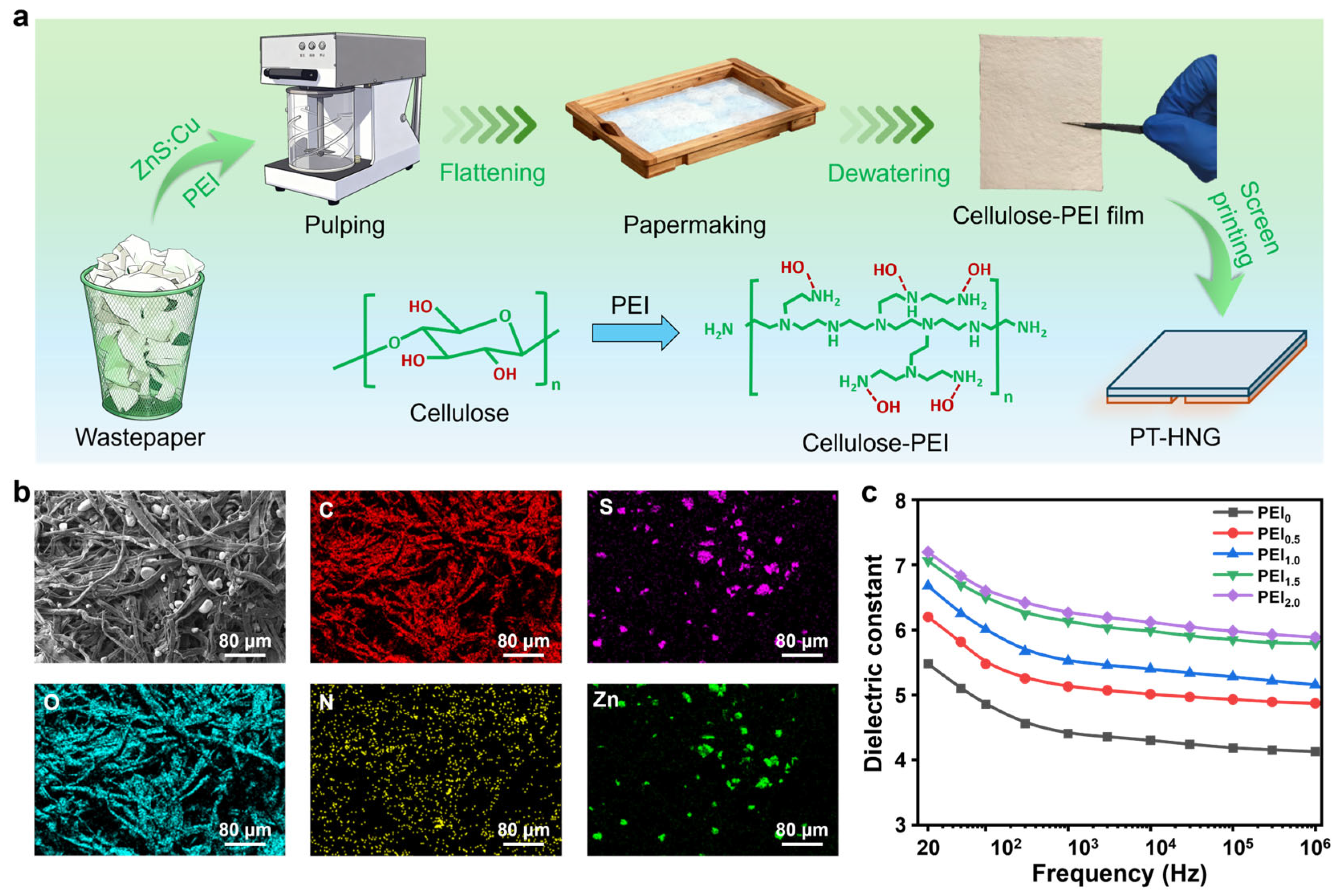
The preparation process of PT-HNG is illustrated in Figure 1a, and mainly involves two steps: pulping and papermaking. During the pulping process, common laboratory waste paper was cut into small pieces and placed in a pulper for stirring, with the simultaneous addition of PEI and ZnS:Cu particles. The pulping process breaks the hydrogen bonds between fibers, resulting in the exposure of a large number of hydroxyl groups. As a hydrophilic cationic polymer rich in amino groups, PEI can rapidly bind to these hydroxyl groups via electrostatic interactions, acting as a crosslinking agent. Additionally, its electron-rich nature enhances the polarity of cellulose, providing more electrons during triboelectrification [54]. In the papermaking process, the prepared pulp was uniformly spread onto a dewatering plate. After dewatering, the film was peeled off to form cellulose-PEI film. Subsequently, silver paste was printed onto the cellulose-PEI film via screen printing technology to form coplanar electrodes, thereby fabricating PT-HNG. Detailed preparation parameters are available in the Section 2. The scanning electron microscope (SEM) and energy dispersive spectrometer (EDS) images of PT-HNG are shown in Figure 1b. The SEM image shows that ZnS:Cu particles are uniformly embedded in the matrix, ensuring the uniformity of luminescence. Furthermore, the uniform distribution of C, N, and O elements in the EDS images confirms the successful grafting of PEI onto the cellulose surface.
In addition, to clarify the effect of PEI addition on the dielectric constant of the composite paper, the relative dielectric constant was measured at different PEI mass fractions, and the role of PEI content in enhancing the dielectric constant is illustrated in Note S1 (Supplementary Materials). As shown in Figure 1c, the relative dielectric constant increases with the increase in PEI doping content over the frequency range of 20–106 Hz. At a frequency of 104 Hz, the relative dielectric constant of the composite paper doped with 1.5 wt% PEI is 6.12, representing a 42.3% increase compared to pure cellulose paper. This result confirms that PEI doping can significantly increase the dielectric constant of composite paper, enhance its capacity to store triboelectric charges, and suppress charge dissipation. Figure S1 (Supplementary Materials) depicts the electron transfer model for the tribological interaction between the PT-HNG (with and without PEI doping) and FEP. PEI-doped PT-HNG facilitates more efficient electron transfer at the contact interface, thus contributing to enhanced triboelectric performance. Notably, although the relative dielectric constant is highest at a PEI doping content of 2.0 wt%, the increase is only marginal compared to that at 1.5 wt%. This may be because when the doping content reaches 1.5 wt%, the system is already close to the doping saturation point. Further addition of PEI may cause local agglomeration, as shown in Figure S2 (Supplementary Materials), ultimately resulting in a less significant increase in relative dielectric constant and reducing output performance. We used an electrostatic tester to measure the surface potential variations in PT-HNG and FEP under different PEI doping concentrations during friction, as shown in Figure S3 (Supplementary Materials). The experimental results show that when the PEI doping level is increased from 0 to 2.0 wt%, the surface potential exhibiting a typical rise-and-fall trend.

3.2. Working Mechanism of PT-HNG

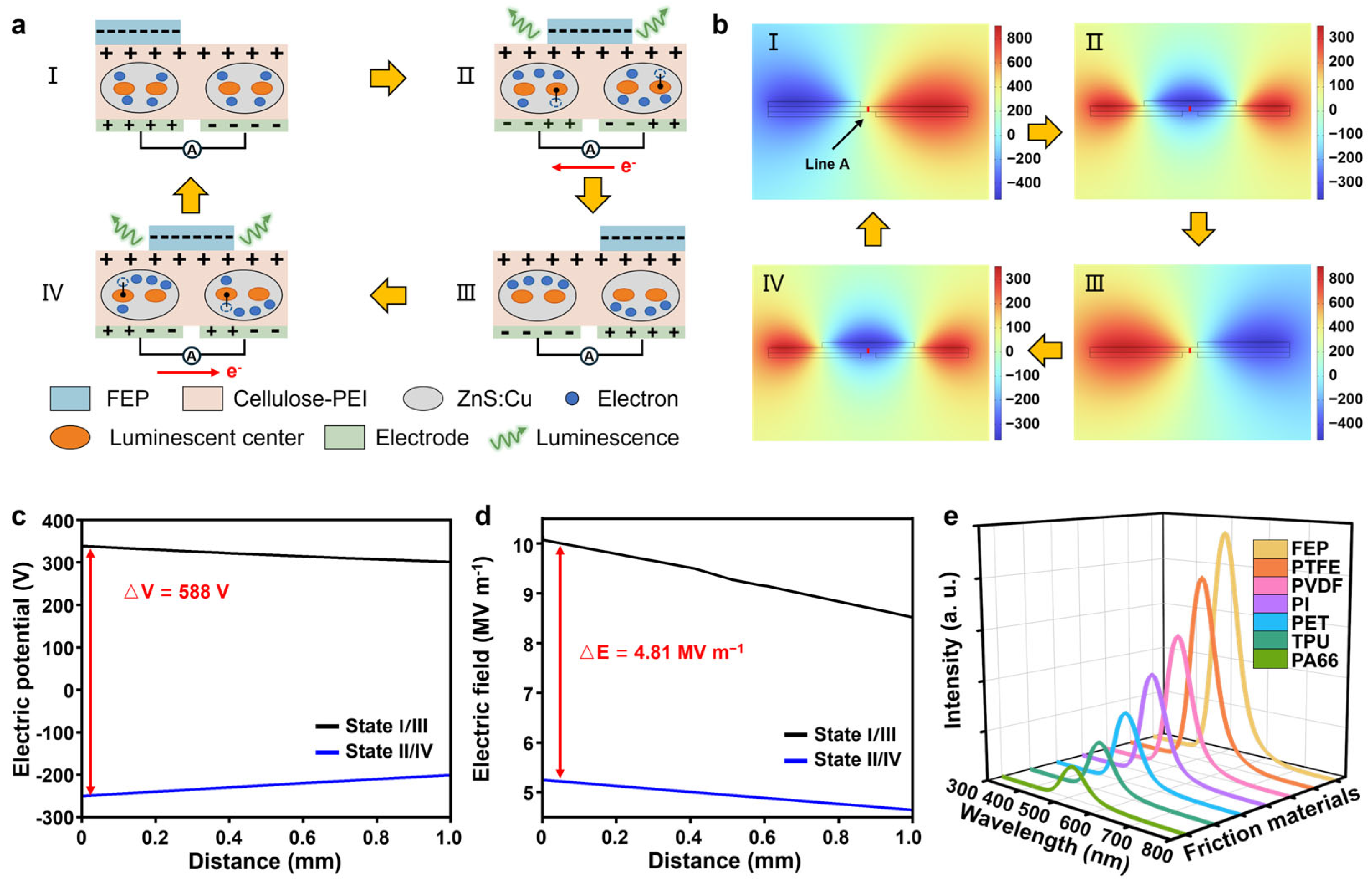
The working process of PT-HNG involves the coupling of triboelectrification, electrostatic induction, and EL. Figure 2a details the changes in its electric field over one working cycle, including four typical states. In the initial State I, when the friction layer is completely overlapped with the left electrode, equal amounts of positive and negative charges are generated on their respective surfaces due to the difference in triboelectric polarity between the materials. Positive charges in the entire electrode circuit are attracted to the upper surface of the left electrode, while positive charges on the surface of the cellulose-PEI film remain stationary. As the friction layer slides to the right, positive charges in the electrode circuit flow from the left electrode to the right electrode, generating a rapidly varying electric field within PT-HNG (State II). Under the action of this alternating electric field, free electrons generated by collision ionization in the lattice migrate to the bottom or top of the phosphor particles during sliding. Some electrons collide with the luminescent centers during migration, exciting the luminescent centers and producing EL. Subsequently, when the friction layer continues to slide rightward and aligns with the right electrode (State III), all positive charges flow into the right electrode. Induced by the electric field, all electrons inside the luminescent particles near the right electrode are distributed at the bottom, while electrons inside the luminescent particles near the left electrode are distributed at the top. Finally, when the friction layer moves in the reverse direction (from the right electrode to the left electrode, State IV), the direction of charge movement is consistent with the di-rection of positive charge migration, leading to electric field reversal. Electrons located at the top or bottom of the luminescent particles migrate in the opposite direction and collide with the luminescent centers, thereby generating EL again.
To validate the proposed mechanism, a model was constructed using COMSOL Multiphysics software (Version: 6.3) in this paper. The potential distribution of PT-HNG in the four typical states within one working cycle is shown in Figure 2b. Simulation results demonstrate that the potential and electric field variations along the “line A” under the four working states can reach 588 V and 4.81 MV m−1 (Figure 2c,d), which is sufficient to excite EL. To further corroborate the mechanism, seven different types of materials were used to rub against the PT-HNG surface: Fluorinated Ethylene Propylene (FEP), Polytetrafluoroethylene (PTFE), Poly(vinylidene fluoride) (PVDF), Polyimide (PI), Polyethylene Terephthalate (PET), Thermoplastic Polyurethane (TPU), and Polyamide 66 (PA66). The corresponding TIEL spectra (Figure 2e) indicate that materials with higher electronegativity exhibit higher TIEL intensity, which further validates the working mechanism illustrated in Figure 2a. Among the various friction materials, FEP exhibited the optimal TIEL performance, and the TIEL intensity generated by its tribological interaction with PT-HNG was significantly higher than that generated by other materials. Therefore, FEP was selected as the friction material for subsequent system tests in this study.

3.3. TIEL Performance of PT-HNG

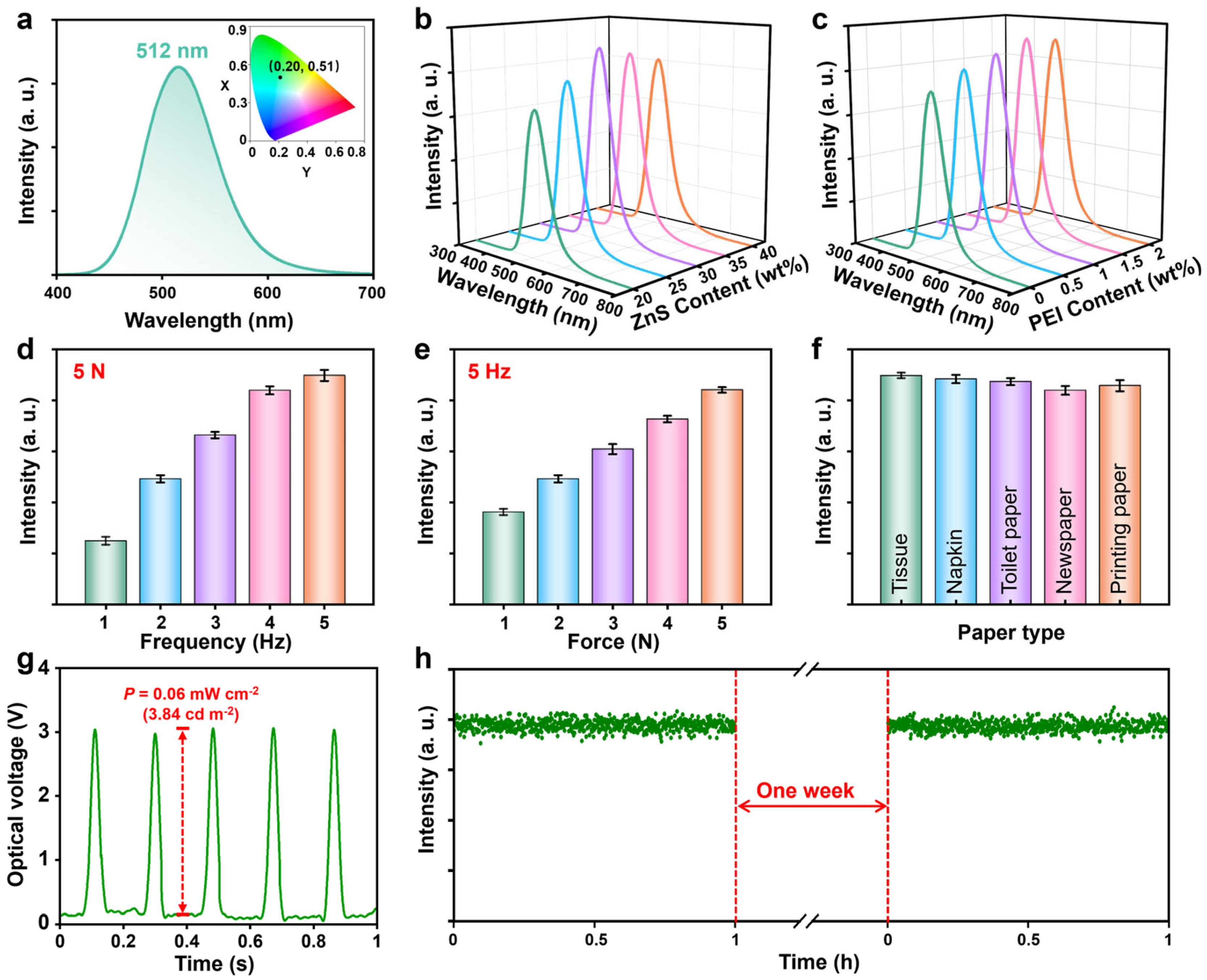
In this analysis, we first characterized the TIEL spectrum of PT-HNG. As shown in Figure 3a, the film exhibits a prominent emission peak at 512 nm in its TIEL spectrum under tribological stimulation. As indicated in the inset, the corresponding International Commission on Illumination (CIE) chromaticity coordinates are (0.20, 0.51), which fall within the green region of the visible spectrum. Next, the effect of raw material fraction on the performance of TIEL was tested. The content of ZnS:Cu is an important factor affecting TIEL performance, as shown in Figure 3b. At a fixed total mass, the luminescence intensity first increases and then decreases as the ZnS:Cu content increases from 20 wt% to 40 wt%. This is because excessive ZnS:Cu content reduces the effective triboelectric contact area, weakening the triboelectrification effect. The luminescence intensity reaches a maximum when the content of ZnS:Cu is 30 wt%, detailed explanations are provided in Note S2 and Figure S4 (Supplementary Materials). The effect of PEI content on TIEL performance was explored, as shown in Figure 3c. When the PEI content increases from 0 to 1.5 wt%, the TIEL performance gradually enhances, which is consistent with the dielectric constant variation trend of PT-HNG shown in Figure 1c, higher PEI content enhances triboelectric charge storage capacity by increasing dielectric constant. When the PEI content increases from 1.5 wt% to 2.0 wt%, the luminescence intensity slightly decreases. This is because when the doping amount exceeds the saturation value, it causes local agglomeration of PEI, reducing the overall dispersion uniformity and weakening the triboelectrification effect, thus verifying the previously proposed viewpoint. And then, we tested the effect of tribological conditions on TIEL performance. Under a fixed pressure of 5 N, as the tribological frequency increases from 1 Hz to 5 Hz, the number of electron collisions and excitations per unit time increases significantly, thereby more effectively activating the luminescent centers and resulting in a continuous increase in TIEL intensity, as shown in Figure 3d. Similarly, at a fixed frequency of 5 Hz, as the pressure increases from 1 N to 5 N, the TIEL intensity of PT-HNG gradually increases with increasing applied pressure, as shown in Figure 3e. This is mainly attributed to the increase in pressure, which enlarges the effective contact area of the tribological interface, thereby enhancing the charge transfer efficiency.
In addition, we prepared PT-HNG samples using five commonly used waste papers in daily life: tissue paper, napkin paper, toilet paper, newspaper, and printing paper. Testing results show that the overall TIEL intensity of the PT-HNG samples prepared from the five waste papers is roughly consistent (Figure 3f), with only slight differences which are mainly attributed to the varying fiber thickness of the raw materials. The finer the fibers of the raw materials, the larger the specific surface area and the more storage capacity of triboelectric charge, thus resulting in a higher TIEL intensity of PT-HNG. On the basis of the aforementioned optimized parameters, the TIEL photoelectric response of PT-HNG was quantified by coupling an oscilloscope with a photodetector. Under the test conditions of 5 N and 5 Hz, as shown in Figure 3g, the optical power density of TIEL reached as high as 0.06 mW cm−2 (3.84 cd m−2). Finally, the repeatability and stability of TIEL emission were evaluated under conditions of 5 Hz frequency and 5 N pressure, with a test duration of 1 h and a measurement interval of 1 s. Subsequently, PT-HNG was placed in air (25 °C, 50% RH) for 1 week to assess the long-term stability of its luminescence intensity. As shown in Figure 3h, the TIEL performance of PT-HNG remains stable without significant attenuation. This is attributed to PEI doping, which enhances the triboelectric charge storage capacity of PT-HNG and improves its moisture resistance. In addition, as detailed in Note S3 and Figure S5 (Supplementary Materials), the results of bending endurance and humidity stability assessments demonstrate the exceptional robustness and high flexibility of PT-HNG.

3.4. Electrical Output Performance of PT-HNG

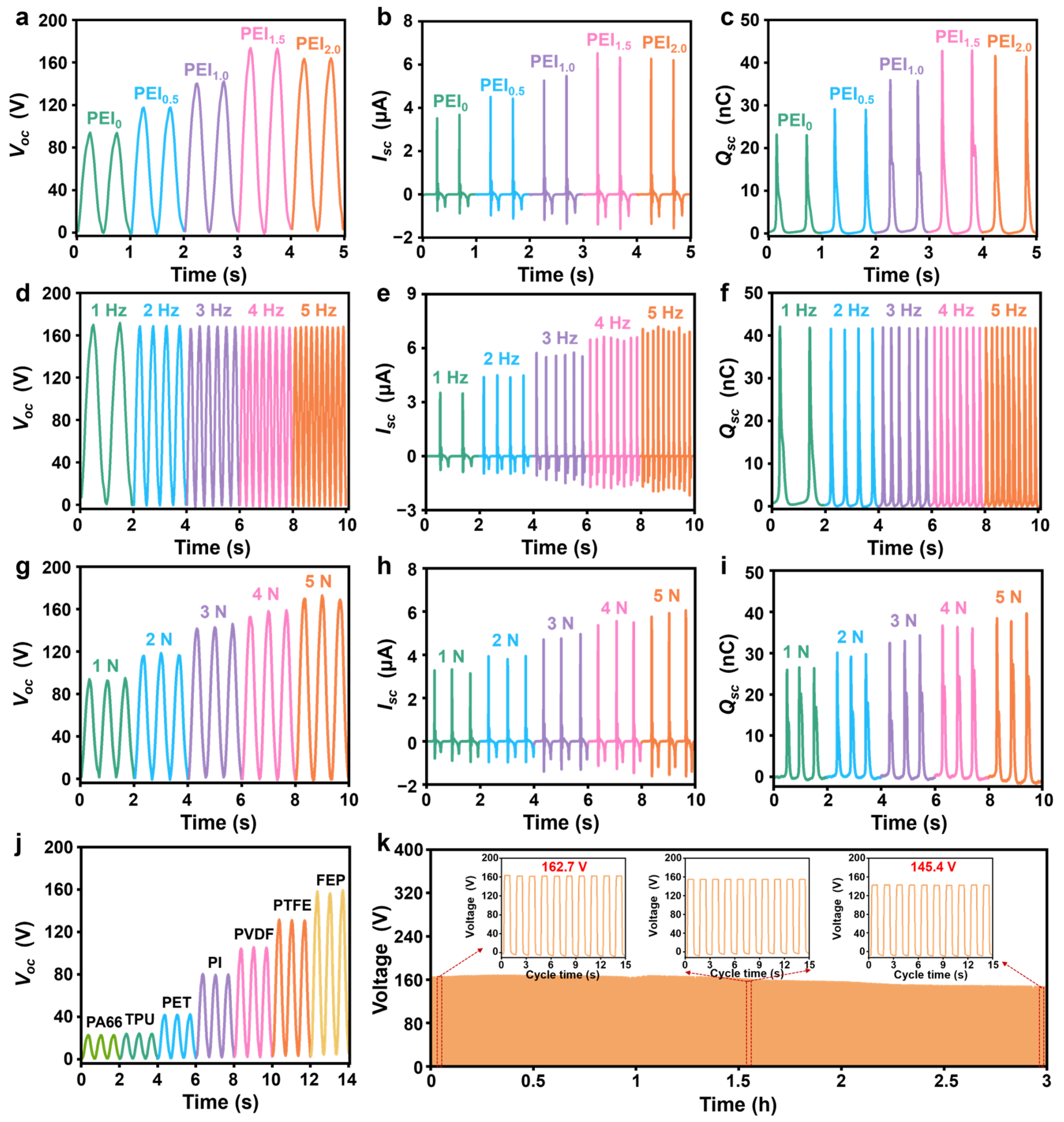
PT-HNG’s triboelectric output characteristics were systematically investigated using PT-HNG with a contact area of 5 × 5 cm2. Firstly, we conducted tests on PT-HNG with different PEI doping contents. From the triboelectric output performance curves in Figure 4a–c, it can be seen that as the PEI doping content increases, the triboelectric output performance continuously enhances. When the PEI mass fraction is 1.5 wt%, the device achieves an open-circuit voltage (Voc) of 172.4 V, a short-circuit current (Isc) of 6.36 μA, and a transferred charge (Qsc) of 43.7 nC, exhibiting the optimal triboelectric output performance. It is worth noting that compared with previously reported hybrid photo-triboelectric systems, PT-HNG exhibits superior performance in both luminescence brightness and electrical output (Table S1, Supplementary Materials). When the PEI content increases to 2.0 wt%, the triboelectric output performance slightly decreases. Similarly, we performed tests on PT-HNG with different ZnS:Cu mass fractions (Figure S6, Supplementary Materials). When the ZnS:Cu content increases from 20 wt% to 40 wt%, the Voc first increases and then decreases, reaching a maximum when the ZnS:Cu mass fraction is 30 wt%.
The triboelectric output characteristics of PT-HNG were tested over the frequency range of 1–5 Hz, as shown in Figure 4d–f. Under a fixed pressure of 5 N, the Voc and Qsc of PT-HNG are approximately 171.7 V and 41.3 nC. As the frequency increases, neither of these parameters exhibits signif5icant variation. In contrast, the Isc increases significantly from 3.56 μA to 6.64 μA. Figure 4g–i show the triboelectric output characteristics of PT-HNG under different pressures (1–5 N). At a fixed frequency of 5 Hz, as the pressure increases, Voc increases from 93.6 V to 172.3 V, Isc increases from 3.16 μA to 6.42 μA, and Qsc increases from 25.9 nC to 42.1 nC. Similarly to the TIEL performance trend, increasing frequency significantly increases the number of electron collisions and excitations per unit time, thereby more effectively activating the luminescent centers. In contrast, increasing pressure expands the effective contact area of the tribological interface and improves charge transfer efficiency, both contributing to enhanced triboelectric output. To evaluate the performance consistency and reproducibility of PT-HNG, we fabricated five independent batches of samples (12 devices per batch) with the optimal composition under identical preparation conditions. The relevant data and analysis have been incorporated into Note S4 and Figure S7 (Supplementary Materials). To enhance the practical relevance of this work, we have also tested the rectified current signals of PT-HNG, with the corresponding results presented in Figure S8 (Supplementary Materials). In addition, the power density of PT-HNG under different external resistance loads (103–109 Ω) was also studied. As shown in Figure S9 (Supplementary Materials), the average output current density and power density under the load of 10 MΩ reach 1.77 mA m−2 and 209.21 mW m−2, respectively. According to the triboelectric sequence theory, the electronegativity difference between two materials is positively correlated with charge transfer efficiency, the larger the electronegativity gap, the greater the charge transfer during tribulation. Therefore, seven types of materials were used as friction layer for electrical performance testing. As shown in Figure 4j, using FEP as the friction layer yielded the optimal triboelectric performance, which is consistent with the triboelectric sequence theory. Finally, the triboelectric output voltage stability of PT-HNG was tested, as shown in Figure 4k. Under uninterrupted operation, the output voltage exhibits only a slight attenuation of 10.6% over 3 h under the tribological conditions of 5 Hz and 5 N, demonstrating that PT-HNG has excellent charge retention capability.

3.5. Applications of Handwriting Recognition and Intelligent Control

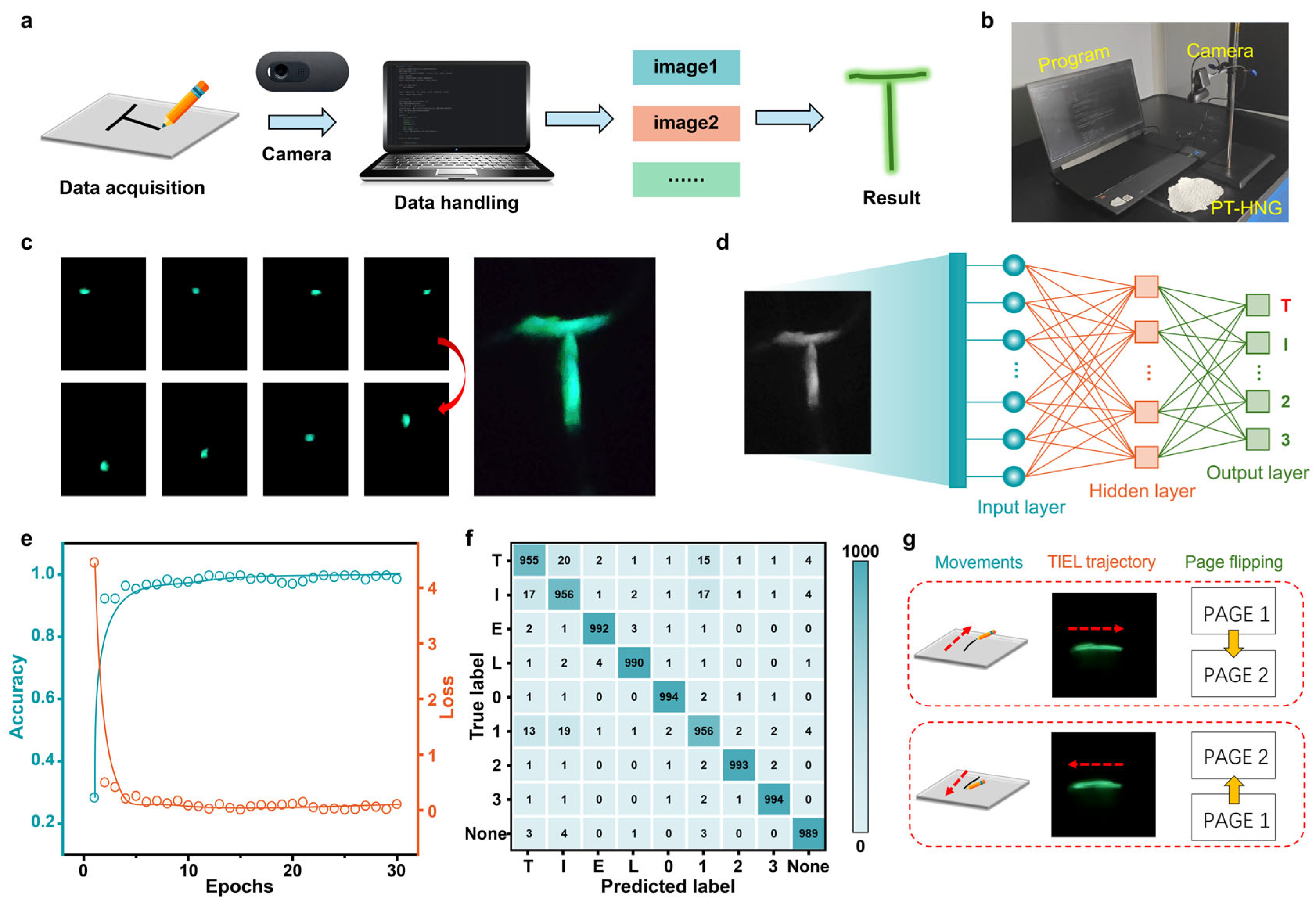
With excellent intuitiveness and interactivity, PT-HNG exhibits strong applicability in scenarios such as smart offices and smart homes. As shown in Figure 5a,b, this study integrated PT-HNG, CCD cameras, and self-developed software to construct a trajectory recognition-based handwritten e-book system, which enables real-time direct upload of handwritten trajectories to terminal devices. The core working principle of this system is that a CCD camera captures the TIEL emission patterns generated by PT-HNG during the sliding friction process in real time. After preprocessing the collected image data, it can be further analyzed or converted to meet diverse application requirements. The workflow of the handwritten e-book system mainly consists of two stages: trajectory extraction and text recognition. For the trajectory extraction process (Figure 5c), it involves real-time reading of the green luminescent motion trajectory of each frame in the image stream, saving multi-frame effective pixels, and combining the frame difference method to convert the dynamic trajectory into a static image, thus achieving real-time trajectory extraction. For the text recognition process, the trajectory-synthesized image is input into a convolutional neural network (CNN) algorithm for classification, with the final output of corresponding text (Figure 5d). Figure 5e shows the trends of accuracy and loss function of the CNN model. As the training iterations proceed, the loss function gradually approaches 0, and the accuracy converges to 1, indicating that the model possesses excellent fitting ability and recognition stability.
To verify the system performance, the letters T, I, E, L, and numbers 0, 1, 2, 3 were selected as recognition objects, with the training set and test set divided in a 75%/25% ratio. The confusion matrix results (Figure 5f) showed a test accuracy of 95.5%, confirming the high recognition accuracy of trajectory features. The complete working process of the system can be found in Video S1. We have conducted a real-time electrical response measurement experiment for the handwriting demonstration. Experimental data showed that the electrical signal characteristics of writing “TIEL” were highly reproducible (Figure S10, Supplementary Materials). By capturing the triboelectric signal generated during the writing process, it can accurately reflect the behavioral characteristics such as stroke sequence, pressure, and speed, and the change in handwriting sequence produces characteristic peaks, the fluctuation of pen pressure affects the peak intensity, and the change in pen speed regulates the periodicity of the signal. The signal-to-noise ratio (SNR) and response time of PT-HNG are presented in Note S5 and Figure S11 (Supplementary Materials), where an SNR of 12.71 dB and a response time of less than 500 ms are observed. In addition, this study demonstrated the real-time intelligent control function of PT-HNG for PowerPoint presentations, as shown in Figure 5g and Video S2. When the control pen slides in different directions on the PT-HNG surface (right sliding for the next page and left sliding for the previous page), precise page flipping of the presentation can be achieved. The above application verifications indicate that PT-HNG has great potential for functional expansion and can meet diverse user needs by integrating more complex control logic.

4. Conclusions

In summary, we developed a novel cellulose-based sustainable photo-triboelectric hybrid nanogenerator (PT-HNG) by integrating wastepaper recycling technology and a PEI-assisted pulping strategy, which can simultaneously convert pressure stimuli into electrical energy and TIEL signals. The results of systematic experiments and theoretical simulations confirm the concept of photo-triboelectric hybrid model. By optimizing the composition of the cellulose-based film, the PT-HNG simultaneously demonstrates excellent optical output (0.06 mW cm−2; 3.84 cd m−2) and electrical output (172.4 V, 6.36 μA, 43.7 nC) under sliding stimulation. Furthermore, the PT-HNG has been successfully demonstrated in energy harvesting and smart control systems by both electrical and optical signals. This study provides an effective design strategy for the integration of circular economy and advanced sensing technology, greatly expanding the application scope of hybrid nanogenerator in fields such as human–computer interaction and IoT terminals.

Supplementary Materials

The following supporting information can be downloaded at: https://www.mdpi.com/article/10.3390/nanoenergyadv6010001/s1, Note S1: The role of PEI content in enhancing the dielectric constant; Note S2: The effect of ZnS:Cu doping content on PT-HNG output; Note S3: Bending endurance and humidity stability assessments; Note S4: The performance consistency and reproducibility of PT-HNG; Note S5: Detailed explanation of SNR and response time test; Figure S1: Electron transfer model for the tribological interaction between PT-HNG (without and with PEI doping) and FEP; Figure S2: SEM images of PT-HNG with different PEI doping contents; Figure S3: Surface potential changes of PT-HNG and FEP under different PEI doping during friction; Figure S4: SEM images of PT-HNG with different ZnS:Cu doping contents; Figure S5: (a) Photographs of PT-HNG under the original, bent, curled, and twisted states. (b) TIEL intensity of PT-HNG after 2000 cycles. (c) Stability test of TIEL intensity over 3 h at 30% RH and 80% RH; Figure S6: Voc Output of PT-HNG with Different ZnS:Cu Mass Fractions; Figure S7: (a) Average output current density and (b) power density of PT-HNG under different external resistances; Figure S8: The rectified current signals of PT-HNG; Figure S9: (a) Average output current density and (b) power density of PT-HNG under different external resistances; Figure S10: The electrical output signals of PT-HNG corresponding to the handwriting of the four letters “TIEL”; Figure S11: The SNR and response time of PT-HNG; Table S1. Comparative evaluation of PT-HNG with other photo-triboelectric systems; Video S1: Demonstration of handwriting recognition system based on PT-HNG; Video S2: Demonstration of PowerPoint page flipping controlled by the TIEL signal of PT-HNG [10,11,42,55,56,57,58,59,60].

Author Contributions

Z.T.: methodology, validation, formal analysis, writing—original draft. J.L.: conceptualization, writing—review and editing. C.D.: software, writing—review and editing. C.Y.: software. M.C.: visualization. X.C.: project administration. Q.L.: project administration. L.S.: supervision, writing—review and editing. All authors have read and agreed to the published version of the manuscript.

Funding

This work was supported by the National Natural Science Foundation of China (52273282), Fundamental Research Funds for the Central Universities (N2523006), and Hebei Natural Science Foundation (F2024501044).

Data Availability Statement

The original contributions presented in the study are included in the article and Supplementary Materials, further inquiries can be directed to the corresponding authors.

Conflicts of Interest

The authors declare no conflicts of interest.

References

  1. Cao, Y.X.; Peng, Y.X.; Ren, W.J.; Wang, H.H.; Diao, Y.; Liu, Z.M.; He, X.; Luo, H.; Wu, X.D. Intrinsically soft and fully recyclable robotic sensors with quadruple sensing functions for reliable human-robot interactions. Sci. Bull. 2025, 70, 2784–2796. [Google Scholar] [CrossRef] [PubMed]
  2. Qu, J.T.; Cui, G.M.; Li, Z.K.; Fang, S.T.; Zhang, X.R.; Liu, A.; Han, M.Y.; Liu, H.D.; Wang, X.Q.; Wang, X.H. Advanced Flexible Sensing Technologies for Soft Robots. Adv. Funct. Mater. 2024, 34, 2401311. [Google Scholar] [CrossRef]
  3. Zhang, T.T.; Manshaii, F.; Bowen, C.R.; Zhang, M.Y.; Qian, W.Q.; Hu, C.S.; Bai, Y.N.; Huang, Z.J.; Yang, Y.; Chen, J. A flexible pressure sensor array for self-powered identity authentication during typing. Sci. Adv. 2025, 11, eads2297. [Google Scholar] [CrossRef] [PubMed]
  4. Wang, J.B.; Xu, S.W.; Qian, W.Q.; Hasan, M.A.M.; Ren, Z.L.; Yang, Y. Pressure-enhanced thermopower of ionic thermoelectric gelatin for identifying materials with different thermal conductivities. Nano Energy 2025, 142, 111156. [Google Scholar] [CrossRef]
  5. Zhao, H.Q.; Zhang, Y.Z.; Han, L.; Qian, W.Q.; Wang, J.B.; Wu, H.T.; Li, J.C.; Dai, Y.; Zhang, Z.Y.; Bowen, C.R.; et al. Intelligent Recognition Using Ultralight Multifunctional Nano-Layered Carbon Aerogel Sensors with Human-Like Tactile Perception. Nano-Micro Lett. 2024, 16, 11. [Google Scholar] [CrossRef]
  6. Lou, Z.; Li, L.; Wang, L.L.; Shen, G.Z. Recent Progress of Self-Powered Sensing Systems for Wearable Electronics. Small 2017, 13, 1701791. [Google Scholar] [CrossRef]
  7. Yu, H.; Li, N.; Zhao, N. How Far Are We from Achieving Self-Powered Flexible Health Monitoring Systems: An Energy Perspective. Adv. Energy Mater. 2021, 11, 2002646. [Google Scholar] [CrossRef]
  8. Hajra, S.; Panda, S.; Song, S.; Panigrahi, B.K.; Pakawanit, P.; Jeong, S.M.; Kim, H.J. Flexible composite material for self-powered applications via triboelectricity and mechanoluminescence: PDMS/ZnS:Cu composites. Nano Energy 2023, 114, 108668. [Google Scholar] [CrossRef]
  9. Wang, X.D.; Que, M.L.; Chen, M.X.; Han, X.; Li, X.Y.; Pan, C.F.; Wang, Z.L. Full Dynamic-Range Pressure Sensor Matrix Based on Optical and Electrical Dual-Mode Sensing. Adv. Mater. 2017, 29, 1605817. [Google Scholar] [CrossRef]
  10. Su, L.; Wang, H.L.; Tian, Z.; Wang, H.J.; Cheng, Q.; Yu, W. Low Detection Limit and High Sensitivity Wind Speed Sensor Based on Triboelectrification-Induced Electroluminescence. Adv. Sci. 2019, 6, 1901980. [Google Scholar] [CrossRef]
  11. Wang, Y.D.; Yang, Q.X.; Li, Y.; Peng, L.; Zhang, C.; Cheng, S.N.; Han, Y.; Cao, X. Light-Emitting Visual Triboelectric Nanogenerator for Self-Powered Personal Security. ACS Energy Lett. 2024, 9, 2231–2239. [Google Scholar] [CrossRef]
  12. Zhang, H.; Chen, H.M.; Lee, J.H.; Kim, E.; Chan, K.Y.; Venkatesan, H.; Shen, X.; Yang, J.L.; Kim, J.K. Mechanochromic Optical/Electrical Skin for Ultrasensitive Dual-Signal Sensing. ACS Nano 2023, 17, 5921–5934. [Google Scholar] [CrossRef]
  13. Li, J.Y.; Zhu, L.P.; Zhang, Z.W.; Wang, A.C.; Wang, Z.L.; Wang, L.F.; Yang, D. Triboelectrification-induced electroluminescent skin for real-time information recording at a record low pressure threshold of 0.125 kPa. Mater. Today 2024, 78, 10–19. [Google Scholar] [CrossRef]
  14. Su, L.; Kuang, S.Y.; Zhao, Y.; Li, J.H.; Zhao, G.D.; Wang, Z.L.; Zi, Y.L. Self-powered visualized tactile-acoustic sensor for accurate artificial perception with high brightness and record-low detection limit. Sci. Adv. 2024, 10, eadq8989. [Google Scholar] [CrossRef]
  15. Tian, Z.; Su, L.; Wang, H.Y.; Wang, H.Q.; Zi, Y.L. Underwater Self-Powered All-Optical Wireless Ultrasonic Sensing, Positioning and Communication with Ultrafast Response Time and Ultrahigh Sensitivity. Adv. Optical Mater. 2021, 10, 2102091. [Google Scholar] [CrossRef]
  16. Zhao, X.J.; Kuang, S.Y.; Wang, Z.L.; Zhu, G. Electricity−free electroluminescence excited by droplet impact driven triboelectric field on Solid−Liquid interface. Nano Energy 2020, 75, 104823. [Google Scholar] [CrossRef]
  17. Jiang, Z.C.; Chen, K.; Tian, B.Q.; Zheng, Z.X.; Yao, Y.T.; Wang, N.; Wang, T.; Hao, H.X. Mechanochromism and mechanical deformation of organic crystals: Tunable packing structure for achieving luminescence reversibility and elasticity. Sci. China Mater. 2024, 67, 232–241. [Google Scholar] [CrossRef]
  18. Peng, D.F.; Jiang, Y.J.; Huang, B.L.; Du, Y.Y.; Zhao, J.X.; Zhang, X.; Ma, R.H.; Golovynskyi, S.; Chen, B.; Wang, F. A ZnS/CaZnOS Heterojunction for Efficient Mechanical-to-Optical Energy Conversion by Conduction Band Offset. Adv. Mater. 2020, 32, 1907747. [Google Scholar] [CrossRef]
  19. Zhuang, Y.X.; Tu, D.; Chen, C.J.; Wang, L.; Zhang, H.W.; Xue, H.; Yuan, C.H.; Chen, G.R.; Pan, C.F.; Dai, L.Z.; et al. Force-induced charge carrier storage: A new route for stress recording. Light-Sci. Appl. 2020, 9, 182. [Google Scholar] [CrossRef]
  20. Li, G.H.; Sun, F.Q.; Zhao, S.K.; Xu, R.D.; Wang, H.; Qu, L.J.; Tian, M.W. Autonomous Electroluminescent Textile for Visual Interaction and Environmental Warning. Nano Lett. 2023, 23, 8436–8444. [Google Scholar] [CrossRef] [PubMed]
  21. Yang, C.H.; Chen, B.H.; Zhou, J.X.; Chen, Y.M.; Suo, Z.G. Electroluminescence of Giant Stretchability. Adv. Mater. 2016, 28, 4480–4484. [Google Scholar] [CrossRef]
  22. Gu, S.Q.; Zhou, Y.L.; Li, Y.Y.; Ma, T.; Guo, R.H.; Lu, Q.Y.; Zhang, J.X.; Cao, S.T.; Zhu, H.Y.; Li, D.C.; et al. Ultrastretchable alternating current electroluminescent panels for arbitrary luminous patterns. Appl. Mater. Today 2023, 31, 101764. [Google Scholar] [CrossRef]
  23. Su, L.; Zhao, G.D.; Wu, Y.; Wang, C.; Guo, Y.S.Y.; Zhao, Y. High-Brightness and High-Resolution Triboelectrification-Induced Electroluminescence Skin for Photonic Imaging and Information Interaction. Adv. Funct. Mater. 2024, 34, 2412956. [Google Scholar] [CrossRef]
  24. Wang, Y.; Wang, H.L.; Li, H.Y.; Wei, X.Y.; Wang, Z.L.; Zhu, G. Enhanced High-Resolution Triboelectrification-Induced Electroluminescence for Self-Powered Visualized Interactive Sensing. ACS Appl. Mater. Interfaces 2019, 11, 13796−13802. [Google Scholar] [CrossRef]
  25. Su, L.; Jiang, Z.Y.; Tian, Z.; Wang, H.L.; Wang, H.J.; Zi, Y.L. Self-powered, ultrasensitive, and high-resolution visualized flexible pressure sensor based on color-tunable triboelectrification-induced electroluminescence. Nano Energy 2021, 79, 105431. [Google Scholar] [CrossRef]
  26. Park, H.J.; Kim, S.M.; Lee, J.H.; Kim, H.T.; Seung, W.; Son, Y.; Kim, T.Y.; Khan, U.; Park, N.M.; Kim, S.W. Self-Powered Motion-Driven Triboelectric Electroluminescence Textile System. ACS Appl. Mater. Interfaces 2019, 11, 5200−5207. [Google Scholar] [CrossRef] [PubMed]
  27. Su, L.; Wang, H.J.; Zi, Y.L. Recent progress of triboelectrification-induced electroluminescence: From fundaments to applications. J. Phys. Mater. 2021, 4, 042001. [Google Scholar] [CrossRef]
  28. Wei, X.Y.; Wang, X.D.; Kuang, S.Y.; Su, L.; Li, H.Y.; Wang, Y.; Pan, C.F.; Wang, Z.L.; Zhu, G. Dynamic Triboelectrification-Induced Electroluminescence and its Use in Visualized Sensing. Adv. Mater. 2016, 28, 6656–6664. [Google Scholar] [CrossRef]
  29. Fan, F.R.; Tian, Z.Q.; Wang, Z.L. Flexible triboelectric generator. Nano Energy 2012, 1, 328–334. [Google Scholar] [CrossRef]
  30. Wang, Z.L. Triboelectric Nanogenerators as New Energy Technology for Self-Powered Systems and as Active Mechanical and Chemical Sensors. ACS Nano 2013, 7, 9533–9557. [Google Scholar] [CrossRef]
  31. Niu, S.M.; Wang, Z.L. Theoretical systems of triboelectric nanogenerators. Nano Energy 2015, 14, 161–192. [Google Scholar] [CrossRef]
  32. Cheng, T.H.; Shao, J.J.; Wang, Z.L. Triboelectric nanogenerators. Nat. Rev. Methods Primers 2023, 3, 39. [Google Scholar] [CrossRef]
  33. Gajula, P.; Yoon, J.U.; Woo, I.; Bae, J.W. Harnessing Mechanical Energy for Green Hydrogen: Pioneering High-Performance Triboelectric Nanogenerators. Adv. Funct. Mater. 2025, 35, 2501074. [Google Scholar] [CrossRef]
  34. Gajula, P.; Mahanty, B.; Lee, D.W. Engineered nano-micro fiber networks: PANI nanowires on electrospun Nylon 11 fibers for enhanced triboelectric performance in wearable biomechanical sensing. Mater. Today Nano 2025, 29, 100602. [Google Scholar] [CrossRef]
  35. Gajula, P.; Yoon, J.U.; Woo, I.; Oh, S.J.; Bae, J.W. Triboelectric touch sensor array system for energy generation and self-powered human-machine interfaces based on chemically functionalized, electrospun rGO/Nylon-12 and micro-patterned Ecoflex/MoS2 films. Nano Energy 2024, 121, 109278. [Google Scholar] [CrossRef]
  36. Yoon, J.U.; Woo, I.; Gajula, P.; Bae, J.W. Creating Smart Washable Flooring: Sandwich-Style Single-Electrode Triboelectric Nanogenerator with Barium Titanate and Graphite-Fluorinated Polymer-Infused Ecoflex Hybrid Composites for Enhanced Safety and Security. Adv. Funct. Mater. 2025, 35, 2421977. [Google Scholar] [CrossRef]
  37. Liu, K.Y.; Xia, Y.F.; Zhi, X.R.; Li, S.H.; Zhang, S.Y.; Yang, B.; Li, M.Y.; Wang, X.; Pan, C.F. Self-powered bimodal tactile imaging device for ultrasensitive pressure sensing, real-time visualization recognition, and intelligent control. Mater. Today 2024, 79, 73–85. [Google Scholar] [CrossRef]
  38. Zhao, X.; Zhang, Z.; Xun, X.C.; Xu, L.X.; Kang, Z.; Zhang, Y. Self-powered user-interactive electronic skin for programmable touch operation platform. Sci. Adv. 2020, 6, eaba4294. [Google Scholar] [CrossRef]
  39. Shang, K.D.; He, C.L.; Zhou, J.; Ling, P.; Lu, X.L.; Fu, C.Q.; Zhang, Y.; Tang, C.; Qian, L.M.; Yang, T.T. Optical and electrical dual-mode tactile sensor with interlinked interfaces recording normal force and slip for closed-loop robotics. Chem. Eng. J. 2023, 475, 146279. [Google Scholar] [CrossRef]
  40. Jia, C.Y.; Xia, Y.F.; Zhu, Y.; Wu, M.; Zhu, S.L.; Wang, X. High-Brightness, High-Resolution, and Flexible Triboelectrification-Induced Electroluminescence Skin for Real-Time Imaging and Human–Machine Information Interaction. Adv. Funct. Mater. 2022, 32, 2201292. [Google Scholar] [CrossRef]
  41. Su, L.; Xiong, Q.; Wang, H.Y.; Zi, Y.L. Porous-Structure-Promoted Tribo-Induced High-Performance Self-Powered Tactile Sensor toward Remote Human-Machine Interaction. Adv. Sci. 2022, 9, 2203510. [Google Scholar] [CrossRef] [PubMed]
  42. Li, J.H.; Tian, Z.; Su, L.; Yang, Y.L.; Ding, C.; Wang, C.; Sun, M.; Zhao, Y. Wearable self-powered intelligent textile with optical-electrical dual-mode functionality for pressure distribution detection and remote intelligent control. J. Mater. Chem. C 2024, 12, 19078−19085. [Google Scholar] [CrossRef]
  43. Xia, Y.F.; Zhu, Y.; Yang, B.; Guo, W.Y.; Han, S.L.; Wang, X. Wireless-controlled, self-powered, and patterned information encryption display system based on flexible electroluminescence devices. Nano Energy 2022, 102, 107653. [Google Scholar] [CrossRef]
  44. Dong, M.L.; Cao, C.; Luo, Z.C.; Ni, S.X.; Bian, H.Y.; Dai, H.Q.; Gao, Y. Lignin nanoparticles-engineered cellulose nanofibrils films with modulated surface microstructure and interfacial polarization for high-performance triboelectric nanogenerators. Chem. Eng. J. 2025, 524, 169234. [Google Scholar] [CrossRef]
  45. Gao, C.; Liu, T.; Luo, B.; Cai, C.C.; Zhang, W.L.; Zhao, J.M.; Yuan, J.X.; Fatehi, P.; Qin, C.R.; Nie, S.X. Cellulosic triboelectric materials for stable energy harvesting from hot and humid conditions. Nano Energy 2023, 111, 108426. [Google Scholar] [CrossRef]
  46. Qian, W.Q.; Yang, Y. Cellulose-Templated Nanomaterials for Nanogenerators and Self-Powered Sensors. Adv. Mater. 2025, 37, 2412858. [Google Scholar] [CrossRef]
  47. Zhang, W.L.; Chen, X.H.; Zhao, J.M.; Wang, X.Y.; Li, X.Z.; Liu, T.; Luo, B.; Qin, Y.; Zhang, S.; Chi, M.C.; et al. Cellulose template-based triboelectric nanogenerators for self-powered sensing at high humidity. Nano Energy 2023, 108, 108196. [Google Scholar] [CrossRef]
  48. Yang, M.Y.; Chen, L.; Wang, J.J.; Msigwa, G.; Osman, A.I.; Fawzy, S.; Rooney, D.W.; Yap, P.S. Circular economy strategies for combating climate change and other environmental issues. Environ. Chem. Lett. 2022, 21, 55–80. [Google Scholar] [CrossRef]
  49. Haile, A.; Gelebo, G.G.; Tesfaye, T.; Mengie, W.; Mebrate, M.A.; Abuhay, A.; Limeneh, D.Y. Pulp and paper mill wastes: Utilizations and prospects for high value-added biomaterials. Bioresour. Bioprocess. 2021, 8, 35. [Google Scholar] [CrossRef]
  50. Abushammala, H.; Masood, M.A.; Ghulam, S.T.; Mao, J. On the Conversion of Paper Waste and Rejects into High-Value Materials and Energy. Sustainability 2023, 15, 6915. [Google Scholar] [CrossRef]
  51. Lei, W.Q.; Fang, C.Q.; Zhou, X.; Yin, Q.; Pan, S.F.; Yang, R.; Liu, D.H.; Ouyang, Y. Cellulose nanocrystals obtained from office waste paper and their potential application in PET packing materials. Carbohyd. Polym. 2018, 181, 376–385. [Google Scholar] [CrossRef]
  52. Fang, Z.Q.; Zhang, H.L.; Qiu, S.Y.; Kuang, Y.D.; Zhou, J.; Lan, Y.; Sun, C.; Li, G.H.; Gong, S.Q.; Ma, Z.Q. Versatile Wood Cellulose for Biodegradable Electronics. Adv. Mater. Technol. 2021, 6, 2000928. [Google Scholar] [CrossRef]
  53. Foroughi, F.; Rezvani Ghomi, E.; Morshedi Dehaghi, F.; Borayek, R.; Ramakrishna, S. A Review on the Life Cycle Assessment of Cellulose: From Properties to the Potential of Making It a Low Carbon Material. Materials 2021, 14, 714. [Google Scholar] [CrossRef] [PubMed]
  54. Jiao, C.Q.; Li, C.; Yue, J.J.; Li, L.P.; Yang, H.J.; Tao, Y.H.; Lu, J.; Lv, Y.N.; Wang, H.S.; Tan, M.Q. Structurally robust cellulosic triboelectric materials under high moisture conditions for self-powered sensing. Nano Energy 2024, 122, 109311. [Google Scholar] [CrossRef]
  55. Umapathi, R.; Pammi, S.V.N.; Han, S.B.; Haribabu, J.; Safarkhani, M.; Rani, G.M.; Huh, Y.S. Designing Smart Anti-Theft Alarm System via Lead-Free BSFO-PDMS Composite Based Triboelectric Nanogenerator. Chem. Eng. J. 2025, 511, 161799. [Google Scholar] [CrossRef]
  56. He, M.; Du, W.W.; Feng, Y.M.; Li, S.J.; Wang, W.; Zhang, X.; Yu, A.F.; Wan, L.Y.; Zhai, J.Y. Flexible and Stretchable Triboelectric Nanogenerator Fabric for Biomechanical Energy Harvesting and Self-Powered Dual-Mode Human Motion Monitoring. Nano Energy 2021, 86, 106058. [Google Scholar] [CrossRef]
  57. Yang, W.F.; Gong, W.; Gu, W.; Liu, Z.X.; Hou, C.Y.; Li, Y.G.; Zhang, Q.H.; Wang, H.Z. Self-Powered Interactive Fiber Electronics with Visual–Digital Synergies. Adv. Mater. 2021, 33, 2104681. [Google Scholar] [CrossRef]
  58. Hajra, S.; Panda, S.; Song, S.K.; Song, H.W.; Panigrahi, B.K.; Jeong, S.M.; Mishra, Y.K.; Kim, H.J. Simultaneous Triboelectric and Mechanoluminescence Sensing Toward Self-Powered Applications. Adv. Sustain. Syst. 2024, 8, 2400609. [Google Scholar] [CrossRef]
  59. Fu, X.T.; Cao, Y.Q.; Song, X.Y.; Sun, R.B.; Jiang, H.; Du, P.; Peng, D.F.; Luo, L.H. Flexible Piezoelectric Energy Harvesters with Mechanoluminescence for Mechanical Energy Harvesting and Stress Visualization Sensing. Adv. Funct. Mater. 2025, 35, 2412507. [Google Scholar] [CrossRef]
  60. Sun, M.; Liu, J.C.; Tian, Z.; Yang, C.Y.; Guo, Y.S.; Wang, C.; Su, L. Stretchable Optical–Electrical Dual-Responsive Photonic Skin and Its Intelligent Sensing Applications. Energy Technol. 2025, e202501727. [Google Scholar] [CrossRef]
Figure 1. Structure and characterization of PT-HNG. (a) Flowchart of synthesizing PT-HNG. (b) SEM and EDS images of cellulose-PEI film with 1.5 wt% PEI content. (c) Dielectric constant of cellulose-PEI films with different mass ratios of PEI.
Nanoenergyadv 06 00001 g001
Figure 2. Working mechanism of PT-HNG. (a) Working principle diagram of PT-HNG for concurrent optical and electrical signal generation during sliding. (b) The 2D models showing the cross-sectional potential distribution of PT-HNG in the four typical working states as constructed using COMSOL software. The corresponding (c) potential variation and (d) electric field variation along the “line A” in the four working states. (e) TIEL spectrum of PT-HNG obtained when seven types of materials are employed as sliding counterparts (testing conditions: 5 N, 5 Hz).
Nanoenergyadv 06 00001 g002
Figure 3. TIEL performance of PT-HNG. (a) TIEL spectrum obtained from PT-HNG (inset: Corresponding color coordinates). Dependence of TIEL spectra on (b) ZnS:Cu content and (c) PEI content. TIEL intensity with (d) sliding frequency from 1 to 5 Hz at a pressure of 5 N and (e) pressure from 1 to 5 N at a frequency of 5 Hz (sliding object: FEP film). (f) TIEL intensity of PT-HNG obtained using different types of paper as raw materials (5 N, 5 Hz). (g) Optical voltage response of PT-HNG with an optical power density of 0.06 mW cm−2 (5 N, 5 Hz). (h) Stability and repeatability test of the TIEL emission in 1 h at an interval of 1 s, comparison of the luminescent performance of PT-HNG before and after 1 week in air.
Nanoenergyadv 06 00001 g003
Figure 4. Electrical properties of PT-HNG. Triboelectric output performance of PT-HNG with different mass ratios of PEI: (a) Voc; (b) Isc; (c) Qsc. Triboelectric output performance of PT-HNG with different frequency: (d) Voc; (e) Isc; (f) Qsc. Triboelectric output performance of PT-HNG at different pressure: (g) Voc; (h) Isc; (i) Qsc; (j) Voltage output of PT-HNG obtained when seven types of materials are employed as sliding counterparts (5 N, 5 Hz). (k) Stability and repeatability test of triboelectric output over 3 h.
Nanoenergyadv 06 00001 g004
Figure 5. Demonstration of the PT-HNG for trajectory recognition and intelligent control through TIEL signals. (a) Schematic diagram of the process for identifying PT-HNG sliding results. (b) Schematic diagram of the handwritten e-book system, including a PT-HNG, a CCD camera, and self-developed software. (c) Real-time reading of each frame during writing and trajectory results. (d) Simulated CNN for trajectory recognition. (e) Recognition accuracy and loss curves for writing trajectories. (f) The classification confusion matrix with the overall accuracy of 95.5%. (g) Demonstration of manipulating the PowerPoint page flipping by sliding PT-HNG.
Nanoenergyadv 06 00001 g005
Disclaimer/Publisher’s Note: The statements, opinions and data contained in all publications are solely those of the individual author(s) and contributor(s) and not of MDPI and/or the editor(s). MDPI and/or the editor(s) disclaim responsibility for any injury to people or property resulting from any ideas, methods, instructions or products referred to in the content.