
You are currently viewing a new version of our website. To view the old version click .
Nanoenergy Advances
  • Article
  • Open Access

12 December 2025

Layer-by-Layer Hybrid Film of PAMAM and Reduced Graphene Oxide–WO3 Nanofibers as an Electroactive Interface for Supercapacitor Electrodes

,
,
and
Laboratory of Applied Nanomaterials and Nanostructures (LANNA), Institute of Exact Sciences, Natural and Education, Federal University of Triângulo Mineiro (UFTM), Uberaba 38064-200, MG, Brazil
*
Author to whom correspondence should be addressed.
This article belongs to the Special Issue Hybrid Energy Storage Systems Based on Nanostructured Materials

Abstract

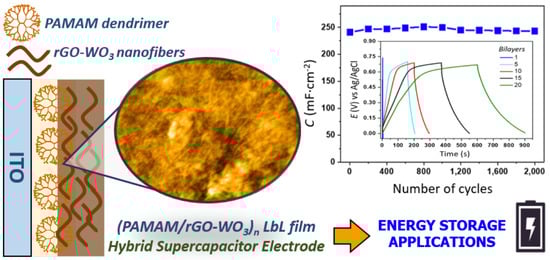
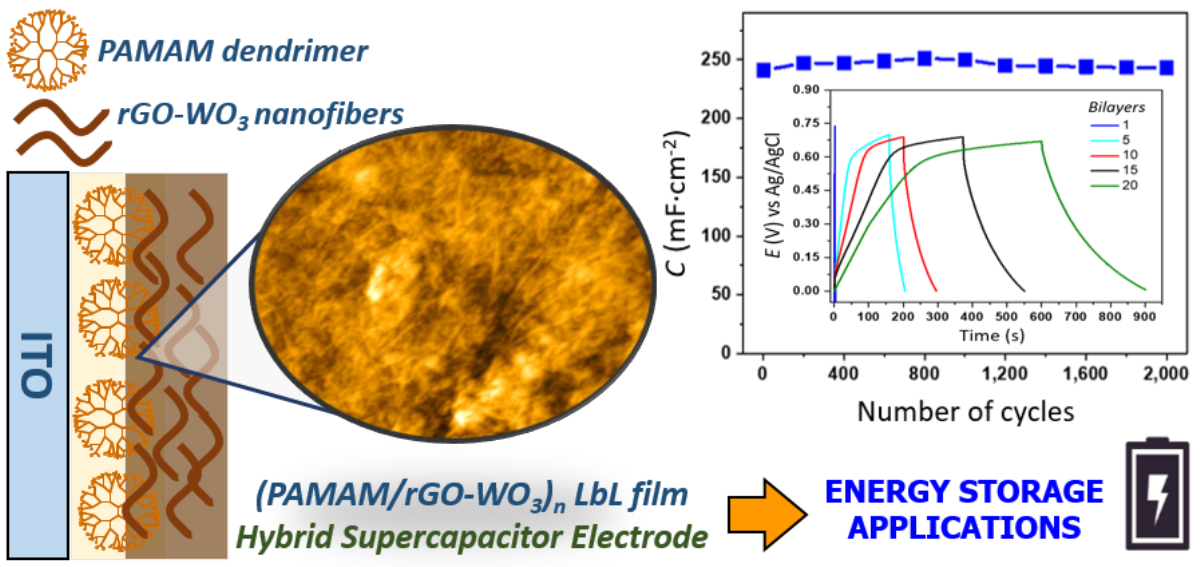
Tungsten oxide (WO3) nanostructures have emerged as promising electroactive materials due to their high pseudocapacitance, structural versatility, and chemical stability, while reduced graphene oxide (rGO) provides excellent electrical conductivity and surface area. The strategic combination of these nanomaterials in hybrid electrodes has gained attention for enhancing the energy storage performance of supercapacitors. In this work, we report the fabrication and electrochemical performance of nanostructured multilayer films based on the electrostatic Layer-by-Layer (LbL) self-assembly of poly (amidoamine) (PAMAM) dendrimers alternated with tungsten oxide (WO3) nanofibers dispersed in reduced graphene oxide (rGO). The films were deposited onto indium tin oxide (ITO) substrates and subsequently subjected to electrochemical reduction. UV-Vis spectroscopy confirmed the linear growth of the multilayers, while atomic force microscopy (AFM) revealed homogeneous surface morphology and thickness control. Electrochemical characterization by cyclic voltammetry (CV) and galvanostatic charge–discharge (GCD) revealed a predominantly electrical double-layer capacitive (EDLC) behavior. From the GCD measurements (PAMAM/rGO-WO3)20 films achieved an areal capacitance of ≈2.20 mF·cm−2, delivering an areal energy density of ≈0.17 µWh·cm−2 and an areal power density of ≈2.10 µW·cm−2, demonstrating efficient charge storage in an ultrathin electrode architecture. These results show that the synergistic integration of PAMAM dendrimers, reduced graphene oxide, and WO3 nanofibers yields a promising strategy for designing high-performance electrode materials for next-generation supercapacitors.

1. Introduction

The growing demand for compact, wearable, and portable electronic devices has intensified the search for advanced energy storage systems that combine miniaturization with high performance [1,2,3,4,5]. In this context, electrochemical capacitors, commonly known as supercapacitors, have emerged as promising candidates due to their rapid charge–discharge capabilities, high power density, and long cycle life [5,6]. These features make them particularly attractive for integration into next-generation electronics, including flexible sensors, implantable medical devices, and microenergy systems [1,2,3,4,5,6]. However, a key limitation of conventional supercapacitors remains their relatively low energy density when compared to batteries, which restricts their use in applications requiring sustained energy delivery. This challenge has motivated extensive research into the development of new electrode architectures and hybrid materials capable of significantly improving energy storage performance without sacrificing flexibility, stability, or scalability [5,6,7,8].
In this context, the integration of metal oxides with carbon-based nanostructures has emerged as a promising strategy for designing hybrid electrodes [5,6,7,8]. Among various metal oxides, tungsten trioxide (WO3) stands out due to its redox activity, environmental stability, and structural versatility. WO3 exhibits multiple oxidation states (W6+/W5+/W4+), enabling fast and reversible faradaic reactions, which are key to achieving high pseudocapacitance [9,10,11]. Additionally, it possesses a wide electrochemical window, good chemical compatibility in aqueous and solid electrolytes, and intrinsic proton or cation intercalation capability. Its high density (~7.16 g/cm3) also favors volumetric capacitance [9,10,11]. When engineered at the nanoscale, particularly in the form of nanofibers, WO3 exhibits enhanced surface area, short ion diffusion paths, and improved ion transport dynamics, making it especially suitable for pseudocapacitive applications in high-performance supercapacitors [9,10,11,12,13].
Reduced graphene oxide (rGO), in turn, offers exceptional electrical conductivity, mechanical flexibility, and a large surface area, enabling efficient charge transport and strong interaction with electroactive species [14,15]. The synergistic combination of WO3 and rGO in a hybrid architecture has been shown to enhance both the capacitive and pseudocapacitive behavior of electrodes, improving overall energy storage capabilities [9,11]. Despite the promising features of rGO/WO3 composites, the effective organization of these materials at the nanoscale remains a challenge. The Layer-by-Layer (LbL) self-assembly technique offers a powerful platform for the controlled deposition of nanomaterials into uniform, stratified multilayers [16,17,18,19]. This approach allows precise tuning of film thickness, composition, and electroactive interface, while enabling the integration of organic and inorganic components into functional architectures [16,17,18,19]. In the field of supercapacitors, LbL assembly provides several strategic advantages, including high structural regularity, the ability to fine-tune porosity and ionic pathways, improved mechanical stability, and the possibility to fabricate ultrathin electrodes with high surface-to-volume ratios [6,19]. Moreover, the versatility of the method allows the rational combination of conductive and pseudocapacitive components, enabling synergistic effects that enhance both energy and power density in miniaturized or flexible energy storage devices [6,19].
Poly(amidoamine) (PAMAM) dendrimers have proven particularly advantageous in this context [20,21]. PAMAM is a hyperbranched, water-soluble dendritic polymer characterized by a well-defined molecular architecture, high density of terminal amine groups, and excellent charge transport properties. Its cationic nature enables strong electrostatic interactions with negatively charged species, making it highly suitable for LbL assembly [18,19,22,23,24]. In supercapacitor applications, PAMAM plays a dual role: it facilitates the uniform growth of multilayer films and contributes to the formation of porous and electrochemically accessible architectures. These features promote enhanced electrolyte diffusion and increase the electroactive surface area, which are essential for improving charge storage performance in nanostructured electrodes.
In this study, we explore the fabrication of hybrid nanostructured multilayer films composed of PAMAM dendrimers alternated with WO3 nanofibers dispersed in rGO. The films were assembled via the LbL technique onto ITO substrates and evaluated as electroactive interfaces for supercapacitor electrode applications. Spectroscopic, morphological, and electrochemical characterizations were conducted to assess film growth, surface features, and capacitive behavior. The performance of PAMAM/rGO-WO3 multilayers was compared with that of PAMAM/rGO films without WO3, highlighting the significant enhancement in specific capacitance and energy storage capability due to the incorporation of WO3 nanofibers.

2. Materials and Methods

2.1. Materials

Poly(amidoamine) (PAMAM) dendrimers, generation 4 (10 wt. % in methanol), and graphene oxide (GO) dispersion (2 mg·mL−1 in H2O) were purchased from Sigma-Aldrich (Darmstadt, Germany) and used without further purification. Sodium tungstate dihydrate (Na2WO4·2H2O), hydrochloric acid (HCl), potassium permanganate (KMnO4), and sodium sulfate (Na2SO4) were acquired from Vetec (São Paulo, Brazil) and used as received. Ultrapure water (18.2 MΩ·cm) was used throughout all experiments.

2.2. Synthesis of WO3 Nanofibers

WO3 nanofibers were synthesized following the hydrothermal method previously reported by Morais et al. [25], which has been shown to consistently produce reproducible nanofibers with uniform diameter, length, and aspect ratio. Briefly, 2.0 g of Na2WO4·2H2O was dissolved in 50 mL of ultrapure water under constant stirring. Then, 6.0 mL of 6 mol·L−1 HCl was added dropwise to acidify the solution, forming a yellowish suspension. The resulting mixture was transferred to a 100 mL Teflon-lined stainless-steel autoclave and maintained at 180 °C for 12 h. After cooling to room temperature, the blue precipitate was collected by centrifugation, washed several times with water and ethanol, and dried at 60 °C for 24 h. The resulting material consisted of uniform WO3 nanofibers with a high aspect ratio, as later confirmed by SEM and AFM. The nanoscale fibrous architecture of the synthesized WO3 material and its structural characterization by means of energy dispersive spectroscopy (EDS) and X-ray diffraction (XRD) are shown in the Supplementary Material (Figure S1).

2.3. Preparation of GO–WO3 Dispersion

The hybrid dispersion was prepared by dispersing the synthesized WO3 nanofibers into the GO aqueous dispersion (1.0 mg·mL−1) under ultrasonic agitation for 1 h. The mass ratio of WO3 to GO was 1:1 (w/w). The final dispersion was adjusted to a pH of approximately 4.1 using dilute hydrochloric acid, ensuring strong electrostatic interaction with the cationic PAMAM during LbL assembly.

2.4. Fabrication of Multilayer Films via Layer-by-Layer Assembly

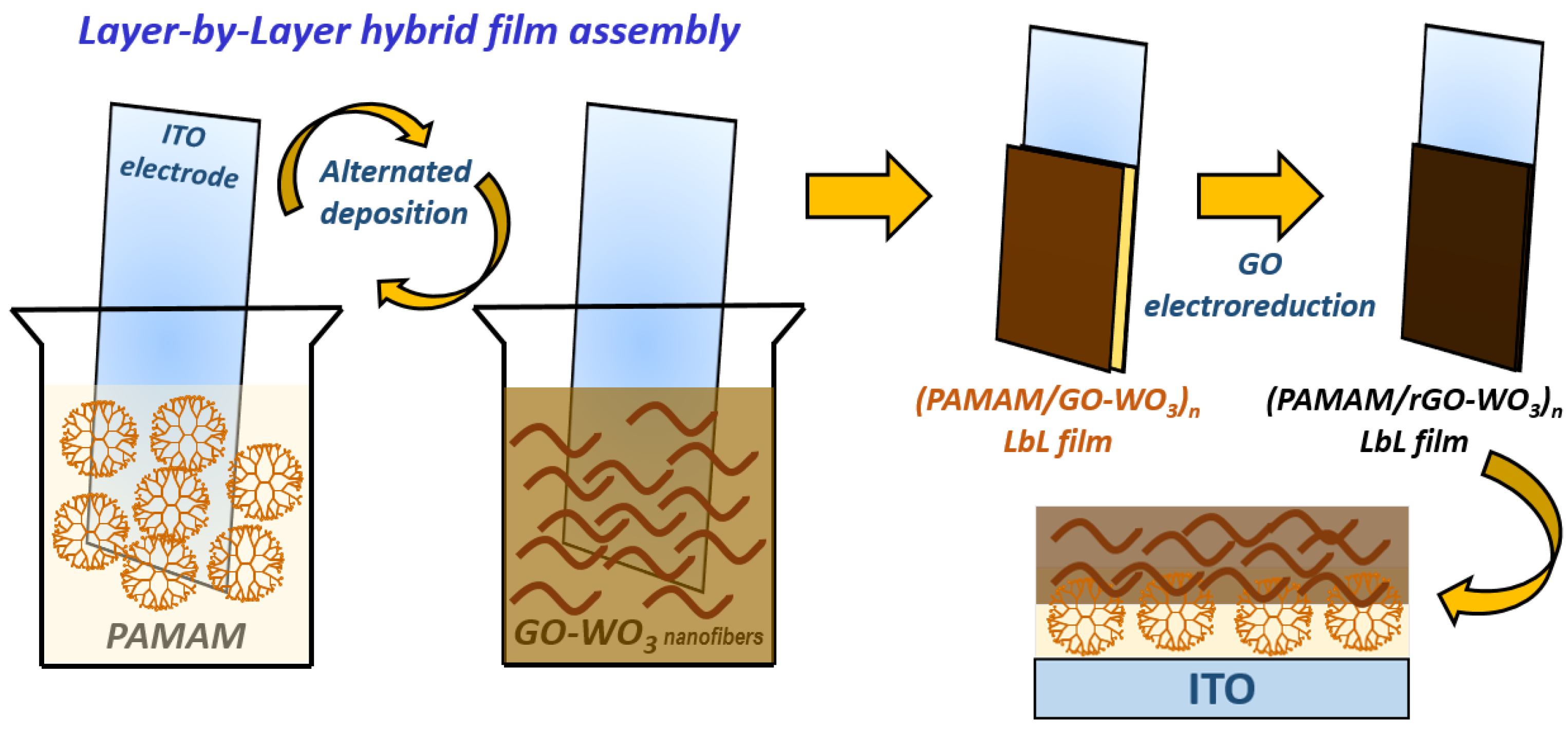
Multilayer films were fabricated using the electrostatic LbL technique. Indium tin oxide (ITO)-coated glass substrates were cleaned by sequential sonication in acetone, ethanol, and ultrapure water (10 min each), followed by drying under nitrogen flow. The substrates were alternately immersed in a PAMAM solution (0.1 mg·mL−1, pH ~6.0) and the GO-WO3 dispersion (pH ~4.1) for 10 min per step, with intermediate rinsing in ultrapure water (1 min) to remove excess material. This process was repeated to build multilayer films with up to 20 bilayers, denoted as (PAMAM/rGO-WO3)n. Control films (PAMAM/GO)n were also assembled using GO dispersion (pH ~4.1) in place of GO-WO3, under identical conditions. The schematic representation of the film fabrication process is illustrated in Figure 1.
Figure 1. Schematic representation of layer-by-layer (LbL) film fabrication on an ITO electrode, consisting of multilayers of poly (amidoamine) dendrimers (PAMAM) and WO3 nanofibers embedded in graphene oxide (GO). Steps involve immersion in a cationic PAMAM solution and anionic dispersion of GO-WO3, followed by subsequent electroreduction in GO.

2.5. Electrochemical Reduction in GO

Electrochemical reduction in GO to rGO in the assembled films was performed via cyclic voltammetry in 1.0 mol·L−1 KCl aqueous electrolyte. The potential was swept from −1.7 V to 0.0 V vs. Ag/AgCl at 50 mV·s−1 for 10 consecutive cycles, using a three-electrode system comprising the film-coated ITO (working electrode), a platinum wire (counter electrode), and an Ag/AgCl reference electrode (3 mol·L−1 KCl). Figure S2 in the Supplementary Material presents the characteristic cyclic voltammograms associated with the electrochemical reduction process.

2.6. Characterization Techniques

UV–Vis spectroscopy (AvaSpec-ULS2048L, Avantes, Apeldoorn, Netherlands) was used to monitor the linear optical growth of the multilayer films in the 200–800 nm wavelength range. Atomic force microscopy (TT-2 AFM, AFMWorkshop, Hilton Head Island, SC, USA) operating in tapping mode was employed to analyze surface morphology and film thickness. The mass loading of the multilayers was determined using a quartz crystal microbalance (QCM200, Stanford Research Systems, Sunnyvale, CA, USA). The average mass per bilayer was obtained by preparing a 15-bilayer film directly onto the QCM crystal and calculating the mass increment per deposition cycle. This procedure allowed us to quantify the ultralow mass loading typical of LbL-assembled thin films (in the microgram range), ensuring that all reported electrochemical parameters—including specific capacitance, energy, and power—were normalized using accurately measured active mass values.
The electrochemical behavior of the films was investigated using a PGSTAT128N potentiostat/galvanostat (Metrohm Autolab, Utrech, The Netherlands), operating in a conventional three-electrode configuration. The multilayer-coated ITO substrate (geometric area: 0.5 cm2) served as the working electrode, while a Ag/AgCl (3 M KCl) electrode and a 1.0 cm2 platinum foil (Metrohm, Utrech, The Netherlands) were employed as the reference and counter electrodes, respectively. All measurements were carried out in 1.0 mol·L−1 KCl aqueous electrolyte previously purged with N2 to remove dissolved oxygen. Cyclic voltammetry (CV) and galvanostatic charge–discharge (GCD) experiments were used to assess the capacitive properties of the films. The areal capacitance (Ca), specific capacitance (Cs), specific energy (E), and specific power (P) were determined according to the following equations:
C a = 1 S ν Δ V   i V d V
C s = i Δ t m Δ V
E = 0.5 C s   Δ V 2 3.6
P = E   3600 Δ t
where i is the current (A), S is the electrode area (cm2), ν is the scan rate (V·s−1), ΔV is the potential window (V), m is the active mass of the film (g), and Δt corresponds to the discharge time (s).
All electrochemical tests were performed under identical experimental conditions—same potential window, electrolyte, electrode configuration, and temperature—ensuring a reliable comparison among samples with different numbers of bilayers.

3. Results and Discussion

3.1. Optical Growth and Structural Characterization

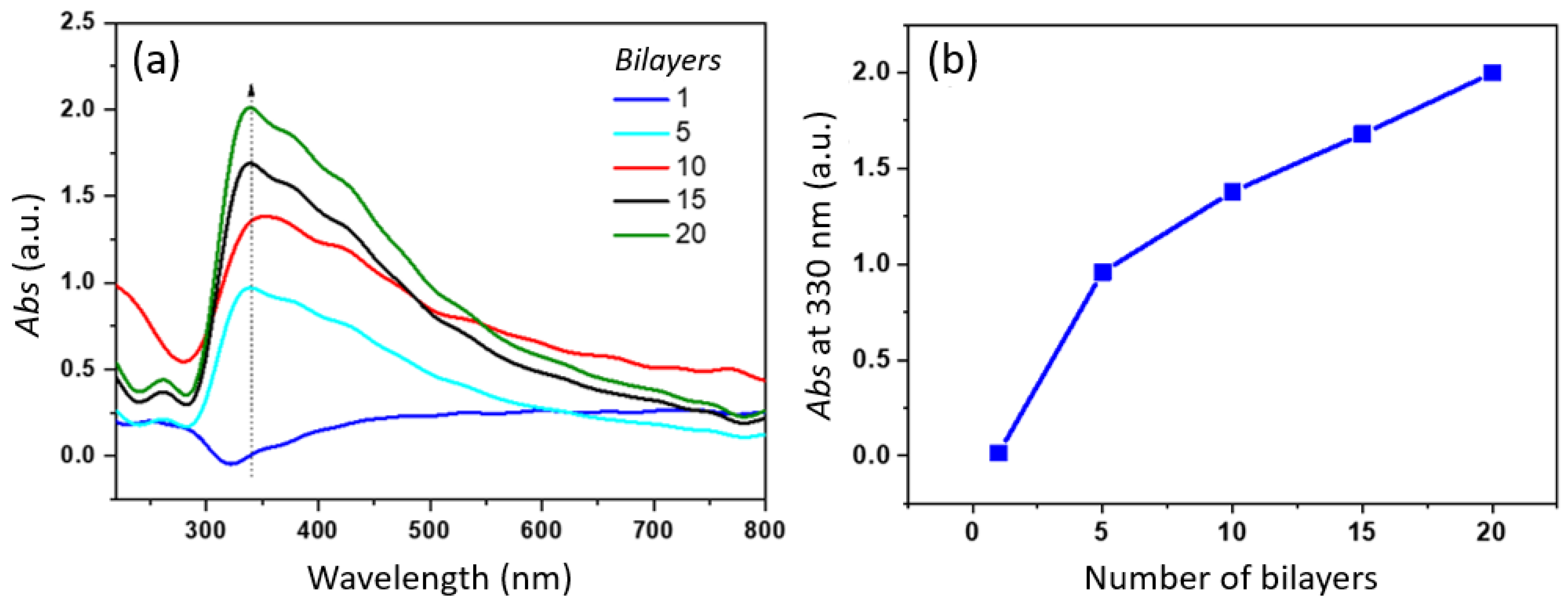
Figure 2 presents the optical characterization of the (PAMAM/GO-WO3)n multilayer films. A gradual and nearly linear increase in absorbance with the number of bilayers is observed, confirming a regular and well-controlled growth typical of the LbL deposition process. This linear trend indicates efficient electrostatic interactions between the positively charged PAMAM dendrimers, arising from their protonated amine groups, and the negatively charged GO-WO3 nanosheets, which contain deprotonated carboxylic groups, during the alternate adsorption steps. The spectra exhibit a broad absorption in the UV–visible region, with a main band centered around 330–350 nm, which corresponds to the π–π* electronic transitions of the GO/rGO domains and to the charge-transfer transitions associated with WO3 [26]. The absorbance intensity increases systematically with film thickness, evidencing uniform material deposition and the cumulative buildup of the hybrid nanocomposite within the multilayer structure. When compared to the (PAMAM/GO)n films, the hybrid (PAMAM/GO-WO3)n films display higher optical density and a slight red-shift in the main absorption band. These effects are attributed to the incorporation of WO3 nanofibers, whose intrinsic optical activity and extended surface area enhance light absorption and promote better dispersion of the GO sheets. Furthermore, the improved absorbance intensity suggests stronger electronic coupling between rGO and WO3 domains, facilitating greater electron delocalization across the hybrid interfaces. Overall, the optical results confirm that the inclusion of WO3 nanofibers not only increases the film’s light-harvesting ability but also contributes to a more compact and electronically interconnected structure, which is beneficial for charge transport and electrochemical performance in supercapacitor applications [6,19].
Figure 2. (a) UV–Vis spectra of LbL-assembled (PAMAM/GO-WO3)n multilayer films with different numbers of bilayers; (b) Linear correlation of absorbance at 330 nm with the number of bilayers.

3.2. Morphological Analysis

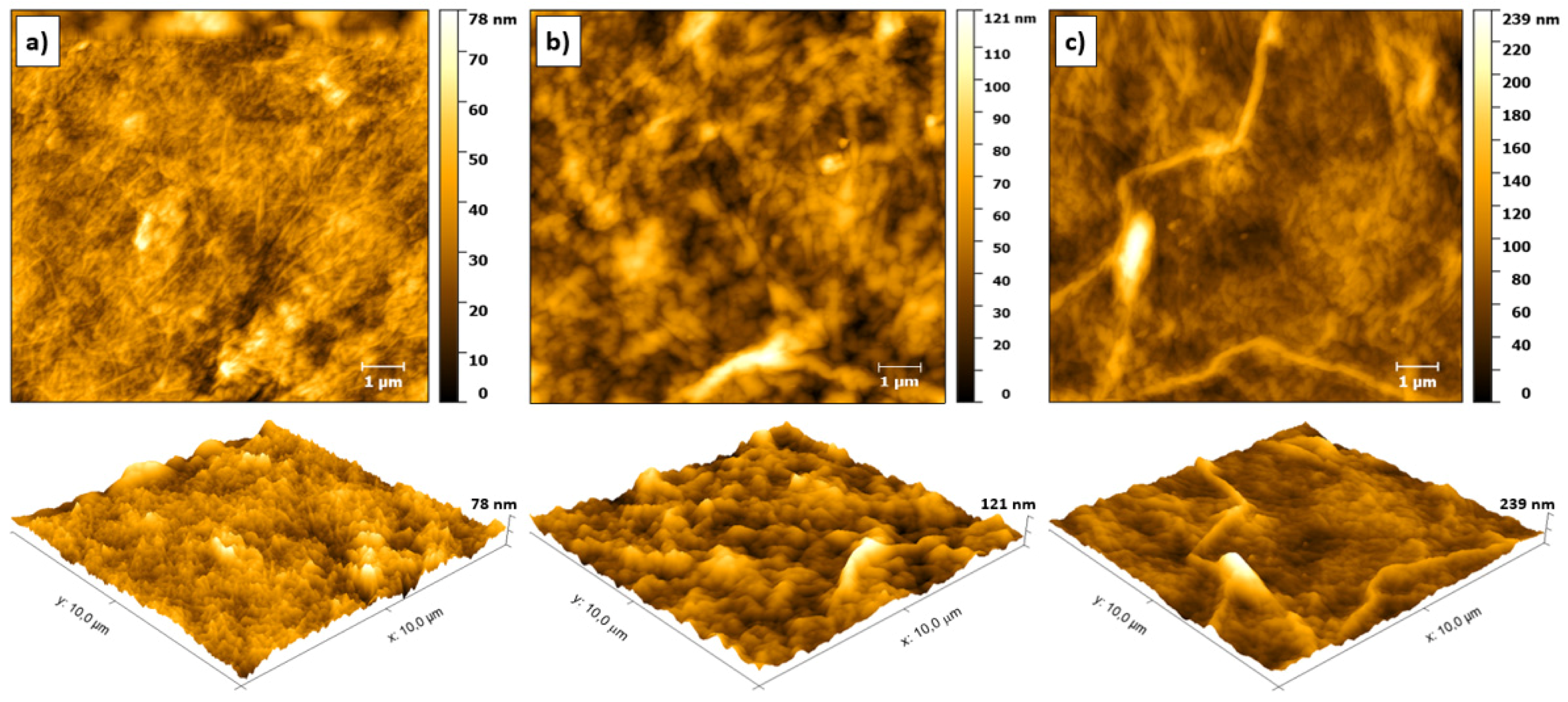
AFM images reveal that (PAMAM/rGO-WO3)n multilayer films exhibit continuous and homogeneous surface coverage, confirming the uniform deposition of the components during the LbL process. The fibrous domains observed in the AFM images of the (PAMAM/rGO-WO3)n films are consistent with the morphological characteristics reported in Figure S1 and with those previously described for hydrothermally synthesized WO3 nanofibers [25], confirming that the nanofibers retain their structural integrity after incorporation into the multilayer architecture. These features arise from the coexistence of dendritic PAMAM domains and dispersed WO3 nanofibers, producing distinct fibrous and granular structures across the surface, as shown in Figure 3. By examining the height scales in the AFM images, one can clearly observe the systematic increase in surface roughness produced by the incorporation of WO3 nanofibers. In addition, the three-dimensional AFM images further emphasize the hierarchical nature of the (PAMAM/rGO-WO3)n films, with interconnected nanofibrous domains forming a porous network. The Z-range values increase systematically with the number of bilayers, following the expected LbL growth. The vertical scale expanded from ≈78 nm (5 bilayers) to ≈121 nm (10 bilayers) and ≈239 nm (20 bilayers). These values may be represented as the minimum topographical thickness profile, and can be correlated strongly with the incremental mass loading measured by QCM and with the film growth verified by UV–Vis absorbance. This consistent agreement among different characterization techniques confirms that the multilayer structure grows regularly and that the hybrid films become progressively thicker and more compact with added bilayers.
Figure 3. AFM top-view and 3D images of LbL-assembled (PAMAM/rGO-WO3) films with (a) 5 bilayers, (b) 10 bilayers, and (c) 20 bilayers, recorded over a 10 × 10 μm2 scanned area.
Compared to the (PAMAM/rGO)n films, which typically display smoother and more compact surfaces with limited nanoscale features, the influence of WO3 nanofibers becomes even more pronounced, resulting in a surface notably rougher and with a more heterogeneous texture. For example, while the (PAMAM/rGO-WO3)10 film exhibits a height variation of approximately 121 nm, the corresponding (PAMAM/rGO)10 film shows a much lower value of only about 18 nm. This pronounced difference highlights the significant structural impact of WO3 nanofibers on the multilayer architecture.
Overall, these morphological characteristics can directly contribute to the superior capacitive and charge–discharge behavior observed for the hybrid supercapacitor electrodes. The hierarchical roughness, enhanced porosity, and well-distributed nanofibrous domains can favor deeper electrolyte penetration and more efficient ion transport throughout the multilayer structure, thereby improving the overall electrochemical performance of the films [6,8,27,28,29,30].

3.3. Electrochemical Characterization of (PAMAM/rGO-WO3)n LbL Films

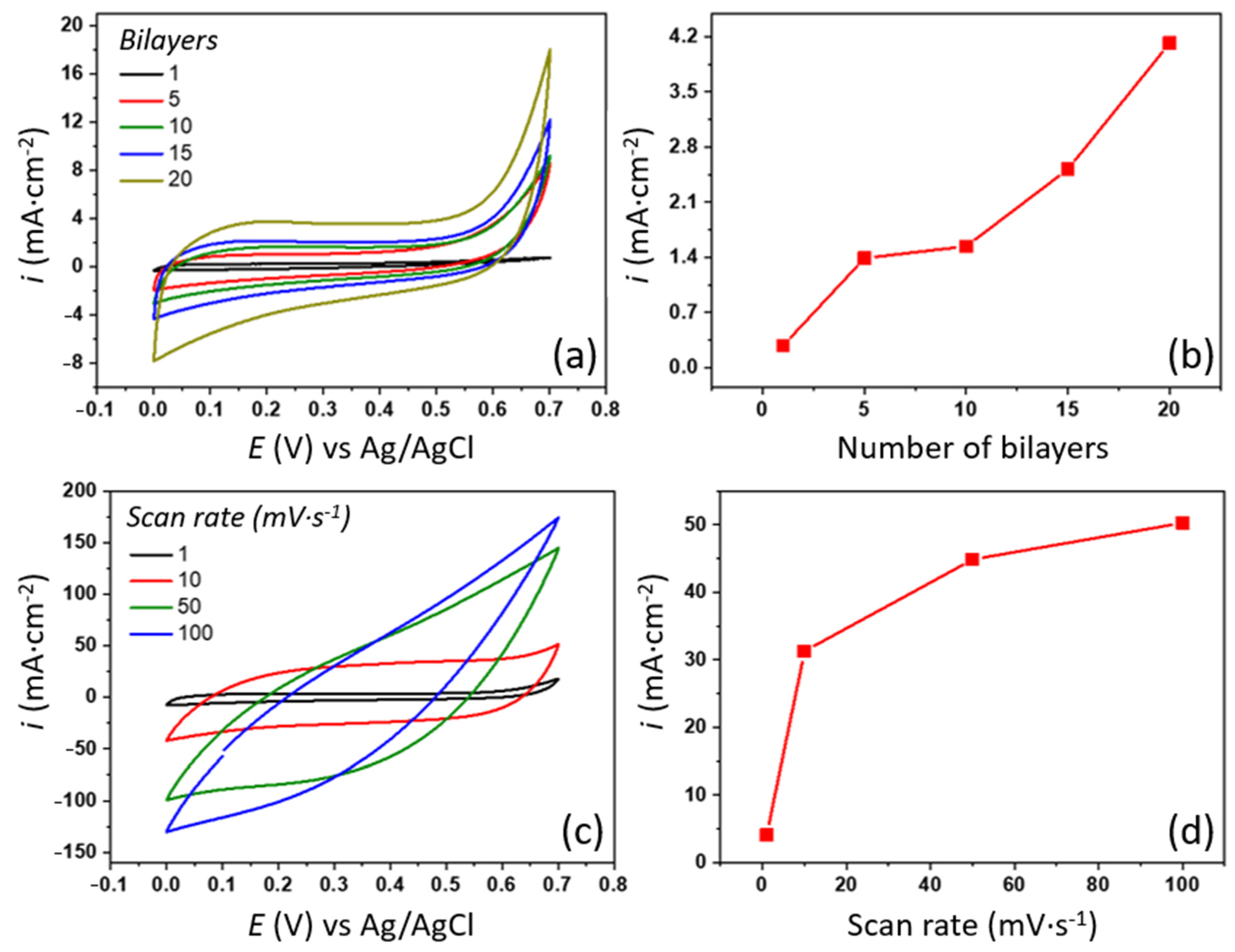
Figure 4 presents the cyclic voltammetry (CV) profiles of the (PAMAM/rGO-WO3)n multilayer films obtained in 1.0 mol·L−1 KCl electrolyte, illustrating the influence of both the number of bilayers and the scan rate on the electrochemical behavior. In Figure 4a, the CV curves recorded at 10 mV·s−1 reveal a progressive increase in current response with the number of bilayers, demonstrating that the charge storage capability of the films improves as the LbL assembly grows. The cyclic voltammograms exhibit quasi-rectangular shapes over the entire potential window, even at low scan rates, with no distinguishable redox peaks. This behavior indicates that the charge-storage mechanism is dominated by electric double-layer capacitance (EDLC), arising mainly from the highly accessible surface provided by the PAMAM/rGO framework. Although WO3 nanofibers are known to undergo fast W6+/W5+ redox transitions, their contribution in the present hybrid structure is modest and does not generate resolvable pseudocapacitive peaks in the CV profiles. The corresponding plot of current density at 0.35 V versus the number of bilayers (Figure 4b) shows a linear relationship, confirming the uniform and reproducible film growth during deposition and the cumulative addition of electroactive material per bilayer. This trend highlights the excellent controllability of the LbL process and its ability to tune film thickness and capacitance by simply adjusting the number of deposition cycles [27,28,29,30].
Figure 4. Cyclic voltammetry (CV) analysis of the multilayer films: (a) CV curves of (PAMAM/rGO)10 at different bilayers ranging from 1 to 20; (b) correlation between peak current density and the number of bilayers for (PAMAM/rGO)n; (c) CV curves of a (PAMAM/rGO-WO3)10 film at different scan rates (1–100 mV·s−1); and (d) corresponding relationship between current density and scan rate at 0.35 V. Electrochemical analyses were carried out in a conventional three-electrode configuration, in which the LbL-modified ITO substrate served as the working electrode, an Ag/AgCl electrode was employed as the reference, a platinum foil acted as the counter electrode, and 0.1 M KCl was used as the supporting electrolyte.
The electrochemical response as a function of scan rate for the 20-bilayer film is shown in Figure 4c. The CV curves preserve their quasi-rectangular shape even at high scan rates (up to 100 mV·s−1), confirming the excellent rate capability and fast ion diffusion within the hybrid multilayer. The plot of current density versus scan rate (Figure 4d) exhibits a near-linear dependence at low and intermediate scan rates, suggesting that the charge storage mechanism is predominantly surface-controlled. However, a slight deviation from linearity at higher scan rates indicates the onset of kinetic limitations associated with ion diffusion and charge-transfer processes. This mild saturation trend can be attributed to the restricted accessibility of inner electroactive sites when the potential is swept too rapidly, preventing complete ion intercalation and deintercalation within the WO3 nanofibers and the porous PAMAM/rGO matrix. As the scan rate increases, the time available for ion migration through the nanoscale channels decreases, leading to a partial loss of electrochemical activity in deeper regions of the film. Consequently, although the system retains capacitive characteristics, its effective charge utilization becomes slightly constrained by ionic diffusion kinetics and interfacial polarization effects.
The morphological characteristics observed by AFM (Figure 2) are consistent with this electrochemical behavior. The (PAMAM/rGO-WO3)n films exhibited a rougher and more textured surface compared to the (PAMAM/rGO)n films, with a progressive increase in surface roughness and grain connectivity as the number of bilayers increased. The incorporation of WO3 nanofibers produced a porous nanostructured architecture that enhances electrolyte accessibility and enlarges the effective electroactive area. However, at high scan rates, this same hierarchical morphology can induce partial diffusion constraints within the deeper pores and interstitial regions, as electrolyte ions may not fully penetrate the entire thickness of the multilayer.
Compared to the (PAMAM/rGO)n system, the (PAMAM/rGO-WO3)n films exhibit a superior current response and better voltammetric shape retention, evidencing efficient electronic conduction through the rGO network and fast, reversible faradaic reactions associated with WO3. These results confirm that the hybrid dendrimer–nanofiber–graphene structure provides a balanced combination of electrical conductivity and ion accessibility, ensuring robust charge propagation and high reversibility even under demanding scan conditions. Therefore, the morphological features of the hybrid film—high roughness, interconnected nanofiber domains, and the open dendrimer framework—play a dual role. They facilitate efficient ion adsorption and charge propagation at moderate scan rates but can also introduce diffusion-path heterogeneity that slightly limits performance at very fast potential sweeps. Nevertheless, the synergistic combination of the conductive rGO network, pseudocapacitive WO3 nanofibers, and the 3D-branched PAMAM matrix ensures robust electrochemical reversibility, making these hybrid films highly promising for efficient thin-film supercapacitor electrodes.
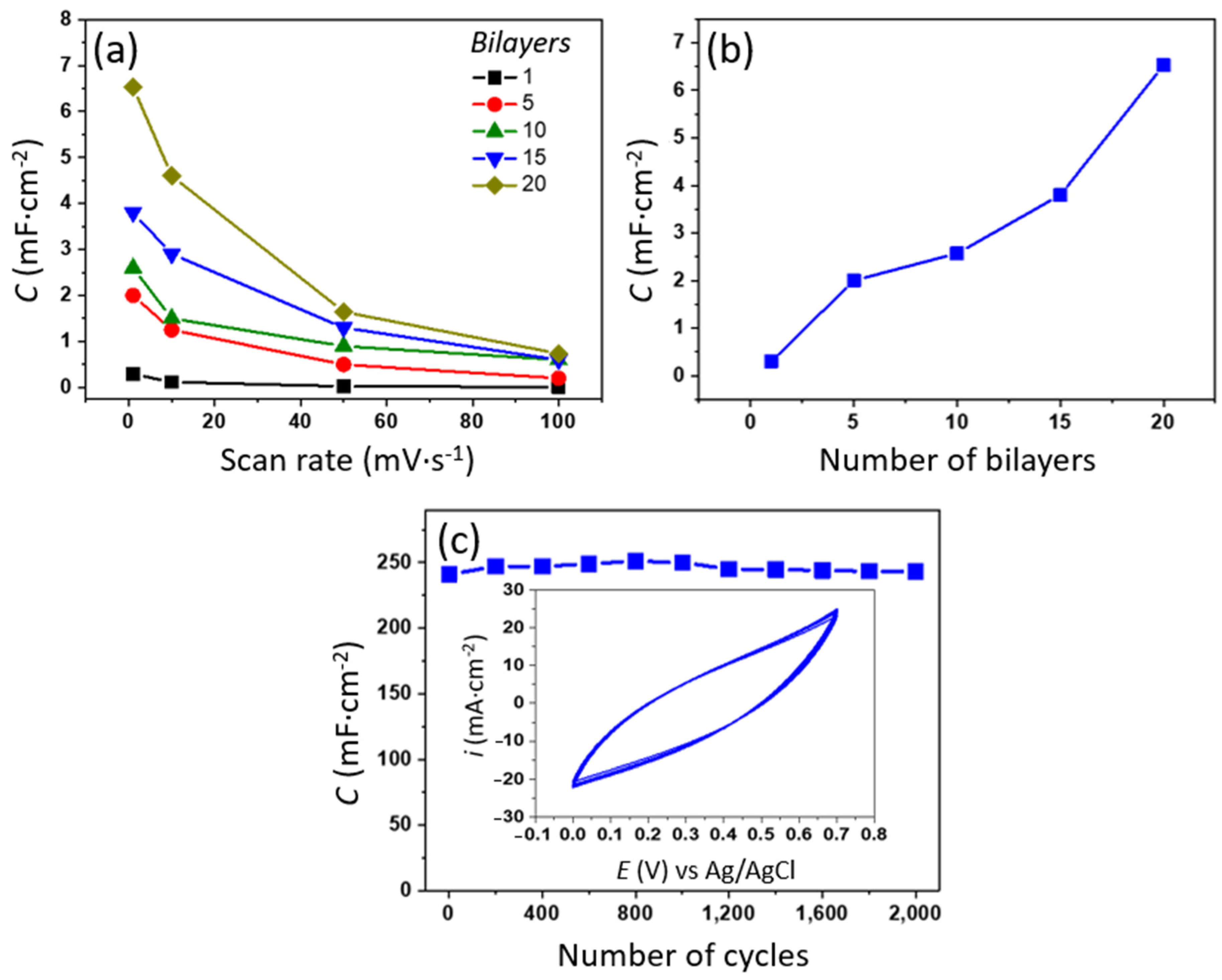
The electrocapacitive behavior of the (PAMAM/rGO-WO3)n multilayer films was further investigated as a function of scan rate, number of bilayers, and long-term cycling stability, as shown in Figure 5. In Figure 5a, the areal capacitance (Ca) decreases with increasing scan rate for all films, a typical trend observed in electrochemical capacitors [27,28,29,30]. At lower scan rates (10 mV·s−1), the electrolyte ions have sufficient time to penetrate the entire porous structure of the multilayers, allowing full utilization of the electroactive sites within the PAMAM/rGO-WO3 network. As the scan rate increases, the diffusion of ions becomes progressively limited, leading to a gradual decrease in the measured capacitance. Among the analyzed systems, the film with 20 bilayers exhibited the highest capacitance, reaching approximately 6.5 mF·cm−2 at 10 mV·s−1, whereas the film with only one bilayer displayed a negligible capacitive response. This behavior confirms the cumulative effect of successive bilayer deposition in increasing the density of electroactive sites and overall film thickness, thus enhancing charge storage capacity. Figure 5b demonstrates the direct correlation between capacitance and the number of bilayers at a fixed scan rate of 10 mV·s−1. The capacitance increases almost linearly up to 20 bilayers, indicating uniform growth of electroactive material during the LbL assembly. This trend evidences that each additional bilayer contributes significantly to the total charge storage, reinforcing the effectiveness of the PAMAM dendrimer matrix in promoting homogeneous film growth and strong electrostatic interactions with the rGO-WO3 nanocomposite.
Figure 5. (a) Relationship between specific capacitance and scan rate for the PAMAM/rGO-WO3 films; (b) dependence of specific capacitance on the number of bilayers at 10 mV·s−1; and (c) cycling stability at 100 mV·s−1. Inset: 2000 consecutive CV cycles recorded at 100 mV·s−1.
Rate-capability analysis was performed using the areal capacitance values obtained from Figure 5a. The (PAMAM/rGO-WO3) multilayers exhibited retention values around 20% when comparing 100 mV·s−1 to 1 mV·s−1, which is consistent with ultrathin LbL assemblies in which ion transport becomes progressively limited at high scan rates. Despite the moderate retention, the high areal capacitance (up to ~6.5 mF·cm−2 at 1 mV·s−1) and the efficient interfacial charge-storage mechanisms highlight the potential applicability of these films for low-power supercapacitors and wearable devices, where slow charge–discharge dynamics and ultralight architectures are strongly advantageous.
The long-term cycling stability of the (PAMAM/rGO-WO3)10 film is shown in Figure 4c. After 2000 consecutive charge–discharge cycles at a high scan rate of 100 mV·s−1, the film retained nearly 100% of its initial capacitance, demonstrating stable electrochemical behaviour. The inset shows overlapping cyclic voltammograms even after extended cycling, indicating no significant degradation or delamination of the multilayers. The outstanding stability can be attributed to the synergistic combination of the mechanically robust PAMAM framework and the conductive, redox-active rGO-WO3 nanofibers, which together provide both flexibility and efficient electron transport throughout the electrode. Overall, the results in Figure 5 highlight the strong dependence of the capacitive response on the structural parameters of the multilayers and confirm that the LbL-assembled PAMAM/rGO-WO3 films combine high capacitance, structural integrity, and long-term electrochemical durability—essential properties for applications in flexible and miniaturized supercapacitor devices [1,2,3,4,5,6,31,32].
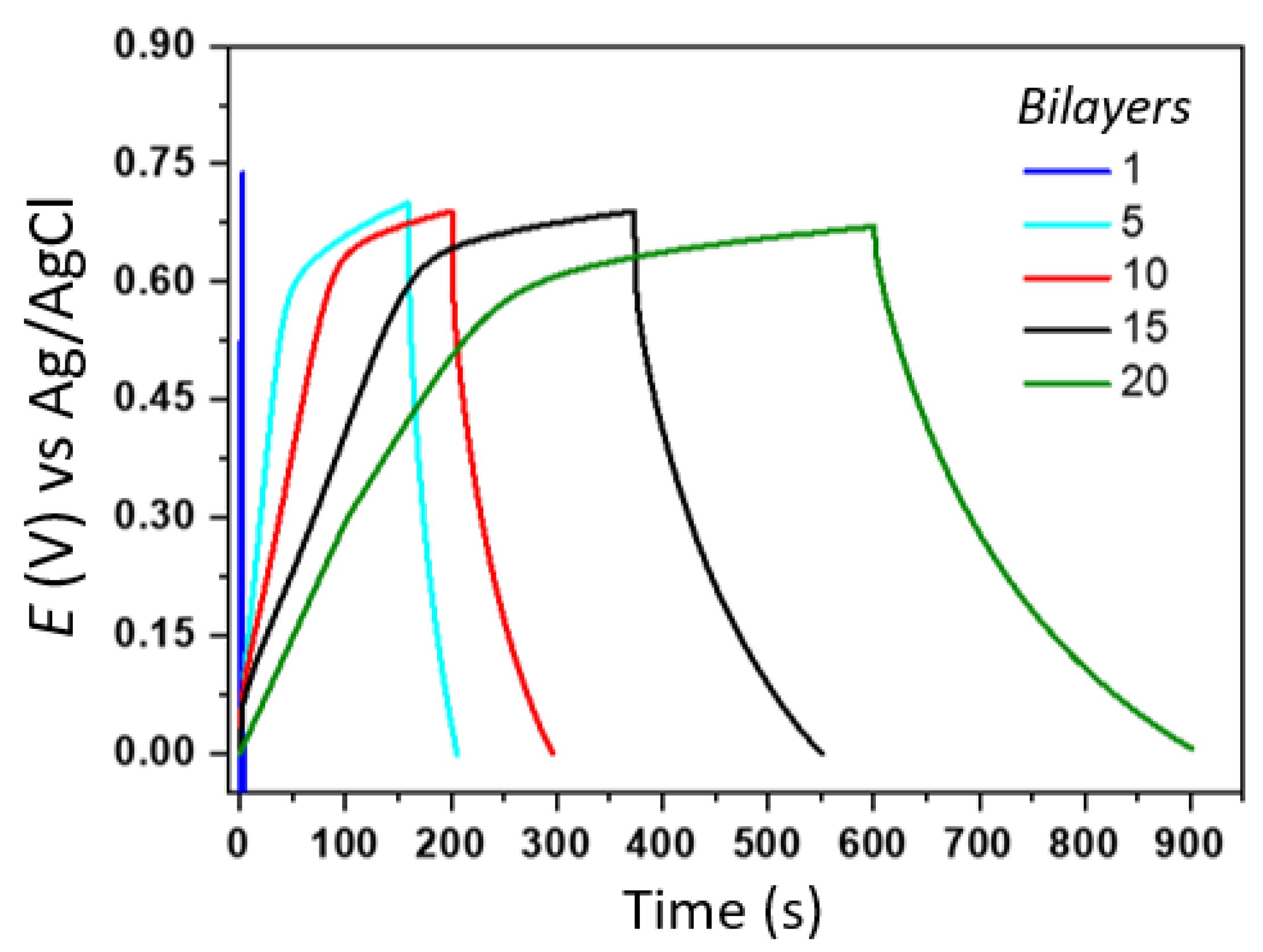
The galvanostatic charge–discharge (GCD) profiles of the (PAMAM/rGO-WO3)n multilayer films, shown in Figure 6, provide further evidence of their capacitive behavior and the strong dependence of charge storage performance on the number of bilayers. All films display typical charge–discharge curves, characteristic of electrochemical capacitors governed by a combination of electric double-layer and pseudocapacitive mechanisms. As the number of bilayers increases, the charge–discharge time becomes significantly longer, confirming a progressive enhancement in total capacitance. The film with 20 bilayers exhibited the longest discharge time, in agreement with the trend observed in Figure 4b, where capacitance increased linearly with the number of bilayers. This behavior demonstrates that each additional PAMAM/rGO-WO3 bilayer contributes new electroactive sites and ion pathways, improving the overall charge storage capability. In contrast, the thinner films (1 and 5 bilayers) showed shorter discharge times and lower potential windows, consistent with their smaller amount of active material. The specific capacitance values calculated from the GCD curves (Equation (2)) were 27.7 F·g−1 for the (PAMAM/rGO)20 film and 73.6 F·g−1 for the (PAMAM/rGO-WO3)20 film, representing an improvement of approximately 165%. The remarkable increase in capacitance may be attributed to the pseudocapacitive contribution of WO3, which may undergo fast and reversible redox transitions (W6+/W5+) during charge–discharge processes, as well as to the conductive rGO network that ensures efficient electron transfer across the electrode. The hybrid structure also promotes effective ion transport and minimizes resistive losses at the electrode/electrolyte interface. This significant enhancement in capacitance values leads to corresponding improvements in energy and power densities. Using Equations (3) and (4), the (PAMAM/rGO)20 film exhibited a specific energy of 1.9 Wh·kg−1 and a specific power density of 26.6 W·kg−1, whereas the (PAMAM/rGO-WO3)20 film achieved a specific energy of 5.0 Wh·kg−1 and a specific power of 60.6 W·kg−1. These values represent increases of approximately 163% in energy density and 128% in power density compared to the PAMAM/rGO system. Such remarkable improvements confirm the effective contribution of WO3 nanofibers in enhancing the electrochemical performance of the hybrid supercapacitor electrodes by promoting faster charge transfer and higher ion accessibility within the multilayer network.
Figure 6. Galvanostatic charge–discharge curves of (PAMAM/rGO-WO3)n multilayer films containing 1, 5, 10, 15, and 20 bilayers, measured at a constant current of 3.0 × 10⁻⁶ A in 1.0 mol·L−1 KCl electrolyte.
It is worth noting that the intrinsically low mass loading—typically in the microgram range—is a characteristic feature of Layer-by-Layer (LbL) assemblies, as observed in the present PAMAM/rGO-WO3 multilayers. While this ultralight architecture enables precise nanoscale control and facilitates fundamental investigations of interfacial charge-storage processes, it also imposes limitations when comparing specific capacitance and energy/power density values with those of high-mass practical electrodes. In thicker electrodes, ion-transport resistance, porosity constraints, and reduced electrolyte accessibility generally lead to lower gravimetric performance. Therefore, the electrochemical metrics reported here should be interpreted as electrode-level values representative of ultrathin LbL systems, rather than optimized device-level figures. Nevertheless, the results clearly demonstrate the synergistic behavior emerging from the PAMAM/rGO-WO3 hybrid structure and provide a solid foundation for future efforts aimed at increasing mass loading and advancing toward more application-oriented electrode architectures.
Thus, in addition to the gravimetric values and to provide a fair comparison with the thin-film and micro-supercapacitor literature, areal energy and power densities were calculated from the GCD data. Using the geometric area (0.5 cm2), the discharge time and ΔV = 0.7 V, the (PAMAM/rGO)20 electrode yields an areal capacitance of ~2.20 mF·cm−2, corresponding to an areal energy density of ≈0.15 µWh·cm−2 and an areal power density of ≈2.10 µW·cm−2. The hybrid (PAMAM/rGO-WO3)20 film presents improved values (Careal ≈ 2.55 mF·cm−2; Eareal ≈ 0.17 µWh·cm−2; Pareal ≈ 2.10 µW·cm−2). These areal metrics are consistent with expectations for ultrathin LbL electrodes. Although the absolute areal energy values are modest compared to bulk devices, the hybrid films combine appreciable areal capacitance with low thickness and ultralight mass loading, a desirable feature for micro- and wearable energy-storage platforms that prioritize form factor and integration over total stored energy.
The improved electrochemical response with increasing thickness can be directly correlated with the optical and morphological analyses discussed earlier. The UV–Vis results demonstrated a linear growth in absorbance with the number of bilayers, indicating uniform material deposition and increased optical density associated with the WO3 content. Likewise, AFM images revealed that the incorporation of WO3 nanofibers produced a more textured and porous surface morphology, enhancing the electroactive area and facilitating electrolyte penetration during cycling. These structural and optical features explain the longer charge–discharge durations observed for thicker multilayers, as ion diffusion and electron transfer occur more efficiently throughout the interconnected rGO-WO3/PAMAM network.
The film with 20 bilayers, therefore, represents an optimized configuration, combining high charge storage capacity, mechanical integrity, and structural uniformity typical of the LbL method. The excellent linearity between charge–discharge time, bilayer number, and capacitance confirms the reliability of the LbL assembly process for tuning film thickness and electrochemical performance. When considered together with the CV and cycling results (Figure 4), the GCD behavior further supports that the PAMAM/rGO-WO3 multilayers exhibit stable and reproducible capacitive properties, which indicates their potential for integration into flexible and miniaturized energy storage devices [1,2,3,4,5,6,31,32].
It should be noted that throughout all electrochemical measurements, the LbL films deposited on ITO exhibited stable behavior and maintained their electroactivity, with no visible signs of delamination or surface degradation. This consistent adhesion indicates that the multilayers withstand repeated cycling under the conditions used in this study. Although mechanical robustness was not explicitly evaluated, the observed stability suggests that the architecture could be further investigated in future work involving bending, adhesion, or deformation-resistance assessments. These observations reinforce the relationship between the multilayer organization, film thickness, and resulting electrochemical response. It is also important to note that both LbL film configurations examined in this work were subjected to identical electrochemical protocols.
The electrochemical performance of the (PAMAM/rGO-WO3)20 film was compared with similar systems reported in the literature (Table 1) [33,34,35,36,37,38,39]. The hybrid multilayer exhibited a specific capacitance of 73.6 F·g−1, which surpasses several related WO3- and rGO-based systems, such as rGO/WO3 nanocomposites (58.3 F·g−1) [38], and PANI/WO3 films (43 F·g−1) [34]. The improvement achieved in this work can be attributed to the synergistic integration of the three components: the highly branched PAMAM matrix, which provides a large number of adsorption sites and a 3D interconnected scaffold; the high surface area and electrical conductivity of rGO, which ensures efficient charge transport across the electrode; and the redox-active WO3 nanofibers, which introduce fast and reversible faradaic reactions. Together, these complementary properties result in enhanced ion accessibility, accelerated charge transfer, and superior capacitive performance compared to the individual components alone.
Table 1. Summary of selected literature reports on supercapacitor systems based on hybrid combinations of WO3, rGO, and other materials, highlighting electrode configuration and specific capacitance parameter.
In terms of practical relevance, the electrochemical performance achieved for the (PAMAM/rGO-WO3)20 multilayers is highly representative for thin-film architectures obtained by the LbL technique. Although the areal capacitance and energy density values are lower than those of bulk or 3D-structured supercapacitors, the films still exhibit stable electrochemical behavior, indicating their potential for integration into miniaturized and low-power electronic systems. The combination of an areal energy density of 0.17 µWh·cm−2 and an areal power density of 2.10 µW·cm−2 positions the PAMAM/rGO-WO3 multilayer films within the performance range reported for thin-film supercapacitors designed for small-scale and low-power electronic applications [1,2,3,4,5,6,40,41]. Although the present work does not include mechanical bending or environmental durability tests, the intrinsic characteristics of the dendrimer-based LbL architecture—such as precise thickness control, nanoscale organization, and compatibility with solution-based processing—suggest that this hybrid system could be adapted in the future for integration onto flexible or non-planar substrates. In particular, the synergistic combination of PAMAM, rGO, and WO3 nanofibers provides a versatile platform for developing ultrathin electrodes that may be engineered for use in next-generation flexible or wearable microsupercapacitors. Thus, while additional mechanical and environmental assessments are required, the results presented here indicate that the hybrid multilayer films show promising potential as electroactive interfaces for flexible, low-voltage energy-storage devices.
Whereas the ultrathin architecture and low mass loading of LbL films differ substantially from commercial high-mass electrodes, it is still useful to contextualize the performance of the present system using typical benchmarks. Commercial carbon-based or MnO2-based thin-film supercapacitors generally exhibit areal energy densities in the range of 0.05–0.50 µWh·cm−2 and areal power densities of 1–10 µW·cm−2, depending on thickness and electrode formulation [40,41]. In comparison, the PAMAM/rGO-WO3 multilayer films prepared here deliver an areal energy density of 0.17 µWh·cm−2 and an areal power density of 2.10 µW·cm−2, placing the system squarely within the performance window of established thin-film storage technologies. These results highlight that even at very low mass loading, the synergistic interaction among PAMAM, rGO, and WO3 nanofibers enables competitive capacitive behavior. Therefore, while the present study focuses on fundamental interfacial design rather than optimized device construction, the obtained metrics reinforce the relevance of the LbL configuration for future micro- and flexible-energy-storage applications.

4. Conclusions

Layer-by-layer hybrid films composed of PAMAM dendrimers, reduced graphene oxide, and WO3 nanofibers were successfully assembled and demonstrated excellent electrochemical behavior as ultrathin supercapacitor electrodes. The incorporation of WO3 nanofibers significantly enhanced the electrochemical performance of the multilayers. For the 20-bilayer configuration, the (PAMAM/rGO-WO3)n film achieved areal energy and power densities of approximately 0.17 µWh·cm−2 and 2.10 µW·cm−2, respectively. These values place the system within the performance range reported for several thin-film micro-supercapacitors designed for compact, low-power electronic devices. Such improvements arise from the synergistic interplay between the highly branched PAMAM dendrimer matrix, which provides abundant ion-accessible sites and three-dimensional connectivity, the conductive rGO network that ensures efficient in-plane electron transport, and the pseudocapacitive WO3 nanofibers that contribute fast, reversible charge-transfer reactions. The hybrid multilayers also exhibited stable cycling behavior and efficient ion diffusion, confirming their potential applicability for miniaturized electrochemical energy-storage platforms.
Although the present study did not include mechanical deformation, biocompatibility, or long-term environmental durability tests, the electrochemical and morphological findings establish a strong foundation for the potential use of these films in flexible and bio-integrable energy-storage devices. The robustness of the multilayer structure, combined with its stable capacitive response and the mild processing conditions inherent to LbL assembly, indicates that this hybrid nanoarchitecture is well-suited for future adaptation to flexible substrates and for use in wearable, healthcare, and low-voltage IoT technologies. Future work will focus on transferring the multilayers to flexible conductive platforms and performing bending, fatigue, and biocompatibility tests to fully assess their applicability in next-generation miniaturized supercapacitors.

Supplementary Materials

The following supporting information can be downloaded at: https://www.mdpi.com/article/10.3390/nanoenergyadv5040022/s1, Figure S1. Structural and compositional characterization of the synthesized WO3 nanofibers. (a) FEG-SEM images reveal a uniform network of interconnected WO3 nanofibers with diameters in the nanometer range, confirming the successful formation of the fibrous morphology. (b) Energy-dispersive X-ray spectroscopy (EDS) analysis shows the characteristic elemental peaks of tungsten and oxygen, consistent with the expected WO3 composition. (c) X-ray diffraction (XRD) pattern displaying the distinct crystalline reflections of monoclinic WO3, in agreement with standard reference data, demonstrating the high crystallinity of the nanofibers. Figure S2. Electrochemical reduction of graphene oxide in the LbL film. Ten consecutive cyclic voltam-mograms recorded during the electrochemical reduction of a 20-bilayer (PAMAM/rGO) film in 0.1 M KCl (scan rate: 50 mV·s−1).

Author Contributions

Conceptualization, J.R.S.J.; methodology, V.F.G.J., D.A.O., P.V.M. and J.R.S.J.; formal analysis, V.F.G.J., D.A.O., P.V.M. and J.R.S.J.; investigation, V.F.G.J. and D.A.O.; resources, J.R.S.J.; data curation, D.A.O. and J.R.S.J.; writing—original draft preparation, D.A.O. and J.R.S.J.; writing—review and editing, J.R.S.J.; supervision, J.R.S.J.; funding acquisition, J.R.S.J. All authors have read and agreed to the published version of the manuscript.

Funding

The Brazilian Foundations FAPEMIG (Grant BPD-00880-22 and APQ-00495-24), CNPq (Grant 150431/2023-6).

Data Availability Statement

The original contributions presented in this study are included in the article and Supplementary Material. Further inquiries can be directed to the corresponding author.

Acknowledgments

The authors are grateful to National Institute of Organic Electronic (INEO) Network (Brazil).

Conflicts of Interest

The authors declare no conflicts of interest.

References

  1. Yu, M.; Peng, Y.; Wang, X.; Ran, F. Emerging Design Strategies Toward Developing Next-Generation Implantable Batteries and Supercapacitors. Adv. Funct. Mater. 2023, 33, 2301877. [Google Scholar] [CrossRef]
  2. Sim, H.J.; Choi, C.; Lee, D.Y.; Kim, H.; Yun, J.-H.; Kim, J.M.; Kang, T.M.; Ovalle, R.; Baughman, R.H.; Kee, C.W.; et al. Biomolecule-Based Fiber Supercapacitor for Implantable Device. Nano Energy 2018, 47, 385–392. [Google Scholar]
  3. Qian, Z.; Yang, Y.; Wang, L.; Wang, J.; Guo, Y.; Liu, Z.; Li, J.; Zhang, H.; Sun, X.; Peng, H. An Implantable Fiber Biosupercapacitor with High Power Density by Multi-Strand Twisting Functionalized Fibers. Angew. Chem. Int. Ed. 2023, 62, e202303268. [Google Scholar]
  4. Lv, J.; Yin, L.; Chen, X.; Jeerapan, I.; Silva, C.A.; Li, Y.; Le, M.; Lin, Z.; Wang, L.; Trifonov, A.; et al. Wearable Biosupercapacitor: Harvesting and Storing Energy from Sweat. Adv. Funct. Mater. 2021, 31, 2102915. [Google Scholar] [CrossRef]
  5. Carvalho, G.B.; Siqueira, J.R. Nanostructured Supercapacitors for Healthcare Devices: Advances and Perspectives. Mod. Concepts Mater. Sci. 2025, 7, 2025. [Google Scholar] [CrossRef]
  6. Oliveira, D.A.; Carvalho, G.B.; Morais, P.V.; Caseli, L.; Siqueira, J.R. Hybrid Nanostructures as Advanced Electrode Materials for Supercapacitors. In Supercapacitors: Fundamentals, Advances and Future Applications; Verma, D.K., Aslam, J., Eds.; Royal Society of Chemistry: London, UK, 2025; Volume 3, pp. 399–423. [Google Scholar]
  7. Li, X.; Wei, B. Supercapacitors Based on Nanostructured Carbon. Nano Energy 2013, 2, 159–173. [Google Scholar] [CrossRef]
  8. Zhi, M.; Xiang, C.; Li, J.; Li, M.; Wu, N. Nanostructured Carbon–Metal Oxide Composite Electrodes for Supercapacitors: A Review. Nanoscale 2013, 5, 72–88. [Google Scholar] [CrossRef]
  9. Cai, Y.; Wang, Y.; Deng, S.; Chen, G.; Li, Q.; Han, B.; Han, R.; Wang, Y. Graphene Nanosheets–Tungsten Oxides Composite for Supercapacitor Electrode. Ceram. Int. 2014, 40, 4109–4116. [Google Scholar]
  10. Ammar, A.U.; Stan, M.; Popa, A.; Toloman, D.; Macavei, S.; Leostean, C.; Ciorita, A.; Erdem, E.; Rostas, A.M. All-in-One Supercapacitor Devices Based on Nanosized Mn4+-Doped WO3. J. Energy Storage 2023, 72, 108599. [Google Scholar] [CrossRef]
  11. Boateng, E.; Thind, S.S.; Chen, S.; Chen, A. Synthesis and Electrochemical Studies of WO3-based Nanomaterials for Environmental, Energy and Gas Sensing Applications. Electrochem. Sci. Adv. 2022, 2, e202100146. [Google Scholar]
  12. Xu, J.; Ding, T.; Wang, J.; Zhang, J.; Wang, S.; Chen, C.; Fang, Y.; Wu, Z.; Huo, K.; Dai, J. Tungsten Oxide Nanofibers Self-Assembled Mesoscopic Microspheres as High-Performance Electrodes for Supercapacitor. Electrochim. Acta 2015, 174, 728–734. [Google Scholar] [CrossRef]
  13. Huang, Y.; Li, Y.; Zhang, G.; Liu, W.; Li, D.; Chen, R.; Zheng, F.; Ni, H. Simple Synthesis of 1D, 2D and 3D WO3 Nanostructures on Stainless Steel Substrate for High-Performance Supercapacitors. J. Alloys Compd. 2019, 778, 603–611. [Google Scholar] [CrossRef]
  14. Novoselov, K.S.; Fal’Ko, V.I.; Colombo, L.; Gellert, P.R.; Schwab, M.G.; Kim, K. A Roadmap for Graphene. Nature 2012, 490, 192–200. [Google Scholar] [CrossRef] [PubMed]
  15. Siqueira, J.R.; Oliveira, O.N. Carbon-Based Nanomaterials. In Nanostructures; Akinwande, D., Ed.; Elsevier: Amsterdam, The Netherlands, 2017; Chapter 9; pp. 233–249. [Google Scholar]
  16. Decher, G. Fuzzy Nanoassemblies: Toward Layered Polymeric Multicomposites. Science 1997, 277, 1232–1237. [Google Scholar] [CrossRef]
  17. Ariga, K.; Hill, J.P.; Ji, Q. Layer-by-Layer Assembly as a Versatile Bottom-Up Nanofabrication Technique for Exploratory Research and Realistic Applications. Phys. Chem. Chem. Phys. 2007, 9, 2319–2340. [Google Scholar] [CrossRef]
  18. Oliveira, O.N.; Iost, R.M.; Siqueira, J.R.; Crespilho, F.N.; Caseli, L. Nanomaterials for Diagnosis: Challenges and Applications in Smart Devices Based on Molecular Recognition. ACS Appl. Mater. Interfaces 2014, 6, 14745–14766. [Google Scholar] [CrossRef]
  19. Oliveira, D.A.; Gasparotto, L.H.S.; Siqueira, J.R. Processing of Nanomaterials in Layer-by-Layer Films: Potential Applications in (Bio)Sensing and Energy Storage. An. Acad. Bras. Ciências 2019, 91, e20181343. [Google Scholar] [CrossRef]
  20. Peng, X.; Pan, Q.; Rempel, G.L. Bimetallic Dendrimer-Encapsulated Nanoparticles as Catalysts: A Review of the Research Advances. Chem. Soc. Rev. 2008, 37, 1619–1628. [Google Scholar] [CrossRef]
  21. Abbasi, E.; Aval, S.F.; Akbarzadeh, A.; Milani, M.; Nasrabadi, H.T.; Joo, S.W.; Hanifehpour, Y.; Nejati-Koshki, K.; Pashaei-Asl, R. Dendrimers: Synthesis, Applications, and Properties. Nanoscale Res. Lett. 2014, 9, 247. [Google Scholar] [CrossRef]
  22. Siqueira, J.R.; Gabriel, R.C.; Zucolotto, V.; Silva, A.C.A.; Dantas, N.O.; Gasparotto, L.H.S. Electrodeposition of Catalytic and Magnetic Gold Nanoparticles on Dendrimer–Carbon Nanotube Layer-by-Layer Films. Phys. Chem. Chem. Phys. 2012, 14, 14340–14343. [Google Scholar] [CrossRef]
  23. Gasparotto, L.H.S.; Castelhano, A.L.B.; Gabriel, R.C.; Dantas, N.O.; Oliveira, O.N.; Siqueira, J.R. Electrogeneration of Platinum Nanoparticles in a Matrix of Dendrimer–Carbon Nanotubes. Phys. Chem. Chem. Phys. 2013, 15, 17887–17892. [Google Scholar] [CrossRef] [PubMed]
  24. Gasparotto, L.H.S.; Castelhano, A.L.B.; Silva, A.C.A.; Dantas, N.O.; Oliveira, O.N.; Siqueira, J.R. Dendrimer–Carbon Nanotube Layer-by-Layer Film as an Efficient Host Matrix for Electrogeneration of PtCo Electrocatalysts. Phys. Chem. Chem. Phys. 2014, 16, 2384–2391. [Google Scholar] [CrossRef] [PubMed]
  25. Morais, P.V.; Suman, P.H.; Silva, R.A.; Orlandi, M.O. High gas sensor performance of WO3 nanofibers prepared by electrospinning. J. Alloys Compd. 2021, 864, 158745. [Google Scholar] [CrossRef]
  26. Saxena, S.; Tyson, T.A.; Shukla, S.; Negusse, E.; Chen, H.; Bai, J. Investigation of Structural and Electronic Properties of Graphene Oxide. Appl. Phys. Lett. 2011, 99, 013104. [Google Scholar] [CrossRef]
  27. Fávero, V.O.; Oliveira, D.A.; Lutkenhaus, J.L.; Siqueira, J.R. Layer-by-Layer Nanostructured Supercapacitor Electrodes Consisting of ZnO Nanoparticles and Multi-Walled Carbon Nanotubes. J. Mater. Sci. 2018, 53, 6719–6728. [Google Scholar] [CrossRef]
  28. Oliveira, D.A.; Lutkenhaus, J.L.; Siqueira, J.R. Building up Nanostructured Layer-by-Layer Films Combining Reduced Graphene Oxide–Manganese Dioxide Nanocomposite in Supercapacitor Electrodes. Thin Solid Film. 2021, 718, 138483. [Google Scholar] [CrossRef]
  29. Oliveira, D.A.; da Silva, R.A.; Orlandi, M.O.; Siqueira, J.R. Exploring ZnO Nanostructures with Reduced Graphene Oxide in Layer-by-Layer Films as Supercapacitor Electrodes for Energy Storage. J. Mater. Sci. 2022, 57, 7023−7034. [Google Scholar] [CrossRef]
  30. Oliveira, D.A.; Siqueira, J.R. Layer-by-Layer Films of Graphene Oxide−MnO2−NbO2 for Nanostructured Energy Storage Applications. ACS Appl. Nano Mater. 2025, 8, 19202−19214. [Google Scholar] [CrossRef]
  31. Singh, B.; Padha, B.; Verma, S.; Satapathi, S.; Gupta, V.; Arya, S. Recent Advances, Challenges, and Prospects of Piezoelectric Materials for Self-Charging Supercapacitors. J. Energy Storage 2022, 47, 103547. [Google Scholar] [CrossRef]
  32. Ramadoss, A.; Saravanakumar, B.; Lee, S.W.; Kim, Y.S.; Kim, S.J.; Wang, Z.L. Piezoelectric-Driven Self-Charging Supercapacitor Power Cell. ACS Nano 2015, 9, 4337–4345. [Google Scholar] [CrossRef]
  33. Rathore, H.K.; Kumar, P.; Sahu, V.; Singh, K.; Narayanan, T.N. Partially Carbonized Tungsten Oxide as Electrode Material for Asymmetric Supercapacitors. J. Solid State Electrochem. 2022, 26, 2039–2048. [Google Scholar] [CrossRef]
  34. Pawar, D.C.; Raj, D.P.; Deshmukh, P.R. Performance of Chemically Synthesized Polyaniline Film-Based Asymmetric Supercapacitor: Effect of Reaction Bath Temperature. Mater. Sci. Eng. B 2023, 292, 116432. [Google Scholar] [CrossRef]
  35. Periasamy, P.; Muthukumaran, B.; Rajasekaran, N. Investigation of Electrochemical Properties of Microwave-Irradiated Tungsten Oxide (WO3) Nanorod Structures for Supercapacitor Electrode in KOH Electrolyte. Mater. Res. Express 2018, 5, 085007. [Google Scholar] [CrossRef]
  36. Yuan, X.; Li, L.; Zheng, Y.; Zhao, Y.; Zhang, Y. An Aqueous Asymmetric Supercapacitor Based on Activated Carbon and Tungsten Trioxide Nanowire Electrodes. Chin. J. Chem. 2017, 35, 61–66. [Google Scholar] [CrossRef]
  37. Paulraj, S.; Jayavel, R. Microwave-Assisted Synthesis of Ru- and Ce-Doped Tungsten Oxide for Supercapacitor Electrodes. J. Mater. Sci. Mater. Electron. 2018, 29, 13794–13802. [Google Scholar] [CrossRef]
  38. Firat, Y.E. Pseudocapacitive Energy Storage Properties of rGO–WO3 Electrode Synthesized by Electrodeposition. Mater. Sci. Semicond. Process. 2021, 133, 105938. [Google Scholar] [CrossRef]
  39. Mohan, V.V.; Anjana, P.M.; Rakhi, R.B. One-Pot Synthesis of Tungsten Oxide Nanomaterial and Application in the Field of Flexible Symmetric Supercapacitor Energy Storage Device. Mater. Today Proc. 2022, 62, 848–851. [Google Scholar] [CrossRef]
  40. El-Kady, M.F.; Strong, V.; Dubin, S.; Kaner, R.B. Laser Scribing of High-Performance and Flexible Graphene-Based Electrochemical Capacitors. Science 2012, 335, 1326–1330. [Google Scholar] [CrossRef]
  41. Eustache, E.; Lethien, C.; Le Bideau, J.; Brousse, T.; Tanguy, C.; Crosnier, O. High Areal Energy 3D-Interdigitated Micro-Supercapacitors in Aqueous and Ionic Liquid Electrolytes. Adv. Mater. Technol. 2017, 2, 1700126. [Google Scholar] [CrossRef]
Disclaimer/Publisher’s Note: The statements, opinions and data contained in all publications are solely those of the individual author(s) and contributor(s) and not of MDPI and/or the editor(s). MDPI and/or the editor(s) disclaim responsibility for any injury to people or property resulting from any ideas, methods, instructions or products referred to in the content.

Article Metrics

Citations

Article Access Statistics

Multiple requests from the same IP address are counted as one view.