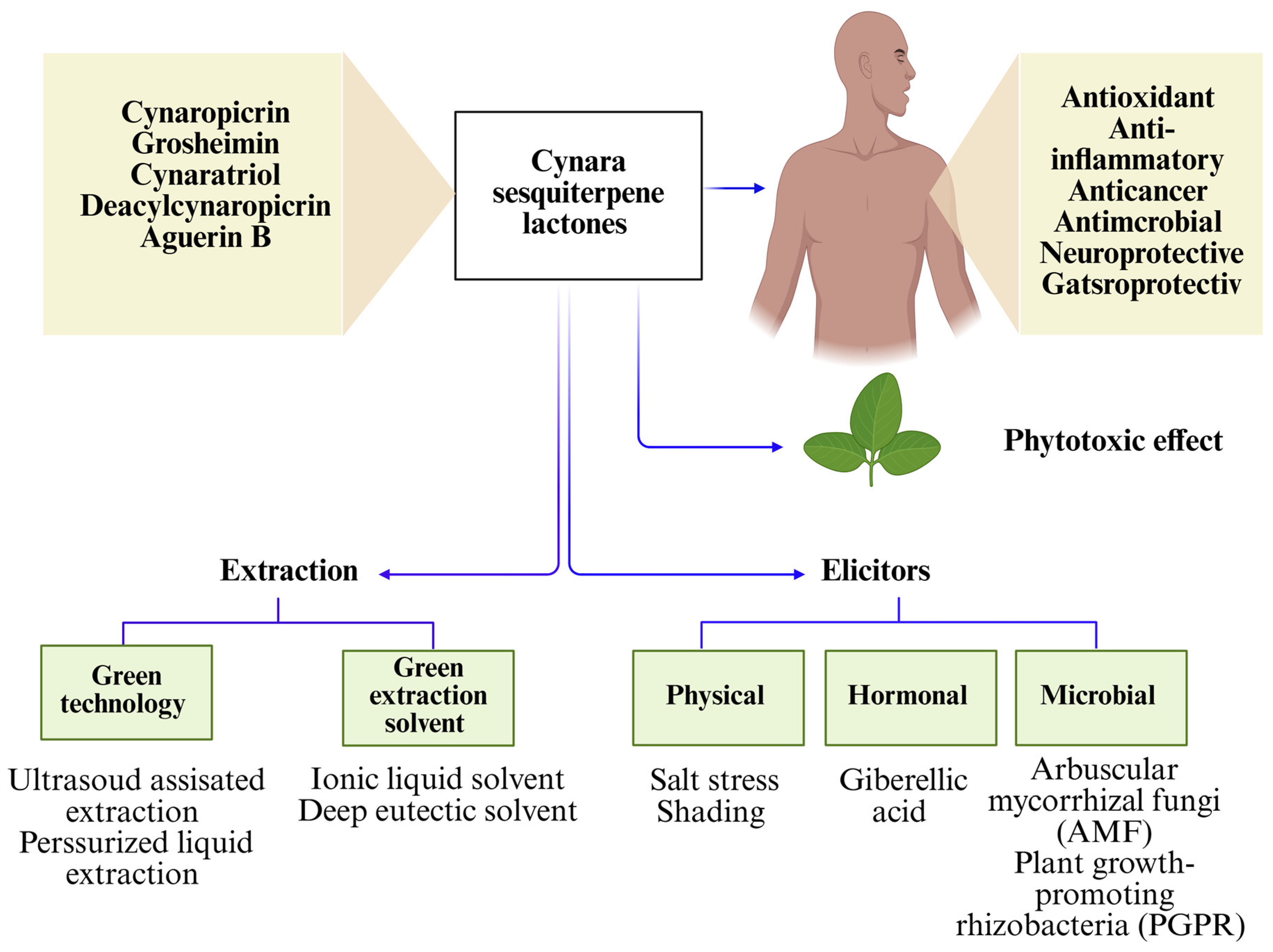

Sesquiterpene Lactones in Cynara: Biological Activities, Agriculture Applications, Extraction Techniques, and Production Enhancement Strategies

 , , , and
Abstract
1. Introduction
2. Methodology
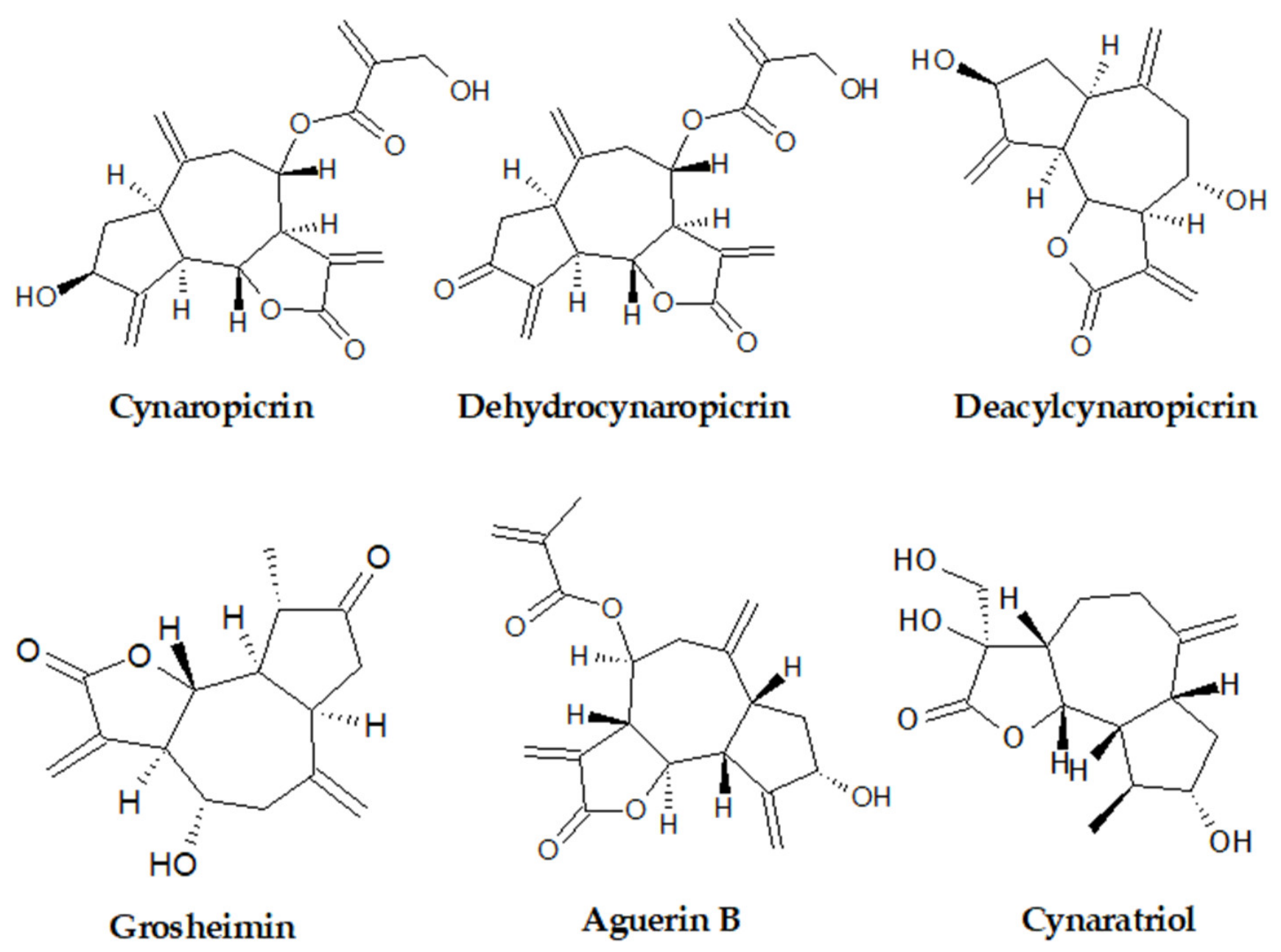
3. Cynara as a Source of Sesquiterpenes Lactones

| Cynara Species | Plant Part | Terpenoids Classes | Compounds | Extraction Method | Technique of Isolation and Identification | Reference |
|---|---|---|---|---|---|---|
| Cynara cornigera | Aerial part | STLs | Grosheimin | Maceration in aqueous methanol (80%) | Fractionation by silica gel chromatography and purification by Sephadex LH-20 column chromatography. | [45] |
| Solstitalin A | ||||||
| STLs | Cornigeraline A | Maceration in aqueous methanol (80%) | Spectroscopic methods coupled with single-crystal X-ray crystallography | [46] | ||
| Sibthorpine | ||||||
| 3-hydroxy-grosheimin | ||||||
| Grosheimin | ||||||
| Solstitalin A | ||||||
| 13-chlorosolstitialine | ||||||
| Cyanaropicrin | ||||||
| Cynara Humulis | Aerial part | STLs | Cynaropicrin | Maceration in MeOH-Et2-O + petrol (1:1:1) for 18 h at room temperature | Fractionation by CC and isolation by H1 and C13 NMR spectroscopy | [47] |
| Aguerin B | ||||||
| Solstitialin | ||||||
| 13-acetylsolstitialin | ||||||
| 13-chlorosolstitialin | ||||||
| 3-actyl-13-chlorosolstitiain | ||||||
| ll,13-epoxysolstitialin | ||||||
| Cynara syriaca | Leaf | STLs | 11,13-dihydrodeacylcynaropicrin | Percolation with petroleum ether: ether: methanol (1:1:1) mixture | Isolation by vacuum liquid chromatography and identification by 13C NMR | [48] |
| 11,13-dihydroxy-8-desoxygrosheimin | ||||||
| Solstitialin | ||||||
| C. scolymus | Leaf | STLs | Cynaropicrin | Bligh–Dyer extraction | Identification by 1H- and 13C NMR | [29] |
| Dehydrocynaropicrin | ||||||
| Grosheimin | ||||||
| Cynaratriol | ||||||
| 8-deoxy-11,13-dihydroxygrosheimin | ||||||
| Chlorophylls | Pheophytin a | |||||
| Pheophytin b | ||||||
| Leaf and stem | Triterpenoids | Squalene | ||||
| C. scolymus | Leaf | Monoterpene | Salvene | Dynamic headspace system using diethyl ether as solvent | Gas chromatography–mass spectrometry (GC-MS) | [49] |
| Myrtenal | ||||||
| Verbanol | ||||||
| Carveol | ||||||
| Thymol | ||||||
| Eugenol | ||||||
| Sesquiterpene | Bourbonene | |||||
| Myristicin | ||||||
| Selinene | ||||||
| Xanthorrhizol | ||||||
| Dihydrofarensol | ||||||
| Bisabolen-12-ol | ||||||
| Catalponol | ||||||
| Canellal | ||||||
| Santonine | ||||||
| Dihydrofarensol | ||||||
| Caryophyllene oxide | ||||||
| Thujaplicinol | ||||||
| C. scolymus | Leaf | Sesquiterpenoids | Mintsulfide | A homogenization-assisted-extraction with 80% methanol acidified with 0.1% formic acid | High-pressure liquid chromatography coupled to a quadrupole-time-of-flight mass spectrometer (UHPLC-ESI/QTOF-MS) | [50] |
| Epi-Antheindurolide A | ||||||
| Tataroside | ||||||
| Antheindurolide A | ||||||
| Lactucain B | ||||||
| Diterpenoids | Armillane | |||||
| (R)-3,4-Dihydro-2-methyl-2-(4,8,12-trimethyl-3,7,11-tridecatrienyl)-2H-1-benzopyran-6-ol | ||||||
| Monoterpenoids | Tsugaric acid B | |||||
| Triterpenoids | Ganoderic acid H | |||||
| C. scolymus | Leaf | Diterpenes | Rosmanol | Two consecutive reflux extractions with 50% ethanol | Ultra-High Performance Liquid Chromatography coupled with High Resolution Mass Spectrometry (UHPLC–HRMS/MS) | [51] |
| Epirosmanol | ||||||
| rosmanol methyl ether | ||||||
| Rosmadial | ||||||
| Carnosol | ||||||
| Sesquiterpenes | Cichorin | |||||
| Cynaropicrin | ||||||
| Leaf | Sesquiterpene lactone | Cynaratriol | Agitation for 4 h at 40 °C using 50% ethanol | Ultra-High Performance Liquid Chromatography coupled with Electrospray Ionization-Mass Spectrometry (UHPLC-ISI-MS) | [52] | |
| Triterpenoids | Ursolic acid | |||||
| Leaf | STLs | 3β,8α,11α,13-tetrahydroxy-10(14)-guaien1α,4β,5α,6βH-6α,12-olide | SLDE Naviglio extractor with 75% ethanol | LC-ESI/LTQ Orbitrap/MS/MS | [53] | |
| Cynaratriol | ||||||
| Diidrodesacylcynaropicrin 8-O-β-glucopyranoside | ||||||
| Deacylcynaropicrin | ||||||
| Cynarinin A | ||||||
| Cynarinin B | ||||||
| Kotschyol B | ||||||
| Aguerin B | ||||||
| Pertosin A | ||||||
| Cynaropicrin | ||||||
| Cynaropicrin methoxylate | ||||||
| C. scolymus | Leaf | STLs | Cynaropicrin | Maceration in water | HPLC | [39] |
| Deacylcynaropicrin | ||||||
| C. scolymus | Leaf | STLs | 3β, 8α, 11α, 13-tetrahydroxy-10 (14)-guaien-1α, 4β, 5α, 6βH-6α, 12-olide | Maceration in ethanol | LC-ESI/HRMS | [35] |
| Cynarascoloside A/B | ||||||
| dodesacylcynaropicrin 8-O-β-D-glucopyranoside | ||||||
| Cynaratriol | ||||||
| Cynarinin B | ||||||
| C. scolymus | Leaf | STLs | Cynaropicrin | Ethyl acetate fraction of water decoction | 1HNMR and 13C and 2D NMR | [37] |
| 11,13-dihydro-8-desoxigrosheimin | ||||||
| 11,13-dihidrodesacylcynaropicrin | ||||||
| Cynaratriol | ||||||
| Grosheimin | ||||||
| Grosheimin | Extraction with 75% (v/v) methanol acidified with formic acid using a pestle and mortar | UHPLC/Q-TOF-MS | [54] | |||
| Cynaratriol | ||||||
| 8-deoxy-11,13-dihydroxygrosheimin | ||||||
| Dihydrocynaropicrin | ||||||
| Cynaropicrin | ||||||
| C. scolymus | Leaf and stalk | Pentacyclic triterpenes | Lupeol | Supercritical extraction | GC-MS | [55] |
| Lup-20(29)-en-3-one | ||||||
| Olean-12-en-3-one | ||||||
| β-amyrin | ||||||
| Ψ-taraxasterol | ||||||
| Taraxasterol | ||||||
| Ψ-taraxasteryl acetate | ||||||
| Taraxasteryl acetate | ||||||
| C. scolymus | Head | STLs | Dehydrocynaropicrin | Homogenization in 80% methanol | UHPLC/QTOF | [56] |
| Grosheimin | ||||||
| Cynaratriol | ||||||
| C. scolymus | Leaf | STLs | Cynaropicrin | Supercritical CO2 extraction | LC-ESI-QTOF MS/MS | [27] |
| Cynaroscoloside A/B | ||||||
| Cynaroscoloside C | ||||||
| C. scolymus | Leaf | STLs | Cynaropicrin | Methanolic extract and fractionation with Ethyl-acetate | Reversed-phase column chromatography and HPLC | [38] |
| Grosheimin | ||||||
| 11β,13-dihydrocynaropicrin | ||||||
| 3β-hydroxy-8α-[(S)-3-hydroxy-2-methylpropionyloxy] guaia-4(15),10(14),11(13)-trien-1α,5α,6βH-12,6-olide | ||||||
| 3β-hydroxy-8α-[2-methoxymethyl-2-propenoyloxy] guaia-4(15),10(14),11(13)-trien-1α,5α,6βH-12,6-olide | ||||||
| Deacylcynaropicrin | ||||||
| Isoamberboin | ||||||
| C. scolymus | Receptacle | Monoterpene hydrocarbons | Camphor | Solid phase micro-extraction | Gas Chromatography-Chemical Ionization Mass Spectrometry (GC-CIMS) | [57] |
| Oxygenated monoterpenes | α-longipinene | |||||
| Cyclosativene | ||||||
| Longicyclene | ||||||
| α-copaene | ||||||
| β-elemene | ||||||
| Longifolene | ||||||
| β-caryophyllene | ||||||
| α-himachalene | ||||||
| α-humulene | ||||||
| α-acoradiene | ||||||
| β-selinene | ||||||
| α-selinene | ||||||
| δ-cadinene | ||||||
| Sesquiterpene hydrocarbons | Caryophyllene oxide | |||||
| Oxygenated sesquiterpenes | Safranal | |||||
| 2,3-butandiol | ||||||
| Hexanal | ||||||
| 2-methylbutanoic acid | ||||||
| 1-hexanol | ||||||
| 3-methyl-1-hexanol | ||||||
| Methyl hexanoate | ||||||
| 1-octen-3-ol | ||||||
| 2-pentylfuran | ||||||
| 3-ethyl-1-hexanol | ||||||
| 3-octen-2-one | ||||||
| (E)-2-octenal | ||||||
| (E)-2-octen-1-ol | ||||||
| (E, Z)-3,5-octadien-2-one | ||||||
| (E, E)-3,5-octadien-2-one | ||||||
| n-undecane | ||||||
| (Z)-2-nonenal | ||||||
| 2-butyl-2-octenal | ||||||
| (Z)-jasmone | ||||||
| C. scolymus | Roots | Triterpenoids | Taraxasterol | Chloroform fraction obtained by percolation | 1HNMR and 13CNMR spectroscopy | [58] |
| Lupeol | ||||||
| Flowers | Triterpene alcohols | α-Amyrin | Maceration with methanol | HPLC coupled with spectroscopy NMR | [59] | |
| α-Amyrin acetate | ||||||
| β-Amyrin | ||||||
| β-Amyrin acetate | ||||||
| Taraxasterol | ||||||
| Taraxasterol acetate | ||||||
| Ψ-Taraxasterol | ||||||
| Ψ-Taraxasterol acetate | ||||||
| C. altilis | Leaf | STLs | Cynaropicrin | Pulsed ultrasound-assisted extraction | UPLC-QTOF | [60] |
| Grosheimin | ||||||
| Aguerin B | ||||||
| Deacylcynaropicrin | ||||||
| C. altilis | Leaf | STLs | Cynaropicrin | Pulsed ultrasound-assisted extraction | UHPLC-MS/MS | [61] |
| Aguerin B | ||||||
| Grosheimin | ||||||
| 11,13-dihydroxy-8-deoxygrosheimin | ||||||
| Cynaratriol | ||||||
| Deacylcynaropicrin | ||||||
| 11,13-dihydro-deacylcynaropicrin | ||||||
| C. altilis | Leaf | STLs | Aguerin B | Ultrasounds assisted extraction | Chromatography coupled with spectroscopy | [40] |
| Grosheimin | ||||||
| 8α-acetoxyzaluzanin C | ||||||
| Dehydromelitensin | ||||||
| Cynaropicrin | ||||||
| 11,13-dihydroxy-8-desoxygrosheimin, | ||||||
| Stalk and leaf | STLs | Grosheimin | Soxhlet extraction with dichloromethane | GC−MS | [62] | |
| Cynaropicrin | ||||||
| Deacylcynaropicrin | ||||||
| Pentacyclic triterpenes | β-amyrin | |||||
| α-amyrin | ||||||
| Lupeol | ||||||
| β-amyrin acetate | ||||||
| α-amyrin acetate | ||||||
| Lupenyl acetate | ||||||
| ψ-taraxasterol | ||||||
| Taraxasterol | ||||||
| Ψ-taraxasteryl acetate | ||||||
| Taraxasteryl acetate | ||||||
| C. altilis | Aerial parts (leaves and floral stems) | STLs | Grosheimin | Cold maceration at room temperature using 80% ethanol | Column chromatographic separation coupled with 1H- and 13C- NMR | [63] |
| Cynaropicrin | ||||||
| C. altilis | Leaf | STLs | Cynaratriol | Maceration in water | HPLC | [39] |
| Cynaropicrin | ||||||
| Deacylcynaropicrin | ||||||
| 11,13-dihydro-deacylcynaropicrin | ||||||
| 11,13-dihydroxi-8-deoxygrosheimin | ||||||
| C. altilis | Leaf | STLs | Cynaropicrin | Maceration in water and fractionation in ethyl acetate | HPLC coupled with spectroscopy NMR | [64] |
| Cynaratiol | ||||||
| Desacylcynaropicrin | ||||||
| (11R)-11,13-dihydroxydesacylcynaropicrin | ||||||
| (11S)-11,13-dihydroxy-desacylcynaropicrin | ||||||
| C. sylvestris | Leaf | STLs | Cynaratriol | Maceration in water | HPLC | [39] |
| Cynaropicrin | ||||||
| Deacylcynaropicrin |
4. The Biological Activities of Sesquiterpenes Lactones from Cynara
4.1. Anticancer Activity
4.2. Antimicrobial Activity
4.3. Antioxidant Activity
4.4. Anti-Inflammatory Activity
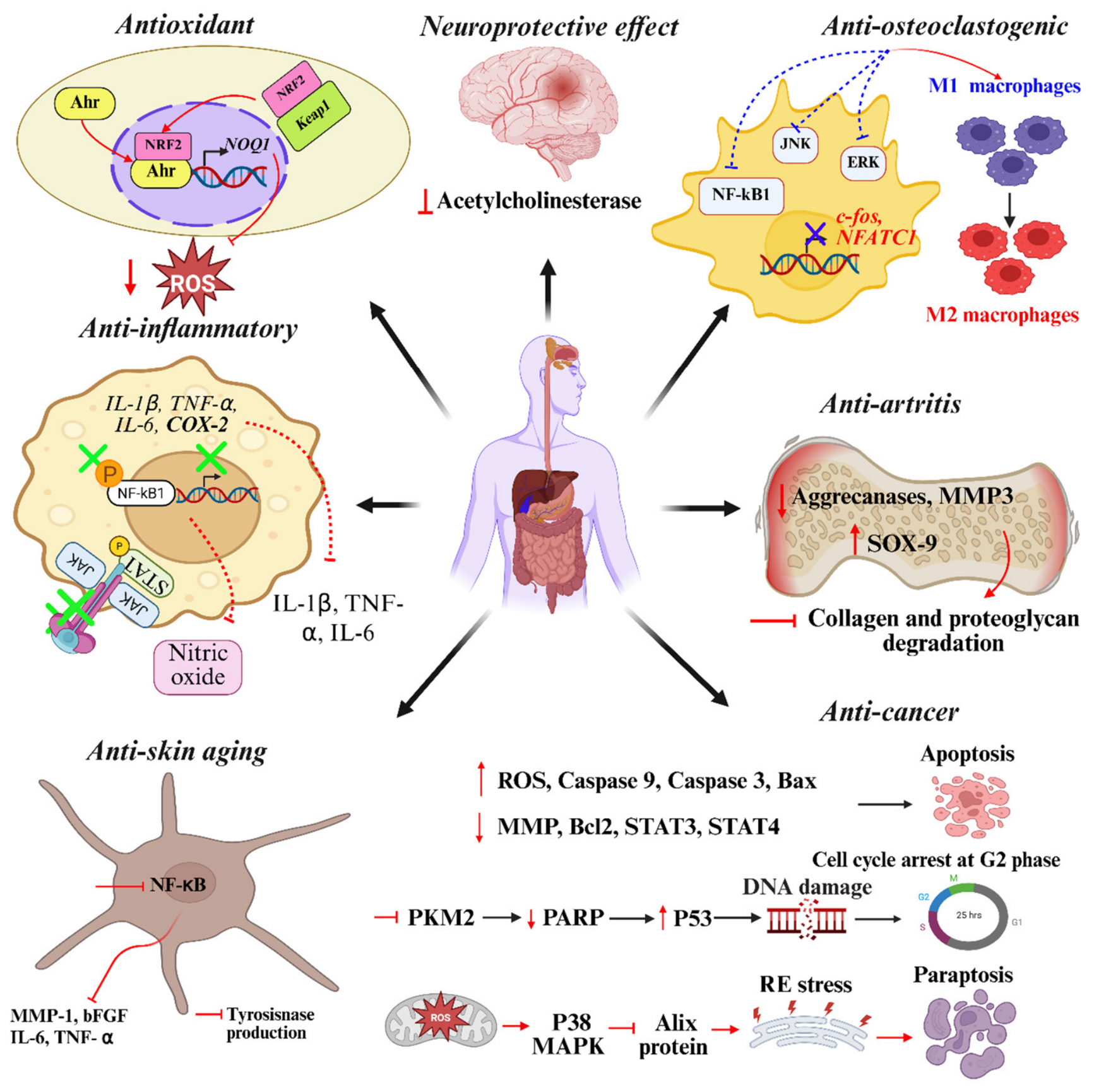
4.5. Other Biological Activities
5. Bioavailability of Sesquiterpene Lactones in Cynara
6. The Application of Cynara Sesquiterpene Lactones in Agriculture
7. The Green Extraction of Sesquiterpene Lactone from Cynara Species
7.1. Extraction Solvents
7.2. Extraction Methods
7.2.1. Conventional Extraction Methods
- Soxhlet extraction
- Maceration
- The Bligh–Dyer extraction technique
| Extraction Technique | Extraction Conditions | Cynara Variety | Plant Part | Concentration | Quantification Method | Reference | Advantages and Limitations |
|---|---|---|---|---|---|---|---|
| Maceration | Solvent: EtOH-H2O 70/30 (v/v) with agitation overnight at 70 °C | Artichoke (Tema cultivar) | Bract | 405.2 ± 1.3 µg/g | HPLC-DAD | [118] | Simple and low- cost process Long extraction time Organic solvents used are harmful to humans and the environment High solvent consumption Requires additional filtration and concentration steps |
| Extraction with acetone with agitation at room temperature | Artichoke (Carciofo di Malegno cultivar) | Leaf | 2.36 ± 0.39 mg/g DW | HPLC | [26] | ||
| Solvent: 70% methanol at a solid/liquid ratio of 1/10 for 72 h at room temperature | Cultivated cardoon | Leaf | 15.8 ± 0.1 mg/L | HPLC-UV | [78] | ||
| Solvent: 70% methanol at a solid/liquid ratio of 1/10 for 72 h at room temperature | Cultivated cardoon | Leaf | 158 ± 2 mg/Kg DM | HPLC-UV | [102] | ||
| Soxhlet | Solvent: dichloromethane for 7 h | Cultivated cardon | Leaf | 40.32 ± 1.13 mg/g DW | HPLC-UV | [108] | Simple and lowcost process High yield due to the continuous extraction cycles Long extraction time Usage of organic solvents Application of high temperatures that degrade the compounds High energy consumption |
| Solvent: dichloromethane for 7 h | Cultivated cardon | Leaf | 455.2 ± 14.7 mg/g | GC-MS | [71] | ||
| Solvent: dichloromethane for 7 h | Cultivated cardoon | Leaf | 87,482 mg/kg DW | GC-MS | [62] | ||
| Stalk | 230 mg/kg DW |
7.2.2. Modern Extraction Techniques
- The ultrasound-assisted extraction
- Pressurized liquid extraction
- The supercritical fluid extraction
- The ultra-turrax assisted extraction technique
- Naviglio
| Cynara Variety | Geographical Origin | Plant Parts | Concentration | Technique of Extraction | Extraction Conditions | Technique of Quantification | Reference |
|---|---|---|---|---|---|---|---|
| Artichoke (Carciofo Ortano cultivar) | Italy | Secondary flower head | 976.85 ± 10.46 mg/kg DW | Ultrasound-assisted extraction | Solvent: 100% methanol Amplitude: 200 W Three cycles of 30 min, at room temperature | HPLC-DAD | [41] |
| Artichoke (Carciofo Ortano cultivar) | Italy | Stem | 2254.58 ± 61.95 mg/kg DW | Ultrasound-assisted extraction | Solvent: 100% methanol Amplitude: 200 W, three cycles of 30 min, at room temperature | HPLC-DAD | [41] |
| Artichoke (Carciofo Ortano cultivar) | Italy | Leaf | 8143.3 ± 2845.4 mg/kg DW | Ultrasound-assisted extraction | Solvent: 100% methanol Amplitude: 200 W Three cycles of 30 min, at room temperature. | HPLC-DAD | [129] |
| Artichoke (Imperial star cultivar) | Italy | Leaf | 3.02 ± 0.29 mg/g DW | Ultrasound-assisted extraction | Solvent: 96%, ethanol Amplitude: 60 Pulsion: 100 Power: 400 W Frequency: 24 kHz | HPLC-DAD | [27] |
| Artichoke (Imperial star cultivar) | Italy | Leaf | 48.33 ± 2.42 mg/g DW | Supercritical CO2 extraction | Temperature: 40 °C Time: 60 min Pressure: 300 bar, CO2 mass flow rate: 1.4 kg CO2/h. | HPLC-PDA | [27] |
| Artichoke (Imperial star cultivar) | Italy | Leaf | 3.19 ± 0.26 mg/g DW | Deep Eutectic Solvent Extraction | Binary mixture of choline chloride and levulinic acid in a 1:2 ratio | HPLC-DAD | [27] |
| Cultivated cardoon | ND | Leaf | 119.34 ± 5.97 mg/g of extract | Pulsed ultrasound-assisted extraction | Solvent: ethanol Duty cycle: 25 % Solid/liquid ratio: 1/27 (g/mL) Extraction temperature: 44 °C Amplitude: 67 % (54.3 µm) Time: 30 min | HPLC-DAD | [61] |
| Cultivated cardoon | ND | Leaf | 299.35 ± 6.70 mg/g extract | Ultrasound-assisted extraction with ethanol | Liquid/solid ratio: 16/1 mL/g, 20 kHz, for 5 min with an amplitude of 15% at 40 °C | UPLC-QTOF | [60] |
| Cultivated cardoon | Spain | Leaf | 55.00 ± 2.92 mg/g DW | Ultrasound-assisted extraction with ethanol | Liquid/solid ratio: 16/1 mL/g, 20 kHz, for 5 min with an amplitude of 15% at 40 °C | HPLC-UV | [108] |
| 56.96 ± 4.52 mg/g DW | Pressurized liquid extraction | Solvent: Ethyl acetate Single static cycle during 5 min, with pressure of 10.77 kPa and temperature of 40 °C | HPLC-UV | [108] | |||
| 38.41 ± 1.61 mg/g DW | Microwave-assisted extraction | Solvent: ethyl acetate Microwave power of 1000 W for 15 min at 80 °C | HPLC-UV | [108] | |||
| Cultivated cardoon | Italy | Leaf | 0.230 mg/mg extract | Naviglio extractor | Solvent: 25 °C ethanol Pression: 9 bars Cycle: static phase 2 min; dynamic phase 2 min, with 12 s stop piston Time: 24 h | GC-MS | [128] |
| Wild cardoon | Italy | Leaf | 45 ± 0.02 mg/g of DW | Ultra-turrax assisted extraction | Solvent: 80% ethanol Solid liquid ratio: 2:5 (w/v) | HPLC-PDA | [98] |
8. The Approaches for Improving Production of Sesquiterpenes Lactones from Cynara
9. Conclusions and Future Perspectives
Author Contributions
Funding
Data Availability Statement
Conflicts of Interest
References
- Bernardini, S.; Tiezzi, A.; Laghezza Masci, V.; Ovidi, E. Natural Products for Human Health: An Historical Overview of the Drug Discovery Approaches. Nat. Prod. Res. 2018, 32, 1926–1950. [Google Scholar] [CrossRef] [Scilit] [PubMed]
- Chaachouay, N.; Zidane, L. Plant-Derived Natural Products: A Source for Drug Discovery and Development. Drugs Drug Candidates 2024, 3, 184–207. [Google Scholar] [CrossRef] [Scilit]
- Bhatla, S.C.; Lal, M.A. Secondary Metabolites. In Plant Physiology, Development and Metabolism; Bhatla, S.C., Lal, M.A., Eds.; Springer Nature: Singapore, 2018; pp. 1099–1166. [Google Scholar] [CrossRef] [Scilit]
- Yang, L.; Wen, K.-S.; Ruan, X.; Zhao, Y.-X.; Wei, F.; Wang, Q. Response of Plant Secondary Metabolites to Environmental Factors. Molecules 2018, 23, 762. [Google Scholar] [CrossRef] [Scilit] [PubMed]
- Yeshi, K.; Crayn, D.; Ritmejerytė, E.; Wangchuk, P. Plant Secondary Metabolites Produced in Response to Abiotic Stresses Has Potential Application in Pharmaceutical Product Development. Molecules 2022, 27, 313. [Google Scholar] [CrossRef] [Scilit] [PubMed]
- Nechchadi, H.; Nadir, Y.; Benhssaine, K.; Alem, C.; Sellam, K.; Boulbaroud, S.; Berrougui, H.; Ramchoun, M. Hypolipidemic Activity of Phytochemical Combinations: A Mechanistic Review of Preclinical and Clinical Studies. Food Chem. 2024, 459, 140264. [Google Scholar] [CrossRef] [Scilit] [PubMed]
- Câmara, J.S.; Perestrelo, R.; Ferreira, R.; Berenguer, C.V.; Pereira, J.A.M.; Castilho, P.C. Plant-Derived Terpenoids: A Plethora of Bioactive Compounds with Several Health Functions and Industrial Applications—A Comprehensive Overview. Molecules 2024, 29, 3861. [Google Scholar] [CrossRef] [Scilit] [PubMed]
- Matos, M.S.; Anastácio, J.D.; Nunes dos Santos, C. Sesquiterpene Lactones: Promising Natural Compounds to Fight Inflammation. Pharmaceutics 2021, 13, 991. [Google Scholar] [CrossRef] [Scilit] [PubMed]
- Sartori, S.K.; Diaz, M.A.N.; Diaz-Muñoz, G. Lactones: Classification, Synthesis, Biological Activities, and Industrial Applications. Tetrahedron 2021, 84, 132001. [Google Scholar] [CrossRef] [Scilit]
- Moujir, L.; Callies, O.; Sousa, P.M.C.; Sharopov, F.; Seca, A.M.L. Applications of Sesquiterpene Lactones: A Review of Some Potential Success Cases. Appl. Sci. 2020, 10, 3001. [Google Scholar] [CrossRef] [Scilit]
- Agatha, O.; Mutwil-Anderwald, D.; Tan, J.Y.; Mutwil, M. Plant Sesquiterpene Lactones. Philos. Trans. R. Soc. B Biol. Sci. 2024, 379, 20230350. [Google Scholar] [CrossRef] [Scilit] [PubMed]
- Paço, A.; Brás, T.; Santos, J.O.; Sampaio, P.; Gomes, A.C.; Duarte, M.F. Anti-Inflammatory and Immunoregulatory Action of Sesquiterpene Lactones. Molecules 2022, 27, 1142. [Google Scholar] [CrossRef] [Scilit] [PubMed]
- Amen, Y.; Abdelwahab, G.; Heraiz, A.A.; Sallam, M.; Othman, A. Exploring Sesquiterpene Lactones: Structural Diversity and Antiviral Therapeutic Insights. RSC Adv. 2025, 15, 1970–1988. [Google Scholar] [CrossRef] [Scilit] [PubMed]
- Herrera Acevedo, C.; Scotti, L.; Feitosa Alves, M.; Formiga Melo Diniz, M.D.F.; Scotti, M.T. Computer-Aided Drug Design Using Sesquiterpene Lactones as Sources of New Structures with Potential Activity against Infectious Neglected Diseases. Molecules 2017, 22, 79. [Google Scholar] [CrossRef] [Scilit] [PubMed]
- Babaei, G.; Aliarab, A.; Abroon, S.; Rasmi, Y.; Aziz, S.G.-G. Application of Sesquiterpene Lactone: A New Promising Way for Cancer Therapy Based on Anticancer Activity. Biomed. Pharmacother. 2018, 106, 239–246. [Google Scholar] [CrossRef] [Scilit] [PubMed]
- Anesini, C.A.; Alonso, M.R.; Martino, R.F. Antiproliferative and Cytotoxic Activities. In Sesquiterpene Lactones: Advances in Their Chemistry and Biological Aspects; Sülsen, V.P., Martino, V.S., Eds.; Springer International Publishing: Cham, Switzerland, 2018; pp. 303–323. [Google Scholar] [CrossRef] [Scilit]
- Rolnik, A.; Olas, B. The Plants of the Asteraceae Family as Agents in the Protection of Human Health. Int. J. Mol. Sci. 2021, 22, 3009. [Google Scholar] [CrossRef] [Scilit] [PubMed]
- Rustaiyan, A.; Faridchehr, A. Constituents and Biological Activities of Selected Genera of the Iranian Asteraceae Family. J. Herb. Med. 2021, 25, 100405. [Google Scholar] [CrossRef] [Scilit]
- Da Costa, F.B.; Terfloth, L.; Gasteiger, J. Sesquiterpene Lactone-Based Classification of Three Asteraceae Tribes: A Study Based on Self-Organizing Neural Networks Applied to Chemosystematics. Phytochemistry 2005, 66, 345–353. [Google Scholar] [CrossRef] [Scilit] [PubMed]
- Silva, H.; Daia, A.M. Exploring the Cardiovascular Potential of Artichoke—A Comprehensive Review. Biology 2025, 14, 397. [Google Scholar] [CrossRef] [Scilit] [PubMed]
- de Falco, B.; Incerti, G.; Amato, M.; Lanzotti, V. Artichoke: Botanical, Agronomical, Phytochemical, and Pharmacological Overview. Phytochem. Rev. 2015, 14, 993–1018. [Google Scholar] [CrossRef] [Scilit]
- Cozzolino, A.; Motti, R.; Cartenì, F.; De Magistris, A.; Gherardelli, M.; Vitasović-Kosić, I. Horticultural Food Plants in Traditional Herbal Medicine in the Mediterranean Basin: A Review. Horticulturae 2024, 10, 684. [Google Scholar] [CrossRef] [Scilit]
- Porro, C.; Benameur, T.; Cianciulli, A.; Vacca, M.; Chiarini, M.; De Angelis, M.; Panaro, M.A. Functional and Therapeutic Potential of Cynara scolymus in Health Benefits. Nutrients 2024, 16, 872. [Google Scholar] [CrossRef] [Scilit] [PubMed]
- Ayuso, P.; Quizhpe, J.; Rosell, M.d.L.Á.; Peñalver, R.; Nieto, G. Bioactive Compounds, Health Benefits and Food Applications of Artichoke (Cynara scolymus L.) and Artichoke By-Products: A Review. Appl. Sci. 2024, 14, 4940. [Google Scholar] [CrossRef] [Scilit]
- Zayed, A.; Serag, A.; Farag, M.A. Cynara cardunculus L.: Outgoing and Potential Trends of Phytochemical, Industrial, Nutritive and Medicinal Merits. J. Funct. Foods 2020, 69, 103937. [Google Scholar] [CrossRef] [Scilit]
- Zuccolo, M.; Bassoli, A.; Giorgi, A.; Giupponi, L.; Mazzini, S.; Borgonovo, G. Phytochemical Profiling of Residual Leaves from an Alpine Landrace of Globe Artichoke (Cynara scolymus L.). Molecules 2025, 30, 2649. [Google Scholar] [CrossRef] [Scilit] [PubMed]
- Masala, V.; Jokić, S.; Aladić, K.; Molnar, M.; Casula, M.; Tuberoso, C.I.G. Chemical Profiling and Evaluation of Antioxidant Activity of Artichoke (Cynara cardunculus Var. scolymus) Leaf By-Products’ Extracts Obtained with Green Extraction Techniques. Molecules 2024, 29, 4816. [Google Scholar] [CrossRef] [Scilit] [PubMed]
- Ramos, P.A.B.; Ferro, A.M.; Oliveira, M.M.; Gonçalves, S.; Freire, C.S.R.; Silvestre, A.J.D.; Duarte, M.F. Biosynthesis and Bioactivity of Cynara cardunculus L. Guaianolides and Hydroxycinnamic Acids: A Genomic, Biochemical and Health-Promoting Perspective. Phytochem. Rev. 2019, 18, 495–526. [Google Scholar] [CrossRef] [Scilit]
- Ingallina, C.; Di Matteo, G.; Spano, M.; Acciaro, E.; Campiglia, E.; Mannina, L.; Sobolev, A.P. Byproducts of Globe Artichoke and Cauliflower Production as a New Source of Bioactive Compounds in the Green Economy Perspective: An NMR Study. Molecules 2023, 28, 1363. [Google Scholar] [CrossRef] [Scilit] [PubMed]
- Elsebai, M.F.; Abass, K.; Hakkola, J.; Atawia, A.R.; Farag, M.A. The Wild Egyptian Artichoke as a Promising Functional Food for the Treatment of Hepatitis C Virus as Revealed via UPLC-MS and Clinical Trials. Food Funct. 2016, 7, 3006–3016. [Google Scholar] [CrossRef] [Scilit] [PubMed]
- Farag, M.A.; Elsebai, M.F.; Khattab, A.R. Metabolome Based Classification of Artichoke Leaf: A Prospect for Phyto-Equivalency of Its Different Leaf Origins and Commercial Preparations. J. Pharm. Biomed. Anal. 2018, 158, 151–159. [Google Scholar] [CrossRef] [Scilit] [PubMed]
- Durán, A.G.; Rial, C.; Gutiérrez, M.T.; Molinillo, J.M.G.; Macías, F.A. Sesquiterpenes in Fresh Food. In Handbook of Dietary Phytochemicals; Springer: Singapore, 2021; pp. 477–542. [Google Scholar] [CrossRef] [Scilit]
- Brás, T.; Neves, L.A.; Crespo, J.G.; Duarte, M.F. Advances in Sesquiterpene Lactones Extraction. TrAC Trends Anal. Chem. 2023, 158, 116838. [Google Scholar] [CrossRef] [Scilit]
- Perassolo, M.; Cardillo, A.B.; Busto, V.D.; Giulietti, A.M.; Talou, J.R. Biosynthesis of Sesquiterpene Lactones in Plants and Metabolic Engineering for Their Biotechnological Production. In Sesquiterpene Lactones; Sülsen, V.P., Martino, V.S., Eds.; Springer International Publishing: Cham, Switzerland, 2018; pp. 47–91. [Google Scholar] [CrossRef] [Scilit]
- Cerulli, A.; Cuozzo, R.; Melis, M.P.; Serreli, G.; Deiana, M.; Masullo, M.; Piacente, S. In-Depth LC-ESI/HRMS-Guided Phytochemical Analysis and Antioxidant Activity Analysis of Eco-Sustainable Extracts of Cynara cardunculus (Carciofo Di Paestum PGI) Leaves. Plants 2024, 13, 3591. [Google Scholar] [CrossRef] [Scilit] [PubMed]
- Farag, M.A.; El-Ahmady, S.H.; Elian, F.S.; Wessjohann, L.A. Metabolomics Driven Analysis of Artichoke Leaf and Its Commercial Products via UHPLC–q-TOF-MS and Chemometrics. Phytochemistry 2013, 95, 177–187. [Google Scholar] [CrossRef] [Scilit] [PubMed]
- Gonçalves, A.; Sampaio, C.I.; Ševčovičová, A.; Dias, A.M.; Oliveira, R. Cynaropicrin- and Chlorogenic Acid-Rich Extracts Easily Prepared from Cynara cardunculus Var. scolymus: Antioxidant and Antigenotoxic Properties. Biocatal. Agric. Biotechnol. 2023, 52, 102808. [Google Scholar] [CrossRef] [Scilit]
- Matsumoto, T.; Nakashima, S.; Nakamura, S.; Hattori, Y.; Ando, T.; Matsuda, H. Inhibitory Effects of Cynaropicrin and Related Sesquiterpene Lactones from Leaves of Artichoke (Cynara scolymus L.) on Induction of iNOS in RAW264.7 Cells and Its High-Affinity Proteins. J. Nat. Med. 2021, 75, 381–392. [Google Scholar] [CrossRef] [Scilit] [PubMed]
- Scavo, A.; Pandino, G.; Restuccia, A.; Lombardo, S.; Pesce, G.R.; Mauromicale, G. Allelopathic Potential of Leaf Aqueous Extracts from Cynara cardunculus L. on the Seedling Growth of Two Cosmopolitan Weed Species. Ital. J. Agron. 2019, 14, 1373. [Google Scholar] [CrossRef] [Scilit]
- Rial, C.; Novaes, P.; Varela, R.M.; Molinillo, J.M.G.; Macias, F.A. Phytotoxicity of Cardoon (Cynara cardunculus) Allelochemicals on Standard Target Species and Weeds. J. Agric. Food Chem. 2014, 62, 6699–6706. [Google Scholar] [CrossRef] [Scilit] [PubMed]
- Laghezza Masci, V.; Mezzani, I.; Alicandri, E.; Tomassi, W.; Paolacci, A.R.; Covino, S.; Vinciguerra, V.; Catalani, E.; Cervia, D.; Ciaffi, M.; et al. The Role of Extracts of Edible Parts and Production Wastes of Globe Artichoke (Cynara cardunculus L. Var. scolymus (L.)) in Counteracting Oxidative Stress. Antioxidants 2025, 14, 116. [Google Scholar] [CrossRef] [Scilit] [PubMed]
- Eljounaidi, K.; Comino, C.; Moglia, A.; Cankar, K.; Genre, A.; Hehn, A.; Bourgaud, F.; Beekwilder, J.; Lanteri, S. Accumulation of Cynaropicrin in Globe Artichoke and Localization of Enzymes Involved in Its Biosynthesis. Plant Sci. 2015, 239, 128–136. [Google Scholar] [CrossRef] [Scilit] [PubMed]
- Menin, B.; Comino, C.; Portis, E.; Moglia, A.; Cankar, K.; Bouwmeester, H.J.; Lanteri, S.; Beekwilder, J. Genetic Mapping and Characterization of the Globe Artichoke (+)-Germacrene A Synthase Gene, Encoding the First Dedicated Enzyme for Biosynthesis of the Bitter Sesquiterpene Lactone Cynaropicrin. Plant Sci. 2012, 190, 1–8. [Google Scholar] [CrossRef] [Scilit] [PubMed]
- Eljounaidi, K.; Cankar, K.; Comino, C.; Moglia, A.; Hehn, A.; Bourgaud, F.; Bouwmeester, H.; Menin, B.; Lanteri, S.; Beekwilder, J. Cytochrome P450s from Cynara cardunculus L. CYP71AV9 and CYP71BL5, Catalyze Distinct Hydroxylations in the Sesquiterpene Lactone Biosynthetic Pathway. Plant Sci. 2014, 223, 59–68. [Google Scholar] [CrossRef] [Scilit] [PubMed]
- Nazif, N. Chemical and Biological Constituents from the Leaf Extracts of the Wild Artichoke (Cynara cornigera). Int. J. Pharm. Pharm. Sci. 2012, 5, 396–400. [Google Scholar]
- Hegazy, M.-E.F.; Ibrahim, A.Y.; Mohamed, T.A.; Shahat, A.A.; Halawany, A.M.E.; Abdel-Azim, N.S.; Alsaid, M.S.; Paré, P.W. Sesquiterpene Lactones from Cynara cornigera: Acetyl Cholinesterase Inhibition and In Silico Ligand Docking. Planta Med. 2016, 82, 138–146. [Google Scholar] [CrossRef] [Scilit] [PubMed]
- Reis, L.V.; Regina Tavares, M.; Palma, F.M.S.B.; Marcelo-Curto, M.J. Sesquiterpene Lactones from Cynara humilis. Phytochemistry 1992, 31, 1285–1287. [Google Scholar] [CrossRef] [Scilit]
- Meriçli, A.H.; Seyhan, G.V. Constituents of Cynara syriaca. Leaves. Pharm. Biol. 2006, 44, 643–645. [Google Scholar] [CrossRef] [Scilit]
- Ghanem, K.Z.; Ramadan, M.M.; Farrag, A.R.H.; Ghanem, H.Z.; Farouk, A. Egyptian artichoke volatile compounds protect against lead-induced hepatic and renal toxicity in male rats. Pol. J. Food Nutr. Sci. 2009, 59, 175–181. [Google Scholar]
- Rocchetti, G.; Lucini, L.; Corrado, G.; Colla, G.; Cardarelli, M.; Pascale, S.D.; Rouphael, Y. Phytochemical Profile, Mineral Content, and Bioactive Compounds in Leaves of Seed-Propagated Artichoke Hybrid Cultivars. Molecules 2020, 25, 3795. [Google Scholar] [CrossRef] [Scilit] [PubMed]
- Costea, L.; Chițescu, C.L.; Boscencu, R.; Ghica, M.; Lupuliasa, D.; Mihai, D.P.; Deculescu-Ioniță, T.; Duțu, L.E.; Popescu, M.L.; Luță, E.-A.; et al. The Polyphenolic Profile and Antioxidant Activity of Five Vegetal Extracts with Hepatoprotective Potential. Plants 2022, 11, 1680. [Google Scholar] [CrossRef] [Scilit] [PubMed]
- Vigh, S.; Cziaky, Z.; Sinka, L.T.; Pribac, C.; Moş, L.; Turcuş, V.; Gálné Remenyik, J.; Mathe, E. Comparative Chemomapping of Phytoconstituents from Different Extracts of Globe Artichoke-Cynara scolymus L. Stud. Univ. Babeș-Bolyai Chem. 2017, 62, 125–143. [Google Scholar] [CrossRef] [Scilit]
- Cerulli, A.; Masullo, M.; Paolillo, A.; Pizza, C.; Piacente, S. Guaiane-Type Sesquiterpenes from Carciofo Bianco Di Pertosa, a Cultivar of Cynara cardunculus Subsp. Scolymus (L.), Leaf: Isolation and Evaluation of Tyrosinase Inhibitory Activity. Fitoterapia 2026, 191, 107262. [Google Scholar] [CrossRef] [Scilit] [PubMed]
- Rouphael, Y.; Bernardi, J.; Cardarelli, M.; Bernardo, L.; Kane, D.; Colla, G.; Lucini, L. Phenolic Compounds and Sesquiterpene Lactones Profile in Leaves of Nineteen Artichoke Cultivars. J. Agric. Food Chem. 2016, 64, 8540–8548. [Google Scholar] [CrossRef] [Scilit] [PubMed]
- Dai, Q.; Yang, Y.; Chen, K.; Cheng, Z.; Ni, Y.; Li, J. Optimization of Supercritical CO2 Operative Parameters to Simultaneously Increase the Extraction Yield of Oil and Pentacyclic Triterpenes from Artichoke Leaves and Stalks by Response Surface Methodology and Ridge Analysis. Eur. J. Lipid Sci. Technol. 2019, 121, 1800120. [Google Scholar] [CrossRef] [Scilit]
- Rocchetti, G.; Giuberti, G.; Lucchini, F.; Lucini, L. Polyphenols and Sesquiterpene Lactones from Artichoke Heads: Modulation of Starch Digestion, Gut Bioaccessibility, and Bioavailability Following In Vitro Digestion and Large Intestine Fermentation. Antioxidants 2020, 9, 306. [Google Scholar] [CrossRef] [Scilit] [PubMed]
- Dabbou, S.; Dabbou, S.; Flamini, G.; Peiretti, P.G.; Pandino, G.; Helal, A.N. Biochemical Characterization and Antioxidant Activities of the Edible Part of Globe Artichoke Cultivars Grown in Tunisia. Int. J. Food Prop. 2017, 20, S810–S819. [Google Scholar] [CrossRef] [Scilit]
- Ahmadian, M. Phytochemical Studies of Some Terpene Compounds in Roots of Cynara scolymus. Int. J. Farming Allied Sci. 2014, 3, 1065–1068. Available online: http://ijfas.com/wp-content/uploads/2014/11/1065-1068.pdf (accessed on 16 April 2026).
- Yasukawa, K.; Matsubara, H.; Sano, Y. Inhibitory Effect of the Flowers of Artichoke (Cynara cardunculus) on TPA-Induced Inflammation and Tumor Promotion in Two-Stage Carcinogenesis in Mouse Skin. J. Nat. Med. 2010, 64, 388–391. [Google Scholar] [CrossRef] [Scilit] [PubMed]
- Rosa, D.; Rial, C.; Palma, M.; Rodríguez-Mejías, F.J.; Varela, R.M.; Macías, F.A.; Duarte, M.F. Nanoemulsion Design of Cynara cardunculus Leaves Extract Rich in Sesquiterpene Lactones. Pest. Manag. Sci. 2026, 82, 4036–4050. [Google Scholar] [CrossRef] [Scilit] [PubMed]
- Rosa, D.; Brás, T.; Rial, C.; Varela, R.M.; Maçãs, B.; Macías, F.A.; Duarte, M.F. Sesquiterpene Lactones Enriched-Fractions Obtained from Cynara cardunculus Extract Diaultrafiltration. Ind. Crops Prod. 2024, 218, 118926. [Google Scholar] [CrossRef] [Scilit]
- Ramos, P.A.B.; Guerra, Â.R.; Guerreiro, O.; Freire, C.S.R.; Silva, A.M.S.; Duarte, M.F.; Silvestre, A.J.D. Lipophilic Extracts of Cynara cardunculus L. Var. altilis (DC): A Source of Valuable Bioactive Terpenic Compounds. J. Agric. Food Chem. 2013, 61, 8420–8429. [Google Scholar] [CrossRef] [Scilit] [PubMed]
- Hamza, R.A.; Mostafa, I.; Mohamed, Y.S.; Dora, G.A.; Ateya, A.-M.; Abdelaal, M.; Fantoukh, O.I.; Alqahtani, A.; Attia, R.A. Bioguided Isolation of Potential Antitumor Agents from the Aerial Parts of Cultivated Cardoon (Cynara cardunculus Var. altilis). Saudi Pharm. J. 2023, 31, 125–134. [Google Scholar] [CrossRef] [Scilit] [PubMed]
- Scavo, A.; Rial, C.; Molinillo, J.M.G.; Varela, R.M.; Mauromicale, G.; Macias, F.A. The Extraction Procedure Improves the Allelopathic Activity of Cardoon (Cynara cardunculus Var. altilis) Leaf Allelochemicals. Ind. Crops Prod. 2019, 128, 479–487. [Google Scholar] [CrossRef] [Scilit]
- Abu-Izneid, T.; Rauf, A.; Shariati, M.A.; Khalil, A.A.; Imran, M.; Rebezov, M.; Uddin, M.d.S.; Mahomoodally, M.F.; Rengasamy, K.R.R. Sesquiterpenes and Their Derivatives-Natural Anticancer Compounds: An Update. Pharmacol. Res. 2020, 161, 105165. [Google Scholar] [CrossRef] [Scilit] [PubMed]
- Li, Q.; Wang, Z.; Xie, Y.; Hu, H. Antitumor Activity and Mechanism of Costunolide and Dehydrocostus Lactone: Two Natural Sesquiterpene Lactones from the Asteraceae Family. Biomed. Pharmacother. 2020, 125, 109955. [Google Scholar] [CrossRef] [Scilit] [PubMed]
- Wang, L.; Bie, X.; Mickymaray, S.; Alothaim, A.S.; Pei, Y.; Gong, H. Induction of Apoptosis by Cynaropicrin in Human Colon Cancer Cell Line HCT-116 through the Mitochondria-Mediated Apoptotic Pathway. Pharmacogn. Mag. 2023, 19, 874–884. [Google Scholar] [CrossRef] [Scilit]
- Zheng, D.; Zhu, Y.; Shen, Y.; Xiao, S.; Yang, L.; Xiang, Y.; Dai, X.; Hu, W.; Zhou, B.; Liu, Z.; et al. Cynaropicrin Shows Antitumor Progression Potential in Colorectal Cancer Through Mediation of the LIFR/STATs Axis. Front. Cell Dev. Biol. 2021, 8, 605184. [Google Scholar] [CrossRef] [Scilit] [PubMed]
- Villarini, M.; Acito, M.; di Vito, R.; Vannini, S.; Dominici, L.; Fatigoni, C.; Pagiotti, R.; Moretti, M. Pro-Apoptotic Activity of Artichoke Leaf Extracts in Human HT-29 and RKO Colon Cancer Cells. Int. J. Environ. Res. Public Health 2021, 18, 4166. [Google Scholar] [CrossRef] [Scilit] [PubMed]
- Kim, M.Y.; Cha, H.-J.; Hong, S.H.; Moon, S.-K.; Kwon, T.K.; Chang, Y.-C.; Kim, G.Y.; Hyun, J.W.; Nam, A.-Y.; Shim, J.-H.; et al. Cynaropicrin Induces Reactive Oxygen Species-Dependent Paraptosis-Like Cell Death in Human Liver Cancer Cells. Biomol. Ther. 2025, 33, 470–482. [Google Scholar] [CrossRef] [Scilit] [PubMed]
- Ramos, P.A.B.; Guerra, Â.R.; Guerreiro, O.; Santos, S.A.O.; Oliveira, H.; Freire, C.S.R.; Silvestre, A.J.D.; Duarte, M.F. Antiproliferative Effects of Cynara cardunculus L. Var. altilis (DC) Lipophilic Extracts. Int. J. Mol. Sci. 2017, 18, 63. [Google Scholar] [CrossRef] [Scilit] [PubMed]
- Amaral, M.B.; Hamad, H.A.; Menon, S.V.; Kaur, M.; Sivaprasad, G.; Kadhum, W.R.; Uthirapathy, S.; Ullah, M.I.; Jawad, M.A.; Mustafa, Y.F. The Effect of Cynaropicrin, a Sesquiterpene Lactone, on the Migratory Properties of Triple-Negative Breast Cancer Cells and the Underlying Mechanisms. Avicenna J. Phytomed. 2026, 16, 66–77. [Google Scholar] [CrossRef] [Scilit] [PubMed]
- Russo, A.; Perri, M.; Cione, E.; Di Gioia, M.L.; Nardi, M.; Cristina Caroleo, M. Biochemical and Chemical Characterization of Cynara cardunculus L. Extract and Its Potential Use as Co-Adjuvant Therapy of Chronic Myeloid Leukemia. J. Ethnopharmacol. 2017, 202, 184–191. [Google Scholar] [CrossRef] [Scilit] [PubMed]
- Yang, R.; Ma, S.; Zhuo, R.; Xu, L.; Jia, S.; Yang, P.; Yao, Y.; Cao, H.; Ma, L.; Pan, J.; et al. Suppression of Endoplasmic Reticulum Stress-Dependent Autophagy Enhances Cynaropicrin-Induced Apoptosis via Attenuation of the P62/Keap1/Nrf2 Pathways in Neuroblastoma. Front. Pharmacol. 2022, 13, 977622. [Google Scholar] [CrossRef] [Scilit] [PubMed]
- Ding, Z.; Xi, J.; Zhong, M.; Chen, F.; Zhao, H.; Zhang, B.; Fang, J. Cynaropicrin Induces Cell Cycle Arrest and Apoptosis by Inhibiting PKM2 to Cause DNA Damage and Mitochondrial Fission in A549 Cells. J. Agric. Food Chem. 2021, 69, 13557–13567. [Google Scholar] [CrossRef] [Scilit] [PubMed]
- Chicca, A.; Tebano, M.; Adinolfi, B.; Ertugrul, K.; Flamini, G.; Nieri, P. Anti-Proliferative Activity of Aguerin B and a New Rare nor-Guaianolide Lactone Isolated from the Aerial Parts of Centaurea deflexa. Eur. J. Med. Chem. 2011, 46, 3066–3070. [Google Scholar] [CrossRef] [Scilit] [PubMed]
- Sülsen, V.P. Sesquiterpene Lactones and Diterpenes: Promising Therapeutic Candidates for Infectious Diseases, Neoplasms and Other Chronic Disorders. Molecules 2021, 26, 1251. [Google Scholar] [CrossRef] [Scilit] [PubMed]
- Scavo, A.; Pandino, G.; Restuccia, C.; Parafati, L.; Cirvilleri, G.; Mauromicale, G. Antimicrobial Activity of Cultivated Cardoon (Cynara cardunculus L. Var. altilis DC.) Leaf Extracts against Bacterial Species of Agricultural and Food Interest. Ind. Crops Prod. 2019, 129, 206–211. [Google Scholar] [CrossRef] [Scilit]
- Schou, C.; Mukavi, J.W.; Sendker, J.; Christodoulou, V.; Cal, M.; Mäser, P.; Karanis, P.; Schmidt, T.J. Isolation and Antiprotozoal Effects of Two Sesquiterpene Lactones from Ptilostemon chamaepeuce Subsp. Cyprius (Asteraceae). Parasitologia 2025, 5, 66. [Google Scholar] [CrossRef] [Scilit]
- Possart, K.; Herrmann, F.C.; Jose, J.; Costi, M.P.; Schmidt, T.J. Sesquiterpene Lactones with Dual Inhibitory Activity against the Trypanosoma Brucei Pteridine Reductase 1 and Dihydrofolate Reductase. Molecules 2021, 27, 149. [Google Scholar] [CrossRef] [Scilit] [PubMed]
- Elsebai, M.F.; Koutsoudakis, G.; Saludes, V.; Pérez-Vilaró, G.; Turpeinen, A.; Mattila, S.; Pirttilä, A.M.; Fontaine-Vive, F.; Mehiri, M.; Meyerhans, A.; et al. Pan-Genotypic Hepatitis C Virus Inhibition by Natural Products Derived from the Wild Egyptian Artichoke. J. Virol. 2016, 90, 1918–1930. [Google Scholar] [CrossRef] [Scilit] [PubMed]
- Takei, K.; Hashimoto-Hachiya, A.; Takahara, M.; Tsuji, G.; Nakahara, T.; Furue, M. Cynaropicrin Attenuates UVB-Induced Oxidative Stress via the AhR–Nrf2–Nqo1 Pathway. Toxicol. Lett. 2015, 234, 74–80. [Google Scholar] [CrossRef] [Scilit] [PubMed]
- Hohmann, M.S.N.; Longhi-Balbinot, D.T.; Guazelli, C.F.S.; Navarro, S.A.; Zarpelon, A.C.; Casagrande, R.; Arakawa, N.S.; Verri, W.A. Chapter 7—Sesquiterpene Lactones: Structural Diversity and Perspectives as Anti-Inflammatory Molecules. Stud. Nat. Prod. Chem. 2016, 49, 243–264. [Google Scholar] [CrossRef] [Scilit]
- Hayata, M.; Watanabe, N.; Kamio, N.; Tamura, M.; Nodomi, K.; Tanaka, K.; Iddamalgoda, A.; Tsuda, H.; Ogata, Y.; Sato, S.; et al. Cynaropicrin from Cynara scolymus L. Suppresses Porphyromonas gingivalis LPS-Induced Production of Inflammatory Cytokines in Human Gingival Fibroblasts and RANKL-Induced Osteoclast Differentiation in RAW264.7 Cells. J. Nat. Med. 2019, 73, 114–123. [Google Scholar] [CrossRef] [Scilit] [PubMed]
- Schepetkin, I.A.; Kirpotina, L.N.; Mitchell, P.T.; Kishkentaeva, A.S.; Shaimerdenova, Z.R.; Atazhanova, G.A.; Adekenov, S.M.; Quinn, M.T. The Natural Sesquiterpene Lactones Arglabin, Grosheimin, Agracin, Parthenolide, and Estafiatin Inhibit T Cell Receptor (TCR) Activation. Phytochemistry 2018, 146, 36–46. [Google Scholar] [CrossRef] [Scilit] [PubMed]
- Oppedisano, F.; Muscoli, C.; Musolino, V.; Carresi, C.; Macrì, R.; Giancotta, C.; Bosco, F.; Maiuolo, J.; Scarano, F.; Paone, S.; et al. The Protective Effect of Cynara cardunculus Extract in Diet-Induced NAFLD: Involvement of OCTN1 and OCTN2 Transporter Subfamily. Nutrients 2020, 12, 1435. [Google Scholar] [CrossRef] [Scilit] [PubMed]
- Tanaka, Y.T.; Tanaka, K.; Kojima, H.; Hamada, T.; Masutani, T.; Tsuboi, M.; Akao, Y. Cynaropicrin from Cynara scolymus L. Suppresses Photoaging of Skin by Inhibiting the Transcription Activity of Nuclear Factor-Kappa B. Bioorganic Med. Chem. Lett. 2013, 23, 518–523. [Google Scholar] [CrossRef] [Scilit] [PubMed]
- Emendörfer, F.; Emendörfer, F.; Bellato, F.; Noldin, V.F.; Cechinel-Filho, V.; Yunes, R.A.; Delle Monache, F.; Cardozo, A.M. Antispasmodic Activity of Fractions and Cynaropicrin from Cynara scolymus on Guinea-Pig Ileum. Biol. Pharm. Bull. 2005, 28, 902–904. [Google Scholar] [CrossRef] [Scilit] [PubMed]
- Ishida, K.; Kojima, R.; Tsuboi, M.; Tsuda, Y.; Ito, M. Effects of Artichoke Leaf Extract on Acute Gastric Mucosal Injury in Rats. Biol. Pharm. Bull. 2010, 33, 223–229. [Google Scholar] [CrossRef] [Scilit] [PubMed]
- Masutani, T.; Tanaka, Y.T.; Kojima, H.; Tsuboi, M.; Hara, A.; Niwa, M. Cynaropicrin Is Dual Regulator for Both Degradation Factors and Synthesis Factors in the Cartilage Metabolism. Life Sci. 2016, 158, 70–77. [Google Scholar] [CrossRef] [Scilit] [PubMed]
- Li, Z.; Zhu, X.; Xu, R.; Wang, Y.; Hu, R.; Xu, W. Deacylcynaropicrin Inhibits RANKL-Induced Osteoclastogenesis by Inhibiting NF-κB and MAPK and Promoting M2 Polarization of Macrophages. Front. Pharmacol. 2019, 10, 599. [Google Scholar] [CrossRef] [Scilit] [PubMed]
- Murillo-Pineda, M.; Martínez-Miralles, J.; Medina-Calzada, Z.; Varela, R.M.; Macías, F.A.; Chinchilla, N.; Juárez-Soto, Á.; Santpere, G.; Reales, E. New Insights into the Molecular Actions of Grosheimin, Costunolide, and α- and β-Cyclocostunolide on Primary Cilia Structure and Hedgehog Signaling. Int. J. Mol. Sci. 2025, 26, 11754. [Google Scholar] [CrossRef] [Scilit] [PubMed]
- Dima, C.; Assadpour, E.; Dima, S.; Jafari, S.M. Bioavailability and Bioaccessibility of Food Bioactive Compounds; Overview and Assessment by in Vitro Methods. Compr. Rev. Food Sci. Food Saf. 2020, 19, 2862–2884. [Google Scholar] [CrossRef] [Scilit] [PubMed]
- Colantuono, A.; Ferracane, R.; Vitaglione, P. Potential Bioaccessibility and Functionality of Polyphenols and Cynaropicrin from Breads Enriched with Artichoke Stem. Food Chem. 2018, 245, 838–844. [Google Scholar] [CrossRef] [Scilit] [PubMed]
- Batuwita, B.K.H.H.; Tilley, A.; Chin, S.T.; Stathopoulos, C. Advanced Green Extraction Methods for Valorising Artichoke Waste: Bioactive Composition, Stabilisation, and Implications for Nutrition and Disease Prevention. Foods 2026, 15, 2048. [Google Scholar] [CrossRef] [Scilit] [PubMed]
- El-Nashar, H.A.S.; Abbas, H.; Zewail, M.; Noureldin, M.H.; Ali, M.M.; Shamaa, M.M.; Khattab, M.A.; Ibrahim, N. Neuroprotective Effect of Artichoke-Based Nanoformulation in Sporadic Alzheimer’s Disease Mouse Model: Focus on Antioxidant, Anti-Inflammatory, and Amyloidogenic Pathways. Pharmaceuticals 2022, 15, 1202. [Google Scholar] [CrossRef] [Scilit] [PubMed]
- Nasrollahi, H.; Raofie, F. Polymer Encapsulation of Cynara scolymus L. Extract Using Supercritical Fluid Expansion into an Aqueous Solution (ESSAS): Optimization of Conditions, Identification of Compounds Using LC-HRMS, and Investigation of Antioxidant Properties. Food Chem. 2026, 498, 147118. [Google Scholar] [CrossRef] [Scilit] [PubMed]
- Masala, V.; Demuro, S.; Serreli, G.; Kranjac, M.; Simola, N.; Deiana, M.; Tuberoso, C.I.G.; Caddeo, C. Valorisation of Wild Cardoon Leaf By-Product: Extraction, Bioactive Compounds, Antioxidant Activity and Nanoformulation. Food Chem. 2026, 509, 148585. [Google Scholar] [CrossRef] [Scilit] [PubMed]
- La Iacona, M.; Lombardo, S.; Mauromicale, G.; Scavo, A.; Pandino, G. Allelopathic Activity of Three Wild Mediterranean Asteraceae: Silybum marianum, Cynara cardunculus Var. sylvestris, Galactites tomentosus. Agronomy 2024, 14, 575. [Google Scholar] [CrossRef] [Scilit]
- Scavo, A.; Rial, C.; Varela, R.M.; Molinillo, J.M.G.; Mauromicale, G.; Macias, F.A. Influence of Genotype and Harvest Time on the Cynara cardunculus L. Sesquiterpene Lactone Profile. J. Agric. Food Chem. 2019, 67, 6487–6496. [Google Scholar] [CrossRef] [Scilit] [PubMed]
- Scavo, A.; Restuccia, A.; Abbate, C.; Mauromicale, G. Seeming Field Allelopathic Activity of Cynara cardunculus L. Reduces the Soil Weed Seed Bank. Agron. Sustain. Dev. 2019, 39, 41. [Google Scholar] [CrossRef] [Scilit]
- Scavo, A.; Pandino, G.; Restuccia, A.; Mauromicale, G. Leaf Extracts of Cultivated Cardoon as Potential Bioherbicide. Sci. Hortic. 2020, 261, 109024. [Google Scholar] [CrossRef] [Scilit]
- Scavo, A.; Rial, C.; Molinillo, J.M.G.; Varela, R.M.; Mauromicale, G.; Macías, F.A. Effect of Shading on the Sesquiterpene Lactone Content and Phytotoxicity of Cultivated Cardoon Leaf Extracts. J. Agric. Food Chem. 2020, 68, 11946–11953. [Google Scholar] [CrossRef] [Scilit] [PubMed]
- Rial, C.; García, B.F.; Varela, R.M.; Torres, A.; Molinillo, J.M.G.; Macías, F.A. The Joint Action of Sesquiterpene Lactones from Leaves as an Explanation for the Activity of Cynara cardunculus. J. Agric. Food Chem. 2016, 64, 6416–6424. [Google Scholar] [CrossRef] [Scilit] [PubMed]
- Mejías, F.J.R.; Fernández, I.P.; Rial, C.; Varela, R.M.; Molinillo, J.M.G.; Calvino, J.J.; Trasobares, S.; Macías, F.A. Encapsulation of Cynara cardunculus Guaiane-Type Lactones in Fully Organic Nanotubes Enhances Their Phytotoxic Properties. J. Agric. Food Chem. 2022, 70, 3644–3653. [Google Scholar] [CrossRef] [Scilit] [PubMed]
- Lefebvre, T.; Destandau, E.; Lesellier, E. Selective Extraction of Bioactive Compounds from Plants Using Recent Extraction Techniques: A Review. J. Chromatogr. A 2021, 1635, 461770. [Google Scholar] [CrossRef] [Scilit] [PubMed]
- Boffo, E.F.; de Melo, K.S.; Shiromoto, M.O.; Silva, A.D.; Vieira, P.C.; Ambrozin, A.R.P. Chemometrics Applied to 1H NMR and UV–Vis Spectroscopy as a Way to Evaluate Solid-Liquid Extraction of Leaves of Artichoke. Food Chem. 2022, 377, 131979. [Google Scholar] [CrossRef] [Scilit]
- Brás, T.; Neves, L.A.; Crespo, J.G.; Duarte, M.F. Effect of Extraction Methodologies and Solvent Selection upon Cynaropicrin Extraction from Cynara cardunculus Leaves. Sep. Purif. Technol. 2020, 236, 116283. [Google Scholar] [CrossRef] [Scilit]
- Nasirpour, N.; Mohammadpourfard, M.; Zeinali Heris, S. Ionic Liquids: Promising Compounds for Sustainable Chemical Processes and Applications. Chem. Eng. Res. Des. 2020, 160, 264–300. [Google Scholar] [CrossRef] [Scilit]
- Sada Khan, A.; Ibrahim, T.H.; Abdel Jabbar, N.; Khamis, M.I.; Nancarrow, P.; Sabri Mjalli, F. Ionic Liquids and Deep Eutectic Solvents for the Recovery of Phenolic Compounds: Effect of Ionic Liquids Structure and Process Parameters. RSC Adv. 2021, 11, 12398–12422. [Google Scholar] [CrossRef] [Scilit] [PubMed]
- Mizuno, H.; Usuki, T. Ionic Liquid-Assisted Extraction and Isolation of Cynaropicrin and Cnicin from Artichoke and Blessed Thistle. ChemistrySelect 2018, 3, 1781–1786. [Google Scholar] [CrossRef] [Scilit]
- de Faria, E.L.P.; Gomes, M.V.; Cláudio, A.F.M.; Freire, C.S.R.; Silvestre, A.J.D.; Freire, M.G. Extraction and Recovery Processes for Cynaropicrin from Cynara cardunculus L. Using Aqueous Solutions of Surface-Active Ionic Liquids. Biophys. Rev. 2018, 10, 915–925. [Google Scholar] [CrossRef] [Scilit] [PubMed]
- Ling, J.K.U.; Hadinoto, K. Deep Eutectic Solvent as Green Solvent in Extraction of Biological Macromolecules: A Review. Int. J. Mol. Sci. 2022, 23, 3381. [Google Scholar] [CrossRef] [Scilit] [PubMed]
- Ivanović, M.; Islamčević Razboršek, M.; Kolar, M. Innovative Extraction Techniques Using Deep Eutectic Solvents and Analytical Methods for the Isolation and Characterization of Natural Bioactive Compounds from Plant Material. Plants 2020, 9, 1428. [Google Scholar] [CrossRef] [Scilit] [PubMed]
- de Faria, E.L.P.; do Carmo, R.S.; Cláudio, A.F.M.; Freire, C.S.R.; Freire, M.G.; Silvestre, A.J.D. Deep Eutectic Solvents as Efficient Media for the Extraction and Recovery of Cynaropicrin from Cynara cardunculus L. Leaves. Int. J. Mol. Sci. 2017, 18, 2276. [Google Scholar] [CrossRef] [Scilit] [PubMed]
- López-Bascón, M.A.; de Castro, M.D.L. Soxhlet Extraction. In Liquid-Phase Extraction; Elsevier: Amsterdam, The Netherlands, 2020; pp. 327–354. [Google Scholar] [CrossRef] [Scilit]
- Martins, R.; Barbosa, A.; Advinha, B.; Sales, H.; Pontes, R.; Nunes, J. Green Extraction Techniques of Bioactive Compounds: A State-of-the-Art Review. Processes 2023, 11, 2255. [Google Scholar] [CrossRef] [Scilit]
- Alves-Silva, J.M.; Zuzarte, M.; Salgueiro, L.; Cocco, E.; Ghiani, V.; Falconieri, D.; Maccioni, D.; Maxia, A. Agroprospecting of Biowastes: Globe Artichoke (Cynara scolymus L. Cultivar Tema, Asteraceae) as Potential Source of Bioactive Compounds. Molecules 2024, 29, 3960. [Google Scholar] [CrossRef] [Scilit] [PubMed]
- Cravotto, G.; Nano, G.M.; Binello, A.; Spagliardi, P.; Seu, G. Chemical and Biological Modification of Cynaropicrin and Grosheimin: A Structure–Bitterness Relationship Study. J. Sci. Food Agric. 2005, 85, 1757–1764. [Google Scholar] [CrossRef] [Scilit]
- Saini, R.K.; Prasad, P.; Shang, X.; Keum, Y.-S. Advances in Lipid Extraction Methods—A Review. Int. J. Mol. Sci. 2021, 22, 13643. [Google Scholar] [CrossRef] [Scilit]
- Brás, T.; Paulino, A.F.C.; Neves, L.A.; Crespo, J.G.; Duarte, M.F. Ultrasound Assisted Extraction of Cynaropicrin from Cynara cardunculus Leaves: Optimization Using the Response Surface Methodology and the Effect of Pulse Mode. Ind. Crops Prod. 2020, 150, 112395. [Google Scholar] [CrossRef] [Scilit]
- Nechchadi, H.; Benhssaine, K.; Boulbaroud, S.; Berrougui, H.; Ramchoun, M. Factors of Variation and the Techniques for Improving Extraction and Bioaccessibility of Carob Polyphenol: A Review. Food Meas. 2023, 17, 4775–4799. [Google Scholar] [CrossRef] [Scilit]
- Travis, C.R.; McMaster, J.; Rivas, F. Advances in Natural Product Extraction: Established and Emerging Technologies. Molecules 2026, 31, 1136. [Google Scholar] [CrossRef] [Scilit] [PubMed]
- Nguyen, T.T.H.; Lieu, L.; Dao, D.T.P.Q.; Pham, V.Y.N.; Nguyen, D.Q. Homogenization-Assisted Extraction of Antioxidants from Centella asiatica Using a Natural Deep Eutectic Solvent (NADES): Optimization and Evaluation. Trends Sci. 2026, 23, 11303. [Google Scholar] [CrossRef] [Scilit]
- Guerboub, L.; Soufi-Maddi, O.; Ouldsaadi, L.; Bachir Bey, M.; Medouni-Haroune, L.; Madani, K.; Boulekbache-Makhlouf, L. Ultra-Turrax Homogenization–Assisted Extraction of Bioactive Compounds from Olive Pomace Using Response Surface Methodology. Food Anal. Methods 2025, 18, 2198–2207. [Google Scholar] [CrossRef] [Scilit]
- Ordonez-Santos, L.E.; Garzón-García, A.M. Optimizing Homogenizer-Assisted Extraction of Chlorophylls from Plantain Epicarp (Musa paradisiaca L.). J. Food Meas. Charact. 2021, 15, 1108–1115. [Google Scholar] [CrossRef] [Scilit]
- Naviglio, D.; Scarano, P.; Ciaravolo, M.; Gallo, M. Rapid Solid-Liquid Dynamic Extraction (RSLDE): A Powerful and Greener Alternative to the Latest Solid-Liquid Extraction Techniques. Foods 2019, 8, 245. [Google Scholar] [CrossRef] [Scilit] [PubMed]
- Spennato, M.; Roggero, O.M.; Varriale, S.; Asaro, F.; Cortesi, A.; Kašpar, J.; Tongiorgi, E.; Pezzella, C.; Gardossi, L. Neuroprotective Properties of Cardoon Leaves Extracts against Neurodevelopmental Deficits in an In Vitro Model of Rett Syndrome Depend on the Extraction Method and Harvest Time. Molecules 2022, 27, 8772. [Google Scholar] [CrossRef] [Scilit] [PubMed]
- Laghezza Masci, V.; Alicandri, E.; Antonelli, C.; Paolacci, A.R.; Marabottini, R.; Tomassi, W.; Scarascia Mugnozza, G.; Tiezzi, A.; Garzoli, S.; Vinciguerra, V.; et al. Cynara cardunculus L. Var. scolymus L. Landrace “Carciofo Ortano” as a Source of Bioactive Compounds. Plants 2024, 13, 761. [Google Scholar] [CrossRef] [Scilit] [PubMed]
- Halder, M.; Sarkar, S.; Jha, S. Elicitation: A Biotechnological Tool for Enhanced Production of Secondary Metabolites in Hairy Root Cultures. Eng. Life Sci. 2019, 19, 880–895. [Google Scholar] [CrossRef] [Scilit] [PubMed]
- Petrova, M.; Miladinova-Georgieva, K.; Geneva, M. Influence of Abiotic and Biotic Elicitors on Organogenesis, Biomass Accumulation, and Production of Key Secondary Metabolites in Asteraceae Plants. Int. J. Mol. Sci. 2024, 25, 4197. [Google Scholar] [CrossRef] [Scilit] [PubMed]
- Docimo, T.; De Stefano, R.; Cappetta, E.; Piccinelli, A.L.; Celano, R.; De Palma, M.; Tucci, M. Physiological, Biochemical, and Metabolic Responses to Short and Prolonged Saline Stress in Two Cultivated Cardoon Genotypes. Plants 2020, 9, 554. [Google Scholar] [CrossRef] [Scilit] [PubMed]
- Lombardo, S.; Scavo, A.; Pandino, G.; Cantone, M.; Mauromicale, G. Improvement in the Cynaropicrin, Caffeoylquinic Acid and Flavonoid Content of Globe Artichokes with Gibberellic Acid Treatment. Plants 2022, 11, 1845. [Google Scholar] [CrossRef] [Scilit] [PubMed]
- Colonna, E.; Rouphael, Y.; Barbieri, G.; De Pascale, S. Microbial-Based Biostimulants Modulate Antioxidant Activity, Bioactive Compounds and Sesquiterpene Lactones Profile of Globe Artichoke. Acta Hortic. 2021, 1320, 421–428. [Google Scholar] [CrossRef] [Scilit]
- Pandino, G.; Gattesco, F.; Bosisio, S.; Lombardo, S.; Russo, A.; Mauromicale, G. Cynaropicrin, Total Caffeoylquinic Acids and Flavonoids in Leaves of Cynara cardunculus (Cardoon) Forms. Acta Hortic. 2020, 1284, 279–284. [Google Scholar] [CrossRef] [Scilit]

Disclaimer/Publisher’s Note: The statements, opinions and data contained in all publications are solely those of the individual author(s) and contributor(s) and not of MDPI and/or the editor(s). MDPI and/or the editor(s) disclaim responsibility for any injury to people or property resulting from any ideas, methods, instructions or products referred to in the content. |
© 2026 by the authors. Licensee MDPI, Basel, Switzerland. This article is an open access article distributed under the terms and conditions of the Creative Commons Attribution (CC BY) license.
Share and Cite
Nechchadi, H.; Nadir, Y.; Berrougui, H.; Boulbaroud, S.; Ramchoun, M. Sesquiterpene Lactones in Cynara: Biological Activities, Agriculture Applications, Extraction Techniques, and Production Enhancement Strategies. Compounds 2026, 6, 39. https://doi.org/10.3390/compounds6030039
Nechchadi H, Nadir Y, Berrougui H, Boulbaroud S, Ramchoun M. Sesquiterpene Lactones in Cynara: Biological Activities, Agriculture Applications, Extraction Techniques, and Production Enhancement Strategies. Compounds. 2026; 6(3):39. https://doi.org/10.3390/compounds6030039
Chicago/Turabian StyleNechchadi, Habiba, Youssef Nadir, Hicham Berrougui, Samira Boulbaroud, and Mhamed Ramchoun. 2026. "Sesquiterpene Lactones in Cynara: Biological Activities, Agriculture Applications, Extraction Techniques, and Production Enhancement Strategies" Compounds 6, no. 3: 39. https://doi.org/10.3390/compounds6030039
APA StyleNechchadi, H., Nadir, Y., Berrougui, H., Boulbaroud, S., & Ramchoun, M. (2026). Sesquiterpene Lactones in Cynara: Biological Activities, Agriculture Applications, Extraction Techniques, and Production Enhancement Strategies. Compounds, 6(3), 39. https://doi.org/10.3390/compounds6030039