Article

Natural Deep Eutectic Solvents and Ultrasound-Assisted Extraction for the Green Recovery of Bioactive Compounds from Gunnera tinctoria Mol.


by
Hernán Vera-Benavides
1,
Dayana Quinchanegua
1,
Antonia Osorio-Weng
1,
Yihajara Fuentes
1,
Paulina Pavez
2,
Gloria Montenegro
3,
Patricia Velásquez
4,* and
Ady Giordano
1,*
1
Departamento de Química Inorgánica, Escuela de Química, Pontificia Universidad Católica de Chile, Santiago 7820436, Chile
2
Departamento de Fisicoquímica, Facultad de Química y de Farmacia, Pontificia Universidad Católica de Chile, Santiago 7820436, Chile
3
Departamento de Ciencias Vegetales, Facultad de Agronomía y Sistemas Naturales, Pontificia Universidad Católica de Chile, Santiago 7820436, Chile
4
Departamento de Ciencias Químicas, Facultad de Ciencias Exactas, Universidad Andres Bello, República 330, Santiago 8370035, Chile
*
Authors to whom correspondence should be addressed.
Compounds 2026, 6(2), 27; https://doi.org/10.3390/compounds6020027
Submission received: 25 February 2026 / Revised: 19 March 2026 / Accepted: 2 April 2026 / Published: 14 April 2026
(This article belongs to the Special Issue Phenolic Compounds: Extraction, Chemical Profiles, and Bioactivity)

Abstract

Nalca (Gunnera tinctoria Mol.) is traditionally consumed for its edible petioles and valued for medicinal properties associated with its bioactive compounds. In this study, natural deep eutectic solvents (NADESs) were synthesized and applied for the ultrasound-assisted extraction of phenolic compounds and alkaloids from Nalca leaves. NADES synthesis was confirmed using 1H NMR, and their physicochemical properties were evaluated to assess their influence on extraction efficiency. The extracts showed total phenolic contents ranging from 6.8 to 142.6 mg GAE/g DW and total alkaloid contents ranging from 0.2 to 3.2 mg OXIE/g DW, depending on solvent composition. Antioxidant activity, evaluated using DPPH and FRAP assays, confirmed that most NADES extracts exhibited significant radical-scavenging and ferric-reducing capacities, generally correlating with phenolic content. The extraction yields obtained with specific NADES formulations were comparable or superior to those achieved with conventional solvents, demonstrating their efficiency. These results demonstrate that NADESs are effective and environmentally friendly alternatives to conventional solvents for extracting bioactive compounds from Nalca leaves. The physicochemical properties of NADESs enable the selective extraction of different metabolite classes, highlighting their potential for green extraction processes in food, nutraceutical, and pharmaceutical applications.

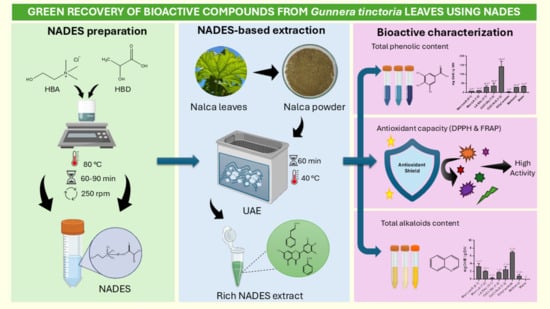
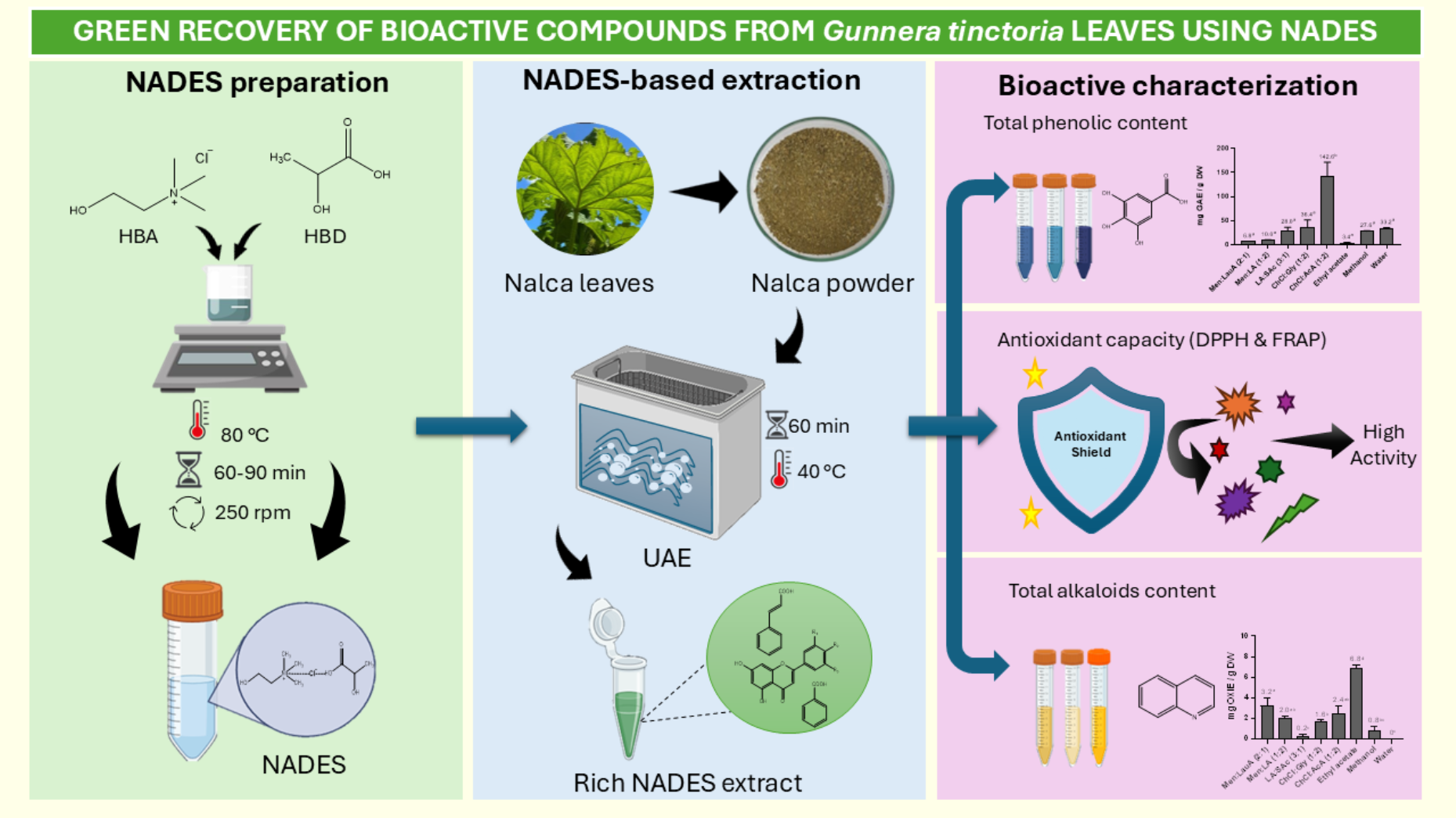
Graphical Abstract

1. Introduction

Nalca (Gunnera tinctoria Mol.), belonging to the monogeneric family Gunneracea, is a herbaceous plant distributed throughout the southern hemisphere, with 14 species in America [1]. In Chile, it is considered a non-timber forest product of considerable importance in rural areas where harvesting is carried out. It is one of the few ornamental plants with an edible petiole, characterized by its reddish-purple color, an acidic flavor, and non-glandular spines [2]. The petiole is commonly used in the preparation of traditional Chilean dishes, including salads, ice cream, jams, and desserts [3]. Nalca is also recognized as a traditional Chilean medicinal herb [1], having been used to treat ailments associated with skin, urinary, respiratory, and circulatory conditions [4,5]. It has also been employed to treat stomach, oral, and throat pain, as well as fever and diarrhea [6], and it has proven to be a hemostatic, astringent, and anti-tumoral agent [7,8]. According to a study conducted on several Chilean plants [9], the methanolic extracts of Nalca exhibited antimicrobial activity against Escherichia coli, Staphylococcus aureus, and Pseudomonas aeruginosa. It was suggested that this activity was related to the plant’s polyphenolic composition [3].
Despite the ethnobotanical importance of Nalca, research has predominantly relied on conventional organic solvents, which offer limited selectivity and do not align with sustainable practice [10]. Recently, new alternatives have been developed that reduce the use of hazardous and toxic solvents, aligning with the principles of green chemistry [11,12]. These alternatives include deep eutectic solvents (DESs), which were reported by Abbott and his group in 2003 [13]. These solvents correspond to eutectic mixtures formed between a hydrogen-bond acceptor (HBA) compound and a hydrogen-bond donor (HBD). In 2011, Choi and his coworkers [14] introduced the term natural deep eutectic solvents (NADESs), which feature primary plant metabolites as the compounds of the eutectic mixture. Among these metabolites, amino acids, sugars, and organic acids stand out as they allow the synthesis of hydrophilic natural solvents [15].
One of the advantages of this eutectic mixture is that altering the combination and molar ratios of the compounds changes the chemical and physical properties of the final solvent, which depend on the van der Waals and hydrogen-bond interactions between the compounds of the eutectic mixture [16,17]. These interactions are responsible for key parameters, such as low melting point, polarity, and high viscosity [18,19], which can be treated by adding small amounts of water to the mixture [15].
Deep eutectic solvents have been widely applied for the extraction of bioactive compounds from various plant species. For instance, they have been successfully used to extract phenolics and flavonoids from fireweed (Chamerion angustifolium) [20], Erigeron Brevisacapus [21], Physalis peruviana fruits [22], and Cercis chilensis flowers [23]. Recently, they have been used to extract other compounds from plant matrices such as proteins from Moringa oleifera seeds [24] or polysaccharides from Tremella fuciformis [25]. These examples demonstrate the versatility of eutectic mixtures as green solvents to obtain valuable phytochemicals from both edible and medicinal plants, highlighting their potential for sustainable extraction processes [26]. However, few studies have used deep eutectic solvents to obtain extracts from Chilean natural resources [27,28,29,30]. Therefore, this study aimed to use NADESs, combined with an ultrasound-assisted extraction process, to extract and quantify the bioactive compounds present in Nalca leaves (Gunnera tinctoria Mol.) as an alternative sustainable approach to formulate edible functional ingredients from Chilean plants.

2. Materials and Methods

2.1. Chemicals and Reagents

Acetic acid, acetonitrile, bromocresol green, chloroform, citric acid, deuterium oxide, dichloromethane, disodium hydrogen phosphate, ethanol, ethyl acetate, Folin–Ciocalteu reagent, ferric chloride hexahydrate, glycerol, hydrochloric acid, lauric acid, menthol, methanol, 4-nitroaniline, N,N-diethyl-4-nitroaniline, and sodium carbonate were purchased from Merck. Choline chloride, gallic acid, lactic acid, Nile Red, sodium acetate, DPPH (2,2-diphenyl-1-picrylhydrazyl), TPTZ (2,4,6-tripyridyl-s-triazine), and Trolox (6-hydroxy-2,5,7,8-tetramethylchromane-2-carboxylic acid) were acquired from Sigma-Aldrich (St. Louis, MO, USA). Oxymatrine standard was obtained from Chengdu Biopurify Phytochemical Ltd. (Chengdu, China).

2.2. Nalca Sample

Plant material was collected at the site located at 41°00′04.4″ S 72°34′23.0″ W in Puerto Octay, Chile. Five individuals were randomly selected, and fully developed fresh leaves were collected. G. tinctoria identification was performed at the Pontificia Universidad Católica de Chile by Gloria Montenegro (voucher sample: Herbarium Department of Plant Sciences (HDCV); Specimen N° 2790). Fresh leaves were separated from the stems, air-dried at room temperature, and ground into a powder using a grinder. The samples were stored in a polypropylene tube at 4 °C until further use.

2.3. Preparation and Characterization of Natural Deep Eutectic Solvents (NADESs)

2.3.1. Synthesis of NADES

The NADESs were synthesized using the constant stirring and heating method described by Dai et al. (2013) [31]. Briefly, both the hydrogen-bond acceptor (HBA) and hydrogen-bond donor (HBD) were weighed according to the molar ratio (Table 1) and then mixed. The mixture was continuously stirred and heated at 250 rpm and 80 °C until a homogeneous, transparent liquid was obtained. After, the solvent was cooled to room temperature and stored in a polypropylene tube.
A BRUKER AVANCE 200 spectrometer (Bruker Corporation, Billerica, MA, USA) was used to perform proton nuclear magnetic resonance (1H NMR) spectroscopy to confirm the successful synthesis of the NADESs.

2.3.2. Viscosity and Density

The density of the NADESs was determined gravimetrically, and the viscosity was determined with an IKA VOLS-1 viscometer (IKA, Staufen, Germany), both at a temperature of 25 °C.

2.3.3. Polarity Measurement

The polarity of the solvents was determined with the UV–visible spectroscopic method reported by Craveiro et al. (2016) [32], which uses Nile Red (NR) for its solvatochromic effect. A solution of NR (1 g L−1) in ethanol was prepared and stored in an amber vial at 4 °C. A mixture of the solvent of interest and the NR solution was prepared at a 1:200 ratio. The maximum absorption wavelength (λmax) at 25°C was determined with a UV–visible spectrophotometer (Ag-Specord 40, Analytik Jena, Jena, Germany). The molar transition energy (ENR) was determined using Equation (1).
ENR = 28,591/λmáx

2.3.4. Determination of Kamlet–Taft Solvatochromic Parameter

Millan et al.’s method (2022) [33] was applied, using 4-nitroaniline (4NA), N,N-diethyl-4-nitroaniline (DENA), and Nile Red (NR) as solvatochromic probes. Stock solutions of 20 Mm of 4NA and DENA were prepared in ethanol and stored in amber glass vials at 4 °C before use. For each measurement, 500 µL of NADES was placed in 1 mm quartz cuvettes, and the blank was recorded. Subsequently, 4 µL of the probe solution was added and stirred. The maximum absorption wavelength at 25 °C was determined and then applied in the following equations to calculate the α, β, and π* parameters:
ν (4NA, DENA o NR) = 104máx
α = [19.96567 − (1.0241 π*) − ν(NR)]/1.6078
β = 0.358 (31.1 − ν(4NA)) − (0.72 π*)
π* = 0.314 (27.53 − ν(DENA))

2.4. Ultrasound-Assisted Extraction of Bioactive Compounds from Nalca Leaves

The method described by Rebocho et al. (2022) [34] was used to prepare the extracts, with some modifications: An amount of 50 mg of the pulverized Nalca leaves and 1 mL of the synthesized solvent were mixed and placed in an Ultrasonic Cleaner VWR ultrasound equipment (model: 97043-966, 45 kHz, VWR International, Radnor, PA, USA) at 40 °C for 60 min. Subsequently, the mixture was centrifuged with a refrigerated centrifuge (Bioprocen 22R, ORTOALRESA, Madrid, Spain) for 15 min at 8300 rpm, and the supernatant was stored at 4 °C for later characterization.

2.5. Bioactive Compounds Characterization

2.5.1. Total Phenolic Content (TPC)

The Folin–Ciocalteu (FC) method with minor modifications was used [35]. Briefly, 20 µL of the extract was mixed with 100 µL of FC reagent at a 1:10 ratio in methanol and 80 µL of a 7.5% sodium carbonate solution. The final mixture was incubated in the dark for 40 min, and the absorbance was measured at 765 nm using a microplate reader (ALLSHENG model FlexA-200, Hangzhou, China). A calibration curve using gallic acid as the standard was used for the quantification, and the results were expressed as mg equivalents of gallic acid (mg GAE) per gram dry weight.

2.5.2. Total Alkaloid Content (TAC)

The spectrophotometric method using the bromocresol green method described by Ajanal et al. [36] was used. Briefly, 1.0 mL of the extract was mixed with 5.0 mL of a phosphate buffer (pH 4.7) and 5.0 mL of a bromocresol green solution (0.1 mmol L−1). The mixture was shaken vigorously, and the complex formed was then extracted with 1.0, 2.0, 3.0, and 4.0 mL of chloroform, separating both phases each time. The absorbance of the yellow complex in chloroform was measured at 420 nm (Ag-Specord 40, Analytik Jena, Germany).
A calibration curve using oxymatrine as the standard was used for the quantification, and the results were expressed as the mg equivalents of oxymatrine (mg OXIE) per gram dry weight.

2.5.3. Ferric-Reducing Antioxidant Power (FRAP) Assay

The antioxidant capacity was determined using the FRAP method [37]. A working solution was prepared by mixing 25.0 mL of the acetate buffer at pH 3.6 (300 mmol L−1), 2.5 mL of TPTZ solution (300 mmol L−1) in HCl (40 mmol L−1), and 2.5 mL of FeCl3·H2O solution (20 mmol L−1). An amount of 50 µL of the sample was mixed with 150 µL of the working solution, previously incubated at 37 °C in a water bath. The mixture was incubated for 30 min in the dark and measured at 593 nm using the microplate reader (ALLSHENG model FlexA-200, Hangzhou, China). A calibration curve using Trolox as a standard was used for the quantification, and the results were expressed as μmol equivalents of Trolox (μmol TE) per gram dry weight.

2.5.4. DPPH Radical-Scavenging Activity Assay

A stock solution was prepared by dissolving 24 mg of DPPH in 100 mL of methanol. Then, a working solution was prepared by mixing 10.0 mL of the stock solution with 45.0 mL of methanol and further diluting with methanol to obtain an absorbance of 1.1 ± 0.02 at 517 nm [38]. An amount of 50 µL of the extract was mixed with 150 µL of the working solution, and the mixture was incubated in the dark for 40 min. The decrease in absorbance was measured at 517 nm using a microplate reader (ALLSHENG model FlexA-200, Hangzhou, China). An amount of 50 µL of methanol instead of the extract was used as a control.
The percentage of inhibition was calculated using Equation (6):
Inhibition (%) = (AC − AS)/AC
where AC represents the absorbance of the control, and AS represents the absorbance of the extract. The half-maximal effective concentration (EC50) was determined from the inhibition curve obtained by plotting the inhibition percentages at different extract concentrations.

2.6. Statistical Analysis

One-way analysis of variance (ANOVA) was performed after a Q–Q plot, followed by Tukey’s test to evaluate significant differences at a 95% confidence level (p < 0.05). All experiments were performed in triplicate (n = 3), and the results are expressed as means ± standard deviation. The statistical analysis and graphical representations were conducted using GraphPad Prism 9.0.

3. Results

3.1. Synthesis and Characterization of Natural Deep Eutectic Solvents (NADESs)

After the solvents were synthesized with the stirring and heating methodology, a simple technique that requires no additional steps, the existence of a new hydrogen-bond interaction between the mixture components was evaluated with proton nuclear magnetic resonance (NMR) spectroscopy. This was assessed by comparing the chemical shift of the signals in the spectrum of the synthesized solvent with those of the individual components.
The principal physicochemical properties that influence the extraction efficiency of bioactive compounds were determined (Table 2). These properties can be tuned by modifying the type of HBD and HBA components in the eutectic mixture, as well as their molar ratio, water content, component purity, and synthesis method [39,40].

3.2. Polarity of Natural Deep Eutectic Solvents (NADESs)

Polarity and basicity were evaluated using solvatochromic methods, which allow the identification of specific solvent–solute interactions that reflect the solvent’s molecular behavior [32]. The values of the molar transition energy parameter (ENR) obtained for the synthesized NADESs are presented in Table 3. Solvents with lower values exhibit higher polarity, as more polar media shift the maximum absorbance wavelength of Nile Red toward longer wavelengths in the UV–visible spectrum.
The polarity of the NADESs was further characterized using the Kamlet–Taft parameters, where α represents the hydrogen-bond-donating ability; β represents the hydrogen-bond-accepting ability; and π* is related to dipolarity/polarizability [41], also presented in Table 3.

3.3. Ultrasound-Assisted Extraction of Bioactive Compounds from Nalca Leaves

3.3.1. Total Polyphenols Content (TPC)

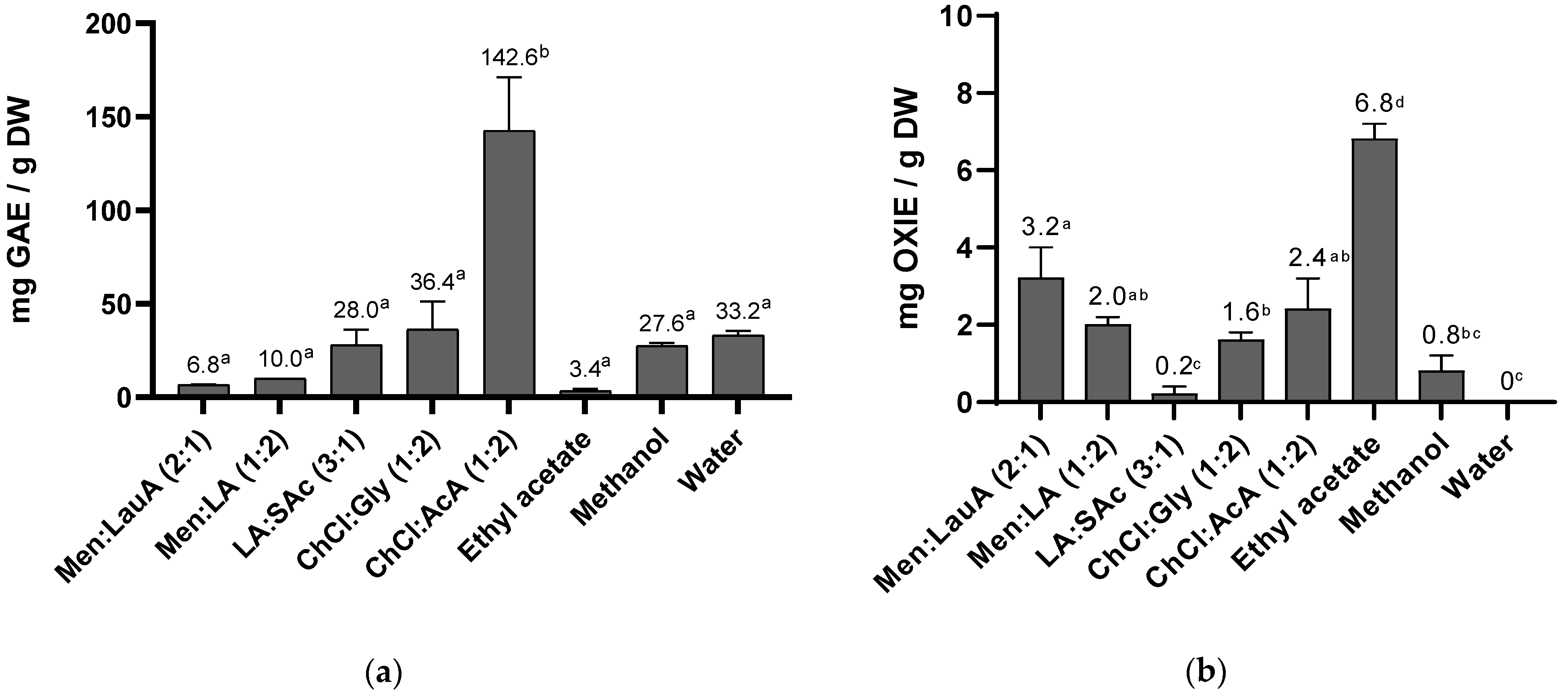
The quantification of the TPC in the Nalca leaves samples is presented in Figure 1a. The lowest yield (6.80 ± 1.60 mg GAE/g DW) was obtained using Men:LauA (2:1), whereas the extract prepared with ChCl:AcA (1:2) showed the highest content (142.6 ± 28.6 mg GAE/g DW).

3.3.2. Total Alkaloids Content

Figure 1b shows the total alkaloid content in Nalca leaves obtained for both NADESs and traditional solvents. Overall, Nalca leaves were poor in alkaloids compared with phenolic compounds.

3.3.3. Ferric-Reducing Antioxidant Power (FRAP) Assay

The FRAP methodology is based on antioxidant compounds’ ability to reduce the ferric ion (Fe3+) to ferrous (Fe2+) by donating electrons [42]. The results of this antioxidant activity are shown in Table 4, where the μmol Trolox equivalents represent the contribution of Nalca leaves to the antioxidant capacity.

3.3.4. DPPH Radical-Scavenging Activity Assay

The results for the EC50 parameter (Table 4) show that extract concentrations required inhibiting 50% of DPPH radical-scavenging activity, whereas lower concentrations corresponded to higher antioxidant activity [34]. These values were derived from the percentage inhibition curves, except for Men:LauA (2:1), whose curve does not reach 50% inhibition; therefore, no EC50 value is reported.

4. Discussion

4.1. Synthesis and Characterization of Natural Deep Eutectic Solvents (NADESs)

One of the key considerations in the design of deep eutectic solvents is that, depending on the chemical nature of the target bioactive compounds, appropriate components must be selected to produce solvents with different polarities and achieve high extraction yields [43]. For example, polar solvents are preferred for the extraction of phenolic compounds [44], whereas alkaloids are more efficiently extracted using solvents with lower polarity [45]. Special consideration was given to the use of different primary metabolites that can be found in nature, such as sugars, alcohols, amino acids, amines and organic acids [46], thus enhancing the compatibility with the environment.
The density of the NADESs was determined via gravimetric analysis. The synthesized solvent with the highest density was LA:SAc (3:1), whereas Men:LauA (2:1) showed the lowest value. Florindo et al.’s study (2014) [47] reported that NADESs based on choline chloride and carboxylic acids typically exhibit density values between 1.10 and 1.26 g mL−1 at room temperature. The authors also noted that increasing the chain length of the carboxylic acid increases the molar volume, therefore decreasing the solvent density. This trend explains the results for Men:LauA (2:1), since lauric acid has a long hydrocarbon chain as its principal moiety. Meanwhile, an increase in hydroxyl groups enhances hydrogen-bond interactions, reducing the free volume between molecular structures and, consequently, increasing the synthesized solvent’s density [40].
Among the synthesized solvents, Men:LauA (2:1) showed the lowest viscosity, whereas LA:SAc (3:1) exhibited the highest viscosity at room temperature. This parameter is particularly relevant for practical applications since high viscosity can limit mass transfer during the extraction of bioactive compounds [48]. Factors influencing viscosity include electrostatic and Van der Waals interactions, the nature and molar radius of the components, and the available free volume within the structure [39]. As with density, the viscosity of the eutectic mixture is influenced by the number of hydroxyl groups in the components. This explains why NADESs based on choline chloride and glycerol (ChCl:Gly) presented viscosity values comparable to those based on carboxylic acids (ChCl:AcA) [49].
The pH of the NADESs was also determined, as it is a key parameter influencing the stability of both the solvent mixture and the extracted bioactive compounds. Variations in pH can affect solubility, extraction efficiency, and the chemical stability of target molecules, particularly phenolics and alkaloids. Therefore, controlling the pH of NADESs is essential for optimizing extraction performance and preserving compound integrity [39].

4.2. Polarity of Natural Deep Eutectic Solvents (NADESs)

Previous studies have shown that the polarity of the solvent used during extraction significantly affects the antioxidant activity of plant extracts [43,44,45,50]. The molar transition energy parameter (ENR) quantifies the solvent’s ability to stabilize the probe molecule in its excited state via intermolecular interactions. In polar solvents, stabilization occurs via hydrogen bonding, dipole–dipole, or induced dipole interactions, leading to absorption maxima at longer wavelengths; in contrast, in nonpolar solvents, the probe is less stabilized, resulting in maxima at shorter wavelengths.
The results indicate that Men:LauA (2:1) was the least polar NADES synthesized, with a molar transition energy value comparable to that of dichloromethane (52.85 ± 0.10 kcal·mol−1), a solvent generally considered nonpolar. In contrast, ChCl:AcA (1:2) was the most polar NADES, exhibiting a lower molar transition energy value than that of water (48.79 ± 0.08 kcal·mol−1).
According to Mohd et al. (2021) [15], the least polar NADESs are typically mixtures containing menthol, lactic acid, or lauric acid, which is consistent with our findings. Similarly, Dai et al. (2015) [46] reported that NADESs based on organic acids such as lactic acid tend to exhibit polarities comparable to water. Moreover, NADES containing choline chloride generally display higher polarity than menthol-based mixtures, agreeing with our results.
Regarding the Kamlet–Taft parameters, the α-values of the NADESs ranged from 0.99 to 20.2, with ChCl:AcA (1:2) exhibiting the highest value. These variations are associated with differences in the systems’ chemical compositions. Choline chloride-based NADESs may display an enhanced hydrogen-bond donor capacity due to the presence of protic functional groups, in contrast with menthol-based systems, where there is a nonpolar hydrocarbon moiety that limits their ability to contribute to strong hydrogen bonding in the eutectic mixture.
The small differences observed between the β-values (0.52–0.66) are consistent with the previous finding, where NADES based on choline chloride and menthol as HBA exhibited nearly identical β-values [47]. This parameter is particularly relevant for understanding how the solvent interacts with hydrogen-bond donor solute, since in eutectic systems, higher basicity may promote hydrogen-bond interactions with HBD species, influencing both the structural organization and viscosity of the system [15].
The results further indicate that NADESs containing menthol exhibited the lowest π*-values, reflecting reduced dipolarity. Consequently, these systems are expected to interact with weaker polar molecules. The presence of menthol, characterized by a hydrophobic hydrocarbon framework and a single hydroxyl group, imparts a more hydrophobic tendency to the eutectic mixture [51].

4.3. Ultrasound-Assisted Extraction of Bioactive Compounds from Nalca Leaves

Ultrasound-assisted extraction (UAE) was employed to enhance extraction efficiency. This technique uses ultrasonic waves to generate cavitation bubbles in the solvent, disrupting plant cell walls and enhancing the release of bioactive compounds.
The extraction was performed using NADESs, alongside a subset of traditional solvents, to obtain reference and comparative results.

4.3.1. Total Polyphenols Content (TPC)

The data showed that several NADES achieved extraction capacities comparable to methanol and water and, in some cases, even exceeded them when compared with traditional solvents. A trend was observed in which the solvent with higher polarity appeared to be associated with increased extraction yield. According to the molar transition energy results, Men:LauA (2:1) and ChCl:AcA (1:2) exhibited values of 52.88 ± 0.06 and 48.19 ± 0.12 kcal·mol−1, respectively, indicating a difference in solvent polarity and, consequently, in their affinity for polar compounds [50].
As shown in Figure 1, the NADES ChCl:AcA (1:2) extract had the highest phenolic content. The Folin–Ciocalteu assay measures the total reducing capacity and is not strictly specific for polyphenols, as other reducing species may react, such as sugars. Therefore, these results are interpreted as a total phenolic content, and further studies are necessary to determine the extent of this influence on polyphenolic quantification [52].

4.3.2. Total Alkaloids Content

None of the NADESs matched the extraction capacity of ethyl acetate (6.8 ± 0.4 mg OXIE/g DW). Among NADESs, the lowest and highest alkaloid contents were observed for LA:SAc (3:1) and Men:LauA (2:1), reflecting differences in polarity and solvent–solute affinity. However, no clear trend was seen, indicating that other physicochemical properties of the solvents also influence extraction. Acidic NADESs can enhance alkaloid extraction via Bronsted and Lewis interactions, where the nitrogen in alkaloids accepts a proton or electron to form stable salts that are more readily extracted [29]. ChCl:Gly (1:2), despite having water-like polarity, extracted alkaloids effectively, likely due to glycerol’s hydroxyl groups forming strong hydrogen bonds with alkaloids.

4.3.3. Ferric-Reducing Antioxidant Power (FRAP) Assay

Most extracts prepared with NADESs showed higher antioxidant activity than those obtained with traditional solvents. These results are consistent with the previously discussed total phenolic content data. In general, extracts with higher phenolic contents, such as those prepared with more polar NADESs such as ChCl:AcA (1:2), also exhibited greater antioxidant capacity. Conversely, the extract prepared with Men:LauA (2:1) showed the lowest total phenolic content. Antioxidant activity is not solely attributable to phenolic compounds; non-phenolic antioxidants such as minerals, amino acids, and vitamins can also contribute [53]. The presence of these compounds may explain some antioxidant activity even in extracts with lower phenolic content.

4.3.4. DPPH Radical-Scavenging Activity Assay

Within the NADES group, the highest and lowest antioxidant capacities were observed for extracts prepared with ChCl:AcA (1:2) and Men:LA (1:2), respectively. Osman et al. (2021) [54] reported a correlation between total phenolic content and antioxidant activity in certain extracts, as phenolic compounds are major contributors to radical-scavenging activity. Consistently, the extract prepared with ChCl:AcA (1:2), which exhibited the highest antioxidant capacity, also had the highest total phenolic content. Conversely, the Men:LauA (2:1) extract likely did not achieve 50% DPPH inhibition because of its lower phenolic content compared with the other extracts.
Many in vitro methods for determining antioxidant capacity are not necessarily correlated, leading to variations in results depending on the method used [54]. Considering the DPPH radical-scavenging results, the extracts prepared with ChCl:AcA (1:2) and Men:LA (1:2) showed the highest and lowest antioxidant capacities, respectively. In contrast, the FRAP results indicated that the extract prepared with ChCl:Gly (1:2) exhibited the highest antioxidant activity, whereas the Men:LauA (2:1) extract showed the lowest.
The differences between the two methodologies arise from their distinct mechanisms. The DPPH assay is based on the transfer of electrons and/or hydrogen atoms from antioxidant compounds, where the antiradical reaction is non-competitive [55,56]. In contrast, the FRAP assay measures the ability of antioxidant compounds to donate electrons and reduce ferric ions [57]. Overall, these results suggest a trend in which higher solvent polarity, and, consequently, higher extraction of phenolic compounds, correlates with increased antioxidant activity.

5. Conclusions

Natural deep eutectic solvents (NADESs) were successfully synthesized using a simple heating–stirring method, and physicochemical characterization was performed. The results demonstrated that solvent composition and molar ratio strongly influence polarity, viscosity, and density, which directly affect the extraction efficiency of bioactive compounds from Gunnera tinctoria. Among the tested mixtures, ChCl:AcA (1:2) showed the highest capacity for extracting phenolic compounds from Nalca leaves, whereas menthol-based NADESs were more suitable for alkaloid recovery. The antioxidant assays (DPPH and FRAP) were generally consistent with total phenolic content, indicating that phenolic compounds are major contributors to antioxidant capacity.
Overall, these findings highlight NADESs as effective, tunable, and environmentally friendly alternatives to conventional solvents for extracting bioactive compounds from Chilean native medicinal plants such as Nalca. Their selective extraction capacity supports their potential application in green processes for food, nutraceutical, and pharmaceutical industries.

Author Contributions

Conceptualization, A.G., G.M. and P.V.; methodology, H.V.-B., D.Q., A.O.-W. and Y.F.; formal analysis, H.V.-B. and Y.F.; resources, P.P., P.V. and A.G.; data curation, P.P., P.V. and A.G.; writing—original draft preparation, H.V.-B.; writing—review and editing, P.V. and A.G.; funding acquisition, A.G. and P.V. All authors have read and agreed to the published version of the manuscript.

Funding

This research was funded by FONDECYT Regular 1231835. D.Q and Y.F gratefully acknowledge the doctoral scholarship provided by the Vicerrectoría de Investigación and the Postgrado of the Pontificia Universidad Católica de Chile. P.V. would like to acknowledge ANID for its support through the Concurso Subvención a la Instalación en la Academia (PAI SA77210056).

Data Availability Statement

The original contributions presented in this study are included in the article. Further inquiries can be directed to the corresponding authors.

Acknowledgments

The authors thank the contributions of Eduardo Muñoz-Carvajal. During the preparation of this manuscript, the authors used ChatGPT based on GPT-5.3 for the purposes of English editing. The authors have reviewed and edited the output and take full responsibility for the content of this publication.

Conflicts of Interest

The authors declare no conflicts of interest.

Abbreviations

The following abbreviations were used in this manuscript:
4NA4-nitroaniline
AcAAcetic acid
ChClCholine chloride
DENAN,N-diethyl-4-nitroaniline
DESDeep eutectic solvent
DPPH2,2-diphenyl-1-picrylhydrazyl
DWDry weight
EC50Half-maximal effective concentration
FCFolin–Ciocalteu
FRAPFerric-reducing antioxidant power
GAEGallic acid equivalents
GlyGlycerol
HBAHydrogen-bond acceptor
HBDHydrogen-bond donor
LALactic acid
LauALauric acid
MenMenthol
NADESNatural deep eutectic solvent
NMRNuclear magnetic resonance
NRNile Red
OXIEOxymatrine equivalents
SAcSodium acetate
TACTotal alkaloids content
TPCTotal polyphenols content
TPTZ2,4,6-tripyridyl-s-triazine

References

  1. Velásquez, P.; Riquelme, K.; Leyton, F.; Giordano, A.; Gómez, M.; Montenegro, G. Antibacterial Potential Assessment of Nalca (Gunnera tinctoria Mol.) Ethanolic Extracts. Nat. Prod. Res. 2021, 35, 5425–5428. [Google Scholar] [CrossRef] [Scilit]
  2. Gioria, M.; Osborne, B.A. Biological Flora of the British Isles: Gunnera tinctoria. J. Ecol. 2013, 101, 243–264. [Google Scholar] [CrossRef] [Scilit]
  3. Petzold, G.; Catril, G.; Duarte, C. Caracterización Fisicoquímica de Pecíolos Del Pangue (Gunnera tinctoria). Rev. Chil. Nutr. 2006, 33, 539–543. [Google Scholar] [CrossRef] [Scilit]
  4. Sabando, C.; Rodríguez-Díaz, M.; Ide, W.; Pastene, E.; Avello, M.; Simirgiotis, M.; Rojas, S.; Villarroel, E.; Silva-Grecchi, T.; Gutiérrez, C.; et al. Improvement of Endothelial Function by Gunnera tinctoria Extract with Antioxidant Properties. Biol. Res. 2020, 53, 55. [Google Scholar] [CrossRef] [Scilit] [PubMed]
  5. Hermosilla, J.; Alves, C.; Zille, A.; Padrão, J.; Sanhueza, C.; Pastene-Navarrete, E.; Acevedo, F. Electrospun Fibers Loaded with Extracts of Gunnera tinctoria and Buddleja globosa with Potential Application in the Treatment of Skin Lesions. J. Drug Deliv. Sci. Technol. 2026, 115, 107628. [Google Scholar] [CrossRef] [Scilit]
  6. Pedro, Z.; Benjamín, R.; Marcela, M.; Haroldo, M.; Patricio, G.; Ociel, M. Biological and Antioxidant Activity of Gunnera tinctoria (Nalca). J. Med. Plants Res. 2017, 11, 318–330. [Google Scholar] [CrossRef] [Scilit]
  7. Hebel-Gerber, S.; García-Cancino, A.; Urbina, A.; Simirgiotis, M.J.; Echeverría, J.; Bustamante-Salazar, L.; Sáez-Carrillo, K.; Alarcón, J.; Pastene-Navarrete, E. Chilean rhubarb, Gunnera tinctoria (Molina) Mirb. (Gunneraceae): UHPLC-ESI-Orbitrap-MS Profiling of Aqueous Extract and Its Anti-Helicobacter Pylori Activity. Front. Pharmacol. 2021, 11, 583961. [Google Scholar] [CrossRef] [Scilit]
  8. Fathi, F.; Ebrahimi, S.N.; Valadão, A.I.G.; Andrade, N.; Costa, A.S.G.; Silva, C.; Fathi, A.; Salehi, P.; Martel, F.; Alves, R.C.; et al. Exploring Gunnera tinctoria: From Nutritional and Anti-Tumoral Properties to Phytosome Development Following Structural Arrangement Based on Molecular Docking. Molecules 2021, 26, 5935. [Google Scholar] [CrossRef] [Scilit] [PubMed]
  9. Mølgaard, P.; Holler, J.G.; Asar, B.; Liberna, I.; Rosenbæk, L.B.; Jebjerg, C.P.; Jørgensen, L.; Lauritzen, J.; Guzman, A.; Adsersen, A.; et al. Antimicrobial Evaluation of Huilliche Plant Medicine Used to Treat Wounds. J. Ethnopharmacol. 2011, 138, 219–227. [Google Scholar] [CrossRef] [Scilit]
  10. Lefebvre, T.; Destandau, E.; Lesellier, E. Selective Extraction of Bioactive Compounds from Plants Using Recent Extraction Techniques: A Review. J. Chromatogr. A 2021, 1635, 461770. [Google Scholar] [CrossRef] [Scilit]
  11. Cunha, S.C.; Fernandes, J.O. Extraction Techniques with Deep Eutectic Solvents. TrAC Trends Anal. Chem. 2018, 105, 225–239. [Google Scholar] [CrossRef] [Scilit]
  12. Savic, S.; Petrovic, S.; Knezevic-Jugovic, Z. Separation Strategies for Polyphenols from Plant Extracts: Advances, Challenges, and Applications. Separations 2026, 13, 46. [Google Scholar] [CrossRef] [Scilit]
  13. Abbott, A.P.; Boothby, D.; Capper, G.; Davies, D.L.; Rasheed, R.K. Deep Eutectic Solvents Formed between Choline Chloride and Carboxylic Acids: Versatile Alternatives to Ionic Liquids. J. Am. Chem. Soc. 2004, 126, 9142–9147. [Google Scholar] [CrossRef] [Scilit]
  14. Choi, Y.H.; van Spronsen, J.; Dai, Y.; Verberne, M.; Hollmann, F.; Arends, I.W.C.E.; Witkamp, G.-J.; Verpoorte, R. Are Natural Deep Eutectic Solvents the Missing Link in Understanding Cellular Metabolism and Physiology? Plant Physiol. 2011, 156, 1701–1705. [Google Scholar] [CrossRef] [Scilit]
  15. Mohd Fuad, F.; Mohd Nadzir, M.; Harun@Kamaruddin, A. Hydrophilic Natural Deep Eutectic Solvent: A Review on Physicochemical Properties and Extractability of Bioactive Compounds. J. Mol. Liq. 2021, 339, 116923. [Google Scholar] [CrossRef] [Scilit]
  16. Espino, M.; de los Ángeles Fernández, M.; Gomez, F.J.V.; Silva, M.F. Natural Designer Solvents for Greening Analytical Chemistry. TrAC Trends Anal. Chem. 2016, 76, 126–136. [Google Scholar] [CrossRef] [Scilit]
  17. Medeiros, I.B.; Mendes, L.A.; do Nascimento da Silva, E. Green Multi-Element Analysis of Unconventional Food Plants Using a Deep Eutectic Solvent-Based Extraction Method. Microchem. J. 2026, 222, 117125. [Google Scholar] [CrossRef] [Scilit]
  18. Singh, M.B.; Kumar, V.S.; Chaudhary, M.; Singh, P. A Mini Review on Synthesis, Properties and Applications of Deep Eutectic Solvents. J. Indian Chem. Soc. 2021, 98, 100210. [Google Scholar] [CrossRef] [Scilit]
  19. Kua, Y.L.; Gan, S. Natural Deep Eutectic Solvent (NADES) as a Greener Alternative for the Extraction of Hydrophilic (Polar) and Lipophilic (Non-Polar) Phytonutrients. Key Eng. Mater. 2019, 797, 20–28. [Google Scholar] [CrossRef] [Scilit]
  20. Tsvetov, N.; Pasichnik, E.; Korovkina, A.; Gosteva, A. Extraction of Bioactive Components from Chamaenerion angustifolium (L.) Scop. with Choline Chloride and Organic Acids Natural Deep Eutectic Solvents. Molecules 2022, 27, 4216. [Google Scholar] [CrossRef] [Scilit]
  21. Zhang, L.; Yu, L.; Yang, S.; Yang, X.; Ye, S.; Ma, H.; Hu, J.; Liu, Y.; Duan, Z.; Wen, X. Natural Deep Eutectic Solvent-Based Ultrasonic-Assisted Simultaneous Extraction of Phenolic Acids and Flavonoids from Erigeron Breviscapus and Its Extraction Mechanism Analysis. ACS Sustain. Chem. Eng. 2026, 14, 249–259. [Google Scholar] [CrossRef] [Scilit]
  22. Tosyagülü Çelik, H. Ultrasound-Assisted Natural Deep Eutectic Solvent Extraction of Physalis Peruviana L. Fruits and Calyces: Phytochemical Profiling and In Vitro Bioactivity Evaluation. Food Bioproc. Technol. 2026, 19, 4. [Google Scholar] [CrossRef] [Scilit]
  23. Shu, P.; Wang, N.; Fan, X.; Zhang, Z.; Yin, H.; Meng, Y.; Guo, T.; Wei, X.; Zhang, L.; Huang, J. Ultrasound-Assisted Extraction of Flavonoids from Cercis Chinensis Flowers Using Deep Eutectic Solvents: Optimization, Characterization, Kinetics and Bioactivity. Ultrason. Sonochem. 2026, 126, 107756. [Google Scholar] [CrossRef] [Scilit] [PubMed]
  24. Wang, L.; Fei, T.; Li, X.; Sun, Q.; Liu, X.; Wang, L. Improved Protein Extraction from Moringa Oleifera Seeds Using Deep Eutectic Solvents: Mechanistic Insights and Protein Characterization. Food Hydrocoll. 2026, 174, 112402. [Google Scholar] [CrossRef] [Scilit]
  25. Wan, Z.; Wang, K.; Wu, J.; Luo, Z.; Li, S.; Liu, H.; Zhang, X. Deep Eutectic Solvent Extraction of Tremella Fuciformis Polysaccharide and the Extract’s Antioxidant Activity. J. Sci. Food Agric. 2026, 106, 1365–1381. [Google Scholar] [CrossRef] [Scilit] [PubMed]
  26. Ali, A.; Li, R.; Zhu, R.; Mahmood, S.; Chen, Q.; Yao, S. Deep Eutectic Solvents for Green Extraction and Separation of Bioactive Compounds from Traditional Chinese Medicines. Chin. Med. 2026, 21, 38. [Google Scholar] [CrossRef] [Scilit]
  27. Fuentes-Jorquera, N.; Canales, R.I.; Pérez-Correa, J.R.; Pérez-Jiménez, J.; Mariotti-Celis, M.S. Differential Extraction and Preliminary Identification of Polyphenols from Ugni Candollei (White Murta) Berries. Antioxidants 2024, 13, 623. [Google Scholar] [CrossRef] [Scilit]
  28. Torres-Vega, J.; Gómez-Alonso, S.; Pérez-Navarro, J.; Alarcón-Enos, J.; Pastene-Navarrete, E. Polyphenolic Compounds Extracted and Purified from Buddleja globosa Hope (Buddlejaceae) Leaves Using Natural Deep Eutectic Solvents and Centrifugal Partition Chromatography. Molecules 2021, 26, 2192. [Google Scholar] [CrossRef] [Scilit]
  29. Torres-Vega, J.; Gómez-Alonso, S.; Pérez-Navarro, J.; Pastene-Navarrete, E. Green Extraction of Alkaloids and Polyphenols from Peumus Boldus Leaves with Natural Deep Eutectic Solvents and Profiling by HPLC-PDA-IT-MS/MS and HPLC-QTOF-MS/MS. Plants 2020, 9, 242. [Google Scholar] [CrossRef] [Scilit]
  30. Velásquez, P.; Bustos, D.; Montenegro, G.; Giordano, A. Ultrasound-Assisted Extraction of Anthocyanins Using Natural Deep Eutectic Solvents and Their Incorporation in Edible Films. Molecules 2021, 26, 984. [Google Scholar] [CrossRef] [Scilit]
  31. Dai, Y.; van Spronsen, J.; Witkamp, G.-J.; Verpoorte, R.; Choi, Y.H. Natural Deep Eutectic Solvents as New Potential Media for Green Technology. Anal. Chim. Acta 2013, 766, 61–68. [Google Scholar] [CrossRef] [Scilit]
  32. Craveiro, R.; Aroso, I.; Flammia, V.; Carvalho, T.; Viciosa, M.T.; Dionísio, M.; Barreiros, S.; Reis, R.L.; Duarte, A.R.C.; Paiva, A. Properties and Thermal Behavior of Natural Deep Eutectic Solvents. J. Mol. Liq. 2016, 215, 534–540. [Google Scholar] [CrossRef] [Scilit]
  33. Millán, D.; González-Turen, F.; Perez-Recabarren, J.; Gonzalez-Ponce, C.; Rezende, M.C.; Da Costa Lopes, A.M. Solvent Effects on the Wood Delignification with Sustainable Solvents. Int. J. Biol. Macromol. 2022, 211, 490–498. [Google Scholar] [CrossRef] [Scilit] [PubMed]
  34. Rebocho, S.; Mano, F.; Cassel, E.; Anacleto, B.; Bronze, M.d.R.; Paiva, A.; Duarte, A.R.C. Fractionated Extraction of Polyphenols from Mate Tea Leaves Using a Combination of Hydrophobic/Hydrophilic NADES. Curr. Res. Food Sci. 2022, 5, 571–580. [Google Scholar] [CrossRef] [Scilit]
  35. Platzer, M.; Kiese, S.; Herfellner, T.; Schweiggert-Weisz, U.; Eisner, P. How Does the Phenol Structure Influence the Results of the Folin-Ciocalteu Assay? Antioxidants 2021, 10, 811. [Google Scholar] [CrossRef] [Scilit]
  36. Ajanal, M.; Gundkalle, M.; Nayak, S. Estimation of Total Alkaloid in Chitrakadivati by UV-Spectrophotometer. Anc. Sci. Life 2012, 31, 198–201. [Google Scholar] [CrossRef] [Scilit]
  37. Bouabid, K.; Lamchouri, F.; Toufik, H.; Faouzi, M.E.A. Phytochemical Investigation, In Vitro and In Vivo Antioxidant Properties of Aqueous and Organic Extracts of Toxic Plant: Atractylis Gummifera L. J. Ethnopharmacol. 2020, 253, 112640. [Google Scholar] [CrossRef] [Scilit]
  38. Bellumori, M.; Innocenti, M.; Andrenelli, L.; Melani, F.; Cecchi, L.; Pandino, G.; Mauromicale, G.; La Malfa, S.; Mulinacci, N. Composition of Discarded Sicilian Fruits of Opuntia Ficus Indica L.: Phenolic Content, Mineral Profile and Antioxidant Activity in Peel, Seeds and Whole Fruit. Food Chem. 2023, 428, 136756. [Google Scholar] [CrossRef] [Scilit] [PubMed]
  39. Ijardar, S.P.; Singh, V.; Gardas, R.L. Revisiting the Physicochemical Properties and Applications of Deep Eutectic Solvents. Molecules 2022, 27, 1368. [Google Scholar] [CrossRef] [Scilit]
  40. Martín, M.I.; García-Díaz, I.; Rodríguez, M.L.; Gutiérrez, M.C.; del Monte, F.; López, F.A. Synthesis and Properties of Hydrophilic and Hydrophobic Deep Eutectic Solvents via Heating-Stirring and Ultrasound. Molecules 2024, 29, 3089. [Google Scholar] [CrossRef] [Scilit] [PubMed]
  41. Zhang, L.; Yu, H.; Liu, S.; Wang, Y.; Mu, T.; Xue, Z. Kamlet–Taft Parameters of Deep Eutectic Solvents and Their Relationship with Dissolution of Main Lignocellulosic Components. Ind. Eng. Chem. Res. 2023, 62, 11723–11734. [Google Scholar] [CrossRef] [Scilit]
  42. Munteanu, I.G.; Apetrei, C. Analytical Methods Used in Determining Antioxidant Activity: A Review. Int. J. Mol. Sci. 2021, 22, 3380. [Google Scholar] [CrossRef] [Scilit] [PubMed]
  43. Tsaturyan, A.; Sahakyan, L.; Hayrapetyan, L.; Minasyan, E.; Chakhoyan, A.; Mirzoyan, V.; Hovhannisyan, G.; Khachatryan, H.; Hayrapetyan, S. Effect of Solvent Polarity on the Extraction of Bioactive Compounds from Heracleum persicum Fruits. Pharmacia 2025, 72, 1–9. [Google Scholar] [CrossRef] [Scilit]
  44. Nawaz, H.; Shad, M.A.; Rehman, N.; Andaleeb, H.; Ullah, N. Effect of Solvent Polarity on Extraction Yield and Antioxidant Properties of Phytochemicals from Bean (Phaseolus vulgaris) Seeds. Braz. J. Pharm. Sci. 2020, 56, e17129. [Google Scholar] [CrossRef] [Scilit]
  45. Zuo, J.; Geng, S.; Kong, Y.; Ma, P.; Fan, Z.; Zhang, Y.; Dong, A. Current Progress in Natural Deep Eutectic Solvents for the Extraction of Active Components from Plants. Crit. Rev. Anal. Chem. 2023, 53, 177–198. [Google Scholar] [CrossRef] [Scilit]
  46. Dai, Y.; Witkamp, G.J.; Verpoorte, R.; Choi, Y.H. Tailoring Properties of Natural Deep Eutectic Solvents with Water to Facilitate Their Applications. Food Chem. 2015, 187, 14–19. [Google Scholar] [CrossRef] [Scilit]
  47. Florindo, C.; Oliveira, F.S.; Rebelo, L.P.N.; Fernandes, A.M.; Marrucho, I.M. Insights into the Synthesis and Properties of Deep Eutectic Solvents Based on Cholinium Chloride and Carboxylic Acids. ACS Sustain. Chem. Eng. 2014, 2, 2416–2425. [Google Scholar] [CrossRef] [Scilit]
  48. Kovács, A.; Neyts, E.C.; Cornet, I.; Wijnants, M.; Billen, P. Modeling the Physicochemical Properties of Natural Deep Eutectic Solvents. ChemSusChem 2020, 13, 3789–3804. [Google Scholar] [CrossRef] [Scilit] [PubMed]
  49. Koh, Q.Q.; Kua, Y.L.; Gan, S.; Tan, K.W.; Lee, T.Z.E.; Cheng, W.K.; Lau, H.L.N. Sugar-Based Natural Deep Eutectic Solvent (NADES): Physicochemical Properties, Antimicrobial Activity, Toxicity, Biodegradability and Potential Use as Green Extraction Media for Phytonutrients. Sustain. Chem. Pharm. 2023, 35, 101218. [Google Scholar] [CrossRef] [Scilit]
  50. Airouyuwa, J.O.; Mostafa, H.; Ranasinghe, M.; Maqsood, S. Influence of Physicochemical Properties of Carboxylic Acid-Based Natural Deep Eutectic Solvents (CA-NADES) on Extraction and Stability of Bioactive Compounds from Date (Phoenix dactylifera L.) Seeds: An Innovative and Sustainable Extraction Technique. J. Mol. Liq. 2023, 388, 122767. [Google Scholar] [CrossRef] [Scilit]
  51. Cannavacciuolo, C.; Pagliari, S.; Frigerio, J.; Giustra, C.M.; Labra, M.; Campone, L. Natural Deep Eutectic Solvents (NADESs) Combined with Sustainable Extraction Techniques: A Review of the Green Chemistry Approach in Food Analysis. Foods 2022, 12, 56. [Google Scholar] [CrossRef] [Scilit]
  52. Dominguez-López, I.; Pérez, M.; Lamuela-Raventós, R.M. Total (Poly)Phenol Analysis by the Folin-Ciocalteu Assay as an Anti-Inflammatory Biomarker in Biological Samples. Crit. Rev. Food Sci. Nutr. 2024, 64, 10048–10054. [Google Scholar] [CrossRef] [Scilit]
  53. Zannou, O.; Pashazadeh, H.; Ibrahim, S.A.; Koca, I.; Galanakis, C.M. Green and Highly Extraction of Phenolic Compounds and Antioxidant Capacity from Kinkeliba (Combretum micranthum G. Don) by Natural Deep Eutectic Solvents (NADESs) Using Maceration, Ultrasound-Assisted Extraction and Homogenate-Assisted Extraction. Arab. J. Chem. 2022, 15, 103752. [Google Scholar] [CrossRef] [Scilit]
  54. Osman, M.A.; Mahmoud, G.I.; Shoman, S.S. Correlation Between Total Phenols Content, Antioxidant Power and Cytotoxicity. Biointerface Res. Appl. Chem. 2020, 11, 10640–10653. [Google Scholar] [CrossRef] [Scilit]
  55. Gómez-Urios, C.; Viñas-Ospino, A.; Puchades-Colera, P.; Blesa, J.; López-Malo, D.; Frígola, A.; Esteve, M.J. Choline Chloride-Based Natural Deep Eutectic Solvents for the Extraction and Stability of Phenolic Compounds, Ascorbic Acid, and Antioxidant Capacity from Citrus Sinensis Peel. LWT 2023, 177, 114595. [Google Scholar] [CrossRef] [Scilit]
  56. de Menezes, B.B.; Frescura, L.M.; Duarte, R.; Villetti, M.A.; da Rosa, M.B. A Critical Examination of the DPPH Method: Mistakes and Inconsistencies in Stoichiometry and IC50 Determination by UV–Vis Spectroscopy. Anal. Chim. Acta 2021, 1157, 338398. [Google Scholar] [CrossRef] [Scilit]
  57. Skroza, D.; Šimat, V.; Vrdoljak, L.; Jolić, N.; Skelin, A.; Čagalj, M.; Frleta, R.; Generalić Mekinić, I. Investigation of Antioxidant Synergisms and Antagonisms among Phenolic Acids in the Model Matrices Using FRAP and ORAC Methods. Antioxidants 2022, 11, 1784. [Google Scholar] [CrossRef] [Scilit]
Figure 1. Bioactive compound determination in Nalca leaves: (a) Total polyphenols content; (b) total alkaloid content. Difference lowercase letters indicate significant differences (p < 0.05) within each graphic.
Compounds 06 00027 g001
Table 1. Compositions of the synthesized NADESs.
CompositionMolar ProportionAbbreviation
Menthol–lauric acid(2:1)Men:LauA (2:1)
Menthol–lactic acid(1:2)Men:LA (1:2)
Lactic acid–sodium acetate(3:1)LA:SAc (3:1)
Choline chloride–glycerol(1:2)ChCl:Gly (1:2)
Choline chloride–acetic acid(1:2)ChCl:AcA (1:2)
Table 2. Physicochemical properties of the synthesized NADESs.
CompositionDensity (g mL−1)Viscosity (mPas·s)pH
Men:LauA (2:1)0.8334 ± 0.02 a36.70 ± 0.17 a3.0 ± 0.2 a
Men:LA (1:2)0.9870 ± 0.01 b138.60 ± 1.31 a1.0 ± 0.2 b
LA:SAc (3:1)1.2148 ± 0.01 c28,440.70 ± 215.50 b4.0 ± 0.2 c
ChCl:Gly (1:2)1.0444 ± 0.03 b104.20 ± 0.46 a4.0 ± 0.2 c
ChCl:AcA (1:2)0.9965 ± 0.03 b62.40 ± 0.30 a2.0 ± 0.2 d
Viscosity was measured at 10.0 rpm, except for LA:Sac (3:1), which was measured at 0.1 rpm. Different lowercase letters indicate significant differences (p < 0.05) within each column according to one-way ANOVA followed by Tukey’s post hoc test.
Table 3. Polarity measurements of the synthesized NADESs.
CompositionENR
(kcal·mol−1)
Kamlet–Taft
αβπ*
Men:LauA (2:1)52.88 ± 0.06 a0.99 ± 0.03 a0.66± 0.06 a0.47± 0.01 a
Men:LA (1:2)50.43 ± 0.27 b1.65 ± 0.10 b0.66 ± 0.03 a0.67 ± 0.01 b
LA:SAc (3:1)50.22 ± 0.13 b1.34 ± 0.05 c0.58 ± 0.04 a1.03 ± 0.01 c
ChCl:Gly (1:2)49.55 ± 0.17 c1.43 ± 0.07 c0.52 ± 0.01 b1.17 ± 0.01 d
ChCl:AcA (1:2)48.19 ± 0.12 d2.02 ± 0.05 d0.57 ± 0.01 a1.06 ± 0.01 c
Different lowercase letters indicate significant differences (p < 0.05) within each column according to one-way ANOVA followed by Tukey’s post hoc test. *: the full description of the parameter.
Table 4. Antioxidant capacity of extract from Nalca leaves.
SolventFRAP Assay
(μmol TE/50 mg DW)
DPPH Assay EC50
(mg mL−1)
Men:LauA (2:1)0.26± 0.07 a--
Men:LA (1:2)0.63 ± 0.16 b2.75 ± 1.01 a
LA:SAc (3:1)2.88 ± 0.21 c1.10 ± 0.03 b
ChCl:Gly (1:2)5.73 ± 0.55 d0.77 ± 0.12 b
ChCl:AcA (1:2)4.83 ± 0.05 e0.40 ± 0.26 b
Methanol1.83 ± 0.21 b0.46 ± 0.19 b
Water1.79 ± 0.09 b0.67 ± 0.32 b
Different lowercase letters indicate significant differences (p < 0.05) within each column according to one-way ANOVA followed by Tukey’s post hoc test.
Disclaimer/Publisher’s Note: The statements, opinions and data contained in all publications are solely those of the individual author(s) and contributor(s) and not of MDPI and/or the editor(s). MDPI and/or the editor(s) disclaim responsibility for any injury to people or property resulting from any ideas, methods, instructions or products referred to in the content.