Previous Article in Journal
Postmortem Pink Teeth in Forensic Medicine: A Scoping Review of Forensic Significance and Interpretive Limits
 
 
Due to scheduled maintenance work on our servers, there may be short service disruptions on this website between 11:00 and 12:00 CEST on March 28th.
Article

Dentine Metabolomics for Forensic Identification: A Pilot Study of the 1H-NMR Approach to Postmortem Cancer Detection


by
Chaniswara Hengcharoen
1,2,
Churdsak Jaikang
1,2,
Giatgong Konguthaithip
1,2,
Paknaphat Watwaraphat
1,2,
Karune Verochana
3 and
Tawachai Monum
1,2,*
1
Department of Forensic Medicine, Faculty of Medicine, Chiang Mai University, Chiang Mai 50200, Thailand
2
Metabolomic Research Group for Forensic Medicine and Toxicology, Department of Forensic Medicine, Faculty of Medicine, Chiang Mai University, Chiang Mai 50200, Thailand
3
Department of Dentistry, Faculty of Dentistry, Chiang Mai University, Chiang Mai 50200, Thailand
*
Author to whom correspondence should be addressed.
Forensic Sci. 2026, 6(2), 33; https://doi.org/10.3390/forensicsci6020033
Submission received: 9 December 2025 / Revised: 7 March 2026 / Accepted: 20 March 2026 / Published: 26 March 2026

Abstract

Background: Reliable identification remains a cornerstone of forensic investigations, particularly when encountering degraded remains or suboptimal biological evidence. This study evaluates the potential of dentine metabolomics, utilizing proton nuclear magnetic resonance (1H-NMR) spectroscopy, to detect cancer-associated metabolic signatures in dental tissues for forensic applications. Methods: Forty-four non-carious second molars were analyzed, comprising 22 samples from deceased individuals with a documented history of cancer and 22 age- and sex-matched controls. Metabolomic profiling was conducted using 1H-NMR spectroscopy to identify and quantify dentine metabolites. Statistical evaluation included unsupervised principal component analysis (PCA), partial least squares discriminant analysis (PLS-DA), receiver operating characteristic (ROC) curve analysis, and exploratory binary logistic regression. Results: Among the 209 identified metabolites, inosinic acid and 2-ketobutyric acid were identified as the most robust discriminative biomarkers across both multivariate and univariate frameworks. The exploration within-sample predictive model achieved a Nagelkerke R2 of 0.822 and an overall classification accuracy of 90.9%, with a specificity of 95.5% and a sensitivity of 86.4%. These key metabolites are fundamentally associated with purine metabolism and oxidative stress pathways frequently dysregulated in oncogenesis. Conclusions: This pilot study suggests that dentine may retain metabolomic information associated with cancer comorbidity under heterogeneous postmortem conditions. However, the findings remain exploratory and require validation in larger cohorts with standardized postmortem variables before practical forensic implementation.

1. Introduction

The identification of individuals is a crucial step in legal and forensic processes, playing a crucial role in determining the identity of deceased persons such as identifying victims in mass casualty events and verifying the age of offenders [1]. While identification is relatively straightforward when a body remains intact and unaffected by decomposition or trauma, the process becomes significantly more challenging when only skeletal remains are available due to advanced decomposition or severe injuries. In such cases, the use of forensic anthropology knowledge to estimate characteristics like sex, ethnicity, age, and height is imperative [2]. However, these methods often provide broad data ranges, which may not be sufficient for precise individual identification. Identifying chronic conditions such as pathological changes from cancer could significantly enhance the specificity and reliability of the identification process.
Cancer is the leading cause of death in Thailand and represents a significant opportunity to enhance forensic identification using disease-specific biochemical markers. According to data from the National Cancer Institute, more than 140,000 new cancer cases are diagnosed annually, with approximately 84,000 cancer-related deaths each year. The most prevalent and fatal cancers among the Thai population include liver and bile duct cancer, lung cancer, breast cancer, cervical cancer, and leukemia [3]. These common forms of cancer underscore the significant health burden they impose on the population while also highlighting the potential utility of cancer-related biochemical markers in forensic applications. By harnessing these markers, researchers and forensic practitioners can develop more precise and reliable methods for identifying individuals in both clinical and forensic investigations.
Metabolomics enables the comprehensive profiling of low-molecular-weight metabolites that reflect physiological and pathological states [4,5]. Among analytical platforms, proton nuclear magnetic resonance 1H-NMR spectroscopy is increasingly utilized in forensics due to its inherent non-destructive nature, high reproducibility, and minimal sample preparation [6,7]. Recent reviews have emphasized that NMR metabolomics is an essential tool for forensic science, offering unique capabilities in investigating biological traces, estimating the postmortem interval (PMI), and identifying metabolic patterns associated with specific conditions of forensic interest [8]. Unlike mass spectrometry-based methods, which require destructive ionization, 1H-NMR allows for the preservation of limited forensic specimens for potential re-analysis or complementary examinations.
In forensic metabolomics, NMR-based approaches have predominantly been applied to biofluids such as blood, urine, vitreous humor, and cerebrospinal fluid [8,9,10,11]. Recent validation studies have further explored the use of pericardial fluid for PMI estimation [9] and addressed the complexities of translating metabolomic evidence from animal models to real human forensic scenarios [10]. In contrast, solid mineralized matrices such as bone and teeth remain underexplored despite their superior resistance to decomposition and environmental degradation.
Despite their structural robustness and resistance to decomposition, metabolomic studies on bones and teeth are relatively limited. Teeth, particularly dentine, are well-suited for forensic investigation due to their mixed organic–inorganic composition and low water content. Dentine consists of approximately 70% inorganic material, 20% organic matter, and 10% water [12], characteristics that may support the preservation of metabolic information under adverse postmortem conditions.
The present study is designed as an exploratory pilot investigation applying 1H-NMR-based dentine metabolomics to evaluate whether discriminative metabolic signals associated with cancer comorbidity can be detected in real-world post-mortem forensic samples. Given the modest sample size and heterogeneous cancer types, the findings are intended to be hypothesis-generating rather than definitive diagnostic evidence.

2. Materials and Methods

2.1. Chemicals

Hydrochloric acid (HCl) was obtained from Merck (Darmstadt, Germany). Deuterium oxide (D2O) and 3-(trimethylsilyl) propanoic acid sodium salt (TSP) were obtained from Sigma-Aldrich (Oakville, ON, Canada).

2.2. Dentine Sample Collection

The cohort utilized in this study has been described in our preliminary report [13]. Briefly, a total of 44 non-carious permanent second molars were collected (22 from deceased individuals with confirmed cancer diagnoses and 22 from healthy controls). All subjects were 20 years old or older. Samples were obtained from the Department of Forensic Medicine, Faculty of Medicine, Chiang Mai University, under ethical approval (FOR-2566-0323).
The postmortem interval (PMI) of the samples ranged from hours to months; however, the precise PMI data were not consistently available for all cases. In routine forensic casework, the exact time of death is frequently unavailable or unreliable, particularly in cases of unattended death, delayed body discovery, or secondary specimen referral from external facilities [14]. Consequently, PMI could not be incorporated as a stratification variable in the present analysis.
To minimize additional postmortem metabolic variation after sample acquisition, all teeth were promptly cleaned with 0.9% normal saline solution and distilled water to eliminate the remaining blood and stored at −20 °C upon receipt [15]. Nevertheless, PMI related effects prior to sample collection cannot be excluded and are acknowledged as an inherent limitation of real-world forensic metabolomic investigations.

2.3. Dentine Preparation

The dentin samples were washed with saline and distilled water. The tooth samples were horizontally cut into 1 mm thick slices using a precision saw model Isomet 1000 with a diamond blade (Lake Bluff, IL, USA). Subsequently, the finished samples were treated to remove the tooth enamel, using a high-speed diamond drill bit. Both steps of sample preparation were carried out under coolant conditions to prevent heat generation [16].

2.4. 1H-NMR Spectroscopy

Dentine samples were pulverized using a freezing mill (SPEX CertiPrep 6750 Freezer/Mill, Metuchen, NJ, USA) for 15 min. Approximately 50 mg of dentine powder was digested with 0.6 M HCl at 100 °C for 24 h. The digested solution was lyophilized, reconstituted with 0.1 M TSP in D2O, and transferred into NMR tubes.
1H-NMR spectra were acquired at 27 °C on a Bruker AVANCE 500 MHz spectrometer (Rheinstetten, Germany) using a Carr–Purcell–Meiboom–Gill (CPMG) pulse sequence with water suppression. A total of 16 scans were collected per sample. Spectral processing, including phase and baseline correction, was performed using Bruker TopSpin software (version 4.0.7).

2.5. Peak Assignment and Untargeted Metabolite Identification

Metabolite identification was performed using the Human Metabolome Database (HMDB) and the previously published literature [17]. Chemical shift values, coupling constants, and signal multiplicity were analyzed using Bruker TopSpin software (version 4.0.7).

2.6. Data Analysis and Statistical Methods

Chemical compounds were identified using HMDB based on chemical shift matching within ±0.02 ppm. Metabolite concentrations were calculated using the following equation [18]:
C A = I A I T S P × H T S P H A × C T S P
CA represents the concentration of the substance.
IA denotes the intensity value of the substance.
ITSP signifies the intensity value of TSP.
HTSP corresponds to the hydrogen atom of TSP.
HA refers to the hydrogen atom of the substance.
CTSP represents the concentration of TSP.
Here, CA is the compound concentration, IA and ITSP are the intensities, HA and HTSP are the hydrogen atom counts, and CTSP is the TSP concentration.

2.7. Statistical Analysis for Metabolomic Data

Statistical analysis was conducted using MetaboAnalyst version 6.0. Data were median-normalized, log-transformed (base 10), and auto-scaled prior to analysis. Unsupervised principal component analysis (PCA) was first performed to explore the intrinsic data structure and identify potential outliers prior to supervised modeling [19].
Partial least-squares discriminant analysis (PLS-DA) was subsequently applied to assess metabolic differences between groups. Model performance was evaluated using R2 and Q2 values obtained through 10-fold cross-validation and permutation testing. Metabolites with VIP scores > 1 were considered contributors to group separation. Volcano plots were generated using absolute fold-change criteria (FC > 2 or FC < 0.5) with p < 0.05. ROC analysis identified metabolites with an AUC > 0.8 as potential candidates [20].
Binary logistic regression was performed as an exploration within simple analysis using IBM SPSS Statistics version 22. The forward stepwise (conditional) method was applied (entry p < 0.05; removal p > 0.10). Given the limited sample size and absence of external validation, regression results were interpreted as exploration and hypothesis-generating rather than definitive predictive performance.

3. Results

3.1. Demographic Data of Participants

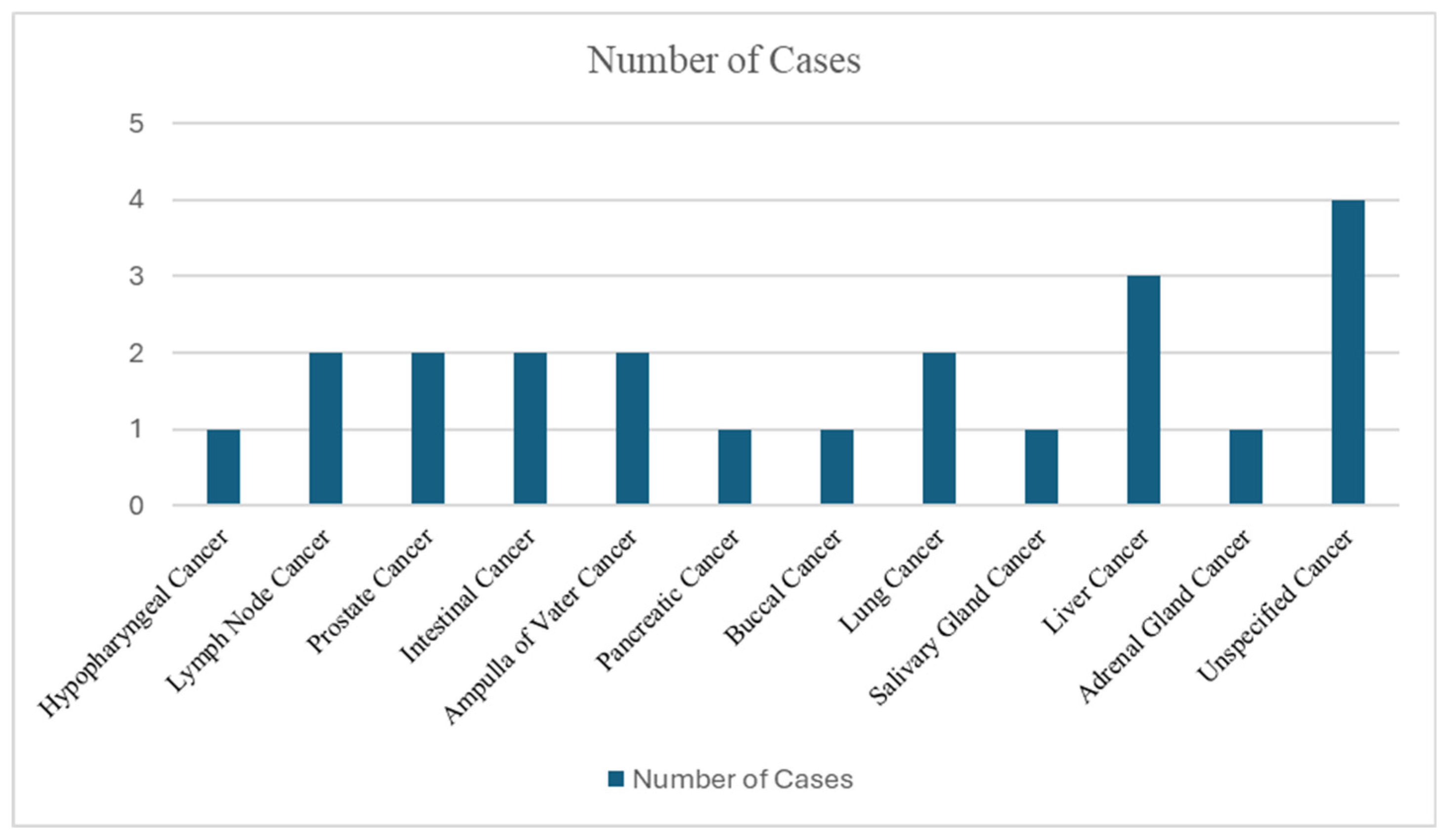
A total of 44 cases were analyzed, comprising a healthy control group (n = 22) and a cancer group (n = 22). The cancer group included heterogeneous diagnoses, with unspecified cancer being the most common (n = 4), followed by liver cancer (n = 3). Other cancer types, including hypopharyngeal, pancreatic, buccal, and adrenal gland cancers, were each represented by one case (Figure 1). Diagnoses were confirmed using available medical records and family information. Both groups showed identical sex distributions (12 females and 10 males per group) and comparable mean ages (controls: 54.6 ± 15.0 years; cancer: 55.7 ± 15.7 years), with no statistically significant differences in age or sex (p > 0.05), minimizing demographic confounding effects.

3.2. Unsupervised Principal Component Analysis (PCA)

Unsupervised principal component analysis (PCA) was first performed to explore intrinsic metabolic patterns and detect potential outliers prior to supervised modeling. PCA demonstrated partial separation between cancer and control groups along PC1, which explained 37.1% of the total variance, while PC2 accounted for 10.1% of the variance. Substantial overlap between groups was observed, and no extreme outliers were detected, supporting the exploratory nature of subsequent supervised analyses [14].
The corresponding PCA score plot is shown in Supplementary Figure S1.

3.3. Identification of Cancer-Associated Metabolites by PLS-DA, Volcano Plot, and ROC Analysis

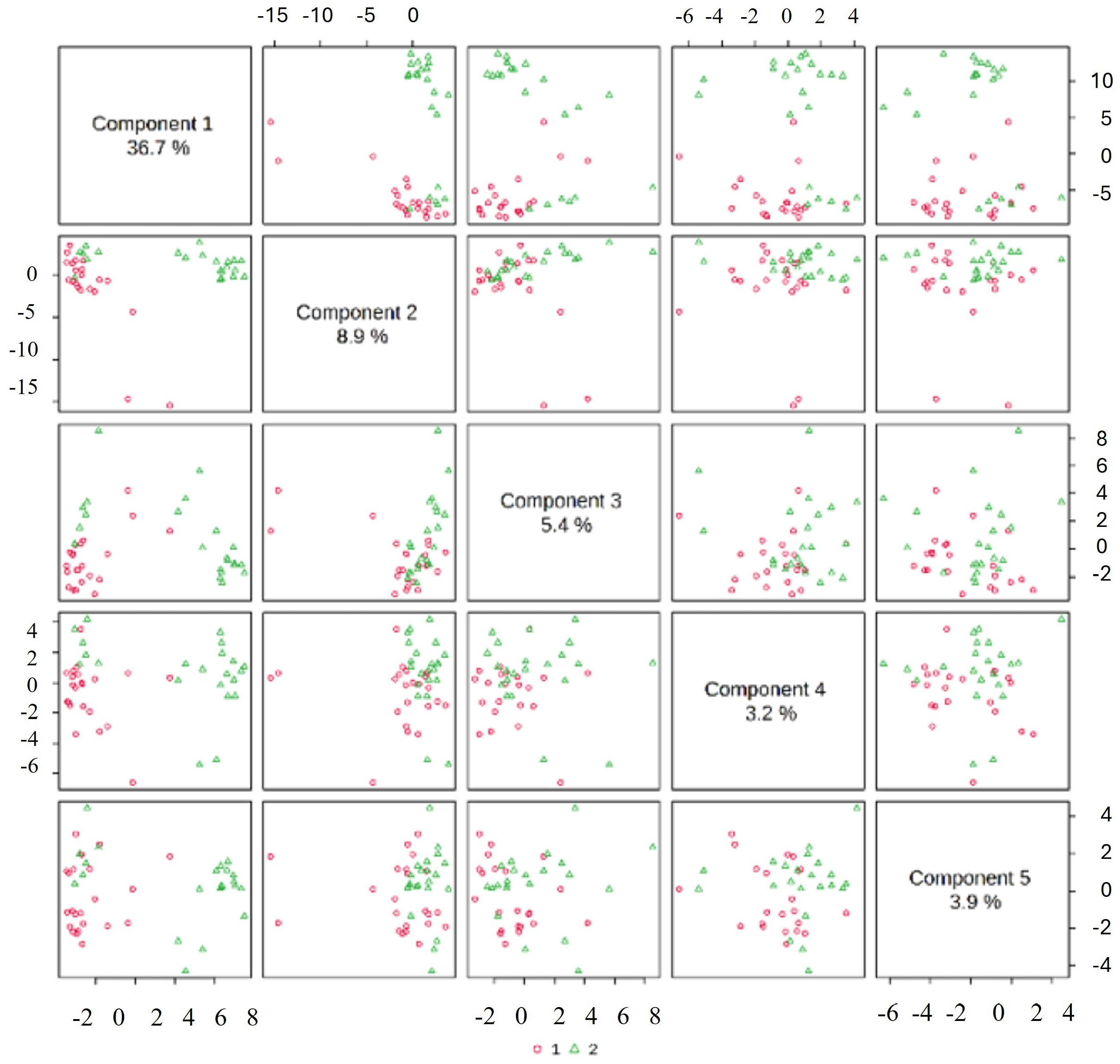
Multivariate datasets were analyzed using Partial Least Squares Discriminant Analysis (PLS-DA) (Figure 2). The first component (PLS-DA Component 1) explained 36.7% of the variance, while Component 2 explained 8.9%. The model revealed partial separation between cancer and control groups. A total of 91 metabolites exhibited variable importance in projection (VIP) scores greater than 1. For clarity and to avoid redundancy, only VIP scores from Component 1 are presented in the main manuscript (Table 1), while additional components are provided in Supplementary Table S2.
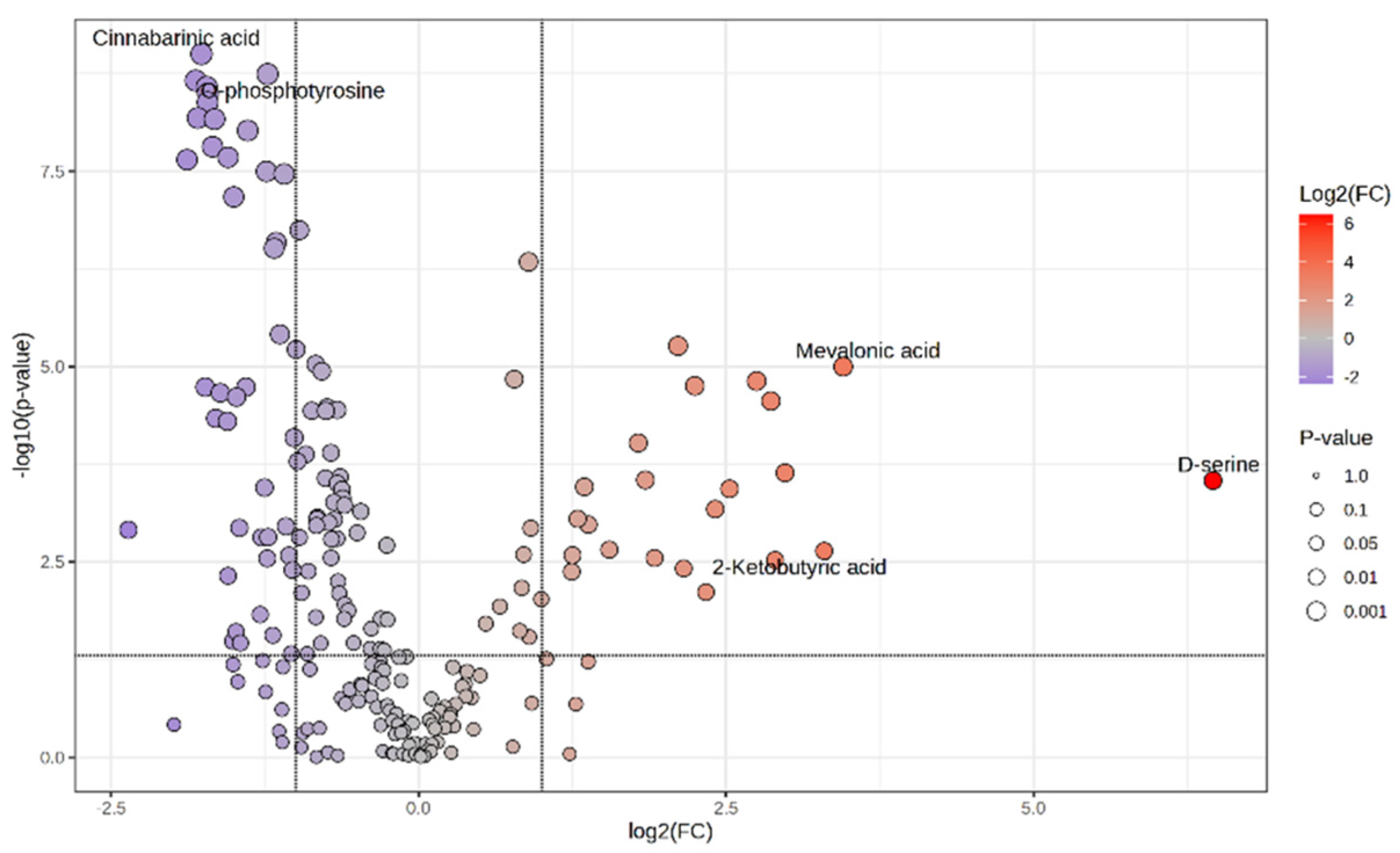
The number of metabolites identified in volcano plot analysis reflects the application of combined statistical significance (p < 0.05) and fold-change thresholds (FC > 2 for upregulation or FC < 0.5 for downregulation). Accordingly, both increased and decreased metabolites were considered in subsequent integrative analyses, accounting for the apparent discrepancy between visual density in the volcano plot and the total number of metabolites meeting the selection criteria. In addition, point overlap (overplotting) in dense regions of the volcano plot may visually underestimate the number of metabolites meeting the statistical thresholds.
Among the 209 detected metabolites, 22 metabolites were upregulated in the cancer group (FC > 2), while 41 metabolites were downregulated (FC < 0.5), as illustrated in the volcano plot (Figure 3). The complete list of metabolites meeting the volcano plot criteria is provided in Supplementary Table S1. Univariate ROC analysis identified 56 metabolites with an AUC greater than 0.80. The top 15 discriminatory metabolites are summarized in Table 2.

3.4. Identification of Potential Biomarkers Using Integrated Selection Criteria

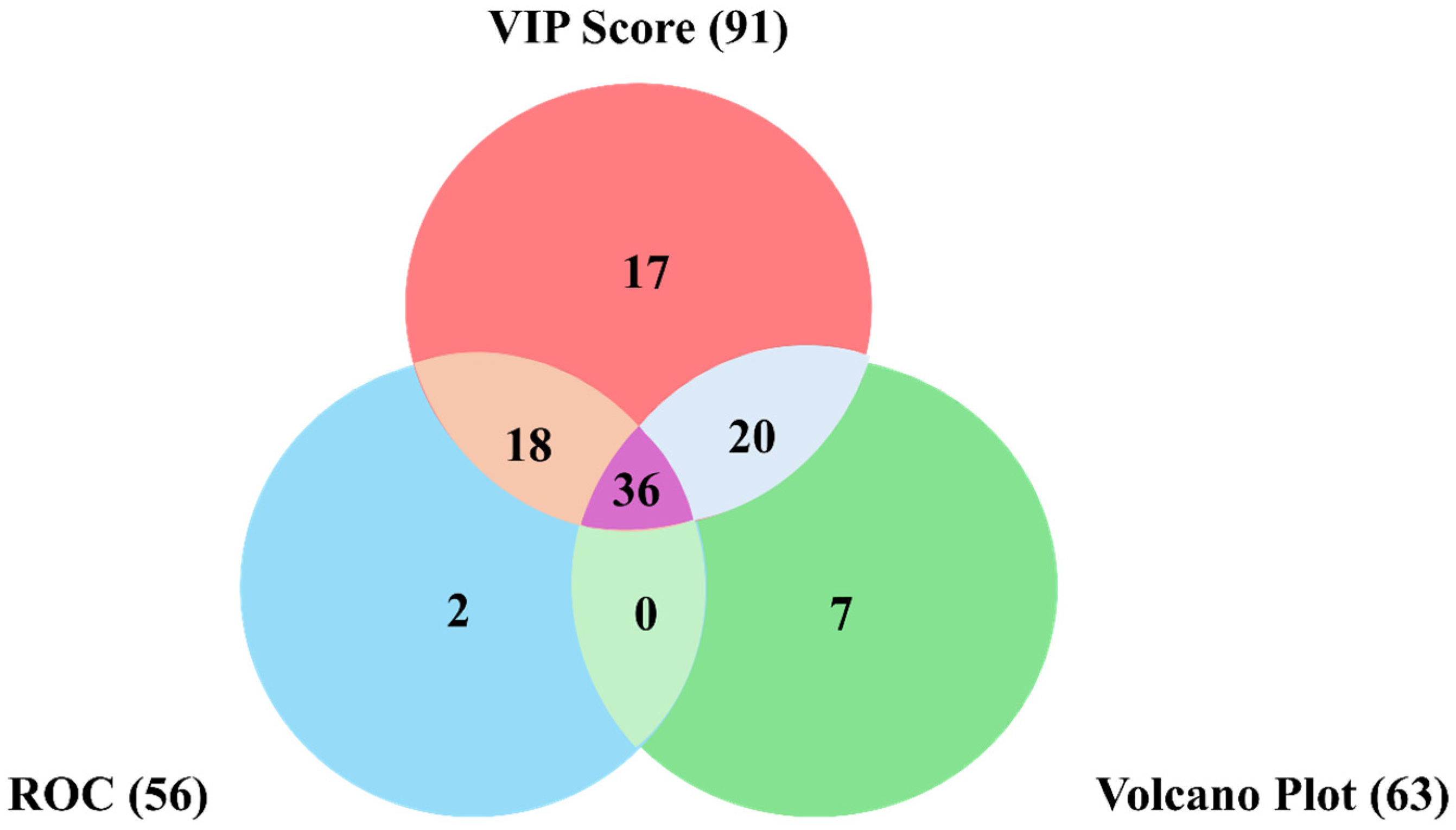
Potential cancer-associated metabolites were identified using an integrative approach combining multivariate and univariate analyses. Selection criteria included VIP > 1 (PLS-DA), a statistically significant fold change (FC > 2 or FC < 0.5; p < 0.05) from the volcano plot analysis, and an AUC > 0.80 from ROC analysis. The Venn diagram (Figure 4) illustrates the overlap among these methods, identifying 36 metabolites that met all criteria. These candidates included both upregulated (Table 3A) and downregulated metabolites (Table 3B), addressing metabolic alterations in both directions.
The selection thresholds applied in this study (VIP > 1, FC > 2 or < 0.5, and AUC > 0.80) were chosen as commonly adopted heuristic criteria in exploratory metabolomics studies to prioritize features with consistent multivariate contribution, substantial effect size, and acceptable discriminatory performance. These thresholds were not intended to define definitive biomarkers but rather to reduce dimensionality and identify candidates for further validation in independent cohorts.

3.5. Exploratory Logistic Regression Analysis

Exploratory binary logistic regression was applied to evaluate the combined discriminatory potential of the 36 candidate metabolites. Using a forward stepwise approach, two metabolites—inosinic acid and 2-ketobutyric acid—were retained in the final model. The model achieved a Nagelkerke R2 of 0.822 and a within-sample classification accuracy of 90.9%. The overall classification accuracy of 90.9% was derived from the correct classification of 41 out of 44 samples (20/22 cancer cases and 21/22 control cases). This accuracy value represents a weighted integration of a sensitivity of 86.4% (the true positive rate for identifying cancer cases) and a specificity of 95.5% (the true negative rate for identifying control cases). Together, these metrics provide a comprehensive measure of the model’s discriminative power within the current study population. Detailed regression outputs are provided in Supplementary Table S3.
It is essential to clarify that these metrics reflect within-sample performance, representing the proportion of correctly classified samples within the discovery dataset used for model construction. While these results provide valuable descriptive insights into the model’s behavior facilitated by the balanced group sizes, they remain exploratory in nature. Consequently, these values should not be interpreted as evidence of generalizable predictive performance in external populations. Given the pilot nature of this study, the modest sample size, and the absence of independent external validation, our findings should be considered primarily as hypothesis-generating rather than definitive diagnostic criteria.

4. Discussion

This exploratory pilot study demonstrates the potential of 1H-NMR-based metabolomics in identifying cancer-associated biochemical signatures within the dentine matrix. Dentine’s inherent durability and resistance to decay make it a promising biological archive for preserving metabolic information, particularly in forensic scenarios where traditional biofluids are degraded or unavailable. By analyzing a cohort of 44 individuals, inosinic acid and 2-ketobutyric acid were identified as significant discriminant metabolites. These candidates were integrated into an exploratory binary logistic regression model that achieved an overall classification accuracy of 90.9%, with 86.4% for cancer cases and 95.5% for non-cancer controls.
Inosinic acid plays a critical role in purine metabolism, supporting DNA and RNA synthesis and energy production—processes frequently dysregulated in cancer. Previous studies have linked its related compound, inosine, to cancer progression, metastasis, and treatment response. For instance, Lee et al. (2021) [21] demonstrated that inosine predicts the metastatic potential of lung squamous cell carcinoma, while Li et al. (2021) [22] reported that elevated inosine levels are associated with esophageal squamous cell carcinoma progression. In bladder cancer [23] and hepatocellular carcinoma [24,25], inosine has been used to distinguish between disease grades and aid in early detection. Interestingly, inosine’s behavior varies across cancer types; in pancreatic cancer, patients exhibit lower inosine levels, which can increase with dietary interventions such as a low-carbohydrate ketogenic diet [26]. These findings emphasize the context-dependent roles of inosinic acid and inosine, influenced by tumor type and systemic metabolic states.
Similarly, 2-ketobutyric acid, a key intermediate in the catabolism of threonine and methionine, contributes to amino acid metabolism and cellular energy production through its role in the tricarboxylic acid (TCA) cycle. [27] This study highlights its potential as a biomarker, particularly in cancer contexts where oxidative stress and amino acid metabolism are disrupted. Elevated levels of related metabolites, such as 2-hydroxybutyric acid, have been observed in lung and colorectal cancers, supporting the relevance of these pathways in tumorigenesis. Dysregulated levels of 2-ketobutyric acid in KRAS-mutant pancreatic cancer further underscore its diagnostic potential and role in metabolic reprogramming [28].
While the present study highlights its potential relevance, observed changes may also reflect generalized physiological stress rather than cancer-specific effects. Cancer is not a single entity but comprises hundreds of distinct diseases, each with unique metabolic reprogramming strategies [29]. This diversity extends even within a single malignancy, such as the distinct metabolomic signatures of luminal A and basal-like breast cancer subtypes [30]. Consequently, a detected metabolic signal may not be cancer-specific but could reflect generalized phenomena like systemic inflammation or cachexia, potentially present in both cancer and control groups.
Several limitations of the study’s design must be acknowledged. Utilizing a modest sample size (n = 44) may not fully capture the metabolic variability of diverse populations or rare cancer subtypes. As an exploratory model, the high predictive values reported must be interpreted with caution until validated through larger, stratified cohorts and independent test sets. Additionally, for forensic reliability, factors such as the post-mortem interval (PMI) and environmental taphonomy must be rigorously investigated. Future research integrating these findings into a systems biology framework combining metabolomics with genomics or proteomics will be essential to enhance the specificity and applicability of this method. This study provides a foundational proof of concept, offering a novel, non-invasive pathway for both precision medicine and forensic identification.

Supplementary Materials

The following supporting information can be downloaded at https://www.mdpi.com/article/10.3390/forensicsci6020033/s1, Table S1: Complete list of dentine metabolites meeting volcano plot selection criteria. Table S2: VIP scores across additional PLS-DA components. Table S3: Exploratory within-sample logistic regression analysis. Figure S1: PCA score plot of dentine metabolomic profiles.

Author Contributions

Conceptualization, C.J. and T.M.; methodology, C.H., G.K., P.W., K.V. and C.J.; validation, C.J. and G.K.; formal analysis, C.H., C.J. and T.M.; data curation, C.H., C.J. and T.M.; writing—original draft preparation, C.H.; writing—review and editing, C.J. and T.M.; visualization, T.M.; supervision, T.M.; project administration, T.M. and C.J.; funding acquisition, T.M. and C.J. All authors have read and agreed to the published version of the manuscript.

Funding

This research was funded by BASIC FUNDAMENTAL FUND, grant number FRB640006.

Institutional Review Board Statement

The study was conducted in accordance with the Declaration of Helsinki and approved by the Ethics Committee of the Faculty of Medicine, Chiang Mai University, Thailand (the study code: FOR-2566-0323 and date of approval: 3 August 2023).

Informed Consent Statement

Informed consent was obtained from all subjects involved in the study. Written informed consent has been obtained from the patients to publish this paper.

Data Availability Statement

The original contributions presented in this study are included in the article and supplementary material. Further inquiries can be directed to the corresponding author.

Conflicts of Interest

The authors declare no conflicts of interest.

References

  1. de Boer, H.H.; Blau, S.; Delabarde, T.; Hackman, L. The role of forensic anthropology in disaster victim identification (DVI): Recent developments and future prospects. Forensic Sci. Res. 2019, 4, 303–315. [Google Scholar] [CrossRef]
  2. Byers, S.N. Introduction to Forensic Anthropology, 5th ed.; Routledge: London, UK, 2016. [Google Scholar]
  3. National Cancer Institute. Hospital Based Cancer Registry 2022; National Cancer Institute, Department of Medical Services, Ministry of Public Health: Bangkok, Thailand, 2023.
  4. Clish, C.B. Metabolomics: An emerging but powerful tool for precision medicine. Cold Spring Harb. Mol. Case Stud. 2015, 1, a000588. [Google Scholar] [CrossRef]
  5. Wang, Z.; Zhu, H.; Xiong, W. Advances in mass spectrometry-based multi-scale metabolomic methodologies and their applications in biological and clinical investigations. Sci. Bull. 2023, 68, 2268–2284. [Google Scholar] [CrossRef] [PubMed]
  6. Emwas, A.H.; Roy, R.; McKay, R.T.; Tenori, L.; Saccenti, E.; Gowda, G.A.N.; Raftery, D.; Alahmari, F.; Jaremko, L.; Jaremko, M.; et al. NMR Spectroscopy for Metabolomics Research. Metabolites 2019, 9, 123. [Google Scholar] [CrossRef]
  7. Dona, A.C.; Jiménez, B.; Schäfer, H.; Humpfer, E.; Spraul, M.; Lewis, M.R.; Pearce, J.T.M.; Holmes, E.; Lindon, J.C.; Nicholson, J.K. Precision High-Throughput Proton NMR Spectroscopy of Human Urine, Serum, and Plasma for Large-Scale Metabolic Phenotyping. Anal. Chem. 2014, 86, 9887–9894. [Google Scholar] [CrossRef]
  8. Locci, E.; Bazzano, G.; Chighine, A.; Ferraro, E.; Demontis, R.; D’aloja, E. Forensic NMR metabolomics: One more arrow in the quiver. Metabolomics 2020, 16, 118. [Google Scholar] [CrossRef]
  9. Chighine, A.; Stocchero, M.; De-Giorgio, F.; Fratini, R.; Fanunza, G.; Kesharwani, R.; Gozzelino, C.; Nioi, M.; D’aloja, E.; Locci, E. PMI estimation through 1H NMR metabolomics on human pericardial fluid: A validation study. Metabolomics 2025, 21, 174. [Google Scholar] [CrossRef]
  10. Chighine, A.; Stocchero, M.; De-Giorgio, F.; Nioi, M.; D’aLoja, E.; Locci, E. Translating metabolomic evidence gathered from an animal model to a real human scenario: The post-mortem interval issue. Metabolomics 2025, 21, 125. [Google Scholar] [CrossRef]
  11. Budsayapanpong, V.; Amornlertwatana, Y.; Konguthaithip, G.; Watcharakhom, S.; Intui, K.; Chaichana, J.; Khamenkhetkarn, M.; Jaikang, C. Metabolomic insights into methamphetamine exposure: 1H-NMR-based urinary biomarker identification and pathway disruption. Chem. Biol. Interact. 2025, 412, 111449. [Google Scholar] [CrossRef] [PubMed]
  12. Diez, C.; Rojo, M.Á.; Martín-Gil, J.; Martín-Ramos, P.; Garrosa, M.; Córdoba-Diaz, D. Infrared Spectroscopic Analysis of the Inorganic Components from Teeth Exposed to Psychotherapeutic Drugs. Minerals 2022, 12, 28. [Google Scholar] [CrossRef]
  13. Hengcharoen, C.; Monum, T.; Verochana, K.; Konguthaithip, G.; Watwaraphat, P.; Jaikang, C. Metabolomics Profile in Dentine Involved in Cancer: Implications for Personal Identification. In Proceedings of the 2025 International Symposium for Agricultural Biomedical Research Network, Chiang Mai, Thailand, 9–10 January 2025; pp. 147–153. [Google Scholar]
  14. Li, C.; Wang, Q.; Zhang, Y.; Lin, H.; Zhang, J.; Huang, P.; Wang, Z. Research progress in the estimation of the postmortem interval by Chinese forensic scholars. Forensic Sci. Res. 2016, 1, 3–13. [Google Scholar] [CrossRef] [PubMed]
  15. Beckonert, O.; Keun, H.C.; Ebbels, T.M.D.; Bundy, J.; Holmes, E.; Lindon, J.C.; Nicholson, J.K. Metabolic profiling, metabolomic and metabonomic procedures for NMR spectroscopy of urine, plasma, serum and tissue extracts. Nat. Protoc. 2007, 2, 2692–2703. [Google Scholar] [CrossRef]
  16. Zaslansky, P.; Friesem, A.A.; Weiner, S. Structure and mechanical properties of the soft zone separating bulk dentin and enamel in human teeth. J. Struct. Biol. 2006, 153, 188–199. [Google Scholar] [CrossRef]
  17. Wishart, D.S.; Jewison, T.; Guo, A.C.; Wilson, M.; Knox, C.; Liu, Y.; Djoumbou, Y.; Mandal, R.; Aziat, F.; Dong, E.; et al. HMDB 3.0—The Human Metabolome Database in 2013. Nucleic Acids Res. 2013, 41, D801–D807. [Google Scholar] [CrossRef]
  18. Bharti, S.K.; Roy, R. Quantitative 1H NMR spectroscopy. Trends Anal. Chem. 2012, 35, 5–26. [Google Scholar] [CrossRef]
  19. Bradley, W.; Robert, P. Multivariate Analysis in Metabolomics. Curr. Metabolomics 2013, 1, 92–107. [Google Scholar] [CrossRef]
  20. Çorbacıoğlu, Ş.K.; Aksel, G. Receiver operating characteristic curve analysis in diagnostic accuracy studies: A guide to interpreting the area under the curve value. Turk. J. Emerg. Med. 2023, 23, 195–198. [Google Scholar] [CrossRef] [PubMed]
  21. Lee, H.; Lee, H.; Park, S.; Kim, M.; Park, J.Y.; Jin, H.; Oh, K.; Bae, J.; Yang, Y.; Choi, H.-K. Integrative Metabolomic and Lipidomic Profiling of Lung Squamous Cell Carcinoma for Characterization of Metabolites and Intact Lipid Species Related to the Metastatic Potential. Cancers 2021, 13, 4179. [Google Scholar] [CrossRef]
  22. Li, X.; Zhao, L.; Wei, M.; Lv, J.; Sun, Y.; Shen, X.; Zhao, D.; Xue, F.; Zhang, T.; Wang, J. Serum metabolomics analysis for the progression of esophageal squamous cell carcinoma. J. Cancer 2021, 12, 3190–3197. [Google Scholar] [CrossRef] [PubMed]
  23. Tan, G.; Wang, H.; Yuan, J.; Qin, W.; Dong, X.; Wu, H.; Meng, P. Three serum metabolite signatures for diagnosing low-grade and high-grade bladder cancer. Sci. Rep. 2017, 7, 46176. [Google Scholar] [CrossRef]
  24. Chen, T.; Xie, G.; Wang, X.; Fan, J.; Qiu, Y.; Zheng, X.; Qi, X.; Cao, Y.; Su, M.; Wang, X.; et al. Serum and urine metabolite profiling reveals potential biomarkers of human hepatocellular carcinoma. Mol. Cell Proteom. 2011, 10, M110.004945. [Google Scholar] [CrossRef] [PubMed]
  25. Ladep, N.G.; Dona, A.C.; Lewis, M.R.; Crossey, M.M.; Lemoine, M.; Okeke, E.; Shimakawa, Y.; Duguru, M.; Njai, H.F.; Fye, H.K.; et al. Discovery and validation of urinary metabotypes for the diagnosis of hepatocellular carcinoma in West Africans. Hepatology 2014, 60, 1291–1301. [Google Scholar] [CrossRef] [PubMed]
  26. Kang, C.M.; Yun, B.; Kim, M.; Song, M.; Kim, Y.H.; Lee, S.H.; Lee, H.; Lee, S.M.; Lee, S.-M. Postoperative serum metabolites of patients on a low carbohydrate ketogenic diet after pancreatectomy for pancreatobiliary cancer: A nontargeted metabolomics pilot study. Sci. Rep. 2019, 9, 16820. [Google Scholar] [CrossRef]
  27. Berg, J.M.; Tymoczko, J.L.; Gatto, G.J.; Stryer, L. Biochemistry, 8th ed.; W. H. Freeman and Company: New York, NY, USA, 2015. [Google Scholar]
  28. Kim, B.; Jung, J. Metabolomic Approach to Identify Potential Biomarkers in KRAS-Mutant Pancreatic Cancer Cells. Biomedicines 2024, 12, 865. [Google Scholar] [CrossRef]
  29. Ledesma, S.N.; Hamed-Hamed, D.; González-Muñoz, A.; Pruimboom, L. Effectiveness of Treatments That Alter Metabolomics in Cancer Patients—A Systematic Review. Cancers 2023, 15, 4297. [Google Scholar] [CrossRef]
  30. Willmann, L.; Schlimpert, M.; Halbach, S.; Erbes, T.; Stickeler, E.; Kammerer, B. Metabolic profiling of breast cancer: Differences in central metabolism between subtypes of breast cancer cell lines. J. Chromatogr. B Anal. Technol. Biomed. Life Sci. 2015, 1000, 95–104. [Google Scholar] [CrossRef] [PubMed]
Figure 1. The distribution of cancer types among dentine samples. A bar chart illustrating the number of cases for each cancer type included in the study. The x-axis represents different types of cancer, and the y-axis indicates the number of cases in each category.
Forensicsci 06 00033 g001
Figure 2. PLS−DA analysis of healthy and cancer cases.
Forensicsci 06 00033 g002
Figure 3. A volcano plot of dentine metabolites. A volcano plot displaying differential metabolites between cancer (n = 22) and control (n = 22) groups. The x-axis represents log2 fold change, and the y-axis represents −log10(p-value).
Forensicsci 06 00033 g003
Figure 4. Venn diagram of biomarker selection. Venn diagram showing overlap of significant metabolites identified by three criteria: PLS-DA VIP > 1 (91 metabolites), volcano plot (63 metabolites), and ROC analysis with AUC > 0.80 (56 metabolites). Thirty-six metabolites overlapped across all three methods.
Forensicsci 06 00033 g004
Table 1. Variable importance in projection (VIP) scores of the top 15 discriminant metabolites across principal components.
MetabolitesVIP (Component 1)
Cinnabarinic acid1.8554
O−phosphotyrosine1.8373
N−acetyl−L−phenylalanine1.8314
1−methylhistidine1.8255
Adenine1.8191
Deoxyinosine1.8109
N4−acetylcytidine1.7956
7−methylguanine1.7944
Inosinic acid1.7829
3−methyladenine1.7663
L−kynurenine1.755
9−methyladenine1.7525
L−tryptophan1.7398
5−HIAA1.737
Mercaptopurine1.711
Table 2. ROC curve analysis of differential dentine metabolites between cancer and control groups.
MetaboliteAUC (ROC)p-ValueFold Change (log2)
O-phosphotyrosine0.942151.81 × 10−91.9414
N-acetyl-L-phenylalanine0.942152.19 × 10−92.6149
N4-acetylcytidine0.935956.60 × 10−92.6602
9-methyladenine0.927692.26 × 10−82.6915
1-methylhistidine0.925622.65 × 10−92.5540
5-HIAA0.921493.43 × 10−81.6964
Cinnabarinic acid0.919421.00 × 10−92.5317
Inosinic acid0.909099.57 × 10−92.1864
Adenine0.907023.23 × 10−92.6200
L-kynurenine0.902892.11 × 10−82.1936
7-methylguanine0.902896.83 × 10−92.5775
Deoxyinosine0.896694.17 × 10−92.6345
Mercaptopurine0.894636.77 × 10−82.2505
L-tryptophan0.892563.18 × 10−81.7726
3-methyladenine0.890501.54 × 10−82.6304
Receiver operating characteristic (ROC) analysis demonstrating the diagnostic performance of the 15 most significantly altered dentine metabolites between cancer (n = 22) and control (n = 22) groups. Metabolites with higher area under the curve (AUC) values exhibit stronger discriminatory power. Among these, O-phosphotyrosine, N-acetyl-L-phenylalanine, N4-acetylcytidine, cinnabarinic acid, and 1-methylhistidine showed the highest discriminative performance with an AUC > 0.92 and extremely low p-values (<1 × 10⁻⁸), indicating robust statistical significance.
Table 3. (A) Upregulated metabolites in cancer (FC > 2, p < 0.05, VIP > 1, AUC > 0.80). (B) Downregulated metabolites in cancer (FC < 0.5, p < 0.05, VIP > 1, AUC > 0.80).
A
MetaboliteHMDB IDVIPFC (Cancer/Control)p-ValueAUC
D-serineHMDB00034061.255787.9232.87 × 10−40.8636
2-Ketobutyric acidHMDB00000051.08009.82830.00230.8554
Mevalonic acidHMDB00002271.475510.9411.00 × 10−50.8161
L-glutamic gamma-semialdehydeHMDB00021041.50924.31395.44 × 10−60.8306
AminoacetoneHMDB00021341.45106.71631.53 × 10−50.8099
CarnosineHMDB00000331.44274.74261.76 × 10−50.8037
L-methionineHMDB00006961.33563.44659.49 × 10−50.8182
Citric acidHMDB00000941.25703.58812.82 × 10−40.8161
D-glutamineHMDB00034231.15042.60260.001050.8161
N-acetylputrescineHMDB00020641.02002.37010.004200.8037
B
O-phosphotyrosineHMDB00111851.83730.42681.81 × 10−90.9422
N-acetyl-L-phenylalanineHMDB00005121.83140.28462.19 × 10−90.9422
N4-acetylcytidineHMDB00059231.79560.28806.60 × 10−90.9359
9-methyladenineHMDB01407131.75250.27112.26 × 10−80.9277
1-methylhistidineHMDB00000011.82550.30292.65 × 10−90.9256
5-HIAAHMDB00007631.73700.46863.43 × 10−80.9215
Cinnabarinic acidHMDB00040781.85540.29411.00 × 10−90.9194
Inosinic acidHMDB00001751.78290.38169.57 × 10−90.9091
AdenineHMDB00000341.81910.30493.23 × 10−90.9070
L-kynurenineHMDB00006841.75500.34162.11 × 10−80.9029
7-methylguanineHMDB00008971.65610.31656.83 × 10−90.9029
DeoxyinosineHMDB00000711.81090.30454.17 × 10−90.8967
MercaptopurineHMDB00149581.71100.35286.77 × 10−80.8946
L-tryptophanHMDB00009291.73980.42413.18 × 10−80.8926
3-methyladenineHMDB00116001.76630.31301.54 × 10−80.8905
7-methyladenineHMDB00116141.65610.44812.57 × 10−70.8843
Dermatan sulfateHMDB00006321.13690.19490.001230.8698
2-aminobenzoic acidHMDB00011231.64850.44303.07 × 10−70.8657
L-glutamic acid 5-phosphateHMDB00011281.42290.35832.45 × 10−50.8554
Hydroxypropyl-threonineHMDB00288731.44040.37781.84 × 10−50.8554
Adenylsuccinic acidHMDB00005361.52730.45773.87 × 10−60.8450
PhosphoserineHMDB00002721.38370.31874.60 × 10−50.8409
L-cysteineHMDB00005741.43040.32702.17 × 10−50.8326
PhosphocreatineHMDB00015111.37810.34045.01 × 10−50.8285
Norophthalmic acidHMDB00057761.44050.30021.83 × 10−50.8161
L-aspartic acidHMDB00001911.00720.34140.004760.8120
Disclaimer/Publisher’s Note: The statements, opinions and data contained in all publications are solely those of the individual author(s) and contributor(s) and not of MDPI and/or the editor(s). MDPI and/or the editor(s) disclaim responsibility for any injury to people or property resulting from any ideas, methods, instructions or products referred to in the content.