
The Spectrum of Choice: A Review of European Abortion Legal Frameworks from a Medicolegal Perspective

 , , , ,
Abstract
1. Introduction
2. Materials and Methods
- -
- Elective abortion limit: the maximum gestational age at which a woman may request a termination without providing a specific medical or legal justification.
- -
- Health exception: any statutory provision allowing termination to prevent risk to the woman’s physical or mental health, excluding immediate life-threatening conditions.
- -
- Fetal anomaly: circumstances where termination is permitted due to diagnosed fetal impairment, categorized by the severity (lethal vs. non-lethal) where specified by law.
2.1. Search Results and Screening Process
- -
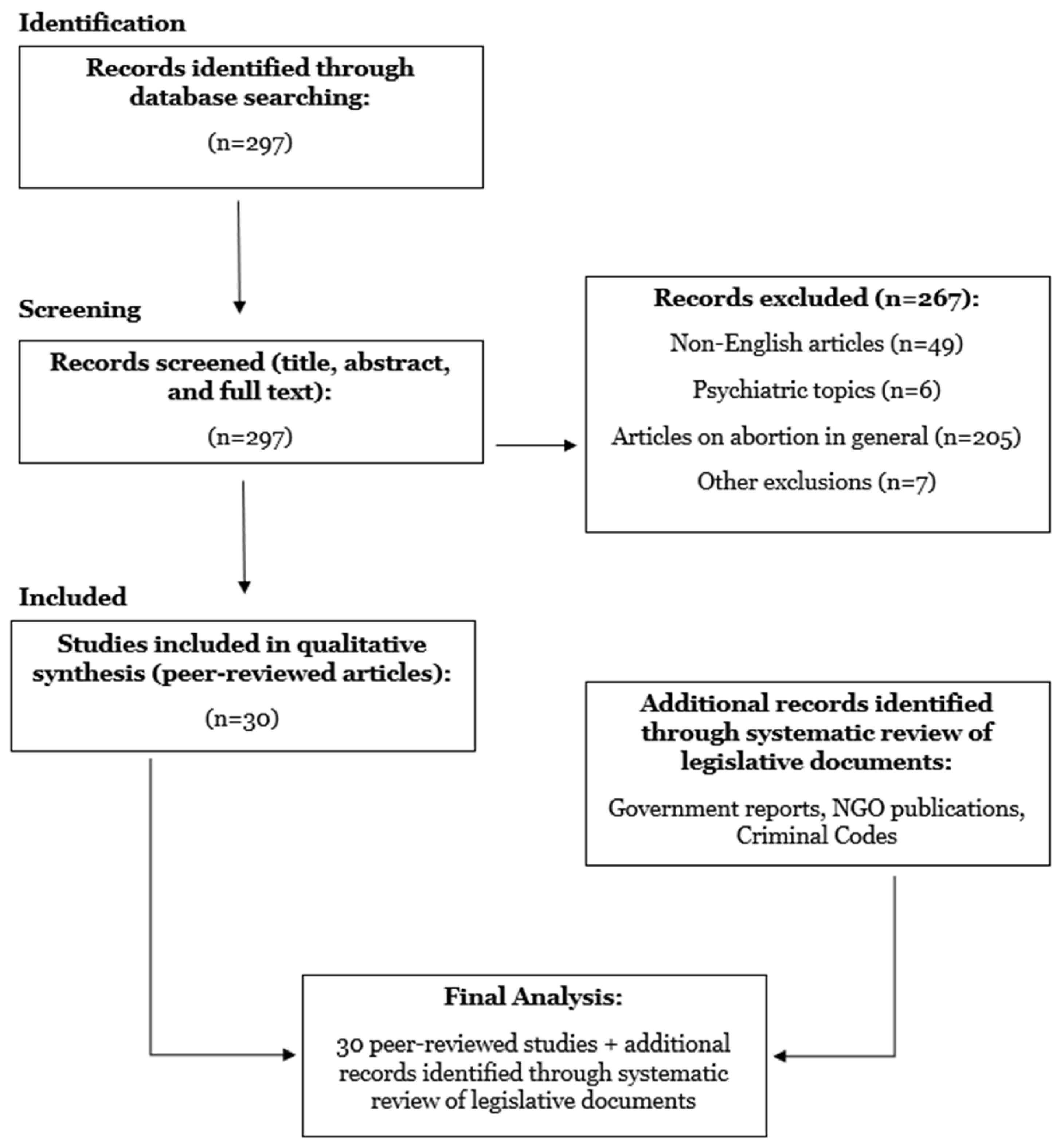
- Focused exclusively on clinical, psychiatric, or sociological aspects without legal analysis.
- -
- Were case reports, opinion pieces, or letters to editors;
- -
- Were randomized controlled trials or purely epidemiological studies;
- -
- Did not address European jurisdictions;
- -
- Did not analyze legal frameworks or statutory provisions.
- -
- Historical evolution of abortion legislation across European countries;
- -
- Constitutional developments and court decisions;
- -
- Comparative legal scholarship examining multiple jurisdictions;
- -
- Policy debates and reform processes;
- -
- Scholarly interpretation of statutory provisions.
- Contextualize the legislative frameworks within broader policy debates;
- Identify historical trajectories of legal reform;
- Understand scholarly interpretations of ambiguous provisions;
- Recognize ongoing constitutional developments.
- -
- search locations: official government websites of European Union (EU) member countries, Switzerland, and the United Kingdom (UK); official parliamentary and legislative databases (e.g., EUR-Lex for EU legislation); websites of national ministries of justice; national legal repositories and gazette archives; official websites of non-governmental organizations focusing on human rights; and legal databases specializing in national legislation;
- -
- search terms: combinations of terms such as “abortion law”, “abortion legislation”, “abortion statutes”, “criminal code abortion” and “abortion-based law”, translated into the official languages of the respective countries where appropriate;
- -
- document authentication: Legislative documents were verified for authenticity through cross-referencing with official parliamentary archives and government gazette publications. Version control was maintained to ensure analysis of the most current consolidated legislation. Where amendments had been enacted, the analysis incorporated the update provisions;
- -
- screening process: documents were first evaluated based on their titles and provided descriptions to ascertain their direct relevance to abortion legislation. Subsequently, full-text documents underwent a detailed assessment to confirm their explicit focus on the analysis of legal frameworks, the definition of offenses, corresponding penalties, and mechanisms concerning patient support related to abortion;
- -
- inclusion criteria: primary legislative instruments (statutes, criminal codes, health acts) governing abortion; constitutional provisions addressing reproductive rights or fetal protection; official governmental reports providing authoritative interpretation; publications from recognized non-governmental organizations with legal expertise; documents published between 2015 and 2025 to ensure currency;
- -
- exclusion criteria: documents lacking a direct legal focus were systematically excluded from the analysis; encompassed resources concentrating solely on prevention campaigns (devoid of legal detail), purely sociological research (without legal assessment), or broad human rights reports not specific to abortion statutes. Geographically, the investigation was restricted to member countries of the EU, Switzerland, and the UK. Countries were excluded from analysis when their abortion legislation was not available in accessible official sources (official government databases, parliamentary archives, or verified legal repositories) or when legislative texts were incomplete due to ongoing legislative processes or lack of consolidated versions. This exclusion criterion ensured that only jurisdictions with verifiable, complete, and current legal frameworks were included in the comparative analysis;
- -
- a further filter was applied to academic literature: articles that did not explicitly analyze abortion laws were eliminated, as were articles on psychiatric subjects, general abortion topics, case reports, and randomized controlled trials. Moreover, direct reference to criminal codes of the included countries was prioritized during the search for legislative documents. While searching online legislative documents, a concerted effort was made to identify and include the main legislative documents, particularly the national criminal codes or equivalent penal statutes, that define and regulate abortion within each given country. This ensured that the primary legal frameworks governing abortion were accurately represented and analyzed.
2.2. Comparative Analysis Framework
- data extraction: key legal provisions were systematically extracted including: (a) gestational limits for elective abortion; (b) exceptional circumstances and their associated limits; (c) procedural requirements (waiting periods, counseling, approval mechanisms); (d) constitutional provisions; and (e) criminal sanctions.
- categorization: jurisdictions were grouped into regulatory models based on their fundamental approach to abortion regulation, including gestational limit-based systems, medial indication systems, and exception-based frameworks. Explicit classification criteria were applied as follows: (1) Gestational limit-based systems: jurisdictions establishing a primary gestational threshold (10–18 weeks) for elective abortion with defined exceptions; (2) Exception-based frameworks: jurisdictions permitting abortion only under exceptional circumstances without general elective provision; (3) Liberal extended-limit systems: jurisdictions with gestational limits exceeding 18 weeks (e.g., The Netherlands at 24 weeks). Hybrid cases exhibiting characteristics of multiple models were classified according to their primary regulator mechanism, with detailed discussion of transitional or mixed features provided in the Results section.
- comparative synthesis: cross-jurisdictional patterns were identified regarding gestational thresholds, exception categories, and procedural architectures.
- interpretation: the analysis examined how legal variations correlate with constitutional structures, secularization levels, regional patterns (Northern, Western, Central, Eastern Europe), and membership in supranational organization (EU, Council of Europe).
2.3. Quality Assessment and Validity Criteria
- source authenticity verification: all legislative documents were authenticated through cross-referencing with multiple official sources, including parliamentary archives, official gazettes, and government legal databases. Only primary legislative sources or officially translated versions were accepted;
- legislative verification date: all jurisdictional analyses reflect the statutory frameworks in force as of 31 December 2024. This verification date is critical given recent legislative changes in several European countries, including France’s constitutional amendment of 4 March 2024 (which enshrined abortion rights in the Constitution), and ongoing legislative reform discussions in other jurisdictions. Each legislative text was verified through multiple official sources to confirm its current validity at this reference date;
- currency and validity assessment: for each jurisdiction, the analysis confirmed that the legislative text represented the current law in force, incorporating all amendments up to the search date. Superseded or repealed legislation was excluded;
- completeness verification: legislative frameworks were considered complete when they included all relevant provisions addressing (gestational limits, exceptional circumstances, procedural requirements, and sanctions). Jurisdictions lacking any of these core elements were noted as having incomplete frameworks;
- translation reliability: for non-English legislative texts, quality was ensured by prioritizing official government translations, followed by professional legal translation services, and finally verified legal databases. Technical legal terminology was cross-referenced across multiple sources to ensure accuracy;
- jurisdictional comparability: only sovereign or semi-autonomous jurisdictions with independent legislative authority over abortion regulation were included, ensuring meaningful comparative analysis.
- Prioritization of official government-authorized English translations were available;
- Consultation of verified legal databases with multilingual capabilities.
- Cross-referencing of technical legal terminology across multiple sources.
2.4. Translation and Linguistic Considerations
2.5. Analytical Limitations
3. Results
3.1. Austria
3.2. Belgium
3.3. Bulgaria
3.4. Cyprus
3.5. Croatia
3.6. Czech Republic
3.7. Denmark
3.8. Estonia
3.9. Finland
3.10. France
3.11. Germany
3.12. Greece
3.13. Hungary
3.14. Ireland
3.15. Italy
3.16. Latvia
3.17. Lithuania
3.18. Luxembourg
3.19. Malta
3.20. The Netherlands
3.21. Norway
3.22. Poland
3.23. Portugal
3.24. Romania
3.25. Slovakia
3.26. Slovenia
3.27. Spain
3.28. Sweden
3.29. Switzerland
3.30. United Kingdom
4. Discussion
- -
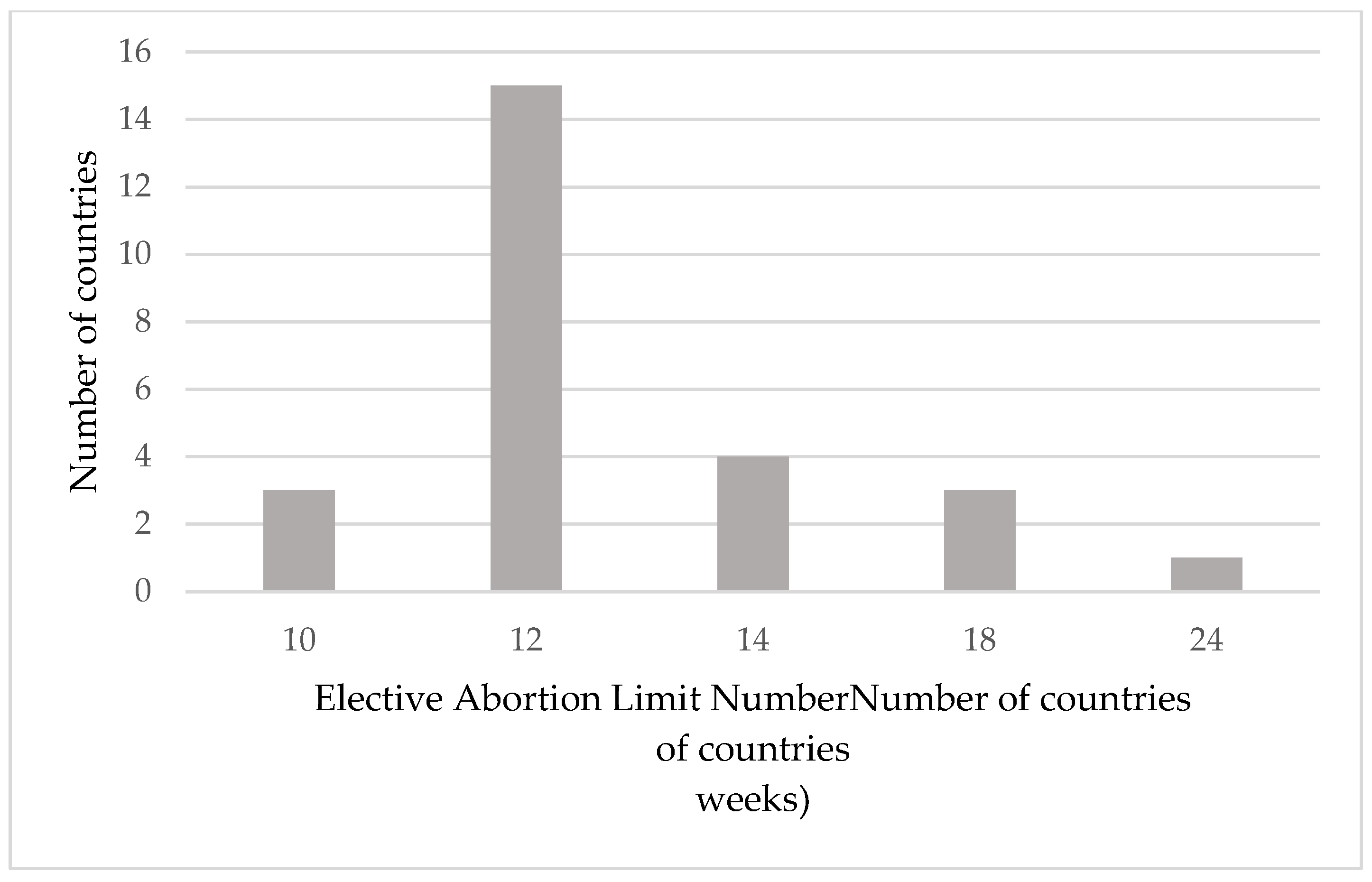
- model 1: gestational limit-based systems (Majority Model). Most European countries establish a primary gestational threshold (typically 10–14 weeks) for elective abortion, with defined exceptions for maternal health, fetal anomaly, and conception circumstances. This model represents a pragmatic compromise between early-term maternal autonomy and graduated state interest in fetal development, though the specific threshold chosen reflects political negotiation rather than biological determinism;
- -
- model 2: medical indication-based systems (e.g., UK). The UK employs a framework without fixed gestational limits, requiring instead medical certification that continuation of pregnancy would involve greater risk to physical or mental health than termination. This physician-centered model emphasizes clinical judgment over arbitrary temporal thresholds, though it potentially medicalizes reproductive decision-making by requiring professional gatekeeping;
- -
- model 3: exception-based frameworks (e.g., Poland, Hungary). These jurisdictions limit abortion to exceptional circumstances (life endangerment, health threats, criminal conception), reflecting constitutional or political prioritization of fetal protection over broad reproductive autonomy;
- -
- model 4: liberal extended-limit systems (e.g., The Netherlands). Extended gestational limits (18–24 weeks) reflect greater prioritization of maternal autonomy and recognition that decision-making and service access may require extended timeframes.
- -
- Geographic maldistribution: even in countries with liberal legal frameworks, services may be geographically concentrate in urban areas. These patter demonstrates that national legal frameworks must be supplemented with implementation analysis examining regional variation, rural-urban disparities, and provider availability;
- -
- Procedural Barriers: Mandatory waiting periods create temporal barriers that may interact with gestational limits to constrain access. Committee approval requirements introduce administrative delays and decision-making uncertainty. These procedural requirements warrant empirical investigation regarding their impact on gestational age at presentation and access patterns;
- -
- Cross-Border Care Flows: The heterogeneity in European abortion legislation generates substantial cross-border healthcare flows. These flows have significant implications: (1) they create inequalities based on financial resources and geographic proximity to liberal jurisdictions; (2) they may delay procedures as women navigate travel logistics, potentially pushing them beyond gestational limits in their destination country; (3) they complicate continuity of care and follow-up; (4) they raise jurisdictional questions regarding informed consent, medical records, and professional liability.
- cross-border practice: physicians trained in one jurisdiction may encounter different legal standards when practicing elsewhere in Europe, necessitating specialized legal training and potentially creating liability exposure when legal standards conflicts with clinical training;
- documentation and reporting requirements: variations in mandatory reporting, record-keeping, and statistical submission create administrative complexity for healthcare institutions, particularly in border regions serving international populations.
- Comprehensive Geographic Scope: the study encompasses 31 European jurisdictions, providing the broadest systematic coverage of European abortion legislation currently available in the scholarly literature;
- Primary Source Analysis: unlike previous reviews relying on secondary sources or international databases, this study systematically identified and analyzed primary legislative instruments (statutes, criminal codes, constitutional provisions) from official governmental sources;
- Systematic authentication protocols: all legislative documents underwent authentication through cross-referencing with multiple official sources, ensuring analysis of current, authoritative legal texts;
- Structured Analytical Framework: the development of a typology of regulatory models (gestational limit-based, medical indication, exception-based, and liberal extended-limit systems) provides conceptual structure for understanding policy variation beyond mere descriptive cataloging;
- Transparency and Reproducibility: detailed documentation of search protocols, inclusion criteria, authentication procedures, and analytical methods enables assessment of methodological rigor and potential replication by other researchers;
- Integration of Constitutional and Statutory Analysis: the study examines both constitutional provisions and statutory frameworks, recognizing that abortion regulation operates at multiple levels of legal hierarchy.
- quantitative analysis of cross-border abortion travel. Systematic data collection on the volume, demographics, and health outcomes of women travelling across European borders for abortion services would provide empirical evidence of practical access disparities;
- implementation studies: detailed examination of how legal provisions are implemented in clinical practice, including documentation requirements, committee approval processes, and conscientious objection management;
- comparative health outcomes research: analysis of maternal mortality and morbidity rates, gestational age at abortion, and complication rates across different regulatory models to assesses the public health impacts of legal variation;
- economic analysis: investigation of the costs of cross-border reproductive care, including travel expenses, lost wages, childcare costs, and psychological impacts of delayed access;
- legal ethnography: qualitative research examining how women, healthcare providers, and legal professionals navigate and interpret abortion laws in practice;
5. Conclusions
- quantitative epidemiological analysis of cross-border abortion flows, gestational age at presentation, maternal health outcomes, and abortion-related morbidity and mortality across different regulatory models;
- qualitative investigation of women’s experiences navigating different legal systems, healthcare provider perspectives on legal constraints, and the practical implementation of statutory provisions;
- economic evaluation of the costs, both financial and psychosocial, associated with cross-border care-seeking and delayed access due to exception-based frameworks;
- medico-legal analysis of professional liability issues, documentation requirements, and ethical challenges faced by providers in multi-jurisdictional contexts;
- medico-legal case analysis: systematic review of litigation and professional disciplinary cases involving abortion provision across European jurisdictions to identify common sources of legal liability and develop evidence-based risk management strategies;
- Constitutional court monitoring: longitudinal analysis of how national constitutional courts and the ECHR interpret and apply abortion-related provisions, examining the evolution of legal standards through jurisprudence;
- Healthcare provider surveys: empirical investigation of how medical professionals understand and navigate legal requirements, including assessment of legal knowledge, perceived ambiguities, and risk management strategies employed in clinical practice.
Supplementary Materials
Author Contributions
Funding
Institutional Review Board Statement
Informed Consent Statement
Data Availability Statement
Conflicts of Interest
Abbreviations
| CC | Criminal Code |
| ECHR | European Court of Human Rights |
| EU | European Union |
| HIV | Human Immunodeficiency Virus |
| NHS | National Health Service |
| PRISMA | Preferred Reporting Items for Systematic reviews and Meta-Analyses |
| UK | United Kingdom |
| WHO | World Health Organization |
References
- Pellegrini, L.; Sorace, L.; Tortorella, V.; Baggio, U.; De Paola, L.; D’Antonio, G.; La Russa, R.; Frati, P. Comparative Analysis of Legislation on Voluntary Interruption of Pregnancy: Italy’s Position Relate to International Panorama. Clin. Ter. 2024, 175, 117–120. [Google Scholar] [CrossRef] [PubMed]
- Frati, P.; Fineschi, V.; Di Sanzo, M.; La Russa, R.; Scopetti, M.; Severi, F.M.; Turillazzi, E. Preimplantation and Prenatal Diagnosis, Wrongful Birth and Wrongful Life: A Global View of Bioethical and Legal Controversies. Hum. Reprod. Update 2017, 23, 338–357. [Google Scholar] [CrossRef] [Scilit] [PubMed]
- Clinical Practice Handbook for Quality Abortion Care. Available online: https://www.who.int/publications/i/item/9789240075207 (accessed on 21 September 2025).
- Abortion Care Guideline. Available online: https://www.who.int/publications/i/item/9789240039483 (accessed on 6 November 2025).
- Hoffman, B.L.; Schorge, J.O.; Halvorson, L.M.; Hamid, C.A.; Corton, M.M.; Schaffer, J.I. (Eds.) Williams Gynecology, 4th ed.; McGraw-Hill’s AccessMedicine; McGraw-Hill Education LLC: New York, NY, USA, 2020; ISBN 9781260456868. [Google Scholar]
- Doran, F.; Nancarrow, S. Barriers and Facilitators of Access to First-Trimester Abortion Services for Women in the Developed World: A Systematic Review. J. Fam. Plann. Reprod. Health Care 2015, 41, 170–180. [Google Scholar] [CrossRef] [Scilit]
- Fiala, C.; Agostini, A.; Bombas, T.; Lertxundi, R.; Lubusky, M.; Parachini, M.; Gemzell-Danielsson, K. Abortion: Legislation and Statistics in Europe. Eur. J. Contracept. Reprod. Health Care 2022, 27, 345–352. [Google Scholar] [CrossRef] [Scilit] [PubMed]
- De Zordo, S.; Zanini, G.; Mishtal, J.; Garnsey, C.; Ziegler, A.; Gerdts, C. Gestational Age Limits for Abortion and Cross-border Reproductive Care in Europe: A Mixed-methods Study. BJOG 2021, 128, 838–845. [Google Scholar] [CrossRef] [Scilit]
- Pinter, B.; Aubeny, E.; Bartfai, G.; Loeber, O.; Ozalp, S.; Webb, A. Accessibility and Availability of Abortion in Six European Countries. Eur. J. Contracept. Reprod. Health Care 2005, 10, 51–58. [Google Scholar] [CrossRef] [Scilit]
- Chavkin, W.; Swerdlow, L.; Fifield, J. Regulation of Conscientious Objection to Abortion: An International Comparative Multiple-Case Study. Health Hum. Rights 2017, 19, 55–68. [Google Scholar]
- Levels, M.; Sluiter, R.; Need, A. A Review of Abortion Laws in Western-European Countries. A Cross-National Comparison of Legal Developments between 1960 and 2010. Health Policy 2014, 118, 95–104. [Google Scholar] [CrossRef] [Scilit]
- De Zordo, S.; Mishtal, J.; Anton, L. A Fragmented Landscape: Abortion Governance and Protest Logics in Europe. Am. Hist. Rev. 2017, 122, 975. [Google Scholar] [CrossRef] [Scilit]
- Page, M.J.; McKenzie, J.E.; Bossuyt, P.M.; Boutron, I.; Hoffmann, T.C.; Mulrow, C.D.; Shamseer, L.; Tetzlaff, J.M.; Akl, E.A.; Brennan, S.E.; et al. The PRISMA 2020 Statement: An Updated Guideline for Reporting Systematic Reviews. BMJ 2021, 372, n71. [Google Scholar] [CrossRef] [Scilit]
- Gesamte Rechtsvorschrift für Strafgesetzbuch, Fassung vom 11.10. 2021. Available online: https://www.cms.int/cami/sites/default/files/document/cms_nlp_aut_criminal_code_1974.pdf (accessed on 21 September 2025).
- Strafgesetzbuch (StGB) Abtreibung §§ 96–98: Abtreibung (Penal Code Articles 96–98: Abortion). Legal Information Institute. Available online: https://www.law.cornell.edu/gender-justice/resource/strafgesetzbuch_%28stgb%29_abtreibung_%C2%A7%C2%A7_96-98_abtreibung_%28penal_code_articles_96-98_abortion%29 (accessed on 21 September 2025).
- Available online: https://www.pregnantinbelgium.com/ending-a-pregnancy (accessed on 21 September 2025).
- De Meyer, F. Late Termination of Pregnancy in Belgium: Exploring Its Legality and Scope. Eur. J. Health Law 2020, 27, 9–34. [Google Scholar] [CrossRef] [Scilit]
- Bulgaria—GAPD—The Global Abortion Policies Database. Available online: https://abortion-policies.srhr.org/country/bulgaria/ (accessed on 20 September 2025).
- CYPRUS—The Parliament Has Changed the Abortion Law After Three Years of Inaction. Available online: https://www.safeabortionwomensright.org/news/cyprus-the-parliament-has-changed-the-abortion-law-after-three-years-of-inaction/ (accessed on 21 September 2025).
- Law No. 1252-1978 of 21 April 1978, Act Concerning the Medical Measures for Materialization of the Right to Freely Decide on the Birth of Children. Available online: https://web.archive.org/web/20120603114716/http://www.hsph.harvard.edu/population/abortion/CROATIA.abo.htm (accessed on 21 September 2025).
- Croatia’s Abortion Provisions. Available online: https://reproductiverights.org/maps/provision/croatias-abortion-provisions/ (accessed on 21 September 2025).
- Czech Republic—GAPD—The Global Abortion Policies Database. Available online: https://abortion-policies.srhr.org/country/czech-republic/ (accessed on 20 September 2025).
- Indenrigsog Sundhedsministeriet, Bekendtgørelse Af Sundhedsloven. 2014. Available online: https://www.retsinformation.dk/eli/lta/2014/1202 (accessed on 26 February 2026).
- Jess, M.; Carlsen, S.E.; Gantzel, M.; Løkkegaard, E.C.L.; Møller, T.; Bendix, J.M.; Timm, H. The Ambivalence of Abortion: An Explorative Study on Attitudes towards Elective Abortion and Abortion Limits among Pregnant Women in Denmark. Midwifery 2025, 145, 104381. [Google Scholar] [CrossRef] [Scilit]
- Having an Abortion in Denmark. International.Kk.Dk. Available online: https://international.kk.dk/live/healthcare/having-a-baby-in-copenhagen/having-an-abortion-in-denmark (accessed on 21 September 2025).
- Termination of Pregnancy. Available online: https://www.inimoigustegiid.ee/en/themes/family/reproductive-rights/termination-of-pregnancy (accessed on 22 September 2025).
- Termination of Pregnancy, (i.e., Abortion). Available online: https://www.eesti.ee/eraisik/en/artikkel/family/pregnancy/termination-of-pregnancy-ie-abortion (accessed on 23 September 2025).
- Oja, L. Why Is a “Good Abortion Law” Not Enough? The Case of Estonia. Health Hum. Rights 2017, 19, 161–172. [Google Scholar] [PubMed]
- Termination of Pregnancy. Available online: https://stm.fi/en/termination-of-pregnancy (accessed on 22 September 2025).
- Abortion. Available online: https://www.infofinland.fi/en/health/abortion (accessed on 22 September 2025).
- Available online: https://www.legifrance.gouv.fr/loda/id/JORFTEXT000000700230?init=true&page=1&query=75-17&searchField=ALL&tab_selection=all (accessed on 24 September 2025).
- Available online: https://www.legifrance.gouv.fr/codes/texte_lc/LEGITEXT000006072665/ (accessed on 24 September 2025).
- Beauchemin, A.; Boulet, L. Impact of a Constitutionally Recognized Right to Abortion: Analysis of the French Case. Völkerrechtsblog 2024. [Google Scholar] [CrossRef]
- Available online: https://www.buzer.de/s1.htm?g=StGB&a=218-219b (accessed on 22 September 2025).
- Ioannidi-Kapolou, E. Use of Contraception and Abortion in Greece: A Review. Reprod. Health Matters 2004, 12, 174–183. [Google Scholar] [CrossRef] [Scilit]
- Available online: https://www.globalcitizensolutions.com/greece-abortion-law/ (accessed on 24 September 2025).
- Women’s Health and Pregnancy Care. Available online: https://help.unhcr.org/hungary/maternity/ (accessed on 22 September 2025).
- Available online: https://nokjoga.hu/wp-content/uploads/abortion-pocket-guide.pdf (accessed on 25 September 2025).
- Available online: https://www.irishstatutebook.ie/eli/2018/act/31/section/11/enacted/en/html (accessed on 26 September 2025).
- When You Can Have an Abortion. Available online: https://www2.hse.ie/conditions/abortion/when-you-can-have/ (accessed on 22 September 2025).
- Carnegie, A.; Roth, R. From the Grassroots to the Oireachtas: Abortion Law Reform in the Republic of Ireland. Health Hum. Rights 2019, 21, 109–120. [Google Scholar] [PubMed]
- Donnelly, M.; Murray, C. Abortion Care in Ireland: Developing Legal and Ethical Frameworks for Conscientious Provision. Int. J. Gynecol. Obstet. 2020, 148, 127–132. [Google Scholar] [CrossRef] [Scilit] [PubMed]
- LEGGE 22 Maggio 1978, n. 194—Normattiva. Available online: https://www.normattiva.it/uri-res/N2Ls?urn:nir:stato:legge:1978-05-22;194 (accessed on 22 September 2025).
- Abortion in Italy. Available online: https://www.epicentro.iss.it/ben/2001/aprile/1_en (accessed on 22 September 2025).
- Paterlini, M. The Italian Law Enabling, and Disabling, Abortion Access. BMJ 2022, 379, o2563. [Google Scholar] [CrossRef] [Scilit] [PubMed]
- Vestnesis.lv Seksuālās un Reproduktīvās Veselības Likums—Latvijas Vēstnesis. Available online: https://www.vestnesis.lv/ta/id/58982-seksualas-un-reproduktivas-veselibas-likums (accessed on 22 September 2025).
- Vestnesis.lv Grūtniecības Pārtraukšanas Organizatoriskā…—Latvijas Vēstnesis. Available online: https://www.vestnesis.lv/ta/id/80585-grutniecibas-partrauksanas-organizatoriska-kartiba (accessed on 22 September 2025).
- Latvia—GAPD—The Global Abortion Policies Database. Available online: https://abortion-policies.srhr.org/country/latvia/ (accessed on 20 September 2025).
- Available online: https://legislationline.org/Latvia (accessed on 23 September 2025).
- Lithuania’s Abortion Provisions. Available online: https://reproductiverights.org/maps/provision/lithuanias-abortion-provisions/ (accessed on 22 September 2025).
- Available online: https://dumas.ccsd.cnrs.fr/dumas-03051710v1/document (accessed on 21 September 2025).
- Available online: https://santesecu.public.lu/dam-assets/fr/publications/i/ivg-fr-de-en-pt/ivg-brochure-en.pdf (accessed on 22 September 2025).
- Available online: https://legislation.mt/eli/cap/9/eng/pdf (accessed on 9 February 2026).
- Available online: https://timesofmalta.com/article/doctors-praise-protocol-for-ectopic-pregnancies-after-womans-claims.835877 (accessed on 9 February 2026).
- Available online: https://www.theguardian.com/world/2023/jun/28/malta-to-allow-abortion-but-only-when-womans-life-is-at-risk (accessed on 9 February 2026).
- Available online: https://eur-lex.europa.eu/eli/treaty/acc_2003/act_1/pro_7/sign (accessed on 9 February 2026).
- Available online: https://cyber.harvard.edu/population/abortion/Nether.abo.htm (accessed on 22 September 2025).
- Available online: https://www.government.nl/topics/abortion (accessed on 22 September 2025).
- Holten, L.; de Goeij, E.; Kleiverda, G. Permeability of Abortion Care in the Netherlands: A Qualitative Analysis of Women’s Experiences, Health Professional Perspectives, and the Internet Resource of Women on Web. Sex. Reprod. Health Matters 2021, 29, 1917042. [Google Scholar] [CrossRef] [Scilit]
- Available online: https://lovdata.no/dokument/NLO/lov/1975-06-13-50 (accessed on 22 September 2025).
- Available online: https://eurohealthobservatory.who.int/monitors/health-systems-monitor/updates/hspm/norway-2020/new-abortion-law-comes-into-force-in-norway (accessed on 20 September 2025).
- Available online: https://www.helsedirektoratet.no/forebygging-diagnose-og-behandling/svangerskap-fodsel-og-barsel/abort (accessed on 19 September 2025).
- Poland Law of 7 January 1993 on Family Planning, Protection of Human Fetuses, and the Conditions under Which Pregnancy Termination Is Permissible. Int. Dig. Health Legis. 1993, 44, 253–255.
- Ray, N. New UN Report: Polish Abortion Law Violates Human Rights. Available online: https://reproductiverights.org/un-cedaw-report-poland-abortion/ (accessed on 29 September 2025).
- Hussein, J.; Cottingham, J.; Nowicka, W.; Kismodi, E. Abortion in Poland: Politics, Progression and Regression. Reprod. Health Matters 2018, 26, 1467361. [Google Scholar] [CrossRef] [Scilit]
- Available online: https://diariodarepublica.pt/dr/detalhe/decreto-lei/48-1995-185720 (accessed on 29 September 2025).
- Campos, G. Portugal Abortion Laws: Everything You Need to Know. Global Citizen Solutions. 2022. Available online: https://www.globalcitizensolutions.com/abortion-law-in-portugal/ (accessed on 26 February 2026).
- Vicente, L.F. The Woman’s Choice for Abortion: The Experience in Portugal with Implementation of the National Network. Cad. Saude Publica 2020, 36, e00036219. [Google Scholar] [CrossRef] [Scilit] [PubMed]
- Available online: https://www.vertic.org/media/National%20Legislation/Romania/RO_Criminal_Code.pdf (accessed on 30 September 2025).
- Noul Cod Penal. 2014. Available online: https://web.archive.org/web/20150517054948/http://www.avocatura.com/ll491-noul-cod-penal.html (accessed on 29 September 2025).
- Available online: https://abortion-policies.srhr.org/country/slovakia/ (accessed on 30 September 2025).
- Available online: https://reproductiverights.org/maps/provision/slovak-republics-abortion-provisions/ (accessed on 30 September 2025).
- Tresnjevka. Abortion in Croatia and Slovenia. Newsl. Womens Glob. Netw. Reprod. Rights 1992, 36–37. [Google Scholar]
- Available online: https://abortion-policies.srhr.org/country/slovenia/ (accessed on 30 September 2025).
- Vodopivec, S.; Bokal, E.V.; Pinter, B. Counselling before First Trimester Abortion and Acceptability of the Procedure: Results from a Slovenian Cross-Sectional Study. Eur. J. Contracept. Reprod. Health Care 2019, 24, 487–493. [Google Scholar] [CrossRef] [Scilit] [PubMed]
- BOE-A-2010-3514 Ley Orgánica 2/2010, de 3 de Marzo, de Salud Sexual y Reproductiva y de La Interrupción Voluntaria Del Embarazo. Available online: https://www.boe.es/buscar/act.php?id=BOE-A-2010-3514 (accessed on 29 September 2025).
- Pellico-López, A.; Paz-Zulueta, M.; Manjón-Rodríguez, J.B.; Sánchez Movellán, M.; Ajo Bolado, P.; García-Vázquez, J.; Cayón-De Las Cuevas, J.; Ruiz-Azcona, L. Evolution of Legislation and the Incidence of Elective Abortion in Spain: A Retrospective Observational Study (2011–2020). Int. J. Environ. Res. Public Health 2022, 19, 9674. [Google Scholar] [CrossRef] [Scilit]
- Available online: https://www.1177.se/sa-fungerar-varden/lagar-och-bestammelser/lagar-i-varden/abortlagen/ (accessed on 30 September 2025).
- Available online: https://www.rfsu.se/contentassets/48adfec3a7254bd590c07c79766000a8/en_om_abort.pdf (accessed on 30 September 2025).
- Wängborg, A.; Schmidt, J.; Mattison, C.; Bourret, K.; Klingberg Allvin, M. The Road to Equity: A Scoping Review of the Evidence and Practices on Abortion Policies and Services in Sweden. Sex. Reprod. Healthc. 2025, 43, 101071. [Google Scholar] [CrossRef] [Scilit]
- Available online: https://www.riksdagen.se/sv/dokument-och-lagar/dokument/statens-offentliga-utredningar/abort-i-sverige-del-1_gtb390/html/ (accessed on 30 September 2025).
- Available online: https://www.riksdagen.se/sv/dokument-och-lagar/dokument/svensk-forfattningssamling/abortlag-1974595_sfs-1974-595/ (accessed on 30 September 2025).
- Available online: http://www.admin.ch/ch/e/rs/3/311.0.en.pdf (accessed on 30 September 2025).
- Available online: https://www.bj.admin.ch/bj/en/home/gesellschaft/gesetzgebung/archiv/schwangerschaftsabbruch.html (accessed on 30 September 2025).
- Available online: https://www.fr.ch/sites/default/files/2018-10/ivg_eng_final_web.pdf?v=1539696173 (accessed on 6 February 2026).
- Available online: https://www.legislation.gov.uk/ukpga/1967/87/contents (accessed on 9 February 2026).
- Available online: https://www.bma.org.uk/advice-and-support/ethics/abortion/the-law-and-ethics-of-abortion (accessed on 9 February 2026).
- Available online: https://www.rcog.org.uk/guidance/browse-all-guidance/other-guidelines-and-reports/the-care-of-women-requesting-induced-abortion-evidence-based-clinical-guideline-no-7/ (accessed on 9 February 2026).
- Available online: https://www.amnesty.org.uk/knowledge-hub/all-resources/abortion-decriminalised-in-northern-ireland/ (accessed on 9 February 2026).
- Greasley, K. Abortion Law in Transnational Perspective: Cases and Controversies; Cook, R.J., Erdman, J.N., Dickens, B.M., Eds.; University of Pennsylvania Press: Philadelphia, PA, USA, 2014; 480p, ISBN 978-0-8122-4627-8. [Google Scholar] [CrossRef] [Scilit]
- Orsini, F.; Cioffi, A.; Cipolloni, L.; Bosco, M.A.; Fabrello, C.; Cecannecchia, C.; De Simone, S. Towards a European End-of-Life Regulation: A Necessary Analysis. Healthcare 2025, 13, 130. [Google Scholar] [CrossRef] [Scilit]
- Frati, P.; De Simone, S.; Pollice, G.; Giacani, E.; Cipolloni, L.; Orsini, F. Legal Perspectives on Sexual Violence: A Cross-European Study. Forensic Sci. 2025, 5, 38. [Google Scholar] [CrossRef] [Scilit]
- Cioffi, A.; Cioffi, F.; Rinaldi, R. COVID-19 and Abortion: The Importance of Guaranteeing a Fundamental Right. Sex. Reprod. Healthc. 2020, 25, 100538. [Google Scholar] [CrossRef] [Scilit]
- Bojovic, N.; Stanisljevic, J.; Giunti, G. The Impact of COVID-19 on Abortion Access: Insights from the European Union and the United Kingdom. Health Policy 2021, 125, 841–858. [Google Scholar] [CrossRef] [Scilit]


| Component | Description | Operational Definition/Criteria |
|---|---|---|
| Review Type | Contextual Narrative Review | Aimed at providing scholarly context for primary legislative analysis rather than a systematic synthesis of empirical outcomes. |
| Search Strategy | Expanded Boolean Query | ((“abortion”) AND (“law” OR “legislation” OR “statute”) AND (“Europe” OR “EU”)) across PubMed, Scopus, and official legal repositories. |
| Elective Limit | Operational Definition | The legal threshold for “abortion on request” (gestational weeks), measured form the first day of the last menstrual period (LMP). |
| Health Exceptions | Coding Category | Statutory grounds covering physical health, mental health, or “well-being” (excluding immediate life-risk). |
| Fetal Grounds | Coding Category | Provisions relating to “fetal abnormality,” “malformation,” or “genetic grounds” with associated gestational limits. |
| Translation | Reliability Method | Prioritization of official governmental translations; cross-referencing technical terms across multilingual legal databases (e.g., EUR-Lex). |
| Country | Elective Abortion Limit | Main Exceptions |
|---|---|---|
| Austria | Up to three months from completed implantation | - Immediate threat to woman’s life; - Risk to physical/mental health; - Severe fetal impairment; pregnancy from rape (age < 14). |
| Belgium | 12 weeks | - Significant threat to woman’s life; - Incurable fetal disease. |
| Bulgaria | 12 weeks | - Up to 20 weeks: risk to woman’s/fetal health; - Any stage: risk to life or severe malformation. |
| Cyprus | 12 weeks | - Any stage: risk to physical/mental health; - Up to 19 weeks: pregnancy from sexual crime; - Up to 24 weeks: sever fetal abnormality. |
| Croatia | 10 weeks | - Any stage: risk to life, health severe congenital defects, rape; - Not permitted if harmful to woman. |
| Czech Republic | 12 weeks | - Any stage: danger to life, severe malformation, fetal nonviability. - Up to 24 weeks: genetic grounds. |
| Denmark | 18 weeks | - Risk to woman’s life/health; - Severe physical/mental fetal disorder; - Woman’s incapacity to care; - Pregnancy from criminal act. |
| Estonia | 11 weeks | - Up to 21 weeks: health risk, severe fetal disorder, age < 15 or >45. |
| Finland | 12 weeks | - Any stage: risk to woman’s health; - Up to 20 weeks: social conditions, age, sexual crimes; - Up to 24 weeks: serious fetal illness. |
| France | 14 weeks | - Serious risk to woman’s life/health - Serious incurable fetal disease. |
| Germany | 12 weeks | - Up to 12 weeks: pregnancy from criminal offense; - Up to 22 weeks: danger to life, grave health impairment. |
| Greece | 12 weeks | - Any stage: risk to life or serious permanent damage; - Up to 19 weeks: rape/incest; - Up to 24 weeks: fetal abnormality. |
| Hungary | Limited grounds for termination | - Any stage: risk to life, incompatible malformation; - Up to 12 weeks: severe health danger, fetal disability, rape; - Up to 18–24 weeks: malformation > 50% probability. |
| Ireland | 12 weeks | - Any stage: immediate serious risk to life/health, fatal fetal condition; - Up to fetal viability: serious risk to life/health. |
| Italy | 12 weeks and 6 days | - Any stage: serious threat to life from pregnancy/childbirth, serious pathologies; - Up to 90 days: health risk, economic/social circumstances. |
| Latvia | 12 weeks | - Up to 12 weeks: rape; - Up to 22 weeks: medical grounds. |
| Lithuania | 12 weeks | - Up to 22 weeks: risk to woman’s life/health, fetal malformation. |
| Luxembourg | 12 weeks | - Any stage: serious threat to woman’s fetal health or life. |
| Malta | Prohibited (Criminalized under Articles 241–243 of the CC) | -Permitted only when the pregnant person’s life is at immediate risk or their health is in grave jeopardy, subject to medical consensus and fetal viability assessment (Article 243B). |
| The Netherlands | 24 weeks | - Up to fetal viability (22–24 weeks): certified state of distress. |
| Norway | 18 weeks | - Beyond 18 weeks: only if medically necessary; - Prohibited after 22 weeks (except nonviability). |
| Poland | Specific exceptional circumstances only | - Only: danger to woman’s life/health, rape/incest. |
| Portugal | 10 weeks | - Any stage: fetal nonviability, danger to life/permanent health; - Up to 16 weeks: sexual violence; - Up to 24 weeks: incurable fetal disease. |
| Romania | 14 weeks | - Any stage: therapeutic purposes; - Up to 24 weeks: woman’s/fetal interests. |
| Slovakia | 12 weeks | - Danger to woman’s life/health, fetal development, genetic abnormalities. |
| Slovenia | 10 weeks | - Up to 28 weeks: with medical committee approval; - After 22 weeks: legally considered stillbirth. |
| Spain | 14 weeks | - Up to 22 weeks: risk to life/health, serious fetal abnormality; - Any stage: malformation incompatible with life. |
| Sweden | 18 weeks | - Up to 22 weeks: serious medical risk to life/health. |
| Switzerland | 12 weeks | - Prevention of serious physical/psychological harm to woman. |
| United Kingdom (England, Scotland, Wales) | Up to 24 weeks | -No time limit if necessary to save the woman’s life, prevent grave permanent injury to her physical/mental health, or in cases of substantial risk of severe fetal abnormality. |
| United Kingdom (Northern Ireland) | Up to 12 weeks | -Beyond 12 weeks, permitted under specific health criteria or fetal abnormality, aligning with the general standards of the UK framework since 2020. |
| Regulatory Model | Explicit Classification Criteria | Key Legislative Features and Jurisdictional Examples | Handling of Hybrid/Mixed Cases |
|---|---|---|---|
| Gestational Limit-based (Majority Model) | Establishment of a primary gestational threshold (typically 10–14 weeks) for elective abortion (on request). | Features: Access on request until the limit; tiered exceptions thereafter (life, health, fetal anomaly). Examples: Austria (14w), France (14w), Italy (12w 6d), Germany (12w). | Classified by the primary elective threshold. Countries like Germany are included here despite mandatory counseling requirements. |
| Medical Indication-based | Absence of a fixed gestational limit for elective abortion; requires medical certification of risk. | Features: Focus on clinical judgment and professional “gatekeeping” rather than temporal milestones. Example: United Kingdom | Categorized as physician-centered. Despite a 24-week limit for some grounds, the lack of an “on request” period defines this model. |
| Exception-based | Prohibition of elective abortion; access granted only under specific, restrictive legal grounds. | Features: Limited to life endangerment, severe health threats, or criminal conception (rape/incest). Examples: Poland, Hungary (under specific grounds). | Jurisdictions prioritizing fetal protection over autonomy. Hungary is included here due to the requirement of specific exceptional grounds even within 12 weeks. |
| Extended Gestational Request-based Model | Primary gestational limits for elective abortion significantly exceeding the 18-week threshold. | Features: Prioritization of maternal autonomy and recognition of extended decision-making timeframes. Example: The Netherlands (24 weeks). | Countries with limits > weeks are grouped here to highlight divergence from the 12-week European “standard.” |
Disclaimer/Publisher’s Note: The statements, opinions and data contained in all publications are solely those of the individual author(s) and contributor(s) and not of MDPI and/or the editor(s). MDPI and/or the editor(s) disclaim responsibility for any injury to people or property resulting from any ideas, methods, instructions or products referred to in the content. |
© 2026 by the authors. Licensee MDPI, Basel, Switzerland. This article is an open access article distributed under the terms and conditions of the Creative Commons Attribution (CC BY) license.
Share and Cite
Orsini, F.; Cipolloni, L.; Frati, P.; Pollice, G.; Fabrello, C.; De Simone, S. The Spectrum of Choice: A Review of European Abortion Legal Frameworks from a Medicolegal Perspective. Forensic Sci. 2026, 6, 29. https://doi.org/10.3390/forensicsci6010029
Orsini F, Cipolloni L, Frati P, Pollice G, Fabrello C, De Simone S. The Spectrum of Choice: A Review of European Abortion Legal Frameworks from a Medicolegal Perspective. Forensic Sciences. 2026; 6(1):29. https://doi.org/10.3390/forensicsci6010029
Chicago/Turabian StyleOrsini, Francesco, Luigi Cipolloni, Paola Frati, Giovanni Pollice, Chiara Fabrello, and Stefania De Simone. 2026. "The Spectrum of Choice: A Review of European Abortion Legal Frameworks from a Medicolegal Perspective" Forensic Sciences 6, no. 1: 29. https://doi.org/10.3390/forensicsci6010029
APA StyleOrsini, F., Cipolloni, L., Frati, P., Pollice, G., Fabrello, C., & De Simone, S. (2026). The Spectrum of Choice: A Review of European Abortion Legal Frameworks from a Medicolegal Perspective. Forensic Sciences, 6(1), 29. https://doi.org/10.3390/forensicsci6010029