1. Introduction
Gender-based violence and femicide are currently at the center of political and social debate, representing the most evident manifestation of a profound cultural distortion and the tragic culmination of a series of acts of violence—physical, psychological, and even economic—perpetrated by men against women.
The cycle of violence is sustained by several factors: gender stereotypes, discrimination, role stratification, and the existence of unequal power relations between women and men, all elements inherently connected to the patriarchal culture that still characterizes contemporary society.
Among the various forms of gender-based violence, particular relevance must be attributed to suicide induced by gender-based violence, a term referring to cases in which women are driven to suicide as a result of the physical, psychological, or economic violence to which they are subjected. This phenomenon is not confined to situations in which women take their own lives following prolonged physical abuse by a partner or family members, leaving them in a state of despair; rather, it manifests differently depending on cultural context. Examples include women in Zimbabwe accused of witchcraft and deprived of all resources, child brides in Sudan enduring intolerable sexual violence “legitimized” by marriage to adult men, and widows in Nepal subjected to social and economic dispossession [
1]. These examples are intended to illustrate the global heterogeneity of femicide, while the core focus of this review is the Italian legislative and medico-legal framework.
Before proceeding, it is necessary to clarify the terms femicide and feminicide, which have entered common and media usage as gender-neutral alternatives to the word “homicide,” but which express closely related—yet not identical—concepts. Both terms refer to the killing of women in all its manifestations.
The word feminicide has ancient origins and was already used in the nineteenth century to denote the killing of a woman because she was a woman; it appeared in the Law Lexicon of 1848 as a punishable crime [
2]. In the 1970s, the term was revived by the Latin American feminist movement, particularly in contexts such as Mexico and other Latin American countries, where murders of women were motivated by gender-related factors, such as refusal to accept abusive relationships or traditional female roles. The concept of “femicide” was introduced in the early 1990s by feminist criminologist Diana H. Russell to describe the killing of women by men because of their gender. Together with Caputi, Russell expanded this notion beyond the strict legal definition of homicide, encompassing a wide range of misogynistic killings rooted in power asymmetries and gender-based discrimination. This broader conceptualization includes murders following prolonged physical abuse, sexual violence escalating into homicide, and culturally or socially legitimized practices such as so-called “honor crimes,” as well as historical forms of persecution of women. In subsequent works, Russell further emphasized intimate partner femicide as one of the most prevalent manifestations of this phenomenon [
3,
4]. In the early 1990s, Karen Stout, in one of the first demographic analyses on the topic, introduced the concept of intimate femicide to describe the killing of women by their partners, excluding acts committed by strangers or acquaintances [
5]. Although this study represented one of the earliest demographic overviews of intimate femicide, it was based on cases occurring in the United States between 1980 and 1982 and therefore cannot be directly extrapolated to the contemporary Italian or European context.
A related phenomenon deserving attention is obstetric violence, still insufficiently recognized but increasingly significant in the Italian context. As highlighted by recent studies, this form of violence manifests through inappropriate or non-consensual practices during pregnancy and childbirth, representing another expression of power imbalance within healthcare settings [
6].
Having clarified the semantic elements and considering the overlapping use of the two terms, it becomes evident that femicide—as the most extreme form of violence—has its roots in misogyny and sexism, deeply embedded in social structures. This type of homicide reflects a broader social issue that underscores oppression and gender inequality, revealing the complex interconnection between violence and sexual discrimination. Discussing femicide today therefore requires addressing the gender dimension directly: it is the intentional killing of a woman because she is a woman [
7].
1.1. The International Framework
Gender-based violence has progressively come to be recognized internationally as a true public health emergency and a violation of fundamental human rights. Since the second half of the twentieth century, supranational organizations have initiated a process of legal and cultural redefinition of violence against women, acknowledging its profound psychological, social and health-related implications.
A turning point was the Convention on the Elimination of All Forms of Discrimination against Women (CEDAW), adopted by the United Nations General Assembly in 1979, which established the obligation for Member States to adopt proactive measures to promote gender equality and prevent all forms of abuse, exploitation and coercion. This approach was further strengthened by the 1993 UN Declaration on the Elimination of Violence against Women, which for the first time defined violence against women as “any act of gender-based violence that results in, or is likely to result in, physical, sexual or psychological harm or suffering to women, including threats, coercion, or arbitrary deprivation of liberty, whether occurring in public or private life” [
8].
The World Health Organization (WHO) contributed to shifting the debate from a purely legal issue to a health-related one, recognizing gender-based violence as a condition capable of causing serious physical and psychological consequences. The 2014 Global Status Report on Violence Prevention showed that one in three women worldwide experiences physical or sexual violence during her lifetime, often perpetrated by a partner or acquaintance [
9].
The Council of Europe, through Recommendation R(85)4 and, subsequently, the Istanbul Convention (2011), introduced an integrated approach based on four pillars: prevention, protection, prosecution, and coordinated policies. The Convention—considered the most important legally binding instrument on the topic—recognizes violence against women as an expression of historically unequal power relations and obligates signatory States to ensure coordination among judicial, healthcare and social systems [
10].
Following the European Union’s accession to the Convention, the multidimensional approach was reinforced through common guidelines and the introduction of mandatory training programs for healthcare professionals, forensic experts, and law enforcement. European Parliament resolutions in 2014 and 2021 reiterated the need for such training for early recognition of violence and proper medico-legal documentation.
Over the past two decades, several European countries have developed response models inspired by system-based logic. Spain, France, Germany, Sweden, and Portugal represent exemplary cases of integration between public policies, judicial protection, and healthcare. In Spain, Ley Orgánica 1/2004 established specialized courts, a unified healthcare protocol, and a national system for case monitoring [
11]; France, with the Grenelle contre les violences conjugales (2019), introduced electronic monitoring devices and mandatory training for judges and forensic physicians [
12]; Germany, through the Gewaltschutzgesetz (2002), established the principle of the immediate removal of the aggressor from the household [
13]; whereas Sweden and Portugal have focused on cultural prevention, education, and data centralization [
14,
15]. These experiences share a common feature: the awareness that reducing gender-based violence does not derive solely from harsher penalties, but from a stable, multidisciplinary system supported by structural resources.
In recent years, the international perspective has shifted toward a holistic conception of gender-based violence, viewing the victim not only as a subject of rights but as a person with complex psychological and social vulnerability. The adoption of trauma-informed care models has placed clinical and medico-legal dimensions at the center of protection pathways, recognizing the probative value of psychological harm as an essential component of judicial protection [
16].
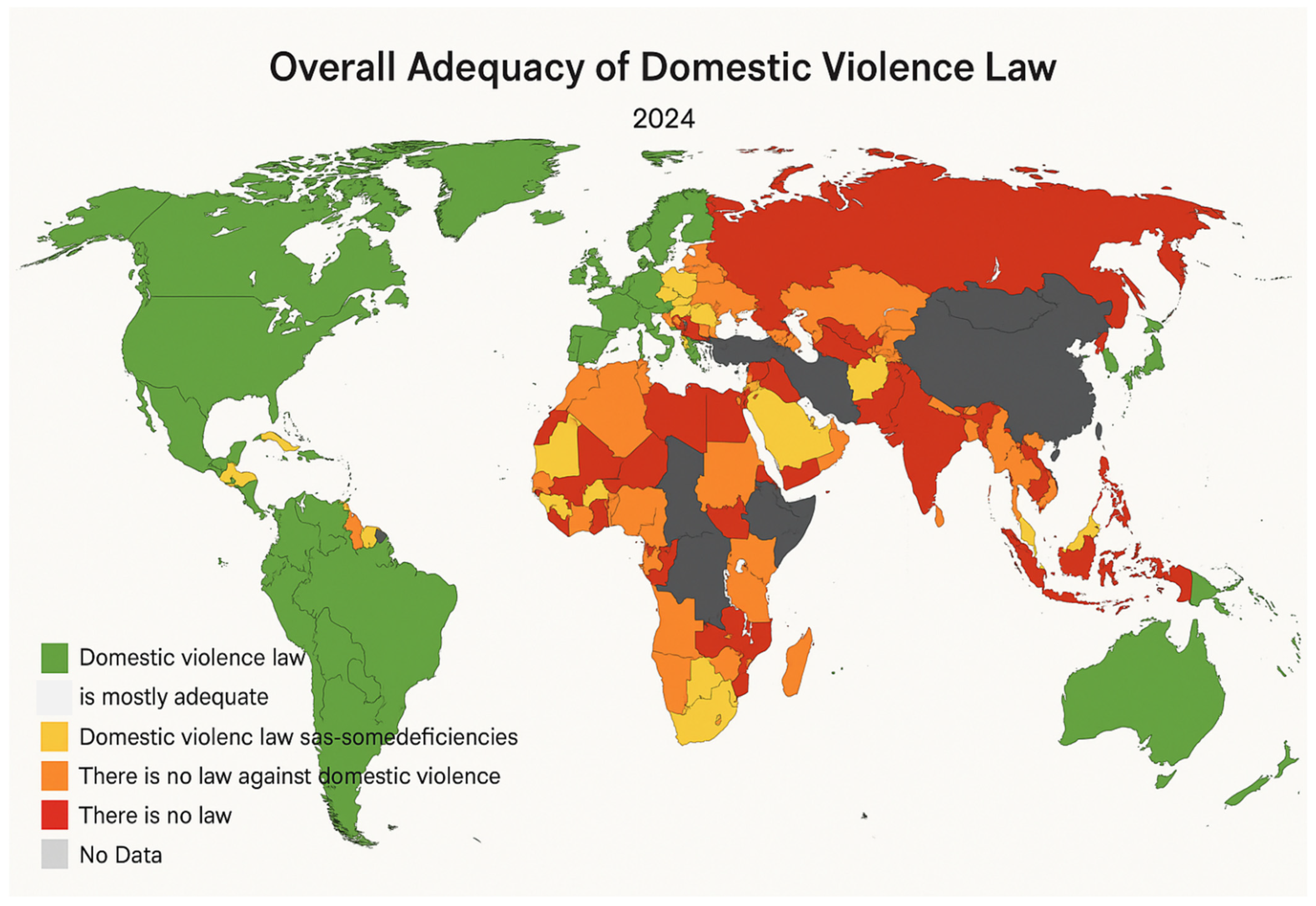
Despite significant legal progress, protection against domestic violence worldwide remains highly uneven.
Figure 1, titled “Overall Adequacy of Domestic Violence Law (2024)”, illustrates how only certain regions of Western Europe, North America, and Oceania have fully adequate legislation, while in many areas of Africa, Central Asia, and the Middle East, domestic violence is still not recognized as an autonomous criminal offense. In such contexts, the absence of an effective legal framework prevents the collection of reliable data and the development of formalized medico-legal protection protocols (
Figure 1). From a medico-legal standpoint, this heterogeneity results in differing capacities to recognize, document, and certify violence as harm to physical and psychological health. In countries with advanced systems, forensic medicine plays a strategic role in the construction of evidence and the safeguarding of the victim’s dignity, becoming an integral component of public health and justice systems. The 2024 global map therefore reflects not only the different levels of legal protection but also the profound cultural and institutional inequalities in the response to gender-based violence, highlighting the need for international convergence among law, medicine, and social sciences so that this phenomenon may be addressed everywhere as a public health issue rather than a private matter.
1.2. The Italian Framework
In Italy, the period following 1968 represented a turning point in the process of women’s emancipation and the affirmation of women’s rights. Driven by protest movements and feminist thought, publishing and public debate gave voice to a generation demanding equality, sexual freedom, economic autonomy, and social recognition [
17,
18]. However, while the issues of divorce and abortion soon gained central importance in political and legal discourse, the matter of gender-based violence remained marginalized for a long time, confined to the private and family sphere. Emblematic of this approach was the persistence, until 1981, of the so-called “honor killing” provision (Art. 587 of the Penal Code), which reduced penalties for homicide committed in defense of family honor—a patriarchal remnant that effectively sanctioned the legal and symbolic inferiority of women [
19]. A first significant shift occurred with Law No. 66/1996, which introduced “provisions against sexual violence,” recognizing for the first time sexual violence as a crime against the person rather than against public morality [
20]. This reform marked the beginning of a process aimed at redefining the role of women in the legal system, consistent with the principle of self-determination and with growing attention to the psychological dimension of the victim. In the 2000s, Italy progressively embraced European and international standards in the field of human rights and equal opportunities, culminating in the ratification of the Istanbul Convention through Law No. 172/2012. From that moment onward, the legislator introduced a series of measures aimed at strengthening penalties for domestic and gender-based violence and implementing preventive protection mechanisms, including the so-called “femicide law” (Law No. 119/2013) and, subsequently, the “Red Code” (Law No. 69/2019), which accelerated judicial intervention in cases of reports of mistreatment or abuse [
21].
The COVID-19 pandemic represented a dramatic rupture: domestic confinement amplified conditions of vulnerability and isolation among victims, leading to a significant increase in intrafamilial violence [
22]. Although quarantine measures were necessary to contain viral transmission, they unfortunately worsened women’s isolation and hindered access to support networks. The first ten months of 2020 revealed a tragic statistic: one femicide every three days.
According to the VII Eures Report on “Femicide in Italy,” one of the most significant findings concerns the correlation between cohabitation and homicide risk. The number of domestic femicides involving cohabiting victims increased by 10.2%, rising from 49 to 54 cases. The rate of cohabitation reached 67.5% in the first ten months of 2020, with a peak of 80.8% during the first lockdown: “21 of the 26 women killed were living with their murderer,” the report states.
The pandemic and the resulting isolation were also associated with a sharp increase in femicide-suicides, which rose by 90.3% (from 31 to 59 cases). While in 2019, this pattern accounted for 23% of cases, in the first ten months of 2020, it increased to 43.1% [
23].
These alarming data served as a driving force behind the reform of criminal procedure (Law No. 134/2021 [
24]), which expanded protections for victims of domestic and gender-based violence. In addition, Law No. 53/2022 [
25] improved the collection of statistical data on gender-based violence, promoting greater coordination among all involved stakeholders.
The most recent step in this legislative evolution is Law No. 168/2023, which introduced a systemic approach to violence prevention, strengthening the warning measure issued by the questore, immediate protective actions, and mandatory training for all professionals who come into contact with victims [
26]. The measure, consisting of 19 articles, is aimed particularly at prevention, ensuring that so-called “sentinel crimes” do not escalate into more serious offenses. The stricter provisions especially concern individuals who have already received a warning and repeat the same conduct—so-called recidivists. With this law, Italy consolidates a genuinely organic vision of the phenomenon, recognizing gender-based violence as an expression of structural inequality rather than a mere individual offense. Overall, the Italian legislative trajectory reflects a profound cultural transition: from the legal tolerance of violence “for honor” to the full protection of women’s personal liberty and psychophysical integrity. However, the gap between legal principles and practical implementation remains wide. The current challenge is not only legal but also medico-legal and social: building effective prevention networks, strengthening the training of healthcare professionals, and ensuring timely recognition of risk indicators, so that the law does not remain a formal statement but becomes a concrete tool of protection and justice (
Table 1).
The aims of this narrative review were threefold:
- -
to analyze and compare the evolution of femicide and gender-based violence legislation in Italy with the main European legal frameworks;
- -
to examine how these legislative models are translated into healthcare and medico-legal practices across different European contexts;
- -
to analyze the Italian “Pink Code” as a hospital-based operational pathway nested within the broader gender-based violence framework, evaluating its medico-legal implications and its degree of comparability with analogous European models.
2. Materials and Methods
This narrative review was designed to integrate legal sources with empirical medico-legal and clinical literature, in order to analyze how legislative frameworks are translated into hospital-based operational protocols, with particular reference to the Italian “Pink Code” pathway.
The term ‘gender-based violence’ is used according to the Italian legal framework, which primarily conceptualizes it as violence against women rooted in structural gender inequality. Violence affecting men, same-sex couples, or transgender individuals—although equally relevant from a human rights perspective—was not included, as it is regulated differently and would require a distinct analytical framework. We conducted this study by examining the landscape of gender-based violence and the increasingly common crime of femicide, both within the Italian context and globally. Our analysis involved a review of the legislation enacted from the 1940s to recent years, through searches of official Italian legislative sources (Gazzetta Ufficiale Italiana), as well as a literature review Electronic databases PubMed/MEDLINE, to identify peer-reviewed medical, forensic, and public health literature and Google Scholar, to retrieve medico-legal analyses, policy-oriented papers, and interdisciplinary studies not indexed in biomedical database, were searched covering the period from 2000 to 2025.
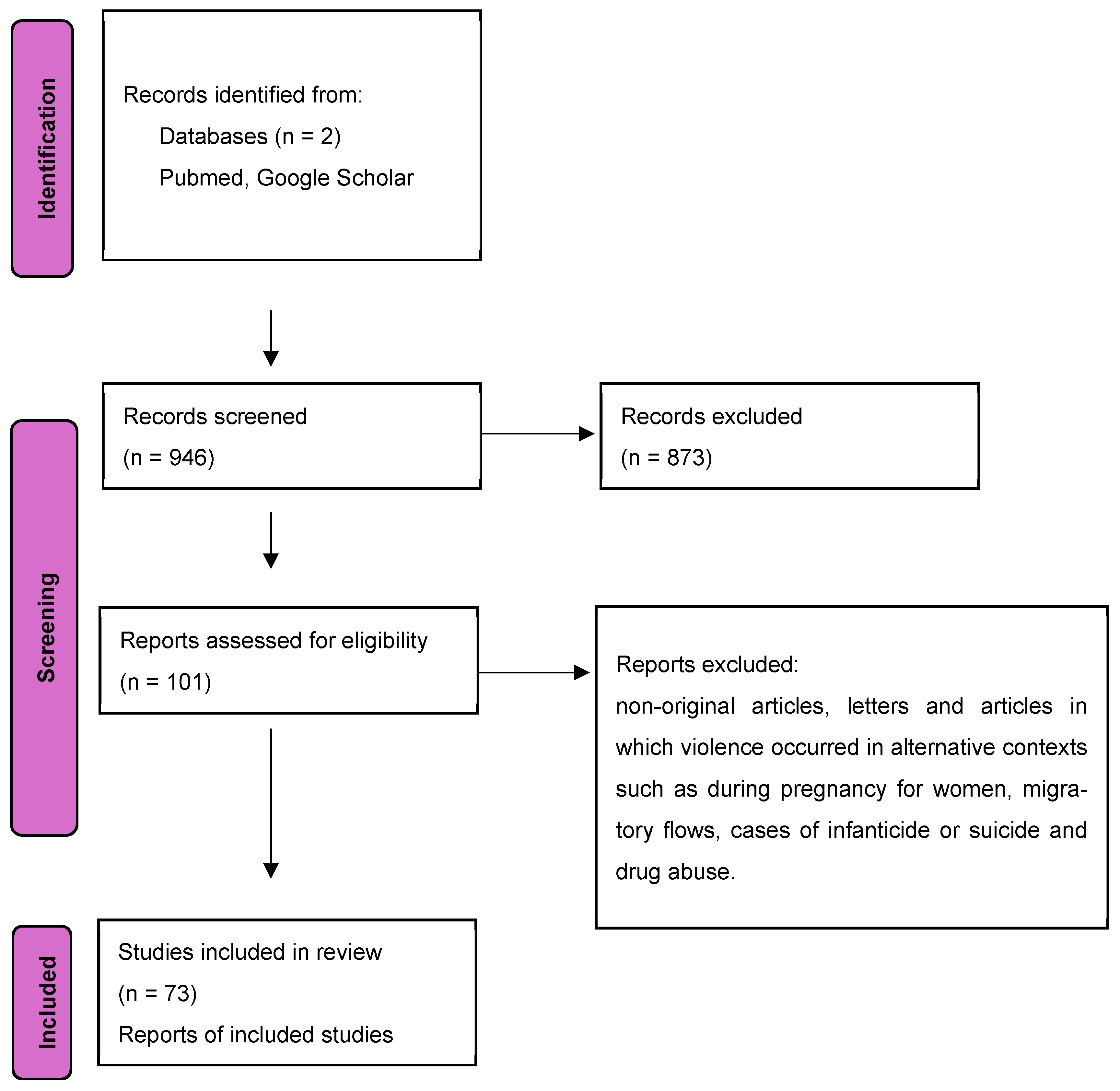
The search terms used were [violence], [medico-legal implications], and [women]. Out of a total of 918 articles initially identified (13 from PubMed and 905 from Google Scholar), after removing duplicates and excluding articles that did not meet the predefined criteria, we included 73 titles in this review. The review included original observational studies, medico-legal analyses, epidemiological reports, and forensic case series. We excluded non-original articles, letters, and studies in which violence occurred in alternative contexts, such as during pregnancy, migration flows, cases of infanticide or suicide, or substance abuse. In addition to these, the legal literature referenced above (28 sources) was also considered (
Figure 2).
3. Results
The geographical distribution of the included studies reflects the dual focus of the review. Of the 73 scientific articles analyzed, the majority (>45%) were conducted in Italy, where the “Pink Code” pathway has been formally implemented within the healthcare system. A substantial proportion originated from other European countries (>30%), mainly addressing gender-based violence from a legislative, public health, or forensic perspective, while a smaller number derived from non-European contexts, primarily North America and international institutional settings (~20%). Italian studies predominantly focused on hospital-based pathways and medico-legal documentation, whereas non-Italian studies addressed broader epidemiological and public health dimensions. This distribution mirrors the objective of the review, which was centered on the Italian medico-legal framework while incorporating a comparative international perspective.
On 20 November 2020, a meeting among European Ministers was held to promote cooperation among EU and EFTA countries in the fight against gender-based violence.
The meeting led to an agreement on the adoption of a single telephone number, valid across all 24 European countries (including Italy), connected to the existing national helplines. For example, in Lithuania a system was introduced allowing reports of domestic violence via SMS to the number 112; in Romania, the VENUS Project (2019–2023) promoted the establishment of 42 shelters and job-reintegration centers for women victims of violence; in Iceland, the Break the Silence project enhanced multisectoral cooperation (police, social services, healthcare) and operator training; in France, during the COVID-19 pandemic, anonymous reporting channels using SMS codes were activated during lockdown.
Thus, although each European country has adopted its own model for the prevention and fight against gender-based violence, several key principles—common to all—have been defined:
- -
prevention, protection, punishment and integrated policies (in line with the Istanbul Convention);
- -
development of “one-stop” models (a single point of access to health, legal and psychological services);
- -
Institutional coordination and social awareness.
When comparing the Italian regulatory framework with that of other European countries in relation to gender-based violence, it emerges that Italy occupies an overall advanced position at the legislative level yet remains heterogeneous and fragmented in terms of organization and territorial implementation. Compared with other European countries, two distinctive features become evident: on the one hand, Italy stands out for its penal framework and for the prompt ratification of the Istanbul Convention; on the other, it displays weaknesses in preventive measures, continuity of funding, and systemic coordination of services.
Italy ratified the Istanbul Convention in 2013, among the first EU Member States, incorporating into its legal system the main provisions on the prevention and counteraction of violence against women. Subsequent reforms—from Law No. 119/2013 on the so-called “femicide” to the 2019 Red Code (Law No. 69/2019)—introduced specific aggravating circumstances and fast-track procedures for criminal cases relating to gender-based offenses. This approach is predominantly punitive and repressive, aimed at ensuring a prompt and severe judicial response. In other European countries, while pursuing the same objectives, a systemic and preventive approach prevails. Spain, for example, with Ley Orgánica 1/2004 sobre medidas de protección integral contra la violencia de género, introduced a comprehensive integrated system combining criminal, civil, social, health, and educational measures within a single unified framework. France, beginning in 2019, incorporated the term féminicide into legislation as a specific aggravating circumstance and strengthened mechanisms for immediate victim protection. Nordic countries, such as Sweden, innovated the criminal field by introducing in 2018 a sexual-consent law (“Sex must be voluntary”), shifting the focus from the behavior of the victim to that of the perpetrator.
Although Italy has developed a formally advanced legislative framework, it remains anchored to a more repressive than preventive paradigm, with comparatively less attention to the cultural and social dimensions of violence. At the organizational level, the Italian model is based on a widespread network of anti-violence centers (CAV) and shelters, coordinated nationally by the Department for Equal Opportunities under the Presidency of the Council of Ministers. However, management is largely delegated to Regions and local authorities, resulting in significant differences between Northern and Southern Italy, both in terms of the number of facilities and the quality standards of services. The lack of a unified monitoring system and of regular funding renders the Italian response only partially effective, often dependent on the organizational capacity of individual territories.
In many other European countries, by contrast, governance is more centralized and stable. In Spain, for instance, the Institute for Women and Gender Equality (Instituto de la Mujer y para la Igualdad de Oportunidades) coordinates a national system of standardized centers and services. In Germany and the Netherlands, support services are regulated by federal or national laws ensuring multi-year funding, quality indicators, and a shared data-collection system among police, healthcare, and judiciary. The main difference compared with Italy lies in the continuity and uniformity of services: in Europe, support for victims is treated as an essential public service, whereas in Italy it often depends on extraordinary funds or time-limited projects. Furthermore, the hospital protocol known as the Pink Code, as a preferential and protected pathway characterized by multidisciplinary collaboration, has not been adopted by any other European country, where comparable solutions exist but are neither homogeneous nor standardized, such as Sexual Assault Care Centres or Women’s Houses, which offer medical, legal, and psychological assistance in the same setting. However, while the Italian Pink Code is not yet regulated by a mandatory national legislative framework, in Europe, such centers—where present—are institutionalized by law and integrated into the public healthcare system. Italy therefore occupies an intermediate position: conceptually innovative, yet still incomplete from both the regulatory and organizational perspectives.
Within the Italian legislative framework outlined above, the healthcare system plays a pivotal role in the operational management of gender-based violence. In this context, the ‘Pink Code’ represents the main hospital-based applied model. In Italy, the management of cases of violence began to be entrusted to hospital facilities through the establishment of a dedicated pathway for the assistance and care of victims, known as the “Pink code”. The Pink code is a specific protocol activated within healthcare structures, particularly in emergency departments, to manage cases of violence or suspected violence in a timely and appropriate manner.
This protocol is directed toward vulnerable victims—such as women, children, older adults, or persons with disabilities—and aims to ensure medical, psychological, and legal assistance, as well as protection and social support. The intra-hospital management of acute cases of gender-based violence is not always straightforward; it requires, in fact, a multidisciplinary approach involving several professionals simultaneously or at subsequent stages, depending on the patient’s clinical condition upon arrival in the emergency department.
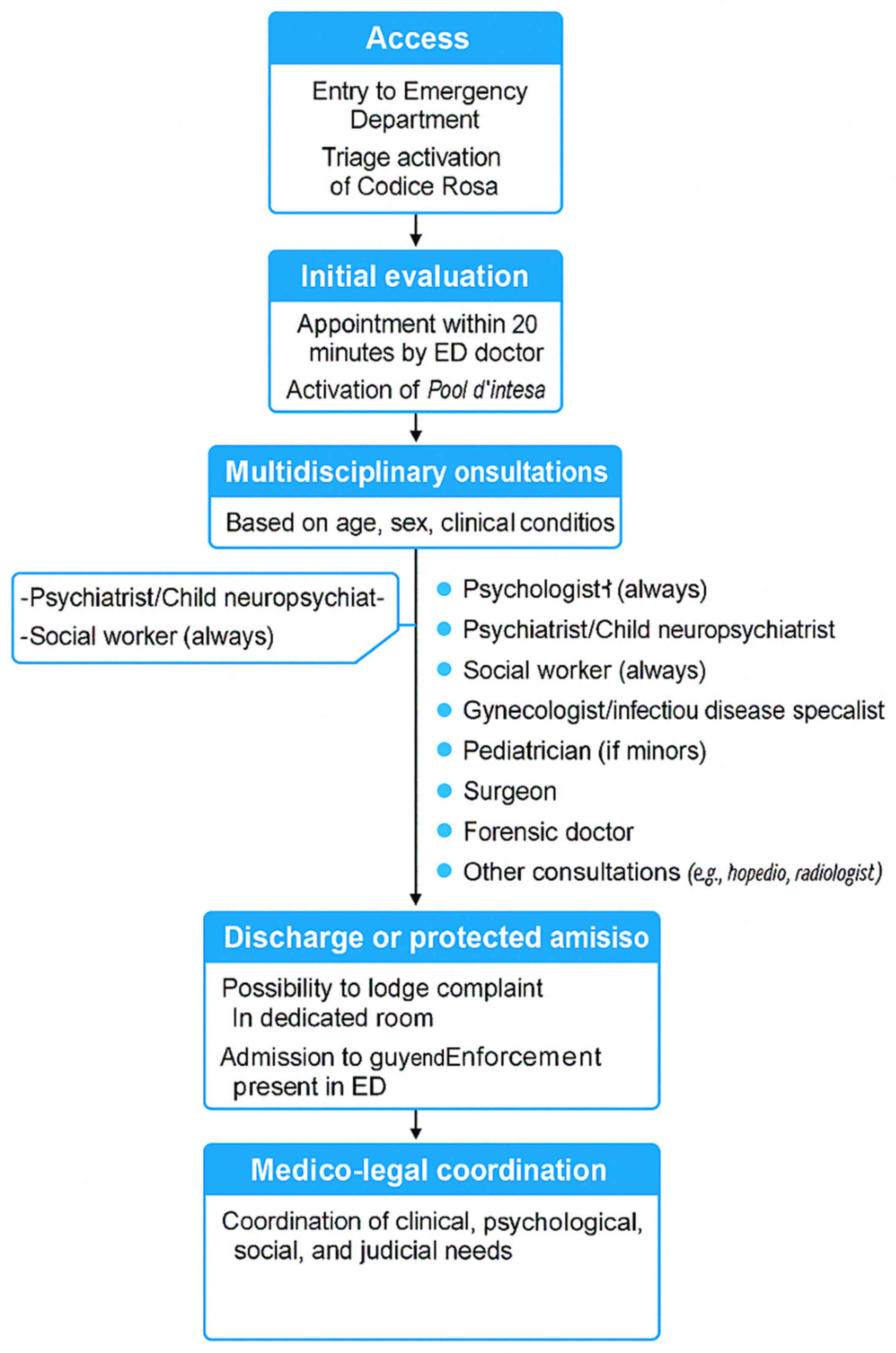
It entails a comprehensive care pathway through an interdisciplinary intervention (nurse, physician, psychologist, social worker, case coordinator) for alleged victims who access the emergency department due to psychological and/or physical and/or sexual abuse perpetrated within intimate, family, or social relationships, as well as by strangers. In emergency management, three time-dependent elements must be carefully considered: the clinical aspect, both general and gynecological; the medico-legal aspect; and the psychological, social, and preventive management of the patient (
Figure 3).
It is essential to explain to the patient the stages and purposes of the assessments and to obtain consent for each individual procedure; limiting the number of operators and movements to what is strictly necessary is also of great importance. After the case is correctly identified as a “Pink code” during triage, the patient will be examined within 20 min of arrival in a dedicated room designed to safeguard privacy.
To prevent the patient from having to repeat the same information multiple times, the medical record includes specific sections so that the professionals involved throughout the multidisciplinary pathway can acquire such information and integrate it with the data they themselves collect during their evaluation.
The clinical pathway proceeds through the following stages:
- -
Patient accesses the Emergency Room, is visited by the triage nurse, and the pink code is activated;
- -
The ED doctor will have to visit the patient within 20 min of accessing the triage and then the same doctor will activate. The medical director in charge of the patient, therefore, will alert the Pool of Understanding, i.e., the consultations deemed necessary, in relation to the patient’s clinical condition, sex and age, and will request:
Psychological counseling (always).
Psychiatric or neuropsychiatric counseling,
For victims aged ≥ 18 years, the psychiatrist on duty performs the clinical assessment of competence.
For victims aged ≥ 14 and up to 17 years of age, the clinical evaluation is the responsibility of a child neuropsychiatrist.
Social worker counseling (always).
Infectious disease counselling in the event of suspected sexual violence.
Gynecological consultation, in the case of a female subject with suspected sexual violence.
General surgery consultation, in the case of a male subject with suspected sexual violence.
Pediatric consultation, in the case of a minor.
Medical legal advice.
Other necessary consultations (e.g., orthopedist or radiologist, etc.).
If the victim wishes to file a complaint, this can be done within the dedicated emergency department room for victims of violence and abuse. Alternatively, the victim may obtain information regarding potential legal and judicial implications through an interview with law enforcement officers permanently stationed in the emergency department. Law enforcement, social workers, and psychologists must collaborate to ensure adequate territorial support and a “safe” discharge plan for the patient. If a female patient requires hospitalization due to clinical needs or for protective purposes, admission will take place in the gynecology ward or, in the presence of minors, in the pediatric ward. Minors will undergo triage and be hospitalized with their mother. In the case of a male victim, available beds in other inpatient units will be utilized. The pathway therefore aims to identify, above all, relational violence, which is often silent and “invisible,” blending emotional, aggressive, and invasive elements, resulting in humiliation and the suppression of the victim’s freedom to “be,” to express herself, and to grow—ultimately undermining her individuality. The role of the forensic physician in this pathway is to coordinate the various professional figures involved in the acute management of the case, ensuring that clinical, psychological, social, privacy, and judicial needs are properly fulfilled. The forensic physician supports the emergency physician and specialists in assessing signs of direct violence, in carrying out the clinical-care pathway, in analyzing the case, reviewing consultations and medical records, assisting all healthcare providers involved, preparing the medico-legal report for the Judicial Authority when required by law, verifying the correct collection and recording of informed consent, and overseeing all procedures for the custody of evidence, coordinating with law enforcement. The forensic physician may also handle any judicial issues arising from the cases under management.
It must be emphasized that, in cases of gender-based violence, the difficulty in recognizing and quantifying non-pecuniary damage derives from several factors, including: when biological damage is purely psychological, the medico-legal assessment becomes complex and requires a valid psychiatric evaluation; when biological damage is accompanied by physical injury, residual impairments are often minimal, resulting in a very limited biological damage assessment. This occurs despite the moral and existential harm being predominant, given the seriousness of the offense and the current and future suffering, which significantly worsen the quality of life of the abused individual [
27].
For these reasons, civil compensation awarded in legal proceedings involving personal injury, mistreatment, threats, and even sexual abuse has historically been markedly limited compared to the harm actually suffered, which in most cases persisted over time [
28,
29].
To address this injustice, Law No. 122/2016 was enacted, establishing that when a victim of sexual violence is unable to obtain the compensation awarded from the offender, the victim is entitled to receive compensation from the State for intentional violent crimes committed against the person [
30].
The Pink Code, as a preferential pathway for the early detection of domestic and gender-based violence and for the activation of a rapid procedure within the Emergency Department, is not present in other European countries, where, however, good practices exist that provide fast and multidisciplinary pathways for victims of violence [
31].
In light of the findings, it emerges that, within the European context, no national legal framework currently provides a protocol as comprehensive and systematically structured as the Italian
Pink Code. This is clearly illustrated by the schematic comparison presented below (
Table 2).
4. Discussion
Gender-based violence and femicide persist as structurally embedded phenomena despite the progressive strengthening of international and national legislative frameworks. The Italian experience, characterized by an advanced penal response and the implementation of healthcare pathways such as the Pink Code, highlights a limited impact on epidemiological trends, with femicide rates remaining substantially stable over recent years. This apparent discrepancy suggests that punitive strategies alone are insufficient to prevent lethal outcomes.
Recent Italian forensic and epidemiological evidence indicates that femicide is most frequently preceded by so-called “sentinel crimes,” including threats, stalking, and domestic abuse, which are often underestimated or inadequately managed. These findings support the hypothesis that failures in prevention and early risk interception, rather than legislative gaps, play a decisive role in the escalation toward fatal violence.
A critical issue emerging from the Italian context is the presence of marked regional disparities. Although a nationwide network of anti-violence centers and hospital-based Pink Code pathways has been established, their availability, organization, and effectiveness vary considerably across regions. Northern and central areas generally benefit from greater institutional coordination and resource allocation, whereas southern regions more frequently experience fragmentation of services, discontinuity of funding, and limited integration between healthcare, social services, and judicial authorities.
From a public health perspective, gender-based violence should be addressed as a preventable condition rather than an inevitable social phenomenon. Evidence supports the effectiveness of integrated strategies based on early identification of risk factors, standardized clinical and medico-legal documentation, mandatory professional training, and coordinated multidisciplinary networks.
No European country has adopted a hospital-based pathway fully equivalent to the Italian “Pink Code” in terms of formalization, multidisciplinary coordination, and medico-legal integration within emergency departments. However, comparable models exist, such as Sexual Assault Care Centres and Women’s Houses, which provide integrated medical, psychological, and legal assistance but are regulated through different legislative and organizational frameworks.
Overall, the Italian model appears conceptually innovative but operationally incomplete, remaining anchored to a predominantly reactive paradigm. A shift toward a preventive, trauma-informed, and system-based approach is required to translate legislative progress into tangible reductions in femicide and severe violence.
5. Study Limitations
This study presents limitations inherent to its narrative review design. The absence of a systematic protocol and quantitative synthesis may introduce selection bias in the choice and interpretation of sources. In addition, the heterogeneity of legal frameworks, definitions, and data-collection systems limits the comparability of epidemiological and medico-legal data across countries.
In the Italian context, available data on gender-based violence and femicide are affected by underreporting and regional inconsistencies, which may lead to an underestimation of the phenomenon and hinder precise assessment of temporal trends. Finally, given the descriptive nature of the available evidence, causal inferences regarding the effectiveness of specific legislative measures or healthcare pathways—such as the Pink Code—cannot be drawn.
The exclusion of substance-abuse-related contexts may have limited the representation of specific forms of femicide in which intoxication or organized criminal environments act as facilitating factors.
6. Conclusions
Every year, the scourge of gender-based violence shows persistently high numbers, which have remained relatively stable over time (613 cases in the period 2018–2022). Almost 60% of victims (i.e., 3 out of 4 women) are killed by their partner (75.8%) or by an ex-partner (24.2%), and at the time of the violence, the average age of the victims is 52 years. The means used by perpetrators vary: in most cases (approximately 40.2%), violent acts are committed with sharp weapons, although firearms (12.8%) and flammable liquids (3.3%) are also frequently involved. Many acts of violence are carried out by strangulation as well (approximately 18%). The reasons leading aggressors to adopt behaviours culminating in extremely violent acts, often fatal, may differ: commonly reported motives include jealousy or passion, psychiatric or physical illness or disability, and especially marital or relationship conflicts. The alarming escalation observed in recent years has fuelled national debate and prompted reflection on a phenomenon increasingly affecting even younger individuals, in a society where technological innovations have unfortunately contributed to perpetuating such forms of crime. As strongly emphasized by the Legislator, a profound cultural renewal is essential—one that begins with education and the raising of public awareness, aimed at analysing gender-based violence and effectively preventing all those behaviours by aggressors that have too often been underestimated, rooted in outdated cultural legacies, or culpably ignored.
The data presented above confirm the need for structural and targeted interventions to prevent and combat gender-based violence, highlighting the importance of integrated policies that include prevention, victim protection, and prosecution of offenders.
The comparison among European countries shows that Italy possesses advanced legal instruments and a solid network of services, yet its management of gender-based violence suffers from institutional fragmentation and from a predominance of a repressive rather than preventive approach.
Other European countries—particularly Spain, France, Germany, Sweden, and Portugal—have adopted systemic and comprehensive strategies based on interinstitutional cooperation, mandatory training, data centralization, and stable funding.
Statistical analysis further reveals that in recent years, the number of gender-based violence cases has remained consistently high, with only a slight decrease in 2023, accompanied by a parallel increase in “sentinel crimes.” Unfortunately, this trend is also confirmed globally: approximately one-third of all women experience violence by a partner or ex-partner at least once in their lifetime. These data show that gender-based violence is far more widespread than commonly perceived and that only through targeted interventions, combined with effective awareness and educational campaigns, will it be possible to counter such an alarming phenomenon.
Finally, it is evident that a judicial gap persists in adequately recognizing victims as such and in ensuring appropriate support in terms of legal protection, aimed at compensating at least a small portion of the extensive biological and non-pecuniary harm suffered in events that profoundly disrupt the victim’s life. To this end, the forensic physician must assume—through his or her transversal and interdisciplinary role—the task of coordinating the clinical needs of the victim with the needs of justice, which remain insufficiently focused on real and effective victim protection.
The future objective cannot be limited to harsher penalties: it is necessary to strengthen prevention strategies, promote the training of healthcare and forensic personnel, and ensure the multidisciplinary management of victims, in line with the principles of the Istanbul Convention.
Only an integrated approach, combining clinical, legal, and cultural dimensions, can ensure a real reduction in gender-based violence and effective protection of human dignity. Ultimately, combating violence against women means reaffirming the universal value of freedom and health as fundamental rights, whose defense constitutes the very foundation of legal civilization and medical ethics.
These conclusions should be interpreted in light of the narrative nature of the review and highlight the need for future empirical and longitudinal studies aimed at assessing the real-world effectiveness of preventive, clinical, and medico-legal interventions.




 ,
,