1. Introduction
Anterior open bite (AOB) is defined as the absence of vertical overlap or contact between the upper and lower anterior teeth. Dental AOB, skeletal AOB, and functional AOB are the three main categories into which AOB is typically divided. However, due to the complexity of the condition, it is often difficult to assign a patient exclusively to one of the categories in clinical practice [
1].
The prevalence of anterior open bite in urban areas is estimated at 2.1%, indicating that approximately 2 out of every 100 individuals are affected. In rural regions, the prevalence is slightly higher, at around 2.4%, indicating that anterior open bites occur at similar rates across both urban and rural communities in Iraq. When considering the overall population, the prevalence decreases to approximately 1.1%, suggesting that just over one in every hundred individuals is affected by an anterior open bite [
2].
Patients typically seek treatment for AOB, with the focus primarily on functional or aesthetic reasons. Common complaints include speech difficulties, such as lisping, and reduced ability to incise food effectively. Closing AOB may assist with eating disorders, but there is limited evidence that treatment improves speech [
3].
It seems that issues with both oral function and appearance can result in a substantial demand for orthodontic therapy. AOB management is a challenging problem with unpredictable outcomes. The growth modification treatment may be effective if the AOB is identified before the growth spurt. However, relapses cannot be prevented if AOB is diagnosed after a growth spurt. Treatment with orthodontic extrusion of the anterior teeth may be needed [
4].
Treatment approaches for anterior open bite generally include: (I) observation and early intervention, (II) interceptive therapy, (III) camouflage treatment, and (IV) combined orthodontic-surgical approaches.
The risk for relapses in the vertical dimension following therapy and the difficulty in identifying and addressing causative variables make AOB treatment complex. Constant thumb sucking causes the maxillary incisors to protrude, lips to become incompetent, and the lip seal necessary for swallowing is broken, and ultimately, AOB will appear. Additionally, abnormal tongue posture, both at rest and during swallowing, may exacerbate the condition [
5].
The interposition of the tongue between the teeth during swallowing is a normal physiological feature during infancy; however, persistence of this pattern beyond the mixed dentition stage is considered atypical and may contribute to the development of an anterior open bite [
6].
Thumb sucking is one of the behaviors that fall under the category of non-nutritive sucking activities. This group also includes the use of blankets, pacifiers, and sucking on other fingers as a form of comfort. Because it provides stimulation or self-soothing, thumb-sucking has been regarded as an adaptive behavior. Malocclusion may result if the behavior continues during the eruption of the permanent teeth [
7].
Studies have demonstrated a correlation between orofacial musculature and facial structure, suggesting a relationship between weak musculature and a long facial pattern, as well as between tongue position and anterior open bite development. Management approaches may involve either eliminating the cause or correcting dentofacial changes, with the objective of improving mastication, respiratory function, and swallowing [
8].
Orofacial myofunctional therapy (OMT), which is frequently regarded as an adjunct to traditional orthodontic treatment, has been demonstrated to be effective in the harmonization of the OMS by enhancing orofacial function and musculature. The cessation of sucking habits, which is a component of myofunctional therapy, led to a more rapid and effective improvement in the tongue rest position and swallowing pattern. Although myofunctional treatment in deciduous and mixed dentition in children appeared to be promising in correcting anterior open bites, the overall quality of the existing evidence remains questionable, according to a recent systematic review and meta-analysis [
9].
To have the best possible control over mal-growing dentofacial components, such as anterior open bite, early therapy is increasingly acknowledged. To ensure occlusal stability, a second phase of treatment is typically required [
10].
Therefore, the aim of this study is to evaluate the effectiveness of orofacial physical exercises in reducing anterior open bite as a therapeutic approach in school-aged children (8–10 years).
2. Methods
2.1. Study Registration
A formal letter was obtained from the College of Dentistry/University of Sulaimani, to visit a number of primary schools to obtain the data necessary for the study, with trial registration by the Ethics Committee of the College of Dentistry. Identification Number: COD-EC-24-0036; Date of Registration: 12th November 2024. All ethical guidelines, including those outlined in the 1975 Declaration of Helsinki, were adhered to throughout the study.
This study is a non-randomized intervention study; thus, for each school, a formal letter was obtained from the Ministry of Education to allow the examiner to visit the schools. The purpose of the study was explained during the consent procedure, and permission was requested for the examination. Furthermore, demographic data, such as age, gender, and geographical location, as well as information regarding non-nutritive sucking behaviors and prior orthodontic treatment, were collected.
This study is a non-randomized intervention study; thus, for each school, a formal letter was obtained from the Ministry of Education to allow the examiner to visit the schools. The purpose of the study was explained during the consent procedure, and permission was requested for the examination. Furthermore, demographic data, such as age, gender, and geographical location, as well as information regarding non-nutritive sucking behaviors and prior orthodontic treatment, were collected.
A team of dental professionals who were trained in data collection conducted the study in school settings. A disposable mirror, explorer, and sterile metal gauge were employed to examine all pupils. Before data collection, all examiners participated in calibration and training sessions to ensure the consistency and reliability of the clinical assessments.
2.2. Informed Consent
Informed consent was obtained from the parents or guardians of all participating minors before the commencement of any data collection. The preservation of children’s rights and compliance with research ethics guidelines are ensured by informed consent from parents [
11].
2.3. Participants, Eligibility Criteria, and Settings
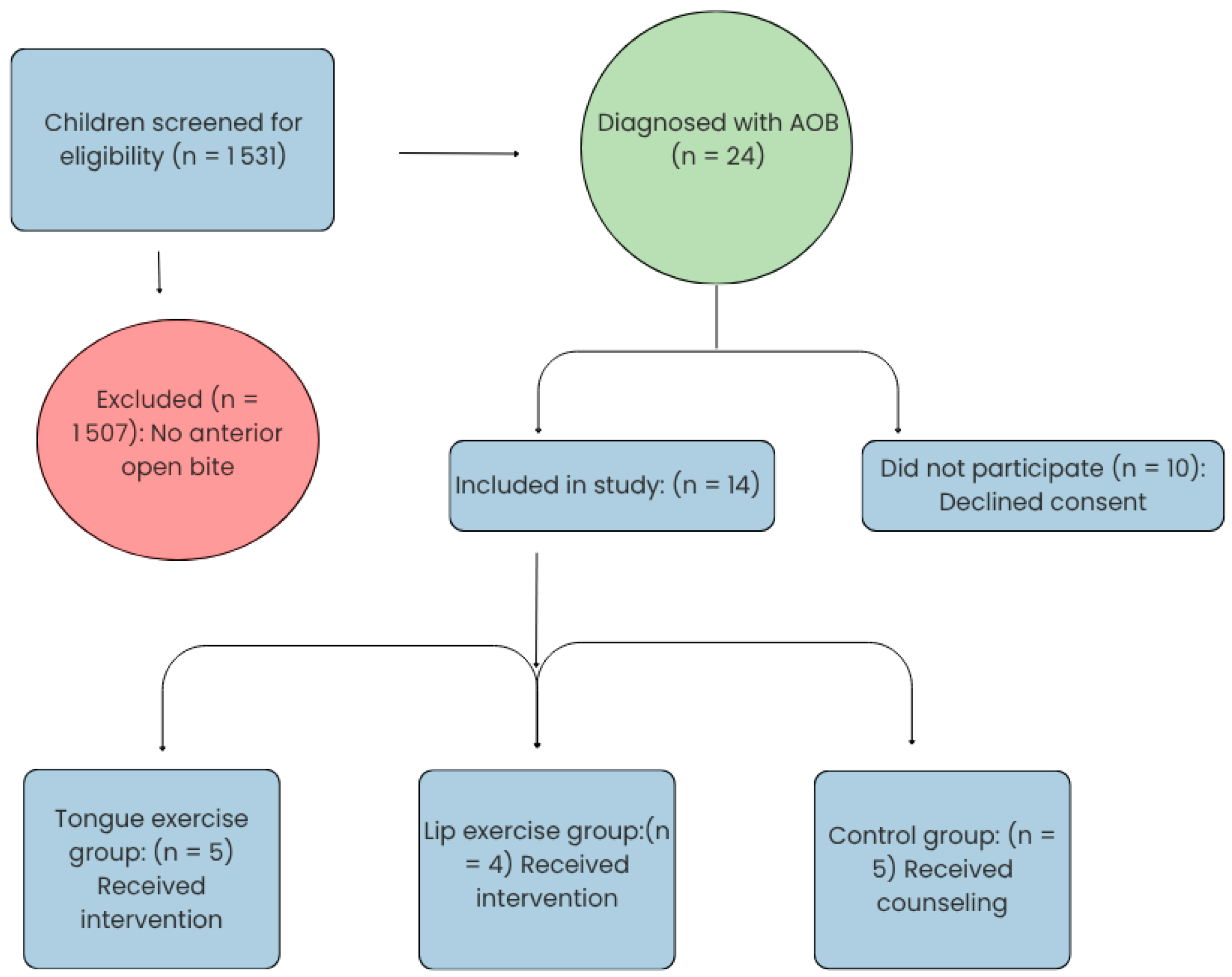
One thousand five hundred thirty-one children were screened. Participants, aged 8–10 years, were recruited from local schools in Sulaymaniyah city. A preliminary screening was conducted to identify potential participants with AOB. Twenty-four cases of anterior open bite were found; among them, only 14 children agreed to be included in the clinical trial. A flow diagram of participant selection, follow-up, and analysis is presented in
Figure 1.
Children were included if they presented with an AOB of 1–5 mm, either unilaterally or bilaterally, based on clinical assessment.
These criteria ensured a homogeneous sample, minimizing confounding factors and enhancing the reliability of the intervention outcomes (
Table 1).
The study incorporated several behavioral management strategies to minimize distress in the participating school children. These strategies included the use of positive reinforcement techniques, a supportive and reassuring communication style, and the provision of appropriate age incentives such as small goodie bags. These measures were implemented to foster a positive and engaging research environment, and all the psychological behavior management techniques aided in the reduction of fear and anxiety [
12].
The sample size for this study was calculated a priori using G*Power 3.1 software. The significance level of α = 0.05 and power of 80% (β = 0.20) were used to detect a medium effect size (f = 0.25) in anterior open bite reduction. Based on these parameters, a minimum of 12 participants was required.
Due to the limited prevalence of anterior open bite in the screened population (24 cases out of 1531 children), all eligible participants who consented (n = 14) were included in the study.
2.4. Study Groups and Intervention Protocol
Three groups were allocated: one control group and two interventional groups using a simple random selection by lottery method as detailed below:
Control Group: To serve as a comparator to evaluate natural progression and the effects of intervention.
Protocol:
- ▪
No active exercises administered;
- ▪
Participants received verbal counseling regarding the nature of anterior open bite, potential etiological factors, and anticipated future treatment needs;
- ▪
Follow-up assessments conducted at the same intervals as intervention groups.
Intervention Group: Orofacial physical exercise participants in the intervention group were divided into two subgroups: tongue posture exercises and lip seal/swallowing exercises.
To assist patients in retraining adaptive patterns of muscle activity and in establishing a stable stomatognathic system, orofacial myofunctional therapy (OMT) uses customized programs that are typically based on oral and peri-oral exercises. OMT often focuses on improving chewing and swallowing patterns, normalizing tongue and lip postures during rest, promoting nasal breathing, and breaking bad oral habits [
13].Participants were provided with exercise tracking charts, and detailed monthly follow-up sheets were maintained throughout the intervention period (
Supplementary Materials).
A. Orofacial Exercises—Tongue Posture
Objective: Correct improper tongue positioning, improve swallowing, and enhance oral motor function.
Assessment and Observation
Observe swallowing patterns for forward tongue movement, facial grimacing, head tilting, and mouth breathing;
Evaluate resting tongue posture for position and protrusion;
Assess speech for lisp or articulation difficulties;
Clinical examination of tooth alignment, tongue size, and shape;
Evaluate oral and facial muscle strength and coordination (tongue, lips, cheeks);
Conduct a formal swallowing assessment;
Record history of oral habits: thumb sucking, pacifier use, nail biting, mouth breathing, allergies, or nasal congestion.
Exercise Protocol:
Tongue posture exercise: Place the tongue tip against the rugae area and swallow [
14].
Hold-pull exercise: Tip and mid-portion of tongue contact the palate while gradually opening the mandible to stretch the lingual frenum [
15].
Frequency: Every 30 min initially or as often as possible until exercises become automatic; parents are reminded to reinforce at home.
Duration per session: 10–15 min.
Total intervention period: 6 months.
B. Orofacial Exercises—Lip Seal and Swallowing
Objective: Improve lip competence, circum-oral muscle tone, and swallowing coordination.
Assessment and Observation:
Observe lips at rest for gaps, mentalis strain, and chin wrinkling;
Assess lip closure and muscle activity during swallowing;
Evaluate lip morphology, length, tone, and strength;
Record incisor display at rest and note mouth breathing tendencies.
Exercise Protocol:
Upper lip stretching: Hold a piece of paper between lips; stretch upper lip downward toward the chin.
Water pumping: Hold and pump water back and forth behind closed lips.
Lip massage: Gently massage lips to stimulate muscle tone.
Button pull exercise: Place a 1.5-inch button behind lips, pull thread while resisting with lip pressure.
Tug-of-war exercise: Similar to button pull, using two buttons with a partner.
Frequency: Every 30 min initially until exercises become subconscious; parents reminded them to reinforce at home.
Duration per session: 10–15 min.
Total intervention period: 6 months.
2.5. Measurements
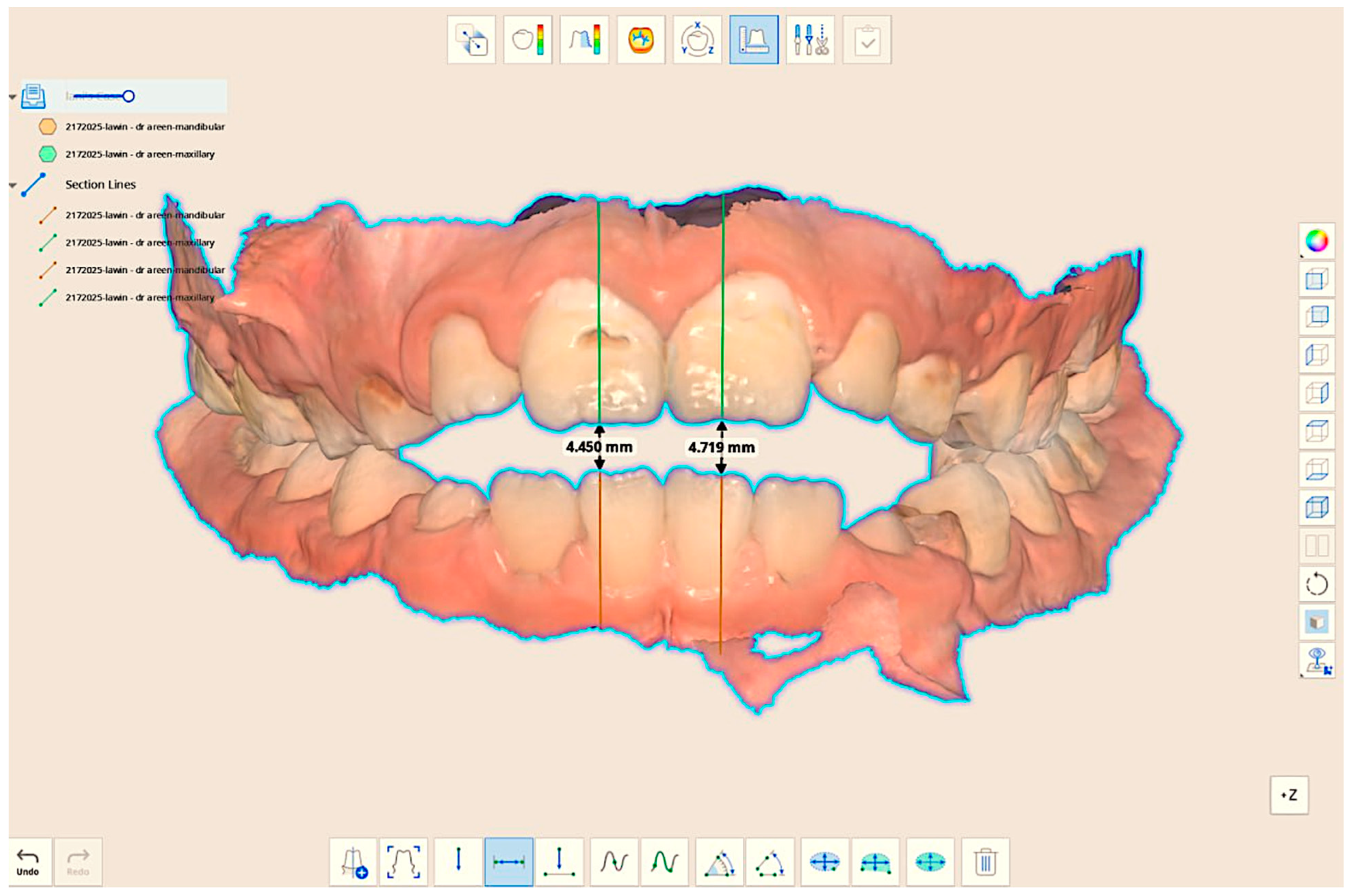
Participants underwent a comprehensive clinical evaluation, including assessment using intraoral scanning. The MEDIT i700 intraoral scanner (Medit Corp., Seoul, Republic of Korea) was used to capture the maxillary and mandibular arches and occlusion at baseline and follow-up to capture the maxillary and mandibular arches and occlusion at baseline and follow-up [
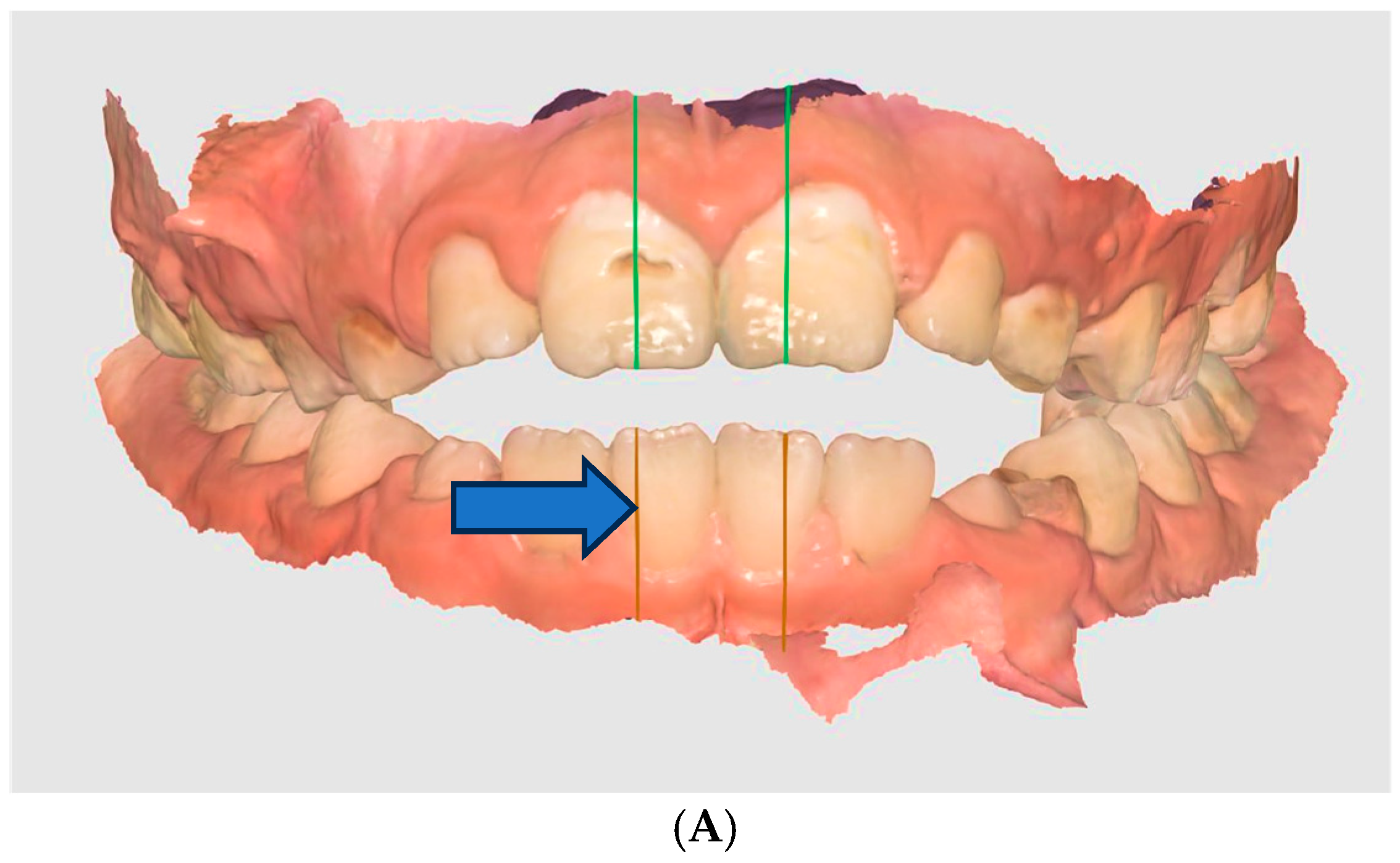
16]. AOB was defined as the vertical distance between the incisal edges of the maxillary and mandibular central incisors in maximum intercuspation and was measured separately for the right and left incisors along the vertical plane perpendicular to the occlusal plane. Inter-canine distance, the linear transverse distance between the cusp tips of the maxillary canines, was also measured.
Digital models were generated at baseline and six months, and linear measurements were performed using the built-in measurement tools of Medit Link software version 3.2.1 (Medit Corp., Seoul, Republic of Korea), ensuring precision and reproducibility., ensuring precision and reproducibility. Supplementary clinical tools and photographs were used for documentation. All examiners underwent calibration and training sessions before data collection, and the same examiner performed measurements at each time point to minimize intra-examiner variability. The use of digital intraoral scanning further reduced the risk of manual measurement error and enhanced measurement consistency.
The primary outcomes were vertical anterior open bite measurements at the right and left central incisors, while the secondary outcome was inter-canine distance. All measurements were recorded in millimeters (mm).
The patients were monitored for six months. To estimate the effectiveness of the early inceptive technique over six months, the anterior open bite measurements for the right and left incisors were repeated three months (but no statistical interpretation was performed) and six months apart.
Participants were instructed to perform the prescribed exercises every 30 min initially, with the goal of facilitating automaticity and long-term adherence to the therapeutic regimen. To ease the process of tracking exercise performance and compliance, participants were provided with charts, and those charts were reviewed monthly [
17].
Given the limitations of traditional manual measurements, digital tools were incorporated to enhance precision and reliability. Digital calipers, intraoral scanners, and imaging software were used to measure interincisal gaps, minimizing observer bias and inter-examiner variability. The use of these digital tools not only improves measurement accuracy but also facilitates data storage, analysis, and longitudinal comparisons, thereby strengthening the overall methodological rigor of the study [
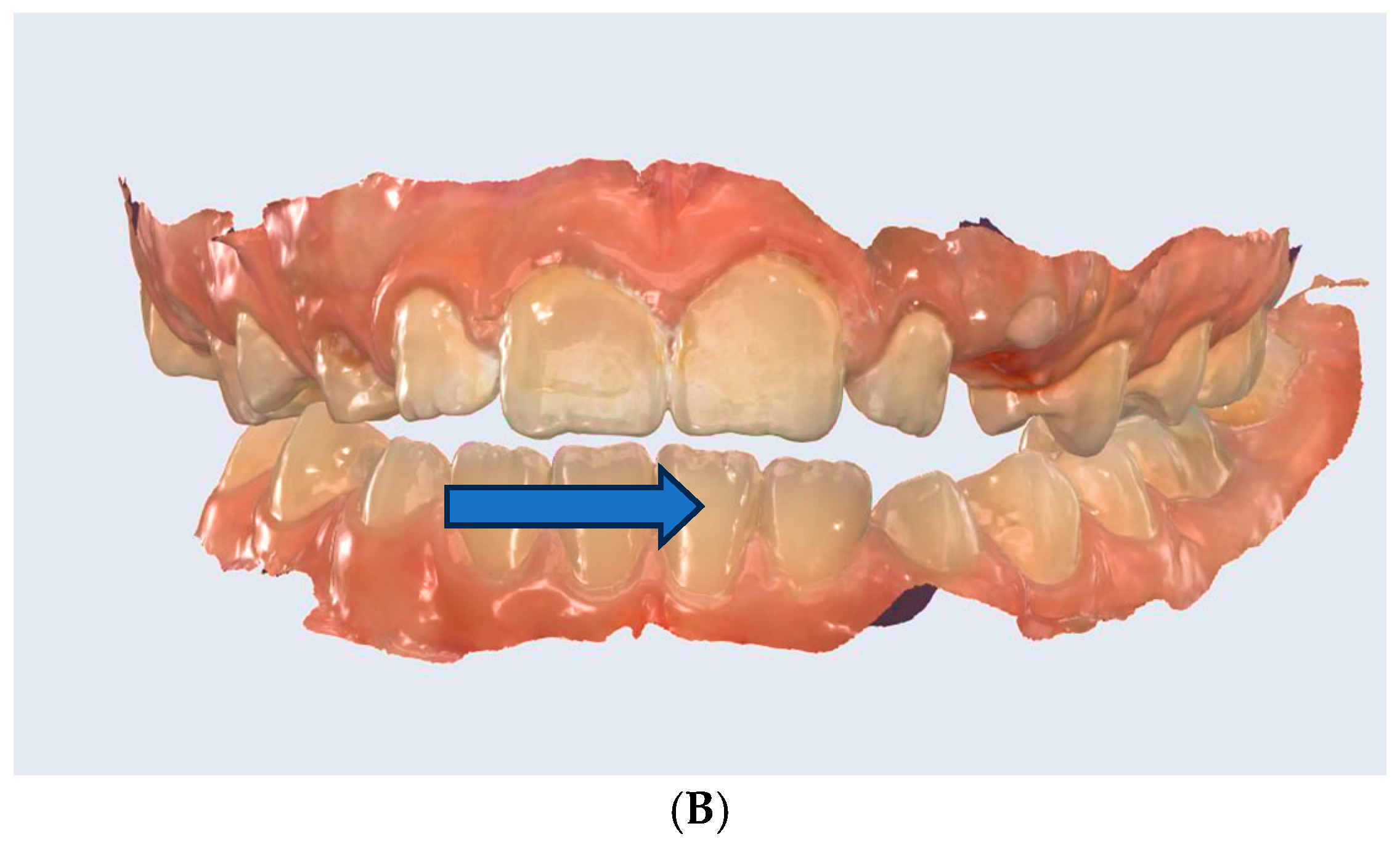
18]. Representative intraoral scan measurements obtained at baseline and after the six-month follow-up are shown in
Figure 2 and
Figure 3.
The intraclass correlation coefficient (ICC) was used to evaluate inter- and intra-examiner reliability. A randomly chosen fraction of the sample was used for repeated measurements, and examiner calibration was carried out before data collection. A high degree of measurement consistency was shown by the ICC values, which showed excellent agreement between examiners (ICC = 0.88–0.94) and within examiners (ICC = 0.90–0.96). This high reliability reduces examiner-related variability and bolsters the study’s internal validity and robustness.
2.5.1. Statistical Analysis
Data normality was assessed using the Shapiro–Wilk test, and repeated measures ANOVA was used for comparing multiple groups with a p-value (p < 0.05). All intervention groups (lip and tongue exercises) showed greater reductions compared with the control, but no comparisons reached statistical significance (p > 0.05). All statistical analyses were conducted using IBM SPSS Statistics for Windows, version 30.0 (IBM Corp., Armonk, NY, USA).
2.5.2. Manuscript Preparation
AI-assisted tools, specifically ChatGPT (OpenAI, San Francisco, CA, USA) and QuillBot (QuillBot, Chicago, IL, USA), were used solely to improve the language and grammar of the manuscript. These tools were not employed in any aspect of the experimental design, data collection, analysis, or interpretation. All AI-generated suggestions were thoroughly reviewed and approved by the authors to ensure accuracy and uphold the scientific integrity of the work.
3. Result
Baseline descriptive analysis showed that the overall mean anterior open bite for all enrolled participants (n = 14) was 4.06 ± 1.86 mm for the right central incisor and 3.89 ± 1.70 mm for the left central incisor, indicating moderate anterior open bite severity at baseline. Sixty-four percent of children showed a non-physiological swallowing pattern, and 36% exhibited lip incompetence associated with an anterior open bite.
3.1. Prevalence as a Secondary Outcome Measure
Out of 1531 children screened, 24 were identified with AOB, corresponding to a prevalence of 1.57%. Among these cases, the majority exhibited features such as anterior non-occlusion and abnormal tongue or lip function, highlighting the clinical significance of early identification and potential intervention.
3.2. Primary Outcome
No statistically significant changes were observed, although all intervention groups (lip and tongue exercises) tended to show greater reductions in anterior open bite compared to the control group; however, these differences did not reach statistical significance at the conventional alpha level of 0.05. Specifically, at baseline, the p-value for the central incisor measurement was 0.75 in the lip exercise group; after 6 months of intervention, this value decreased to 0.34. Similarly, in the tongue exercise group, the central incisor p-value was 0.664 at baseline and decreased to 0.422 after 6 months. In contrast, the control group demonstrated a more modest change in the central incisor p-value, from 0.552 at baseline to 0.474 after 6 months. While these numerical reductions suggest a potential trend towards improvement in the intervention groups, it is important to emphasize that none of these comparisons achieved statistical significance.
3.3. Results—Effect of Child Cooperation
Children who actively participated in their exercise charts demonstrated a greater reduction in anterior open bite compared to those with lower adherence. This suggests that higher cooperation and consistent engagement with orofacial exercises may enhance treatment outcomes. The following tables present the study results (
Table 2 and
Table 3).
4. Discussion
The current findings highlight the ongoing controversy surrounding the timing and efficacy of orofacial physical exercises as a therapeutic approach for anterior open bite. While some clinicians, including speech pathologists and orthodontists, advocate for early intervention through targeted exercises, the available evidence remains limited and inconclusive [
19].
The main limitation of this study was the small sample size; however, this was statistically justifiable, as the prevalence of anterior open bite is approximately 1.57%, which is considerably lower compared with other types of malocclusions. Additionally, participants were allocated according to a simple random selection by lottery method, and no matching or stratification procedures were reported. Given the small sample size, this raises a substantial risk of selection bias; therefore, the results should be interpreted with caution. Future studies employing randomized allocation and appropriate stratification methods are recommended to minimize selection bias and strengthen the validity of the conclusions.
Another limitation was the short follow-up time (6 months), as following the cases for a longer time may show further improvement.
Although the results indicated some variations in open bite severity, the evidence was not sufficient to conclusively demonstrate a significant therapeutic effect of the exercises employed. The hypothesis, suggesting that orofacial physical exercises have no significant effect in managing AOB, remains supported by the findings. Although the intervention groups showed a tendency towards improvement, the changes observed were not statistically significant. This indicates that orofacial exercises showed a supporting impact in the treatment of AOB within the confines of this study. These results emphasize the significance of including orofacial exercises within a comprehensive, multidisciplinary treatment plan that incorporates orthodontic therapies, functional therapy, and behavioral change.
These findings align with the broader literature, which often reports mixed results regarding the role of orofacial exercises in early intervention. The variability in outcomes may be attributed to differences in exercise protocols, participant compliance, and individual anatomical factors. Consequently, while orofacial exercises may hold potential as a non-invasive adjunct in early anterior open bite management, current evidence does not definitively endorse their routine use prior to orthodontic intervention.
One major obstacle to the successful treatment outcomes of many healthcare initiatives is patients’ disregard for the advice of their healthcare professional. The same is true for orofacial myotherapy treatment regimens, where patient compliance is critical to their success [
19].
Moreover, the sense of closure or achievement by participants suggests that a structured routine with clear end goals leads to motivation and psychological reinforcement. This aligns with findings that patients who recognize improvements and understand the purpose of their therapeutic exercises are more likely to adhere to prescribed regimens and report satisfaction with outcomes [
20,
21].
The success of myofunctional therapy largely depends on tailored exercises that promote proper tongue positioning, swallowing, and lip sealing. Consistency and patient compliance are critical factors influencing therapeutic success, with regular follow-up necessary to monitor progress and reinforce correct habits. Additionally, integrating myofunctional therapy with orthodontic treatment can help reinforce the desired functional patterns, ultimately leading to more stable and optimal outcomes [
22].
Based on existing evidence, orofacial exercises might show a trend toward improvement but may not produce significant changes due to limited sample size and variability in children’s cooperation.
Further longitudinal studies with larger sample sizes are warranted to better elucidate the true efficacy of orofacial physical exercises in this context. Until then, clinicians should consider these interventions as potentially beneficial but not yet definitively proven and should continue to rely on comprehensive diagnostic and treatment planning tailored to each patient’s specific needs.
5. Conclusions
This study does not provide evidence supporting the clinical effectiveness of orofacial exercises as a standalone intervention. However, orofacial physical exercises demonstrated a trend toward improvement in anterior open bite, tongue function, and lip competence in children; however, the changes were not statistically significant. Higher cooperation and adherence to the exercise regimen were associated with greater reductions in open bite, highlighting the importance of patient engagement in therapeutic outcomes. While these exercises may serve as a supportive, non-invasive adjunct in early management, their efficacy remains inconclusive, and they should be integrated within a comprehensive treatment plan. Further studies with larger sample sizes, standardized protocols, and extended follow-up are needed to clarify the therapeutic potential of orofacial exercises in children with anterior open bites.
Supplementary Materials
The following supporting information can be downloaded at:
https://www.mdpi.com/article/10.3390/oral6030060/s1. Supplementary materials, including exercise charts, intraoral scan images, Medit Design measurement outputs, and detailed monthly follow-up sheets, are available from the corresponding author upon reasonable request.
Author Contributions
Conceptualization: A.I.O. and T.M.A.M.; Methodology: A.I.O. and T.M.A.M.; Data Collection: A.I.O.; Data Analysis: A.I.O.; Writing—Original Draft Preparation: A.I.O.; Writing—Review and Editing: A.I.O. and T.M.A.M.; Supervision: T.M.A.M. All authors have read and agreed to the published version of the manuscript.
Funding
This research received no external funding.
Institutional Review Board Statement
A formal letter was obtained from the College of Dentistry, University of Sulaimani, to visit primary schools to collect the data necessary for this study. The study was registered with the Ethics Committee of the College of Dentistry (Identifying Number: COD-EC-24-0036, Date of Registration: 12 November 2024). All procedures were conducted in accordance with the ethical guidelines outlined in the 1975 Declaration of Helsinki.
Informed Consent Statement
Informed consent was obtained from the parents or legal guardians of all participants involved in the study. Additionally, assent was obtained from the children when appropriate.
Data Availability Statement
The datasets generated and analyzed during the current study are available from the corresponding author on reasonable request.
Acknowledgments
The authors express their sincere gratitude to the College of Dentistry, University of Sulaimani, for providing ethical approval and institutional support for this research. Special thanks are extended to the participating schools, children, and their families for their valuable cooperation. Large Language Models ChatGPT (OpenAI, San Francisco, CA, USA) and QuillBot (QuillBot, Chicago, IL, USA) were used only for English language polishing during manuscript preparation. They did not contribute to study design, data collection, analysis, interpretation, or conclusions. All authors reviewed and approved the final content. The authors also acknowledge the assistance of the dental professionals who contributed to data collection and clinical assessments.
Conflicts of Interest
The authors declare no conflicts of interest related to this study. No financial or personal relationships influenced the conduct, interpretation, or reporting of this research.
References
- Hsu, J.-Y.; Cheng, J.H.-C.; Feng, S.-W.; Lai, P.-C.; Yoshida, N.; Chiang, P.-C. Strategic treatment planning for anterior open bite: A comprehensive approach. J. Dent. Sci. 2024, 19, 1328–1337. [Google Scholar] [CrossRef] [PubMed] [PubMed Central]
- Alhuwaizi, A. Open bite in Iraq (A National Survey). J. Coll. Dent. 2005, 17, 81–85. [Google Scholar]
- Alachioti, X.S.; Dimopoulou, E.; Vlasakidou, A.; Athanasiou, A.E. Amelogenesis imperfecta and anterior open bite: Etiological, classification, clinical and management interrelationships. J. Orthod. Sci. 2014, 3, 1–6. [Google Scholar] [CrossRef]
- Borrie, F.R.P.; Bearn, D.R.; Innes, N.P.T.; Iheozor-Ejiofor, Z. Interventions for the cessation of non-nutritive sucking habits in children. Cochrane Database Syst. Rev. 2015, 2015, CD008694. [Google Scholar] [CrossRef] [PubMed] [PubMed Central]
- Cenzato, N.; Iannotti, L.; Maspero, C. Open bite and atypical swallowing: Orthodontic treatment, speech therapy or both? A literature review. Eur. J. Paediatr. Dent. 2021, 22, 286–290. [Google Scholar] [CrossRef] [PubMed]
- Machado, D.B.; Brizon, V.S.C.; Ambrosano, G.M.B.; Madureira, D.F.; Gomes, V.E.; Oliveira, A.C.B. de Factors associated with the prevalence of anterior open bite among preschool children: A population-based study in Brazil. Dent. Press J. Orthod. 2014, 19, 103–109. [Google Scholar] [CrossRef]
- Lentini-Oliveira, D.A.; Carvalho, F.R.; Ye, Q.; Luo, J.; Saconato, H.; Machado, M.A.C.; Prado, L.B.; Prado, G.F. Orthodontic and orthopaedic treatment for anterior open bite in children. Cochrane Database Syst. Rev. 2007, CD005515. [Google Scholar] [CrossRef]
- Koletsi, D.; Makou, M.; Pandis, N. Effect of orthodontic management and orofacial muscle training protocols on the correction of myofunctional and myoskeletal problems in developing dentition. A systematic review and meta-analysis. Orthod. Craniofacial Res. 2018, 21, 202–215. [Google Scholar] [CrossRef] [PubMed]
- Al Hamadi, W.; Saleh, F.; Kaddouha, M. Orthodontic Treatment Timing and Modalities in Anterior Open Bite: Case Series Study. Open Dent. J. 2017, 11, 581–594. [Google Scholar] [CrossRef] [PubMed] [PubMed Central]
- Rashid, Z.J.; Muhamad, N.O.; Ali, D.A.; Amin, A.A. Orthodontic treatment needs in 10–12-year-old school children from Sulaimani City, Iraq: A cross-sectional study. BMC Oral Health 2025, 25, 556. [Google Scholar] [CrossRef] [PubMed] [PubMed Central]
- Varkey, B. Principles of Clinical Ethics and Their Application to Practice. Med. Princ. Pract. 2021, 30, 17–28. [Google Scholar] [CrossRef] [PubMed] [PubMed Central]
- Kohli, N.; Hugar, S.M.; Soneta, S.P.; Saxena, N.; Kadam, K.S.; Gokhale, N. Psychological behavior management techniques to alleviate dental fear and anxiety in 4–14-year-old children in pediatric dentistry: A systematic review and meta-analysis. Dent. Res. J. 2022, 19, 47. [Google Scholar] [CrossRef]
- Stefani, C.M.; de Almeida de Lima, A.; Stefani, F.M.; Kung, J.Y.; Flores-Mir, C.; Compton, S.M. Effectiveness of orofacial myofunctional therapy in improving orofacial function and oral habits: A scoping review. Can. J. Dent. Hyg. 2025, 59, 59–72. [Google Scholar] [PubMed] [PubMed Central]
- Van Dyck, C.; Dekeyser, A.; Vantricht, E.; Manders, E.; Goeleven, A.; Fieuws, S.; Willems, G. The effect of orofacial myofunctional treatment in children with anterior open bite and tongue dysfunction: A pilot study. Eur. J. Orthod. 2016, 38, 227–234. [Google Scholar] [CrossRef] [PubMed] [PubMed Central]
- Lee, K.-H.; Jung, E.-S.; Choi, Y.-Y. Effects of lingual exercises on oral muscle strength and salivary flow rate in elderly adults: A randomized clinical trial. Geriatr. Gerontol. Int. 2020, 20, 697–703. [Google Scholar] [CrossRef] [PubMed]
- Shah, S.S.; Nankar, M.Y.; Bendgude, V.D.; Shetty, B.R. Orofacial Myofunctional Therapy in Tongue Thrust Habit: A Narrative Review. Int. J. Clin. Pediatr. Dent. 2021, 14, 298–303. [Google Scholar] [CrossRef]
- Amornvit, P.; Rokaya, D.; Sanohkan, S. Comparison of Accuracy of Current Ten Intraoral Scanners. BioMed Res. Int. 2021, 2021, 2673040. [Google Scholar] [CrossRef] [PubMed] [PubMed Central]
- Ballanti, F.; Franchi, L.; Cozza, P. Transverse dentoskeletal features of anterior open bite in the mixed dentition. Angle Orthod. 2009, 79, 615–620. [Google Scholar] [CrossRef] [PubMed]
- Gune, N.S.; Katre, A.N. Dental Practitioner’s Perception of the Compliance of Pediatric Patients to Orofacial Myotherapy Treatment Protocols: A Mixed Methods Study. Int. J. Clin. Pediatr. Dent. 2021, 14, 222–228. [Google Scholar] [CrossRef] [PubMed] [PubMed Central]
- Hansen, D.D.; Tinbod, U.; Feng, X.; Dammen, T.; Hrubos-Strøm, H.; Skirbekk, H. Orofacial Myofunctional Therapy for Patients with Obstructive Sleep Apnea—A Mixed Methods Study of Facilitators and Barriers to Treatment Adherence. Int. J. Orofac. Myol. Myofunctional Ther. 2025, 51, 6. [Google Scholar] [CrossRef]
- Hong, H.; Zeng, Y.; Chen, X.; Peng, C.; Deng, J.; Zhang, X.; Deng, L.; Xie, Y.; Wu, L. Electromyographic features and efficacy of orofacial myofunctional treatment for skeletal anterior open bite in adolescents: An exploratory study. BMC Oral Health 2021, 21, 242. [Google Scholar] [CrossRef] [PubMed] [PubMed Central]
- Proffit, W.R.; Mason, R.M. Myofunctional therapy for tongue-thrusting: Background and recommendations. J. Am. Dent. Assoc. 1975, 90, 403–411. [Google Scholar] [CrossRef] [PubMed]
| Disclaimer/Publisher’s Note: The statements, opinions and data contained in all publications are solely those of the individual author(s) and contributor(s) and not of MDPI and/or the editor(s). MDPI and/or the editor(s) disclaim responsibility for any injury to people or property resulting from any ideas, methods, instructions or products referred to in the content. |