Review

Hydroxyapatite-Based Biomaterials in Dentistry: Functional Performance and Clinical Relevance—A Narrative Review

Grigore T. Popa University of Medicine and Pharmacy, 700115 Iasi, Romania
*
Author to whom correspondence should be addressed.
Oral 2026, 6(3), 58; https://doi.org/10.3390/oral6030058 (registering DOI)
Submission received: 1 March 2026 / Revised: 18 April 2026 / Accepted: 14 May 2026 / Published: 18 May 2026

Abstract

Hydroxyapatite-based biomaterials are widely investigated for oral-tissue-healing applications; however, the available literature is heterogeneous in terms of material design, experimental models, and reported outcomes. This narrative review synthesizes peer-reviewed studies published between 2014 and 2024 that investigate hydroxyapatite-based biomaterials in the context of oral soft and hard tissue healing. The literature was identified through targeted searches of major scientific databases and selected based on relevance to material characteristics, biological response, and oral regenerative applications. The analysis reveals substantial heterogeneity in material formulation, experimental design, and outcome assessment, limiting direct comparison between studies and translational interpretation. While modified and nano-sized hydroxyapatite systems often demonstrate enhanced biological responses, supporting evidence is predominantly preclinical. Greater standardization of methodologies and outcome measures is required to strengthen clinical relevance.

1. Introduction

Oral tissue healing represents a complex and highly dynamic biological process, essential for the maintenance of oral function, aesthetics, and overall quality of life [1]. The oral cavity is continuously exposed to mechanical stress, microbial challenges, and chemical insults, making oral soft and hard tissues particularly vulnerable to injury following trauma, surgical interventions, inflammatory diseases, or dental treatments [2,3]. Efficient and predictable healing of these tissues is therefore a critical objective in contemporary dentistry and oral medicine [3].
Dental tissues have exceptional regenerative capability when compared to other parts of the body, although poor or delayed healing is nonetheless a common problem in clinical practice [4]. Tissue healing can be hindered by factors such local inflammation, infection, impaired vascularization, systemic diseases, and the inherent limits of traditional biomaterials. Therefore, biomaterials that can structurally assist tissue regeneration and actively modulate biological responses at the injury site are attracting a lot of attention [5,6].
One of the most extensively studied biomaterials in the field of oral healthcare is hydroxyapatite (HA), a calcium phosphate compound that is chemically comparable to the mineral phase of human hard tissues [7]. Bone regeneration, implant dentistry, and restorative techniques have made widespread use of hydroxyapatite-based materials due to their superior biocompatibility, bioactivity, and osteoconductive qualities [8]. In addition to its use in hard tissue applications, there is mounting evidence that HA-based solutions can greatly benefit oral soft tissue healing through increasing cell adhesion, decreasing inflammation, and improving tissue integration [9,10].
A wide variety of hydroxyapatite-based formulations, such as nano-hydroxyapatite, doped and functionalized HA, and composite systems combining polymers or bioactive substances, have been developed in recent years as a result of advancements in the field of material science [11]. These advancements have expanded HA’s possible therapeutic uses, establishing it as a versatile biomaterial that can facilitate the healing of hard and soft tissues in the oral cavity [12].
Although numerous in vitro, preclinical, and clinical studies have investigated the biological performance of hydroxyapatite-based materials, the available evidence remains dispersed across different disciplines and clinical contexts [13]. A comprehensive synthesis of current knowledge is therefore necessary to clarify the mechanisms of action, therapeutic indications, limitations, and future potential of these materials in oral tissue healing [14,15].
Accordingly, the aim of this comprehensive review is to analyze and integrate existing evidence on the therapeutic potential of hydroxyapatite-based materials in oral tissue healing. This review examines the biological background of oral tissue repair, the physicochemical properties of hydroxyapatite relevant to healing processes, the mechanisms underlying its interaction with oral tissues, and its applications in both soft and hard tissue regeneration.
Additionally, current limitations, translational challenges, and future research directions are discussed. By providing an updated and structured overview, this review seeks to support clinicians and researchers in optimizing the use of hydroxyapatite-based materials for improved oral healing outcomes.

2. Literature Review

This comprehensive review is based on a careful reading and synthesis of the scientific literature addressing hydroxyapatite-based materials in oral tissue healing. Given the heterogeneity of study designs, material formulations, and experimental settings reported in this field, the literature was examined with attention to relevance and biological context.

2.1. Literature Search Strategy

To ensure a comprehensive and balanced synthesis of current evidence, a structured literature search was conducted across multiple electronic databases. Scientific articles were identified through PubMed/MEDLINE, Scopus, and Web of Science, which were selected due to their broad coverage of biomedical, dental, and material science literature. Additional relevant records were retrieved by manual screening of reference lists from key publications.
This review primarily included original research articles, preclinical studies, clinical trials, and relevant review papers addressing biological behavior, therapeutic mechanisms, and clinical performance of hydroxyapatite-based materials in oral soft and hard tissue healing. Studies focusing exclusively on non-oral applications or non-calcium phosphate biomaterials were excluded unless they provided mechanistic insights directly applicable to the oral environment.
The search strategy combined controlled vocabulary and free-text terms related to hydroxyapatite including articles published up to 2025 and used combinations of the following keywords: “hydroxyapatite”, “nano-hydroxyapatite”, “dental materials”, “oral regeneration”, “bone regeneration”, and “hydrogels”. No strict time restriction was imposed in order to capture both foundational studies and recent advances.
Grey literature, including conference abstracts, theses, technical reports, and other non-peer-reviewed sources, was considered in a limited and controlled manner. Its inclusion was restricted to cases where such sources provided relevant mechanistic, translational, or methodological insights that were not sufficiently represented in the peer-reviewed literature. These sources were not used as primary evidence for clinical or quantitative conclusions but rather to support contextual interpretation where appropriate.
To ensure scientific rigor, opinion papers, non-scientific reports, and publications lacking adequate methodological detail were excluded. In addition, articles not published in English, studies with insufficient experimental or clinical information, and reports lacking direct relevance to oral tissue healing were excluded from the final synthesis.
Due to the narrative and integrative nature of this review, no formal meta-analysis was performed. Instead, the available evidence was critically evaluated with respect to study design, biological relevance, and translational applicability.

2.2. Study Selection

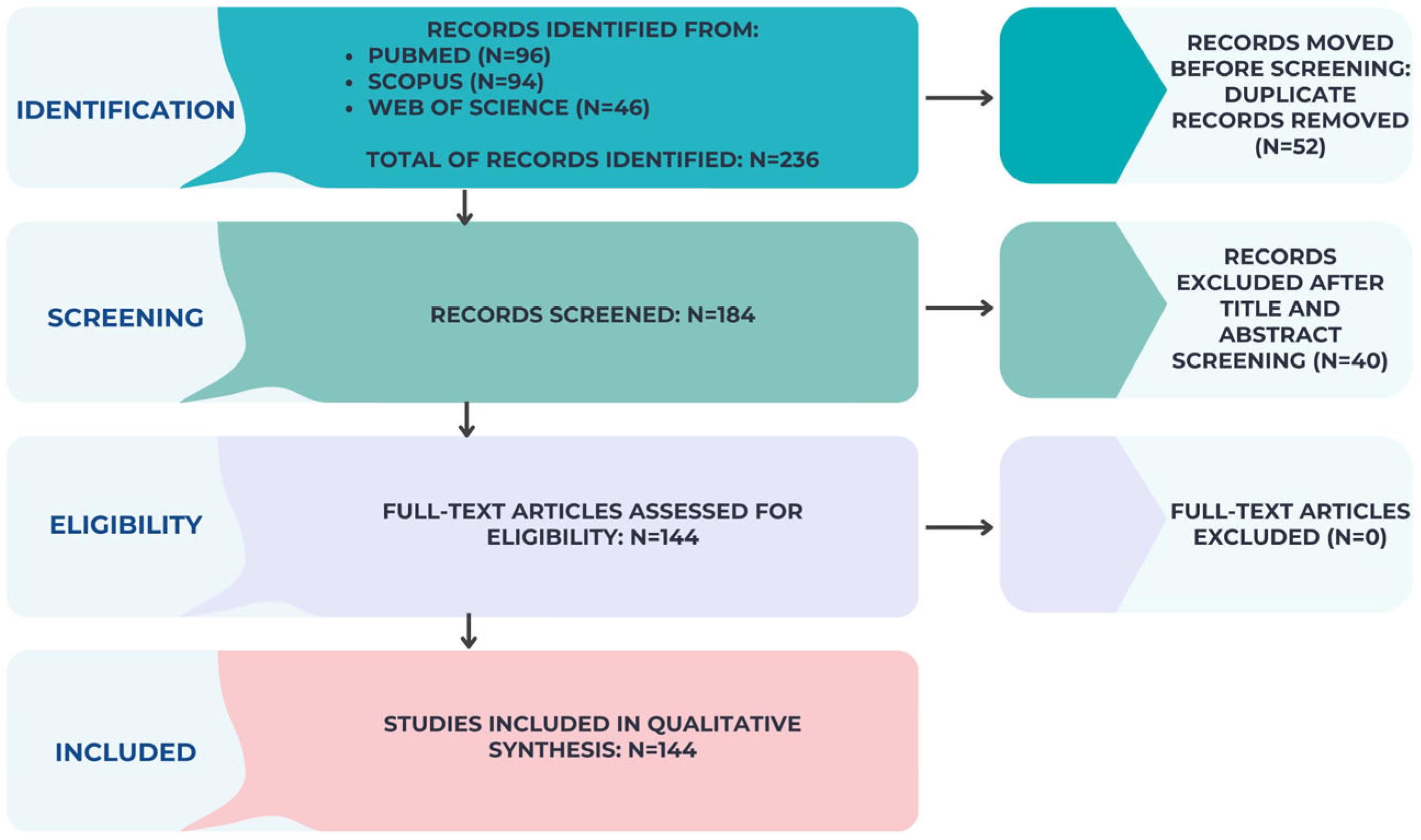
A total of 236 records were initially identified through database searching. After removal of duplicates (n = 52), 184 records remained for screening. Titles and abstracts were evaluated, and 40 records were excluded due to lack of relevance to dental applications, absence of hydroxyapatite-based materials, or insufficient methodological detail.
The remaining 144 articles were assessed in full text and were considered eligible for inclusion based on their relevance to physicochemical properties, biological performance, or clinical applicability of hydroxyapatite-based systems in oral and dental contexts.
Due to the heterogeneity of study designs, material formulations, and outcome measures, a formal meta-analysis was not feasible, and a qualitative synthesis of the data was performed, as illustrated in Figure 1.
To improve the interpretability of the available evidence and to avoid purely descriptive reporting, the included studies were critically appraised according to their experimental design and level of evidence. In particular, a clear distinction was made between in vitro studies, animal models, and clinical investigations. In vitro studies primarily provide mechanistic insights into cellular responses, including cytocompatibility, adhesion, and differentiation; however, their relevance for predicting clinical outcomes remains limited.
Animal studies allow for evaluation of tissue-level responses and regenerative potential but are constrained by interspecies differences and controlled experimental conditions that do not fully reflect clinical reality. Clinical studies represent the highest level of evidence but remain limited in number and are frequently affected by methodological constraints, including small sample sizes, short follow-up periods, and variability in study design.

2.3. Biological and Structural Background of Oral Tissues

Oral tissues form a highly specialized biological system in which soft and hard tissue components are structurally and functionally integrated. This close interdependence enables efficient mastication, speech, and aesthetics, while also supporting a dynamic balance between tissue integrity and continuous exposure to mechanical forces, microorganisms, and chemical stimuli [16]. The biological characteristics of oral tissues confer a relatively high regenerative potential; however, healing outcomes are strongly influenced by local and systemic factors, as well as by the materials applied during therapeutic interventions [17]. A clear understanding of oral tissue biology is therefore essential when evaluating biomaterials intended to support tissue repair.

2.3.1. Anatomy and Histology of Oral Hard and Soft Tissues

Oral hard tissues include alveolar bone, cementum, and dentin, all of which exhibit a mineralized structure predominantly composed of calcium phosphate in the form of hydroxyapatite crystals [18]. Alveolar bone is a highly dynamic tissue characterized by continuous remodeling, driven by mechanical loading and biological signaling. Its microarchitecture and metabolic activity allow for rapid adaptation but also make it susceptible to resorption under inflammatory or traumatic conditions [19,20].
Oral soft tissues comprise the gingiva, oral mucosa, periodontal ligament, and associated connective tissues. Histologically, these tissues consist of a stratified squamous epithelium supported by a connective tissue layer rich in fibroblasts, collagen fibers, blood vessels, and immune cells [21,22]. Regional variations exist within the oral cavity, with keratinized tissues such as the attached gingiva providing increased mechanical resistance, while non-keratinized mucosa exhibits greater flexibility and permeability. These histological differences significantly influence tissue response to injury and healing dynamics [23].

2.3.2. Vascularization, Innervation, and Regenerative Capacity

A defining feature of oral tissues is their dense vascular network, which ensures efficient delivery of oxygen, nutrients, inflammatory mediators, and reparative cells to sites of injury. This rich vascularization contributes to faster healing compared to many other tissues in the body. Adequate blood supply also supports angiogenesis, a critical process during the proliferative phase of tissue repair [24,25].
Innervation of oral tissues plays an important regulatory role in healing through neurogenic inflammation and neuropeptide signaling. Sensory and autonomic nerve fibers influence vascular tone, immune cell activity, and cellular proliferation, thereby modulating both inflammatory responses and tissue regeneration [26].
In addition, oral tissues harbor resident progenitor and stem cell populations, particularly within the periodontal ligament, gingival connective tissue, and alveolar bone marrow. These cells contribute to tissue homeostasis and repair by differentiating into fibroblasts, osteoblasts, and other specialized cell types in response to local biological and mechanical cues [27].

2.3.3. Pathophysiology of Oral Tissue Injury and Repair

Injury to oral tissues can occur as a result of trauma, inflammatory disorders, infections, or long-term mechanical irritation, in addition to surgical operations. There is a well-coordinated order to the steps involved in tissue repair, which include remodeling, cell proliferation, and inflammation [28]. Excessive or chronic inflammation may delay healing and cause fibrosis, delayed epithelialization, or bone loss, but the first inflammatory response is necessary for debris clearing and immune activation [29].
Wound stability is particularly problematic in the oral cavity because of constant contact with saliva, the oral bacteria, and the functional movements involved in chewing and speaking [30]. There is a need for treatment techniques that promote both biological repair and mechanical stability, as these factors can affect clot formation and epithelial migration [31]. Therefore, biomaterials utilised to treat oral tissues should have a positive effect on the local milieu by reducing inflammation, increasing cellular adhesion, and easing tissue integration [32].

2.4. Hydroxyapatite: Structure, Properties, and Biological Behavior

Hydroxyapatite (HA), a calcium phosphate compound with the chemical formula Ca10(PO4)6(OH)2, represents the primary inorganic constituent of human hard tissues, including bone and teeth [33]. Its chemical and structural similarity to the mineral phase of native tissues underlies its extensive use in oral and maxillofacial applications. As a biomaterial, hydroxyapatite exhibits favorable biological behavior, making it particularly suitable for therapeutic strategies aimed at supporting oral tissue healing and regeneration [34].

2.4.1. Chemical Composition and Crystallographic Structure

Hydroxyapatite belongs to the apatite family of calcium phosphates and crystallizes in a hexagonal lattice structure. Its stoichiometric composition is characterized by a calcium-to-phosphate ratio of approximately 1.67, although biological and synthetic hydroxyapatite frequently exhibit deviations from this ideal ratio due to ionic substitutions and structural imperfections. Such variations influence crystal size, solubility, and surface reactivity, all of which are relevant to biological performance [35].
In biological systems, hydroxyapatite crystals are nanoscale, poorly crystalline, and often substituted with ions such as carbonate, magnesium, sodium, or fluoride. Synthetic HA materials can be engineered to mimic these features, allowing for modulation of physicochemical properties to better match the biological environment of oral tissues [36,37].

2.4.2. Physicochemical Properties Relevant to Oral Tissue Healing

Several physicochemical properties of hydroxyapatite are critical to its role in oral tissue healing. These include surface chemistry, crystallinity, porosity, particle size, and dissolution behavior [38]. HA is generally characterized by low solubility under physiological conditions, which contributes to its structural stability while allowing for gradual ionic exchange at the tissue–material interface [39].
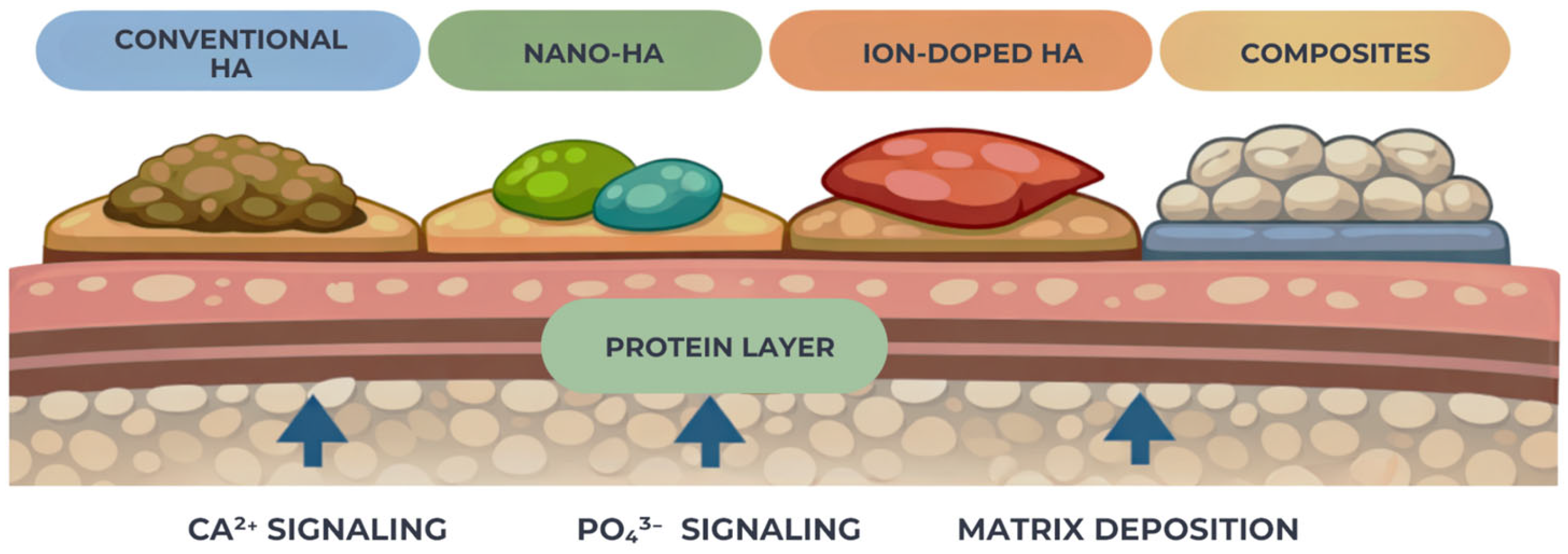
Surface characteristics play a key role in protein adsorption and subsequent cell attachment. The presence of calcium and phosphate ions facilitates the adsorption of adhesion proteins, promoting cellular anchorage and proliferation [40]. Porous HA structures further enhance biological performance by increasing surface area and supporting vascular ingrowth and tissue integration, particularly in bone-related applications. The influence of these surface properties on protein layer formation and ion-mediated signaling at the biomaterial interface is illustrated in Figure 2.

2.4.3. Bioactivity, Biocompatibility, and Osteoconductive Behavior

Hydroxyapatite is widely recognized for its excellent biocompatibility, eliciting minimal inflammatory or foreign body reactions when implanted in oral tissues. Its bioactivity is primarily attributed to its ability to form a biologically active apatite layer upon contact with physiological fluids, facilitating direct bonding with surrounding tissues [41,42].
In hard tissue applications, HA exhibits pronounced osteoconductive properties, providing a scaffold that supports bone cell migration and new bone formation. Although hydroxyapatite lacks intrinsic osteoinductive capacity, its interaction with the biological environment can indirectly stimulate osteogenic responses through ion release and surface-mediated signaling [43]. Emerging evidence also suggests that HA-based materials can favorably influence soft tissue behavior by supporting fibroblast adhesion, modulating inflammatory responses, and enhancing epithelial attachment, thereby extending their therapeutic relevance beyond bone regeneration [44].

2.4.4. Interaction of Hydroxyapatite with Oral Cells and Tissues

The biological behavior of hydroxyapatite is governed by its interaction with cells and extracellular matrix components at the tissue interface. HA surfaces regulate cellular responses through physicochemical cues that influence adhesion, proliferation, migration, and differentiation [45,46,47,48].
Ion exchange between hydroxyapatite and the surrounding environment contributes to the modulation of cellular activity, particularly through calcium- and phosphate-mediated signaling pathways. These interactions can enhance matrix deposition, promote angiogenesis, and support coordinated tissue repair [49,50]. However, excessive stability or inappropriate material design may limit biological responsiveness, underscoring the importance of tailoring HA properties to specific oral healing applications [51].
Osteoblasts exhibit increased adhesion, alkaline phosphatase activity, and expression of osteogenic markers when cultured on HA-based substrates, supporting matrix mineralization and bone regeneration [52]. Similarly, fibroblasts and gingival connective tissue cells interact favorably with HA surfaces, enhancing attachment, cytoskeletal organization, and collagen production, which are essential for soft tissue stability and wound healing [53]. Epithelial cells may also respond positively to appropriately engineered HA surfaces, showing improved adhesion and migration, thereby contributing to epithelial sealing [54,55].
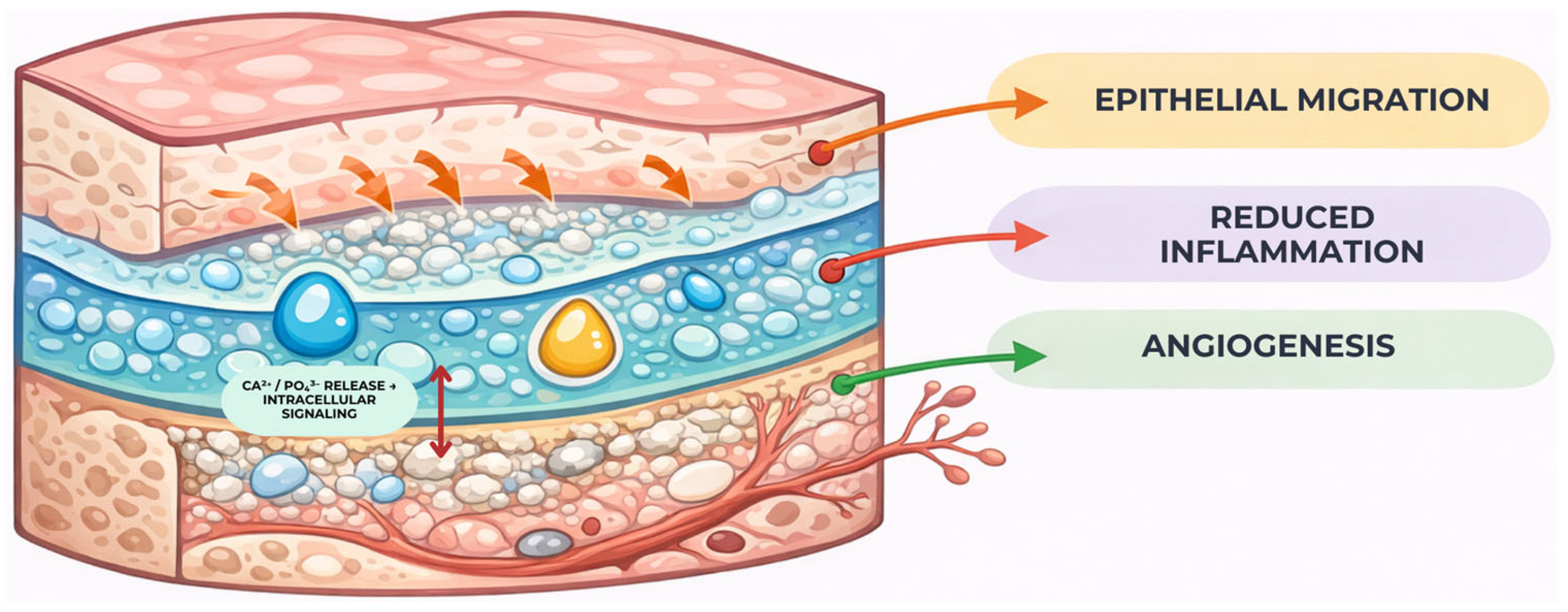
Ion exchange at the HA–tissue interface represents a key mechanism underlying these biological effects. The gradual release of calcium and phosphate ions modulates intracellular signaling pathways involved in cell survival, differentiation, and matrix synthesis [56,57,58]. These processes support coordinated tissue repair, extracellular matrix remodeling, and angiogenesis, as illustrated in Figure 3.
In addition to its direct cellular effects, hydroxyapatite can modulate the local inflammatory response. Properly designed HA materials have been shown to reduce excessive inflammatory signaling, creating a microenvironment conducive to tissue regeneration rather than chronic inflammation [59,60]. This immunomodulatory capacity is especially relevant in the oral cavity, where biomaterials are constantly exposed to microbial challenges and mechanical stress [61].
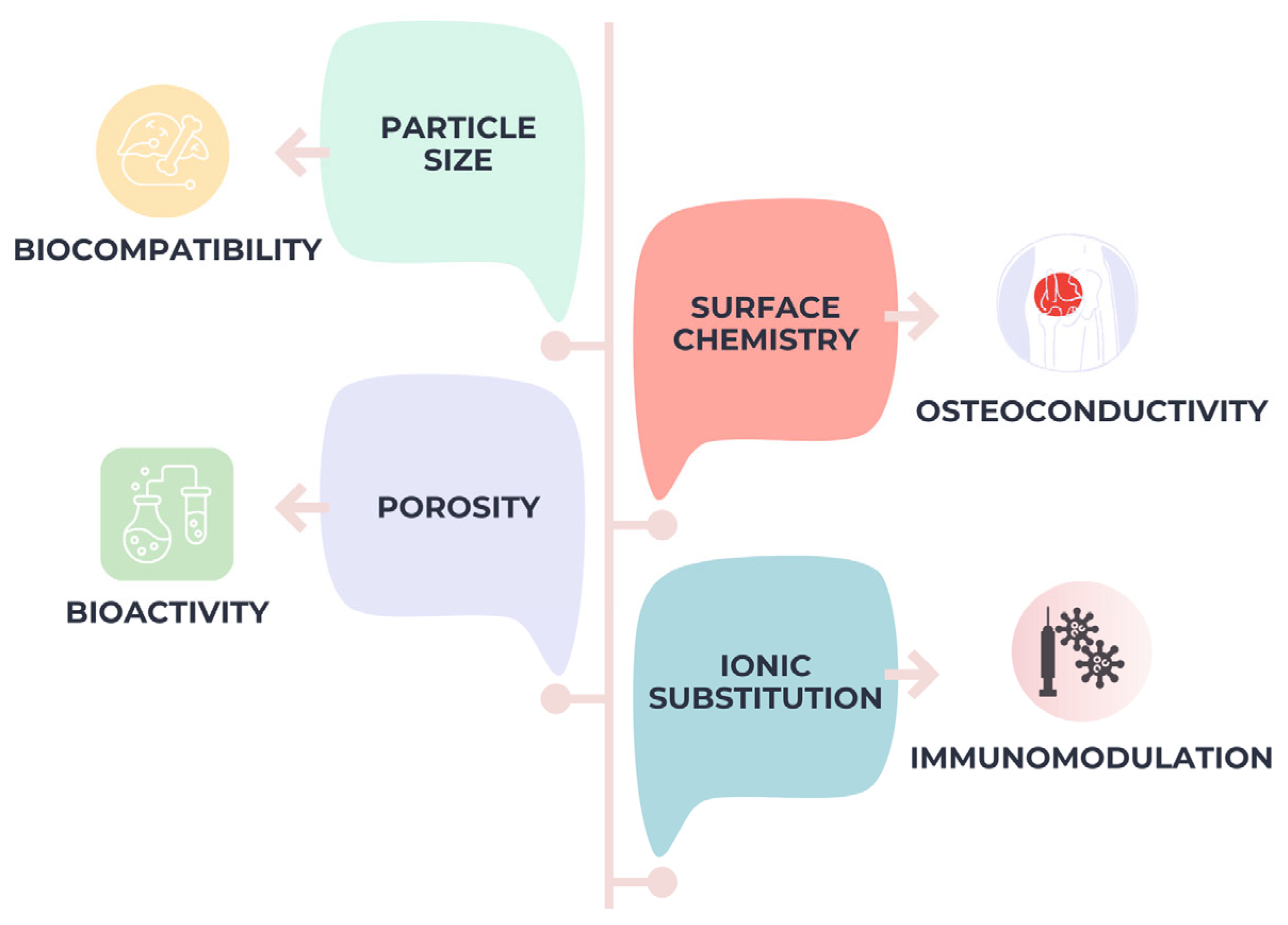
The interrelationship between the physicochemical characteristics of hydroxyapatite-based materials and their resulting biological effects relevant to oral tissue healing is summarized schematically in Figure 4.
To provide a clearer overview of the biological role of hydroxyapatite in oral tissue healing, the main properties and associated mechanisms are summarized in Table 1.
Clinically, hydroxyapatite-based materials are most commonly utilised in operations involving periodontal regeneration, bone augmentation, and ridge maintenance. Their low resorption rate and excellent osteoconductive capacity make them ideal for applications requiring volume stability and long-term structural support. If full material resorption and replacement by freshly produced bone is sought, however, this same feature may be a limitation.
While β-tricalcium phosphate (β-TCP) may show less volume stability over time, it is better suited for uses that require rapid remodelling because to its higher resorption rate and progressive replacement by newly produced bone. Some indications may be limited by bioactive glass’s mechanical properties and clinical handling, but overall, it is a unique class of biomaterials that can promote tissue regeneration by releasing ions and has antibacterial and angiogenic effects.
There is clinical evidence that materials derived from hydroxyapatite, β-TCP, and bioactive glass can accomplish what is needed for bone regeneration and operations involving implants; nonetheless, the effectiveness of these materials is highly influenced by the characteristics of the materials and the specific surgical techniques used. Thus, the unique clinical circumstances, such as the nature of the defect, the intended resorption profile, and the goals of regeneration, should direct the choice of biomaterial.
Despite the well-documented biocompatibility and bioactivity of hydroxyapatite, its biological performance is highly dependent on subtle variations in physicochemical properties, including crystallinity, particle size, surface chemistry, and ionic substitution. The absence of standardized characterization protocols across studies complicates direct comparison of reported outcomes and limits reproducibility. Moreover, while in vitro and preclinical models consistently demonstrate favorable cellular responses, the extent to which these findings translate into predictable clinical benefits remains insufficiently clarified.

2.4.5. Critical Appraisal of In Vitro Biocompatibility Assessment and Need for Standardization

The procedures employed to reach the results that hydroxyapatite-based materials are biocompatible and promote cellular proliferation and adhesion should be critically evaluated, regardless of the consistency of these reports.
When evaluating cytocompatibility, the majority of the existing research uses in vitro assays such CCK-8 viability tests, MTT assays, and Live/Dead staining. These methods have some promising early results, but they have a number of drawbacks that limit their practical use [68].
Inconsistency in cell models employed in different research is a big drawback. Common alternatives to primary human oral cells include fibroblasts, osteoblast-like cell lines, and epithelial cells, all of which exhibit vastly different biological behaviours. Immortalised cell lines could not be a good indicator of real-life situations because of changes in proliferation rates and reactions to biomaterials [69].
Another issue is that control groups are not always chosen in a clinically representative manner. Instead of using therapeutically relevant gold standards like recognised grafting materials or validated biomaterials used in oral surgery, tests are often conducted against inert or tissue culture plastic. Because of this, it is difficult to put hydroxyapatite’s biological performance into context with actual therapeutic situations [70].
More uniformity in assessing hydroxyapatite biocompatibility is obviously required in light of these constraints. Clinically relevant cell models, ideally primary human oral cells, and suitable control groups that represent current treatment materials should be a standard feature of future research. It is also crucial to evaluate the short- and long-term impacts and apply supplementary biological assays to measure cell viability, differentiation, and inflammatory response. For the sake of repeatability and useful cross-study comparisons, it is important to guarantee transparent reporting of experimental circumstances. The dependability of reported findings and the clinical translation of hydroxyapatite-based biomaterials could be greatly improved with such standardised procedures.

2.5. Hydroxyapatite-Based Formulations for Oral Tissue Healing

Numerous hydroxyapatite-based formulations have been developed to improve oral tissue repair, owing to advancements in material science. Modern formulations of hydroxyapatite attempt to optimise physicochemical qualities and delivery mechanisms in order to increase biological performance [62]. Traditional hydroxyapatite has been utilised in dentistry for a long time because to its biocompatibility and osteoconductive properties [63]. Considering biological materials in oral environment are subject to elevated levels of moisture, organisms, and mechanical stress, these developments are of crucial significance in that area.

2.5.1. Conventional Hydroxyapatite-Based Formulations

Hydroxyapatite can be incorporated into various formulations, including powders, coatings, scaffolds, composites, and topical delivery systems [64]. Each formulation presents distinct advantages depending on the target tissue, whether hard or soft, and the intended clinical application [65].
One of the first and most used types of hydroxyapatite is powder, which has many uses but is most commonly used for repairing bone defects and preserving sockets [66]. Rapid ion exchange and early biological interaction are made possible by HA particles’ high surface area; nevertheless, their weak mechanical stability limits its usage to non-load-bearing applications [67].
Surfaces of implants and prosthetics are often coated with HA to increase bioactivity and facilitate better tissue integration [71]. Coatings of hydroxyapatite on metallic substrates change the surface chemistry in a way that speeds up osseointegration and promotes direct contact between the bone and the implant. Furthermore, coated surfaces have the potential to facilitate the attachment of soft tissues and aid in the establishment of a solid biological barrier surrounding implants [72,73,74].
Three-dimensional hydroxyapatite scaffolds have been extensively investigated for bone regeneration purposes [75]. Their porous architecture provides mechanical support while allowing for cell migration, vascular ingrowth, and new tissue formation. The pore size, interconnectivity, and overall scaffold architecture play a crucial role in determining biological performance and regenerative outcomes [76].
Composite systems that integrate hydroxyapatite with polymers or bioactive substances, functionalised HA particles, and HA on a nanoscale have recently attracted a lot of attention from researchers [77]. The goal of these methods is to control local biological reactions like inflammation and angiogenesis while simultaneously increasing surface reactivity and cellular connections [78]. The capacity of soft tissue formulations like hydrogels and gels to conform to complicated anatomical areas, keep in touch with oral tissues for an extended period of time, and deliver therapeutic ions or molecules in a controlled manner caught a lot of interest [79].
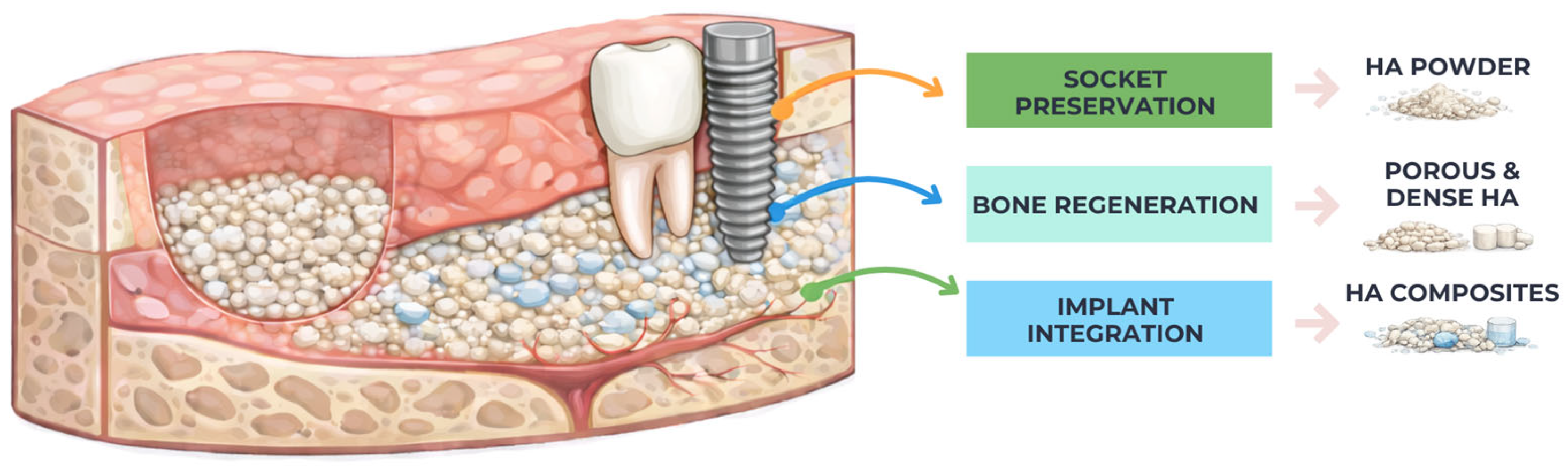
The relationship between different hydroxyapatite formulations and their main clinical applications in oral surgery and implant dentistry is schematically illustrated in Figure 5.
The choice of formulation influences ion release kinetics, surface interactions, cellular responses, and overall tissue integration, thereby directly affecting healing outcomes. An overview of the most common hydroxyapatite-based formulations and their relevance in oral tissue healing is presented in Table 2.
While conventional HA-based formulations have demonstrated clinical success, their biological performance is strongly influenced by formulation-specific characteristics. This has driven continued research toward advanced systems designed to enhance surface reactivity, cellular interactions, and controlled biological responses, including nano-scale hydroxyapatite and soft tissue–oriented delivery systems [87,88,89,90].

2.5.2. Nano-Hydroxyapatite-Based Systems

An important step forward in the creation of biomaterials for the repair of oral tissues has been the arrival of nano-hydroxyapatite (nano-HA). The size, shape, and surface properties of nano-HA are more similar to those of apatite crystals found in bone and dental tissues than those of traditional, microcrystalline hydroxyapatite [85,86]. Improved biological performance, especially at the interface between tissues and materials, is conferred by this biomimetic resemblance [91].
Although nano-hydroxyapatite systems exhibit enhanced surface reactivity and improved cellular interactions compared to conventional hydroxyapatite, their clinical applicability remains a subject of debate. The reduced particle size increases cellular uptake, which, depending on concentration, crystallinity, and surface charge, may induce cytotoxicity, oxidative stress, or undesirable inflammatory responses. Furthermore, the lack of consensus regarding optimal nanoparticle dimensions, dosing thresholds, and long-term safety profiles represents a major limitation.
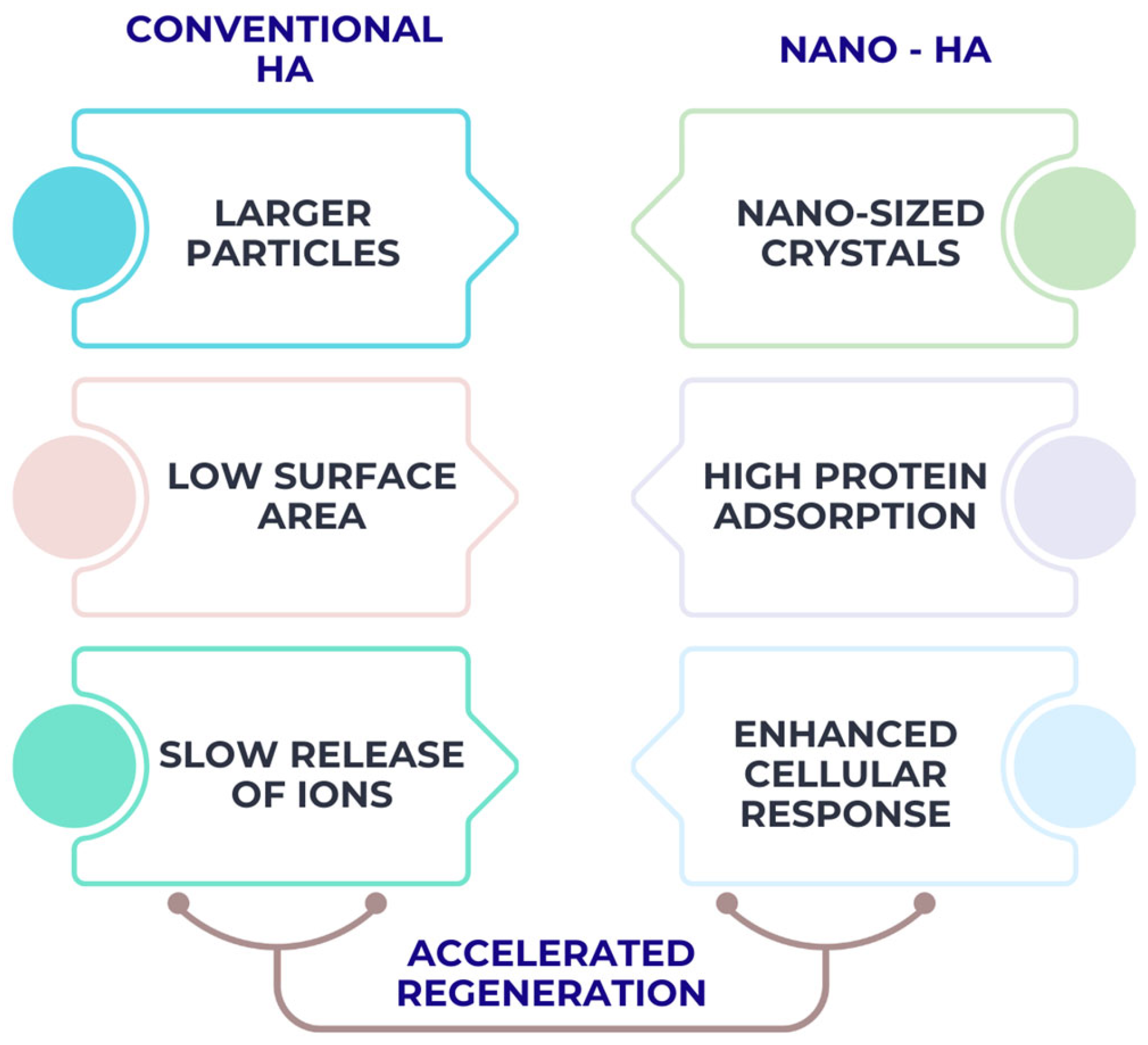
The main differences between conventional hydroxyapatite and nano-hydroxyapatite, including particle size, surface area, and resulting biological effects, are schematically summarized in Figure 6.
One of the defining features of nano-HA is its increased surface area–to–volume ratio, which markedly enhances surface reactivity and protein adsorption [91]. These properties facilitate improved cell adhesion and spreading, promoting favorable interactions with osteoblasts, fibroblasts, and epithelial cells [92]. As a result, nano-HA has been shown to support cellular proliferation and differentiation more effectively than conventional HA, contributing to accelerated tissue repair and regeneration [93,94].
Increased ion exchange dynamics are another property of nano-HA systems that permits controlled release of phosphate and calcium ions into the local microenvironment. Within cells, this localised ionic availability controls signalling pathways that are involved in mineralisation, matrix deposition, and angiogenesis [95,96]. These processes facilitate the growth of new bone and enhance its integration with the surrounding native alveolar bone in the context of oral hard tissue applications. When applied to soft tissues, nano-HA has the potential to modulate inflammatory responses and enhance fibroblast activity [97].
Some concerns have been raised about the development of systems based on nano-hydroxyapatite. Although these systems are chemically identical, their reduced dimensions make them easily absorbed by cells, which can lead to negative effects like cytotoxicity, oxidative stress induction, apoptosis, and inflammatory responses.
Nano-hydroxyapatite exhibits size- and dose-dependent biological effects, including cytotoxicity and apoptosis. Shi et al. [98] demonstrated that nanoparticle size directly influences both proliferation and apoptosis of osteoblast-like cells, while Motskin et al. [99] reported that hydroxyapatite particle properties, including size and morphology, are strongly correlated with cytotoxic responses.
Composites, coatings, gels, and hydrogels are just a few of the many delivery systems that can contain nano-hydroxyapatite from a formulation standpoint [100]. Its uniform biological activity and improved mechanical stability are both brought about by its tiny particle size, which allows for homogeneous dispersion inside polymeric matrix. These features are especially helpful for topical and minimally invasive procedures that involve close contact with irregular oral surfaces [101,102].
Despite its advantages, the biological performance of nano-HA is strongly influenced by factors such as particle size distribution, crystallinity, surface charge, and degree of aggregation [103]. Poorly controlled synthesis or excessive nanoparticle agglomeration may reduce bioactivity or compromise handling properties. Therefore, careful material design and characterization are essential to balance bioactivity, stability, and safety [104,105].

2.5.3. Hydroxyapatite-Containing Gels and Hydrogels

Hydroxyapatite-containing gels and hydrogels represent an important class of composite systems designed to extend the application of hydroxyapatite beyond traditional hard tissue regeneration toward oral soft tissue healing and wound management [106].
Hydrogel biomechanics and cell behaviour are enhanced by hydroxyapatite, a ceramic filler for bone scaffolds, which has engineering uses owing to its osteogenic, osteoconductive, and osteoinductive characteristics [107]. Composite hydrogels have recently attracted interest in bone regeneration as a means to simulate the extracellular matrix and facilitate cell adhesion, migration, and proliferation [108]. Several composite hydrogel materials have been investigated for use in bone tissue regeneration, such as alginate, chitosan, hyaluronic acid, and gelatin, which have improved mechanical properties, facilitate cell infiltration, promote the differentiation of mesenchymal stem cells and osteoblasts, and ultimately lead to natural bone formation [109,110].
Hydrogel systems that incorporate hydroxyapatite allow for the localised and sustained release of phosphate and calcium ions, which are recognised to impact cellular processes linked to remodelling, angiogenesis, and tissue healing [111]. Particulate hydroxyapatite functions as a stable mineral repository, enabling slow ion release without quick depletion, in contrast to soluble agents. This process may help create an optimal healing environment without the side effects of substances that are easily absorbed by the body [112].
Additionally, hydrogels containing hydroxyapatite have the potential to improve material-tissue interface biological interactions. Mineral particles embedded in a polymeric network can enhance surface-mediated cell adhesion and protein adsorption [113]. Using nanoscale hydroxyapatite can enhance cellular responses related to oral wound healing since the increased surface area amplifies these interactions even more. In order to keep the material uniform and mechanically stable, it is necessary to carefully regulate the size, concentration, and distribution of the particles within the hydrogel matrix [114].
There are a number of useful clinical applications for hydroxyapatite-based gel systems. They can be applied topically or by injection, allowing for less invasive administration. The material-tissue interaction in the mouth is sustained because of the extended retention at the application site [115]. Systems with these characteristics have potential for a variety of uses, such as the treatment of wounds after extraction, periodontal therapy, the healing of mucosal surfaces, and the management of soft tissues around implants [116].
Beyond their conceptual advantages, hydroxyapatite-containing gels and hydrogels should also be assessed on the basis of quantifiable preclinical efficacy outcomes. In the available literature, the most informative parameters include hemostasis time in in vivo bleeding models, antimicrobial inhibition zones for formulations incorporating anti-infective components, and wound closure rates in fibroblast or epithelial scratch assays. These endpoints provide a more rigorous basis for comparing formulations than qualitative descriptions alone.
Within the available literature included in this review, only a limited number of studies specifically investigate hydroxyapatite-based hydrogels in relevant experimental models.
For example, Tanongpitchayes et al. [117] demonstrated that a nanohydroxyapatite-based hydrogel evaluated in post-extraction socket models resulted in enhanced bone formation and improved tissue integration compared to untreated controls, supporting its potential role in oral wound healing.
At the cellular level, existing in vitro studies provide indirect evidence regarding the biological effects of hydroxyapatite. Specifically, Gouma et al. [118] reported enhanced cell proliferation in hydroxyapatite-containing composite systems, while Areid et al. [119] demonstrated improved adhesion-related responses in human gingival fibroblasts exposed to hydroxyapatite-modified surfaces. These findings suggest that hydroxyapatite may support cellular processes relevant to tissue repair; however, they are not derived from hydrogel-specific wound healing models, and direct evidence from standardized migration assays remains limited.
Regarding antimicrobial activity, Balhuc et al. [120] discussed the potential of hydroxyapatite-based systems, particularly in modified or composite formulations, to exhibit antibacterial effects.
However, these observations are largely based on heterogeneous experimental conditions and are not consistently quantified using standardized methodologies, such as inhibition zone measurements. For more accurate comparisons and better translational relevance, future studies should use standardised quantitative endpoints such as cell migration dynamics, haemostatic response, and antimicrobial performance.
Major obstacles persist despite their potential. The described formulations vary greatly in terms of the hydroxyapatite particle properties, loading concentrations, polymer composition, and crosslinking techniques [121]. This lack of uniformity makes it difficult to compare studies side by side. In addition, there is a lack of high-quality clinical evidence assessing the safety and effectiveness of hydroxyapatite-containing gels over the long term, even if preclinical studies show positive biological responses [122,123].
Purity and the ability to modify properties like porosity, hardness, and Ca/P ratio are two benefits of synthetic hydroxiapatite. Because hydroxyapatite has several uses and is quite adaptable, there are many alternative ways to synthesise it. The goals can include obtaining hydroxyapatite in powder, granular, macro- or microporous form, with varying degrees of crystallinity, etc., since there is essentially a method for every particular design or application. Despite some disagreements, the majority of writers agree that dry, wet, and high temperature processes are the best ways to categorise synthesis methods. processes involving elevated temperature.

2.6. Distinct Approaches to Hydroxyapatite Synthesis

Given the significant role of hydroxyapatite in materials designed for tissue regeneration, particular attention must be paid to the influence of synthesis routes and processing methodologies on the final performance of the material [124]. The mechanical resistance and osteointegrative capacity of hydroxyapatite powders are strongly dependent on their microstructural features, which are, in turn, dictated by the synthesis conditions. Consequently, a major challenge in the development of medical-grade hydroxyapatite lies in achieving precise control over morphological parameters that directly affect mechanical behavior, biocompatibility, and bioactivity [125].
Furthermore, it is essential to consider the inherent heterogeneity of bone tissue when designing hydroxyapatite-based biomaterials. Compact or cortical bone, located primarily at the outer surface, is dense and mechanically robust, with thickness that adapts to local mechanical loading. In contrast, cancellous or trabecular bone is predominantly found in the internal regions of skeletal structures and is characterized by a lightweight, porous architecture composed of a trabecular network that provides space for bone marrow [126,127,128]. Replicating these structural distinctions remains a key objective in the synthesis and optimization of hydroxyapatite for regenerative applications. Hydroxyapatite synthesis routes are commonly grouped into three main categories: dry, wet, and high-temperature methods [129].
Dry synthesis approaches include solid-state and mechanochemical techniques and are primarily used to obtain stoichiometric hydroxyapatite. In solid-state methods, calcium- and phosphate-based precursors are thermally treated at high temperatures, leading to hydroxyapatite formation through ionic diffusion during calcination [130]. Mechanochemical routes rely on mechanically induced reactions, typically using high-energy milling, where processing conditions influence particle size, crystalline, and morphology.
Wet synthesis methods are based on the formation of hydroxyapatite through precipitation reactions that occur when aqueous solutions containing calcium and phosphate ions are combined [131]. This category represents the most widely used group of synthesis routes and includes low-temperature chemical precipitation, hydrolysis-based reactions, and hydrothermal approaches.
Hydroxyapatite produced via the first approach typically exhibits a porous structure and a non-uniform chemical composition, whereas the latter method yields powders with higher crystallinity and improved compositional homogeneity [132]. In wet synthesis routes, material characteristics such as morphology, crystallinity, and chemical structure are strongly influenced by synthesis conditions, including reactant concentration, addition rate, thermal treatment, and, most notably, solution pH and reaction temperature [133].
Sintering conditions, including temperature and processing atmosphere, play a significant role in determining the mechanical performance of hydroxyapatite. Excessively high sintering temperatures can lead to dehydroxylation of the hydroxyapatite lattice, promoting partial phase transformation into α-tricalcium phosphate, β-tricalcium phosphate, or tetracalcium phosphate. Such phase changes reduce the proportion of the hydroxyapatite phase and may hinder proper densification, ultimately compromising mechanical strength [132].
Despite these limitations, wet synthesis routes are generally regarded as simple, cost-effective, and accessible methods. Water is typically the main reaction by-product, and the risk of contamination during synthesis is relatively low, making these approaches attractive for biomedical material production.
Given the critical role of hydroxyapatite in tissue regeneration applications, careful consideration of synthesis methodology is essential, as it directly influences material viability and functional performance [133].
Properties such as powder strength and osteointegration capacity are closely linked to microstructural features. Consequently, one of the primary challenges in producing hidroxyapatite for medical use lies in controlling morphological parameters that govern mechanical behavior, biocompatibility, and bioactivity [134].
Porosity control represents a critical factor in the design of hydroxyapatite-based implants, as it directly influences surface chemistry and biological integration. Adequate porosity facilitates bone tissue ingrowth, thereby enhancing the mechanical anchorage of the implant within the host site. As porous ceramic implants are progressively infiltrated and replaced by newly formed bone, their biomechanical behavior increasingly resembles that of native bone tissue. The relevance of porosity in hydroxyapatite implants has been extensively reported in the literature [135,136].
For effective osteoconduction, a minimum pore size and adequate interconnectivity are required to support vascular infiltration and subsequent bone formation. Pore dimensions play a decisive role in determining biological response: pores smaller than 10 μm restrict cellular infiltration; pores ranging from 10 to 50 μm permit fibrovascular tissue penetration; pores between 50 and 150 μm support bone ingrowth; and pores exceeding 150 μm favor both bone penetration and new bone formation [137].
Moreover, successful bone tissue infiltration has been shown to depend on pore interconnectivity, as isolated or closed pores do not support effective tissue integration [138].
Early investigations by Korkusuz et al. [139] showed that porous hydroxyapatite implants exhibit adequate biomechanical stability and integrate well with surrounding bone tissue. Their findings indicated minimal differences between the implanted material and adjacent native bone, accompanied by enhanced osteoblastic activity and a progressive increase in bending stiffness during the healing process [139].
The bioactive behavior of hydroxyapatite has been attributed by several authors to the presence of hydroxyl groups on its surface, which display strong affinity for amino acids, proteins, and organic acids present in the human body [136,137]. These interactions, primarily mediated through hydrogen bonding, are considered central to the material’s ability to support biological integration and bone regeneration [136].
Klein et al. [140] reported the successful fabrication of hydroxyapatite cylindrical structures measuring 3.5 mm in diameter and 7 mm in length, characterized by pore sizes ranging from 75 to 550 µm and an overall porosity of approximately 45–60%. In addition, foaming-based techniques have been applied to generate macroporous HA architectures, resulting in highly interconnected pore networks and elevated porosity levels, typically between 60% and 90% [140].
Beyond conventional dry and wet synthesis routes, several modern techniques have been developed to obtain hydroxyapatite with enhanced structural control and tailored biological performance. The sol–gel method enables the production of hydroxyapatite with high chemical homogeneity and fine particle size, offering improved control over stoichiometry and morphology while operating at relatively low processing temperatures. This approach is particularly advantageous for biomedical applications requiring uniform composition and high purity [141].
Microwave-assisted synthesis has emerged as an efficient alternative, characterized by shortened reaction times, reduced energy consumption, and improved crystallinity of the resulting hydroxyapatite. The rapid and uniform heating associated with microwave processing allows for better control of nucleation and growth, leading to reproducible material properties [142].
Biomimetic synthesis methods aim to replicate physiological conditions, such as body temperature and pH, to produce hydroxyapatite with structural features resembling those of natural bone mineral [143]. These materials often exhibit enhanced bioactivity and improved interaction with biological tissues.
Additionally, electrochemical deposition techniques have been employed to fabricate hydroxyapatite coatings and structures with precisely controlled thickness and morphology, making them particularly suitable for surface modification of biomedical implants [144].
These differences in processing approaches and resulting material features are reflected across the main hydroxyapatite synthesis methods summarized in Table 3.

2.7. Correlation Between Characterization Parameters and Clinical Performance of Hydroxyapatite-Based Materials

The lack of a correlation between data from physicochemical characterisation and clinically relevant outcomes is a crucial gap in the current literature, despite the widespread reporting of synthesis methods and the features of the resultant materials. Closing this gap is crucial for the transition of biomaterials made of hydroxyapatite from testing systems to anticipated medicinal uses.
The chemical bonding and functional groups inside hydroxyapatite structures can be better understood with the use of spectroscopic methods like Fourier-transform infrared spectroscopy (FTIR) [145]. Surface reactivity, protein adsorption, and ion exchange capacity are all directly affected by variations in hydroxyl, phosphate, and carbonate groups [146]. These variations often arise from differing synthesis processes. The dynamics of soft and hard tissue healing are influenced by these molecular-level interactions, which are essential for early biological events such cell adhesion and signalling [146].
Particle size, porosity, and surface architecture exhibit notable variations, as shown by morphological and structural characterisation by scanning electron microscopy (SEM) and transmission electron microscopy (TEM) [147]. Bone regeneration relies on cellular migration, vascular infiltration, and nutrient diffusion, all of which are made possible by interconnected pore networks and nanoscale porosity. Tissue integration and healing might be slowed down by structures that are too dense or have insufficient connections. In addition, surfaces area and cellular interaction are improved by smaller particles, especially in nano-hydroxyapatite systems [148]. However, depending on concentration and aggregation state, there is a risk of cytotoxicity and inflammatory responses.
The storage modulus (G′) and loss modulus (G″) are two important rheological characteristics of hydrogels and gels that include hydroxyapatite that are crucial in deciding their therapeutic usefulness [149]. To keep structural stability in bone regeneration situations, materials with a higher storage modulus behave more solid-like. Contrarily, systems that are softer and more viscoelastic, with balanced G′/G″ ratios, work better in soft tissue applications because they can mould and adapt to complicated anatomical surfaces [149].
The rate of hydroxyapatite dissolution and ion release needs to be synchronised with the biological healing timetable, which in turn affects degradation kinetics and clinical performance. Materials that are too stable might impede tissue remodelling and integration, while those that degrade too quickly could cause structural support to be lost too soon. Oral tissues have different regenerative needs, such as mucosal healing requires a quicker turnover rate and alveolar bone regeneration requires a slower remodelling rate, hence degradation profiles should ideally be adjusted accordingly.

3. Limitations and Future Directions

Despite being designed as a comprehensive review, several limitations should be considered when interpreting the findings of this work. Although an extensive and structured literature search was conducted across major scientific databases, the rapidly expanding nature of research on hydroxyapatite-based biomaterials means that newly published studies may not have been captured at the time of analysis.
Further limitation arises from the inherent heterogeneity of the included literature. The reviewed studies vary substantially in terms of experimental design, material formulations, synthesis methods, biological models, and outcome measures. Differences in hydroxyapatite particle size, crystallinity, surface modification, and incorporation into gels, hydrogels, or composite systems limit direct comparison and preclude quantitative synthesis. Consequently, conclusions are based on qualitative integration of evidence rather than statistical aggregation.
Despite the increasing number of studies investigating hydroxyapatite-based biomaterials, the available clinical evidence remains limited and is affected by several methodological shortcomings. Many of the existing clinical trials are characterized by relatively small sample sizes, which reduce statistical power and limit the generalizability of the findings. In addition, follow-up periods are often short, preventing adequate assessment of long-term clinical performance and material stability.
Furthermore, several studies lack robust study design elements, such as proper randomization procedures and blinding, which may introduce selection and observer bias. In some cases, the absence of standardized control groups and variability in outcome measures further complicate the interpretation and comparison of results. These limitations highlight the need for well-designed, adequately powered randomized controlled trials with standardized protocols, longer follow-up periods, and clearly defined clinical endpoints to establish the long-term safety and efficacy of hydroxyapatite-based materials.
The majority of the existing literature is based on in vitro and animal research, even though this review sought to incorporate both preclinical and clinical information. While these investigations provide valuable mechanistic insights into biological interactions and healing processes, their translational applicability to clinical practice remains limited. Conclusions about clinical efficacy and long-term safety can only be drawn from a limited number of well-designed, long-term clinical trials.
Finally, this comprehensive review focused specifically on hydroxyapatite-based materials in oral and wound healing contexts. Findings from other biomedical applications of hydroxyapatite were not systematically analyzed, which may limit the broader generalizability of certain observations.
Several significant possibilities for further study arise from the existing data, despite the large amount of literature dealing with hydroxyapatite-based biomaterials in dental applications. Shifting focus from material-centered characterization to design techniques driven by biology and clinical trials is one of the most prevalent issues highlighted in the studies that were analyzed. Additional study should concentrate on optimizing the physicochemical qualities of hydroxyapatite formulations for use in the mouth, taking into account factors such as the kind of tissue, the stage of healing, and any mechanical or microbiological issues peculiar to the area.
The complex oral microenvironment and hydroxyapatite-based materials should be further investigated in future studies. This involves doing a more thorough examination of the effects of HA formulations on immunological responses, angiogenesis, and tissue remodeling in real-world clinical settings. Better healing results with less chronic inflammation, particularly in peri-implant and periodontal tissues, may be attainable with a better knowledge of the immunomodulatory effects of functionalized HA systems and nano-hydroxyapatite.
Improving delivery systems based on hydroxyapatite for use in soft tissues is another crucial area of research. While HA has long been linked to bone and ligament regeneration, there is growing evidence that it also plays a role in the repair of gums and mucosa. Research in the future should focus on developing and studying composite matrices, hydrogels, and gels that contain HA. These materials should be able to maintain contact with tissues for an extended period, release ions under control, and transport bioactive chemicals to specific areas. These technologies have the potential to revolutionize postoperative wound care and minimally invasive therapy.
From a translational standpoint, there is still a need for carefully planned clinical trials that compare various HA formulations in a controlled environment. Current cross-study comparisons are limited, and the formulation of explicit therapeutic standards is obstructed by variability in particle size, crystallinity, doping techniques, and composite composition. To improve the assessment of safety, effectiveness, and long-term performance in both hard and soft oral tissues, future clinical trials should implement standardized methodologies and outcome measurements.
Future research might also benefit from investigating new manufacturing technologies, such as surface functionalization methods and additive manufacturing. There is hope for patient-specific solutions that take into account anatomical complexity and functional demands through the incorporation of hydroxyapatite into hybrid biomaterials, coatings, and three-dimensional scaffolds. Optimizing production methods while keeping the biological activity of HA-based components requires further research, nevertheless.

4. Conclusions

This comprehensive review highlights the central role of hydroxyapatite-based biomaterials in contemporary dental applications, driven by their close chemical resemblance to native mineralized tissues and their favorable biological interactions within the oral environment. The accumulated body of evidence confirms that hydroxyapatite exhibits excellent biocompatibility, bioactivity, and osteoconductive behavior, supporting its widespread use in bone regeneration, implant dentistry, and restorative procedures. Increasing attention has also been directed toward its potential role in oral soft tissue healing, where hydroxyapatite-based systems may contribute to improved cellular adhesion, modulation of inflammation, and enhanced tissue integration.
Advances in material science have led to the development of diverse hydroxyapatite formulations, including nano-sized particles, ion-substituted variants, composite systems, and hydroxyapatite-containing gels and hydrogels. These strategies aim to optimize surface reactivity, ion-mediated signaling, and adaptability to complex oral anatomical conditions. Experimental and preclinical studies consistently report enhanced cellular responses and regenerative potential for these advanced systems compared to conventional hydroxyapatite. However, such benefits are strongly dependent on precise control of physicochemical properties, including particle size, crystallinity, surface chemistry, and synthesis route.
Despite these promising developments, the clinical translation of hydroxyapatite-based biomaterials remains limited. A major challenge identified throughout the reviewed literature is the pronounced heterogeneity in material formulations, synthesis methods, experimental models, and outcome measures. This variability hinders direct comparison between studies and complicates the formulation of standardized, evidence-based clinical protocols. In particular, nano-hydroxyapatite systems raise unresolved concerns regarding long-term safety, optimal dosing, and potential cytotoxic or pro-inflammatory effects, while hydroxyapatite-containing gels and hydrogels suffer from a notable lack of high-quality, long-term randomized clinical trials.

Author Contributions

Conceptualization, D.A. and F.C.B.; methodology, A.G.; software, F.R.C. and N.T.; validation, M.M.S., F.R.C. and D.G.B.; formal analysis, I.L. and V.C.; investigation, N.T., V.C. and C.C.; resources, C.C. and M.M.S.; data curation, F.C.B.; writing—original draft preparation, D.A.; writing—review and editing, I.L., A.G. and F.C.B.; visualization, F.R.C. and C.C.; supervision, D.G.B.; project administration, I.L. All authors have read and agreed to the published version of the manuscript.

Funding

This research received no external funding.

Institutional Review Board Statement

Not applicable.

Informed Consent Statement

Not applicable.

Data Availability Statement

No new data were created or analyzed in this study. Data supporting the findings of this review are available within the cited literature.

Conflicts of Interest

The authors declare no conflicts of interest.

Abbreviations

The following abbreviations are used in this manuscript:
HAHydroxyapatite
CCK-8Cell Counting Kit-8
MTT3-(4,5-dimethylthiazol-2-yl)-2,5-diphenyltetrazolium bromide
FTIRFourier-Transform Infrared Spectroscopy
SEMScanning Electron Microscopy
TEMTransmission Electron Microscopy

References

  1. Enax, J.; Epple, M. Synthetic hydroxyapatite as a biomimetic oral care agent. Oral Health Prev. Dent. 2018, 16, 7–19. [Google Scholar] [PubMed]
  2. Habibah, T.U.; Amlani, D.V.; Brizuela, M. Hydroxyapatite Dental Material. In StatPearls; StatPearls Publishing: Treasure Island, FL, USA, 2020. [Google Scholar]
  3. Meyer, F.; Amaechi, B.T.; Fabritius, H.-O.; Enax, J. Overview of calcium phosphates used in biomimetic oral care. Open Dent. J. 2018, 12, 406. [Google Scholar] [CrossRef]
  4. Pepla, E.; Besharat, L.K.; Palaia, G.; Tenore, G.; Migliau, G. Nano-hydroxyapatite and its applications in preventive, restorative and regenerative dentistry: A review of literature. Ann. Stomatol. 2014, 5, 108. [Google Scholar] [CrossRef]
  5. Pu’ad, N.A.S.M.; Koshy, P.; Abdullah, H.Z.; Idris, M.I.; Lee, T.C. Syntheses of hydroxyapatite from natural sources. Heliyon 2019, 5, e01588. [Google Scholar] [CrossRef]
  6. Shavandi, A.; Wilton, V.; Bekhit, A.E.-D.A. Synthesis of macro and micro porous hydroxyapatite (HA) structure from waste kina (Evechinus chloroticus) shells. J. Taiwan Inst. Chem. Eng. 2016, 65, 437–443. [Google Scholar] [CrossRef]
  7. Hannig, M.; Hannig, C. Nanomaterials in preventive dentistry. Nat. Nanotechnol. 2010, 5, 565–569. [Google Scholar] [CrossRef] [PubMed]
  8. Enax, J.; Fabritius, H.-O.; Fabritius-Vilpoux, K.; Amaechi, B.T.; Meyer, F. Modes of action and clinical efficacy of particulate hydroxyapatite in preventive oral health care—State of the art. Open Dent. J. 2019, 13, 274–287. [Google Scholar] [CrossRef]
  9. Zafar, M.S.; Amin, F.; Fareed, M.A.; Ghabbani, H.; Riaz, S.; Khurshid, Z.; Kumar, N. Biomimetic aspects of restorative dentistry biomaterials. Biomimetics 2020, 5, 34. [Google Scholar] [CrossRef]
  10. Imran, E.; Mei, M.L.; Li, K.C.; Ratnayake, J.; Ekambaram, M.; Cooper, P.R. Dental Applications of Ion-Substituted Hydroxyapatite: A Review of the Literature. Dent. J. 2024, 12, 304. [Google Scholar] [CrossRef]
  11. De Leeuw, N.H. Local ordering of hydroxy groups in hydroxyapatite. Chem. Commun. 2001, 17, 1646–1647. [Google Scholar] [CrossRef]
  12. Kolmas, J.; Groszyk, E.; Kwiatkowska-Różycka, D. Substituted Hydroxyapatites with Antibacterial Properties. BioMed Res. Int. 2014, 2014, 178123. [Google Scholar] [CrossRef]
  13. Siddiqui, H.A.; Pickering, K.L.; Mucalo, M.R. A Review on the Use of Hydroxyapatite-Carbonaceous Structure Composites in Bone Replacement Materials for Strengthening Purposes. Materials 2018, 11, 1813. [Google Scholar] [CrossRef] [PubMed]
  14. Ressler, A.; Žužić, A.; Ivanišević, I.; Kamboj, N.; Ivanković, H. Ionic substituted hydroxyapatite for bone regeneration applications: A review. Open Ceram. 2021, 6, 100122. [Google Scholar] [CrossRef]
  15. Sadat-Shojai, M.; Khorasani, M.T.; Dinpanah-Khoshdargi, E.; Jamshidi, A. Synthesis methods for nanosized hydroxyapatite with diverse structures. Acta Biomater. 2013, 9, 7591–7621. [Google Scholar] [CrossRef]
  16. Huang, Y.-C.; Hsiao, P.-C.; Chai, H.-J. Hydroxyapatite extracted from fish scale: Effects on MG63 osteoblast-like cells. Ceram. Int. 2011, 37, 1825–1831. [Google Scholar] [CrossRef]
  17. Sarna-Boś, K.; Boguta, P.; Skic, K.; Wiącek, D.; Maksymiuk, P.; Sobieszczański, J.; Chałas, R. Physicochemical Properties and Surface Characteristics of Ground Human Teeth. Molecules 2022, 27, 5852. [Google Scholar] [CrossRef]
  18. DeRocher, K.A.; Smeets, P.J.; Goodge, B.H.; Zachman, M.J.; Balachandran, P.V.; Stegbauer, L.; Cohen, M.J.; Gordon, L.M.; Rondinelli, J.M.; Kourkoutis, L.F.; et al. Chemical gradients in human enamel crystallites. Nature 2020, 583, 66–71. [Google Scholar] [CrossRef] [PubMed]
  19. Kuc, A.E.; Sulewska, M.; Sybilski, K.; Kotuła, J.; Hajduk, G.; Saternus, S.; Małachowski, J.; Bar, J.; Lis, J.; Kawala, B.; et al. Mechanobiological Regulation of Alveolar Bone Remodeling: A Finite Element Study and Molecular Pathway Interpretation. Biomolecules 2026, 16, 150. [Google Scholar] [CrossRef]
  20. Pietroń, K.; Mazurkiewicz, Ł.; Sybilski, K.; Małachowski, J. Correlation of Bone Material Model Using Voxel Mesh and Parametric Optimization. Materials 2022, 15, 5163. [Google Scholar] [CrossRef]
  21. Gavriiloglou, M.; Hammad, M.; Iliopoulos, J.M.; Layrolle, P.; Apatzidou, D.A. Bioengineering the Junctional Epithelium in 3D Oral Mucosa Models. J. Funct. Biomater. 2024, 15, 330. [Google Scholar] [CrossRef]
  22. Cinquini, C.; Marchio, V.; Di Donna, E.; Alfonsi, F.; Derchi, G.; Nisi, M.; Barone, A. Histologic Evaluation of Soft Tissues around Dental Implant Abutments: A Narrative Review. Materials 2022, 15, 3811. [Google Scholar] [CrossRef]
  23. Lu, E.M.-C. Three-Dimensional Organotypic Systems for Modelling and Understanding Molecular Regulation of Oral Dentogingival Tissues. Int. J. Mol. Sci. 2024, 25, 11552. [Google Scholar] [CrossRef] [PubMed]
  24. Everts, P.A.; Lana, J.F.; Onishi, K.; Buford, D.; Peng, J.; Mahmood, A.; Fonseca, L.F.; van Zundert, A.; Podesta, L. Angiogenesis and Tissue Repair Depend on Platelet Dosing and Bioformulation Strategies Following Orthobiological Platelet-Rich Plasma Procedures: A Narrative Review. Biomedicines 2023, 11, 1922. [Google Scholar] [CrossRef]
  25. Chelmu Voda, C.; Stefanopol, I.A.; Gurau, G.; Hîncu, M.A.; Popa, G.V.; Mateescu, O.G.; Baroiu, L.; Mehedinti, M.C. Update on the Study of Angiogenesis in Surgical Wounds in Patients with Childhood Obesity. Biomedicines 2025, 13, 375. [Google Scholar] [CrossRef]
  26. Chung, M.-K.; Raman, S.; Szallasi, A. Tooth Pulp Afferents and Transient Receptor Potential (TRP) Ion Channels as Key Regulators of Pulp Homeostasis, Inflammation, and Pain. Int. J. Mol. Sci. 2026, 27, 182. [Google Scholar] [CrossRef] [PubMed]
  27. Ronan, E.A.; Nagel, M.; Emrick, J.J. The anatomy, neurophysiology, and cellular mechanisms of intradental sensation. Front. Pain Res. 2024, 5, 1376564. [Google Scholar] [CrossRef]
  28. Surendra, G.; Perera, I.; Ranasinghe, A.; Kumarapeli, V.; Tham, R.; Wickramaratne, P. Pattern and Causes of Oral and Maxillofacial Injuries Presented to a Tertiary Care Public Dental Hospital in Strictly Imposed COVID-19 Lockdown Scenario. Oral 2021, 1, 3–14. [Google Scholar] [CrossRef]
  29. Vasalou, V.; Kotidis, E.; Tatsis, D.; Boulogeorgou, K.; Grivas, I.; Koliakos, G.; Cheva, A.; Ioannidis, O.; Tsingotjidou, A.; Angelopoulos, S. The Effects of Tissue Healing Factors in Wound Repair Involving Absorbable Meshes: A Narrative Review. J. Clin. Med. 2023, 12, 5683. [Google Scholar] [CrossRef]
  30. Janakiram, N.B.; Valerio, M.S.; Goldman, S.M.; Dearth, C.L. The Role of the Inflammatory Response in Mediating Functional Recovery Following Composite Tissue Injuries. Int. J. Mol. Sci. 2021, 22, 13552. [Google Scholar] [CrossRef]
  31. Jin, C.; Jin, Y.; Ding, Z.; Nuch, K.S.; Han, M.; Shim, J.; Chien, P.N.; Heo, C.Y. Cellular and Molecular Mechanisms of Wound Repair: From Biology to Therapeutic Innovation. Cells 2025, 14, 1850. [Google Scholar] [CrossRef]
  32. Norahan, M.H.; Sivarasu, S.; Fayzullin, A.; Mbanefo, C.; Bikmulina, P.; Ashurko, I.; Khristidis, I.; Timashev, P. Bioengineering of Periodontal Tissues: Cell Therapy and Biomaterials Application. Bioengineering 2025, 12, 1213. [Google Scholar] [CrossRef]
  33. Bulina, N.V.; Avakyan, L.A.; Makarova, S.V.; Orehov, I.B.; Bystrov, V.S. Structural Features of Oxyapatite. Minerals 2023, 13, 102. [Google Scholar] [CrossRef]
  34. Paterlini, V.; Bettinelli, M.; Rizzi, R.; El Khouri, A.; Rossi, M.; Della Ventura, G.; Capitelli, F. Characterization and Luminescence of Eu3+- and Gd3+-Doped Hydroxyapatite Ca10(PO4)6(OH)2. Crystals 2020, 10, 806. [Google Scholar] [CrossRef]
  35. Gross, K.A.; Petzold, C.; Pluduma-LaFarge, L.; Kumermanis, M.; Haugen, H.J. Structural and Chemical Hierarchy in Hydroxyapatite Coatings. Materials 2020, 13, 4447. [Google Scholar] [CrossRef] [PubMed]
  36. Wang, B.; Zhang, Z.; Pan, H. Bone Apatite Nanocrystal: Crystalline Structure, Chemical Composition, and Architecture. Biomimetics 2023, 8, 90. [Google Scholar] [CrossRef]
  37. Rupani, A.; Hidalgo-Bastida, L.A.; Rutten, F.; Dent, A.; Turner, I.; Cartmell, S. Osteoblast activity on carbonated hydroxyapatite. J. Biomed. Mater. Res. Part. A 2012, 100, 1089–1096. [Google Scholar] [CrossRef] [PubMed]
  38. Motoyama, Y.; Yamauti, M.; Nakajima, M.; Ikeda, M.; Tagami, J.; Shimada, Y.; Hosaka, K. Hydroxyapatite Affects the Physicochemical Properties of Contemporary One-Step Self-Etch Adhesives. Materials 2022, 15, 8255. [Google Scholar] [CrossRef]
  39. Nguyen, N.M.; Kakarla, A.B.; Nukala, S.G.; Kong, C.; Baji, A.; Kong, I. Evaluation of Physicochemical Properties of a Hydroxyapatite Polymer Nanocomposite for Use in Fused Filament Fabrication. Polymers 2023, 15, 3980. [Google Scholar] [CrossRef] [PubMed]
  40. Cichoń, E.; Kosowska, K.; Pańtak, P.; Czechowska, J.P.; Zima, A.; Ślósarczyk, A. Physicochemical Properties of Inorganic and Hybrid Hydroxyapatite-Based Granules Modified with Citric Acid or Polyethylene Glycol. Molecules 2024, 29, 2018. [Google Scholar] [CrossRef]
  41. Tsai, S.-W.; Hsu, Y.-W.; Pan, W.-L.; Vadivelmurugan, A.; Hwang, P.-A.; Hsu, F.-Y. Influence of the Components and Orientation of Hydroxyapatite Fibrous Substrates on Osteoblast Behavior. J. Funct. Biomater. 2022, 13, 168. [Google Scholar] [CrossRef]
  42. Ielo, I.; Calabrese, G.; De Luca, G.; Conoci, S. Recent Advances in Hydroxyapatite-Based Biocomposites for Bone Tissue Regeneration in Orthopedics. Int. J. Mol. Sci. 2022, 23, 9721. [Google Scholar] [CrossRef] [PubMed]
  43. Ingole, V.H.; Ghule, S.S.; Vuherer, T.; Kokol, V.; Ghule, A.V. Mechanical Properties of Differently Nanostructured and High-Pressure Compressed Hydroxyapatite-Based Materials for Bone Tissue Regeneration. Minerals 2021, 11, 1390. [Google Scholar] [CrossRef]
  44. Bulina, N.V.; Makarova, S.V.; Baev, S.G.; Matvienko, A.A.; Gerasimov, K.B.; Logutenko, O.A.; Bystrov, V.S. A Study of Thermal Stability of Hydroxyapatite. Minerals 2021, 11, 1310. [Google Scholar] [CrossRef]
  45. Enax, J.; Amaechi, B.T.; Schulze zur Wiesche, E.; Meyer, F. Overview on Adjunct Ingredients Used in Hydroxyapatite-Based Oral Care Products. Biomimetics 2022, 7, 250. [Google Scholar] [CrossRef]
  46. Limeback, H.; Enax, J.; Meyer, F. Biomimetic hydroxyapatite and caries prevention: A systematic review and meta-analysis. Can. J. Dent. Hyg. 2021, 55, 148–159. [Google Scholar]
  47. Fabritius-Vilpoux, K.; Enax, J.; Herbig, M.; Raabe, D.; Fabritius, H.-O. Quantitative affinity parameters of synthetic hydroxyapatite and enamel surfaces in vitro. Bioinspired Biomim. Nanobiomater. 2019, 8, 141–153. [Google Scholar] [CrossRef]
  48. Chen, L.; Al-Bayatee, S.; Khurshid, Z.; Shavandi, A.; Brunton, P.; Ratnayake, J. Hydroxyapatite in Oral Care Products—A Review. Materials 2021, 14, 4865. [Google Scholar] [CrossRef]
  49. Meyer, F.; Enax, J. Hydroxyapatite in oral biofilm management. Eur. J. Dent. 2019, 13, 287–290. [Google Scholar] [CrossRef]
  50. Izzetti, R.; Gennai, S.; Nisi, M.; Gulia, F.; Miceli, M.; Giuca, M.R. Clinical applications of nano-hydroxyapatite in dentistry. Appl. Sci. 2022, 12, 10762. [Google Scholar] [CrossRef]
  51. Sans, J.; Sanz, V.; Puiggalí, J.; Turon, P.; Alemán, C. Controlled Anisotropic Growth of Hydroxyapatite by Additive-Free Hydrothermal Synthesis. Cryst. Growth Des. 2020, 2, 748–756. [Google Scholar] [CrossRef]
  52. Molino, G.; Palmieri, M.C.; Montalbano, G.; Fiorilli, S.; Vitale-Brovarone, C. Biomimetic and mesoporous nano-hydroxyapatite for bone tissue application: A short review. Biomed. Mater. 2020, 27, 022001. [Google Scholar] [CrossRef]
  53. Varadarajan, N.; Balu, R.; Rana, D. Accelerated Sonochemical Synthesis of Calcium Deficient Hydroxyapatite Nanoparticles: Structural and Morphological Evolution. J. Biomater. Tissue Eng. 2014, 4, 295–299. [Google Scholar] [CrossRef]
  54. Arantes, T.M.; Coimbra, L.M.M.; Cristovan, F.H.; Arantes, T.M.; Rosa, G.M.; Lião, L.M. Synthesis and optimization of colloidal hydroxyapatite nanoparticles by hydrothermal processes. J. Braz. Chem. Soc. 2018, 29, 1894–1903. [Google Scholar] [CrossRef]
  55. Ghiasi, B.; Sefidbakht, Y.; Mozaffari-Jovin, S.; Gharehcheloo, B.; Mehrarya, M.; Khodadadi, A.; Rezaei, M.; Ranaei Siadat, S.O.; Uskoković, V. Hydroxyapatite as a biomaterial—A gift that keeps on giving. Drug Dev. Ind. Pharm. 2020, 46, 1035–1062. [Google Scholar] [CrossRef]
  56. Szcześ, A.; Ho, L.; Chibowski, E. Synthesis of hydroxyapatite for biomedical applications. Adv. Colloid Interface Sci. 2017, 249, 321–330. [Google Scholar] [CrossRef]
  57. Cai, Y.; Liu, Y.; Yan, W.; Hu, Q.; Tao, J.; Zhang, M.; Shi, Z.; Tang, R. Role of Hydroxyapatite Nanoparticle Size in Bone Cell Proliferation Role of hydroxyapatite nanoparticle size in bone cell proliferation. J. Mater. Chem. 2007, 17, 3780–3787. [Google Scholar] [CrossRef]
  58. Shi, H.; Zhou, Z.; Li, W.; Fan, Y.; Li, Z.; Wei, J. Hydroxyapatite based materials for bone tissue engineering: A brief and comprehensive introduction. Crystals 2021, 11, 149. [Google Scholar] [CrossRef]
  59. Awasthi, S.; Pandey, S.K.; Arunan, E.; Srivastava, C. A review on hydroxyapatite coatings for the biomedical applications: Experimental and theoretical perspectives. J. Mater. Chem. B 2020, 9, 228–249. [Google Scholar] [CrossRef]
  60. Pu’ad, N.A.S.M.; Abdul Haq, R.H.; Mohd Noh, H.; Abdullah, H.Z.; Idris, M.I.; Lee, T.C. Synthesis method of hydroxyapatite: A review. Mater. Today Proc. 2019, 29, 233–239. [Google Scholar]
  61. Ferraz, M.P.; Monteiro, F.J.; Manuel, C.M. Hydroxyapatite nanoparticles: A review of preparation methodologies. J. Appl. Biomater. Biomech. 2004, 2, 74–80. [Google Scholar]
  62. Alkaron, W.; Almansoori, A.; Balázsi, K.; Balázsi, C. Hydroxyapatite-Based Natural Biopolymer Composite for Tissue Regeneration. Materials 2024, 17, 4117. [Google Scholar] [CrossRef]
  63. Bushra, A.; Subhani, A.; Islam, N. A comprehensive review on biological and environmental applications of chitosan-hydroxyapatite biocomposites. Compos. Part C Open Access 2023, 12, 100402. [Google Scholar] [CrossRef]
  64. Said, H.A.; Mabroum, H.; Lahcini, M.; Oudadesse, H.; Barroug, A.; Youcef, H.B.; Noukrati, H. Manufacturing methods, properties, and potential applications in bone tissue regeneration of hydroxyapatite-chitosan biocomposites: A review. Int. J. Biol. Macromol. 2023, 243, 125150. [Google Scholar] [CrossRef]
  65. Soleymani, S.; Naghib, S.M. 3D and 4D printing hydroxyapatite-based scaffolds for bone tissue engineering and regeneration. Heliyon 2023, 9, e19363. [Google Scholar] [CrossRef]
  66. Hartati, Y.W.; Irkham, I.; Zulqaidah, S.; Syafira, R.S.; Kurnia, I.; Noviyanti, A.R.; Topkaya, S.N. Recent advances in hydroxyapatite-based electrochemical biosensors: Applications and future perspectives. Sens. Biosens. Res. 2022, 38, 100542. [Google Scholar] [CrossRef]
  67. Bezzi, G.; Celotti, G.; Landi, E.; La Torretta, T.M.G.; Sopyan, I.; Tampieri, A. A novel sol–gel technique for hydroxyapatite preparation. Mater. Chem. Phys. 2003, 78, 816–824. [Google Scholar] [CrossRef]
  68. Cai, L.; Qin, X.; Xu, Z.; Song, Y.; Jiang, H.; Wu, Y.; Ruan, H.; Chen, J. Comparison of cytotoxicity evaluation of anticancer drugs between real-time cell analysis and CCK-8 method. ACS Omega 2019, 4, 12036–12042. [Google Scholar] [CrossRef]
  69. Trombelli, L.; Penolazzi, L.; Torreggiani, E.; Farina, R.; Lambertini, E.; Vecchiatini, R.; Piva, R. Effect of hydroxyapatite-based biomaterials on human osteoblast phenotype. Minerva Stomatol. 2010, 59, 103–115. [Google Scholar]
  70. Susin, C.; Lee, J.; Fiorini, T.; Koo, K.-T.; Schüpbach, P.; Finger Stadler, A.; Wikesjö, U.M. Screening of Hydroxyapatite Biomaterials for Alveolar Augmentation Using a Rat Calvaria Critical-Size Defect Model: Bone Formation/Maturation and Biomaterials Resolution. Biomolecules 2022, 12, 1677. [Google Scholar] [CrossRef]
  71. Hikmawati, D.; Benecdita, N.; Nurmala, S. Synthesis of Hydroxyapatite Based on Nano Coral Using precipitation Method for Bone Substitution. J. Phys. Conf. Ser. 2020, 1445, 012015. [Google Scholar]
  72. Ma, G. Three common preparation methods of hydroxyapatite. IOP Conf. Ser. Mat. Sci. Eng. 2019, 688, 033057. [Google Scholar] [CrossRef]
  73. Gomes, D.S.; Santos, A.M.C.; Neves, G.A.; Menezes, R.R. A brief review on hydroxyapatite production and use in biomedicine. Cerâmica 2019, 65, 282–302. [Google Scholar] [CrossRef]
  74. Eliaz, N.; Metoki, N. Calcium phosphate bioceramics: A review of their history, structure, properties, coating technologies and biomedical applications. Materials 2017, 10, 334. [Google Scholar] [CrossRef] [PubMed]
  75. Mangano, C.; Scarano, A.; Iezzi, G.; Orsini, G.; Perrotti, V.; Mangano, F.; Montini, S.; Piccirilli, M.; Piattelli, A. Maxillary sinus augmentation using an engineered porous hydroxyapatite: A clinical, histological, and transmission electron microscopy study in man Biomaterials Bone engineering Porous hydroxyapatite Sinus augmentation procedures. J. Oral. Implantol. 2006, 32, 122–131. [Google Scholar] [CrossRef] [PubMed]
  76. Furko, M.; Balázsi, K.; Balázsi, C. Calcium Phosphate Loaded Biopolymer Composites—A Comprehensive Review on the Most Recent Progress and Promising Trends. Coatings 2023, 13, 360. [Google Scholar] [CrossRef]
  77. Furkó, M.; Balázsi, K.; Balázsi, C. Comparative Study on Preparation and Characterization of Bioactive Coatings for Biomedical Applications—A Review on Recent Patents and Literature. Rev. Adv. Mater. Sci. 2017, 48, 25–51. [Google Scholar]
  78. Bensalah, H.; Bekheet, M.F.; Younssi, S.A.; Ouammou, M.; Gurlo, A. Hydrothermal synthesis of nanocrystalline hydroxyapatite from phosphogypsum waste. J. Environ. Chem. Eng. 2018, 6, 1347–1352. [Google Scholar] [CrossRef]
  79. Virvescu, D.I.; Luchian, I.; Cioanca, O.; Rotundu, G.; Bida, F.C.; Budala, D.G.; Scurtu, M.; Surlari, Z.; Butnaru, O.-M.; Hancianu, M. Gel Delivery Systems in Dental Medicine: From Controlled Release to Regenerative Applications. Gels 2025, 11, 925. [Google Scholar] [CrossRef]
  80. Rossi, R.; Carli, E.; Bambini, F.; Mummolo, S.; Licini, C.; Memè, L. The Use of Nano-Hydroxyapatite (NH) for Socket Preservation: Communication of an Upcoming Multicenter Study with the Presentation of a Pilot Case Report. Medicina 2023, 59, 1978. [Google Scholar] [CrossRef]
  81. Toscano, R.A.; Barbosa, S.; Campos, L.G.; de Sousa, C.A.; Dallazen, E.; Mourão, C.F.; Shibli, J.A.; Ervolino, E.; Faverani, L.P.; Assunção, W.G. The Addition of Hydroxyapatite Nanoparticles on Implant Surfaces Modified by Zirconia Blasting and Acid Etching to Enhance Peri-Implant Bone Healing. Int. J. Mol. Sci. 2024, 25, 7321. [Google Scholar] [CrossRef]
  82. Liu, W.; Cheong, N.; He, Z.; Zhang, T. Application of Hydroxyapatite Composites in Bone Tissue Engineering: A Review. J. Funct. Biomater. 2025, 16, 127. [Google Scholar] [CrossRef] [PubMed]
  83. Bhushan, S.; Singh, S.; Maiti, T.K.; Sharma, C.; Dutt, D.; Sharma, S.; Li, C.; Tag Eldin, E.M. Scaffold Fabrication Techniques of Biomaterials for Bone Tissue Engineering: A Critical Review. Bioengineering 2022, 9, 728. [Google Scholar] [CrossRef] [PubMed]
  84. Vdoviaková, K.; Jenca, A.; Jenca, A., Jr.; Danko, J.; Kresáková, L.; Simaiová, V.; Reichel, P.; Rusnák, P.; Pribula, J.; Vrzgula, M.; et al. Regenerative Potential of Hydroxyapatite-Based Ceramic Biomaterial on Mandibular Cortical Bone: An In Vivo Study. Biomedicines 2023, 11, 877. [Google Scholar] [CrossRef]
  85. Daugaard, H.; Elmengaard, B.; Bechtold, J.E.; Jensen, T.; Soballe, K. The effect on bone growth enhancement of implant coatings with hydroxyapatite and collagen deposited electrochemically and by plasma spray. J. Biomed. Mater. Res. A 2010, 92, 913–921. [Google Scholar] [CrossRef]
  86. Dragomir, B.R.; Robu, A.; Bita, A.-I.; Sipu, D. Bioactive Hydroxyapatite–Collagen Composite Dressings for Wound Regeneration: Advances in Fabrication, Functionalization and Antimicrobial Strategies. Appl. Sci. 2026, 16, 576. [Google Scholar] [CrossRef]
  87. Mechay, A.; Feki, H.E.L.; Schoenstein, F.; Jouini, N. Nanocrystalline hydroxyapatite ceramics prepared by hydrolysis in polyol medium. Chem. Phys. Lett. 2012, 541, 75–80. [Google Scholar] [CrossRef]
  88. Liu, D.-M.; Yang, Q.; Troczynski, T. Sol–gel hydroxyapatite coatings on stainless steel substrates. Biomaterials 2002, 23, 691–698. [Google Scholar] [CrossRef]
  89. Lubojański, A.; Zakrzewski, W.; Samól, K.; Bieszczad-Czaja, M.; Świtała, M.; Wiglusz, R.; Watras, A.; Mielan, B.; Dobrzyński, M. Application of Nanohydroxyapatite in Medicine—A Narrative Review. Molecules 2024, 29, 5628. [Google Scholar] [CrossRef]
  90. Lamasanu, V.; Luchian, I.; Virvescu, D.I.; Tudorici, T.; Surlari, Z.; Budala, D.G.; Bida, F.C.; Butnaru, O.M.; Scurtu, M.; Georgescu, A.; et al. Digital Manufacturing of Calcium Phosphate-Based Dental Materials: From Design to Clinical Use. Materials 2026, 19, 757. [Google Scholar] [CrossRef]
  91. Roveri, N.; Iafisco, M. Evolving application of biomimetic nanostructured hydroxyapatite. Nanotechnol. Sci. Appl. 2010, 3, 107–125. [Google Scholar] [CrossRef] [PubMed]
  92. Krishnan, L.; Chakrabarty, P.; Govarthanan, K.; Rao, S.; Santra, T.S. Bioglass and nano bioglass: A next-generation biomaterial for therapeutic and regenerative medicine applications. Int. J. Biol. Macromol. 2024, 277, 133073. [Google Scholar] [CrossRef] [PubMed]
  93. Sobierajska, P.; Nowak, N.; Rewak-Soroczynska, J.; Targonska, S.; Lewińska, A.; Grosman, L.; Wiglusz, R.J. Investigation of topography effect on antibacterial properties and biocompatibility of nanohydroxyapatites activated with zinc and copper ions: In vitro study of colloids, hydrogel scaffolds and pellets. Biomater. Adv. 2022, 134, 112547. [Google Scholar] [CrossRef]
  94. Šupová, M. Substituted hydroxyapatites for biomedical applications: A review. Ceram. Int. 2015, 41, 9203–9231. [Google Scholar] [CrossRef]
  95. Abidi, S.S.A.; Murtaza, Q. Synthesis and Characterization of Nano-hydroxyapatite Powder Using Wet Chemical Precipitation Reaction. J. Mater. Sci. Technol. 2014, 4, 307–310. [Google Scholar] [CrossRef]
  96. Kim, I.S.; Kumta, P.N. Sol–gel synthesis and characterization of nanostructured hydroxyapatite powder. Mater. Sci. Eng. B 2004, 2, 232–236. [Google Scholar] [CrossRef]
  97. Ma, G.; Liu, X.Y. Hydroxyapatite: Hexagonal or monoclinic? Cryst. Growth Des. 2009, 7, 2991–2994. [Google Scholar] [CrossRef]
  98. Shi, Z.; Huang, X.; Cai, Y.; Tang, R.; Yang, D. Size effect of hydroxyapatite nanoparticles on proliferation and apoptosis of osteoblast-like cells. Acta Biomater. 2009, 5, 338–345. [Google Scholar] [CrossRef] [PubMed]
  99. Motskin, M.; Wright, D.M.; Muller, K.; Kyle, N.; Gard, T.G.; Porter, A.E.; Skepper, J.N. Hydroxyapatite nano and microparticles: Correlation of particle properties with cytotoxicity and biostability. Biomaterials 2009, 30, 3307–3317. [Google Scholar] [CrossRef] [PubMed]
  100. Mondal, S.; Dorozhkin, S.V.; Pal, U. Recent progress on fabrication and drug delivery applications of nanostructured hydroxyapatite. Wiley Interdiscip. Rev. Nanomed. Nanobiotechnol. 2018, 10, e1504. [Google Scholar] [CrossRef]
  101. Ji, X.; Yuan, X.; Ma, L.; Bi, B.; Zhu, H.; Lei, Z.; Liu, W.; Pu, H.; Jiang, J.; Jiang, X.; et al. Mesenchymal stem cell-loaded thermosensitive hydroxypropyl chitin hydrogel combined with a three-dimensional-printed poly(ε-caprolactone)/nano-hydroxyapatite scaffold to repair bone defects via osteogenesis, angiogenesis and immunomodulation. Theranostics 2020, 10, 725–740. [Google Scholar] [CrossRef]
  102. Son, J.S.; Appleford, M.; Ong, J.L.; Wenke, J.C.; Kim, J.M.; Choi, S.H.; Oh, D.S. Porous hydroxyapatite scaffold with three-dimensional localized drug delivery system using biodegradable microspheres. J. Control. Release 2011, 153, 133–140. [Google Scholar] [CrossRef]
  103. Ye, F.; Guo, H.; Zhang, H.; He, X. Polymeric micelle-templated synthesis of hydroxyapatite hollow nanoparticles for a drug delivery system. Acta Biomater. 2010, 6, 2212–2218. [Google Scholar] [CrossRef]
  104. Zakrzewski, W.; Dobrzyński, M.; Zawadzka-Knefel, A.; Lubojański, A.; Dobrzyński, W.; Janecki, M.; Kurek, K.; Szymonowicz, M.; Wiglusz, R.J.; Rybak, Z. Nanomaterials Application in Endodontics. Materials 2021, 14, 5296. [Google Scholar] [CrossRef]
  105. Mondal, S.; Pal, U.; Dey, A. Natural origin hydroxyapatite scaffold as potential bone tissue engineering substitute. Ceram. Int. 2016, 42, 18338–18346. [Google Scholar] [CrossRef]
  106. Virvescu, D.I.; Nicolaiciuc, O.-S.; Rotundu, G.; Bida, F.C.; Butnaru, O.-M.; Surlari, Z.; Scurtu, M.; Budala, D.G.; Luchian, I. An Update Regarding the Use of Contemporary Dental Materials in Periodontal Regeneration. Materials 2025, 18, 4278. [Google Scholar] [CrossRef] [PubMed]
  107. Byun, H.; Jang, G.N.; Jeong, H.; Lee, J.; Huh, S.J.; Lee, S. Development of a composite hydrogel incorporating anti-inflammatory and osteoinductive nanoparticles for effective bone regeneration. Biomater. Res. 2023, 27, 132. [Google Scholar] [CrossRef]
  108. Liu, M.; Zeng, X.; Ma, C.; Yi, H.; Ali, Z.; Mou, X.; Li, S.; Deng, Y.; He, N. Injectable hydrogels for cartilage and bone tissue engineering. Bone Res. 2017, 5, 17014. [Google Scholar] [CrossRef]
  109. Cui, Z.K.; Kim, S.; Baljon, J.J.; Wu, B.M.; Aghaloo, T.; Lee, M. Microporous methacrylated glycol chitosan-montmorillonite nanocomposite hydrogel for bone tissue engineering. Nat. Commun. 2019, 10, 3523. [Google Scholar] [CrossRef]
  110. Zhao, B.; Zhao, M.; Li, L.; Sun, S.; Yu, H.; Cheng, Y.; Yang, Y.; Fan, Y.; Sun, Y. Preparation and Properties of Double-Crosslinked Hydroxyapatite Composite Hydrogels. Int. J. Mol. Sci. 2022, 23, 9962. [Google Scholar] [CrossRef]
  111. Lee, S.; Tong, X.; Yang, F. Effects of the poly(ethylene glycol) hydrogel crosslinking mechanism on protein release. Biomater. Sci. 2016, 4, 405–411. [Google Scholar] [CrossRef]
  112. Feng, C.; Xue, J.M.; Yu, X.P.; Zhai, D.; Lin, R.C.; Zhang, M.; Xia, L.G.; Wang, X.Y.; Yao, Q.Q.; Chang, J.; et al. Co-inspired hydroxyapatite-based scaffolds for vascularized bone regeneration. Acta Biomater. 2021, 119, 419–431. [Google Scholar] [CrossRef] [PubMed]
  113. Wei, W.; Ma, Y.Z.; Yao, X.D.; Zhou, W.Y.; Wang, X.Z.; Li, C.L.; Lin, J.X.; He, Q.L.; Leptihn, S.; Ouyang, H.W. Advanced hydrogels for the repair of cartilage defects and regeneration. Bioact. Mater. 2021, 6, 998–1011. [Google Scholar] [CrossRef] [PubMed]
  114. Choi, S.; Lee, J.S.; Shin, J.; Lee, M.S.; Kang, D.; Hwang, N.S.; Lee, H.; Yang, H.S.; Cho, S.W. Osteoconductive hybrid hyaluronic acid hydrogel patch for effective bone formation. J. Control. Release 2020, 327, 571–583. [Google Scholar] [CrossRef] [PubMed]
  115. Wang, H.; Hu, B.; Li, H.; Feng, G.; Pan, S.Y.; Chen, Z.Q.; Li, B.; Song, J.L. Biomimetic Mineralized Hydroxyapatite Nanofiber-Incorporated Methacrylated Gelatin Hydrogel with Improved Mechanical and Osteoinductive Performances for Bone Regeneration. Int. J. Nanomed. 2022, 17, 1511–1529. [Google Scholar] [CrossRef]
  116. Kumar, B.Y.S.; Isloor, A.M.; Kumar, G.C.M.; Inamuddin; Asiri, A.M. Nanohydroxyapatite Reinforced Chitosan Composite Hydrogel with Tunable Mechanical and Biological Properties for Cartilage Regeneration. Sci. Rep. 2019, 9, 15957. [Google Scholar] [CrossRef]
  117. Tanongpitchayes, K.; Randorn, C.; Lamkhao, S.; Chokethawai, K.; Rujijanagul, G.; Na Lampang, K.; Somrup, L.; Boonyapakorn, C.; Thongkorn, K. Effectiveness of a Nanohydroxyapatite-Based Hydrogel on Alveolar Bone Regeneration in Post-Extraction Sockets of Dogs with Naturally Occurring Periodontitis. Vet. Sci. 2022, 9, 7. [Google Scholar] [CrossRef]
  118. Gouma, P.; Xue, R.; Goldbeck, C.P. Nano-hydroxyapatite–cellulose acetate composites for growing of bone cells. Mater. Sci. Eng. C 2012, 32, 607–612. [Google Scholar] [CrossRef]
  119. Areid, N.; Abushahba, F.; Riivari, S.; Närvä, E.; Kylmäoja, E.; Ritala, M.; Tuukkanen, J.; Vallittu, P.K.; Närhi, T.O. Impact of Atomic Layer-Deposited Hydroxyapatite-Coated Titanium on Expression of Focal Adhesion Molecules of Human Gingival Fibroblasts. Nanomaterials 2025, 15, 887. [Google Scholar] [CrossRef]
  120. Balhuc, S.; Campian, R.; Labunet, A.; Negucioiu, M.; Buduru, S.; Kui, A. Dental Applications of Systems Based on Hydroxyapatite Nanoparticles—An Evidence-Based Update. Crystals 2021, 11, 674. [Google Scholar] [CrossRef]
  121. Sanchez-Fernandez, J.A.; Presbitero-Espinosa, G.; Pena-Paras, L.; Pizana, E.I.R.; Galvan, K.P.V.; Vopalensky, M.; Kumpova, I.; Elizalde-Herrera, L.E. Characterization of Sodium Alginate Hydrogels Reinforced with Nanoparticles of Hydroxyapatite for Biomedical Applications. Polymers 2021, 13, 2927. [Google Scholar] [CrossRef]
  122. Salzlechner, C.; Haghighi, T.; Huebscher, I.; Walther, A.R.; Schell, S.; Gardner, A.; Undt, G.; da Silva, R.M.P.; Dreiss, C.A.; Fan, K.; et al. Adhesive Hydrogels for Maxillofacial Tissue Regeneration Using Minimally Invasive Procedures. Adv. Healthc. Mater. 2020, 9, e1901134. [Google Scholar] [CrossRef]
  123. Xie, H.; Ruan, S.; Zhao, M.; Long, J.; Ma, X.; Guo, J.; Lin, X. Preparation and characterization of 3D hydroxyapatite/collagen scaffolds and its application in bone regeneration with bone morphogenetic protein-2. RSC Adv. 2023, 13, 23010–23020. [Google Scholar] [CrossRef]
  124. Chen, F.; Zhu, Y.-J. Large-Scale Automated Production of Highly Ordered Ultralong Hydroxyapatite Nanowires and Construction of Various Fire-Resistant Flexible Ordered Architectures. ACS Nano 2016, 10, 11483–11495. [Google Scholar] [CrossRef]
  125. Fiume, E.; Magnaterra, G.; Rahdar, A.; Verné, E.; Baino, F. Hydroxyapatite for Biomedical Applications: A Short Overview. Ceramics 2021, 4, 542–563. [Google Scholar] [CrossRef]
  126. Tadic, D.; Beckmann, F.; Schwarz, K.; Epple, M. A novel method to produce hydroxyapatite objects with interconnecting porosity that avoids sintering. Biomaterials 2004, 25, 3335–3340. [Google Scholar] [CrossRef]
  127. Yoshikawa, H.; Myoui, A. Bone tissue engineering with porous hydroxyapatite ceramics. J. Artif. Organs 2005, 8, 131–136. [Google Scholar] [CrossRef]
  128. Sopyan, I.; Mel, M.; Ramesh, S.; Khalid, K. Porous hydroxyapatite for artificial bone applications. Sci. Technol. Adv. Mater. 2007, 8, 116. [Google Scholar] [CrossRef]
  129. Rodríguez-Lugo, V.; Karthik, T.; Mendoza-Anaya, D.; Rubio-Rosas, E.; Villaseñor Cerón, L.; Reyes-Valderrama, M.; Salinas-Rodríguez, E. Wet chemical synthesis of nanocrystalline hydroxyapatite flakes: Effect of pH and sintering temperature on structural and morphological properties. R. Soc. Open Sci. 2018, 5, 180962. [Google Scholar] [CrossRef]
  130. Yelten-Yilmaz, A.; Yilmaz, S. Wet chemical precipitation synthesis of hydroxyapatite (HA) powders. Ceram. Int. 2018, 44, 9703–9710. [Google Scholar] [CrossRef]
  131. Ramesh, S.; Adzila, S.; Tan, C. Properties of hydroxyapatite synthesize by wet chemical method. J. Ceram. Process. Res. 2013, 14, 448–452. [Google Scholar]
  132. Cox, S.C.; Walton, R.I.; Mallick, K.K. Comparison of techniques for the synthesis of hydroxyapatite. Bioinspired Biomim. Nanobiomater. 2015, 4, 37–47. [Google Scholar] [CrossRef]
  133. Zeitz, C.; Faidt, T.; Grandthyll, S.; Hähl, H.; Thewes, N.; Spengler, C.; Schmauch, J.R.; Deckarm, M.J.; Gachot, C.; Natter, H. Synthesis of hydroxyapatite substrates: Bridging the gap between model surfaces and enamel. ACS Appl. Mater. Interfaces 2016, 8, 25848–25855. [Google Scholar] [CrossRef]
  134. Nie, W.; Peng, C.; Zhou, X.; Chen, L.; Wang, W.; Zhang, Y.; Ma, P.X.; He, C. Three-dimensional porous scaffold by self-assembly of reduced graphene oxide and nano-hydroxyapatite composites for bone tissue engineering. Carbon 2017, 116, 325–337. [Google Scholar] [CrossRef]
  135. Türk, S.; Altınsoy, I.; Efe, G.Ç.; İpek, M.; Özacar, M.; Bindal, C. 3D porous collagen/functionalized multiwalled carbon nanotube/chitosan/hydroxyapatite composite scaffolds for bone tissue engineering. Mater. Sci. Eng. C 2018, 92, 757–768. [Google Scholar] [CrossRef]
  136. Gao, C.; Peng, S.; Feng, P.; Shuai, C. Bone biomaterials and interactions with stem cells. Bone Res. 2017, 5, 17059. [Google Scholar] [CrossRef]
  137. Wang, Z.; Xu, Z.; Zhao, W.; Sahai, N. A potential mechanism for amino acid-controlled crystal growth of hydroxyapatite. J. Mater. Chem. B 2015, 3, 9157–9167. [Google Scholar] [CrossRef]
  138. Patrício, T.M.F.; Mumcuoglu, D.; Montesi, M.; Panseri, S.; Witte-Bouma, J.; Garcia, S.F.; Sandri, M.; Tampieri, A.; Farrell, E.; Sprio, S. Bio-inspired polymeric iron-doped hydroxyapatite microspheres as a tunable carrier of rhBMP-2. Mater. Sci. Eng. C 2021, 119, 111410. [Google Scholar]
  139. Korkusuz, F.; Karamete, K.; Irfanoğlu, B.; Yetkin, H.; Hastings, G.W.; Akkas, N. Do porous calcium hydroxyapatite ceramics cause porosis in bone? A bone densitometry and biomechanical study on cortical bones of rabbits. Biomaterials 1995, 16, 537–543. [Google Scholar] [CrossRef]
  140. Klein, C.; de Groot, K.; Chen, W.; Li, Y.; Zhang, X. Osseous substance formation induced in porous calcium phosphate ceramics in soft tissues. Biomaterials 1994, 15, 31–34. [Google Scholar] [CrossRef]
  141. Catauro, M.; Barrino, F.; Blanco, I.; Piccolella, S.; Pacifico, S. Use of the Sol–Gel Method for the Preparation of Coatings of Titanium Substrates with Hydroxyapatite for Biomedical Application. Coatings 2020, 10, 203. [Google Scholar] [CrossRef]
  142. Méndez-Lozano, N.; Pérez-Ramírez, E.E.; de la Luz-Asunción, M. Microwave-Assisted Hydrothermal Synthesis of Hydroxyapatite Flakes as Substrates for Titanium Dioxide Film Deposition. Ceramics 2024, 7, 735–742. [Google Scholar] [CrossRef]
  143. Riau, A.K.; Venkatraman, S.S.; Mehta, J.S. Biomimetic vs. Direct Approach to Deposit Hydroxyapatite on the Surface of Low Melting Point Polymers for Tissue Engineering. Nanomaterials 2020, 10, 2162. [Google Scholar] [CrossRef]
  144. Safavi, M.S.; Walsh, F.C.; Surmeneva, M.A.; Surmenev, R.A.; Khalil-Allafi, J. Electrodeposited Hydroxyapatite-Based Biocoatings: Recent Progress and Future Challenges. Coatings 2021, 11, 110. [Google Scholar] [CrossRef]
  145. Baldassarre, F.; Altomare, A.; Mesto, E.; Lacalamita, M.; Dida, B.; Mele, A.; Bauer, E.M.; Puzone, M.; Tempesta, E.; Capelli, D.; et al. Structural Characterization of Low-Sr-Doped Hydroxyapatite Obtained by Solid-State Synthesis. Crystals 2023, 13, 117. [Google Scholar] [CrossRef]
  146. Lara-Ochoa, S.; Ortega-Lara, W.; Guerrero-Beltrán, C.E. Hydroxyapatite Nanoparticles in Drug Delivery: Physicochemistry and Applications. Pharmaceutics 2021, 13, 1642. [Google Scholar] [CrossRef]
  147. Ali, A.; Zhang, N.; Santos, R.M. Mineral Characterization Using Scanning Electron Microscopy (SEM): A Review of the Fundamentals, Advancements, and Research Directions. Appl. Sci. 2023, 13, 12600. [Google Scholar] [CrossRef]
  148. Brum, I.d.S.; Elias, C.N.; Ciambarella, B.T.; da Fonseca, G.A.M.D.; Frigo, L.; de Carvalho, M.A.A.; de Carvalho, J.J. Nano-Hydroxyapatite/β-Tricalcium Phosphate (n-HA/β-TCP) and Type 1 Collagen Block-Shaped Composite: In Vitro Analysis and Physicochemical Characterization. J. Compos. Sci. 2026, 10, 35. [Google Scholar] [CrossRef]
  149. Dimic-Misic, K.; Imani, M.; Gasik, M. Effects of Hydroxyapatite Additions on Alginate Gelation Kinetics During Cross-Linking. Polymers 2025, 17, 242. [Google Scholar] [CrossRef]
Figure 1. Flow diagram illustrating the study selection process.
Oral 06 00058 g001
Figure 2. Influence of hydroxyapatite formulation and surface characteristics on protein adsorption, ionic signaling, and extracellular matrix deposition at the tissue–material interface.
Oral 06 00058 g002
Figure 3. Schematic representation of the biological mechanisms through which hydroxy-apatite supports oral tissue healing, including epithelial migration, reduced inflammation, angiogenesis, and ion-mediated intracellular signaling.
Oral 06 00058 g003
Figure 4. Conceptual diagram illustrating how key physicochemical properties of hydroxyapatite—such as particle size, porosity, surface chemistry, and ionic substitution—govern bioactivity, osteoconductivity, and immunomodulatory effects relevant to oral tissue healing.
Oral 06 00058 g004
Figure 5. Schematic overview of clinical applications of different hydroxyapatite formulations in oral surgery and implant dentistry, including socket preservation, bone regeneration, and implant integration.
Oral 06 00058 g005
Figure 6. Comparison between conventional hydroxyapatite and nano-hydroxyapatite illustrating differences in particle size, surface area, protein adsorption, and resulting cellular responses that contribute to accelerated tissue regeneration.
Oral 06 00058 g006
Table 1. Key biological properties of hydroxyapatite relevant to oral tissue healing.
Biological PropertyDefinitionUnderlying MechanismsRelevance in Oral Tissue Healing
BiocompatibilityAbility of the material to perform without eliciting adverse local or systemic reactionsChemical similarity to native mineral phase; low immunogenicity; stable tissue–material interfaceMinimizes inflammatory and foreign body reactions; allows for safe integration in bone and soft tissues [61].
BioactivityCapacity to form a biologically active apatite layer in contact with physiological fluidsSurface ion exchange; nucleation of calcium–phosphate layers; protein adsorptionPromotes direct bonding to bone and supports tissue integration at the interface [62,63].
OsteoconductivityAbility to act as a scaffold for bone cell adhesion and migrationPorous structure; surface roughness; calcium and phosphate availabilityFacilitates guided bone regeneration and alveolar bone repair [64].
Ion-mediated signalingRelease of Ca2+ and PO43− ions influencing cellular behaviorActivation of intracellular signaling pathways; regulation of gene expressionEnhances osteogenic differentiation and matrix mineralization [65].
Soft tissue compatibilityAbility to support soft tissue adhesion and healingFavorable surface chemistry; modulation of inflammatory mediatorsImproves fibroblast attachment, epithelial sealing, and gingival healing [66].
Immunomodulatory effectsCapacity to influence inflammatory responseReduction in pro-inflammatory cytokine expression; balanced macrophage responseCreates a microenvironment conducive to regeneration rather than chronic inflammation [67].
Table 2. Common hydroxyapatite-based formulations and their relevance in oral tissue healing.
HA Formulation TypeMain CharacteristicsPrimary Oral Applications
PowdersHigh surface area; rapid ion releaseBone defects, socket preservation [80]
CoatingsImproved surface bioactivity; strong tissue bondingImplant surfaces, prosthetic interfaces [81].
ScaffoldsPorous structure; mechanical supportBone regeneration, guided tissue regeneration [82,83].
CompositesCombined mechanical and biological propertiesRestorative materials, regenerative systems [84].
Topical systems (gels/hydrogels)Conformability; prolonged tissue contact; controlled releaseSoft tissue healing, periodontal and mucosal applications [85,86].
Table 3. Comparative overview of hydroxyapatite synthesis methods.
Synthesis MethodPrinciple/ProcessKey Processing ParametersResulting HAp CharacteristicsMain AdvantagesMain LimitationsBiomedical/Dental Relevance
Solid-state (dry) [130]Calcination of solid Ca- and P-based precursors at high temperatureTemperature, time, atmosphereHigh crystallinity, stoichiometric Ca:P ≈ 1.67Simple process, chemical stabilityHigh energy consumption, low homogeneityBulk ceramics, load-bearing components
Mechanochemical (dry) [129,130]Mechanically induced reactions via high-energy millingMilling speed, time, ball-to-powder ratioFine powders, adjustable crystallinitySolvent-free, reduced reaction timePossible contamination, limited morphology controlPowders for composites and coatings
Chemical precipitation (wet) [129,132]Aqueous reaction between Ca2+ and PO43− ionspH, temperature, ion concentrationTunable particle size, porous structureLow cost, mild conditionsSensitive to synthesis parametersPowders, gels, hydrogels
Hydrothermal [142]Crystallization under pressure and temperatureTemperature, pressure, timeHighly crystalline, uniform morphologyControlled shape and sizeSpecialized equipment requiredCrystalline powders, coatings
Sol–gel [141]Molecular-level mixing and gelationPrecursor chemistry, drying conditionsHigh homogeneity, nanoscale particlesLow processing temperatureShrinkage, cracking riskThin films, coatings
Microwave-assisted [142]Rapid volumetric heating of reaction mixturesPower, irradiation timeEnhanced crystallinity, small particlesFast, energy efficientLimited scalabilityNanostructured HA
Biomimetic [143]Mineralization under physiological-like conditionspH, temperature, timeBone-like composition, low crystallinityHigh bioactivitySlow reaction ratesTissue engineering, coatings
Electrochemical deposition [144]Electric-field-driven deposition on substratesVoltage, current densityControlled thick coatingsPrecise surface modificationSubstrate limitationsDental and orthopedic implants
Disclaimer/Publisher’s Note: The statements, opinions and data contained in all publications are solely those of the individual author(s) and contributor(s) and not of MDPI and/or the editor(s). MDPI and/or the editor(s) disclaim responsibility for any injury to people or property resulting from any ideas, methods, instructions or products referred to in the content.