
Influence of the Probiotic Lactobacillus rhamnosus on the Physical Properties of Restorative Dental Materials: An In Vitro Study

 , , and
Highlights
- Probiotics are known to promote intestinal homeostasis, and similar biological mechanisms may also be relevant in the oral environment.
- An in vitro experimental model was used to evaluate changes in the microhardness and surface roughness of restorative dental materials following exposure to probiotic yogurt.
- Exposure to probiotic yogurt resulted in statistically significant changes in the microhardness of the tested restorative materials.
- The interaction between probiotics and restorative dental materials may represent a potential component of preventive strategies in contemporary dentistry.
Abstract
1. Introduction
2. Materials and Methods
- conventional glass ionomer (GIC), Fuji II; type: conventional glass ionomer cement, fluoro-alumino-silicate glass + polyacrylic acid, filler particles: ~5–15 µm (average)
- high viscosity glass ionomer (GIC), Fuji IX; type: conventional glass ionomer cement (GIC), fluoro-alumino-silicate glass + polyacrylic acid, filler particles: ~8–12 µm
- Light-curing microhybrid composite (MH COMP Te Econom); type: microhybrid composite (light-cure), organic matrix (dimethacrylates) + inorganic fillers (barium glass, ytterbium trifluoride, silica), filler particles: 0.04–7 µm, average ~0.85 µm
- LGG Dukat yogurt (Lactobacillus rhamnosus 107 CFU/g).
- Group G1.3 (n = 5): Fuji II disks;
- Group G2.3 (n = 5): Fuji IX disks;
- Group G3.3 (n = 5): Te Econom microhybrid composite disks.
- Sample 1 (U1.3): 5 samples of Fuji II;
- Sample 2 (U2.3): 5 samples of Fuji IX;
- Sample 3 (U3.3): 5 samples of microhybrid composite (Te Econom).
3. Results
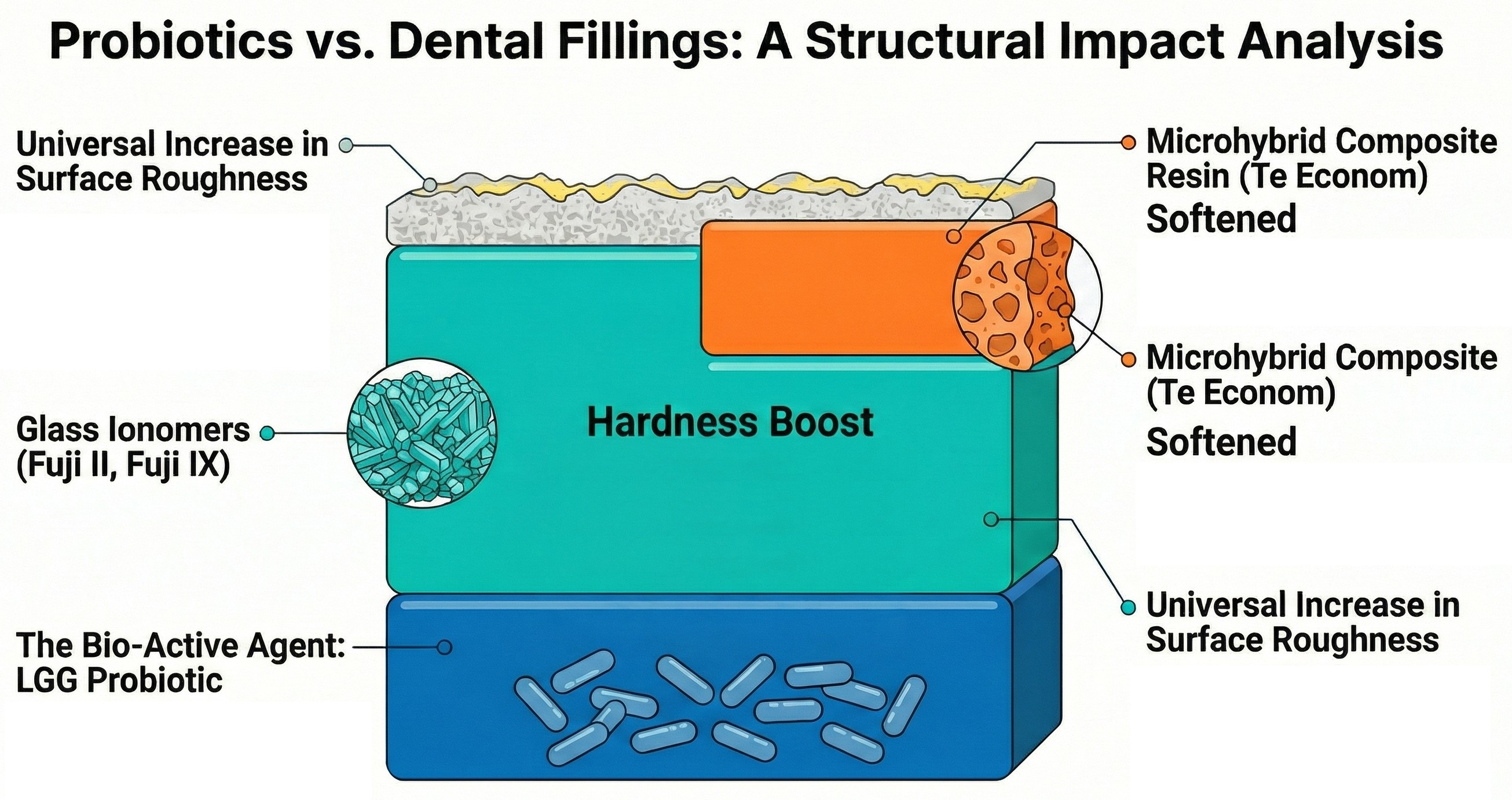
- After the microhardness of samples made of resin-reinforced glass ionomer cement RM GICs (FUJI II LC) (first measurement) was determined, it was concluded that after the samples were immersed in probiotic yogurt (second measurement), the microhardness increased samples (Table 2). A statistically significant difference in microhardness (p < 0.05) between the first and second measurements was observed via the Wilcoxon signed-rank test.
- An examination of the microhardness measurement results for samples made from the MH COMP Te Econom Plus composite (first measurement) revealed that after the samples were immersed in probiotic yogurt (second measurement), the microhardness of the samples decreased (Table 3). The application of the Wilcoxon signed-rank test revealed that there was a statistically significant difference in microhardness (p < 0.05) between the first and second measurements.
- The microhardness measurements of the samples made of high-viscosity glass ionomer cement HVGICs (FUJI IX) (first measurement) revealed that after the samples were immersed in probiotic yogurt (second measurement), the microhardness of the samples increased (Table 4). Analysis of the results obtained using the Wilcoxon signed-rank test revealed that there was no statistically significant difference in microhardness (p > 0.05) between the first and second measurements.
- A two-way analysis of variance (two-way ANOVA) was conducted to examine the effects of the material group (Group) and therapy (Therapy), as well as their interaction, on the microhardness of the samples (Table 5). The total number of samples tested was N = 30. The analysis was performed at a significance level of α = 0.05.

| N | Middle Rank | (Z; p) | ||
|---|---|---|---|---|
| Second measurement– First measurement | Second measurement < First measurement | 0 | 0.00 | Z = −2.023; p = 0.043 |
| Second measurement > First measurement | 5 | 3.00 | ||
| Second measurement = First measurement | 0 | |||
| In total | 5 | |||
| N | Middle Rank | (Z; p) | ||
|---|---|---|---|---|
| Second measurement– First measurement | Second measurement < First measurement | 5 | 3.00 | Z = −2.023; p = 0.043 |
| Second measurement > First measurement | 0 | 0.00 | ||
| Second measurement = First measurement | 0 | |||
| In total | 5 | |||
| N | Middle Rank | (Z; p) | ||
|---|---|---|---|---|
| Second measurement– First measurement | Second measurement < First measurement | 0 | 0.00 | Z = −1.826; p = 0.068 |
| Second measurement > First measurement | 4 | 2.50 | ||
| Second measurement = First measurement | 1 | |||
| In total | 5 | |||
| Material | Group | N | Means ± SD | F-Value | p-Value | Statistical Significance |
|---|---|---|---|---|---|---|
| HV GIC | Baseline | 5 | 72.38 ± 2.97 | 62.08 | <0.001 | Significant |
| After | 5 | 75.50 ± 2.52 | 62.08 | <0.001 | Significant | |
| RM GIC | Baseline | 5 | 24.54 ± 0.30 | 62.08 | <0.001 | Significant |
| After | 5 | 40.58 ± 1.78 | 62.08 | <0.001 | Significant | |
| Composite | Baseline | 5 | 22.20 ± 1.35 | 62.08 | <0.001 | Significant |
| After | 5 | 19.84 ± 1.17 | 62.08 | <0.001 | Significant |
3.1. Main Effects
3.2. Interaction Effect
3.3. Post Hoc Analysis
3.4. Effect Size and Model Fit
- -
- For samples made from the Fuji IX material (first measurement), there was a statistically significant difference in roughness (p < 0.05) between the first measurement and after immersion in the probiotic yogurt (second measurement).
- -
- For samples made from the Te Econom Plus composite material (baseline), there was a statistically significant difference in roughness (p < 0.05) compared to the measurement after immersion in probiotic yogurt (after treatment).
- -
- Compared with the samples from the first measurement, the Fuji II samples from the probiotic yogurt had a significantly greater roughness.
4. Discussion
5. Conclusions
Author Contributions
Funding
Institutional Review Board Statement
Informed Consent Statement
Data Availability Statement
Acknowledgments
Conflicts of Interest
References
- Yan, F.; Polk, D.B. Probiotics and Probiotic-Derived Functional Factors—Mechanistic Insights Into Applications for Intestinal Homeostasis. Front. Immunol. 2020, 11, 1428. [Google Scholar] [CrossRef] [PubMed]
- Karatas, O.; Delikan, E.; Erturk-Avunduk, A.T. Comparative evaluation of probiotic solutions on surface roughness and microhardness of different restorative materials and enamel. J. Clin. Pediatr. Dent. 2024, 48, 107–119. [Google Scholar] [CrossRef]
- Hamdy, T.M. Evaluation of compressive strength, surface microhardness, solubility and antimicrobial effect of glass ionomer dental cement reinforced with silver doped carbon nanotube fillers. BMC Oral Health 2023, 23, 777. [Google Scholar] [CrossRef]
- Mathipa-Mdakane, M.G.; Thantsha, M.S. Lacticaseibacillus rhamnosus: A Suitable Candidate for the Construction of Novel Bioengineered Probiotic Strains for Targeted Pathogen Control. Foods 2022, 11, 785. [Google Scholar] [CrossRef]
- Cheng, Y.; Liu, J.; Ling, Z. Short-chain fatty acids-producing probiotics: A novel source of psychobiotics. Crit. Rev. Food Sci. Nutr. 2022, 62, 7929–7959. [Google Scholar] [CrossRef] [PubMed]
- Hasslöf, P.; Stecksén-Blicks, C. Probiotic bacteria and dental caries. Impact Nutr. Diet Oral Health 2020, 28, 99–107. [Google Scholar]
- Burne, R.A.; Marquis, R.E. Alkali production by oral bacteria and protection against dental caries. FEMS Microbiol. Lett. 2000, 193, 1–6. [Google Scholar] [CrossRef]
- Caglar, E.; Kargul, B.; Tanboga, I. Bacteriotherapy and probiotics’ role on oral health. Oral Dis. 2005, 11, 131–137. [Google Scholar] [CrossRef]
- Mai, J.; Tian, X.L.; Gallant, J.W.; Merkley, N.; Biswas, Z.; Syvitski, R.; Douglas, S.E.; Ling, J.; Li, Y.H. A novel target-specific, salt-resistant antimicrobial peptide against the cariogenic pathogen Streptococcus mutans. Antimicrob. Agents Chemother. 2011, 55, 5205–5213. [Google Scholar] [CrossRef]
- Zeng, Y.; Fadaak, A.; Alomeir, N.; Wu, Y.; Wu, T.T.; Qing, S.; Xiao, J. Effect of Probiotic Lactobacillus plantarum on Streptococcus mutans and Candida albicans Clinical Isolates from Children with Early Childhood Caries. Int. J. Mol. Sci. 2023, 24, 2991. [Google Scholar] [CrossRef] [PubMed]
- Laleman, I.; Detailleur, V.; Slot, D.E.; Slomka, V.; Quirynen, M.; Teughels, W. Probiotics reduce mutans streptococci counts in humans: A systematic review and meta-analysis. Clin. Oral Investig. 2014, 18, 1539–1552. [Google Scholar] [CrossRef]
- Wasfi, R.; Abd El-Rahman, O.A.; Zafer, M.M.; Ashour, H.M. Probiotic Lactobacillus sp. inhibit growth, biofilm formation and gene expression of caries-inducing Streptococcus mutans. J. Cell. Mol. Med. 2018, 22, 1972–1983. [Google Scholar] [CrossRef]
- Zare Javid, A.; Amerian, E.; Basir, L.; Ekrami, A.; Haghighizadeh, M.H.; Maghsoumi-Norouzabad, L. Effects of the Consumption of Probiotic Yogurt Containing Bifidobacterium lactis Bb12 on the Levels of Streptococcus mutans and Lactobacilli in Saliva of Students with Initial Stages of Dental Caries: A Double-Blind Randomized Controlled Trial. Caries Res. 2020, 54, 68–74. [Google Scholar] [CrossRef] [PubMed]
- Altwaim, B.; Salama, F.; Alogayyel, S. Effect of Probiotic Mouthrinses on Surface Microhardness of Esthetic Restorative Materials. J. Contemp. Dent. Pract. 2020, 21, 543–548. [Google Scholar] [CrossRef] [PubMed]
- Kumari, C.M.; Bhat, K.M.; Bansal, R.; Singh, N.; Anupama, A.; Lavanya, T. Evaluation of surface roughness and hardness of newer nanoposterior composite resins after immersion in food-simulating liquids. Contemp. Clin. Dent. 2019, 10, 289–293. [Google Scholar] [CrossRef]
- Barve, D.; Dave, P.N.; Gulve, M.N.; Meera Sahib, M.A.; Naz, F.; Shahabe, S.A. Effect of Commonly Consumed Beverages on Microhardness of Two Types of Composites. Int. J. Clin. Pediatr. Dent. 2020, 13, 663–667. [Google Scholar] [CrossRef]
- Bethapudy, D.R.; Bhat, C.; Lakade, L.; Chaudhary, S.; Kunte, S.; Patil, S. Comparative evaluation of water sorption, solubility, and microhardness of zirconia-reinforced glass ionomer, resin-modified glass ionomer, and Type IX glass ionomer restorative materials: An in vitro study. Int. J. Clin. Pediatr. Dent. 2022, 15, 175–181. [Google Scholar] [CrossRef] [PubMed]
- Moheet, I.A.; Luddin, N.; Ab Rahman, I.; Masudi, S.M.; Kannan, T.P.; Nik Abd Ghani, N.R. Analysis of ionic-exchange of selected elements between novel nano-hydroxyapatite-silica added glass ionomer cement and natural teeth. Polymers 2021, 13, 3504. [Google Scholar] [CrossRef]
- Dülger, K.; Koşar, T. Microhardness, degree of conversion, and water sorption/solubility of non-expired and expired (two and three years) dental composites. Bezmialem Sci. 2023, 11, 151–157. [Google Scholar] [CrossRef]
- Mansoor, A.; Mansoor, E.; Mehmood, M.; Ul Hassan, S.M.; Shah, A.U.; Asjid, U.; Ishtiaq, M.; Jamal, A.; Rai, A.; Palma, P.J. Novel microbial synthesis of titania nanoparticles using probiotic Bacillus coagulans and its role in enhancing the microhardness of glass ionomer restorative materials. Odontology 2024, 112, 1123–1134. [Google Scholar] [CrossRef]
- Ong, S.H.; Yoo, S.H. Surface roughness and chemical composition changes of resin-modified glass ionomer immersed in 0.2% sodium fluoride solution. J. Dent. Sci. 2021, 16, 389–396. [Google Scholar] [CrossRef]
- Fúcio, S.B.P.; Paula, A.B.D.; Sardi, J.C.O.; Duque, C.; Correr-Sobrinho, L.; Puppin-Rontani, R.M. Streptococcus mutans biofilm influences on the antimicrobial properties of glass ionomer cements. Braz. Dent. J. 2016, 27, 681–687. [Google Scholar] [CrossRef] [PubMed]
- Saha, S.; Chopra, A.; Kamath, S.U.; Kashyap, N.N. Can acid produced from probiotic bacteria alter the surface roughness, microhardness, and elemental composition of enamel? An in vitro study. Odontology 2023, 111, 929–941. [Google Scholar] [CrossRef]
- Han, L.; Okamoto, A.; Fukushima, M.; Okiji, T. Evaluation of flowable resin composite surfaces eroded by acidic and alcoholic drinks. Dent. Mater. J. 2008, 27, 455–465. [Google Scholar] [CrossRef]
- Nithya, K.; Sridevi, K.; Keerthi, V.; Ravishankar, P. Evaluation of surface roughness, hardness, and gloss of composites after three different finishing and polishing techniques: An In Vitro Study. Cureus 2020, 12, e7037. [Google Scholar] [CrossRef] [PubMed]
- St-Pierre, L.; Martel, C.; Crépeau, H.; Vargas, M.A. Influence of polishing systems on surface roughness of composite resins: Polishability of composite resins. Oper. Dent. 2019, 44, E122–E132. [Google Scholar] [CrossRef]
- Veček, N.N.; Par, M.; Sever, E.K.; Miletić, I.; Krmek, S.J. The Effect of a Green Smoothie on Microhardness, Profile Roughness and Color Change of Dental Restorative Materials. Polymers 2022, 14, 2067. [Google Scholar] [CrossRef]
- Gehlot, P.; Sudeep, P.; Manjunath, V.; Annapoorna, B.M.; Prasada, L.K.; Nandlal, B. Influence of various desensitizing mouthrinses and simulated toothbrushing on surface roughness and microhardness of Tetric N-Ceram bulk-fill resin composite: An in vitro study and scanning electron microscope analysis. Eur. J. Dent. 2022, 16, 820–827. [Google Scholar] [CrossRef] [PubMed]
- Lovrić, J.; Marković, M.; Bulajić, M.; Zeljković, S.; Ilić, J.; Dolić, O. The impact of dental varnishes on the immediate surface microhardness and roughness of restorative dental materials: An in vitro study. Vojnosanit. Pregl. 2023, 80, 1022–1027. [Google Scholar] [CrossRef]
- Trauth, K.G.S.; de Godoi, A.P.T.; Colucci, V.; Corona, S.A.M.; Catirse, A.B.C. The influence of mouthrinses and simulated toothbrushing on the surface roughness of a nanofilled composite resin. Braz. Oral Res. 2012, 26, 209–214. [Google Scholar] [CrossRef]
| G1.3 | G2.3 | G3.3 | |||||
|---|---|---|---|---|---|---|---|
| First measurement | 5 | 7.80 | 5 | 3.20 | 5 | 13.00 | χ2(2) = 12,500; p = 0.002 a |
| Second measurement | 5 | 3.20 | 5 | 13.00 | 4 | 7.80 | χ2(2) = 12,500 p = 0.002 a |
| Wilcoxon signed-ranks test | Z = −2.023; p = 0.043 | Z = −2.023; p = 0.043 | Z = −1.826; p = 0.068 | ||||
| Comparison (After vs. Baseline) | n | Mean Rank | Z-Value | p-Value | Result |
|---|---|---|---|---|---|
| After > Baseline | 5 | 3.00 | −2.023 | 0.043 * | Significant increase |
| After < Baseline | 0 | 0.00 | |||
| No change | 0 |
| Comparison (After vs. Baseline) | n | Mean Rank | Z-Value | p-Value | Result |
|---|---|---|---|---|---|
| After > Baseline | 5 | 3.00 | −2.032 | 0.042 * | Significant increase |
| After < Baseline | 0 | 0.00 | — | — | — |
| No change | 0 | — | — | — | — |
| Measurement | N | Middle Rank | N | Middle Rank | N | Middle Rank | |
|---|---|---|---|---|---|---|---|
| Roughness | Baseline | U1.3 | U2.3 | U3.3 | |||
| 5 | 7.00 | 5 | 7.00 | 5 | 6.60 | ||
| Kruskal–Wallis test | ꭕ2 = 2.299; p = 0.317 | ꭕ2 = 1.836; p = 0.399 | ꭕ2 = 1.727; p = 0.422 | ||||
| After treatment | U1.3 | U2.3 | U3.3 | ||||
| 5 | 13.00 | 5 | 9.60 | 5 | 13.00 | ||
| Kruskal–Wallis test | ꭕ2 = 12.500; p = 0.002 a | ꭕ2 = 9.780; p = 0.008 b | ꭕ2 = 9.420; p = 0.009 c | ||||
| Material | Group | Mean ± SD | Median | Min–Max | Δ Change | p-Value | Sig. |
|---|---|---|---|---|---|---|---|
| Fuji IX (Conventional GIC) | Baseline | 0.25 ± 0.02 | 0.25 | 0.22–0.27 | |||
| After | 2.42 ± 0.39 | 2.79 | 2.25–2.93 | +2.17 | 0.043 | * | |
| Fuji II LC (RMGIC) | Baseline | 0.33 ± 0.04 | 0.32 | 0.28–0.39 | |||
| After | 1.31 ± 0.07 | 1.28 | 1.24–1.43 | +0.98 | 0.043 | * | |
| Composite (MH COMP) | Baseline | 0.80 ± 0.03 | 0.81 | 0.75–0.84 | |||
| After | 1.61 ± 0.29 | 1.51 | 1.41–2.13 | +0.81 | 0.043 | * |
Disclaimer/Publisher’s Note: The statements, opinions and data contained in all publications are solely those of the individual author(s) and contributor(s) and not of MDPI and/or the editor(s). MDPI and/or the editor(s) disclaim responsibility for any injury to people or property resulting from any ideas, methods, instructions or products referred to in the content. |
© 2026 by the authors. Licensee MDPI, Basel, Switzerland. This article is an open access article distributed under the terms and conditions of the Creative Commons Attribution (CC BY) license.
Share and Cite
Lovric, J.; Gnjato, S.; Zeljković, S.; Adamovic, T.; Ilic, J.; Skrbic, L.; Jovicic, P.; Jankovic, O.; Dolic, O. Influence of the Probiotic Lactobacillus rhamnosus on the Physical Properties of Restorative Dental Materials: An In Vitro Study. Oral 2026, 6, 59. https://doi.org/10.3390/oral6030059
Lovric J, Gnjato S, Zeljković S, Adamovic T, Ilic J, Skrbic L, Jovicic P, Jankovic O, Dolic O. Influence of the Probiotic Lactobacillus rhamnosus on the Physical Properties of Restorative Dental Materials: An In Vitro Study. Oral. 2026; 6(3):59. https://doi.org/10.3390/oral6030059
Chicago/Turabian StyleLovric, Jovana, Sanja Gnjato, Saša Zeljković, Tijana Adamovic, Jana Ilic, Ljubica Skrbic, Predrag Jovicic, Ognjenka Jankovic, and Olivera Dolic. 2026. "Influence of the Probiotic Lactobacillus rhamnosus on the Physical Properties of Restorative Dental Materials: An In Vitro Study" Oral 6, no. 3: 59. https://doi.org/10.3390/oral6030059
APA StyleLovric, J., Gnjato, S., Zeljković, S., Adamovic, T., Ilic, J., Skrbic, L., Jovicic, P., Jankovic, O., & Dolic, O. (2026). Influence of the Probiotic Lactobacillus rhamnosus on the Physical Properties of Restorative Dental Materials: An In Vitro Study. Oral, 6(3), 59. https://doi.org/10.3390/oral6030059