1. Introduction
Behavior management is universally recognized as a cornerstone of pediatric dentistry, equally important as diagnostic accuracy and technical skill. Successful dental treatment in children depends not only on the clinical procedure itself but also on the child’s emotional regulation, sense of control, and perception of safety in the dental environment. The first dental visit represents a particularly sensitive and formative experience, often shaping long-term attitudes toward oral health, regular dental visits, and healthcare providers in general [
1,
2,
3].
Fear and anxiety related to dental interventions are common in children and have a complex etiology. Studies report prevalence rates ranging from 9% to over 40%, depending on age, sociocultural context, assessment instruments, and clinical setting [
2,
4]. Dental anxiety is not a transient emotional state but a multidimensional construct encompassing cognitive (anticipatory worry, catastrophic thinking), emotional (fear, distress), behavioral (avoidance, crying, resistance), and physiological components (increased heart rate, sweating) [
5]. These responses arise from dynamic interactions among the child’s developmental stage, temperament, previous medical or dental experiences, parental attitudes and anxiety, and contextual factors within the dental office [
6,
7].
Early negative dental experiences have long-term consequences. Children who experience fear or pain during initial visits are more likely to avoid dental care, present with advanced oral disease, and require more invasive interventions later in life [
7]. This creates a cycle in which anxiety leads to avoidance, avoidance leads to disease progression, and progression necessitates more complex and anxiety-provoking treatment.
To address these challenges, pediatric dentistry has developed a range of behavior management techniques. According to the American Academy of Pediatric Dentistry (AAPD), these include basic non-pharmacological approaches—such as Tell–Show–Do, positive reinforcement, distraction, modeling, and parent presence—as well as advanced methods including protective stabilization, inhalation sedation, and general anesthesia [
8]. Modern guidelines emphasize that behavior management should be individualized, ethically justified, and minimally invasive, with pharmacological approaches used only when basic techniques are insufficient [
9].
Despite clear guidelines, behavior assessment in routine practice often remains informal and subjective. In many clinical settings, the first structured contact occurs in the dental chair immediately prior to treatment, often under time pressure and in a novel, potentially intimidating environment. These conditions limit the accuracy of behavioral risk assessment and the application of tailored management strategies [
10]. Consequently, decisions regarding distraction, sedation, or referral for general anesthesia are often reactive rather than proactive.
Parallel to these challenges, digital technologies have significantly transformed modern pediatric dental practice. Audiovisual distraction via cartoons or videos, tablet applications, mobile games, and immersive augmented reality (AR) or virtual reality (VR) systems are increasingly used to reduce anxiety and perceived pain during dental procedures [
11,
12]. Studies indicate that digital distraction, especially immersive VR, can significantly reduce anxiety, improve cooperation, and increase patient satisfaction [
13,
14].
However, most existing digital interventions are applied in a standardized, non-personalized manner. Children are often exposed to generic content without consideration of individual interests, sensory sensitivities, previous experiences, or specific fear triggers. A growing body of evidence from child psychology and human–computer interaction indicates that personalized digital interventions are more effective than generic ones, particularly in emotionally demanding clinical situations [
15]. This highlights a gap between the technological potential of digital tools and their actual clinical application in pediatric dentistry.
Structured pre-visit behavioral assessment completed by parents or guardians represents a promising solution to bridge this gap. Parents have unique insight into their child’s typical reactions to unfamiliar situations, specific fears, coping strategies, and interests. When such information is systematically collected and translated into actionable clinical recommendations, it can enable early identification of behavioral risk, optimize appointment planning, and support rational, individualized application of both non-pharmacological and pharmacological behavior management techniques.
Therefore, the aim of this study was to develop and evaluate a simple, web-based digital pre-visit tool designed to support proactive and individualized behavior management in pediatric dentistry.
2. Materials and Methods
2.1. Study Design
This study was designed as a prospective observational cohort study. The cohort consisted of 90 pediatric patients (aged 4–8 years), including 48 girls and 42 boys, attending their first dental visit, for whom the pre-visit digital questionnaire was completed by a parent or legal guardian. No exclusion criteria related to systemic diseases, developmental disorders, or previous medical conditions were applied, in order to provide a realistic representation of everyday clinical practice and patient diversity. Participation in the study was voluntary, and the digital tool did not collect personally identifiable or confidential data. Accordingly, in line with institutional guidelines, ethical approval was not required. No clinical decisions were made solely based on the tool’s results, preserving standard ethical and professional responsibilities.
In accordance with STROBE recommendations, all eligible children attending their first dental visit during the study period were invited to participate. No participants were excluded after enrollment [
16].
2.2. Development of the Digital Pre-Visit Tool
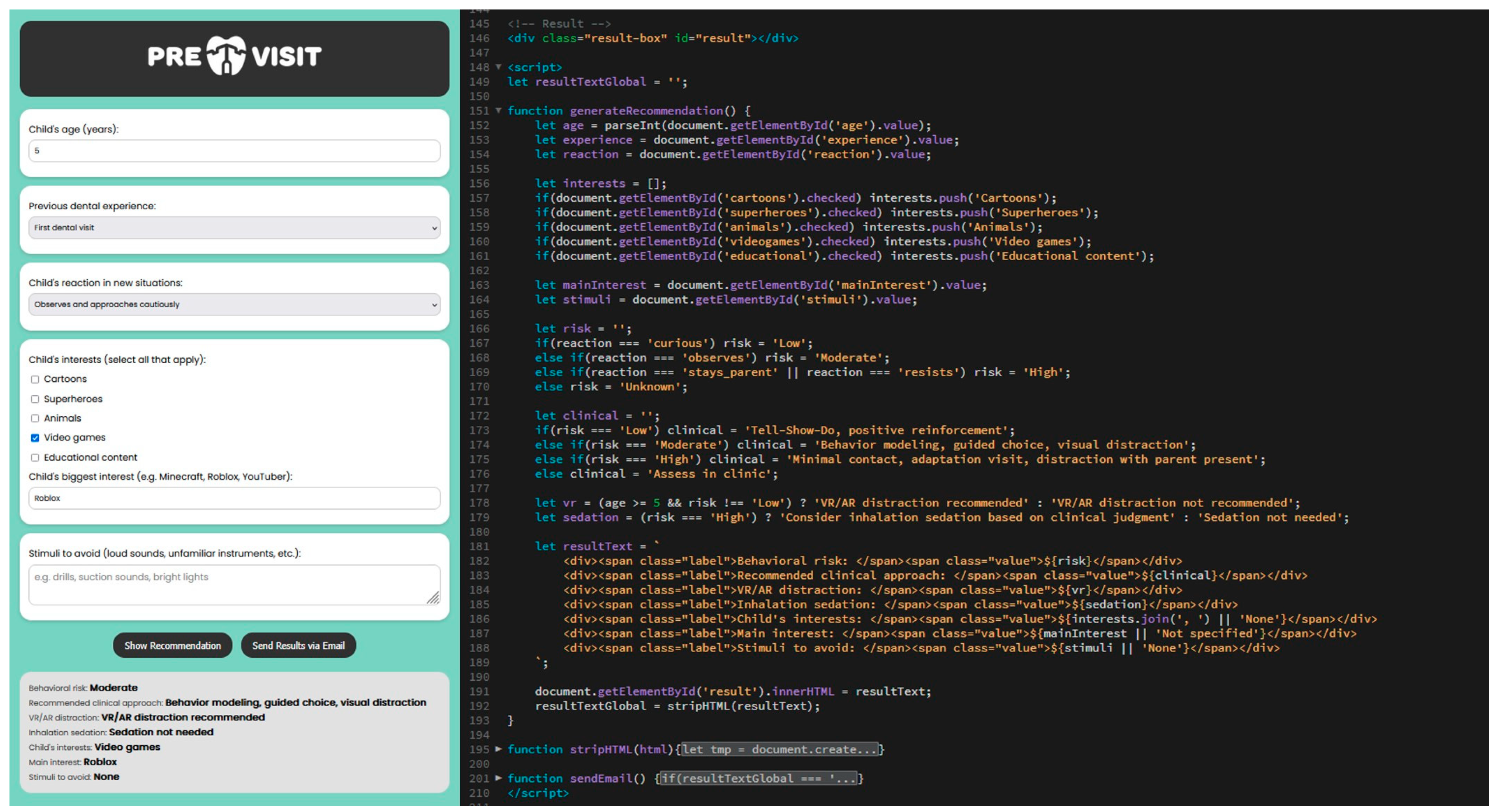
A web-based digital application was developed using standard front-end technologies (HTML, CSS, and JavaScript) to ensure platform independence, low implementation cost, and compatibility with commonly used devices (smartphones, tablets, and desktop computers) (
Figure 1). The tool was designed to be short, intuitive, and easily completed by parents at home. It was conceptualized and developed by a pediatric dentist (first author R.M.).
The questionnaire included items across four main domains:
Child’s age, used as an indicator of developmental, cognitive, and emotional maturity.
Previous dental experiences, classified as positive, neutral, or negative based on parental perception.
Typical child responses to unfamiliar situations, including curiosity, cooperation, withdrawal, fear, or distress.
Individual interests and preferences, including favorite cartoons, video games, superheroes, educational content, music, or other media relevant for planning digital distraction.
Additionally, parents could indicate specific sensory stimuli to avoid, such as loud sounds, rotating instruments, bright lights, or unfamiliar equipment. An optional free-text field allowed parents to provide additional comments or contextual information not covered by structured questions. The tool was designed as a decision-support aid, not as a diagnostic or predictive instrument.
2.3. Decision Logic and Recommendation Algorithm
Based on predefined decision rules implemented through a JavaScript-based algorithm, children were categorized into one of three behavioral risk groups: low, moderate, or high risk.
Each risk category was linked to a predefined set of clinical recommendations, including:
Recommended non-pharmacological behavior guidance techniques;
Appropriate digital distraction modalities;
Potential indication for inhalation sedation as an adjunct measure.
2.4. Clinical Implementation
The collected information was used to plan appointments, select behavior guidance techniques, and tailor digital distraction content. For immersive digital distraction, the KeppyXR glasses (10X Immersive Inc., Middletown, DE, USA) was used, which enables the preparation and individual customization of content prior to the intervention for each child, while inhalation sedation was administered using the Baldus Touch device (Bendorf, Germany). The final clinical approach was determined by the dentist based on professional judgment and the child’s actual behavior during the examination. The digital tool did not replace clinical assessment but served as an additional resource for individualized planning of the clinical approach.
2.5. Statistical Analysis
Data were analyzed using descriptive statistics. Associations between behavioral risk classification and first-visit treatment outcomes were examined using the chi-square test. Odds ratios (OR) with corresponding 95% confidence intervals (CI) were calculated to estimate the strength of associations.
Sex was recorded as a biological variable and included in the analysis as a potential confounding factor. Associations between sex and behavioral risk category, treatment outcomes, and digital content preferences were evaluated using chi-square tests, with calculation of ORs and 95% CIs where appropriate.
All statistical tests were two-tailed, and statistical significance was set at p < 0.05.
3. Results
3.1. Primary Outcomes of the First Dental Visit
The study included a total of 90 pediatric patients attending their first dental visit. The children’s ages ranged from 4 to 8 years (mean 6.1 ± 1.2). Analysis of the distribution across behavioral risk categories showed that the majority of children were classified as moderate risk (38 children), while 32 children were classified as low risk and 20 as high behavioral risk (
Table 1).
One of the key findings was the high proportion of children successfully managed during their first visit (
Table 2). Overall, more than 90% of children received active clinical intervention at the first visit, while only a small number required exclusively an adaptation visit. Children in the low-risk group almost universally completed the full treatment during the first visit. Notably, nearly three-quarters of children in the moderate-risk group were also successfully managed at the first visit, although in routine practice an adaptation visit would often be planned. A statistically significant association was observed between behavioral risk category and successful completion of treatment during the first visit (χ
2 = 18.42,
p < 0.001).
Additionally, odds ratios (OR) were calculated using the high-risk group as the reference (
Table 3). Children with low risk had over 18 times higher odds of being successfully managed during the first visit compared to high-risk children. Children in the moderate-risk group also showed significantly higher odds of success compared to the high-risk group.
Digital distraction was widely used, according to pre-visit recommendations (
Table 3). Immersive AR/VR was primarily applied to children in the moderate- and high-risk groups and was associated with better cooperation and reduced need for treatment postponement.
Analysis of parental responses revealed a high degree of individualization of children’s interests. Aligning digital content with the child’s preferences was particularly effective for moderate-risk children, resulting in increased engagement and improved tolerance of procedures (
Table 4).
3.2. Additional Outcome Analyses
Further analysis demonstrated a significant association between the use of advanced distraction modalities and treatment outcomes within behavioral risk groups (
Table 5). Among children classified as moderate risk, those who received immersive AR/VR distraction achieved a significantly higher rate of complete treatment during the first visit compared to those managed with standard audiovisual distraction alone (84.6% vs. 63.2%, χ
2 = 4.12,
p = 0.042).
In the high-risk group, the combination of immersive AR/VR distraction and inhalation sedation resulted in a higher likelihood of completing at least partial treatment during the first visit compared to non-immersive approaches (80.0% vs. 55.6%), although this difference did not reach statistical significance (p = 0.087), likely due to the limited sample size.
Age-related differences were also observed. Younger children (4–5 years) were significantly more likely to require partial treatment or adaptation-only visits compared to older children (6–8 years) (χ2 = 6.38, p = 0.012). However, when immersive digital distraction was applied, this age-related difference was attenuated, suggesting a moderating effect of immersive technologies on developmental limitations.
Parental reports of negative previous dental experiences were strongly associated with higher behavioral risk classification. Children with reported negative experiences were more frequently assigned to the high-risk group compared to those with neutral or positive histories (46.2% vs. 14.8%, χ2 = 11.27, p = 0.001). Despite this, more than half of these children were still able to undergo active clinical intervention during the first visit when individualized distraction strategies were applied.
Finally, personalization of digital content showed a measurable impact on cooperation. Children whose distraction content matched their reported interests demonstrated a significantly higher rate of complete or partial treatment compared to those exposed to non-preferred content (88.2% vs. 70.4%, χ2 = 4.95, p = 0.026). This effect was most pronounced in the moderate-risk group, supporting the role of tailored digital interventions in optimizing behavioral outcomes.
3.3. Sex-Based Analysis
Sex-based differences in behavioral risk classification were analyzed. No statistically significant association was observed between sex and behavioral risk category (χ2 = 1.84, p = 0.399). Boys were slightly more frequently classified in the moderate- and high-risk categories compared to girls (56.3% vs. 47.6%); however, this difference did not reach statistical significance.
Sex was also not significantly associated with successful completion of treatment during the first visit (χ2 = 0.72, p = 0.396). The odds ratio for successful treatment in boys compared to girls was OR = 1.29 (95% CI: 0.54–3.08).
Regarding digital content preferences, boys more frequently selected video game and superhero-related content (68.7% vs. 38.1%), whereas girls demonstrated a broader distribution of preferences including animated series and music-based content. However, the association between sex and dominant content preference did not reach statistical significance (χ2 = 3.41, p = 0.065).
4. Discussion
One of the most significant findings of this study was the high proportion of children for whom parents reported negative previous dental experiences. This observation aligns with prior research indicating that early adverse experiences are a major factor in the development of dental anxiety and uncooperative behavior in children [
9]. It is important to note that such experiences are often not apparent during a brief chairside assessment, particularly in younger children who may lack the verbal skills to clearly express their fears. The pre-visit digital tool overcomes this limitation by shifting behavioral assessment to a calmer, familiar environment—typically the child’s home—where parents can provide more thoughtful and accurate information.
Early behavioral risk stratification is critical for the evidence-based application of behavior guidance. In this study, children classified as high behavioral risk demonstrated the greatest need for advanced behavior management strategies, including immersive distraction and adjunctive inhalation sedation. These findings are consistent with previous research showing that children with pronounced fear or negative prior experiences benefit most from minimal-contact strategies, gradual adaptation, and enhanced control of sensory stimuli [
1,
17]. Timely identification of such patients allows clinicians to plan longer appointments, adaptation visits, and appropriate digital or pharmacological support in advance, thereby reducing stress for both the child and the dental team [
18].
Analysis of reported child interests revealed a strong preference for video games and superhero-related content, reflecting contemporary media consumption patterns in children [
3,
19]. These findings have important clinical implications. Digital distraction is not merely a passive attentional diversion but represents a complex interactive cognitive process. Content aligned with a child’s interests is more likely to induce immersion, reduce anticipatory anxiety, and modulate pain perception via attentional and emotional mechanisms [
13,
20]. Therefore, personalized digital distraction represents a logical evolution from generic audiovisual approaches toward precise, individualized behavior management.
Although boys demonstrated a tendency toward video game and superhero-related content and girls showed more diverse media preferences, these differences did not reach statistical significance. Furthermore, sex was not associated with behavioral risk classification or treatment success. These findings suggest that individualized digital planning should prioritize personal interests and behavioral indicators rather than rely on sex-based assumptions.
It is important to emphasize that the proposed digital tool should be regarded as a decision-support system rather than a diagnostic instrument. Parental assessments of child behavior are inherently subjective and may be influenced by parental anxiety, expectations, or prior experiences with the healthcare system [
21,
22]. Nevertheless, these subjective perceptions carry significant clinical value, as parental anxiety is a well-established predictor of dental anxiety in children [
23]. Even imperfect information can thus enhance anticipatory patient management and improve communication between the dentist and family.
From an ethical perspective, proactive behavior management planning aligns fully with the principles of minimally invasive dentistry and patient-centered care. By reducing the likelihood of negative experiences, such tools can contribute to safer, more acceptable, and cost-effective pediatric care. Additionally, pre-visit digital tools may promote greater equity in healthcare by standardizing behavioral assessment and reducing variability associated with individual clinician experience or subjective judgment.
Certain limitations of the study should also be acknowledged. The sample size was relatively small, and the analysis was descriptive, without direct comparison to validated behavioral or anxiety scales. Future research should focus on integrating validated psychometric instruments into the digital platform, assessing predictive validity, and evaluating longitudinal outcomes, including treatment success, appointment duration, and the need for sedation. Further development may also include integration with electronic dental records and the application of artificial intelligence–based algorithms. Although sex was analyzed as a potential confounding variable, the relatively small sample size may have limited the statistical power to detect subtle sex-related differences.



 ,
,