Article

Pulpal Chamber Floor Thickness of First Molars in a Black South African Sample

by
Marisca Meyer
1,2,
Casper Hendrik Jonker
3,*,
Sandeepa Rajbaran-Singh
1,
Federico Foschi
4 and
Anna Catherina Oettlé
2
1
Department of Maxillofacial and Oral Radiology, School of Dentistry, Sefako Makgatho Health Sciences University, Ga-Rankuwa 0208, South Africa
2
Anatomy and Histology Department, School of Medicine, Sefako Makgatho Health Sciences University, Ga-Rankuwa 0208, South Africa
3
Truro Dental Education Facility, Royal Cornwall Hospital, Knowledge Spa, Peninsula Dental School, Faculty of Health, University of Plymouth, Truro TR1 3HD, UK
4
Eastman Dental Institute, Rockefeller Building, 21 University Street, London WC1E 6DGL, UK
*
Author to whom correspondence should be addressed.
Submission received: 2 January 2026 / Revised: 4 February 2026 / Accepted: 26 February 2026 / Published: 12 March 2026
(This article belongs to the Special Issue Advanced Radiographic Techniques in Endodontics)

Highlights

What are the main findings?
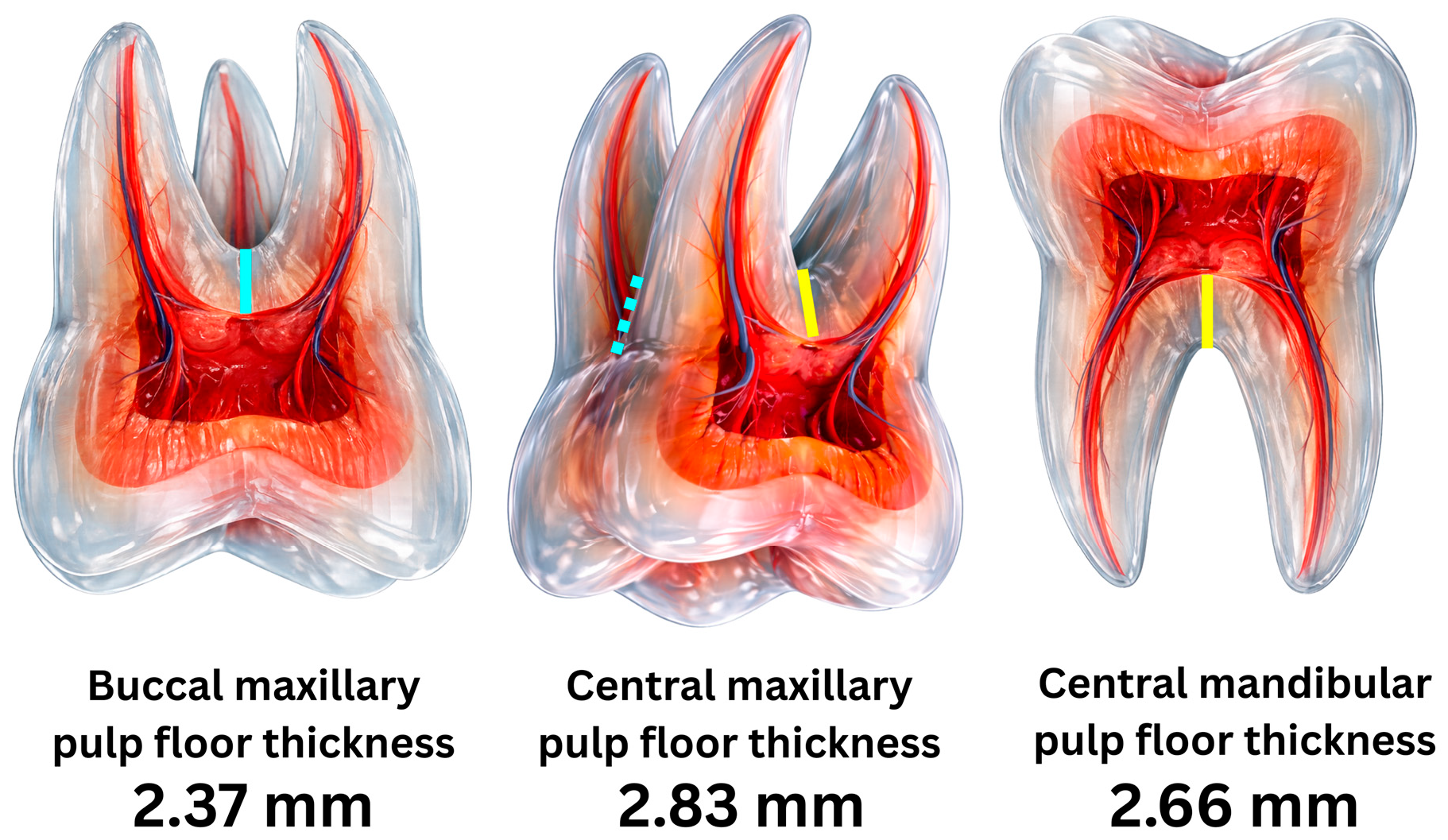
  • Using Micro-CT analysis, smaller mean pulpal floor thicknesses of 2.66 mm in mandibular and 2.83 mm in maxillary first molars were found in a Black South African sample when compared to previous studies.
  • Pulpal floor thickness increased significantly with age, while arch side and sex showed no significant influence.
What are the implications of the main findings?
  • Practitioners should consider the mean values as guidelines when performing root canal procedures to reduce the risk of iatrogenic perforation.
  • The study demonstrates that Micro-CT and 3D reconstruction provide more precise anatomical data for clinical guidelines than traditional 2D methodologies.

Abstract
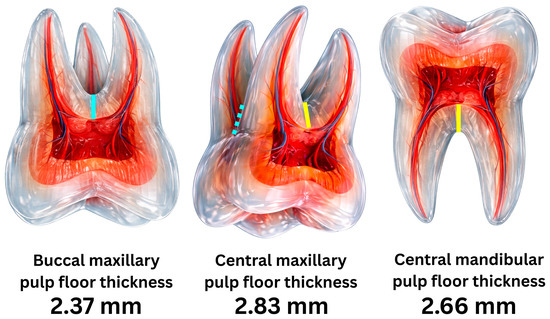
Background/Objectives: Root canal procedures on multi-rooted teeth, including first molars, depend on experience, tactile perception, and anatomical knowledge to avoid perforation in the furcation region. Studies using various methodologies and populations have reported discrepant findings on pulpal floor thickness. No study using micro-computed tomography (Micro-CT), the gold standard, has been conducted on a Black South African sample to evaluate pulpal floor thickness. Methods: In this cross-sectional, descriptive, quantitative study, Micro-CT scans of 91 maxillary and 77 mandibular first molars were reconstructed in 3D and oriented according to a reference plane along the cemento-enamel junction using Avizo software. Measurements were taken from the midpoint of the pulpal chamber floor to the perpendicular point on the furcation. In maxillary molars, an additional measurement between the mesiobuccal and distobuccal roots was taken. The effects of arch, side, age, and sex were assessed. Results: Neither sex, arch, nor side had a significant influence on the pulpal floor thickness. The central mandibular and maxillary pulpal floor thicknesses increased significantly with aging, while the effect on the buccal maxillary pulpal floor thickness was not significant. The mean central mandibular and maxillary pulpal floor thicknesses were 2.66 and 2.83 mm, respectively, while the buccal maxillary pulpal floor thickness was significantly smaller at 2.37 mm. Conclusions: More accurate and repeatable findings compared to the literature could be attributed to the use of Micro-CT, which provides higher resolution images, and to Avizo, which enables precise localization of 3D points. Variations from the literature might also be explained by differences in the age and geographical origin of the samples.

Graphical Abstract

1. Introduction

Knowledge regarding the dentinal thickness of the pulpal chamber floor is important for effective treatment planning [1]. During endodontic access into the pulp chamber, perforation of the pulp floor may occur, which could seriously affect treatment outcomes and reduce the prognosis of the tooth. Such perforations not only reduce the restorability of the affected tooth but also increase the risk of fractures and peri-radicular infections [1,2]. An adequate and safe approach during endodontic access and the amount of tooth structure removed rely on the clinician’s experience, tactile perception, and knowledge of the pulpal anatomy [3].
Radiographic investigations are performed to provide a deeper understanding of the dentinal thickness spanning from the pulp chamber floor to the furcation. As 2D radiographs are limited in their ability to capture depth, they often produce distorted or overlapping images, leading to anatomical noise and inaccurate representation of internal structures [4,5]. The advent of 3D imaging (cone-beam computed tomography (CBCT) and micro-computed tomography (Micro-CT)) has provided clinicians with advanced diagnostic tools, allowing for a more accurate evaluation of pulp space morphology, something previously unavailable. Cone-beam computed tomography offers distinct clinical advantages, including relatively low radiation dose, accessibility, and sufficient accuracy for diagnostic and treatment planning purposes in vivo [6,7,8]. While CBCT is historically more susceptible to image degradation, modern systems have integrated metal artifact reduction (MAR) algorithms. Although these advancements significantly mitigate beam hardening and streak artifacts, providing clearer diagnostic images, they do not entirely eliminate interference patterns [9]. Despite these clinical improvements, Micro-CT offers significantly higher resolution due to its smaller voxel size [10], allowing for more detailed and accurate analysis of dental structures such as dentine thickness. While both modalities are affected by artifacts, Micro-CT is generally less susceptible and delivers superior diagnostic clarity, particularly when imaging extracted teeth or skeletal elements [11]. Consequently, micro-computed tomography remains the gold standard for morphometric and dimensional accuracy, especially for investigating fine detail, providing superior resolution for ex vivo measurement and anatomical analysis. However, its application remains limited to research contexts due to the high radiation dose and the small field of view [12,13,14]. This technology also has the ability to enhance specific areas within an image for better analysis [15]. To the best of the authors’ knowledge, no study on permanent teeth has used Micro-CT to measure the pulp floor thickness.
Given these variations in modalities used, measurement techniques, population demographics, and the influence of secondary dentine apposition associated with aging, further research is necessary in this field. No studies have been conducted on a South African population. The purpose of this study was to establish a comprehensive data base on pulpal floor thickness in a Black South African Micro-CT scan sample.

2. Materials and Methods

The study design was cross-sectional, descriptive, quantitative, and observational, and reporting followed the Strengthening the Reporting of Observational Studies in Epidemiology (STROBE) guidelines [16] (Supplementary Materials). Micro-CT scans of 91 maxillary first molars and 77 mandibular first molars of 69 individuals (34 males and 35 females) (total of 168 first molars) were used. Where possible, left and right first molars were used from the same individual. The scans were retrospectively collected from the dried skeletal collections of the anatomy departments of two universities in the Gauteng province of South Africa. The sampling was achieved using a convenience sampling method.
Ethical approval for this study, titled “Evaluation of dentinal thickness in first molars of a South African sample,” was obtained from the School of Medicine Research Committee of the Sefako Makgatho Health Sciences University (SREC) and the Sefako Makgatho Health Sciences University Ethics Committee (SMUREC) (SMUREC/M/443/2024:PG), ensuring adherence to the guidelines for research involving human subjects. All Micro-CT scans were anonymized to protect patient privacy. All information that could possibly lead to the identification of the individual was removed before storage of the scans. The data will be kept for a minimum of 15 years from the commencement of the study and will form part of the Sefako Makgatho Health Sciences University (smu.ac.za) scan collection.
As a convenience sampling method was used, the inclusion criteria for the Micro-CT scans were based on the availability of scans. Exclusion criteria involved scans of individuals with poorly preserved first molars or damaged root formation and any dentinal/enamel defects, including the presence of root fractures, coronal or radicular resorption identified within the pulpal-root complex, and extensive caries where accurate measurements were obscured, if the individual had undergone any previous endodontic treatment on a particular tooth or if any metallic restorations were present (such as full or partial metal crowns and porcelain fused to metal crowns, amongst others). The demographic information of all individuals scanned was known in order to make comparisons between groups. By using convenience sampling, biases arising from selective sampling could not entirely be excluded, but they were minimised by selecting all scans that met the inclusion criteria. The study was performed blind; therefore, no demographic data was available to the researcher while placing the landmarks. Confirmation bias was minimised by accepting all findings, even if they contradicted the hypothesis and did not match the researcher’s expectations or were not comparable to those found in the literature. All the data collected were considered, and the results were interpreted as obtained.
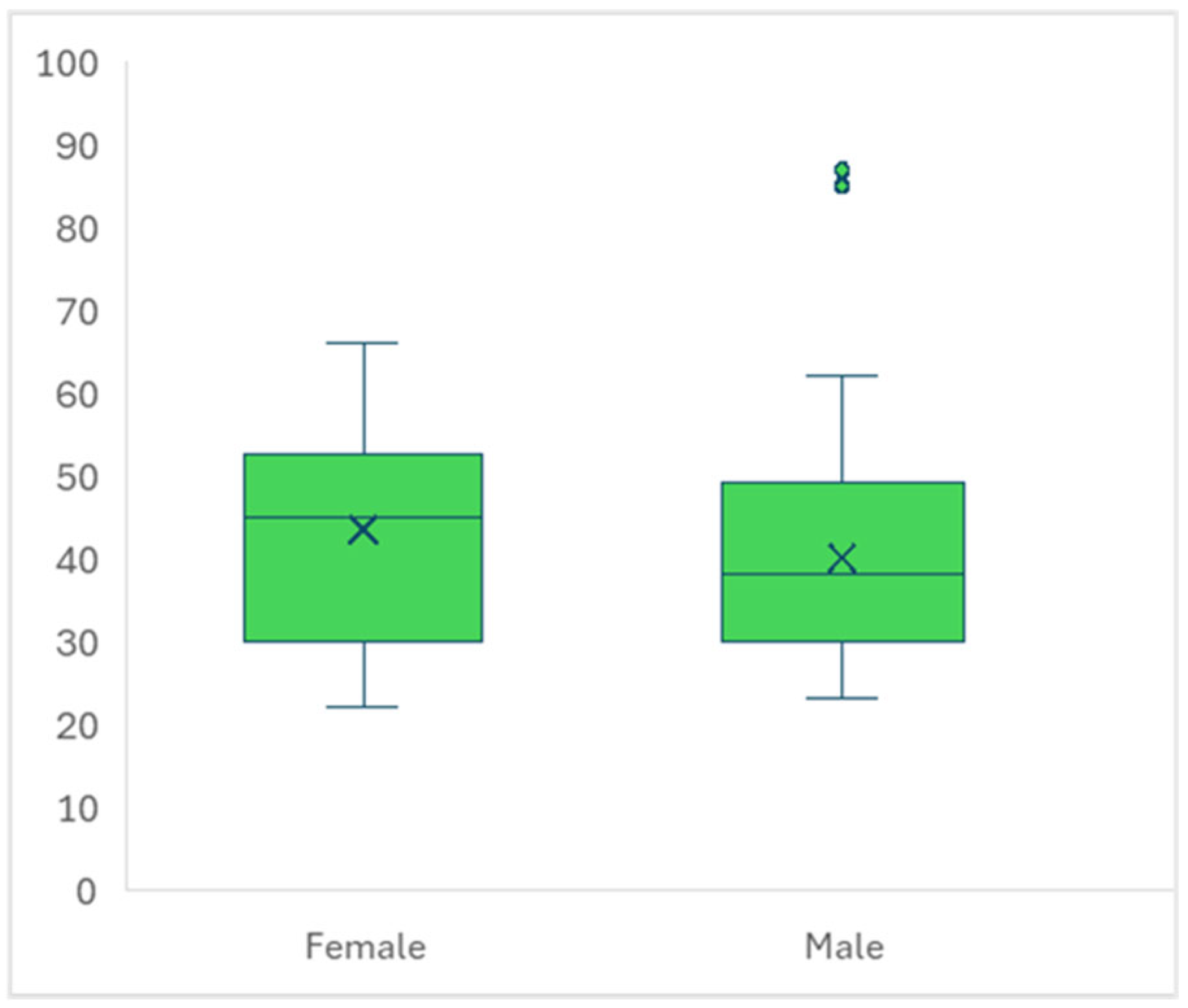
The composition of the scan collection is detailed in Table 1, while the age distribution is shown in Figure 1. The mean age of the female sample was 44.12 years, with a standard deviation of 13.51, while the mean age of the male sample was 40.75 years, with a standard deviation of 13.84.

2.1. Imaging Software and Data Processing

A similar methodology to that described by Jonker et al. (2023) [17] was followed for this study to obtain and align the Micro-CT images. Skulls were scanned using a Nikon XTH 225L Micro-CT system at the Micro-Focus X-ray Radiography and Tomography facility (MIXRAD) of the South African Nuclear Energy Corporation (Necsa), Pelindaba, South Africa. Scans were performed at 100 kV and 100 mA, with 2 s exposures, producing 200 × 200 µm voxels, and were reconstructed in Nikon CT Pro 3D (v4.4.3) at 40–74 µm resolution.
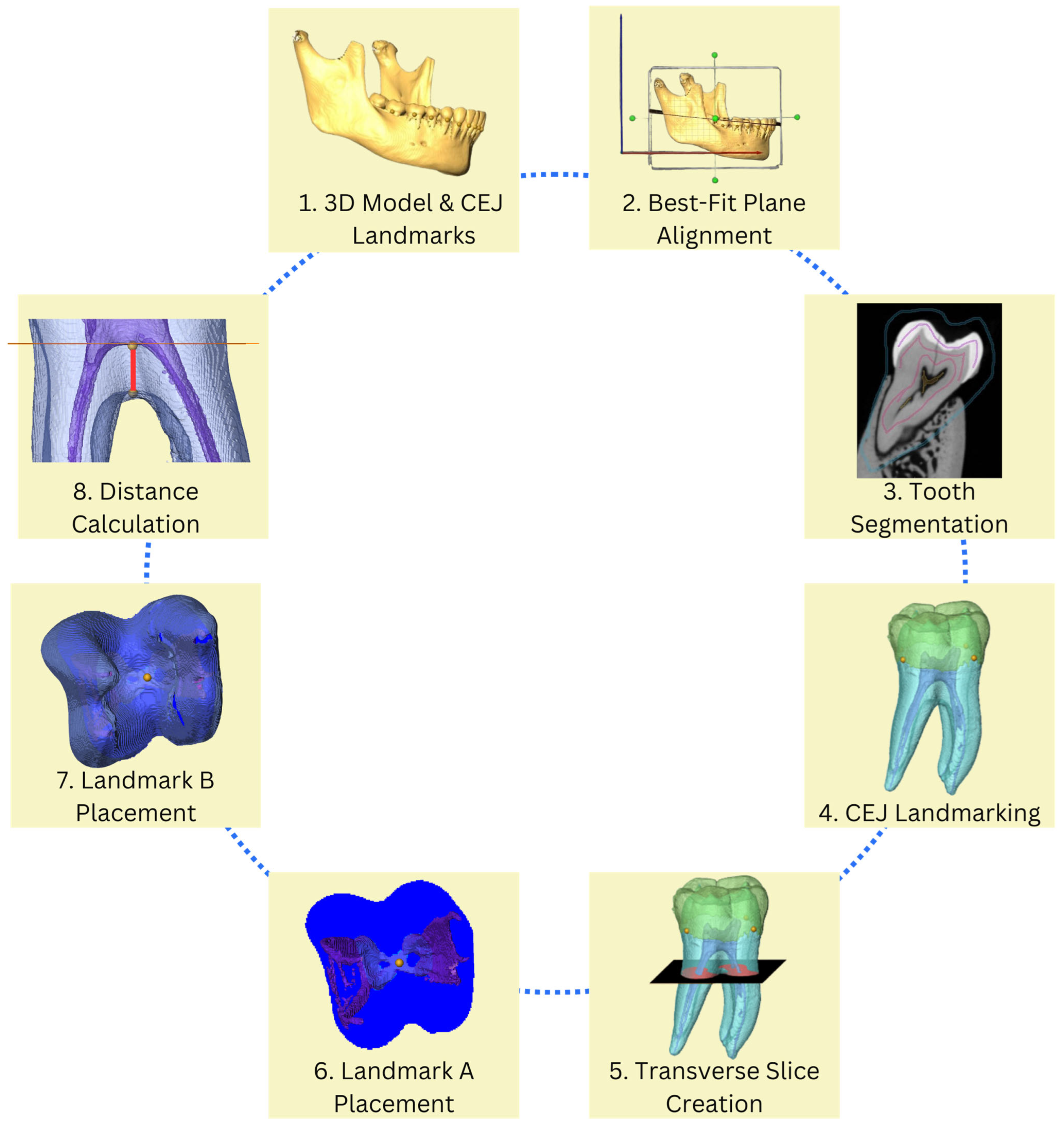
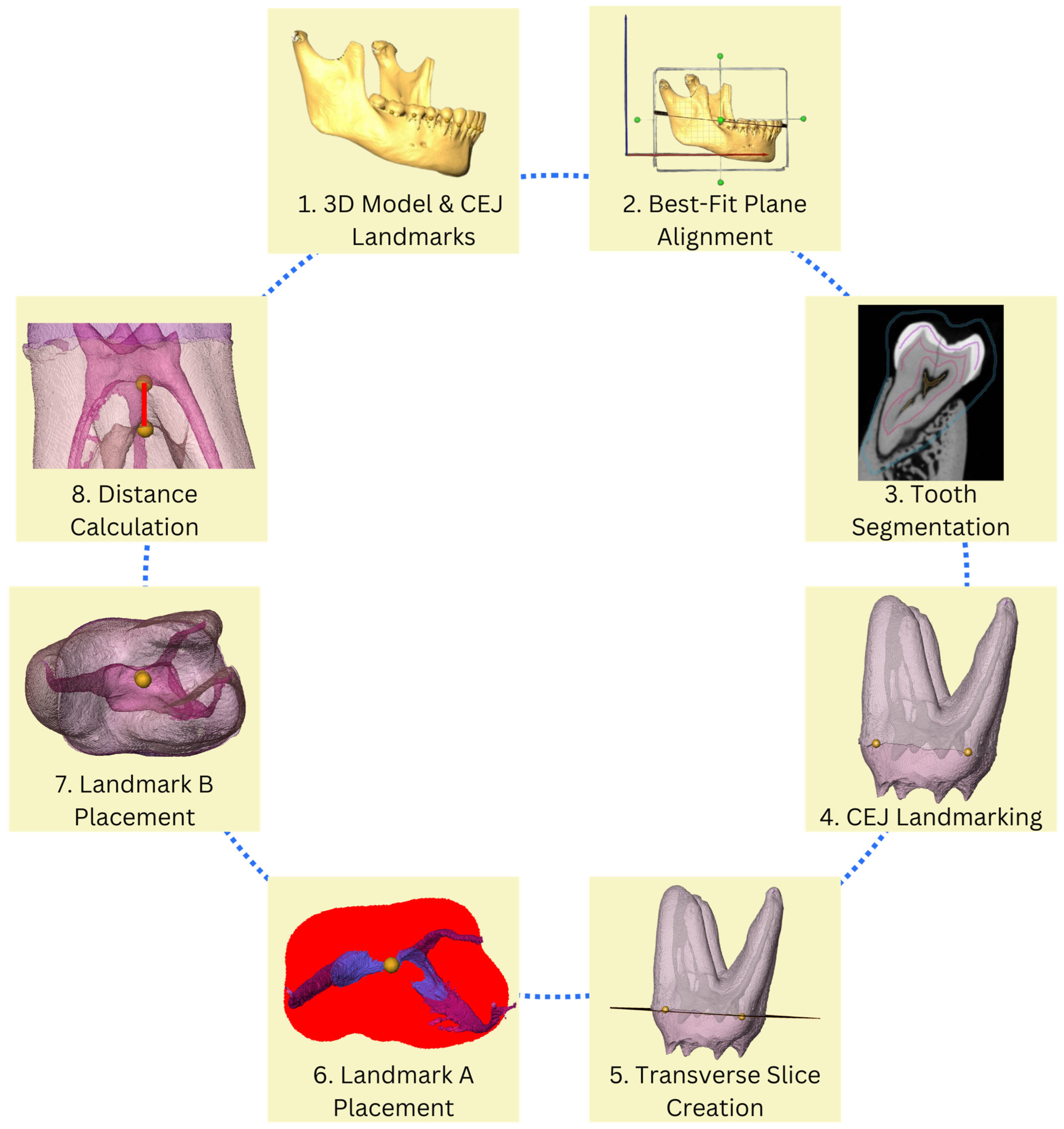
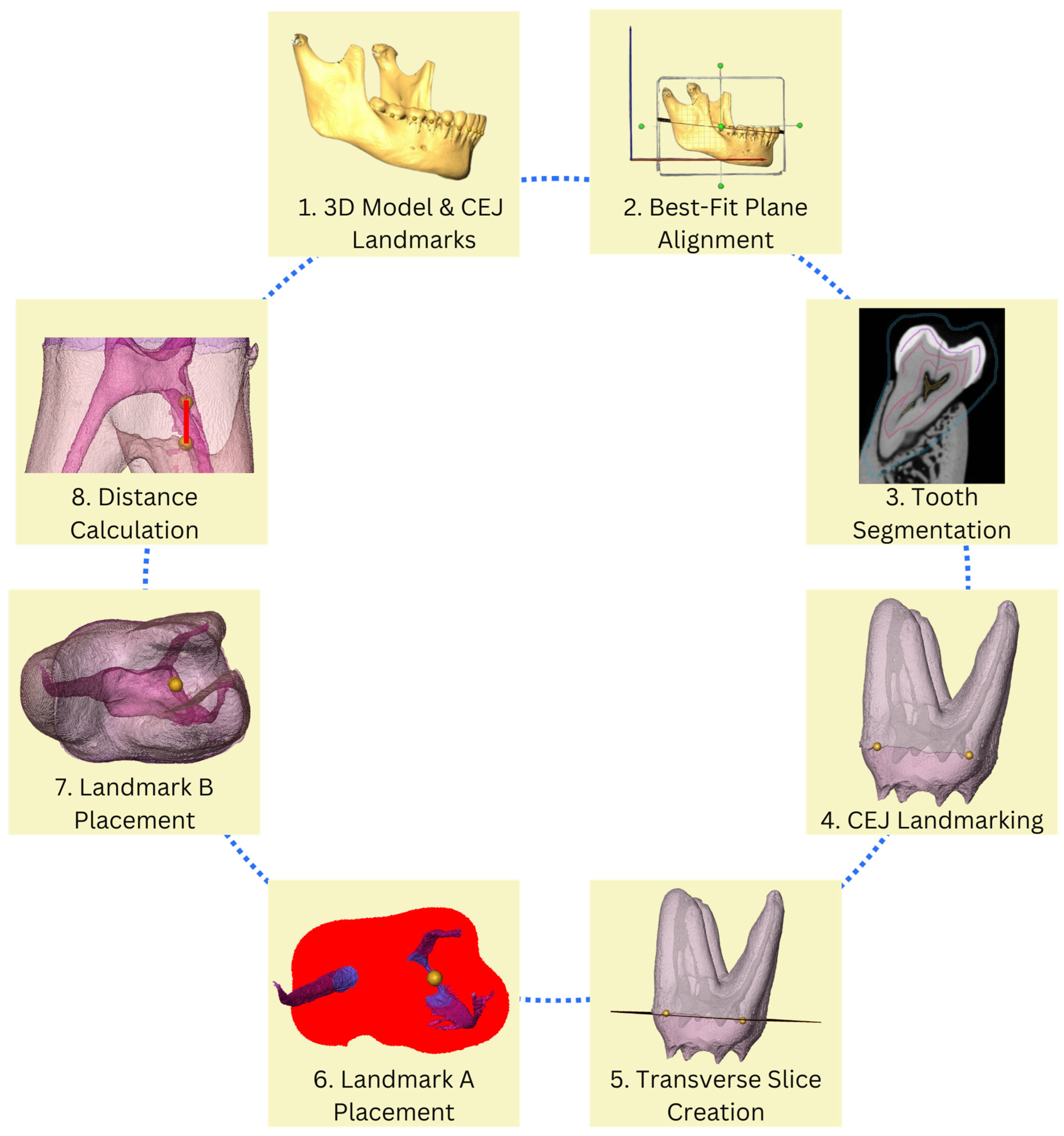
Micro-CT data were processed in Avizo 2019 to generate 3D models. Sliding landmarks were placed along the cemento-enamel junction (CEJ) to calculate a best-fit plane for realignment. Individual molars were isolated by cropping and watershed segmentation, and CEJ landmarks were reapplied following Jonker et al. (2023) [18]. A transverse slice was aligned to these landmarks using the ‘points to fit’ function to define the reference plane.
For mandibular first molars, a single measurement—the mean mandibular pulp thickness—was taken at the center of the pulp chamber floor (Figure 2). For maxillary first molars, two measurements were recorded: the central thickness between the palatal and buccal roots (mean central maxillary pulp thickness) (Figure 3) and the buccal thickness between the mesiobuccal and distobuccal roots (buccal maxillary pulp thickness) (Figure 4). These measurements were obtained by placing landmarks as follows: The exterior dentine layer was hidden to increase visibility of the pulp chamber. This slice was then moved until it reached the first pixel of the middle of the pulpal chamber floor, where a landmark (Landmark A) was placed (Figure 2 and Figure 3).
To place the next landmark, the exterior dentine layer was revealed. The landmark (Landmark B) was then placed directly on the furcation beneath Landmark A, aligned vertically. This ensured the two points were perpendicular to one another.
The three-dimensional (XYZ) coordinates of both landmarks were exported and used to calculate the Euclidean distance between them [19]. This was done using a standard distance formula in Microsoft Excel.

2.2. Statistical Analysis

The repeatability of the measurements was evaluated to ensure the reliability of the data gathered. Two evaluators, well experienced in imaging analysis (main researcher and another researcher), were blinded to the sample demographics when they assessed the images. The main researcher assessed the images across two sessions four weeks apart. This approach for repeatability testing has been performed by other researchers in the literature, for example, Eskandarloo et al. (2019) [20]. For intra- and interobserver repeatability assessment, intraclass correlation coefficients (ICCs) were calculated for each inter-landmark distance measurement. As the measurements of pulpal floor thicknesses are considered continuous (quantitative) data, statistical agreement is considered consensus.
After ensuring the repeatability of the measurements, the following statistical analyses were conducted using the PAST v. 4.11 program [21]. Descriptive statistics were calculated for each measurement obtained from the Micro-CT scans to analyze the data’s central tendency and variability. These statistics included the mean to indicate central tendency, as well as the standard deviation and range to capture the data’s spread.
The Shapiro–Wilk test was used to evaluate the normality of the data, as it is well-suited for the small-to-moderate sample sizes commonly encountered in medical research involving Micro-CT scan measurements. The normality assumption was tested at a 5% significance level (α = 0.05), with the null hypothesis stating that the data follow a normal distribution. If this hypothesis had been rejected, indicating a deviation from normality, the use of alternative non-parametric statistical methods for subsequent analyses would have been warranted.
In cases of normal distribution of data, two-sample t-tests were employed to compare the means of the measurements between sexes, while two-sample paired tests were used to compare means between sides. The dataset was restricted to individuals for whom both left and right teeth were available. This ensured that comparisons between sides were based on matched pairs, allowing for more accurate statistical testing of potential asymmetries in pulp floor dentine thickness. Next, Ordinary Least Squares (OLS) regression was performed to model the relationship between the measured pulp chamber floor dentine thickness and age.
Post hoc and a priori power analyses were performed using G*Power software (v 3.1.9.7) [22] to compare pulpal floor thickness between sexes and sides and to evaluate its correlation with age. A priori power analyses were performed to estimate the sample size required to have a high probability of detecting a statistically significant effect of sex, side, or age on pulpal floor thickness using a set α of 0.05 and power of 0.80, consistent with conventions in biomedical research to balance sensitivity with feasibility [23]. Post hoc tests were performed to compute the achieved statistical power of the measurements to distinguish between sex, side, or age at the sample sizes reached by convenience sampling and the effect size calculated from the means and standard deviations at a set α of 0.05. In the comparisons between sides and in the correlation with age, the correlation coefficient (r) and the coefficient of determination (r2) were also considered.

3. Results

3.1. Repeatability Results

The intra-observer assessments yielded intraclass correlation coefficient (ICC) values of 0.9801 for the maxillary central pulp distance, 0.9678 for the maxillary buccal pulp distance, and 0.9934 for the mandibular central pulp thickness. The corresponding interobserver assessments produced ICC values of 0.9643 for the maxillary central pulp distance, 0.8539 for the maxillary buccal pulp distance, and 0.9654 for the mandibular central pulp thickness. Collectively, these ICC values demonstrate excellent reliability (with the exception of good reliability for the maxillary buccal pulp distance interobserver measurement), indicating a high degree of measurement precision and consistency across both intra- and interobserver evaluations.

3.2. Dentine Thickness Results

For both the mandibular and maxillary first molars, the dentine thickness increased with age. For the female group, the mean central (between palatal and buccal roots) maxillary first molar pulp thickness was 2.81 mm and 2.79 mm (Table 2) for left and right, respectively, and the buccal (between mesiobuccal and distobuccal root) maxillary first molar pulp thickness was 2.41 mm for left and 2.33 mm for right (Table 3). The mean dentine thicknesses were 2.76 mm for left mandibular first molars and 2.81 mm for right mandibular molars (Table 4).
In males, the mean central maxillary first molar pulp thickness was 2.88 for left and 2.83 for right, and the buccal maxillary first molar pulp thickness was 2.37 mm and 2.40 mm for left and right, respectively (Table 2 and Table 3). The mean dentine thicknesses were 2.53 mm for the left mandibular first molars and 2.61 mm for the right mandibular molars (Table 4).
  • Maxillary molars
Table 2. Summary statistics of mean central (between palatal and buccal roots) maxillary first molar pulp thickness.
Female left
n = 21
Female right
n = 26
Male left
n = 24
Male right
n = 22
2.81
0.49
(2.04–3.86)
2.79
0.37
(2.19–3.56)
2.88
0.53
(1.89–4.13)
2.83
0.51
(1.86–3.94)
The number per group is indicated by n values. The mean (mm) values are indicated in bold. The standard deviation is indicated in italics, and the range is shown within the round (brackets).
Table 3. Summary statistics of buccal (between mesiobuccal and distobuccal root) maxillary first molar pulp thickness.
Female left
n = 21
Female right
n = 26
Male left
n = 24
Male right
n = 22
2.41
0.44
(1.81–3.77)
2.33
0.39
(1.75–2.94)
2.37
0.34
(1.89–4.13)
2.40
0.43
(1.80–3.79)
The number per group is indicated by n values. The mean (mm) values are indicated in bold. The standard deviation is indicated in italics, and the range is shown within the round (brackets).
  • Mandibular molars
Table 4. Summary statistics of pulp chamber floor dentine thickness in mandibular molars.
Female left
n = 16
Female right
n = 17
Male left
n = 21
Male right
n = 23
2.76
0.55
(1.97–3.98)
2.81
0.51
(2.14–3.79)
2.53
0.49
(1.57–3.35)
2.61
0.43
(1.67–3.40)
The number per group is indicated by n values. The mean (mm) values are indicated in bold. The standard deviation is indicated in italics, and the range is shown within the round (brackets).
Normality tests were performed and confirmed the normal distribution of all samples (Shapiro–Wilk > 0.05). There were no statistically significant differences between males and females or left and right. Age correlations were statistically significant for mandibular first molar pulp floor thickness and the mean central maxillary first molar pulp thickness, but insignificant for buccal maxillary first molar pulp thickness. Although thickness increased with age, all correlations were very weak.

3.3. Paired Left–Right Comparison

In the subset of individuals for whom both left and right teeth were available, two-sample t-tests indicated no statistically significant difference in pulp floor dentine thickness between the left and right sides for either the maxillary or mandibular teeth. Although the differences were not significant, the average dentine thickness was slightly greater on the right side compared to the left in both arches. This pattern was consistent across both sets of measurements, and effect sizes were very small, indicating that the observed side-to-side differences were negligible.

3.4. Power Analyses

Power analyses for central and buccal maxillary first molar pulp thickness indicated low statistical power, with required sample sizes in the thousands (Table 5 and Table 6) to detect statistically significant sex differences, reflecting the small magnitude of the sex effect. However, when considering mandibular first molar pulp thickness, the effect of sex was medium, while the statistical power was still poor. Sample sizes in the case of the mandible needed to demonstrate possible statistically significant sex differences on the left and right, which were respectively 164 and 176 (Table 7). The power analyses between sides revealed a low statistical power, small effect size, and large required sample sizes to detect possible statistical significance.
The power analyses for pulp thickness in all areas considered, as well as the sample numbers achieved, were adequate for age correlations, although the effect of age was small.

4. Discussion

In this study, Micro-CT scans and 3D imaging were used to measure the pulp chamber floor dentine thickness of a South African population and to determine whether age, side or sex had an influence on dentine thickness. Knowledge of the thickness of the pulp chamber floor is critical in the endodontic treatment approach. Not only will an in-depth understanding reduce the risk of perforations during the creation of endodontic access, but it will also provide a better understanding of the internal root canal morphology. The pulpal floor provides valuable clues to locate root canal orifices such as developmental lines and color changes. Unfortunately, some or all of these can easily be destroyed during improper endodontic access due to excessive dentin removal [24,25].
To gain more insight into the dentinal thickness from the pulp chamber floor to the furcation, several studies have been conducted in various populations, as described in Table 5. Despite employing different technologies and sample groups, studies conducted around the turn of the millennium reported pulpal floor dentine thicknesses approaching 3 mm in both maxillary and mandibular first molars (Table 8).
It is noteworthy that studies conducted using newer 3D technology, such as CBCT, reported thinner pulpal floor thicknesses in the primary molars. For example, Bovino et al. (2021) [31] measured an average thickness of 1.55 ± 0.41 mm in the maxillary first molars and 1.42 ± 0.39 mm in the mandibular first molars, whereas Dabawala et al. (2015) [3], using 2D bitewing radiographs, reported 1.70 ± 0.38 mm and 1.59 ± 0.31 mm, respectively.
Although the anatomical data on primary first molars cannot be directly compared to that of permanent first molars due to their larger pulp chambers and thinner pulp floors [31], such findings highlight the superiority of CBCT over two-dimensional radiography, emphasizing that differences in measured values are often rooted in imaging methodology rather than anatomy alone.
Discrepancies in the literature may, in part, result from differences in the ages of study participants. Age-related secondary dentine apposition predominantly occurs on the pulp chamber floor rather than the ceiling [32,33,34]. Reduction in the pulp chamber due to calcifications or secondary dentine formation has been noted with increased age [35]. A small, sclerotic pulp chamber can pose significant challenges to treating clinicians to gain adequate and safe access to the pulpal complex without risking iatrogenic damage [34].
The pulpal chamber floor dentine thicknesses observed in this study were slightly smaller than those reported in the previous literature but notably thicker than those performed on CBCT by Azim et al. (2014) [30]. As Micro-CT delivers more focused images than CBCT, lower values are expected. A factor that may have influenced these results is the difference in the geographical origin of the samples. While Azim et al. [30] did not specify the ancestry of their sample, the geographic context of their research suggests a predominantly European population, whereas our study focused on individuals of African descent.
Previous studies have demonstrated that individuals of African descent generally present with larger tooth dimensions, greater facial proportions, and more robust skeletal structures compared to individuals of European descent [36,37]. These anatomical differences may contribute to stronger bite forces, which could, in turn, influence dentine thickness through mechanical loading. However, this needs to be confirmed by comparative research studies on geographically distinct groups.
The discrepancy in measurements can also be attributed to the methodological differences in measurements or to differences in the age spread of the samples. Unlike prior studies that typically relied on two-dimensional (2D) models and linear measurements from the pulp chamber floor to the root furcation in a single plane, this study employed three-dimensional (3D) models in high definition. Dentine thickness was calculated using set landmarks, and the same steps were repeated for every tooth in the sample to enhance repeatability. For mandibular molars, a measurement was taken from the midpoint of the pulp chamber floor to the perpendicular point on the furcation. Similarly, in maxillary molars, a central measurement was taken between the palatal and buccal roots, but with the addition of a secondary buccal measurement between the mesiobuccal and distobuccal roots. This more anatomically accurate and repeatable approach could possibly have led to smaller measurements by taking into account variations in morphology that might not have been captured in 2D analyses.
As anticipated, with aging, the pulpal chamber floor dentine thicknesses increased [38,39]. However, the age distribution of the sample analyzed in this study may differ from that of samples used in previous studies, which could influence the average dentine thickness values obtained. Interestingly, statistical significance was detected in the mandibular and central maxillary pulp thickness measurements, but not in the buccal maxillary pulp thickness ones. It must be said that the calculated statistical significance demonstrated a weak relationship, and it is anticipated that larger samples could increase the likelihood of statistically significant age correlations.
Although no statistically significant side dominance could be discerned in the pulpal chamber floor dentine thicknesses in males, females, the mandible, or the maxilla, the right side in the mandibular sample seemed to be more sensitive to thickening with aging than the left side, whilst the left side of the maxilla seemed to be more sensitive to thickening with aging than the right side. It is also interesting to note that when looking at the whole dataset, the mean dentine thicknesses on the left were greater than on the right in maxillary molars for both females and males, while the opposite was true in mandibular molars. However, in the subset of individuals with both left and right teeth available, the right side tended to be slightly thicker than the left in both maxillary and mandibular teeth. Although this was the case, no statistically significant differences were observed in pulp floor dentine thickness between sides, indicating that these differences are likely of minimal biological significance. The power analyses supported the first maxillary molar findings in this study, namely that sex and side had a negligible effect, while the first mandibular molar pulpal floor thickness showed a more pronounced effect of sex, with females exhibiting a non-significant tendency toward greater pulpal floor thickness than males. This finding may be clarified in studies with larger sample sizes. As females had an older mean age, the weak but significant effect of aging might explain the greater pulpal floor thickness in the first mandibular molar in females compared to males.
Dentine thickness may be greater on the right-hand side due to chewing side preference, which leads to increased mechanical loading on that side [40,41,42]. Habitual chewing predominantly on one side causes the occlusal forces and masticatory muscle activity to be higher on that side, stimulating adaptive responses in the dentine structure [43]. Studies show that higher occlusal forces correlate with the preferred chewing side [43,44], and chewing side preference has been linked to lateral asymmetry of bite force and occlusal contact area [44]. This increased mechanical stress could promote secondary dentine deposition, resulting in thicker dentine on the preferred side. Additionally, brain lateralization and handedness are associated with chewing side preference, often favoring the right side in most individuals [42,43,44,45,46], which can explain why the right side tends to exhibit greater dentine thickness due to these habitual loading patterns.
Several limitations should be acknowledged in this study. Firstly, the analysis was restricted to first molars, thereby limiting the evaluation of the proposed methodology to a single tooth type. While the approach yielded satisfactory results for the included specimens, its applicability to other teeth remains untested. Furthermore, the inclusion of a larger and more diverse group of assessors may have enhanced the reliability of landmark identification. The relatively small sample size may also be regarded as a limitation, as a larger cohort could have provided greater statistical power and allowed for more robust conclusions regarding dentine thickness variability. Nonetheless, sample sizes of a similar scale have been employed in previous investigations [47,48,49,50,51,52]. The measurements obtained in this study were limited to the perpendicular distance at the center of the pulp chamber floor. It is important to note that the thickness of the pulpal floor may vary across different regions, suggesting a potential avenue for future research. In addition, the study population was limited to individuals from the northern region of Gauteng, South Africa, and as such, the generalizability of the findings to other populations—both within and beyond South Africa—remains uncertain. Lastly, no specimens in the sample exhibited fused roots, which may restrict the applicability of the methodology to teeth with more complex root configurations. However, it is plausible that the technique could be adapted for use with other multi-rooted teeth.

5. Conclusions

In this South African sample, pulpal chamber floor dentine thickness averaged around 2.5 mm, showed minimal age-related increase, and was greater in the maxillary than the mandibular first molar. Obtaining repeatable and thinner values than expected may reflect on the accuracy of the methodology used or be attributable to the characteristics of the population investigated.

Supplementary Materials

The following supporting information can be downloaded at: https://www.mdpi.com/article/10.3390/oral6020033/s1, STROBE guidelines checklist for this study.

Author Contributions

Conceptualization, C.H.J.; methodology, M.M., A.C.O. and C.H.J.; validation, M.M., A.C.O. and C.H.J.; formal analysis, M.M. and A.C.O.; investigation, M.M.; resources, C.H.J., A.C.O., S.R.-S. and M.M.; data curation, M.M., A.C.O. and C.H.J.; writing—original draft preparation, M.M.; writing—review and editing, S.R.-S., A.C.O., F.F. and C.H.J.; visualization, S.R.-S., A.C.O., C.H.J., F.F. and M.M.; supervision, S.R.-S., A.C.O. and C.H.J.; project administration, A.C.O.; funding acquisition, S.R.-S. All authors have read and agreed to the published version of the manuscript.

Funding

This study was supported by the National Research Foundation (NRF) under the Research Development Grants for New Generation of Academics Program (nGAP) [Grant No: NGAP240205203589] and co-funded by the Department of Higher Education and Training (DHET) through the Staffing South African Universities Framework (SSAUF) and nGAP.

Institutional Review Board Statement

Ethical approval for this study was obtained from the School of Medicine Research Committee of the Sefako Makgatho Health Sciences University (SREC) and the Sefako Makgatho Health Sciences University Ethics Committee (SMUREC) (SMUREC/M/443/2024:PG) (13 February 2025), ensuring adherence to the guidelines for research involving human subjects.

Informed Consent Statement

Informed consent from patients was not possible as Micro-CT scans from skulls of deceased individuals were used. Permission for research was given by family members in the case of a donation, and unclaimed bodies are protected by the National Health Act 61 of 2012.

Data Availability Statement

The data presented in this study are available from the corresponding author upon request. The data are not publicly available due to ethical reasons.

Acknowledgments

The authors acknowledge Daniele Kristen for her assistance with the interobserver testing.

Conflicts of Interest

The authors declare no conflicts of interest.

References

  1. Gaba, C.; Gurtu, A.; Bansal, R.; Kumar, P. Morphological Measurements of Anatomical Landmarks in Human Maxillary First Molar Pulp Chambers and Evaluation of Number of Pulp Canal Orifices Using Spiral Computed Tomography: An in Vitro Study. J. Conserv. Dent. 2019, 22, 233–236. [Google Scholar] [CrossRef] [PubMed]
  2. Deutsch, A.; Musikant, B. Morphological Measurements of Anatomic Landmarks in Human Maxillary and Mandibular Molar Pulp Chambers. J. Endod. 2004, 30, 388–390. [Google Scholar] [CrossRef]
  3. Dabawala, S.; Chacko, V.; Suprabha, B.S.; Rao, A.; Natarajan, S.; Ongole, R. Evaluation of Pulp Chamber Dimensions of Primary Molars From Bitewing Radiographs. Pediatr. Dent. 2015, 37, 361–365. [Google Scholar] [PubMed]
  4. Gupta, K.P.; Grewal, P.S. Clinical Challenges in Managing Minor Developmental Anomalies in Children. J. Oral Health Community Dent. 2015, 5, 136–141. [Google Scholar] [CrossRef]
  5. Selvakumar, H.; Kavitha, S.; Vijayakumar, R.; Eapen, T.; Bharathan, R. Study of Pulp Chamber Morphology of Primary Mandibular Molars Using Spiral Computed Tomography. J. Contemp. Dent. Pract. 2014, 15, 726–729. [Google Scholar] [CrossRef] [PubMed]
  6. Mozzo, P.; Procacci, C.; Tacconi, A.; Martini, P.T.; Andreis, I.A. A New Volumetric CT Machine for Dental Imaging Based on the Cone-Beam Technique: Preliminary Results. Eur. Radiol. 1998, 8, 1558–1564. [Google Scholar] [CrossRef]
  7. Pauwels, R.; Beinsberger, J.; Collaert, B.; Theodorakou, C.; Rogers, J.; Walker, A.; Cockmartin, L.; Bosmans, H.; Jacobs, R.; Bogaerts, R.; et al. Effective Dose Range for Dental Cone Beam Computed Tomography Scanners. Eur. J. Radiol. 2012, 81, 267–271. [Google Scholar] [CrossRef]
  8. Rokn, A.R.; Hashemi, K.; Akbari, S.; Kharazifard, M.J.; Barikani, H.; Panjnoosh, M. Accuracy of Linear Measurements Using Cone Beam Computed Tomography in Comparison with Clinical Measurements. J. Dent. 2016, 13, 333–339. [Google Scholar]
  9. Moannaei, M.; Halvaei, F.; Abdinian, M.; Soltani, P.; Rengo, C.; Cernera, M. Investigating the efficacy of the metal artifact reduction algorithm in cone-beam computed tomography images for endodontic and restorative materials. G. Ital. Endod. 2025, 39, 33–43. [Google Scholar] [CrossRef]
  10. Kulczyk, T.; Rychlik, M.; Lorkiewicz-Muszyńska, D.; Abreu-Głowacka, M.; Czajka-Jakubowska, A.; Przystańska, A. Computed Tomography versus Optical Scanning: A Comparison of Different Methods of 3D Data Acquisition for Tooth Replication. Biomed. Res. Int. 2019, 2019, 4985121. [Google Scholar] [CrossRef]
  11. Al-Rawi, B.; Hassan, B.; Vandenberge, B.; Jacobs, R. Accuracy Assessment of Three-Dimensional Surface Reconstructions of Teeth from Cone Beam Computed Tomography Scans. J. Oral Rehabil. 2010, 37, 352–358. [Google Scholar] [CrossRef]
  12. Metscher, B.D. MicroCT for Comparative Morphology: Simple Staining Methods Allow High-Contrast 3D Imaging of Diverse Non-Mineralized Animal Tissues. BMC Physiol. 2009, 9, 11. [Google Scholar] [CrossRef] [PubMed]
  13. Parsa, A.; Ibrahim, N.; Hassan, B.; van der Stelt, P.; Wismeijer, D. Bone Quality Evaluation at Dental Implant Site Using Multislice CT, Micro-CT, and Cone Beam CT. Clin. Oral Implant. Res. 2015, 26, e1–e7. [Google Scholar] [CrossRef] [PubMed]
  14. Van Dessel, J.; Nicolielo, L.F.P.; Huang, Y.; Coudyzer, W.; Salmon, B.; Lambrichts, I.; Jacobs, R. Accuracy and Reliability of Different Cone Beam Computed Tomography (CBCT) Devices for Structural Analysis of Alveolar Bone in Comparison with Multislice CT and Micro-CT. Eur. J. Oral Implantol. 2017, 10, 95–105. [Google Scholar]
  15. Nair, M.K.; Nair, U.P. Digital and Advanced Imaging in Endodontics: A Review. J. Endod. 2007, 33, 1–6. [Google Scholar] [CrossRef]
  16. Cuschieri, S. The STROBE Guidelines. Saudi J. Anaesth. 2019, 13, S31–S34. [Google Scholar] [CrossRef] [PubMed]
  17. Jonker, C.H.; Van Der Vyver, P.J.; Oettlé, A.C. Root and Canal Morphology of the Mandibular First Molar: A Micro-Computed Tomography-Focused Observation of Literature with Illustrative Cases. Part 1: External Root Morphology. S. Afr. Dent. J. 2023, 78, 449–456. [Google Scholar] [CrossRef]
  18. Jonker, C.H.; Lambourn, G.; Oettlé, A.C.; Foschi, F.; Theye, C.; L’Abbé, E.N. A New Methodology to Determine the Orifice for Root Canal Configurations in First Permanent Molar Root and Canal Morphologies Using Micro-Computed Tomography. J. Clin. Med. 2023, 13, 71. [Google Scholar] [CrossRef]
  19. Kobedi, R.; Jagesur, S.; Abdool, Z.; Oettlé, J.; Oettlé, A.C. Variations in Pelvic Floor Thickness in Relation to Bony Dimensions in South African Women: Using Computed Tomography Scans. Eur. J. Anat. 2024, 28, 495–503. [Google Scholar] [CrossRef]
  20. Eskandarloo, F.; Eskandarloo, A.; Amini, P. The Ability of Different Observers in Measuring Dimensions of Objects and Cavities in Cone Beam-CT Images. Avicenna J. Dent. Res. 2019, 11, 139–143. [Google Scholar] [CrossRef]
  21. Hammer, O.; Harper, D.A.T.; Ryan, P.D. PAST: Paleontological Statistics Software Package for Education and Data Analysis. Palaeontol. Electron. 2001, 4, 1–9. [Google Scholar]
  22. Faul, F.; Erdfelder, E.; Lang, A.G.; Buchner, A. G*Power 3: A Flexible Statistical Power Analysis Program for the Social, Behavioral, and Biomedical Sciences. Behav. Res. Methods 2007, 39, 175–191. [Google Scholar] [CrossRef]
  23. Biau, D.J.; Kernéis, S.; Porcher, R. Statistics in Brief: The Importance of Sample Size in the Planning and Interpretation of Medical Research. Clin. Orthop. Relat. Res. 2008, 466, 2282–2288. [Google Scholar] [CrossRef] [PubMed]
  24. Vertucci, F.J. Root Canal Morphology and Its Relationship to Endodontic Procedures. Endod. Top. 2005, 10, 3–29. [Google Scholar] [CrossRef]
  25. Krasner, P.; Rankow, H.J. Anatomy of the Pulp-Chamber Floor. J. Endod. 2004, 30, 5–16. [Google Scholar] [CrossRef]
  26. Majzoub, Z.; Kon, S. Tooth Morphology Following Root Resection Procedures in Maxillary First Molars. J. Periodontol. 1992, 63, 290–296. [Google Scholar] [CrossRef]
  27. Sterrett, J.D.; Pelletier, H.; Russell, C.M. Tooth Thickness at the Furcation Entrance of Lower Molars. J. Clin. Periodontol. 1996, 23, 621–627. [Google Scholar] [CrossRef]
  28. Velmurugan, N.; Venkateshbabu, N.; Abarajithan, M.; Kandaswamy, D. Evaluation of the Pulp Chamber Size of Human Maxillary First Molars: An Institution Based in Vitro Study. Indian. J. Dent. Res. 2008, 19, 92–94. [Google Scholar] [CrossRef]
  29. Khojastepour, L.; Rahimizadeh, N.; Khayat, A. Morphologic Measurements of Anatomic Landmarks in Pulp Chambers of Human First Molars: A Study of Bitewing Radiographs. Iran. Endod. J. 2008, 2, 147–151. [Google Scholar]
  30. Azim, A.A.; Azim, K.A.; Deutsch, A.S.; Huang, G.T.-J. Acquisition of Anatomic Parameters Concerning Molar Pulp Chamber Landmarks Using Cone-Beam Computed Tomography. J. Endod. 2014, 40, 1298–1302. [Google Scholar] [CrossRef] [PubMed]
  31. Bovino, M.; Santos, L.d.S.; Cavalcante, L.L.F.d.A.; Lima, C.C.B.; de Lima, M.d.D.M.; de Moura, M.S.; de Macêdo, P.d.T.S.; de Deus Moura, L.d.F.A. Dentin Thickness of Pulp Chamber Floor in Primary Molars: Evaluation by Cone-Beam Computed Tomography. Pesqui. Bras. Odontopediatr. Clín. Integr. 2021, 21, e0013. [Google Scholar] [CrossRef]
  32. Philippas, G.G. Influence of Occlusal Wear and Age on Formation of Dentin and Size of Pulp Chamber. J. Dent. Res. 1961, 40, 1186–1198. [Google Scholar] [CrossRef]
  33. Shaw, L.; Jones, A.D. Morphological Considerations of the Dental Pulp Chamber from Radiographs of Molar and Premolar Teeth. J. Dent. 1984, 12, 139–145. [Google Scholar] [CrossRef]
  34. Lokade, J.; Rawlani, S.; Baheti, R.; Roy, S.; Chandak, M.; Lohe, V. Morphological Measurements of Anatomic Landmarks in Human Mandibular Molar Pulp Chambers—An in Vivo Study. J. Korean Dent. Sci. 2011, 4, 1–5. [Google Scholar] [CrossRef]
  35. Mireku, A.S.; Romberg, E.; Fouad, A.F.; Arola, D. Vertical Fracture of Root Filled Teeth Restored with Posts: The Effects of Patient Age and Dentine Thickness. Int. Endod. J. 2010, 43, 218–225. [Google Scholar] [CrossRef] [PubMed]
  36. Liebenberg, L.; L’Abbé, E.N.; Stull, K.E. Population Differences in the Postcrania of Modern South Africans and the Implications for Ancestry Estimation. Forensic Sci. Int. 2015, 257, 522–529. [Google Scholar] [CrossRef] [PubMed]
  37. Zengin, A.; Pye, S.R.; Cook, M.J.; Adams, J.E.; Wu, F.C.W.; O’Neill, T.W.; Ward, K.A. Ethnic Differences in Bone Geometry between White, Black and South Asian Men in the UK. Bone 2016, 91, 180–185. [Google Scholar] [CrossRef]
  38. Gupta, P.; Kaur, H.; Shankari, G.S.M.; Jawanda, M.K.; Sahi, N. Human Age Estimation from Tooth Cementum and Dentin. J. Clin. Diagn. Res. 2014, 8, ZC07-10. [Google Scholar] [CrossRef]
  39. Chaleefong, M.; Prapayasatok, S.; Nalampang, S.; Louwakul, P. Comparing the Pulp/Tooth Area Ratio and Dentin Thickness of Mandibular First Molars in Different Age Groups: A Cone-Beam Computed Tomography Study. J. Conserv. Dent. 2021, 24, 158–162. [Google Scholar] [CrossRef] [PubMed]
  40. Zamanlu, M.; Khamnei, S.; SalariLak, S.; Oskoee, S.S.; Shakouri, S.K.; Houshyar, Y.; Salekzamani, Y. Chewing Side Preference in First and All Mastication Cycles for Hard and Soft Morsels. Int. J. Clin. Exp. Med. 2012, 5, 326–331. [Google Scholar]
  41. de Moraes, K.J.R.; da Cunha, D.A.; Albuquerque, L.C.A.; de Carvalho, C.C.; da Silva, H.J. Chewing Preference and Its Relationship with Postural Muscular Electric Potential. Rev. CEFAC 2018, 20, 648–656. [Google Scholar] [CrossRef]
  42. Khamnei, S.; Sadat-Ebrahimi, S.-R.; Salarilak, S.; Savadi Oskoee, S.; Houshyar, Y.; Shakouri, S.K.; Salekzamani, Y.; Zamanlu, M. Manifestation of Hemispheric Laterality in Chewing Side Preference and Handedness. Bioimpacts 2019, 9, 189–193. [Google Scholar] [CrossRef]
  43. Bicaj, T.; Pustina, T.; Ahmedi, E.; Dula, L.; Lila, Z.; Tmava-Dragusha, A.; Ademi-Abdyli, R.; Ajeti, N. The Relation between the Preferred Chewing Side and Occlusal Force Measured by T-Scan III System. Open J. Stomatol. 2015, 05, 95–101. [Google Scholar] [CrossRef]
  44. Haralur, S.B.; Majeed, M.I.; Chaturvedi, S.; Alqahtani, N.M.; Alfarsi, M. Association between Preferred Chewing Side and Dynamic Occlusal Parameters. J. Int. Med. Res. 2019, 47, 1908–1915. [Google Scholar] [CrossRef] [PubMed]
  45. Martinez-Gomis, J.; Lujan-Climent, M.; Palau, S.; Bizar, J.; Salsench, J.; Peraire, M. Relationship between Chewing Side Preference and Handedness and Lateral Asymmetry of Peripheral Factors. Arch. Oral Biol. 2009, 54, 101–107. [Google Scholar] [CrossRef]
  46. Lee, S.-M.; Oh, S.; Yu, S.J.; Lee, K.-M.; Son, S.-A.; Kwon, Y.H.; Kim, Y.-I. Association between Brain Lateralization and Mixing Ability of Chewing Side. J. Dent. Sci. 2017, 12, 133–138. [Google Scholar] [CrossRef]
  47. Harris, S.P.; Bowles, W.R.; Fok, A.; McClanahan, S.B. An Anatomic Investigation of the Mandibular First Molar Using Micro–Computed Tomography. J. Endod. 2013, 39, 1374–1378. [Google Scholar] [CrossRef]
  48. De-Deus, G.; Rodrigues, E.A.; Belladonna, F.G.; Simões-Carvalho, M.; Cavalcante, D.M.; Oliveira, D.S.; Souza, E.M.; Giorgi, K.A.; Versiani, M.A.; Lopes, R.T.; et al. Anatomical Danger Zone Reconsidered: A Micro- CT Study on Dentine Thickness in Mandibular Molars. Int. Endod. J. 2019, 52, 1501–1507. [Google Scholar] [CrossRef]
  49. Leite Pinto, S.; Lins, R.; Videira Marceliano-Alves, M.; Guimarães, M.S.; Da Fonseca, B.; Radetic, A.; De Paula Porto, Á.N.; Lopes, H. The Internal Anatomy of Danger Zone of Mandibular Molars: A Cone-Beam Computed Tomography Study. J. Conserv. Dent. 2018, 21, 481–484. [Google Scholar] [CrossRef]
  50. Azimi, V. Comparison of Dentinal Wall Thickness in the Furcation Area (Danger Zone) in the First and Second Mesiobuccal Canals in the Maxillary First and Second Molars Using Cone-Beam Computed Tomography. Eur. Endod. J. 2020, 5, 81–85. [Google Scholar] [CrossRef] [PubMed]
  51. Tabrizizadeh, M.; Reuben, J.; Khalesi, M.; Mousavinasab, M.; Ezabadi, M.G. Evaluation of Radicular Dentin Thickness of Danger Zone in Mandibular First Molars. J. Dent. 2010, 7, 196–199. [Google Scholar]
  52. Ordinola-Zapata, R.; Martins, J.N.R.; Versiani, M.A.; Bramante, C.M. Micro-CT Analysis of Danger Zone Thickness in the Mesiobuccal Roots of Maxillary First Molars. Int. Endod. J. 2019, 52, 524–529. [Google Scholar] [CrossRef] [PubMed]
Figure 1. Age distribution of sample.
Oral 06 00033 g001
Figure 2. Process of measuring pulp floor dentine thickness in mandibular molars.
Oral 06 00033 g002
Figure 3. Process of measuring central pulp floor dentine thickness in maxillary molars.
Oral 06 00033 g003
Figure 4. Process of measuring buccal pulp floor dentine thickness in maxillary molars.
Oral 06 00033 g004
Table 1. Distribution of the Micro-CT samples.
Maxillary First MolarMandibular First MolarTotal
Females463379
Males454489
Total9177168
Table 5. Power analysis of the central maxillary first molar pulp thickness.
Parameters and OutcomesBetween Sexes: LeftBetween Sexes: RightBetween Sides: MalesBetween Sides: FemalesWith Aging
A priori: Required sample size1672398994129726
Post hoc: Effect size 0.13710.08990.08110.14470.3320
Post hoc: Power analysis0.07340.06060.12430.22100.9998
Table 6. Power analysis of the buccal maxillary first molar pulp thickness.
Parameters and OutcomesBetween Sexes: LeftBetween Sexes: RightBetween Sides: MalesBetween Sides: FemalesWith Aging
A priori: Required sample size30361082884676123
Post hoc: Effect size d/f20.10170.17050.08370.09570.0653
Post hoc: Power analysis0.06280.08890.12750.12750.6791
Table 7. Power analysis of the mandibular first molar pulp thickness.
Parameters and OutcomesBetween Sexes: LeftBetween Sexes: RightBetween Sides: MalesBetween Sides: FemalesWith Aging
A priori: Required sample size164176143910644
Post hoc: Effect size d/f2/dz0.44160.42400.06560.24360.1466
Post hoc: Power analysis0.30360.25270.10600.33130.9126
Table 8. Pulpal floor dentine thickness.
AuthorMaxilla or MandibleFirst Molar/RandomMean Distance Achieved in mmMethodology UsedCountry of Study
Majzoub and Kon (1992) [26]MaxillaFirst molar2.70 ± 0.38Calibrated calliperBrazil/Canada
Sterrett et al. (1996) [27]MandibleFirst molar2.83 ± 0.49Photographic analysisCanada:
90% European descent
5% Black
Deutsch and Musikant (2004) [2]MaxillaRandom3.05 Radiographic techniques and StereomicroscopeUSA
MandibleRandom2.96
Velmurugan et al. (2008) [28]MaxillaFirst molar2.70 ± 0.63 Radiographic techniquesIndia
Khojastepour et al. (2008) [29]MaxillaFirst molar2.86 ± 0.57 Radiographic techniquesIran
MandibleFirst molar2.89 ± 0.61
Azim et al. (2014) [30]MaxillaFirst molar1.97 ± 0.58CBCTUSA
MandibleFirst molar2.24 ± 0.47
Disclaimer/Publisher’s Note: The statements, opinions and data contained in all publications are solely those of the individual author(s) and contributor(s) and not of MDPI and/or the editor(s). MDPI and/or the editor(s) disclaim responsibility for any injury to people or property resulting from any ideas, methods, instructions or products referred to in the content.