Article

Head Tilt as a Technique to Reduce Contralateral Arch Artifacts in Small Field of View Cone Beam Computed Tomography Imaging


by
Dominik Niklas Elvers
1,
Marius Meier
2,3,
Dritan Turhani
2,3,
Sebastian Fitzek
4,
Philipp Johann Poxleitner
5 and
Jörg Philipp Tchorz
1,*
1
Division for Endodontics, Center for Operative Dentistry and Periodontology, Department of Dentistry, Faculty of Medicine and Dentistry, Danube Private University, 3500 Krems, Austria
2
Center for Oral and Maxillofacial Surgery, Department of Dentistry, Faculty of Medicine and Dentistry, Danube Private University, 3500 Krems, Austria
3
Intelligence in Dentistry (CAAID) Group, Department of Dentistry, Faculty of Medicine and Dentistry, Danube Private University, 3500 Krems, Austria
4
Health Services Research Group, Medical Images Analysis and Artificial Intelligence, Danube Private University, 3500 Krems, Austria
5
Department of Oral and Maxillofacial Surgery and Facial Plastic Surgery, University Hospital, Ludwig Maximilians University, 80337 Munich, Germany
*
Author to whom correspondence should be addressed.
Submission received: 14 January 2026 / Revised: 14 February 2026 / Accepted: 2 March 2026 / Published: 9 March 2026
(This article belongs to the Special Issue Advanced Radiographic Techniques in Endodontics)

Abstract

Background/Objectives: Cone beam computed tomography (CBCT) is vital in endodontics but suffers from beam-hardening artifacts caused by metallic restorations, which can obscure diagnostic details. This study evaluated a novel patient positioning protocol—a controlled head tilt—designed to mitigate these artifacts by moving contralateral metallic structures outside the primary X-ray path in small field of view (FoV) CBCTs. Methods: Using a skull phantom with metallic restorations CBCT scans were acquired in three positions: standard alignment, a 12° tilt toward the region of interest (ROI), and a 12° tilt to the opposite side. Fifty experienced dentists, blinded to the protocol, subjectively compared image quality and artifact severity between the tilted and reference images. Results: The tilt away from the ROI was rated as providing better image quality significantly more often than the tilt towards the side of the ROI (442 of 585 non-tied comparisons; p < 0.001). A complementary rater-clustered GEE analysis adjusted for slide confirmed higher odds of “better” ratings under head tilt away from the ROI for image quality (OR = 4.16, 95% CI 3.12–5.56) and artefacts (OR = 2.87, 95% CI 1.93–4.26). An individual head tilt significantly improves subjective small-FoV CBCT image quality, most evidently in the longitudinal plane, by reducing artifact interference from contralateral metals, and should be considered a practical strategy for clinical use, and may serve as a practical chairside strategy, pending clinical validation.

1. Introduction

Cone beam computed tomography (CBCT) has revolutionized diagnostic imaging in dentistry over the past two decades, becoming an indispensable tool in endodontics [1,2]. Its ability to generate high-resolution, three-dimensional (3D) images overcomes the critical limitations of conventional two-dimensional radiography, allowing for precise visualization of complex root canal anatomy, periapical lesions, and facilitating accurate treatment planning [2,3,4,5,6]. For these endodontic applications, optimal diagnostic yield is achieved through small field of view (FoV) protocols, which enhance spatial resolution while adhering to the ALARA principle [7].
However, the diagnostic superiority of CBCT is constrained by its susceptibility to artifacts, which are image distortions caused by physical, technical, or patient-related factors [8]. Among the most clinically significant are artifacts stemming from radiopaque materials such as metallic restorations. These artifacts, including scatter and beam hardening, manifest as disruptive streaks and hypodensities that can obscure details, potentially compromising diagnostic efficacy and the visualization of fine endodontic structures [9,10,11]. Because the cone beam rotates around the patient during acquisition, any radiopaque object in the jaw—even in the opposite arch—can intersect and generate such artifacts [12,13]. While software-based Metal Artifact Reduction (MAR) algorithms can mitigate artifacts in the reconstructed volume, they are often challenged by the high density and complex geometry of certain dental materials, and their performance is inherently dependent on the specific CBCT unit [14,15,16]. Other modifiable factors, such as patient positioning, provide a straightforward means of reducing artifact interference, but their adjustment is limited in conventional CBCT devices [17].
This study aims to determine whether a novel positioning protocol involving a controlled, individualized head tilt can mitigate beam-hardening artifacts in small-FoV endodontic CBCT. We hypothesize that moving contralateral metallic restorations strategically out of the primary beam path will reduce artifact severity and enhance image quality compared to standard alignment or an incidental mispositioning.

2. Materials and Methods

The study protocol was approved by the institutional Ethics Committee of the Danube Private University (DPU-EK/145). This study comprised an anonymous survey of dentists rating de-identified CBCT screenshots acquired from a phantom model; no patient data were collected. Participation was voluntary and implied consent was obtained by questionnaire completion.
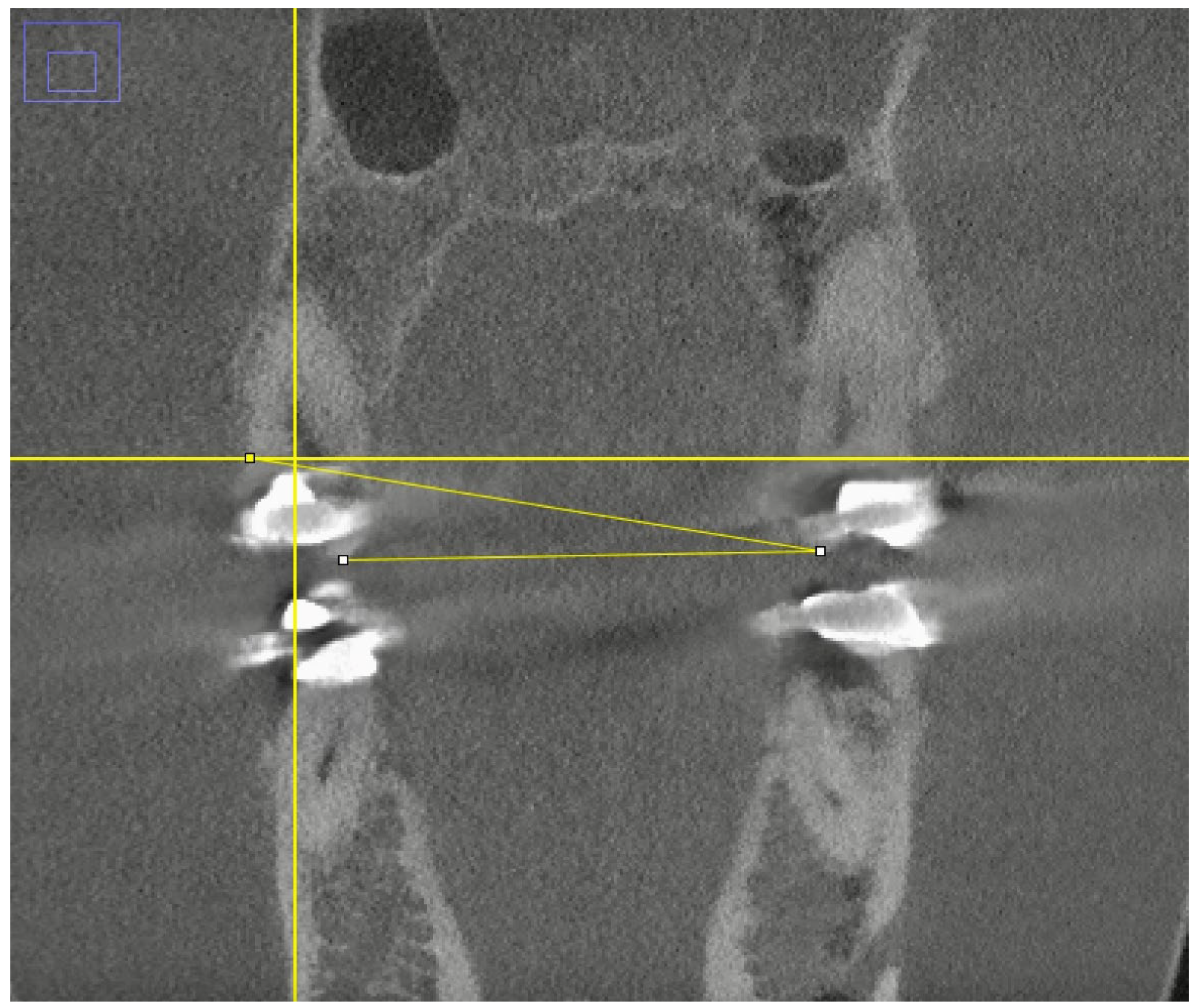
A dental radiographic phantom comprising a real human skull embedded in resin, featuring metallic restorations in all maxillary premolars and molars was used for this observational study. Specifically, the first quadrant contained three metallic crowns, while the remaining teeth had large amalgam restorations. To determine the head tilt angle required to project contralateral metallic restorations outside the primary beam path, an initial large FoV scan was acquired using an Axeos CBCT unit (Dentsply Sirona, Bensheim, Germany). Using this scan, the angle formed between the cusp tips of the maxillary premolars and molars and the contralateral alveolar crest was measured (Figure 1). As the calculated angles ranged from 8° to 12°, a definitive individual head tilt of 12°—encompassing the maximum measured value—was selected for all subsequent high-resolution image acquisitions.

2.1. Image Acquisition and Experimental Setup

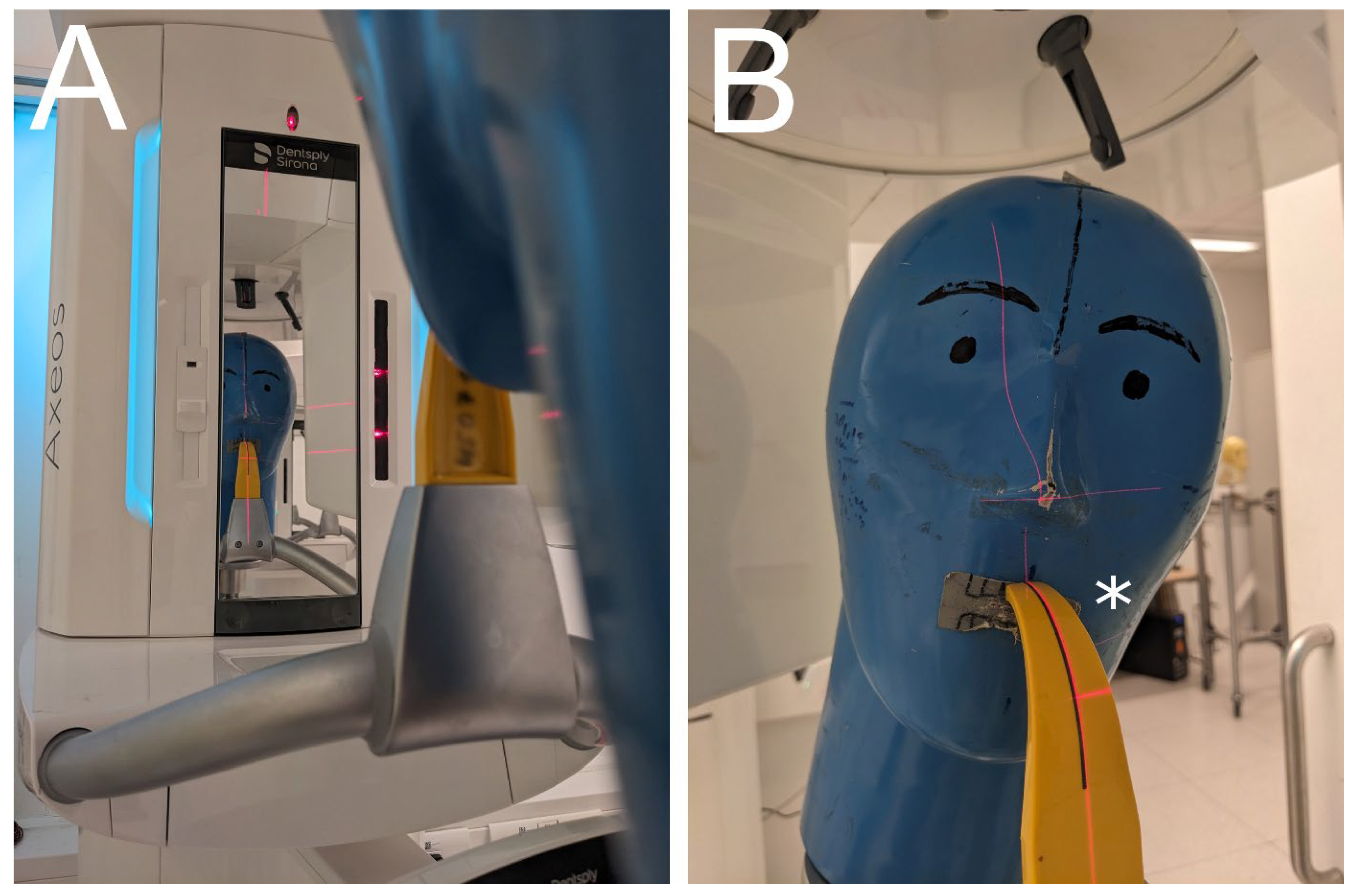
Small-FoV (5 × 5 cm) CBCT scans of the same phantom head were acquired using an Axeos (85 kV and 5 mA). Reconstruction used the manufacturer’s standard software pipeline with the integrated metal artefact reduction (MAR) option enabled (default setting); no additional post-processing was applied. The phantom head was mounted on a tripod and CBCTs of the maxillary premolar/molar region were taken with three different head positions. A baseline “no tilt” position (Figure 2A), ensuring the midsagittal plane was vertical and the occlusal plane was horizontal. Subsequently, two high-resolution, small-FoV CBCT scans were acquired using the determined 12° tilt. The phantom head was positioned at this angle in two opposing orientations: first, tilted toward the side containing the primary region of interest (ROI) (Figure 2B), and second, tilted away from it.

2.2. CBCT Preparation and Image Selection

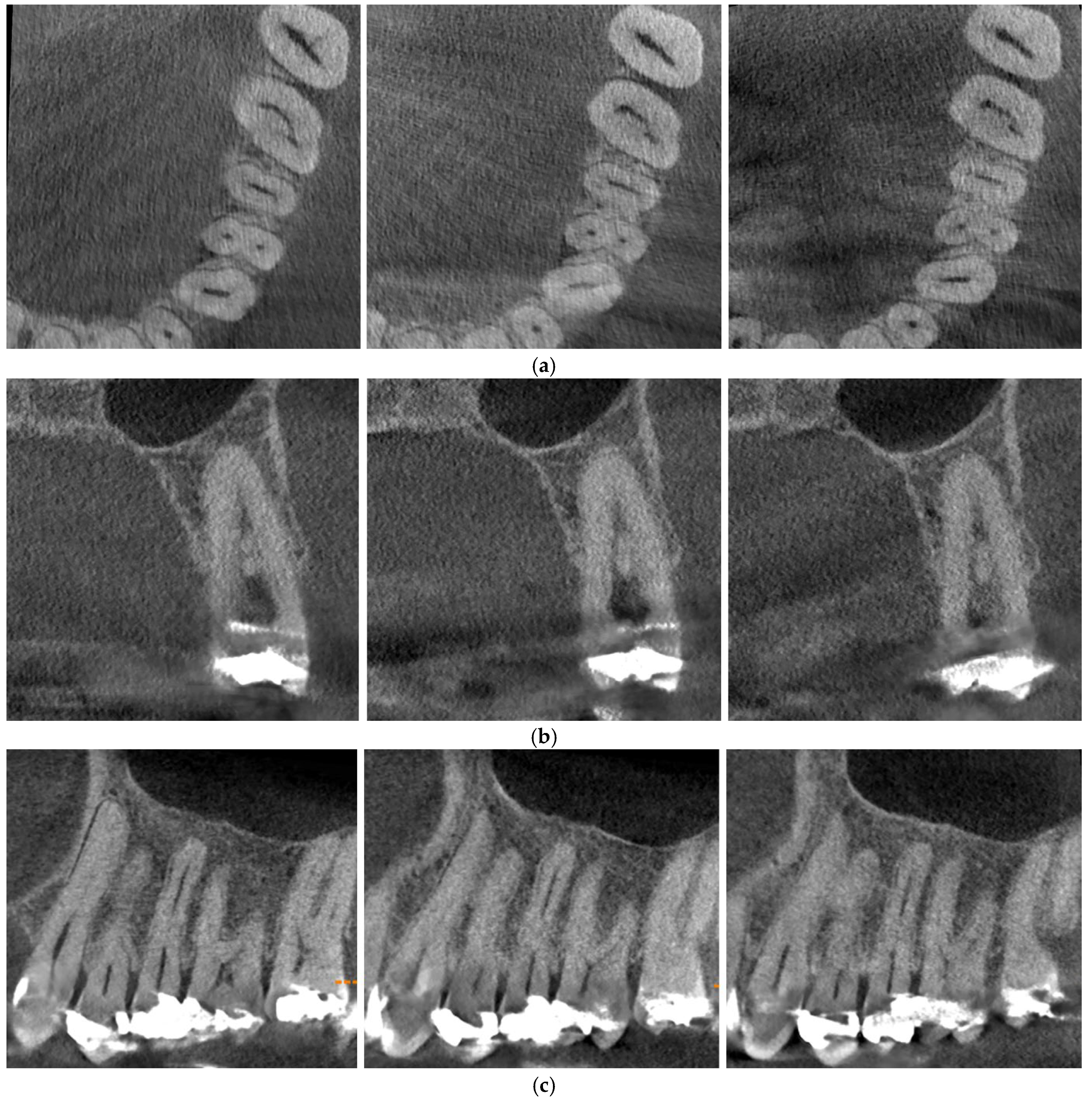
In a first step, the DICOM data of the two tilted scans were opened using SIDEXIS (version 4.3, DentsplySirona, Bensheim, Germany) and the phantom head position was corrected by adjusting the tilt and rotation. For this purpose, the coronal, sagittal and axial sectional images were aligned parallel to the horizontal and transverse axes. The alignment of patient position was helpful to ensure that all subsequent screenshots of the three different CBCTs would show identical planes. Within the small-FoV, three different ROIs were randomly selected for analysis. For each ROI, three screenshots were captured in identical axial, coronal, and sagittal planes (Figure 3a–c). In total, nine different CBCT sections were chosen for qualitative evaluation. Due to the small-FoV, the selection of different ROIs was limited. In the axial orientation, Screenshots were taken at three levels: a coronal section (pulp chamber or root canal orifice), the middle third of the root, and the apical section (apices). For the remaining two views, the selection was focused on single-rooted teeth that could be fully contained within a single plane.

2.3. Evaluation of Image Quality and Artifacts

The standard “no tilt” screenshots served as the reference for each view and the corresponding tilted datasets were compiled into a randomized evaluation portfolio (Figure 3). A panel of 50 experienced dentists, blinded to the tilt condition of each image, was calibrated on the assessment criteria, which focused on overall subjective image quality and the presence of common CBCT artifacts. Participants were recruited through a convenience sampling approach, utilizing the authors’ professional networks of clinical staff and postgraduate master’s students. Participation was voluntary and anonymized. For each of the three anatomical views (axial, longitudinal, cross-sectional), evaluators were presented with a randomized triad consisting of the reference “no tilt” image alongside the two tilted condition images. For each tilted image, they were asked to compare it directly to the reference “no tilt” image and select one of the following outcomes:
  • Better: The tilted image presented superior subjective image quality or fewer artifacts.
  • Tie: No perceptible difference in image quality or artifacts.
  • Worse: The tilted image presented inferior subjective image quality or more pronounced artifacts.

2.4. Data and Statistical Analysis

All responses were collected and anonymized. For each rater × ROI × evaluation parameter (subjective image quality, artifact severity), ratings (better, equal, worse) were mapped to +1/0/−1 and used to derive paired outcomes for correct versus wrong head tilt (correct better, wrong better, tie), stratified by anatomical plane. Outcomes are reported as counts of paired comparisons. Each plane × parameter row summarizes 150 paired comparisons (50 raters × 3 ROIs), yielding 900 paired comparisons overall (3 planes × 2 parameters × 150). Two-sided binomial sign tests were applied to non-tied pairs (ties excluded), with alpha = 0.05; p values are unadjusted. Analyses were implemented in Python version 3.9.10 using pandas/numpy/scipy and statsmodels. Inter-rater reliability was quantified with Fleiss’ κ for the 3-category ratings (better/equal/worse), computed separately for image quality and artefacts; uncertainty was assessed via a nonparametric bootstrap. To estimate the tilt effect while accounting for repeated ratings per rater and slide, we additionally fitted a rater-clustered generalized estimating equations (GEE) logistic regression with slide fixed effects; the outcome was defined as “better” (b) versus {equal, worse} and results are reported as odds ratios (ORs) with 95% confidence intervals. For plane-stratified sign tests, p-values were additionally checked under Benjamini–Hochberg false discovery rate control across the plane × endpoint tests.

3. Results

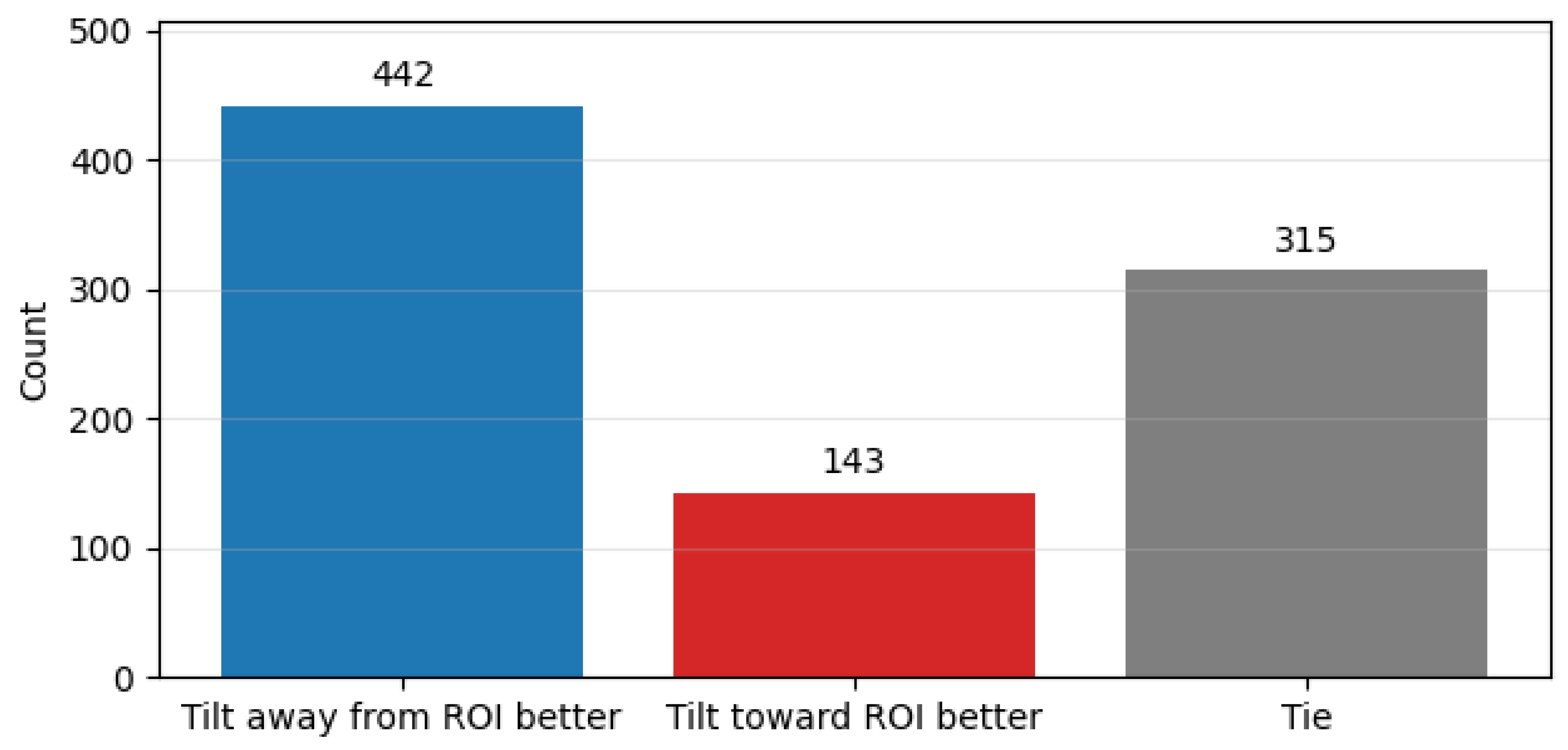
The evaluation was conducted by 50 dentists (24 female, 26 male) with a mean professional experience of 7.5 years. Overall, CBCT screenshots acquired with the hypothesized correct head tilt were more frequently rated as having better image quality than screenshots from both alternative protocols (no tilt, wrong tilt), as shown in Figure 4. When directly comparing correct versus wrong head tilt, ratings favored correct tilt in 442 of 585 non-tied paired comparisons (ties = 315 of 900 total paired comparisons), indicating a statistically significant difference (two-sided sign test, p < 0.001). The effect of head tilt was more pronounced for subjective image quality than for artifact severity. Across raters, 54.9% rated the correct head-tilt protocol as superior to both alternatives for image quality and 84.4% rated it as equal to or better than the alternatives; for artifact evaluation, the corresponding proportions were 43.3% and 83.3%. Plane-specific analyses (Table 1) showed the strongest differences in the longitudinal plane (quality: 97 vs. 15; artifacts: 64 vs. 19 [correct better vs. wrong better]), while cross-sectional artifacts did not reach statistical significance (p = 0.063). Inter-rater agreement was slight: Fleiss’ κ = 0.139 (95% bootstrap CI 0.070–0.195) for image quality and κ = 0.131 (0.068–0.180) for artefacts. In the rater-clustered GEE model adjusted for slide, correct tilt increased the odds of a “better” rating for image quality (OR = 4.16, 95% CI 3.12–5.56, p = 3.5 × 10⁻²²) and for artefact severity (OR = 2.87, 95% CI 1.93–4.26, p = 1.8 × 10⁻⁷).

4. Discussion

In our study we evaluated a single, maximally effective tilt angle (12°) based on preliminary CBCT measurements. The optimal angle may vary with individual patient anatomy, arch form, and the specific location and dimension of metallic restorations. The assessment was based on subjective ratings by experienced clinicians using standardized CBCT screenshots. This method was selected to prioritize a focused and efficient evaluation, as direct review and comparison of three full multiplanar reconstructions would have been significantly more complex. Such an approach would have introduced confounding variables related to participants’ proficiency with diagnostic software and general CBCT navigation. The use of static screenshots facilitated a rapid, controlled, and direct comparative assessment of the three acquisition protocols. The use of representative screenshots, however, introduces a potential selection bias. Although the selection of comparable axial planes remains relatively consistent following tilt correction, the precise localization of identical longitudinal and cross-sectional planes is inherently limited. Consequently, raters may have compared subtly different anatomical slices across protocols. This discrepancy in multiplanar alignment could explain the observed variation in artifact ratings between the different CBCT planes.
Other studies have already shown that deviations in head position during CBCT acquisition have a minimal—and likely clinically insignificant—impact on measurement accuracy and diagnosis. This finding consequently presents a viable opportunity to explore their utility for artifact reduction [18,19,20,21].
Lindfors et al. [22], for example, evaluated the effect of head positioning deviation from the horizontal plane by 20 degrees on image quality in two CBCT devices, using contrast-to-noise ratio (CNR) as a metric. Their study found that a backward head tilt yielded significantly higher mean CNR values and improved image quality in the mandibular region, irrespective of the field of view (FoV). However, as their phantom lacked dental restorations or metal components, the clinical impact of artifacts remains uncertain. In a clinical setting, a backward head tilt could reduce artifacts in the mandible by shifting anterior restorations (e.g., in premolars, canines, or incisors) out of the primary beam path. Conversely, for the maxilla, the same tilt would draw those restorations into the path, potentially degrading image quality in endodontically relevant areas of the molars.
Barros-Costa et al. [17] evaluated the influence of dental implants on artifact formation in CBCTs obtained with different spatial orientations, tube current levels, and metal artifact reduction (MAR) algorithm conditions. For their setup, they placed one dental implant and 2 tubes filled with a radiopaque solution in the posterior region of a mandible acquired CBCTs in 2 spatial orientations, a standard and a modified one. The modified spatial orientation was achieved by tilting the phantom head 90 degrees backward, aligning the tubes and dental implant parallel to the axial plane. With the modified orientation they observed enhances brightness and reduces noise in the regions adjacent to a dental with no further impact of MAR. The authors attributed this to the minimal artifacts generated in such scenarios, which presented little need for reduction. Although a specific 90 degrees backward head orientation may not be clinically practical due to patient discomfort, it reveals an important principle: modifying standard patient positioning in CBCT can significantly influence image quality. Conversely, our approach offers a clinically feasible alternative, as the required head tilt is likely adaptable in most CBCT devices. However, one limitation of our study is, that it was confined to the effects of standard dental restorations (fillings, crowns, bridges), which, due to their limited height, required only minor head tilt modifications. The influence of larger contralateral structures, such as dental implants or teeth with posts and root canal fillings—which would require a more substantial head tilt— and the influence on CBCTs without MAR algorithm was not investigated and should be addressed in future research.
An interesting observation was made by Mancini et al. [23], who investigated the influence of head angulation on effective radiation dose across three CBCT machines. They reported a dose reduction for small-FoV scans of the posterior mandible and anterior maxilla when using an increased anteroposterior head angulation (30° and 45°). Furthermore, when applying a lateral head tilt (0°, 20° towards the side of the ROI and 20° to the opposite direction), they observed lower effective doses for the posterior mandible with a 20° tilt away from the ROI. This direction of tilt aligns with the findings of our current study, which associated it with higher subjective image quality and fewer artifacts. The superiority of an individually adjusted head tilt over both the standard protocol and, more critically, over an incorrectly tilted position toward the ROI, underscores the necessity of ideal patient positioning for CBCT imaging. This is especially vital in endodontics, where high image quality and the precise detection of small anatomic structures are crucial for diagnosis and treatment planning.
Because ratings are subjective and agreement was only slight (κ ≈ 0.13), we interpret these results as rater-perceived differences rather than objective physical image-quality improvements. A plausible mechanism for occasional benefits under “wrong” tilt is that changing the relative geometry between metallic restorations and the region of interest can shift streaking/beam-hardening patterns away from diagnostically relevant structures; this effect is plane- and case-dependent. Limitations include the use of a single phantom dataset, device- and setting-specific reconstruction (integrated MAR), and the absence of quantitative metrics (e.g., grayscale variance, signal-to-noise ratio, contrast-to-noise ratio, voxel intensity dispersion); future work should combine rater assessments with objective measures in larger multi-device datasets. The results of this present study should be interpreted within the context of its limitations. First, the use of a phantom model, may not fully replicate the beam attenuation and scatter encountered in clinical practice. While a phantom model provides perfect standardization and repeatability, it cannot replicate potential patient discomfort or compensatory movements induced by the novel head tilt maneuver. Second, the use of a single CBCT device and the focus on the maxillary premolar/molar region limits the generalizability of our findings, as image quality and artifact expression can vary between different anatomical regions, scanners and acquisition protocols.

5. Conclusions

The findings demonstrate that an individual head tilt during image acquisition significantly improves subjective image quality and reduces artifact interference in the ROI, consistent with our a priori expectation. These findings may also inform the future development of patient positioning aids designed to facilitate precise and reproducible head angulation during small-FoV CBCT scans. As a pragmatic chairside takeaway, applying the recommended head tilt may be most relevant in cases where multiple contralateral metallic restorations are visible on existing panoramic radiographs or have been previously diagnosed. The degree of head tilt should be chosen based on the width of the jaw and the dimensions of the metallic restoration or object. When applying such an approach, one should keep in mind that in the mandibular premolar or molar region, a reverse head tilt toward the ROI may be necessary.

Author Contributions

Conceptualization, D.N.E., P.J.P. and J.P.T.; methodology, J.P.T.; software, D.N.E.; validation, P.J.P., D.T. and J.P.T.; formal analysis, D.N.E. and S.F.; investigation, D.N.E. and J.P.T.; resources, M.M. and D.T.; data curation, J.P.T. and S.F.; writing—original draft preparation, D.N.E. and J.P.T.; writing—review and editing, M.M., D.T., S.F. and P.J.P.; visualization, J.P.T.; supervision, D.T. and J.P.T.; project administration, D.T. and J.P.T. All authors have read and agreed to the published version of the manuscript.

Funding

This research received no external funding.

Institutional Review Board Statement

The study was conducted in accordance with the Declaration of Helsinki, and approved by the Institutional Ethics Committee of the Danube Private University (DPU-EK/145; Approved on 7 October 2025).

Informed Consent Statement

Informed consent was obtained from all subjects involved in the study.

Data Availability Statement

The raw data supporting the conclusions of this article will be made available by the authors upon request.

Conflicts of Interest

The authors declare no conflicts of interest.

References

  1. Patel, S.; Durack, C.; Abella, F.; Shemesh, H.; Roig, M.; Lemberg, K. Cone beam computed tomography in Endodontics—A review. Int. Endod. J. 2015, 48, 3–15. [Google Scholar]
  2. Setzer, F.C.; Lee, S.M. Radiology in Endodontics. Dent. Clin. N. Am. 2021, 65, 475–486. [Google Scholar]
  3. Chogle, S.; Zuaitar, M.; Sarkis, R.; Saadoun, M.; Mecham, A.; Zhao, Y. The Recommendation of Cone-beam Computed Tomography and Its Effect on Endodontic Diagnosis and Treatment Planning. J. Endod. 2020, 46, 162–168. [Google Scholar] [CrossRef]
  4. Tay, K.X.; Lim, L.Z.; Goh, B.K.C.; Yu, V.S.H. Influence of cone beam computed tomography on endodontic treatment planning: A systematic review. J. Dent. 2022, 127, 104353. [Google Scholar] [CrossRef] [PubMed]
  5. Chan, F.; Brown, L.F.; Parashos, P. CBCT in contemporary endodontics. Aust. Dent. J. 2023, 68, S39–S55. [Google Scholar] [CrossRef] [PubMed]
  6. Grün, P.; Hatamikia, S.; Jadadic, R.; Gjergjindreaj, A.; Jansen, L.; Pfaffeneder-Mantai, F.; Fitzek, S.; Mostegel, M.; Choi, K.-E.A.; Turhani, D. Volumetric measurements from manually drawn segmentations of periapical lesions in cone-beam computed tomography scans correlate with the inflammatory activity classified using the dental apical inflammation score. Adv. Oral Maxillofac. Surg. 2025, 17, 100510. [Google Scholar]
  7. Patel, S.; Brown, J.; Semper, M.; Abella, F.; Mannocci, F. European Society of Endodontology position statement: Use of cone beam computed tomography in Endodontics: European Society of Endodontology (ESE) developed by. Int. Endod. J. 2019, 52, 1675–1678. [Google Scholar]
  8. Schulze, R.; Heil, U.; Gross, D.; Bruellmann, D.D.; Dranischnikow, E.; Schwanecke, U.; Schoemer, E. Artefacts in CBCT: A review. Dentomaxillofac. Radiol. 2011, 40, 265–273. [Google Scholar]
  9. Weber, M.T.; Stratz, N.; Fleiner, J.; Schulze, D.; Hannig, C. Possibilities and limits of imaging endodontic structures with CBCT. Swiss Dent. J. 2015, 125, 293–311. [Google Scholar] [CrossRef]
  10. Soltani, P.; Moaddabi, A.; Mehdizadeh, M.; Bateni, M.R.; Naghdi, S.; Cernera, M.; Mirrashidi, F.; Azimipour, M.M.; Spagnuolo, G.; Valletta, A. Effect of a metal artifact reduction algorithm on cone-beam computed tomography scans of titanium and zirconia implants within and outside the field of view. Imaging Sci. Dent. 2024, 54, 313–318. [Google Scholar] [CrossRef]
  11. Pinto, J.C.; de Faria Vasconcelos, K.; Leite, A.F.; Wanderley, V.A.; Pauwels, R.; Oliveira, M.L.; Jacobs, R.; Tanomaru-Filho, M. Image quality for visualization of cracks and fine endodontic structures using 10 CBCT devices with various scanning protocols and artefact conditions. Sci. Rep. 2023, 13, 4001. [Google Scholar] [CrossRef] [PubMed]
  12. Pauwels, R.; Stamatakis, H.; Bosmans, H.; Bogaerts, R.; Jacobs, R.; Horner, K.; Tsiklakis, K. Quantification of metal artifacts on cone beam computed tomography images. Clin. Oral Implant. Res. 2013, 24, 94–99. [Google Scholar] [CrossRef] [PubMed]
  13. Gurjar, B.S.; Sharma, V.; Paliwal, J.; Kalla, R.; Meena, K.K.; Tahir, M. The role of implants and implant prostheses on the accuracy and artifacts of cone-beam computed tomography: An in-vitro study. Sci. Rep. 2024, 14, 704. [Google Scholar] [CrossRef] [PubMed]
  14. Vasconcelos, K.F.; Codari, M.; Queiroz, P.M.; Nicolielo, L.F.P.; Freitas, D.Q.; Sforza, C.; Jacobs, R.; Haiter-Neto, F. The performance of metal artifact reduction algorithms in cone beam computed tomography images considering the effects of materials, metal positions, and fields of view. Oral Surg. Oral Med. Oral Pathol. Oral Radiol. 2019, 127, 71–76. [Google Scholar] [CrossRef]
  15. de Faria Vasconcelos, K.; Queiroz, P.M.; Codari, M.; Pinheiro Nicolielo, L.F.; Freitas, D.Q.; Jacobs, R.; Haiter-Neto, F. A quantitative analysis of metal artifact reduction algorithm performance in volume correction with 3 CBCT devices. Oral Surg. Oral Med. Oral Pathol. Oral Radiol. 2020, 130, 328–335. [Google Scholar] [CrossRef]
  16. Yashayaeva, A.; MacDonald, R.L.; Robar, J.; Cherpak, A. Evaluation of a Metal Artifact Reduction Algorithm for Image Reconstruction on a Novel CBCT Platform. J. Appl. Clin. Med. Phys. 2024, 25, e14516. [Google Scholar] [CrossRef]
  17. Barros-Costa, M.; Barros-Candido, J.R.; Sampaio-Oliveira, M.; Freitas, D.Q.; Sverzut, A.T.; Oliveira, M.L. Impact of the spatial orientation of the patient’s head, metal artifact reduction, and tube current on cone-beam computed tomography artifact expression adjacent to a dental implant: A laboratory study using a simulated surgical guide. Imaging Sci. Dent. 2024, 54, 191–199. [Google Scholar] [CrossRef]
  18. Koch, G.K.; Hamilton, A.; Wang, K.; Herschdorfer, L.; Lee, K.H.; Gallucci, G.O.; Friedland, B. Dimensional accuracy of cone beam CT with varying angulation of the jaw to the X-ray beam. Dentomaxillofac. Radiol. 2019, 48, 20180319. [Google Scholar] [CrossRef]
  19. Stamatakis, H.C.; Steegman, R.; Dusseldorp, J.; Ren, Y. Head positioning in a cone beam computed tomography unit and the effect on accuracy of the three-dimensional surface mode. Eur. J. Oral Sci. 2019, 127, 72–80. [Google Scholar] [CrossRef]
  20. van Eijnatten, M.; Wolff, J.; Pauwels, R.; Karhu, K.; Hietanen, A.; der Sarkissian, H.; Koivisto, J.H. Influence of head positioning during cone-beam CT imaging on the accuracy of virtual 3D models. Dentomaxillofac. Radiol. 2022, 51, 20220104. [Google Scholar] [CrossRef]
  21. El Bachaoui, S.; Verhelst, P.J.; de Faria Vasconcelos, K.; Shaheen, E.; Coucke, W.; Swennen, G.; Jacobs, R.; Politis, C. The impact of CBCT-head tilting on 3D condylar segmentation reproducibility. Dentomaxillofac. Radiol. 2023, 52, 20230072. [Google Scholar] [CrossRef]
  22. Lindfors, N.; Lund, H.; Johansson, H.; Ekestubbe, A. Influence of patient position and other inherent factors on image quality in two different cone beam computed tomography (CBCT) devices. Eur. J. Radiol. Open 2017, 4, 132–137. [Google Scholar] [CrossRef]
  23. Mancini, A.X.M.; Carmozini, G.A.; Inácio, T.M.; Réa, M.T.; Viccari, C.; Brasil, D.M.; Oliveira-Santos, C. Variations in head tilt during the acquisition of cone beam computed tomography scans and their effects on effective radiation dose. Dentomaxillofac. Radiol. 2024, 53, 566–572. [Google Scholar] [CrossRef]
Figure 1. The individual necessary head tilt was determined by measuring the angles formed between the cusp tips of the maxillary premolars and molars and the contralateral alveolar crest. This individual head tilt was determined because the phantom head included only metallic restorations (amalgam restorations, crowns) and no root canal treatments, posts or implants.
Oral 06 00029 g001
Figure 2. CBCT acquisitions of the phantom head using (A) the standard protocol and (B) an individual head tilt toward the marked region of interest (ROI).
Oral 06 00029 g002
Figure 3. (ac). The figures show three representative example screenshots from the evaluation (out of nine total) in axial (a), coronal (b) and sagittal (c) views. Within the interface, the reference (“no tilt”) image was fixed in the center column. Raters, who were blinded to the randomization, compared it to two neighboring images: one with a tilt towards the ROI and one with a tilt to the opposite direction, randomly positioned on the left or right. In this specific example, the tilt away from the ROI is displayed on the left and the other tilt protocol on the right.
Oral 06 00029 g003
Figure 4. Figure presenting the overall counts for all CBCT planes, independent of evaluation parameter (image quality, artifacts).
Oral 06 00029 g004
Table 1. Results of the rater evaluation comparing correct versus wrong head-tilt acquisitions, stratified by anatomical plane and evaluation parameter (subjective image quality, artifact severity). Counts indicate the number of paired comparisons in which the correct-tilt image was rated better, the wrong-tilt image was rated better, or ratings were tied. Each row summarizes 150 paired comparisons (50 raters × 3 ROIs). Sign-test p values are from two-sided binomial sign tests applied to non-tied pairs (ties excluded); p values are unadjusted. FDR-adjusted inference (Benjamini–Hochberg across the six plane × endpoint tests) was unchanged.
PlaneParameterCorrect BetterWrong BetterTiesSign-Test p
AxialQuality822444<0.001
AxialArtifacts802149<0.001
LongitudinalQuality971538<0.001
LongitudinalArtifacts641967<0.001
Cross-sectionalQuality683151<0.001
Cross-sectionalArtifacts5133660.063
Disclaimer/Publisher’s Note: The statements, opinions and data contained in all publications are solely those of the individual author(s) and contributor(s) and not of MDPI and/or the editor(s). MDPI and/or the editor(s) disclaim responsibility for any injury to people or property resulting from any ideas, methods, instructions or products referred to in the content.