1. Introduction
In maxillofacial prosthodontics, impression-making is often complicated by anatomical and functional limitations. Large or irregular defects, restricted mouth opening due to surgery or radiotherapy-induced scar contracture, altered anatomy, and risks related to airway obstruction can make conventional impression (CI) techniques difficult or impractical [
1,
2]. These challenges are particularly pronounced in mandibulectomy patients, where the extent of hard- and soft-tissue loss and reconstructive procedures introduce substantial morphological variability that may affect impression accuracy and clinical feasibility [
3,
4,
5].
In this context, intraoral scanners (IOSs) have been introduced as a digital alternative to CI techniques, with well-established advantages in dental practice [
6,
7,
8,
9,
10,
11,
12]. IOS technology has also demonstrated acceptable accuracy and precision in various dental and prosthodontic applications [
13,
14]. Several studies have investigated the accuracy of IOSs in capturing dentulous and edentulous jaws without defects [
15,
16,
17,
18,
19,
20,
21], as well as intraoral and extraoral maxillofacial defects [
3,
4,
22,
23].
Among maxillofacial defects, mandibulectomy presents unique challenges in terms of digital scanning and prosthetic rehabilitation [
3,
4,
5]. In such cases, scanning accuracy may be affected by unstable mucosal tissues, the need for soft tissue stretching to ensure adequate visualization of the defect, salivary drooling, trismus, and difficulties in achieving continuous surface capture between the defect area and the remaining dentition [
4,
24]. Additionally, the defect extent, surface characteristics, and variations in surgical reconstruction techniques (e.g., skin grafts) introduce additional challenges that can influence scanning accuracy. Despite these challenges, few studies have investigated IOS technology as a means of digitizing mandibulectomy defects [
3,
4]. However, these studies primarily involved commercially fabricated models rather than real patient data. Consequently, they may not adequately represent the wide morphological variability observed in actual mandibulectomy patients. The present study addresses this gap by using patient-derived resin replicas of reconstructed defects and by directly comparing partially and completely edentulous mandibulectomy models using the same IOS system. Therefore, the aim of this in vitro study was to evaluate the trueness of DIs made with an IOS compared with CIs in terms of digitizing mandibulectomy defects in both completely and partially edentulous models. The null hypothesis is that there are no differences in the impression trueness of mandibulectomy defect models according to impression technique or oral condition.
2. Materials and Methods
Dental models from 20 mandibulectomy patients treated at the Clinic for Maxillofacial Prosthetics, Institute of Science Tokyo, were included in this study. These models were obtained from conventional impressions made during routine clinical prosthodontic treatment and poured in dental stone. The models were archived and retrospectively selected for inclusion in the present study using simple randomization, in which each model was assigned a number and selection was performed using a random number generator. Ten of the selected models were completely edentulous (CE) and were classified according to the Cantor and Curtis classification system [
25]. Class I (radical mandibular alveolectomy, n = 6), Class IV (lateral bone and split-thickness skin graft, n = 1), and Class V (anterior bone and split-thickness skin graft, n = 3). The remaining 10 models were partially edentulous (PE) and were categorized using the Brown classification [
26]. Class I (lateral defect not including the ipsilateral canine or condyle, n = 3), Class II (hemimandibulectomy including the ipsilateral but not the contralateral canine or condyle, n = 4), and Class IV (extensive anterior mandibulectomy including both canines and one or both angles, n = 3). All models were in good condition, with minimal air bubbles, particularly in critical areas such as the ridge and teeth, ensuring generally acceptable surface details. Fourteen of the 20 models were reconstructed using split-thickness skin grafts at the defect locations.
2.1. Reference Data
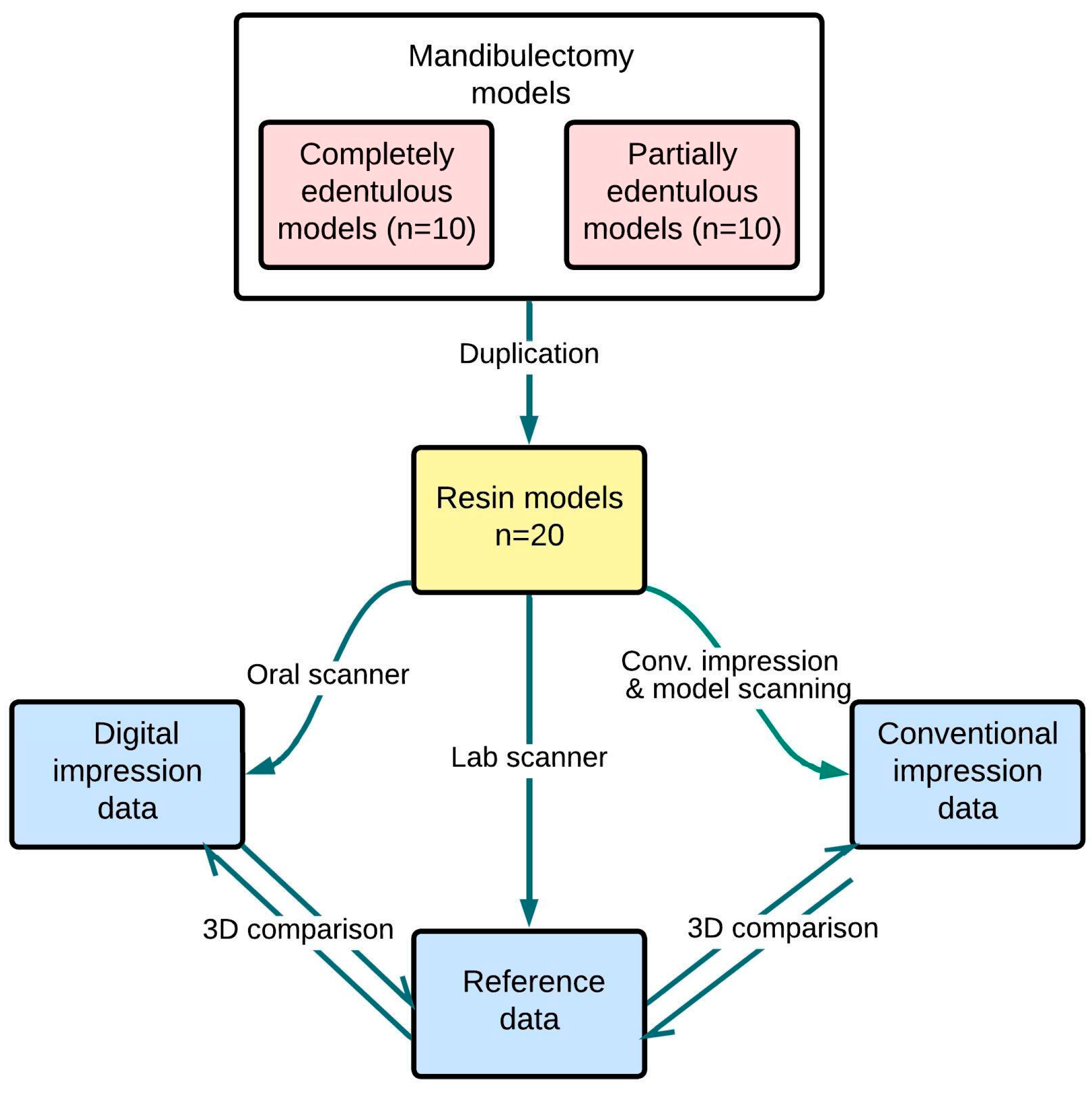
To create standardized reference data and to avoid repeated handling of the original patient models, the mandibular models were duplicated using polyurethane resin (Wave Resin Cast EX; Wave, Tokyo, Japan). The original stone casts were used to fabricate negative molds, into which the polyurethane resin was poured and allowed to polymerize according to the manufacturer’s instructions. After polymerization, the duplicated resin models were retrieved and inspected for surface integrity before use. The duplicated resin models were used for all subsequent conventional and digital impression procedures and were digitized with a desktop scanner (i/s/can; Organical CAD/CAM, Berlin, Germany) with an error of 0.001 mm. These standard steps in model preparation and scanning have their own small error contribution, which is assumed to be small and similar across groups. The scanned data were exported as Standard Tessellation Language (STL) files and used as reference datasets to assess the trueness of the test groups (
Figure 1).
2.2. Conventional Impressions Followed by Digital Scanning
For the conventional method, the impressions of the resin models were obtained in custom trays (Ostron 100; GC Europa, Leuven, Belgium), using impression compound (ISO Functional; GC Europa) and silicone impression material (Exafine Regular and Injection; GC Japan, Tokyo, Japan). The working model was fabricated using Type 3 stone (Pico-crema soft; Picodent, Wipperfürth, Germany), and a single scan was obtained using the desktop scanner (i/s/can; Organical CAD/CAM). The procedures described above were repeated for each of the 20 models and exported as STL files to obtain CI data (n = 20).
The obtained data contained two groups based on oral condition: STL files of CE mandibulectomy models (n = 10) obtained by CI-making followed by scanning using a laboratory scanner (CI-CE, n = 10) and STL files of PE mandibulectomy models obtained by CI followed by scanning with a laboratory scanner (CI-PE, n = 10).
2.3. Digital Impression Using IOS
Each resin model was assigned to one study condition (CE or PE), and a single digital scan was obtained per model using IOS (True Definition [TD] Scanner; 3M ESPE, Saint Paul, MN, USA) and exported as STL files in order to obtain DI data (n = 20). To enable digitization with the TD system, the surfaces were slightly dusted with titanium dioxide and zirconium oxide powder (3M ESPE Lava Powder; 3M ESPE) according to the manufacturer’s instructions. For the PE models, the remaining teeth were first scanned at the occlusal surface, followed by the lingual surfaces, and proceeding to buccal surfaces. Finally, the defect area was scanned in a zigzag motion [
3]. This was repeated for each of the 10 PE models, and the data were exported as STL files in order to obtain the DI-PE group (n = 10). For the CE models, scanning started along the ridge crest at the non-defect area, followed by a zigzag motion along the defect, proceeding to the lingual slope and vestibule, and finally along the buccal slope and vestibule. This was repeated for each of the 10 CE models, and the data were exported as STL files in order to obtain the DI-CE group (n = 10). All scans were conducted by the same operator at an average room temperature of 22.1 °C ± 0.89 °C, an average relative air humidity of 43.8% ± 24.8%, and clinical ambient light conditions.
2.4. Data Matching and Analysis
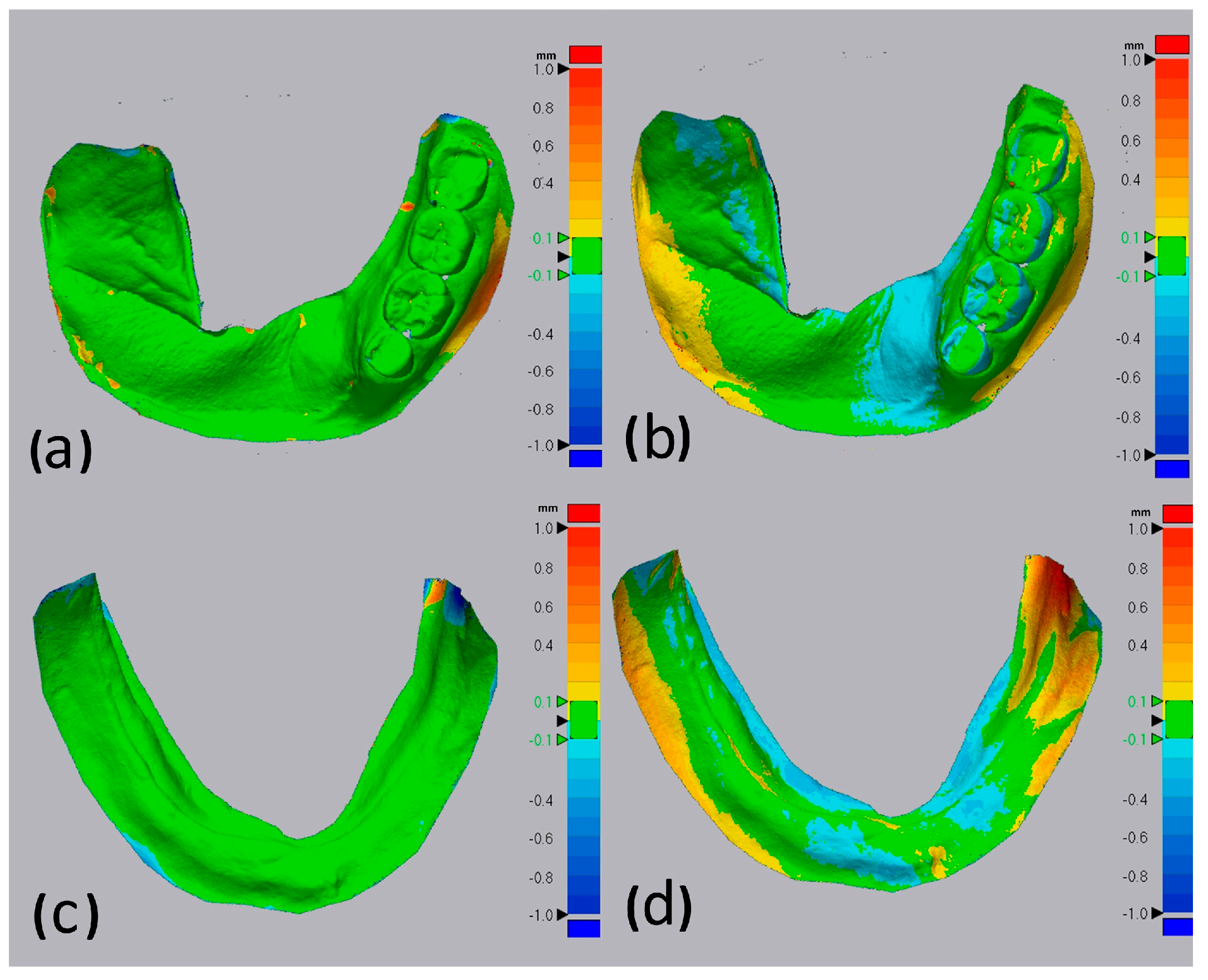
The acquired datasets were analyzed using 3D inspection and metrology software (Geomagic Control X v20.0; 3D Systems Inc., Rock Hill, SC, USA). After the removal of artifacts, datasets were cropped to be proximal to the vestibule. The two different datasets were superimposed on corresponding reference scans and a deviation analysis was performed with the best-fit method in order to calculate trueness values (
Figure 2) [
27]. Trueness was defined as the closeness of agreement between the test scan and the reference model, expressed as the mean absolute deviation (in µm) following 3D superimposition [
27].
Figure 1 shows the workflow of the present study and the alignment procedures used to obtain the experimental groups.
2.5. Sample Size Calculation
The sample size was calculated using G*Power software (ver. 3.1.9.4, Heinrich Heine University Düsseldorf, Düsseldorf, Germany) based on a repeated-measures design because each model was subjected to both DI and CI. A large effect size (Cohen’s f = 0.4) was chosen to reflect a conservative estimate of clinically meaningful differences between impression techniques. The significance level was set at α = 0.05, power at 0.80, and the correlation between repeated measures was estimated as 0.5. Based on these parameters, the required sample size was determined to be 20 models. To enable subgroup comparisons (CI-PE, CI-CE, DI-PE, and DI-CE), a sample size of 10 per subgroup was set to provide adequate power (>80%) to detect large effects (Cohen’s f ≥ 0.4) at a 5% significance level.
2.6. Statistical Analyses
Mean absolute 3D deviations were obtained and statistically analyzed for trueness. For descriptive analysis, the mean, median, and standard deviation were computed. Furthermore, boxplots were used for the graphical presentation of the data. A linear mixed-effects model was used to assess differences in accuracy between DI and CI, accounting for variation between dentulous and edentulous conditions. The impression method and condition were included as fixed effects, and the sample as a random effect. Statistical significance was set at p < 0.05. All statistical analyses were performed using STATA version 15.1 (StataCorp, College Station, TX, USA).
3. Results
Figure 2 shows the typical deviation pattern between each of the test groups and the reference scan. In the visual analysis, greater deviations were evident for DI-CE in the posterior and lateral parts of the defect and were distributed laterally and along the resection margin in DI-PE (
Figure 2). The descriptive statistics for the evaluated conditions (DI versus CI) in the edentulous and dentulous models are summarized in
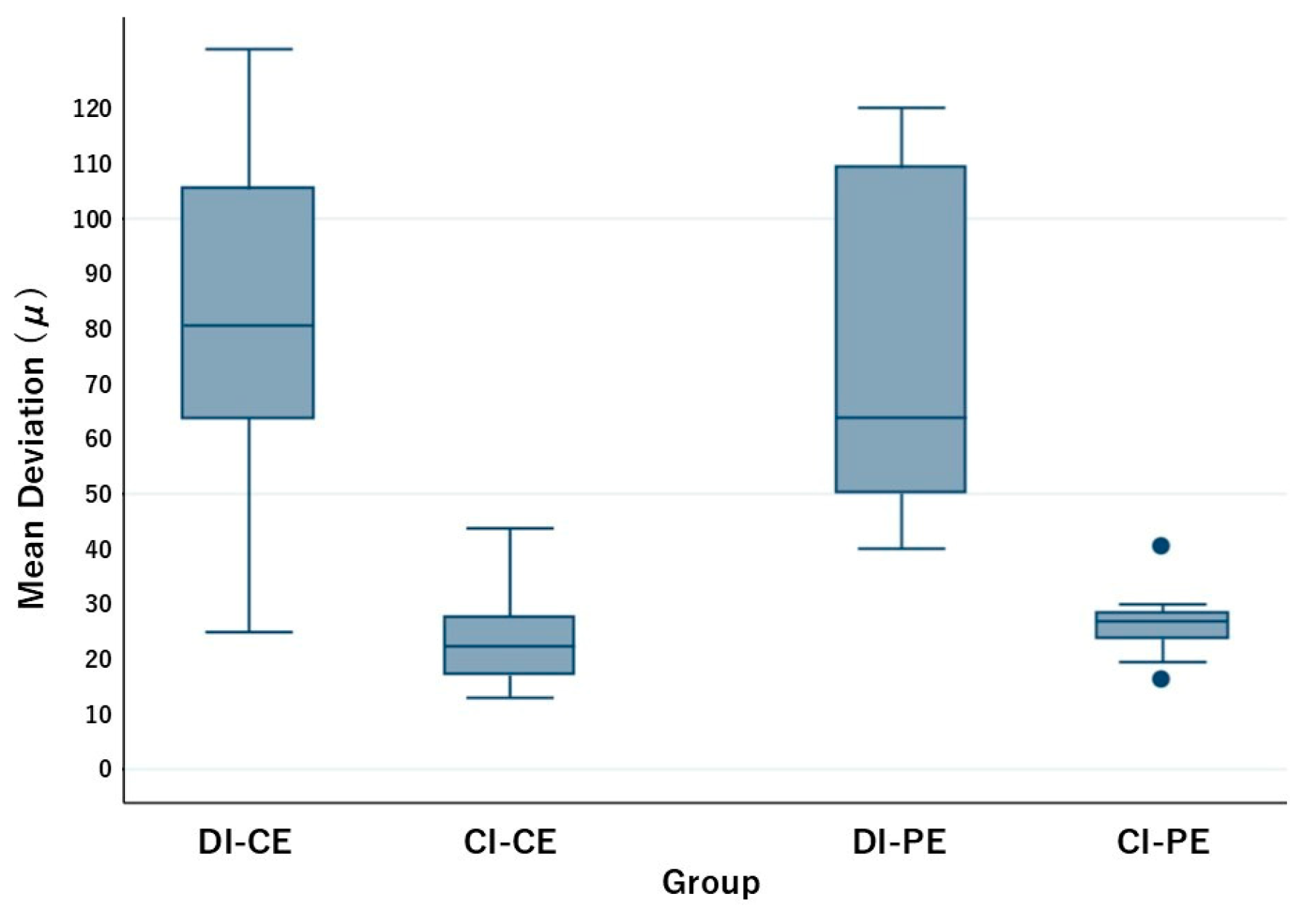
Table 1. The mean deviations ± standard deviations (in µm) in CI-PE, CI-CE, DI-PE, and DI-CE were 26.49 ± 6.39, 23.10 ± 8.94, 76.64 ± 31.75, and 80.93 ± 33.21, respectively. The mean discrepancy was higher for the DI (78.78 ± 31.69 µm) compared with the CI (25.24 ± 7.67 µm) (
Figure 3). The range of discrepancies was also wider in the digital group (24.90–130.80 µm) than in the conventional group (12.95–43.75 µm) (
Table 1,
Figure 3).
Digital impressions showed higher mean discrepancies and greater variability in both dentulous and edentulous models compared with CIs, with the highest discrepancy observed in the edentulous digital group (
Table 1).
The mixed-effects model confirmed that the impression technique significantly influenced trueness (p < 0.001), with CIs yielding lower discrepancies. DIs showed significantly lower trueness than CIs, with a mean deviation difference of 54 µm (β = −54 µm; 95% CI: −68 to −39 µm; p < 0.001). However, no significant difference in trueness was found between partially and completely edentulous models (β = −0.895 µm; 95% CI: −15.5 to 13.7 µm; p = 0.904). Although an interaction term between impression technique and oral condition could be considered, oral condition had no significant main effect on trueness, and descriptive differences between groups indicated that the effect of technique was similar for dentulous and edentulous models. Therefore, the main-effects model was considered appropriate.
4. Discussion
This study compared the trueness of DIs and CIs of mandibulectomy defect models and demonstrated that the impression technique significantly influenced trueness, whereas the oral condition did not. CIs showed more consistent surface reproduction, while DIs exhibited greater variability across both partially and completely edentulous models. These findings indicate that, in the context of mandibulectomy defects, the choice of impression technique plays a more critical role in determining trueness than the presence or absence of remaining teeth. Accordingly, the null hypothesis was partially rejected.
The findings of this study are in agreement with those of Hattori et al. [
3], who evaluated the trueness of digital and CIs on commercial epoxy resin models simulating maxillectomy and mandibulectomy defects. In their study, five repeated scans were performed per model, with data combined across both defect types. They reported significantly lower trueness for DIs compared with CIs (48.38 ± 16.55 µm), with substantial variation among scanners: Omnicam (97.20 ± 97.52 µm) and TD (96.97 ± 60.21 µm), while TRIOS 3 performed closest to the conventional method (43.30 ± 9.99 µm). In contrast, the present study, which utilized TD as the sole scanner, found lower deviations for both techniques, with trueness values of 25.24 ± 7.67 µm for CIs and 78.78 ± 31.69 µm for DIs. Although Hattori et al. [
3] worked with standardized commercial models featuring artificial defects, the present study used patient-derived resin replicas, which better reflected post-surgical anatomical variations, including flap reconstructions. The presence of skin texture in the patient-derived resin models, unlike the smooth and idealized surfaces of commercial resin models used in Hattori et al.’s study [
3], may have provided additional reference points for the scanner and improved the scanning accuracy. Alternatively, the lower deviations for the TD scanner in the present study (78.78 µm) compared with those reported by Hattori et al. [
3] (96.97 µm) may not stem from these model differences but instead reflect methodological variations. Specifically, Hattori et al. [
3] reported combined trueness values for TD across both maxillectomy and mandibulectomy models, potentially inflating overall deviations. Powder application for the TD scanner, required in both studies, introduces an unquantified variable whose interaction with polyurethane vs. epoxy surfaces may uniquely affect reflectivity.
The deviations observed in the present study were also lower than those reported in some investigations involving the edentulous mandible without defects [
16]. Meanwhile, the presence of defects in dentulous mandibulectomy models appeared to reduce trueness compared with fully dentate arches [
15,
17]. This suggests that although defect surfaces may introduce additional reference features for image stitching, disruption of continuous anatomical landmarks—particularly in dentulous arches—can negatively affect scan accuracy.
Gao et al. [
4] demonstrated that IOSs can achieve clinically acceptable accuracy when digitizing dentulous mandibulectomy models under simulated trismus conditions. However, direct comparison with the present study is limited due to methodological differences, including the use of a single commercial model, simulated soft tissue, restricted mouth openings, repeated scans per condition, and a powder-free scanner system. The unrestricted-access scanning setup in our study presents an idealized condition that likely represents a ‘best-case’ scenario for scanner performance, potentially overestimating clinical feasibility where access is likely restricted.
From a clinical perspective, all observed deviations remained within previously reported acceptance thresholds, for prosthodontic applications (300 µm in 99.5% of the model scans) [
4,
15,
18,
19]. Although reduced trueness may influence prosthesis fit, adjustment requirements, and fabrication accuracy, the magnitude of deviation observed in this study is unlikely to compromise clinical outcomes when appropriate design and verification steps are applied. Future studies incorporating larger datasets and more diverse defect morphologies and reconstructive conditions would further strengthen the external validity of these findings.
The selection of the TD scanner was based on its extensive clinical use at our institution, global commercial availability during the study period, and its wavefront sampling technology, which has historically demonstrated high trueness in full-arch scanning [
15]. Moreover, the TD scanner has one of the smallest wand tips among IOSs of its generation, which enhances maneuverability and facilitates access to mandibular defect sites—an important advantage for mandibulectomy patients, who often present with trismus [
4]. Additionally, IOSs with powder-coating functionality, such as TD, showed higher accuracy than those without, even with excessive coating by minimizing light scattering and improving data capture [
21]. In the present study, a thin, uniform layer of scanning powder was applied to the model surfaces to optimize reflectivity and ensure consistent data acquisition, while avoiding potential artifacts that could result from uneven or excessive powder application. Modern powder-free IOSs offer advantages such as improved patient comfort and the elimination of intraoral powder and aerosol concerns; therefore, future studies comparing powder-based and powder-free IOSs across different scanning technologies may further clarify their relative performance in mandibulectomy defects.
The limitations of this study include the in vitro setting, which is more controlled compared with in vivo oral environments having saliva, flexible tissue, moisture from respiration, and restricted mouth opening. The surface reflection, color, and texture differ from those of oral tissues. Factors such as patient movement and compliance were not simulated but can be expected to make the use of IOSs more challenging in the clinical setting. Nevertheless, this controlled design was intentionally adopted to isolate the influence of the impression technique itself on trueness, independent of patient-related variables, and future studies should include in vivo evaluations to validate these findings under clinical conditions. Moreover, workflow efficiency—including scanning time, ease of use, and patient comfort—should be assessed in future studies. Additionally, multiple scanners should be compared, and greater patient variability should be incorporated to further validate digital scanning in mandibulectomy patients. In particular, comparative studies evaluating different scanning technologies—such as confocal microscopy, active triangulation, and video-based IOSs—would offer broader insights into the applicability of digital impressions for mandibulectomy defects.
Although DIs offer advantages in terms of efficiency and workflow integration, their limitations in accuracy for mandibulectomy defect models must be considered. Future research should focus on refining scanning techniques, improving software algorithms for defect surface reconstruction, and exploring hybrid approaches that integrate both digital and conventional methods in order to optimize accuracy and reproducibility.



 ,
,