Article

Pre–Post Changes in Dental Knowledge, Attitudes, Skills, and Oral Hygiene Behaviors After a Five-Week Community Health Worker Intervention


1
School of Public Health, San Diego State University (SDSU), San Diego, CA 92182, USA
2
Institute for Behavioral and Community Health (IBACH), San Diego Prevention Research Center (SDPRC), San Diego, CA 92123, USA
3
Vista Community Clinic (VCC), Vista, CA 92081, USA
4
City of Encinitas, Parks and Recreation Department, Encinitas, CA 92024, USA
5
National Latino Research Center (NLRC), San Marcos, CA 92078, USA
*
Author to whom correspondence should be addressed.
Submission received: 1 December 2025 / Revised: 3 March 2026 / Accepted: 6 March 2026 / Published: 11 March 2026

Highlights

What are the main findings?
  • This community-based intervention increased adults’ oral hygiene skills, oral health-related knowledge and some attitudes. After the intervention, brushing and flossing frequency increased among subgroups of adults who were not already brushing twice/day or flossing once/day at baseline.
What are the implications of the main findings?
  • Community health worker-led interventions for families should include skill-building, education, activities, and goal-setting.

Abstract

Objective: This study evaluates the pre–post changes in dental knowledge, attitudes, skills, and behaviors following a community health worker (CHW)-led intervention. Methods: Adult caregivers from migrant worker families living near the United States–Mexico border participated in the five-week, in-person, CHW-led intervention program. The two-hour once/week interactive sessions were held in Spanish and included oral health education, skill-building, and goal-setting. Participants completed pre- and post-surveys about dental knowledge, attitudes, skills, and oral hygiene behaviors (N = 117). Participants self-reported frequency of brushing and flossing in the prior week, which was dichotomized to reflect meeting the American Dental Association (ADA) guidelines of brushing twice/day and flossing once/day. Mean group comparisons and paired t-tests were conducted to assess pre- and post-intervention differences. Intervention feedback was also evaluated. Results: Pre-intervention, most adults met hygiene guidelines, and in the overall sample, there were no significant differences post-intervention. However, there were meaningful behavior change differences observed among subgroups not meeting ADA guidelines at baseline. Among the 32% of adults who did not meet ADA brushing guidelines and the 61% that did not meet ADA flossing guidelines at baseline, there were significant improvements post-intervention and increased weekly frequency for brushing (p < 0.001) and flossing (p < 0.001). Pre-intervention, 30% reported not being taught to properly brush or floss; post-intervention, only 3% reported not being taught this skill (p < 0.001). Knowledge (p < 0.001) and some attitudes, including self-efficacy (p < 0.001), significantly increased post-intervention. Program feedback from participants and CHWs was positive, and 81% of participants shared materials. Conclusions: After the CHW-led intervention, there were increases in the adults’ self-reported dental knowledge, some attitudes, and hygiene skills. Toothbrushing and flossing frequency increased post-intervention among the subgroups of adults that were not already meeting ADA guidelines at baseline.

1. Introduction

California (CA) is a large, populous state on the west coast of the United States (U.S.), on the U.S.–Mexico border. It is a large producer of food and agricultural products, and home to the largest group of farmworkers in the country, many of whom are of Mexican descent [1]. The disparate health status of U.S. farmworkers is well documented [2,3,4,5,6]. Dental health is commonly named as a top unmet health need among U.S. farmworkers [7]. Villarejo and colleagues reported in 2010 that about one-third of farmworkers in California had decayed or missing/broken teeth [8]. Access to dental care continues to be challenging for farmworkers in California [9] and other states across the U.S. [10,11], especially for workers who migrate.
Nationwide, Mexican–Americans have worse oral health status than other racial/ethnic groups, and they experience more dental caries and periodontal disease, according to national health data [12,13,14,15]. Mexican–American families living near the CA–Mexico border report challenges accessing dental care [16], and adolescents reported negative dental experiences [17]. Spanish-speaking Mexican–American caregivers have identified challenges with oral health literacy, finding and communicating with dental providers, and making appointments for their children [18]. This group has a high risk for oral disease and would benefit from oral health-promoting interventions.
Oral diseases are preventable with regular access to dental care and treatment when needed, and good daily oral hygiene habits. The main foci of individual oral disease prevention efforts include promoting good daily oral hygiene, enabling dental visits, and consuming a nutritious and balanced diet. The American Dental Association’s (ADA) oral hygiene recommendations are brushing twice per day with fluoridated toothpaste and flossing once per day [19,20]. Daily toothbrushing and flossing have been linked to reduced oral diseases [21,22]. Dental caries can be significantly reduced with effective toothbrushing [23,24].
Culturally appropriate, effective behavior change interventions to reduce oral health disparities for Mexican–Americans are needed. Health promotion interventions for this priority population have included the use of community health workers (CHWs), also referred to as the ‘promotor model’ [25]. CHWs are also called Líderes Comunitarios (community leaders), which is the preferred term in the local region of this study; thus, ‘CHWs/Líderes’ is used hereafter to refer to this role. CHWs/Líderes can effectively provide a culturally sensitive approach and reach historically vulnerable and harder-to-reach population groups, as they share both culture and language with the target population [26]. CHWs/Líderes have proven to be able to deliver messages and health education to migrant farmworkers in culturally and linguistically appropriate ways in flexible settings. CHWs/Líderes have successfully addressed general health (e.g., diabetes) and oral health topics [4,27,28]. A recent review of the migrant farmworker health literature noted a gap in detailed studies about health interventions and CHWs/Líderes in research [29]. Another review of health educational materials designed for farmworkers identified key health topics and found few oral health materials [30]. In a 2021 review of CHW/Líderes roles, training, and impact in oral health promotion, Garcia and colleagues noted CHWs/Líderes were often educators and motivators of behavior changes for community members [31].
Other examples of successful oral health behavior change interventions for at-risk groups have included education, along with skill-building with an advanced dental student and goal-setting. A five-week oral health group intervention with Mexican–American caregivers had 15 min skill-building exercises [32]. In that study with 46 caregivers of preschool-aged children, the caregivers exhibited increased knowledge and confidence (self-efficacy) around brushing their children’s teeth after the intervention. Mexican–American adults and adolescents living in the midwestern U.S. reported limited instruction in proper oral hygiene and fatalistic oral health beliefs [33]. Few interventions have focused on skill-building. This research helps fill this gap and builds upon the existing literature by providing a detailed process and outcome evaluation of a multi-component intervention.
The purpose of the present study is to examine the effectiveness of a five-week, CHW-led intervention to improve oral hygiene-related knowledge, attitudes, skills, and behavior among Mexican migrant families. Program feedback is also reported.

2. Materials and Methods

2.1. Study Design

“Boca Sana, Cuerpo Sano-Healthy Mouth, Healthy Body” (BSCS) was a community-based participatory research (CBPR) project that developed and implemented a five-week, community health worker-led oral health intervention [34]. The goals of the intervention were to enhance dental-related knowledge, attitudes, and skills to improve oral hygiene and other health-promoting behaviors, as well as reduce barriers to accessing dental care. This analysis utilized a single-arm pre–post study design to evaluate the intervention and assess changes in self-reported knowledge, attitudes, skills, and frequency of performing oral hygiene behaviors. There was no control group. Informed by extensive community input via a one-year CBPR planning phase [34], the study design was feasible within the scope of the two-year implementation phase. This intervention study was reviewed and approved by the San Diego State University Institutional Review Board (IRB #1607091). All study materials were created in both English and Spanish. All participants provided written informed consent in Spanish.
The BSCS intervention lasted five weeks. The two-hour, in-person sessions were held once a week. The interactive sessions were led by pairs of trained CHWs/Líderes. All sessions were facilitated in Spanish and included oral health education, skill-building, and goal-setting worksheets, with discussions about barriers and strategies to meet goals. Brightly colored, large flipcharts with simple graphics were designed and utilized for each session, guided by scripts developed at approximately a 5th-grade reading level. In addition to visuals, most sessions involved props, demonstrations, and teach-backs or games, as appropriate. The five topics covered were: (1) tooth decay and the bacterial process, (2) oral hygiene, (3) nutrition and oral health, (4) gum disease, and (5) dental services. Details about the CBPR process to develop the intervention content and materials have been described elsewhere [34]. Each session included activities, a goal-setting worksheet, and brainstorming about how to overcome barriers (see Supplemental Material File S1: BSCS Goals and Barrier Worksheets in English and Spanish). In line with CBPR, BSCS also included process evaluation and sought program feedback from both participants and CHWs/Líderes.

2.2. Setting

Vista Community Clinic (VCC) is a migrant and federally qualified health center that serves migrant and seasonal farmworkers and their families in northern region of the county of San Diego, CA, USA. This region is geographically dispersed and includes remote rural, agricultural, and mountain areas. VCC was the lead agency, with staff from the Migrant Health Program and Health Promotion office working closely with an established network of CHWs/Líderes [35]. The CBPR project was conducted in partnership with the National Latino Research Center [36] and Community Housing Works [37] in three communities in Vista, Fallbrook, and Pala. CHWs/Líderes served an integral role in the CBPR project as cultural liaisons (an intermediary) between the community-based organizations and the migrant community. A research team at the San Diego Prevention Research Center (SDPRC) led evaluation efforts. The focus of the SDPRC (funded 2004–2014 by the Centers for Disease Control and Prevention, or CDC) was to build capacity and conduct CBPR research in Latino communities to promote healthy lifestyles [38].

2.3. Sample

While migrants are defined by section 330(g) of the Public Health Service Act (previously called the Migrant Health Act) to include different types of agricultural workers, this CBPR project employed a broader definition of “migrant.” VCC serves migrant and seasonal farmworkers and their families. In this region, many Mexican migrant workers were employed in a range of other non-farmwork occupations, including as day laborers, hotel workers, gardeners, nannies, domestic workers, construction workers, and restaurant workers. These non-agricultural workers exhibited similar “mobile lifestyles” as migrant or seasonal agricultural workers. All migrant workers in this region were similarly characterized by impermanent housing, economic insecurity, isolation from broader society, and exposure to environmental hazards in their homes and workplaces. Most of these workers migrated locally within the region.
Adults who self-identified as part of Mexican migrant families in northern San Diego County were recruited to participate in BSCS. A flyer was developed and shared, but most recruitment efforts were verbal. Short oral presentations about BSCS were delivered in Spanish in a variety of community settings by trained study staff and CHWs/Líderes. Two existing coalitions in the region served as community advisory boards during the formative phase, and also supported recruitment efforts for the intervention: the FarmWorker CARE Coalition (CARE stands for Coordination/Communication, Advocacy/Access, Research/Resources, and Empowerment/Education) [39] and the North County Dental Task Force. The project goal was to recruit a total of 150 families and follow them for six months. Eligibility criteria included: (1) participants were adults over 18 years old, (2) a primary caregiver to at least one child, (3) self-identified as part of a Mexican migrant family (using our broad definition of migrant worker that included more than farmworkers), and (4) planned to stay in the area for the six-month study period. All BSCS group sessions were held in accessible community locations (e.g., VCC classrooms).
Twelve CHWs/Líderes were trained for BSCS; they were required to pass knowledge tests for all sessions to receive certification. They received at least 16 h of in-person training from partner organization staff with the BSCS materials and were encouraged to review and practice session content further on their own. All sessions were led by pairs of CHWs/Líderes. At the end of this study, feedback was also obtained from eleven of the twelve trained CHWs/Líderes who delivered BSCS.

2.4. BSCS Intervention Evaluation

Surveys were designed to assess dental-related knowledge, self-efficacy, attitudes, and behaviors, guided by Social Cognitive Theory (SCT) [40,41]. Some dental survey questions in both English and Spanish from the MICASA study with California farmworker families were reviewed and used with permission in the BSCS evaluation surveys [42,43,44]. Additional intervention-specific survey questions were developed by the SDPRC research team in English first, then translated to Spanish by a professional translator, reviewed by native Spanish speakers at the partner organizations, and then pre-tested with CHWs/Líderes.
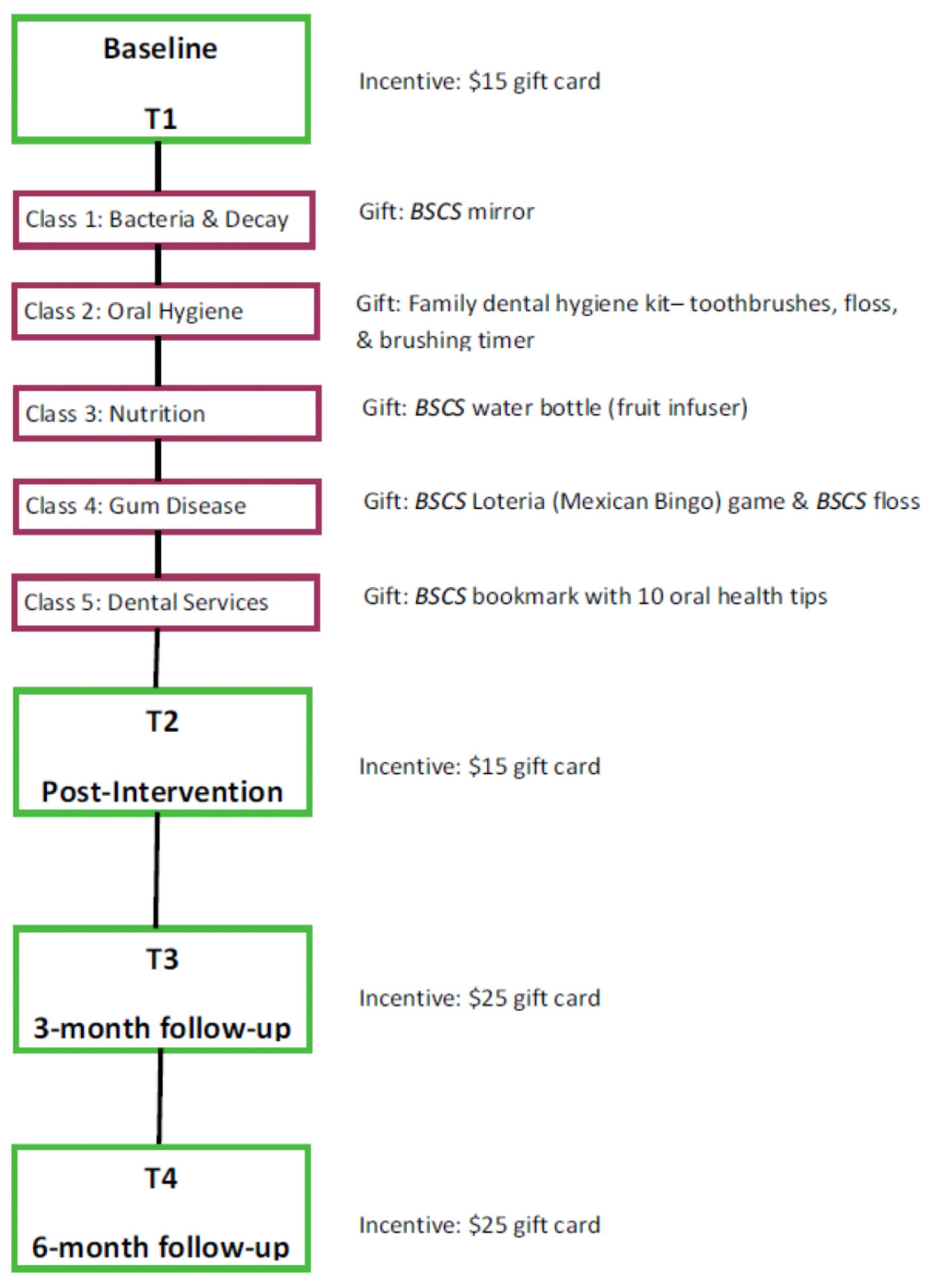
Enrolled participants responded to a set of questions about themselves and their household, and a set about one select study child in their family. Surveys were conducted in Spanish by trained bilingual (English/Spanish) staff from the community partner organizations as an in-person interview, and responses were recorded on paper. Surveys were collected with enrolled participants at baseline before the intervention (T1), immediately after the five-week BSCS intervention (T2), and two follow-up assessments were completed at three-months (T3) and six-months (T4). T2 surveys included process evaluation questions for participants. Interview responses were recorded on paper surveys at each timepoint, and assessed dental-related knowledge, attitudes, skills, and behaviors for all topics covered in BSCS. Paper surveys were stored in secure, locked fileboxes from each of the three community study sites and transported to the evaluation site in San Diego by partner organization staff, where the trained research team conducted quality checks for clarity and completeness, and manually double-entered survey data.
Participants received a $15 gift card after completing each survey at T1 and T2, and a $25 gift card after completing each survey at T3 and T4 (totaling $80 if participants completed all four surveys). Participants also received BSCS-branded session-specific gifts to support their engagement in the intervention group sessions. The BSCS name and logo were designed by community members in the formative CBPR phase [34]. With input from community members, VCC hired a graphic designer to develop all program training and intervention materials, including an oral health-specific loteria (Mexican bingo game) and a bookmark with 10 tips from BSCS, all branded with the BSCS logo. (See Supplemental Material File S2: Example BSCS-branded intervention flipchart visuals and session gifts). See Figure 1 for an overview of the study design and evaluation timepoints.

2.5. Measures

2.5.1. Oral Hygiene Behaviors

Primary outcomes of interest were oral hygiene behaviors. Participants reported on the frequency of brushing and flossing in the prior week, which was then dichotomized to reflect meeting the ADA guidelines of brushing twice/day (≥14 times/week) and flossing once/day (≥7 times/week).

2.5.2. Oral Hygiene Knowledge

Oral health knowledge was measured with 25 items, covering content from all five educational sessions. Correct answers were recoded as “1”, and wrong or missing answers as “0”. A subscale sum score for oral hygiene behavior-related knowledge was computed (6 items; min 0, max 6). This score indicated the total number of correct oral hygiene knowledge answers related to the ADA-recommended guidelines for brushing and flossing, using fluoride toothpaste, cleaning teeth/mouth before sleeping, and rinsing with mouthwash.

2.5.3. Attitudes Towards Oral Health

Nine statements measured a range of oral health attitudes. Participants selected either “Disagree”, “Neutral” or “Agree”. These items already existed in English and Spanish, and were used in the dental component of the MICASA study of agricultural workers [43,44], other studies with Mexican–American families, and the basic research factors questionnaire [45]. Each question referred to one specific attitude about oral health (e.g., perceived susceptibility or fatalistic belief). Responses were recoded to reflect endorsement of each specific attitude, which was each treated as a single item.

2.5.4. Oral Health Self-Efficacy

Oral health self-efficacy was measured with an 8-item scale, using a 4-point Likert response option ranging from 1 (“Not at all sure”) to 4 (“Extremely sure”). These questions were developed for each target behavior in BSCS. Self-efficacy beliefs captured confidence in the ability to perform specific oral health-promoting behaviors from the educational sessions, including performing daily oral hygiene. A mean score for self-efficacy was computed using all eight questions, with higher scores reflecting higher confidence (αT1 = 0.72 and αT2 = 0.77).

2.5.5. Oral Hygiene Skills

Participants reported whether or not they were ever taught how to properly brush and floss. These two single items were written for BSCS to capture skills.

2.5.6. Demographics

Participants self-reported demographic characteristics (age, sex), marital status, highest level of education completed, household size, monthly income from all sources, nativity status and years lived in the US.

2.6. BSCS Process Evaluation

2.6.1. BSCS Participant Process Evaluation

The T2 survey included 36 questions soliciting feedback about participant engagement and experiences in BSCS, guided by the Steckler and Linnan process evaluation framework for public health interventions [46]. Questions captured the extent of participation (e.g., number of sessions attended, if homework was completed, and if other family members attended). Perceptions about the BSCS program included questions about different aspects of the sessions (e.g., preferences about the length and amount of content included per session), the whole program (e.g., what they liked most/least), and about the CHWs/Líderes. Participants also reported on the BSCS impact on their behaviors and changes in their family, and if they shared program materials with others.

2.6.2. BSCS CHWs/Líderes Process Evaluation

CHWs/Líderes participated in a one-time, one-hour focus group after the intervention. They answered a shorter subset of the same questions to provide feedback on the BSCS program from their perspective. Additional questions probed about training.

2.7. Analyses

There were 147 participants enrolled in this study, with 118 (80%) who completed the baseline survey (T1), the BSCS intervention, and the post-intervention survey (T2). This analysis focuses on the adult caregivers’ immediate pre- and post-intervention (T1–T2) comparisons, and not the follow-up, due to attrition and reduced sample size at those later time points (T3: 104, T4: 73). One participant’s responses were extreme outliers and highly irregular and were excluded from analysis. Participants with complete pre- and post-survey responses for dental knowledge, attitudes, skills, and oral hygiene behaviors were evaluated in the final analytic sample (N = 117). Descriptive statistics were tabulated.
After merging T1 and T2 together, missingness was explored. Random missingness was above 5% for the following items: household income (10%), number of years living in the U.S. (6%), and brushing without a non-fluoride toothpaste (6%), all from the T1 survey. Across variables in this analysis, very few had any missingness, and it was <5%, with one exception. Due to a typo, the T2 flossing self-efficacy question was not asked for 29 (25%) participants. Given the large percentage and systematic nature of the missingness for the T2 flossing self-efficacy variable, imputation was not used for this variable. The flossing self-efficacy single-item pre–post comparison used matched complete cases (n = 88). For all other variables in this study, multiple imputation was used to address missingness [47]. All missing values were replaced, using the pooled result of five runs of multiple imputations, rounded to the nearest integer. To check if imputation affected the results, means of the imputed variables were compared to non-imputed means of the same variables, showing no significant difference.
Attrition characteristics were checked to assess the representativeness of the T2 sample compared to the larger T1 group. A check for selective attrition was performed by comparing the dropout group with the remaining participants using independent samples t-tests, chi-square tests and Fisher’s Exact test.
Paired t-tests were performed to check for the significance of changes between T1 and T2. When imputing missing values, the degrees of freedom in paired-samples t-tests were high, because the results were pooled from five imputed datasets. For the analysis, no corrections were applied. Effect sizes were calculated using the University of Colorado, Colorado Springs Effect Size Calculator [48]. Effect sizes of 0.10, 0.30, and 0.50 were considered small, medium, and large, respectively [49]. Using T1 as the control group and T2 as the treatment group, r was calculated to measure effect size.
All pre–post comparisons were conducted with the full sample. Additional exploratory subgroup analyses for oral hygiene behaviors were also conducted. Oral hygiene behaviors were a primary target for the intervention. BSCS educational messages included ADA guidelines that recommended brushing twice per day and flossing once per day. Subgroups were defined post hoc, based on whether participants met ADA oral hygiene guidelines at T1 or not. Pre–post changes in oral hygiene behavior were examined for the whole sample and for these subgroups defined at baseline.
Finally, descriptive statistics were tabulated for the process evaluation measures from participants and CHWs/Líderes. All data were originally entered, checked, and analyzed using SPSS 31 (Statistical Package for Social Scientists, Chicago, IL, USA).

3. Results

3.1. Participant Characteristics

Table 1 summarizes the participant characteristics. The majority (92%) of the BSCS participants were females, and most (82%) were married or cohabiting. Half (51%) completed education through 6th grade. Many (67%) were unemployed homemakers, and more than half of the families reported monthly incomes below USD$1500. Nearly all participants were born in Mexico.
Attrition analyses showed that the dropout group differed significantly in education (attended more school years, MT1 = 9.1 vs. MT2 = 7.4 years, p = 0.038).

3.2. Oral Hygiene Behaviors

At T1, participants’ mean (M) weekly brushing frequency was 14.60 times/week (standard deviation [SD] = 5.71). This number slightly decreased to a mean of 13.52 times/week (SD = 5.47) at T2.
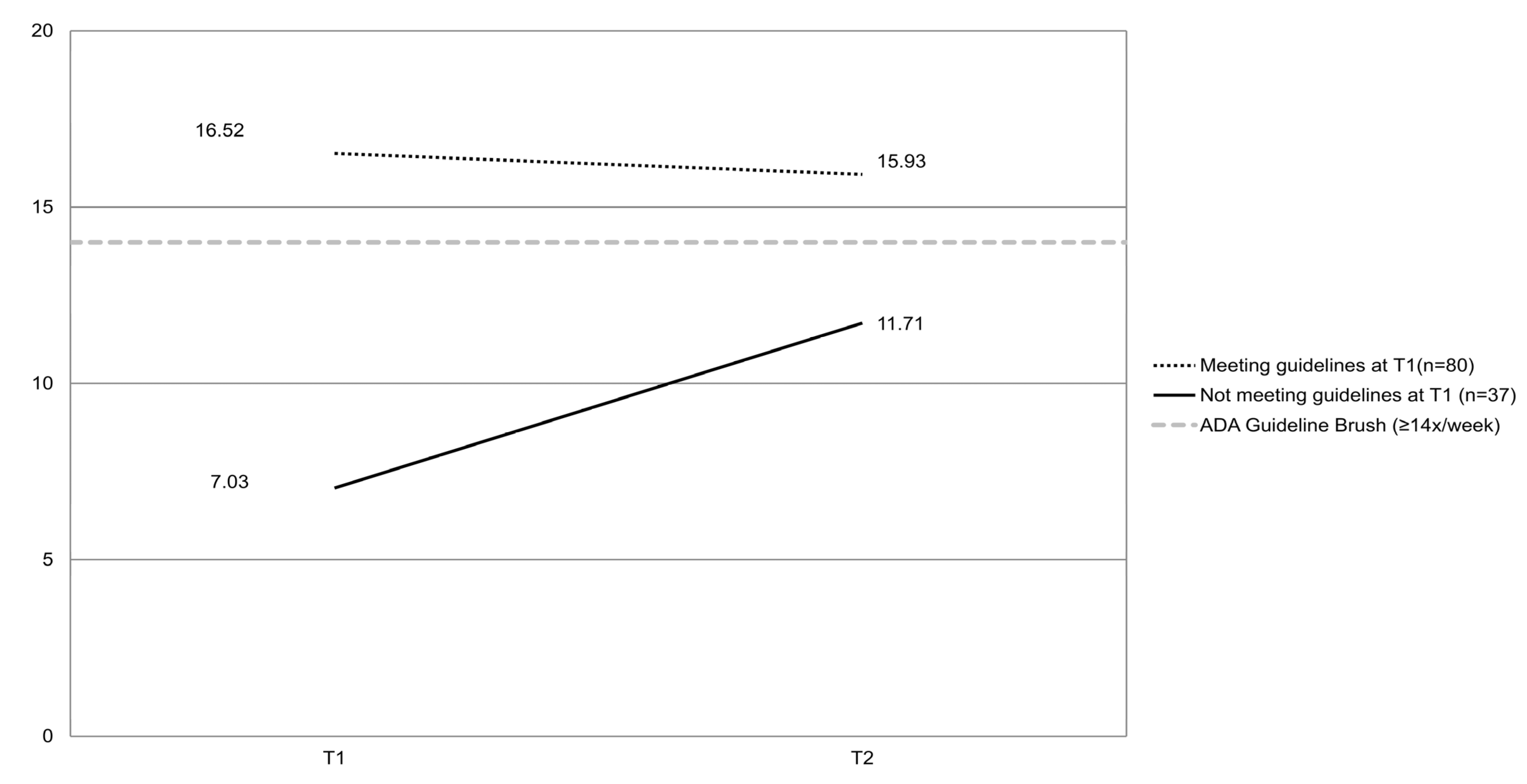
There were 80 (68%) participants who reported brushing frequencies that met ADA guidelines (≥14 times a week) at T1 (M = 16.52, SD = 3.7). This subgroup’s mean frequency slightly decreased to 15.93 (SD = 5.23) at T2, which was still meeting ADA brushing guidelines. The subgroup of 37 (32%) participants who did not meet ADA guidelines at T1 reported brushing less than 14 times in the last week (M = 7.03, SD = 3.41). This subgroup increased brushing frequencies by 67% at T2 (M = 11.71, SD = 4.82). The subgroup not meeting ADA brushing guidelines at baseline reported brushing more often after the intervention. Although the subgroup mean at T2 was still below the ADA brushing guidelines, this increase was a significant pre–post change. Figure 2 displays the changes in mean weekly brushing frequency in the two subgroups.
For flossing, a mean frequency of 5.41 times/week (SD = 5.71) was reported at T1 and increased to 6.46 (SD = 4.82) at T2 in the full sample.
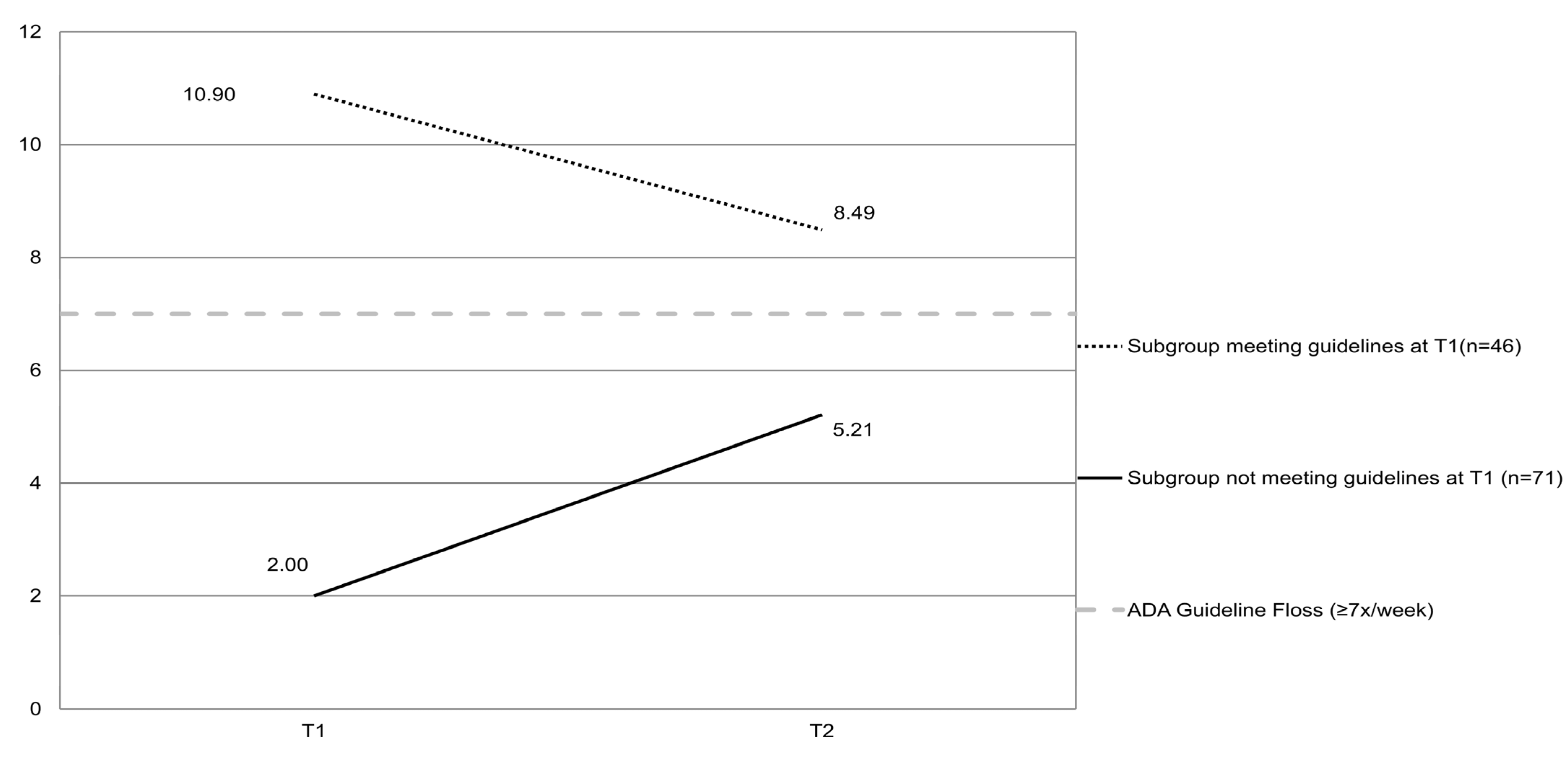
There were 46 (39%) participants who reported flossing frequencies that met ADA guidelines (≥7 times a week) at T1 (M = 10.90, SD = 5.44). This subgroup’s mean flossing frequency decreased to 8.49 times a week at T2 (SD = 4.15). The subgroup of 71 (61%) participants not meeting ADA flossing guidelines had a mean flossing frequency of 2.00 (SD = 1.97) to 5.21 (SD = 4.79) times a week at T1. Despite this significant increase at T2, this subgroup’s mean did not meet the ADA flossing recommended guidelines. Additionally, there were still 18 participants (15%) who did not floss at all at T2. Figure 3 displays the mean changes in weekly flossing frequency in the two subgroups.
Table 2 summarizes the pre–post changes in participants’ oral hygiene behavior frequency, overall, and for the subgroups based on meeting ADA guidelines or not at T1. There were no significant changes in brushing frequency in the full sample, but there was a significant increase in the subgroup that did not meet ADA guidelines at baseline (p < 0.001). For flossing, there was a borderline significant change in the full sample (p = 0.05). There was a significant increase in the subgroup that did not meet ADA flossing guidelines at baseline (p < 0.001). There was also a significant decrease in the subgroup that did meet ADA guidelines at baseline, though the subgroup’s mean remained above the once-per-day recommendation (p = 0.005).

3.3. Oral Health Knowledge and Self-Efficacy

Table 3 summarizes changes in oral health knowledge and self-efficacy. At T1, participants answered a mean of 4.64 (SD = 0.81) out of six oral hygiene knowledge questions correctly. After BSCS, this significantly increased to 5.05 (SD = 0.63) (p < 0.001).
Participants’ overall mean self-efficacy scores were high at baseline and following the intervention. The overall mean self-efficacy score increased significantly by 13% from 3.26 (SD = 0.53) at T1 to 3.69 (SD = 0.47) at T2 (p < 0.001). Significant changes were found for flossing self-efficacy, which increased from 3.32 (SD = 0.94) to 3.72 (SD = 0.73; p = 0.003), reflecting improved confidence in the ability to floss daily. Brushing self-efficacy increased but was not statistically significant pre- and post-intervention.

3.4. Oral Hygiene Skills and Attitudes

Table 4 summarizes changes in oral hygiene skills and attitudes. At T1, 69% reported they have been taught proper techniques for how to brush and floss at some point in life. After the intervention, nearly all participants indicated they had received proper oral hygiene instruction. These changes were significant for both brushing and flossing, reflecting increased skills in oral hygiene technique.
At T1, the perception of the inevitability of experiencing caries was reported by 77%. Seventeen percent believed they could not do much to have good teeth (fatalistic belief). Sixty-two percent anticipated losing their teeth when they get older (negative outcome expectation). The perceived severity of dental problems was endorsed by 94% of the participants, and 78% believed oral health to be less important than other aspects of health (perceived importance of oral health). Nearly all (97%) endorsed going to the dentist if they were experiencing dental problems. Dental fear was expressed by 38%. A high perceived susceptibility for dental problems was reported by 88%. Many (78%) caregivers endorsed the importance of baby teeth. Significant changes were reported after the intervention for only two attitudes: the perceived importance of oral health, which increased by 12% (p = 0.005), and the importance of baby teeth, which increased by 19% (p < 0.001).

3.5. Process Evaluation

3.5.1. Participant Feedback

Table 5 presents feedback about BSCS from the participants. Overall, the feedback was positive. Most (84%) participants attended all five classes. The majority (76%) felt that five sessions were adequate, 87% felt the duration of each session was the right length, and 92% felt the amount of information presented was enough. The majority (97%) of participants reported liking BSCS (very much or completely), and 76% indicated it was easy to understand the lessons. Most (89%) reported doing the homework, and many also felt homework helped their family make dental health changes to some extent. Most (80%) reported their family was interested in making changes at home, and 67% had other family members also attending sessions with them. Nearly all (94%) participants reported that they planned to work on their family’s dental health goals after T2. Most (81%) participants shared educational program materials with others, including their family members, friends, and neighbors.
Participants liked all educational sessions overall, with nearly all indicating they liked each session “a great deal” or “completely” (see Table 6). Participant ratings for how helpful the class was in supporting the adoption of healthier behaviors were also positive. Overall, the majority (98%) reported that Class #4 on “Nutrition” was the most helpful.
Participants rated the CHWs/Líderes favorably, indicating that they were trustworthy, respectful, knowledgeable, and prepared (See Table 7). Additionally, participants indicated high levels of support from the CHWs/Líderes throughout the intervention.

3.5.2. CHWs/Líderes Feedback About BSCS

The mean age of the CHWs/Líderes was 40 and ranged 24–55 years. Nearly all (91%) were females, 64% were married/cohabitating, 60% had completed high school education or more, and 73% were employed. Most were experienced, and 91% reported being part of more than five other community educational programs prior to their roles in BSCS, indicating they were a very experienced group of CHWs/Líderes.
See Table 8 for a summary of BSCS feedback from the eleven CHWs/Líderes that delivered the program. All but one reported feeling prepared to deliver BSCS, and all reviewed training materials on their own. They expressed positive feedback, similar to the participants, with the majority indicating the number of sessions and quantity of information was about right, but only half felt the duration of each session was the right length. The demonstrations/session activities and inclusion of the whole family were the top two most helpful aspects of BSCS. There were mixed perceptions about the informational handouts, group sharing, and strategizing aspects of BSCS, which were noted on both lists of the most and least helpful parts of the program. This finding also paralleled the mixed ratings from participants.

4. Discussion

After the five-week CHWs/Líderes-led intervention, there were several significant increases in oral hygiene-related skills, knowledge, and some attitudes in the whole sample. Proper brushing and flossing technique skills improved from pre- to post-intervention. In the whole sample, there were no significant increases in brushing or flossing weekly frequency, though pre–post changes did approach statistical significance. When the sample was stratified by baseline ADA oral hygiene guidelines adherence, statistically significant pre–post changes were found. The subgroups of participants not meeting guidelines reported that they brushed and flossed more often at T2. Interestingly, participants in the subgroup meeting ADA guidelines adjusted their hygiene habits downwards towards the guidelines (brushing 14 times and flossing seven times per week, respectively). This subgroup significantly decreased the number of times they brushed or flossed, while still remaining above the weekly guidelines. The study team speculated that participant perceptions about minimum adequate behavior may have changed, and they felt that brushing or flossing more than the recommended frequency was unnecessary. The ADA guidelines appeared to resonate with participants. The results suggest that the intervention was most effective for promoting oral hygiene behaviors, particularly for those not already meeting ADA guidelines.
The ADA oral hygiene guidelines reflect the profession’s recommended daily frequency for brushing and flossing, but simply “meeting ADA guidelines” does not guarantee better oral health. The ADA guidelines do not account for how well oral hygiene behaviors are performed in practice. Not meeting ADA guidelines can be a useful cut-point to indicate infrequent brushing and flossing, a reflection of possible “poor oral hygiene.” A meta-analysis examining 15 studies found that inadequate oral hygiene is a risk factor for periodontal (or gum) disease [50]. Increasing oral hygiene behavior frequency can make a difference in oral health by removing plaque more often to keep the teeth and mouth clean. Good oral hygiene is important for oral health promotion. The intervention’s focus on oral hygiene skill-building proved effective. About one-third of participants reported no prior instruction in proper oral hygiene techniques before BSCS, while almost all participants reported acquiring these skills following the intervention. The oral hygiene class sessions included instruction, demonstrations on a typodont, and hands-on practice and guidance. Other interventions that involved oral hygiene instruction and skill-building have focused on teaching caregivers how to brush their children’s teeth, and skill-building was an effective approach to supporting behavior change [32,51,52,53]. In a CHW/Líderes oral health promotion program with women in Brazil, hygiene behaviors, knowledge and self-efficacy were improved among both the CHWs/Líderes and participants [54]. BSCS focused on caregivers and improving their skills to promote proper brushing and flossing of their own teeth, illustrating that adults may still need instruction and can benefit from oral hygiene skill-building.
Post-intervention, knowledge scores increased. The educational components of the intervention were well-received by participants, and oral health knowledge about a range of topics increased. Self-efficacy levels were already relatively high at T1, and confidence increased at T2. The self-efficacy mean score and the flossing self-efficacy single item both significantly increased post-intervention. The brushing self-efficacy single item slightly increased post-intervention but was not statistically significant. Flossing remained a new and more challenging behavior for some, as evidenced by the 15% of participants who still did not floss post-intervention. Self-efficacy, a central construct in Social Cognitive Theory, suggests that confidence in the ability to perform a behavior is an important determinant of engaging that behavior [41]. Self-efficacy for brushing was already very high, and there was little room to improve, in contrast to self-efficacy for flossing. Skill-building and practice can enhance confidence in ability. Flossing is a more complex behavior than brushing, and requires more instruction, demonstration, repeated practice, and reinforcement to adopt and sustain. It may take more time to gain confidence in newer skills. Other studies with Mexican–Americans found that flossing was often need-driven, and not a daily habit like toothbrushing [55,56]. Future oral health interventions should prioritize more intensive initial training to first establish flossing, then more reinforcement and support to maintain flossing routines.
Participant-reported perceptions about the importance of oral health and the importance of baby teeth increased post-intervention. Other attitudes were unchanged. In a meta-analysis of over 200 studies, when changes in attitudes, norms, and self-efficacy were observed in experiments, they did contribute to changes in intentions and subsequent health behaviors [57]. While changing knowledge and attitudes may be possible, it may not be enough to translate to sustained behavior changes. Participants appeared eager to sustain oral hygiene practices in their immediate families and share information in their communities. Future interventions could build in more support from others for changing behaviors. Notably, there appeared to be interest in engaging others in these health behavior changes, as 81% of participants and all CHWs/Líderes shared BSCS materials with others outside the program.
Valuable BSCS process feedback was obtained from the participants and CHWs/Líderes, and the intervention was rated positively overall. The BSCS pre–post intervention results are promising and suggest that expanding upon the intervention would be acceptable and feasible in this community. The BSCS materials were carefully developed to be accessible at a low literacy level [34]. Information was delivered orally and with simple visuals, and sessions included skill-building and discussions around goal-setting and overcoming barriers. The intentional use of flipcharts and engaging activities was well-received. The program relied on low-tech flipcharts, models, and paper/pencil materials rather than digital technology. This intentional choice made it easier to deliver the program in a range of community settings and did not require electricity or other equipment. This approach was helpful to enable delivering the intervention in more rural, remote locations, and a variety of indoor or outdoor settings to increase accessibility. In a study of CHW/Líderes health promotion efforts with farmworkers, technology concerns and challenges with internet connections were identified [58]. This study contributes to the research base about CHWs/Líderes’ experiences in health promotion programs. The BSCS program made a positive impact in these communities, supported families in changing their oral health behaviors, and has potential scalability.
Future interventions could include additional objective measures to not rely solely on self-reported data, a control comparison group, a larger sample, and more follow-up to improve retention. There was little contact with participants beyond T2. Potential reasons for dropping out were tracked when possible and included: losing contact with participants, poor cell phone reception, migration for agricultural work, and lack of transportation. Nearly all enrolled participants were able to attend all sessions. Yet not all participants were fully engaged or received the entire intervention, though make-up sessions were offered. The small group format and openness to other family members attending and participating were positive aspects that likely contributed to the success of the five-week BSCS intervention.
The study findings confirm that a community-based oral health intervention, delivered by trained CHWs/Líderes, is feasible and acceptable in a border community with limited access to care. This approach, designed to be highly responsive to local needs, shows significant promise for reducing oral health disparities. Importantly, the successful strategies used here provide a blueprint for designing other interventions addressing oral health or relevant health issues in other underserved population groups.

Strengths and Limitations

A major strength of the intervention was that it was theory-driven and assessed multiple factors (knowledge, attitudes, self-efficacy, and skills) related to two target oral hygiene behaviors. BSCS was offered to all family members of enrolled participants and covered multiple oral health topics in a culturally competent, accessible manner. The small group format and use of trained CHWs/Líderes who were experienced in delivering health education programs contributed to the success of BSCS. Another key strength of this study was its comprehensive content coverage and multi-session design. The assessment of post-intervention outcomes occurred after the completion of the entire program, rather than immediately following a single session. This longitudinal pre–post design provided a robust measure of knowledge retention and measured changes in attitudes and hygiene behaviors.
This CBPR project facilitated an in-depth process evaluation, yielding valuable insights into the components of the intervention. The CBPR approach to the development of the intervention may have contributed to the engagement and positive feedback from participants and CHWs/Líderes.
Study limitations include potential recall or social desirability biases, since all data were self-reported. There were no clinical assessments, and this study did not assess objective oral health status. There was attrition during the five-week program, so there may be some selection bias in the results. The convenience sample was drawn from three communities in one county, which may also contribute to selection bias and limit external validity. Most of this sample were non-working females in migrant worker families. The inclusion criteria for “migrant worker family” were broad. Thus, the study findings may not be generalizable to other migrant workers in other regions, or more broadly to other Mexican–American caregivers, farmworkers, or adults without children. An inherent limitation of a pre–post study design is the lack of a control group for comparison. Causality cannot be determined in a single-arm, pre–post evaluation, and observed changes post-intervention may not be fully attributable to the intervention alone. While the final analytic sample size was modest, it was adequate to detect medium–large effect sizes, based on post hoc power analyses.

5. Conclusions

This study provides pre–post evidence that a CHWs/Líderes-led culturally and linguistically appropriate oral health intervention developed for Mexican migrant families was effective. Pre–post oral health knowledge and self-efficacy scores, and some attitudes, increased after five weeks in the whole sample. Toothbrushing and flossing frequency significantly increased among subgroups of adults who did not meet ADA-recommended guidelines before the intervention.

Supplementary Materials

The following supporting information can be downloaded at: https://www.mdpi.com/article/10.3390/oral6020031/s1, File S1: BSCS goals and barrier worksheets in English and Spanish. File S2: Example BSCS-branded intervention flipchart visuals and session gifts.

Author Contributions

Conceptualization, T.L.F. and N.S.; methodology, T.L.F., N.S., A.N.-A., A.P.-Z., P.A., and M.R.; validation, T.L.F.; formal analysis, M.R., T.L.F., and P.A.; investigation, A.P.-Z. and A.N.-A.; resources, T.L.F.; data curation, T.L.F., M.R., and P.A.; writing—original draft preparation, T.L.F. and M.R.; writing—review and editing, N.S., A.N.-A., A.P.-Z., and P.A.; visualization, M.R., P.A., and T.L.F.; supervision, T.L.F., N.S., and A.N.-A.; project administration, T.L.F., P.A., and N.S.; funding acquisition, T.L.F. and N.S. All authors have read and agreed to the published version of the manuscript.

Funding

This community-based participatory research project was supported by the DentaQuest Foundation’s National Community Committee (NCC) Oral Health Initiative (2013–2015 implementation grant).

Institutional Review Board Statement

This study was conducted in accordance with the Declaration of Helsinki and approved by the San Diego State University Institutional Review Board (IRB #1607091, on 16 January 2014).

Informed Consent Statement

Written informed consent (in Spanish, participants’ primary language) was obtained from all participants involved in this study.

Data Availability Statement

Dataset access is tracked. Limited minimum datasets from this analysis may be made available by reasonable request to the PI/corresponding author at tfinlays@sdsu.edu. Additional dataset information: Finlayson, T. (2025). Boca Sana Cuerpo Sano (BSCS): pre–post oral hygiene and process eval (min datasets). Zenodo. https://doi.org/10.5281/zenodo.17833970 (accessed on 1 October 2025).

Acknowledgments

The authors thank all our community partners, participating families, Líderes Comunitarios, student research assistants and project staff for making the project a success.

Conflicts of Interest

The authors declare no conflicts of interest. The funders had no role in the design of this study; in the collection, analyses, or interpretation of data; in the writing of the manuscript; or in the decision to publish the results.

References

  1. California Department of Food and Agriculture. California Agricultural Statistics Review 2023–2024; California Department of Food and Agriculture: Sacramento, CA, USA, 2024. [Google Scholar]
  2. Entwistle, B.A.; Swanson, T.M. Dental needs and perceptions of adult Hispanic migrant farmworkers in Colorado. J. Dent. Hyg. 1988, 63, 286–292. [Google Scholar]
  3. Gentry, K.; Quandt, S.A.; Davis, S.W.; Grzywacz, J.G.; Hiott, A.E.; Arcury, T.A. Child healthcare in two farmworker populations. J. Community Health 2007, 32, 419–431. [Google Scholar] [CrossRef] [Scilit] [PubMed]
  4. Lukes, S. Promotora Training Program Invests in Oral Health. Access 2003, 17, 30–32. [Google Scholar]
  5. Quandt, S.A.; Hiott, A.; Grzywacz, J.; Davis, S.; Arcury, T. Oral health and quality of life of migrant and seasonal farmworkers in North Carolina. J. Agri Saf. Health 2007, 13, 45–55. [Google Scholar] [CrossRef] [Scilit] [PubMed]
  6. Quandt, S.A.; Clark, H.M.; Rao, P.; Arcury, T.A. Oral health of children and adults in Latino migrant and seasonal farmworker families. J. Imm Min. Health 2007, 9, 229–235. [Google Scholar] [CrossRef] [Scilit]
  7. Anthony, M.; Williams, J.M.; Avery, A.M. Health needs of migrant and seasonal farmworkers. J. Community Health Nurs. 2008, 25, 153–160. [Google Scholar] [CrossRef] [Scilit] [PubMed]
  8. Villarejo, D.; McCurdy, S.A.; Bade, B.; Samuels, S.; Lighthall, D.; Williams, D. The health of California’s immigrant hired farmworkers. Am. J. Ind. Med. 2010, 53, 387–397. [Google Scholar] [CrossRef] [Scilit]
  9. Public Policy Institute of California. Health Care Access among California’s Farmworkers; Public Policy Institute of California: San Francisco, CA, USA, 2022. [Google Scholar]
  10. Bright, K.L.; Lichtman, K. An ethnographic study of a community dentistry network serving Latine migrant farmworkers in Vermont: Barriers and access to care during the COVID-19 pandemic and beyond. Community Dent. Oral. Epidemiol. 2024, 52, 59–67. [Google Scholar] [CrossRef] [Scilit]
  11. Kline, N. “There’s nowhere i can go to get help, and i have tooth pain right now”: The oral health syndemic among migrant farmworkers in florida. Ann. Anthro Pr. 2012, 36, 387–401. [Google Scholar] [CrossRef] [Scilit]
  12. NIH. Oral Health in America: Advances and Challenges; US Department of Health and Human Services, National Institutes of Health, National Institute of Dental and Craniofacial Research: Bethesda, MD, USA, 2021. [Google Scholar]
  13. Eke, P.I.; Thornton-Evans, G.O.; Wei, L.; Borgnakke, W.S.; Dye, B.A.; Genco, R.J. Periodontitis in US Adults: National Health and Nutrition Examination Survey 2009-2014. J. Am. Dent. Assoc. 2018, 149, 576–588.e576. [Google Scholar] [CrossRef] [Scilit]
  14. Sanders, A.E.; Campbell, S.M.; Mauriello, S.M.; Beck, J.D.; Jimenez, M.C.; Kaste, L.M.; Singer, R.H.; Beaver, S.M.; Finlayson, T.L.; Badner, V.M. Heterogeneity in periodontitis prevalence in the Hispanic Community Health Study/Study of Latinos. Ann. Epidemiol. 2014, 24, 455–462. [Google Scholar] [CrossRef] [Scilit]
  15. Beck, J.D.; Youngblood, M., Jr.; Atkinson, J.C.; Mauriello, S.; Kaste, L.M.; Badner, V.M.; Beaver, S.; Becerra, K.; Singer, R. The prevalence of caries and tooth loss among participants in the Hispanic Community Health Study/Study of Latinos. J. Am. Dent. Assoc. 2014, 145, 531–540. [Google Scholar] [CrossRef] [Scilit] [PubMed]
  16. Velez, D.; Palomo-Zerfas, A.; Nunez-Alvarez, A.; Ayala, G.X.; Finlayson, T.L. Facilitators and Barriers to Dental Care Among Mexican Migrant Women and Their Families in North San Diego County. J. Immigr. Minor. Health 2017, 19, 1216–1226. [Google Scholar] [CrossRef] [Scilit]
  17. Cabudol, M.J.; Asgari, P.; Stamm, N.; Finlayson, T.L. Illuminating Mexican Migrant Adolescents’ Dental Access and Utilization Experiences. Community Dent. Health 2018, 35, 204–210. [Google Scholar] [CrossRef] [Scilit]
  18. Lopez, A.; Hoeft, K.S.; Guerra, C.; Barker, J.C.; Chung, L.H.; Burke, N.J. Spanish-speaking Mexican-American parents’ experiences while navigating the dental care system for their children. J. Public Health Dent. 2022, 82, 99–104. [Google Scholar] [CrossRef] [Scilit]
  19. American Dental Association. Wake up to prevention for the smile of a lifetime. J. Am. Dent. Assoc. 1988, 116, G6–G13. [Google Scholar] [CrossRef] [Scilit]
  20. American Dental Assocation. Keeping your gums healthy. J. Am. Dent. Assoc. 2015, 146, A46. [Google Scholar] [CrossRef] [Scilit] [PubMed]
  21. Chapple, I.L.C.; Van der Weijden, F.; Doerfer, C.; Herrera, D.; Shapira, L.; Polak, D.; Madianos, P.; Louropoulou, A.; Machtei, E.; Donos, N.; et al. Primary prevention of periodontitis: Managing gingivitis. J. Clin. Perio. 2015, 42, S71–S76. [Google Scholar] [CrossRef] [Scilit]
  22. Creeth, J.E.; Gallagher, A.; Sowinski, J.; Bowman, J.; Barrett, K.; Lowe, S.; Patel, K.; Bosma, M.L. The effect of brushing time and dentifrice on dental plaque removal in vivo. J. Dent. Hyg. 2009, 83, 111–116. [Google Scholar]
  23. Worthington, H.V.; MacDonald, L.; Pericic, T.P.; Sambunjak, D.; Johnson, T.M.; Imai, P.; Clarkson, J.E. Home use of interdental cleaning devices, in addition to toothbrushing, for preventing and controlling periodontal diseases and dental caries. Cochrane Database Syst. Rev. 2019, 4, CD012018. [Google Scholar] [CrossRef] [Scilit]
  24. Kumar, S.; Tadakamadla, J.; Johnson, N.W. Effect of Toothbrushing Frequency on Incidence and Increment of Dental Caries: A Systematic Review and Meta-Analysis. J. Dent. Res. 2016, 95, 1230–1236. [Google Scholar] [CrossRef] [Scilit] [PubMed]
  25. Elder, J.P.; Ayala, G.X.; Parra-Medina, D.; Talavera, G.A. Health communication in the Latino community: Issues and approaches. Ann. Rev. Public Health 2009, 30, 227–251. [Google Scholar] [CrossRef] [Scilit]
  26. Witmer, A.; Seifer, S.D.; Finocchio, L.; Leslie, J.; O’Neil, E.H. Community health workers: Integral members of the health care work force. Am. J. Public Health 1995, 85, 1055–1058. [Google Scholar] [CrossRef] [Scilit] [PubMed]
  27. Arcury, T.A.; Quandt, S.A. Delivery of health services to migrant and seasonal farmworkers. Ann. Rev. Public Health 2007, 28, 345–363. [Google Scholar] [CrossRef] [Scilit]
  28. Watson, M.R.; Horowitz, A.M.; Garcia, I.; Canto, M.T. A Community Participatory Oral Health Promotion Program in an Inner-city Latino Community. J. Public Health Dent. 2001, 61, 34–41. [Google Scholar] [CrossRef] [Scilit]
  29. Bloss, J.E.; LePrevost, C.E.; Zahra, A.G.; Firnhaber, G.C.; Cofie, L.E.; Zepeda, R.; Lee, J.G.L. Advancing the Health of Migrant and Seasonal Farmworkers in the United States: Identifying Gaps in the Existing Literature, 2021. Health Promot Pr. 2022, 23, 432–444. [Google Scholar] [CrossRef] [Scilit]
  30. Harwell, E.L.; Wright, M.Z.; LePrevost, C.E.; Bloss, J.E.; Lee, J.G.L. An Analysis of the Availability of Health Education Materials for Migrant and Seasonal Farmworkers. J. Agromedicine 2023, 28, 615–619. [Google Scholar] [CrossRef] [Scilit] [PubMed]
  31. Garcia, D.T.; Lawson, J.A.; Brody, E.R.; McKernan, S.C.; Raskin, S.E.; Arauz, N.R.; Mosavel, M.; Brickhouse, T.H. A scoping review of the roles, training, and impact of community health workers in oral health. Community Dent. Health 2021, 38, 198–208. [Google Scholar] [CrossRef] [Scilit]
  32. Rai, N.K.; Tiwari, T. Oral Health Behavior Change in Mexican-American Caregivers: A Community-Based Intervention Study. Int. J. Environ. Res. Public Health 2019, 16, 3409. [Google Scholar] [CrossRef] [Scilit]
  33. Maupome, G.; Aguirre-Zero, O.; Westerhold, C. Qualitative description of dental hygiene practices within oral health and dental care perspectives of Mexican-American adults and teenagers. J. Public Health Dent. 2015, 75, 93–100. [Google Scholar] [CrossRef] [Scilit]
  34. Finlayson, T.L.; Asgari, P.; Hoffman, L.; Palomo-Zerfas, A.; Gonzalez, M.; Stamm, N.; Rocha, M.-I.; Nunez-Alvarez, A. Formative Research: Using a Community-Based Participatory Research Approach to Develop an Oral Health Intervention for Migrant Mexican Families. Health Prom. Pr. 2016, 18, 454–465. [Google Scholar] [CrossRef] [Scilit]
  35. Vista Community Clinic Migrant Health Program. Available online: https://www.vistacommunityclinic.org/programs/ (accessed on 1 October 2025).
  36. National Latino Research Center, C.S.U. San Marcos. Available online: https://www.csusm.edu/nlrc/index.html (accessed on 1 October 2025).
  37. Community Housing Works. Available online: https://chworks.org/ (accessed on 1 October 2025).
  38. Elder, J.P.; Ayala, G.X.; Arredondo, E.M.; Talavera, G.A.; McKenzie, T.L.; Hoffman, L.; Cuestas, L.; Molina, M.; Patrick, K. Community Health Partnerships for Chronic Disease Prevention Among Latinos: The San Diego Prevention Research Center. J. Prim. Prev. 2013, 34, 17–29. [Google Scholar] [CrossRef] [Scilit]
  39. FarmWorker CARE Coalition. Available online: https://farmworkercare.wordpress.com/about-us/ (accessed on 1 October 2025).
  40. Bandura, A. Human agency in social cognitive theory. Am. Psych. 1989, 44, 1175–1184. [Google Scholar] [CrossRef]
  41. DeVellis, B.M.; DeVellis, R.F. Self-efficacy and health. In Handbook of Health Psychology; Baum, A., Revenson, T.A., Singer, J.E., Eds.; Lawrence Erlbaum Associates Inc.: Mahwah, NJ, USA, 2001; pp. 235–247. [Google Scholar]
  42. Stoecklin-Marois, M.T.; Hennessey-Burt, T.E.; Schenker, M.B. Engaging a hard-to-reach population in research: Sampling and recruitment of hired farm workers in the MICASA study. J. Agric. Saf. Health 2011, 17, 291–302. [Google Scholar] [CrossRef] [Scilit] [PubMed]
  43. Finlayson, T.L.; Gansky, S.A.; Shain, S.G.; Weintraub, J.A. Dental utilization among Hispanic adults in agricultural worker families in California’s Central Valley. J. Public Health Dent. 2010, 70, 292–299. [Google Scholar] [CrossRef] [Scilit] [PubMed]
  44. Finlayson, T.L.; Gansky, S.A.; Shain, S.; Weintraub, J.A. Dental utilization among children in agricultural worker families. J. Dent. Oral. Craniofac Epi 2014, 2, 15–24. [Google Scholar]
  45. Albino, J.; Tiwari, T.; Gansky, S.A.; Henshaw, M.M.; Barker, J.C.; Brega, A.G.; Gregorich, S.E.; Heaton, B.; Batliner, T.S.; Borrelli, B.; et al. The basic research factors questionnaire for studying early childhood caries. BMC Oral. Health 2017, 17, 83. [Google Scholar] [CrossRef] [Scilit] [PubMed]
  46. Steckler, A.; Linnan, L. Process Evaluation for Public Health Interventions and Research, 1st ed.; Jossey-Bass: San Francisco, CA, USA, 2002. [Google Scholar]
  47. van Ginkel, J.R.; Linting, M.; Rippe, R.C.A.; van der Voort, A. Rebutting Existing Misconceptions About Multiple Imputation as a Method for Handling Missing Data. J. Pers. Assess. 2020, 102, 297–308. [Google Scholar] [CrossRef] [Scilit]
  48. Becker, L.A. Calculate the Value of Cohen’s d and the Effect-Size Correlation (Version of 3/20/2000). 2000. Available online: https://lbecker.uccs.edu/ (accessed on 1 October 2025).
  49. Cohen, J. Statistical Power Analysis for the Behavioral Sciences, 2nd ed.; Lawrence Erlbaum: Mahwah, NJ, USA, 1988. [Google Scholar]
  50. Lertpimonchai, A.; Rattanasiri, S.; Arj-Ong Vallibhakara, S.; Attia, J.; Thakkinstian, A. The association between oral hygiene and periodontitis: A systematic review and meta-analysis. Int. Dent. J. 2017, 67, 332–343. [Google Scholar] [CrossRef] [Scilit]
  51. Huebner, C.E.; Milgrom, P. Evaluation of a parent-designed programme to support tooth brushing of infants and young children. Int. J. Dent. Hyg. 2015, 13, 65–73. [Google Scholar] [CrossRef] [Scilit]
  52. Hoeft, K.S.; Barker, J.C.; Shiboski, S.; Pantoja-Guzman, E.; Hiatt, R.A. Effectiveness evaluation of Contra Caries Oral Health Education Program for improving Spanish-speaking parents’ preventive oral health knowledge and behaviors for their young children. Comm. Dent. Oral. Epidemiol. 2016, 44, 564–576. [Google Scholar] [CrossRef] [Scilit] [PubMed]
  53. Villalta, J.; Askaryar, H.; Verzemnieks, I.; Kinsler, J.; Kropenske, V.; Ramos-Gomez, F. Developing an Effective Community Oral Health Workers-“Promotoras” Model for Early Head Start. Front. Public Health 2019, 7, 175. [Google Scholar] [CrossRef] [Scilit]
  54. Frazão, P.; Marques, D. Effectiveness of a community health worker program on oral health promotion. Rev. Saude Publica 2009, 43, 463–471. [Google Scholar] [CrossRef]
  55. Yu, M.; Ayala, G.X.; Schiaffino, M.K.; Hoeft, K.S.; Malcarne, V.; Finlayson, T.L. A Mixed Methods Comparison of Oral Hygiene Behaviors by Gender Among Mexican-Origin Young Adults in California. Oral 2025, 5, 5. [Google Scholar] [CrossRef] [Scilit] [PubMed]
  56. Aguirre-Zero, O.; Westerhold, C.; Goldsworthy, R.; Maupome, G. Identification of barriers and beliefs influencing engagement by adult and teen Mexican-Americans in oral health behaviors. Community Dent. Health 2016, 33, 44–47. [Google Scholar] [PubMed]
  57. Sheeran, P.; Maki, A.; Montanaro, E.; Avishai-Yitshak, A.; Bryan, A.; Klein, W.M.; Miles, E.; Rothman, A.J. The impact of changing attitudes, norms, and self-efficacy on health-related intentions and behavior: A meta-analysis. Health Psychol. 2016, 35, 1178–1188. [Google Scholar] [CrossRef] [Scilit]
  58. Harwell, E.L.; LePrevost, C.E.; Cofie, L.E.; Lee, J.G.L. Community Health Workers’ Role in Addressing Farmworker Health Disparities. J. Agromed. 2022, 27, 391–401. [Google Scholar] [CrossRef] [Scilit] [PubMed]
Figure 1. Boca Sana, Cuerpo Sano (BSCS) intervention study design.
Oral 06 00031 g001
Figure 2. Mean changes in weekly brushing frequencies pre- and post-intervention, by subgroup.
Oral 06 00031 g002
Figure 3. Mean changes in reported weekly flossing frequencies pre- and post-intervention, by subgroup.
Oral 06 00031 g003
Table 1. Participant characteristics (N = 117).
n (%)
Age
18–3542 (36)
36–4540 (34)
≥4635 (30)
Sex
Male11 (9)
Female106 (91)
Marital status 1
Married96 (82)
Single21 (18)
Education
Grades 0–660 (51)
Grades 7–1132 (27)
Grades 12+25 (21)
Employment
Employed39 (33)
Unemployed78 (67)
Monthly income (USD)
<$150069 (59)
$150048 (41)
Household size
≤323 (20)
432 (27)
529 (25)
≥633 (28)
Nativity
US-born6 (5)
Foreign-born 2111 (95)
Years in the U.S.
1–1029 (25)
11–2052 (44)
≥2136 (31)
1 Married also includes living with partner; single also includes separated, divorced, and widowed; 2 Born in Mexico, with exception of 3 participants born in Guatemala.
Table 2. Changes in oral hygiene behavior frequency pre- and post-intervention.
T1
M (SD)
T2
M (SD)
Difference a (%) bSig.
(2-Tailed) c
Effect Size
r d
Reported brushing frequency
 All participants (n = 117)14.60 (5.71)13.52 (5.47)−1.08 (−7)0.062−0.095
 Not meeting guidelines e (n = 37)7.03 (3.41)11.71 (5.24)4.68 (67)<0.0010.467
 Meeting guidelines (n = 80)16.52 (3.70)15.93 (5.23)−0.59 (−4)0.315−0.065
Reported flossing frequency
 All participants (n = 117)5.41 (5.71)6.46 (4.82)1.05 (19)0.0500.099
 Not meeting guidelines f (n = 71)2.00 (1.97)5.21 (4.79)3.21 (160)<0.0010.401
 Meeting guidelines (n = 46)10.90 (5.44)8.49 (4.15)−2.42 (−22)0.005−0.242
a Mean difference between T1 and T2. b Mean percentage change. c Paired t-test statistics. d r = 0.10, 0.30, and 0.50 are considered small, medium, and large effect sizes, respectively. e Not meeting ADA brushing guidelines at T1 (<14 times a week). f Not meeting ADA flossing guidelines at T1 (<7 times a week).
Table 3. Changes in oral health knowledge and self-efficacy scores pre- and post-intervention (N = 117).
T1
M (SD)
T2
M (SD)
Difference a (%) bSig.
(2-Tailed) c
Effect Size
r d
Oral hygiene behavior related knowledge
 Sum score (6 items, 0 = low, 6 = high)4.64 (0.81)5.05 (0.63)0.41 (9)<0.0010.416
Oral health self-efficacy
 Mean efficacy score e 3.26 (0.53)3.69 (0.47)0.43 (13)<0.0010.664
 Brushing only f3.73 (0.58)3.84 (0.45)0.11 (3)0.0910.105
 Flossing only f, g3.32 (0.94)3.72 (0.73)0.40 (12)0.6930.475
a Mean difference between T1 and T2. b Mean percentage change. c Paired t-test statistics. d r = 0.10, 0.30, and 0.50 are considered small, medium, and large effect sizes, respectively. e Based on mean score across eight items (1 = low, 4 = high). f Based on one item (1 = low, 4 = high); g Flossing single item based on n = 88.
Table 4. Changes in oral hygiene skills and oral health attitudes pre- and post-intervention.
T1 Endorsement
n (%)
T2 Endorsement
n (%)
Difference a (%) bSig.
(2-Tailed) c
Effect Size
r d
Oral Hygiene Skill e
 Taught how to properly brush 81 (69)114 (97)33 (28)< 0.001−0.369
 Taught how to properly floss 81 (69)113 (97)32 (27)< 0.001−0.374
Attitudes e
 Perception of inevitability90 (77)86 (74)−4 (−3)0.474−0.035
 Fatalistic belief20 (17)13 (11)−7 (−6)0.176−0.086
 Negative outcome expectation72 (62)72 (62)0 (0)10
 Perceived severity110 (94)108 (92)−2 (−2)0.637−0.039
 Perceived importance of oral health91 (78)105 (90)14 (12)0.0050.162
 Problem driven care seeking114 (97)117 (100)3 (3)0.5560.140
 Dental fear44 (38)37 (32)−7 (−6)0.158−0.063
 Perceived susceptibility103 (88)97 (83)−6 (−5)0.210−0.062
 Perceived importance of baby teeth91 (78)113 (97)22 (19)<0.0010.283
a Raw number change. b Percentage change. c Paired t-test statistics. d r = 0.10, 0.30, and 0.50 are considered small, medium, and large effect sizes, respectively. e Number of participants expressing endorsement.
Table 5. Participant feedback about BSCS (N = 117).
n (%)
Number of sessions attended 1
 <512 (11)
 589 (76)
 5 + orientation9 (8)
 Missing7 (6)
Number of sessions 1
 Too many3 (3)
 Adequate88 (76)
 Not too many23 (20)
 Don’t Know3(3)
Duration of each session
 Too short10 (9)
 Just the right length102 (87)
 Too long5 (4)
Quantity of information in each session
 Not enough3 (3)
 Enough107 (92)
 Too much7 (6)
How much participant liked the BSCS program
 A little1 (1)
 Somewhat2 (2)
 Very much60 (51)
 Completely54 (46)
How easy was it to understand the lessons 1
 Not at all10 (9)
 A little7 (6)
 Somewhat11 (10)
 Very much36 (31)
 Completely53 (45)
Did you do the homework? 1
 No12 (10)
 Yes, some60 (51)
 Yes, all44 (38)
How helpful was the homework in helping your family make behavior changes? 1
 Not at all9 (8)
 A little3 (3)
 Somewhat18 (15)
 Very much40 (34)
 Completely45 (39)
How interested was your family in making changes at home to support better dental health?
 A little10 (8)
 Somewhat15 (12)
 Very much45 (39)
 Completely47 (41)
Will you and your family work on dental health goals now that the educational classes ended?
 Definitely no3 (3)
 Probably no1 (1)
 Probably yes13 (11)
 Definitely yes100 (86)
Did any family members come with you to at least one session?
 No39 (33)
 Yes78 (67)
Did you share program materials with anyone?
 No22 (19)
 Yes95 (81)
1 Does not total 117, as a few participants skipped or indicated “I don’t know”.
Table 6. Participant ratings of BSCS classes (N = 117).
How Much Did You Like the Class?How Helpful was the Class in Supporting Your Family to Adopt Healthier Behavior?
n (%)n (%)
Session 1: Decay and Bacteria
 A little 0 (0)0 (0)
 Somewhat3 (3)5 (4)
 A great deal64 (55)22 (19)
 Completely50 (43)90 (76)
Session 2: Oral Hygiene 1
 A little 0 (0)0 (0)
 Somewhat1 (1)2 (2)
 A great deal59 (51)20 (17)
 Completely55 (47)93 (80)
Session 3: Nutrition 1
 A little 0 (0)0 (0)
 Somewhat1 (1)2 (2)
 A great deal52 (44)18 (15)
 Completely 61 (52)95 (81)
Session 4: Gum Disease 1
 A little 0 (0)1 (1)
 Somewhat2 (2)1 (1)
 A great deal50 (43)18 (15)
 Completely 61 (52)93 (80)
Session 5: Dental Care 1
 A little 1 (1)1 (1)
 Somewhat4 (3)5 (4)
 A great deal55 (47)23 (20)
 Completely54 (46)86 (74)
1 Does not total 117; a few participants did not receive this session, so they did not rate it.
Table 7. Participant ratings of CHWs/Líderes (N = 117).
TrustworthyRespectfulKnowledgeablePrepared
n (%)n (%)n (%)n (%)
A little1 (1)0 (0)0 (0)0 (0)
Somewhat4 (3)2 (2)9 (8)7 (6)
A great deal33 (28)32 (27)36 (31)32 (27)
Completely79 (68)83 (71)72 (62)78 (67)
Table 8. CHWs/Líderes feedback about BSCS (N = 11).
n (%)
Felt prepared to lead community intervention 10 (91)
Studied BSCS training materials on own11 (100)
Number of sessions 9 (82)
 Adequate
Duration of each session
 Just the right length6 (55)
Quantity of information
 Just about right 10 (91)
Three most helpful things in BSCS
 Demonstrations/session activities10 (91)
 Having the whole family able to participate in sessions9 (82)
 Informational handouts and group sharing4 (36)
Three least helpful things in BSCS
 Homework sheets and goal-setting7 (70)
 Informational handouts and group sharing6 (60)
 Group sharing and strategizing3 (27)
Did you share program materials with anyone?
 Family 11 (100)
 Friends10 (91)
 Neighbors7 (64)
Disclaimer/Publisher’s Note: The statements, opinions and data contained in all publications are solely those of the individual author(s) and contributor(s) and not of MDPI and/or the editor(s). MDPI and/or the editor(s) disclaim responsibility for any injury to people or property resulting from any ideas, methods, instructions or products referred to in the content.