
Wind Speed Influences Vigilance in Sentinels of a Cooperative Breeder


Simple Summary
Abstract
1. Introduction
2. Materials and Methods
3. Results
4. Discussion
5. Conclusions
Author Contributions
Funding
Institutional Review Board Statement
Informed Consent Statement
Data Availability Statement
Acknowledgments
Conflicts of Interest
References
- Beauchamp, G. Animal Vigilance: Monitoring Predators and Competitors; Academic Press: London, UK, 2015. [Google Scholar]
- Lima, S.L. Vigilance while feeding and its relation to the risk of predation. J. Theor. Biol. 1987, 124, 303–316. [Google Scholar] [CrossRef]
- Elgar, M.A. Predator vigilance and group size in mammals and birds: A critical review of the empirical evidence. Biol. Rev. 1989, 64, 13–33. [Google Scholar] [CrossRef]
- Roberts, G. Why individual vigilance declines as group size increases. Anim. Behav. 1996, 51, 1077–1086. [Google Scholar] [CrossRef]
- Pulliam, H.R. On the advantages of flocking. J. Theor. Biol. 1973, 38, 419–422. [Google Scholar] [CrossRef] [PubMed]
- Keverne, E.B.; Leonard, R.A.; Scruton, D.M.; Young, S.K. Visual monitoring in social groups of talapoin monkeys (Miopithecus talapoin). Anim. Behav. 1978, 26, 933–944. [Google Scholar] [CrossRef]
- Treves, A. Within-group vigilance in red colobus and redtail monkeys. Am. J. Primatol. 1999, 48, 113–126. [Google Scholar] [CrossRef]
- Favreau, F.-R.; Goldizen, A.W.; Pays, O. Interactions among social monitoring, anti-predator vigilance and group size in eastern grey kangaroos. Proc. R. Soc. B Biol. Sci. 2010, 277, 2089–2095. [Google Scholar] [CrossRef] [PubMed]
- Vahl, W.K.; van der Meer, J.; Weissing, F.J.; van Dullemen, D.; Piersma, T. The mechanisms of interference competition: Two experiments on foraging waders. Behav. Ecol. 2005, 16, 845–855. [Google Scholar] [CrossRef]
- Caraco, T. Time budgeting and group size: A theory. Ecology 1979, 60, 611–617. [Google Scholar] [CrossRef]
- Hilton, G.M.; Ruxton, G.D.; Cresswell, W. Choice of foraging area with respect to predation risk in redshanks: The effects of weather and predator activity. Oikos 1999, 87, 295–302. [Google Scholar] [CrossRef]
- Hogstad, O. Rank-related response in foraging site selection and vigilance behaviour of a small passerine to different winter weather conditions. Ornis Fenn. 2015, 92, 53–62. [Google Scholar] [CrossRef]
- Kogure, Y.; Sato, K.; Watanuki, Y.; Wanless, S.; Daunt, F. European shags optimize their flight behavior according to wind conditions. J. Exp. Biol. 2016, 219, 311–318. [Google Scholar] [CrossRef]
- Studd, E.K.; Peers, M.J.L.; Menzies, A.K.; Derbyshire, R.; Majchrzak, Y.N.; Seguin, J.L.; Murray, D.L.; Dantzer, B.; Lane, J.E.; McAdam, A.G.; et al. Behavioural adjustments of predators and prey to wind speed in the boreal forest. Oecologia 2022, 200, 349–358. [Google Scholar] [CrossRef]
- Barton, B.T. Reduced wind strengthens top-down control of an insect herbivore. Ecology 2014, 95, 2375–2381. [Google Scholar] [CrossRef]
- Boysen, A.F.; Lima, S.L.; Bakken, G.S. Does the thermal environment influence vigilance behavior in dark-eyed juncos (Junco hyemalis)? An approach using standard operative temperature. J. Therm. Biol. 2001, 26, 605–612. [Google Scholar] [CrossRef]
- Hollen, L.I.; Bell, M.B.V.; Wade, H.M.; Rose, R.; Russell, A.; Niven, F.; Ridley, A.R.; Radford, A.N. Ecological conditions influence sentinel decisions. Anim. Behav. 2011, 82, 1435–1441. [Google Scholar] [CrossRef]
- Blumstein, D.T.; Daniel, J.C. Foraging behavior of three Tasmanian macropodid marsupials in response to present and historical predation threat. Ecography 2003, 26, 585–594. [Google Scholar] [CrossRef]
- Cherry, M.J.; Barton, B.T. Effects of wind on predator-prey interactions. Food Webs 2017, 13, 92–97. [Google Scholar] [CrossRef]
- Shepard, E.L.C.; Ross, A.N.; Portugal, S.J. Moving in a moving medium: New perspectives on flight. Philos. Trans. R. Soc. B Biol. Sci. 2016, 371, 20150382. [Google Scholar] [CrossRef]
- Quinn, J.L.; Cresswell, W. Predator hunting behaviour and prey vulnerability. J. Anim. Ecol. 2004, 73, 143–154. [Google Scholar] [CrossRef]
- Wolf, B.O.; Walsberg, G.E. Thermal effects of radiation and wind on a small bird and implications for microsite selection. Ecology 1996, 77, 2228–2236. [Google Scholar] [CrossRef]
- Pravosudov, V.V.; Grubb, T.C. Vigilance in the tufted titmouse varies independently with air temperature and conspecific group size. Condor 1995, 97, 1064–1067. [Google Scholar] [CrossRef]
- Westover, L.; Morris-Drake, A.; Layton, M.; Kern, J.M.; Arbon, J.J.; Radford, A.N. The combined effects of elevated predation risk and anthropogenic noise on dwarf mongoose vigilance behaviour. Biol. Lett. 2025, 21, 20240645. [Google Scholar] [CrossRef]
- Quinn, J.L.; Whittingham, M.J.; Butler, S.J.; Cresswell, W. Noise, predation risk compensation and vigilance in the chaffinch Fringilla coelebs. J. Avian Biol. 2006, 37, 601–608. [Google Scholar] [CrossRef]
- Eastcott, E.; Kern, J.M.; Morris-Drake, A.; Radford, A.N. Intrapopulation variation in the behavioral responses of dwarf mongooses to anthropogenic noise. Behav. Ecol. 2020, 31, 680–691. [Google Scholar] [CrossRef]
- Carr, J.M.; Lima, S.L. High wind speeds decrease the responsiveness of birds to potentially threatening moving stimuli. Anim. Behav. 2010, 80, 215–220. [Google Scholar] [CrossRef]
- Fogarty, D.T.; Elmore, R.D.; Fuhlendorf, S.D.; Loss, S.R. Variation and drivers of airflow patterns associated with olfactory concealment and habitat selection. Ecology 2018, 99, 289–299. [Google Scholar] [CrossRef]
- Roth, T.C.; Cox, J.G.; Lima, S.L. Can foraging birds assess predation risk by scent? Anim. Behav. 2008, 76, 2021–2027. [Google Scholar] [CrossRef]
- Hayes, A.R.; Huntly, N.J. Effects of wind on the behavior and call transmission of pikas (Ochotona princeps). J. Mammal. 2005, 86, 974–981. [Google Scholar] [CrossRef]
- Welch, R.J.; le Roux, A.; Petelle, M.B.; Périquet, S. The influence of environmental and social factors on high- and low-cost vigilance in bat-eared foxes. Behav. Ecol. Sociobiol. 2018, 72, 29. [Google Scholar] [CrossRef]
- Fairbanks, B.; Dobson, F.S. Mechanisms of the group-size effect on vigilance in Columbian ground squirrels: Dilution versus detection. Anim. Behav. 2007, 73, 115–123. [Google Scholar] [CrossRef]
- van der Marel, A.; López-Darias, M.; Waterman, J.M. Group-enhanced predator detection and quality of vigilance in a social ground squirrel. Anim. Behav. 2019, 151, 43–52. [Google Scholar] [CrossRef]
- Edwards, A.M.; Best, E.C.; Blomberg, S.P.; Goldizen, A.W. Individual traits influence vigilance in wild female eastern grey kangaroos. Aust. J. Zool. 2013, 61, 332–341. [Google Scholar] [CrossRef]
- Ciuti, S.; Northrup, J.M.; Muhly, T.B.; Simi, S.; Musiani, M.; Pitt, J.A.; Boyce, M.S. Effects of humans on behaviour of wildlife exceed those of natural predators in a landscape of fear. PLoS ONE 2012, 7, e50611. [Google Scholar] [CrossRef] [PubMed]
- Fernández-Juricic, E.; Smith, R.; Kacelnik, A. Increasing the costs of conspecific scanning in socially foraging starlings affects vigilance and foraging behaviour. Anim. Behav. 2005, 69, 73–81. [Google Scholar] [CrossRef]
- Clermont, J.; Couchoux, C.; Garant, D.; Réale, D. Assessing anti-predator decisions of foraging eastern chipmunks under varying perceived risks: The effects of physical and social environments on vigilance. Behaviour 2017, 154, 131–148. [Google Scholar] [CrossRef]
- Carter, K.; Goldizen, A.W. Habitat choice and vigilance behaviour of brush-tailed rock-wallabies (Petrogale penicillata) within their nocturnal foraging ranges. Wildl. Res. 2003, 30, 355–364. [Google Scholar] [CrossRef]
- Novčić, I.; Vidović, Z. Nearest-neighbour distance, rather than group size, affects vigilance in urban flocks of preening Black-headed Gulls Chroicocephalus ridibundus. Bird Study 2021, 68, 174–182. [Google Scholar] [CrossRef]
- McBlain, M.; Jones, K.A.; Shannon, G. Sleeping Eurasian oystercatchers adjust their vigilance in response to the behaviour of neighbours, human disturbance and environmental conditions. J. Zool. 2020, 312, 75–84. [Google Scholar] [CrossRef]
- Woolfenden, G.E.; Fitzpatrick, J.W. The Florida Scrub-Jay: Demography of a Cooperative-Breeding Bird; May, R.M., Ed.; Monographs in Population Biology; Princeton University Press: Princeton, NJ, USA, 1984; Volume 20. [Google Scholar]
- McGowan, K.J.; Woolfenden, G.E. A sentinel system in the Florida scrub jay. Anim. Behav. 1989, 37, 1000–1006. [Google Scholar] [CrossRef]
- Beauchamp, G.; Bowman, R. Visual monitoring strategies of sentinels in a cooperative breeder. Biology 2022, 11, 1769. [Google Scholar] [CrossRef]
- Hailman, J.P.; McGowan, K.J.; Woolfenden, G.E. Role of helpers in the sentinel behaviour of the Florida scrub jay (Aphelocoma c. coerulescens). Ethology 1994, 97, 119–140. [Google Scholar] [CrossRef]
- Fernández-Juricic, E. Sensory basis of vigilance behavior in birds: Synthesis and future prospects. Behav. Process. 2012, 89, 143–152. [Google Scholar] [CrossRef]
- Linson, A.; Beauchamp, G.; Barve, S. Alerting and orienting attention in anti-predator vigilance: Neurocognitive modelling and behavioural evidence. J. R. Soc. Interface 2026, 23, 20250687. [Google Scholar] [CrossRef] [PubMed]
- Beauchamp, G.; Barve, S. Multiple sentinels in a cooperative breeder synchronize rather than coordinate gazing. Animals 2023, 13, 1524. [Google Scholar] [CrossRef]
- Fernández-Juricic, E.; Beauchamp, G.; Treminio, R.; Hoover, M. Making heads turn: Association between head movements during vigilance and perceived predation risk in brown-headed cowbird flocks. Anim. Behav. 2011, 82, 573–577. [Google Scholar] [CrossRef]
- Mettke-Hofmann, C. Is vigilance a personality trait? Plasticity is key alongside some contextual consistency. PLoS ONE 2022, 17, e0279066. [Google Scholar] [CrossRef]
- Hofmann, G.; Mettke-Hofmann, C. Watch out! High vigilance at small waterholes when alone in open trees. PLoS ONE 2024, 19, e0304257. [Google Scholar] [CrossRef]
- Lazarus, J. Flock size and behaviour in captive red-billed weaverbirds (Quelea quelea): Implications for social facilitation and the functions of flocking. Behaviour 1979, 71, 127–145. [Google Scholar] [CrossRef]
- Iasiello, L.; Colombelli-Négrel, D. Bright and early: Artificial light affects arrival time, but not group size or vigilance in Little Penguins (Eudyptula minor). Ibis 2025, 167, 248–262. [Google Scholar] [CrossRef]
- Yorzinski, J.L.; Argubright, S. Wind increases blinking behavior in Great-tailed Grackles (Quiscalus mexicanus). Front. Ecol. Evol. 2019, 7, 330. [Google Scholar] [CrossRef]
- Kern, J.M.; Radford, A.N. Sentinel dwarf mongooses, Helogale parvula, exhibit flexible decision making in relation to predation risk. Anim. Behav. 2014, 98, 185–192. [Google Scholar] [CrossRef]



| Head Turns per min | |||
|---|---|---|---|
| p | CI | Beta Estimates | Predictors |
| <0.001 | 41.2–43.9 | 42.6 | (Intercept) |
| <0.001 | −2.4–−0.63 | −1.5 | Group size (log scale) |
| <0.001 | 1.7–5.8 | 3.8 | Status [non-breeders vs. breeders] |
| <0.001 | −7.1–−3.1 | −5.1 | Other sentinels [present vs. absent] |
| 0.03 | 0.18–3.9 | 2.1 | Obstruction [present vs. absent] |
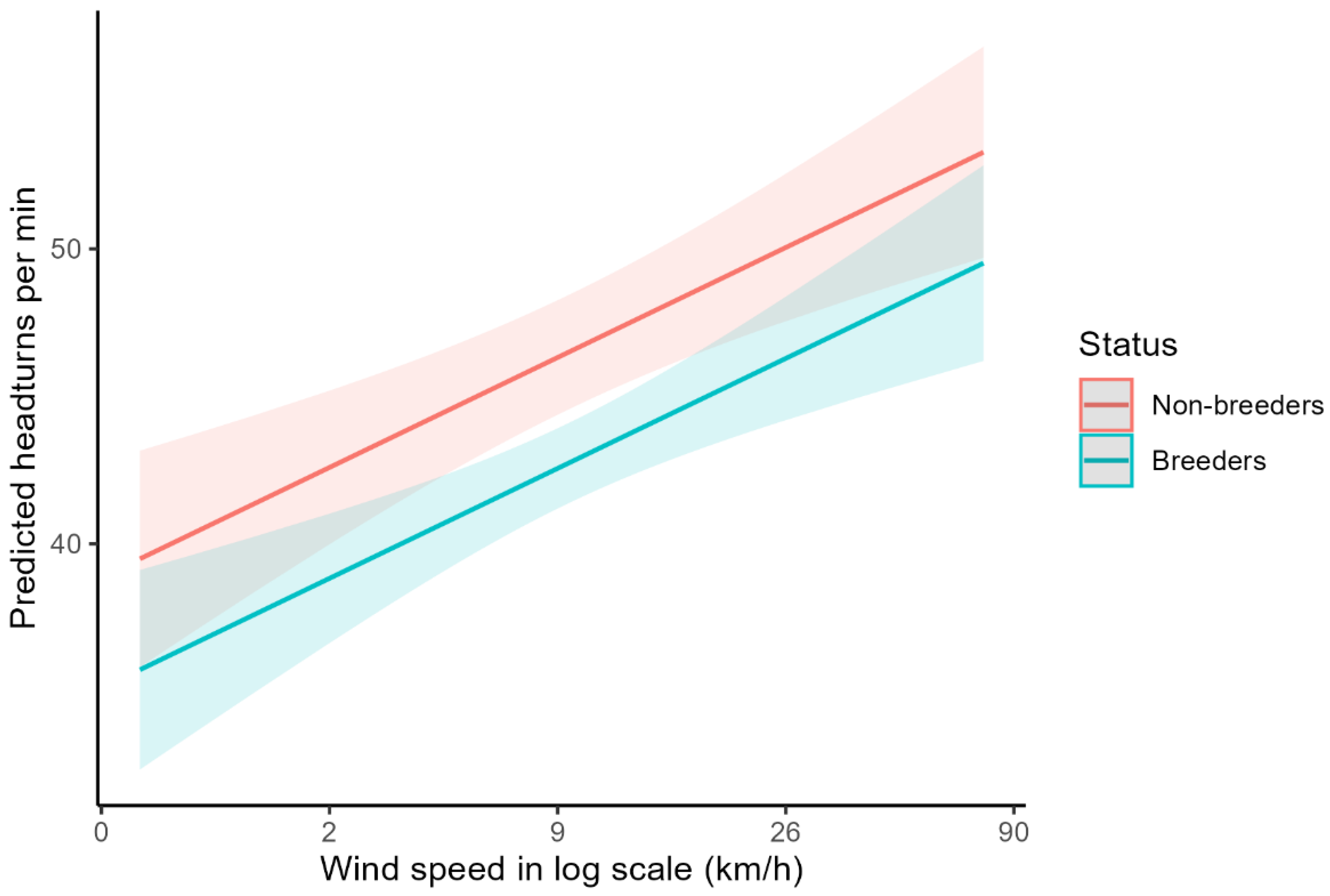
| <0.001 | 1.0–2.7 | 1.9 | Wind speed (log scale) |
| <0.001 | −2.7–−0.9 | −1.8 | Perch height (log scale) |
| Random Effects | |||
| 70.3 | σ2 | ||
| 13.4 | τ00 id | ||
| 0.16 | ICC | ||
| 213 | N id | ||
| 468 | Observations | ||
| 0.17/0.31 | Marginal R2/Conditional R2 | ||
Disclaimer/Publisher’s Note: The statements, opinions and data contained in all publications are solely those of the individual author(s) and contributor(s) and not of MDPI and/or the editor(s). MDPI and/or the editor(s) disclaim responsibility for any injury to people or property resulting from any ideas, methods, instructions or products referred to in the content. |
© 2026 by the authors. Licensee MDPI, Basel, Switzerland. This article is an open access article distributed under the terms and conditions of the Creative Commons Attribution (CC BY) license.
Share and Cite
Beauchamp, G.; Barve, S. Wind Speed Influences Vigilance in Sentinels of a Cooperative Breeder. Birds 2026, 7, 23. https://doi.org/10.3390/birds7020023
Beauchamp G, Barve S. Wind Speed Influences Vigilance in Sentinels of a Cooperative Breeder. Birds. 2026; 7(2):23. https://doi.org/10.3390/birds7020023
Chicago/Turabian StyleBeauchamp, Guy, and Sahas Barve. 2026. "Wind Speed Influences Vigilance in Sentinels of a Cooperative Breeder" Birds 7, no. 2: 23. https://doi.org/10.3390/birds7020023
APA StyleBeauchamp, G., & Barve, S. (2026). Wind Speed Influences Vigilance in Sentinels of a Cooperative Breeder. Birds, 7(2), 23. https://doi.org/10.3390/birds7020023