Article

Visibility, Sound Propagation and Exposure to Predators: Effect of Height on Birds’ Perch Use in a Meadow Habitat


by
Heather Williams
1,* and
Leslie Reed-Evans
2
1
Biology Department, Williams College, Williamstown, MA 01267, USA
2
Williamstown Rural Lands Foundation, Williamstown, MA 01267, USA
*
Author to whom correspondence should be addressed.
Birds 2026, 7(1), 22; https://doi.org/10.3390/birds7010022
Submission received: 16 January 2026 / Revised: 5 March 2026 / Accepted: 10 March 2026 / Published: 16 March 2026

Simple Summary

Artificial perches offer songbirds benefits such as improved audibility and visibility of displays, more efficient insect foraging, and better detection of approaching predators. However, there is a potential cost: increased risk of predation. A study using observations of birds and of fecal boli present on artificial perches in conservation meadows in Williamstown, Massachusetts, found that while species composition did not change, all perches were used, with taller perches being used most frequently. The advantages of using higher, more exposed perches for displaying and foraging appear to outweigh the associated predation risks.

Abstract

Elevated perches allow songbirds to better transmit their songs and increase the visibility of territorial displays, but there is a cost: increased predation risk. To investigate how grassland birds evaluate these tradeoffs, we placed artificial perches in one of four meadows kept open by mowing in Williamstown, Massachusetts. We tracked meadow and perch usage by passerine birds using both a weekly census and monthly counts of fecal boli as a proxy for occupancy of the artificial perches. The same species were observed in the meadow with artificial perches and the meadows without such perches. Nevertheless, all of the artificial perches were used, some extensively. Much of the variation in perch use could be explained by perch height. Birds preferred taller perches, which are the most visible to predators, but also provide the largest advantages in terms of song propagation and visibility for better territory advertisement. Other advantages include increased visibility for foragers hunting insects, as well as possible earlier detection of predators. The increased predation risk of perching in the open on higher perches appears to be offset by the advantages gained by being seen, being heard, and having a better view of the surrounding area.

1. Introduction

Many birds choose to use sites that improve the accurate transmission and reach of their vocal and visual displays to enhance the interplay between senders and receivers that is critical for communication [1,2]. However, conspicuous auditory and visual displays also carry a risk of attracting predators’ attention. The benefits and risks of performing displays from an exposed location are similar to the tradeoffs between foraging and predation risk that have been well characterized [3,4]. Passerine birds’ use of display perches may in part be driven by such tradeoffs, and, consequently, the presence and type of perches may influence whether and how a habitat is occupied.
Acoustic features such as large frequency bandwidths and rapid trills are the most likely to be degraded when sung from a position obstructed by vegetation, and vegetation between the singer and the hearer also decreases the distance over which a song is heard [5]. Rufous-and-white Wrens (Thryophilus rufalbus) choose higher perches when singing [6] which allows for better sound propagation [7]. The songs of Eurasian Wrens (Troglodytes troglodytes) suffer less acoustic degradation when sung from a higher, exposed perch [8], and other males’ territorial responses are weaker to degraded songs [9]. Acoustically degraded songs are perceived differently by their hearers, as male swamp sparrows tutored with both degraded and undegraded songs learn the undegraded songs [10]. A singer’s choice of display site or perch consequently affects the fidelity and range of the signal that reaches the receiver [2].
Birds also choose and adjust their display sites to maximize the visibility of their displays. Satin Bowerbirds (Ptilonorhynchus violaceus) place their bowers below openings in the canopy and orient them so that sunlight better illuminates the male and his display items [11]. Red-capped Cardinals (Paroaria gularis) spend more time in the portions of their territory where they are more visible to conspecifics [12]. Male African Houbara(Chlamydotis undulata) choose display sites that have a larger “viewshed”, which allows females to see male displays from afar [13].
Singing birds’ positioning also reflects sensitivity to predation risk. Northern cardinals (Cardinalis cardinalis) sang from perches more obscured by vegetations when a Cooper’s Hawk (Astur cooperii) was nesting nearby [14], and African savanna birds on concealed perches sing more and are less vigilant than those on exposed perches [15]. Models of Crested Tits (Lophophanes cristatus) that were accompanied by a playback of a long-range call were much more likely to be attacked by a raptor [16]. Birds maximizing the propagation of their displays thus also increase their conspicuousness to predators; perching in an exposed location and singing loudly carries a predation risk.
Birds’ choices of perches are also constrained by the characteristics of their habitat. Over the past decades, open land in much of northeastern North America has shifted from agricultural uses to conservation. Along with this shift have come changes in land use practices that result in old fields and meadows becoming shrub or second-growth habitats, reducing or fragmenting open areas [17]. Practices such as delaying mowing until after the breeding season [18] are used to maintain open habitats. However, mowing prevents the growth of shrubs and small trees that can serve as perches, which might limit the use of otherwise suitable habitat [19]. Mowed meadows without natural perches provide an opportunity for assessing the effects of artificial perches on birds’ signaling and risk avoidance behaviors.
Our study addresses two main questions. First, we asked whether passerine birds would use artificial perches in a mowed meadow, and, if so, whether the preferred perch characteristics would inform us about how the birds evaluate the tradeoffs between visibility, audibility and predation risk. Second, we asked whether the species composition of the passerine birds using the meadow would be affected by the presence of artificial perches. To address these questions, we placed artificial perches within one of four meadows mowed yearly to eliminate secondary growth at a former farm now in conservation use, and censused birds’ use of meadows with and without perches. We also measured fecal bolus accumulation, a proxy for perch use, and asked how it was related to perch spacing, height, vegetation height, and distance from natural perches. We predicted that birds’ use of perches of variable height and exposure would reflect their evaluation of the tradeoffs between an increased risk of predation and the benefits of greater visibility and audibility.

2. Materials and Methods

2.1. Study Site

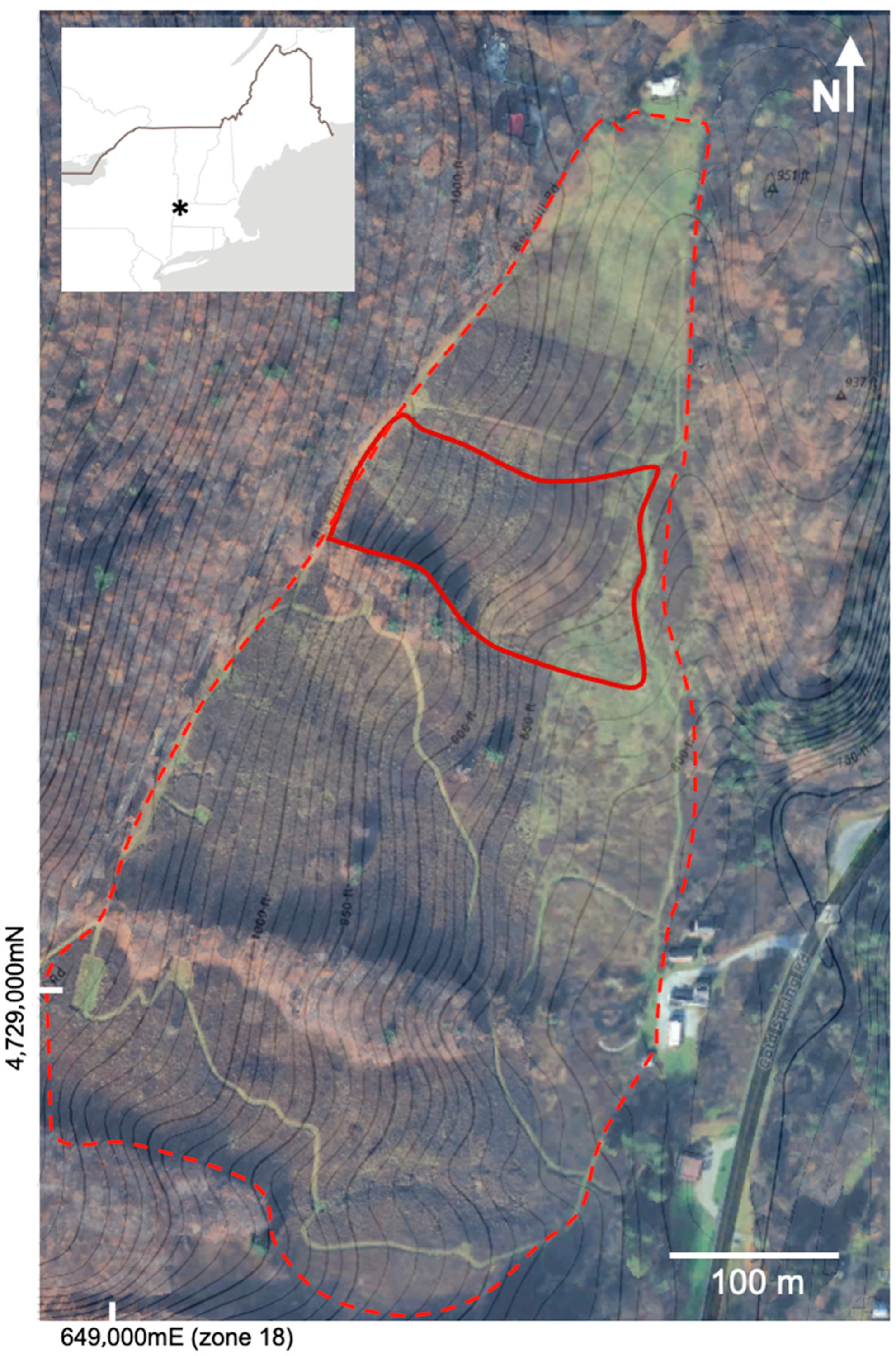
The study site was a 2.25 hectare field at the Williamstown Rural Lands Foundation’s Sheep Hill property in Williamstown, MA (42.6996, −73.2256, WGS84 datum, UTM zone 18; Figure 1). The field lies along a slope (elevation 200–300 m), and is bounded at its eastern base by second-growth woods and at its upper western margin by a mature oak/beech/hemlock forest. The northern and southern sides of the field are defined by seasonally wet drainages and clusters of trees and shrubs. To the north and south of the study field are three additional fields that are similar in topography, vegetation, size, and boundaries. All fields are mowed once yearly, in August or September, to maintain open space. The fields were last grazed 6 years prior to the study, and last hayed 4 years prior to the study. After the late-season mowing regime began, the composition of species shifted from a mix of Phleum pratense (timothy), Dactylis glomerata (orchard grass) and other hay forbs to Galium spp. (bedstraws), Tridens flavus (purpletop), Solidago spp. (goldenrod) and non-native but naturalized flora such as Daucus carota (Queen Anne’s Lace), Trifolium pratense (red clover) and Cirsium arvense (Canada thistle). The taller species reach heights of 1.5 m in late summer.

2.2. Artificial Perches

In April 2007, 45 wooden stakes (2.5 × 2.5 cm cross-section, standing 0.75–1.75 m high) were placed throughout the study meadow to serve as artificial perches. Stakes were chosen in succession from a bundle with variable lengths, and final height depended upon the consistency of the soil: stakes were pounded in far enough to be well fixed, and so the length above ground was reduced by varying amounts. Stakes were placed neither randomly nor at regular intervals, but were scattered across the meadow. The mean inter-stake distance was 17.65 m (standard deviation = 3.91 m). Two stakes were not found in late June (making the June n = 43), and an additional three stakes were added at that time (for a July n = 46).

2.3. Data Collection

One of the authors (LRE) performed a weekly census of birds present at the study site, walking all four meadows between 08:00 and 09:30 AM EDT and noting the species of birds seen on the meadow with artificial perches, on the artificial perches, and in the adjacent meadows.
On 30 June and again on 25 July the stakes were examined and the number of distinct avian fecal boli on the top and sides of each stake and on vegetation within 10 cm of that stake was counted. Some stakes had a fewer fecal boli in July than in June, presumably because of decreased use of that stake as a perch combined with weather removing feces from the stakes (which affected all stakes). We used the fecal bolus count as a cumulative measure of artificial perch use.
On 25 July, the height of each stake above ground level and the height of the tallest vegetation within 1 m of the stake were measured. The height of the vegetation was subtracted from the stake height to determine the relative height of the vegetation. GPS coordinates for each stake were collected, converted to UTM format and plotted on commercially available aerial photographs overlain with USGS contour lines. We then used the coordinates to calculate the distance to the nearest stake. We also measured the distance to the nearest tree or shrub > 1.5 m in height (all of which were on the periphery of the mowed meadow) from the aerial photographs, and used the minimum of the distances to (a) the nearest tree or shrub and (b) the nearest stake as the distance to the nearest alternate perch.

2.4. Data Analysis

We performed statistical analyses in the base R environment [20]. We first checked all variables for normality and skew using functions from the statpsych package (version 1.9.0) [21]. Three variables were not normally distributed and were square-root transformed before being used in statistical models: stake height, July fecal bolus count, and change in fecal bolus count. Linear models including stake height, the distance to the nearest alternate perch, and relative vegetation height (for the July model) as predictors were used to assess relationships with three response variables: fecal bolus counts in June and July as well as the change in fecal bolus counts between June and July. Graphs were prepared using ggplot2 (version 3.5.2) [22].

3. Results

3.1. Species Using Artificial Perches

The passerine species observed using the artificial perches during the 2007 breeding season are listed in Table 1. All of these species were also seen in the three adjacent meadows that lacked artificial perches. No raptors were observed using the artificial perches, although a sharp-shinned hawk (Accipiter striatus) was seen regularly. We did not see any predation take place.
Most of the species observed perching on stakes can be described as “edge” species that are usually found at boundaries between woodlands and open meadows. An exception to this pattern is the field sparrow, most often seen in Solidago meadows. Although one grasshopper sparrow and one Savannah sparrow were heard on the study site early in the breeding season, they did not use the artificial perches, and no other species of grassland birds (e.g., Eastern meadowlarks, Sturnella magna, or bobolinks, Dolichonyx oryzivorus) that occur elsewhere in the region were seen on artificial perches (or elsewhere on the study site).

3.2. Frequency of Artificial Perch Use and Factors Affecting Use

The pattern of fecal bolus accumulation suggests that artificial perches were preferred perching sites in the study meadow. On 25 July, when 587 fecal boli were counted on stakes, exactly two fecal boli were observed on vegetation within one meter of the stakes (a total area of 144 m2, compared to the combined 0.018 m2 area 10 cm of and on the stakes). All of the artificial perches accumulated fecal boli, and the fecal bolus counts spanned a wider range than the counts of bird observations during census sweeps. The stake that accumulated the most fecal boli (32 in June; 71 in July) was frequently used by a male red-winged blackbird, and had approximately 12 times as many as the stake with the least number of boli (3 in June; 6 in July). Because of this pattern, we judged fecal bolus count to be a good proxy for overall perch use.
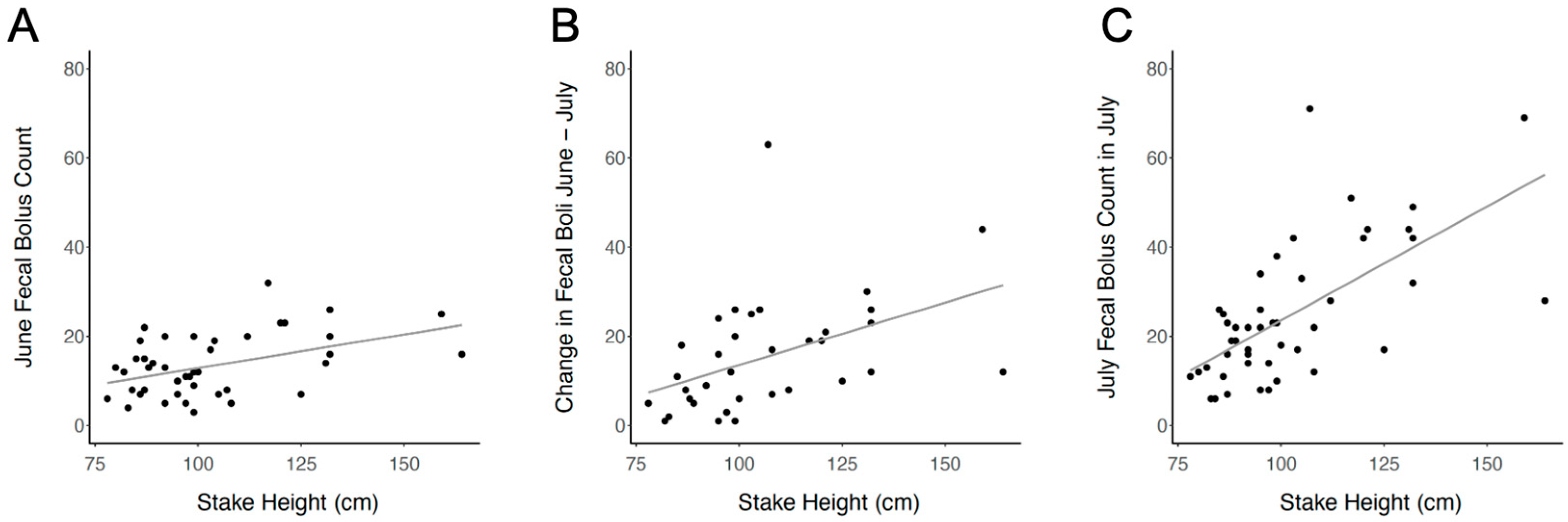
The results of linear models testing which summary variables best predicted fecal bolus counts are shown in Table 2. The full models for the June and July fecal bolus counts as well as the June–July change in fecal bolus counts reached significance (Table 1). For all three models, the only variable that significantly predicted the bolus count was the height of the stake (perch). Both the overall model’s and the stake height’s predictions of fecal bolus accumulation became more accurate as the season progressed. Both the full model and the stake height were most successful at predicting fecal bolus count for the July data.
The July data (r2 = 0.46; Table 2 and Figure 2C), was collected when meadow vegetation had grown substantially higher than it had been in June. The model was not as successful at predicting the June data (r2 = 0.25; Table 2 and Figure 2A). The increase in fecal bolus counts between the June and July counts was intermediate in its prediction by the full model (r2 = 0.30; Table 2 and Figure 2A).

3.3. Spatial Patterns of Artificial Perch Use

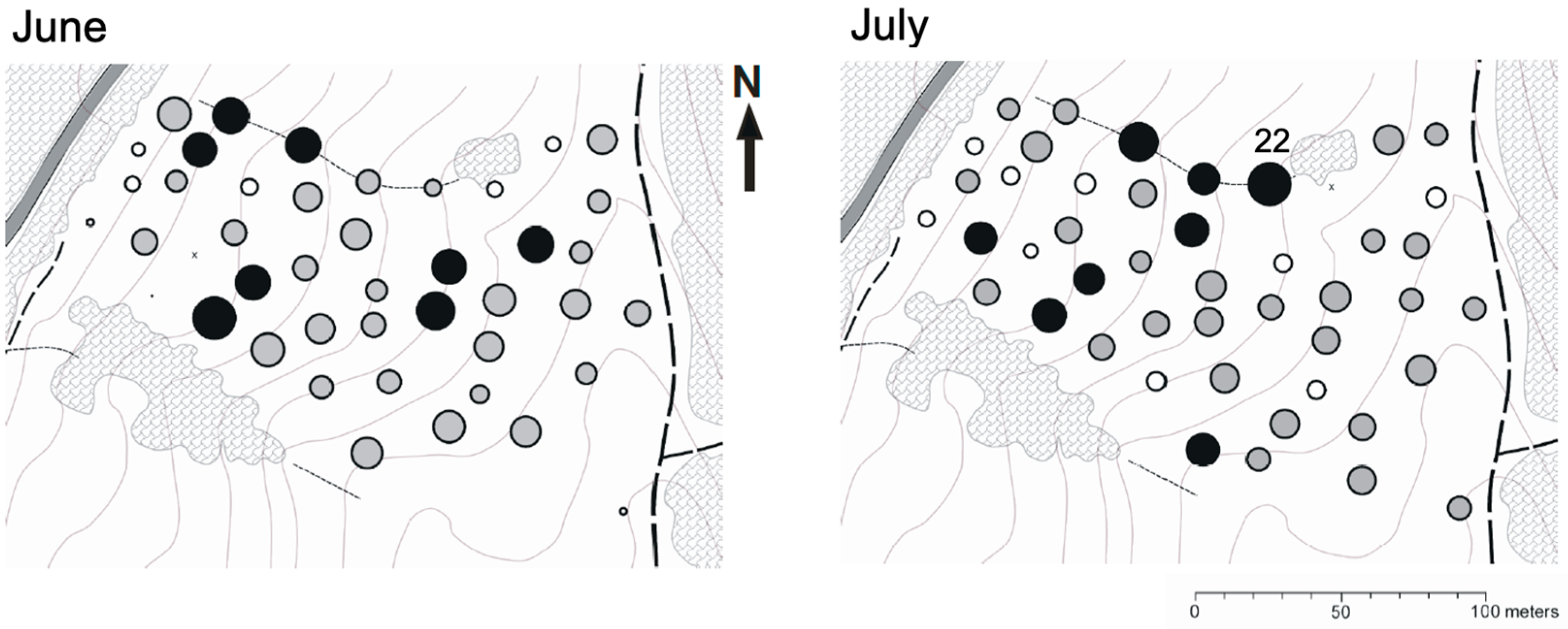
The residuals for a simple regression of fecal bolus count on stake height were calculated for both dates, and plotted on the map of the study area (Figure 3) so that the spatial pattern of stake use, corrected for height, could be examined. Weekly observations suggest that the disproportionately large numbers of fecal boli on stakes near the clump of trees along the north edge of the study field were most likely due to a male red-winged blackbird, seen on at least one of these stakes during each census sweep. One of the stakes which that bird used, no. 22, was the most prominent outlier in the relationship between stake height and fecal bolus count in Figure 2. A song sparrow was seen during most census sweeps on stakes along the south side of the study field, two of which had more fecal boli than would be predicted by their height. These observations suggest that the stakes with larger accumulations of fecal boli than would be predicted by their height were favored by individual birds or pairs, perhaps because of their location with respect to territory boundaries. Other stakes were used less intensively and/or only sporadically by different birds and species, with a frequency that was better predicted by stake height.

4. Discussion

All of the artificial perches, regardless of location, height, or surrounding vegetation, accumulated fecal boli. Despite the fact that rain and weathering periodically removed the feces, we counted as many as 71 boli on a single stake in July, while the stake with the fewest boli had only 6. If we assume that number of fecal boli accumulated was proportional to the time the perch was used, stakes were frequently used as perches and either (1) perching in the meadow was increased by the presence of the stakes or (2) perch use in the study side shifted from vegetation to the stakes. Judging from our census observations, the first alternative—that birds perched more frequently in the meadow (as opposed to the trees and shrubs bordering the meadow) when artificial perches were available—is more likely. Birds in adjacent fields without artificial perches were observed perching on trees and shrubs, but only rarely on meadow vegetation.
One of the characteristics many passerine birds require in a territory is one or more good song perches, and the absence of such perches might limit the use of mowed fields by grassland or meadow species [19]. Apart from the field sparrow, the species we observed on the perches are best described as “edge” species usually found at the boundaries between open and wooded areas; these birds appear to have used the perches to extend their use of habitat into the meadow. Our results are consistent with previous research finding that providing artificial perches in open areas does not change the species composition in those areas [23,24], particularly in relatively small areas such as our study site [25]. However, past results suggest that providing artificial perches may change the population density or spatial patterns of habitat use by existing species [26,27,28]. In our study, small clusters of stakes with large fecal bolus counts probably corresponded to frequent occupation by one or two individual birds, indicating that stake spatial density was high enough to provide multiple perches on a single territory. Man-made objects are frequently used as perches in active farmland [29]. For the whinchat (Saxicola rubetra), a declining grassland species, the presence of perches increased habitat use during the breeding season [30]. Similarly, grassland species including Savannah sparrows, Western Meadowlarks (Sturnella neglecta), Vesper Sparrows (Pooecetes gramineus), and Horned Larks (Eremophila alpestris) were more abundant near shallow oil well heads, which have pipes and fences up to 1.5 m above the ground that the birds use as perches [31,32]. Our results are consistent with these other studies in suggesting that providing artificial perches in conservation areas that are kept clear of secondary growth by mowing or grazing would enhance the habitat for grassland and edge passerine species.
The best predictor of how often a stake was used as a perch was its height: stakes accumulated fecal boli in direct proportion to their height, which was the only significant factor in the linear models that accounted for as much as 48% of the variation in perch use. Past studies disagree about the importance of perch height. Harrison [33] found no overall preference for artificial perches of two different heights (1.5 and 2.0 m), with some species effects, but the perches in that study were very far apart (80 m compared to an average of 17 m in our study). In contrast, Castrale [34] found that several species preferred the taller of closely spaced natural song perches. Payne et al. [35] did not collect systematic data, but suggested that grassland birds chose perches for their height above the vegetation, and Grzyvascewski et al. [36] found that the Aquatic Warbler (Acrocephalus paludicola) sang from higher natural perches when the surrounding vegetation was higher. In our study, higher artificial perches were significantly more likely to be used, emphasizing the importance of using artificial perches that rise to at least 1 m above ground level in meadows.
Artificial perches can provide their users with enhanced opportunities for hearing others and being heard, as singing from higher, more exposed perches facilitates the propagation of songs. Songs that are rich in trills, buzzes, and frequency sidebands are also subject to acoustic degradation when there is vegetation between the singer and the receiver [5,37]. Four of the seven species seen on perches (Red-winged blackbird, Song sparrow, Eastern bluebird, Indigo bunting) have songs with acoustic characteristics that are subject to degradation. Singing from higher perches not only allows a singer to be heard more clearly at a greater distance [6] but also provides advantages for listening to other individuals’ songs as they too are less degraded by intervening vegetation [38,39,40].
Perches that rise above the vegetation also provide a greater “viewshed”, and visual displays from such perches will be visible to more conspecifics [13]. Males of two of the species that used the artificial perches in our study (Indigo buntings and Red-winged blackbirds) have prominent coloration that would be more visible from an exposed perch. Being able to see across the top of meadow or grassland vegetation also allows for easy visual detection of insect prey, and species that forage in this manner prefer higher perches [26,41,42]. Two of the species that we saw on the stakes (Eastern kingbird and least flycatcher) are birds that forage by “hawking” prey that they detect visually, and so would benefit from the wider field of view provided by a higher artificial perch. The addition of stakes to the meadow may have provided enhanced opportunities for both visual advertisement and foraging.
However, using higher, more exposed perches has a potential cost: increased susceptibility to predation [43]. We observed no predation events during our study, and so we cannot quantify predation risk, but the taking of prey is notoriously difficult to observe [44]. One raptor that specializes in small songbirds, the Sharp-shinned Hawk (Accipiter striatus), was seen frequently at the study site, strongly suggesting that birds in our study area were at risk of predation during time spent on exposed perches. Songbirds are known to adjust their use of perches and song posts based on the current or recent presence of predators by singing from perches that are either less exposed [14,15] or that allow for increased anti-predator vigilance [45]. In mixed-species flocks, Willow Tits (Poecile montanus) tend to occupy the higher, more exposed foraging sites, but if they are removed, Crested Tits (Lophophanes cristatus) move up to those exposed sites, suggesting that increased exposure is counterbalanced by increased foraging opportunities and earlier predator detection [46]. The tradeoffs between the costs and benefits of an exposed perch appear to vary based on individual differences in vigilance and risk tolerance in Collared Flycatchers (Ficedula albicollis) [47]. The risk of increased visibility to predators for birds that occupied the higher, more exposed artificial perches in our study area may have been in part offset by the better view of the surroundings, which provided opportunities for increased vigilance. The benefits for communication and foraging of using the artificial perches may outweigh the potential predation risk after adjusting for the benefit of earlier detection of predators, and so result in the extensive use that we observed.
Our study has some limitations. We only placed stakes within a single meadow at one study site, and birds within a different set of meadows or a different ecosystem may respond differently to the availability of artificial perches. Although we found no significant effect of vegetation height relative to perch height on fecal bolus count in a linear model that included other variables, our measure of vegetation height occurred at a single time point (when the meadow vegetation was highest during the study) and the fecal bolus counts were cumulative so they reflect the perch usage only at the time vegetation height was measured. A future study that manipulated vegetation height could clarify the possible role of vegetation height relative to perch height.
Providing artificial perches in meadows and fields that are managed by mowing appears to provide birds that might not otherwise use these areas the opportunity to move into open areas as singers and foragers. Territorial singers are most likely to use clusters of perches near the focus of their territories. Foragers are likely to use a variety of perches, perhaps shifting with insect densities within the field. In the context of conservation, one concern in providing artificial perches is that they may set up an “ecological trap”—attracting birds to an area that lacks other resources needed to support them or increases the risk of predation [48]. The patterns we observed, larger fecal bolus counts on higher stakes and the same species present in meadows with and without stakes, suggest that such issues are not important even when a high density of perches is provided and they are used extensively. The tradeoff between advantages (signaling, foraging, better visibility) and disadvantages (predation risk) of perching on higher stakes appears to be weighted in favor of the advantages.

5. Conclusions

Artificial perches were readily and extensively used by passerine birds in a mowed meadow habitat. Fecal boli accumulated on all stakes placed in the meadow, confirming their frequent use as perches. The species present in the meadow with artificial perches and three nearby meadows without perches did not differ; edge-associated species tended to occupy the perches, extending their use of habitat into portions of the meadow.
The height of a stake strongly predicted the number of fecal boli that accumulated on that stake. Elevated perches enhance key behavioral and ecological functions such as acoustic transmission of songs, viewing visual displays, and foraging for insects. Although using the perches is also likely to increase predation risk, the extensive use we observed suggests that the behavioral and ecological benefits of elevated perch use likely outweighs any potential costs.
Our study was limited to a single meadow system and we did not manipulate vegetation height or directly quantify predation risk. Nevertheless, the data provide clear evidence that artificial perches placed in meadows that lack natural perches are readily used by passerines. From a conservation perspective, incorporating artificial perches that rise at least 1 m above ground level into managed grasslands and conservation areas may be a low-cost strategy that supports territory establishment, communication, and foraging by passerine birds.

Supplementary Materials

The following supporting information can be downloaded at https://www.mdpi.com/article/10.3390/birds7010022/s1, Figure S1: a photograph of a stake used as an artificial perch with fecal boli indicated, Table S1: the full data set for stake characteristics and fecal boli accumulation.

Author Contributions

Conceptualization and methodology, H.W. and L.R.-E.; stake data collection, H.W.; bird census data collection and management of meadows, L.R.-E.; writing—original draft preparation, H.W., writing—review and editing, H.W. and L.R.-E.; visualization, H.W. All authors have read and agreed to the published version of the manuscript.

Funding

This research received no external funding.

Institutional Review Board Statement

Ethical review and approval were waived for this study because no birds were captured or stimulated with visual or auditory stimuli.

Informed Consent Statement

Not applicable.

Data Availability Statement

A data table including stake locations, heights, vegetation height, location of nearest stakes and trees, and fecal boli can be found in the Supplementary Materials.

Acknowledgments

We thank A. Dunlavey, C. Hart, I. Kleiser, Z. Remillard, and J. Ziemek for assistance with fieldwork, and the Williamstown Rural Lands Foundation, which administers the field site, for permission to use their facilities for this study.

Conflicts of Interest

The authors declare no conflicts of interest.

References

  1. Elie, J.E.; Hoffmann, S.; Dunning, J.L.; Coleman, M.J.; Fortune, E.S.; Prather, J.F. From Perception to Action: The Role of Auditory Input in Shaping Vocal Communication and Social Behaviors in Birds. Brain Behav. Evol. 2019, 94, 51–60. [Google Scholar] [CrossRef]
  2. Podos, J.; Webster, M.S. Ecology and Evolution of Bird Sounds. Curr. Biol. 2022, 32, R1100–R1104. [Google Scholar] [CrossRef]
  3. Houston, A.I.; McNamara, J.M.; Hutchinson, J.M.C. General Results Concerning the Trade-off between Gaining Energy and Avoiding Predation. Philos. Trans. R. Soc. B Biol. Sci. 1993, 341, 375–397. [Google Scholar] [CrossRef]
  4. Bonter, D.N.; Zuckerberg, B.; Sedgwick, C.W.; Hochachka, W.M. Daily Foraging Patterns in Free-Living Birds: Exploring the Predation–Starvation Trade-Off. Proc. R. Soc. B 2013, 280, 20123087. [Google Scholar] [CrossRef] [PubMed]
  5. Wiley, R.H. Associations of Song Properties with Habitats for Territorial Oscine Birds of Eastern North America. Am. Nat. 1991, 138, 973–993. [Google Scholar] [CrossRef]
  6. Barker, N.K.S.; Mennill, D.J. Song Perch Height in Rufous-and-White Wrens: Does Behaviour Enhance Effective Communication in a Tropical Forest? Ethology 2009, 115, 897–904. [Google Scholar] [CrossRef]
  7. Barker, N.K.S.; Dabelsteen, T.; Mennill, D.J. Degradation of Male and Female Rufous-and-White Wren Songs in a Tropical Forest: Effects of Sex, Perch Height, and Habitat. Behaviour 2009, 146, 1093–1122. [Google Scholar] [CrossRef]
  8. Mathevon, N.; Aubin, T.; Dabelsteen, T. Song Degradation during Propagation: Importance of Song Post for the Wren Troglodytes troglodytes. Ethology 1996, 102, 397–412. [Google Scholar] [CrossRef]
  9. Mathevon, N.; Aubin, T. Reaction to Conspecific Degraded Song by the Wren Troglodytes troglodytes: Territorial Response and Choice of Song Post. Behav. Process. 1997, 39, 77–94. [Google Scholar] [CrossRef]
  10. Peters, S.; Derryberry, E.P.; Nowicki, S. Songbirds Learn Songs Least Degraded by Environmental Transmission. Biol. Lett. 2012, 8, 736–739. [Google Scholar] [CrossRef]
  11. Doucet, S.M.; Montgomerie, R. Bower Location and Orientation in Satin Bowerbirds: Optimising the Conspicuousness of Male Display? Emu-Austral Ornithol. 2003, 103, 105–109. [Google Scholar] [CrossRef][Green Version]
  12. Eason, P.; Stamps, J. The Effect of Visibility on Space Use by Territorial Red-Capped Cardinals. Behaviour 2001, 138, 19–30. [Google Scholar] [CrossRef]
  13. Ucero, A.; Alonso, J.C.; Palacín, C.; Abril-Colón, I.; Álvarez-Martínez, J.M. Display Site Selection in a Ground Dwelling Bird: The Importance of Viewshed. Behav. Ecol. 2023, 34, 223–235. [Google Scholar] [CrossRef]
  14. Duncan, W.J.; Bednekoff, P.A. Singing in the Shade: Song and Song Posts of Northern Cardinals near Nesting Cooper’s Hawks. Can. J. Zool. 2006, 84, 916–919. [Google Scholar] [CrossRef]
  15. Campos, D.P.; Bander, L.A.; Raksi, A.; Blumstein, D.T. Perch Exposure and Predation Risk: A Comparative Study in Passerines. Acta Ethologica 2009, 12, 93–98. [Google Scholar] [CrossRef]
  16. Krams, I. Communication in Crested Tits and the Risk of Predation. Anim. Behav. 2001, 61, 1065–1068. [Google Scholar] [CrossRef]
  17. Hall, B.; Motzkin, G.; Foster, D.R.; Syfert, M.; Burk, J. Three Hundred Years of Forest and Land-use Change in Massachusetts, USA. J. Biogeogr. 2002, 29, 1319–1335. [Google Scholar] [CrossRef]
  18. Warren, K.A.; Anderson, J.T. Grassland Songbird Nest-Site Selection and Response to Mowing in West Virginia. Wildl. Soc. Bull. 2005, 33, 285–292. [Google Scholar] [CrossRef]
  19. Lack, D. Habitat Selection in Birds. With Special Reference to the Effects of Afforestation on the Breckland Avifauna. J. Anim. Ecol. 1933, 2, 239. [Google Scholar] [CrossRef]
  20. R Core Team. R: A Language and Environment for Statistical Computing; R Foundation for Statistical Computing: Vienna, Austria, 2021; Available online: https://www.R-project.org (accessed on 9 April 2025).
  21. Bonett, D.G. Statpsych: Statistical Methods for Psychologists. 2026. Available online: https://CRAN.R-project.org/package=statpsych (accessed on 12 January 2026).
  22. Wickham, H. Ggplot2: Elegant Graphics for Data Analysis; Springer: New York, NY, USA, 2016. [Google Scholar]
  23. Vickery, P.D.; Hunter, M.L. Do Artificial Song-Perches Affect Habitat Use by Grassland Birds in Maine? Am. Midl. Nat. 1995, 133, 164. [Google Scholar] [CrossRef]
  24. Furey, M.A.; Burhans, D.E. Territory Selection by Upland Red-Winged Blackbirds in Experimental Restoration Plots. Wilson J. Ornithol. 2006, 118, 391–398. [Google Scholar] [CrossRef]
  25. Vickery, P.D.; Hunter, M.L.; Melvin, S.M. Effects of Habitat Area on the Distribution of Grassland Birds in Maine. Conserv. Biol. 1994, 8, 1087–1097. [Google Scholar] [CrossRef]
  26. Yosef, R. Influence of Observation Posts on Territory Size of Northern Shrikes. Wilson Bull. 1993, 105, 180–183. [Google Scholar]
  27. Knodel-Montz, J.J. Use of Artificial Perches on Burned and Unburned Tallgrass Prairie. Wilson Bull. 1981, 93, 547–548. [Google Scholar]
  28. Jensen, W.E.; Cully, J.F. Density-Dependent Habitat Selection by Brown-Headed Cowbirds (Molothrus ater) in Tallgrass Prairie. Oecologia 2005, 142, 136–149. [Google Scholar] [CrossRef]
  29. Pustkowiak, S.; Kwieciński, Z.; Lenda, M.; Żmihorski, M.; Rosin, Z.M.; Tryjanowski, P.; Skórka, P. Small Things Are Important: The Value of Singular Point Elements for Birds in Agricultural Landscapes. Biol. Rev. 2021, 96, 1386–1403. [Google Scholar] [CrossRef]
  30. Border, J.A.; Henderson, I.G.; Redhead, J.W.; Hartley, I.R. Habitat Selection by Breeding Whinchats Saxicola rubetra at Territory and Landscape Scales. Ibis 2017, 159, 139–151. [Google Scholar] [CrossRef]
  31. Rodgers, J.A.; Koper, N. Shallow Gas Development and Grassland Songbirds: The Importance of Perches. J. Wildl. Manag. 2017, 81, 406–416. [Google Scholar] [CrossRef]
  32. Hamilton, L.E.; Dale, B.C.; Paszkowski, C.A. Effects of Disturbance Associated with Natural Gas Extraction on the Occurrence of Three Grassland Songbirds. Avian Conserv. Ecol. 2011, 6, 7. [Google Scholar] [CrossRef]
  33. Harrison, K.G. Perch Height Selection of Grassland Birds. Wilson Bull. 1977, 89, 486–487. [Google Scholar]
  34. Castrale, J.S. Selection of Song Perches by Sagebrush-Grassland Birds. Wilson Bull. 1983, 95, 647–655. [Google Scholar]
  35. Payne, N.F.; Kobal, S.N.; Ludwig, D.R. Perch Use by 7 Grassland Bird Species in Northern Illinois. Trans. Ill. State Acad. Sci. 1998, 91, 77–83. [Google Scholar]
  36. Grzywaczewski, G.; Osiejuk, T.S.; Cios, S.; Marczakiewicz, P. Song Post Selection in the Aquatic Warbler Acrocephalus paludicola. Ann. Zool. Fenn. 2014, 51, 495–500. [Google Scholar] [CrossRef][Green Version]
  37. Wiley, R.H.; Richards, D.G. Adaptations for Acoustic Communication in Birds: Sound Transmission and Signal Detection. In Acoustic Communication in Birds; Volume 1. Production, Perception, and Design Features of Sounds; Kroodsma, D.E., Miller, E.H., Eds.; Academic Press: New York, NY, USA, 1982; pp. 131–181. [Google Scholar]
  38. Blumenrath, S.; Dabelsteen, T. Degradation of Great Tit (Parus major) Song Before and After Foliation: Implications for Vocal Communication in a Deciduous Forest. Behaviour 2004, 141, 935–958. [Google Scholar] [CrossRef]
  39. Mathevon, N.; Dabelsteen, T.; Blumenrath, S.H. Are High Perches in the Blackcap Sylvia atricapilla Song or Listening Posts? A Sound Transmission Study. J. Acoust. Soc. Am. 2005, 117, 442–449. [Google Scholar] [CrossRef]
  40. Brzozowski, R.; Kobrina, A.; Mahoney, S.M.; Pasch, B. Advertising and Receiving from Heights Increases Transmission of Vocalizations in Semi-Arboreal Mice. Behav. Ecol. Sociobiol. 2023, 77, 83. [Google Scholar] [CrossRef]
  41. Bohall-Wood, P. Abundance, Habitat Use, and Perch Use of Loggerhead Shrikes in North-Central Florida. Wilson Bull. 1987, 99, 82–86. [Google Scholar]
  42. Guilfoyle, M.P.; Fischer, R.A.; Wakeley, J.S. Perch Characteristics of Acadian Flycatchers (Empidonax virescens) in Southern Bottomland Hardwood Forests. Southeast. Nat. 2002, 1, 353–364. [Google Scholar] [CrossRef]
  43. Møller, A.P.; Nielsen, J.T.; Garamszegi, L.Z. Song Post Exposure, Song Features, and Predation Risk. Behav. Ecol. 2006, 17, 155–163. [Google Scholar] [CrossRef]
  44. Mills, N. Techniques to Evaluate the Efficacy of Natural Enemies. In Methods in Ecological and Agricultural Entomology; CAB International: Wallingford, UK, 1997; pp. 271–291. [Google Scholar]
  45. Krams, I. Perch Selection by Singing Chaffinches: A Better View of Surroundings and the Risk of Predation. Behav. Ecol. 2001, 12, 295–300. [Google Scholar] [CrossRef][Green Version]
  46. Krams, I.I. Seeing without Being Seen: A Removal Experiment with Mixed Flocks of Willow and Crested Tits Parus montanus and cristatus. Ibis 2001, 143, 476–481. [Google Scholar] [CrossRef]
  47. Garamszegi, L.Z.; Eens, M.; Török, J. Birds Reveal Their Personality When Singing. PLoS ONE 2008, 3, e2647. [Google Scholar] [CrossRef]
  48. Battin, J. When Good Animals Love Bad Habitats: Ecological Traps and the Conservation of Animal Populations. Conserv. Biol. 2004, 18, 1482–1491. [Google Scholar] [CrossRef]
Figure 1. Study Site. The meadow where stakes were placed is outlined with a solid red line. The dashed red outline bounds the other meadows at the Williamstown Rural Lands Foundation’s Sheep Hill property. The asterisk in the inset at top left shows the location of the study site within the northeast United States. Contour lines (elevations in feet) from the United States Geographical Survey (Williamstown 7.5 min quadrangle) are shown as gray lines (elevations in feet). Aerial imagery from Google Maps.
Birds 07 00022 g001
Figure 2. Fecal bolus counts as a function of stake height. (A) Fecal bolus counts on June 25 as a function of stake height. (B) Fecal bolus counts on July 30, as a function of stake height. (C) Change in fecal bolus counts from 25 June to 30 July as a function of stake height. Negative changes are thought to result from rain storms washing fecal boli off the stakes. See Table 2 for statistical analysis. The most prominent outlier, with a stake height of 107 cm and a July count of 71 fecal boli, corresponds to stake 22.
Birds 07 00022 g002
Figure 3. Spatial patterns of artificial perch use after accounting for stake height. The area of each circle represents the number of fecal boli on a stake, after correcting for stake height, and normalized to the maximum for each date (32 for 30 June, and 71 for 25 July). Stakes that accumulated at least one SD more than the mean number of boli are shown in black; those with at most one SD less than the mean in white; those within one SD of the mean in gray. Solid line = gravel road; dashed lines = trails; dotted lines = drainages; filled areas = wooded areas; contour line interval = 7 m. The position of stake 22, the prominent outlier in Figure 2C (71 fecal boli on a 107 cm stake), is shown on the July map. Positions marked with an x denote stakes that were not found during a fecal bolus count.
Birds 07 00022 g003
Table 1. Passerine species observed at the study site.
Passerine Species ObservedArtificial Perch Use
Agelaius phoeniceus (Red-winged Blackbird)++++++
Melospiza melodia (Song Sparrow)+++++
Tyrannus tyrannus (Eastern Kingbird)+++++
Sialia sialis (Eastern Bluebird)+++
Spizella pusilla (Field Sparrow)++
Passerina cyanea (Indigo Bunting)+
Empidonax minimus (Least Flycatcher)+
Ammodramus savannarum (Grasshopper Sparrow)
Passerculus sandwichensis (Savannah Sparrow)
Species not seen using artificial perches are denoted by a minus sign. The frequency of perch use is indicated by the number of plus signs: 1 = once, 2 = twice, 3 = three times, 5 = most census sweeps, 6 = all census sweeps.
Table 2. Factors predicting bolus accumulation on artificial perches.
EstimateSEtp
June 25
full model r2 = 0.25, F(2,41) = 6.88, p = 0.003
Intercept−30.18311.768−2.4130.014
Stake height3.5381.0113.4490.002
Nearest alternate perch0.4990.2751.8450.072
Change
full model r2 = 0.30, F(3,40) = 5.61, p = 0.0026
Intercept−75.05724.472−3.1980.003
Stake height8.0572.0173.9950.0003
Nearest alternate perch0.3430.5400.6350.473
July 30
full model r2 = 0.49, F(3,42) = 11.95, p = 9 × 10⁻⁶
Intercept−6.0652.755−2.2020.033
Stake height0.9430.2553.7040.0006
Relative vegetation height0.0080.0090.9420.352
Nearest alternate perch0.0850.0511.6890.099
Results of linear models of the relationships between stake (perch) height above the ground, maximum vegetation height within 1 m of each stake in July, and distance to the nearest alternate perch. Stake height, July fecal bolus counts, and change in fecal bolus counts did not have normal distributions and were square-root transformed prior to running the model. Bold type denotes significant factors.
Disclaimer/Publisher’s Note: The statements, opinions and data contained in all publications are solely those of the individual author(s) and contributor(s) and not of MDPI and/or the editor(s). MDPI and/or the editor(s) disclaim responsibility for any injury to people or property resulting from any ideas, methods, instructions or products referred to in the content.