
Article

Combined Effects of Plateau Pikas (Ochotona curzoniae) and Yak Grazing (Bos grunniens) on Habitat Suitability for Alpine Passeridae Birds in Xizang Plateau, China

Key Laboratory of Biodiversity and Environment on the Qinghai-Tibetan Plateau, School of Ecology and Environment, Xizang University, Lhasa 850000, China
*
Author to whom correspondence should be addressed.
Birds 2026, 7(1), 14; https://doi.org/10.3390/birds7010014
Submission received: 2 December 2025 / Revised: 13 February 2026 / Accepted: 14 February 2026 / Published: 24 February 2026

Simple Summary

We assessed how plateau pikas and yak grazing jointly affect the habitat suitability and occupancy of three endemic alpine passeridae species in Riduo Township, Xizang Autonomous Region, China. Using systematic transect surveys and occupancy modeling across five grazing regimes, we found that White-rumped and Rufous-necked Snowfinch occupancy was positively associated with pika burrow density and proximity to yak bedding sites, whereas the Ground Tit showed no such pattern. These results highlight how interactions between a small ecosystem engineer and a large herbivore shape microhabitats for alpine birds in Xizang rangelands.

Abstract

The combined effects of plateau pikas and yak grazing on the distribution or occupancy of endemic passeridae birds on the Qinghai-Tibetan plateau, China remain largely unknown. To assess habitat selection patterns within the frameworks of niche construction theory and the rivet hypothesis, we measured the occupancy rates of passeridae species along five sample strips of transects established in a treeless ecosystem. Each transect was surveyed three times within each seasonal sampling window (spring, summer, and autumn 2024), and repeated visits were treated as detection occasions for occupancy modeling. We used plateau pika density and yak grazing patterns as key variables to investigate their influence on the occupancy of alpine passeridae birds. We found that the occupancy of both the White-rumped and Rufous-necked Snowfinch was positively associated with proximity to yak bedding sites and high densities of plateau pika burrows. However, the occupancy of both species declined with increasing distance from yak bedding areas. In contrast, the Ground Tit showed no detectable association with these variables. This strong interspecific variation underscores the importance of disentangling mechanistic linkages among large herbivores, ecosystem engineers, and avian niche specialization in this fragile biome. Further research should explore how cross-taxa interactions mediate habitat availability and species resilience under ongoing environmental change.

1. Introduction

Habitat loss and fragmentation, driven by anthropogenic activities such as accelerating population growth, infrastructure development, livestock grazing, and climate change, pose significant threats to global biodiversity [1,2]. Meanwhile factors like vegetation type, water availability, and topography shape species distributions [3] and niche construction, the process by which organisms actively modify their environments, providing a critical lens for understanding ecological dynamics [4,5,6]. Ecosystem engineers such as beavers (Castor) reshape aquatic habitats through dam-building [7], while plateau pikas (Ochotona curzoniae) and domestic yaks (Bos grunniens) alter the structure and function of Qinghai-Tibetan Plateau rangelands [8,9,10]. These rangelands are comparable to Africa’s Serengeti in ecological significance [10] and support unique assemblages of wildlife and livestock, whose interactions can be framed by niche construction theory.
Yaks are the dominant livestock species in Tibetan nomadic areas, exhibiting distinct grazing patterns characterized by seasonal migration between daytime foraging areas and nighttime bedding sites [8,11]. Their grazing activities and associated livestock management affect the occupancy of plateau pikas, a small lagomorph endemic to the alpine steppes and meadows of the Qinghai-Tibetan Plateau China [8,12].
Despite their ecological importance as burrowers that enhance microhabitat heterogeneity [13], pikas remain contentious due to perceived competition with livestock and potential contributions to grassland degradation [8,14]. Recent studies suggest that their impacts on vegetation and soil metrics, such as coverage, diversity, and biomass, vary with disturbance intensity [15], highlighting their dual role as both ecosystem engineers and agents of ecological trade-offs.
Within this system, alpine passeridae birds, notably altitudinal migrants representing ~13% of the regional avifauna [16], serve as key indicators of habitat quality. Prior work has explored linkages between yak grazing, pika activity, and avian occupancy [17,18], yet mechanisms underpinning these associations remain poorly resolved. This study investigates how microhabitat transformation by yaks and pikas influences the distribution of specialized passeridae species. We examine how yak bedding sites and pika burrow density jointly shape habitat suitability for specialized alpine passeridaes.
Livestock grazing is a significant land-use practice that variably affects bird communities globally. In temperate grasslands, moderate grazing can enhance habitat heterogeneity, supporting grassland bird populations by reducing the dominance of certain plant species and increasing plant diversity. This habitat heterogeneity provides critical foraging and nesting sites for a variety of avian species [19]. However, when grazing intensity exceeds sustainable levels, it can lead to soil degradation, reduced plant diversity, and consequently, a decline in bird species richness [20].
Studies in Mediterranean forest [21] and mountain [22] landscapes show that excessive grazing can degrade soil quality and reduce vegetation productivity, negatively affecting habitat suitability for birds. Livestock grazing, especially by cattle and sheep, plays a crucial role in maintaining habitats for many ground-foraging bird species. It helps control shrub and tree overgrowth, ensuring the persistence of herbaceous plants that are essential food sources for these birds. However, overgrazing can reduce the availability of suitable nesting sites and food resources, further emphasizing the need for sustainable grazing management to preserve biodiversity.
In tropical savannas, grazing by large herbivores such as cattle influences bird communities by creating open areas that some species favor for nesting and foraging. These areas also support higher insect densities, which constitute an important food source for insectivorous birds. However, intensive grazing pressure may displace smaller bird species, especially those reliant on areas with denser vegetation [23]. The negative impacts of overgrazing in these ecosystems underscore the importance of managing grazing intensity to ensure long-term bird population stability.
In South America, particularly in the Pampa region, grazing affects bird communities by altering plant species composition and food resource availability. The impacts of grazing in these areas vary with grazing intensity; however, studies show that sustainable practices can help maintain bird diversity by preventing overgrazing and habitat degradation [24]. Similarly, in floodplain woodlands, moderate grazing enhances bird habitat suitability by promoting diverse plant communities that provide food and shelter for various avian species [25].
Overall, the impact of grazing on bird communities is contingent upon regional differences in ecosystem characteristics and management practices. While moderate grazing can support bird populations by enhancing habitat diversity, improper management, particularly overgrazing, can lead to habitat degradation and a decline in avian diversity. Effective grazing management, incorporating techniques such as rotation and restricted grazing periods, is crucial for maintaining bird diversity and ecosystem health across diverse regions.
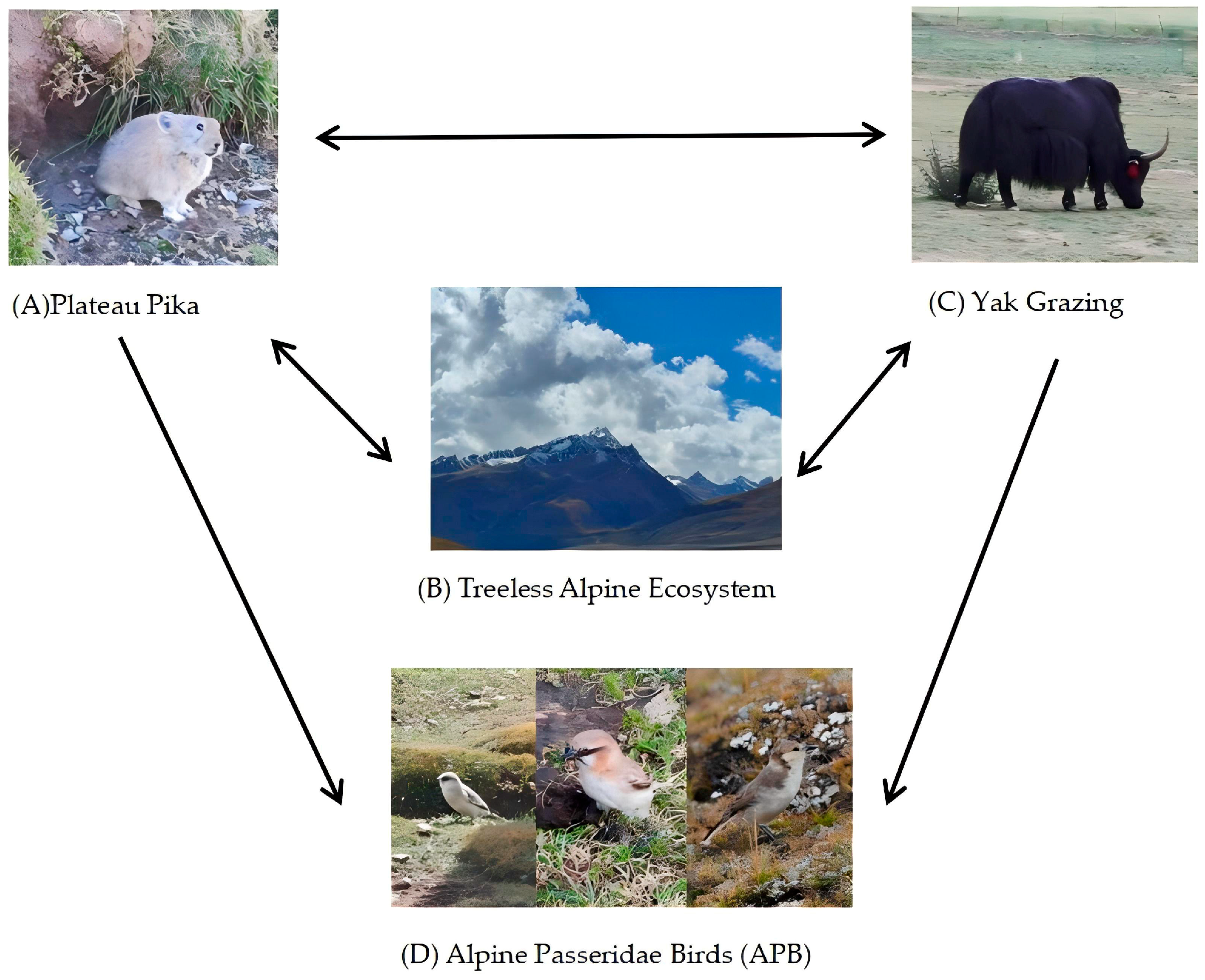
We aimed to quantify how plateau pika engineering (burrow density) and yak grazing (proximity to bedding sites) jointly influence the habitat selection and occupancy of three endemic alpine passeridae species in Riduo Township, Xizang Autonomous Region, China. We establish the systematic structure of the cyclic influence of the three in our study (Figure 1). We tested the following hypotheses: (1) Microhabitat engineering by plateau pikas (burrow construction) enhances local habitat suitability and influences the species occupancy rate for snowfinch species by providing critical nesting sites and refugia. (2) Yak bedding areas enrich local food resources (e.g., dung-associated arthropods), thereby indirectly promoting avian occupancy and influence the species occupancy rate. Based on these hypotheses, we made three specific predictions: (1) The occupancy probability of the White-rumped Snowfinch (Onychostruthus taczanowskii) and Rufous-necked Snowfinch (Pyrgilauda ruficollis) will be positively correlated with pika burrow density; (2) the occupancy probability of these snowfinches will decline with increasing distance from yak bedding sites; and (3) the Ground Tit (Pseudopodoces humilis) will show no significant association with pika burrow density or proximity to yak bedding sites, owing to its different nesting ecology.

2. Materials and Methods

2.1. Study Area

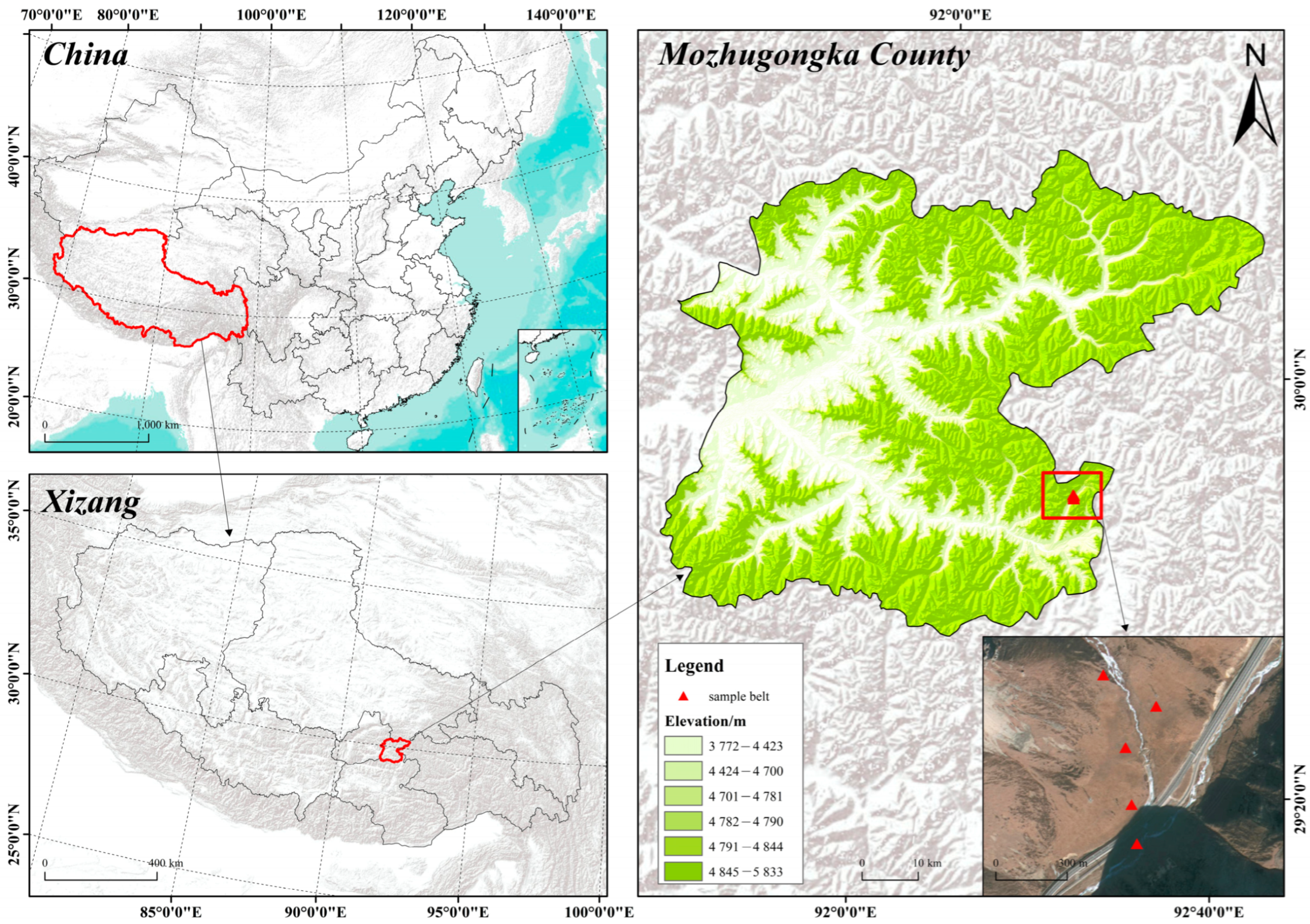
The study area (29°46′11″ N, 92°19′24″ E) encompasses a pastoral region in the Nyian (Nian) Valley of RiDuo Township, Medrogongkar (Mozhugongka) County, Lhasa Prefecture, within the Xizang Autonomous Region of China (Figure 2). The study area, located at an elevation of 4423–5013 m a.s.l., encompasses approximately 22 km2. For sample plot selection, we prioritized sites that collectively represented features four dominant ecological landscapes: (1) typical plateau steppe; (2) shrub-influenced plateau steppe; (3) plateau swamp steppe; (4) bare mountainous slopes [26]. The study area is situated in an alpine meadow ecosystem, dominated by typical high-altitude sedges of the genus Kobresia, with key species including Carex parvula (Kobresia pygmaea), Carex deasyi (K. schoenoides), and Carex bonatiana (K. fragilis) [8]. The plant community structure is simple, with a short herbaceous layer (generally 3–10 cm in height) [27] and a brief growing season. Medrogongkar County is characterized by a typical plateau temperate semi-arid continental monsoon climate. The mean annual temperature is 5.6 °C, with the coldest month averaging –5.4 °C and the warmest month 14.1 °C, and a frost-free period of approximately three months. Solar radiation is intense, with annual sunshine duration ranging from 2278 to 3028 h and a sunshine percentage of 60–65%. Mean annual precipitation between 2003 and 2022 was 424.48 mm, exhibiting substantial interannual variability (maximum: 526.74 mm; minimum: 289.08 mm) [28]. Domestic yaks forage freely across these habitats during daylight hours, while their nighttime bedding sites, which are clustered near tent settlements, are patchily distributed [11,26]. The animal community is dominated by the domestic yak (Bos grunniens), which is the primary economic livestock species. Other wild mammals present in the area include the himalayan marmot (Marmota himalayana), blue sheep (Pseudois nayaur), tibetan gazelle (Procapra picticaudata), plateau hare (Lepus oiostolus), stoliczka’s mountain vole (Alticola stoliczkanus), and the tibetan fox (Vulpes ferrilata), among others [29]. The avian community consists mainly of high-altitude passeridaes, primarily including the Rufous-necked Snowfinch, White-rumped Snowfinch, and Ground Tit [18,30]. Raptors such as the saker falcon (Falco cherrug) and the upland buzzard (Buteo hemilasius) are also present. This study area offers several notable advantages: a relatively high baseline elevation, a broad elevational gradient, distinctive geomorphological features and topographic heterogeneity, and rich biodiversity.

2.2. Study Species

The Qinghai-Tibetan Plateau (QTP) harbors unique avian diversity, with recent phylogenetic studies suggesting its role as an evolutionary cradle for certain passeridae lineages [26,31]. This study focuses on three endemic passeridae species:
The White-rumped Snowfinch, as a high-altitude specialist, is tightly linked to alpine grasslands, where it relies on plateau pika burrows for nesting and shelter [30]. Its distribution reflects adaptations to extreme environmental conditions. The White-rumped Snowfinch is a typical “ecological companion “ of plateau pikas and a obligate burrow-nester [30]. The species’ survival and reproduction are therefore highly dependent on the availability of abandoned pika burrows for nesting and shelter. Morphologically, it is easily identified by its white rump, undertail coverts, and a distinct white supercilium [32]. This species almost exclusively uses abandoned pika burrows for nesting and roosting, forming a strict symbiotic relationship with the pikas [30,33]. Furthermore, its activity is closely linked to domestic yaks; it forages for insects in yak dung during summer and, like the plateau pika, may consume the dung directly for energy during winter and spring [34]. This dual dependence on pika burrows and yak grazing disturbance makes the White-rumped Snowfinch a key indicator of alpine meadow ecosystem integrity.
The Rufous-necked Snowfinch, a congener of the White-rumped Snowfinch, exhibits year-round sympatry with it on the QTP. Both species are known to utilize plateau pika burrows for breeding [33,35,36]. The most distinguishable morphological feature of this species is a rufous patch on the nape and sides of the neck, complemented by two dark vertical stripes on the throat. Although their habitats are highly sympatric, ecological differentiation in microhabitat selection and diet may exist to mitigate direct competition. For instance, the Rufous-necked Snowfinch exhibits a more pronounced seasonal dietary shift, feeding primarily on insects (e.g., grasshoppers and beetles) during summer before transitioning almost entirely to seeds in autumn and winter [32]. This dietary flexibility may provide a mechanism for its long-term coexistence with the White-rumped Snowfinch.
The Ground Tit is a unique species to the QTP; the classification of this group shows significant evolutionary divergence. It was a monotypic genus within the tits (Paridae) family through molecular analysis [37,38]. It primarily inhabits dry alpine steppe at ~4000–5300 m a.s.l. The Ground Tit, as a distinctive open-country species, exhibits clear preferences in its habitat selection. It completely avoids forested environments, strictly excluding densely vegetated biomes; it occurs in semi-desert shrublands where vegetation cover is relatively low [39]. It is one of the few bird species on the plateau that forages by digging with its beak and claws in abandoned pika burrows and loose soil on the ground. It primarily preys on insect larvae found underground or in rock crevices, such as Coleoptera and Lepidoptera larvae [32,39]. While not strictly dependent on pika burrows for breeding like snowfinches (as it also utilizes rock crevices), its home range closely overlaps with that of pikas because the loose soil created by their activity provides critical foraging sites. This unique foraging strategy allows it to occupy a distinct niche within the alpine food web.
According to the IUCN Red List, all three species are classified as of Least Concern [40]. Detailed information can be found in Supplementary Material S3. The habitats of the three species examined in this study exhibit considerable stability. During winter, individuals may show short-distance movements or limited altitudinal migration [32].

2.3. Methods

2.3.1. Study Design and Sample Belt Selection

To investigate passeridae habitat utilization or occupancy, we established five permanent belt transects designed to span the complete yak grazing gradient within the study area. These transects were strategically positioned to ensure spatial independence. Each transect was established as detailed in Table 1.
Transects were designed to incorporate key anthropogenic features including seasonal yak feeding stations (tent sites), winter livestock shelters, and pastoral exclusion zones. To maintain spatial independence among sampling units, adjacent belt transects were established with a minimum separation of 50 m. Sampling points within each transect were then located using a stratified random design. To ensure precise relocation for repeated surveys, standardized stone cairns were placed at fixed intervals along the central axis of each transect, and each axis was additionally marked with highly visible spray paint for clear field identification. The closed population sampling protocol was applied to collect the data on the distribution of both passeridae birds and plateau pikas.

2.3.2. Belt Transect Sampling

We conducted standardized line-transect surveys along five permanent belt transects with length ranges of 0.99–1.5 km each (total length: 6.15 km) during the spring, summer, and autumn of 2024. Each transect was divided into 30 m segments, and within each segment, we surveyed a 30 × 12 m2 belt; the transect width extended 6 m on each side of the centerline to reduce visual obstruction caused by terrain features while maintaining an optimal observation distance for field observers. This design balances field visibility and survey practicality and follows the sampling framework proposed by Wangdwei (2013) [18]. The research focuses on the core area adjacent to the transect. To account for imperfect detection, we conducted three replicate surveys per transect within each seasonal sampling period. Replicate surveys were retained as separate detection occasions (1/0) for each site within each season, as required for single-season occupancy modeling.
Surveys were conducted between 08:00 and 16:00 under suitable weather conditions. Two trained observers walked at a constant pace (approx. 5 m/min) and recorded all detections of the target species within the belt, as detailed in Table 2. For occupancy analyses, each 30 m segment was treated as a site, and the three repeat visits within each seasonal sampling window were treated as survey occasions; sites were assumed closed within each season. The order of transect surveys was randomized each day to minimize temporal bias. Occupancy analyses used detection/non-detection. For each occasion, detection was coded as 1 if ≥ 1 individual was observed within the belt, and 0 otherwise; counts of individuals/pairs were not used as the response variable in occupancy models.

2.3.3. Data Collection

We measured the distance to yak bedding areas (tent site), pika burrow density, vegetation type, slope, and elevation for each 30 m segment. Distance to bedding areas was calculated as the Euclidean distance from the segment midpoint to the nearest current or historical tent site.
Yak Bedding Areas and Number of Burrows
During each sampling period, we quantified yak use of the landscape by measuring the distance from each transect segment to the nearest yak bedding area. Bedding areas were defined as resting sites currently used by yaks as well as abandoned or historical tent sites and were identified through a combination of field observations and semi-structured interviews with local pastoralists. We mapped these sites in the field and calculated, for each segment, the shortest Euclidean distance to the nearest bedding area; the maximum recorded distance was approximately 1000 m.
We surveyed plateau pika burrows along the transects to characterize burrow activity and status. Active burrows were identified by fresh soil at the entrance and the presence of fecal pellets. Burrows were classified as abandoned when the entrance showed clear signs of prolonged disuse, such as vegetation growth, accumulated debris, spider webs, or other on-site evidence. All burrow assessments were conducted independently by two observers in the field and reconciled on site to ensure consistent classification. These measurements and interviews were conducted during each seasonal field campaign (spring, summer, and autumn), concurrent with the bird surveys.
Vegetation
To establish the criteria for vegetation sampling covariates in estimating site occupancy, vegetation coverage and compositional data were systematically examined across the five transect sections. Vegetation types were identified based on dominant and subdominant species at sampled locations. To measure vegetation coverage by individual plant species, a 1 × 1 m2 grid system was systematically and randomly used to assign sampling points across each 30 × 12 m2 plot [8,26]. “Systematically” indicates fixed-interval placement—quadrats placed every 10 m within each belt; “Randomly” refers to randomized quadrat orientation for species-level cover estimation.
Slope and Elevation
The occurrence of passeridae birds and plateau pikas varied across different topographic settings within the study area. For each transect segment, slope and elevation were measured using a handheld GPS unit equipped with a built-in clinometer, with elevation recorded directly from GPS readings. Slope was classified into three categories: flat (<5°), gentle (5–10°), and steep (>10°).
These topographic variables were selected as covariates because they represent key environmental factors that may influence habitat suitability as well as species detectability in open alpine landscapes. Classifying terrain into discrete slope categories provided a standardized framework for evaluating how topographic heterogeneity affects the distribution and detection of passeridae birds and plateau pikas.

2.4. Statistical Analyses

We used single-season occupancy models to estimate species occurrence probability while accounting for imperfect detection. Model selection was based on Akaike’s Information Criterion corrected for sample data (ΔAICc) [37,41]. This approach explicitly models two processes: (1) occupancy probability (ψ), the probability that a site is truly occupied by the species, as a function of environmental covariates; and (2) detection probability (p), the probability of detecting the species during a survey given that the site is occupied, which can be modeled as a function of observational covariates.
Prior to model fitting, we assessed multicollinearity among all continuous environmental covariates (pika burrow count, distance to yak bedding sites, elevation, slope) by calculating Variance Inflation Factors (VIFs). All VIF values were <2, indicating low collinearity and allowing all variables to be considered simultaneously.
We constructed a candidate model set that included combinations of environmental covariates for the occupancy process (ψ). For the detection process (p), we initially considered models with observational covariates (weather, observer), but as these showed no significant effects (all p > 0.05), we used a constant detection probability model (p (.)) in all final candidate models to maintain parsimony. This was justified because our standardized survey protocol was designed to minimize variation in detectability.
Models were fitted using the occu function in the unmarked package in R (v4.4.3; R Core Team; R Foundation for Statistical Computing, Vienna, Austria). Model selection was based on Akaike’s Information Criterion corrected for small sample size (AICc). We performed model averaging across all models with ΔAICc < 6 to obtain robust parameter estimates and unconditional standard errors. Goodness-of-fit for the global model was assessed using a parametric bootstrap procedure (10,000 simulations) in the unmarked package, which indicated adequate fit (ĉ ≈ 1).
Full equations are provided in the Supplementary Materials S1 (Statistical Modeling Framework and Equations) and the R code can be found in Supplementary Materials S2 (R Scripts Analysis).

3. Results

3.1. White-Rumped Snowfinch

Our analyses revealed no statistically significant association between White-rumped Snowfinch occupancy and vegetation type (all p > 0.05) or slope gradient (p > 0.05). However, occupancy patterns were strongly influenced by other covariates (slope + number of burrows + altitude distance to new or old tent sites), as evidenced by the top-ranked model (Model 1), which accounted for 99.9% of Akaike weight (Table 3).
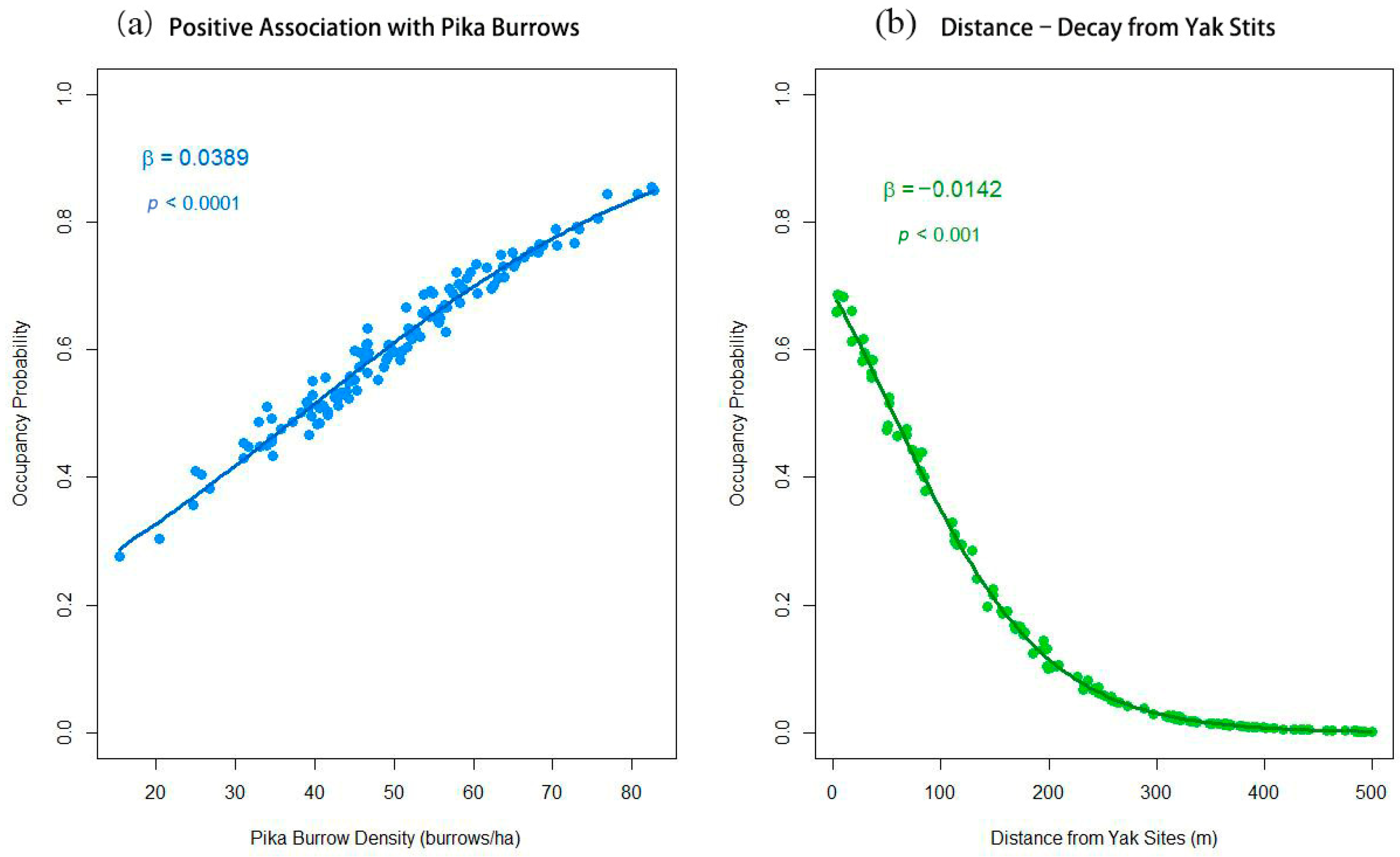
Findings demonstrated a robust positive association between White-rumped Snowfinch occupancy and plateau pikas burrow density (β = 0.0389, SE = 0.0064, z = 6.124, p < 0.001, 95% CI: 0.018–0.046). Further analysis showed a pronounced distance-decay relationship, with snowfinch occupancy probabilities declining significantly as the distance from yak congregation sites increased (β = −0.0142, SE = 0.0032, z = −4.319, p < 0.001, 95% CI: −0.018–−0.006; Figure 3).
Occupancy increased with pika burrow density and decreased with distance to yak bedding sites (Figure 3). These patterns suggest strong coupling between snowfinches and microhabitats created by pika burrows within areas of concentrated yak activity. The population density of the White-rumped Snowfinch is significantly positively correlated with the distribution and density of pika colonies.

3.2. Rufous-Necked Snowfinch

Rufous-necked Snowfinch occupancy was best explained by models including burrow density and distance to yak bedding sites; the top model carried 98.9% of the Akaike weight (Table 4).
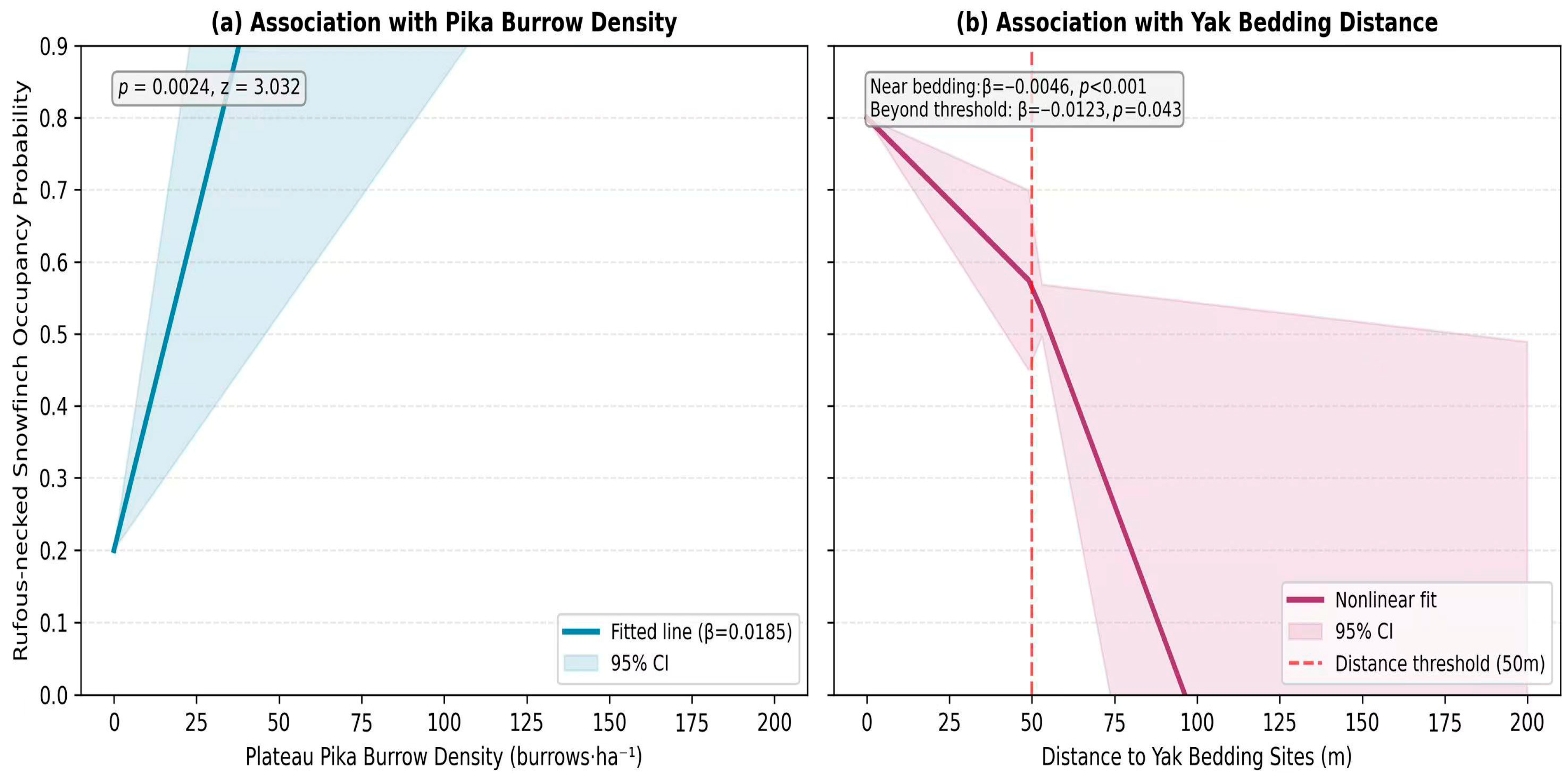
There was a significant positive association between Rufous-necked Snowfinch occupancy and plateau pikas burrow density (β = 0.0185, SE = 0.0061, z = 3.032, p = 0.0024). Notably, proximity to yak bedding sites strongly influenced occupancy patterns, with a marked decline observed within the immediate vicinity of bedding areas (β= −0.0046, SE = 0.0013, z = −3.441, p < 0.001). Beyond this threshold (50 m), occupancy probabilities exhibited a marginally significant secondary decline (β = −0.0123, SE = 0.006, z = −2.027, p = 0.043), suggesting a nonlinear distance–decay relationship (Figure 4). In our study area, the Rufous-necked Snowfinch population was slightly smaller than that of the White-rumped Snowfinch, but the distribution patterns of both species in areas with active pika burrows were highly similar.

3.3. Ground Tits

The top-ranked model explaining Ground Tits’ occupancy received substantial support (Akaike weight w = 0.45; Table 5), indicating pronounced elevational dependency in habitat selection. Analyses revealed a significant positive relationship between occupancy probability and elevation (β = 0.01, SE = 0.0036, z = 2.806, p = 0.005), with a 1.3% increase in occupancy likelihood per 100 m elevational gain. A facultative association emerged with White-rumped Snowfinch presence (β = 1.8649, SE = 0.7529, z = 2.477, p = 0.013), suggesting potential niche complementarity between these alpine specialists. In contrast, steep slopes (>25°) exhibited weak negative effects on occupancy (β = −0.12, SE = 0.07, z = −1.71, p = 0.087). Statistical analysis revealed a significant positive relationship between Ground Tit and White-rumped Snowfinch abundances (β = 2.4423, SE = 0.7055, z = 3.462, p < 0.001). Specifically, sites with higher Ground Tit densities consistently yielded more detections of White-rumped Snowfinch. The two species exhibit broadly overlapping ecological niches. However, their harmonious coexistence suggests effective niche differentiation. Notably, plateau pikas burrow density showed no measurable influence (p > 0.15), highlighting divergent microhabitat preferences among sympatric alpine passeridaes.

4. Discussion

Our study demonstrates that the occupancy patterns of two endemic snowfinch species on the QTP are predominantly shaped by facilitative interactions with two key species: the plateau pika and the domestic yak. In strong support of our predictions, occupancy probabilities for both the White-rumped Snowfinch and the Rufous-necked Snowfinch increased significantly with higher pika burrow density and decreased with increasing distance from yak bedding areas. As hypothesis, the Ground Tit showed no significant association with these biotic factors. This finding is consistent with its more flexible nesting requirements and distinct foraging ecology. Non-biological factors such as vegetation structure, slope, and elevation show little independent effect. Biotic interactions are the main drivers of bird community structure in these harsh alpine environments, and this matches Ahmad (2025) [42] and Piccinelli (2025) [43]. These results underscore the nature of habitat selection in alpine ecosystems, where avian distributions are shaped by both fine-scale biotic interactions (pika burrow availability) and broader-scale landscape context (proximity to herbivore activity zones).
Overall, our results support the idea that a small allogenic engineer (plateau pika) and a large herbivore (yak) can interact to create spatially heterogeneous nesting and foraging opportunities for specialist snowfinches, while other endemic passeridaes may be governed more strongly by broad abiotic filters such as elevation.

4.1. Collaborative Construction of Habitat

The concurrent dependence of snowfinches on both pika burrows and yak bedding sites reveals a synergistic, engineer-driven habitat template. This system exemplifies the core tenets of niche construction theory, wherein organisms modify their environment [7], creating ecological inheritance that shapes the distribution and fitness of associated species.
Plateau pikas act as foundational allogenic engineers by physically creating burrow systems. These structures provide snowfinches with critical, stable microhabitats for nesting and shelter, significantly reducing predation pressure and buffering against extreme climates. This reinforces their obligate dependency, a conclusion supported by previous studies reporting that over 85% of snowfinch nests are located in pika burrows [18]. Its functional role supports the rivet hypothesis—its removal would likely lead to the disproportionate decline of these specialist birds, compromising ecosystem integrity [44,45]. Snowfinch distributions respond to environmental change, and they do not shape the environment. Snowfinches appear to track habitat conditions created by pikas and yaks, rather than directly modifying the habitat themselves. Instead, their alteration of the environment is a passive consequence of their survival needs. However, this does not undermine the plateau pika’s role as a keystone species in the Qinghai-Tibetan Plateau ecosystem. The two concepts—passive habitat modification and ecological importance—are not in conflict.
Yaks as Resource-Modifying Agents: Yaks function as resource modifiers, enhancing habitat quality through trophic pathways. Dung deposition in bedding areas increased local arthropod biomass by 28–42% during the breeding season, providing a vital food subsidy for nestling provisioning [18]. Furthermore, the positive association between snowfinch occupancy and proximity to yak sites, contrasted with reduced pika activity in core grazing zones, indicates a spatially nuanced interaction: yaks create resource-rich foraging patches near their resting areas [12] while simultaneously structuring the landscape in a way that may concentrate pika (and thus burrow) activity in adjacent zones. Our occupancy patterns are consistent with this distance-dependent subsidy effect, although direct measurements of prey availability would strengthen this inference.
This tripartite facilitation network—where yaks indirectly subsidize food webs and pikas provide physical infrastructure—creates a mosaic of high-quality microhabitats. Together, pika-created nesting infrastructure and yak-associated resource subsidies may facilitate snowfinch persistence by coupling shelter and food resources at fine spatial scales. It demonstrates that species persistence in harsh alpine grasslands depends more on biotic modifications and interactions than on static abiotic habitat features [46,47] This highlights that community responses to grazing cannot be inferred from vegetation metrics alone, but also depend on cross-taxa interactions.

4.2. Mechanisms of Association and Niche Partitioning

4.2.1. Distance-Dependent Habitat Selection

The significant decline in snowfinch occupancy with distance from yak bedding areas mirrors patterns observed for plateau pikas themselves, aligning with patterns reported by Lu et al. (2009) [47] and Wangdwei et al. (2013) [18], and it shows exactly the same occupancy rates as plateau pikas’ pattern. This congruence suggests a shared attraction to resources associated with livestock concentration [45]. The mechanism is likely twofold: (1) direct foraging on dung-associated arthropods by birds, and (2) selection for areas with higher pika burrow density, which itself is influenced by the landscape of grazing pressure and nutrient deposition.

4.2.2. Contrasting Strategies Among Avian Species

The contrasting responses of snowfinches and the Ground Tit point to niche differentiation within the same landscape template: Obligate Burrow Dependents or Facultative Burrow User. Snowfinches appear to be more dependent on pika burrows as nesting infrastructure, which may make them sensitive to variation in burrow availability and to the spatial footprint of bedding sites.
The weak correlation between the densities of the ground tit and plateau pikas is consistent with the flexible nesting strategy of the Ground Tit (using rock crevices or anthropogenic structures) and unique foraging behavior (probing soil), granting it a broader ecological niche less tied to the pika–yak complex [13,48]. Its distribution range at higher altitudes suggests that abiotic conditions may set the primary constraint on occupancy in our study area.

4.3. Research Limitations

This study has several limitations. First, our sampling was conducted within a single year and focused on the breeding and post-breeding seasons, potentially missing winter dynamics when dependencies may shift (e.g., towards dung as a direct food source). Second, the spatial extent was confined to specific transects in Riduo County; broader geographical replication would test the generality of these patterns across the QTP.

4.4. Future Research and Management Suggestions

Future research should treat alpine passeridae, plateau pika disturbance, and yak grazing as a tightly coupled system and track their dynamics through sustained multi-season, multi-year monitoring, so that grazing effects can be distinguished as far as possible from interannual climatic variation. We propose a repeatable integrated framework that uses standardized metrics to quantify bird occupancy or abundance and reproductive outcomes (e.g., nest monitoring), while concurrently characterizing pika activity using burrow density, fecal pellet counts, and a limited set of camera traps, and explicitly documenting grazing intensity and its spatial and temporal pattern. Adding assessments of avian prey resources (e.g., arthropod sampling) would help move interpretation beyond correlation toward more testable mechanisms. Studies should also incorporate fine-scale weather covariates and, where feasible, use small-scale field experiments (such as manipulating burrow availability or removing dung) to strengthen causal inference and provide more targeted evidence for management decisions. Given accelerating environmental change on the plateau, future work should further test whether climate change and shifts in precipitation regimes disrupt existing biotic interactions. Finally, explicitly modeling detectability in study design and analysis will ensure that observed changes in occupancy or abundance more reliably reflect ecological processes rather than differences in observation conditions.
With regard to policy implementation, it is recommended that the competent authorities establish a science-based, adaptive grazing management framework to achieve an optimal balance between livestock production and ecological restoration of vegetation. This system should establish a long-term monitoring program, including real-time soil moisture tracking and periodic vegetation surveys. Future work should track local plateau pika populations and yak grazing intensity, especially in habitats used by ground-feeding snowfinches such as the Rufous-necked Snowfinch and the White-rumped Snowfinch [49].

5. Conclusions

Taken together, our results indicate that yak grazing, plateau pikas, and snowfinches form a fragile but consequential ecological coupling in high-altitude pasture. Yak grazing alters vegetation structure and near-surface conditions in ways that can shape habitat availability for alpine passeridaes, and pika activity—as an ecosystem-engineering process—can further modify microhabitats and mediate these effects. By clarifying these linked pathways, our study adds evidence on how grazing and ecosystem engineers jointly influence habitat suitability for alpine birds and underscores the need for integrated management that aligns pastoral livelihoods with conservation goals. Future work should build on standardized, long-term monitoring to test cascading effects and evaluate whether these relationships persist across grazing regimes and under changing climate conditions. Developing adaptive, evidence-based management will be essential for sustaining rangeland function while supporting biodiversity in the Qinghai-Tibet Plateau, China.

Supplementary Materials

The following supporting information can be downloaded at: https://www.mdpi.com/article/10.3390/birds7010014/s1. S1. Statistical Modeling Framework and Equations; S2. R Scripts Analysis; S3. The IUCN Red List of Threatened Species in 2018. Detailed information can be found in the supplementary material file.

Author Contributions

Conceptualization, W.M.; methodology, W.M.; software, B.A. and W.M.; validation, B.A., Y.Y. and W.M.; formal analysis, B.A.; investigation, B.A. and Y.Y.; resources, W.M.; data curation, W.M.; writing—original draft preparation, B.A.; writing—review and editing, B.A. and W.M.; visualization, B.A. and W.M.; supervision, W.M.; project administration, W.M.; funding acquisition, W.M. All authors have read and agreed to the published version of the manuscript.

Funding

This research was supported by the National Natural Science Foundation of China, grant number: 32360269 and the High-level Talent Program of Xizang University, grant number: 2025-GSP-S093.

Institutional Review Board Statement

Ethical review and approval were waived for this study. Only birds were observed, and no animals were harmed.

Informed Consent Statement

Not applicable.

Data Availability Statement

The data presented in this study are available on request from the corresponding author due to privacy.

Acknowledgments

The authors are grateful to the funding from the National Natural Science Foundation of China and the High–level Talent Program of Xizang University for this research.

Conflicts of Interest

The author declares no conflicts of interest.

References

  1. Millington, J.A.; Booth, C.A.; Fullen, M.A.; Moor, G.M.; Trueman, I.C.; Worsley, A.T.; Richardson, N.; Baltrènaitè, E. The role of long-term landscape photography as a tool in dune management. J. Environ. Eng. Landsc. Manag. 2009, 17, 253–260. [Google Scholar]
  2. Pearson, R.G.; Dawson, T.P. Predicting the impacts of climate change on the distribution of species: Are bioclimate envelope models useful? Glob. Ecol. Biogeogr. 2003, 12, 361–371. [Google Scholar] [CrossRef]
  3. Manly, B.F.J. Estimating a resource selection function with line transect sampling. J. Appl. Math. Decis. Sci. 2002, 6, 213–228. [Google Scholar] [CrossRef]
  4. Laland, K.N.; Sterelny, K. Seven reasons (not) to neglect niche construction. Evolution 2006, 60, 1751–1762. [Google Scholar] [CrossRef] [PubMed]
  5. Luciano, B.; Fichera, G.; Mucedda, M.; Pidinchedda, E.; Veith, M.; Smeraldo, S.; De Pasquale, P.P.; Mori, E.; Ancillotto, L. Island Life and Interspecific Dynamics Influence Body Size, Distribution and Ecological Niche of Long-Eared Bats. J. Biogeogr. 2025, 53, e70071. [Google Scholar]
  6. Zuleger, A.M.; Perino, A.; Pereira, H.M. Ecological dynamics and coexistence patterns of wild and domestic mammals in an abandoned landscape. Wildl. Biol. 2025, 3, e01319. [Google Scholar] [CrossRef]
  7. Odling-Smee, F.J.; Laland, K.N.; Feldman, M.W. The Evidence for Niche Construction. In Niche Construction: The Neglected Process in Evolution (MPB-37); Princeton University Press: Princeton, NJ, USA, 2003; pp. 36–115. [Google Scholar]
  8. Wangdwei, M. Demography, Distribution, and Behaviour of Plateau Pika (Ochotona curzoniae) in Relation to Land-Use Type and Yak (Bos grunniens) Grazing on the Qinghai-Tibetan Plateau, China. Ph.D. Thesis, University of Bergen, Bergen, Norway, September 2012. [Google Scholar]
  9. Smith, A.T.; Wilson, M.C.; Hogan, B.W. Functional-trait ecology of the plateau pika Ochotona curzoniae in the Qinghai–Tibetan Plateau ecosystem. Integr. Zool. 2019, 14, 87–103. [Google Scholar] [CrossRef]
  10. Schaller, G.B. Wild Life of the Tibetan Steppe; University of Chicago Press: Chicago, IL, USA, 1998. [Google Scholar]
  11. Wangdwei, M. Effects of vegetation cover and pastoral land-use types on the foraging and vigilance behaviors of the plateau pika. Acta Theriol. Sin. 2019, 39, 69–76. [Google Scholar]
  12. Lai, C.H.; Smith, A.T. Keystone status of plateau pikas (Ochotona curzoniae): Effect of control on biodiversity of native birds. Biodivers. Conserv. 2003, 12, 1901–1912. [Google Scholar] [CrossRef]
  13. Xia, W. Progress in mammalian ecology in China. Acta Theriol. Sin. 1984, 4, 223–238. [Google Scholar]
  14. Smith, A.T.; Foggin, J.M. The Plateau Pika Is A Keystone Species For Biodiversity On The Tibetan Plateau. In Animal Conservation; Zoological Society of London: London, UK, 1999; pp. 235–240. [Google Scholar]
  15. Huang, Z.; Ke, Z.; Ma, Y.; Xia, C.; Tang, X.; He, Q.; Zhang, Q.; Sun, F.D. The effects of different interference degrees of plateau pikas on plant diversity, soil bulk density and water content. J. Sichuan Agric. Univ. 2024, 42, 1348–1356. [Google Scholar]
  16. Pageau, C.; Vale, M.M.; de Menezes, M.A.; Barçante, L.; Shaikh, M.; SAlves, M.A.; Reudink, M.W. Evolution of altitudinal migration in passerines is linked to diet. Ecol. Evol. 2020, 10, 3338–3345. [Google Scholar] [CrossRef] [PubMed]
  17. Arthur, A.D.; Pech, R.P.; Davey, C.; Jiebu; Zhang, Y.; Hui, L. Livestock grazing, plateau pikas and the conservation of avian biodiversity on the Tibetan plateau. Biol. Conserv. 2008, 141, 1972–1981. [Google Scholar] [CrossRef]
  18. Wangdwei, M.; Ma, H. A study on the distribution of Niverfinch and Niverfinch in heterogeneous habitats on the Tibetan Plateau. J. Tibet. Univ. (Nat. Sci. Ed.) 2013, 28, 1–6. [Google Scholar]
  19. Vold, S.T.; Berkeley, L.I.; McNew, L.B. Effects of livestock grazing management on grassland birds in a northern mixed–grass prairie ecosystem. Rangel. Ecol. Manag. 2019, 72, 933–945. [Google Scholar] [CrossRef]
  20. Neilly, H.; Schwarzkopf, L. The impact of cattle grazing regimes on tropical savanna bird assemblages. Austral Ecol. 2019, 44, 187–198. [Google Scholar] [CrossRef]
  21. Leal, A.I.; Acácio, M.; Meyer, C.F.J.; Rainho, A.; Palmeirim, J.M. Grazing improves habitat suitability for many ground foraging birds in Mediterranean wooded grasslands. Agric. Ecosyst. Environ. 2019, 270–271, 1–8. [Google Scholar] [CrossRef]
  22. Errea, P.; Lasanta, T.; Zabalza-Martínez, J.; Cortijos-López, M.; Nadal-Romero, E. Rethinking extensive livestock grazing to revive Mediterranean mountain landscapes. J. Environ. Manag. 2025, 391, 126541. [Google Scholar] [CrossRef]
  23. Val, J.; Eldridge, D.J.; Travers, S.K.; Oliver, I. Livestock grazing reinforces the competitive exclusion of small-bodied birds by large aggressive birds. J. Appl. Ecol. 2018, 55, 1919–1929. [Google Scholar] [CrossRef]
  24. Bazzi, G.; Foglini, C.; Brambilla, M.; Saino, N.; Rubolini, D. Habitat management effects on prealpine grassland bird communities. Ital. J. Zool. 2015, 82, 251–261. [Google Scholar] [CrossRef]
  25. Hansen, B.D.; Fraser, H.S.; Jones, C.S. Livestock grazing effects on riparian bird breeding behaviour in agricultural landscapes. Agric. Ecosyst. Environ. 2019, 270, 93–102. [Google Scholar] [CrossRef]
  26. Tietze, D.T.; Päckert, M.; Martens, J.; Lehmann, H.; Sun, Y.-H. Complete phylogeny and historical biogeography of true Rosefinches (Aves: Carpodacus). Zool. J. Linn. Soc. 2013, 169, 215–234. [Google Scholar] [CrossRef]
  27. Zhou, X.M. The Alpine Meadow of China; Science Press: Beijing, China, 2001; pp. 47, 110. [Google Scholar]
  28. Xu, G. Ecological Risk Assessment of Geological Disasters in Mozhugongka County. Master’s Thesis, Xizang University, Lhasa, China, 2025. [Google Scholar]
  29. Valdez, R. Wildlife Conservation in China: Preserving the Habitat of China’ s Wild West. J. Wildl. Manag. 2008, 72, 1283–1284. [Google Scholar] [CrossRef]
  30. MacKinnon, J.; Phillipps, K.; He, F.Q. A Field Guide to the Birds of China; Oxford University Press: Oxford, UK, 2000; p. 233. [Google Scholar]
  31. Lei, F.; Qu, Y.; Song, G. Species diversification and phylogeographical patterns of birds in response to the uplift of the Qinghai—Tibet Plateau and Quaternary glaciations. Curr. Zool. 2014, 60, 149–161. [Google Scholar] [CrossRef]
  32. Zhao, Z. Fauna of China, Volume II: Passeriformes; Jilin Science and Technology Press: Changchun, China, 2001; pp. 203–204, 787–789. [Google Scholar]
  33. Zhang, X. Research on the Reproductive Biology of Ten Passeriformes Birds in Alpine Meadows. Acta Zool. Sin. 1982, 28, 190–199. [Google Scholar]
  34. Speakman, J.R.; Chi, Q.; Ołdakowski, Ł.; Fu, H.; Fletcher, Q.E.; Hambly, C.; Togo, J.; Liu, X.; Piertney, S.B.; Wang, X.; et al. Surviving winter on the Qinghai-Tibetan Plateau: Pikas suppress energy demands and exploit yak feces to survive winter. Proc. Natl. Acad. Sci. USA 2021, 118, e2100707118. [Google Scholar] [CrossRef] [PubMed]
  35. Migmar, W.; Jigme, T. The Interaction Between Plateau pikas (Ochotona curzoniae) and White rumpped snow-finches (Pyrilauda taczanowskii) at Nian village, Rutog Township of Medrolgongkar County. J. Xizang Univ. (Nat. Sci. Ed.) 2015, 30, 16–20. [Google Scholar]
  36. Zheng, Q.; Tang, Z.; Wei, W. The ecological role of and survival threats to grassland rodents. Pratacultural Sci. 2019, 36, 2962–2970. [Google Scholar]
  37. Ericson, P.G.P.; Johansson, U.S. Phylogeny of Passerida (Aves: Passeriformes) based on nuclear and mitochondrial sequence data. Mol. Phylogenetics Evol. 2003, 29, 126–138. [Google Scholar] [CrossRef] [PubMed]
  38. Yang, S.J.; Yin, Z.H.; Ma, X.M.; Lei, F.M. Phylogeography of Hume’s Groundpecker (Pseudopodoces humilis) based on mtDNA: Evidence of past fragmentation on the Tibetan Plateau. Mol. Phylogenetics Evol. 2006, 41, 257–265. [Google Scholar] [CrossRef]
  39. MacKenzie, D.I.; James, D.; Nichols, J.; Royle, A.; Pollock, K.H.; Bailey, L.; Hines, J.E. Occupancy Estimation and Modeling, 1st ed.; Academic Press: New York, NY, USA, 2005. [Google Scholar]
  40. BirdLife International. The IUCN Red List of Threatened Species. 2018. Available online: https://www.iucnredlist.org/en (accessed on 12 February 2026).
  41. Banik, B.; Roy, S.; Paul, S.; Reang, M.; Majumdar, K.; Baishnab, B.; Datta, B.K. Habitat characteristics and modeling current and future potential distributions of Canarium strictum using MaxEnt: A threatened socioeconomically significant plant of Northeast India. Landsc. Ecol. Eng. 2025, 21, 399–426. [Google Scholar] [CrossRef]
  42. Ahmad, S.; Wanghe, K.; Jialing, L.; Gonzalez, E.B.; Syms, C.; Strelnikov, I.I.; Bosso, L.; Mao, W. Climate—Driven Morphological Variation in Passerine Birds. Glob. Ecol. Biogeogr. 2025, 34, e70164. [Google Scholar] [CrossRef]
  43. Piccinelli, S.; Cannone, N. Divergent Responses of Alpine Rock Glaciers to Climate Change: A Review of Ecological and Abiotic Dynamics. Permafr. Periglac. Process. 2025, 36, 438–450. [Google Scholar] [CrossRef]
  44. Ehrlich, P.R.; Ehrlich, A.H. Extinction: The Causes and Consequences of the Disappearance of Species; Victor Gollancz Ltd.: London, UK, 1981. [Google Scholar]
  45. Walker, B.H. Biodiversity and ecological redundancy. Conserv. Biol. 1992, 6, 18–23. [Google Scholar] [CrossRef]
  46. Ram, M.; Gadhavi, D.; Sahu, A.; Srivastava, N.; Rather, T.A.; Dagur, T.; Modi, V.; Jhala, L.; Zala, Y.; Jhala, D. Reintroduction of Indian Grey Hornbills in Gir, India: Insights into Ranging, Habitat Use, Nesting and Behavioural Patterns. Birds 2025, 6, 58. [Google Scholar] [CrossRef]
  47. Lu, X.; Ke, D.; Zeng, X.; Yu, T. Reproductive ecology of two sympatric Tibetan snowfinch species at the edge of their altitudinal range: Response to more stressful environments. J. Arid. Environ. 2009, 73, 1103–1108. [Google Scholar] [CrossRef]
  48. Zheng, Z. Fauna Sinica, Aves Vol. 10: Passeriformes, Muscicapidae I, Turdinae; Science Press: Beijing, China, 1995; p. 239. [Google Scholar]
  49. An, B.; Yang, Y.; Migmar Wangdwei, E.F. Yak grazing and pika engineering synergistically structure alpine passerine distributions on the Qinghai-Tibetan Plateau. In Proceedings of the First Western Ecological Environment Youth Forum, Lasha, China, 25 July 2025. [Google Scholar]
Figure 1. A schematic layout of the interactions studied: (A) plateau pikas as burrow engineers; (B) treeless alpine ecosystem as living habitat for species studied; (C) yak grazing as resource—modifying agents; (D) alpine passeridae bird species (White-rumped Snowfinch; Rufous-necked Snowfinch; Ground Tit) as mainly studied species. The arrow denotes the pathway that is impacted.
Birds 07 00014 g001
Figure 2. Study area map.
Birds 07 00014 g002
Figure 3. Effects of (a) plateau pika burrow density and (b) distance to yak bedding sites on occupancy of White-rumped Snowfinch. The line shows the model-fitted trend for occupancy probability, and the points represent the observed detection events in each sampling unit.
Birds 07 00014 g003
Figure 4. Correlation between the occupancy of the Rufous-necked Snowfinch and distance to the burrow of plateau pikas. (a) The solid blue line represents the nonlinear fitted occupancy probability based on the top-ranked occupancy model. (b) The vertical dashed red line indicates the 50 m distance threshold, beyond which occupancy probability exhibited a substantial decline, suggesting a critical ecological breakpoint in habitat suitability. The shaded ribbon denotes the 95% confidence interval (CI).
Birds 07 00014 g004
Table 1. Survey of five permanent transects.
Transect NumberDetailed Description
Transect 14423 m a.s.l (uniform plateau, fencing-enclosed homogeneous alpine meadow);
Transect 24666–4700 m a.s.l (V-shaped fluvial valley mosaic: alpine steppe/mead-ow/bushland);
Transect 34712–4781 m a.s.l (moderate-slope yak congregation zone: bush–steppe complex with perennial stream);
Transect 44712–4790 m a.s.l (high-density steep-gradient yak area: bush–steppe/riparian ecotone);
Transect 54800–4844 m a.s.l (high-altitude rocky steppe: lithophytic shrub–steppe formation).
Table 2. Belt transect specifications and measured variables.
VariableDescription of the Variable
Transect 11.23 km (41 sections) and the total number of sections (each sampling section has 30 × 12 m2)
Transect 20.99 km (33 sections) km and the total number of sections (each sampling section has 30 × 12 m2)
Transect 31.23 km (41 sections) and the total number of sections (each sampling section has 30 × 12 m2)
Transect 41.14 km (38 sections) and the total number of sections (each sampling section has 30 × 12 m2)
Transect 51.56 km (52 sections) and the total number of sections (each sampling section has 30 × 12 m2)
Distance to tent sitesThe distance (meter) from a sampling section to a tent site.
Vegetation typesThe vegetation coverage of a dominant species–subdominant species in sections.
Slopes degreesThe degree of slope at a sampling section.
The number of burrowsThe number of burrows in a sampling section 30 × 12 m2.
ObserversIndependent observer (X1, X2, X3, X4, X5).
Weather conditionsThe weather conditions of sampling occasion, such as sunny, windy, overcast and so on.
Table 3. Model selection results for occupancy of White-rumped Snowfinch.
ModelAICΔAICcWδ
White-rumped Snowfinch (slope + number of burrows + altitude distance to new or old tent sites)404.9800.9996
White-rumped Snowfinch (distance to new or old tent sites)423.9018.920.0012
White-rumped Snowfinch (slope + number of burrows)436.0931.1105
Notes: The model components are initial slope, number of burrows, altitude, distance to new or old tent sites. ΔAICc is relevant different values compared with the top ranked model; W is AIC model weights; δ is the number of parameters.
Table 4. Model selection results for occupancy of Rufous-necked Snowfinch.
ModelAICΔAICcWδ
Rufous-necked Snowfinch (slope + number of burrows + altitude + distance to new or old tent sites)591.0500.9896
Rufous-necked Snowfinch (slope + number of burrows) 600.719.660.0084
White-rumped Snowfinch (slope)602.6611.610.0033
Notes: The model components are initial slope, number of burrows, altitude, distance to new or old tent sites. ΔAICc is relevant different values compared with the top ranked model; W is AIC model weights; δ is the number of parameters.
Table 5. Model selection results for occupancy of Ground Tits.
ModelAICΔAICcWδ
Ground Tits (slope + number of burrows + altitude + distance to new or old tent sites + Rufous-necked Snowfinch + White-rumped Snowfinch)122.5100.44708
Ground Tits (slope + number of burrows + altitude + distance to new or old tent sites)123.420.91090.28356
Ground Tits (slope + number of burrows + altitude)123.521.01160.26955
Notes: The model components are initial slope, number of burrows, altitude, distance to new or old tent sites; ΔAICc is relevant different values compared with the top ranked model; W is AIC model weights; δ is the number of parameters.
Disclaimer/Publisher’s Note: The statements, opinions and data contained in all publications are solely those of the individual author(s) and contributor(s) and not of MDPI and/or the editor(s). MDPI and/or the editor(s) disclaim responsibility for any injury to people or property resulting from any ideas, methods, instructions or products referred to in the content.