
The Potential of Omics in Biological Dosimetry

Federal Office for Radiation Protection (BfS), Department of Effects and Risks of Ionising and Non-Ionising Radiation, 85764 Oberschleissheim, Germany
*
Author to whom correspondence should be addressed.
Radiation 2022, 2(1), 78-90; https://doi.org/10.3390/radiation2010006
Submission received: 10 December 2021
/
Revised: 13 January 2022
/
Accepted: 14 January 2022
/
Published: 17 January 2022
(This article belongs to the Special Issue Omics in Radiation Research)
Simple Summary
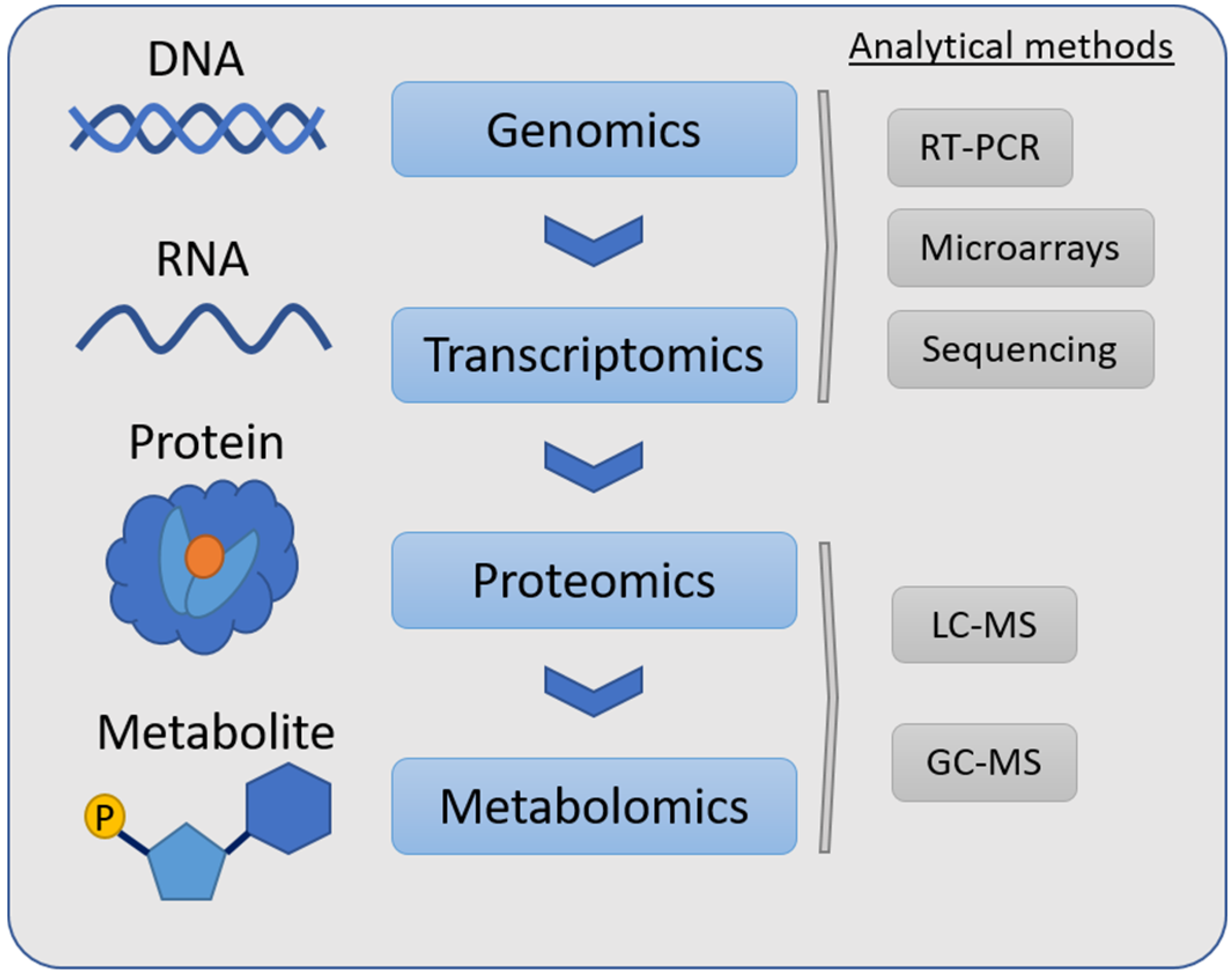
Biological dosimetry is used to detect and quantify a radiation exposure using biological indicators. Classically, cytogenetic methods are used for dose estimation in a nuclear incident. However, as these methods are very time-consuming, new techniques for dose estimation are being sought, especially in the case of a large radiation accident involving several thousands of people. This review describes the potential use of omics-based technologies such as transcriptomics, proteomics, and metabolomics for dose estimation.
Abstract
Biological dosimetry is an internationally recognized method for quantifying and estimating radiation dose following suspected or verified excessive exposure to ionising radiation. In severe radiation accidents where a large number of people are potentially affected, it is possible to distinguish irradiated from non-irradiated people in order to initiate appropriate medical care if necessary. In addition to severe incidents caused by technical failure, environmental disasters, military actions, or criminal abuse, there are also radiation accidents in which only one or a few individuals are affected in the frame of occupational or medical exposure. The requirements for biological dosimetry are fundamentally different for these two scenarios. In particular, for large-scale radiation accidents, pre-screening methods are necessary to increase the throughput of samples for a rough first-dose categorization. The rapid development and increasing use of omics methods in research as well as in individual applications provides new opportunities for biological dosimetry. In addition to the discovery and search for new biomarkers, dosimetry assays based on omics technologies are becoming increasingly interesting and hold great potential, especially for large-scale dosimetry. In the following review, the different areas of biological dosimetry, the problems in finding suitable biomarkers, the current status of biomarker research based on omics, the potential applications of assays using omics technologies, and also the limitations for the different areas of biological dosimetry are discussed.
Keywords:
biological dosimetry; omics; transcriptomics; proteomics; metabolomics