1. Introduction
Recent studies show that religious tourism is substantial in scale, geographic reach and faith-driven mobility (
Griffin, 2017;
Olsen, 2022;
Timothy & Shinde, 2026). Unlike leisure destinations, religious tourism sites develop distinctive economies shaped by governance, scale and institutional arrangements involving both religious actors, who enable ritual practice, and non-religious actors, who provide tourism infrastructure and services. Mecca’s pilgrimage economy, for example, is state-driven and organised through large-scale infrastructure, hospitality, transport and logistics (
Green, 2015;
Henderson, 2011). Catholic sites such as Lourdes and Fatima show how Church-led sanctuary management, hospitality and visitor services can turn small towns into internationally recognised religious-tourism centres (
Jarraud & Clarimont, 2021), while Santiago de Compostela demonstrates how route-based pilgrimage reshapes mobility, accommodation, heritage branding and services (
Chemin, 2016). These cases represent relatively formal systems linking sacred meanings with markets, infrastructure, labour and policy. By contrast, much religious tourism in non-Western contexts remains more informal, shaped by ritual practice, patronage and social networks (
Aukland, 2017;
Setyawati et al., 2026;
Shinde, 2020).
In India, religious tourism accounts for about 70% of domestic tourist flows (
Shinde, 2020), and the spiritual and religious tourism market is estimated at USD 59 billion, with projected employment of more than one hundred million people in temporary and permanent jobs (
KPMG, 2024). Yet research and policy still focus largely on iconic destinations, formal tourism industries, major events such as Kumbha Mela (
Bala & Malviya, 2025), and infrastructure-led development (
Lazzaretti, 2021). TempleConnect estimates that pilgrimage tourism generated USD 16 billion (₹1.34 lakh crore) in 2022 and that India’s temple economy is worth about USD 72 billion (₹6 lakh crore), supporting around 350 million livelihoods (templeconnect.com). However, the ways pilgrimage economies generate, distribute and constrain livelihood opportunities remain poorly understood, especially in temple-towns where informal businesses, family enterprises, street vendors, small accommodation providers and local supply chains are central to the visitor experience but marginal in policy, planning and economic assessment (
Álvarez-García et al., 2018;
Shinde, 2010,
2012). This gap matters because tourism growth can expand local economic activity while reproducing unequal access to its benefits (
Krishnan, 2026;
Setyawati et al., 2026).
This paper asks how religious tourism generates and constrains entrepreneurship in temple-town economies. Its objectives are to identify entrepreneurs and activities within the religious tourism ecosystem, assess enterprise performance and growth challenges, and recommend strategies to strengthen entrepreneurship. It draws on a comparative study of Jejuri and Tuljapur in Maharashtra, India—two major pilgrimage centres where livelihoods depend heavily on visitors but differ in scale, spatial form, ritual organisation and urban function. Both towns also show key transitions, including weekend visitation, expanding accommodation and food services, persistent hereditary religious roles, and new enterprises linked to growing touristic orientations, making them useful cases for examining tourism growth in embedded local economies (
Krishnan, 2026;
Shinde, 2020).
The paper makes three contributions. Empirically, it offers comparative evidence from two Indian temple-towns where religious tourism depends on formal and informal enterprises, ritual services, religious retail, and household livelihoods. Theoretically, it frames these economies as embedded entrepreneurial ecosystems (
Dodd et al., 2016;
McKeever et al., 2015) shaped by religious authority, informality, seasonality, and social and symbolic capital (
Setyawati et al., 2026). In policy terms, it shows that sustainable and inclusive tourism requires attention to informal enterprises, seasonal vulnerability, participatory governance, local benefit, and distributional justice, alongside infrastructure and destination promotion.
The remainder of the paper is organised as follows. The next section reviews scholarship on religious tourism economy centred on temple-towns, which then helps to develop a theoretical framework around key concepts of embeddedness, social and symbolic capital, informality, and entrepreneurial ecosystems. The paper then introduces the study sites and methodology before presenting findings on visitor expenditure, enterprise structure, business characteristics, and emerging entrepreneurial opportunities. The discussion interprets these findings in relation to inclusive tourism development, governance, distributional justice, and sustainable tourism. The final section outlines policy implications and conclusions.
2. Literature Context: Religious Tourism Economy, Informality and Sustainability
Existing scholarship on pilgrimage economies highlights two themes. The first focuses on temples as the main reason for visiting pilgrim-towns and as anchors of the pilgrimage economy. Indian studies of iconic temples such as Puri, Thanjavur, Nathdwara and Tirupati analyse temple economies through rituals, social relations and networks (
Rösel, 1983).
Heitzman (
1991) identifies seven transactions necessary to temple functioning and proposes a transactional network model, while
Subramaniam (
2014, p. 168) describes temples as consumers, bankers, employers and “the focus of the material life of the people.” Medieval and institutional analyses similarly portray temples as economic units and centres of ritual exchange, hierarchy, patronage and redistribution (
Chakrabarti, 2025;
Galewicz, 2023;
Heitzman, 1991;
Stein, 1992;
Subramaniam, 2014). Although historically grounded, this literature helps explain how temples anchor religious tourism economies.
The second theme revolves around the significant economic role of religious intermediaries and specialists in pilgrimage economies as they offer a range of services: bringing visitors to temples, organising darshan—the act of seeing and being seen by the deity—providing assistance in performing rituals and cultural performances, organising a tour to sacred sites, and so on (
Caplan, 1997;
Shinde, 2020;
van Der Veer, 1988). They get remunerated for such services. The materials and services required in rituals generate an economy that is uniquely dominated by ritual knowledge, hereditary rights, and social networks. The capacity of religious actors to adapt practices to new visitor demands create entrepreneurship opportunities (
Shinde, 2010). It is the continuation and transformation of pilgrimage economies that defines religious tourism in India (
Aukland, 2018;
Shinde, 2020).
Religious tourism economies differ from other tourism sectors because many benefits arise through informal transactions linked to ritual material culture, rather than through formal enterprises such as hotels and tour agencies. Yet tourism policy often privileges formal enterprises, limiting analysis of such informal economies (
Cakmak et al., 2018;
Setyawati et al., 2026). Religious service providers are frequently excluded from official tourism policy and industry accounts because the state treats them as “informal” and difficult to measure (
Shinde, 2010, p. 534). Thus, even when policy recognises religious tourism’s economic potential—for example, projections that India’s spiritual tourism could employ over one hundred million people and reach USD 59 billion by 2030 (
KPMG, 2024)—attention remains centred on formal enterprises.
A broader view of religious tourism economies highlights emerging stakeholders who act as entrepreneurs. Traditional religious actors—temple priests, managers, local priests, ashrams and dharmshalas—have extended their leadership by developing products for new tourists and can be understood as religious entrepreneurs. Yet religious tourism also involves many other stakeholders. Building on
Shinde (
2010),
Lin’s (
2021) study of Mazu pilgrimage in Taiwan identified “six possible stakeholders and their 18 possible contributions,” while
Heidari et al. (
2021, p. 428) used Stakeholder Network Analysis to show how different actors influence “the success of businesses on a religious site”. This wider, diffuse actor base can generate significant multiplier effects and shows that informal businesses may sustain the cultural and religious resources on which destinations depend (
Setyawati et al., 2026).
A few studies highlight the importance of seasonality in religious tourism economies.
Libison and Murlidharan’s (
2008) study of the Sabarimala pilgrimage in Kerala shows that local household incomes rose substantially during the pilgrimage season, with service providers earning at least 50% additional income, though benefits were unevenly distributed.
Patlolla’s (
2023) study of vendors near the Saraswathi Devi Temple in Basara, Telangana, similarly shows seasonal fluctuations, with 30% of vendors also engaged in non-temple-related businesses. These insights support a fine-grained, bottom-up understanding of local economies and entrepreneurship.
This overview highlights the need for a more comprehensive understanding of religious tourism economies that extends beyond temples and customary pilgrimage rituals. In temple-towns, sustainability cannot be assessed only through infrastructure, visitor management or heritage conservation; it must also consider the everyday livelihood systems that sustain destinations, including informal retail, ritual services, household labour, seasonal vending, religious accommodation, local food production and community participation in governance. Existing studies rarely examine how these factors convert religious mobility into entrepreneurial opportunity. A stronger theoretical lens is therefore needed to connect pilgrimage practices, social relations, local institutions and enterprise development.
3. Theoretical Framework: Embedded Entrepreneurial Ecosystem
From the existing literature, it can be suggested that temple-town business opportunities are shaped not only by visitor numbers but also by ritual obligations, hereditary rights, caste and kinship networks, trust, reputation, sacred geographies, and the moral economy of pilgrimage (
Heitzman, 1991;
Shinde, 2010,
2020).
Shinde’s (
2010) study of Vrindavan shows how religious actors opened new markets by reorganising pilgrimage for religious tourism and displaying entrepreneurial traits such as risk taking, expertise, expectation of gain, supportive environments and task motivation. Religious tourism entrepreneurship is therefore shaped by inheritance, religious values, group status and family structure. The religious tourism economy is not simply a market near a temple, but a socially embedded field where ritual authority, household livelihoods and commercial exchange overlap (
Setyawati et al., 2026;
Shinde, 2020).
The theory of embeddedness captures these dynamics by viewing economic action as situated within social relations, cultural meanings and institutions, rather than driven only by prices, demand and competition (
Dodd et al., 2016;
McKeever et al., 2015). It helps explain why some entrepreneurs expand into broader tourism-oriented services while others remain confined to low-margin retail and vending (
Korsgaard et al., 2022). However, embeddedness alone is not enough to illustrate the peculiarities of religious tourism economy. For that, it needs to be combined with social and symbolic capital. Social capital refers to resources accessed through trust, obligation and recognition (
Bourdieu, 1986;
Coleman, 1988). In religious tourism, it includes religious and cultural capital rooted in kinship-based temple service arrangements and patron–client ties between religious specialists and pilgrims (
Shinde, 2010). Symbolic capital refers to the value attached to religious legitimacy, ritual knowledge, sacred goods and place-based identity (
Bourdieu, 1986). Religious actors such as gurus, priests, saints and long-established devotees may use such capital to attract visitors, maintain loyalty, and convert religious authority into economic advantage, while entrepreneurs without this recognition may struggle in the same visitor economy.
An additional significant feature of religious tourism is informality (
Setyawati et al., 2026). Informal economies are structured by rules, obligations, networks and institutions that operate outside, alongside, or in tension with formal regulation (
Cakmak et al., 2018;
Dahles, 1999;
Jelen, 2002). In religious tourism, such businesses often have suppliers, spatial routines, seasonal rhythms and social obligations despite lacking registration, contracts or formal finance (
Hitchcock, 2000;
Shinde, 2010). Recognising this prevents policy from equating informality with backwardness and helps explain how small retailers, vendors and household enterprises perform cultural and economic functions.
To understand how entrepreneurship, ritual authority, and informality interact, and how livelihoods can be strengthened without undermining the social and religious relations that sustain the destination, this study proposes to use the framework of entrepreneurial ecosystems. This refers to the actors, resources, institutions, relationships and rules through which pilgrimage-related economic activity is organised. It includes formal businesses, informal vendors and retailers, religious actors, wholesalers, and state, and the social relations connecting them. Rather than a market of isolated businesses, it is a relational field where ritual authority, place access, supply chains, household labour, visitor loyalty, finance, infrastructure and policy recognition jointly shape entrepreneurial possibility. From a sustainable tourism perspective, this ecosystem approach shifts attention from visitor growth to the quality, resilience and distribution of local benefits. Sustainability is therefore understood through the lens of an ecosystem that fosters livelihood durability and cultural continuity.
4. Study Sites—Jejuri and Tuljapur
The Indian subcontinent is dotted with hundreds and thousands of temple-towns where the tradition of pilgrimage is anchored around the need for performing religious obligations and rituals to deities in specific shrines. The scholarly studies of popular Hindu temple-towns, including Vrindavan (
Aukland, 2018;
Entwistle, 1987;
Shinde, 2008), Gaya (
Singh, 2012), Banaras (
Parry, 1994), Pushkar (
Joseph, 1994), Haridwar (
Lochtefeld, 1992), etc., have shown how livelihoods remain deeply embedded in patronage relationships between pilgrims and priests that act as local hosts, ritual authorities shared by religious actors, and social relationships and networks. Such traditional pilgrim-towns now evolved into popular religious tourism destinations, and yet their economic dimensions have received far less attention.
To better understand the economics of religious tourism in traditional temple-towns, this study has focused on two purposively selected sites in Maharashtra, India—Jejuri and Tuljapur. These two are not intended to be statistically representative of all Indian temple-towns; rather, they are analytically useful cases that capture recurring features of religious tourism economies that have developed from the tradition of pilgrimage travels to temple-towns. Both towns exhibit temple-centred visitor flows, ritual-service networks, religious retail, informal vending, family-run enterprises, seasonal demand and uneven access to tourism benefits. Although their scale and institutional form vary considerably, these features are widely observed across Indian sacred geography, and hence, the findings of this study would be generally transferrable and applicable to several traditional temple-towns that are now becoming religious tourism destinations.
The comparative study of Jejuri and Tuljapur highlights how two temple-towns located within the same state and shaped by similar pilgrimage traditions nevertheless produce different religious tourism economies. Jejuri, about 50 km from Pune with a population of roughly 12,000, is dedicated to Khandoba (or Malhari Martanda), a male family deity (kul-daivat) mainly worshipped by warrior clans, farmers, herders and priest families in the Deccan. It is a smaller, compact hill-temple town where visitor activity is strongly concentrated around short-duration darshan, turmeric-based ritual symbolism, and day-trip movement from Pune and nearby regions. Tuljapur, by contrast, is a larger pilgrimage and administrative town with around 35,000 residents. Developed around Devi Tulja Bhavani, a regional incarnation of Shakti and family deity (Kul-devi) for several Maratha clans, it has more extensive ritual requirements, a wider range of religious retail, stronger accommodation demand and a more diversified urban economy. These differences are important because they show that temple-town entrepreneurship is shaped not only by visitor volume, but also by deity traditions, ritual material culture, spatial form, institutional scale, and the structure of local services.
In both sites, pilgrimage economy centre on ritual traditions such as
kul-dharm, the lineage-based duties of a person, and
kul-achaar, the rituals followed by family lineage. Pilgrims perform these rituals with the paid assistance (
dakshina) of religious specialists: guravs in Jejuri and pujaris in Tuljapur. These specialists provide lodging, guide visitors to the temple, prepare offerings, and, through hereditary rights, serve pilgrims from specific social groups and regions. Although religious specialists play similar roles in both towns, their social composition and the rituals related to the deity differ. In Tuljapur, Devi is worshipped in human form: the idol is bathed, clothed, fed, entertained with devotional music and put to bed, while devotees offer items ranging from cloth, coconuts, puffed rice, garlands and sweets to full meals, creating elaborate ritual activity. By contrast, rituals dedicated to Khandoba in Jejuri are more limited. However, after making offerings, pilgrims take back some part of the offerings as prasad—which is a significant part of the material culture related to religious practice (
Pinkney, 2020). The contrast between Jejuri’s compact hill-temple setting and Tuljapur’s larger administrative and pilgrimage economy involving a much complex web of religious specialists provides a useful basis for comparing spatial form, ritual organisation, and urban scale shaping entrepreneurial opportunity.
5. Methods
The study adopted a mixed-method case study design. Fieldwork was conducted in both the towns in March–April 2025 as per ethics approval (indicated later in the notes). Data were collected from two participant groups. First, visitor surveys were conducted with 100 respondents in each town using a structured questionnaire administered through Kobo Toolbox (
https://www.kobotoolbox.org/). The survey examined purpose of visit, travel behaviour, duration of stay, accommodation, frequency of visitation and expenditure patterns.
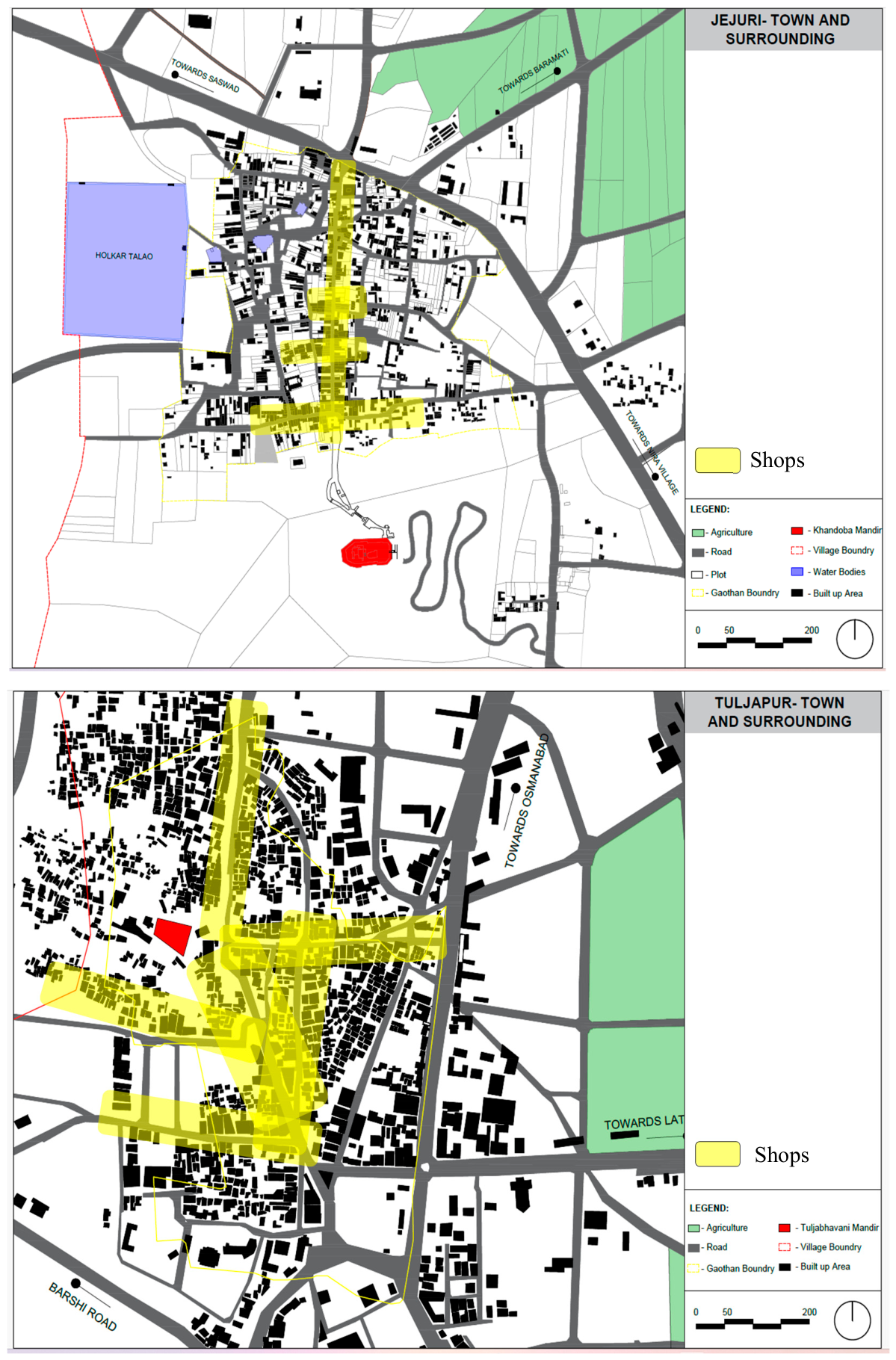
Second, business enterprises within the core visitor zones of both towns, roughly one kilometre from the main temple, were inventoried and selected for semi-structured interviews. This is indicated in
Figure 1. Our inventory used categories from earlier tourism-economy studies such as
Lin (
2021), where expenditure was assessed across accommodation, food and drink, transport/parking, mementos and souvenirs, fees and charges, donations, tourist purchases, and other expenditure; and
Patlolla (
2023) who distinguished vendor types such as hotels and messes, general stores, toy shops, bangle stores, tea points, lodges and restaurants, entertainment, and pooja stores.
The field inventory identified 401 shops in Jejuri and 565 in Tuljapur: of these 27 business types directly related to visitors, eight are indirectly related to visitors and 25 serve residents. Shops and vendors selling items related to religious practices were especially prominent, reflecting visitors’ need for making offerings to the deity during their darshan and rituals. These are collectively termed “religious retail”. The research team completed 35 enterprise interviews in Tuljapur and 21 in Jejuri, each lasting 25–30 min and covering business history, ownership, labour, finance, supply chains, income, seasonality, challenges and aspirations.
The interviews were designed to generate deeper insight into the operation of key enterprise types, including pooja shops, accommodation providers such as hotels, lodges and pujari houses, food and beverage outlets, novelty and souvenir stores, and tour agencies. Random sampling strategy was used with a focus on approaching enterprises within proximity of the main temple and where economic activities were concentrated (as shown in the map) because of a sizable flow of visitors was visible. Pujaris and Guravs who provided accommodation in their houses were recruited through snowball sampling method. Participants were selected from various age groups and were asked questions related to their enterprises. For example, pooja-shop owners were asked about the sourcing, packaging and sale of offerings such as coconuts, flowers, incense, prasad and materials for rituals; accommodation providers were asked about visitor length of stay and links with religious specialists; and street vendors were asked about daily location choices, seasonality, informal payments and dependence on footfall. Because many enterprises offered similar products and services and served the same visitor base, recurring patterns became evident during fieldwork. Interview responses showed clear similarities in business operations and entrepreneurial challenges, including dependence on family labour, limited access to formal credit, reliance on wholesalers, and seasonal income fluctuation. Some of these resonated with what was reported in similar studies of pilgrimage economy by
Libison and Murlidharan (
2008) and
Patlolla (
2023). This sample adequately represents religious tourism entrepreneurship in both towns and is supported by comparable qualitative studies: saturation was reached after 43 interviews in Buddhist sites (
Chen et al., 2017), while pilgrimage and tourism studies have used 10–25 interviews to examine consumption patterns and visitor perceptions (
Higgins & Hamilton, 2011;
Wong et al., 2013).
Koerber and McMichael (
2008) similarly note that further data collection becomes redundant once no new themes emerge. The interviews were transcribed and analysed manually, and themes were developed inductively from repeated patterns in the data.
The mixed-method design links visitor expenditure to local enterprise structures and experiences. As in many field studies of informal economies, the data are interpreted as qualitative insight rather than a complete census of income or enterprise performance: surveys show broad expenditure patterns, while interviews reveal how entrepreneurs understand their opportunities and constraints.
6. Findings
The findings are organised in four parts. First, visitor flows and expenditure patterns establish the scale and composition of demand. Second, the business inventory shows how that demand is translated into local enterprise forms. Third, enterprise interviews reveal ownership, labour and finance constraints. Finally, the section identifies emerging opportunities for entrepreneurship development.
6.1. Visitor Flows and Expenditure
The two towns receive substantial visitor flows as indicated in
Table 1.
These figures demonstrate the scale of demand placed on local businesses and services, and infrastructure. Key findings from the visitor survey are summarised below in
Table 2 to provide a sense of visitation patterns.
Visitor expenditure patterns reveal a significant transformation in the pilgrimage economy. While 65 percent of visitors reported darshan as the primary purpose of travel, a large share of expenditure was directed towards travel, accommodation and food at 45%, 21% and 14% respectively. Only a smaller proportion, about 15%, was spent towards “religious retail” including pooja offerings, prasad, and fees for religious services. This is a surprising finding as one would have anticipated that visitors would spend lot more on “religious retail”, given the primary purpose of their visit is “religious”. Moreover, with high rates of repeat visitation, they are likely to patronise more familiar and established businesses in the temple-town. This suggests that the religious purpose of travel does not automatically translate into high levels of spending on religious retail. Instead, the expanding tourism economy is increasingly shaped by mobility, short-stay accommodation, and food services.
6.2. Structure of the Business Economy
The inventory confirms both towns’ strong dependence on visitors: of the 401 shops in Jejuri and 565 in Tuljapur, visitor-related businesses account for about 94% and 81% respectively. Overall, as shown in
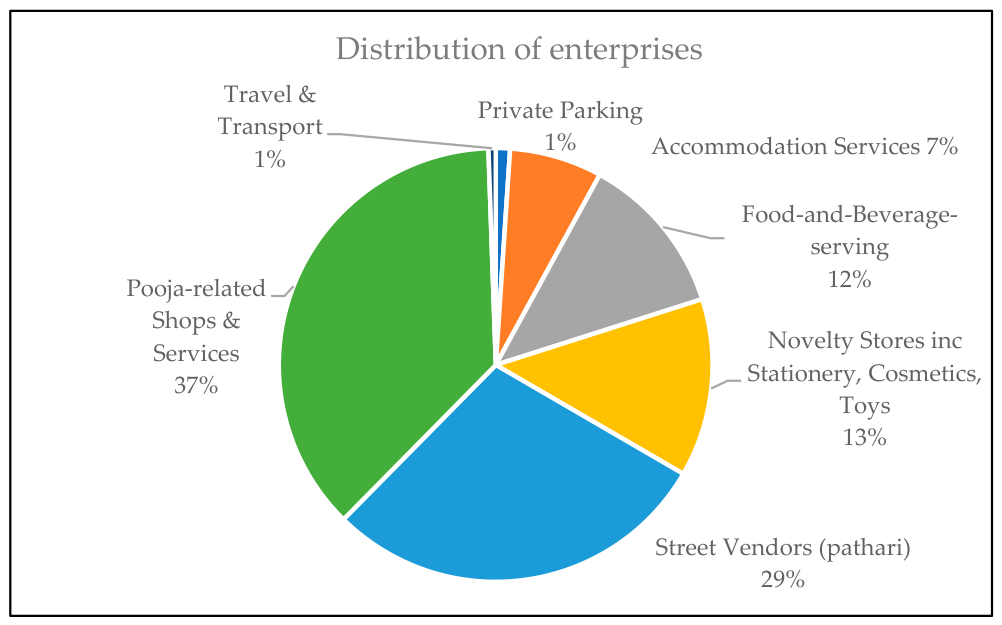
Figure 2, religious retail was the largest category, making up 37% of shops selling pooja offerings, prasad, souvenirs, puja thalis and related devotional items. Street vendors formed the next largest group (29%). Especially in Tuljapur, they sold a large variety of objects including jewellery, sacred threads, food, drinks and flowers. Only 7% of enterprises were specifically for accommodation (hotels, lodges). However, this figure excludes unregistered stays in priests’ homes, which still constitute almost one-third of the accommodation facilities in the town. Moreover, their concentration in the vicinity of the temple makes them a significant player in the town’s economy. Not accounting for such contribution skews their contribution. Overall, 80% of businesses operate informally.
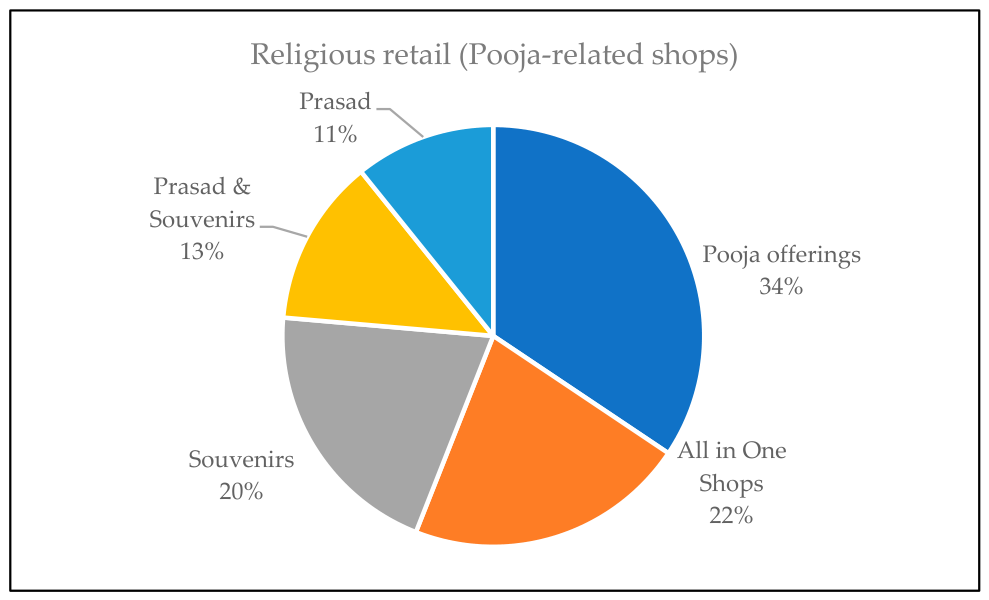
A closer analysis of religious retail shows that, among the five sub-categories in
Figure 3, pooja-offering shops dominate (34%), reflecting visitors’ need to offer something to the deity during darshan. This was confirmed in the visitor survey as well: about 50% of visitors bought “prasad”, and about 20% bought souvenirs such as lockets, photos, and idols. Notably, “all-in-one” shops also account for a sizeable share (22%), suggesting that single-item sales are less profitable and that retailers combine offerings, prasad, and souvenirs to serve both pilgrims and tourists.
Differences in deity worship shape retail patterns. Tuljapur has more souvenir shops, reflecting both its larger visitor economy and the wider range of Devi-related items, especially idols and shringar (dresses for adorning the deity). Jejuri has more shops selling only prasad, largely because local prasad pedha production and distribution are dominated by a local entrepreneur and suit day-trip visitors. In Tuljapur, dry prasad sells more strongly.
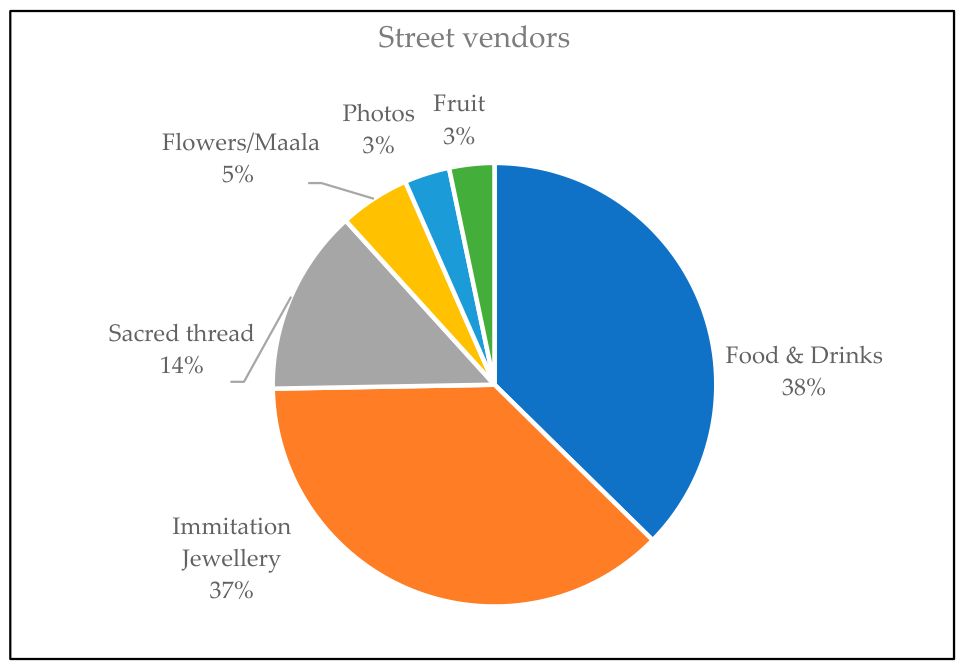
Despite its numerical dominance and cultural centrality, religious retail remains largely informal, low-value and low-margin. Small retailers typically buy from local wholesalers, repackage goods and sell them in small quantities, with limited value addition and modest profits. Larger traders and wholesalers capture greater returns by controlling supply chains and sourcing goods from outside the town. For example, wholesalers import brass idols and metal artefacts in bulk from industrial hubs in Uttar Pradesh. This highlights religious retail’s economic vulnerability. The vulnerability is even more pronounced in street vending. Street vendors cluster along temple access routes, often arriving in the morning and leaving late at night. As expected, and indicated in
Figure 4, a large proportion sell snacks, fast food, and drinks such as water and juice—all that are required for visitors as they walk to the temples. Locally sourced religious retail—such as imitation jewellery, flowers and sacred threads—accounts for nearly 60% of vending.
6.3. Enterprise Characteristics
The interviews with 56 enterprises (35 in Tuljapur and 21 in Jejuri) reveal some significant characteristics regarding their scale, motivations, entrepreneurial traits, dependency, etc. These are presented in
Table 3.
Overall, most businesses are small, family-owned micro-enterprises dependent on household labour. Business ownership is often driven by inheritance, livelihood need and necessity rather than formal entrepreneurial aspiration. Owners’ daily presence, limited education, weak capacity for expansion and reluctance to seek formal bank loans because of paperwork requirements further constrain growth. Many remain in religious retail because they have few viable alternatives.
6.4. Emerging Entrepreneurial Opportunities
Although religious retail remains central, new opportunities are emerging in accommodation, food services, parking, franchises and partnerships. Local products such as prasad, pedha, milk products, and ritual foods have strong cultural value but limited branding; improved packaging, food-grade processing, marketing and place-based branding could expand their markets. Tuljapur’s larger visitor catchment and ritual requirements support accommodation growth through pujari stays, lodges and hotels, while Jejuri’s limited space and day-trip pattern restrict accommodation but create opportunities in parking and short-duration services. Restaurant numbers are similar in both towns, but Tuljapur has more up-market food outlets as well as dairy and ice-cream businesses, partly due to ritual offerings of milk, curd, and milk products to the Devi and the town’s hot climate. Tuljapur has administrative headquarters within the district with government offices, and hence, a diversified economy serving a wider catchment. Food services are expanding in both towns, with franchise-style models such as Naad-Brahma Idli beginning to influence local practice. These opportunities require training, coordination, branding and public support.
7. Discussion: Inequality and Sustainability
Temple-town religious tourism economies are rooted in pilgrimage traditions, which shape economic activity while sustaining the socio-cultural and religious identities that make tourism possible. The following themes are central to the sustainability of these towns and their economies.
7.1. Embedded Entrepreneurship, Unequal Opportunity
The findings show that religious tourism entrepreneurship is embedded in ritual, household, informal and spatial economies. Religious retail micro-enterprises employ many workers but generate low incomes. Except for perishables such as vegetables and flowers, most retailers depend on local wholesalers, buying small quantities of pooja offerings, sacred threads, photo-frames, prasad packets, idols, and incense, and then repackaging them for resale. This sustains religious retail for many entrepreneurs but adds little value and yields low margins, while larger traders who source materials from outside capture the greatest profits.
Income disparities also separate long-established religious-specialist families from newer enterprises. Religious specialists often benefit from inherited legitimacy, visitor loyalty, property access, and patronage networks, which give them social and human resources for business expansion. One pujari family, for example, reported an annual income of about INR two crores (USD 210,000), compared with roughly the average of INR 300,000 (USD 3000) that was reported by many enterprises. Newer vendors and low-margin retailers operate in the same economy but possess less symbolic and social capital, explaining how high visitor flows coexist with income insecurity. Religious authority therefore shapes access to pilgrims, transaction legitimacy, and economic advantage through accommodation, ritual services, retail referrals, and visitor trust, while those without ritual recognition rely more on location, price competition, or wholesaler ties.
Overall, entrepreneurship must be interpreted through the social and symbolic relations that organise pilgrimage, including hereditary ritual authority, kinship, trust, repeat visitation, bazaar location, and local supply chains. Symbolic capital can be converted into economic capital, but unevenly. For example, religious retail depends on sacred meanings and ritual requirements, but its profitability depends on access to wholesalers, location in the bazaar, repeat customers, and the ability to bundle offerings, prasad, and souvenirs. Similarly, accommodation entrepreneurship is shaped by both market demand and ritual obligations that require visitors to stay with, or near, recognised religious intermediaries. The temple-town economy is therefore not only an opportunity structure; it is also a stratified field in which access to opportunity depends on historically accumulated resources. The social-religious embeddedness is a major determinant of economic participation (
Krishnan, 2026).
7.2. Informality, Seasonality and Livelihood Vulnerability
Informality also shapes benefit distribution (
Cakmak et al., 2018). It enables low-capital households, vendors and small shopkeepers to enter the visitor economy without large investments or complex paperwork. In the study towns, this appears in street vendors selling snacks, water, flowers, sacred threads, imitation jewellery, and ritual goods along temple access routes; religious retailers buying small quantities of pooja materials, prasad, agarbatti, coconuts, flowers, and souvenirs from wholesalers for daily resale; family labour replacing hired employees; and about two-thirds of interviewed entrepreneurs relying on personal savings, relatives, or friends rather than bank loans. However, informality limits access to bank finance, training, legal protection, secure premises, and state support. More than half of respondents to the tax question reported paying no taxes, reflecting this informal structure. The result is a tiered ecosystem in which informal enterprises are numerous and culturally visible (
Cakmak et al., 2018), but economically weak, while actors with property, licences, supply-chain control, or institutional recognition are better positioned to grow.
Seasonality also shapes who benefits from pilgrimage-related tourism (
Butler, 2001;
Setyawati et al., 2026). Weekend and festival peaks create intense but uneven demand. Accommodation providers, restaurants, parking operators and established religious retailers can capture high-volume periods if they have fixed premises, storage, family labour and loyal visitors. In Jejuri, for example, weekend car-based visitation enables landowners to run private parking lots for 10–15 cars and earn up to INR 5000 (USD 50) per day. In Tuljapur, dairy and ritual food businesses benefit from increased demand for milk, curd, paneer, and milk products during weekends and festivals. Smaller vendors and retailers may also earn more during peaks, but their incomes remain volatile because they depend on daily footfall, weather, festival calendars and favourable locations. Seasonality therefore creates both opportunity and vulnerability: it expands short-term income but limits long-term planning for those without savings or alternative income.
Tourism policy shapes the ecosystem by determining which actors are visible, eligible and supported. Under Maharashtra’s Tourism Policy 2024, enterprises must register with the Department of Tourism/Ministry of Tourism to qualify as “eligible units” for government schemes. The lowest “micro” threshold requires investment of INR 1 crore (approx. USD 105,000) and employment for 10 people; homestays need at least one lettable room, while restaurants require at least 10 seats, washrooms, and relevant licences, including FSSAI approval (
Government of Maharashtra, 2024, p. 119). Such criteria may support infrastructure, formal accommodation, and destination branding, but exclude informal religious retailers, vendors, and household enterprises.
In terms of livelihood vulnerability, the embedded relations create both opportunity and constraint (
Setyawati et al., 2026). Hereditary business structures can provide continuity, social networks and market access, but they may also limit innovation and concentrate advantage among established actors. Low education levels, weak access to finance, limited paperwork, seasonality and dependence on family labour restrict the ability of smaller entrepreneurs to expand. The result is a dual economy: a small number of established religious actors and larger traders capture higher returns, while many micro-enterprises remain survival-oriented. Policies that recognise religious retail, enable low-barrier finance, provide training, improve vendor infrastructure, and include temple-town actors in planning would distribute benefits more widely. The key governance issue is not only how to grow pilgrimage tourism, but how to ensure marginal and informal actors can participate in and benefit from that growth.
7.3. Inclusive Tourism Development and Distributional Justice
The study contributes to debates on inclusive tourism development by showing that high visitor numbers and dependence on pilgrimage do not automatically produce inclusive local development. Local economic benefit is also unevenly distributed (
Setyawati et al., 2026). Visitor expenditure generates demand for accommodation, food, parking, transport, religious services, and retail, but a large share of travel expenditure may be captured outside the temple-town. Within the towns, higher returns are more likely to accrue to accommodation providers, property owners, wholesalers and established religious families, while many street vendors and small religious retailers operate at subsistence margins. The study therefore cautions against equating visitor growth with broad-based prosperity. The key development question is not only how much tourism revenue is generated, but how much remains locally, who captures it, and whether marginal enterprises can move beyond survival-oriented participation (
Setyawati et al., 2026).
Religious tourism sustains many livelihoods, but there are issues with distributional justice (
Jamal & Camargo, 2014) as inclusion depends on access to visitors, premises, ritual authority, wholesalers, finance, training and policy recognition. Moreover, informality is not simply a deficit (
Gladstone, 2005;
Setyawati et al., 2026). In both towns, informal enterprises are organised through family labour, hereditary rights, wholesaler–retailer relations, repeat visitation, local credit and seasonal routines. While informality enables low-capital participation, it also creates low margins, weak bargaining power, exclusion from formal finance, and limited legal protection. It includes not only mobile vending but also fixed shops operating through oral agreements, family labour and wholesaler credit. Pooja-offering shops may sell coconuts, flowers, turmeric, incense, small idols, and ready-made thalis without formal branding or contracts, while vendors often occupy habitual temple-route locations to sell water, snacks, sacred threads, or jewellery. These activities are economically organised and socially recognised, yet weakly protected, vulnerable to eviction during peak periods, and rarely counted as formal tourism enterprises (
Jamal & Camargo, 2014). Inclusive tourism in temple-towns therefore requires recognition of the full religious tourism ecosystem, not just formal “eligible tourism units” and visitor infrastructure.
Similarly, seasonality also produces insecurity (
Butler, 2001;
Setyawati et al., 2026). A vendor who earns well during festival days may experience very low sales in off-peak periods, while a small retailer must hold inventory without certainty that demand will continue. Established businesses can absorb these fluctuations more easily than those dependent on daily sales. For inclusive tourism development, the key issue is therefore recognition: informal enterprises need supportive pathways into policy, credit, training, and market access without erasing the social and ritual relations on which the pilgrimage economy depends.
The study reframes entrepreneurship as embedded and often necessity-driven (
McKeever et al., 2015;
Minniti, 2007), with many entrepreneurs entering business through family inheritance, limited employment options, ritual affiliation, or access to small premises rather than formal planning (
Setyawati et al., 2026). Emerging opportunities in hospitality and tourism services are real but unevenly accessible: actors with property, education, symbolic legitimacy, networks, and capital can diversify, while smaller entrepreneurs remain concentrated in low-margin vending and retail. These patterns raise distributional justice concerns because governance often favours visible infrastructure and formal enterprises while under-recognising informal and ritual-commercial actors (
Dahles, 1999;
Hailey, 1992). A fairer approach would include vendors, micro-enterprises and religious service providers in planning, coordinate temple, municipal, financial, and tourism institutions, and spread benefits beyond established religious and commercial elites. Distributional justice therefore requires attention to historically accumulated advantages, including hereditary authority, property ownership, social networks, and symbolic capital, and entrepreneurship policy must address structural barriers rather than assume all local actors benefit equally from tourism growth.
8. Conclusions
This paper began with asking a simple yet significant question—who benefits in religious tourism economy. Drawing on Jejuri and Tuljapur, this paper has unpacked various layers of such economy and highlighted how entrepreneurship in religious tourism is both vibrant and constrained. It has shown how they exhibit different entrepreneurial logic of temple-town economies. In Jejuri, the compact hill-temple setting and short-visit pattern favour low-investment, fast-turnover enterprises such as prasad sales, parking, small retail, and route-based services. In Tuljapur, a larger urban base, more elaborate rituals and longer visitor stays create wider opportunities in accommodation, food, ritual goods, dairy products, souvenir retail, and tourism services. The difference between the two towns therefore supports the broader argument that temple-town entrepreneurship is embedded, place-specific, and socially differentiated: some actors are able to expand because they possess property, ritual legitimacy, supply-chain access or visitor trust, while many others remain confined to informal, seasonal and low-margin activities. Visitor flows sustain diverse micro- and small enterprises, especially culturally central but economically fragile religious retail. As tourism orientation increases, spending is shifting toward travel, accommodation, and food, creating new entrepreneurial opportunities. However, high visitor numbers alone do not ensure sustainability, local benefit or distributional justice (
Jamal & Camargo, 2014), as outcomes depend on access to ritual legitimacy, social networks, finance, supply chains, seasonal resilience and governance institutions.
This study extends existing entrepreneurship and religious tourism theories by developing a more integrated theoretical explanation of how religious tourism economies work, rather than simply applying existing concepts to Indian temple-towns. It extends entrepreneurship theory beyond the economic dimensions by showing that entrepreneurial opportunities in religious tourism are produced through a combination of other culturally significant factors such as hereditary rights to religious service, symbolic legitimacy and ritual authority, caste and kinship networks, patronage relationships with visitors, family labour, and informal finance. This means the entrepreneur is not simply a market actor responding to demand, but a socially and religiously embedded actor whose ability to enter, survive or grow depends on historically accumulated social and symbolic capital. The study therefore broadens embedded entrepreneurship theory by showing how religious legitimacy and ritual relations operate as entrepreneurial resources, while also producing unequal access to opportunity.
The study advanced the theoretical concept of temple-towns as embedded entrepreneurial ecosystems by combining entrepreneurship theory, embeddedness, social and symbolic capital, informality, seasonality and sustainable tourism into one framework. Rather than treating informality, low-margin retail, or seasonal vending as background conditions, the study theorises them as structural features of religious tourism economies. It shows that opportunity and vulnerability are produced together: high visitor flows create livelihood possibilities, but benefits are unevenly distributed. Its broader theoretical claim is that religious tourism economies should be understood as socially, culturally, institutionally, and symbolically embedded entrepreneurial ecosystems. This extends previous studies by explaining how sacred value is converted into economic value, how informal and ritual-linked actors sustain tourism destinations, and why tourism growth does not automatically generate inclusive or equitable entrepreneurship. Religious tourism can therefore support sustainable and inclusive local development only if policy recognises the embedded, informal and unequal nature of temple-town economies.
The paper contributes to sustainable tourism debates by reframing sustainability around livelihood durability, cultural continuity, participatory governance, and fair benefit distribution (
Jamal & Camargo, 2014). The two towns show that visitor growth can create livelihoods, but not necessarily secure, well-paid or evenly distributed ones. Sustainable religious tourism therefore requires mechanisms that strengthen micro-enterprises, reduce leakage, support local product value chains, and help small businesses survive off-peak periods. It must also recognise that religious retail, prasad production, specialist services, offerings, sacred threads, flowers, and ritual food are not merely commercial products but part of the pilgrimage’s cultural infrastructure. Policy should therefore protect these everyday religious-commercial practices rather than displace them with formal tourism services.
The study adds a distributional justice perspective by showing that pilgrimage-related benefits are mediated by property ownership, hereditary religious authority, symbolic capital, wholesaler access, formal finance, education and location. Sustainability must therefore ask who captures tourism’s value, who bears off-peak risk, whose work is recognised and whose livelihoods remain precarious. Sustainable religious tourism is inseparable from justice, informality, and local economic democracy. Policy should emphasise participation, equity, and stakeholder coordination so that sustainability does not become a managerial agenda that improves destinations while excluding vulnerable tourism-dependent actors from decisions and benefits. Planning should also support diversification, including hospitality training and alternative income sources, to build resilience in temple-town economies.
Finally, the paper calls for strengthening the micro-enterprises, household businesses and ritual-commercial networks that sustain the visitor economy, improve livelihood resilience, and distribute benefits more fairly. Recognition should avoid heavy-handed regulation and instead create supportive pathways for registration, training, credit, infrastructure, hygiene support, packaging assistance and market development. Bringing marginal actors into policy and reducing dependence on short periods of intense demand can help turn pilgrimage tourism from a volatile livelihood source into a more durable local development pathway. Future research could measure income multipliers, compare additional temple-towns and state-led pilgrimage infrastructure projects, and examine how technology reshapes local entrepreneurship and benefit distribution.