1. Introduction
On 1 April 2026, the Dutch expedition ship MV Hondius left Ushuaia, Argentina, carrying 196 passengers and crew on a three-week voyage, calling at Saint Helena, Ascension Island, Cape Verde and the Canary Islands. By early May, the World Health Organization had confirmed an outbreak of Andes virus (i.e., a hantavirus variant which can pass between people in sustained close contact) aboard the ship (
WHO, 2026). By mid-June, there were thirteen cases and three deaths on board, corresponding to a case-fatality ratio above 20%, and triggering contact-tracing operations across more than thirty countries and territories. A cohort of exposed Americans was held in biocontainment units in Nebraska and Atlanta for forty-two days of monitoring (
CDC, 2026a;
ECDC, 2026). This was a unique situation, as although the pathogen is endemic to rodents in the Andean foothills of Argentina and Chile, it had never been carried over the Atlantic, across a confined population of strangers who dispersed via commercial flights and cruise-terminal disembarkations, challenging several national health systems at once (
CIDRAP, 2026). Retrospective case-finding traced the outbreak to a Dutch passenger who had trekked through a rodent habitat in Patagonia prior to boarding, while genomic sequencing of the cases showed no more than a single nucleotide difference between them; evidence consistent with one zoonotic spillover event rather than a rodent incursion aboard the ship itself (
Liu et al., 2026). The voyage also reprised a dispute familiar from the COVID-19 pandemic’s initial outbreak. Cabo Verde refused ship port entry, citing insufficient isolation and testing capacity, which was a decision compatible with the jurisdiction that the UN Convention on the Law of the Sea and the International Health Regulations assign to flag states and port states, but does not clearly resolve (
Liu et al., 2026;
H. Zhang et al., 2022).
One can classify the Hondius outbreak as an isolated incident and exception. Namely, the unlucky combination of an exotic pathogen, an unlucky itinerary, and a small expedition vessel, all far removed from the floating resorts comprising the mass-market cruise sector. Six years earlier, a much larger ship had already shown that the underlying vulnerability is not confined to small or unusual voyages. On 20 February 2020, 634 of the 3711 passengers and crew aboard the Diamond Princess had tested positive for SARS-CoV-2 (a figure that would reach 712 by the end of the outbreak; see
Section 5), after a two-week quarantine that would symbolically serve as the as the opening chapter of a pandemic rather than an isolated maritime curiosity (
Mizumoto et al., 2020). Where the Hondius outbreak involved a rare zoonotic agent travelling in an unexpectedly social direction, the Diamond Princess involved a transmission route everyone already understood: respiratory droplets and aerosols, in a dense, recirculated-air environment, spread at a scale few had modelled in advance (
Azimi et al., 2021). The two events sit, six years and one pandemic apart, at opposite ends of the same structural exposure: a hantavirus that should not, by its own epidemiological history, have spread person-to-person did so on a 196-berth expedition ship; a coronavirus that everyone already knew could spread person-to-person did so on a 3700-berth cruise ship with a magnitude which unprecedently challenged the global public health system.
Between these two extremes there is the persisting, yet not as media-impactful, norovirus-outbreaks baseline, which is the focus of our discussion. Over the last couple of decades, noroviruses have been responsible for the vast majority of reported cruise-ship outbreaks, approximately every fortnight during the sailing season. Yet, these rarely make the news at all. Treating the rare catastrophic (i.e., pandemic) and the routine manageable event as a single phenomenon offers a more holistic understanding (and perhaps realistic perception) of the cruise sector’s exposure to health risks. The polarized classification of outbreaks either as rare crisis management incidents or as merely a regular ‘cost-of-doing-business’ places structural and operational changes in the background. In other words, treating health incidents on board either as a trigger for ship-wide emergency procedures or accepting them as a necessary evil is not likely to trigger lasting changes in how daily life on board and passenger behavior is managed.
As the cruise sector has been modernizing its image and expanding its customer base, its competitiveness largely depends upon affordable ticket prices, subsidized by onboard revenue. Affordable experience-diversity and safe adventure within a controlled environment is arguably the recipe of success in the cruise sector; capitalizing on the very nature of cruise holidays. Namely, the convenience of waking up to different destinations, without changing accommodation, the thrill of excursions and experiences on land while returning to the comfort and familiarity of one’s ‘home at sea’, coupled with high standards of catering and service 24/7. According to
Vogel and Oschmann (
2011), cruises reflect a hyperreal environment within a protective socio-physical ‘cocoon’, which is the foundation of the cruise sector’s ongoing popularity and success. This ‘cocoon’ relieves holiday-makers of the day-to-day hassles of travelling, but does not require them to organize their own accommodation or transport. The focus is, therefore, entirely on entertainment, shopping and safety within this mobile world. This ‘hyperreal holiday cocoon’ comes at a price comparable to a land-based holiday package. According to
Cruise Market Watch (
2025), cruise passengers spend on average
$2154 on a typical cruise. Approximately a third of that amount (incl. spa and medical treatments). Shipboard spa revenue, onboard wellness activities and dedicated health-tourism excursions and/or itineraries are thus a relevant, but still under-researched, feature of the cruise sector’s business model (
Papathanassis, 2020;
M. K. Smith & Puczkó, 2013). Healthy menu options, medical facilities on board, rigorous hygiene standards and pre-embarkation controls and health questionnaires all signal health and safety, the backbones of wellness and wellbeing. Without those, the ‘cocoon’ disintegrates, threatening the very branding genetics of the cruise tourism sector.
Set against that branding, the Hondius and Diamond Princess cases are difficult to ignore. Viewed as an epidemiological unit, cruise ships are among the most efficient transmission environments within the tourism context; largely irrespective of which pathogen happens to be circulating in a given season (
Xiao et al., 2024;
N. Zhang et al., 2016).
Research does not address this contradiction adequately. The public-health literature treats cruise ships as a closed population suitable for outbreak modelling, without elaborating on the recreational tourism aspects. The tourism-management literature treats the cruise sector’s health and wellness aspects as a market-driven development, threatened by the risk of outbreaks and the corresponding reputational shock that needs to be managed (
Liu et al., 2016;
Radic et al., 2020). Neither framing, taken alone, captures what it means for a tourism subsector to market itself on health and wellbeing, while remaining structurally exposed to zoonotic, pandemic and endemic disease categories. This contradiction, the “(Cruise) wellness-risk paradox”, is neither a communication problem nor a matter of occasional operational failure. It is structural in nature, since the very characteristics rendering a cruise a health and wellbeing platform (i.e., ‘restorative cocoon’) are also those which make it a risky transmission environment (i.e., enclosure). The infection risk is the by-product of the value-proposition. The degree of reputational damage sustained from a health incident is amplified by the dominance of the health and wellbeing claims made. If wellness is an additional revenue stream, an outbreak leads to revenue losses and if wellness is the theme of the sailing, an outbreak cancels it.
This perspective is not a systematic review given that the epidemiological evidence base on cruise-associated outbreaks is extensive and well-reviewed (
Kordsmeyer et al., 2021;
Mouchtouri et al., 2024). Our aim is narrower, and tuned to this special issue on health tourism’s challenges and innovations. More specifically, our aim is to critically review the last decade of officially reported outbreaks through a tourism lens, to extract what it reveals about the limits of the sector’s current health-assurance architecture and well-being promise, and to set out where the innovation potential lies. To decompose this paradox, our perspective is structured along the following questions:
What does the cruise outbreak record reveal when set against the sector’s own trajectory?
How does that influence the cruise sector’s credibility in terms of health and wellbeing as a core value proposition?
What are the critical success factors in this context and where does the innovation potential lie?
2. Health and Well-Being as an Emerging Value Proposition for Cruise Tourism
Over the last few years and particularly after the pandemic, the cruise sector has shifted its advertising focus from selling the ship and its features (e.g., cabins, food, entertainment), to selling emotional outcomes such as renewal, social connection and well-being.
Ahn and Back (
2019) found that creating a cruise brand experience incorporating functional, as well as wellness value, positively influences customer satisfaction and loyalty. Similarly,
Jotov et al. (
2022) state a trend of an increasing integration of structured wellness and health programs into cruise lines’ onboard offerings.
Albano and Sabato (
2016) examine and elaborate on onboard wellness-space design and the impact of marketing language with regard to customers’ well-being expectations.
Buhalis et al. (
2022) frame health and wellness services as a core value proposition and as an area in which cruise operators are increasingly investing.
Wellness offers such as Holland America’s “Greenhouse Spa and Salon” or Viking Cruises’ “Nordic Spa Experience” use imagery featuring quiet interiors, natural materials and ocean views, and emphasize mindfulness (e.g., “Scandinavian Serenity”) and restoration (e.g., “Reset your mind”). (
Holland America Line, n.d.;
LivNordic, n.d.). Similarly, Princess Cruises’ “The Sanctuary” Spa, MSC’s Aurea Spa and Celebrity Cruises’ “Nothing Comes Close” campaign focus on rejuvenation and tranquility, framing emotional renewal as luxury. (
Celebrity Cruises, n.d.;
MSC Cruises, n.d.;
Princess Cruises, n.d.). Rather than presenting wellness as an optional activity, Virgin Cruises adopts a more holistic approach (“Better Way to Well-being” campaign), framing wellness as a cruise lifestyle, incorporating sunrise yoga, meditation, healthy dining, outdoor fitness, recovery spaces, and spa rituals (
Virgin Voyages, n.d.).
Beyond the examples above, narratives of ‘escape’, ‘community’, ‘balance’ and ‘personal transformation’ point towards wellness as a core concept. Advertising slogans such as Princess Cruises’ “Come back new”, Celebrity Cruises’ “Modern Luxury”, Holland America’s “Savor the Journey”, and MSC Cruises’ “The Mediterranean Way of Life”, frame cruising as a slow, relaxed, sensory-calm, transformative experience. Ship names such as TUI’s “Mein Schiff Relax” and “Mein Schiff Flow” represent prime examples of the cruise product’s value-proposition shift.
With regard to medical tourism, cruises play a secondary, indirect role. Medical tourism is primarily offered by land-based destinations rather than onboard. From this perspective, cruise tourism enables medical tourism by facilitating passenger mobility. Medical tourists can combine access to healthcare services (in port destinations) with a cruise. For example, popular cruising destinations in the Caribbean and parts of Central America offer dental and cosmetic procedures that are specifically marketed to international visitors (
Connell, 2013;
Heung et al., 2011). Similarly, Mediterranean destinations such as Spain, Italy, and Greece, are also well-known hubs for cosmetic surgery and aesthetic medical tourism (
M. K. Smith & Puczkó, 2017), representing the second most popular cruise sailing region after the Caribbean. While a wide array of medical services is available on land, onboard medical facilities are limited to providing basic care, diagnostics, and emergency stabilization. While some luxury cruise operators offer wellness-oriented health checks, fitness assessments, and consultation-based services, these cannot be readily classified as clinical preventive or curative medicine (medical tourism). This distinction is worth elaborating further upon. As onboard health offers expand, from spa treatment towards diagnostic screening, longevity-improving and consultation-oriented services, the sector gradually moves towards a land-based health domain, governed by clinical accreditation regimes which have no maritime equivalent. Two trends make this trajectory likely rather than speculative. First, the core North American and Northern European source markets are ageing, and the mortality data discussed in
Section 4 (
Heggie & Burton-Heggie, 2020) indicate a passenger population already carrying a considerable cardiac and psychiatric baseline risk, for which preventive and monitoring services are a natural commercial response. Second, the itinerary overlap between the two largest cruise regions, the Caribbean and the Mediterranean, and the world’s established dental and cosmetic medical-tourism hubs geographically overlap, rendering port-side treatment a palpable and manageable offer extension for cruise operators. Notwithstanding, cruise operators face the challenge of bearing the reputational risks and duty-of-care liabilities associated with medical tourism, while lacking the assurance architecture that typically addresses them.
In summary, the above discussion can be synthesized as follows:
- (a)
Wellness can constitute a value-creating component of the cruise product (
Ahn & Back, 2019;
Buhalis et al., 2022;
Jotov et al., 2022), which extends its scope beyond that of an ‘extra onboard service’. This implies that disruptions in this context echo a failure of a cruise’s core proposition.
- (b)
Wellness promotion operates through two clearly distinguishable mechanisms: credibility, which is either borrowed from an external and independently identifiable party (e.g., an endorser, a spa brand, a clinical partner) or constructed through narrative.
- (c)
Lastly, neither the tourism- nor the public-health literature distinguishes between these two mechanisms when discussing health-incident-related reputational damage, even though they imply divergent recovery patterns. The typology developed in the following section aims at conceptualizing this distinction for analytical purposes.
3. Towards a Typology of Wellness Cruising
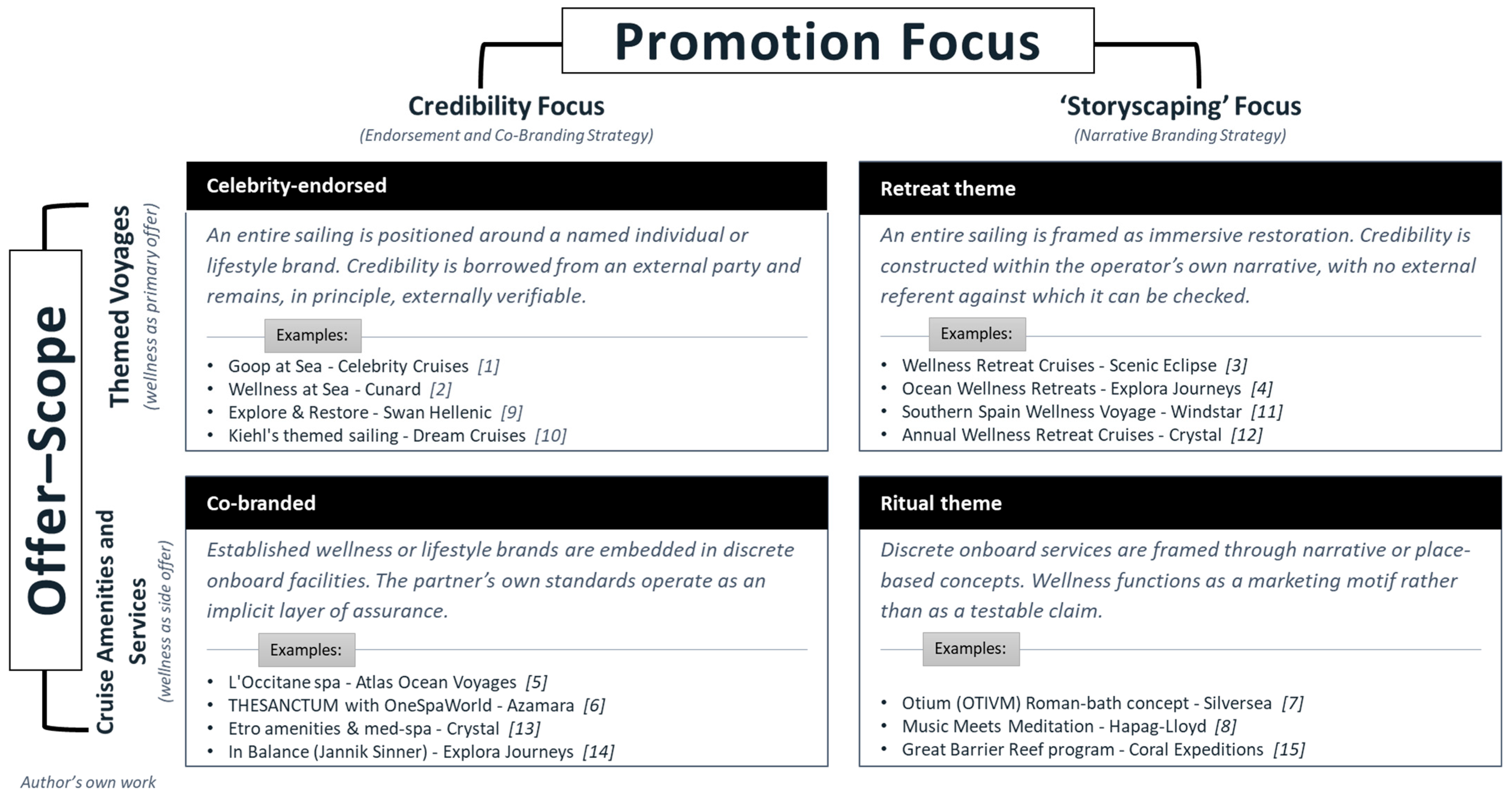
At this point, it is pertinent to conceptualize wellness in cruise tourism, in order to be able to assess the impact of the sectors’ overall health-architecture and structural deficits in this context. For this, we propose a typology of wellness cruising (
Figure 1), with examples extracted from cruise industry press coverage (i.e., cruise industry news press articles from 2008–2026). The typology is structured along two dimensions. The first, offer scope, distinguishes themed voyages, in which wellness constitutes the primary offer, from cruise amenities and services, in which wellness serves as an ancillary component of the broader cruise product. The second dimension, promotion focus, separates a credibility focus, operationalized through endorsement and co-branding strategies, from a “storyscaping” focus, in which wellness is communicated through narrative branding.
The offer-scope axis follows the economic logic of the cruise sector’s business model, whereby a comparatively low ticket price is cross-subsidized by onboard and shore-side revenue (
Papathanassis, 2020;
Vogel & Oschmann, 2011). Whether a wellness service component is included in the ticket price (e.g., themed voyage), or is separately bookable (i.e., extra service onboard), determines whether service failures in this area represent forgone revenue on board or failure of the cruise as a whole. The promotion-focus axis draws on the established distinction between source-credibility strategies, in which persuasion is transferred from an external party with verifiable standards, and narrative or ‘storyscaping’ strategies, in which meaning is constructed by a brand’s communication. From these two approaches, it is only the former that provides an external reference against a claim following a service failure. This corresponds to quality signaling under conditions of information asymmetry, which is endemic for services in general (inseparability, intangibility) and tourism in particular. A promise of wellness cannot be inspected or verified in advance by the guests. The credibility/value of this claim depends on the cost and consequences for the provider if they fail to deliver it (
Kirmani & Rao, 2000). Borrowed credibility transfers these costs and consequences to an identifiable external entity with referable standards. This is not the case for narrative construction.
The two axes are treated as independent because an operator’s choice of promotional mechanism is not determined by the centrality of the wellness offer. Moreover, all four combinations are evident in practice, as the examples below illustrate. These examples were identified through a structured search of the Cruise Industry News archive (2008–2026) searching for the keywords: ‘wellness’, ‘spa’, ‘retreat’, ‘mindfulness’ and ‘health’. Those items that described a named, branded wellness offer attributable to an identifiable operator were retained. The resulting selection of examples is intended for descriptive purposes and by no means a comprehensive account. The purpose here is to demonstrate that all four cells of the typology are occupied in practice. The full source list is reported in
Supplementary Table S1.
Combining these dimensions produces four distinct types of wellness cruising. Celebrity-endorsed wellness cruises leverage the credibility of prominent individuals or lifestyle brands to position entire sailings around wellness; for example, Goop at Sea on Celebrity Cruises [1] and Cunard’s Wellness at Sea voyage headlined by Katarina Johnson-Thompson [2]. Retreat-themed wellness cruises construct wellness as an immersive narrative experience, illustrated by Scenic Eclipse’s “wellness retreat cruises” [3] and Explora Journeys’ “Ocean Wellness Retreats” [4]. At the level of amenities and services, co-branded offerings embed established wellness and lifestyle brands in the wellness offer onboard, such as the L’Occitane spa on Atlas Ocean Voyages [5] and Azamara’s “THESANCTUM” concept with OneSpaWorld [6]. Ritual-themed amenities frame discrete onboard services through narrative or place-based concepts, as in Silversea’s “Otium program”, which draws on Roman bathing culture [7], and Hapag-Lloyd’s “Music Meets Meditation format” [8].
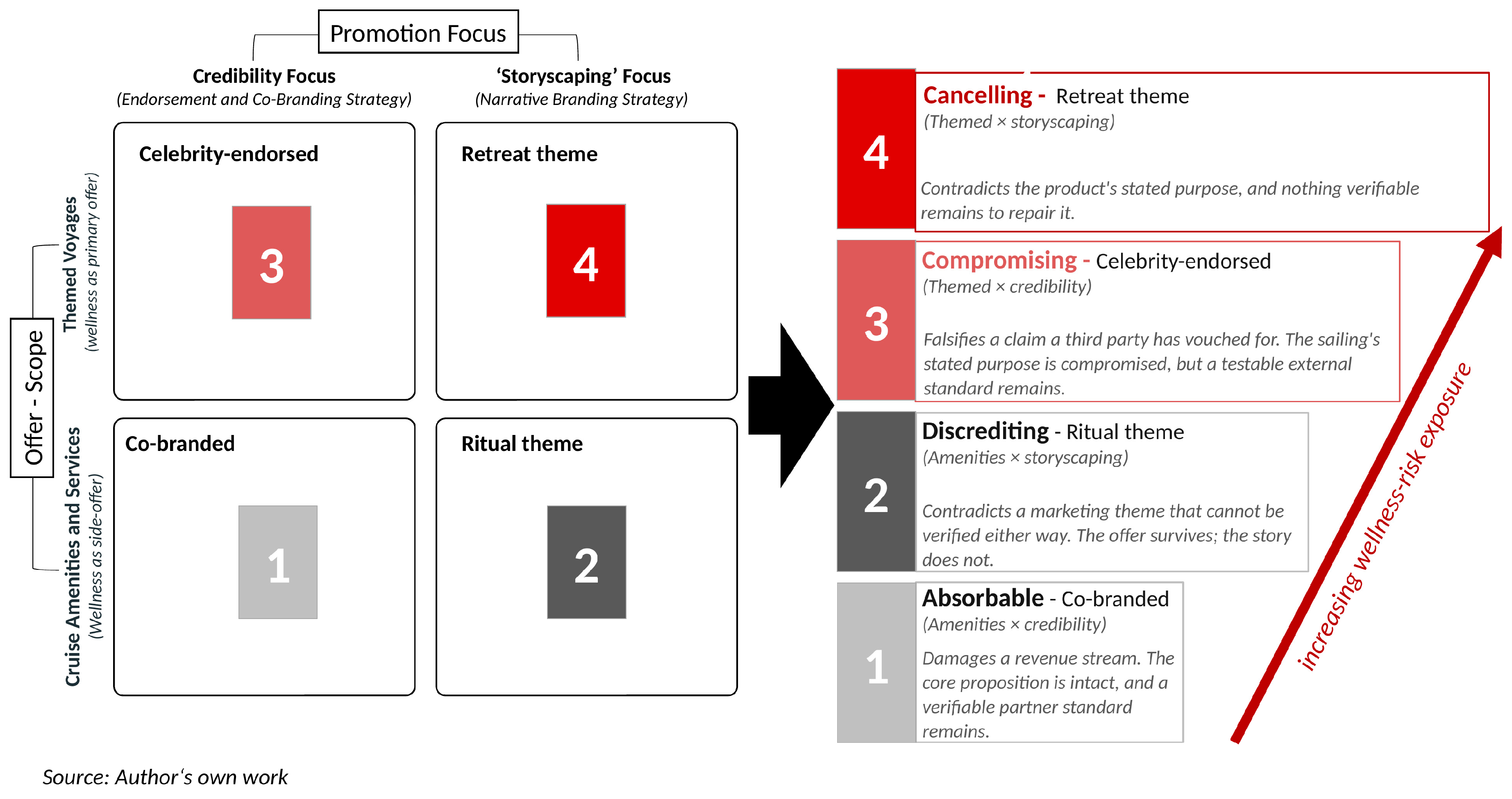
To summarize, the proposed typology classifies wellness in the cruise sector along two independent axes: the centrality of wellness to the overall offer and the promotional logic through which it is communicated, ranging from borrowed credibility to constructed narrative. Both credibility and narrative (i.e., promotion focus dimension) can be challenged and presumably overshadowed by health incidents onboard; the extent of the corresponding impact ultimately depending on the centrality of wellness in the overall offer (
Figure 2). The proposed typology, applied in the context of this paper, leads to three propositions, including their underlying mechanisms and suggestions on how to test them.
First, the higher the centrality of wellness in the cruise offering, the higher the exposure to the wellness-risk paradox (i.e., a health incident negatively impacts secondary revenue streams in the amenities quadrants, but cancels the product itself in the theme quadrants). The mechanism assumed is one of substitutability. An outbreak in an amenity quadrant removes a service the passenger can forgo, whereas in a themed quadrant it removes the very motivation for purchasing the cruise in the first place. This proposition could be tested by comparing post-incident booking recovery and price evolution across the two offer-scope categories while controlling for incident severity. A convergence of recovery trajectories would falsify this proposition.
Second, in the case of health incidents, narrative-based promotion is more fragile than credibility-based, precisely because it offers the passenger nothing to compare it against. Externally-anchored credibility, by contrast, supplies a reference instance to be compared and juxtaposed against an incident, in conjunction with a third party with a vested and independent interest in the standard being upheld. The proposition follows from the falsifiability condition in the Extended Parallel Process Model (
Liu et al., 2016; see
Section 7) and could be empirically tested by presenting respondents with an identical outbreak scenario under endorsement-based and narrative-based framings and then measuring the change in trust and booking intention. If narrative framings proved equally or more resilient, the proposition would be falsified.
Last, considering the previous two suppositions, a quadrant-adjusted quality-assurance scheme is presumably more effective than a unilateral inspection standard. The argument here is that assurance efforts should be proportionate to reputational exposure rather than uniform across a fleet, and that the assurance instrument should match the corresponding promotional mechanism (i.e., verifiable outcome claims where credibility is borrowed, and independently audited operational standards where it is narrated). The proposition is testable by a comparison of incident outcomes under differentiated and uniform assurance regimes, and would be falsified if inspection compliance alone predicted reputational recovery.
4. The ‘Wellness-Risk Paradox’: The Structural Limitations of Wellbeing
As mentioned, health tourism entails both a curative motive (medical tourism) and a preventive or restorative one (spa and wellness tourism) and cruise-related health tourism sits awkwardly across both (
M. K. Smith & Puczkó, 2013). This ‘awkwardness’ is structural in nature. A land-based spa or wellness hotel can screen its guests, control interactions with its environment and release them at the end of a treatment. On board a cruise ship, none of those three are as straightforward: passengers and crew embark and disembark at several ports, occupy and share a close-quarters environment for several days (
Rutenberg et al., 2021). In most cases, health screening of passengers is limited to completing a questionnaire at the start of their cruise, which means that, assuming they do this honestly and correctly (even though this could mean the end of their holiday), the symptoms of an impending infection may not have appeared yet (incubation period).
With regards to health and safety, risk exposure is broader than infectious disease alone. A comprehensive accounting of passenger and crew mortality across the industry, examining fatal-incident reports filed by seventy-eight ocean and river lines between 2000 and 2019, found that falls overboard or to lower decks, cardiac events, and suicide or murder accounted for the bulk of the 623 deaths identified; with infectious disease not amongst the leading causes (
Heggie & Burton-Heggie, 2020). In this study, United States citizens accounted for 66% of passenger deaths in the sample, a skew attributed to the age profile of North American cruisers, while crew suicides clustered among employees from lower-income countries, enduring long periods of separation from their family and working under difficult conditions. These findings reframe health and wellbeing before disease is even considered: a population that is older, more sedentary, frequently intoxicated and confined for several days in a limited space is subjected to higher cardiac and psychiatric risk. This, in combination with seasonal pathogens, means cruise operators are making a health-and-wellbeing brand promise against a baseline mortality risk, which is irrespective of disease control effectiveness. The mainstream measures available to a ship’s captain for controlling an outbreak, once one starts, are essentially those available to an Adriatic harbormaster several centuries ago: isolate the symptomatic patient, restrict movement between groups, and wait out the incubation period. The word “Quarantine” derives from the Venetian ‘
quarantena’, the forty days a vessel suspected of carrying plague was required to wait offshore before making port. This was more of a maritime-trade innovation than a medical one, devised to protect Adriatic cities and avoid disrupting commercial activity. Although this logic persists today, it has become more effective owing to faster diagnostics, better-documented case definitions and more detailed reporting. Nonetheless, the underlying maneuver (i.e., separation and patience) has not changed (
Codreanu et al., 2021;
Walker et al., 2021).
What has changed is the marketing layer placed on top of that logic. Modern cruise ships feature onboard medical centers, advertise indoor air-quality filtering and monitoring and, on some itineraries, they partner directly with wellness and medical-tourism providers ashore (
Buhalis et al., 2022;
Cheung et al., 2025). The proliferation of cruise wellness offers (refer to
Section 2 and
Section 3) aims at positioning the ship as a health-tourism destination in its own right; rather than merely a means of transport to one (
Papathanassis, 2020). Yet, this sits uneasily beside the epidemiological literature’s treatment of a cruise vessel as a high-density transmission environment (
Mawatari & Kato, 2014;
Towers et al., 2018). This ‘wellness-risk paradox’ is not a contradiction the sector is oblivious to, but one it has predominantly managed through reassurance signaling and recovery messaging; instead of fundamentally rethinking the underlying health and safety operational architecture.
In theoretical terms, the cruise wellness-risk paradox is best understood as a distinctive case within the body of health-tourism literature.
M. K. Smith and Puczkó’s (
2013) curative–preventive distinction presupposes a setting in which the provider controls admission, exposure and discharge. A cruise ship satisfies none of these conditions while making the same restorative promise. The hyperreal “cocoon” described by
Vogel and Oschmann (
2011) derives much of the cruise product’s appeal from its enclosed environment. Epidemiologically, however, this same enclosure constitutes a fundamental determinant of transmission efficiency (
N. Zhang et al., 2016). The service-management literature’s treatment of value co-production places the customer inside the production process. In the cruise context, the passenger is simultaneously a co-producer of the wellness experience and the primary source of service failure in this respect. In a broader sense, this qualifies as a paradox as it reflects persisting contradictory, yet co-existing, conditions (
Poole & Van de Ven, 1989;
W. K. Smith & Lewis, 2011;
Berti et al., 2021). As such, it cannot be regarded as a decisional dilemma and reflects more than an ordinary reputational risk. For one, the risk is integral (i.e., not incidental) to the value proposition. Those interacting to co-create a wellness experience are also those who can ‘co-destroy’ it; namely, the guests. This also means that it cannot be excluded by (re)design, as this would dismantle the very attribute that creates the value (i.e., wellness experience). This is why the sector’s response tends to be communicative rather than architectural in nature. Furthermore, the magnitude of reputational damage is highly dependent on the intensity and structure of the health claim (wellness promise), with the epidemiological severity of an event playing a secondary role. More specifically, a norovirus outbreak of identical clinical scale is an operating cost on a mainstream vessel and an existential event on a wellness retreat. This is what renders this case a relevant contribution for the tourism domain: The assurance logic of the health-tourism literature certifies service providers on the assumption that the provider controls the determinants of the outcome. This collapses wherever the guest population is itself a principal determinant of the risk. The typology introduced in
Section 3 is a device for locating an operator’s position on that gradient, and
Table 1 sets out the corresponding assurance implications.
Under the lens of the proposed typology, the type of wellness offering and its promotional focus determines the relationship between an incident and its reputational impact. The Hondius incident, for example, is exemplary in this sense, precisely because it corresponds to a small expedition vessel corresponding to the themed (i.e., retreat themes and celebrity-endorsed) quadrant row. This segment features the highest centrality of wellness in its offering, but is subjected, due to the ship’s size and itinerary, to limited isolation and medical capacity onboard, amplified by the limited response capability of smaller, remote ports. The wellness-risk paradox is most dominant where the wellness scope and promise are highest (
Table 1).
5. A Decade in Numbers: Have Cruise Holidays Become ‘Healthier’?
The oldest and most consistent published source of cruise-outbreak data is the U.S. Centers for Disease Control and Prevention’s (CDC) Vessel Sanitation Program (VSP), which has been monitoring acute gastrointestinal (AGE) illness on cruise ships calling at U.S. ports since 1975. The CDC has published outbreak-level data, with varying completeness, since the 1990s (
CDC, 2024,
2026b) and the VSP defined an outbreak as a voyage where 3% of passengers or crew exhibit gastrointestinal symptoms. This threshold and the corresponding reporting come with limitations, since they exclude, by design, both ships not calling at U.S. ports and COVID-19 outbreaks. The latter were tracked separately and subject to a different reporting mechanism during 2020–2022 (
CDC, 2025). Nevertheless, the VSP series is the closest thing the sector has to an official, decade-spanning time series in this respect.
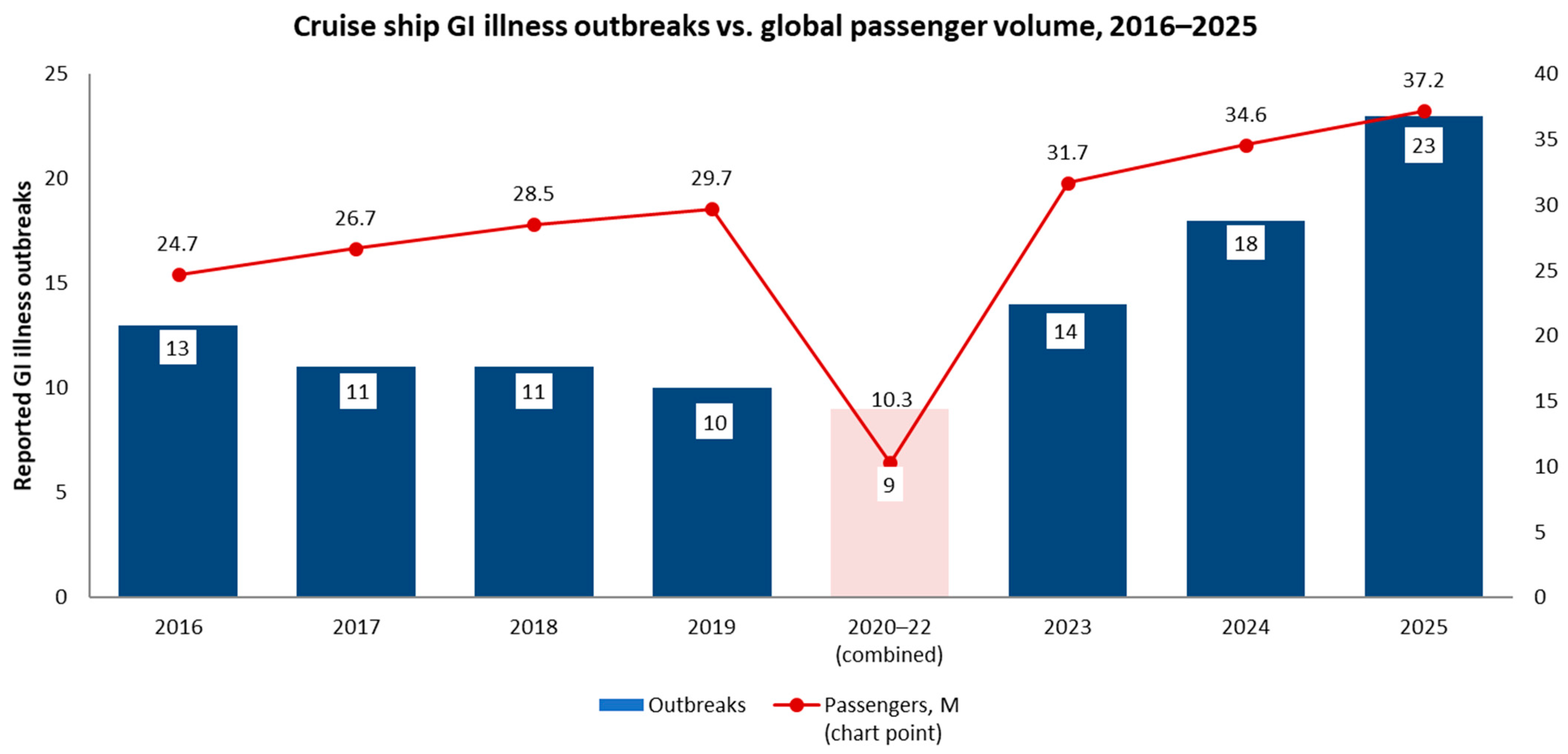
Figure 3 plots reported AGE (abbr. Acute Gastroenteritis) outbreaks meeting VSP’s threshold for 2016 through 2025 against the same period’s global ocean cruise passenger volume, drawn from the Cruise Lines International Association’s (CLIA) own annual reporting (
CLIA, 2025,
2026). The two series move together in the obvious places and apart in the more interesting ones. The pre-pandemic years (2016–2019) show a mild downward trend of outbreaks, from thirteen to ten, even though passenger volume increased from 24.7 to 29.7 million. Indeed, the CDC reports a declining trend between 2006 and 2019, due to improved sanitation practices and higher onboard hygiene compliance (
Jenkins et al., 2021). The time series for the 2020–2022 period is aggregated here to account for the ‘No Sail’ period, during which cruise operations were, for the larger part, suspended. The combined series (bar) counts outbreaks to nine across three years and an average annual passenger volume of 10.3 million.
The data for the post-pandemic period challenge the declining trend evidenced prior to the ‘No-Sail’ period. In parallel to the recovery of passenger volume to 37.2 million in 2025 (i.e., a 25% rise over the 2019 baseline), the reported outbreak counts more than doubled over the same period, from ten in 2019 to twenty-three in 2025; the highest annual total VSP has recorded in over a decade. Expressed as a rate rather than a count, reported outbreaks per million passengers stood at 0.34 in 2019 and 0.62 in 2025 (
Table 2).
Considering the low count of the annual outbreak figures, testing the significance of the increase is pertinent. In other words, we need to test whether outbreaks have become more frequent due to the number of people cruising, or whether the rate increase from 0.34 to 0.62 per million passengers falls within the expected variation of our sample. Treating outbreaks as events occurring over a measured exposure, which in our case is passenger volume, the 2019-to-2025 comparison gives a rate ratio of 1.84 (95% CI 0.87–3.86; p = 0.116). Comparing the pre-pandemic period as a whole (2016–2019: 45 outbreaks, 109.6 million passengers, 0.41 per million) with the post-restart period (2023–2025: 55 outbreaks, 103.5 million passengers, 0.53 per million) gives a rate ratio of 1.29 (95% CI 0.87–1.92; p = 0.230). Expressed as a trend, the rate falls by 13.3% per year across 2016–2019 and rises by 18.4% per year across 2023–2025.
The increase is evident in terms of direction, but uncertain concerning its magnitude. With ten outbreaks in the 2019 baseline, the range of values consistent with the data is wide, and none of the comparisons above reaches conventional significance. The choice of 2019 as the reference year also accentuates the contrast, since 2019 recorded the lowest rate in the series (0.34 per million, against 0.53 in 2016). Nonetheless, two findings can be stated. First, the pre-pandemic improvement does not appear to have continued, as a rate that had been declining until 2019 is now on the rise. Second, outbreaks are not aligned with the passenger volume recovery, suggesting that volume alone does not account for them. Establishing the magnitude of the reversal would require voyage-level exposure data, which are not published and constitute a limitation compounded by the mismatch between a global passenger denominator and a numerator restricted to vessels within VSP jurisdiction. That absence is itself part of the argument developed below. A number of additional factors could be relevant and have a compounding character in this respect:
Hygiene Fatigue: In the aftermath of the pandemic-era, the vigilance of the wider population in general, and of cruise passengers and crews in particular, has eased disproportionately to the actual transmission risk. The decline in protective behavior has been observed in the wider tourism context (
Pan et al., 2021).
Viral Evolution: Viruses, including Noroviruses (e.g.,
Preston et al., 2026), mutate over time into novel strains with longer incubation periods and/or symptomatic windows, which in turn sets a challenge to screening and subsequently facilitates onward transmission.
Measurement Limitation: Counting ‘outbreaks per million passengers’ is arguably a crude metric and does not adequately account for factors which could also affect transmission risk and infection rates such as ship size and length of trip (
Jenkins et al., 2021).
COVID-19 marked a discontinuity in the history of cruise health management. Unlike recurring gastrointestinal outbreaks, it exposed infectious disease as a fundamental operational and governance challenge. The Diamond Princess ultimately recorded 712 confirmed cases among the 3711 passengers and crew on board (up from the 634 confirmed at the close of the quarantine period on 20 February 2020, cited in
Section 1), while asymptomatic infections ranged between 18% of confirmed cases (
Mizumoto et al., 2020) to 74% undetected when modelled (
Emery et al., 2020). Other cruise voyages in 2020 reported more than 800 confirmed cases and ten deaths (
Moriarty et al., 2020), prompting tourism researchers to treat the pandemic as an existential crisis for the cruise industry (
Radic et al., 2020).
In turn, and when considering the sparse pre-pandemic academic literature, it can be argued that academia has largely overlooked cruise-related health risks. A bibliometric analysis by
H. Li et al. (
2021) of Web of Science literature on cruise disease between 1996 and 2019 found that only sixty-nine qualifying articles, compared with a total of 437 on cruise tourism, addressed Noroviral, respiratory infections, Legionnaires’ disease and vaccine-preventable diseases. This corresponds to an average of less than five papers a year. The same authors also found that scholarly interest in this area increased only after 2020. For a sector currently promoting health and wellbeing in its core value proposition, both the outbreak record and the thinness of the corresponding research point to an actionable gap.
In the typology proposed here, this means that VSP data series predominantly reflect larger, mainstream cruise vessels, where wellness tends to be offered as an amenity, rendering an outbreak commercially absorbable. In contrast, the themed quadrants are substantially underrepresented in the dataset, since expedition and small luxury vessels frequently fall below the VSP’s reporting threshold. This is a surveillance gap and it applies precisely to the segment for which the reputational stakes of an incident are highest.
Two features of the reporting standards support this inference. For one, VSP jurisdiction extends to vessels carrying thirteen or more passengers on international voyages that call at a U.S. port, which excludes a large share of the expedition and small-luxury itineraries operating in Antarctic, Arctic, Baltic and Asian waters. In addition to this, the 3% threshold needs to be considered in relation to ship size: on a 200-berth expedition vessel the threshold is crossed in six cases, which is a count attainable from a single household cluster, whereas on a 4000-berth vessel this would require one hundred and twenty. The threshold is thus proportionately easier to cross on precisely those vessels least likely to be captured by the reporting regime. The Hondius case illustrates this well. Thirteen cases aboard a 196-berth vessel would have exceeded the VSP threshold several times over, yet the voyage fell wholly outside the program’s jurisdiction and does not appear in comparable time series.
To summarize, the gap identified here is based on a reasoned inference based on the reporting rules. A measured finding to establish the magnitude of such a gap would require voyage-level illness data and currently operators are under no obligation to publish. Nevertheless, it is still of consequence for the argumentation developed here, given that the segment invisible to the surveillance system is the very segment identified in
Section 3 as carrying the highest reputational exposure.
6. Beyond Compliance: The Case for Risk-Assessment Frameworks
In this context, the corresponding regulatory framework is also liable to scrutiny. VSP conducts unannounced operational inspections of ships under its jurisdiction approximately twice a year, scoring them against a 100-point standard with 86 typically treated as a ‘pass’. A five-year review of inspection scores against subsequent outbreak occurrence (
Taylor, 2018) found no statistically significant difference between pre-outbreak inspection scores (mean = 96.4) and those not followed by an outbreak (mean = 95.1; z = 0.81,
p = 0.42). In other words, inspection reports are not reliable predictors of an outbreak.
A compliance inspection checks whether the apparatus for preventing transmission is present and maintained: water systems, food-handling procedures, hygiene protocols, and documentation. Ultimately, most norovirus outbreaks are due to human-to-human transmission and not due to system failure (
Mouchtouri et al., 2024;
Towers et al., 2018). This means that even if a cruise vessel is fully compliant, a single symptomatic passenger’s cabin-mate can become a ‘super-spreader’ within forty-eight hours (
Mouchtouri et al., 2024).
Mouchtouri et al. (
2024) report an odds ratio of 38.70 for cabin-mate illness as a transmission risk factor. Inspections, therefore, check conditions that are necessary but not sufficient. This is not to assert that inspections are irrelevant, as omitting them would presumably further increase the outbreak risk.
Nevertheless, inspection compliance cannot function as a proxy for health-tourism quality assurance. Quality assurance in health tourism is not a checklist to be completed but a risk to be assessed and managed. It is a design problem that the cruise sector, in common with other high-density tourism sectors (e.g., theme parks, religious pilgrimage tourism, large-scale spa resorts), has not adequately addressed to date. The bibliometric study by
H. Li et al. (
2021) identified six recurring risk factors: port-state epidemic-prevention capacity, the mode of disease transmission, the adequacy of international public-health regulation, ship design and construction, onboard medical and health conditions, and the structural characteristics of cruise tourism itself (i.e., dense, mobile, multinational populations moving through multiple jurisdictions on a single voyage). Interestingly, none of those six factors is reflected in the VSP checklists and several of them (e.g., ship design, port-state capacity, the demographic mix of a sailing) are not within a captain’s control.
A risk-management framework, covering these six factors (as proposed by
H. Li et al., 2021), would arguably optimally complement the existing inspection protocols and bring the quality-assurance standard of health-cruising a step closer to the sector’s selling proposition. Several of those risk factors are most pertinent in the quadrants where the centrality of wellness is higher; namely, small luxury and expedition ships (i.e., limited medical capacity and remote port incident readiness).
A risk-assessment framework as such would require capabilities that the current inspection regime does not provide. While inspections generate periodic, vessel-level, essentially binary assessments of compliance against a fixed checklist, a risk-based approach would generate voyage-specific, continuously updated, and explicitly probabilistic estimates. At a minimum level, those would incorporate: itinerary risk (port-state response capacity and diagnostic availability along the route), demographic risk (the age structure and comorbidity profile of passengers and crew), density and design risk (berth capacity, cabin occupancy, ventilation zoning, and dining configuration), behavioral risk (measured hand-hygiene compliance and symptom-reporting rates), and response capacity (availability of isolation berths, medical staffing, and rapid diagnostic capability relative to the number of persons onboard). Of these dimensions, only aspects of density and design are partially addressed by current inspection practices, while none are reassessed on a voyage-specific basis. Consequently, the output would be an ex ante risk estimate for an individual voyage rather than an ex post compliance certificate for a vessel.
Taylor’s (
2018) findings, mentioned above, reflect the measurement boundaries of the inspection regime and not its failure per se. Mean inspection scores of 96.4 for vessels preceding outbreaks and 95.1 for vessels without subsequent outbreaks suggest a compliance system operating near its limit, without sufficient capacity to distinguish between higher- and lower-risk voyages. In contrast,
Mouchtouri et al. (
2024) reported an odds ratio of 38.70 for cabin-mate illness, indicating that transmission is primarily driven by passenger proximity and behavior; both not covered by checklist-based inspections. Similarly, the six determinants identified by
H. Li et al. (
2021) predominantly reflect voyage-specific and passenger-related characteristics that fall largely outside both the inspection framework and the captain’s operational control. These findings suggest that the current assurance architecture prioritizes conditions that are readily standardized over those that most strongly influence public health outcomes. Consequently, the principal challenge is one of system design rather than regulatory enforcement. Mapping the six risk factors onto the proposed typology further highlights this distinction. Port-state response capacity and onboard medical capability are most critical in the themed quadrants, where remote itineraries and smaller passenger complements constrain access to external healthcare resources. By contrast, structural and vessel-design characteristics become more relevant for the amenity quadrants, where passenger density and ship size are the primary determinants of transmission risk. These differences indicate that a uniform inspection standard is poorly aligned with the heterogeneous risk profiles of contemporary cruise operations, placing disproportionate emphasis on risks that can be readily assessed, while largely overlooking those that are voyage-specific and dynamically determined.
7. Guests’ Risk Perceptions, Health-Positive Branding and Crisis Recovery
Much of the cruise-specific literature on risk perception and crisis recovery provides a reasonably consistent picture of how the wellness-risk paradox is experienced from the demand side. Passenger reactions to extended, uncertain confinement aboard ship had already attracted scholarly attention before COVID-19, studying fire-related incidents, power failures, as well as widely publicized cases such as the 2013 breakdown of the Carnival Triumph.
Papathanassis’s (
2016) study of cruisers ‘stranded at sea’ during such incidents found that passengers’ interpretation of an unfolding emergency depended more on their own prior travel experience and on their own direct observations than information provided by the crew. Moreover, service failures during and after such an incident had a more lasting reputational damage than the incident’s specifics. In this respect, disease-driven confinement can be seen as a specific case of a more general phenomenon: passengers are left waiting for a return to a normal service and under-informed throughout the entire incident duration.
Three findings recur in the COVID-era literature. First, trust in the operator and trust in government regulation differed, with travelers placing more weight on the latter during acute crisis. For example, Australian cruisers in mid-2020 reported greater trust in their government than in cruise companies to manage health risk, even though the cruise companies were the parties with operational control (
Quintal et al., 2022).
Second, this trust asymmetry changes over time. By early 2021, surveyed travelers of the same broad population expressed willingness to cruise again, irrespective of the prevailing health situation. It appears that risk tolerance normalizes faster than the underlying epidemiological recovery (
Walters et al., 2022). Such a finding implies that demand-side confidence and supply-side risk are increasing, instead of correcting each other.
Third, recovery signaling is more effective when combined with legible incentives than when reduced to generic reassurance statements.
Pan et al. (
2021) utilized constraint and prospect theory to a sample of North American cruisers, and found that perceived discounting and loss-framing impacted on renewed purchase intention equally or more than overall confidence in onboard safety.
Yuen et al. (
2021) tested a health belief model against post-pandemic cruise intention and found that perceived benefit and self-efficacy raised respondents’ perceived value of the cruise product, while perceived health-threat lowered it. The perceived value predicting the stated intention to cruise was moderated by trust in the operator’s pandemic management. This pathway alone accounted for more than half of the variance in reported trust.
Z. Li et al.’s (
2022) study modelled operator strategy into quality, health, financial and social-communication management. Their empirical analysis found that financial incentives (i.e., discounts, loyalty points, price-match guarantees) and health-management measures accounted for the largest total effect on a renewed intention to cruise; more than passenger demographics and prior cruise experience. Reassurance about safety, therefore, competes for passenger attention with comparatively mundane commercial considerations, and does not reliably win. This supports
Pan et al.’s (
2021) loss-framing finding.
The crisis-communication literature provides some insight into why reassurance alone underperforms compared with specific information.
Liu et al.’s (
2016) application of the Extended Parallel Process Model to cruise crisis response found that messaging only works when it combines a credible threat appeal with an equally credible efficacy claim. Simply stated, reassurance without a specific, falsifiable claim about what has changed onboard is perceived as evasive, not confident. This presents an opportunity for the cruise industry. Passengers primed to think of a cruise ship as a health-positive environment are more receptive to specific safety claims. The wellness branding amplifies efficacy claims and could serve as a component of the industry’s crisis recovery. Here, the promotion-focus dimension of the typology can help elaborate this.
Liu et al.’s (
2016) finding corresponds to the demand-side distinction between borrowed credibility and constructed narrative. Storyscaping, by design, cannot be tested or weighed against an efficacy claim, and thus falls into the evasive reassurance predicted by the Extended Parallel Process Model. On the other hand, endorsement and co-branding of a spa or a sailing, during an outbreak, also adds a third party’s reputation in the equation; leveraging their verifiable standards and thus acting as an additional quality assurance layer. Finally, when it comes to financial incentives as instruments for recovery, the effectiveness of discounting (
Z. Li et al., 2022;
Pan et al., 2021) is quadrant-dependent. Discounting can restore demand where wellness is an extra service offer, but cannot repair the credibility loss of a wellness retreat positioning.
Within the broader tourism management literature, the demand-side evidence reviewed above reflects a well-established pattern with a distinctive implication for the cruise context. Research on destination recovery and service restoration generally demonstrates that perceived risk declines more rapidly than the underlying hazard, with confidence restored through a combination of price adjustments and credible information provision (
Pan et al., 2021;
Walters et al., 2022). In many tourism settings, this asymmetry is relatively benign because the underlying hazard typically diminishes over time. In cruise tourism, however, the situation differs, as the structural exposure identified in
Section 4 persists across successive voyages. Consequently, while demand-side confidence may recover over time, the supply-side risk remains fairly constant, evading the corrective relationship between market response and operational improvement. This implies that market mechanisms alone cannot be assumed to generate sufficient pressure for structural risk reduction, as passengers may resume travel before the conditions associated with previous incidents have been adequately addressed. Responsibility, therefore, shifts from consumer choice towards the design of effective assurance mechanisms. This distinguishes cruise tourism from many land-based wellness contexts, where accreditation/certification systems, licensing requirements, and recurrent local inspections provide an ongoing external oversight. The broader transferable implication here is that cruise tourism calls for an adapted assurance logic, comparable to that of land-based health and wellness tourism (
M. K. Smith & Puczkó, 2013,
2017). The key modification required here is the recognition that risk is co-produced by providers, passengers, and the characteristics of the shared onboard environment.
8. Wellness-Risk Paradox and Innovation Potential in Cruise Tourism
In
Hahn et al.’s (
2018) typology, the Wellness-Risk Paradox is “instrumental”, meaning that the corresponding endemic tensions present opportunities, provided they are actively managed. Based on the argumentation and analysis in the previous sections, four areas of innovation can be identified. While these cannot dissolve the contradiction between the cruise sector’s wellness positioning and its health-risk exposure, they reflect strategies for managing it.
The first is more frequent air-quality monitoring, which is not limited to a twice-a-year formal inspection. A study of continuous indoor air-quality monitoring, trialed on a large sailing cruise ship, found generally acceptable CO
2 levels across most ship areas, with the exception of highly-frequented dining areas (
Cheung et al., 2025). According to the authors, aside from passenger discomfort, this is also linked to elevated airborne transmission risk. Furthermore,
Azimi et al. (
2021) modelled the transmission routes of the Diamond Princess outbreak and concluded that aerosol inhalation contributed more than initially assumed. Both these findings make a strong case for ventilation engineering, combined with the standard surface disinfection protocols, as a health-assurance lever.
The second is wastewater-based surveillance, already piloted as a complementary signal for SARS-CoV-2 detection aboard cruise vessels and aircraft (
Ahmed et al., 2020) and conceptually extendable to norovirus, given that environmental transmission—while secondary to direct person-to-person spread—has been shown to sustain outbreak chains in the absence of strict sanitation practice (
Towers et al., 2018). A continuously sampled wastewater signal would not replace symptom-based surveillance, but it would shorten the detection lag that currently allows an outbreak to reach the 3% reporting threshold before any system-level response begins.
This kind of modelling points towards a further, insufficiently explored aspect. Namely, the behavior and interaction dynamics of passengers and their inclusion within cruise-specific risk modelling. Despite repeated calls for behavioral intervention research, particularly in relation to symptom self-reporting and hand-hygiene compliance (
Mouchtouri et al., 2024), such research remains rare. Here, there is cross-fertilization potential with existing knowledge from land-based quality frameworks in medical and wellness tourism (
M. K. Smith & Puczkó, 2013). Instead of treating cruise ships as a special case requiring tailored standards, they can be treated as an unusually exposed health-tourism domain.
Finally, the last area of potential is more of a jurisdictional than technical issue. The Hondius incident exemplifies its relevance.
H. Zhang et al. (
2022) compared the COVID-era responses of four cruise ships (i.e., Diamond Princess, Costa Serena, Westerdam and Grand Princess) and uncovered a similar dilemma to that of Hondius when it was denied docking in Cabo Verde. Flag states, port states and the states of passenger origins each carry partial, overlapping and occasionally contradictory obligations under the UN Convention on the Law of the Sea and the International Health Regulations. None of those instruments is capable of imposing a binding consequence on a state’s refusal to act. Post-pandemic isolation standards, a standing World Health Organization-International Maritime Organization reporting mechanism for shipboard outbreaks, and proposing coordinated rather than ad hoc port-of-call decisions proved ineffective in the Hondius case. The hantavirus outbreak advances the countermeasure toolkit: mandatory pre-boarding travel declarations for passengers transiting known zoonotic reservoirs, vector control during port calls, and rapid diagnostic capacity for pathogens with no prior shipboard history are now specific, visible gaps (
Liu et al., 2026).
While these four domains identify the principal areas for innovation, they do not provide implementation guidance.
Table 3 addresses this gap by translating each domain into specific measures, identifying the responsible actors, the quadrants in which each measure is most relevant, and externally verifiable indicators of implementation. The definition and reporting of adoption indicators are a core element here as they represent a visible commitment to passenger health. As argued in the previous section, commitments to passenger health that cannot be externally verified fail to operate as credible signals and are, therefore, functionally equivalent to reassurance messaging.
9. Conclusions
While the Hondius (Hantavirus case) and the Diamond Princess (COVID-19 case) are by no means identical, they cannot be treated as unrelated. Both are enabled by an operating model built around dense, mixed, slow-to-disembark populations, repeatedly exposed, regardless of which pathogen happens to be circulating that season. The same applies to the norovirus baseline running between these two extremes.
A tourism subsector that markets itself on health and wellbeing is faced with the challenge of bearing accountability for health risks beyond its immediate control. Inspection compliance (
Section 6) and reassurance messaging (
Section 7) are insufficient. The selling proposition of health and wellbeing currently rests on wellness branding, which does not withstand comparison with the sector’s own outbreak record. An outbreak rate rising faster than passenger volume, five years after the pandemic-induced shutdown, is worth addressing on its own terms. How this is to be addressed depends on the cruise operator. The further their offer sits towards the themed end of the offer-scope axis, and the more its promotion rests on narrative rather than on verifiable claim, the higher the health standard that needs to be kept in order to credibly sustain the wellness promise. In order to address this health-risk paradox, this paper proposes four domains of potential action.
The argumentation and perspective presented in the previous pages should not be perceived as a reproach for health-cruising. It is merely a case for addressing the challenge of health(quality)-assurance in the cruise sector. Ultimately, a sector capable of floating resorts and technological marvels at sea is in a position to build effective health-surveillance onboard. The technological capability, the genotype data and the behavioral research are all available, yet remain underutilized in a sector actively pursuing a competitive position within health tourism. Simply stated, the cruise sector, which has spent almost two decades selling health and wellbeing on its vessels, is coming increasingly under pressure to prove it can deliver it.
From a theoretical perspective, the work presented here contributes by identifying and elaborating a boundary condition for health-tourism assurance. The dominant assurance logic in the existing literature (i.e., certification) presumes that the provider controls the determinants of the outcome. The cruise sector represents a broader category of health tourism settings in which health outcomes are determined not only by the service-provider’s practices but also by the characteristics and behavior of the guest population. In such settings, certification remains a necessary component of quality assurance, but is structurally insufficient on its own. Comparable conditions are likely to exist in other high-density, co-produced tourism contexts such as large-scale spa resorts, pilgrimage tourism, and festival and expedition tourism, indicating that the wellness–risk paradox is not unique to cruise tourism. Such settings share a similar configuration and are thus subjected to the wellness-risk paradox: The ‘wellness value’ stems from a self-contained (controlled) setting, where the guests/users cannot be sufficiently screened and where certification presumes control over outcome.
From a managerial viewpoint, the implication is that investments in health assurance should be allocated by quadrant rather than uniformly across a fleet. Operators whose wellness proposition is central to their value proposition and actively communicated face a level of reputational exposure that cannot be mitigated through price discounting (
Section 7) and is not addressed by inspection-based compliance (
Section 6). For these operators, the marginal value of verifiable, independently audited assurance is, therefore, greatest. By contrast, operators for whom wellness constitutes an ancillary, co-branded offering already benefit from a degree of external assurance through their commercial partnerships and can extend this assurance contractually at comparatively low cost.
Table 3 indicates where each measure returns most.
The three propositions introduced in
Section 3 are intended as hypotheses for empirical evaluation. Proposition 1 calls for comparative analyses of post-incident booking behavior and pricing across different wellness offer categories. Proposition 2 lends itself to experimental studies that vary promotional framing while controlling for the underlying incident scenario. Proposition 3 requires longitudinal evaluations of differentiated and uniform assurance regimes. Underpinning all three, however, is the actionable agenda outlined in
Section 5, notably the establishment of voyage-level exposure denominators, extended surveillance of vessels operating outside VSP jurisdiction, and standardized reporting for the expedition and small-luxury cruise segments.
Finally, the work presented here is subject to a number of limitations. The argument presented in this perspective paper is conceptual, supported by a secondary analysis of aggregate published surveillance data, subject to the denominator mismatch and count-level uncertainty outlined in
Section 5. The typology is based on descriptive industry material rather than systematic content analysis, and the categories/quadrants constitute analytical constructs. The propositions developed in this paper are, therefore, interpretive and theory-driven rather than empirically validated. Nevertheless, these limitations do not diminish the relevance of the underlying structural argument and can be regarded as the required empirical conditions to further evaluate and validate it.