1. Introduction
Tourism has long been a central development pathway for many Small Island Developing States (SIDS), precisely because it can generate foreign exchange, employment, and international visibility with relatively limited industrial capacity. At the same time, “smallness” and “islandness” often translate into higher exposure to external shocks, narrow export bases, and constraints associated with remoteness and limited resources (
Briguglio, 1995). In tourism studies, this tension has produced two recurring, and sometimes competing, ways of framing island destinations: one that emphasises vulnerability and dependence, and another that insists on agency, adaptability, and the capacity of island societies to chart development paths that fit their own priorities (
Scheyvens & Momsen, 2008). The COVID-19 pandemic made this debate more than theoretical. Global travel restrictions triggered an abrupt collapse of international mobility, with international tourist arrivals falling by roughly three quarters in 2020 according to UN sources (
UN Tourism, 2021), and island destinations, often more tourism-dependent than larger economies, faced a particularly sharp test of resilience.
While the COVID-19 disruption represents a critical turning point, this study adopts a longer-term perspective (2010–2025) to situate the shock within the broader structural evolution of a mature island tourism destination.
Against this backdrop, Mauritius offers a timely and policy-relevant case. The country is officially recognised as a SIDS (
United Nations OHRLLS, n.d.) and has a mature tourism sector whose performance is closely tracked through regular statistical publications. Beyond the immediate pandemic shock, Mauritius has also been pursuing a broader agenda of modernisation and digital transformation, framed as a route to competitiveness and sustainability (
Ministry of Information Technology, Communication and Innovation, 2025;
UNDP, 2025). These dynamics resonate with current discussions in tourism research, where “resilience” is increasingly treated not only as the ability to rebound after a crisis, but also as a process that involves adaptation, learning, and, at times, strategic reorientation (
Jiang et al., 2021;
Sharma et al., 2020). Some authors describe COVID-19 as a potential turning point that could accelerate sustainability transitions, while others caution that crises may just as easily reinforce existing models and inequalities if recovery is driven by short-term imperatives (
Gössling et al., 2021;
Hall et al., 2020).
A second debate sits at the centre of contemporary island tourism: how innovation, especially digitalisation, interacts with authenticity. Authenticity is a contested concept and not a single measurable attribute;
Wang (
1999) famously distinguished objective, constructive, and existential forms, showing why tourist “authenticity” can refer to originals, to socially negotiated meanings, or to a felt sense of being that emerges through experience. More recently, the growth of platform-mediated tourism has intensified what some call a “digital authenticity paradox”, where visibility and engagement incentives may not align with culturally accurate representation (
Manlee & Kasemsarn, 2025). For SIDS, where the destination brand is often built on nature, culture, and a promise of distinctiveness, the innovation–authenticity balance is not just a marketing concern; it is tied to questions of carrying capacity, community benefit, and long-term positioning. At the same time, not all relevant dimensions of authenticity are directly observable in macro-level statistics, which creates a practical challenge for destination monitoring and policy evaluation.
This paper responds to that challenge by focusing on what can be shown transparently with secondary data, while keeping the discussion anchored in the wider debates above. The purpose of the study is to examine how the Mauritian tourism sector’s performance and “value capture” evolved from 2010 to 2025, with particular attention to the COVID-19 disruption and the shape of the post-pandemic recovery. The analysis is based exclusively on official secondary sources: (i) arrivals and source-market statistics published by the Ministry of Tourism (
Ministry of Tourism, 2024a), complemented by annual performance reporting for contextual interpretation (
Ministry of Tourism, 2024b), and (ii) monthly gross tourism earnings disseminated by the Bank of Mauritius (
Bank of Mauritius, n.d.). These datasets allow the study to speak to resilience in a concrete way, through changes in volumes, revenues, seasonality, and market dependence, without relying on time-intensive primary fieldwork.
1.1. Conceptual Framing: Resilience and Value Capture
To move beyond descriptive “bounce-back” accounts, we frame tourism resilience as a multi-dimensional process that involves (i) resistance to disruption, (ii) speed of recovery, and (iii) reorientation of the tourism system towards a less vulnerable and more value-generating configuration. In SIDS settings, where tourism is simultaneously a foreign-exchange engine and a key exposure channel, the quality of recovery is therefore as important as the return of volumes. We combine resilience thinking with a value-capture lens by distinguishing demand recovery (arrivals) from monetary performance (gross tourism earnings) and by operationalising a pragmatic proxy for value capture (revenue per arrival). This allows us to examine whether recovery is primarily volume-led, value-led, or characterised by a decoupling between volumes and yield.
The objective of this study is to examine not only the scale but also the quality of tourism recovery in a Small Island Developing State (SIDS) context, using Mauritius as an empirical case. Specifically, the study aims to assess how the recovery of tourist arrivals relates to tourism earnings, value capture, and structural vulnerability indicators, including seasonality and source-market concentration. By combining these dimensions, the paper seeks to provide a more comprehensive and policy-relevant understanding of post-COVID tourism recovery, moving beyond volume-based interpretations towards an evaluation of recovery quality and resilience.
1.2. Research Questions and Expected Contributions
The manuscript addresses three research questions: (RQ1) To what extent did the post-COVID rebound in arrivals translate into a rebound in tourism earnings and revenue per arrival? (RQ2) Did recovery coincide with changes in seasonality intensity and source-market concentration that alter the destination’s risk profile? (RQ3) What conceptual lesson can be drawn for how tourism and hospitality research should assess “recovery success” in mature island destinations? Empirically, we provide a consolidated reading of Mauritius’s trajectory across the pre-shock period, the COVID-19 disruption, and the recovery phase up to 2025 using a consistent set of indicators. Conceptually, we propose a simple resilience–value capture matrix that can be used to classify recovery profiles (e.g., volume-led recovery versus upgraded recovery), offering a transferable device for future comparative work using official statistics.
1.3. Paper Structure
The remainder of the paper is organised as follows.
Section 2 summarises the Mauritian context and tourism profile.
Section 3 details the secondary data design, measures, and analytical strategy.
Section 4 presents and interprets the empirical patterns, emphasising the relationship between volumes, earnings, and vulnerability channels.
Section 5 and
Section 6 derive managerial implications and limitations, respectively.
Methodologically, the paper combines descriptive time-series evidence with an explicitly defined set of resilience and value-capture indicators. Rather than treating official statistics as an end in themselves, we use them to (i) quantify the magnitude of the shock, (ii) measure the speed and completeness of recovery relative to pre-pandemic baselines, and (iii) diagnose whether recovery is accompanied by shifts in yield, seasonality, and source-market dependence. This indicator-based approach is designed to be replicable and to support cumulative research across SIDS destinations.
The analysis yields two empirical insights that go beyond documenting a generic recovery curve. First, the return of arrivals and the recovery of tourism earnings do not move one-to-one: revenue per arrival varies substantially across the disruption and recovery phases, signalling compositional change in the visitor mix and the pricing/length-of-stay structure of demand. Second, recovery unfolds through vulnerability channels: the post-COVID rebound is closely tied to a limited set of origin markets and to seasonal peaks, which matters because concentration can accelerate rebound while simultaneously increasing exposure to future shocks.
Overall, the study aims to (i) quantify Mauritius’s tourism resilience using a dual lens of volume and value, and (ii) translate the observed patterns into a transferable conceptual device for tourism and hospitality research: a resilience–value capture matrix that distinguishes between volume-led recovery, upgraded recovery, and other recovery profiles. This directly addresses the need for analytical depth when secondary data are used, by showing how official series can be mobilised to test recovery quality rather than merely describe trends.
1.4. Research Gap
Despite the growing body of literature on tourism resilience in Small Island Developing States (SIDS), existing studies tend to emphasise either conceptual discussions of resilience or descriptive analyses centred on tourist arrivals. This has resulted in a limited operationalisation of recovery quality, particularly in terms of how volume recovery translates into economic performance and structural vulnerability. In addition, there is a lack of simple, transparent, and replicable frameworks that make systematic use of official secondary data to assess the relationship between demand recovery, value capture, seasonality and source-market dependence. As a result, important dimensions of post-crisis recovery, such as whether destinations are returning to pre-existing vulnerabilities or transitioning towards more resilient and higher-value configurations that remain underexplored in empirical terms. This study addresses this gap by proposing and applying a secondary-data-based analytical framework that captures both the scale and the quality of tourism recovery in a SIDS context.
3. Methodology
3.1. Research Design
This study follows a secondary-data case-study design to examine tourism resilience and value capture in Mauritius over the period 2010–2025. The approach is intentionally transparent and replicable: it relies on official statistical series to document how demand and tourism earnings evolved before, during, and after the COVID-19 shock. The pandemic is treated as an exogenous disruption that allows the analysis to distinguish between (i) medium-term pre-pandemic dynamics, (ii) the disruption period (2020–2021), and (iii) the recovery phase from 2022 onwards. In analytical terms, the COVID-19 period (2020–2021) is treated as a structural break in the time series, separating pre-pandemic dynamics from the recovery phase.
The 2010–2025 timeframe was selected for three reasons. First, it provides a sufficiently long pre-pandemic baseline to observe changes in volumes, seasonality and source-market structure in a mature island destination. Second, it captures both the COVID-19 rupture and the subsequent recovery, which is essential to assess whether performance simply returned to prior patterns or shifted towards a different profile. Third, the period accommodates a measurement consideration in the earnings series: the Bank of Mauritius reports an expanded coverage of gross tourism earnings from January 2015 onwards. Working with a longer window makes it possible to interpret earnings-based indicators with appropriate caution while still ending the analysis with the most recent official observations available.
3.2. Data Sources and Compilation
The dataset combines two core sources. First, annual totals and origin-market breakdowns of tourist arrivals were compiled from the Handbooks of Statistical Data on Tourism published by the Ministry of Tourism, complemented where relevant by official performance reporting. Second, monthly gross tourism earnings (GTE) were extracted from the Bank of Mauritius series, reported in Mauritian rupees (Rs) and typically expressed in Rs million.
All series were harmonised to a consistent time index (month/year). Where monthly arrivals were available, they were used to assess seasonality; annual values were derived by aggregating monthly observations to align arrivals and earnings at the same periodicity. In interpreting earnings-based indicators, the analysis explicitly accounts for the change in coverage noted by the Bank of Mauritius from January 2015 onwards, treating pre-2015 and post-2015 earnings levels as not strictly comparable.
3.3. Measures and Operationalisation
The analysis is based on a set of policy-relevant indicators derived from official tourism statistics, designed to capture both the scale and the quality of tourism recovery. The operationalisation follows a structured framework that distinguishes between three analytical dimensions: (i) volume recovery, (ii) value capture, and (iii) structural vulnerability.
Volume recovery is measured using total tourist arrivals, expressed both in absolute terms and relative to a pre-pandemic benchmark. To enable consistent comparison across periods, arrivals are normalised using the 2018–2019 average as a reference point, allowing recovery to be interpreted as the extent to which post-pandemic levels approach or exceed pre-COVID conditions.
Value capture is proxied by revenue per arrival, calculated as the ratio between gross tourism earnings and total arrivals for the corresponding period. This indicator provides a pragmatic measure of the economic yield associated with tourism activity, enabling the analysis to distinguish between volume-led and value-led recovery dynamics. Given that gross tourism earnings are reported in nominal terms and reflect both price and composition effects, the indicator is interpreted as a relative measure of performance rather than a direct estimate of value creation.
Structural vulnerability is assessed through two complementary indicators. First, seasonality intensity is measured using monthly arrivals, combining the coefficient of variation within each year with a peak-to-trough amplitude ratio to capture the concentration of demand over time. Second, source-market concentration is approximated using a Herfindahl–Hirschman Index (HHI) based on available market shares. Where the published data are limited to major origin markets, the index is interpreted as a concentration proxy rather than a full-population measure.
To support interpretation and ensure analytical consistency, recovery patterns are assessed relative to the pre-pandemic baseline (2018–2019) across all indicators. In particular, the joint evolution of volume recovery (arrivals) and value capture (revenue per arrival) provides the basis for classifying recovery profiles. A recovery is considered volume-led when arrivals return to or exceed pre-pandemic levels while revenue per arrival remains below its benchmark. Conversely, an upgraded recovery would require both volume and value indicators to return to or surpass pre-pandemic levels. This rule-based operationalisation allows the resilience–value capture matrix to be applied in a consistent and replicable manner.
This operationalisation enables a transparent and replicable assessment of tourism recovery using only official secondary data, facilitating comparison across time and potentially across destinations.
3.4. Analytical Strategy
To move beyond a purely descriptive identification of the COVID-19 disruption, the monthly arrivals and gross tourism earnings series were examined using a segmented (break-sensitive) time-series approach. Given the exogenous nature of the pandemic shock, the analysis focuses on identifying level and trend discontinuities around 2020 through a segmented comparison across three regimes: pre-pandemic (2010–2019), disruption (2020–2021), and recovery (2022 onwards).
This phase-based approach allows for a structured comparison of both mean levels and trajectories across regimes, providing a basis to assess whether post-pandemic recovery reflects a simple return to pre-existing patterns or a shift in value-capture dynamics. The analysis is therefore not limited to the pandemic period but is explicitly embedded in a longer-term trajectory (2010–2025), enabling short-term disruptions to be interpreted within broader structural trends.
The empirical analysis proceeds in four steps. First, it provides a descriptive account of arrivals and earnings, reporting levels, growth patterns, and key turning points over time. Second, it benchmarks the disruption period (2020–2021) against a pre-pandemic baseline (2018–2019) and traces recovery trajectories from 2022 onwards. Third, recovery is interpreted not only in terms of volumes but also through value capture, seasonality, and source-market dependence. Finally, the observed quantitative patterns are discussed considering official tourism performance reporting, ensuring that interpretation remains consistent with institutional definitions and contextual dynamics.
While the study does not pursue causal identification in a formal econometric sense, it adopts a structured time-series modelling perspective to compare performance across regimes and to assess recovery dynamics in a consistent and policy-relevant manner.
This approach is particularly suited to secondary-data settings, where analytical depth can be achieved through structured comparison of regimes rather than through data-intensive econometric modelling.
3.5. Data Availability and Ethics
All data used are drawn from publicly available official sources. No individual-level information was collected, and no human participants were involved; therefore, ethical review and informed consent procedures are not applicable.
4. Results and Discussion
The interpretation of results is anchored in a long-term perspective (2010–2025), ensuring that the COVID-19 disruption is analysed as a temporary shock within a broader trajectory of tourism development. For interpretative clarity, the recovery phase (2022–2024) is consistently benchmarked against a pre-pandemic baseline (2018–2019), allowing for a structured comparison of both volume and value dynamics. Relative to this baseline, the recovery of arrivals is substantially more complete than the recovery of revenue per arrival, indicating a divergence between volume and value dynamics in the post-pandemic period.
This study examines tourism resilience and value capture in Mauritius through a structured secondary-data approach, using tourist arrivals and gross tourism earnings over the period 2010–2025. The time window is sufficiently long to situate the COVID-19 disruption within the broader evolution of a mature island destination, while remaining recent enough to capture recovery dynamics with clear policy relevance. The comparison across regimes confirms a clear level break in 2020–2021, followed by a sustained recovery trajectory from 2022 onwards.
Two key patterns emerge from the official statistics. First, the pandemic produced a sharp contraction in performance: arrivals declined to 179,780 in 2021, representing a substantial drop relative to pre-pandemic levels. Second, the rebound has been strong in volume terms, with arrivals reaching 1,382,177 in 2024, effectively returning to the pre-COVID scale of activity. A similar pattern is observed for earnings, which fell to Rs 15,253 million in 2021 and recovered to Rs 93,574 million in 2024. Taken together, these trends confirm the dual reality often associated with SIDS tourism systems: high exposure to external shocks combined with a capacity for relatively rapid recovery once demand conditions normalise.
More broadly, the time-series patterns are consistent with three distinct phases: a relatively stable pre-pandemic period, a sharp disruption during 2020–2021, and a recovery phase from 2022 onwards. However, when assessed jointly, arrivals, earnings, and revenue per arrival indicate that recovery is not a single-dimensional process. In particular, the divergence between volume recovery and value capture suggests that the post-pandemic rebound cannot be interpreted solely in terms of restored demand levels, but must also consider changes in economic yield and associated vulnerability dynamics.
Table 2 summarises the evolution of key indicators across these phases, providing the empirical basis for assessing recovery patterns in terms of both scale and value capture.
Based on the indicators reported in
Table 2, the recovery observed in 2024 is consistent with a volume-led recovery profile, as arrivals have returned to pre-pandemic levels while revenue per arrival remains below the corresponding benchmark.
4.1. Interpreting Resilience Beyond the Return of Volumes
In island destinations, “resilience” is often assessed through the speed at which tourist arrivals return to pre-crisis levels. In the case of Mauritius, the comparison with the 2018–2019 baseline indicates that this recovery has been largely achieved by 2024, as arrivals return to pre-pandemic levels (
Table 2). The segmented comparison across pre-pandemic, disruption, and recovery phases confirms a sharp contraction in 2020–2021, followed by a sustained rebound from 2022 onwards.
While this pattern reflects a strong recovery in volume terms, it provides only a partial view of resilience. A return of arrivals to pre-pandemic levels does not necessarily imply a full recovery in economic or structural terms. As shown in
Table 2, the recovery trajectory is characterised by differences in the evolution of key indicators, suggesting that volume recovery may coexist with changes in value capture and vulnerability dynamics.
This distinction is particularly relevant in SIDS contexts, where tourism systems are both highly exposed to external shocks and dependent on a limited set of markets and seasonal flows. The evidence suggests that Mauritius has largely achieved volume recovery, but this alone does not imply a fully restored or less vulnerable tourism system. For this reason, resilience is interpreted here not only in terms of the return of demand, but also in relation to the quality and structure of recovery, as captured by complementary indicators of value and vulnerability.
4.2. Value Capture and the Meaning of Recovery
A central analytical focus of the study is value capture, proxied by revenue per arrival. This indicator does not claim to measure “value” in a normative sense, nor does it capture distributional outcomes; instead, it provides a pragmatic way to assess whether the sector is recovering through higher volumes alone or whether the economic yield per visitor is also changing. The indicator is particularly useful in contexts where arrival numbers can recover faster than earnings, or vice versa, for reasons that include changes in length of stay, price levels, market composition, airline capacity, and the mix of tourism products.
At the same time, interpretation requires caution. Gross tourism earnings are reported in nominal terms and reflect both real activity and price effects. Moreover, the Bank of Mauritius notes a change in the coverage of the earnings series from January 2015 onwards, which means that pre-2015 and post-2015 levels should not be read as a single uninterrupted trend. For this reason, the paper treats the ratio primarily as a tool for within-regime interpretation and for understanding post-2015 dynamics, while using earlier years to contextualise the longer trajectory of the destination.
Using the official totals reported in this study (
Table 2), revenue per arrival is estimated at approximately Rs 84,843 in 2021 (Rs 15,253 million divided by 179,780 arrivals) and Rs 67,700 in 2024 (Rs 93,574 million divided by 1,382,177 arrivals). Relative to the pre-pandemic benchmark (2018–2019), and despite the near-complete recovery in arrivals, the ratio remains comparatively lower, indicating that value capture has not recovered at the same pace as volumes. This divergence illustrates that “recovery” is not a single curve: volumes, receipts, and yield can move differently.
This volume–value decoupling provides a concrete empirical basis for reframing resilience as the capacity to restore both demand and economic yield while reducing vulnerability channels, rather than as a simple return to arrivals. In line with the operational criteria defined in
Section 3.3, this pattern is consistent with a volume-led recovery profile, in which the return of tourist flows is not matched by a corresponding recovery in economic yield per visitor. The observed changes in revenue per arrival are likely to reflect compositional effects, including shifts in visitor profiles, length of stay, and pricing structures, rather than purely structural improvements in value generation.
As such, revenue per arrival is treated in this study as a pragmatic proxy that signals relative changes in the economic yield of tourism, rather than as a comprehensive measure of value creation, and its interpretation should be understood in the context of broader demand and market dynamics.
4.3. Resilience–Value Capture Matrix: Classifying Recovery Profiles
To translate the empirical patterns into a conceptual contribution, we propose a resilience–value capture matrix that classifies recovery profiles along two axes: (i) completeness of volume recovery (arrivals relative to a pre-shock benchmark) and (ii) restoration of value capture (earnings and revenue per arrival). This yields four stylised profiles that can be operationalised with official statistics: (a) upgraded recovery (high volume, high value), where the destination rebounds while sustaining or improving yield; (b) volume-led recovery (high volume, lower value), where arrivals return faster than earnings/yield, indicating price pressure, shorter stays, or a shift to lower-spend segments; (c) niche value capture (lower volume, high value), where a destination retains monetary performance through high-spend segments but does not restore scale; and (d) stalled recovery (lower volume, lower value).
To operationalise the resilience–value capture matrix, recovery profiles are defined along two dimensions: (i) the extent of volume recovery, measured as tourist arrivals relative to a pre-pandemic benchmark (2018–2019 average), and (ii) the evolution of value capture, proxied by revenue per arrival. Following the rule-based approach outlined in
Section 3.3, a recovery is classified as “volume-led” when tourist arrivals return to or exceed pre-pandemic levels while revenue per arrival remains below the corresponding benchmark, indicating that recovery is driven primarily by volumes rather than by improvements in economic yield. Conversely, an “upgraded recovery” implies both a recovery in volumes and a restoration or increase in revenue per arrival. These thresholds are applied in a relative sense, focusing on deviations from the pre-pandemic baseline.
In the case of Mauritius, the recovery observed in 2024 is consistent with a volume-led recovery profile. While tourist arrivals have returned to pre-pandemic levels, revenue per arrival remains below earlier benchmarks, indicating that the recovery has been driven primarily by volume rather than by an improvement in value capture. This classification reinforces the interpretation developed in
Section 4.2 and highlights that the recovery agenda cannot be reduced to “getting numbers back” but should explicitly address value capture and vulnerability management. The framework can also be interpreted dynamically across phases (pre-shock, disruption, recovery), allowing it to function not only as a static typology but also as a tool to track shifts in recovery patterns over time.
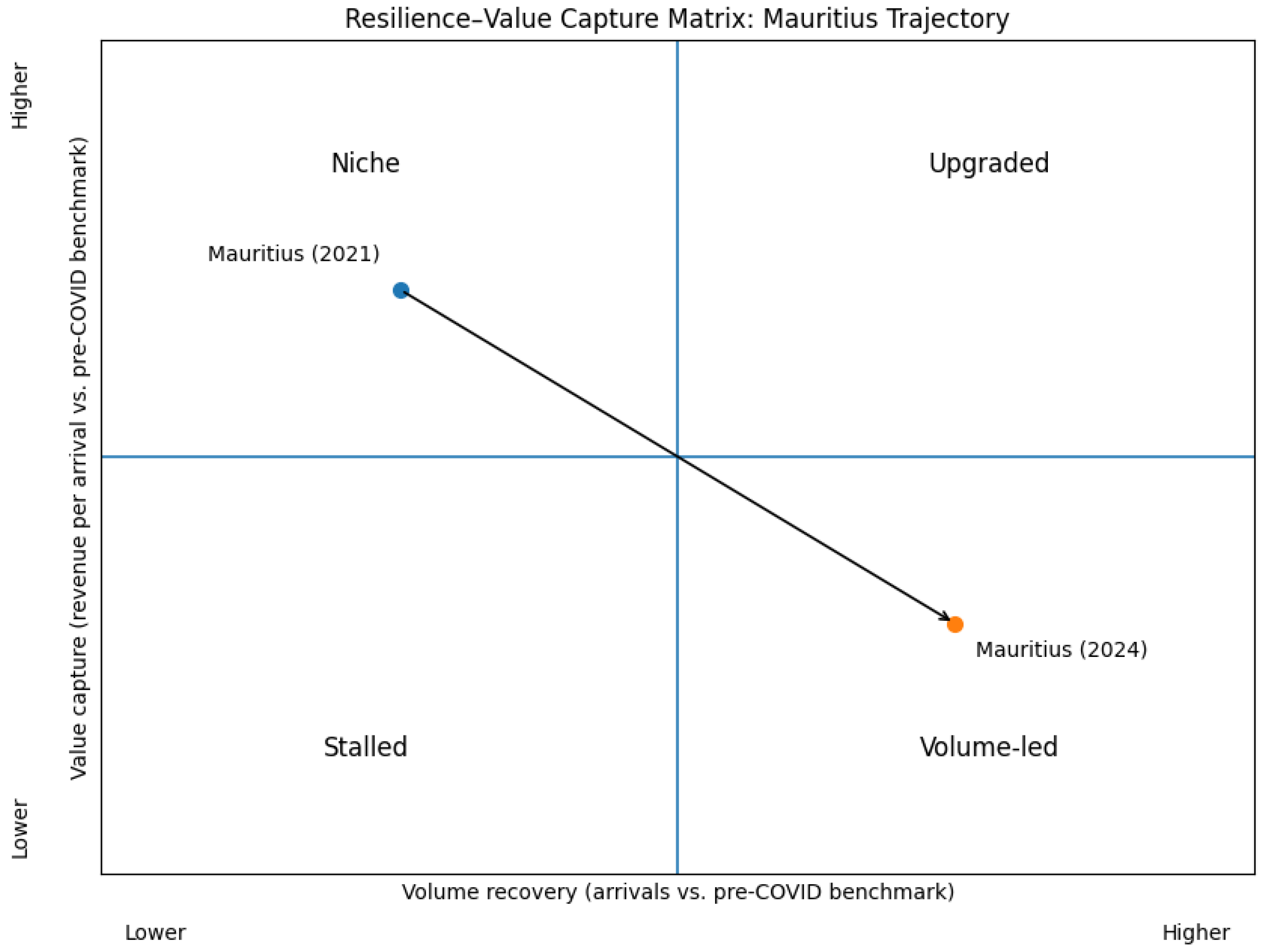
The matrix classifies recovery profiles according to two dimensions: volume recovery, measured relative to a pre-COVID benchmark, and value capture, proxied by revenue per arrival relative to the same benchmark. The Mauritius trajectory illustrates a shift from a niche profile in 2021 (low volume, relatively high value capture) to a volume-led recovery profile in 2024 (high volume, lower value capture).
Figure 1 presents the empirical application of the resilience–value capture matrix to the Mauritian case, illustrating the evolution of recovery dynamics between 2021 and 2024. In 2021, Mauritius is positioned in a niche profile, characterised by low arrival volumes but relatively high revenue per arrival, reflecting compositional effects during the disruption phase. By contrast, the 2024 position indicates a shift towards a volume-led recovery, as tourist arrivals have returned to pre-pandemic levels while revenue per arrival remains comparatively lower. This transition highlights that recovery is not a linear process but involves structural changes in the relationship between demand and economic yield. More broadly, the figure illustrates how the proposed framework can be used not only to classify recovery outcomes but also to track dynamic shifts in recovery patterns over time, thereby offering a practical tool for monitoring resilience in tourism-dependent SIDS contexts.
4.4. Seasonality and Source-Market Concentration as Vulnerability Channels
Beyond earnings, two structural features are especially important for SIDS tourism: seasonality and source-market concentration. Within the analytical framework adopted in this study, these dimensions capture structural vulnerability and complement the assessment of volume recovery and value capture. Seasonality is not merely a descriptive characteristic; it shapes employment stability, the viability of small operators, the utilisation of infrastructure and environmental pressure during peak months. Quantifying seasonal intensity using monthly arrivals provides a basis for assessing whether recovery reproduces the same concentration of flows or whether demand is becoming more evenly distributed across the year.
A parallel vulnerability channel is the concentration of demand in a small number of origin markets. High concentration can generate scale advantages in connectivity and marketing, but it also increases exposure to shocks that originate outside the destination’s control (economic downturns, regulatory changes, geopolitical events, currency movements, or shifts in consumer confidence). In this context, the concentration indicator used in this study is interpreted as a risk signal, allowing the evolution of dependence and diversification to be assessed over time.
Using the published 2024 market shares for major source countries (France 24.6%, the United Kingdom 11.4%, Réunion 10.2%, Germany 9.0%, South Africa 7.7%, and India 4.1%), a partial concentration proxy yields an HHI of approximately 996 on the conventional 0–10,000 scale. Although this calculation excludes smaller markets and should therefore be interpreted as a lower bound, it indicates that a limited number of markets account for a substantial share of arrivals. This pattern highlights a structural trade-off: the recovery observed in
Section 4.1 is partly supported by core markets, but this concentration also increases exposure to future external shocks.
Although the HHI is calculated for the most recent period to illustrate current concentration levels, the available evidence suggests that source-market dependence has remained structurally significant over time. Before the pandemic, Mauritius already exhibited a strong reliance on a limited number of European markets, particularly France and the United Kingdom. The post-COVID recovery appears to have reinforced this pattern, with the rebound in arrivals driven primarily by core markets with established connectivity and demand links. From a temporal perspective, the segmented comparison across pre-pandemic and recovery phases indicates continuity in the structure of demand, with core markets maintaining a dominant role.
Taken together, these indicators suggest that, while Mauritius has achieved a strong recovery in volume terms, structural vulnerability has not been substantially reduced. This reinforces the interpretation developed in
Section 4.2 and
Section 4.3: recovery has been primarily volume-led and accompanied by persistent exposure to concentration and seasonal dynamics. From a policy perspective, resilience is strengthened when recovery is associated not only with demand restoration but also with risk reduction and improvements in the economic yield of tourism.
For Mauritius, the managerial and governance challenge is therefore to sustain a strong return of demand while avoiding a recovery model that amplifies seasonal peaks or deepens dependence on a narrow set of markets. This does not imply a single policy recipe, but it does suggest a coherent direction of travel: product diversification that spreads demand across the year; targeted market development that reduces concentration risk; and a value proposition that prioritises quality, experience design, and higher-value segments, rather than a simple expansion of volumes. In the Mauritian context, this conversation is inseparable from climate exposure and the protection of coastal ecosystems, since the island’s tourism appeal is closely linked to natural assets and lagoon environments.
4.5. What the Secondary-Data Approach Adds and What It Cannot Show
Methodologically, the paper demonstrates what a structured secondary-data monitoring framework can add to SIDS tourism research and practice. Building on the indicator-based and phase-comparative approach developed in
Section 3.3 and
Section 3.4, the analysis shows how official statistics can be used not only to describe trends but also to assess recovery dynamics in terms of volume, value capture, and structural vulnerability.
First, the approach is inexpensive and replicable and can be updated regularly as new official releases become available. Second, it supports comparability over time, which is critical when recovery narratives shift quickly and when public debate depends on credible baselines. Third, it provides a common evidence base that can be used by researchers, destination managers and policymakers to align discussions about performance, vulnerability and priorities. In this sense, the framework offers a transparent and operational tool for monitoring tourism recovery using publicly available data.
At the same time, the limits of secondary data should be made explicit. Macro-level statistics cannot capture key social dimensions of tourism development, such as how benefits are distributed across communities and business types, nor can they directly observe authenticity, resident sentiment, or visitor experience quality. They also provide only indirect insight into environmental pressures and carrying capacity. In addition, the indicators used in this study (particularly revenue per arrival and concentration measures) should be interpreted as proxies, reflecting aggregate patterns rather than fully capturing underlying behavioural or structural mechanisms.
These limits do not reduce the value of the approach; rather, they clarify its role as a baseline analytical framework. The results, therefore, point to the need for complementary primary research when the objective is to understand perceptions, behaviours, and local impacts in greater depth, as well as to refine the interpretation of recovery dynamics beyond what can be observed through aggregate data alone.
4.6. Conclusions
The evidence assembled in this study supports three main conclusions. First, Mauritius experienced a pronounced tourism shock in 2020–2021, followed by a strong recovery in 2022–2024, illustrating both the vulnerability and the adaptive capacity that characterise tourism-dependent SIDS. The segmented comparison across pre-pandemic, disruption, and recovery phases confirms a clear break in performance and a subsequent rebound in demand.
Second, assessing recovery through a multi-indicator lens is essential. Arrivals provide a necessary but insufficient measure of resilience, and the joint analysis of arrivals, earnings, seasonality, and source-market concentration offers a more policy-relevant interpretation of recovery quality and exposure. In particular, the comparison with pre-pandemic benchmarks shows that the recovery of volume has outpaced the recovery of value capture, indicating a divergence between demand and economic yield.
Third, the application of the resilience–value capture framework demonstrates that the post-pandemic trajectory of Mauritius is consistent with a volume-led recovery profile. While tourist flows have returned to pre-pandemic levels, revenue per arrival remains comparatively lower, and structural vulnerability—particularly in terms of market concentration—persists. This highlights that recovery is not a single-dimensional process, but rather a combination of volume restoration, changes in economic yield, and evolving exposure to risk.
Finally, the study shows that a transparent secondary-data framework can serve as a practical monitoring tool for destination governance, helping to keep debates grounded in evidence while remaining feasible for researchers and policymakers facing time and resource constraints.
Overall, the paper argues for a cautious interpretation of “success” in post-crisis recovery: returning to pre-pandemic volumes is important, but long-term resilience depends on whether the destination can diversify risk, manage seasonal pressures, and sustain value capture without eroding the natural and cultural assets that support its competitiveness.
5. Managerial Implications
The empirical patterns discussed in this paper translate into a set of managerial implications for destination governance and for tourism operators in Mauritius. The central message is straightforward: post-crisis recovery should not be managed as a return to volume alone. Consistent with the findings of this study, the recovery observed in Mauritius is best understood as volume-led, with arrivals recovering faster than value capture and with structural vulnerability remaining significant. In a SIDS context, where exposure to external shocks is structural, managerial priorities therefore need to combine demand recovery with risk reduction and with the safeguarding of the natural and cultural assets that sustain competitiveness.
The first implication concerns monitoring. Destination managers benefit from tracking arrivals and gross tourism earnings together, rather than treating them as separate scoreboards. A routine dashboard built around arrivals, gross earnings, revenue per arrival, seasonality intensity and source-market concentration can support quicker and more credible decision-making. This multi-indicator approach aligns with the framework developed in this study and helps assess recovery in terms of volume, value capture, and vulnerability. It is particularly relevant when public narratives focus on headline arrival numbers: a compact indicator set helps identify whether recovery is accompanied by improving economic yield, whether seasonal peaks are intensifying, and whether dependence on a narrow group of markets is increasing. Operationally, the value of this approach is its feasibility: it can be updated regularly and used consistently across agencies and industry stakeholders.
A second implication follows directly from the importance of market structure. For a tourism-dependent island, diversification is best understood as a risk-management tool. Even when one or two origin markets perform strongly, relying too heavily on them can amplify exposure to shocks that originate outside the destination’s control. The findings of this study suggest that the post-COVID recovery has reinforced the role of core markets, rather than substantially reducing dependence. A practical managerial response is to treat source markets as a portfolio: maintain strong connectivity and brand presence in core markets, while actively developing a second tier of markets that can buffer downturns. This requires coordinated action across airlines, tour operators, destination marketing organisations and the public sector, particularly around air access, targeted campaigns and product–market fit. At the firm level, the same logic suggests reducing dependency on a single distribution channel and balancing direct bookings, platform visibility and trade partnerships.
Seasonality should also be treated as an operational constraint with economic, social and environmental consequences. Strong peak concentration increases pressure on coastal ecosystems and infrastructure, while off-peak troughs weaken business viability and employment stability. The persistence of seasonal patterns in the recovery phase suggests that volume growth alone does not reduce this form of structural vulnerability. Managers can act on seasonality through event and product programming in shoulder and low seasons, differentiated pricing and packaging, incentives for domestic and regional markets during quieter months, and the promotion of inland and nature-based experiences that spread visitor flows geographically. The goal is not to eliminate seasonality (an unrealistic objective for many islands), but to reduce its intensity and to make peaks more manageable.
Because Mauritius competes in a global market where many beach destinations look superficially similar, strengthening value capture through experience design and higher-value positioning is equally important. Revenue per arrival can be influenced by length of stay, product mix, pricing power and the distribution of spending across the local economy. The evidence presented in this study indicates that value capture has not recovered at the same pace as arrivals, reinforcing the need to prioritise economic yield alongside volume. This points to practical priorities: curated cultural and culinary experiences, marine activities with clear sustainability standards, wellbeing and nature-based offers that support higher willingness to pay, and service upgrades that translate into stronger reviews and pricing power. At the destination level, value capture also depends on linkages; supporting local suppliers and small operators helps retain spending locally and reduces leakages.
Digital innovation can raise efficiency and improve the visitor journey, but it also shapes how authenticity is represented and experienced. The pragmatic implication is to use digitalisation where it adds clear value (pre-arrival information, itinerary planning, mobility guidance, visitor flow management and service recovery), while avoiding communication strategies that flatten local culture into generic imagery. For firms, this means investing in consistent digital service delivery and in content governance that is accurate, community-sensitive and aligned with the destination’s sustainability narrative.
Finally, resilience in Mauritius cannot be discussed without preparedness. Operational plans for disruption like health events, extreme weather or connectivity shocks should be embedded in destination governance and in firm-level practice through scenario planning, communication protocols, contingency budgeting and coordination mechanisms. Given the importance of coastal and lagoon ecosystems, climate adaptation is not a separate agenda from tourism management: it is part of protecting the core product.
Overall, the managerial takeaway is that Mauritius’ post-pandemic rebound provides an opportunity to consolidate a more resilient tourism model by focusing on the structure of recovery (market dependence, seasonal concentration and economic yield per visitor), while using innovation and sustainability as practical instruments to strengthen the destination’s long-term position.
6. Study Limitations
This study has several limitations that should be acknowledged. First, the analysis relies exclusively on secondary, aggregate official statistics. While this ensures transparency and replicability, it does not allow for the observation of key social and behavioural dimensions of tourism development, such as resident attitudes, perceptions of authenticity, visitor experience quality, or the distribution of benefits and costs across communities and business types. Second, the use of gross tourism earnings as the main economic indicator entails interpretive constraints. The series is reported in nominal terms and is therefore sensitive to inflation and exchange-rate dynamics, and its coverage expands from January 2015 onwards, limiting comparability across the full 2010–2025 period. As a result, derived indicators such as revenue per arrival should be interpreted with caution and are most robust for within-period comparisons. Moreover, changes in this ratio may reflect compositional effects—such as variations in visitor profiles, length of stay, or pricing structures—rather than direct improvements in value capture. Third, the measurement of seasonality and source-market concentration depends on the level of disaggregation available in official statistics. When origin-market data are limited to major markets, concentration indices such as the HHI function as proxies rather than exhaustive measures of dependence. Finally, the study adopts a descriptive, indicator-based approach and does not attempt causal identification. The patterns observed may reflect multiple interacting factors, including policy measures, air connectivity, global demand conditions, price dynamics, and supply-side adjustments, which cannot be disentangled using the available data. These limitations do not undermine the value of the findings but rather position the study as a baseline assessment suited for monitoring and policy discussion. Future research could extend this approach by incorporating inflation-adjusted earnings, more granular expenditure and origin-market data, and formal quantitative techniques—such as structural break tests, time-series decomposition, or regression-based modelling—to further refine the analysis of tourism recovery dynamics.