1. Introduction
Small Island Developing Countries (SIDSs) occupy a distinctive position within the global tourism system. Characterized by limited territorial scale, geographic isolation, high exposure to environmental risks, and strong dependence on tourism revenues, these territories face complex challenges in balancing economic development with environmental sustainability and social resilience. In this context, tourism is not merely a complementary economic activity but a central pillar of national development strategies. At the same time, structural constraints related to infrastructure, connectivity, and resource availability demand innovative and adaptive approaches to destination management. Digitalization and smart solutions have therefore emerged as critical instruments for enhancing competitiveness, resilience, and sustainability in island tourism destinations.
Research on smart tourism has traditionally drawn on smart city frameworks developed for large, continental urban environments. However, the literature on small islands emphasizes that SIDS represent a fundamentally different development context, characterized by limited economies of scale, geographic isolation, environmental fragility, and strong dependence on tourism. According to the
Doster and Chavis (
2021), smartness in small island contexts should not be understood as the intensive deployment of advanced technologies, but rather as the strategic and adaptive use of digital and technological solutions to optimize scarce resources, enhance resilience, and improve overall quality of life. This island-specific interpretation of smartness highlights efficiency, connectivity, sustainability, and inclusiveness as core dimensions, challenging technology-centric models derived from continental smart cities.
This perspective is further reinforced by the concept of sustainable smart specialization for small island tourism economies, as proposed by the Joint Research Centre’s Tourism Framework (JTF, 2020). This approach argues that small tourism-dependent islands should prioritize selective and high-impact smart investments that align with local environmental conditions, economic structures, and cultural assets. Rather than pursuing comprehensive technological modernization, smart specialization in island contexts focuses on targeted digital solutions capable of strengthening competitiveness, sustainability, and resilience. This framework provides a relevant theoretical lens for understanding how smart tourism can support development in SIDS.
Despite the growing body of research on smart tourism, the majority of studies remain focused on large urban destinations or technologically advanced contexts, leaving small island environments comparatively underexplored. Existing literature has extensively examined smart tourism technologies, digital transformation, and tourist experiences (e.g.,
Gretzel et al., 2015;
Buhalis & Amaranggana, 2015), yet there is limited empirical evidence on how these dynamics operate in SIDS, where infrastructural, geographic, and environmental constraints are more pronounced. In particular, insufficient attention has been paid to how international tourists perceive smart tourism features in island destinations and which attributes, such as digital connectivity, sustainability technologies, or smart mobility, most strongly influence the perceived “smartness” of these destinations. Addressing this gap is essential for informing tourism development policies that aim to balance competitiveness, inclusiveness, and resilience within the specific physical and environmental limitations of small island contexts.
This study investigates international tourists’ views of smart tourism features in small island developing countries, focusing on how technological, informational, and sustainable attributes shape the overall tourist experience. By contextualizing smart tourism within SIDS, this study advances both theory and practice. The results indicate that smart tourism strategies in island environments should prioritize investments that directly improve accessibility, connectivity, mobility, and environmental sustainability. Rather than replicating smart city models developed for large urban centers, SIDS require tailored approaches that reflect their unique geographic, economic, and environmental constraints. In this sense, smart tourism emerges as a critical pathway for strengthening destination resilience and long-term competitiveness in tourism-dependent island economies. The contribution of this study lies in its contextualization of the concept of smart tourism within small island environments, which face unique constraints such as limited infrastructure, environmental vulnerability, and high dependency on tourism. By highlighting the preferences and expectations of international visitors, the study provides empirical evidence to inform destination management, sustainable tourism planning, and digital innovation strategies tailored to the specific needs of territories, bridging a gap in literature on smart tourism applications in island contexts.
1.1. Smart Tourism and the Evolution of Smart City Paradigms
Tourism is the main economic driver for many small island developing countries, yet their environmental vulnerability and dependence on external resources make innovation and digitalization indispensable for sustainable growth. The evolution of tourism and technologies has led to the emergence of the smart tourism concept, understood as an evolution of traditional tourism (
Kontogianni & Alepis, 2020). Smart tourism refers to the integrated use of digital technologies to optimize destination management, planning, and tourist experience and businesses (
Dalgic & Birdir, 2020;
Gretzel et al., 2015;
Buhalis & Amaranggana, 2015).
Thus, smart tourism functions not merely as a tool for innovation but as a strategic pathway toward sustainable island development. Smart Tourism focuses on the application of advanced technologies and digital solutions throughout the tourist journey, from the planning stage to the post-visit period (
Wang et al., 2021). Smart tourism also promotes the co-creation of value by involving tourists more actively in the process of producing experiences. Digital platforms and social networks make tourists not only consumers, but also producers of useful content and information (
Del Vecchio et al., 2018). By employing tools such as the Internet of Things, Artificial Intelligence, Big Data, Augmented Reality, and Virtual Reality, smart tourism enables the creation of personalized, interactive, and immersive experiences tailored to the individual preferences of tourists (
Archi et al., 2023). These technological innovations make it possible to collect and analyse massive data in real time, optimizing recommendations for activities, transport, and accessibility, and enabling continuous monitoring of tourists throughout their visit (
Gómez-Ceballos et al., 2023). More than merely digitizing tourism services, this model seeks to create an ecosystem in which technology, culture, and the local economy operate in synergy, enhancing environmental sustainability and universal accessibility (
Huertas et al., 2021). For example, sensors and mobile devices enable the personalization of tourist experiences based on visitors’ behaviour and preferences (
Xiang et al., 2021).
With the rapid advancement of digital technologies and their application to territorial development, new concepts associated with smart tourism have emerged, most notably the concept of smart cities. Originating in the early 21st century, the smart city paradigm was driven by the evolution of Information and Communication Technologies (ICT) and increasing global urbanisation (
Bayerl & Butot, 2021). Urban challenges such as population growth, environmental degradation, and the need for more efficient and accessible public services accelerated the modernization of urban infrastructure (
Sharifi & Allam, 2021/2022). Initially, smart cities were primarily defined through technology-oriented solutions aimed at optimizing urban services, including transport, energy, and waste management (
Caragliu et al., 2011;
Kozłowski & Suwar, 2021). Over time, however, the concept evolved to incorporate broader dimensions, including governance, human capital, social inclusion, and sustainability, reflecting a more holistic approach to urban development.
1.2. Smart Tourism in Small Island Developing Countries
Building on the smart tourism and smart city paradigms, the concept of smart destinations has emerged as a framework for improving tourism management, optimizing resource use, and enhancing the well-being of both visitors and residents (
Samancıoğlu et al., 2024). When applied to island contexts, this approach evolves into the notion of the “Smart Island,” which emphasizes technological integration aligned with sustainability and resource efficiency (
Bhuiyan et al., 2022;
Mantero, 2021;
Dabeedooal et al., 2019). In Small Island Developing States, digitalization can mitigate geographic isolation and economic constraints by improving access to information, energy management, and stakeholder coordination (
Koo et al., 2017). As an adaptation of the smart city paradigm, the smart island concept integrates ICTs to enhance service efficiency, visitor experience, and environmental sustainability (
Gretzel et al., 2015;
Baggio et al., 2020).
Today, smart places are no longer understood solely as technologically advanced locations, but as spaces that deliberately employ digital technologies to foster environmental sustainability, social inclusion, and economic well-being (
Reyes-Rubiano et al., 2021;
Kozłowski & Suwar, 2021). This conceptual evolution reflects a shift from purely technological optimization toward integrated and place-based development strategies (
Gössling & Hall, 2019). Connectivity between infrastructure and users through smart digital networks has thus become a fundamental driver of effective smart place functioning (
Youssef, 2021).
2. Materials and Methods
The study employed a non-probabilistic, purposive sampling method targeting international tourists with recent travel experience to urban destinations (
Etikan et al., 2016). Online surveys distributed through social media and travel communities are also well established as valid tools for collecting data from international travelers, particularly in studies exploring technology adoption and tourist behaviour (
Nayak & Narayan, 2019;
Wirtz & Lee, 2003). A total of 420 valid responses were collected through an online survey distributed via social media, travel forums, and university mailing lists. The inclusion criteria required participants to be over 18 years old and to have visited at least one city internationally within the past two years.
The sample comprised 48% male, 48% female, and 4% identifying as non-binary or other. The age distribution ranged from 18 to 65 years (M = 35.2, SD = 9.8), reflecting a balanced representation of young, middle-aged, and senior travelers. Educational attainment was relatively high, with 45% holding a bachelor’s degree, 25% a master’s, 10% a PhD, and 20% having completed secondary education. Participants represented eight countries: United States, United Kingdom, Germany, France, Spain, Brazil, India, and Australia, ensuring cross-cultural variability.
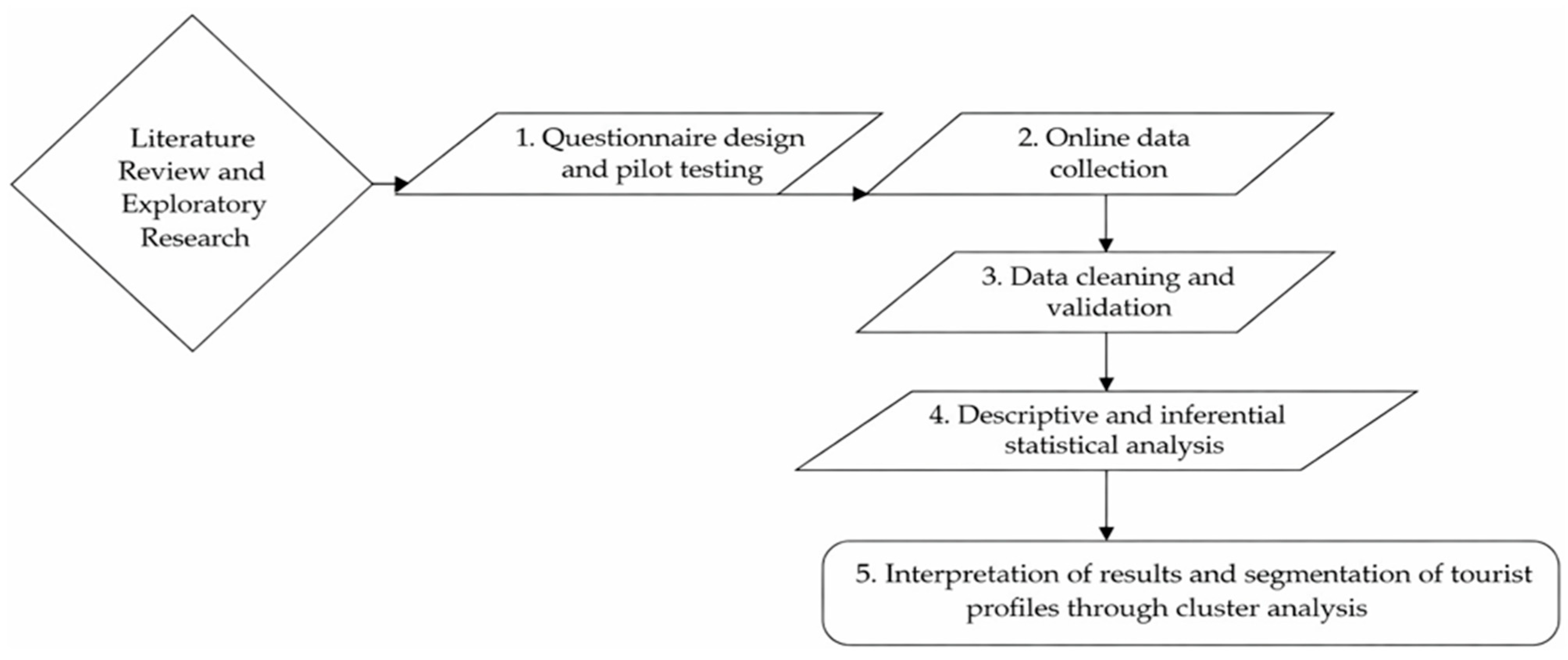
Figure 1 illustrates the research framework and analytical procedure adopted in this study. The model conceptualizes smart tourism features as independent variables influencing overall perceived destination smartness. The research process followed five sequential stages: (1) questionnaire design and pilot testing; (2) online data collection; (3) data cleaning and validation; (4) descriptive and inferential statistical analysis; and (5) interpretation of results and segmentation of tourist profiles through cluster analysis.
The survey instrument consisted of a structured questionnaire (see
Appendix A) designed based on prior literature on smart tourism and ICT adoption in urban tourism contexts (
Gretzel et al., 2015;
Li et al., 2017). It was composed of three main sections:
- (1)
Demographics: including age, gender, education, nationality, and frequency of international travel;
- (2)
Smart tourism features evaluation: a 10-item scale measuring the perceived importance of selected smart features on a 5-point Likert scale (1 = Not Important, 5 = Very Important). The features assessed were: (i) Free Wi-Fi access; (ii) Destination-specific mobile apps; (iii) Real-time public information (e.g., events, transport); (iv) Digital tour guides; (v) Augmented reality (AR) experiences; (vi) Smart public transport systems; (vii) Sustainability-related infrastructure (e.g., electric transport, energy-efficient buildings); (viii) Online review integration; (ix) Cashless payment systems; and (x) Smart surveillance and safety systems.
- (3)
Overall Perceived Smartness: a global evaluation question asking participants to rate how “smart” they considered a destination based on their past travel experiences.
The internal consistency of the smart feature items was high (Cronbach’s α = 0.84), indicating good reliability.
The study was conducted entirely online over a period of six weeks. The survey was pilot tested with 20 participants to ensure clarity, language neutrality, and usability across devices. Minor modifications were made to improve the clarity of item wording. Data collection ensured respondent anonymity, and informed consent was obtained digitally prior to participation. Ethical clearance was obtained through a university research ethics board.
To increase participation, the survey was disseminated through targeted Facebook travel groups, Reddit travel communities, and email lists of tourism-related university departments. Each respondent could complete the survey only once, and IP checks were used to avoid duplication. Participants completed the anonymous online survey voluntarily.
Data was analyzed using IBM SPSS Statistics (Version 27). Initial data cleaning included the removal of incomplete responses and outliers (e.g., response times < 60 s). Descriptive statistics were calculated to determine central tendencies and dispersion for each smart tourism feature (
DeVellis, 2016;
Hair et al., 2019).
Inferential analyses were conducted as follows:
- (a)
Pearson correlation analysis examined the relationships between smart features and overall perceived smartness of destinations.
- (b)
Independent samples t-tests explored differences across gender and education levels.
- (c)
One-way ANOVA analyzed variations in feature importance across nationalities.
- (d)
Multiple linear regression was used to identify which smart features were significant predictors of perceived smartness. The regression model included the ten smart tourism variables as predictors, and the global perceived smartness rating as the dependent variable. Multicollinearity was tested using Variance Inflation Factor (VIF) values, all of which remained below 2.0, indicating no multicollinearity concerns.
All statistical tests were two-tailed, and a significance level of p < 0.05 was adopted throughout.
The analytical strategy followed a sequential approach. First, descriptive statistics were used to summarize the importance attributed to each smart tourism feature. Second, Pearson correlation analyses were conducted to examine the relationships between individual smart tourism attributes and overall perceived destination smartness. Third, independent samples t-tests and one-way ANOVA were applied to explore differences across demographic and nationality groups. Finally, multiple linear regression analysis was performed to identify the smart tourism features that significantly predict overall perceived destination smartness.
3. Results
3.1. Descriptive Statistics
Descriptive statistics for the smart tourism attributes evaluated by international tourists are presented. Overall, respondents assigned high importance to core digital and infrastructural features, particularly real-time information systems, smart security, free Wi-Fi access, and cashless payment systems. In contrast, immersive technologies such as augmented reality and digital tour guides received comparatively lower mean scores, suggesting a more complementary rather than essential role in shaping perceptions of destination smartness. Participants consistently rated real-time information systems (M = 4.3, SD = 0.7), smart security (M = 4.3, SD = 0.8), and free Wi-Fi (M = 4.2, SD = 0.8) as the most important smart features in tourism. Augmented Reality experiences received the lowest average rating (M = 3.5, SD = 1.1), suggesting more niche or generational appeal. The relatively low standard deviations indicate consistent perceptions across the sample for most items, though greater variation was noted in digital tour guides (SD = 1.0) and AR experiences (SD = 1.1).
The Mean scores (M) and Standard Deviations (SD) for each feature were:
Free Wi-Fi: M = 4.2; SD = 0.8
Mobile Apps: M = 4.0; SD = 0.9
Real-Time Information: M = 4.3; SD = 0.7
Digital Tour Guides: M = 3.8; SD = 1.0
AR Experiences: M = 3.5; SD = 1.1
Smart Transport: M = 4.1; SD = 0.8
Sustainability Tech: M = 4.0; SD = 0.9
Online Reviews: M = 3.9; SD = 0.9
Cashless Payment: M = 4.2; SD = 0.7
Smart Security: M = 4.3; SD = 0.8
3.2. Correlation Analysis
Regarding correlational analysis, positive correlations were found between overall smart destination satisfaction and: Real-Time Information (r = 0.56, p < 0.01); Free Wi-Fi (r = 0.49, p < 0.01); Smart Security (r = 0.44, p < 0.01); Sustainability Tech (r = 0.39, p < 0.01) and Smart Transport (r = 0.37, p < 0.001).
These correlations suggest that perceptions of a city’s smartness are strongly linked to how well it provides accessible, safe, and sustainable infrastructure. Surprisingly, features such as AR experiences and Digital tour guides showed weaker correlations (r < 0.30), indicating they may be viewed more as enhancements rather than core smart features, as we can see in
Table 1.
Pearson correlation coefficients between smart tourism features and overall perceived destination smartness are reported in
Table 1. Strong positive correlations were observed between perceived smartness and real-time information, free Wi-Fi access, smart security, and sustainability-related technologies. Conversely, immersive features such as augmented reality and digital tour guides exhibited weaker associations, indicating that these elements may enhance the experience without constituting core determinants of perceived smartness.
3.3. Gender and Education Differences
In terms of gender and education differences, independent samples t-tests revealed that Women rated Smart Security (M = 4.5) significantly higher than men (M = 4.1), t(418) = 3.52, p < 0.01. Similarly, they valued Sustainability Tech more (M = 4.2 vs. M = 3.9), p < 0.05. In the Education Level, respondents with postgraduate education rated AR Experiences and Digital Tour Guides significantly higher (M = 3.9 and M = 4.1) than those with only secondary education (M = 3.3 and M = 3.5), p < 0.05. This suggests higher familiarity and openness to interactive technologies among more educated tourists.
3.4. ANOVA by Nationality
A one-way ANOVA revealed statistically significant differences across nationalities:
- (a)
Cashless Payment: F(7, 412) = 5.78, p < 0.001. Australian and Indian respondents rated this higher (M = 4.5) than participants from European countries (M = 3.9).
- (b)
Mobile Apps: F(7, 412) = 4.93, p < 0.01. Australian and Indian tourists valued destination-specific apps more than Western counterparts.
- (c)
Sustainability Technologies: European respondents rated these higher (M = 4.3) than the global average (M = 4.0), p < 0.05, reflecting strong environmental values.
Post-hoc Tukey tests confirmed that the most significant differences occurred between Australian and Indian and European cohorts, which could possibly be explained by cultural issues, given that the Australians and Indian respondents rated Cashless Payment and Mobile Apps higher than Western counterparts (p < 0.01), and European respondents emphasized Sustainability Technologies more than others (p < 0.05).
Independent samples t-tests and one-way ANOVA revealed significant differences in the evaluation of smart tourism features across gender, education level, and nationality. Female respondents attributed higher importance to smart security and sustainability-related technologies, while participants with postgraduate education rated immersive tools more positively. Cross-national differences were particularly evident for cashless payment systems, mobile applications, and sustainability technologies. These results indicate that demographic and cultural factors moderate tourists’ expectations of smart tourism features.
3.5. Regression Analysis
A multiple linear regression was conducted to identify which features predict the overall perceived smartness of a destination. The model was statistically significant, F(4, 415) = 72.88, p < 0.001, and explained 42% of the variance (R2 = 0.42). The significant predictors were: (a) Real-Time Information (β = 0.31, p < 0.001); (b) Free Wi-Fi (β = 0.27, p < 0.001); (c) Sustainability Technologies (β = 0.21, p < 0.01); and (d) Smart Transport (β = 0.19, p < 0.01).
No multicollinearity issues were detected (all VIF < 2.0). Notably, Digital Tour Guides and AR did not significantly contribute to the model (p > 0.05), suggesting that core infrastructural technologies are more influential than immersive digital tools in shaping perceptions.
The results of the multiple linear regression analysis are presented in
Table 2. The model was statistically significant and explained a substantial proportion of the variance in overall perceived destination smartness. Real-time information systems emerged as the strongest predictor, followed by free Wi-Fi access, sustainability-related technologies, and smart transport systems. Other variables did not show statistically significant effects, reinforcing the relevance of core infrastructural and informational features over advanced or immersive technologies.
3.6. Cluster Analysis (Exploratory)
An exploratory K-means cluster analysis segmented respondents into two main groups (
Table 3):
Cluster 1—Practical Planners (61%): Prioritized Wi-Fi, smart transport, and real-time data.
Cluster 2—Tech Enthusiasts (39%): Rated AR and digital guides much higher but still valued core infrastructure.
This segmentation suggests different traveler profiles when approaching smart destinations, which could help tourism planners tailor services.
4. Discussion
From an empirical standpoint, the literature provides little quantitative evidence on how international tourists perceive smart tourism attributes in island destinations. While previous studies have examined technology adoption and tourist experiences in urban contexts, they rarely investigate which smart features are most influential in shaping perceived destination smartness under conditions of infrastructural scarcity and environmental sensitivity. This study addresses this gap by empirically identifying the smart tourism attributes that international tourists associate most strongly with smart destinations, offering context-specific insights that are particularly relevant for Small Island Developing Countries.
The findings reinforce that tourists perceive smart cities as those offering seamless digital experiences, with a strong emphasis on information access and infrastructure efficiency. Real-time information and Wi-Fi access are foundational expectations. Interestingly, sustainability-related technologies also emerged as strong predictors of perceived smartness, aligning with global environmental awareness trends (
Koo et al., 2017). These results suggest that, in SIDS, smart tourism should be understood less as an expression of technological sophistication and more as a strategic tool for overcoming structural limitations, enhancing resilience, and supporting sustainable tourism development.
The role of cultural background was notable, considering that Asian and Australian participants’ preference for mobile and cashless technologies may reflect broader regional adoption trends (
Li et al., 2017).
In addition to technological factors, demographic characteristics such as education and gender also influenced perceptions. For example, individuals with higher education were more receptive to immersive and interactive tools like AR and digital guides, possibly due to greater familiarity with such technologies. Gender differences regarding safety and sustainability highlight the need for inclusive design in smart tourism infrastructure, as advocated by
Doster and Chavis (
2021) and
Reyes-Rubiano et al. (
2021).
These insights have strong implications for tourism and urban planners. Smart city strategies should not only focus on technological innovation but also on the actual expectations and behaviors of tourists. Tailoring digital experiences to diverse audiences (culturally, demographically, and technologically) is essential to foster satisfaction and repeat visitation, also according to
Wang et al. (
2021) and
Del Vecchio et al. (
2018).
Following the same authors, tourism promotion should highlight smart features explicitly, as they appear to significantly influence destination choice. Tourists increasingly equate digital efficiency and sustainability with modernity and convenience.
These findings suggest that urban tourism strategies should prioritize not only technological sophistication but also inclusiveness, accessibility, and alignment with local and international user habits, as many of the authors studied in this research also argue (
Alshaflut, 2024;
Baranov & Garas, 2022;
Doster & Chavis, 2021;
Youssef, 2021;
Bayerl & Butot, 2021;
Reyes-Rubiano et al., 2021;
Kozłowski & Suwar, 2021;
UN-Habitat, 2020;
Sproull & Patterson, 2004;
Hiramatsu & Ishida, 2001).
5. Conclusions
This study contributes to the understanding of how digital and smart features affect tourist perception and preferences. By identifying the key elements that travelers associate with Smart Cities, policymakers and destination managers can prioritize investments and communication strategies that align with tourist values. The results indicate that smart tourism strategies in island environments should prioritize investments that directly improve accessibility, connectivity, mobility, and environmental sustainability. Rather than replicating smart city models developed for large urban centers, SIDS require tailored approaches that reflect their unique geographic, economic, and environmental constraints. In this sense, smart tourism emerges as a critical pathway for strengthening destination resilience and long-term competitiveness in tourism-dependent island economies.
Overall, the findings of this study confirm that the research objectives were largely achieved. By empirically identifying which smart tourism attributes most strongly shape international tourists’ perceptions of destination smartness in SIDS, the study provides robust evidence that smartness is primarily associated with functional, accessible, and sustainability-oriented solutions rather than advanced or immersive technologies. The results validate the initial assumption that, in island contexts marked by infrastructural limitations and environmental vulnerability, smart tourism should be understood as a strategic mechanism to enhance connectivity, accessibility, resilience, and sustainable destination management. While immersive tools such as augmented reality were found to play a secondary role, their relevance among specific tourist segments suggests opportunities for targeted differentiation rather than universal adoption. Consequently, the study successfully advances the conceptualization of smart tourism beyond technology-centric models, offering a context-sensitive framework that aligns empirical evidence with the specific development needs and constraints of small island destinations. In this regard, the study fulfills its proposed objectives and contributes empirical evidence to support context-specific smart tourism strategies for island destinations.
In line with the study’s objective of identifying which smart tourism attributes most strongly shape tourists’ perceptions of destination smartness, the empirical results demonstrate that international visitors primarily value functionalities that enhance accessibility, connectivity, mobility, and environmental sustainability. Real-time information systems, free Wi-Fi access, sustainability-oriented technologies, and smart transport emerged as the core determinants of perceived smartness, rather than advanced or immersive digital solutions. From a policy perspective, these findings suggest that in SIDS, smart tourism strategies should prioritize investments in essential digital infrastructure and sustainable mobility systems that directly enhance visitor experiences and destination resilience, rather than replicating high-technology smart city models developed for large urban contexts. The main conclusions are summarised in the following topics:
The study provides quantitative empirical evidence that international tourists primarily perceive a destination as “smart” based on core digital and infrastructural functionalities, rather than on advanced or immersive technologies.
Real-time information systems emerged as the strongest predictor of perceived destination smartness (β = 0.31), highlighting tourists’ need for immediate access to navigation, transport schedules, and event updates.
Free and reliable Wi-Fi access was identified as the second most influential predictor (β = 0.27), confirming connectivity as a foundational expectation in smart tourism experiences.
Sustainability-related technologies (e.g., energy-efficient infrastructure and eco-friendly transport) significantly influenced perceived smartness and were highly valued by tourists (M = 4.0; SD = 0.9), reflecting growing environmental awareness.
Smart transport systems also played a significant role (M = 4.1; SD = 0.8), reinforcing the importance of mobility efficiency in shaping positive destination perceptions.
Together, real-time information, Wi-Fi access, sustainability technologies, and smart transport explained 42% of the variance in perceived destination smartness, indicating strong explanatory power of the model.
Advanced and immersive technologies, such as Augmented Reality and digital tour guides, were less influential overall, suggesting they are perceived as complementary rather than essential smart features.
Perceptions of smart tourism attributes varied across demographic and cultural profiles:
Tourists with higher education levels showed greater appreciation for immersive digital tools.
Women placed higher importance on smart security and sustainability features.
Asian and Australian respondents valued cashless payment systems and mobile applications more strongly than other groups.
The findings demonstrate that, in Small Island Developing Countries, smart tourism is understood less as technological sophistication and more as a strategic mechanism for improving accessibility, connectivity, sustainability, and destination resilience under structural and environmental constraints.
To attract global tourists, smart cities must ensure reliable, visible, and user-friendly digital services. Destinations should invest in real-time communication systems, widespread connectivity, and eco-friendly infrastructure. Smart tourism is not only about technology, but also about perception, accessibility, and satisfaction.
This study provides robust empirical evidence that tourists evaluate the “smartness” of a destination primarily based on four key elements: access to real-time information, availability of free Wi-Fi, implementation of sustainability technologies, and efficiency of smart transport systems. Real-Time Information was the most significant predictor of smart destination perception (Beta = 0.31), followed closely by Free Wi-Fi (Beta = 0.27). These findings suggest that tourists value instant access to navigation, schedules, and event updates features that directly impact the convenience and enjoyment of their visit.
Sustainability Technologies (M = 4.0, SD = 0.9) and Smart Transport (M = 4.1, SD = 0.8) were also rated highly, reinforcing the growing demand for environmentally friendly and efficient travel options. Notably, Smart Security and Cashless Payment were especially appreciated by specific subgroups (e.g., women and Asian and Australian respondents), reflecting culturally and socially driven expectations.
The model explained 42% of the variance in perceived smartness, indicating that while technological features are critical, other contextual facts, such as local culture, hospitality, and urban aesthetics, may also influence overall tourist satisfaction and should be examined in future research.
Based on the core objective of this study—to identify what tourists expect from a destination to consider it a ‘Tourist’ Smart City—the results clearly demonstrate that visitors prioritize functionalities that enhance convenience, connectivity, and sustainability. The most valued features were real-time information systems, free Wi-Fi access, and sustainable infrastructure, all of which contribute to a seamless and efficient travel experience. These findings confirm that tourists perceive a destination as “smart” not merely by its technological advancement, but by the extent to which these technologies are visible, accessible, and enhance their experience. Thus, the study provides a data-driven framework for urban planners and tourism managers aiming to align smart city initiatives with actual visitor expectations.
In conclusion, for destinations aiming to position themselves as Smart Cities in the eyes of tourists, investment should prioritize digital infrastructure that ensures seamless, safe, and sustainable experiences. Urban tourism strategies must also be adaptive to demographic diversity and evolving technological trends.
Despite its contributions, this study has some limitations. The use of a non-probabilistic sample may limit the generalizability of the findings, and the reliance on self-reported perceptions does not capture actual technology usage behavior. Future research could adopt longitudinal designs, include resident perspectives, or compare multiple island destinations to further refine the smart island tourism framework.
Future work should explore longitudinal changes in tourist expectations, particularly in the post-pandemic digital acceleration context, and examine behavioral data to complement stated preferences.