
Community-Based Sustainability Perceptions in Rural Destinations: The “Pueblos con Encanto” Program in Cruz Pampa–Yapatera, Peru

 and
and
Abstract
1. Introduction
2. Literature Review
2.1. Sustainable Tourism and the Triple Bottom Line
2.2. Community-Based Tourism and Local Agency
2.3. Residents’ Perceptions and Social Legitimacy of Tourism
2.4. International Rural-Tourism Programs and Territorial Governance
2.5. “Pueblos Mágicos” (Magical Villages) in Mexico
2.6. “Pueblos con Encanto” (Charming Villages) in Peru
3. Methods
3.1. Study Area
3.2. Data Collection
3.3. Sampling
3.4. Instruments and Procedures
3.5. Ethical Considerations
4. Results
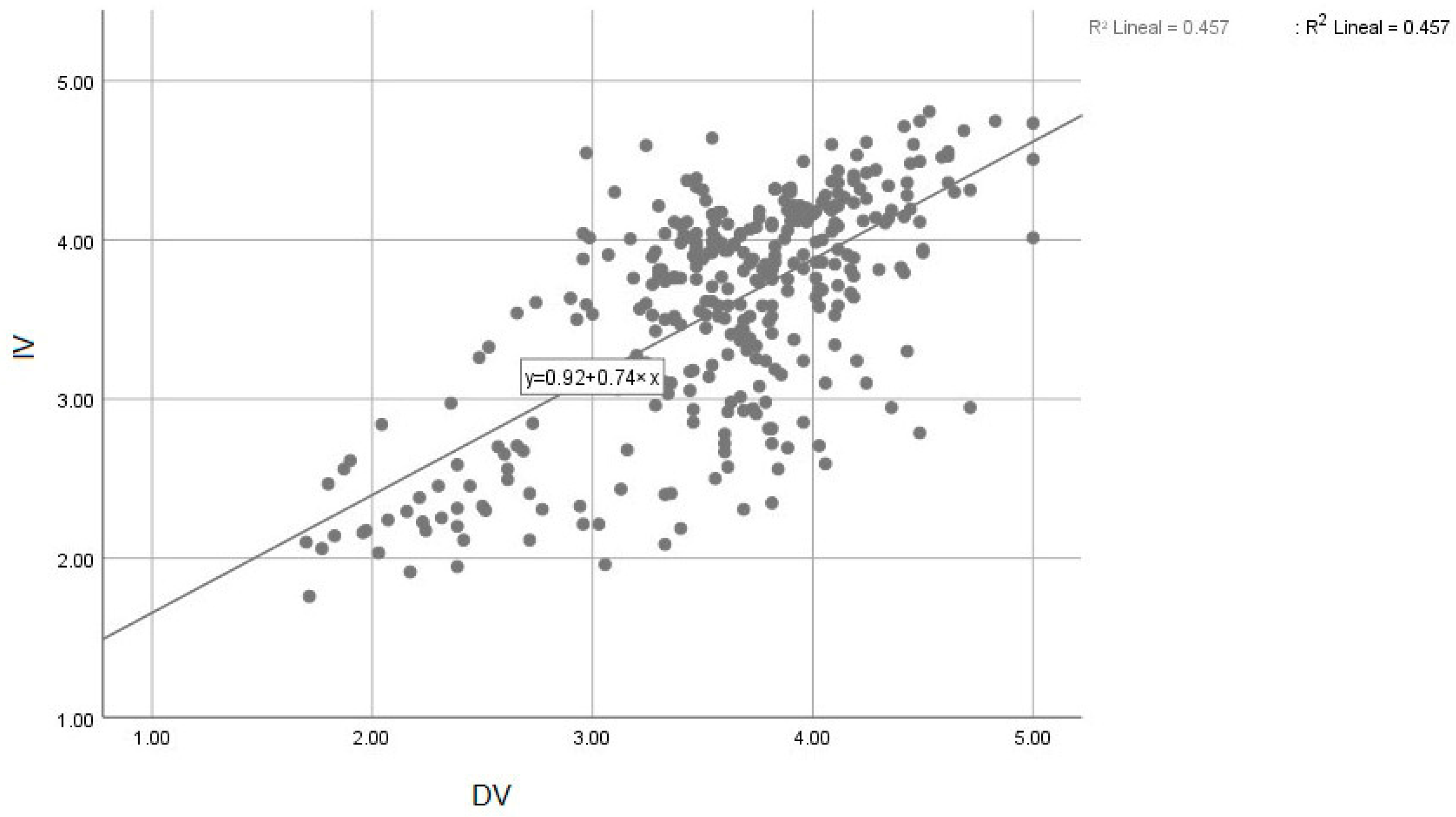
4.1. Quantitative Data
Statistical Interpretation
4.2. Qualitative Data
Analysis and Interpretation
- Community Participation and Governance
- Destination Readiness Conditions
- Monitoring and Sustainability Metrics
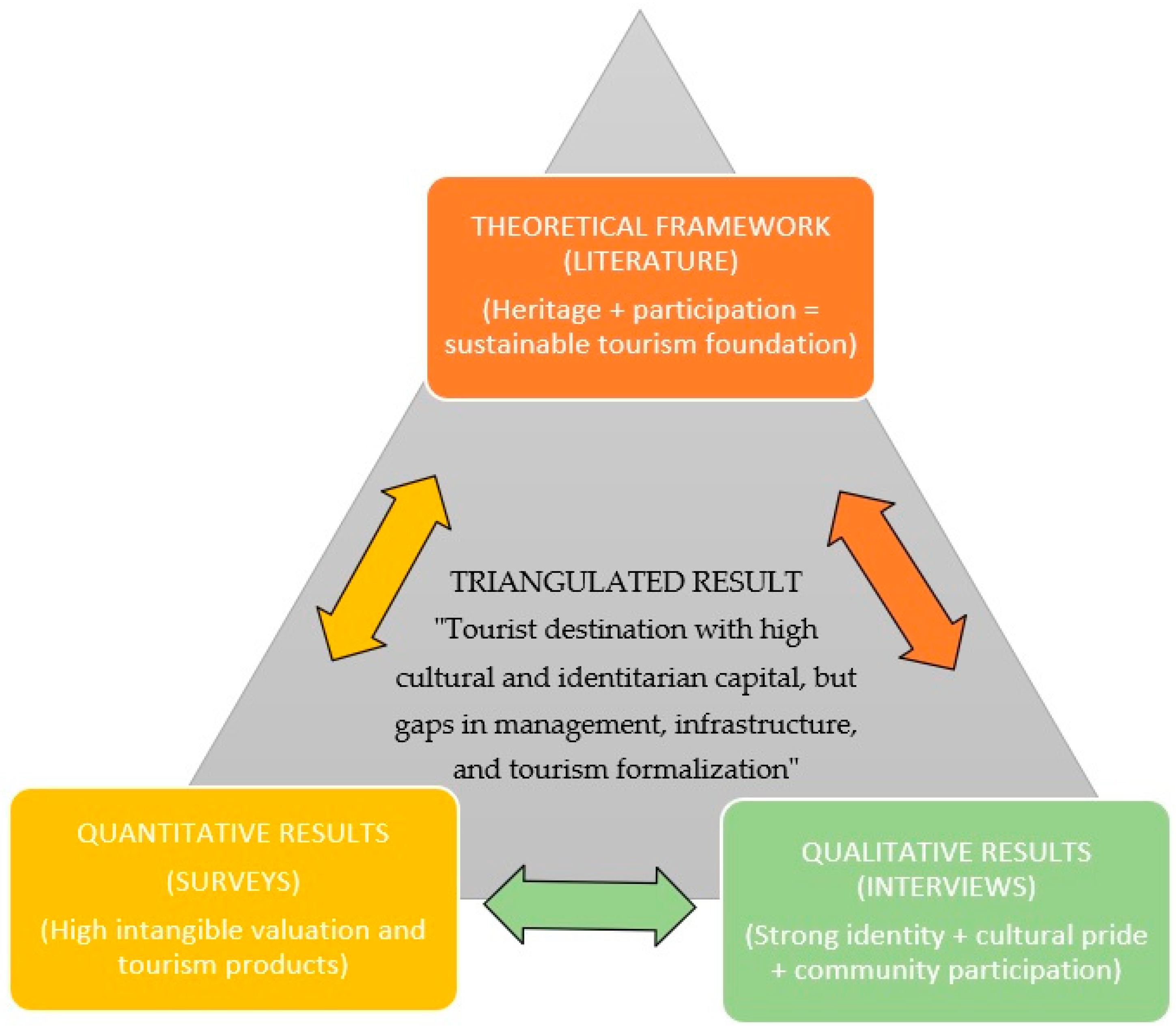
4.3. Triangulation Analysis
5. Discussion
6. Conclusions
Author Contributions
Funding
Institutional Review Board Statement
Informed Consent Statement
Data Availability Statement
Acknowledgments
Conflicts of Interest
Abbreviations
| MINCETUR | Ministry of Foreign Trade and Tourism |
| IV | Independent Variable |
| DV | Dependent Variable |
| TCC | Tourist carrying capacity |
| 1 | Complementing Yapatera Hill and the La Pilca river beach, the Mango Festival (each January) fosters intergenerational reconnection, bolstering Afro-Peruvian identity while showcasing export-grade mango varieties to the US and Europe, yielding local income through community-based sustainable tourism. Cumanana—satirical verses passed orally—and the Yapatera Intercultural Museum safeguard Ñañañique and Vicús relics, enriching a material and intangible heritage portfolio. |
References
- Adriwati, A., Ahmad, A. F., & Karunia, L. (2025). Evaluation of tourism village development program: Comparative study of Lebak regency and Ende regency tourism villages. KnE Social Sciences, 10(15), 226–251. [Google Scholar] [CrossRef] [Scilit]
- Al Anshori, H. A., & Dzulkifli, M. (2025). Classification of tourism villages in Sleman regency in 2022: Quantitative and qualitative analysis based on sustainable tourism indicators. Journal Toursci, 3(1), 77–89. [Google Scholar] [CrossRef] [Scilit]
- Alberca-Sialer, F. A., & Soto-Cáceda, D. R. (2022). Patrimonio cultural inmaterial y turismo. Análisis de la producción científica publicada en revistas Iberoamericanas de turismo. Investigaciones Turísticas, (23), 112. [Google Scholar] [CrossRef] [Scilit]
- Alvarado Rosas, C. (2015). Conservación del patrimonio cultural en el Pueblo Mágico de Tepoztlán, Morelos (2001–2012). Territorios, 16(32), 15–33. [Google Scholar] [CrossRef] [Scilit]
- Amrullah, Kaltum, U., Sondari, M. C., & Pranita, D. (2023). The Influence of capability, business innovation, and competitive advantage on a smart sustainable tourism village and its impact on the management performance of tourism villages on Java Island. Sustainability, 15(19), 14149. [Google Scholar] [CrossRef] [Scilit]
- Arias-Gómez, J., Villasís-Keever, M. Á., & Miranda-Novales, M. G. (2016). El protocolo de investigación III: La población de estudio. Revista Alergia México, 63(2), 201–206. [Google Scholar] [CrossRef] [Scilit]
- Armendáriz, A. M., Sidón, G. M., & Concha, J. C. P. (2024). Impacto del programa Pueblos Mágicos en el emprendimiento económico e ingreso de las empresas: Estudio de caso de los Pueblos Mágicos de Loreto y Todos Santos, México. REVISTA DELOS, 17(62), e3365. [Google Scholar] [CrossRef] [Scilit]
- Ballina Ballina, F. J. (2025). El efecto de las re-visitas en la modelización dinámica de los destinos turísticos. Investigaciones Turísticas, (29), 210–231. [Google Scholar] [CrossRef] [Scilit]
- Bolaños Ortega, R., Lizardi Rojo, V., & Roldán Oropeza, N. A. (2021). Los Pueblos Mágicos y la relevancia de la educación cultural de sus habitantes para fomentar el turismo y el desarrollo local. Revista GEON (Gestión, Organizaciones y Negocios), 8(2). [Google Scholar] [CrossRef] [Scilit]
- Bui, H. T., Jones, T. E., Weaver, D. B., & Le, A. (2020). The adaptive resilience of living cultural heritage in a tourism destination. Journal of Sustainable Tourism, 28(7), 1022–1040. [Google Scholar] [CrossRef] [Scilit]
- Caro-Carretero, R., & Monroy-Rodríguez, S. (2025). Residents’ perceptions of tourism and sustainable tourism management: Planning to prevent future problems in destination management—The case of Cáceres, Spain. Cogent Social Sciences, 11(1), 2447398. [Google Scholar] [CrossRef] [Scilit]
- Castaño-Prieto, L., Solano-Sánchez, M. Á., Hidalgo-Fernández, A., & López-Guzmán, T. (2025). Profiling intangible cultural heritage visitors through multilayer perceptron’s model. Investigaciones Turísticas, (29), 101–123. [Google Scholar] [CrossRef] [Scilit]
- Castillo Chung, L. B., & Luján Johnson, G. L. (2023). Propuesta sobre capacidad de carga turística para mejorar la gestión sostenible en El Ñuro, 2023. Ciencia Latina Revista Científica Multidisciplinar, 6(6), 12865–12885. [Google Scholar] [CrossRef] [Scilit]
- Cerjak, M., Galić, G., & Antoniak, M. A. (2026). Cultural heritage as a driver of sustainable rural tourism development: A case study of Šibenik-Knin county. Sustainability, 18(3), 1416. [Google Scholar] [CrossRef] [Scilit]
- Cruz Rocha, E. E., Osorio García, M., & Nava Bernal, E. G. (2024). Transformación del paisaje rural desde los significados sociales. Caso Malinalco, Estado de México. Investigaciones Turísticas, (28), 127–150. [Google Scholar] [CrossRef] [Scilit]
- Dirección Regional de Comercio Exterior y Turismo de Piura. (2024). Pueblo de Cruz Pampa—Yapatera. Available online: https://consultasenlinea.mincetur.gob.pe/fichaInventario/index.aspx?cod_Ficha=12448 (accessed on 25 January 2026).
- Gobierno de México. (2020). Estrategia nacional de Pueblos Mágicos. Available online: https://www.gob.mx/sectur/acciones-y-programas/estrategia-nacional-de-pueblos-magicos (accessed on 12 February 2026).
- Gogitidze, G., Nadareishvili, N., Harun, R., Arion, I. D., & Muresan, I. C. (2022). Exploring residents’ perceptions towards tourism development—A case study of the Adjara mountain area. Sustainability, 15(1), 492. [Google Scholar] [CrossRef] [Scilit]
- Han, S., Ramkissoon, H., You, E., & Kim, M. J. (2023). Support of residents for sustainable tourism development in nature-based destinations: Applying theories of social exchange and bottom-up spillover. Journal of Outdoor Recreation and Tourism, 43, 100643. [Google Scholar] [CrossRef] [Scilit]
- Hernández Marroquin, N., Cabrera Zepeda, G., Romero Flores, E. A., Aguirre Y Hernández, F., & Salazar Medina, M. (2023). Gestión de un observatorio turístico de un pueblo mágico mediante inteligencia de negocios. Ciencia Latina Revista Científica Multidisciplinar, 7(2), 8968–8987. [Google Scholar] [CrossRef] [Scilit]
- Hernández Sampieri, R., Fernández Collado, C., & Baptista Lucio, P. (2014). Metodología de la investigación (6th ed.). McGraw-Hill Education. [Google Scholar]
- Hernández-Sampieri, R., & Mendoza Torres, C. P. (2018). Metodología de la investigación: Las rutas cuantitativas, cualitativas y mixtas. Available online: https://virtual.cuautitlan.unam.mx/rudics/?p=2612 (accessed on 3 April 2026).
- Heyik, M. A., Castellanos-Escobar, M. C., Romero-Martínez, J. M., & Çalışkan, Z. (2024). Exploring citizens’ perspectives on participatory design and planning: A comparative study across three capital cities. Urban Governance, 4(2), 101–112. [Google Scholar] [CrossRef] [Scilit]
- INEI. (2017). Resultados definitivos del departamento de Piura. Available online: https://www.inei.gob.pe/media/MenuRecursivo/publicaciones_digitales/Est/Lib1553/ (accessed on 12 January 2026).
- Infante Sánchez, E. D. P. (2014). Elementos determinantes en Cundinamarca para el desarrollo del turismo como actividad estratégica regional. Suma de Negocios, 5(10), 40–48. [Google Scholar] [CrossRef] [Scilit]
- Jackson, L. A. (2025). Community-based tourism: A catalyst for achieving the United Nations sustainable development goals one and eight. Tourism and Hospitality, 6(1), 29. [Google Scholar] [CrossRef] [Scilit]
- Jiang, Y., Guo, Y., & Zhou, H. (2023). Residents’ perception of tourism impact, participation and support in destinations under the COVID-19 pandemic: The intermediary role of government trust. Sustainability, 15(3), 2513. [Google Scholar] [CrossRef] [Scilit]
- Jiménez Jiménez, F., Muñoz Mazón, A. I., & Fuentes Moraleda, L. (2021). Evaluación del bienestar en los destinos turísticos ¿cómo aplicar el índice de desarrollo humano? El caso de Tapijulapa, Pueblo Mágico, Méjico. Investigaciones Turísticas, (21), 86. [Google Scholar] [CrossRef] [Scilit]
- Lemke, C., & Bastini, K. (2020). Embracing multiple perspectives of sustainable development in a composite measure: The multilevel sustainable development index. Journal of Cleaner Production, 246, 118884. [Google Scholar] [CrossRef] [Scilit]
- Liu, C.-H. S., Horng, J.-S., & Chou, S.-F. (2015). A critical evaluation of sustainable tourism from the integrated perspective: Conducting moderated–mediation analysis. Tourism Management Perspectives, 16, 43–50. [Google Scholar] [CrossRef] [Scilit]
- Ministerio de Comercio Exterior y Turismo. (2023, June 22). Lineamientos generales para la incorporación y permanencia. Available online: https://cdn.www.gob.pe/uploads/document/file/5819188/5161508-lineamientos-pueblos-con-encanto-mincetur.pdf (accessed on 5 February 2026).
- Ministerio de Comercio Exterior y Turismo. (2025a). Iniciativa «pueblos con encanto». Available online: https://pueblosconencanto.pe (accessed on 5 February 2026).
- Ministerio de Comercio Exterior y Turismo. (2025b, January 11). Ollantaytambo: El primer “pueblo con encanto” del Perú y una joya arquitectónica camino a Machu Picchu. Available online: https://www.gob.pe/institucion/mincetur/noticias/1091731-ollantaytambo-el-primer-pueblo-con-encanto-del-peru-y-una-joya-arquitectonica-camino-a-machu-picchu (accessed on 6 February 2026).
- Ministerio de Comercio Exterior y Turismo. (2025c, April 10). Mincetur invita al público a visitar los siguientes “pueblos con encanto” el próximo fin de semana largo por semana santa. Available online: https://www.gob.pe/institucion/mincetur/noticias/1143533-mincetur-invita-al-publico-a-visitar-los-siguientes-pueblos-con-encanto-el-proximo-fin-de-semana-largo-por-semana-santa (accessed on 6 February 2026).
- Ningrum, A. R. S., Febianti, F., & Nurhasanah, D. W. (2025). Tourism village promotion strategy in developing tourism villages based on local wisdom in Sumedang district. Lex Localis-Journal of Local Self-Government, 23(10), 136–142. [Google Scholar] [CrossRef] [Scilit]
- Núñez-Camarena, G. M., & Ettinger-Mc Enulty, C. (2020). La transformación de un territorio cultural. El desarrollo de los Pueblos Mágicos en México: Pátzcuaro como caso de estudio/The transformation of a cultural territory. The development of “pueblos magicos” in Mexico: Pátzcuaro as a case study. Urbano, 23, 40–57. [Google Scholar] [CrossRef] [Scilit]
- Ortiz Martínez, F. I., Guzmán Sala, A., & Reyes Cornelio, R. (2024). Factores de gestión competitiva del Pueblo Mágico de Tapijulapa desde la perspectiva de sus actores involucrados. PASOS. Revista de Turismo y Patrimonio Cultural, 22(1), 163–176. [Google Scholar] [CrossRef] [Scilit]
- Pacurucu-Cáceres, N., Orellana-Alvear, B., Ordóñez-Castro, A., García-Erazo, H., Zalamea-León, E., & Hidalgo-Cordero, J. F. (2025). Local perception of territorial reality through community mapping. Seis de Julio community, Naranjal-Ecuador. Cogent Social Sciences, 11(1), 2461268. [Google Scholar] [CrossRef] [Scilit]
- Paredes Izquierdo, J. C., Alberca Sialer, F. A., Arriola Miranda, A. M., Ávila Huamán, C., Gavidia Farro, M. Z., Gómez Castillo, E. S., Julca Meza, E. C., Llontop Diez, C. E., Marsano Delgado, J. M. E., Noriega Cardó, C. H., & Zapata Acha, S. M. (2020). La COVID-19 y el turismo en el Perú. Análisis y propuestas ante un nuevo escenario. Turismo y Patrimonio, (15), 11–30. [Google Scholar] [CrossRef] [Scilit]
- Pasanchay, K., & Schott, C. (2021). Community-based tourism homestays’ capacity to advance the sustainable development goals: A holistic sustainable livelihood perspective. Tourism Management Perspectives, 37, 100784. [Google Scholar] [CrossRef] [Scilit]
- Pérez-Castañeira, J. A., Gómez-Figueroa, O., Sangroni Laguardia, N., Santa-Cruz, S. R., Cruz-Blanco, C., & Santos-Pérez, O. (2021). Estudio de modelos que abordan la gestión de destinos turísticos. Ingeniería Industrial, 42(3), 109–119. [Google Scholar]
- Pérez Ramírez, C. A., & Antolín Espinos, D. I. (2016). Programa Pueblos Mágicos y desarrollo local: Actores, dimensiones y perspectivas en El Oro, MéxicoMagical villages program and local development: Actors, dimensions and perspectives in El Oro, México. Estudios Sociales. Revista de Alimentación Contemporánea y Desarrollo Regional, 25(47), 217. [Google Scholar] [CrossRef] [Scilit]
- Pinassi, A. (2026). Iniciativa Best Tourism Villages (ONU turismo). Alcances, discursos y discusiones en el caso argentino (periodo 2021–2024). Revista Internacional de Turismo, Empresa y Territorio, 9(2), 238–260. [Google Scholar] [CrossRef] [Scilit]
- Pramono, R., & Juliana, J. (2025). Beyond tourism: Community empowerment and resilience in rural Indonesia. Tourism and Hospitality, 6(4), 210. [Google Scholar] [CrossRef] [Scilit]
- Rasoolimanesh, S. M., Jaafar, M., Ahmad, A. G., & Barghi, R. (2017). Community participation in World Heritage Site conservation and tourism development. Tourism Management, 58, 142–153. [Google Scholar] [CrossRef] [Scilit]
- Reese, L. A., & Li, X. (2020). Conceptions of local economic development: Comparing citizen and local official attitudes. Economic Development Quarterly, 34(1), 3–20. [Google Scholar] [CrossRef] [Scilit]
- Rodríguez Del Carmen, J. M., Vega Zárate, C., & Ricárdez Jiménez, J. D. (2025). Reconocimiento de la incorporación de las regiones afro veracruzanas en el turismo como factor de desarrollo. PASOS. Revista de Turismo y Patrimonio Cultural, 23(4), 1115–1123. [Google Scholar] [CrossRef] [Scilit]
- Santamarina Campos, B., & Del Mármol, C. (2017). Ciudades creativas y pueblos con encanto: Los nuevos procesos patrimoniales del siglo XXI. Revista de Dialectología y Tradiciones Populares, 72(2), 359–377. [Google Scholar] [CrossRef] [Scilit]
- Santos-Júnior, A., Almeida-García, F., Morgado, P., & Mendes-Filho, L. (2020). Residents’ quality of life in smart tourism destinations: A theoretical approach. Sustainability, 12(20), 8445. [Google Scholar] [CrossRef] [Scilit]
- Sebele, L. S. (2010). Community-based tourism ventures, benefits and challenges: Khama Rhino Sanctuary trust, central district, Botswana. Tourism Management, 31(1), 136–146. [Google Scholar] [CrossRef] [Scilit]
- Song, H., Chen, J., & Li, P. (2025). Decoding the cultural heritage tourism landscape and visitor crowding behavior from the multidimensional embodied perspective: Insights from Chinese classical gardens. Tourism Management, 110, 105180. [Google Scholar] [CrossRef] [Scilit]
- Soto De Anda, L. A., & Arzate Salgado, J. (2025). La actividad turística en Iberoamérica y la (re)producción de desigualdades sociales, económicas y territoriales. PASOS. Revista de Turismo y Patrimonio Cultural, 23(2), 375–388. [Google Scholar] [CrossRef] [Scilit]
- Su, Y., Wang, Y., & Li, R. (2025). Mechanisms to overcome the Homogenization of rural tourism products and improve the competitiveness of rural tourist destinations: A case study from China. Systems, 13(4), 287. [Google Scholar] [CrossRef] [Scilit]
- Šegota, T., Mihalič, T., & Perdue, R. R. (2024). Resident perceptions and responses to tourism: Individual vs. community level impacts. Journal of Sustainable Tourism, 32(2), 340–363. [Google Scholar] [CrossRef] [Scilit]
- Šerić, M., Patrizi, M., Ceccotti, F., & Vernuccio, M. (2024). Resident perspectives unveiled: The role of a sustainable destination image in shaping pro-sustainable responses. Journal of Retailing and Consumer Services, 81, 103985. [Google Scholar] [CrossRef] [Scilit]
- Tovmasyan, G. (2023). Rural tourism and the best tourism villages. Amberd Bulletin, 6, 29–37. [Google Scholar] [CrossRef] [Scilit]
- Tudela, J. W., Aliaga-Melo, G., & Cahui-Cahui, E. (2022). Impacto del COVID-19 en la demanda de turismo internacional del Perú. Una aplicación de la metodología Box-Jenkins. Revista de Investigaciones Altoandinas-Journal of High Andean Research, 24(1), 27–36. [Google Scholar] [CrossRef] [Scilit]
- Turčinović, M., Vujko, A., & Stanišić, N. (2025). Community-led sustainable tourism in rural areas: Enhancing wine tourism destination competitiveness and local empowerment. Sustainability, 17(7), 2878. [Google Scholar] [CrossRef] [Scilit]
- Universidad de Sonora, Enríquez Acosta, J. Á., & Vargas Ochoa, R. Y. (2021). El estudio de los Pueblos Mágicos. Una revisión a casi 20 años de la implementación del programa. Dimensiones Turísticas, 5(8), 9–38. [Google Scholar] [CrossRef] [Scilit]
- UN Tourism. (2025). Best tourism villages by UN tourism: Our vision: Make tourism a driver of rural development and wellbeing. Available online: https://www.untourism.int/best-tourism-villages-2026 (accessed on 4 April 2026).
- Uysal, M., Berbekova, A., & Wang, J. (2025). Quality-of-life: A critical examination of research progress. Tourism Management, 107, 105070. [Google Scholar] [CrossRef] [Scilit]
- Vázquez Hernández, M. (2022a). Evaluación de políticas y programas públicos: El caso de Pueblos Mágicos y sus efectos socioeconómicos en México. Iberoforum. Revista de Ciencias Sociales, 2(2), 1–33. [Google Scholar] [CrossRef] [Scilit]
- Vázquez Hernández, M. (2022b). Percepción social del Programa Pueblos Mágicos para el desarrollo local en Tlalpujahua, Michoacán (México). Turismo y Sociedad, 31. [Google Scholar] [CrossRef] [Scilit]
- Vázquez Hernández, M. (2023). El programa Pueblos Mágicos. Entre la continuidad y la intermitencia. El Periplo Sustentable, (45), 27. [Google Scholar] [CrossRef] [Scilit]
- Velarde Valdez, M., Maldonado Alcudia, A. V. D. C., & Maldonado Alcudia, M. C. (2009). Pueblos Mágicos. Estrategia para el desarrollo turístico sustentable: Caso Sinaloa. Teoría y Praxis, 5(6), 81–95. [Google Scholar] [CrossRef] [Scilit]
- Vizcaíno Zúñiga, P. I., Cedeño Cedeño, R. J., & Maldonado Palacios, I. A. (2023). Metodología de la investigación científica: Guía práctica. Ciencia Latina Revista Científica Multidisciplinar, 7(4), 9723–9762. [Google Scholar] [CrossRef] [Scilit]
- Winiarczyk-Raźniak, A., & Raźniak, P. (2021). Are Pueblos Mágicos really magic? Tourism development program in the context of the quality of life of town residents. Land, 10(12), 1342. [Google Scholar] [CrossRef] [Scilit]
- Yapici, O. Ö., Gök, H. S., & Karakuş, Y. (2026). From best tourism village to regional development: The power of destination image in an old Greek town Mustafapaşa. El Periplo Sustentable, 50, 7–32. [Google Scholar]



| Variable | Dimensions | Items | Indicators | Mean | Low (%) | Medium (%) | High (%) |
|---|---|---|---|---|---|---|---|
| “Pueblos con Encanto” program (IV) | Planning and management (D1) | 3 | There is an action plan for tourism development in Cruz Pampa-Yapatera. I participate in workshops and meetings as a member of the management committee promoting tourism development. I am familiar with local regulations that benefit Cruz Pampa-Yapatera. | 2.39 | 19.6% | 21.4% | 58.9% |
| Development and strengthening tourism products and services (D2) | 3 | I believe that if a visitor comes to Cruz Pampa-Yapatera, they will have a pleasant experience. I know there is a directory of tourist services in Cruz Pampa-Yapatera. Visitors can easily access the services available in the town. | 2.69 | 2.1% | 26.5% | 71.4% | |
| Development of the tourism region (D3) | 5 | The tidiness, cleanliness, and well-maintained facades of the town of Cruz Pampa-Yapatera create a pleasant atmosphere. There is a facility in the town of Cruz Pampa-Yapatera that provides tourist information, public restrooms, and internet access for visitors. Banking services, a parking lot, and a public medical center are available to tourists. Projects to improve services for visitors are being promoted. Investment projects to improve the image, order, and cleanliness of the town of Cruz Pampa-Yapatera are being promoted. | 2.67 | 1.2% | 30.4% | 68.5% | |
| Positioning and commercial coordination (D4) | 5 | Tourism promotion activities are carried out for Cruz Pampa-Yapatera. The town of Cruz Pampa-Yapatera has partnerships with public and private institutions to support tourism promotion. Support is received to promote tourism development projects in Cruz Pampa-Yapatera. Visitors arriving in the town of Cruz Pampa-Yapatera are registered to determine the type of visitor. Visitor satisfaction with the services, activities, and tourism experiences in Cruz Pampa-Yapatera is evaluated. | 2.43 | 3.0% | 51.2% | 45.8% | |
| Minimum Requirements (D5) | 6 | It offers a variety of tourist attractions. It stands out from other towns in the province for its culture. It has sufficient basic services, such as water, electricity, access roads, sewage, and communications. It offers a variety of tourist activities for visitors. It has a wide selection of restaurants. It offers a variety of lodging options. | 2.74 | 4.8% | 16.1% | 79.2% | |
| “Characterization of a tourist destination” (DV) | Tangible Elements (D1) | 7 | It can be considered a charming town because it offers picturesque natural and cultural attractions for visitors. It has access points, overlooks, trails, and an information booth to provide adequate service for visitors. It has enough food establishments to provide adequate service to visitors. It has enough lodging options to provide adequate service to visitors. It has enough transportation services to provide adequate service to visitors. There is enough staff to meet the needs of tourism management in the town of Cruz Pampa-Yapatera. There is enough staff to provide tourists with recreational activities. | 2.51 | 0.9% | 46.7% | 52.4% |
| Intangible Elements (D2) | 5 | It is a “Charming Town” based on its current image. Cruz Pampa-Yapatera’s cultural identity sets it apart as a “charming town.” Visitors and tourists feel safe when visiting it. Tourists have access to historical and cultural information about Cruz Pampa-Yapatera during their visit. There are enough staff members to assist tourists with public services in the town, such as information, guidance, or assistance. | 2.79 | 1.8% | 17.3% | 81.0% |
| Variable | Thematic Axis | Items | Indicators |
|---|---|---|---|
| “Pueblos con Encanto” program | Living Heritage, Cultural Identity, and Eligibility | 2 | The availability, conditions, and quality of tourism resources and services in Cruz Pampa–Yapatera. The degree to which the formalization and visibility of tourism services in Cruz Pampa–Yapatera have improved. |
| Active Community Participation, Governance, and Coordination | 3 | An opinion regarding the appearance (landscape, cleanliness, order, and maintenance of building façades) of public spaces and streets in the town of Cruz Pampa–Yapatera. A description of the availability of services such as healthcare, public safety, accessibility, communications, and financial services (ATMs, bank agents, and others). An assessment of public investment projects and their current status in relation to the benefits they have provided to residents and/or tourism in Cruz Pampa–Yapatera. | |
| “Characterization of a tourist destination” | Destination Welcoming Conditions (Infrastructure, Facilities, Services, and Tourist Experience) | 3 | What types of tourism promotion and branding initiatives are currently being implemented for the town of Cruz Pampa–Yapatera? What mechanisms are in place to assess visitor satisfaction, such as visitor logs, satisfaction surveys, or other tools? Provide an estimate of the budget allocation and prioritization for tourism promotion activities or tourism development projects in the town of Cruz Pampa–Yapatera. |
| Monitoring, Formalization, and Sustainability Indicators | 2 | Your assessment of whether Cruz Pampa–Yapatera meets the requirements—considering both tangible and intangible elements—for initiating the “Charming Towns” recognition process. The extent to which the cultural identity present in Cruz Pampa–Yapatera qualifies it as a “Charming Town.” |
| Variables/Dimensions | r | Correlation |
|---|---|---|
| VI-VD | 0.676 | Strong moderate positive |
| D1 (VI) → D1 (VD) | 0.364 | Weak to moderate positive |
| D1 (VI) → D2 (VD) | 0.194 | Very weak positive |
| D2 (VI) → D1 (VD) | 0.440 | Moderate positive |
| D2 (VI) → D2 (VD) | 0.417 | Moderate positive |
| D3 (VI) → D1 (VD) | 0.551 | Strong moderate positive |
| D3 (VI) → D2 (VD) | 0.482 | Moderate positive |
| D4 (VI) → D1 (VD) | 0.543 | Strong moderate positive |
| D4 (VI) → D2 (VD) | 0.303 | Weak to moderate positive |
| D5 (VI) → D1 (VD) | 0.545 | Strong moderate positive |
| D5 (VI) → D2 (VD) | 0.755 | Strong positive |
| Variables/ Dimensions | p-Value | Confidence Intervals (95%) | |
|---|---|---|---|
| Superior Limit | Inferior Limit | ||
| VI → VD | 0.000 | 0.613 | 0.730 |
| D1 (VI) → D1 (VD) | 0.000 | 0.268 | 0.454 |
| D1 (VI) → D2 (VD) | 0.000 | 0.089 | 0.295 |
| D2 (VI) → D1 (VD) | 0.000 | 0.349 | 0.522 |
| D2 (VI) → D2 (VD) | 0.000 | 0.324 | 0.501 |
| D3 (VI) → D1 (VD) | 0.000 | 0.472 | 0.622 |
| D3 (VI) → D2 (VD) | 0.000 | 0.396 | 0.561 |
| D4 (VI) → D1 (VD) | 0.000 | 0.463 | 0.615 |
| D4 (VI) → D2 (VD) | 0.000 | 0.205 | 0.397 |
| D5 (VI) → D1 (VD) | 0.000 | 0.465 | 0.616 |
| D5 (VI) → D2 (VD) | 0.000 | 0.706 | 0.797 |
| Thematic Axis | Resident’s Positive Responses | Resident’s Negative Responses |
|---|---|---|
| Living Heritage, Cultural Identity, and Eligibility | Pronounced Afro-Peruvian pride; high regard for cumananas, festivals, local history, and consensus that Cruz Pampa–Yapatera qualifies as a “Pueblos con Encanto.” | Acknowledgment of needed material and organizational enhancements to realize full potential. |
| Active Community Participation, Governance, and Coordination | Engagement in festivals, cultural promotion, schools, Casa de la Cultura, networks, and local advocates; strong willingness to contribute | Uneven participation, inadequate outreach, limited continuity, and reliance on select individuals. |
| Destination Welcoming Conditions (Infrastructure, Facilities, Services, and Tourist Experience) | Recognition of attractions (Casa de la Cultura, former sugar factory, gastronomy, local venues) and partial improvements in aesthetics/access. | Absence of formal lodging/restaurants, restricted accessibility, inconsistent ornamentation, intermittent services, health/safety constraints. |
| Monitoring, Formalization, and Sustainability Indicators | Partial records/targeted programs present; awareness of tourism management needs. | Low formalization, unsystematic tracking, budgetary opacity, minimal visitor/satisfaction monitoring. |
Disclaimer/Publisher’s Note: The statements, opinions and data contained in all publications are solely those of the individual author(s) and contributor(s) and not of MDPI and/or the editor(s). MDPI and/or the editor(s) disclaim responsibility for any injury to people or property resulting from any ideas, methods, instructions or products referred to in the content. |
© 2026 by the authors. Licensee MDPI, Basel, Switzerland. This article is an open access article distributed under the terms and conditions of the Creative Commons Attribution (CC BY) license.
Share and Cite
Calle-Ruiz, S.H.; Farfan-Atoche, A.; Castillo-Chung, L.B.; Santa-Cruz Arévalo, J.E. Community-Based Sustainability Perceptions in Rural Destinations: The “Pueblos con Encanto” Program in Cruz Pampa–Yapatera, Peru. Tour. Hosp. 2026, 7, 106. https://doi.org/10.3390/tourhosp7040106
Calle-Ruiz SH, Farfan-Atoche A, Castillo-Chung LB, Santa-Cruz Arévalo JE. Community-Based Sustainability Perceptions in Rural Destinations: The “Pueblos con Encanto” Program in Cruz Pampa–Yapatera, Peru. Tourism and Hospitality. 2026; 7(4):106. https://doi.org/10.3390/tourhosp7040106
Chicago/Turabian StyleCalle-Ruiz, Samanta Hilda, Aldimir Farfan-Atoche, Luiggi Bruno Castillo-Chung, and Johanna Elena Santa-Cruz Arévalo. 2026. "Community-Based Sustainability Perceptions in Rural Destinations: The “Pueblos con Encanto” Program in Cruz Pampa–Yapatera, Peru" Tourism and Hospitality 7, no. 4: 106. https://doi.org/10.3390/tourhosp7040106
APA StyleCalle-Ruiz, S. H., Farfan-Atoche, A., Castillo-Chung, L. B., & Santa-Cruz Arévalo, J. E. (2026). Community-Based Sustainability Perceptions in Rural Destinations: The “Pueblos con Encanto” Program in Cruz Pampa–Yapatera, Peru. Tourism and Hospitality, 7(4), 106. https://doi.org/10.3390/tourhosp7040106