1. Introduction
Tourism is one of the most important sectors of the global service economy and contributes substantially to international trade, economic growth, and employment. Between 2010 and 2019, global inbound arrivals grew at an average annual rate of approximately 4 percent, reaching nearly 1.5 billion trips before the COVID-19 pandemic triggered a contraction of nearly 74 percent in 2020 (
World Tourism Organization, 2023). The subsequent recovery of international travel reaffirms the sector’s structural centrality to the global economy. Within this broader context, Mongolia represents a particularly instructive empirical setting: a landlocked, geographically peripheral economy in which inbound tourism has been identified as a strategic pillar of economic diversification, yet whose demand determinants have attracted limited systematic empirical investigation.
Understanding the factors that shape international tourism flows is therefore important for tourism policy, marketing strategies, and infrastructure planning. Studies of tourism demand commonly examine variables such as income, prices, population, and geographical distance. Among the analytical approaches used to explain cross-country flows, the gravity model has become one of the most widely applied frameworks. In this approach, the volume of flows between two countries is typically explained by their economic size and the geographical distance between them (
Anderson, 2011). A substantial body of empirical research demonstrates that gross domestic product, commonly used as an indicator of economic size, consistently positively influences bilateral tourism flows. In contrast, greater geographical distance tends to reduce tourist arrivals, primarily due to increased travel costs and higher information barriers (
Morley et al., 2014). This negative association between distance and tourism demand, often referred to as the distance-decay effect, is considered one of the most robust and widely observed patterns in tourism economics (
Mckercher & Lew, 2003).
In recent years, machine learning and artificial intelligence methods have been increasingly used in studies to explain and forecast tourism demand. Machine learning algorithms can capture nonlinear relationships and interactions among variables, which may provide additional insights into tourism demand dynamics. Empirical studies show that ensemble-based approaches such as Random Forest, LightGBM, and XGBoost, together with deep learning models including long short-term memory networks, often achieve superior predictive performance compared with traditional statistical methods across different forecasting settings and regional contexts (
Peng et al., 2021;
Salamanis et al., 2022;
Bi et al., 2023a). In recent years, explainable artificial intelligence techniques have been increasingly employed to enhance the interpretability of these models. In particular, methods such as SHAP enable researchers to extract economically meaningful insights from complex model outputs, thereby strengthening the link between data-driven prediction and theory-based interpretation (
Wu et al., 2023;
X. Li et al., 2025).
Despite these advances, several limitations remain in the existing literature. First, conventional gravity models impose constant-elasticity assumptions through log-linear functional forms, which may conceal threshold effects, saturation dynamics, and heterogeneous demand responses across origin markets. Second, while machine learning models offer superior predictive flexibility, most existing applications treat them as black-box forecasting tools, with limited attention to the economic interpretation of their outputs. Third, integrated frameworks combining structural gravity estimation with explainable machine learning remain scarce in the tourism literature, and are virtually absent in analyses of non-OECD, geographically peripheral destinations. This third gap is especially pronounced for Mongolia, where neither the linearity of the distance–tourism relationship nor potential heterogeneity of distance sensitivity across income groups has been examined within a unified empirical framework.
Tourism is also increasingly viewed as an important sector for economic diversification in Mongolia. Before the pandemic, Mongolia recorded approximately 580,000 international tourist arrivals in 2019 (
World Tourism Organization, 2023). These inbound flows originated from markets that differ substantially in both economic conditions and geographical distance, making the examination of distance-related nonlinearities and income-based heterogeneity particularly relevant. Despite growing policy attention to the tourism sector, empirical research systematically investigating the structural determinants of inbound tourism to Mongolia remains limited. Moreover, to the best of our knowledge, no study has applied an integrated framework that combines gravity modelling with explainable machine learning techniques in Mongolia.
Against this background, the present study examines the economic and geographic determinants of international tourist arrivals to Mongolia over the period 2000–2024, employing an integrated framework that combines panel-data gravity econometrics with explainable machine learning methods. Alongside conventional gravity elasticity estimation, the analysis deploys Random Forest, LightGBM, and XGBoost with SHAP-based interpretation to assess variable sensitivity and detect potential nonlinear distance effects. By pairing elasticity-based inference with machine learning sensitivity measures, the study offers a methodologically coherent perspective on the forces shaping tourism demand at a destination that has received limited empirical scrutiny. The main contributions of the study are as follows. First, the study develops an integrated analytical framework that combines panel-data gravity estimation with explainable machine learning, applied to international tourist arrivals to Mongolia. Second, explainable machine learning methods, such as SHAP, are used to interpret model predictions and evaluate the relative importance of explanatory variables. Third, the analysis examines potential nonlinear distance effects using both log-linear gravity specifications and machine-learning partial dependence functions, enabling a direct cross-method comparison.
Fourth, the study investigates whether distance sensitivity exhibits systematic heterogeneity across origin countries classified by income level, with implications for market segmentation and destination strategy. The study is structured as follows and is guided by four research questions developed in relation to the existing literature in
Section 2:
- RQ1.
What are the primary economic and geographic determinants of international tourist arrivals to Mongolia?
- RQ2.
Do ensemble machine learning models yield lower in-sample fit errors than the structural gravity specification, suggesting the presence of nonlinear patterns not captured by the log-linear model?
- RQ3.
Is the effect of geographical distance on tourism flows nonlinear, and does it vary systematically across origin countries with differing income levels?
- RQ4.
Can explainable machine learning methods reveal variable sensitivities or nonlinear patterns that the traditional gravity model does not fully capture?
2. Literature Review
The analysis and forecasting of tourism demand have long been central topics in tourism economics. The theoretical foundations of tourism demand research are commonly based on several complementary perspectives, including tourism demand theory, spatial interaction theory, and travel cost theory. Within the framework of tourism demand theory, travel decisions are generally considered to depend on factors such as income, prices, exchange rates, and broader macroeconomic conditions. Early syntheses of tourism demand studies suggest that income, prices, and macroeconomic conditions represent the primary determinants of international travel flows (
Witt & Witt, 1995).
Subsequent research expanded the methodological approaches used to model tourism demand. In addition to conventional statistical and econometric methods, studies increasingly began to incorporate more advanced forecasting techniques. For example, a comprehensive review of tourism demand modelling and forecasting highlights that methods such as ARIMA models, econometric approaches, and hybrid forecasting frameworks are widely applied in tourism demand research (
Song & Li, 2008).
Spatial interaction theory also provides an important conceptual basis for explaining tourism flows. According to this perspective, flows between two locations depend on the attractiveness of the regions involved and the distance separating them. Based on this concept, gravity models have become widely used in economic research to explain spatial flows. In tourism demand studies, systematic reviews of gravity model applications indicate that variables such as GDP, population, and geographical distance are among the most consistent determinants of tourism flows. A comprehensive survey of 143 empirical studies confirms that GDP, population, and distance constitute the dominant explanatory variables across gravity-based tourism demand models, while also identifying ongoing challenges in the structural specification and estimation of these models (
Rosselló Nadal & Santana Gallego, 2022).
Similarly, empirical studies using panel gravity models find that the economic capacity of both origin and destination countries is positively associated with tourist flows, while geographical distance typically exhibits a negative relationship (
Yerdelen Tatoglu & Gul, 2020). Other studies within the tourism gravity literature also suggest that income levels, prices, distance, and infrastructure conditions are important factors influencing international tourism flows (
Yang et al., 2010).
More recent research indicates that additional factors, such as migration networks and information flows, may also influence tourism movements. These relationships can be examined within the gravity model framework, which allows the inclusion of broader social and economic linkages between countries (
Santana-Gallego & Paniagua, 2020).
Geographical distance is widely regarded as one of the most stable determinants of tourism flows. According to travel cost theory, travel decisions are directly related to travel costs and distance. As distance increases, travel costs tend to rise, and tourism demand generally declines. This pattern, in which tourism flows decrease as distance increases, is commonly referred to as the distance-decay effect. Empirical studies examining the spatial distribution of tourist flows indicate that tourism demand tends to concentrate in nearby destinations, while the probability of travel decreases as distance increases (
Mckercher & Lew, 2003). Global empirical evidence further suggests that approximately 80 percent of international travel occurs within destinations located within 1000 km of the origin country (
McKercher et al., 2008). Similarly, many international tourism flows tend to concentrate between neighbouring countries, indicating that geographical proximity plays an important role in travel decisions (
McKercher & Mak, 2019).
Income level represents another important determinant of tourism demand. Empirical research based on data from European countries finds that outbound tourism demand tends to be income elastic, meaning that the likelihood of international travel increases as income rises (
Eugenio-Martin & Campos-Soria, 2010). However, the effect of income may not be constant over time. Studies examining global tourism export flows suggest that income elasticity can change across different periods (
Gunter & Smeral, 2014). Other research indicates that tourism demand may also respond differently during periods of economic fluctuations or increased macroeconomic uncertainty (
Smeral, 2016).
In addition to economic factors, tourism flows can also be influenced by institutional conditions, cultural differences, and policy-related factors. For example, a study examining tourism flows within the ASEAN region finds that cultural distance and economic integration may influence tourism movements between countries (
Türedi et al., 2022). Similarly, empirical studies suggest that institutional distance and cultural distance can affect inbound tourism in different ways (
C. Li et al., 2024). Furthermore, international research indicates that technological innovation and research and development activities may also play a role in attracting tourist flows (
Verelst & Henríquez, 2025).
Mongolia represents an especially informative case among emerging tourism destinations. International tourist arrivals increased from approximately 386,000 in 2015 to around 637,000 in 2019, corresponding to an average annual growth rate of about ten percent over this period (
National Statistics Office of Mongolia, 2020;
World Bank, 2021). The structure of origin markets is strongly geographically concentrated, with China, the Russian Federation, and the Republic of Korea accounting for more than 70 percent of total arrivals. This pattern reflects the importance of proximity and highlights the role of distance-related constraints in shaping tourism demand in landlocked economies (
World Bank, 2021). The COVID-19 pandemic led to a sharp decline in international arrivals, which fell to approximately 67,000 in 2020. This was followed by a gradual recovery, with arrivals reaching around 594,000 by 2023 (
CEIC Data, 2024). Despite sustained growth trends and ongoing policy efforts to promote tourism as a tool for economic diversification, empirical evidence on the structural determinants of inbound tourism to Mongolia remains relatively limited. In particular, no study integrates gravity-based econometric modelling with explainable machine learning techniques to examine tourism demand in this context. This gap in the literature provides a clear motivation for the present study.
In recent years, machine learning and artificial intelligence methods have been increasingly applied in studies that aim to explain tourism demand. Research on forecasting tourist arrivals shows that hybrid models combining Random Forest and LSTM can produce more accurate predictions than traditional statistical models (
Peng et al., 2021). Studies based on LSTM models also suggest that deep learning approaches can capture nonlinear patterns in tourism demand (
Salamanis et al., 2022). More recent work indicates that deep learning architectures can generate relatively accurate forecasts when applied to tourism time series data (
Bi et al., 2023b;
Zhang et al., 2025). In addition, studies that apply machine learning methods to international tourism demand forecasting suggest that gradient boosting and ensemble algorithms may achieve higher predictive accuracy than conventional econometric models (
Dimitriadou et al., 2024;
Vasenska, 2025).
An increasing body of research has shifted attention from purely predictive performance toward model interpretability. In this context, explainable artificial intelligence techniques, particularly SHAP, have been used to derive economically meaningful measures of variable importance from complex machine learning models. These approaches allow researchers to identify the key determinants of tourism demand and to examine whether their effects exhibit nonlinear patterns (
Wu et al., 2023;
X. Li et al., 2025). Despite these methodological developments, the application of explainable machine learning within a gravity model setting remains relatively limited. In particular, studies directly comparing machine learning–based sensitivity measures with elasticity estimates from econometric gravity models remain scarce in the tourism literature.
Taken together, the existing literature indicates that factors such as economic size, income, geographical distance, cultural differences, and institutional conditions play important roles in shaping tourism flows. However, several methodological limitations remain in previous studies. First, traditional gravity models typically rely on linear relationships and may therefore have limited ability to capture nonlinear patterns in tourism flows. Second, although machine learning models often achieve strong predictive performance, relatively few studies provide systematic interpretations of the economic mechanisms or determinants underlying these predictions. Third, empirical studies that combine econometric approaches and machine learning methods within a single analytical framework remain relatively limited in the tourism demand literature. Fourth, the application of integrated analytical frameworks to non-OECD and geographically peripheral destinations remains largely underexplored in the existing literature. In such contexts, the influence of distance on tourism demand may differ from conventional patterns, and variation in income levels across origin markets may be more pronounced, highlighting the need for more context-specific empirical investigation.
For this reason, the present study seeks to provide a deeper explanation of the factors influencing tourism flows to Mongolia by combining a traditional gravity model with explainable machine learning methods. In particular, the study integrates econometric analysis based on the gravity model with machine-learning model-interpretation techniques, such as SHAP and partial dependence analysis. This combined approach enables examination of the determinants of tourism flows with greater detail by identifying the magnitude of their effects, the relative sensitivity of variables, and potential nonlinear relationships. In this way, the study proposes an analytical framework that integrates traditional econometric methods and modern data-driven approaches in tourism demand modelling. Based on the theoretical foundations and empirical evidence reviewed above, the following hypotheses are proposed:
H1. The economic size of origin and destination countries positively influences international tourist arrivals to Mongolia.
H2. Geographical distance negatively influences international tourist arrivals to Mongolia.
H3. The effect of geographical distance on tourism flows is nonlinear and varies systematically across origin countries with different income levels.
The study is further guided by the following research questions, which are examined in relation to the empirical findings presented in
Section 4.
3. Methodology
3.1. Research Model and Empirical Framework
This study employs an empirical framework that combines an economic model based on gravity theory with machine learning methods in order to analyze the factors influencing international tourism flows. The objective is not to replace the linear relationships estimated by the traditional gravity model, but rather to complement them by examining potential nonlinear sensitivities and interactions among the determinants of tourism flows.
The empirical analysis is conducted in two stages. In the first stage, a baseline model derived from gravity theory is estimated in order to identify the fundamental relationships between tourism flows and key economic and geographical variables. This step provides a theoretical benchmark for the empirical analysis.
In the second stage, machine learning methods are applied to explore potential nonlinear relationships and interactions among the explanatory variables. In particular, tree-based algorithms such as Random Forest, LightGBM, and XGBoost are used. These methods do not require the functional form of the model to be specified in advance and therefore provide flexibility in identifying nonlinear patterns in tourism demand.
To improve the interpretability of the machine learning models, SHAP (Shapley Additive Explanations) analysis is employed. This method allows the relative contribution of each variable to the model’s predictions to be evaluated, thereby providing a clearer interpretation of the model’s internal decision structure.
Overall, the study employs an empirical strategy that combines structural analysis based on the gravity model with nonlinear analysis using machine learning methods. The empirical results are interpreted cautiously and are not presented as direct causal effects, but rather as empirical relationships that are consistent with the underlying economic theory.
3.2. Data and Variables
3.2.1. Data Sources and Coverage
The study uses panel data covering 27 origin countries from 2000 to 2024. These countries account for a large share of the tourist arrivals to Mongolia and are therefore considered sufficiently representative for the analysis.
The dataset was compiled from several sources. Macroeconomic indicators were obtained from the World Bank. Data on tourist arrivals and tourism expenditure were collected from the National Statistics Office of Mongolia. Information on bilateral distance and geographical characteristics was obtained from the CEPII database. Indicators related to tourism competitiveness were drawn from the World Economic Forum. Because data for some policy-related variables are not available for all years, the panel dataset is partially unbalanced.
3.2.2. Dependent Variable
The dependent variable in this study is the annual number of tourists arriving in Mongolia from each origin country. For the empirical analysis, tourist flows are transformed into logarithmic form. This transformation helps reduce skewness in the distribution and allows the estimated coefficients to be interpreted as elasticity measures.
3.2.3. Explanatory Variables
The gravity model includes several explanatory variables representing key economic and geographic determinants of international flows. First, the economic size of the origin country is represented by its gross domestic product (GDP), measured in constant 2015 US dollars. Countries with larger economies generally have a greater capacity to generate outbound travel demand. This variable, therefore, reflects potential demand for international tourism.
Second, geographical distance between countries is used as a proxy for overall travel barriers. Distance captures several factors simultaneously, including travel time, transportation costs, and connectivity constraints. Within the gravity framework, distance is generally expected to be negatively related to tourism flows.
Together, these variables represent the core components of the gravity model and capture the fundamental determinants of international tourism flows.
3.2.4. Control Variables
In addition to the main gravity variables, the model includes several control variables to account for other factors that may influence tourism demand. These include the average expenditure per tourist, expressed in current US dollars, an indicator of tourism infrastructure drawn from the World Economic Forum’s Travel and Tourism Competitiveness Index, and purchasing power parity (PPP), sourced from the World Bank’s International Comparison Program.
These variables are intended to capture differences in travel costs, service conditions, and relative price levels between countries. Where observations were missing for isolated years, linear interpolation was applied to variables exhibiting smooth trends; for variables with more irregular patterns or extended missingness, the affected country-year observations were excluded from the estimation sample, yielding the partially unbalanced panel structure noted above.
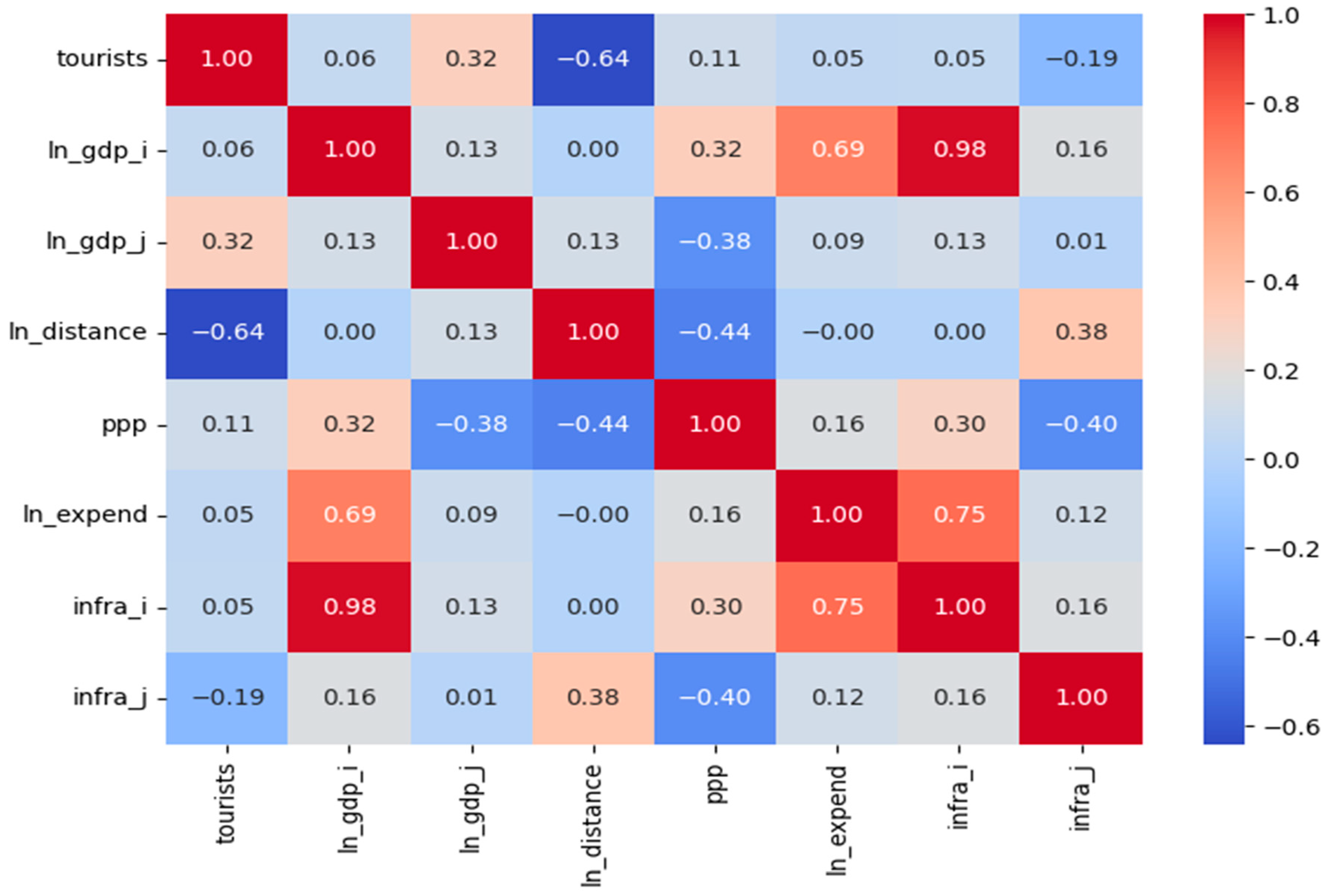
Descriptive statistics for the variables used in the analysis are presented at the beginning of
Table 1. A correlation analysis among the variables is provided in
Appendix A.
3.3. Structural Gravity Model
To identify the fundamental relationships underlying tourism flows, a gravity model is employed. This framework assumes that the volume of flows between countries depends on their economic size and the geographic distance between them. The model is specified in log-linear form, which imposes a constant-elasticity structure on the relationship between tourism flows and the explanatory variables. This specification is standard in the gravity literature and permits a direct interpretation of the estimated coefficients as elasticities (
Rosselló Nadal & Santana Gallego, 2022). The baseline model used in the study is specified as follows.
where
denotes the number of tourists arriving in Mongolia from origin country j in year t.
represents the economic size of Mongolia.
represents the origin country’s economic size.
denotes the geographical distance between the two countries.
represents purchasing power parity.
denotes the average expenditure per tourist.
represents an indicator of tourism infrastructure.
denotes origin country fixed effects.
denotes year fixed effects.
The model is estimated using panel data methods, including pooled OLS, Random Effects, Correlated Random Effects, and Poisson Pseudo Maximum Likelihood. To guide the choice between fixed- and random-effects specifications, a Hausman specification test is conducted. Under the null hypothesis, the individual effects are uncorrelated with the regressors and the random-effects estimator is consistent and efficient; rejection of this null favours the fixed-effects estimator as the preferred specification (
Hausman, 1978). In the present study, the Hausman test yields a statistic that rejects the null at conventional significance levels, supporting the use of origin-country fixed effects as the primary specification. The correlated random-effects estimator is also reported as a robustness check, as it permits consistent estimation under assumptions intermediate to those of the fixed- and random-effects models. Robust standard errors are used to account for potential heteroskedasticity, which arises frequently in bilateral flow data and can render conventional standard errors unreliable if left uncorrected (
Santos Silva & Tenreyro, 2006). The Poisson Pseudo Maximum Likelihood estimator is included as a further robustness check; it is consistent under multiplicative heteroskedasticity and accommodates zero-valued flows without requiring log-linearization of the dependent variable. Because the main variables are expressed in logarithmic form, the estimated coefficients can be interpreted as elasticity measures.
Before estimating the model, descriptive statistics and correlation analysis are conducted to examine the distribution of the variables and their pairwise relationships. The results of these preliminary analyses are presented at the beginning of
Table 1, while the correlation matrix is reported in
Appendix A.
The estimation of the structural gravity model provides a benchmark assessment of the economic and geographical factors associated with tourism flows. This benchmark serves as a reference point for comparison with the results obtained from the subsequent machine learning analysis.
3.4. Machine Learning Models and Interpretation Methods
The linear gravity model provides estimates of the average effects of explanatory variables. However, it may have limited ability to capture potential nonlinear relationships and interactions in tourism demand. For this reason, the analysis is complemented with tree-based machine learning methods. Random Forest, LightGBM, and XGBoost were selected for their established interpretive performance on structured tabular data, their ability to detect threshold effects and variable interactions without prior assumptions about functional form, and their compatibility with SHAP-based post hoc interpretation (
Peng et al., 2021;
Wu et al., 2023). In the present study, these algorithms are not employed as forecasting tools; rather, they serve as complementary analytical instruments for examining potential nonlinear patterns and variable sensitivity measures that may not be fully captured by the log-linear gravity specification. To explore nonlinear relationships, the study applies Random Forest, LightGBM, and XGBoost algorithms. These approaches rely on ensembles of decision trees and can identify threshold effects and interactions among variables without requiring the functional form of the model to be specified in advance.
All three algorithms are fitted to the full panel dataset covering 2000 to 2024, using the same set of explanatory variables as the structural gravity model. This parallel structure allows the sensitivity measures derived from the machine learning models to be directly compared with the elasticity estimates obtained from the gravity specification. Model hyperparameters, including maximum tree depth, learning rate, number of estimators, and subsampling ratios, are selected using five-fold cross-validation on the estimation sample, with mean squared error as the selection criterion. This approach helps to limit overfitting and supports the stability and robustness of the resulting sensitivity estimates across the observed data range.
Model performance is evaluated using RMSE, MAE, and the in-sample . In this study, machine learning models are not used as tools for causal inference. Instead, they serve as complementary analytical methods that help provide additional insights alongside the results obtained from the gravity model. To interpret the outputs of the machine learning model, SHAP (Shapley Additive Explanations) analysis is applied. SHAP values measure the contribution of each variable to the model output for a given observation. The mean absolute SHAP value is commonly used to assess the relative importance of variables within the model.
In addition, partial dependence analysis is used to visualize how changes in specific variables affect tourism flows. This approach allows the comparison of the linear sensitivity estimated by the gravity model with potential nonlinear patterns detected by machine learning methods. The results of the machine learning and SHAP analyses are presented in the following section and are discussed in relation to the benchmark estimates obtained from the gravity model.
4. Empirical Results
Table 1 reports the main descriptive statistics of the variables used in the analysis. Tourism flows, measured by the number of arrivals, exhibit substantial variation across origin country pairs.
The mean number of tourists is approximately 13,356, while the standard deviation is about 2.7 times larger than the mean, indicating a strongly right-skewed distribution. This pattern suggests that a limited number of major source markets, including China, the Russian Federation, and the Republic of Korea, account for a disproportionately large share of total arrivals. Such heterogeneity provides a strong justification for the use of panel data estimation techniques, as these methods allow for differences across countries in both the level and responsiveness of tourism demand to be appropriately captured. The economic size of both the origin and destination countries () also exhibits a relatively wide distribution. The standard deviation of exceeds 1.5 log points, reflecting the inclusion of origin markets ranging from small transition economies to large OECD members. This variation is analytically important because it allows the GDP elasticity of tourism demand to be identified across a broad spectrum of income levels, including markets in which the income sensitivity of outbound travel may differ substantially. The average value of geographical distance is 8.49, indicating that the dataset includes both regional tourism markets and more distant international destinations.
Given that a value of equal to 8.49 corresponds to roughly 4900 km, the sample includes both relatively close origin markets, where travel costs remain moderate, and more distant markets, for which the effect of distance is expected to impose a stronger constraint on tourism flows. For travel expenditure and tourism infrastructure indicators, some variation across countries is also observed. The infrastructure index for origin countries, denoted as , has a mean value of 97.27 and a minimum of 40.79. In comparison, the corresponding indicator for Mongolia, , ranges from 57.06 to 84.50 over the sample period, suggesting a gradual improvement in domestic tourism capacity. The purchasing power parity variable has an average value of 0.45 and exhibits considerable variation, reflecting substantial differences in relative price levels across origin markets. These differences may influence the responsiveness of tourism demand, particularly for long-distance travel to Mongolia.
The correlation matrix among the variables is presented in
Appendix A. In general, tourism flows are positively associated with the economic size of the destination country and negatively associated with geographical distance. These patterns are broadly consistent with the theoretical expectations of the gravity model. The negative correlation between
and tourism flows is among the strongest pairwise associations in the matrix, providing preliminary support for the distance-decay hypothesis that is central to the gravity framework and motivates the nonlinear distance analysis presented in
Section 4.4.
4.1. Baseline Structural Gravity Estimation
To evaluate the factors associated with international tourism flows, the baseline gravity model was estimated using panel data methods. The estimation was conducted using pooled OLS, Random Effects, Correlated Random Effects, and Poisson Pseudo Maximum Likelihood approaches. The OLS specification represents a pooled estimation of the panel dataset. These estimation methods are widely used in gravity model studies and allow a comparison of parameter stability and the robustness of the results. In addition, the structural estimation provides a benchmark for comparing the sensitivity measures derived from the machine learning analysis presented in the following sections. The main estimation results of the gravity model are reported in
Table 2.
The estimation results indicate that the signs of the coefficients are generally consistent with the theoretical expectations of the gravity model. In particular, geographical distance (ln_distance) exhibits a statistically significant negative association across all specifications, while the economic size of both the origin and destination countries (ln_gdp_i and ln_gdp_j) is positively associated with tourism flows. These findings are consistent with the traditional gravity framework for international travel flows. Tourism expenditure (ln_expend) also exhibits a positive association with tourist arrivals, suggesting that tourism demand tends to increase alongside consumption-related spending. In contrast, the coefficients for PPP and some infrastructure variables are not consistently statistically significant across the model specifications.
The infrastructure indicator for the destination country (infra_j) appears with a positive sign in some estimations, suggesting that improvements in tourism services and facilities are associated with higher tourist flows. On the other hand, the infrastructure variable for the origin country (infra_i) appears with a negative sign in several specifications. This pattern may be consistent with the idea that stronger domestic tourism infrastructure could be associated with a lower propensity for outbound travel. In terms of explanatory power, the OLS model yields an R
2 of 0.6755, while the PPML specification produces a pseudo-R
2 of 0.8045. These values suggest that the gravity model explains a substantial share of the variation in tourism flows. The structural estimation, therefore, provides a useful interpretive benchmark, establishing the direction and approximate magnitude of key determinants before the machine learning analysis is applied to examine potential nonlinear patterns in these relationships. The key elasticity estimates derived from the gravity model are summarized in
Table 3.
The results reported in
Table 3 indicate that the economic size of both the origin and destination countries is positively associated with tourism flows. The elasticity of origin-country GDP, which ranges from approximately 2.0 under PPML to 4.8 under OLS, implies that a one percentage point increase in the economic size of an origin market is associated with a substantial increase in tourist departures to Mongolia. This finding is consistent with the interpretation that income growth in origin countries generates latent travel demand and that Mongolia’s inbound flows are particularly sensitive to macroeconomic expansion in nearby and middle-income source markets. Geographical distance exhibits a statistically significant negative relationship, consistent with the theoretical expectations of the gravity model. The estimated elasticity of distance ranges between approximately −1.85 and −2.10 across model specifications, suggesting that a one percent increase in bilateral distance is associated with a reduction of about two percent in tourist arrivals. This relatively strong negative effect underscores Mongolia’s geographic remoteness and indicates a high sensitivity of inbound tourism demand to travel-related costs. Such a pattern is consistent with the characteristics of landlocked and remote destinations, where distance plays a more pronounced role compared with more accessible tourism markets documented in the broader gravity literature (
Rosselló Nadal & Santana Gallego, 2022). Tourism expenditure also exhibits a positive elasticity, suggesting that tourism demand tends to increase alongside higher levels of consumption-related spending. This result may reflect a composition effect: origin markets with higher average tourist expenditure tend to generate visitors with greater financial capacity, for whom the cost of long-haul travel to Mongolia represents a smaller share of disposable income. Overall, the similarity in the sign and relative magnitude of the coefficients across the OLS, RE, and PPML estimations suggests that the baseline gravity results are relatively stable. The consistency across specifications provides confidence that the identified relationships are not artefacts of any particular estimation approach, but reflect robust structural associations between the explanatory variables and inbound tourism flows to Mongolia.
4.2. Machine Learning Model Fit and Comparison with the Gravity Benchmark
To assess the in-sample fit of the machine learning models relative to the structural gravity benchmark, Random Forest, LightGBM, and XGBoost were each estimated on the full panel dataset spanning 2000 to 2024, using the same set of explanatory variables as the gravity specification. This parallel structure ensures that any differences in fit metrics reflect differences in the models’ ability to represent the observed variation in tourism flows, rather than differences in sample coverage or variable selection. The fit statistics for each model are reported in
Table 4 using RMSE, MAE, and R
2.
Table 4 shows that all three tree-based models achieve lower RMSE and MAE values than the structural gravity model estimated on the same sample. XGBoost records the lowest RMSE (31,875) and MAE (12,651), followed by Random Forest and LightGBM. The gravity model’s R
2 of 0.256 is lower than those of the machine learning models, which range from 0.309 to 0.338. This gap in in-sample fit is consistent with the expectation that flexible, nonparametric methods can accommodate nonlinear patterns and variable interactions that a log-linear gravity specification, by construction, cannot represent.
Differences in model fit should not be interpreted as evidence that machine learning models provide a superior causal explanation. The gravity model is grounded in economic theory and incorporates structural assumptions such as constant elasticity and additive separability. In contrast, tree-based algorithms are designed to be flexible and do not impose such restrictions. As a result, the lower in-sample RMSEs observed for machine learning models reflect their ability to capture complex patterns in the data rather than any limitation of the gravity framework in terms of structural interpretation.
Moreover, the relatively small improvement in fit, with RMSE reductions not exceedingly approximately 5.6 percent, indicates that the log-linear gravity model already explains the majority of the variation in tourism flows. Machine learning models, therefore, contribute primarily by capturing additional nonlinear features that are not fully accounted for in the baseline specification. The results of the forecast comparison using the Diebold–Mariano test are presented in
Table 5.
Therefore, the structural gravity model remains a useful theoretical framework for explaining tourism flows. Machine learning algorithms serve as complementary analytical instruments, not as replacements for the gravity specification. Their primary contribution lies in the SHAP-based sensitivity analysis and partial dependence examination presented in the following sections, where the focus shifts from overall model fit to the identification of variable-specific nonlinear patterns that the log-linear gravity framework is structurally unable to detect.
4.3. Comparison of SHAP-Based Sensitivity and Elasticity
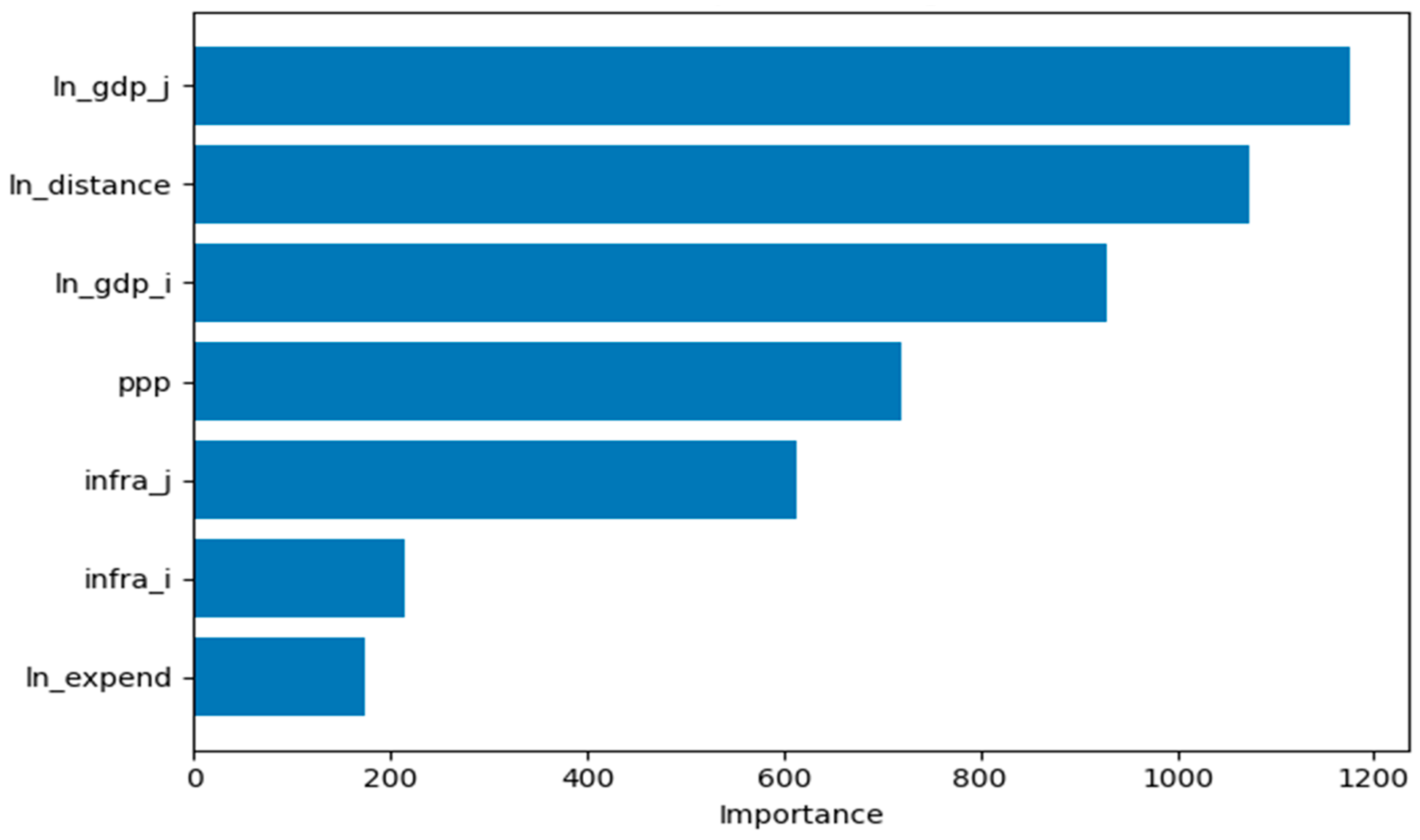
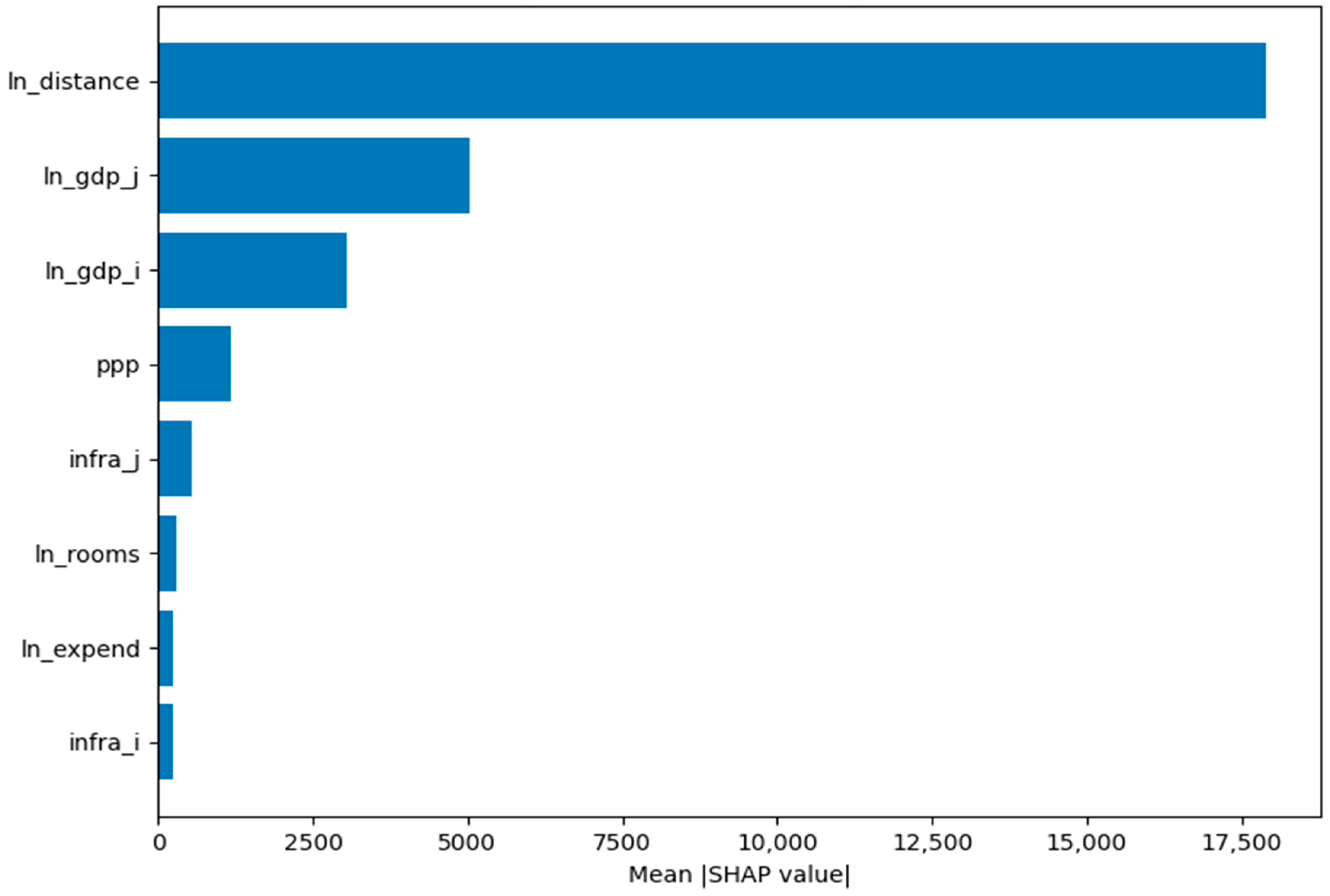
To improve the interpretability of the machine learning models, the SHAP (Shapley Additive Explanations) method was applied to assess each variable’s contribution to the model’s outputs. The SHAP approach is based on game theory and measures the contribution of a variable by comparing model outputs with and without that variable. The mean absolute SHAP value is commonly used to assess the global importance of variables. In the present study, SHAP values serve as sensitivity measures that complement the elasticity estimates derived from the gravity model: whereas the gravity elasticities quantify the average marginal effect of each variable under the assumption of log-linearity, the mean absolute SHAP values reflect each variable’s average contribution to the machine learning model’s output across all observations, without imposing any functional form restriction. The relative importance of variables derived from the LightGBM model is illustrated in
Figure 1.
As shown in
Figure 1, the economic size of the origin country (ln_gdp_j) makes the largest contribution to explaining tourism flows. Geographical distance (ln_distance) and the economic size of the destination country (ln_gdp_i) appear as the next most important variables. This pattern is consistent with the central intuition of gravity theory, which posits that economic size and geographic distance are the primary determinants of international tourism flows. The result that the origin country GDP emerges as the most influential variable in the SHAP ranking, exceeding the importance of distance, indicates that income capacity on the demand side may play a somewhat stronger average role in shaping bilateral tourism flows to Mongolia than geographical constraints. This pattern can partly be explained by the relatively limited range of distance variation in the sample, with ln_distance ranging from 7.11 to 9.21. Such a narrow interval may reduce the observed variation in distance effects relative to the broader dispersion in GDP across origin countries.
Other variables, such as purchasing power parity, tourism infrastructure indicators, and average tourist expenditure, also contribute to the model outputs, although their relative importance is lower. The comparatively low SHAP importance of expenditure (248.2) and rooms (294.4) relative to distance (17,876.9) indicates that, once economic size and geographical friction are accounted for, destination-level and expenditure-related factors contribute only marginally to explaining variation in tourism flows. This pattern is consistent with the gravity literature’s characterization of GDP and distance as the dominant bilateral determinants, with other variables playing a secondary conditioning role. Overall, the variable importance identified by the machine learning model appears broadly consistent with the key determinants highlighted by the gravity model. To illustrate the machine learning model’s fit relative to observed flows,
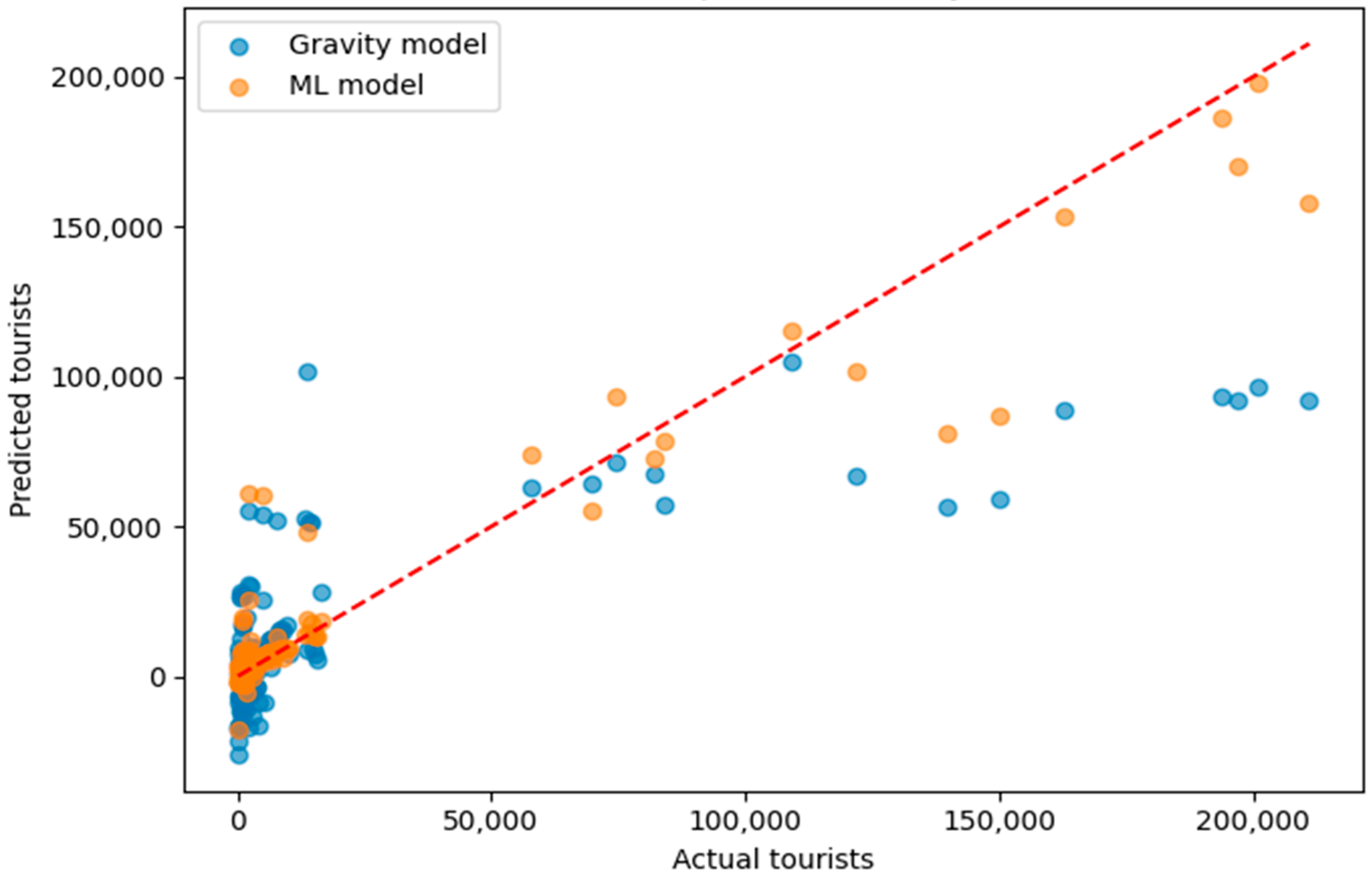
Figure 2 compares observed tourism flows with fitted values.
Figure 2 indicates that the machine learning model’s predictions are relatively close to the observed values. In contrast, the linear gravity model tends to underestimate some of the larger tourism flows. This pattern may reflect the limitation of the linear functional form, which may not fully capture certain nonlinear variations in tourism demand. Tree-based machine learning algorithms, on the other hand, can capture interactions among variables and potential nonlinear relationships. The gravity model tends to underestimate larger tourism flows, particularly when the interaction between distance and income exhibits nonlinear characteristics. These types of heterogeneous patterns provide a clear motivation for the partial dependence analysis developed in
Section 4.4 and
Section 4.5, which is designed to capture variations that cannot be fully represented within the linear gravity framework. The sensitivity derived from the machine learning model was further compared with the elasticity estimates obtained from the structural gravity model. The results are presented in
Table 6.
The results in
Table 6 indicate that the general direction of the effects is broadly consistent with the gravity model results. In particular, geographical distance (ln_distance) remains the variable with the highest relative importance. The mean absolute SHAP value for distance is 17,876.9, which is more than three times that of the origin country’s GDP, measured at 5031.6. This indicates that distance exhibits the greatest overall variation in its influence across observations. Such a pattern is consistent with the broad distribution of bilateral distances in the sample and aligns with the strong distance decay relationship identified in
Section 4.1. The SHAP analysis also suggests that economic size is positively associated with tourism flows.
However, SHAP values are not measured in the same units as elasticity estimates. Therefore, they should not be interpreted directly as coefficients or causal effects. Instead, SHAP values are an interpretive analytical measure that reflects each variable’s relative contribution to the model’s outputs. The comparison presented here, therefore, focuses on the consistency in the direction and relative importance of variables rather than on the direct magnitude of coefficients. Taken together, the SHAP-based importance rankings and the elasticity estimates from the gravity model identify the same key determinants: origin country income and bilateral distance. This consistency across methodological approaches provides complementary evidence and enhances the overall credibility of the empirical results. The detailed distribution of SHAP global importance is presented in
Appendix A Figure A2. These results suggest that the variables identified by the machine learning model are broadly consistent with the key determinants predicted by gravity theory.
4.4. Nonlinear Effects of Distance and Distance Interval Sensitivity
To examine whether geographical distance has a nonlinear influence on tourism flows, a quadratic term for distance (ln_distance
2) was added to the gravity specification. This augmented specification relaxes the constant-elasticity assumption imposed by the log-linear baseline model and allows the marginal effect of distance to vary with its own level. The estimation results are reported in
Table 7.
Table 7 shows that the coefficients for ln_distance and ln_distance_sq are both statistically significant at conventional levels. The negative sign of ln_distance, together with the positive sign of the squared term, suggests that the relationship between geographical distance and tourism flows may be nonlinear. This pattern indicates that tourism flows may decline rapidly at first as distance increases, while the rate of decline may become less pronounced at greater distances. From a behavioural standpoint, this result is consistent with the idea that the marginal disutility of travel distance diminishes once a threshold of long-haul travel has been crossed: travellers who have already committed to reaching a geographically remote destination such as Mongolia are less sensitive to incremental increases in distance than those choosing between nearby alternatives.
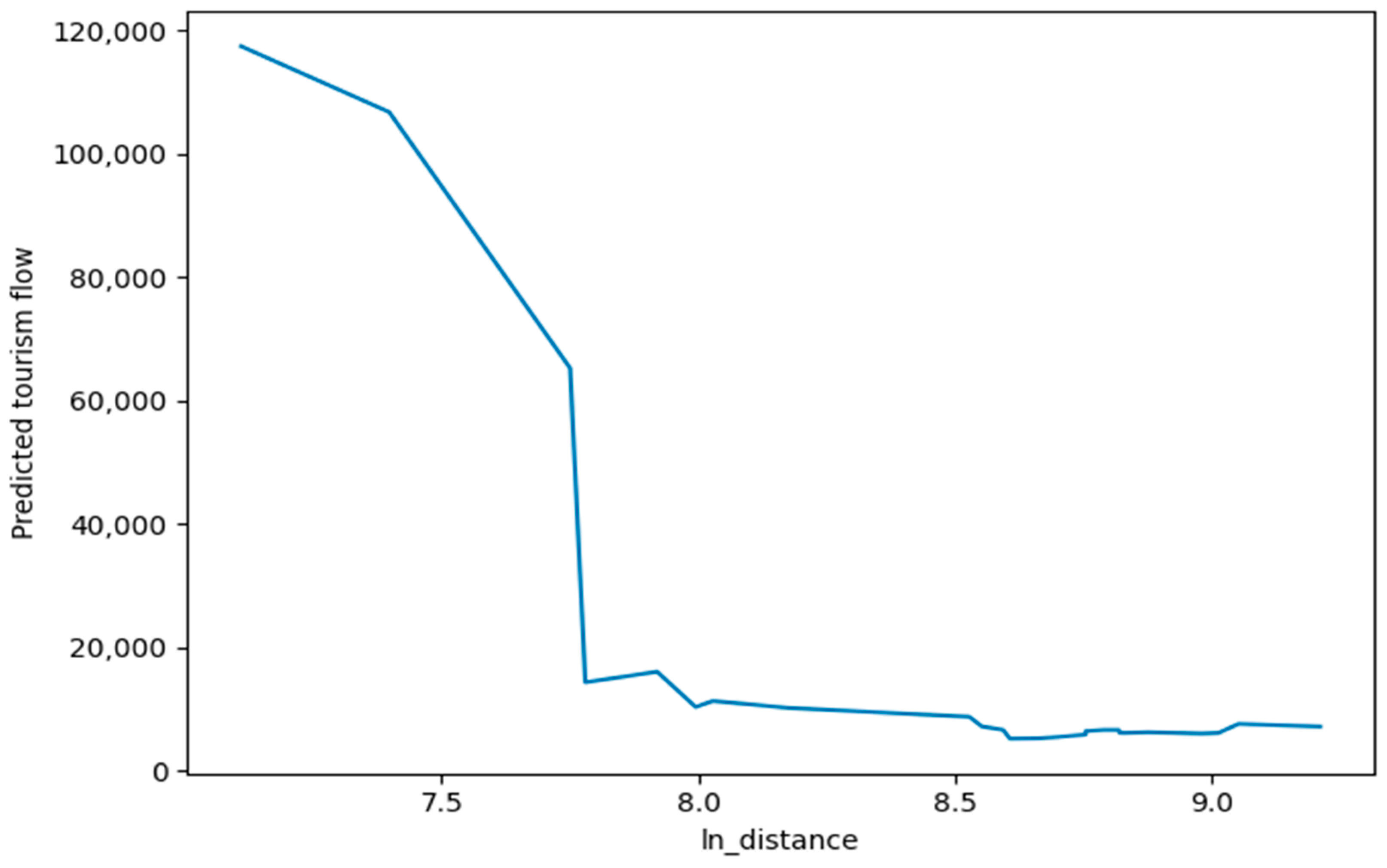
To illustrate the effect of distance more clearly, a partial dependence analysis derived from the machine learning model was used to visualize the relationship between distance and fitted tourism flows. The results are shown in
Figure 3.
Figure 3 indicates that tourism flows tend to be relatively high at shorter distances and decline as distance increases. The decline appears to be more pronounced in intermediate-distance ranges. At greater distances, however, the rate of decline becomes more gradual. This pattern further suggests that the relationship between distance and tourism flows may be nonlinear. The shape of the partial dependence curve is broadly consistent with the quadratic gravity specification: a steep initial decline followed by a flattening of the distance effect in the upper range of the sample. Importantly, the partial dependence profile is derived independently of the gravity framework, relying solely on the machine learning model’s internal representation of the data. The convergence of the two approaches, therefore, provides cross-method corroboration for the nonlinear distance hypothesis rather than a circular confirmation.
Based on the quadratic specification, the turning point of the distance effect occurs at ln_distance ≈ 8.65, corresponding to a distance of about 5700 km. This result suggests that beyond a certain distance threshold, the marginal effect of additional distance on tourism flows may gradually diminish. From a geographic perspective, the threshold of approximately 5700 km can be interpreted as separating Mongolia’s regional source markets, including China, Russia, South Korea, and Japan, from more distant markets in Europe and North America. The observed weakening of the distance effect beyond this point is consistent with a self-selection mechanism among long-distance travellers. Individuals who travel to Mongolia from distant origins are likely to be less sensitive to both cost and distance than the average tourist. As a result, the negative relationship between distance and tourist arrivals becomes less pronounced at higher distance levels.
To examine the distance effect in greater detail, the distance variable was divided into several intervals, and the average sensitivity of tourism flows was calculated for each interval. The results are presented in
Table 8.
Table 8 indicates that tourism flows are relatively more sensitive to changes in distance within shorter distance intervals. In contrast, sensitivity appears to decline in the medium- and long-distance ranges. In other words, changes in distance may have a stronger effect on tourism flows in nearby markets, whereas the marginal impact of additional distance may be smaller in more distant markets.
The marked difference between sensitivity at short distances, estimated at 40,019.7, and that observed for medium- and long-distance ranges, estimated at 6092.9 and 6488.5, respectively, highlights the practical importance of the nonlinear pattern. The implied ratio of approximately 6.5 to 1 indicates that a one-unit increase in ln_distance is associated with a substantially larger change in predicted tourism flows in nearby markets than in long-distance markets.
This result suggests that policy measures aimed at improving regional air connectivity or reducing cross-border travel frictions with neighbouring countries are likely to yield significantly greater increases in inbound tourism than comparable cost reductions directed at long-distance markets.
Overall, the results from the nonlinear gravity specification and the machine-learning partial dependence analysis are broadly consistent. Both approaches suggest that the influence of geographical distance on tourism flows may vary across distance intervals. This finding indicates that treating distance solely as a linear factor in tourism gravity models may be insufficient and that accounting for nonlinear patterns may provide a more realistic interpretation of tourism flows. More broadly, the convergence of econometric and machine-learning evidence on the nonlinear distance effect represents one of the core methodological contributions of the present study, demonstrating that an integrated analytical framework can generate insights into demand structure that neither approach would readily yield in isolation.
4.5. Heterogeneous Distance Sensitivity by Income Groups
To account for economic differences across origin countries, the effect of distance on tourism flows was further examined by income level. Origin countries were classified into two groups: high-income and middle-income economies, following the World Bank income classification applied to the sample period. The influence of distance was then evaluated using a machine-learning-based partial dependence approach. This method illustrates the relationship between distance and fitted tourism flows while holding other variables at their average levels. By stratifying the partial dependence profiles by income group, the analysis examines whether the distance-decay relationship documented in
Section 4.1 and
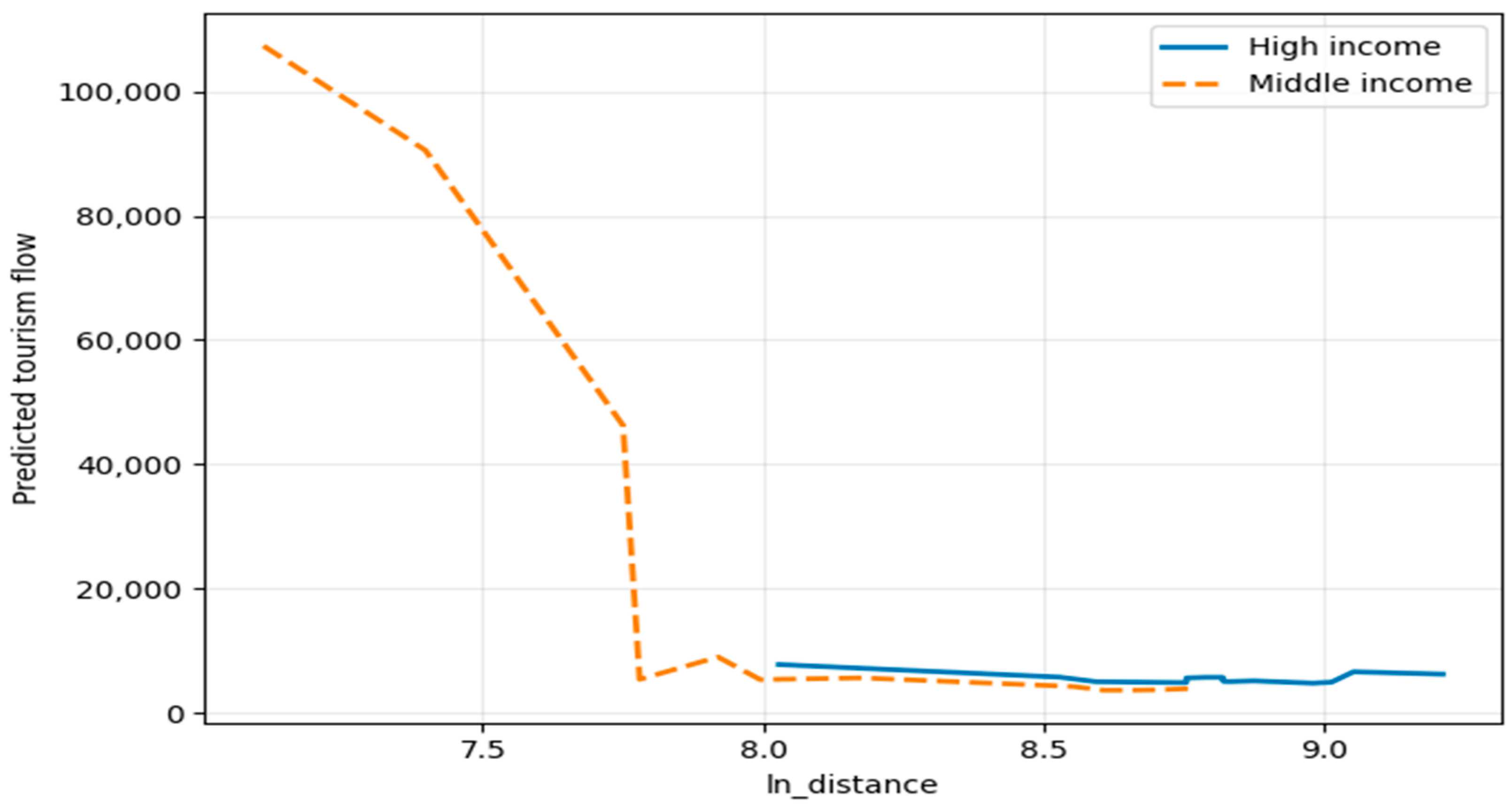
Section 4.4 operates uniformly across origin markets or exhibits heterogeneity that the aggregate gravity specification cannot capture. The variation in tourism flows as distance increases across income groups is illustrated in
Figure 4.
Figure 4 shows that tourism flows from middle-income countries decline more sharply as distance increases. The decline appears particularly pronounced when moving from medium-distance markets to long-distance markets. This pattern suggests that total travel costs and transportation expenses may have a stronger influence on tourism demand in middle-income markets. This result is consistent with the standard microeconomic interpretation of travel cost theory: for households in middle-income origin countries, the expenditure share devoted to long-haul international travel is larger, making demand for trips to geographically remote destinations such as Mongolia more sensitive to changes in travel costs and, by extension, to bilateral distance. Put differently, the budget constraint faced by travellers from middle-income markets is more likely to bind at the distances that characterize access to Mongolia, generating a steeper observed decline in flows.
In contrast, the negative effect of distance appears relatively weaker for high-income countries. Although tourism flows still decline as distance increases, the rate of decline is more gradual compared with middle-income markets. This pattern indicates that travellers from high-income countries may have greater financial capacity to undertake long-distance travel. For these origin markets, travel decisions appear to be influenced more strongly by destination-specific factors, such as cultural uniqueness, nature-based tourism resources, and the appeal of novel experiences, rather than by distance-related constraints alone. This suggests that marketing strategies targeting higher-income markets may be more effective if they highlight Mongolia’s distinctive experiential offerings rather than focusing primarily on accessibility.
Overall, the results suggest that the influence of distance varies across income groups. In middle-income markets, decisions to undertake long-distance travel appear more sensitive to cost-related factors. For high-income markets, however, the ability to travel longer distances appears to remain relatively stable. To examine the robustness of this result, the income classification was re-evaluated using an alternative income grouping based on the OECD framework. The overall pattern remained similar. The effect of distance continued to differ between middle and high-income groups. The consistency of the results across two alternative classification approaches, based on the World Bank income thresholds and the OECD membership criterion, strengthens confidence that the observed heterogeneity is not driven by the specific grouping method applied. Taken together, these findings indicate that income level may moderate the sensitivity of tourism flows to distance.
This moderation effect has important implications for the analysis and management of Mongolia’s inbound tourism market. A single equation gravity model that assumes a constant distance elasticity across all origin countries may fail to capture the differing responses of high- and middle-income travellers, potentially leading to biased parameter estimates and less effective policy design. The integrated framework adopted in this study, which combines gravity-based elasticity estimation with machine-learning partial dependence analysis, enables such heterogeneity to be identified and interpreted more clearly. In this way, the approach offers a methodological contribution that extends beyond the specific context of Mongolia and may be applicable to other tourism markets with similar structural characteristics.
5. Discussion
The findings of this study provide several insights that extend beyond the numerical results presented in the previous sections. This discussion situates the empirical evidence within the broader literature on tourism demand, clarifies the methodological contribution of the integrated framework, and highlights the implications for both academic research and policy design.
5.1. Consistency with Gravity Theory and Prior Evidence
The gravity model estimates confirm that economic size and geographical distance remain the primary structural determinants of inbound tourism flows to Mongolia. This result is consistent with a large body of empirical research showing that tourism demand increases with income and declines with distance. The estimated distance elasticity, which ranges between approximately −1.85 and −2.10, is somewhat larger in absolute value than the average estimates reported in cross-country studies. This difference can be explained by Mongolia’s geographic position. As a landlocked and relatively remote destination, the country is more exposed to travel cost barriers, which amplify the role of distance compared with more accessible destinations.
The elasticity associated with origin-country GDP is also relatively large, indicating that tourism demand is strongly linked to economic conditions in source markets. This pattern is commonly observed in emerging tourism destinations, where travel demand tends to respond more sensitively to changes in income. In Mongolia, which attracts visitors through niche offerings such as nomadic culture and nature-based tourism, demand appears closely tied to the purchasing power of travellers, particularly in neighbouring regional economies.
The limited statistical significance of variables such as purchasing power parity and infrastructure in some model specifications should be interpreted cautiously. Rather than suggesting that these factors are unimportant, the result likely reflects the limited variation in these variables within the sample. When variation is restricted, it becomes more difficult to identify their effects econometrically, a pattern noted in previous gravity model applications.
5.2. What the Machine Learning Analysis Adds
The machine learning component complements rather than replaces the gravity model. The relatively small improvement in predictive accuracy indicates that the linear gravity specification already captures the main patterns in the data. This reinforces the gravity model’s role as a theoretically grounded benchmark.
At the same time, machine learning models provide additional insights by identifying patterns that are not easily captured within a linear framework. Their flexibility allows them to detect nonlinear relationships and interactions without imposing predefined functional forms. The SHAP analysis is particularly useful in this context, as it enables interpretation of the contribution of individual variables.
Importantly, both the gravity model and the machine learning analysis identify the same key determinants, namely origin-country income and geographical distance. This consistency across methods strengthens confidence in the empirical findings. It also suggests that the core relationships in tourism demand remain broadly linear, while nonlinearities play a secondary but still meaningful role. The machine learning results therefore add depth to the analysis rather than overturning the conclusions derived from the gravity model.
5.3. The Nonlinear Distance Effect and Its Implications
One of the most important findings of the study is the presence of a nonlinear relationship between distance and tourism flows. Both the extended gravity model and the partial dependence analysis indicate that the negative effect of distance is strongest at shorter ranges and becomes less pronounced at longer distances. A turning point is observed at approximately 5700 km.
This pattern can be explained by traveller behaviour. Individuals who travel long distances are likely to have stronger motivation, higher income, or lower sensitivity to travel costs. As a result, once distance exceeds a certain threshold, its marginal effect on travel decisions declines. This interpretation is consistent with theoretical insights from travel cost theory and with empirical evidence from other peripheral destinations.
The practical implications of this finding are substantial. The sensitivity of tourism flows to distance is much higher for nearby markets than for distant ones. This implies that policies aimed at reducing travel barriers in regional markets are likely to generate significantly larger increases in visitor numbers. Improvements in connectivity, simplified visa procedures, and cross-border cooperation with neighbouring countries can therefore have a disproportionately strong impact on inbound tourism.
5.4. Income Heterogeneity and Market Segmentation
The analysis also reveals that the effect of distance varies across income groups. Tourism demand from middle-income countries is more sensitive to distance than demand from high-income countries. This finding is consistent with the idea that travel costs represent a stronger constraint for households with limited disposable income.
In contrast, travellers from high-income countries appear less constrained by distance and more influenced by destination-specific characteristics. For these visitors, factors such as cultural uniqueness, natural landscapes, and the overall travel experience play a more important role than cost alone.
This heterogeneity has clear implications for tourism strategy. A uniform approach to all markets is unlikely to be effective. Instead, policies should be tailored to different segments. Regional markets may respond strongly to cost reductions and improved accessibility, while long-distance high-income markets may be more responsive to branding, product differentiation, and the promotion of unique tourism experiences.
The robustness of this result across different income classification methods further strengthens its validity. The fact that similar patterns emerge under alternative definitions of income groups suggests that the observed differences reflect genuine behavioural variation rather than methodological artefacts.
5.5. Methodological Contribution and Limitations
From a methodological perspective, this study demonstrates that gravity models and explainable machine learning approaches can be used in a complementary manner. The gravity model provides a clear theoretical structure and interpretable elasticity estimates. Machine learning methods, on the other hand, offer flexibility and allow the identification of nonlinear and heterogeneous effects.
By combining these approaches, the study can capture both average relationships and more complex patterns in the data. This integrated framework provides a richer understanding of tourism demand than either method could achieve on its own.
Several limitations should be acknowledged. The dataset includes 27 origin countries, which represent the main tourism markets but do not capture all potential demand sources. In addition, institutional factors such as visa policies, political relations, and cultural distance could not be fully incorporated due to data constraints. Finally, while the analysis identifies nonlinear patterns, it does not fully capture continuous variation in responses across all possible income levels.
Future research could extend this framework by incorporating additional variables, expanding coverage across countries, and exploring more flexible interaction models. Such extensions would further enhance the understanding of tourism demand in geographically diverse and emerging destinations.
6. Policy Implications and Future Research
6.1. Policy and Practical Implications
The empirical findings of this study lead to several important policy implications.
First, the results on distance sensitivity show that tourism flows from nearby markets respond much more strongly to changes in travel conditions than those from more distant regions. In particular, responsiveness in the short-distance segment is several times higher than in medium- and long-distance markets. Since Mongolia’s main source countries, including China, the Russian Federation, and the Republic of Korea, fall within this highly responsive group, policies that improve accessibility in regional markets are likely to produce the largest increases in visitor numbers. Expanding direct flight connections, improving cross-border transport infrastructure, and simplifying visa procedures for neighbouring countries are therefore expected to yield substantial benefits.
Second, the analysis highlights clear differences between middle-income and high-income source markets. For middle-income countries, travel demand appears highly sensitive to costs. This suggests that policies aimed at reducing the financial burden of travel, such as promotional pricing, package tour incentives, or simplified border procedures, may be particularly effective in increasing arrivals. In contrast, visitors from high-income markets appear less constrained by travel costs and more influenced by the destination’s unique characteristics. For these markets, marketing strategies that emphasize Mongolia’s cultural heritage, natural environment, and distinctive travel experiences are likely to be more successful than approaches focused solely on improving accessibility.
Third, the relatively high elasticity with respect to origin-country income indicates that inbound tourism demand is closely linked to economic conditions in source markets. This implies that fluctuations in economic activity abroad can directly affect visitor numbers. Tourism planning should therefore incorporate forward-looking economic indicators from key partner countries, enabling more adaptive capacity management and demand forecasting rather than relying solely on past trends.
6.2. Limitations of the Study
Several limitations should be acknowledged when interpreting the results.
First, the analysis is based on a sample of 27 origin countries, which represent the major tourism markets but do not include all potential demand sources. As a result, the estimated relationships may not fully generalize to smaller or emerging markets.
Second, the empirical model does not explicitly include institutional and policy-related variables such as visa regulations, bilateral air service agreements, or cultural proximity. The absence of these factors may influence the estimated coefficients, particularly those associated with distance, by capturing effects that are not directly observed in the model.
Third, the use of discrete income categories in the heterogeneity analysis simplifies what is likely to be a continuous relationship between income and tourism demand. A more flexible specification would enable a more detailed representation of how this relationship evolves across income levels.
6.3. Directions for Future Research
The results of this study suggest several promising directions for future research.
First, applying the integrated analytical framework to other destinations with similar geographic characteristics would help determine whether the patterns identified in this study are specific to Mongolia or reflect broader regularities in tourism demand. In particular, landlocked or geographically remote countries may exhibit similar nonlinear responses to distance and comparable differences across income groups.
Second, extending the model to include institutional and policy variables would improve its explanatory power. Indicators such as visa openness, air transport capacity, and regulatory frameworks could provide a more complete understanding of the factors influencing tourism flows and help address potential omitted variable bias.
Third, future studies could move beyond discrete income classifications by adopting approaches that allow the relationship between income and tourism demand to vary continuously. Methods such as varying coefficient models or quantile-based analysis would enable examination of how sensitivity to distance varies across the full income distribution, providing a more detailed and realistic picture of tourism behaviour.
7. Conclusions
This study examined the determinants of international tourism flows to Mongolia within an integrated analytical framework that combines the traditional gravity model with machine-learning approaches. Using panel data covering 27 origin countries over the period 2000–2024, the analysis proceeds in two stages: a structural gravity estimation that establishes elasticity-based benchmarks, followed by an explainable machine-learning analysis that examines potential nonlinear patterns and variable sensitivities without imposing functional-form restrictions.
The empirical results indicate that the economic size of both origin and destination countries positively influences tourism flows, while geographical distance has a negative effect. The distance elasticity, ranging from approximately −1.85 to −2.10 across specifications, is somewhat larger in absolute magnitude than the cross-country averages reported in the gravity literature, consistent with Mongolia’s status as a geographically peripheral, landlocked destination with above-average travel cost barriers. The results also suggest that income levels and broader macroeconomic conditions play an important role in shaping tourism demand. The estimated elasticity of origin country GDP, ranging from 2.0 to 4.8, indicates that inbound tourism to Mongolia is highly responsive to economic conditions in source markets. This pro-cyclical pattern has important implications for both demand forecasting and capacity planning in the tourism sector.
In addition to confirming the central importance of income and distance, the analysis reveals two findings that extend the conventional gravity framework. First, the relationship between distance and tourism flows is nonlinear. Tourist arrivals decline rapidly over shorter distances and more gradually as distance increases, with a turning point observed at approximately 5700 km. The estimated sensitivity in nearby markets is several times higher than that observed in medium- and long-distance segments, indicating that reductions in travel barriers within the regional market are likely to produce substantially larger increases in visitor numbers than comparable improvements directed at distant markets.
Second, the impact of distance differs across income groups. Tourism flows from middle-income countries show a stronger response to distance compared with those from high-income countries. This pattern is consistent with tighter budget constraints in middle-income markets, while travel from higher-income countries appears more strongly influenced by destination-specific motivations. Both findings are supported by econometric estimates and machine-learning-based analysis, which together provide consistent evidence and strengthen the overall reliability of the results.
Overall, this study contributes to the tourism demand modelling literature by demonstrating how traditional econometric techniques and modern data-driven approaches can be integrated within a single analytical framework. The gravity model provides a structured framework grounded in economic theory and yields elasticity estimates that are directly interpretable. In contrast, machine learning approaches offer greater flexibility and can identify nonlinear relationships that a log-linear specification cannot capture. The fact that both approaches identify the same key determinants, namely origin country income and bilateral distance, strengthens confidence that the observed relationships reflect underlying structural features of tourism demand rather than being driven by model-specific assumptions. The integrated framework developed here is applicable beyond the Mongolian context and offers a replicable template for demand analysis in other emerging, geographically peripheral destinations where the linearity assumptions of conventional gravity models may be insufficient to capture the full structure of international tourism flows.