



Critical Resilience Factors for Post-Disaster Tourism Recovery: Evidence from Baños de Agua Santa via Fuzzy Multi Criteria Analysis
 ,
,
Abstract
1. Introduction
1.1. Contextualization of the Case: Baños de Agua Santa, Ecuador
1.2. From Conceptual Assessment to Operational Prioritization
1.3. Research Gap and Study Significance
2. Theoretical Framework: Critical Dimensions of Resilience
- A.
- Regional-economic resilience. The region’s capacity to absorb and recover from the shock (Cheng & Zhang, 2020; Urbani et al., 2025). It includes diversification—tourism dependence heightens vulnerability in Baños—employment, equity and socio-economic vulnerability (Cheng & Zhang, 2020; Chouhan et al., 2023; Yadav & Barve, 2017). A resilient economy mobilizes investment and raises local incomes (Cheng & Zhang, 2020).
- B.
- Firm-level economic resilience. At the micro level, it measures the capacity of tourism organizations and micro, small and medium-sized enterprises (MSMEs) to withstand, adapt and resume operations (Badoc-Gonzales et al., 2022; Nguyen et al., 2022; Praptika et al., 2024). Key factors include entrepreneurial vision, opportunity- and innovation-driven entrepreneurship (Ribeiro et al., 2025) and planning (business continuity and proactive preparedness) to mitigate impacts (Nguyen et al., 2022).
- C.
- Socio-regional resilience. This encompasses education, social vulnerability (poverty and gender) and cultural identity, factors that shape risk-coping capacity and residents’ attitudes during recovery (Parsons et al., 2016; Chouhan et al., 2023; Pu & Chang-Richards, 2024; Yadav & Barve, 2017; Liu-Lastres et al., 2020).
- D.
- Socio-community resilience. This dimension emphasizes social capital and networks: cohesion and mutual assistance, leadership, inter-institutional and peer trust, and social responsibility; all of these support self-organization and adaptability (Guo et al., 2018b; C.-F. Liu & Mostafavi, 2025; Ruslanjari et al., 2025; Gu et al., 2025; Hu & Xu, 2022; G. Herrera-Enríquez & Rodríguez-Rodríguez, 2017).
- E.
- Institutional resilience. This comprises governance, policies and processes for risk management—prevention, mitigation and public–private–community coordination; the existence of plans and drills is a key indicator (Al-Manji et al., 2021; Badoc-Gonzales et al., 2022; Carpenter et al., 2012; Hu & Xu, 2022; Praptika et al., 2024).
- F.
- Infrastructure resilience. The physical capital that underpins livelihoods: the availability and functioning of critical infrastructure (services, healthcare and urban planning with a risk-sensitive focus) for effective response and sustained recovery (Liu-Lastres et al., 2020; Asadzadeh et al., 2017; Guo et al., 2018b; Ma et al., 2024; Mushtaha et al., 2025).
- G.
- Ecological resilience. The tourism–environment interface in a hazardscape such as Baños: exposure, biodiversity protection and restoration capacity. Reconstruction should avoid further damage and promote assisted natural restoration, in line with the Building Back Better approach (Fountain & Cradock-Henry, 2020; Badoc-Gonzales et al., 2022; Gocer et al., 2024; Zhao et al., 2023).
- H.
- Experiential resilience. The tourist component: risk and safety perception, experience and expectations. Perceived risk suppresses demand, whereas safety and trust facilitate the return of tourists (L.-W. Liu et al., 2024; Urbani et al., 2025; Fountain & Cradock-Henry, 2020; Putera et al., 2025).
3. Study Aim and Contribution
4. Materials and Methods
4.1. Sampling Strategy and Participant Selection
- (i)
- Demonstrable experience in risk management, disaster studies or tourism recovery;
- (ii)
- Direct participation in eruptions, evacuations, reconstruction or local governance;
- (iii)
- Technical or academic knowledge of Tungurahua or territories with comparable risks.
4.2. Modeling Phases
4.3. Empirical Application and Data Treatment
- Primary sources: surveys of 306 businesses, 290 households, community leaders, technical staff and scientists, together with interviews with experts.
- Secondary sources: official records and databases (e.g., INEC, census data).
4.4. Fuzzy Representation of Expert Judgements
4.5. Empirical Application of the FAHP Model for Prioritizing Resilience Dimensions
| D(D1 > D2) | 0.992 | D(D2 > D1) | 1.000 | D(D3 > D1) | 1.000 | ||
| D(D1 > D3) | 0.982 | D(D2 > D3) | 0.990 | D(D3 > D2) | 1.000 | ||
| D(D1 > D4) | 0.717 | D(D2 > D4) | 0.741 | D(D3 > D4) | 0.732 | ||
| D(D1 > D5) | 0.669 | D(D2 > D5) | 0.695 | D(D3 > D5) | 0.684 | ||
| D(D1 > D6) | 0.818 | D(D2 > D6) | 0.837 | D(D3 > D6) | 0.835 | ||
| D(D1 > D7) | 0.800 | D(D2 > D7) | 0.820 | D(D3 > D7) | 0.816 | ||
| D(D1 > D8) | 0.791 | D(D2 > D8) | 0.812 | D(D3 > D8) | 0.808 | ||
| D(D4 > D1) | 1.000 | D(D5 > D1) | 1.000 | D(D6 > D1) | 1.000 | ||
| D(D4 > D2) | 1.000 | D(D5 > D2) | 1.000 | D(D6 > D2) | 1.000 | ||
| D(D4 > D3) | 1.000 | D(D5 > D3) | 1.000 | D(D6 > D3) | 1.000 | ||
| D(D4 > D5) | 0.956 | D(D5 > D4) | 1.000 | D(D6 > D4) | 0.901 | ||
| D(D4 > D6) | 1.000 | D(D5 > D6) | 1.000 | D(D6 > D5) | 0.855 | ||
| D(D4 > D7) | 1.000 | D(D5 > D7) | 1.000 | D(D6 > D7) | 1.000 | ||
| D(D4 > D8) | 1.000 | D(D5 > D8) | 1.000 | D(D6 > D8) | 0.976 | ||
| D(D7 > D1) | 1.000 | D(D8 > D1) | 1.000 | ||||
| D(D7 > D2) | 1.000 | D(D8 > D2) | 1.000 | ||||
| D(D7 > D3) | 1.000 | D(D8 > D3) | 1.000 | ||||
| D(D7 > D4) | 0.925 | D(D8 > D4) | 0.930 | ||||
| D(D7 > D5) | 0.881 | D(D8 > D5) | 0.886 | ||||
| D(D7 > D6) | 1.000 | D(D8 > D6) | 1.000 | ||||
| D(D7 > D8) | 0.996 | D(D8 > D7) | 1.000 |
5. Results
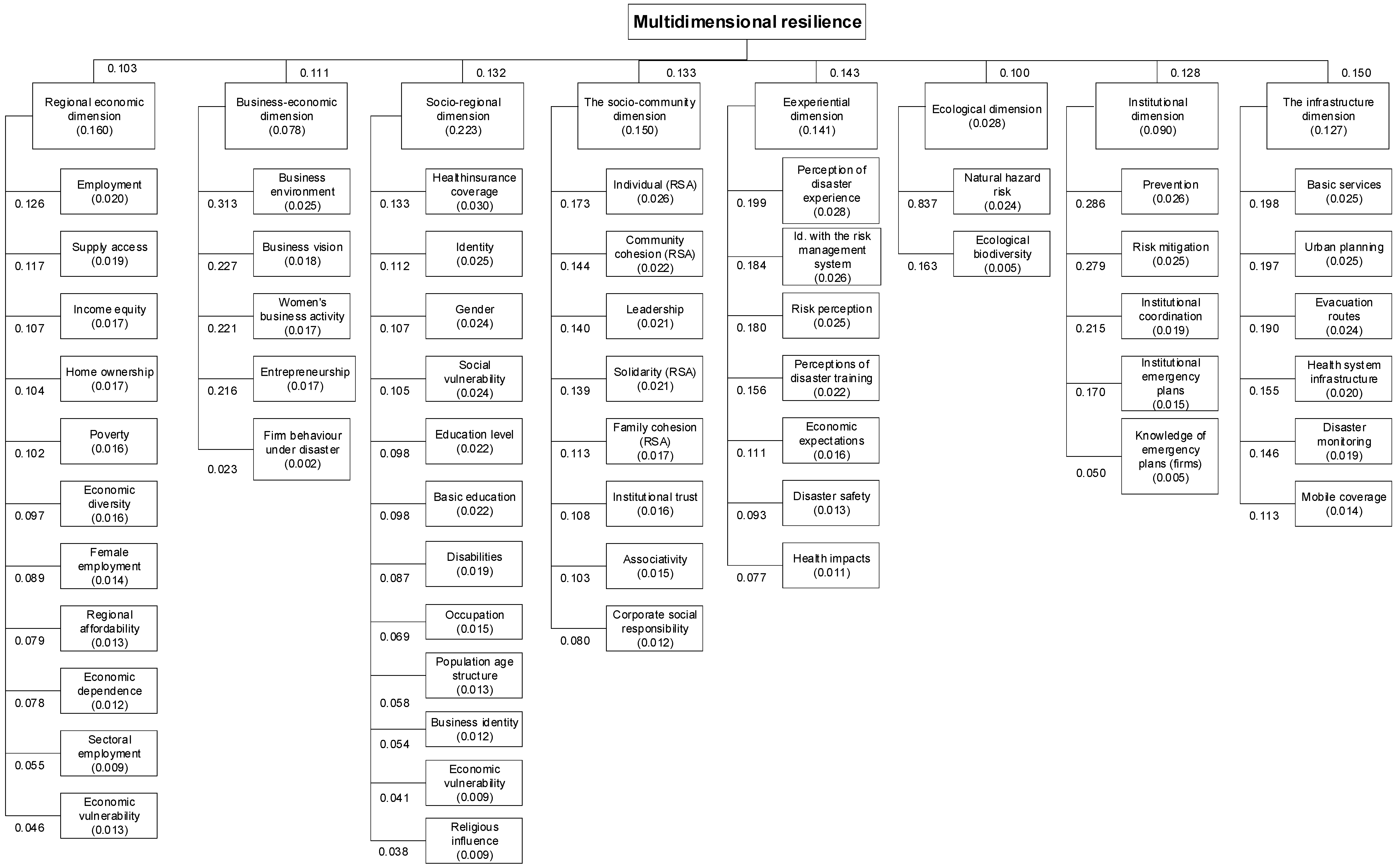
- The most relevant dimensions. The Experiential Dimension makes the largest contribution to resilience, followed by the economic–business and socio-community dimensions.
- Critical adaptability factors. Fifteen very high-impact factors were identified (adjusted score > 0.0170), predominantly endogenous in nature—associated with individual conditions and community action—including actual risk perception, basic education (low illiteracy), individual resilience capacities (RSA), institutional coordination and prevention, the business environment, and female entrepreneurial activity.
- Factors that hinder adaptability. Those of very low relevance include the country’s economic vulnerability, low economic diversity, insufficient health infrastructure, and limited medical coverage.
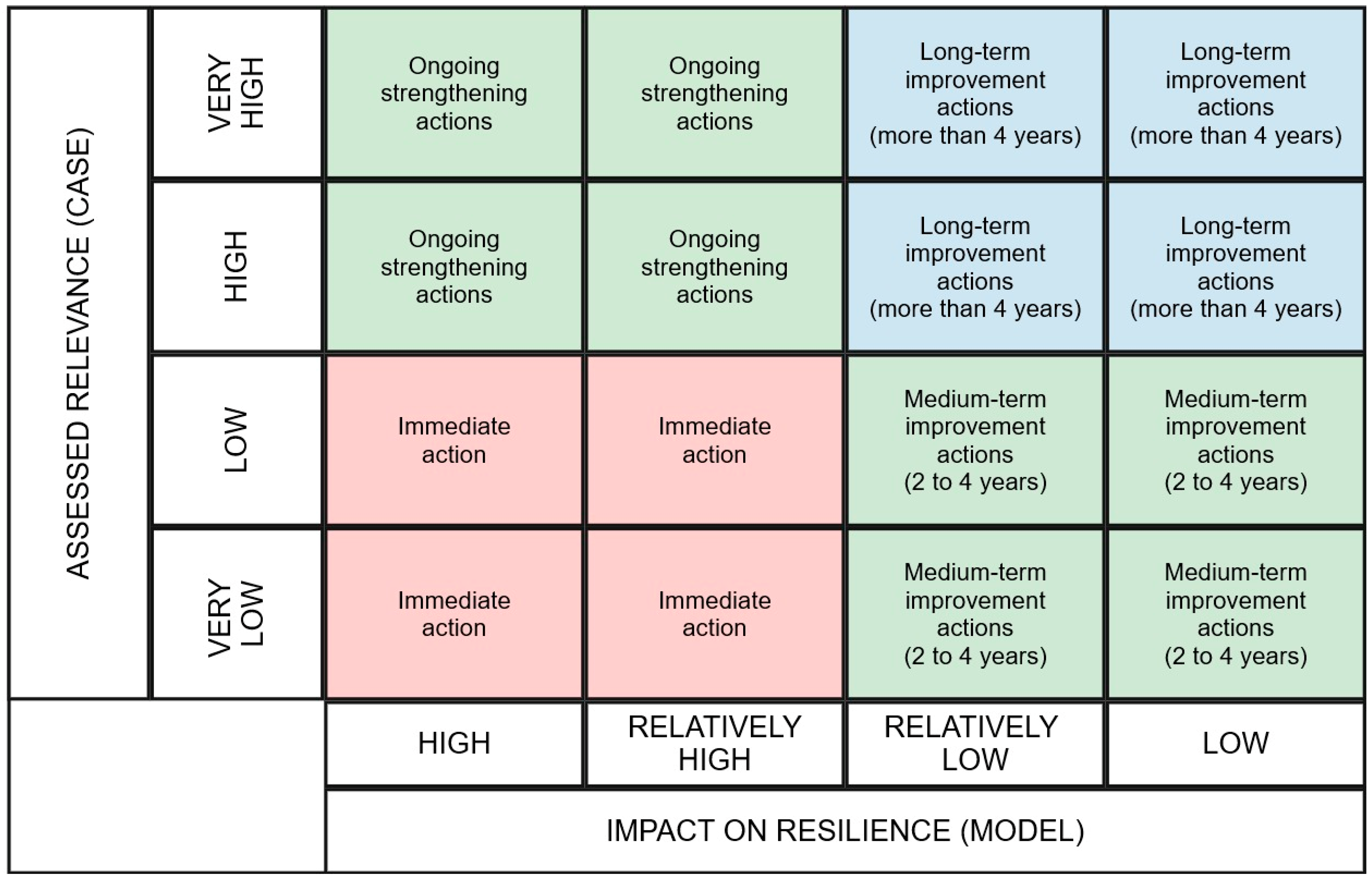
Action Matrix: Adaptive Governance
- Immediate actions. High-impact criteria with low local relevance (critical weaknesses). They require clear policies on medical coverage, urban planning, lifelines and safe evacuation, health infrastructure, and income equity.
- Ongoing strengthening. Criteria with high relevance and high/relatively high impact (core strengths): disaster risk perception and experience, institutional coordination, prevention, the business environment, and community cohesion.
- Medium-term improvement (2–4 years). Weaknesses with relatively low/low impact that may become critical if neglected: economic diversification, institutional trust, and associativity.
- Long-term improvement (>4 years). Strengths with low impact on overall resilience that should nonetheless be preserved: high levels of entrepreneurship, low poverty, low economic dependency, and a young population.
- High importance + high governability: these comprise the priority agenda; the municipality can intervene directly (e.g., risk management, institutional capacities).
- High importance + low governability: these require intergovernmental coordination (ministries, provincial GADs, national entities), as they concern critical areas outside municipal jurisdiction (e.g., major infrastructure, large-scale territorial planning).
- Low importance + high governability: these enable gradual improvements through incremental interventions.
- Low importance + low governability: these are incorporated into a monitoring agenda to prevent emerging vulnerabilities.
6. Discussion
- Institutional dominance vs. community agency. In multiple contexts, governance shapes recovery: in L’Aquila, economic convergence was lacking after the earthquake (Urbani et al., 2025); in Indonesia, regulation led the IWN (Lestari et al., 2023); and in Mandalika, centralization reduced the community’s role (Putera et al., 2025). In Baños, self-organization and local agency—the return after evacuation—drove a bottom-up recovery, with entrepreneurial dynamism (e.g., female entrepreneurship) prevailing over the institutional response (G. Herrera-Enríquez & Rodríguez-Rodríguez, 2017; Lane et al., 2003).
- Economic recovery and infrastructure. In Kaikōura, damage to critical infrastructure directly affected tourism (Estevão & Costa, 2020; Fountain & Cradock-Henry, 2020); in Lombok, the reactivation of MSMEs was associated with planned resilience and connectivity (Nguyen et al., 2022). In Baños, the economic–business dimension ranks second due to adaptive specialization and innovation (a shift towards adventure/ecotourism), rather than infrastructure or external financing (G. Herrera-Enríquez & Rodríguez-Rodríguez, 2016).
- Dark tourism and culture. Some destinations capitalize on disaster—such as tsunami museums and sites in Aceh—generating economic and social capital (Liu-Lastres et al., 2020; Pu & Chang-Richards, 2024). In Baños, the promotion of the erupting volcano strengthened the Experiential Dimension and dark tourism (Liu-Lastres et al., 2020). In Baños, the promotion of the erupting volcano strengthened the Experiential Dimension and dark tourism (Liu-Lastres et al., 2020). However, positioning disaster risk as an attraction entails ethical and long-term sustainability concerns (e.g., commodification of suffering, community acceptance, and reputational risks). We therefore frame dark tourism as a conditional strategy that requires community-led governance, visitor management, and safeguards aligned with sustainable destination development.
- (a)
- Chronic risk and perception. This bottom-up component is empirically captured through local household measures such as perceived disaster training and risk perception (4-point Likert-based indicators, normalized as reported in Supplementary File S1). Under prolonged volcanic risk, realistic risk perception and territorial identity are decisive; the hierarchy validates milieu and historical memory as supports for destination reconfiguration (Lane et al., 2003; Guo et al., 2018b; Lundin & Soulard, 2025; G. Herrera-Enríquez & Rodríguez-Rodríguez, 2016).
- (b)
- Product transformation. The shift from religious/thermal tourism towards adventure/ecotourism linked experience and the economy: the experiential offer drove business recovery.
- (c)
- Agency and local leadership. The greater weight assigned to the Experiential Dimension reflects learning, self-organization, and community adaptability (Gocer et al., 2024; G. Herrera-Enríquez & Rodríguez-Rodríguez, 2017).
7. Conclusions
8. Future Research Directions
Supplementary Materials
Author Contributions
Funding
Institutional Review Board Statement
Informed Consent Statement
Data Availability Statement
Conflicts of Interest
References
- Ainuddin, S., & Routray, J. K. (2012). Community resilience framework for an earthquake prone area in Baluchistan. International Journal of Disaster Risk Reduction, 2, 25–36. [Google Scholar] [CrossRef]
- Al-Manji, S., Lovett, J., & Mitchell, G. (2021). Factors affecting disaster resilience in Oman: Integrating stakeholder analysis and fuzzy cognitive mapping. Risk, Hazards & Crisis in Public Policy, 12(1), 29–50. [Google Scholar] [CrossRef]
- Altuntas Vural, C., Balci, G., Surucu Balci, E., & Gocer, A. (2025). Looking inside the panarchy: Reorganisation capabilities for food supply chain resilience against geopolitical crises. Supply Chain Management: An International Journal, 30(7), 1–19. [Google Scholar] [CrossRef]
- Asadzadeh, A., Kötter, T., Salehi, P., & Birkmann, J. (2017). Operationalizing a concept: The systematic review of composite indicator building for measuring community disaster resilience. International Journal of Disaster Risk Reduction, 25, 147–162. [Google Scholar] [CrossRef]
- Ayala, J.-C., & Manzano, G. (2014). The resilience of the entrepreneur. Influence on the success of the business. A longitudinal analysis. Journal of Economic Psychology, 42, 126–135. [Google Scholar] [CrossRef]
- Badoc-Gonzales, B. P., Mandigma, M. B. S., & Tan, J. J. (2022). SME resilience as a catalyst for tourism destinations: A literature review. Journal of Global Entrepreneurship Research, 12(1), 23–44. [Google Scholar] [CrossRef]
- Barbhuiya, M. R., & Chatterjee, D. (2020). Vulnerability and resilience of the tourism sector in India: Effects of natural disasters and internal conflict. Tourism Management Perspectives, 33, 100616. [Google Scholar] [CrossRef]
- Berkes, F., & Ross, H. (2016). Panarchy and community resilience: Sustainability science and policy implications. Environmental Science & Policy, 61, 185–193. [Google Scholar] [CrossRef]
- Bhati, A., Upadhayaya, A., & Sharma, A. (2016). National disaster management in the ASEAN-5: An analysis of tourism resilience. Tourism Review, 71(2), 148–164. [Google Scholar] [CrossRef]
- Boschma, R., & Gianelle, C. (2014). Regional branching and smart specialisation policy. S3 policy brief series No. 06/2014. Publications Office of the European Union. [Google Scholar]
- Briguglio, L., Cordina, G., Farrugia, N., & Vella, S. (2009). Economic vulnerability and resilience: Concepts and measurements. Oxford Development Studies, 37(3), 229–247. [Google Scholar] [CrossRef]
- Bruyelle, J. L., O’Neill, C., El Koursi, E. M., Hamelin, F., Sartori, N., & Khoudour, L. (2014). Improving the resilience of metro vehicle and passengers for an effective emergency response to terrorist attacks. Safety Science, 62, 37–45. [Google Scholar] [CrossRef]
- Büyüközkan, G., Ertay, T., Kahraman, C., & Ruan, D. (2004). Determining the importance weights for the design requirements in the house of quality using the fuzzy analytic network approach. International Journal of Intelligent Systems, 19(5), 443–461. [Google Scholar] [CrossRef]
- Carpenter, S., Arrow, K., Barrett, S., Biggs, R., Brock, W., Crépin, A.-S., Engström, G., Folke, C., Hughes, T., Kautsky, N., Li, C.-Z., McCarney, G., Meng, K., Mäler, K.-G., Polasky, S., Scheffer, M., Shogren, J., Sterner, T., Vincent, J., … Zeeuw, A. (2012). General resilience to cope with extreme events. Sustainability, 4(12), 3248–3259. [Google Scholar] [CrossRef]
- Chang, D.-Y. (1996). Applications of the extent analysis method on fuzzy AHP. European Journal of Operational Research, 95(3), 649–655. [Google Scholar] [CrossRef]
- Chang, K.-F., & Yang, H.-W. (2011). A study of cosmetic bundle by utilizing a fuzzy Analytic Hierarchy Process (AHP) to determine preference of product attributers toward customer value. African Journal of Business Management, 5(22), 8728–8739. [Google Scholar] [CrossRef]
- Cheng, L., & Zhang, J. (2020). Is tourism development a catalyst of economic recovery following natural disaster? An analysis of economic resilience and spatial variability. Current Issues in Tourism, 23(20), 2602–2623. [Google Scholar] [CrossRef]
- Chouhan, S., Thieken, A. H., Bubeck, P., & Mukherjee, M. (2023). Role of tourism on disaster recovery: A case study of Uttarakhand, India. International Journal of Disaster Risk Reduction, 95, 103878. [Google Scholar] [CrossRef]
- Chowdhury, M., Prayag, G., Orchiston, C., & Spector, S. (2019). Postdisaster social capital, adaptive resilience and business performance of tourism organizations in Christchurch, New Zealand. Journal of Travel Research, 58(7), 1209–1226. [Google Scholar] [CrossRef]
- Cowell, M. M. (2013). Bounce back or move on: Regional resilience and economic development planning. Cities, 30, 212–222. [Google Scholar] [CrossRef]
- Cutter, S. L. (2024). The origin and diffusion of the social vulnerability index (SoVI). International Journal of Disaster Risk Reduction, 109, 104576. [Google Scholar] [CrossRef]
- Cutter, S. L., Barnes, L., Berry, M., Burton, C., Evans, E., Tate, E., & Webb, J. (2008). A place-based model for understanding community resilience to natural disasters. Global Environmental Change, 18(4), 598–606. [Google Scholar] [CrossRef]
- Cutter, S. L., Burton, C. G., & Emrich, C. T. (2010). Disaster resilience indicators for benchmarking baseline conditions. Journal of Homeland Security and Emergency Management, 7(1). [Google Scholar] [CrossRef]
- Das, T., Talukdar, S., Shahfahad, Naikoo, M. W., Ahmed, I. A., Rahman, A., Islam, M. K., & Alam, E. (2024). Integration of fuzzy AHP and explainable AI for effective coastal risk management: A micro-scale risk analysis of tropical cyclones. Progress in Disaster Science, 23, 100357. [Google Scholar] [CrossRef]
- D’Ercole, R., & Trujillo, M. (2003). Amenazas, vulnerabilidad, capacidades y riesgo en el Ecuador: Los desastres, un reto para el desarrollo. Available online: https://bibliotecadigital.puce.edu.ec/library/publication/amenazas-vulnerabilidad-capacidades-y-riesgo-en-el-ecuador-los-desastres-un-reto-para-el-desarrollo-1744306204 (accessed on 1 February 2026).
- Estevão, C., & Costa, C. (2020). Natural disaster management in tourist destinations: A systematic literature review. European Journal of Tourism Research, 25, 2502. [Google Scholar] [CrossRef]
- Few, R., Armijos, M. T., & Barclay, J. (2017). Living with Volcan Tungurahua: The dynamics of vulnerability during prolonged volcanic activity. Geoforum, 80, 72–81. [Google Scholar] [CrossRef]
- Fountain, J., & Cradock-Henry, N. A. (2020). Recovery, risk and resilience: Post-disaster tourism experiences in Kaikōura, New Zealand. Tourism Management Perspectives, 35, 100695. [Google Scholar] [CrossRef]
- Friborg, O., Barlaug, D., Martinussen, M., Rosenvinge, J. H., & Hjemdal, O. (2005). Resilience in relation to personality and intelligence. International Journal of Methods in Psychiatric Research, 14(1), 29–42. [Google Scholar] [CrossRef]
- Gocer, O., Boyacioglu, D., Karahan, E. E., & Shrestha, P. (2024). Cultural tourism and rural community resilience: A framework and its application. Journal of Rural Studies, 107, 103238. [Google Scholar] [CrossRef]
- Gu, T., Chang, W., Li, Y., & Wang, Y. (2025). Exploring factors influencing the resilience of flood disaster response networks for old communities in China through an enhanced DNA-ISM framework. Urban Climate, 60, 102336. [Google Scholar] [CrossRef]
- Guo, Y., Zhang, J., Zhang, Y., & Zheng, C. (2018a). Catalyst or barrier? The influence of place attachment on perceived community resilience in tourism destinations. Sustainability, 10(7), 2347. [Google Scholar] [CrossRef]
- Guo, Y., Zhang, J., Zhang, Y., & Zheng, C. (2018b). Examining the relationship between social capital and community residents’ perceived resilience in tourism destinations. Journal of Sustainable Tourism, 26(6), 973–986. [Google Scholar] [CrossRef]
- Ha-Mim, N. M., Hossain, M. Z., Islam, M. T., & Rahaman, K. R. (2024). Evaluating resilience of coastal communities upon integrating PRISMA protocol, composite resilience index and analytical hierarchy process. International Journal of Disaster Risk Reduction, 101, 104256. [Google Scholar] [CrossRef]
- Han, G., & Yang, E. (2025). How do multidimensional tourism factors affect community resilience? Applied Geography, 178, 103597. [Google Scholar] [CrossRef]
- Herrera-Enríquez, G., Guevara Viejó, F., Castillo Paez, S., & Zambrano Vera, D. (2016). Proceso analítico jerárquico difuso en la selección de variables para la evaluación de la resiliencia en zonas afectadas por desastres. Ingeniería Industrial. Actualidad y Nuevas Tendencias, 16, 45–66. [Google Scholar]
- Herrera-Enríquez, G., & Rodríguez-Rodríguez, G. (2016). Resiliencia y turismo: El caso de la ciudad de Baños de Agua Santa-Ecuador. HOLOS, 3, 229–250. [Google Scholar] [CrossRef]
- Herrera-Enríquez, G., & Rodríguez-Rodríguez, G. (2017). Turismo y sistemas empresariales resilientes: Factores críticos de adaptabilidad en Baños de Agua Santa–Ecuador. Revista de Gestão e Secretariado, 8(1), 1–25. [Google Scholar] [CrossRef]
- Herrera-Enríquez, G. P., & Castillo-Montesdeoca, E. A. (2025). Proceso de análisis jerárquico: La ciencia detrás de las decisiones estratégicas. Editorial Grupo AEA. [Google Scholar] [CrossRef]
- Hu, H., & Xu, K. (2022). Visualizing the development of research on tourism resilience with mixed methods. Sage Open, 12(3), 21582440221126684. [Google Scholar] [CrossRef]
- Ifejika Speranza, C., Wiesmann, U., & Rist, S. (2014). An indicator framework for assessing livelihood resilience in the context of social–ecological dynamics. Global Environmental Change, 28, 109–119. [Google Scholar] [CrossRef]
- Khan, A., Shah, A. A., Alotaibi, B. A., & Khan, I. (2024). Prioritizing resource and policy barriers to post-disaster recovery in Pakistan: A multi-expert fermatean fuzzy AHP analysis. Sustainability, 16(23), 10414. [Google Scholar] [CrossRef]
- Kusumastuti, R. D., Viverita, Husodo, Z. A., Suardi, L., & Danarsari, D. N. (2014). Developing a resilience index towards natural disasters in Indonesia. International Journal of Disaster Risk Reduction, 10, 327–340. [Google Scholar] [CrossRef]
- Lane, L. R., Tobin, G. A., & Whiteford, L. M. (2003). Volcanic hazard or economic destitution: Hard choices in Banños, Ecuador. Environmental Hazards, 5(1), 23–34. [Google Scholar] [CrossRef]
- Lee, S., & Pennington-Gray, L. (2025). Measuring resilience of the tourism sector: Reflective Resilience Index (REFLEX) approach. Annals of Tourism Research, 114, 103983. [Google Scholar] [CrossRef]
- Lestari, Y. D., Sukmana, R., Beik, I. S., & Sholihin, M. (2023). The development of national waqf index in Indonesia: A fuzzy AHP approach. Heliyon, 9(5), e15783. [Google Scholar] [CrossRef]
- Lin, Y., Kelemen, M., & Kiyomiya, T. (2021). Bridging community resilience and sustainable tourism development via post-disaster education tourism in rural Japan. The Journal of Organization and Discourse, 2(1), 32–44. [Google Scholar] [CrossRef]
- Liu, C.-F., & Mostafavi, A. (2025). Network dynamics of community resilience and recovery: New frontier in disaster research. International Journal of Disaster Risk Reduction, 123, 105489. [Google Scholar] [CrossRef]
- Liu, L.-W., Pahrudin, P., Tsai, C.-Y., & Hao, L. (2024). Disaster, risk and crises in tourism and hospitality field: A pathway toward tourism and hospitality management framework for resilience and recovery process. Natural Hazards Research, 4(4), 653–668. [Google Scholar] [CrossRef]
- Liu-Lastres, B., Mariska, D., Tan, X., & Ying, T. (2020). Can post-disaster tourism development improve destination livelihoods? A case study of Aceh, Indonesia. Journal of Destination Marketing & Management, 18, 100510. [Google Scholar] [CrossRef]
- Lundin, E., & Soulard, J. (2025). Residents’ engagements in post-disaster tourism: Creating composite accounts out of social practices. Annals of Tourism Research, 110, 103894. [Google Scholar] [CrossRef]
- Lupiano, V., Chidichimo, F., Machado, G., Catelan, P., Molina, L., Calidonna, C. R., Straface, S., Crisci, G. M., & Di Gregorio, S. (2020). From examination of natural events to a proposal for risk mitigation of lahars by a cellular-automata methodology: A case study for Vascún valley, Ecuador. Natural Hazards and Earth System Sciences, 20(1), 1–20. [Google Scholar] [CrossRef]
- Lv, W., Fan, W., & Wang, Z. (2024). How to enhance the resilience of domestic tourism? Journal of Hospitality and Tourism Management, 61, 165–177. [Google Scholar] [CrossRef]
- Ma, W., Lin, S., Ci, Y., & Li, R. (2024). Resilience evaluation and improvement of post-disaster multimodal transportation networks. Transportation Research Part A: Policy and Practice, 189, 104243. [Google Scholar] [CrossRef]
- Martin, R., & Sunley, P. (2015). On the notion of regional economic resilience: Conceptualization and explanation. Journal of Economic Geography, 15(1), 1–42. [Google Scholar] [CrossRef]
- Maurischa, S. D., Fahmi, F. Z., & Suroso, D. S. A. (2023). Transformative resilience: Transformation, resilience and capacity of coastal communities in facing disasters in two Indonesian villages. International Journal of Disaster Risk Reduction, 88, 103615. [Google Scholar] [CrossRef]
- Mushtaha, A. W., Alaloul, W. S., Baarimah, A. O., Musarat, M. A., Alzubi, K. M., & Khan, A. M. (2025). A decision-making framework for prioritizing reconstruction projects in post-disaster recovery. Results in Engineering, 25, 103693. [Google Scholar] [CrossRef]
- Nguyen, V. K., Pyke, J., Gamage, A., De Lacy, T., & Lindsay-Smith, G. (2022). Factors influencing business recovery from compound disasters: Evidence from Australian micro and small tourism businesses. Journal of Hospitality and Tourism Management, 53, 1–9. [Google Scholar] [CrossRef]
- Norris, F. H., Stevens, S. P., Pfefferbaum, B., Wyche, K. F., & Pfefferbaum, R. L. (2008). Community resilience as a metaphor, theory, set of capacities, and strategy for disaster readiness. American Journal of Community Psychology, 41(1–2), 127–150. [Google Scholar] [CrossRef]
- Oliva, S., & Lazzeretti, L. (2018). Measuring the economic resilience of natural disasters: An analysis of major earthquakes in Japan. City, Culture and Society, 15, 53–59. [Google Scholar] [CrossRef]
- Östh, J., Reggiani, A., & Galiazzo, G. (2015). Spatial economic resilience and accessibility: A joint perspective. Computers. Environment and Urban Systems, 49, 148–159. [Google Scholar] [CrossRef]
- Parsons, M., Glavac, S., Hastings, P., Marshall, G., McGregor, J., McNeill, J., Morley, P., Reeve, I., & Stayner, R. (2016). Top-down assessment of disaster resilience: A conceptual framework using coping and adaptive capacities. International Journal of Disaster Risk Reduction, 19, 1–11. [Google Scholar] [CrossRef]
- Praptika, I. P. G. E., Yusuf, M., & Heslinga, J. H. (2024). How can communities better prepare for future disasters? Learning from the tourism community resilience model from Bali, Indonesia. Journal of Tourism Futures, 10(3), 504–523. [Google Scholar] [CrossRef]
- Pu, G., & Chang-Richards, A. Y. (2024). Identifying critical factors affecting the livelihood recovery following disasters: A comparative analysis of China and New Zealand. International Journal of Disaster Risk Reduction, 114, 104958. [Google Scholar] [CrossRef]
- Putera, R. E., Fathani, A. T., Lenggogeni, S., & Asrinaldi. (2025). Tourism disaster management dilemmas: Insights from Mandalika, Indonesia. Social Sciences & Humanities Open, 11, 101400. [Google Scholar] [CrossRef]
- Rajesh, S., Jain, S., & Sharma, P. (2018). Inherent vulnerability assessment of rural households based on socio-economic indicators using categorical principal component analysis: A case study of Kimsar region, Uttarakhand. Ecological Indicators, 85, 93–104. [Google Scholar] [CrossRef]
- Ribeiro, M. A., Adam, I., Kimbu, A. N., Dayour, F., Adeola, O., & Tichaawa, T. M. (2025). Resilience in uncertainty: The impact of coping strategies on tourism entrepreneurs’ subjective well-being in sub-Saharan Africa. Tourism Management, 110, 105169. [Google Scholar] [CrossRef]
- Rindrasih, E. (2018). Under the volcano: Responses of a community-based tourism village to the 2010 eruption of mount Merapi, Indonesia. Sustainability, 10(5), 1620. [Google Scholar] [CrossRef]
- Rose, A., & Krausmann, E. (2013). An economic framework for the development of a resilience index for business recovery. International Journal of Disaster Risk Reduction, 5, 73–83. [Google Scholar] [CrossRef]
- Ruslanjari, D., Putri, R. A. P., Puspitasari, D., Djatmiko, R. H., Tanaka, R., Alvionita Hasan, H., Nabil, T., & Fajarian, N. A. (2025). From vulnerability to resilience: Examining the Sister Village program’s approach to volcanic disaster risk reduction using the DROP model. Progress in Disaster Science, 26, 100439. [Google Scholar] [CrossRef]
- Sabatino, M. (2016). Economic crisis and resilience: Resilient capacity and competitiveness of the enterprises. Journal of Business Research, 69(5), 1924–1927. [Google Scholar] [CrossRef]
- Sherrieb, K., Norris, F. H., & Galea, S. (2010). Measuring capacities for community resilience. Social Indicators Research, 99(2), 227–247. [Google Scholar] [CrossRef]
- Su, H., Zhao, X., Wang, L., & Li, Y. (2024). How rural community resilience evolves after a disaster? A case study of the eastern Qinghai-Tibetan Plateau, China. Applied Geography, 165, 103238. [Google Scholar] [CrossRef]
- Urbani, R., Colantoni, F., Persio, R., & Stanková, V. (2025). Adaptive recovery and regional response: The impact of an earthquake on tourism industry dynamics. Papers in Regional Science, 104(3), 100100. [Google Scholar] [CrossRef]
- Yadav, D. K., & Barve, A. (2017). Analysis of socioeconomic vulnerability for cyclone-affected communities in coastal Odisha, India. International Journal of Disaster Risk Reduction, 22, 387–396. [Google Scholar] [CrossRef]
- Zhang, H., Tian, L., Long, S., Li, R., & Wu, Y. J. (2023). Tourist rescue in natural disasters. Sage Open, 13(4), 21582440231215149. [Google Scholar] [CrossRef]
- Zhao, L., Xu, G., Cui, Y., Kong, F., Gao, H., & Zhou, X. (2023). Post-disaster restoration and reconstruction assessment of the Jiuzhaigou lake landscape and a resilience development pathway. International Journal of Environmental Research and Public Health, 20(5), 3957. [Google Scholar] [CrossRef]
- Zhu, K.-J., Jing, Y., & Chang, D.-Y. (1999). A discussion on Extent Analysis Method and applications of fuzzy AHP. European Journal of Operational Research, 116(2), 450–456. [Google Scholar] [CrossRef]



| Linguistic Scale for Importance | Triangular Fuzzy Scale | Triangular Fuzzy Reciprocal Scale |
|---|---|---|
| IM | 1/2, 1, 3/2 | 2/3, 1, 2 |
| MI | 1, 3/2, 2 | 1/2, 2/3, 1 |
| FI | 3/2, 2, 5/2 | 2/5, 1/2, 2/3 |
| MFI | 2, 5/2, 3 | 1/3, 2/5, 1/2 |
| IE | 5/2, 3, 7/2 | 2/7, 1/3, 2/5 |
| Ecological | Economic–Business | Economic–Regional | Experiential | Infrastructure | Institutional | Socio-Community | Socio-Regional | |||||||||||||||||
|---|---|---|---|---|---|---|---|---|---|---|---|---|---|---|---|---|---|---|---|---|---|---|---|---|
| Ecological | 0.50 | 1.00 | 1.50 | 0.69 | 0.97 | 1.29 | 0.66 | 0.98 | 1.50 | 0.54 | 0.76 | 1.02 | 0.47 | 0.62 | 0.92 | 0.50 | 0.63 | 0.82 | 0.55 | 0.80 | 1.15 | 0.53 | 0.70 | 0.98 |
| Economic–Business | 0.78 | 1.03 | 1.44 | 0.50 | 1.00 | 1.50 | 0.61 | 0.85 | 1.32 | 0.51 | 0.80 | 1.25 | 0.41 | 0.51 | 0.70 | 0.56 | 0.82 | 1.22 | 0.54 | 0.80 | 1.32 | 0.63 | 0.83 | 1.11 |
| Economic–Regional | 0.67 | 1.02 | 1.52 | 0.76 | 1.18 | 1.64 | 0.50 | 1.00 | 1.50 | 0.42 | 0.58 | 0.80 | 0.44 | 0.56 | 0.78 | 0.63 | 0.82 | 1.08 | 0.59 | 0.76 | 0.98 | 0.56 | 0.75 | 1.00 |
| Experiential | 0.98 | 1.32 | 1.84 | 0.80 | 1.25 | 1.97 | 1.25 | 1.72 | 2.37 | 0.50 | 1.00 | 1.50 | 0.72 | 1.02 | 1.40 | 1.06 | 1.43 | 1.84 | 0.72 | 1.06 | 1.50 | 0.72 | 1.06 | 1.50 |
| Infrastructure | 1.08 | 1.62 | 2.14 | 1.43 | 1.95 | 2.46 | 1.28 | 1.78 | 2.29 | 0.72 | 0.98 | 1.38 | 0.50 | 1.00 | 1.50 | 0.77 | 1.08 | 1.68 | 0.68 | 1.00 | 1.38 | 0.58 | 0.87 | 1.32 |
| Institutional | 1.22 | 1.58 | 1.99 | 0.82 | 1.22 | 1.80 | 0.92 | 1.22 | 1.60 | 0.54 | 0.70 | 0.94 | 0.60 | 0.92 | 1.30 | 0.50 | 1.00 | 1.50 | 0.67 | 0.94 | 1.40 | 0.71 | 1.02 | 1.61 |
| Socio-Community | 0.87 | 1.25 | 1.82 | 0.76 | 1.25 | 1.86 | 1.02 | 1.32 | 1.71 | 0.67 | 0.94 | 1.40 | 0.72 | 1.00 | 1.46 | 0.72 | 1.06 | 1.50 | 0.50 | 1.00 | 1.50 | 0.61 | 1.00 | 1.55 |
| Socio-Regional | 1.02 | 1.43 | 1.90 | 0.90 | 1.20 | 1.58 | 1.00 | 1.33 | 1.78 | 0.67 | 0.94 | 1.40 | 0.76 | 0.98 | 1.72 | 0.62 | 0.98 | 1.41 | 0.64 | 1.00 | 1.64 | 0.50 | 1.00 | 1.50 |
| Ecological | Economic–Business | Economic–Regional | Experiential | Infrastructure | Institutional | Socio-Community | Socio-Regional | Sum | Priority Vector | |
|---|---|---|---|---|---|---|---|---|---|---|
| Ecological | 1.000 | 0.975 | 1.010 | 0.766 | 0.642 | 0.641 | 0.818 | 0.716 | 6.569 | 0.097 |
| Economic–Business | 1.059 | 1.000 | 0.888 | 0.827 | 0.526 | 0.843 | 0.844 | 0.845 | 6.834 | 0.101 |
| Economic–Regional | 1.047 | 1.184 | 1.000 | 0.592 | 0.578 | 0.833 | 0.766 | 0.761 | 6.760 | 0.100 |
| Experiential | 1.349 | 1.293 | 1.749 | 1.000 | 1.036 | 1.437 | 1.075 | 1.075 | 10.014 | 0.149 |
| Infrastructure | 1.619 | 1.948 | 1.782 | 1.000 | 1.000 | 1.131 | 1.011 | 0.897 | 10.388 | 0.154 |
| Institutional | 1.592 | 1.248 | 1.232 | 0.714 | 0.931 | 1.000 | 0.974 | 1.068 | 8.757 | 0.130 |
| Socio-Community | 1.279 | 1.267 | 1.335 | 0.974 | 1.031 | 1.075 | 1.000 | 1.027 | 8.988 | 0.133 |
| Socio-Regional | 1.442 | 1.215 | 1.351 | 0.974 | 1.064 | 0.990 | 1.048 | 1.000 | 9.084 | 0.135 |
| 10.387 | 10.131 | 10.347 | 6.847 | 6.809 | 7.950 | 7.535 | 7.389 | 67.394 |
| Dimension | l | m | n |
|---|---|---|---|
| D1 | 0.05 | 0.10 | 0.20 |
| D2 | 0.05 | 0.10 | 0.22 |
| D3 | 0.05 | 0.10 | 0.21 |
| D4 | 0.07 | 0.15 | 0.31 |
| D5 | 0.08 | 0.16 | 0.32 |
| D6 | 0.06 | 0.13 | 0.26 |
| D7 | 0.06 | 0.13 | 0.28 |
| D8 | 0.07 | 0.13 | 0.28 |
| Dimension k | n | Structural Adjustment of Priorities | ||
|---|---|---|---|---|
| Ecological | 2 | 0.1000 | 0.0036 | 0.0283 |
| Economic–Business | 5 | 0.1110 | 0.0099 | 0.0784 |
| Economic–Regional | 11 | 0.1030 | 0.0202 | 0.1601 |
| Experiential | 7 | 0.1430 | 0.0179 | 0.1414 |
| Infrastructure | 6 | 0.1500 | 0.0161 | 0.1272 |
| Institutional | 5 | 0.1280 | 0.0114 | 0.0904 |
| Socio-Community | 12 | 0.1320 | 0.0283 | 0.2238 |
| Socio-Regional | 8 | 0.1330 | 0.0190 | 0.1503 |
| Total sum: | N = 56 | 1.0000 | 0.1264 | 1.0000 |
| Statistics | ||
|---|---|---|
| N | Valid | 56 |
| Missing | 0 | |
| Mean | 0.017857 | |
| Percentiles | 25th | 0.013250 |
| 50th | 0.017500 | |
| 75th | 0.024000 | |
Disclaimer/Publisher’s Note: The statements, opinions and data contained in all publications are solely those of the individual author(s) and contributor(s) and not of MDPI and/or the editor(s). MDPI and/or the editor(s) disclaim responsibility for any injury to people or property resulting from any ideas, methods, instructions or products referred to in the content. |
© 2026 by the authors. Licensee MDPI, Basel, Switzerland. This article is an open access article distributed under the terms and conditions of the Creative Commons Attribution (CC BY) license.
Share and Cite
Herrera-Enríquez, G.; Castillo-Montesdeoca, E.; Simbaña-Taipe, L.; Martínez-Navalón, J.G. Critical Resilience Factors for Post-Disaster Tourism Recovery: Evidence from Baños de Agua Santa via Fuzzy Multi Criteria Analysis. Tour. Hosp. 2026, 7, 84. https://doi.org/10.3390/tourhosp7030084
Herrera-Enríquez G, Castillo-Montesdeoca E, Simbaña-Taipe L, Martínez-Navalón JG. Critical Resilience Factors for Post-Disaster Tourism Recovery: Evidence from Baños de Agua Santa via Fuzzy Multi Criteria Analysis. Tourism and Hospitality. 2026; 7(3):84. https://doi.org/10.3390/tourhosp7030084
Chicago/Turabian StyleHerrera-Enríquez, Giovanni, Eddy Castillo-Montesdeoca, Luis Simbaña-Taipe, and Juan Gabriel Martínez-Navalón. 2026. "Critical Resilience Factors for Post-Disaster Tourism Recovery: Evidence from Baños de Agua Santa via Fuzzy Multi Criteria Analysis" Tourism and Hospitality 7, no. 3: 84. https://doi.org/10.3390/tourhosp7030084
APA StyleHerrera-Enríquez, G., Castillo-Montesdeoca, E., Simbaña-Taipe, L., & Martínez-Navalón, J. G. (2026). Critical Resilience Factors for Post-Disaster Tourism Recovery: Evidence from Baños de Agua Santa via Fuzzy Multi Criteria Analysis. Tourism and Hospitality, 7(3), 84. https://doi.org/10.3390/tourhosp7030084