


Abstract
This study examines why consumers intend to visit restaurants recommended by food influencers on social media. Grounded in the Theory of Planned Behavior (TPB) and social influence mechanisms, we test an extended TPB model in which trust in the influencer is incorporated as an additional antecedent of intention and as a mediating mechanism linking influencer–follower identification to visit intention. To obtain information, a structured questionnaire was administered to a sample of 474 Ecuadorian social media users who follow at least one gastronomic influencer. Hypotheses were assessed using partial least squares structural equation modeling (PLS-SEM) and predictive assessment (PLSpredict). The results show that attitude toward recommendations and perceived control exert a significant effect on intention, while subjective norms have a more moderate influence. Trust is projected as an additional facilitator in the transition from evaluation to intention, indicating that parasocial affinity translates into intended behavior only when it is accompanied by perceived credibility. The study contributes to TPB and influencer marketing by clarifying how influencer-mediated digital recommendation contexts reshape the classic TPB mechanism and by specifying trust as the key bridge between identification and behavioral intention in a high-uncertainty gastronomic decision.
1. Introduction
In recent decades, the internet and social media have radically transformed the way consumers discover and choose products and services (Dzreke & Dzreke, 2025; Hadining et al., 2020). Influencers have emerged in this digital ecosystem. They are content creators capable of mobilizing audiences by building trust, credibility, and closeness with their followers (Lou & Yuan, 2019). This is why brands have turned to employing social media influencers to develop their communication strategies (Leung et al., 2022).
Influencer marketing—also known as influencer marketing—has proven to be an effective strategy for connecting businesses and brands with specific audiences, especially when the recommendation is perceived as authentic and credible (Cueva-Estrada et al., 2020; Rosário et al., 2023). This effectiveness is partly due to the fact that, unlike traditional advertising, an influencer’s recommendation can be interpreted as a personal opinion rather than a commercial message, which enhances its impact on the consumer, since it is not perceived as a direct sale. Thus, in recent years, various investigations have been conducted on the effectiveness of influencer marketing in various business fields (Cascio Rizzo et al., 2024; Janssen et al., 2022; Lee & Theokary, 2021; Li et al., 2024; Valsesia et al., 2020; Vrontis et al., 2021).
Among the different types of content creators, food influencers have gained a prominent role as key figures in the promotion of restaurants, wine bars, cafes, and other culinary spaces. Through platforms such as Facebook, Instagram, TikTok, and YouTube, influencers generate visually compelling content while building bonds of trust and closeness with their audiences, directly influencing their consumer decisions. In the food sector, this aspect of marketing has a particular connotation due to the emotional, sensory, and social component that accompanies choosing a place to eat.
Influencer marketing has been used in various business sectors. In fashion and beauty, influencers have established themselves as influencers capable of shaping brand perceptions and consumer trends (Casaló et al., 2020; Gonzalez Marin et al., 2024). On the other hand, in the technology and consumer electronics sector, its role has been decisive in reducing the uncertainty associated with the purchase of complex products, conveying confidence through reviews and demonstrations (Arya et al., 2025; Waghmare et al., 2025). In the tourism industry, digital content creators have contributed to the construction of destinations and experiences, acting as mediators between the offer and potential travelers (Susanto, 2024). Even in areas such as health and fitness, digital influence has demonstrated its ability to promote healthy behaviors and lifestyles (De Jans et al., 2021; Willoughby et al., 2024). Despite its consolidation as a transversal strategy in different sectors, influencer marketing still presents a research gap regarding its specific impact in the gastronomic field. In this sense, little research has specifically studied how recommendations from food influencers on social media influence the actual decision to visit a restaurant.
To explain how influencer recommendations translate into restaurant choices, this study adopts the Theory of Planned Behavior (TPB) as its core behavioral framework. TPB is particularly suitable because the decision to visit a restaurant is typically intentional and preceded by evaluative judgments (attitude), social cues (subjective norms), and feasibility perceptions (perceived behavioral control). Although planned behavior theory (TPB) has been extensively applied to experiential services (tourism, leisure, hedonic consumption), little is known about how its mechanisms are reorganized when the service recommendation is mediated by a food influencer and consumed in a context of ephemeral and highly sensory experience, such as a restaurant visit. This gap makes it impossible to know whether TPB operates in the same way as in other services, or whether gastronomy reveals a differential role for trust and parasocial bonds in shaping behavioral intentions.
This creates the need to investigate the factors that influence this decision, considering variables such as trust in the influencer, attitude toward their recommendations, subjective norms, perceived behavioral control, and level of exposure to food content. Thus, the following research question arises: What role do these variables play in the intention to visit a restaurant suggested on social media? In response, this study aims to empirically analyze the relationship between gastronomic influencers and consumer behavior, contributing to a better understanding of the mechanisms that guide this contemporary form of recommendation and consumption. Accordingly, we integrate TPB with social influence theory by incorporating identification with the influencer and modeling trust as a digital-specific mechanism that can directly shape intention and channel identification into intention. In doing so, we test an extended TPB in a gastronomic influencer context rather than merely replicating the original TPB structure.
In this sense, this study offers two sets of contributions. Theoretical contributions: (1) It tests TPB in an influencer-mediated gastronomic decision and compares the relative strength of the classic TPB predictors in this context; and (2) it extends TPB by integrating social influence mechanisms, specifying trust as a key bridge through which identification becomes behavioral intention. Managerial contributions: It provides actionable guidance for restaurants and practitioners on how to design influencer collaborations that increase visit intention by combining credibility-building practices with friction-reducing information that strengthens perceived behavioral control.
2. Literature Review and Hypothesis
Influencer marketing is a strategy based on collaboration between brands or businesses and individuals with a high level of credibility and reach on social media, known as influencers, with the goal of promoting products or services in a more organic and personalized way (Castelló-Martínez & del Pino Romero, 2015). Unlike traditional advertising, which is perceived as direct and with an explicitly commercial intent, influencer marketing relies on building relationships of trust and closeness between the influencer and their audience. In this sense, (Sanz Marcos, 2018) points out that business-influencer collaboration is enhanced when the brand’s target audience shares traits and interests with the influencer’s audience.
According to Freberg et al. (2011), an influencer is a person who has developed a significant degree of credibility in a particular niche and who has the power to influence the purchasing decisions of others due to their authority, knowledge, position, or relationship with their audience. This influence can be massive (macro influencers or celebrities) or in more specific contexts, as is the case with food influencers, who share content related to food, restaurants, recipes, and culinary experiences, generally at a local level (Casquero et al., 2023; Guzmán-Pizarro, 2024; İpekoğlu & Enser, 2024). Along these same lines, (Sanz Marcos, 2018) distinguishes two types of influencer marketing strategies: on the one hand, organic influencer campaigns, where brands collaborate with micro influencers without offering direct financial compensation, but generating mutual benefits; and on the other hand, paid influencer campaigns, where the influencer receives payment to promote products or services on behalf of the company. In this type of marketing, the influencer acts as a digital influencer, whose opinion can be perceived by their followers as authentic and trustworthy, which reduces the perception of risk associated with choosing a product or service (De Veirman et al., 2017). This perception of authenticity is key in consumer decision-making, especially in sectors where the experience is strongly linked to sensory and emotional aspects, such as food consumption (Chen et al., 2020; Choi et al., 2025).
Within the framework of this study, influencer marketing serves as a starting point for understanding how people assimilate and act on food recommendations seen on social media. In this sense, influencers have become an efficient means of achieving greater brand recognition and reach, allowing social media users to identify the wide variety of restaurants in their area and, in turn, the gastronomic diversity they can enjoy, from the smallest businesses—even street food—to the most sophisticated and elegant restaurants (Amaya Henao et al., 2021; Drew et al., 2022; Pereira et al., 2023). Thus, the analysis of this social phenomenon allows us to explore both the communicative power of the influencer and how that power translates into specific consumer behaviors.
2.1. Theory of Planned Behavior
The theory of planned behavior (TPB), proposed by (Ajzen, 1991), is one of the most widely used theories for predicting and understanding intentional human behavior. According to this model, the intention to perform a specific behavior is the best predictor of actual behavior, and this intention is influenced by three main factors: attitude toward the behavior, subjective norm, and perceived behavioral control.
While TPB assumes that intentions emerge from beliefs about outcomes (attitude), perceived social expectations (subjective norms), and feasibility (perceived behavioral control), influencer-mediated recommendations can reshape these belief-formation processes. Attitudes may be formed not only from prior experience but also from the influencer’s content quality, sensory cues, and perceived authenticity, which can operate as informational shortcuts in a high-uncertainty service. In the context of this study, this translates to how favorable a person is about visiting a restaurant following an influencer recommendation. For example, if the influencer’s content generates interest or trust in a person, their attitude is likely to be positive. In this sense, the influencer’s credibility significantly influences the consumer’s attitude toward the recommended restaurant; thus, when the influencer is perceived as credible and authentic, followers are more likely to evaluate the recommended restaurant favorably, resulting in a more positive attitude toward acting on the recommendation (Bash et al., 2024; Syarif et al., 2025). Along these same lines, the quality of the relationship between the influencer and their followers, known as parasocial interaction, also plays an important role. Thus, a strong parasocial interaction can enhance positive attitudes toward the influencer’s recommendations (Patrício et al., 2024).
Perceived behavioral control refers to an individual’s perception of their ability or ease in performing the behavior, which is related to the person’s belief in the efficacy and resources needed to facilitate a behavior (Shin et al., 2018). In the present study, this factor is presented as access to information, available budget, or familiarity with the recommended location (Lien et al., 2010). Thus, perceived behavioral control may be affected by the availability of actionable information embedded in posts (location, prices, reservation links) that reduces friction and increases perceived feasibility.
Finally, the subjective norm involves the perceived social pressure to perform or not perform an action. In the field of social networks, this dimension can be related to the influence of the individual’s digital or social environment (partner, friends, colleagues, family or online community) (Bash et al., 2024; Masur et al., 2021), which can validate or reinforce the influencer’s recommendation (Nurullah Berk et al., 2025; Teerada Cattapan, 2023). In this sense, subjective norms may extend beyond offline referents to include visible platform signals (e.g., comments, shares, and “trending” cues) that communicate what is socially valued.
In the context of food influencers, the TPB predictors reflect how followers evaluate acting on a recommendation (attitude), how they perceive social approval for following influencer-driven trends (subjective norms), and whether they feel able to visit the venue given resources and accessibility constraints (perceived behavioral control). In light of these findings, the following hypotheses are proposed:
H1.
Attitude toward food influencers’ recommendations positively influences the intention to visit restaurants suggested on social media.
H2.
Subjective norms positively influence the intention to visit restaurants suggested on social media.
H3.
Perceived behavioral control positively influences the intention to visit restaurants suggested on social media.
However, these digital-specific mechanisms justify testing TPB while modeling additional constructs that capture source credibility and parasocial influence.
2.2. Trust in the Influencer and Social Influence
Within the TPB framework, most research has focused on the classic predictors—attitude, subjective norms, and perceived behavioral control—as fundamental explanations of behavioral intention. However, there is still a gap in the literature regarding the incorporation of variables that more accurately capture the dynamics of digital environments and social media-mediated interactions. In this context, trust emerges as a particularly promising construct, referring to the belief in the credibility and honesty of the source of influence (Guiñez-Cabrera et al., 2020; Shamim & Azam, 2024). Although trust has been studied in fields such as e-commerce and online persuasive communication (Abbas & Talat, 2023; Wang & Emurian, 2005; Zhong & Shao, 2006), its explicit integration into the TPB model in the gastronomic sector and under the logic of influencer marketing represents a novel theoretical contribution of this research. Unlike other experiential services (e.g., medium-term tourism, recurring leisure activities), choosing a restaurant recommended by a food influencer involves high ex ante uncertainty, strong social co-presence, and ephemeral consumption. These elements suggest that trust in the source and social influence mechanisms may play a different role than in other contexts where food-based tourism has been applied.
Conceptually, attitude refers to the evaluation of the behavior (“how good it is to visit the recommended restaurant”), while trust is oriented toward the source of the recommendation (“how credible and honest I consider the influencer”). Therefore, an individual may value the idea of trying new restaurants positively (favorable attitude) but not trust a specific influencer, or vice versa. This distinction justifies modeling trust as an additional construct, distinct from and irreducible to attitude. In the case of influencer marketing, trust in the influencer is projected as a decisive element in legitimizing persuasion, as consumers tend to place greater value on recommendations perceived as authentic and transparent (Randers et al., 2023; Sokolova & Kefi, 2020). Based on the literature reviewed, the following hypotheses are proposed:
H4.
Attitude toward recommendations positively influences trust in the food influencer.
H5.
Trust in the food influencer positively influences intention to visit.
Similarly, considering the centrality of trust in the sender within the influencer marketing framework, it is appropriate to also analyze its potential role as an explanatory mechanism in the relationships between traditional predictors of TPB and behavior. In this sense, when consumers trust the influencer, positive attitudes, perceptions of social support, and feelings of control can more easily translate into a concrete intention to visit a recommended restaurant. Under this logic, trust acts as a psychological bridge that strengthens or weakens the transition from individual and social assessments to behavioral decisions. Based on this, the following mediation hypotheses are proposed, with trust as the mediating variable.
H6a.
Trust in the food influencer mediates the relationship between attitude and visit intention.
H6b.
Trust in the food influencer mediates the relationship between subjective norms and visit intention.
H6c.
Trust in the food influencer mediates the relationship between perceived behavioral control and visit intention.
Furthermore, the subjective norm of TPB is related to the theory of social influence, initially proposed by (Kelman, 1958), which argues that individuals’ behavior can be modified by the presence, opinions, or actions of others, even in the absence of direct pressure. This theory has been widely used in the analysis of consumer behavior, particularly in contexts where individual decisions are affected by social and symbolic factors, as is the case on social media (Akhtar et al., 2024; Hu et al., 2019; Xi et al., 2016).
Kelman identifies three core processes through which social influence occurs: (1) Compliance, which occurs when an individual adopts a behavior to gain approval or avoid rejection from others, even if they do not necessarily agree with that behavior. (2) Identification, where the individual acts in a certain way because they wish to resemble or maintain a relationship with the person or group influencing them—in this case, the influencer. This identification of consumers with the influencer is based on shared values or interests, which in turn strengthens their attitude toward the recommended behavior and fosters a sense of connection and trust (Shi et al., 2024; Xiao et al., 2021). (3) Internalization, where the individual incorporates the behavior or belief because they consider it congruent with their own values, that is, they genuinely adopt it. The following hypotheses are proposed:
H6d.
Trust in the food influencer mediates the relationship between identification with the influencer and visitation intention.
H7.
Identification with the food influencer positively influences the intention to visit restaurants recommended on social media.
H8.
Identification with the food influencer positively influences trust in the influencer.
In the context of digital marketing, especially in the field of food influencers, these three mechanisms are present simultaneously. For example, a user may visit a recommended restaurant to feel part of a community (compliance), because they admire or identify with the influencer who recommended it (identification), or because they genuinely consider the recommendation valid based on the influencer’s perceived knowledge or experience (internalization).
Additionally, this theory is closely linked to the principles of behavioral economics, recognizing that consumer decisions are not based exclusively on rational information, but also on social heuristics (Pérez Martínez & Rodríguez Fernández, 2022; Reisch & Zhao, 2017; Sumba Nacipucha & Sánchez-Bayón, 2024; Thacker & Reddy, 2024), such as the number of followers, positive comments, or the appearance of authority projected by the influencer on their social media.
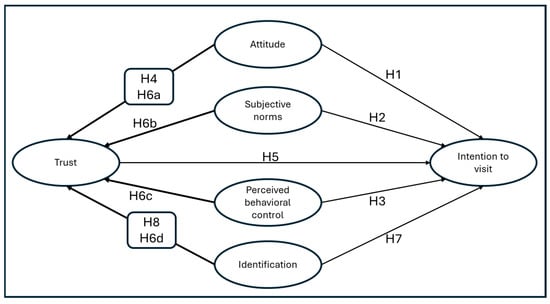
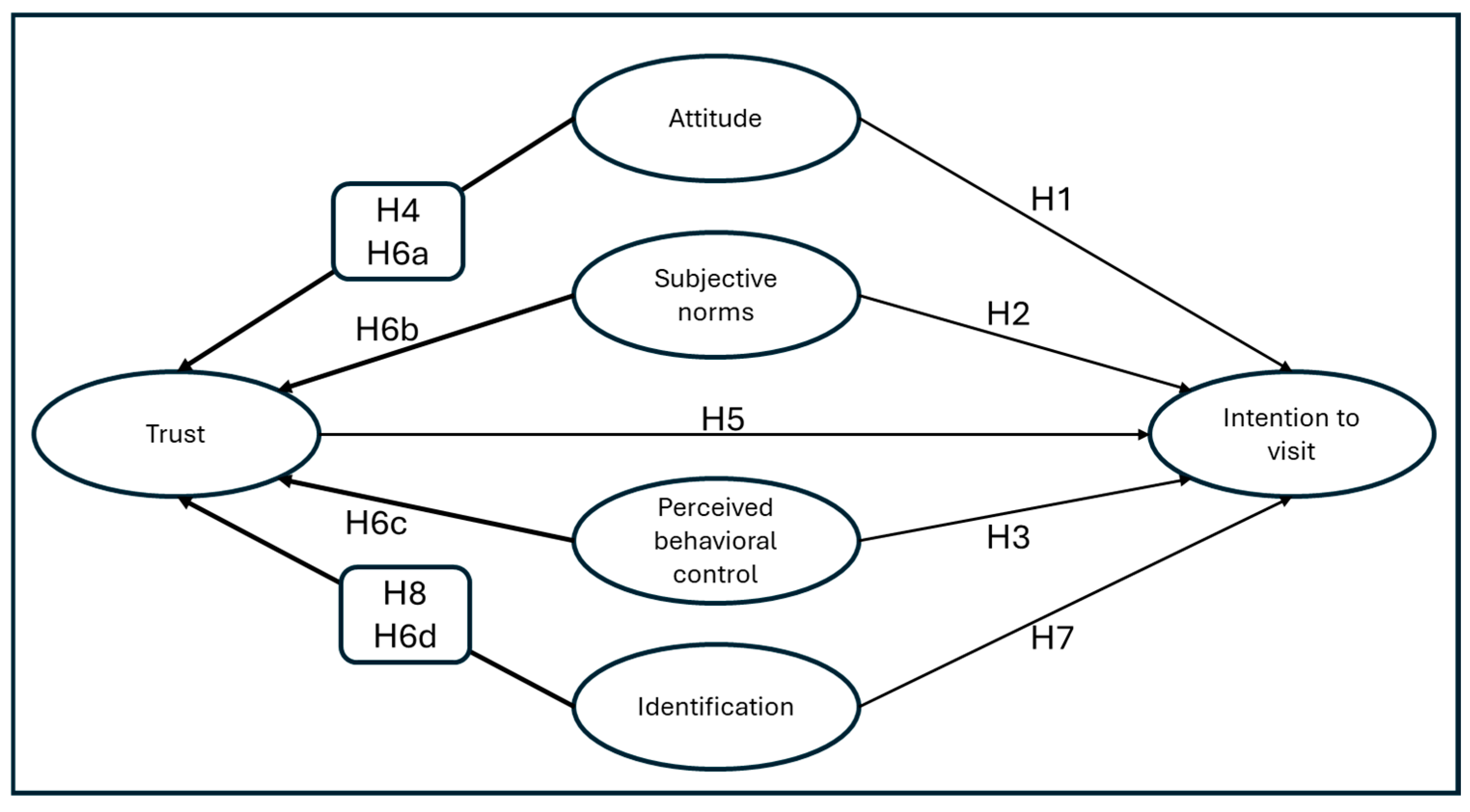
In this sense, the theory of planned behavior allows linking psychological and social elements with a specific action (Chopra et al., 2021; Fayyaz et al., 2025), while the theory of social influence allows explaining how the symbolic bond between the influencer and their followers, as well as the perception of belonging to a digital community, can directly influence the decision to visit a restaurant recommended on social media, even without explicit pressure. Therefore, the study aims to analyze the factors that influence consumers’ decision to visit restaurants recommended by gastronomic influencers on social media, considering variables such as following these content creators, perceived trust, attitude toward the recommendations, social influence (subjective norms), perceived behavioral control, and identification with the influencer. The hypotheses raised can be seen in the model proposed in Figure 1.
Figure 1.
Conceptual model. Source: Author’s own work based on (Abbas & Talat, 2023; Ajzen, 1991; Kelman, 1958; Wang & Emurian, 2005).
The study contributes to TPB and social influence theory by proposing and contrasting a model in which (1) the relative strength of classic TPB predictors (attitude, subjective norms, perceived control) is compared in a highly hedonistic and local gastronomic context; and (2) influencer trust is conceptualized as a mechanism that channels parasocial identification towards visit intention, rather than functioning as a redundant extension of attitude.
3. Materials and Methods
3.1. Survey Design
The study employed a quantitative, non-experimental, cross-sectional design with an explanatory aim, testing the hypothesized relationships among constructs in the proposed model, with the aim of identifying the factors that influence consumers’ decisions to visit restaurants recommended by gastronomic influencers on social media. Because the objective was to test a nomological network of simultaneous relationships among latent constructs, we estimated the model using variance-based structural equation modeling (PLS-SEM). We used bootstrapping with 5000 resamples to assess the significance of direct, indirect (mediation), and total effects, and we evaluated predictive performance using PLSpredict.
To this end, a structured questionnaire was designed based on operational variables. Measurement items were adapted from prior validated studies in TPB, influencer marketing, and social influence research (see Table 1), with minor wording adjustments to fit the context of food influencers and restaurant visits. The instrument included closed-ended dichotomous screening question (Yes/No) and Likert-type items. All multi-item constructs (attitude, subjective norms, perceived control, and identification with the influencer) were measured using a 5-point Likert scale (odd-numbered) anchored from 1 = Totally disagree to 5 = Totally agree. The single-item measure of trust used a 5-point scale anchored from 1 = Not at all to 5 = Completely. Visit intention was measured with a single Likert-type statement using the same agreement anchors as the other constructs.
Table 1.
Variables involved in the intention to visit a food recommendation.
To mitigate common-method bias, several procedural controls were implemented: participant anonymity was guaranteed, it was emphasized that there were no right or wrong answers, and the wording of the items was thoroughly reviewed to reduce potential ambiguities. Prior to administration, the questionnaire underwent content validation through expert judgment. Trust in the influencer and visit intention were measured using single items, given their highly concrete and unidimensional nature.
Items were presented in a fixed order grouped by construct to preserve questionnaire flow and comprehension (screening question → construct measures → sociodemographics). Randomization was not implemented. Although the instrument is short, we acknowledge that a fixed order may introduce order effects; this issue is therefore noted among the study limitations and should be addressed in future research by randomizing items.
A pretest was conducted in May 2025 with a small group of participants who met the study’s inclusion criteria. Following this process, minor adjustments were made to the wording and order of some questions, allowing for a refined and validated instrument for comprehension before its widespread application. The final questionnaire was administered online during the months of June and July 2025, over a period of four weeks, ensuring the diversity of the sample in terms of gender and age groups.
3.2. Sample Size and Composition
A non-probability convenience sampling strategy was employed by distributing the online questionnaire through social media and personal/professional networks; participants were included if they were Ecuadorian residents aged 18+ and reported following at least one food influencer. A filter question was included asking whether they followed one or more food influencers on any of their social media platforms. A brief description of what it means to be a food influencer was provided beforehand. The inclusion criterion required participants to follow at least one food influencer; the study did not restrict responses to a specific influencer category (micro vs. macro) or to a specific campaign format (paid vs. organic), nor did it restrict participation to a single platform. Participants were instructed to answer the items with reference to the food influencer they follow most frequently and whose restaurant recommendations they are most exposed to. Consequently, the findings represent an aggregated, cross-platform influencer context; potential differences by influencer type, sponsorship disclosure, and platform are acknowledged as limitations and proposed as directions for future research.
Focusing on Ecuador is contextually relevant because influencer-mediated restaurant discovery is rapidly growing in emerging markets, yet empirical evidence on how TPB mechanisms operate in Global South digital consumption settings remains limited. Additionally, restaurant choices in Ecuador are strongly shaped by local accessibility constraints (budget, mobility, proximity), making it a suitable context to examine the role of perceived behavioral control alongside influencer trust.
The questionnaire was administered to 1056 people; however, only 474 of them reported following at least one food influencer, which constituted the final sample size and representing an eligibility rate of 44.9% among completed questionnaires. Following the 10-times rule, the minimum sample should be at least ten times the maximum number of structural paths pointing at any endogenous construct; in our model, visit intention has five predictors, implying a minimum of 50 observations. To assess sample adequacy, we performed a power-based sensitivity analysis for multiple regression (α = 0.05; power = 0.80–0.95) focusing on the most complex endogenous construct in the model (five predictors). The results indicate that with n = 474 the study is sufficiently powered to detect effects ranged from f2 ≥ 0.027 to f2 ≥ 0.042, which corresponds to a small-to-moderate effect size. Therefore, the achieved sample (n = 474) exceeds both rule-of-thumb and sensitivity power-based thresholds.
Table 2 details the sample characterization, which includes a description of the sociodemographic and behavioral variables relevant to the study, such as age, gender, education level, and monthly income. This description of the sample was conducted to identify potential biases that could impact the study results.
Table 2.
Sample characterization.
3.3. Measurement Model: Reliability and Validity
The study used the variance-based partial least squares (PLS-SEM) technique, which has gained increasing acceptance in social science and management research due to its ability to handle complex models with multiple simultaneous relationships between latent variables, allowing for the prediction and explanation of the variance of the dependent constructs (Hair et al., 2011).
In this method, before evaluating the coefficient results, it is important to assess their reliability and the validity of the model. The results of the loadings of the different latent variables were observed and found to have a value of 0.70 or higher. In this case, all the loadings exceed 0.85, so it can be indicated that all the items reach an acceptable level of reliability (Hair et al., 2011).
Furthermore, all items load more heavily on their own construct than on another. These results strongly support the reliability of reflective measures, as in the model proposed here. For the internal consistency analysis, composite reliability (CR) and average variance extracted (AVE) were reviewed. In particular, the Composite Reliability (CR) values ranged between 0.855 and 0.926, and the AVE between 0.746 and 0.862, exceeding the recommended thresholds of 0.70 and 0.50, respectively (Hair et al., 2021; Nunnally & Bernstein, 1994).
Discriminant validity was assessed using the HTMT criterion. After running the bootstrapping procedure with 5000 resamples, most of the relationships between constructs presented values below the recommended threshold of 0.85, confirming the discriminant adequacy of the model (Henseler et al., 2015). Only in the case of the relationship between subjective norms and Identification (0.908) does this result indicate a high empirical proximity between both dimensions, probably associated with the fact that identification with the influencer and the perception of social pressure to follow digital trends coexist in the same contexts. However, the HTMT confidence intervals did not include the value 1, and the theory supports the distinction between normative compliance and parasocial identification, so it was decided to retain the constructs in the model.
Collinearity was then assessed in both the measurement model (Outer VIF) and the structural model (Inner VIF). The results showed that all values were below 3.3, confirming the absence of multicollinearity issues at the indicator and construct levels (Hair et al., 2021).
4. Results
4.1. Structural Model: Goodness of Fit Statistics
Absolute fit indices allow us to assess the extent to which a model adequately replicates the data or fits the priors (McDonald & Ho, 2002). In the case of PLS-SEM, the SRMR (Standardized Root Mean Square Residual) has been proposed as a goodness-of-fit indicator (Henseler et al., 2016), useful for preventing model specification problems. For approximate fit indices such as the SRMR, a value below 0.10 is considered acceptable. In this study, the model achieved an SRMR of 0.086, suggesting a fit within acceptable limits.
The structural model showed R2 values of 0.512 for trust and 0.495 for visit intention, indicating that the included predictors explain approximately half of the variance in these constructs. According to the criteria of (Hair et al., 2021), both values correspond to moderate explanatory power. Furthermore, the model’s predictive capacity was evaluated using PLSpredict (Shmueli et al., 2019). The results showed positive Q2 prediction values for Trust (0.500) and Visit Intention (0.471), indicating substantial predictive relevance. Furthermore, the prediction errors (RMSE and MAE) of the PLS model were comparable to those of the linear benchmark (LM), confirming that the model has adequate out-of-sample predictive performance.
4.2. Results of SEM
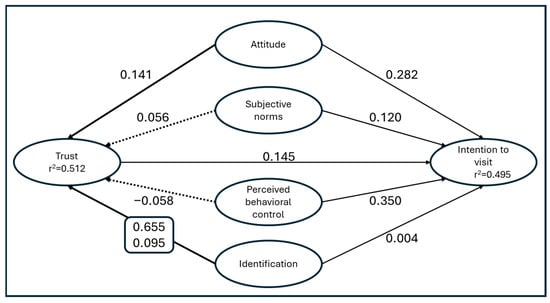
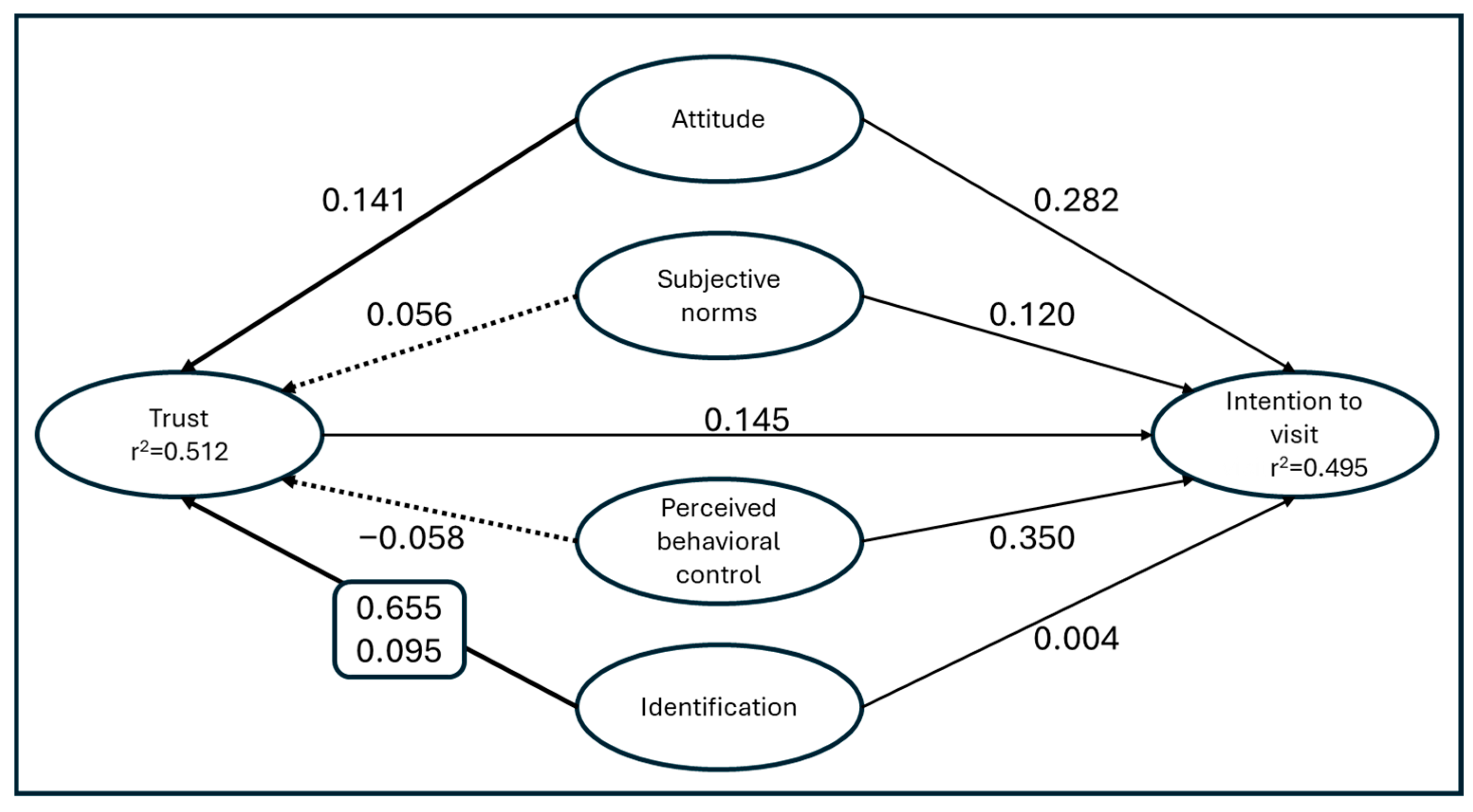
The results of the structural model (see Figure 2) confirm the validity of the theoretical approach and show that the measurements achieve adequate levels of reliability and validity, guaranteeing the quality of the constructs evaluated. As seen in the figure, the R2 values indicate that trust explains 51.2% of the variance and visit intention explains 49.5%, reflecting moderate-to-high explanatory power.
Figure 2.
Model results. Source: Author’s own work.
Regarding direct relationships, the results show that attitude toward recommendations significantly influences visit intention (β = 0.282, p < 0.001), supporting H1. Similarly, subjective norms have a positive, albeit weaker, effect on intention (β = 0.120, p < 0.05), confirming H2. Perceived behavioral control is the strongest predictor of intention (β = 0.350, p < 0.001), thus supporting H3.
Regarding the role of trust, the results show that attitude has a positive effect on this construct (β = 0.141, p < 0.01), confirming H4, while identification with the influencer shows an even stronger influence (β = 0.655, p < 0.001), which allows us to accept H8. In turn, trust in the influencer is projected as a significant antecedent of the intention to visit (β = 0.145, p < 0.01), which supports H5.
Regarding the mediation hypotheses, bootstrapping indirect effects analyses reveal that only identification with the influencer has a significant mediated effect on intention through trust (β = 0.095, p < 0.01), supporting H6d. In contrast, the proposed mediations between attitude, subjective norms, and perceived behavioral control on intention via trust (H6a, H6b, and H6c) did not reach statistical significance and are therefore rejected. Finally, the direct effect of identification on intention (β = 0.004, p = 0.948) was not significant, and thus H7 is not confirmed. The fact that trust does not mediate the relationships between attitude, subjective norms, and perceived behavioral control with intention suggests that classic predictors of the TPB act relatively autonomously with respect to influencer credibility. In contrast, identification with the influencer only translates into intention when it generates trust in their recommendations. Theoretically, this qualifies the role of trust in gastronomic environments: rather than reinforcing pre-existing attitudes or norms, it functions as a bridge that transforms parasocial affinity into an effective disposition to visit the recommended restaurant.
The model’s results show that perceived behavioral control, attitude toward the visit, and subjective norms maintain positive and significant associations with the intention to visit restaurants recommended by food influencers, with perceived behavioral control being the predictor with the greatest explanatory power among the three. Similarly, identification with the influencer is positively and significantly related to the trust placed in their recommendations, while it does not show a significant direct association with the intention to visit. For its part, trust is positively linked to the intention to visit, suggesting a relevant role in the proposed model.
5. Discussion
5.1. Theoretical Implications
The results obtained contribute to the literature on influencer marketing and the theory of planned behavior (TPB) by demonstrating that, in digital contexts, trust in the influencer, besides being a direct predictor of consumer intention, can also act as a mediating mechanism that facilitates the transition from identification with the sender to visitation intention. This extension is relevant given that, in the classic formulation of TPB (Ajzen, 1991), trust was not explicitly considered as part of the model. Thus, the present study contributes to expanding the theoretical framework of TPB in the field of digital marketing, integrating variables specific to online persuasive communication and highlighting its ability to reduce consumer uncertainty in environments characterized by information overload.
In this regard it is important to point out that the influencer-mediated restaurant decision is digitally specific in at least four ways. First, there is information asymmetry between influencer and follower, as followers cannot fully verify the experience ex ante; this helps explain why trust becomes a pivotal mechanism for translating parasocial identification into intention. Second, commercial sponsorship ambiguity (uncertainty about whether content is paid or organic) can trigger skepticism, making credibility and transparency central to persuasion effectiveness. Third, algorithmic amplification increases repeated exposure to influencer content and shapes perceived popularity, which can strengthen normative cues while simultaneously saturating attention. Finally, users are exposed to competing recommendations (multiple influencers, review platforms, peers), which may attenuate the role of subjective norms and highlight feasibility considerations (perceived behavioral control) as decisive for whether intention forms. When considering these characteristics of digital environments, the findings clarify why TPB remains predictive but benefits from extensions that capture source credibility and parasocial influence.
In this sense, the finding that identification with the influencer strongly predicts trust, but does not directly affect visit intention, suggests that identification functions as a more distal antecedent, whose influence is channeled through trust. In other words, personal assessments of the advisability of visiting a restaurant, perceived social pressure, and perceived control over behavior appear to rely on sources of information and experiences that are not solely dependent on the influencer, whereas identification with the influencer does require the filter of trust to translate into visit intention. This evidence qualifies previous research that attributed direct effects to identification on behavioral intention (Sokolova & Kefi, 2020) and suggests that its true theoretical value lies in enhancing the perceived credibility of the sender. This reinforces the notion that parasocial ties and communication authenticity should be incorporated into future models of digital consumer behavior (Audrezet et al., 2020).
The dominant role of perceived behavioral control as the strongest predictor of intention reinforces the validity of TPB, but at the same time highlights that, in digital scenarios, the intention to act—in this case, to visit a restaurant—does not depend exclusively on favorable attitudes or social norms, but rather on the perceived feasibility of carrying out the behavior. This result is consistent with the nature of the dining decision, in which factors such as available budget, restaurant location, and time availability significantly influence the actual possibility of making the visit. In this sense, it can be noted that, in the intention to visit restaurants, considered as a type of ephemeral experiential service, the perception of resources and facilitators plays a decisive role in the decision compared to other more evaluative or normative predictors. This is consistent with recent findings that highlight the importance of perceived capabilities and access to digital resources as central determinants in the adoption of online recommendations (Casaló et al., 2020). These results align with those of (Sutiadiningsih et al., 2023), who found that attitudes toward and perceptions of control influence the choice of gastronomic experiences. Along these same lines, (Chang et al., 2025) assert that attitudes and perceived behavioral control play an important role in shaping behavioral intentions toward the consumption of gastronomic offerings. Therefore, the results and the proposed model suggest that the TPB can be extended by integrating constructs linked to trust and digital interaction, considering the specificities of the digital environments and social networks in which society currently operates.
These findings contribute to integrating the theory of planned behavior with the theory of social influence in the context of food influencers. From Kelman’s process perspective, subjective norms largely capture the social pressure and normative compliance associated with “being trendy” or following recommendations circulating within reference groups; the attitude toward the visit reflects internalization processes, insofar as the influencer’s recommendation aligns with personal values and preferences; and identification with the influencer represents the process by which the individual adopts behaviors to maintain a symbolic relationship with the admired figure. However, in the gastronomic context mediated by influencers, identification alone is not enough to activate the intention to visit a restaurant; it is when this identification is accompanied by trust that the influencer’s social influence translates into behavioral intention. Thus, these results provide evidence that trust reconfigures the processes of social influence in an experiential service characterized by high pre-consumption uncertainty, reinforcing its role as a relevant mechanism in translating parasocial bonds into restaurant visit decisions.
5.2. Managerial Implications
The results presented offer guidelines for managing gastronomic marketing contextualized in the Ecuadorian digital environment. First, it can be noted that building trust is a key factor for influencer recommendations to translate into visit intentions. In this order of ideas, brands and restaurants should prioritize collaborating with content creators whose credibility derives from the transparency and authenticity of their interactions with their audiences. Therefore, strategies such as explicitly disclosing paid collaborations (Guiñez-Cabrera et al., 2020; Karagür et al., 2022), ensuring consistency between the influencer’s lifestyle and gastronomic content (Venciute et al., 2023), and generating genuine experiences can strengthen the perception of honesty, which in turn increases the impact on consumer decisions (Ki et al., 2020).
Secondly, the role of influencer identification suggests that organizations in their campaigns should focus on recruiting digital profiles that reflect values and lifestyles close to those of their target audience, rather than solely considering metrics such as number of followers and number of posts, which a priori may lead to greater visibility but lack the necessary connection between the digital influencer and the community. In gastronomic contexts, cultural proximity and local knowledge provide strategic value to the influencer, as this fosters an emotional connection with consumers and generates trust in the recommendation. This alignment between the influencer and the target audience allows for the development of parasocial ties that strengthen consumption intentions, provided these are managed according to criteria of consistency and authenticity (Patrício et al., 2024; Shi et al., 2024).
Furthermore, the significant influence of perceived behavioral control on the intention to visit a restaurant indicates that marketing strategies cannot be limited exclusively to persuasion but must be accompanied by practical facilitators that contribute to the intention to visit. Therefore, brands must develop actions such as providing direct links to reservations, detailing the menu with its respective prices, showing accessibility options, and providing the address of the establishment (through Google Maps website or similar) to mitigate perceived barriers and increase the feasibility of the action. This is consistent with recent research that points out how reducing friction in the decision-making process improves the conversion of digital influence into effective behavior (Lien et al., 2010; Lou & Yuan, 2019).
5.3. Social Implications
The results of this study also have relevant social implications, especially regarding the role that gastronomic influencers play as agents of trust in contexts of skepticism toward traditional advertising. In countries like Ecuador, where the credibility of commercial messages is frequently questioned, influencers can become intermediaries that reshape the relationship between consumers and establishments, thus generating new ways of building digital social capital. By moving the recommendation from the institutional to the interpersonal sphere, consumption is promoted based more on trust and cultural proximity, which contributes to reducing the information asymmetries that have traditionally affected the relationship between companies and customers (Uzunoğlu & Misci Kip, 2014).
On the other hand, influencer marketing in the gastronomic sector can act as a catalyst for social dynamics linked to identity and support for local products. While it is true that influencer recommendations stimulate restaurant consumption, they also promote the appreciation of gastronomy as a cultural heritage and a driver of social and economic cohesion in localities. Thus, a distinctive feature of the Ecuadorian context lies in the socioeconomic and cultural structure of gastronomic consumption, where small restaurants, family businesses, and local ventures that lack large advertising budgets abound. In this context, gastronomic influencers, in addition to being influencers of consumer trends, simultaneously become cultural disseminators who highlight the offerings of emerging economic actors. In this way, digital influence transcends the economic to become a mechanism that fosters the recognition of local culinary traditions. This phenomenon has been highlighted in recent studies on the role of digital media in cultural preservation and the construction of collective identities in the era of social media (Cordova-Buiza et al., 2025; Panchal & Mago, 2024).
5.4. Future Lines of Research
While this study provides novel evidence on the relationship of gastronomic influencers to the intention to visit restaurants, future research should broaden the analysis to include other contexts and complementary variables. First, it would be pertinent to explore how factors such as information overload, digital fatigue, or the perception of commercial authenticity moderate the relationship between trust and consumption intentions. In this regard, it is also recommended to compare the results across different cultural and geographical sectors to identify whether the patterns observed in Ecuador are replicated in contexts in the Global North or in other Latin American countries. This would enrich the debate on the universality or cultural specificity of influencer marketing. Furthermore, incorporating longitudinal methodologies would make it possible to examine the temporal evolution of trust and identification with the influencer, providing a more holistic understanding of the processes of digital influence in gastronomy. Future studies should test whether effects differ across paid vs. organic collaborations, micro vs. macro influencers, and platform formats (Instagram, YouTube, TikTok), potentially using multi-group analysis or experimental manipulations of sponsorship disclosure.
6. Conclusions
This study addressed the research question of how TPB predictors (attitude, subjective norms, and perceived behavioral control) and influencer-related mechanisms (trust and identification) jointly explain consumers’ intention to visit restaurants recommended by food influencers on social media. The results show that, in Ecuador, the intention to visit restaurants recommended by gastronomic influencers is primarily explained by perceived behavioral control and attitude toward the recommendations, while subjective norms play a more limited role. Identification with the influencer is shown to be a central antecedent of trust, confirming that personal connection and perceptions of authenticity are more decisive than simple exposure to the content. Trust, for its part, is seen as a differentiating factor that, although with a moderate effect, contributes to transforming positive evaluations into a concrete intention to visit.
Overall, the results confirm the relevance of the core TPB predictors, but they also show that TPB operates with an uneven pattern in this context, as subjective norms are comparatively weaker. Beyond confirmation, the study extends TPB by demonstrating that trust functions as an additional predictor of intention and as a key mediating bridge through which identification translates into intention, a mechanism not specified in the original TPB formulation.
These findings indicate that, in the field of digital gastronomic marketing, influence does not depend solely on the visibility of the message, but also on the influencer’s ability to generate credibility and closeness with their audience. For influencer marketing theory, the findings refine the role of identification: identification alone does not necessarily trigger visit intention; rather, it becomes influential when it generates trust, indicating that parasocial closeness is not sufficient unless followers perceive the recommendation as credible and authentic. Consequently, the proposed model reaffirms the validity of the predictors of the theory of planned behavior in the gastronomic market through social media and adds trust as a mediating mechanism in the relationship between identification and intention, thus offering a broader understanding of persuasion processes in digital environments.
Limitations of the study include the use of non-probability convenience sampling, which limits the statistical generalizability of the results. However, in line with the PLS-SEM approach and the study’s main objective—to test a set of theoretical relationships and evaluate the model’s predictive capacity—the sample allows for valid conclusions to be drawn at the level of a developing theory, which should be replicated in future studies using probabilistic designs. The study did not explicitly differentiate between influencer types (micro vs. macro), campaign formats (paid vs. organic), or platform-specific contexts; these factors may shape credibility perceptions and engagement and should be examined in future research. A further limitation is that items were not randomized, which may allow order effects; future studies should randomize item order or use counterbalancing. Future research could also test the model through cross-cultural comparisons; adopt longitudinal designs to capture how trust develops over time; use experimental designs that manipulate influencer disclosure and credibility; differentiate the effects between micro, macro, and mega influencers; and compare the dynamics of digital platforms where algorithms, formats, and social proof signals differ.
Author Contributions
Conceptualization, N.S.-N., F.G.-C. and J.C.-E.; methodology, N.S.-N. and P.C.-V.; software, N.S.-N. and J.C.-E.; validation, N.S.-N., F.G.-C. and J.C.-E.; formal analysis, N.S.-N., F.G.-C. and J.C.-E.; investigation, N.S.-N., F.G.-C., P.C.-V. and J.C.-E.; resources, N.S.-N. and J.C.-E.; data curation, N.S.-N. and J.C.-E.; writing—original draft preparation, N.S.-N., F.G.-C. and J.C.-E.; writing—review and editing, P.C.-V.; visualization, N.S.-N., F.G.-C. and J.C.-E.; supervision, P.C.-V.; project administration, N.S.-N. and J.C.-E.; funding acquisition, N.S.-N. and J.C.-E. All authors have read and agreed to the published version of the manuscript.
Funding
The APC was funded by Politecnica Salesiana University.
Institutional Review Board Statement
The study was conducted in accordance with the Declaration of Helsinki, and approved by the Ethics Committee of Research Coordination, Universidad Politécnica Salesiana (protocol code: 04-0017-2022-11-28 and date of approval: 28 November 2022).
Informed Consent Statement
Informed consent was obtained from all individual participants included in the study.
Data Availability Statement
The original contributions presented in this study are included in the article. Further inquiries can be directed to the corresponding author.
Conflicts of Interest
The authors declare no conflicts of interest.
References
- Abbas, A., & Talat, S. (2023). Consumer trust in e-commerce: Factors affecting trustworthiness. International Journal of eBusiness and eGovernment Studies, 15(1), 488–511. [Google Scholar]
- Ajzen, I. (1991). The theory of planned behavior. Organizational Behavior and Human Decision Processes, Theories of Cognitive Self-Regulation, 50(2), 179–211. [Google Scholar] [CrossRef] [Scilit]
- Akhtar, N., Hameed, Z., Islam, T., Pant, M. K., Sharma, A., Rather, R. A., & Kuzior, A. (2024). Avatars of influence: Understanding how virtual influencers trigger consumer engagement on online booking platforms. Journal of Retailing and Consumer Services, 78, 103742. [Google Scholar] [CrossRef] [Scilit]
- Amaya Henao, S. M., Silva Cortés, G. A., & Rincón Quintero, Y. A. (2021). Impacto de los influencers en las estrategias promocionales del sector gastronómico de la ciudad de Medellín. Fonseca, Journal of Communication, (22), 77–97. [Google Scholar] [CrossRef] [Scilit]
- Arya, A., Goel, P., Verma, S. K., & Jain, K. (2025). AI’s impact on consumer purchase intent through influencer marketing—A determinant of purchase behaviour in e-commerce. Multidisciplinary Reviews, 8(11), 2025349. [Google Scholar] [CrossRef] [Scilit]
- Audrezet, A., De Kerviler, G., & Guidry Moulard, J. (2020). Authenticity under threat: When social media influencers need to go beyond self-presentation. Journal of Business Research, 117, 557–569. [Google Scholar] [CrossRef] [Scilit]
- Bash, M., Bandyopadhyay, A., Pahari, M. P., & Pahari, S. (2024). The effect of social media influencers on visit intention in the restaurant industry. Indian Journal of Marketing, 54(5), 45. [Google Scholar] [CrossRef] [Scilit]
- Casaló, L. V., Flavián, C., & Ibáñez-Sánchez, S. (2020). Influencers on instagram: Antecedents and consequences of opinion leadership. Journal of Business Research, 117, 510–519. [Google Scholar] [CrossRef] [Scilit]
- Cascio Rizzo, G. L., Villarroel Ordenes, F., Pozharliev, R., De Angelis, M., & Costabile, M. (2024). How high-arousal language shapes micro- versus macro-influencers’ impact. Journal of Marketing, 88(4), 107–128. [Google Scholar] [CrossRef] [Scilit]
- Casquero, A. D., González Robles, E. M., & Del Alcázar, B. (2023). Digital influencers and the restaurant sector. In S. Teixeira, S. Teixeira, Z. Oliveira, & E. Souza (Eds.), Advances in marketing, customer relationship management, and e-services (pp. 269–287). IGI Global. [Google Scholar] [CrossRef] [Scilit]
- Castelló-Martínez, A., & del Pino Romero, C. (2015). Prescriptores, marcas y tuits: El marketing de influencia. aDResearch: Revista Internacional de Investigación en Comunicación, 12(12), 86–106. [Google Scholar] [CrossRef] [Scilit]
- Chang, M.-Y., Huang, C.-X., Lin, I.-K., & Chen, H.-S. (2025). Exploring product innovation and consumer attitudes in molecular gastronomy: Marketing insights for the gourmet food industry. Foods, 14(2), 209. [Google Scholar] [CrossRef] [Scilit] [PubMed]
- Chen, Q., Huang, R., & Hou, B. (2020). Perceived authenticity of traditional branded restaurants (China): Impacts on perceived quality, perceived value, and behavioural intentions. Current Issues in Tourism, 23(23), 2950–2971. [Google Scholar] [CrossRef] [Scilit]
- Choi, Y.-J., Jung, I.-Y., & Na, T.-K. (2025). How place attachment moderates the relationship between perceived authenticity and revisit intention to time-honored restaurants. Sustainability, 17(19), 8602. [Google Scholar] [CrossRef] [Scilit]
- Chopra, A., Avhad, V., & Jaju, A. S. (2021). Influencer marketing: An exploratory study to identify antecedents of consumer behavior of millennial. Business Perspectives and Research, 9(1), 77–91. [Google Scholar] [CrossRef] [Scilit]
- Cordova-Buiza, F., Grillo-Torres, C. M., & Vega, C. R. (2025). Gastronomic culture and social networks: The impact of digital strategies on the promotion of traditional colombian cuisine. Geojournal of Tourism and Geosites, 59(2), 587–594. [Google Scholar] [CrossRef] [Scilit]
- Cueva-Estrada, J., Sumba-Nacipucha, N., & Villacrés-Beltrán, F. (2020). El marketing de influencias y su efecto en la conducta de compra del consumidor millennial. Suma de Negocios, 11(25), 99–107. [Google Scholar] [CrossRef] [Scilit]
- De Jans, S., Spielvogel, I., Naderer, B., & Hudders, L. (2021). Digital food marketing to children: How an influencer’s lifestyle can stimulate healthy food choices among children. Appetite, 162, 105182. [Google Scholar] [CrossRef] [Scilit]
- De Veirman, M., Cauberghe, V., & Hudders, L. (2017). Marketing through Instagram influencers: The impact of number of followers and product divergence on brand attitude. International Journal of Advertising, 36(5), 798–828. [Google Scholar] [CrossRef] [Scilit]
- Drew, Z., Fulton, J., & McIntyre, P. (2022). #foodporn: Examining Instagram food influencers through the systems model of creativity. Communication Research and Practice, 8(4), 308–326. [Google Scholar] [CrossRef] [Scilit]
- Dzreke, S. S., & Dzreke, S. (2025). Influence of social media on consumer behavior: Investigating how social media platforms shape consumer purchasing decisions and loyalty. Open Journal of Business and Management, 13(02), 1154–1175. [Google Scholar] [CrossRef]
- Fayyaz, M. S., Abbasi, A. Z., Kumar, S., Qureshi, A., Hussain, K., & Muhammad, L. (2025). Integrating digital influencer persuasion model and theory of planned behavior: The mediating role of consumer involvement in endorsed brands. Journal of Retailing and Consumer Services, 85, 104309. [Google Scholar] [CrossRef] [Scilit]
- Freberg, K., Graham, K., McGaughey, K., & Freberg, L. A. (2011). Who are the social media influencers? A study of public perceptions of personality. Public Relations Review, 37(1), 90–92. [Google Scholar] [CrossRef] [Scilit]
- Gonzalez Marin, N. C., Guiracocha Arriciaga, R. V., Cueva Estrada, J., & Sumba, N. (2024). El marketing de influencias y su efecto en la decisión de compra de los clientes en el sector de la moda y la belleza en el Ecuador. Doxa Comunicación. Revista Interdisciplinar de Estudios de Comunicación y Ciencias Sociales, 38, 207–226. [Google Scholar] [CrossRef] [Scilit]
- Guiñez-Cabrera, N., Mansilla-Obando, K., & Jeldes-Delgado, F. (2020). La transparencia publicitaria en los influencers de las redes sociales. Retos, 10(20), 265–281. [Google Scholar] [CrossRef] [Scilit]
- Guzmán-Pizarro, J. V. (2024, December 2–4). Influencers en la gastronomía limeña: ¿Catalizadores del cambio o agentes de gentrificación? 4th LACCEI International Multiconference on Entrepreneurship, Innovation and Regional Development (LEIRD 2024): ‘Creating Solutions for a Sustainable Future: Technology-Based Entrepreneurship’, Virtual. [Google Scholar] [CrossRef] [Scilit]
- Hadining, A. F., Robi’ah, H., Kusnadi, K., & Nugraha, A. E. (2020, August 10–14). How C2C communication in online communities influence customer purchase decision? 5th NA International Conference on Industrial Engineering and Operations Management, Detroit, MI, USA. [Google Scholar]
- Hair, J. F., Hult, G. T. M., Ringle, C. M., Sarstedt, M., Danks, N. P., & Ray, S. (2021). Partial least squares structural equation modeling (PLS-SEM) using R: A workbook. Springer International Publishing. [Google Scholar] [CrossRef] [Scilit]
- Hair, J. F., Ringle, C. M., & Sarstedt, M. (2011). PLS-SEM: Indeed a silver bullet. Journal of Marketing Theory and Practice, 19(2), 139–152. [Google Scholar] [CrossRef] [Scilit]
- Henseler, J., Hubona, G., & Ray, P. A. (2016). Using PLS path modeling in new technology research: Updated guidelines. Industrial Management & Data Systems, 116(1), 2–20. [Google Scholar] [CrossRef] [Scilit]
- Henseler, J., Ringle, C. M., & Sarstedt, M. (2015). A new criterion for assessing discriminant validity in variance-based structural equation modeling. Journal of the Academy of Marketing Science, 43(1), 115–135. [Google Scholar] [CrossRef] [Scilit]
- Hu, X., Chen, X., & Davison, R. M. (2019). Social support, source credibility, social influence, and impulsive purchase behavior in social commerce. International Journal of Electronic Commerce, 23(3), 297–327. [Google Scholar] [CrossRef] [Scilit]
- İpekoğlu, E., & Enser, İ. (2024). The effect of social media influencers on consumer food and beverage consumption behaviour. In S. Tabari, W. Chen, & N. Colmekcioglu (Eds.), Consumer behaviour in hospitality and tourism (1st ed., pp. 245–255). Routledge. [Google Scholar] [CrossRef] [Scilit]
- Janssen, L., Schouten, A. P., & Croes, E. A. J. (2022). Influencer advertising on Instagram: Product-influencer fit and number of followers affect advertising outcomes and influencer evaluations via credibility and identification. International Journal of Advertising, 41(1), 101–127. [Google Scholar] [CrossRef] [Scilit]
- Karagür, Z., Becker, J.-M., Klein, K., & Edeling, A. (2022). How, why, and when disclosure type matters for influencer marketing. International Journal of Research in Marketing, 39(2), 313–335. [Google Scholar] [CrossRef] [Scilit]
- Kelman, H. C. (1958). Compliance, identification, and internalization three processes of attitude change. Journal of Conflict Resolution, 2(1), 51–60. [Google Scholar] [CrossRef] [Scilit]
- Ki, C.-W. C., Cuevas, L. M., Chong, S. M., & Lim, H. (2020). Influencer marketing: Social media influencers as human brands attaching to followers and yielding positive marketing results by fulfilling needs. Journal of Retailing and Consumer Services, 55, 102133. [Google Scholar] [CrossRef] [Scilit]
- Lee, M. T., & Theokary, C. (2021). The superstar social media influencer: Exploiting linguistic style and emotional contagion over content? Journal of Business Research, 132, 860–871. [Google Scholar] [CrossRef] [Scilit]
- Leung, F. F., Gu, F. F., Li, Y., Zhang, J. Z., & Palmatier, R. W. (2022). Influencer marketing effectiveness. Journal of Marketing, 86(6), 93–115. [Google Scholar] [CrossRef] [Scilit]
- Li, W., Zhao, F., Lee, J. M., Park, J., Septianto, F., & Seo, Y. (2024). How micro- (vs. mega-) influencers generate word of mouth in the digital economy age: The moderating role of mindset. Journal of Business Research, 171, 114387. [Google Scholar] [CrossRef] [Scilit]
- Lien, C.-Y., Chen, Y.-S., & Huang, C.-W. (2010). The relationships between green consumption cognition and behavioral intentions for consumers in the restaurant industry. In 2010 IEEE international conference on industrial engineering and engineering management (pp. 748–752). IEEE. [Google Scholar] [CrossRef] [Scilit]
- Lou, C., & Yuan, S. (2019). Influencer marketing: How message value and credibility affect consumer trust of branded content on social media. Journal of Interactive Advertising, 19(1), 58–73. [Google Scholar] [CrossRef] [Scilit]
- Masur, P. K., DiFranzo, D., & Bazarova, N. N. (2021). Behavioral contagion on social media: Effects of social norms, design interventions, and critical media literacy on self-disclosure. PLoS ONE, 16(7), e0254670. [Google Scholar] [CrossRef] [Scilit]
- McDonald, R. P., & Ho, M.-H. R. (2002). Principles and practice in reporting structural equation analyses. Psychological Methods, 7(1), 64–82. [Google Scholar] [CrossRef]
- Nunnally, J. C., & Bernstein, I. H. (1994). The assessment of reliability. Psychometric Theory, 3, 248–292. [Google Scholar]
- Nurullah Berk, O., Štimac, H., & Bilandžić Tanasić, K. (2025). Influencer marketing: A cross-cultural study of generation Z in Croatia and Türkiye. Drustvena Istrazivanja, 33(4), 547–567. [Google Scholar] [CrossRef] [Scilit]
- Panchal, P., & Mago, B. (2024). Social media as a tool for cultural preservation among diaspora communities. International Journal for Global Academic & Scientific Research, 3(3), 14–20. [Google Scholar] [CrossRef] [Scilit]
- Patrício, G. A., Da Silva Añaña, E., Zucco, F. D., & Reinert, P. S. (2024). The effects of consumer-influencer parasocial interactions on purchase intentions. In B. Barbosa (Ed.), Advances in marketing, customer relationship management, and e-services (pp. 204–225). IGI Global. [Google Scholar] [CrossRef] [Scilit]
- Pereira, M. J. D. S., Cardoso, A., Canavarro, A., Figueiredo, J., & Garcia, J. E. (2023). Digital influencers’ attributes and perceived characterizations and their impact on purchase intentions. Sustainability, 15(17), 12750. [Google Scholar] [CrossRef] [Scilit]
- Pérez Martínez, A., & Rodríguez Fernández, A. (2022). Economía conductual: Revisión teórica desde la interdisciplinariedad y la complejidad. Apuntes del Cenes, 41(74), 17–40. [Google Scholar] [CrossRef] [Scilit]
- Randers, M., Correia, R. F., Venciute, D., & Fontes, R. (2023). Trust in influencer marketing: Factors influencing followers’ perceptions in the Baltic countries. In R. F. Correia, D. Venciūtė, & B. M. Sousa (Eds.), Advances in marketing, customer relationship management, and e-services (pp. 1–20). IGI Global. [Google Scholar] [CrossRef] [Scilit]
- Reisch, L. A., & Zhao, M. (2017). Behavioural economics, consumer behaviour and consumer policy: State of the art. Behavioural Public Policy, 1(2), 190–206. [Google Scholar] [CrossRef] [Scilit]
- Rosário, A. T., Lopes, P. R., & Rosário, F. S. (2023). Influencer marketing in the digital ecosystem. In R. Bansal, S. A. Qalati, & A. Chakir (Eds.), Advances in marketing, customer relationship management, and e-services (pp. 132–166). IGI Global. [Google Scholar] [CrossRef] [Scilit]
- Sanz Marcos, P. (2018). Soy marca. Quiero trabajar con influencers. Influencer marketing. Ambitos: Revista Internacional de Comunicación, (39), 15. [Google Scholar]
- Shamim, K., & Azam, M. (2024). The power of social media influencers: Unveiling the impact on consumers’ impulse buying behaviour. Humanities and Social Sciences Communications, 11(1), 1461. [Google Scholar] [CrossRef] [Scilit]
- Shi, S., Hu, Z., Nagasawa, S., & Gao, S. (2024). Role models or competitors? Understanding influencer marketing in restaurants from the perspective of customers’ social comparison orientation. Journal of Hospitality and Tourism Management, 61, 156–164. [Google Scholar] [CrossRef] [Scilit]
- Shin, Y. H., Im, J., Jung, S. E., & Severt, K. (2018). Locally sourced restaurant: Consumers willingness to pay. Journal of Foodservice Business Research, 21(1), 68–82. [Google Scholar] [CrossRef] [Scilit]
- Shmueli, G., Sarstedt, M., Hair, J. F., Cheah, J.-H., Ting, H., Vaithilingam, S., & Ringle, C. M. (2019). Predictive model assessment in PLS-SEM: Guidelines for using PLSpredict. European Journal of Marketing, 53(11), 2322–2347. [Google Scholar] [CrossRef] [Scilit]
- Sokolova, K., & Kefi, H. (2020). Instagram and YouTube bloggers promote it, why should I buy? How credibility and parasocial interaction influence purchase intentions. Journal of Retailing and Consumer Services, 53, 101742. [Google Scholar] [CrossRef] [Scilit]
- Sumba Nacipucha, N., & Sánchez-Bayón, A. (2024). Avances en la economía conductual: Cambio paradigmático hacia una economía humanista. Telos: Revista de Estudios Interdisciplinarios En Ciencias Sociales, 26(2), 633–650. [Google Scholar] [CrossRef] [Scilit]
- Susanto, E. (2024). Influencing travel decisions: Social media’s role in destination perception and visit intentions. Tourism and Leisure, 13(3), 531–539. [Google Scholar] [CrossRef]
- Sutiadiningsih, A., Purwidiani, N., Dewi, I. H. P., Hamdani, A. T., & Tho Le, H. (2023). Gastronomic experience as a motivation for tourists to choose tourist destinations in Indonesia and Vietnam. GeoJournal of Tourism and Geosites, 47(2), 424–431. [Google Scholar] [CrossRef] [Scilit]
- Syarif, R., Sucipto, K. R. R., Rimakka, A. I. D., & Pratama, A. A. D. M. (2025). Social media food influencers and follower’s local food purchase intention: A parasocial relationship perspective. Journal of Consumer Sciences, 10(1), 173–196. [Google Scholar] [CrossRef] [Scilit]
- Teerada Cattapan. (2023). The influence of social media influencers (SMI) on the pro-environmental behavior of Thai generation Y regarding the purchase of electric vehicles. ABAC Journal, 43, 7791. [Google Scholar] [CrossRef]
- Thacker, R., & Reddy, K. J. (2024). Social cognition and behavioral economics: Understanding social influences on decision making. In K. J. Reddy (Ed.), Advances in finance, accounting, and economics (pp. 251–278). IGI Global. [Google Scholar] [CrossRef] [Scilit]
- Uzunoğlu, E., & Misci Kip, S. (2014). Brand communication through digital influencers: Leveraging blogger engagement. International Journal of Information Management, 34(5), 592–602. [Google Scholar] [CrossRef] [Scilit]
- Valsesia, F., Proserpio, D., & Nunes, J. C. (2020). The positive effect of not following others on social media. Journal of Marketing Research, 57(6), 1152–1168. [Google Scholar] [CrossRef] [Scilit]
- Venciute, D., Mackeviciene, I., Kuslys, M., & Correia, R. F. (2023). The role of influencer–follower congruence in the relationship between influencer marketing and purchase behaviour. Journal of Retailing and Consumer Services, 75, 103506. [Google Scholar] [CrossRef] [Scilit]
- Vrontis, D., Makrides, A., Christofi, M., & Thrassou, A. (2021). Social media influencer marketing: A systematic review, integrative framework and future research agenda. International Journal of Consumer Studies, 45(4), 617–644. [Google Scholar] [CrossRef] [Scilit]
- Waghmare, G., Todmal, A. D., Shahare, P., Magar, A. V., Sharma, J. K., Jindal, S., & Pramanik, S. (2025). Impact driven by technology using influencer marketing analytics to revolutionize marketing techniques. In V. T. Vale, & A. C. Gradim (Eds.), Effective marketing and consumer behavior tactics for high-end products (pp. 51–80). IGI Global. [Google Scholar] [CrossRef] [Scilit]
- Wang, Y. D., & Emurian, H. H. (2005). An overview of online trust: Concepts, elements, and implications. Computers in Human Behavior, 21(1), 105–125. [Google Scholar] [CrossRef] [Scilit]
- Willoughby, J. F., Couto, L., Kang, S., Randall, J., Kirkpatrick, A. W., Lee, D. K. L., Su, Y., Booth, A. M., & Domgaard, S. (2024). An exploratory content analysis of the use of health communication strategies and presence of objectification in fitness influencer social media posts. Health Communication, 39(5), 888–895. [Google Scholar] [CrossRef] [Scilit] [PubMed]
- Xi, H., Hong, Z., Sun, J., Li, X., Wei, J., & Davison, R. B. (2016, June 27–July 1). Impulsive purchase behaviour in social commerce: The role of social influence. Pacific Asia Conference on Information Systems, Chiayi, Taiwan. Available online: https://www.semanticscholar.org/paper/Impulsive-Purchase-behaviour-in-Social-Commerce%3A-of-Xi-Hong/2b616ad0fc9370b437779e6da1f2b7041337a076 (accessed on 2 March 2026).
- Xiao, L., Saleem, A., Tariq, S. M., Ul Haq, J., & Guo, M. (2021). I wish I could be like her/him! How self-congruence stimulates a desire to mimic. Journal of Theoretical and Applied Electronic Commerce Research, 16(7), 3025–3042. [Google Scholar] [CrossRef] [Scilit]
- Zhong, Y.-f., & Shao, P.-j. (2006). The model for consumer trust in C2C online auction. In 2006 international conference on management science and engineering (pp. 125–129). IEEE. [Google Scholar] [CrossRef] [Scilit]

Disclaimer/Publisher’s Note: The statements, opinions and data contained in all publications are solely those of the individual author(s) and contributor(s) and not of MDPI and/or the editor(s). MDPI and/or the editor(s) disclaim responsibility for any injury to people or property resulting from any ideas, methods, instructions or products referred to in the content. |
© 2026 by the authors. Licensee MDPI, Basel, Switzerland. This article is an open access article distributed under the terms and conditions of the Creative Commons Attribution (CC BY) license.