1. Introduction
Digital transformation represents one of the most significant drivers of structural change in the global economy, reshaping business models, value creation processes, and mechanisms of competitiveness (
OECD, 2024). In tourism, digital technologies increasingly influence how destinations are managed, promoted, and evaluated due to the sector’s strong dependence on information flows and the experiential nature of tourism consumption (
Buhalis, 2019;
UN Tourism, 2024). The growing diffusion of smart solutions, artificial intelligence, mobile technologies, and data-driven management systems has fundamentally transformed tourism governance and service delivery (
Gursoy et al., 2019;
Wu et al., 2024). These developments indicate that digital transformation is evolving from a purely technological process toward a strategic mechanism shaping the competitiveness of tourism destinations (
Bekele & Raj, 2025). In developing and transitional economies, digital transformation can help tourism destinations overcome structural limitations, improve market accessibility, and strengthen international competitiveness (
González-Rodríguez & Díaz-Fernández, 2025;
Sezer & İlban, 2024;
UN Tourism, 2024). Digital technologies enable tourism enterprises and destination managers to improve information flows, optimize marketing strategies, and enhance communication with visitors through online platforms and digital service systems (
Chatzigeorgiou, 2025). However, existing research indicates that technological adoption rarely generates competitiveness directly. Instead, its effects typically emerge through improvements in service quality, managerial efficiency, and resource governance (
Ku, 2024). Recent studies emphasize that the digital economy contributes to high-quality tourism development by enhancing productivity and encouraging pro-environmental behavior among tourism stakeholders (
Cheng, 2025;
Rienda et al., 2024). Smart technologies such as artificial intelligence, Internet of Things (IoT) systems, and advanced data analytics enable destinations to monitor visitor flows, optimize resource utilization, and support innovation in tourism services (
Koo et al., 2025;
Anica-Popa et al., 2025). These technologies allow tourism destinations to convert digital data into managerial knowledge that supports both service innovation and sustainability-oriented decision-making. Consequently, digital transformation increasingly interacts with environmental governance and service quality formation within tourism systems. Within tourism research, service quality and sustainability are widely recognized as essential determinants of long-term destination competitiveness (
Gössling et al., 2021;
Ritchie & Crouch, 2003). Tourists increasingly evaluate destinations not only according to traditional service attributes but also according to environmental responsibility and sustainability performance (
Maráková et al., 2025). As a result, environmental practices are progressively integrated into the broader perception of tourism service quality. Digital technologies may facilitate this integration by enabling better monitoring of environmental impacts and by supporting more efficient management of tourism resources (
Gretzel et al., 2015). Digital communication platforms also influence the relationship between sustainability initiatives and tourist perceptions (
Gutiérrez & Ferreira, 2023). Electronic word-of-mouth (eWOM) systems reduce information asymmetry and allow tourism enterprises to communicate sustainability initiatives more transparently (
Wahyudi et al., 2025;
Wu et al., 2024). Studies examining digital tourist behavior emphasize that online reviews and digital communication channels significantly influence tourists’ perceptions of destination quality and trust (
Lee et al., 2025;
Zhang et al., 2025;
Polukhina et al., 2025). Moreover, the integration of digital tools with sustainability strategies is increasingly aligned with the principles of Industry 5.0, which emphasize human-centered technological development and sustainability-oriented innovation (
Khoshroo & Soltani, 2025;
Ristanović et al., 2025).
Digital Transformation (DT) may influence tourism performance primarily through improvements in sustainability-oriented service quality. To capture this interaction, the present study conceptualizes Quality and Environmental Responsibility (QTS) as an integrated construct reflecting sustainability-driven service quality within tourism destinations. In this framework, DT functions as a strategic enabler supporting the development of environmentally responsible and high-quality tourism services.
Accordingly, the following hypothesis is proposed:
H1. Digital Transformation (DT) has a positive effect on Quality and Environmental Responsibility (QTS).
A substantial body of literature also highlights that high-quality tourism services and environmentally responsible practices contribute directly to destination competitiveness. Destination Competitiveness (COMP) refers to the ability of a destination to attract visitors, ensure visitor satisfaction, and generate sustainable economic benefits while preserving local resources (
Rasul et al., 2025). Empirical studies demonstrate that destinations integrating sustainability principles into tourism management achieve stronger market differentiation and improved visitor loyalty (
Meng et al., 2024;
Mutmainah et al., 2025). In this context, sustainability-driven service quality may represent a key mechanism through which technological innovation translates into competitive advantage.
Therefore, the following hypothesis is formulated:
H2. Quality and Environmental Responsibility (QTS) has a positive effect on Destination Competitiveness (COMP).
Despite the increasing diffusion of digital technologies, tourism destinations differ significantly in their level of digital maturity. Differences in infrastructure, digital skills, institutional capacity, and policy coordination often create heterogeneous levels of digital transformation across tourism systems (
OECD, 2024;
European Commission, 2024). Research suggests that destinations with higher levels of digital maturity tend to achieve more advanced levels of service innovation, environmental monitoring, and stakeholder coordination (
González-Rodríguez & Díaz-Fernández, 2025;
Koo et al., 2025). These structural disparities may therefore influence the implementation of sustainability-oriented service quality within tourism destinations.
Accordingly, the following hypothesis is proposed:
H3. There are significant differences in Quality and Environmental Responsibility (QTS) across destinations with different levels of digital maturity.
The empirical analysis of these relationships is conducted in the context of the Slovak tourism sector, representing a transitional European economy. According to the
Statistical Office of the Slovak Republic (
2024), tourism contributed approximately 2.43% to the national gross domestic product in 2023. In addition, World Bank data indicate that Slovakia recorded approximately 15.3 million international tourist arrivals in the most recent fully pre-pandemic reference year (2018) (
World Bank, 2024). In terms of digital development, Slovakia ranks in the mid-range of the European Union Digital Economy and Society Index (DESI), reflecting a moderate level of digital maturity within the European tourism context (
European Commission, 2024). Despite its economic importance, the Slovak tourism sector remains characterized by structural digital disparities and uneven institutional capacity, which may influence the effectiveness of digital–sustainability integration.
The objective of this study is therefore to examine the relationships between the constructs of DT, QTS and COMP. Specifically, the study investigates whether DT contributes to COMP through sustainability-driven quality formation and whether differences in digital maturity influence the implementation of QTS practices across tourism destinations.
2. Materials and Methods
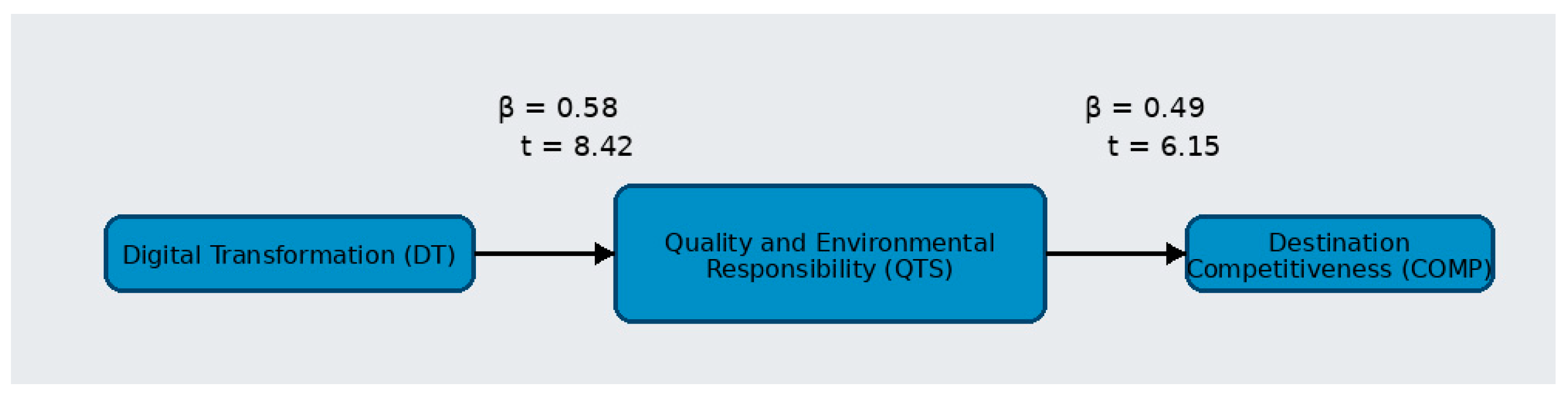
The study is designed as a quantitative, cross-sectional empirical investigation based on a questionnaire survey, with the aim of testing the proposed conceptual model and three main hypotheses (H1–H3). The hypothesized relationships are summarized in the conceptual model presented in
Figure 1.
The figure illustrates the conceptual model examining the relationships between DT, QTS and destination competitiveness (
Rheeders, 2022). DT is conceptualized as an independent variable that influences QTS. QTS acts as a mediating variable through which DT affects COMP. The direct effect of QTS on competitiveness is also assumed. The model reflects a mediation-oriented approach suitable for examining indirect relationships in developing economies.
The mediating mechanism of QTS is examined using a regression-based, mediation-oriented analytical framework. The empirical model assumes that digital transformation influences destination competitiveness primarily through improvements in QTS, providing a mediation-oriented basis for examining indirect relationships using regression analysis. This mediation logic forms the conceptual basis for the regression-based analytical framework applied in the study. This approach enables statistical examination of the relationships between digital transformation, QTS, and destination competitiveness. The methodological foundations of the study reflect the multidimensional nature of digital transformation in tourism, which is manifested through quality management and environmental processes. A quantitative approach is therefore appropriate for measuring the perceptions of key stakeholders and for comparing levels of digital maturity across selected destinations.
The empirical research is based on a sample of key tourism stakeholders. The empirical research was conducted in Slovakia, classified as a developing/transitional economy within the European context.
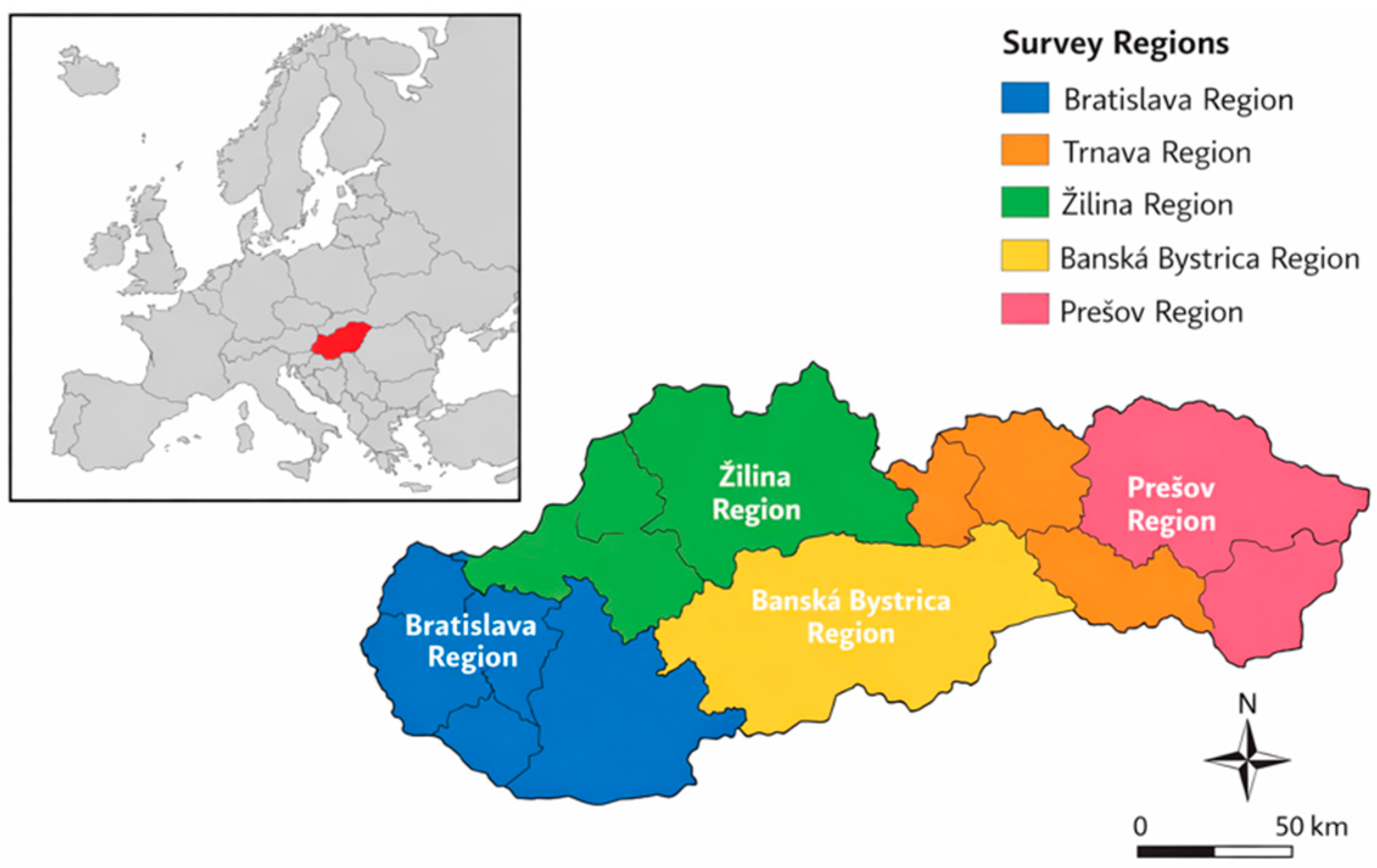
The survey targeted tourism stakeholders operating within the Slovak tourism system at the national level. The geographic context of the study is illustrated in
Figure 2. The research design focused on national-level analysis of structural relationships among constructs and therefore did not incorporate a stratified regional sampling framework. Prior to the main data collection phase involving 276 respondents, a pilot study was conducted with a sample of 15 industry experts to ensure the clarity and interpretability of the terms “smart solutions” and “environmental responsibility” within the context of the digital economy. The target population included representatives of destination management organizations (DMOs) and tourist information centers, accommodation and food service providers, travel agencies and tour operators, as well as entities responsible for managing tourist attractions.
The online survey was implemented to minimize entry barriers for stakeholders across different geographic regions. Data collection was carried out through an online questionnaire distributed via institutional networks and professional associations. The use of online data collection is justified by the digital focus of the research and by established methodological practices that consider the online environment appropriate for examining digitally driven managerial processes. The final dataset (n = 276) meets the recommended minimum thresholds for regression analysis and mediation testing.
Table 1 provides a detailed overview of the composition of the research sample, which consists of 276 key stakeholders operating in the tourism sector. The red colored area in the inset map (top left) indicates the location of Slovakia within Europe, where the research was conducted. Accommodation and food service providers represent the largest group within the sample (40.6%), reflecting their central role in the practical implementation of digital and environmental innovations. A noteworthy finding is that nearly half of the respondents (49.3%) report more than ten years of professional experience in the tourism industry, which enhances the relevance and expertise of the evaluations obtained. In terms of digital maturity, the majority of respondents (52.2%) identify themselves at an intermediate level, confirming the heterogeneous nature of developing economies where the digital transformation process remains ongoing.
The questionnaire was structured into four main sections and employed a five-point Likert scale (1–5), where higher values indicate a higher level of agreement. The first section captured socio-demographic and professional characteristics of respondents, including the type of organization, length of professional experience, and the level of involvement in digital activities. The second section focused on digital transformation (DT), measured through dimensions related to digital marketing practices, online reputation management (eWOM), and the adoption of smart solutions. The third section addressed environmental responsibility and quality (QTS), operationalized through respondents’ perceptions of service innovativeness, pro-environmental practices, and the ability to meet the expectations of the modern tourist. Although service quality and environmental responsibility are frequently conceptualized as distinct constructs, this study integrates them into a unified QTS construct. The integration of service quality and environmental responsibility into a single construct reflects the increasing conceptual convergence of sustainability and perceived service quality in contemporary tourism research. The rationale for this integration lies in the contemporary understanding of sustainable tourism development, where perceived quality increasingly incorporates environmental performance as a core dimension of value creation. In developing economies, visitors often interpret environmental responsibility as an integral component of service excellence rather than as a separate attribute. Nevertheless, this conceptual integration may limit interpretive precision and is acknowledged as a limitation of the study. The final section measured COMP, reflecting the ability to attract visitors, achieve brand recognition, and generate added value. The measurement items were adapted from validated scales used in prior tourism, sustainability, and digital transformation research, particularly studies by
Koo et al. (
2025),
Wahyudi et al. (
2025),
Gössling et al. (
2021), and
Ritchie and Crouch (
2003). The wording of the items was slightly modified to reflect the specific institutional and developmental context of tourism destinations in developing economies. Each construct was operationalized using Likert-type measurement items adapted from relevant literature and aggregated into composite indices. Specifically, DT was measured using 9 items (focusing on digital marketing, online reputation, and smart solutions); QTS was measured using 9 items (covering environmental practices, innovativeness, and satisfaction standards); and COMP was measured using 7 items (reflecting market position, brand recognition, and added value). These items were then aggregated into composite indices for further analysis.
Data analysis was conducted in several sequential steps in accordance with established scientific procedures. Descriptive statistics were first calculated to obtain means and standard deviations for all constructs. The internal consistency of the measurement scales was then assessed using Cronbach’s alpha coefficient, with values exceeding the recommended threshold of 0.70 indicating acceptable reliability. Subsequently, analysis of variance (ANOVA) was applied to examine differences among stakeholder groups according to the levels of digital maturity of their destinations. Hierarchical regression analysis was employed to examine the proposed structural relationships among DT, QTS, and COMP, enabling empirical verification of hypotheses H1–H3. In addition, the mediating role of QTS was examined using a regression-based approach, allowing for the assessment of indirect relationships among the constructs. This analytical strategy is appropriate for examining theoretically parsimonious directional relationships in tourism research. Although structural equation modeling (SEM) is frequently used in tourism research, the present study operationalizes the examined constructs as composite indices rather than latent variables. For this reason, regression-based mediation analysis was considered methodologically appropriate for estimating the structural relationships. This approach enables transparent coefficient estimation and direct interpretation of indirect effects, which is particularly suitable for theoretically parsimonious models and moderate sample sizes in tourism research.
3. Results
The results support the proposed analytical framework, indicating that DT affects COMP primarily through improvements in QTS. Prior to testing the research hypotheses, a reliability analysis of the measurement instrument was conducted. The internal consistency of all constructs was confirmed using Cronbach’s alpha coefficient, with values ranging from 0.82 to 0.89. According to
Nunnally (
1978) and
Hair et al. (
2019), a Cronbach’s alpha value above 0.70 indicates acceptable internal consistency. These results exceed the recommended threshold, indicating a high level of internal consistency for the scales measuring DT, QTS, and COMP.
The analysis of the correlation matrix further revealed that none of the correlation coefficients exceeded the value of 0.70 (all r < 0.70), thereby excluding the risk of multicollinearity and confirming the suitability of the data for regression analysis. The operationalization of variables (
Table 2) was designed to capture the multidimensional nature of digital transformation and its linkage with environmental responsibility. Measurement items were derived from recent scientific literature, with particular emphasis placed on destinations’ ability to leverage digital channels and smart solutions to enhance the quality of tourism offerings. This framework enables precise measurement not only of technological adoption but also of perceived value and the market positioning of destinations within the context of sustainable development.
The descriptive analysis presented in
Table 3 indicates that respondents perceive the level of QTS (mean = 3.95) slightly higher than the level of digital transformation (mean = 3.84). All examined constructs demonstrate a high level of reliability (Cronbach’s α > 0.70), which supports their suitability for further statistical analysis. The correlation matrix reveals a strong and statistically significant relationship between the quality of the tourism offering and overall destination competitiveness (r = 0.64;
p < 0.01), suggesting that a quality- and environmentally oriented approach represents a key determinant of success in the digital environment. The internal consistency coefficients and inter-construct correlations indicate satisfactory construct coherence and discriminant tendencies among the proposed dimensions.
The regression analysis confirms that digital transformation positively influences QTS (β = 0.58; t = 8.42; p < 0.01). These results demonstrate that digital transformation represents a statistically significant predictor of QTS within the examined context. The magnitude of the coefficient indicates a substantial practical effect within the examined structural model. In light of these findings, H1 is supported.
The regression results demonstrate a statistically significant positive relationship between QTS and COMP (β = 0.49;
p < 0.01). These findings indicate that pro-environmental orientation and quality enhancement contribute directly to competitive positioning. Accordingly, H2 is supported. The strength of this relationship confirms the strategic relevance of sustainability-driven quality management for competitive positioning. The structural relationships among DT, QTS, and COMP are visually summarized in
Figure 3. The diagram illustrates the magnitude and direction of the standardized regression coefficients within the mediation-oriented framework. The results confirm that digital transformation exerts a strong positive effect on QTS (β = 0.58), which subsequently contributes significantly to destination competitiveness (β = 0.49). This visual representation enhances the interpretability and transparency of the structural relationships identified in the regression analysis.
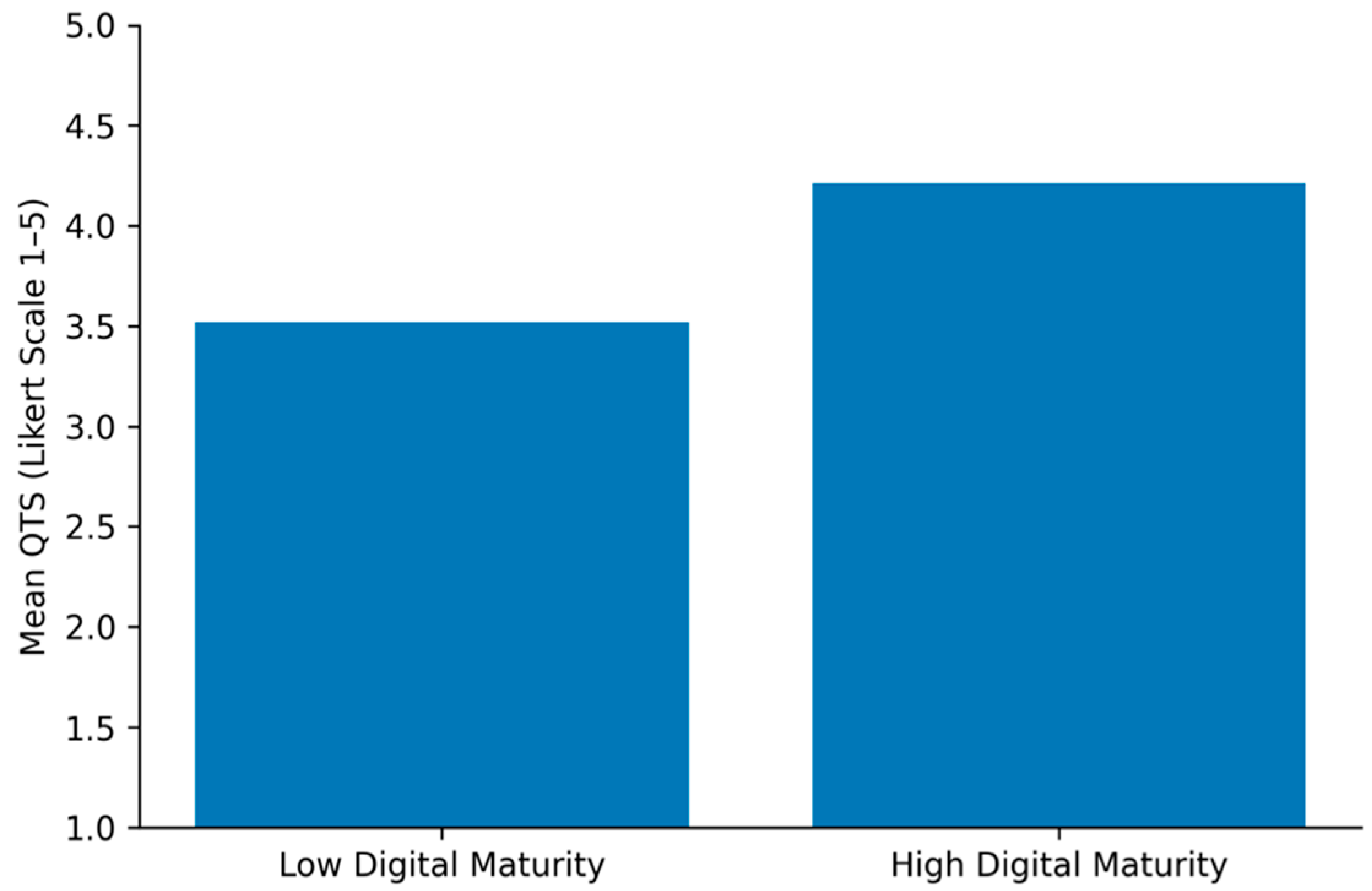
To test H3, a one-way analysis of variance (ANOVA) was conducted to examine differences in QTS across stakeholder groups differentiated by levels of digital maturity. The results reveal statistically significant differences among the examined groups (F = 12.45;
p < 0.01). The Tukey HSD post hoc test was utilized to determine the direction of the differences between the levels of digital maturity. The results indicated that stakeholders in destinations with high digital maturity achieved significantly higher mean scores in QTS (M = 4.21) compared to those with low digital maturity (M = 3.52,
p < 0.05). As the analysis focused on overall group differences, the findings are interpreted at the aggregate level. Based on the significant ANOVA result, H3 is supported. The magnitude of the difference between low and high digital maturity groups is visually illustrated in
Figure 4, highlighting the substantial variation in perceived QTS across maturity levels.
Overall, the results suggest that within the examined national context, digital transformation does not operate in isolation; rather, its impact on destination competitiveness operates primarily through improvements in QTS. This integrated perspective indicates that technological progress should be aligned with the sustainable use of local resources to enhance competitive positioning.
The regression modeling results summarized in
Table 4 indicate statistical support for the proposed hypotheses. To further examine the strength and direction of the relationships, the following section presents the regression findings assessing the relationships among DT, QTS, and COMP.
5. Conclusions
This study contributes to current research by empirically examining a mediation-oriented regression framework in which digital transformation enhances destination competitiveness through sustainability-driven quality formation in a transitional European economy. Drawing on survey data from 276 tourism stakeholders, the findings demonstrate that digital transformation operates not merely as a technological input, but as a governance-oriented integrator aligning environmental responsibility with quality enhancement across the tourism value chain. Rather than functioning as isolated technological adoption, digitalization emerges as a structural mechanism coordinating promotion, distribution, monitoring systems, and sustainability strategies. The results indicate that sustainability-oriented quality formation represents the primary pathway through which digital maturity translates into competitive advantage. Differences across digital maturity levels further suggest that digital transformation outcomes are closely associated with institutional capacity and infrastructure conditions, highlighting structural asymmetries within transitional development contexts. The study contributes theoretically by reframing digital transformation as a strategic integrator within sustainability-based competitiveness models, and methodologically by applying a mediation-oriented regression framework to examine indirect structural effects among key destination constructs. From a managerial and policy perspective, the findings underscore the necessity of aligning digital investments with environmental performance and service quality enhancement. Small and medium-sized enterprises are encouraged to strategically communicate sustainability initiatives through digital platforms to strengthen reputation and customer trust, while public authorities should prioritize digital skill development and institutional coordination mechanisms to reduce structural disparities. The empirical evidence provided in this study demonstrates that digital transformation alone does not guarantee competitiveness; rather, it becomes strategically effective only when embedded within sustainability-oriented quality governance structures. Overall, the study demonstrates that digital transformation and environmental responsibility constitute mutually reinforcing pillars of destination competitiveness, underpinning long-term sustainable tourism development within transitional economies. These findings suggest that in transitional economies, digital transformation should be conceptualized not as a standalone innovation strategy, but as a structurally embedded governance mechanism aligned with sustainability-oriented quality management.