
New Profiles and Needs of Wine Tourists in Italy—“Eno-Slow” Tourism?




Abstract
1. Introduction
2. Theoretical Framework
2.1. Background
2.2. Wine Tourism
Wine Routes in Italy and Sicily
- Wine Route of Terre Sicane, which runs between the Valley of the Temples and the whole province of Agrigento;
- Wine Route Val di Mazara;
- Wine Route Marsala-Terre d’Occidente, this itinerary ideally connects two geographically distant and separate territories: the westernmost tip of Sicily and the island of Pantelleria;
- Wine Route Erice Doc wine route from the city of Erice, founded by Trojan exiles and later one of the most beautiful medieval Arab–Norman towns in the world;
- Wine Route Alcamo Doc;
- Wine Route Monreale Doc, a territory that bewitches tourists with the architectural splendor of the Cathedral of Monreale, the greatest example of Norman architecture in Sicily;
- Wine Route on the road of the “Targa Florio,” in an area close to Madonie Park, characterized by the route of the Targa Florio, the most famous automobile races in the world;
- Wine Route of the Province of Messina with an itinerary around the archipelago of the Aeolian Islands (a UNESCO World Heritage Site);
- Wine Route of Etna, which spans around the largest volcano in Europe (Etna Mountain), now on the UNESCO list of World Heritage Sites;
- Wine Route Val di Noto, characterized by the presence of baroque towns;
- Wine Route of Cerasuolo di Vittoria, including the provinces of Ragusa and Syracuse, among the baroque beauties of another UNESCO World Heritage Site: La Villa del Casale with Cerasuolo di Vittoria DOCG wine;
- Wine Route of Castelli Nisseni (the Nisseni Castles) in the heart of Sicily;
- Strada del Vino e dei Sapori della Valle dei Templi (Route of Wines and Flavors of the Valley of the Temples) in Agrigento, including the famous archeological park “Valley of the Temples” (Greek temples), one of the sites declared as a UNESCO World Heritage Site.
2.3. Slow Tourism
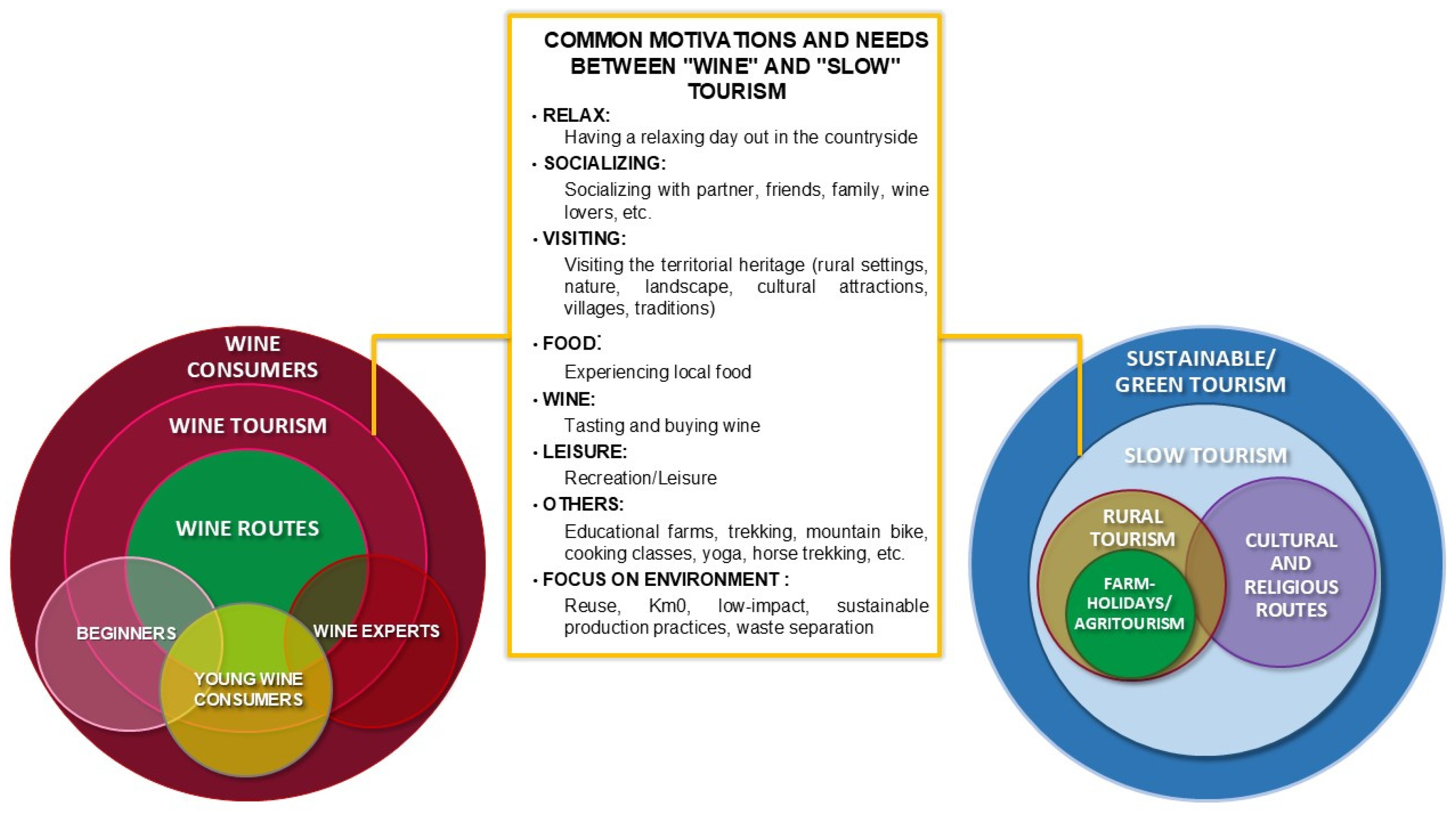
2.4. Eno-Slow Tourist Conceptual Framework
2.5. Hypotheses and Objectives
- Whether the traditional profiles of food and wine tourists have changed (after the COVID-19 pandemic);
- Whether there are any new profiles of food and wine tourists, with specific characteristics (e.g., age, income, etc.), behaviors (interests, lifestyles, etc.), preferences (favorite activities, communication channels, etc.), and needs;
- Whether interest in the typical characteristics of slow tourism (longer stays, focus on authenticity, choice of lesser-known destinations, sustainable mobility, support for the local economy, conscious approach, etc.) has increased among food and wine tourists or not (i.e., the hierarchy of motivations for visiting a winery along the Wine Routes may be changed).
3. Materials and Methods
3.1. Study Design
3.2. Tourist Sampling Design and Questionnaire
4. Results
The Profile of the Wine Tourist
5. Discussion
6. Conclusions
Author Contributions
Funding
Institutional Review Board Statement
Informed Consent Statement
Data Availability Statement
Conflicts of Interest
Abbreviations
| WRs | Wine Routes |
| SWRs | Sicilian Wine Routes |
References
- Alant, K., & Bruwer, J. (2004). Wine tourism behaviour in the context of a motivational framework for wine regions and cellar doors. Journal of Wine Research, 15(1), 27–37. [Google Scholar] [CrossRef]
- Alebaki, M., & Iakovidou, O. (2010). Segmenting the Greek wine tourism market using a motivational approach. New Medit, 9(4), 31–40. [Google Scholar]
- Alebaki, M., & Iakovidou, O. (2011). Market segmentation in wine tourism: A comparison of approaches. Tourismos, 6, 123–140. [Google Scholar] [CrossRef]
- Alebaki, M., Psimouli, M., Kladou, S., & Anastasiadis, F. (2022). Digital winescape and online wine tourism: Comparative insights from Crete and Santorini. Sustainability, 14(14), 8396. [Google Scholar] [CrossRef]
- Ali, F., Ryu, K., & Hussain, K. (2016). Influence of experiences on memories, satisfaction and behavioral intentions: A study of creative tourism. Journal of Travel & Tourism Marketing, 33(1), 85–100. [Google Scholar] [CrossRef]
- Alonso, A. D., & Liu, Y. (2011). The potential for marrying local gastronomy and wine: The case of the ‘fortunate islands’. International Journal of Hospitality Management, 30(4), 974–981. [Google Scholar] [CrossRef]
- Altamore, L., Ingrassia, M., Chironi, S., Columba, P., Sortino, G., Vukadin, A., & Bacarella, S. (2018). Pasta experience: Eating with the five senses—A pilot study. AIMS Agriculture and Food, 3(4), 493–520. [Google Scholar] [CrossRef]
- Associazione Italiana Turismo Enogastronomico. (2025). Available online: https://www.robertagaribaldi.it/rapporto-sul-turismo-enogastronomico-italiano/ (accessed on 13 September 2025).
- Associazione Nazionale Città del Vino. (2025). Available online: https://cittadelvino.com/ (accessed on 13 September 2025).
- Bacco, M., Barsocchi, P., Ferro, E., Gotta, A., & Ruggeri, M. (2019). The digitisation of agriculture: A survey of research activities on smart farming. Array, 3, 100009. [Google Scholar] [CrossRef]
- Back, R. M., Bufquin, D., & Park, J.-Y. (2021). Why do they come back? The effects of winery tourists’ motivations and satisfaction on the number of visits and revisit intentions. International Journal of Hospitality & Tourism Administration, 22(1), 1–25. [Google Scholar] [CrossRef]
- Beames, G. (2003). The Rock, the Reef and the grape: The challenges of developing wine tourism in regional Australia. Journal of Vacation Marketing, 9(3), 205–212. [Google Scholar] [CrossRef]
- Bekar, A., & Benzergil, N. (2025). The profile of wine tourists and the factors affecting their wine-related attitudes: The case of Türkiye. Tourism and Hospitality, 6(3), 132. [Google Scholar] [CrossRef]
- Bella, G. (2018). Estimating the tourism induced environmental Kuznets curve in France. Journal of Sustainable Tourism, 26(12), 2043–2052. [Google Scholar] [CrossRef]
- Bellia, C., Columba, P., & Ingrassia, M. (2022). The brand–land identity of Etna Volcano valley wines: A policy Delphi study. Agriculture, 12(6), 811. [Google Scholar] [CrossRef]
- Bellia, C., Scavone, V., & Ingrassia, M. (2021). Food and religion in Sicily—A new green tourist destination by an ancient route from the past. Sustainability, 13(12), 6686. [Google Scholar] [CrossRef]
- Bonarou, C., Tsartas, P., & Sarantakou, E. (2019). E-storytelling and wine tourism branding: Insights from the “Wine Roads of Northern Greece”. In M. Sigala, & R. N. S. Robinson (Eds.), Wine tourism destination management and marketing: Theory and cases (pp. 77–98). Springer International Publishing. [Google Scholar] [CrossRef]
- Brida, J. G., Matesanz Gómez, D., & Segarra, V. (2020). On the empirical relationship between tourism and economic growth. Tourism Management, 81, 104131. [Google Scholar] [CrossRef]
- Bruwer, J. (2003). South African wine routes: Some perspectives on the wine tourism industry’s structural dimensions and wine tourism product. Tourism Management, 24(4), 423–435. [Google Scholar] [CrossRef]
- Bruwer, J., & Alant, K. (2009). The hedonic nature of wine tourism consumption: An experiential view. International Journal of Wine Business Research, 21(3), 235–257. [Google Scholar] [CrossRef]
- Bruwer, J., Coode, M., Saliba, A., & Herbst, F. (2013). Wine tourism experience effects of the tasting room on consumer brand loyalty. Tourism Analysis, 18(4), 399–414. [Google Scholar] [CrossRef]
- Bruwer, J., & Rueger-Muck, E. (2019). Wine tourism and hedonic experience: A motivation-based experiential view. Tourism and Hospitality Research, 19(4), 488–502. [Google Scholar] [CrossRef]
- Byrd, E. T., Canziani, B., (Jerrie) Hsieh, Y.-C., Debbage, K., & Sonmez, S. (2016). Wine tourism: Motivating visitors through core and supplementary services. Tourism Management, 52, 19–29. [Google Scholar] [CrossRef]
- Carvalho, M., Kastenholz, E., & Carneiro, M. J. (2021). Pairing co-creation with food and wine experiences—A holistic perspective of tourist experiences in Dão, a Portuguese wine region. Sustainability, 13(23), 13416. [Google Scholar] [CrossRef]
- Charters, S., & Ali-Knight, J. (2002). Who is the wine tourist? Tourism Management, 23(3), 311–319. [Google Scholar] [CrossRef]
- Chen, C.-W., Chih, M., & Nguyen, D. T. T. (2025). YouTube video travel influencers’ role in shaping wishful traveling through social comparison processes. Tourism Review. [Google Scholar] [CrossRef]
- Chironi, S., Altamore, L., Columba, P., Bacarella, S., & Ingrassia, M. (2020). Study of Wine Producers’ Marketing Communication in Extreme Territories–Application of the AGIL Scheme to Wineries’ Website Features. Agronomy, 10(5), 721. [Google Scholar] [CrossRef]
- Cittaslow. (2025). Available online: https://www.cittaslow.org/ (accessed on 2 January 2026).
- Clemente-Ricolfe, J.-S., Escribá-Pérez, C., Rodriguez-Barrio, J.-E., & Buitrago-Vera, J.-M. (2012). The potential wine tourist market: The case of Valencia (Spain). Journal of Wine Research, 23(2), 185–202. [Google Scholar] [CrossRef]
- Colombini, D. C. (2015). Wine tourism in Italy. International Journal of Wine Research, 7, 29–35. [Google Scholar] [CrossRef]
- Contreras, D. D. J., & Medina, F. X. (2021). Food and wine tourism in rural areas: A critical theoretical reflection from the anthropology of food perspectives. International Journal of Tourism Anthropology, 8(4), 416–435. [Google Scholar] [CrossRef]
- Cucculelli, M., & Goffi, G. (2016). Does sustainability enhance tourism destination competitiveness? Evidence from Italian destinations of excellence. Special Volume: Sustainable Tourism: Progress, Challenges and Opportunities, 111, 370–382. [Google Scholar] [CrossRef]
- Cunha, D., Kastenholz, E., & Silva, C. (2023). Analyzing diversity amongst visitors of Portuguese wine routes based on their wine involvement. International Journal of Wine Business Research, 35(1), 121–141. [Google Scholar] [CrossRef]
- Dayoub, B., Yang, P., Dayoub, A., Omran, S., & Li, H. (2020). The role of cultural routes in sustainable tourism development: A case study of Syria’s spiritual route. International Journal of Sustainable Development and Planning, 15(6), 865–874. [Google Scholar] [CrossRef]
- Demirović Bajrami, D., Radosavac, A., Cimbaljević, M., Tretiakova, T. N., & Syromiatnikova, Y. A. (2020). Determinants of residents’ support for sustainable tourism development: Implications for rural communities. Sustainability, 12(22), 9438. [Google Scholar] [CrossRef]
- Dias, A., Sousa, B., Santos, V., Ramos, P., & Madeira, A. (2023). Wine tourism and sustainability awareness: A consumer behavior perspective. Sustainability, 15(6), 5182. [Google Scholar] [CrossRef]
- Dickinson, J., & Lumsdon, L. (2010). Slow travel and tourism (1st ed.). Routledge. [Google Scholar] [CrossRef]
- Dixit, S. K., Sigala, M., & Robinson, R. (2019). Management and marketing of wine tourism business: Theory, practice, and cases. Information Technology & Tourism, 21(1), 135–137. [Google Scholar] [CrossRef]
- Du, Y., & Morrish, S. C. (2025). Understanding the wine consumption behaviour of young Chinese consumers. Beverages, 11(4), 109. [Google Scholar] [CrossRef]
- Esau, D., & Senese, D. M. (2022). Consuming location: The sustainable impact of transformational experiential culinary and wine tourism in Chianti Italy. Sustainability, 14, 7012. [Google Scholar] [CrossRef]
- Fauzi, M. A. (2025). Sustainable tourism and sustainable development goals (SDGs): A state-of-the-art review of past, present, and future trends. Environment, Development and Sustainability, 27(2), 2841–2862. [Google Scholar] [CrossRef]
- Festa, G., Shams, S. M. R., Metallo, G., & Cuomo, M. T. (2020). Opportunities and challenges in the contribution of wine routes to wine tourism in Italy—A stakeholders’ perspective of development. Tourism Management Perspectives, 33, 100585. [Google Scholar] [CrossRef]
- Figueroa, B. E., & Rotarou, E. S. (2018). Challenges and opportunities for the sustainable development of the wine tourism sector in Chile. Journal of Wine Research, 29(4), 243–264. [Google Scholar] [CrossRef]
- Gao, J., Xu, W., & Zhang, L. (2021). Tourism, economic growth, and tourism-induced EKC hypothesis: Evidence from the Mediterranean region. Empirical Economics, 60(3), 1507–1529. [Google Scholar] [CrossRef]
- García-Rodea, L. F., Thomé-Ortiz, H., Espinoza-Ortega, A., & de Alcântara Bittencourt-César, P. (2022). Viniculture and tourism in the new world of wine: A literature review from the American continent. Wine Economics and Policy, 11(1), 127–140. [Google Scholar] [CrossRef]
- Gázquez-Abad, J. C., Huertas-García, R., Vázquez-Gómez, M. D., & Casas Romeo, A. (2015). Drivers of sustainability strategies in Spain’s wine tourism industry. Cornell Hospitality Quarterly, 56(1), 106–117. [Google Scholar] [CrossRef]
- Getz, D., & Brown, G. (2006). Critical success factors for wine tourism regions: A demand analysis. Tourism Management, 27(1), 146–158. [Google Scholar] [CrossRef]
- Gilinsky, J., Newton, S. K., Atkin, T. S., Santini, C., Cavicchi, A., Casas, A. R., & Huertas, R. (2015). Perceived efficacy of sustainability strategies in the US, Italian, and Spanish wine industries: A comparative study. International Journal of Wine Business Research, 27, 164–181. [Google Scholar] [CrossRef]
- Grimstad, S., & Burgess, J. (2014). Environmental sustainability and competitive advantage in a wine tourism micro-cluster. Management Research Review, 37(6), 553–573. [Google Scholar] [CrossRef]
- Hall, C. M. (2019). Constructing sustainable tourism development: The 2030 agenda and the managerial ecology of sustainable tourism. Journal of Sustainable Tourism, 27(7), 1044–1060. [Google Scholar] [CrossRef]
- Hall, C. M., & Prayag, G. (2017). Special issue: Wine tourism: Moving beyond the cellar door? International Journal of Wine Business Research, 29(4), 338–502. [Google Scholar] [CrossRef]
- Heitmann, S., Robinson, P., & Povey, G. (2011). Slow food, slow cities and slow tour-ism. CABI, 114–127. [Google Scholar] [CrossRef]
- Higgins-Desbiolles, F. (2018). Sustainable tourism: Sustaining tourism or something more? Tourism Management Perspectives, 25, 157–160. [Google Scholar] [CrossRef]
- Hira, A., & Swartz, T. (2014). What makes Napa Napa? The roots of success in the wine industry. Wine Economics and Policy, 3(1), 37–53. [Google Scholar] [CrossRef]
- Hjalager, A.-M., & Richards, G. (2002). Tourism and gastronomy (Vol. 11). Routledge. Available online: https://www.researchgate.net/profile/Greg-Richards-2/publication/239844909_Gastronomy_an_essential_ingredient_in_tourism_production_and_consumption/links/556c435008aefcb861d63a35/Gastronomy-an-essential-ingredient-in-tourism-production-and-consumption.pdf (accessed on 2 January 2026).
- Hojman, D. E., & Hunter-Jones, P. (2012). Wine tourism: Chilean wine regions and routes. Journal of Business Research, 65(1), 13–21. [Google Scholar] [CrossRef]
- Ingrassia, M., Altamore, L., Bacarella, S., Bellia, C., Columba, P., & Chironi, S. (2022a). Influence of coherent context for positioning distinctive and iconic Sicilian sparkling wines: Effect of a sensorial experience on a gulet. Journal of International Food & Agribusiness Marketing, 34(2), 144–175. [Google Scholar] [CrossRef]
- Ingrassia, M., Altamore, L., Bacarella, S., Columba, P., & Chironi, S. (2020). The wine influencers: Exploring a new communication model of open innovation for wine producers—A netnographic, factor and AGIL analysis. Journal of Open Innovation: Technology, Market, and Complexity, 6(4), 165. [Google Scholar] [CrossRef]
- Ingrassia, M., Altamore, L., Bellia, C., Grasso, G. L., Silva, P., Bacarella, S., Columba, P., & Chironi, S. (2022b). Visitor’s motivational framework and wine routes’ contribution to sustainable agriculture and tourism. Sustainability, 14(19), 12082. [Google Scholar] [CrossRef]
- Ingrassia, M., Altamore, L., Columba, P., Bacarella, S., & Chironi, S. (2019). The wine routes in Sicily as a tool for rural development: An exploratory analysis (pp. 1785–1792). CABI Databases. Available online: https://www.cabidigitallibrary.org/doi/full/10.5555/20203191871 (accessed on 13 September 2025).
- Ingrassia, M., Bacarella, S., Altamore, L., Sortino, G., & Chironi, S. (2018). Consumer acceptance and primary drivers of liking for small fruits. In Acta horticulturae (pp. 1147–1154). International Society for Horticultural Science (ISHS). [Google Scholar] [CrossRef]
- Ingrassia, M., Bacarella, S., Bellia, C., Columba, P., Adamo, M. M., Altamore, L., & Chironi, S. (2023). Circular economy and agritourism: A sustainable behavioral model for tourists and farmers in the post-COVID era. Frontiers in Sustainable Food Systems, 7, 1174623. [Google Scholar] [CrossRef]
- Ingrassia, M., Bellia, C., Giurdanella, C., Columba, P., & Chironi, S. (2022c). Digital influencers, food and tourism—A new model of open innovation for businesses in the Ho.Re.Ca. sector. Journal of Open Innovation: Technology, Market, and Complexity, 8(1), 50. [Google Scholar] [CrossRef]
- Ingrassia, M., & Chironi, S. (2010). Studio dell’attrattività delle strade del vino in Sicilia. Una analisi fattoriale per lo studio delle motivazioni che inducono i turisti a visitare le cantine, secondo il parere dei soggetti qualificati. Italus Hortus, 17, 260–266. [Google Scholar]
- I.R.V.O. Istituto Regionale del Vino e dell’Olio. (2025). Available online: https://www.irvos.it/dati-settore-vitivinicolo/ (accessed on 13 September 2025).
- Jiménez-Castillo, D., & Sánchez-Fernández, R. (2019). The role of digital influencers in brand recommendation: Examining their impact on engagement, expected value and purchase intention. International Journal of Information Management, 49, 366–376. [Google Scholar] [CrossRef]
- Karafolas, S. (2007). Wine roads in Greece: A cooperation for the development of local tourism in rural areas. Journal of Rural Cooperation, 35(1), 71–90. [Google Scholar] [CrossRef]
- Kastenholz, E., Paço, A., & Nave, A. (2022). Wine tourism in rural areas—Hopes and fears amongst local residents. Worldwide Hospitality and Tourism Themes, 15(1), 29–40. [Google Scholar] [CrossRef]
- Knox, P. L. (2005). Creating ordinary places: Slow cities in a fast world. Journal of Urban Design, 10(1), 1–11. [Google Scholar] [CrossRef]
- Kostilnikova, K., Matlovicova, K., Demkova, M., Mocak, P., Mishra, P. K., Bujdoso, Z., Matlovic, R., & Zawilinska, B. (2022). Slow travel in tourism—An outline of conceptual frameworks: Potential and limits in the context of post-pandemic recovery. GeoJournal of Tourism and Geosites, 42(Suppl. 2), 751–758. [Google Scholar] [CrossRef]
- Kritikos, A., Magoutas, A., & Poulaki, P. (2025). Sustainable Tourism and regional development through innovation in the Post-COVID-19 era: The case of hersonissos and chios. Tourism and Hospitality, 6(3), 134. [Google Scholar] [CrossRef]
- LEGGE 27 luglio. (1999). n. 268 Disciplina delle “strade del vino”. (GU n.185 del 9-8-1999). Available online: https://www.gazzettaufficiale.it/eli/id/1999/08/09/099G0344/sg (accessed on 13 September 2025).
- L’Organizzazione Internazionale della Vigna e del Vino. (2022). OIV State of the world vine and wine sector in 2022. Available online: https://www.oiv.int/sites/default/files/documents/OIV_State_of_the_world_Vine_and_Wine_sector_in_2022_2.pdf (accessed on 13 September 2025).
- López-Guzmán, T., Vieira-Rodríguez, A., & Rodríguez-García, J. (2014). Profile and motivations of European tourists on the sherry wine route of Spain. Tourism Management Perspectives, 11, 63–68. [Google Scholar] [CrossRef]
- Martínez-Falcó, J., Sánchez-García, E., Marco-Lajara, B., & Georgantzis, N. (2024). The interplay between competitive advantage and sustainability in the wine industry: A bibliometric and systematic review. Discover Sustainability, 5(1), 13. [Google Scholar] [CrossRef]
- Meng, B., & Choi, K. (2016). The role of authenticity in forming slow tourists’ intentions: Developing an extended model of goal-directed behaviour. Tourism Management, 57, 397–410. [Google Scholar] [CrossRef]
- Moira, P., Mylonopoulos, D., & Kondoudaki, A. (2017). The application of slow movement to tourism: Is slow tourism a new paradigm? Journal of Tourism and Leisure Studies, 2(2), 1. [Google Scholar] [CrossRef]
- Molina, A., Gómez, M., González-Díaz, B., & Esteban, Á. (2015). Market segmentation in wine tourism: Strategies for wineries and destinations in Spain. Journal of Wine Research, 26(3), 192–224. [Google Scholar] [CrossRef]
- Montella, M. M. (2017). Wine tourism and sustainability: A review. Sustainability, 9(1), 113. [Google Scholar] [CrossRef]
- Movimento del Turismo del Vino, Guida al Turismo del Vino. (2025). Available online: https://movimentoturismovino.it/ (accessed on 13 September 2025).
- National Observatory of Wine Tourism. (2024). Censis-association of wine cities, report 2024. Available online: https://cittadelvino.com/wp-content/uploads/2024/05/240408-Nomisma_1-Valore-potenziale-enoturismo-in-Italia.pdf (accessed on 13 September 2025).
- Nomisma Wine Monitor. (2025). Available online: https://www.nomisma.it/soluzioni/ricerca/osservatori-abbonamento/osservatorio-wine-monitor/ (accessed on 13 September 2025).
- Nosi, C., & Zanni, L. (2004). Moving from “typical products” to “food-related services”: The slow food case as a new business paradigm. British Food Journal, 106(10–11), 779–792. [Google Scholar] [CrossRef]
- Nunkoo, R., Seetanah, B., Jaffur, Z. R. K., Moraghen, P. G. W., & Sannassee, R. V. (2020). Tourism and economic growth: A meta-regression analysis. Journal of Travel Research, 59(3), 404–423. [Google Scholar] [CrossRef]
- Pahrudin, P., Liu, L.-W., & Li, S.-Y. (2022). What is the role of tourism management and marketing toward sustainable tourism? A bibliometric analysis approach. Sustainability, 14(7), 4226. [Google Scholar] [CrossRef]
- Pappalardo, G., Sisto, R., & Pecorino, B. (2018). Is the partnership governance able to promote endogenous rural development? A preliminary assessment under the adaptive co-management approach. European Countryside, 10(4), 543–565. [Google Scholar] [CrossRef]
- Paramati, S. R., Alam, M. S., & Chen, C.-F. (2017). The effects of tourism on economic growth and CO2 Emissions: A comparison between developed and developing economies. Journal of Travel Research, 56(6), 712–724. [Google Scholar] [CrossRef]
- Peña-Sánchez, A. R., Ruiz-Chico, J., Jiménez-García, M., & López-Sánchez, J. A. (2020). Tourism and the SDGs: An analysis of economic growth, decent employment, and gender equality in the European Union (2009–2018). Sustainability, 12(13), 5480. [Google Scholar] [CrossRef]
- Peris-Ortiz, M., Del Río Rama, M. d. l. C., & Rueda-Armengot, C. (2016). Wine and tourism. Springer. Available online: https://link.springer.com/book/10.1007/978-3-319-18857-7 (accessed on 2 January 2026).
- Petrini, C., Watson, B., & Slow Food Editore. (2001). Slow food: Collected thoughts on taste, tradition, and the honest pleasures of food. Chelsea Green Pub. Available online: https://books.google.it/books?id=L1zdmAEACAAJ (accessed on 2 January 2026).
- Pérez-Romero, M. E., Jiménez-Islas, D., Álvarez-García, J., & de la Cruz del Río-Rama, M. (2025). Wine tourism and sustainable territorial development: Analysis of worldwide scientific coverage. In H. Albuquerque, I. Freitas, & G. A. Gardner (Eds.), Wine tourism and landscapes: Challenges and opportunities for a sustainable approach (pp. 95–115). Springer Nature. [Google Scholar] [CrossRef]
- Poitras, L., & Donald, G. (2006). Sustainable wine tourism: The host community perspective. Journal of Sustainable Tourism, 14(5), 425–448. [Google Scholar] [CrossRef]
- Regione Sicilia Legge Regionale 2 agosto. (2002). n. 5 Istituzione delle strade e delle rotte del vino. Norme urgenti sull’ inventario viticolo della Sicilia. Altre disposizioni per il settore agricolo. (GU n.46 del 16-11-2002). Available online: https://www.gazzettaufficiale.it/eli/id/2002/11/16/002R0657/s3 (accessed on 13 September 2025).
- Reyes, C. (2012). The satisfaction of wine tourist: Causes and effects: Supervisor: Dr. Alfonso Vargas Sánchez institution awarding the Ph.D. degree: University of Huelva, Spain th Date of defence: 22 September 2011. European Journal of Tourism Research, 5(1), 80–83. [Google Scholar] [CrossRef]
- Ruiz Pulpón, Á. R., & Cañizares Ruiz, M. d. C. (2025). The European wine tourism charter and its link with wine museums in Spain. Tourism and Hospitality, 6(3), 128. [Google Scholar] [CrossRef]
- Santini, C., Cavicchi, A., & Casini, L. (2013). Sustainability in the wine industry: Key questions and research trendsa. Agricultural and Food Economics, 1(1), 9. [Google Scholar] [CrossRef]
- Serdane, Z. (2020). Slow philosophy in tourism development in Latvia: The supply side perspective. Tourism Planning & Development, 17(3), 295–312. [Google Scholar] [CrossRef]
- Séraphin, H., Gladkikh, T., & Vo Thanh, T. (2020). Overtourism (Vol. 448). Springer. [Google Scholar]
- Sharples, L., Cambourne, B., & Macionis, N. (2000). Wine tourism around the world: Development, management and markets. Routledge. [Google Scholar] [CrossRef]
- Sigala, M., & Robinson, R. N. (2019). Management and marketing of wine tourism business. Springer. Available online: https://link.springer.com/book/10.1007/978-3-319-75462-8 (accessed on 30 December 2025).
- Smith, S., & Costello, C. (2009). Segmenting visitors to a culinary event: Motivations, travel behaviour, and expenditures. Journal of Hospitality Marketing & Management, 18(1), 44–67. [Google Scholar] [CrossRef]
- Taplin, I. M. (2021). The Napa Valley wine industry: The organisation of excellence. Cambridge Scholars Publishing. Available online: https://books.google.it/books?id=UdczEAAAQBAJ (accessed on 2 January 2026).
- Tavares, C., & Azevedo, A. (2011). Generation x and y expectations about wine tourism experiences: Douro (Portugal) versus Napa valley (USA). Tourism & Management Studies, 1, 259–269. [Google Scholar]
- Tănase, M. O., Dina, R., Isac, F.-L., Rusu, S., Nistoreanu, P., & Mirea, C. N. (2022). Romanian wine tourism—A paved road or a footpath in rural tourism? Sustainability, 14(7), 4026. [Google Scholar] [CrossRef]
- Trigo, A., & Silva, P. (2022). Sustainable development directions for wine tourism in Douro wine region, Portugal. Sustainability, 14(7), 3949. [Google Scholar] [CrossRef]
- Vaquero-Piñeiro, C., Henke, R., Cimino, O., & Sardone, R. (2025). Wine and tourism: An analysis of synergies in Italy. Tourism Economics. [Google Scholar] [CrossRef]
- Vázquez Vicente, G., Martín Barroso, V., & Blanco Jiménez, F. J. (2021). Sustainable tourism, economic growth and employment—The case of the wine routes of Spain. Sustainability, 13(13), 7164. [Google Scholar] [CrossRef]
- Vecchio, R., Annunziata, A., & Bouzdine-Chameeva, T. (2024). How to promote sustainable wine tourism: Insights from Italian and French young adults. Annals of Tourism Research Empirical Insights, 5(2), 100137. [Google Scholar] [CrossRef]
- Werner, K., Griese, K.-M., & Bosse, C. (2021). The role of slow events for sustainable destination development: A conceptual and empirical review. Journal of Sustainable Tourism, 29(11–12), 1913–1931. [Google Scholar] [CrossRef]
- Winery Tasting Sicily. (2025). Available online: https://www.winerytastingsicily.com/magazine/it/notizie/nasce-la-federazione-strade-del-vino-dellolio-e-dei-sapori-di-sicilia/ (accessed on 13 September 2025).
- WTM Global Travel Report. (2024). In association with tourism economics. Available online: https://tourismanalytics.com/uploads/1/2/0/4/120443739/wtm-global-travel-report-2024.pdf.coredownload.307954965.pdf (accessed on 13 September 2025).
- WTO, UN Tourism, UN Tourism Barometer. (2025). Available online: https://pre-webunwto.s3.eu-west-1.amazonaws.com/s3fs-public/2025-11/World_Tourism%20Barometer_Nov25_en_excerpt.pdf?VersionId=ETZAIrkrEG8_lWh5.Mi7iMlehB4Kisc6 (accessed on 13 September 2025).
- Yadav, M. K., & Dixit, S. K. (2022). The growth and evolution of global wine tourism. In Routledge handbook of wine tourism (pp. 15–28). Taylor & Francis. Available online: https://www.taylorfrancis.com/chapters/edit/10.4324/9781003143628-3/growth-evolution-global-wine-tourism-manoj-kumar-yadav-saurabh-kumar-dixit (accessed on 2 January 2026).


| Variables | Categories | Frequences |
|---|---|---|
| Gender | Female | 46% |
| Male | 54% | |
| Range of age | 20–30 yrs old | 20% |
| 31–40 yrs old | 45% | |
| 41–50 yrs old | 16% | |
| 51–60 yrs old | 12% | |
| 61–70 yrs old (and older) | 7% | |
| Origin | Italy | 39% |
| Europe (France, Germany, Switzerland, Netherlands, Belgium, Austria, Sweden) | 36% | |
| USA | 23% | |
| Other | 2% | |
| Employment | Professional/manager | 11% |
| Civil servant | 23% | |
| Worker/trader/craftsman | 5% | |
| Self-employed | 21% | |
| Student (full-time) | 13% | |
| Retired | 8% | |
| Unemployed | 12% | |
| Other | 7% | |
| Level of education | High school or lower | 3% |
| Some college without a degree | 48% | |
| Bachelor’s degree | 44% | |
| Postgraduate degree | 5% | |
| Annual family income | Less than €25,000 | 14% |
| €25,000–€50,000 | 55% | |
| More than €50,000 | 31% |
| Variables | Categories | Percentages |
|---|---|---|
| Type of holiday | Wine tourism/other vacation with parents/friends, do-it-yourself via the internet | 22% |
| Wine tourism/other vacation with parents/friends, organized tour | 48% | |
| Day trip | 71% | |
| Information channels | Brochures and leaflets in hotels | 3% |
| Tourist guides/Tour operator/Travel agencies | 23% | |
| Tourist information points | 19% | |
| Specialized wine magazines | 8% | |
| Newspapers, periodicals, magazines | 4% | |
| Billboards in airports and along roads/highways | - | |
| Websites/social networks of wine routes/wineries | 19% | |
| Websites/social networks and online platforms | 21% | |
| Other | 3% | |
| Wine consumption | Frequent | 35% |
| Regular | 35% | |
| Occasional | 30% | |
| Type of consumer considered to be | “Wine experts” | 37% |
| Average consumer | 28% | |
| Newcomer | 35% |
| Order of Presentation of Variables to Respondents | Motivations/Needs | Mean of Scores Given to the Variables | Standard Deviation |
|---|---|---|---|
| 4 | To enjoy the experience of a winery visit | 9.60 | 1.362 |
| 7 | To experience local food and wine | 9.52 | 2.785 |
| 14 | To have a relaxing day (or weekend) out | 9.21 | 2.254 |
| 12 | To visit cultural attractions and rural settings of the territory | 8.93 | 2.896 |
| 5 | Because I knew a specific Sicilian wine brand and I want to experience the winery personally | 8.69 | 2.214 |
| 1 | Tasting and buying food and wine | 8.35 | 2.023 |
| 10 | Socializing with other wine lovers | 7.88 | 2.362 |
| 11 | Socializing with partner, friends, family, and/or local inhabitants | 7.66 | 2.148 |
| 6 | Winery tour | 7.35 | 2.654 |
| 2 | To visit the winery and learn about the winemaking | 7.29 | 2.745 |
| 3 | To enjoy new/special wines | 7.06 | 2.614 |
| 8 | To learn about wines and wine production (focus on sustainability) from the winemaker | 6.94 | 2.789 |
| 9 | To have information about wine prices and how to buy wines | 6.84 | 2.895 |
| 13 | Recreation/Leisure (walks, picnics, lunches in the vineyard, sensory trails, wine painting, educational farms, trekking, mountain bike, cooking classes, yoga, horse trekking, etc.) | 6.63 | 3.648 |
| 15 | Other complementary activities (hobbies, congresses, events, celebrations, work conventions, etc.) | 3.63 | 3.349 |
| 16 | Because the winery is associated with a Wine Route | 3.27 | 2.316 |
| Variables | Main Profiles of Wine Consumers | ||
|---|---|---|---|
| Wine Experts | Beginners | Young Wine Tourists | |
| Age | Senior | Intergenerational | Youngsters |
| Main benefit sought | High quality and prestigious research | Progressive learning | Immediate and emotional sharing |
| Behavior | Habitual, immersive, and contemplative behavior | Curious and exploratory behavior | Social, digital, and sharing behavior, connection between tradition and innovation |
| Information sources | Specialized and authoritative sources | Accessible and practical sources | Fast, interactive digital sources |
| Product knowledge | Expert knowledge | Basic knowledge | Superficial knowledge and curious attitude |
| Frequency of travel | Regular | Accidental and occasional | Regular, occasional, and accidental |
Disclaimer/Publisher’s Note: The statements, opinions and data contained in all publications are solely those of the individual author(s) and contributor(s) and not of MDPI and/or the editor(s). MDPI and/or the editor(s) disclaim responsibility for any injury to people or property resulting from any ideas, methods, instructions or products referred to in the content. |
© 2026 by the authors. Licensee MDPI, Basel, Switzerland. This article is an open access article distributed under the terms and conditions of the Creative Commons Attribution (CC BY) license.
Share and Cite
Ingrassia, M.; Bacarella, S.; Galluzzo, S.; Chironi, S. New Profiles and Needs of Wine Tourists in Italy—“Eno-Slow” Tourism? Tour. Hosp. 2026, 7, 25. https://doi.org/10.3390/tourhosp7010025
Ingrassia M, Bacarella S, Galluzzo S, Chironi S. New Profiles and Needs of Wine Tourists in Italy—“Eno-Slow” Tourism? Tourism and Hospitality. 2026; 7(1):25. https://doi.org/10.3390/tourhosp7010025
Chicago/Turabian StyleIngrassia, Marzia, Simona Bacarella, Sandro Galluzzo, and Stefania Chironi. 2026. "New Profiles and Needs of Wine Tourists in Italy—“Eno-Slow” Tourism?" Tourism and Hospitality 7, no. 1: 25. https://doi.org/10.3390/tourhosp7010025
APA StyleIngrassia, M., Bacarella, S., Galluzzo, S., & Chironi, S. (2026). New Profiles and Needs of Wine Tourists in Italy—“Eno-Slow” Tourism? Tourism and Hospitality, 7(1), 25. https://doi.org/10.3390/tourhosp7010025