Article

When Growth Impedes Resort Renewal: A Path Dependence Perspective on the Impact of Scarce Resources on Product Innovation in Atami, Japan


1
Graduate Program in Sustainability Science, The University of Tokyo, Rm 761, Building of Environmental Studies, 5-1-5 Kashiwanoha, Kashiwa 277-8563, Chiba, Japan
2
Sustainable Society Design Center, Graduate School of Frontier Sciences, The University of Tokyo, Room 212, General Research Building 2, 5-1-5 Kashiwanoha, Kashiwa 277-8589, Chiba, Japan
3
Department of International Studies, The University of Tokyo, Rm 770, Building of Environmental Studies, 5-1-5 Kashiwanoha, Kashiwa 277-8563, Chiba, Japan
*
Author to whom correspondence should be addressed.
Tour. Hosp. 2026, 7(1), 3; https://doi.org/10.3390/tourhosp7010003
Submission received: 8 November 2025 / Revised: 14 December 2025 / Accepted: 18 December 2025 / Published: 23 December 2025
(This article belongs to the Special Issue Sustainability of Tourism Destinations)

Abstract

The Tourism Area Life Cycle shaped tourism research for decades, but its concepts Product Life Cycle and Carrying Capacity remain problematic. We apply a Path Dependence frame under an Urban Growth Machine Theory lens to explore the effects of growth pressure and resource undersupply on the decline and rejuvenation of Japan’s former premier hot spring resort Atami. We conduct structured data collection utilizing sampling and coding methods to collect quantitative and qualitative data from primary and secondary sources, reconstructing Atami’s development paths. Findings suggest that growth pressure conflicted with local supply such as land, water, labor and created negative externalities, most notably high prices. Decision makers’ uncompromising focus on growth aggravated displacement of key actors, disrupting local communities and undermining the human agency needed for small-scale product innovation; empowered associations obstructing promotion and diversification efforts; encouraged extreme specialization depriving Atami of new independent businesses; and drove local opposition to major new projects, thereby stalling product renewal. The framework helped recontextualize Atami’s recovery and demonstrated the value of directly incorporating factors of capacity into analysis. Results link displacement to long-term sustainability risks affecting ‘replaceable’ resorts reliant on innovation. Unencumbered access to local resources for residents (housing, training) is proposed as mitigation.

1. Introduction

For more than four decades Butler’s (2006) Tourism Area Life Cycle (TALC) model has played a pivotal role in shaping tourism research (Che, 2018, p. 164). The model depicts the typical path of tourism resort growth and change (Lagiewski, 2006), by linking a destination’s appeal and longevity to two key factors: the management of local resources (Carrying Capacity, CC) and the resort’s relative obsolescence compared to newer competitors (Product Life Cycle, PLC) (Butler, 2006, pp. 5, 10). Recently, TALC research entered a new phase, aiming for deeper integration with Evolutionary Economic Geography (EEG) (Butler, 2025, p. 604). Incorporating EEG offers an opportunity to move beyond PLC and CC and circumvent several of their recognized shortcomings (Dodds, 2024). Consequently, this manuscript builds on Brouder’s (2017, p. 444) proposal to use “[…] sustainable development as a critical lens on EEG […]” by introducing a Path Dependence frame under an Urban Growth Machine Theory (UGM) lens. UGM theory examines the antagonistic relation between residents and property owners, explaining why and how urban places grow (Farahani, 2017, p. 1). The proposed framework is demonstrated through the case of Atami—once Japan’s premier hot spring resort—by examining its decline, subsequent revitalization, and the impact of capacity-related factors in shaping the resort cycle.
The resort cycle can be seen as a combination of multiple overlapping product cycles such as lodgings, restaurants, etc., coexisting at different life cycle stages within the same destination (Butler, 2024b, p. 232; McKercher & Wong, 2024, p. 303). Stagnation and decline, as captured by the TALC, can thus be understood as the result of an internal failure to capture new markets by renewing (process innovation) or replacing (product innovation) older cycles (Butler, 2024c, pp. 332–333; Albaladejo & Martínez-García, 2017, pp. 395–396; McKercher & Wong, 2024, p. 307).
The aggregation of individual product cycles shapes a resort’s evolutionary trajectory (McKercher & Wong, 2024, p. 309), directly linking the TALC to path dependence (Butler, 2024c, p. 321). Local innovation accordingly reflects changes in trajectory (Brouder & Eriksson, 2013, pp. 376–379). Henceforth, understanding the inhibitors that prevent destinations from changing direction, i.e., that undercut the creation of new product cycles, becomes key to understanding resort decline (Ma & Hassink, 2013, p. 98).
The present manuscript posits that these inhibitors to renewal are linked to factors associated with CC, namely physical resources. CC is considered a critical component under the TALC model and has gained renewed relevance with the advent of overtourism and the growing emphasis on sustainable tourism (Butler, 2024b, pp. 229–230; Butler, 2025, p. 600). Despite consensus on the importance of incorporating CC into analysis (Dodds, 2024, p. 52) persistent issues (Dodds, 2024, p. 45)—most notably the ambiguity surrounding capacity measurement (Butler, 2024a, p. 16)—have often led to its neglect (Rodrigo et al., 2023; Gore et al., 2021) or even abandonment (Butler, 2024a, p. 15), creating a disconnect and imbalance in TALC studies in favor of PLC-centric approaches. As a result, CC commonly remains inconsequential to study outcomes (Saarinen, 2006, pp. 1122–1126).
The prescriptive nature of popular alternatives like sustainable tourism, their continued de facto reliance on CC, and the absence of effective guidelines render them vulnerable to similar weaknesses (Dodds, 2024, p. 49; Saarinen, 2006, pp. 1122, 1129). Several mathematical approaches have been proposed, including logistic modeling (e.g., Albaladejo & Martínez-García, 2017), Gompertz modeling (e.g., Kraja & Beshiri, 2019) and system dynamics (e.g., Hell & Petrić, 2021). However, these methods typically emulate idealized curves that are detached from real-world physical constraints and the heterogeneous factors that are known to affect capacities (Milanović Pešić et al., 2025, p. 1; Butler, 2019; Eggli, 2024, pp. 244–245).
This manuscript instead emphasizes resource management and distribution (Butler, 2024a, p. 16; Haywood, 2024, p. 103). Saarinen (2006, p. 1131) advocates a power relations perspective that considers how the ‘appropriate’ level of resource use is determined. This approach shifts the focus away from absolute physical capacity towards the allocation of available resources among competing uses and users (Milanović Pešić et al., 2025, p. 1; Eggli, 2024, pp. 242, 247–248). Maximizer pressures (Rodrigo et al., 2023, p. 9), contradictory interests in the industry (Eggli, 2024, p. 250) and the far-reaching impact of policy on local development (McKercher & Wong, 2024, p. 306) make UGM a good fit. UGM emphasizes the role of place commodification (Greenwood & Dwyer, 2017, p. 581), power and human agency (Collins, 2020, p. 257), offering a lens to understand how local resource use is determined.
Applying a path dependence perspective to PLC assumes that the cumulative effects of past events and developments progressively constrain actors’ choices, making it increasingly difficult to deviate from an established trajectory (Pierson, 2000, pp. 251–252; Martin & Sunley, 2006, pp. 399, 403). This highlights the critical role of entrepreneurial path creation (Taylor et al., 2019) and path divergence (A. M. Gill & Williams, 2017) and human agency—the need to build momentum to actively break away from entrenched paths (Taylor et al., 2019, p. 80; A. M. Gill & Williams, 2017, pp. 52, 58). At the same time, it requires acknowledging the fundamental physical and social conditions that enable or restrict such action (see Najda-Janoszka & Kopera, 2014, p. 196).
The UGM lens complements the path dependence frame by illustrating how restrictive conditions emerge from local coalitions—such as landowners and realtors—who share an interest in “[…] intensifying the exchange value of urban places” (Farahani, 2017, p. 1). These coalitions influence political decisions and shape public opinion to steer land-use outcomes, ensuring that development remains the top priority (Farahani, 2017, p. 2). In doing so, they guide destinations towards paths favorable to “[…] gain[ing] the preconditions of growth” (Molotch, 1976, p. 312; Darrah-Okike, 2019, p. 431), often at the expense of other stakeholders through rising consumer prices, pollution, displacement (Farahani, 2017, p. 1; Molotch, 1976, pp. 318–319). Capacity, therefore, reflects a distribution conflict between growth pressures, physical and social restraints, materializing as industry, government and community strategies to either maintain (Harrill et al., 2011) or break with the established path (Greenwood & Dwyer, 2017; Gebhardt, 2017; Darrah-Okike, 2019; A. Gill, 2000).
The proposed framework retains the TALC’s core insights and structure while introducing crucial updates. It acknowledges the capitalist nature of the tourism production system (Britton, 1991), including the industry’s presumed imperative for growth (Fletcher, 2019), and emphasizes often-overlooked linkages between CC and PLC—specifically, how physical constraints may stall the motors of change (Perles-Ribes et al., 2018, pp. 1356, 1363; Najda-Janoszka & Kopera, 2014, p. 196). The empirical case study on Atami will illustrate these alterations by addressing the following research questions:
  • How does tourism, driven by relentless growth pressure, cope with physical limitations?
  • How and why can past growth cause local industry renewal to stall in mature destinations?

2. Materials and Methods

2.1. Case Study Description

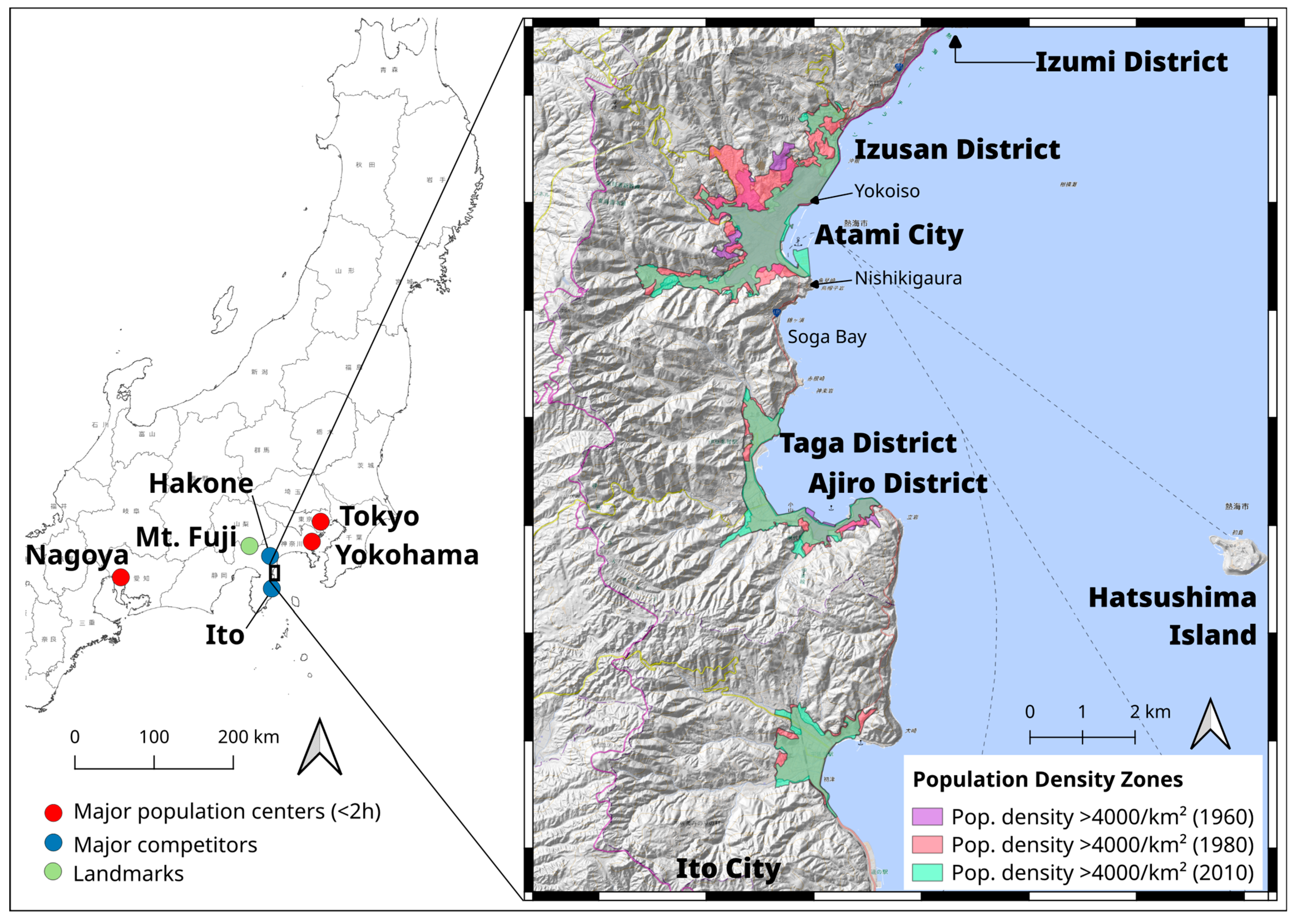
Atami, a small but dense city rich in hot spring water (Figure A1), is one of Japan’s oldest tourism resorts and has historically had a substantial impact on the development of domestic tourism (Takayanagi, 2017a, p. 235). Until its decline around 1990, Atami’s advantageous location (Figure 1), ease of access (~45 min from Tokyo; 5th station on the world’s busiest rail line) and lack of regulations made it an industry trail blazer (N. Takeda & Moon, 2010; H. Takeda, 2025) admired for its innovative prowess and versatility (Aihara, 1975, p. 7).
Wedged between steep mountains and the sea (Figure 1), situated inside a nature conservation area (Nishikawa, 2019), and poor in drinking water (Takayanagi, 2017c, p. 258), Atami’s constant struggle with its legal and physical boundaries to development made it particularly relevant for a study on local distribution.
Out of Atami’s six districts (Figure 1), four (Atami, Izusan, Taga and Ajiro) feature relevant tourism activity. The Izumi and Hatsushima districts are not part of the case for their social, political and spatial distance from the center (Takayanagi, 2017b, pp. 250–256).
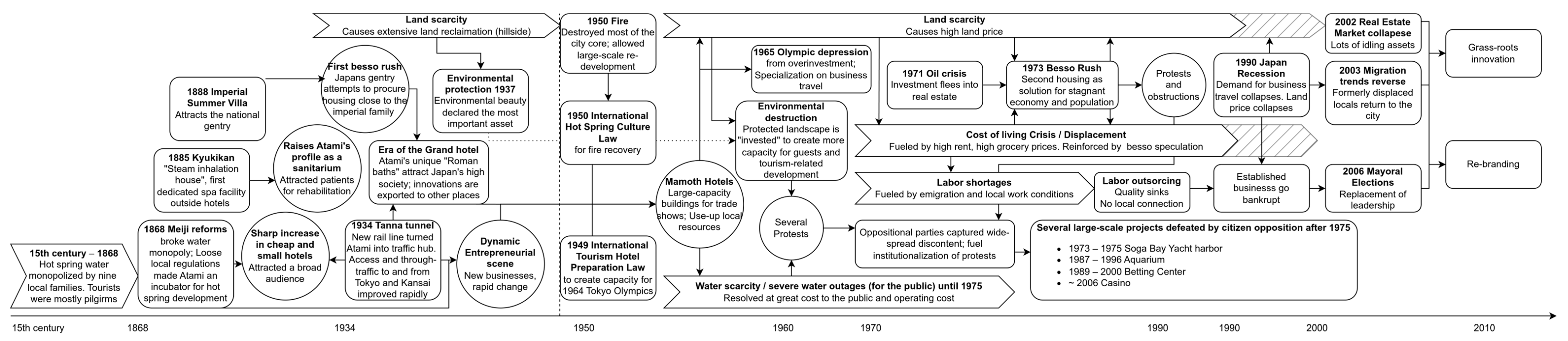
Mirroring past studies (Martin & Sunley, 2006), Atami’s path-dependent status is defined based on its target audience, thereby avoiding infinite regress (Pierson, 2000, p. 263), and establishing a clear cut-off point with the 1950 fire ravaging most neighborhoods. The substantial redevelopment instigated a shift in target audience from female textile workers to male businessmen (Moon, 2012, p. 35). The next notable shift in audience took place around 2011 towards young women (Yamamura, 2017, pp. 312–313), marking the second soft cut-off point. Figure A2 in the Appendix A provides a more comprehensive historical overview for reference, reflecting major developments and themes.

2.2. Methods and Sources

2.2.1. Overview of Methodical Approach

We adopt a hybrid approach of Snyder (2019) and Yin (2018) to conduct structured data collection from secondary and primary sources—essentially an integrated review fundamentally enriched by incorporating complementary, supplementary and novel data from archival and other materials. Elements from grounded theory (sampling and coding) are adopted as a general research strategy (Yin, 2018, pp. 215–216): Coding was applied to label and organize the diverse data, which was then stored in a MaxQDA 2020 database. The structure followed an approach similar to Gale (2024, p. 138), using a complex time-series design to track the rise and fall of local innovation over time, starting from known issues that affected local renewal and tracking them backwards through time by following the causality chain. Different data types were compounded and evaluated together in a form of triangulation to improve study rigor and trustworthiness (Yin, 2018, pp. 291, 555; Taylor et al., 2019, p. 89). The structured data was retrieved from the database in chronological order to reconstruct development paths reflecting individual locking mechanisms. The following Section 2.2.2, Section 2.2.3 and Section 2.2.4 below describe the data and process in detail.

2.2.2. Data Sources

The initial set of secondary data sources covering the case of Atami was gathered throughout 2021 from CiNii (Japanese academic database) using the keyword 熱海 [Atami]. Search results were screened for relevance, discarding anything unrelated to local development (architecture, tourism planning, etc.) or local resources (hot springs, land use), resulting in 52 relevant sources. To widen the search, we identified additional sources (primary and secondary) from references in documents, literature proposed by local stakeholders (e.g., Atami library staff), targeted searches on the internet, in local newspapers and chronologies. Each source was selected based on its relevance to specific issues uncovered throughout the research process. The total number of sources utilized in the present study was 115 (see Table 1 for an overview of document categories and number of sources). Newspapers, considered part of the growth machine (Molotch, 1976, pp. 315–316), were screened for potential bias during article reviews. Additional data was derived from 138 statistics books, used to cross-reference findings, assess their likely impact and discover neglected events.

2.2.3. Coding, Sampling and Analysis Strategy

The adopted coding follows Corbin and Strauss (2014, pp. 194, 532) in structure and Mayring (2002) in method, distinguishing between (1) open coding: labeling chunks of data to considerably condense new knowledge into concepts, and (2) axial coding: linking concepts by either incorporating additional data or by logical reasoning (inference), where concepts linked together form theoretical categories. Further details are provided in the intercoder agreement section of Appendix A.
The initial sampling was conducted in the form of a targeted literature review on the 52 secondary sources retrieved from CiNii. Any factors related to the UGM (Table 2) were coded (open coding) in MaxQDA 2020 at a low level of abstraction (summarization) (Mayring, 2002, p. 105) and logically grouped (axial coding) (Matteucci & Gnoth, 2017, p. 51). Emerging categories each represent a distinct path-reinforcing mechanism. Categories reflecting issues beyond local reach, i.e., customer taste (Hori, 2016), natural disasters (Yamada, 2020) and economic slumps (Yamamura, 2017), were excluded.
The initial categories served as the starting point for an iterative and evolving process of data analysis driving consecutive data collection (theoretical sampling) within the scope of the research questions (Yin, 2018, p. 553; Matteucci & Gnoth, 2017, pp. 50–51). Numerous rounds of theoretical sampling were conducted to “[…] develop [categories] in terms of [their] properties and dimensions […] (Corbin & Strauss, 2014, p. 37).
Additional concepts were collected from coding more in-depth of the original sample (narrow context analysis), and 63 new sources, selected purposefully to derive specific information (wide context analysis) (Mayring, 2002, pp. 89–91). Principally, new concepts were investigated based on previous analysis results. However, probing sources for specific information yielded coincidental findings of potentially relevant material, which, just like information discarded for lack of relevance, were tentatively bookmarked for potential later retrieval and analysis (Mayring, 2002, p. 105).

2.2.4. Category Refinement

Categories were regularly tested against research questions to ensure suitability—confirming their alignment with the study’s scope and maintaining clear distinctions between categories to allow unambiguous assignment of concepts (Mayring, 2002, p. 101). Whenever collected information fell within the scope of the study but did not fit any existing category, a new category was created. Existing concepts and sub-concepts were equally evaluated for overlap and reassigned as necessary to ensure fit within the constantly evolving categories (Matteucci & Gnoth, 2017, p. 51; Mayring, 2002, p. 117).

3. Results

Final categories are summarized and described in Table 3. Key findings are elaborated and contrasted in the following Section 3.1, Section 3.2, Section 3.3 and Section 3.4. The section on destruction of production conditions (Section 3.1) was further divided into thematic subsections to better capture the individual elements that shaped the described mechanism.
Each subchapter corresponds to a category, paragraphs reflect individual concepts, and the information within relates to individual codes. Given space constraints, only essential details are presented to construct a coherent narrative. Sections remain primarily descriptive, with interpretations reserved for the discussion section to avoid misrepresenting individual sources.

3.1. Destruction of Production Conditions

3.1.1. Land

After the 1950 fire, Atami’s recovery accelerated through two key laws: the Atami International Hot Spring Culture City Law, which mandates administrative support for tourism developers (e-gov, 2023a), and the International Tourism Hotel Preparation Law, which granted generous tax breaks to expand guest capacity for the 1964 Tokyo Olympics (e-gov, 2023b). These measures set Atami on a path toward large-scale redevelopment, and new “mammoth hotels” quickly occupied the space cleared by the fire.
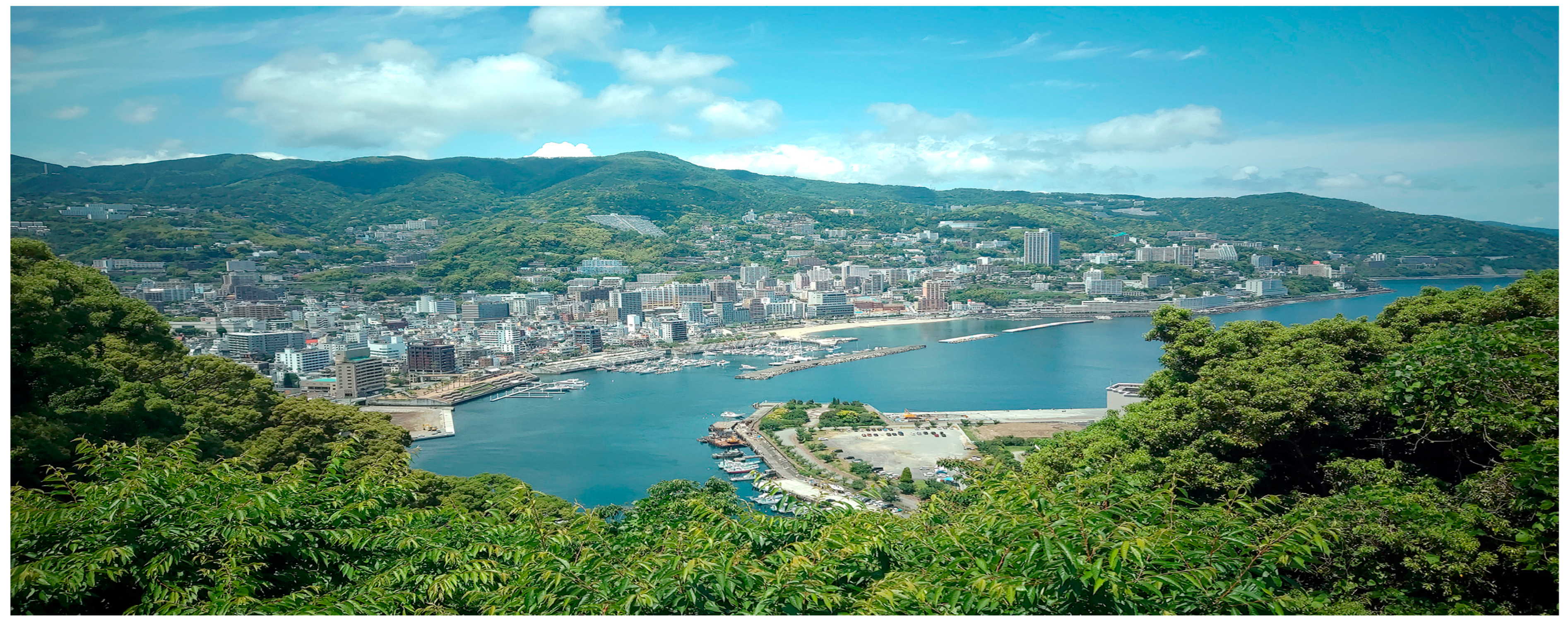
By 1953, construction land in Atami had become scarce, and the city’s landscape—protected since 1937 and regarded as its greatest tourism asset—faced mounting development pressure. Illegal projects began breaking ground on multiple fronts. Observers noted a clear policy shift from protecting the landscape to protecting the industry: lawmakers, worried that strict regulations might deter future investment, framed “underutilized land” as an asset to be “invested” into tourism and retroactively legalized many projects in 1963 (Nishikawa, 2019, pp. 1344, 1346, 1348–1350). Starting in 1958, the city sold protected public land to expand development space and raise funds for tourism infrastructure (Yamamura, 2017, p. 304; Atami, 1997, p. 160; Nishikawa, 2019, pp. 1348–1349). Construction soon intensified on surrounding hills (Yamamura, 2017, p. 305, Figure 2), degrading the landscape and destroying historically significant sites (Atami Shimbun, 1973, p. 11501).
The rise of automotive transport from the 1960s disadvantaged Atami compared to rival locations. High land value begot high parking cost and expanding capacity came with trade-offs: more historic assets were lost (Atami, 2007, p. 48; Nishikawa, 2019, p. 1346; Atami Shimbun, 1973, p. 11565) and some of Atami’s most valuable neighborhoods turned into unappealing “concrete wastelands” (Yamamura, 2017, pp. 308, 313; Atami Shimbun, 1973, pp. 11485, 11622).

3.1.2. Water

Atami’s water supply has been a persistent challenge since 1900 (Atami, 2022, p. 2). Business owners, appealing to local pride (“embarrassing infrastructure”), pushed for multiple publicly funded expansions—often against popular vote (Takayanagi, 2017c, p. 258; Atami, 2022, pp. 2–3). Between 1955 and 1965, mammoth hotels tripled water consumption, straining supply to its limits (Atami, 2022, p. 6). This led to a decade of severe water shortages and frequent outages beginning in the late 1950s (Atami, 2022, p. 4).
Decision-makers largely ignored Atami’s potential for water conservation1, considering existing capacities as a barrier to visitor growth (Takayanagi, 2017c, p. 261). Instead, the government imposed water rationing on residents until major capacity expansions were completed in 1975 (Takayanagi, 2017c, pp. 259–261; Atami, 2022, p. 6). The new prefecture-funded pipeline ended the shortages, but triggered sharp water price increases, substantially raising living costs and reducing industry competitiveness (Atami Shimbun, 1975, p. 12024; Atami, 2022; Figure 3).

3.1.3. Housing and Population

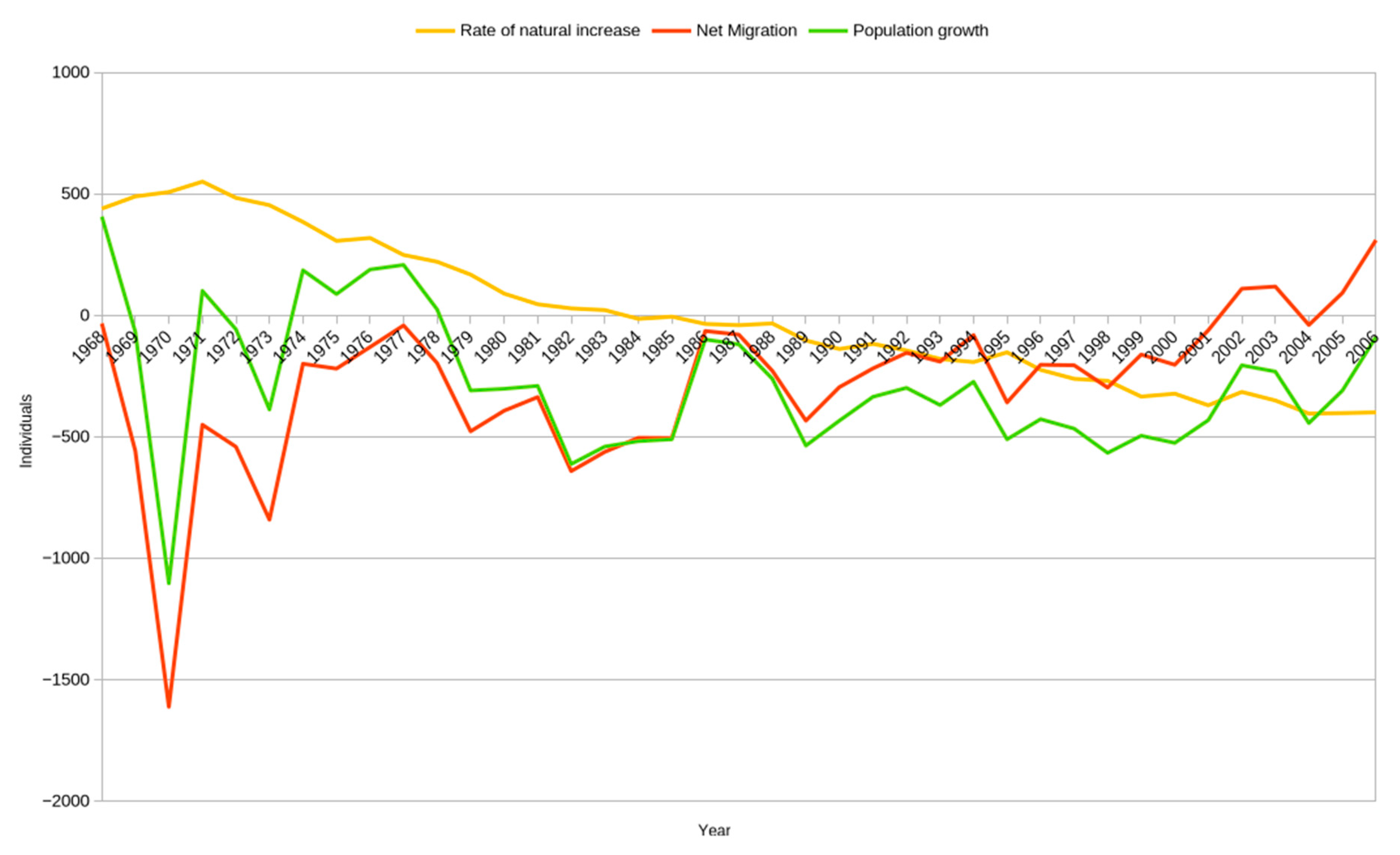
Land scarcity drove property values up, creating a shortage of affordable housing and exacerbating the cost-of-living crisis (Atami Shimbun, 1975, p. 12222). The administration could no longer ignore the demographic impact once the population began shrinking by about 500 residents per year. This decline not only contributed to labor shortages—conflicting with the tourism industry’s growth ambitions—but also threatened to depress local land values, an outcome considered undesirable at the time (Atami Shimbun, 1973, p. 11425; Atami Shimbun, 1975, p. 12222; Takayanagi, 2017a, pp. 238, 241; Hosokawa, 2018).
The administration purposefully chose to embrace the “besso rush” (second-housing boom) sparked by the 1971 oil crisis. Besso2 development was expected to provide housing through market forces, revitalize the local economy, counter population decline, and ultimately double the population to 100.000—a declared goal (Atami Shimbun, 1973, p. 11690).
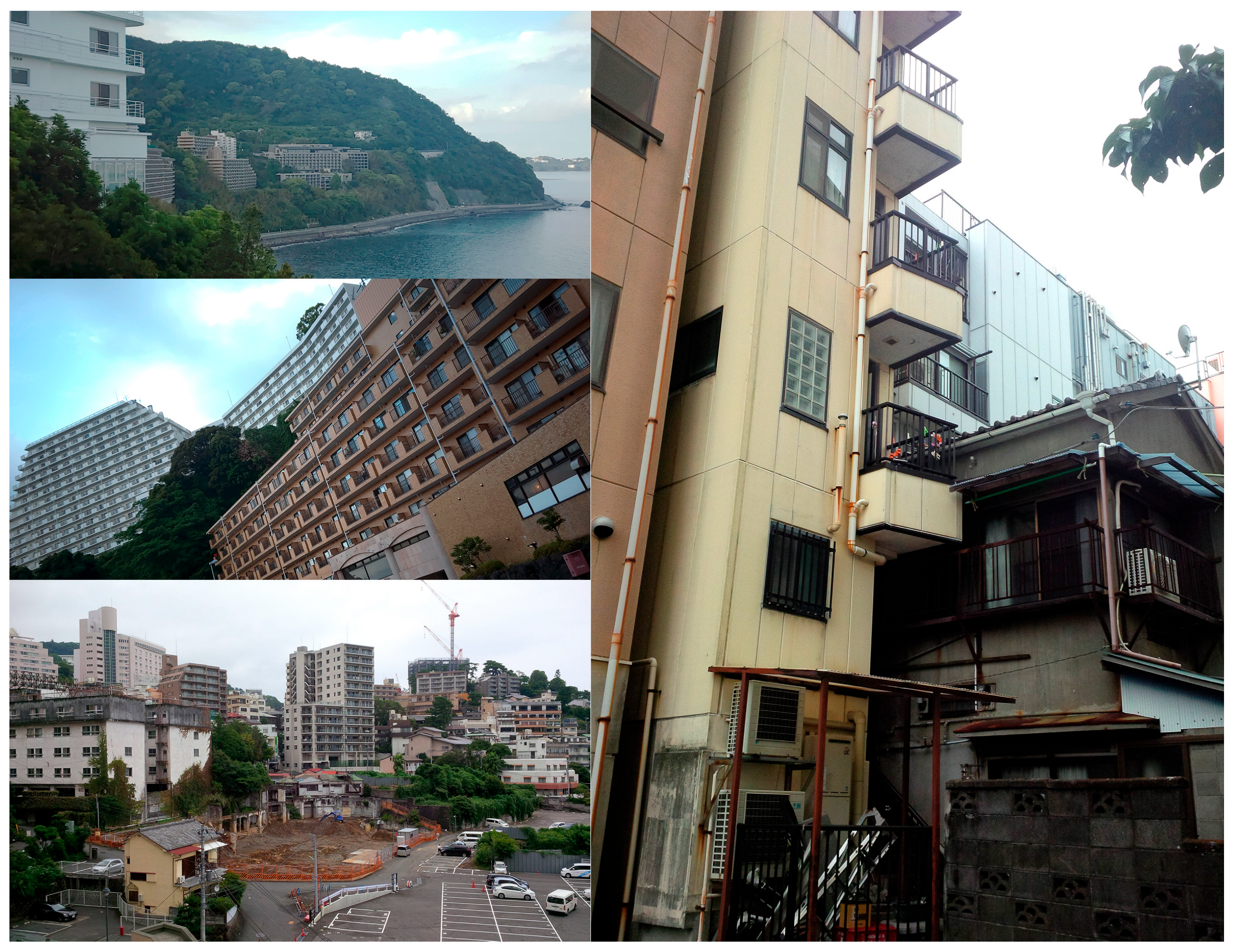
As critics anticipated, more than half of the 14,000 apartments built between 1971 and 1973 remained vacant (Atami Shimbun, 1973, pp. 11706, 11573; Ichiki, 2018, p. 23; Figure 4). The rest served mainly as weekend homes for retirees or operated as illegal holiday rentals, undermining the local industry (Atami Shimbun, 1973, pp. 11573, 11626; Yamada, 2020).
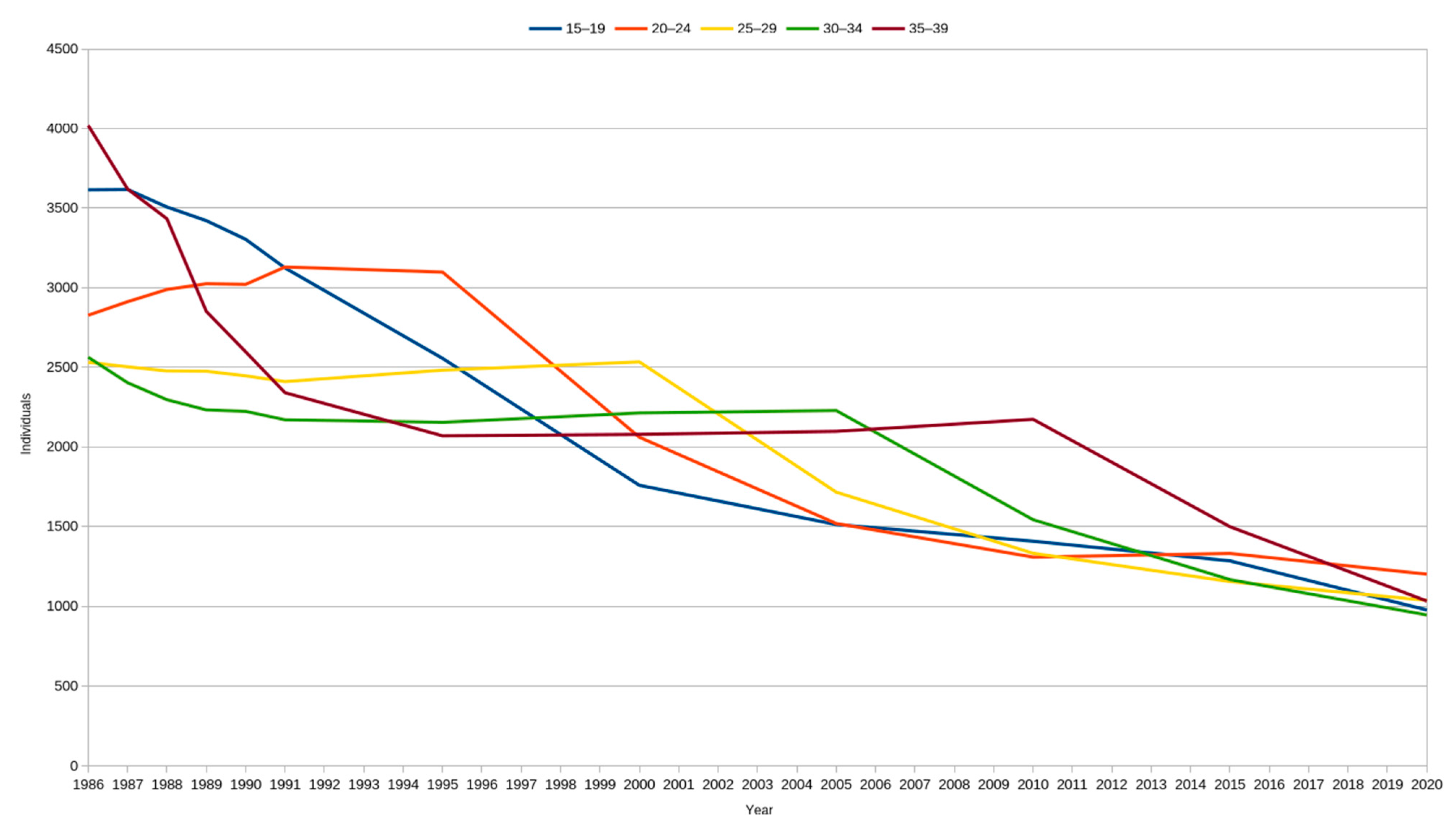
Persistent civic opposition (see Section 3.3) and the negative impact of besso on local tourism and agriculture forced the administration to freeze besso construction applications in 1973. The freeze was lifted in December 1979, justified as “the time felt right to remove a senseless measure hampering Atami’s development” (Atami Shimbun, 1979, p. 13485). It was reinstated in 1990 “[…] to shield young citizens from displacement” (Atami Shimbun, 1973, p. 11706; Atami Shimbun, 1998, p. 19303; Kobayashi & Nakagawa, 2010, p. 3), but by then most residents aged 15–40 had already left (Figure 5), making Atami the oldest city in Japan by population age (Ichiki, 2018, p. 23). The second freeze was partially lifted in 1998 and fully removed in 2005 under conditions intended—unsuccessfully—to prevent speculative construction, once again justified as a measure “to reinvigorate the local economy and raise the population” (Atami Shimbun, 1998, p. 19173; Kobayashi & Nakagawa, 2010, p. 33).
Besso owners (mostly retirees) were commonly exempt from local taxes, and the residual revenue failed to offset the cost of welfare services and the installation and maintenance of expensive infrastructure (Sakurai, 1994, pp. 1, 24; Atami Shimbun, 1975, p. 12298). A novel “besso tax”, permitted in 1975 in exchange for phasing out the old International Tourism Hotel Preparation Law (Atami Shimbun, 1975, p. 12158), was deliberately set low to avoid “overly burdening owners.” As a result, revenue often fell short of even the cost of collection (Atami, 2007, p. 54; Namba, 2018, pp. 65–66).
Ultimately, the city had to cater to besso owners despite their financial burden, as failing to do so would have been even more costly. Efforts to convert besso owners into permanent residents by accommodating their demands (e.g., parking) left the city in a desolate state (Figure 4). While only moderately successful, the expanded car capacity fueled further demand and worsened inner-city traffic (Sakurai, 1994, p. 1; Hosokawa, 2018; Ichiki, 2018, p. 67).
Since besso failed to ease the demographic decline, the city revived its danchi (public housing) program in 1973. The newly established public land development corporation reported severe issues in contracting construction firms and securing enough land within budget: speculation in besso had further inflated land values and construction costs, forcing larger public projects to maximize space utilization resulting in higher rent (Atami Shimbun, 1973, pp. 11416, 11672, 11415; Atami Shimbun, 1975, p. 12275). Between 1973 and 1979, the program added about 100 apartments per year at less than one-third of the market rate (Atami Shimbun, 1973, p. 11416; Doi, 1998, p. 112). Demand regularly exceeded supply by a ratio of eleven to one (Atami Shimbun, 1973, pp. 11460, 11470), offering only limited relief to population decline as reflected by the temporary stabilization of emigration in Figure 6 (1974–1979).
Tourism workers from poorer regions of Japan—mainly Tōhoku and Hokkaidō—were the only consistent influx of (initially) young people (N. Takeda & Moon, 2010, p. 83) and were particularly reliant on subsidized housing (Moon, 2012; Takayanagi, 2017a, p. 236). However, strict eligibility aimed at promoting population growth deliberately excluded single women—the largest group employed in tourism (Atami Shimbun, 1975, p. 12175).
Neglected by both public and private housing providers, tourism workers and businesses became reliant on company dormitories. Firms unable to allocate land for staff dormitories struggled to recruit and often went out of business (Takayanagi, 2017a, p. 237). Cramped living conditions—where four or more women shared a room—combined with temporary contracts and a significant gender imbalance (10 women for every 7 men) created by industry hiring practices, left few opportunities to start families. As a result, many female workers either moved away to marry or remained single (see disparity between age brackets 20–24 and 25–29 in Figure 5). Atami’s rate of single residents rose to four times the national average, producing the country’s lowest birth rate, deepening reliance on immigration, and accelerating population aging (Takayanagi, 2017a, pp. 234, 239, 241, 243; Takayanagi, 2017b, p. 248).

3.1.4. Labor

Starting in 1954, the growing inability to hire locally forced mass recruitment drives in poorer regions of Japan (Moon, 2012; Takayanagi, 2017a, p. 236). Businesses struggled to retain staff—initially because workers were hired on temporary contracts, and later due to the unfavorable local conditions described above (Takayanagi, 2017a, pp. 238, 241). Reports of exploitative labor practices in Atami, combined with rising competition for the same labor pool, made attracting migrant workers increasingly difficult (Takayanagi, 2017a, p. 243; Atami Shimbun, 1973, pp. 11586, 11624).
In 1965 only 60% of open positions could be filled, leaving a shortfall of about 500 workers each month (Takayanagi, 2017a, pp. 238, 242). By 1973, more than 3000 positions remained vacant (Atami Shimbun, 1973, p. 11586), and by 1990 the number had soared to almost 16,000 (Atami, 1992, p. 19).
Desperate for staff, the industry abandoned hiring standards and specifically targeted women in precarious situations, especially single mothers without job prospects or a “place in society” (Takayanagi, 2017a, pp. 237, 241; Moon, 2012, pp. 38–39). From 1974 this “ideal” employee was actively recruited through women’s magazines, until temporary work agencies became the norm in the late 1980s. As semi-stable seasonal assignments gave way to weekend hires, job insecurity increased, service quality suffered, and population volatility worsened (Moon, 2012, pp. 34–37).

3.1.5. Mechanism

Financially inaccessible resources and their impact on cooperation severely limited NGO activities in the 1990s (Atami, 2006; Yamada, 2020; Ichiki, 2018, pp. 60–61, 65, 81; see Figure 7). Poor attitudes, high turnover, and constant uncertainty among migrant workers—combined with residents watching their town deteriorate and indifference from besso owners and retirees—eroded social ties and discouraged community participation (Yamada, 2020; Atami Shimbun, 1973, p. 11586; Ichiki, 2018, pp. 60–61, 65, 81). Once high land values displaced residents, local communities fractured and were replaced by apathetic, temporary actors. Young citizens left, and couples raised the next generation of potential innovators elsewhere. In short, those most likely to drive grassroots innovation disappeared (Ichiki, 2018, pp. 78–79).
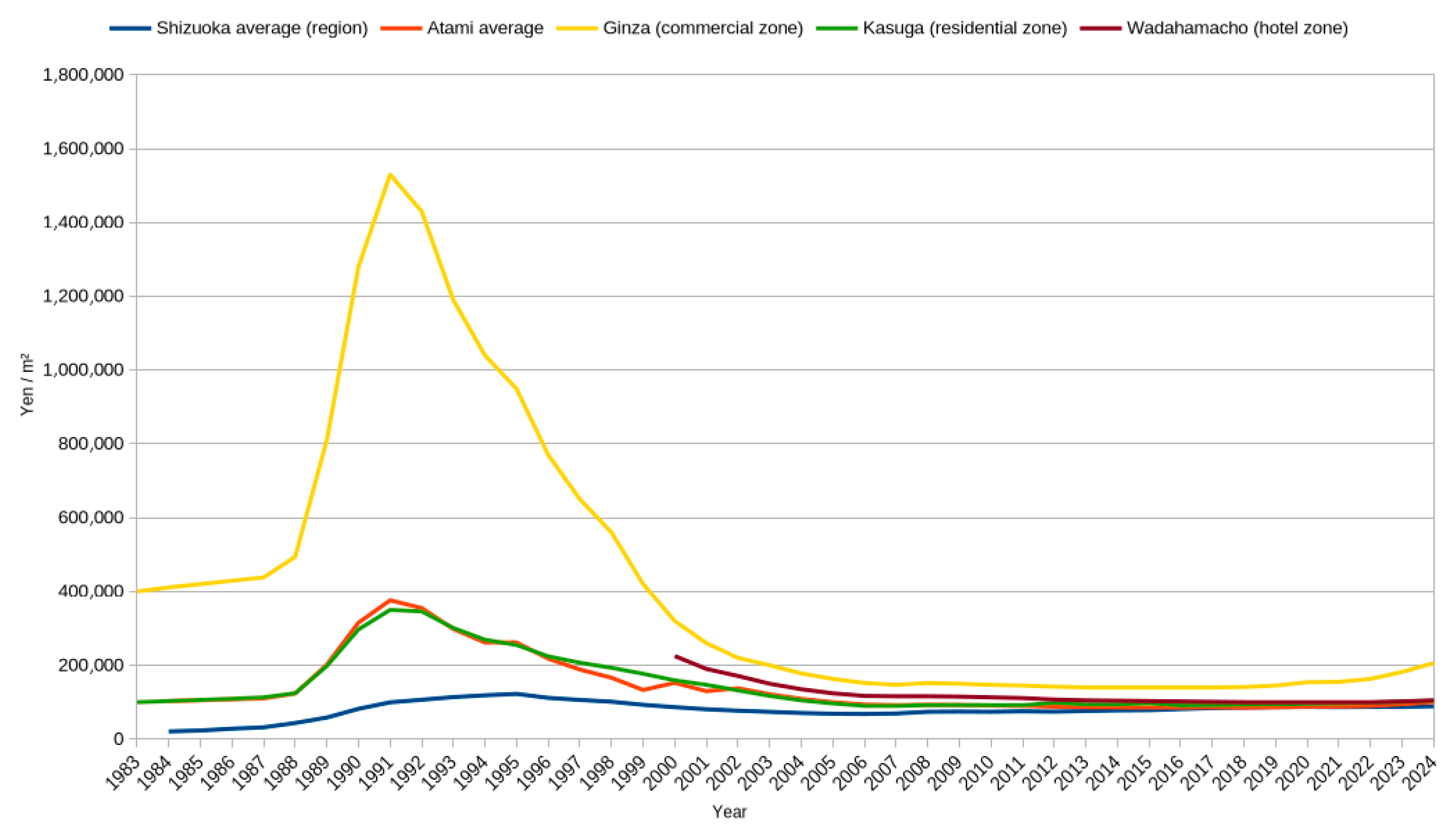
The recession of the 1990s, coupled with a wave of major hotel bankruptcies, drove land values to unprecedented lows (Figure 7), triggering a reversal in migration trends and resulting in positive net migration in 2002—the first in 32 years (Figure 6). Although most newcomers were retirees, some were returning Atami natives in their 30s who had been displaced at a young age, including self-described local patriot Ichiki Koichiro. Ichiki and his NGO Atamista focused on community building and creating “new content” (i.e., tourism products). Their efforts are widely credited as key drivers of Atami’s 2012 rejuvenation (e.g., Ichiki, 2018; Yamada, 2020; Jimokoro, 2016; Nakazawa, 2019; Hori, 2016).
A comparison with less successful 1990s NGOs shows that Atamista’s success was rooted in a fundamental shift in local production conditions. Our data indicates that earlier grassroots efforts were crippled by financially inaccessible resources and the resulting breakdown in local cooperation (Atami, 2006; Yamada, 2020; Ichiki, 2018, pp. 60–61, 65, 78–79, 81; see Figure 7). In contrast, Atamista benefited from rapidly depreciating assets and their positive demographic effects, which provided access to resources (empty spaces), collaborators, and—crucially—young volunteers eager to experiment with new ideas (Atami, 2006; Hori, 2016, pp. 47, 80, 72, 98, 109, 113).
Early initiatives such as Team Satoniwa [village garden]—an agricultural experience involving the last surviving farm within city limits—and Ontama (guided walking tours) failed commercially but became vital networking platforms for besso owners and creatives in their 20s and 30s. By gradually rebuilding Atami’s collective human agency through these activities, Atamista was able to launch increasingly ambitious projects, ultimately leading to a complete revamp of Atami’s image and tourism offerings (Atamista, 2017; Yamada, 2020; Hori, 2016, pp. 71, 81–82, 98, 109; Ichiki, 2018, pp. 62–63, 65–68, 70–72, 84).

3.2. Institutional Obstruction of Change

Known as the “Olympic depression,” inflated estimates of foreign visitor demand in 1964 and subsequent overinvestment forced a painful shift in Atami’s tourism model—from the high-class grand hotels of the past to cheaper family and business-oriented travel (Takayanagi, 2017b, p. 252). Price cuts driven by oversupply, combined with a growing disdain for foreign guests (less than 1% of visitors), discouraged diversification and narrowed Atami’s potential audience long-term (Hori, 2016, p. 51; Ichiki, 2018, pp. 32–33).
City officials begrudgingly acknowledged that as the six powerful tourism associations and their members grew increasingly conservative, they began rejecting untested ideas and restricting outside groups from hosting events on city property, instead favoring “more of the same” experiences (Hori, 2016, pp. 38, 72, 93, 110, A59, A65–A66; Funamoto, 2014).
Tourism promotion was fragmented among private-sector players operating on annual cycles, preventing a consistent advertising strategy. Lacking expertise themselves, city officials funded the associations’ demands for equal representation, which further diluted marketing efforts and wasted public money on feckless campaigns—promoting events or offerings that did not exist (e.g., special event promotion featuring non-participating hotels) (Nakazawa, 2019; Hori, 2016, pp. 48, 73, 102).
A “generational change” in industry and association leadership during the early 2000—partly driven by the dismal turnout at the 2004 Flower Expo—combined with deliberate consensus-building efforts such as roundtables and workshops gradually reduced the associations’ damaging influence and transformed them into valuable partners (Yamamura, 2017, p. 310; Atami, 2007, pp. 67–68; Ichiki, 2018, pp. 79, 90; Hori, 2016, pp. 95, 98, 110, 114).
The election of outsider Sakae Saito in 2006 and his 2007 basic tourism plan marked a deliberate break from decades of “laissez-faire politics” (Doi, 1998, p. 95; Atami Shimbun, 1994, p. 17949). Atami adopted a hands-on approach that included direct support for local entrepreneurs promoting “new tourism” and taking charge of long-term promotion planning through three-year contracts (Nakazawa, 2019; Hori, 2016, p. 38). This new direction funded local projects (discussed above) and launched multiple branding and marketing initiatives aimed at attracting visitors from across Japan (“igaito Atami” [surprising Atami], “AD-san, irasshai!” [Media Producers welcome!])—encouraging them not only to visit but ideally to stay and start new ventures in Atami (Jimokoro, 2016; Ichiki, 2018, pp. 89, 96–98; Nakazawa, 2019; Hori, 2016, pp. 90–91).

3.3. Local Attitude Towards Tourism Development

Atami’s prominence among Japan’s tourist destinations attracted politicians, business tycoons, celebrities, nobility, and highly motivated entrepreneurs (Nakazawa, 2019; N. Takeda & Moon, 2010, p. 70). It also inflated land values, as besso could sell for exorbitant prices based on prestige alone (Yamada, 2020).
Conversely, local opinion was historically divided. Civil resistance groups of varying effectiveness and composition have been part of Atami’s culture since at least the early 1950s, when illegal tourism developments threatened the protected landscapes of Yokoiso and Nishikigaura (see Figure 1; Nishikawa, 2019).
Early opposition movements focused mainly on protecting their immediate living environment and did not oppose tourism development per se. For example, the “mizu o yokose!” [give us water!] protests of the early 1960s benefited the industry by pressuring the administration to invest in infrastructure (Takayanagi, 2017c, pp. 260–261). As noted above, these improvements ultimately led to higher water prices, sparking further protests and deepening public resentment toward the political establishment (Atami Shimbun, 1975, p. 12024; Atami, 2022).
In early 1973, the negative impact of besso on the living environment and property values of individual housing units (impaired view) provoked massive civil and political resistance (Atami Shimbun, 1973, pp. 11565, 11498, 11513, 11633, 11655; Atami, 1997, p. 66, 186; Hosokawa, 2018). Merely rumors of potential weekend home projects triggered the formation of new opposition groups (Atami Shimbun, 1973, p. 11610). By mid-1973, essentially every construction project faced scrutiny (Atami Shimbun, 1973, pp. 11481, 11513, 11610, 11620, 11633), with nearby renters going so far as to fund their own geological surveys to force hazard-zone designations on prospective construction sites (Atami Shimbun, 1973, pp. 11473, 11513).
However, despite strong opposition, Atami’s tourism development remained largely unaffected, as shown by the eventual materialization of besso and other illegal projects. Soga Bay marked a turning point:
The 1950 recovery plan envisioned a yacht harbor as the next major development step (Atami Shimbun, 1973, p. 11661; Kato, 2003). In 1973, local groups from the southern Taga district, backed by social democrats and the communist party, strongly opposed the proposal approved by the mayor. The coalition of citizens and opposition politicians succeeded in imposing additional obligations on harbor developers, ultimately freezing the project in 1975 (Atami Shimbun, 1973, pp. 11614, 11442; Atami Shimbun, 1975, p. 12125). The yacht harbor—and other projects planned for Soga Bay—never materialized, despite strong development ambitions as recently as 2022 (Ward, 2022).
In the mid-1980s, several major projects—including an aquarium, a betting center, a convention center, and multiple casinos—entered the planning stage. In 1987, opponents gathered 5152 signatures to demand a referendum on the aquarium. Although the city council initially refused, construction was delayed, and by 1996 developers abandoned the plans for economic reasons (Atami, 2007, p. 6; Atami, 1997, pp. 189–190, 196).
The betting center, announced in 1989, met a similar end. In 1997, opposition by Momoyama Middle School’s Parent-Teacher Associations—historically a strong lobby—collected 1222 signatures urging the mayor to reconsider its location (Atami, 2007, pp. 8, 10, 38, 40). By 1999, developers signaled they might abandon the project, and after sustained pressure, they officially did so in 2000 (Atami, 2007, pp. 49–50). Other projects, including the convention center and casinos, fared no better despite the mayor’s personal lobbying efforts (Kawaguchi, 2003). Citizen pressure either blocked or delayed these developments until worsening economic conditions made them financially unviable (Atami, 1997, pp. 189, 196; Atami, 2007, p. 50; Nitta, 2008).
While major new developments got thwarted by opposition movements, established players—clinging to past successes—continued to rely on familiar attractions, such as fireworks, long adopted by competitors elsewhere. This only reinforced Atami’s stagnant feel (Ichiki, 2018, p. 55; Hori, 2016, pp. 38, A94, A96; Yamada, 2020). By the 1990s, stagnation had deepened into decline and even resentment. As locals watched their city’s identity and vibrancy crumble (Ichiki, 2018, pp. 60–61), their enthusiasm for recovery efforts faded (Ichiki, 2018, p. 81). Some residents became openly hostile, telling tourists to “go somewhere else, because there is nothing here” (Ichiki, 2018, p. 58).
Rejection of tourism development and the deep rift between status quo and change advocates peaked during the 1994 elections. The grassroots party “Change Atami!”, challenged status quo politics, accusing city leaders of neglecting citizens in favor of industry interests (Atami Shimbun, 1994, pp. 17906, 17944–17945, 17948). The institutional vote tipped a close race towards the incumbent party (15,210 vs. 13,060 votes) (Atami Shimbun, 1994, p. 17951). The re-elected administration continued courting major external investors and new attractions as promised. However, its lack of a clear future vision became evident with the underwhelming 2004 Flower Expo (Atami, 2007, p. 68), paving the way for a shift toward citizen-focused politics in the spirit of “Change Atami!”.
“Wanting to do something for the town” (Ichiki, 2018, p. 38), the idolized image of past success and lively streets became a powerful motivator for recovery. Inspired by this vision, former residents left secure jobs to return home, dedicating themselves to restoring the community and reviving its former vibrancy (Ichiki, 2018, pp. 15, 33, 53, 100; Yamada, 2020). Although (highly romanticized) nostalgia for the ‘good old days’ initially hindered progress (see Atami Shimbun, 1973, p. 11425), it ultimately helped drive change and renewal.

3.4. Successful Process Innovation

To offset unavoidable price-cuts following the “Olympic depression”, most major businesses began internalizing popular leisure activities (e.g., karaoke, mahjong, drinking, etc.). By the mid-1970s, Atami had become the leading destination for one-day business trips. Guests typically arrived by shuttle bus, had dinner at the hotel restaurant, enjoyed the spa, drank at the bar, sang karaoke, and then headed to bed—returning to Tokyo the next morning. Because all major hotels offered virtually the same experience, guests often could not even recall the name of the hotel they stayed at (Takayanagi, 2017b, pp. 251–252; Ichiki, 2018, p. 32; Yamamura, 2017, p. 306).
Nearly all major players streamlined their operations by opening only on peak days—made possible through staff outsourcing—and serving the same set meals every day (Hori, 2016, pp. A71–A72). Meals included with every stay discouraged guests from dining outside the hotel, while the lack of variety made longer stays unappealing, increasingly clashing with individualized travel preferences (Hori, 2016, pp. A32, A45, A65, A71–A72). The continuous relative success of the business model, combined with the industries inward-looking attitude, likely masked emerging problems and delayed efforts at rejuvenation (Funamoto, 2014; Ichiki, 2018, pp. 32–35; Hori, 2016, p. 48).
Poor customer service in local restaurants, combined with Atami’s heavy reliance on in-house meals and entertainment, gradually “locked” guests inside their hotels. Independent businesses shortened their operating hours, creating a stark impression of “nothing to visit” (Hori, 2016, p. A65; Ichiki, 2018, p. 61). This triggered a vicious cycle of declining public life and less places to visit, as the necessary foot traffic for independent businesses to thrive dwindled (Hori, 2016, p. A71; Ichiki, 2018, pp. 33, 68–71; Yamamura, 2017, p. 306). Potential newcomers saw little chance of success and avoided the risks, discouraging new ideas and establishments (Hori, 2016, p. A74).
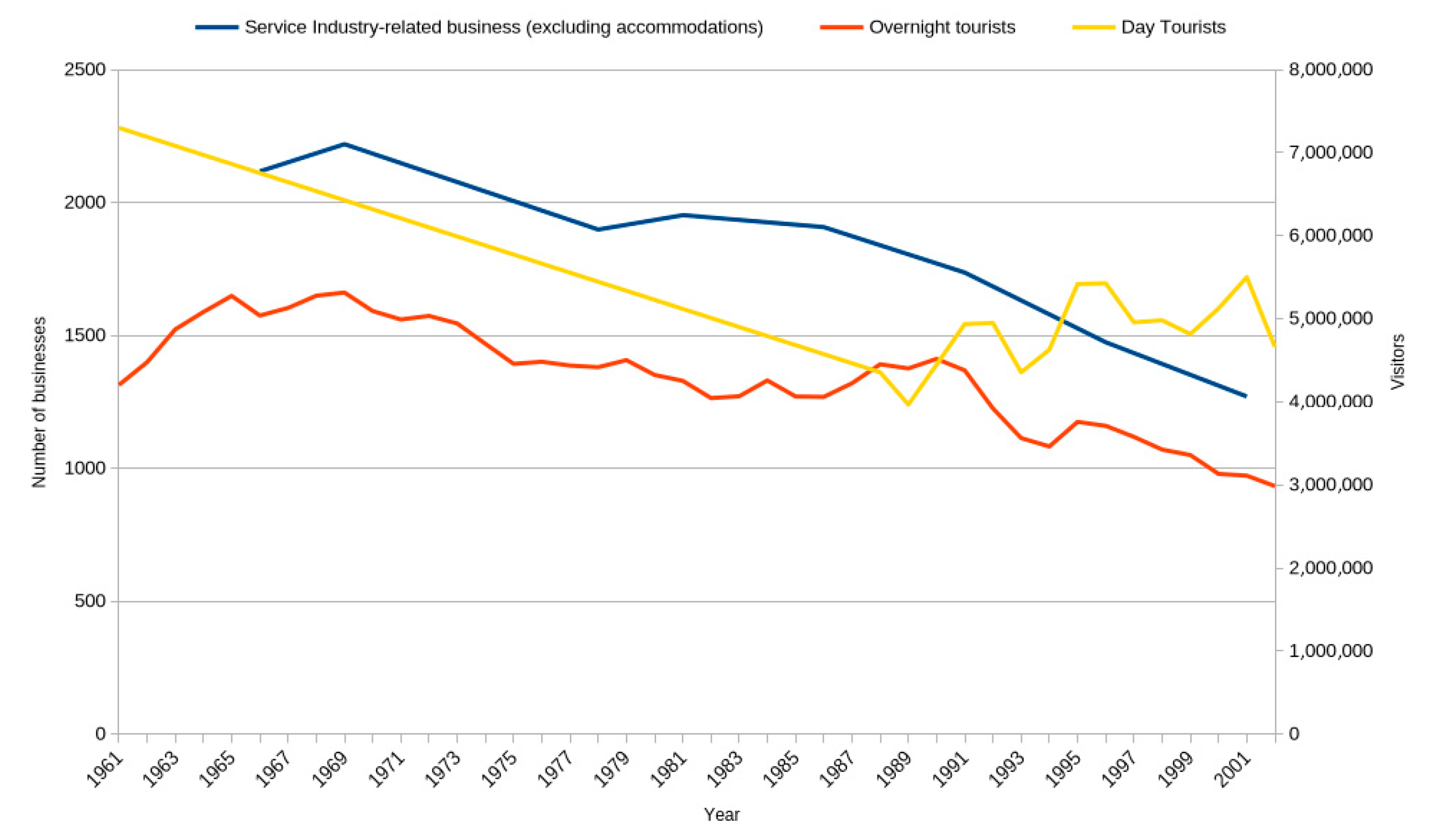
The strong correlation between declining day tourists and the number of establishments (see Figure 8) suggests that businesses closed as visitor numbers fell. However, the literature reveals a more complex picture: existing attractions, restaurants and bars lost both potential and actual customers, shut down or deferred investments. This reportedly created a repulsive atmosphere and left few establishments to visit (Ichiki, 2018, pp. 61, 81; Hori, 2016, p. A71). The business model may have become a self-fulfilling prophecy: why leave the hotel or visit Atami if only bad or no experiences await?
The Saito administration’s 2007 basic tourism plan aimed to boost foot traffic by supporting experimental business ideas to gradually break the deadlock (Yamada, 2020). One such initiative was Atamista’s Ontama walking tours, designed to draw people out of their hotels and encourage visits to independent restaurants and cafés (Ichiki, 2018, pp. 76–77). These tours attracted besso owners, residents, hotel staff, and—through word of mouth—for the first time in decades, a completely new audience: individual travelers (Hori, 2016, pp. 70–71; Ichiki, 2018, pp. 62–63, 65–68, 70–72, 76–77).
In October 2011, Machimori Inc. absorbed Atamista’s operations (Ichiki, 2018, pp. 99, 102) and began purchasing abandoned buildings along Atami’s main street “Atami Ginza”. These properties were renovated and transformed into stylish cafés and boutique hostels (Ichiki, 2018, pp. 92–93). One example, Guesthouse MARUYA, intentionally omits breakfast to encourage guests to explore nearby shops. Similarly, Atami Purin—a new local pudding chain—lures visitors across town through strategically placed locations (Yamada, 2020).
New public and private decision-makers jointly launched “99°,” an incubator designed to sustain local product innovation by positioning Atami as a testbed and inviting entrepreneurs to develop new businesses (Atamista, 2017). As of 2020, 99° had spawned 20 firms, including some focused on maintenance and staffing (Machimori, 2021; Yamada, 2020). Contemporary Atami recalls the 1930s, when the town similarly served as an incubator for small entrepreneurs from all over Japan, who leveraged liquid assets to grow their ventures into major establishments (N. Takeda & Moon, 2010, pp. 51, 55–56).

4. Discussion

Atami’s relentless pursuit of growth pervaded local thought on law and policy making and manifested as rising land value and capacity increases over efficiency improvements. Atami’s physical location constrained its growth ambitions, necessitating import of resources (water, labor) and intensified use of fixed resources (land). Limits were relative (e.g., O’Connor, 2014) rather than absolute (e.g., Perles-Ribes et al., 2018, pp. 1356, 1363), meaning that scarcity closely correlated with resource cost, increasingly determining land use and users (see Harvey, 2009). Consequently, the pressure to grow overemphasized capacity (hosting), marginalizing living or gazing uses (see Urry, 2002). As long as value rose (increased demand for fixed input, i.e., land), exploitation intensified, as did destructive measures (hillside land reclamation) (see Meadows et al., 2004, pp. 232–233), and related negative externalities (high living expenses, environmental destruction, etc.).
Comments made by Atami’s administration demonstrated awareness for pressing issues such as housing affordability. Yet, the contradiction between the administration’s unwavering commitment to growth and the problems that this pursuit created left decision-makers unable to resolve them. Instead of resolving issues, measures were either retracted (weekend home construction freezes), purposefully flawed (weekend home tax) or they transposed problems to other areas (cost of living), where issues compounded into new hurdles. For example, as cost of living displaced locals and migrant workers the city responded with pro-growth measures (more besso). Besso speculation impacted affordable housing construction, amplifying cost of living. Insufficient and restrictive public housing drove laborers into company dormitories with three consequences: (1) businesses were forced to compromise on land use between guest capacity, access (parking), gazing (environmental quality) and housing workers (dorms), impacting recruitment outcomes and competitiveness; (2) residents and laborers continued to emigrate as the cost of living issue remained unresolved; and (3) service quality and the city’s image suffered, as labor standards dropped. Likewise, expected economic gains from the decision to increase water capacity were likely offset as price rose. On aggregate, Atami’s adherence to growth undercut their industry renewal and growth potential by eroding the environmental and human resource fundamentals (both crucial inputs for tourism).
The tourism industry’s spatial and temporal fixity, i.e., requiring the product to be produced and consumed in situ (Hall & Page, 2014, p. 115), means that as long as Atami remained ‘the place to be’, rent as a factor of production could not be circumvented and high entry cost only deterred specific players and products (Haywood, 2005, pp. 278–279). Efficient use and allocation cannot be expected, as will be discussed in the following paragraphs.
Increasing costs (as intensified land use lowered potential for further extraction of trade value) encouraged exploitative labor practices, creating a situation where economic factors (low income conflicting with high living expenses) displaced people living and working in Atami. By extension, high land value suppressed individual human agency and destroyed existing local networks and collective human agency, hampering grass roots-based product innovation.
Although immigrants could be considered a potential source of product innovation, Atami’s new besso owners showed little interest in engaging with the community because they bought into an idea (prestige) and not into a place. Likewise, migrant workers became trapped in an “embedded culture of temporariness”. Workers are “[…] expected to come and go with resource boom-and-bust cycles […]” (Carson & Carson, 2016, p. 115), stifling formation of social bonds and long-term commitment to local development. Carson and Carson (2016, p. 115) suspected that new actors would not implement new ideas “[…] because the entrenched way of doing business continues to attract similar types of people and organizations […]”. Atami’s experience suggests that even if migrants had the agency and incentives to divert from entranced patterns, Atami’s lack of affordable and appropriate spaces precluded potential actors from product innovation.
High land value added to the pressure on living expenses negatively affected staffing. The tourism associations’ crucial role in mass recruitment solidified their power and control over local promotions and industry direction that excluded potential audiences (e.g., inbound tourists). Although association members shared a common interest in growth, their willingness to cooperate was undercut by intense local competition among them (partially exacerbated by land value) (see Molotch, 1976, p. 312). Infighting and procedural issues hindered the development of coordinated marketing strategies.
Established actors held more assets (land, bigger facilities), helping them to (partially) offset rising expenses by progressively specializing their tourism products (process innovation). Process innovation is generally understood to allow mature destinations to circumvent the rent trap (see Agarwal, 2001). In Atami’s case, specialization appeared to have created more externalities (low foot traffic) and exacerbated risks (land price). We suspect this further lowered the viability of small independent businesses and may have potentially discouraged investment in innovation. The suspected self-reinforcing cycle of lacking foot traffic and lacking outside experiences conceivably held-back innovative business opportunities, often associated with community development and city renewal (Greenwood & Dwyer, 2017, p. 591). A dedicated study on this specific issue is highly encouraged.
In general, risk-adverse Japanese businesses enter mature locations for quick returns and have limited interest in novel offerings (Funck, 1999, pp. 339–340). The kind of product they are willing to push is larger in scale and impact. Starting from the mid-1970s, local populations showed less appetite for such development. Civic opposition grew from land use conflicts and several major initiatives to create new tourism products (yacht harbor, casinos) were defeated.
Contrary to previous observations (Gebhardt, 2017), Atami’s growth coalition could not exploit local pride to deter opposition, because pride was rooted in local history, environmental beauty and crowding (usually a negative externality), rather than just in industry performance (cf. Harrill et al., 2011, pp. 49–50). Growth directly conflicted with these sources of pride in two ways: product specialization reduced crowding; and resources scarcities densified development and intensified competition. As ever larger construction actually harmed the value of individual units (obstructed view), property owners’ contradicting interest in land value counteracted cooperation (see Molotch, 1976, p. 312), reflected by mounting broad opposition against weekend homes.
Japan’s bubble burst dragged down the market for company trips, the mainstay of Atami’s customer base. Established players, grown dependent on extreme specialization (one-day company trips) and steered by their inward-looking leadership, found it impossible to adapt and capture potential new audiences (such as solo travelers). High land price and low foot traffic impacted small players and handicapped efforts to create niche “content”. As disgruntled citizens opposed large-scale development proposals, Atami’s industry failed to cultivate a new tourism product.
The conventional understanding of path dependence suggests that development paths lock into one of multiple equilibria (Arthur, 1994, p. 4), and the evidence on Atami presented above indicates how devaluation of alternatives (e.g., independently owned restaurants) by sheer physical proximity (low foot traffic, land value), established image (“nothing there”) and actors influence (associations) shaped its path. Findings imply that company trips continued to dominate because externalities from the growth process undercut alternatives (see Arthur, 1994, p. 1), indicating that Atami’s relentless pursuit of growth directly and indirectly reinforced its specific development path.
Even though prices predictably rebounded as the market corrected, they did not immediately lead to the restart of new product cycle creation. Because the market correction did not restore social conditions of production (e.g., local networks) (see O’Connor, 2014), the human agency needed for path diversion became unlikely as the means to “[…] deliberately seek to break away from established institutional structures and practice […]” (A. M. Gill & Williams, 2017, p. 52) had been diminished. In other words, exogenous shocks disrupted a weakened growth machine, creating the preconditions for path creation but did not spur immediate path divergence (see Martin & Sunley, 2006, p. 417).
Local pride, i.e., emotional attachment, eventually emerged as an indispensable driving force for steering the local economy towards rejuvenation. Former citizens, compelled by their personal desire to see their hometown reborn, returned under considerable personal sacrifice (leaving stable jobs) for unpredictable gains and gathered under one “local champion” (see Cooper, 2006). An affordable environment allowed returnees, incentivized by local pride, to engage in costly and time-consuming restoration and cultivation of stable peer-networks (reinvigorating collective human agency), helping to restore local product innovation.
Atami’s remarkable rejuvenation was recently interrupted by the COVID-19 pandemic (Figure A1), delivering another blow to the city’s fragile situation. Current data does not yet allow for conclusions about long-term ramifications or whether the city can quickly return to its growth trajectory. Major new projects (started before the pandemic) appear to have remained on track—most notably a massive 239-room resort hotel comprising three buildings of 17, 15, and 7 floors, scheduled to open in early 2026 (Kyoritsu, 2025). If the trend continues, Atami could become an early example of a late-cycle destination successfully pushing through this temporary setback (cf. Butler, 2022, pp. 1686, 1691).
This research was originally inspired by Perles-Ribes et al. (2018) hypothetical study on the exhaustion of physical development land in Calpe, Spain. Their fictional scenario—questioning how tourism development would evolve if physical limits constrained spatial expansion (cf. Butler, 2019)—piqued our curiosity. Perles-Ribes et al. (2018, pp. 1380–1381) anticipated that reaching the physical limit of land would either encourage sustainable development or lead to a steady-state situation. They predicted a collapse in the construction sector, whose effects would ripple through other industries, ultimately causing a steady state. While persistent land shortages in Atami revealed a similar domino effect, its impact extended across a far broader range of sectors and stakeholders than Perles-Ribes et al. (2018, pp. 1356, 1363, 1379) envisioned—beyond construction, retail and banking.
Atami’s case thereby highlights rarely discussed issues: the impact of spatial proximity and zero-sum conflicts on shaping local development patterns. While blight (spatial proximity) is acknowledged in international discourse (e.g., Butler, 2019), the problem appears far more pronounced in Japan. For example, the Japan Tourism Agency recently recognized the adverse impact of nearby blight on development and visitation, responding with a subsidy program to support the demolition of abandoned hotels (Jiji, 2025). It underscores a broader challenge in tourism: the absence of repercussions for business operators whose deferred maintenance may depress entire areas.
Likewise, discourse on zero-sum development typically centers on gentrification (see below) and pays less attention to granular trade-offs (e.g., park or parking lot?), likely because spatial expansion is rarely viewed as a limiting factor per se. This may be because only a few major destinations exhibit comparable dynamics (e.g., Venice), or because scholarly interest in geographical tourist space as a research subject has declined since the 1990s (Dodds, 2024, pp. 47–48). It is also plausible that Japan’s bubble economy, group- and company-driven travel patterns, and tourism development led by diversified conglomerates reinforced the emergence of densely concentrated resorts in unlikely locations, making this issue particularly salient to Japan. Follow-up studies focusing on spatial restrictions in minor destinations across Asia and beyond could provide valuable insights and potentially uncover overlooked dynamics.
While access to physical space was a critical factor, as proposed in the Calpe-scenario (Perles-Ribes et al., 2018), Atami’s development trajectory aligns more closely with O’Connor’s (2014) concept of relative resource scarcity and Meadows et al. (2004, pp. 203, 261) assertion that limitations and stagnation are politically unacceptable. The pursuit of growth amid soaring land values diverted Atami from a steady-state path towards decline—measures intended to avert stagnation paradoxically eroded self-sufficiency, with escalating resource costs emerging as the primary driving force.
High cost affects most destinations, often driving gentrification and displacement (e.g., Bertocchi & Visentin, 2019; Gebhardt, 2017). However, unlike major destinations (e.g., Venice or Barcelona) that can derive appeal from their unique attractions, more interchangeable resorts—like Atami—must continually reinvent themselves to remain attractive. This need for re-innovation is central to the TALC (Butler, 2006, p. 8). The challenge becomes increasingly acute in the later stages of the cycle, when large operators may divest due to declining profitability (Ioannides, 2005, p. 141), leaving the burden for sustaining resort appeal to disgruntled residents and local entrepreneurs (Butler, 2025, p. 605; Peters & Schönherr, 2024, p. 278).
Peters and Schönherr (2024, p. 277) argue that “[…] the entrepreneurial ability to act proactively must be created earlier […] at the end of the development phase”. However, Atami’s experience suggests that potential entrepreneurs and their supporters might not endure long enough. In other words, it cannot be expected that all social and physical conditions for path divergence will be met when needed—they need to be properly cultivated throughout development. When Butler (2024c, p. 334) asserts that destinations should be equally good places to live, this is no longer merely a moral imperative—it may be essential for long-term sustainability of minor resorts.
The management of resources (Butler, 2025, p. 601) should consider mechanisms providing unencumbered access to local resources, thereby facilitating broad participation. Atami’s experience has shown how business as usual wasted human and economic potential by treating laborers like a commodity, ‘imported’ for a specific task and ‘stored’ in dorms for their period of use—a common practice in many resorts (e.g., A. Gill, 2000, p. 1092). Tourism labor needs holistic re-conceptualizing from an input to tourism production, to an input for nurturing a healthy local community.
Public housing programs, as observed in Atami, can decouple migrant laborers (and residents) from market forces and their dependence on company dormitories. By providing opportunities for permanent settlement and a long-term perspective, such programs can enable work migrants to create local connections beyond the duration of their employment contracts. This, in turn, strengthens local resilience and positively impacts the sustainability of the local industry (cf. Greenwood & Dwyer, 2017). Moreover, it alleviates businesses from allocating valuable production space to accommodate essentially non-paying customers. Despite the potential, public housing in the context of tourism has received scant attention in research—aside from limited discussion (e.g., A. Gill, 2000)—and warrants further exploration as a potential stopgap measure for escalating land values.
Similarly, residents’ contributions depend on access to local resources. One approach is pop-up development, which matches local landowners with entrepreneurs; another is fostering an environment conductive to local entrepreneurship (Peters & Schönherr, 2024, p. 271). Initiatives like 99° could play a positive role in steering local development and management towards sustainable outcomes (Butler, 2025, p. 601). Unfortunately, the current program lacks sustainability criteria beyond basic self-sustenance (Atamista, 2017)—a missed opportunity that highlights a deep challenge: entrepreneurs often distrust public legislation (see Ichiki, 2018, p. 102). Attempts to impose values (Haywood, 2024, p. 104) or enforce “responsible entrepreneurship” (Peters & Schönherr, 2024, p. 280) risk backfiring, repelling rather than attracting collaborators. Strategies must be devised that enable public guidance of entrepreneurs without crossing into ‘overreach’.
While facilitating a positive city image is regarded essential for attracting visitors (Jarratt, 2024), public awareness campaigns, as envisioned by Jarratt (2024, p. 68), have demonstrated promising outcomes in drawing both tourists and new talent (Jimokoro, 2016). While initiatives such as the 24/7 volunteer-driven “AD-san, irasshai!” program may be challenging to replicate, it can offer a valuable blueprint for other undervalued mature resorts seeking revitalization.
Applying a UGM lens to path dependence underscores how capacity can be more than just a metric for development stages or a benchmark for sustainability—it is a key factor in explaining why and how tourism resort development unfolds. While UGM provides a strong foundation for developing a critical lens on EEG, it is not without limitations. Its narrow focus on land use can obfuscate other resource conflicts, both tangible (e.g., water) and intangible (e.g., labor). Similarly, its data requirements—though less rigid than CC—are demanding, requiring significant time to evaluate qualitative sources. Coding proved useful for managing large volumes of data, but others might prefer less time-intensive methods. However, while this study relied solely on published material, future research may find our approach advantageous, as it readily accommodates interviews and other qualitative methods that could further strengthen findings.
Given tourism’s embeddedness within the capitalist system (Fletcher, 2019), scholars may also consider moving closer to Marxist analysis to explore what Britton (1991, p. 455) termed the “tourism production system”—in essence, how the extraction of surplus value from tourism intersects with its production. Harvey’s (2009) work on the economic geography of cities provides a robust basis for such inquiry, addressing zero-sum development and adversarial land use. More than UGM, it raises fundamental questions about the role of land and private ownership in shaping tourism, offering a more complex yet potentially transformative lens for path dependence.

5. Conclusions

This study accompanies the TALC model’s transition towards EEG, substituting its main concepts—PLC and CC—with an integrated framework combing path dependence and urban growth machine. This new framework was applied to examine both Atami’s “motors of change” and conversely its roadblocks (stalled innovation). UGM proved effective in incorporating factors of capacity into the analysis of resort development, thereby reframing the narrative of Atami’s decline and subsequent rejuvenation. The new perspective yields distinct policy implications, exposing critical shortcomings in the current recovery strategy.
Similarly, the findings caution against concentrating efforts on renewing local appeal at specific points in time, as is often implied under the TALC model. Instead, the enhanced framework advocates for creating and sustaining an environment that fosters product innovation by preserving human agency and ensuring unobstructed access to local resources. Unlike PLC and CC that rely on ambiguous and prescriptive indicators of destination change, the logic behind path dependence combined with UGM indicators offers a more robust approach for understanding and designing environments conducent to change, empowering locals to drive destination renewal themselves.
Findings are: (1) resource cost drove displacement of key actors and disruption of local communities, undermining the human agency needed for small-scale product innovation; (2) displacement made local hiring difficult for businesses, increasing their dependence on tourism associations, who had the capacity to hire nationwide, but who’s conservative stance and internal competition inhibited effective promotion and diversification strategies; (3) local stakeholders, aggravated by land use conflicts, grew weary of and opposed new major projects; (4) established players self-centered operation and specialization in one-day travel packages prevented capturing new audiences, deprived the city of foot traffic and revenue opportunities, potentially discouraging new independent businesses.
Once Atami’s target customers dissipated, established businesses were unable to adapt, and small and large newcomers were deterred from providing alternatives. A financial crisis (the Japanese bubble) restored environmental conditions of production (land values) but did not restore social conditions (local-driven collective human agency). The market correction created the preconditions for path-divergence without triggering one.
Atami’s case unveiled how high demand for resources (land, water, labor), driven by growth pressure, conflicted with finite local supply, creating negative externalities in the form of high prices, resulting in intensified exploitation and adverse selection of resource use and users. Atami decision makers’ dedication to growth precluded solutions to resulting social and environmental issues if those solutions entailed compromising on growth objectives. Critical issues therefore remained unaddressed and intensified in reach and scope, impairing crucial inputs to tourism production, steadily stalling industry renewal.

Author Contributions

Conceptualization, E.H. and G.B.S.; methodology, E.H.; validation, E.H., G.B.S. and R.H.; investigation, E.H.; resources, R.H.; data curation, E.H.; writing—original draft preparation, E.H. and G.B.S.; writing—review and editing, E.H., G.B.S. and R.H.; visualization, E.H.; supervision, R.H.; project administration, R.H.; funding acquisition, R.H. All authors have read and agreed to the published version of the manuscript.

Funding

This research was supported by JSPS KAKENHI under Grant 22H01657; the Monbukagakusho Scholarship under Grant 200542; and a collaborative project under a university-corporate collaboration agreement between Kubota Corporation and The University of Tokyo.

Institutional Review Board Statement

Not applicable.

Informed Consent Statement

Not applicable.

Data Availability Statement

The data presented in this study are available on request from the corresponding author due to containing copyrighted material.

Acknowledgments

We are highly grateful to Mieko Miyazawa and Paul Consalvi for their invaluable input and time, and the Atami municipal library staff for diligently accommodating our data requests. We also thank the anonymous reviewers for their time and comments that helped improve this manuscript.

Conflicts of Interest

The authors declare no conflicts of interest.

Abbreviations

The following abbreviations are used in this manuscript:
CCCarrying Capacity
EEGEvolutionary Economic Geography
NGONon-governmental organization
PLCProduct Life Cycle
TALCTourism Area Life Cycle
UGMUrban Growth Machine

Appendix A

Intercoder Agreement

The chosen coding guidelines (Mayring, 2002) accommodate all forms of communication—textual, verbal, and visual. However, the material used in the present study only includes written and visual data to maintain a consistent level of abstraction and interpretation.
The validity of documents in the corpus must be assessed under the following five criteria:
  • Document type—recognizing varying levels of reliability.
  • Internal features—including content and conveyed message.
  • Intention—the purpose behind the document’s creation.
  • Proximity—spatial, temporal, and social distance from the research objective.
  • Origin—how and by whom the document was produced.
Understanding the context of a document will alter its interpretation. When multiple interpretations are possible, the one requiring the fewest additional assumptions is selected.
Summarization was selected as the primary coding technique. Summarization condenses the material to its essential elements, creating a manageable corpus that accurately represents the original source. To avoid misrepresenting secondary sources and transcribed interviews, the level of abstraction was kept very low.
Axial coding could take two forms. Ideally axial codes were tied to empirical evidence that could serve as a bridging concept between deeper layers of information. For example, an excerpt of an article discussing cost of living issues could function as an axial code, with multiple other codes detailing specific issues related to high consumer prices. When no bridging concept was available, axial codes were themselves summaries of underlying codes. For instance, several text fragments addressing high consumer prices for different products could be combined to support the interpretation that consumer prices were a significant issue. Special attention was given to the temporal dimension, as high prices of clothing in 1990 cannot indicate a consumer price issue in 1970.
The material was interpreted in relation to the research questions and indicators derived from previous UGM studies (see Table 2). Codes should capture completed statements and ideas, avoiding isolated text fragments that could be misinterpreted out of context. Multiple codes within a single paragraph were permitted to reflect temporal distance or provide additional details (e.g., historical background) through lower-level codes. For instance, a main code addressing clothing prices issues could include sub codes illustrating price examples across different years or refer to establishments related to the issue. Unless multiple pieces of information from sources independent of each other contain the same assertion (framing an issue in the same way), a new code should be created to reflect the nuance between sources. Such codes reflecting different nuances can then be combined under an axial code summarizing the general sentiment. Likewise, codes representing broader events or conditions (e.g., a consumer price crisis) are elevated to concepts and grouped with other related concepts (e.g., high cost of living, high water fees).
The interpretation of words and their meanings can shift depending on context and the researcher’s evolving understanding of the subject. It is assumed that the researcher’s knowledge deepens throughout the process. Initial coding was intentionally broad, allowing for the inclusion of a wider range of potentially related events (e.g., coding statements about crime issues as potential impact on growth). After processing approximately 40–50% of the corpus, all codes were re-evaluated and revised where necessary. Another revision was conducted after 100% completion, insuring that gained knowledge and context does not conflict with previous interpretations.
Coding was theory-guided but not theory-dominated: critical content took precedence over procedural considerations, prioritizing validity over reliability. This approach proved important in one instance where multiple sources highlighted the significance of water-related factors—an element not originally included in the framework.
Figure A1. Atami’s population 1920–2020 and Visitors to Atami 1958–2016. Data Sources: Atami Tōkei Jōhō 1–R6; 入湯税による宿泊客数; conservative 1961 day visitors estimate based on (Atami, 1997, p. 164); Unofficial estimates suggest a peak of roughly 80,000 inhabitants in the late 1960s (Ichiki, 2018, pp. 22–23).
Tourismhosp 07 00003 g0a1
Figure A2. Atami’s development timeline (incorporating findings from this study). 15th century to 2020.
Tourismhosp 07 00003 g0a2

Notes

1
The average daily per-capita water allocation rose steadily from 650 L in 1949 to 1215 L in 1965, 1569 L in 1972, and 1650 L in 1977. By contrast, Japan’s estimated average per-capita consumption (countrywide) in 2020 was between 250 and 300 L (Atami, 2022; Statista, 2025).
2
Besso’s are a form of Japanese second housing. They fulfill many functions, including use as holiday rentals, weekend homes, retirement homes, and for investment purposes.

References

  1. Agarwal, S. (2001). Restructuring seaside tourism. The resort lifecyle. Annals of Tourism Research, 29(1), 25–55. [Google Scholar] [CrossRef]
  2. Aihara, Y. (1975). Changing aspect of Atami city from viewpoint of tourist industry geography. A study on fluctuations of hotel accommodations and number of tourists. Curatorial Geography, 29, 5–17. [Google Scholar]
  3. Albaladejo, I. P., & Martínez-García, M. P. (2017). The poststagnation stage for mature tourism areas. A mathematical modeling process. Tourism Economics, 23(2), 387–402. [Google Scholar] [CrossRef]
  4. Arthur, W. B. (1994). Increasing returns and path dependence in the economy. The University of Michigan Press. [Google Scholar]
  5. Atami. (1992). Atami toukei jouhou No 89. Atami Planning Department. [Google Scholar]
  6. Atami. (1997). Ichi-sei shikō 60-shūnen kioku. Atami rekishi-toshi-hyō. [Google Scholar]
  7. Atami. (2006). Atami statistics heisei 18. Atami Planning Department. [Google Scholar]
  8. Atami. (2007). Ichi-sei shikō 70-shūnen kioku. Atami Heisei rekishi-toshi-hyō. [Google Scholar]
  9. Atami. (2022). Reiwa 3 nendoban Atami no suido. Atami City Public Enterprise Department Water and Hot Spring Division. [Google Scholar]
  10. Atami Shimbun. (1973). Atami shinbun showa 48. Izushimbun Co., Ltd. [Google Scholar]
  11. Atami Shimbun. (1975). Atami shinbun showa 50. Izushimbun Co., Ltd. [Google Scholar]
  12. Atami Shimbun. (1979). Atami shinbun showa 54. Izushimbun Co., Ltd. [Google Scholar]
  13. Atami Shimbun. (1994). Atami shinbun heisei 6. Izushimbun Co., Ltd. [Google Scholar]
  14. Atami Shimbun. (1998). Atami shinbun heisei 10. Izushimbun Co., Ltd. [Google Scholar]
  15. Atamista. (2017). 99 °C startup program for Atami 2030. Available online: https://renovation-atami.net/99spa/ (accessed on 30 November 2025).
  16. Bertocchi, D., & Visentin, F. (2019). ‘The overwhelmed city’: Physical and social over-capacities of global tourism in venice. Sustainability, 11, 6937. [Google Scholar] [CrossRef]
  17. Britton, S. G. (1991). Tourism, capital, and place. Towards a critical geography of tourism. Environment and Planning D: Society and Space, 9, 461–478. [Google Scholar] [CrossRef]
  18. Brouder, P. (2017). Evolutionary economic geography: Reflections from a sustainable tourism perspective. Tourism Geographies, 19(3), 438–447. [Google Scholar] [CrossRef]
  19. Brouder, P., & Eriksson, R. H. (2013). Tourism evolution. On the synergies of tourism studies and evolutionary evolutionary economic geography. Annals of Tourism Research, 43, 370–389. [Google Scholar] [CrossRef]
  20. Butler, R. (Ed.). (2006). The concept of a tourist area cycle of evolution: Implications for management of resources. In The tourism area life cycle, Vol. 1. Applications and modifications (pp. 3–12). Channel View Publications. [Google Scholar]
  21. Butler, R. (2019). Overtourism and the tourism area life cycle. In R. Dodds, & R. W. Butler (Eds.), Overtourism. Issues, realities and solutions (pp. 76–92). De Gruyter. [Google Scholar]
  22. Butler, R. (2022). COVID-19 and its potential impact on stages of tourist destination development. Current Issues in Tourism, 25(10), 1682–1695. [Google Scholar] [CrossRef]
  23. Butler, R. (Ed.). (2024a). Revisiting the TALC model. In The Tourism area life cycle: Review, relevance and revision (pp. 14–20). Channel View Publications. [Google Scholar]
  24. Butler, R. (Ed.). (2024b). The TALC: Relevance 40 years on. In The tourism area life cycle: Review, relevance and revision (pp. 228–239). Channel View Publications. [Google Scholar]
  25. Butler, R. (Ed.). (2024c). Final thoughts: Revisions and modifications to the TALC model. In The tourism area life cycle: Review, relevance and revision (pp. 320–338). Channel View Publications. [Google Scholar]
  26. Butler, R. (2025). Tourism destination development: The tourism area life cycle model. Tourism Geographies, 27(3–4), 599–607. [Google Scholar] [CrossRef]
  27. Carson, D. A., & Carson, D. B. (2016). Path dependence in remote area tourism development: Why institutional legacies matter. In P. Brouder, S. A. Clavé, A. Gill, & D. Ioannides (Eds.), Tourism destination evolution (pp. 115–134). Routledge. [Google Scholar]
  28. Che, D. (2018). Tourism geography and its central role in a globalized world. Tourism Geographies, 20(1), 164–165. [Google Scholar] [CrossRef]
  29. Collins, B. (2020). Putting culture on the map: Media discourse and the urban growth machine in Koreatown, Los Angeles. Urban Affairs Review, 56(1), 254–288. [Google Scholar] [CrossRef]
  30. Cooper, C. (2006). The anatomy of the rejuvenation stage of the TALC. In R. Butler (Ed.), The tourism area life cycle, Vol. 2. Conceptual and theoretical issues (pp. 183–200). Channel View Publications. [Google Scholar]
  31. Corbin, J., & Strauss, A. (2014). Basics of qualitative research. Techniques and procedures for developing grounded theory (4th ed.). Sage Publications, Inc. [Google Scholar]
  32. Darrah-Okike, J. (2019). Disrupting the growth machine: Evidence from Hawai‘i. Urban Affairs Review, 55(2), 428–461. [Google Scholar] [CrossRef]
  33. Dodds, R. (2024). An evaluation of the tourism resort life cycle and the need for sustainability planning. In R. Butler (Ed.), The tourism area life cycle: Review, relevance and revision (pp. 42–56). Channel View Publications. [Google Scholar]
  34. Doi, E. (1998). About Atami city price monitoring. Shizuoka University Economic Research, 3(2), 93–130. [Google Scholar]
  35. Eggli, F. (2024). The need to revise the conceptual approach of the TALC model. In R. Butler (Ed.), The tourism area life cycle: Review, relevance and revision (pp. 242–253). Channel View Publications. [Google Scholar]
  36. e-gov. (2023a). Atami kokusai kankō onsen bunka toshi kensetsu-hō. e-gov. Available online: https://elaws.e-gov.go.jp/document?lawid=325AC1000000233 (accessed on 10 February 2024).
  37. e-gov. (2023b). Kokusai kankō hoteru seibi-hō. e-gov. Available online: https://elaws.e-gov.go.jp/document?lawid=324AC1000000279 (accessed on 10 February 2024).
  38. Farahani, A. (2017). Urban growth machine. In S. T. Bryan (Ed.), The Wiley Blackwell encyclopedia of social theory. John Wiley and Sons, Ltd. [Google Scholar]
  39. Fletcher, R. (2019). Ecotourism after nature. Anthropocene tourism as a new capitalist ‘fix’. Journal of Sustainable Tourism, 27(4), 522–535. [Google Scholar] [CrossRef]
  40. Funamoto, S. (2014). A study on factors and wax and wane process of Atami hot spring. St. Paul’s Annals of Tourism Research, 15, 87–88. [Google Scholar]
  41. Funck, C. (1999). When the bubble burst. Planning and reality in Japan’s resort industry. Current Issues in Tourism, 2(4), 333–353. [Google Scholar] [CrossRef]
  42. Gale, T. (2024). Revisiting Rhyl and the TALC: A study of land use, value and cover, and tourism policy in a traditional seaside resort, 1990–2023. In R. Butler (Ed.), The tourism area life cycle: Review, relevance and revision (pp. 138–157). Channel View Publications. [Google Scholar]
  43. Gebhardt, D. (2017). Barcelona. Regulating the tourism growth-machine. Geographische Zeitschrift, 105(3–4), 225–248. [Google Scholar] [CrossRef]
  44. Gill, A. (2000). From growth machine to growth management: The dynamics of resort development in Whistler, British Columbia. Environment and Planning A, 32, 1083–1103. [Google Scholar] [CrossRef]
  45. Gill, A. M., & Williams, P. W. (2017). Contested pathways towards tourism-destination sustainability in Whistler, British Columbia. In P. Brouder, S. A. Clavé, A. Gill, & D. Ioannides (Eds.), Tourism destination evolution (pp. 43–64). Routledge. [Google Scholar]
  46. Gore, S., Borde, N., Desai, P. H., & George, B. (2021). Empirically mapping the evolutionary phases of tourism area life cycle (TALC): The case of goa, India. Tourism. An International Interdisciplinary Journal, 69(3), 346–366. [Google Scholar] [CrossRef]
  47. Greenwood, V. A., & Dwyer, L. (2017). Reinventing Macau tourism: Gambling on creativity? Current Issues in Tourism, 20(6), 580–602. [Google Scholar] [CrossRef]
  48. Hall, C. M., & Page, S. J. (2014). The geography of tourism and recreation. Environment, place and space (4th ed.). Routledge. [Google Scholar]
  49. Harrill, R., Uysal, M., Cardon, P. W., Vong, F., & Dioko, L. (2011). Resident attitudes towards gaming and tourism development in Macao: Growth machine theory as a context for identifying supporters and opponents. International Journal of Tourism Research, 13, 41–53. [Google Scholar] [CrossRef]
  50. Harvey, D. (2009). Social justice and the City. University of Georgia Press. [Google Scholar]
  51. Haywood, K. M. (2005). Economic business cycles and the tourism life-cycle concept. In D. Ioannides, & K. G. Debbage (Eds.), The economic geography of the tourism industry. A supply-side analysis (pp. 275–286). Routledge. [Google Scholar]
  52. Haywood, K. M. (2024). Opinions on the reformation of TALC studies. In R. Butler (Ed.), The tourism area life cycle: Review, relevance and revision (pp. 97–110). Channel View Publications. [Google Scholar]
  53. Hell, M., & Petrić, L. (2021). System dynamics approach to TALC modeling. Sustainability, 13, 4803. [Google Scholar] [CrossRef]
  54. Hori, K. (2016). Onsen-chi no kankō saikō ni okeru masu tsūrizumu to nyū tsūrizumu no katsudō shutai no renkei ni kansuru kenkyū—Beppu-shi Noboribetsu-shi Atami-shi no jirei no hikaku bunseki kara [Ph.D. thesis, Tokyo Institute of Technology]. [Google Scholar]
  55. Hosokawa, K. (2018). Shōwa no dai kankōchi ‘Atami’ hontō ni genki ni natta ka. Toyokeizai. Available online: https://toyokeizai.net/articles/-/208641 (accessed on 24 August 2021).
  56. Ichiki, K. (2018). Atami no kiseki. Toyokeizaishinhousha. [Google Scholar]
  57. Ioannides, D. (2005). Tour operators: The gatekeepers of tourism. In D. Ioannides, & K. G. Debbage (Eds.), The economic geography of the tourist industry (pp. 137–156). A supply-side analysis. Routledge. [Google Scholar]
  58. Jarratt, D. (2024). The role of place image in the decline and rejuvenation of traditional English seaside resorts. In R. Butler (Ed.), The tourism area life cycle: Review, relevance and revision (pp. 158–170). Channel View Publications. [Google Scholar]
  59. Jiji. (2025, November 9). Japan to subsidize demolition of abandoned inns. The Japan Times. Available online: https://www.japantimes.co.jp/news/2025/11/09/japan/society/abandoned-inns-demolition/ (accessed on 13 December 2025).
  60. Jimokoro. (2016, February 25). Toshi-chū mukyū. Kami taiō de roke-chi 3 baizō!? Tatta ichi-ri de ‘Atami no Hariuddo-ka’ o takuramu saikyō no ojisan. Jimokoro. Available online: https://www.e-aidem.com/ch/jimocoro/entry/schoo01 (accessed on 28 December 2023).
  61. Kato, Y. (2003). Saihakken atamishimin no kindaishi. Toshoinsatsu Kabushikikaisha. [Google Scholar]
  62. Kawaguchi, I. (2003). ‘Hana to hikari to kajino’ de Atami saisei wo. Shisei, 2003(7), 67–70. [Google Scholar]
  63. Kobayashi, T., & Nakagawa, Y. (2010). A study on influence that apartment house construction of Atami urban area on making to decline about surrounding area. Civil Engineering Planning Research and Lectures, 42, 200. Available online: http://library.jsce.or.jp/jsce/open/00039/201011_no42/pdf/200.pdf (accessed on 13 December 2025).
  64. Kraja, A., & Beshiri, X. (2019). Modeling of foreign tourists arrived by land and sea in Albania using logistic and Gompertz models. Journal of Multidisciplinary Engineering Science and Technology, 6(9), 10595–10599. [Google Scholar]
  65. Kyoritsu. (2025). La Vista Atami Terrace. Dormy Hotels and Resorts. Available online: https://dormy-hotels.com/resort/hotels/la_atami/ (accessed on 30 November 2025).
  66. Lagiewski, R. M. (2006). The application of the TALC model: A literature survey. In R. Butler (Ed.), The tourism area life cycle, Vol. 1. Applications and modifications (pp. 27–50). Channel View Publications. [Google Scholar]
  67. Ma, M., & Hassink, R. (2013). An evolutionary perspective on tourism area development. Annals of Tourism Research, 41, 89–109. [Google Scholar] [CrossRef]
  68. Machimori. (2021). Our mission. Machimori. Available online: https://machimori.jp/about/mission/ (accessed on 27 July 2021).
  69. Martin, R., & Sunley, P. (2006). Path dependence and regional economic evolution. Journal of Economic Geography, 6, 395–437. [Google Scholar] [CrossRef]
  70. Matteucci, X., & Gnoth, J. (2017). Elaborating on grounded theory in tourism research. Annals of Tourism Research, 65, 49–59. [Google Scholar] [CrossRef]
  71. Mayring, P. (2002). Einführung in die qualitative Sozialforschung: Eine Anleitung zu qualitativem Denken (5th ed.). Beltz Verlag. [Google Scholar]
  72. McKercher, B., & Wong, I. A. (2024). Can destinations have multiple life cycles? In R. Butler (Ed.), The tourism area life cycle: Review, relevance and revision (pp. 303–319). Channel View Publications. Available online: https://www.channelviewpublications.com/page/detail/?K=9781845419127 (accessed on 29 November 2025).
  73. Meadows, D. H., Meadows, D., & Randers, J. (2004). Limits to growth: The 30-year update. Earthscan. [Google Scholar]
  74. Milanović Pešić, A., Brankov, J., & Oliveira Moreira, C. (2025). Sustainable tourism and use of natural resources—Contemporary practices and management challenges. Sustainability, 17, 2383. [Google Scholar] [CrossRef]
  75. Molotch, H. (1976). The city as a growth machine: Toward a political economy of place. American Journal of Sociology, 82(2), 309–332. [Google Scholar] [CrossRef]
  76. Moon, J.-s. (2012). Residence and work instability among women working in Labor market: A case study of the Labor market of hot spring resort. Annual Report of the Japan Association for Urban Sociology, 30, 29–41. [Google Scholar] [CrossRef]
  77. Najda-Janoszka, M., & Kopera, S. (2014). Exploring barriers to innovation in tourism industry—The case of southern region of Poland. Procedia—Social and Behavioral Sciences, 110, 190–201. [Google Scholar] [CrossRef]
  78. Nakazawa, A. (2019). Suitai shite iru Atami ni naze kankō kyaku ga fuete iru no ka. itmedia. Available online: https://www.itmedia.co.jp/business/articles/1902/12/news026.html (accessed on 18 June 2021).
  79. Namba, Y. (2018). Avoiding free riders–benefit and burden of public services for dual-residences. Journal of the Japan Association for Real Estate Sciences, 32(2), 64–69. [Google Scholar] [CrossRef]
  80. Nishikawa, R. (2019). Study on the management of scenic districts in Atami city under the former city planning law after the WW2: Focus on discussions in the city council. Journal of the City Planning Institute of Japan, 54(3), 1343–1350. [Google Scholar] [CrossRef]
  81. Nitta, T. (2008). A note on the economic activity in Atami as a tourist destination. Casino plan. Japanese Journal of Tourism Studies, 7, 39–44. [Google Scholar]
  82. O’Connor, J. (2014). Capitalism, nature, socialism: A theoretical introduction. libcom. Available online: https://libcom.org/library/capitalism-nature-socialism-theoretical-introduction-james-oconnor (accessed on 8 November 2021).
  83. Perles-Ribes, J. F., Ramón-Rodríguez, A., Vera-Rebollo, J. F., & Ivars-Baidal, J. (2018). The end of growth in residential tourism destinations. Steady state or sustainable development? The case of Calpe. Current Issues in Tourism, 21(12), 1355–1385. [Google Scholar] [CrossRef]
  84. Peters, M., & Schönherr, S. (2024). The role of entrepreneurship in tourism destinations: Implications for TALC. In R. Butler (Ed.), The tourism area life cycle: Review, relevance and revision (pp. 269–284). Channel View Publications. [Google Scholar]
  85. Pierson, P. (2000). Increasing returns, path dependence, and the study of politics. The American Political Science Review, 94(2), 251–267. [Google Scholar] [CrossRef]
  86. Rodrigo, M., Ajala, I., & Irhanida, A. K. (2023). Qualitative analysis of a tourism area life cycle model for interacting tourism destinations. Annals of Tourism Research Empirical Insights, 4, 100093. [Google Scholar] [CrossRef]
  87. Saarinen, J. (2006). Traditions of sustainability in tourism studies. Annals of Tourism Research, 33(4), 1121–1140. [Google Scholar] [CrossRef]
  88. Sakurai, R. (1994). Resort Development and public Finance Atami City and Yuzawa Town. Legal Studies, 73, 1–25. [Google Scholar]
  89. Snyder, H. (2019). Literature review as a research methodology: An overview and guidelines. Journal of Business Research, 104, 333–339. [Google Scholar] [CrossRef]
  90. Statista. (2025). Average daily consumption volume of water per person in Japan from fiscal year 2011 to 2020. Statista. Available online: https://www.statista.com/statistics/1193527/japan-average-daily-consumption-volume-domestic-water-per-person/ (accessed on 30 November 2025).
  91. Takayanagi, T. (2017a). Atami no ryokan keiei wo sasaeta joseitachi, Atami onsen shi. In Shiseishikou hachi shūnen kioku (pp. 234–243). Atami-Shi. [Google Scholar]
  92. Takayanagi, T. (2017b). Atami onsen kyo toshite no hatten to sono tenkai, Atami onsen shi. In Shiseishikou hachi shūnen kioku (pp. 248–257). Atami-Shi. [Google Scholar]
  93. Takayanagi, T. (2017c). Atami onsen no seikatsu infura seibi—Jokasuido to shiei onsenn jigyo, Atami onsen shi. In Shiseishikou hachi shūnen kioku (pp. 258–269). Atami-Shi. [Google Scholar]
  94. Takeda, H. (2025, September 8). Number of trains running on Japan’s Tokaido Shinkansen bullet train line hits highest ever at 383 per day on average. Yomiuri Shimbun. Available online: https://japannews.yomiuri.co.jp/original/perspectives/20250908-279758/ (accessed on 30 November 2025).
  95. Takeda, N., & Moon, J.-s. (2010). Onsen rizooto sutadiizu. Hakone Atami no iyashi kuukan to saabisuwaaku. Seikyusha. [Google Scholar]
  96. Taylor, P., Frost, W., & Laing, J. (2019). Path creation and the role of entrepreneurial actors: The case of the Otago central rail trail. Annals of Tourism Research, 77, 79–91. [Google Scholar] [CrossRef]
  97. Urry, J. (2002). Consuming places. Routledge. [Google Scholar]
  98. Ward, Z. (2022, December 21). Luxury resort villa project planned for Atami. Japan Property Central K.K. Available online: https://japanpropertycentral.com/2022/12/luxury-resort-villa-project-planned-for-atami/ (accessed on 25 January 2024).
  99. Yamada, T. (2020, November 8). Suitai kara itten, ‘Atami no kiseki’ ga jitsugen shita butai ura o, saisei kī pāson ni kiite kita―Gai-dzukuri to kankō no rendō kara ‘kankei jinkō’ no sōshutsu made. Travel Voice. Available online: https://www.travelvoice.jp/20201108-147348 (accessed on 24 June 2021).
  100. Yamamura, J. (2017). Onsen Kankou Toshi. Atami no jiikihenka to kadai. In Atami onsen shi. Shiseishikou hachi shūnen kioku (pp. 304–313). Atami-Shi. [Google Scholar]
  101. Yin, R. K. (2018). Case study research and applications: Design and methods (6th ed.). SAGE Publishing. [Google Scholar]
Figure 1. Atami’s topography and geographical location. Key places are highlighted by name. Data source: https://maps.gsi.go.jp/development/ichiran.html (accessed on 19 April 2025) (DEM10B); https://nlftp.mlit.go.jp/ksj/index.html (accessed on 19 April 2025) (DID).
Tourismhosp 07 00003 g001
Figure 2. Atami seen from Nishikigaura (2022). Besso (second housing) line the hillside (protected areas), with several overgrown vacant lots of demolished hotels visible in between.
Tourismhosp 07 00003 g002
Figure 3. Water price 1948–2020. Data source: (Atami, 2022).
Tourismhosp 07 00003 g003
Figure 4. (Top left): besso line the coast (Izusan, 2022); (center left): (mostly) empty besso (Izusan, 2022); (bottom left): former site of New Daiwa Hotel, Isomatsu Hotel, Tsuruya Hotel, Atami Grand Hotel and New Asahi Hotel cleared for parking lots (center district, 2022); (right): crammed living conditions in the city core (center district, 2024).
Tourismhosp 07 00003 g004
Figure 5. Demographic change by age brackets (15–39) 1986–2020. Data source: Atami Tōkei Jōhō 69-R2.
Tourismhosp 07 00003 g005
Figure 6. Demographic change in Atami 1968–2006. Flatling emigration between 1974 and 1980 exhibits the impact of the danchi program. Data source: Atami Tōkei Jōhō 1–92; H1–H18.
Tourismhosp 07 00003 g006
Figure 7. Land price (inflation adjusted) 1983–2024. Data source: Ministry of Land, Infrastructure, Transport and Tourism, Real Estate and Construction Economics Bureau Land Price Announcement Materials (L01), https://nlftp.mlit.go.jp/ksj/gml/datalist/KsjTmplt-L01-2025.html (accessed on 15 December 2025).
Tourismhosp 07 00003 g007
Figure 8. Atami’s service industry (shops and restaurants) 1966–2002 contrasted with visitor numbers. Data source: Atami Tōkei Jōhō 1–H16.
Tourismhosp 07 00003 g008
Table 1. Source overview.
CategoryNumberExample CitationKey Points
Secondary Literature (papers, monographs, essays, dissertations)59(Nishikawa, 2019)Publications related to development issues in Atami; served as initial background and context for identifying and detailing path dependence mechanisms
Published Interviews9(Hori, 2016, p. A)Interviews with key decision-makers 1 provided direct insights into actors’ assessment of industry stagnation and innovation barriers
Biography1(Ichiki, 2018)Biography of Ichiki Koichiro; provided a grassroots perspective on social hurdles to product innovation faced by a Non-Governmental Organization (NGO) called “Atamista”
Websites5 Websites of relevant actors (companies, institutions); provided information on their activities and achievements
City Chronicles4(Atami, 1997)Documented crucial events in town history; helped narrow down time spans and identify key occurrences
Newspapers (yearbook)10(Atami Shimbun, 1973)Provided historical interviews, essays, and articles to fill data gaps, enrich known events with (potentially contrary) information and uncover occurrences overlooked by past literature
Advertising brochures20 Pamphlets from the 1970s; illustrated promotional strategies
Government reports, white papers and meeting logs4 To assess local priorities and comprehend political decision-making
Law texts3(e-gov, 2023a)Development-related laws; to understand the legal framework
1 Interviews included discussions on product innovation hurdles with Kowakutsu Toru (former Director of the Atami Tourism Promotion Office) and Tatsumi Shuji (Atami City Tourism and Construction Department Tourism and Economics Division Chief) conducted by; rejuvenation challenges with Atami’s mayor, Sakae Saito (Nakazawa, 2019); and community development experiences with Ichiki Koichiro (Yamada, 2020).
Table 2. Criteria and identifiers (Molotch, 1976, pp. 309–313, 316–317, 320, 326; Farahani, 2017, p. 2; Gebhardt, 2017, pp. 226–227, 230, 236–237, 244; Greenwood & Dwyer, 2017, pp. 581–585, 587; Darrah-Okike, 2019, p. 434).
LensesIdentifiers (Not Exhaustive)
Base factorsMeasures meant to instill growth; resource supply issues
Pro-growth legislatureMeasures maintaining a “business climate” (taxation, regulation, zoning, etc.); growth-first legislation
Growth coalitionCircumvent growth-restricting legislation (illegal actions, higher government tiers)
Opposition to growthLand-use conflicts; protests (goals and themes); institutionalization (opposition)
Growth ImpactPollution/externalities (living expenses, labor migration); social fabric (cohesion, feel, engagement, participation and support for tourism); SME’s prosperity
Propagation of growthFavorable news coverage; political justification for destructive measures (Jobs, local wealth); boosting “local pride”
Table 3. Final categories with definition.
Final CategoryNo. of CodesDefinition
Destruction of production conditions905Impairment of resources and potential resource users
Institutional obstruction of change140Institutional actors rejecting novelty over proven concepts
Successful process innovation271Specialization discouraging product innovation in non-accommodation establishments
Local attitude towards tourism development362Actor attitude hindering (and aiding) tourism-related development
Disclaimer/Publisher’s Note: The statements, opinions and data contained in all publications are solely those of the individual author(s) and contributor(s) and not of MDPI and/or the editor(s). MDPI and/or the editor(s) disclaim responsibility for any injury to people or property resulting from any ideas, methods, instructions or products referred to in the content.