
Article

A Floristic Analysis and Reconstruction for the Renewal of Botanical Memory: The “Experimental Agricultural Garden of Villa Santa Maria in Potenza” (Southern Italy) as a Model


by
Flavia Bartoli
1,
Maria Antonietta Pontrandolfi
2,
Zohreh Hosseini
2,3,* and
Giulia Caneva
2,3
1
Institute of Heritage Science, National Research Center, SP35d, 9, Montelibretti, 00010 Rome, Italy
2
Department of Science, Roma Tre University, Viale Marconi 446, 00146 Rome, Italy
3
National Biodiversity Future Center (NBFC), Piazza Marina 61, 90133 Palermo, Italy
*
Author to whom correspondence should be addressed.
J. Zool. Bot. Gard. 2026, 7(1), 12; https://doi.org/10.3390/jzbg7010012
Submission received: 4 January 2026 / Revised: 11 February 2026 / Accepted: 12 February 2026 / Published: 19 February 2026

Abstract

Historic gardens are dynamic archives of biodiversity and cultural heritage, yet many have been lost or transformed, erasing their original floristic identity. This study reconstructs the experimental agricultural garden of Villa Santa Maria in Potenza (Southern Italy). The garden was founded in 1823 by the Società Economica di Basilicata as a provincial center for agronomic innovation. Through a multidisciplinary approach—archival research, iconographic analysis, and taxonomic revision—we analyzed the Catalogus Plantarum Horti Agrarii Lucani (1846), which listed 670 cultivated taxa, including 196 varieties. Updated nomenclature confirmed the presence of 450 plant taxa. The garden featured a clear functional zoning system integrating ornamental parterres, orchards, nurseries, artificial meadows, and experimental plots for industrial crops and forage species. Chorological analysis reveals a dominant Mediterranean component, along with significant Asiatic and American elements, and smaller Australian and African contributions, reflecting 19th-century plant exchange networks. The conservation assessment shows that many historically cultivated taxa are now nationally protected, and several endemics retain high ecological value. These results highlight the role of historic gardens as living laboratories for biodiversity conservation and cultural continuity. Reintroducing documented species and heritage cultivars within a conservation framework can strengthen urban resilience and identity. This case exemplifies how botanical memory can guide landscape planning by linking historical authenticity with contemporary ecological and educational objectives.

1. Introduction

In recent decades, the conservation of historic gardens has gained growing attention for their cultural, ecological, and social value. In addition to serving as artistic and landscape testimonies, historic gardens are key elements of urban quality and environmental resilience [1,2]. However, many historic complexes have been lost or heavily altered, causing fragmentation of their botanical heritage and posing significant challenges for protection and redevelopment policies [3,4].
International studies show a growing focus on the cultural dimension of historic green spaces, with approaches ranging from integral conservation to contemporary reinterpretation. The study of lost or highly transformed gardens, through interdisciplinary methods, enables the reconstruction of historical layouts and original plant compositions, supporting interventions that respect the place’s identity [5,6,7]. Documentary and cartographic sources help identify historical plant compositions and species of high conservation interest, even when these gardens no longer exist in their original form [8,9]. Such reconstruction is not merely an act of memory; it also provides an operational tool for reintroducing rare or threatened species, enhancing ecological resilience, and maintaining genetic heritage [10,11]. Restoration of historic gardens, therefore, combines cultural heritage protection with biodiversity conservation, transforming urban areas into living laboratories for conservation. These interventions strengthen both the historical and botanical value of sites, linking past and present, and generating environmental, social, and educational benefits [12,13].
During the 19th century, botanical gardens and experimental agricultural stations played a central role in the transition from empirical practices to scientific agriculture. They became key infrastructures for the systematic study of plant species, taxonomic classification, and the acclimatization of exotic flora, contributing to global botanical exchange and biodiversity conservation [14,15,16]. Experimental agricultural gardens, often affiliated with universities, learned societies, and agricultural academies, evolved from existing botanical gardens or were founded as complementary institutions. Their functions included pedagogical functions (including agronomic education and training), experimental activities (such as field trials on crop varieties, soil fertilization, and irrigation techniques), and innovative practices (including the introduction of novel crops and cultivation methods) [17,18,19,20]. These sites served as living laboratories, fostering the dissemination of scientific knowledge and accelerating the modernization of agricultural systems across Europe [21,22,23,24].
In this context, experimental agricultural gardens were pivotal in the transition from empirical to scientific agriculture. Across Europe, these institutions integrated applied research, technical education, and crop innovation to address major socio-economic transformations [19,25]. In Italy, the Agricultural Garden of Florence—originating from the Renaissance Giardino dei Semplici—was restructured under the Accademia dei Georgofili as a center for agronomic trials and taxonomic studies [20]. After national unification, the Ministry of Agriculture created experimental stations, such as Asti (1866), Acireale (1881), and Rieti (1907), focusing on soil analysis, varietal selection, and genetic improvement [24]. Similar models emerged in France and Germany, often linked to academic institutions, emphasizing crop rotation, chemical fertilization, and irrigation techniques.
A notable example is the 19th-century experimental municipal agricultural garden in Potenza (Basilicata, Italy), today known as Villa Santa Maria. Despite later transformations, the garden has preserved its original layout, standing as evidence of a distinguished past, well known to contemporary botanists. The site has been recognized by the local population since its establishment as part of its botanical and historical-cultural heritage [2,26,27,28,29,30]; however, to date, a detailed reconstruction of its floristic assemblage is still lacking.
By interpreting the historical flora, it will be possible to understand its original function and suggest a requalification within a conservation-oriented context for the city. Thus, this study aims to: (1) analyze historical sources and update the older scientific name of plant taxa to current valid nomenclature, reconstructing the garden structure and floristic composition; (2) examine the biogeographical origin of the species, highlighting the garden’s role in introducing exotic taxa into Italy; (3) evaluate the loss of ancient biodiversity up to the present days and clarify the garden’s continuing relevant as a historic garden; (4) evaluate the conservation role of a historical experimental agronomic garden within a contemporary redevelopment. This information will also enhance its scientific significance and value within a broader framework of cultural innovation in agronomy, thereby highlighting its floristic peculiarities and supporting the dissemination and promotion of its botanical memory.

2. Materials and Methods

2.1. Study Area: Features and History

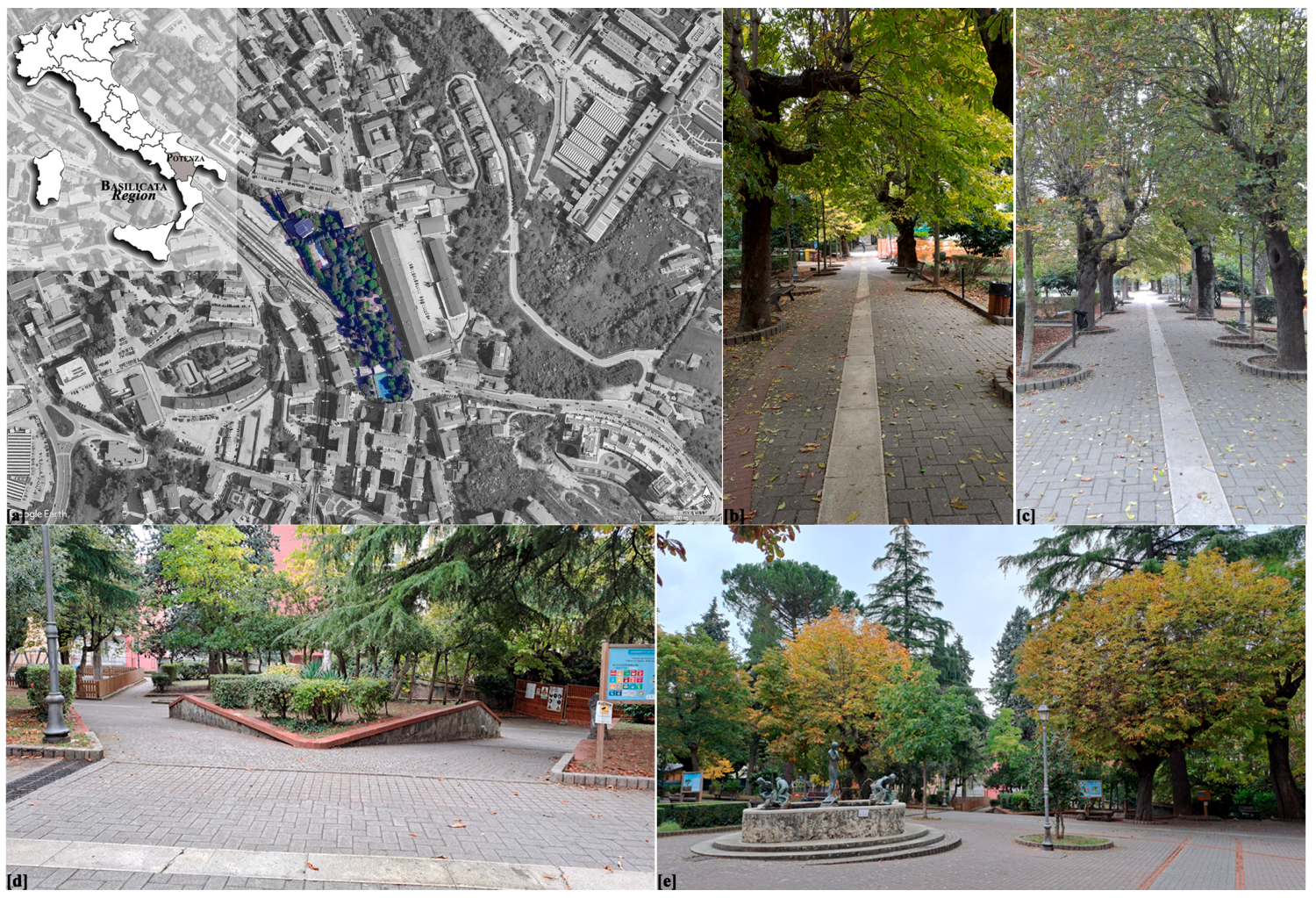
Basilicata is a mountainous region in Southern Italy, situated between Campania, Puglia, and Calabria, with access to both the Tyrrhenian and Ionian seas. Historically, it was one of the most isolated provinces of the Kingdom of Naples and retained an agrarian and pastoral economy well into the modern era. Potenza, the regional capital, served as the main administrative center despite its modest size. The city rises within the Lucanian Apennines and is set on distinctly mountainous terrain (Figure 1a). The climate is Mediterranean, with dry summers, featuring a mean annual temperature of about 11.9 °C and strong seasonal thermal contrasts. Annual precipitation averages around 615 mm, concentrated mainly in autumn and winter, reflecting the typical rainfall patterns of inland Mediterranean mountain climates [31].
From Longobard to Byzantine rule in the Middle Ages, and later from Norman and Swabian dominion to Aragonese and Bourbon sovereignty in the Modern Era, Basilicata followed the broader political trajectory of Southern Italy during Italian unification (1848–1870). Initiatives such as the creation of experimental agricultural gardens in the 19th century integrated the region into wider European processes of modernization. Today, Basilicata offers a distinctive case for studying rural resilience and historical development within the Mediterranean context.
During the early 19th century (1810), under the so-called “French Decade” (1806–1815), and particularly under Joachim Murat (1808–1815), Agricultural Societies were created throughout the Kingdom of Naples, and later transformed into Economic Societies (Royal Decree, 1812). After the Bourbon Restoration (1815–1860), Ferdinand I maintained these institutions (Royal Decree, 1817) and promoted innovation in local agriculture. In this framework, the establishment of an experimental agricultural garden was encouraged to test new crops and products [32,33,34]. The Royal Economic Society of Basilicata, composed of ordinary, corresponding, and honorary members, promoted collaboration with provincial landowners [34].
The foundation of the Royal Botanical Garden of Naples (1807), under the direction of Michele Tenore, an internationally renowned botanist, marked the beginning of a network of experimental gardens in the Kingdom of the Two Sicilies. While the Neapolitan Garden focused on the acclimatization of exotic species and the creation of new taxa, as documented in the Index Seminum [35,36], the Lucanian garden concentrated on useful crops—fodder, dye, and industrial plants—and the propagation of fruit trees, as shown in its catalogue.
Encouraged by the Economic Society of Basilicata, the Experimental Agrarian Garden of Potenza was founded in 1823, integrating the region into a broader program of agricultural modernization. It served as a provincial nursery and a center for agronomic experimentation. The garden was located on municipal land at Piano di S. Maria, an estate formerly linked to the Monastery of the Reformed Friars and documented as early as 1488 [37,38,39,40,41]. Regulations required constant updates on the activities of other agrarian gardens, particularly Naples, highlighting a functional and cultural link between the two institutions [42]. This relationship reflects the Bourbon intention to combine botanical research with agronomic application to support technical and economic progress in the southern provinces [29,43]. The garden was curated by Francesco Antonio Rosano until 1842, and later by his son, Pietro Rosano, until 1845, both serving as perpetual secretaries of the Society. In 1846, Gaetano Manfredi became director and, together with Felice Crocchi, compiled the official catalogue of the cultivated species.
After the dissolution of the Royal Economic Society of Basilicata (1866) and the completion of Italian Unification following the capture of Rome (1870), the area of Santa Maria in Potenza remained a peripheral agricultural zone dominated by the Experimental Agricultural Garden. It included orderly gardens, flowerbeds, and structures for agricultural education. Over time, it underwent significant downsizing: first by the construction of military barracks in the late 19th century, then by the building of a railway tunnel and sports fields in the 1920s–30s. Nevertheless, several historical features remain visible today, such as the avenue layout and some original trees—including horse chestnuts, cypresses, pines, and yews—which testify to its layered history [30,44]. In the second half of the 20th century, the district underwent a major transformation. Residential buildings, tree-lined avenues, and public spaces gradually replaced its former experimental and agricultural functions (Figure 1b–e). Santa Maria evolved from an agricultural center into an integrated urban neighborhood as a Municipal Garden, while preserving a constant presence of greenery—a defining trait of its historical identity.

2.2. Historical Reconstruction

Following previous studies [8], the historical reconstruction of the garden was carried out using a multidisciplinary approach that integrated archival research, bibliographic analysis, iconographic interpretation, and spatial mapping. Primary sources included the Giornale Economico-Letterario della Basilicata [42], which reported agronomic activities, structural changes, and experimental trials, and, above all, the Catalogus Plantarum Horti Agrarii Lucani [45], which listed the taxa cultivated in the garden. Additional information was drawn from Cesare Malpica’s travel diary [40] and from late 19th- and early 20th-century texts, which provided details on flora, garden layout, and plant placement.
Secondary sources comprised historical studies and iconographic materials [29,30,46], supplemented by lithographs and early photographs used for spatial verification. These visual documents were analyzed to identify key structural elements, including the central avenue, parterres, hydraulic features, and the protective woodland, confirming their continuity with the present-day layout. Plant species lists were reconstructed by cross-referencing catalog data with descriptive reports, allowing the allocation of taxa to functional areas (e.g., ornamental parterres, orchards, nurseries, experimental plots).

2.3. Floristic Interpretation and Updating Nomenclature

The Catalogus Plantarum Horti Agrari Lucani [45] compiled by Felice Crocchi and Gaetano Manfredi lists 670 taxa, including 474 botanical species—listed only with Latin binomial names, without patronymic authors—and 196 agronomic varieties.
First, we compared historical names with modern floristic nomenclature sources, including the Plants of the World Online (POWO) database [47], World Flora Online (WFO) [48], Flora d’Italia [49], Bartolucci et al. [50], Galasso et al. [51] and the Portal to the Flora of Italy [52]. This allowed us to assign updated, valid names to species without nomenclatural ambiguity. In cases where names were associated with different patronyms, an initial comparison was conducted using the Catalogue of the species cultivated in the Royal Botanical Garden of Naples by Michele Tenore [53]. If the species was not present in this list, we applied filters in POWO to disambiguate identical scientific names with different authors, excluding those with invalid (illegitimate) names.
For taxa not found in either the Naples Botanical Garden catalogue or modern nomenclature databases, we examined historical botanical sources, including descriptive texts [53,54,55,56,57,58,59,60,61,62,63,64,65,66,67,68,69,70,71] and illustrated herbaria [72,73,74,75,76,77,78], to clarify nomenclatural inconsistencies and assign the correct scientific name. Cross-referencing these sources enabled the reliable correspondence between historical Latin binomials and current botanical nomenclature.

2.4. The Evaluation of the Biodiversity and Conservation Relevance

The biodiversity and conservation relevance of the historical collection were assessed using multiple criteria. The historical Catalogus Plantarum Horti Agrarii Lucani [45] was systematically compared with conservation data retrieved from Plants of the World Online [48], the IUCN Red List [79], and Bartolucci et al. [50], in order to identify endemic species, ornamental introductions, and their conservation status at international, national, and regional levels.
For each taxon, life forms and chorotypes were determined using Acta Plantarum [80] and Flora d’Italia [49] for native species. For exotic species not included in the Italian flora and therefore lacking specific life-form and chorological classifications, these attributes were assigned based on species descriptions, nomenclatural rules according to Raunkiaer’s system, and their areas of origin. The chronology of introduction and geographic origin was verified using GBIF [81], POWO [47], and Maniero [82].

3. Results

3.1. Result of Historical Reconstruction

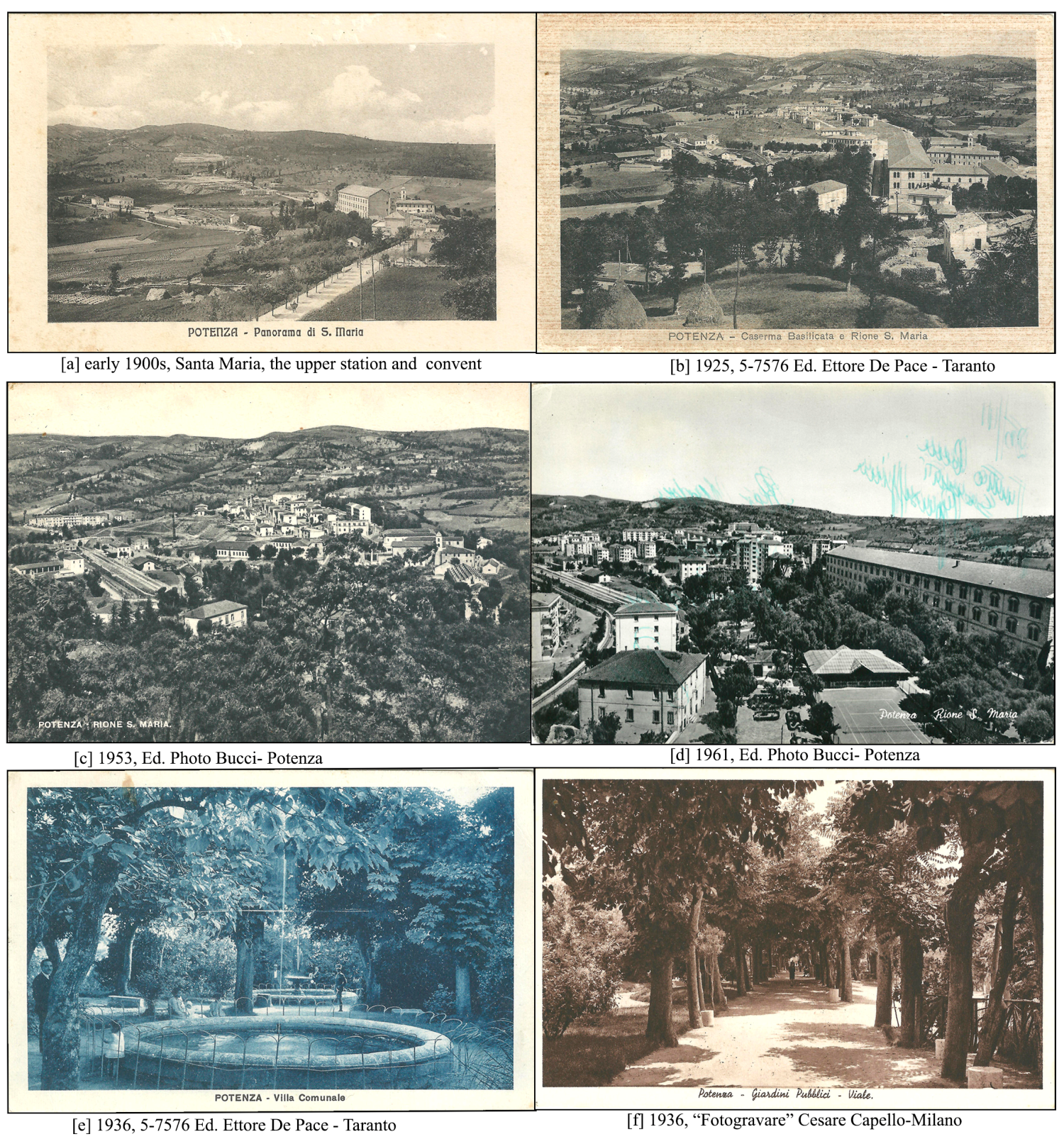
Through the finding of historical postcards, we reconstructed a visual evaluation of Potenza’s Santa Maria district and its public spaces from the early 20th century to the mid-1900s. The earliest images (Figure 2a,b) show a predominantly rural setting dominated by the upper railway station, the convent, and sparse built structures. Later images (Figure 2c,d) reveal progressive urban densification and infrastructural development, leading to a more defined urban fabric by the 1960s.
Additional postcards from 1936 (Figure 2e,f) portray Villa Comunale as an important civic space, characterized by a monumental fountain and a central avenue lined with mature trees, features that still characterize the area today. These historical views emphasize key design elements, including the original enclosure, the spatial relationship with Santa Maria Road and the military barracks, and the continuity of formal alignments over time. Functional zoning was reconstructed by cross-referencing descriptive archival sources with surviving physical traces—such as avenue alignments and ornamental features—and by interpreting historical maps and cadastral plans. Together, these sources provide a comprehensive understanding of the site’s morphological evolution and its enduring role in Potenza’s urban identity.
Table 1 summarizes the historical functional areas of the Experimental Agrarian Garden of Potenza during its formative period (1823–1847). This reconstruction highlights the garden’s spatial organization and the diversity of cultivated species. Each area served a specific role within the site’s integrated design, combining ornamental, experimental, and productive functions. The table provides a clear overview of these areas, their historical roles, and representative plant species, offering a clear framework for understanding the garden’s original structure and its role as a provincial hub for agronomic innovation and botanical exchange.

3.2. Floristic Reconstruction and Updating

The Experimental Agricultural Garden was characterized by a remarkable diversity of species, selected for productive, ornamental, and technical purposes. Among industrial and dye plants, dyer’s knotweed (Persicaria tinctoria) was cultivated for indigo extraction, with documented economic returns. Oriental sesame (Sesamum indicum) was proposed as an alternative oilseed crop in areas unsuitable for olives, while Siamese cotton (Gossypium herbaceum L. subsp. herbaceum) was introduced to diversify textile production [42]. Other economically relevant species included castor bean (Ricinus communis) and tobacco (Nicotiana tabacum), both undergoing acclimatization trials, as well as perennial flax (Linum perenne L.), valued for its ability to persist for several years without reseeding.
On the forage front, the garden successfully tested artificial meadows, an essential for rational livestock management. Species such as sulla (Sulla coronaria), alfalfa (Medicago sativa), coronilla (Coronilla sppl.), and clovers (Trifolium sppl.) provided multiple harvests and reduced grazing costs. Ornamental and forestry species included prized trees and shrubs, such as Magnolia grandiflora L., Camellia sppl., and Rhododendron arboreum Sm., along with species useful for reforestation and microclimatic protection, such as American sycamore (Platanus occidentalis L.), tree of heaven (Ailanthus altissima), acacia (Robinia pseudoacacia), cypresses (Cupressus sppl.), firs (Abies sppl.), and spruce (Picea sppl.) [42].
Mulberry plantations (Morus alba L. var. multicaulis and other Morus species) supported sericulture. The orchard included traditional fruit trees (pear, apple, plum, cherry) along with almond, grapevine, and azarole. Finally, experimental plots hosted innovative cereals (three maize varieties), high-quality legumes, and ornamental collections (roses, peonies, dahlias), reflecting an integrated project that combined economic utility, aesthetic value, and agronomic progress [40].
The Catalogus plantarum horti agrarii lucani [45], with its collection of plants (670 taxa, including 474 species and 196 varieties), well documents the diversity and richness of the Lucanian agricultural garden at the age of its settlement. In the present revision, 450 botanical species are confirmed, while 21 entries were identified as duplicates, and three species seem to be missing from the current taxonomic references. The complete list of species is provided in Supplementary Materials (Table S1).

3.3. The Result of the Biodiversity and Conservation Relevance

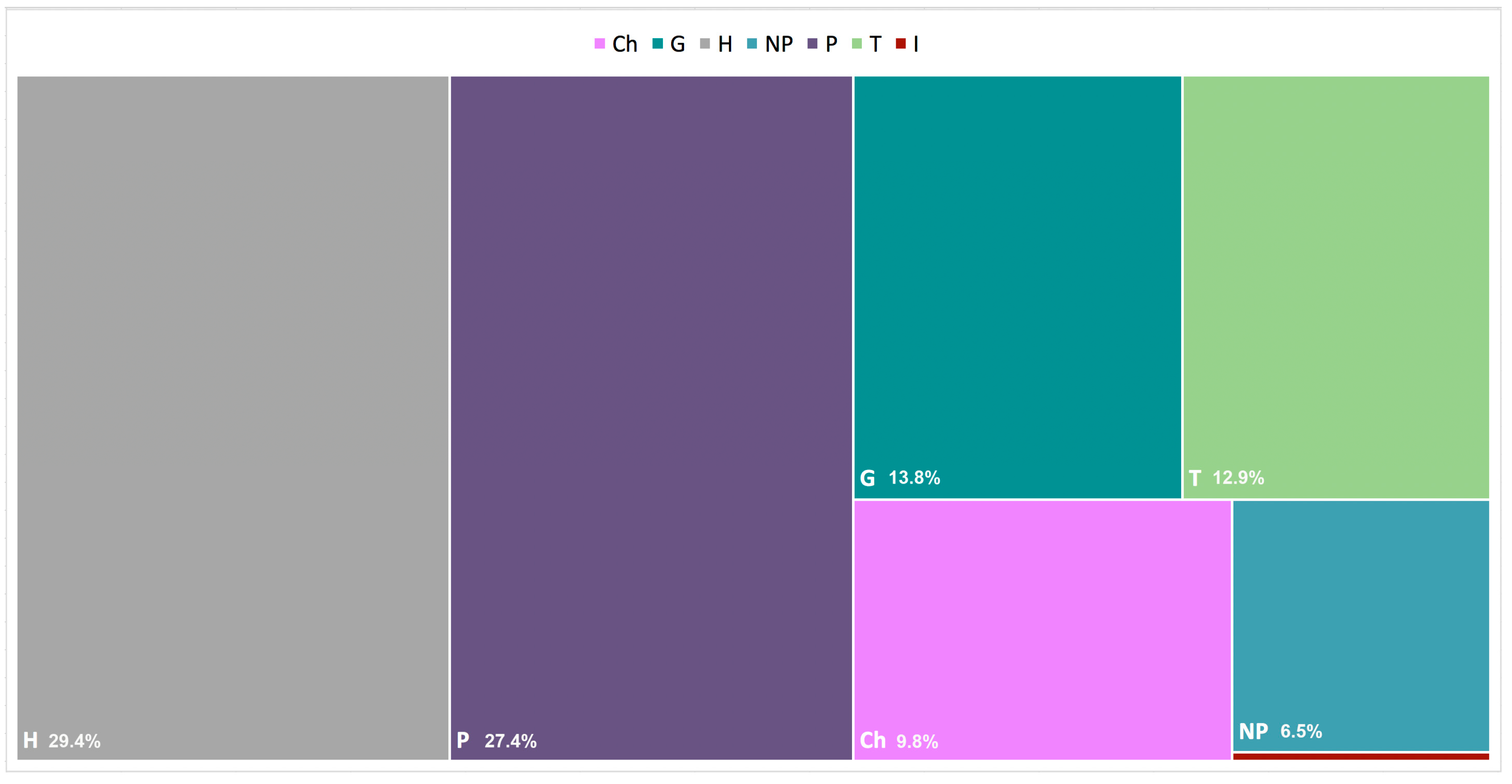
The analysis of biological forms (Figure 3) reveals a clear dominance of hemicryptophytes (29.4%) and phanerophytes (27.4%), which together account for more than half of the total occurrences. Scapose forms are overwhelmingly prevalent, accounting for nearly 48% of all records, particularly in hemicryptophytes, phanerophytes, and therophytes. Geophytes contribute significantly (13.8%), mainly as bulbous and rhizomatous types, while chamaephytes are mostly suffruticose. Nanophanerophytes and hydrophytes appear marginal.
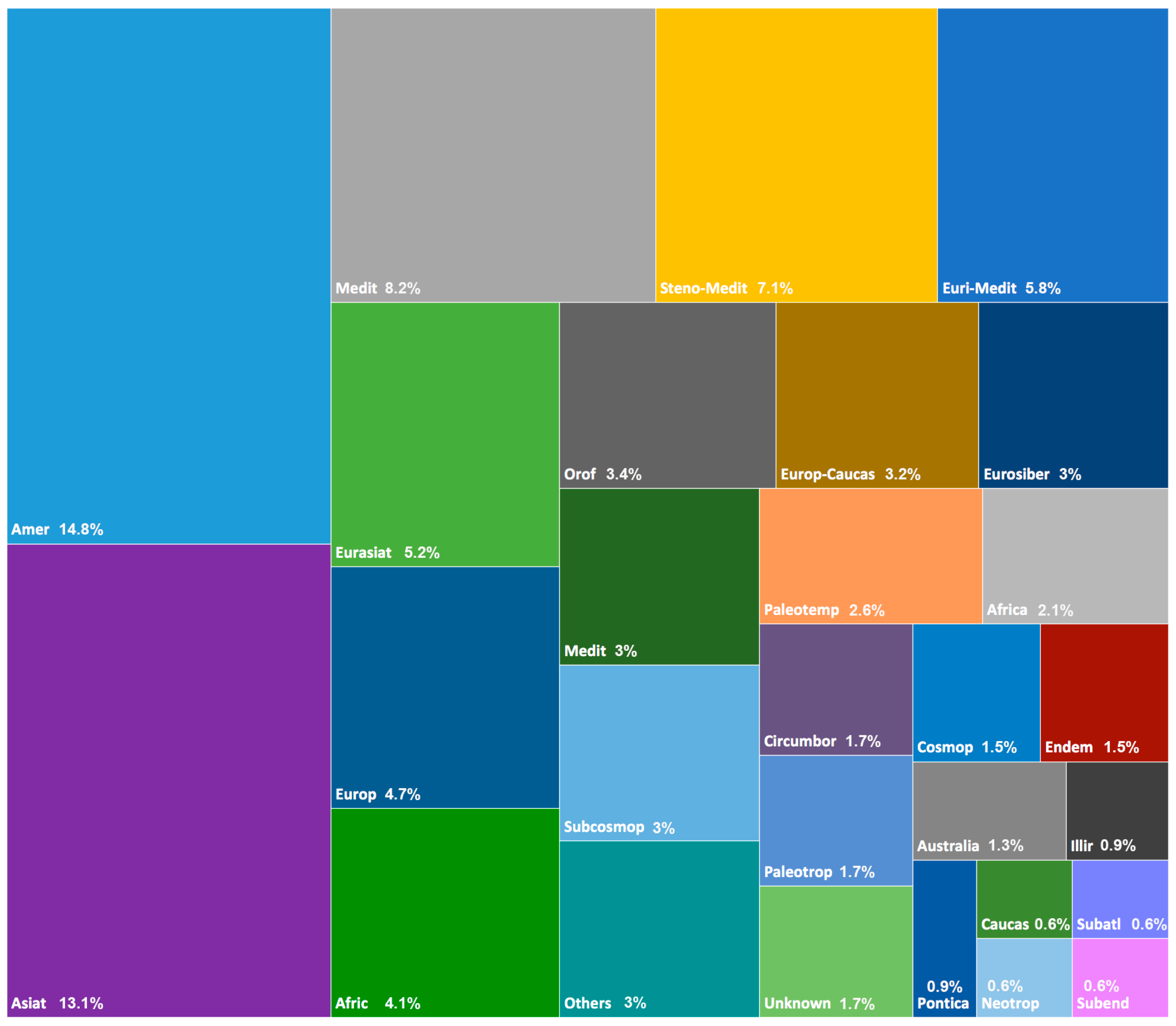
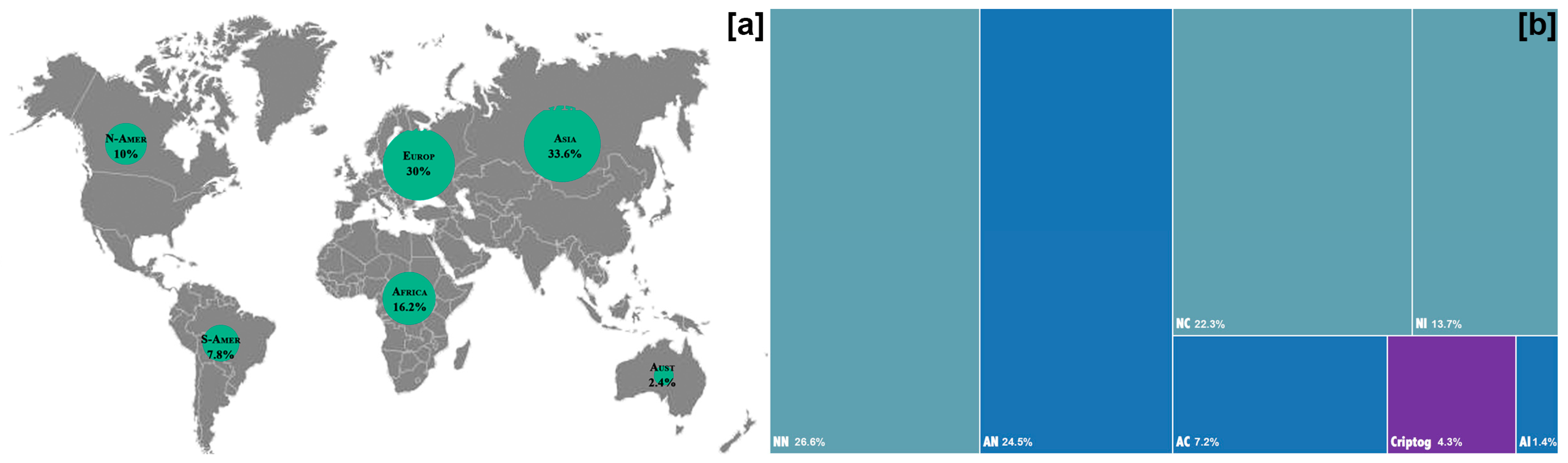
The species composition reflects broad extra-regional affinities with a strong Mediterranean imprint (Figure 4). The dataset shows American (14.8%) and Asian (13.1%) elements as the largest single groups, closely followed by the Mediterranean complex—Mediterranean 11.2%, Steno-Mediterranean 7.1%, Euri-Mediterranean 5.8%—which together account for 24.0%. European-related lineages (Eurasiatic, European, Eurosiberian, European–Caucasian) account for 16.1%, while African components account for 6.2%. Cosmopolitan/Subcosmopolitan taxa are limited (4.5%), and Endemic/Subendemic elements are rare (2.1%). Smaller fractions include Orophilous 3.4%, Paleotemperate 2.6%, Paleotropical and Circumboreal 1.7% each, with additional minor contributions from Australia, Pontic, Illirian, Caucasian, and Neotropical elements. Regarding the provenience (Figure 5a), the largest proportion originates from Asia (33.6%) and Europe (30%), followed by Africa (16.2%), North America (10%), South America (7.8%), and Australia (2.4%). Classes associated with exotic/alien status (Figure 5b) sum to 88 records, the largest fractions are Naturalized Neophyte (24.3%) and Archaophyte (22.4%), followed by Casual (6.6%) and Invasive (1.3%) Archeophyte. The remaining 42.1% belong to the other categories: Neophyte casual (20.4%), Invasive (12.5%), and Cryptogenic (3.9%).
The chronology of introductions highlights the progressive arrival of exotic species in Italy during the 19th and early 20th centuries, paralleling the foundation and development of the Botanical Garden of Potenza as an experimental agronomical site (Table 2). Species introduced shortly after the garden’s establishment include Coreopsis tinctoria (1820) and Photinia glabra (1822–1823), both primarily cultivated as ornamentals. Australian taxa, such as Eucalyptus longifolia (1829) and Ammobium alatum (1837–1840), reflect interest in drought-tolerant species for forestry and horticulture. Mid-century introductions include Sequoia sempervirens (1845–1847), valued for its monumental landscape role, while Hesperocyparis glabra (1915) represents later efforts to incorporate hardy conifers.
Analysis of the conservation status of native species (Table 3) reveals that 52% of the taxa are protected at the national level, reflecting their recognized ecological and cultural importance within Italy. Among these, a smaller subset—approximately 2%—benefits from additional regional protection, indicating heightened conservation priority in specific local contexts.
The analysis of species listed in the historical catalogue reveals a diverse set of taxa with varying biogeographic origins and conservation profiles (Table 4). Several species are endemic-subendemic to Italy or the Apennine region, such as Linaria purpurea, Stachys italica Mill., Dianthus rupicola Biv. subsp. rupicola and Solenanthus apenninum, and are of high conservation value. Among these Rhaponticoides centaurium is Vulnerable (VU), indicating a significant risk of decline. Most endemic species, including Linaria purpurea and Stachys italica, are assessed as Least Concern (LC) but remain under national protection, reflecting proactive conservation measures. Interestingly, all listed taxa are categorized as Least Concern (LC) under the IUCN Red List, except Narcissus pseudonarcissus, which is classified as Near Threatened (NT), indicating localized vulnerability despite its introduction status.
In contrast, ornamental or exotic taxa, such as Catharanthus roseus and Ipomoea rosea, endemic to Madagascar and Brazil, respectively, are introduced or naturalized, with no protection status and not evaluated by the IUCN. Distribution records show that while many native species are confirmed in Basilicata via GBIF [81] (e.g., Linaria purpurea, Stachys italica), others lack regional records despite being listed as native in POWO [47], suggesting gaps in biodiversity documentation. Overall, the dataset underscores the coexistence of high-value endemic species requiring targeted conservation and ornamental introductions with negligible ecological persistence.

4. Discussion

The present results confirm the value of historic gardens—whether preserved, transformed, or lost—as archives of botanical and cultural knowledge. They provide essential information for reconstructing past plant compositions, functions, and landscape meanings, and for tracing long-term changes in plant biodiversity [2,8,9,83,84].
The updated nomenclature emphasizes both the historical significance of the original catalogue and the dynamic nature of botanical taxonomy. Numerous taxa recorded under older names have since undergone reclassification. For instance, Ornithogalum proliferum Pall. is now treated as Gagea minima (L.) Ker Gawl.; Aloe subnigricans Spreng. has been reassigned to Gasteria brachyphylla (Salm-Dyck) van Jaarsv. var. brachyphylla; Mespilus japonica Thunb. is currently Eriobotrya japonica (Thunb.) Lindl.; Cupressus horizontalis Mill. refers to Cupressus sempervirens L.; and Mespilus germanica L. remains valid but is often discussed in relation to its phylogenetic position within Rosaceae [49,85] and is also recognized as Crataegus germanica (L.) Kuntze. These examples illustrate how advances in molecular phylogenetics and the application of the International Code of Nomenclature (ICN) [86] continue to reshape species delimitation and generic boundaries. Consequently, historic floristic inventories require continuous revision to ensure taxonomic accuracy and maintain their relevance for biodiversity conservation [87].
This scientific assessment also underscores the importance of protecting biological resources and highlights how documenting ancient cultivars and ornamental species can support horticultural practices that integrate cultural heritage. In our case, the Catalogus Plantarum Horti Agrarii Lucani [45] revealed a mixed collection drawn from Mediterranean, Eurasian, Asian, African, and American sources, consistent with the garden’s role as a provincial nursery and as a node in plant exchange networks with Naples and other provinces [29,42].
The comparative analysis of the historical catalog and contemporary databases indicated that some historically cultivated species and cultivars have disappeared from the present regional horticultural landscape. Similar patterns have been reported in other Italian regions, where long-used taxa have become rare or were replaced by a narrow set of ornamental species [2,8,83,88]. Recovering climatically resilient but obsolete cultivars—especially fruit trees—offers opportunities for reintroduction under present conditions of climate and landscape change, strengthening both genetic diversity and cultural continuity [89,90]. Such efforts align with the Florence Charter’s emphasis on authenticity in species selection and layout [5] and with contemporary heritage frameworks that stress the integration of botanical identity in conservation [9,91].
Aligning historical names with current taxonomy and distribution records allowed us to trace introduction pathways, evaluate diffusion, and assess whether exotic taxa persisted or naturalized. International experience shows that many ornamental introductions remain confined to cultivation, while a subset can naturalize depending on ecological filters and planting history [92,93,94,95,96]. In line with our earlier results, woody ornamentals (e.g., Sequoia sppl., and Hesperocyparis glabra) are largely tied to cultivation in Italy, with scattered casual or localized naturalization records. Conversely, certain genera (e.g., Eucalyptus) are well-documented for allelopathic effects on understory diversity, altering plantation ecology and water balance, though their Italian naturalization remains spatially limited [97,98]. Distinguishing low-persistence herbaceous ornamentals (e.g., Coreopsis, Ammobium) from potentially transformative tree introductions helps refine risk-aware planting policies and supports historically informed selection [99,100].
Our dataset also shows that a part of the native taxa present in the historical garden is now protected at the national level, with a smaller subset protected at the regional level, reflecting their ecological and cultural importance. For example, Aconitum lycoctonum and Narcissus poeticus are under absolute regional protection in addition to national safeguards, reflecting their rarity and conservation priority [101]. In contrast, species such as Abies alba and Narcissus pseudonarcissus receive only partial regional protection, suggesting a lower, but still relevant level of conservation concern.
The chorotypes confirm that these species are primarily European montane or temperate taxa, aligning with the region’s historical horticultural and ornamental practices. The floristic patterns observed in Basilicata mirror broader Italian and European trends. Some taxa, such as Abies alba and Paeonia peregrina, show ecological and biogeographic fidelity to montane and sub-Mediterranean areas, as also noted in Tuscany and Liguria [51,52,92]. This discrepancy highlights the importance of regional assessments, as global conservation status may not fully capture local ecological pressures [102]. Overall, Basilicata exemplifies national patterns of native montane taxa under strong protection, sporadic ornamental introductions, and incomplete biodiversity records, underscoring the value of integrating historical catalogues with modern databases for long-term conservation planning [103].
Historically, the garden served as a nursery for useful and experimental species [29,42], and today offers a blueprint for climate-adaptive, culturally resonant planting that reconnects agrarian knowledge, local identity, and ecological function. Lost gardens can act as catalysts for renewal, and reconstructing their plant narratives enriches place identity and informs contemporary green infrastructure [84,89,90,104]. By documenting species introductions and naturalization processes, this study clarifies how exotic plants entered regional floras—a topic increasingly relevant for managing invasive species and preserving native biodiversity.
Finally, to bring historical botanical knowledge into contemporary practice, it is essential to reconcile historical names with current taxonomy and conservation status [8]. Following this, taxa with local resonance and ecological compatibility should be prioritized, particularly endemic and protected species as well as culturally significant cultivars [9].

5. Conclusions

The reconstruction of the Experimental Agricultural Garden of Villa Santa Maria in Potenza demonstrates the value of historical gardens as archives of biodiversity and cultural heritage. By comparing historical catalogs with modern taxonomic and conservation data, this study reveals species that have vanished from the current landscape, and highlights pathways of introduction and naturalization, identifying endemic taxa of high conservation priority. These findings underscore the potential of historical horticultural knowledge to inform climate-resilient planting strategies, biodiversity restoration, and cultural valorization. Integrating botanical memory into urban regeneration and education initiatives can transform forgotten gardens into models for sustainable and heritage-driven landscape planning.

Supplementary Materials

The following supporting information can be downloaded at: https://www.mdpi.com/article/10.3390/jzbg7010012/s1, Table S1: Floristic list of garden cultivated species with the nomenclature upgrading from the original list of Catalogus plantarum Horti agrarii Lucani (1846) to modern scientific name by Plants of the World Online, Kew Science (powo.science.kew.org), with their family, chorotype and life form.

Author Contributions

Conceptualization, F.B., M.A.P. and G.C.; methodology, F.B. and G.C.; validation, F.B. and G.C.; formal analysis, F.B. and Z.H.; investigation, F.B., M.A.P. and Z.H.; resources, F.B., and M.A.P.; data curation, F.B. and Z.H.; writing—original draft preparation, F.B. and Z.H.; writing—review and editing G.C.; visualization, F.B. and Z.H.; supervision, G.C.; project administration, G.C.; funding acquisition, G.C. All authors have read and agreed to the published version of the manuscript.

Funding

This work was supported by PNRR M1C3, Measure 2 “Regeneration of small cultural sites, cultural, religious and rural heritage”, Investment 2.3: “Programs to enhance the identity of places: historic parks and gardens”. Grant number 818000_2024_RegioneBasilicata. Then, the National Recovery and Resilience Plan (PNRR), Mission 4—Component 2 “From Research to Business”, within the framework of the National Biodiversity Future Center (NBFC), funded by the European Union—NextGenerationEU, NBFC PNRR 2022-CN033-Centro Nazionale Biodiversità—CUP F83C22000730006.

Institutional Review Board Statement

Not applicable.

Informed Consent Statement

Not applicable.

Data Availability Statement

The original contributions presented in this study are included in the article/Supplementary Materials. Further inquiries can be directed to the corresponding author.

Acknowledgments

The authors wish to express their sincere thanks to Giovani D’Andrea for providing access to historic postcard data essential to this work.

Conflicts of Interest

The authors declare no conflicts of interest.

References

  1. Ignatieva, M. Planning and design of ecological networks in urban areas. Landsc. Ecol. Eng. 2011, 7, 17–25. [Google Scholar] [CrossRef]
  2. Funsten, C.; Borsellino, V.; Schimmenti, E. A systematic literature review of historic garden management and its economic aspects. Sustainability 2020, 12, 10679. [Google Scholar] [CrossRef]
  3. Larkham, P.J. Conservation and the City; Routledge: London, UK, 2002. [Google Scholar]
  4. Mason, R. Assessing values in conservation planning: Methodological issues and choices. In Assessing the Values of Cultural Heritage; de la Torre, M., Ed.; Getty Conservation Institute: Los Angeles, CA, USA, 2002; pp. 5–30. [Google Scholar]
  5. ICOMOS–IFLA. Florence Charter on the Conservation of Historic Gardens; ICOMOS: Paris, France, 1982; Available online: https://www.icomos.org/images/DOCUMENTS/Charters/gardens_e.pdf (accessed on 2 October 2025).
  6. Funsten, C.; Borsellino, V.; Schimmenti, E. The appropriate legal and administrative measures: The Florence Charters and legislation governing historic gardens in Palermo, Sicily. Restauro Archeol. 2021, 2, 152–157. [Google Scholar]
  7. Turbé, A.; Shwartz, A.; Simon, L.; Julliard, R. Enhancing urban biodiversity and its influence on city-dwellers: An experiment. Biol. Conserv. 2014, 171, 82–90. [Google Scholar] [CrossRef]
  8. Bartoli, F.; D’Amato, L.; Nucera, A.; Albani Rocchetti, G.; Caneva, G. Understanding the lost: Reconstruction of the garden design of Villa Peretti Montalto (Rome, Italy) for urban valorization. Plants 2024, 13, 77. [Google Scholar] [CrossRef] [PubMed]
  9. Hosseini, Z.; Bartoli, F.; Pontrandolfi, M.A.; Caneva, G. Identity of a historic garden: The view of the international literature and committees on the role of botanical elements. Urban For. Urban Green. 2024, 101, 128501. [Google Scholar] [CrossRef]
  10. Di Paolo, A. Linee Guida Sui Parchi e Giardini Storici: Conoscere e Conservare; Studio Andrea Di Paolo: Rome, Italy, 2020. [Google Scholar]
  11. PaRID. Conservation of Historic Gardens and Plant Architectures: Methodological and Operational Guidelines; Politecnico di Milano: Milan, Italy, 2005. [Google Scholar]
  12. Tzortzi, N.; Lux, M.S. Urban deserts and garden-oases: Micro-green geography for historic centers. In ARIDO; Politecnico di Milano: Milan, Italy, 2023. [Google Scholar]
  13. APGI. Management Plan for a Historic Garden: Methodological Guidelines and General Contents; Associazione Parchi e Giardini d’Italia: Rome, Italy, 2024. [Google Scholar]
  14. Drayton, R. Nature’s Government: Science, Imperial Britain, and the Improvement of the World; Yale University Press: New Haven, CT, USA, 2000. [Google Scholar]
  15. Brockway, L.H. Science and colonial expansion: The role of the British Royal Botanic Gardens. Am. Ethnol. 1979, 6, 449–465. [Google Scholar] [CrossRef]
  16. Añón Feliú, C. (Ed.) Culture and Nature: International Legislative Texts Referring to the Safeguard of Natural and Cultural Heritage; Leo S. Olschki: Florence, Italy, 2003. [Google Scholar]
  17. Kohler, R.E. Landscapes and Labscapes: Exploring the Lab–Field Border in Biology; University of Chicago Press: Chicago, IL, USA, 2002. [Google Scholar]
  18. Kloppenburg, J. First the Seed: The Political Economy of Plant Biotechnology; University of Wisconsin Press: Madison, WI, USA, 2004. [Google Scholar]
  19. Pisani Barbacciani, P.L.; Nanni, P. Gli orti agrari di Firenze. Riv. Stor. Agric. 1996, 35, 69–107. [Google Scholar]
  20. Di Fazio, L.; Luzzi, P. La collezione dei “Semplici” nell ’Orto agrario di Firenze del XIX secolo. Museol. Sci. 2010, 4, 98–104. [Google Scholar]
  21. Bonneuil, C. The building of a new scientific discipline: Agricultural science in France, 1870–1914. J. Hist. Biol. 2000, 33, 283–312. [Google Scholar]
  22. Anderson, W. Colonial Pathologies: American Tropical Medicine, Race, and Hygiene in the Philippines; Duke University Press: Durham, NC, USA, 2005. [Google Scholar]
  23. Cini, M. Agronomia e Agricoltura in Corsica e Toscana Nel XIX Secolo; IRIS UNIPI: Pisa, Italy, 2014. [Google Scholar]
  24. CREA. Storia Delle Stazioni Sperimentali Agrarie Italiane; CREA: Rome, Italy, 2021. [Google Scholar]
  25. Nanni, P. I Targioni Tozzetti e l’orto agrario sperimentale dei Georgofili. Riv. Stor. Agric. 2006, 2, 47–64. [Google Scholar] [CrossRef]
  26. Grano, M.C. Paesaggio, strutture rurali e architettura popolare nelle Provincie di Potenza e Matera. Cult. Landsc. 2014, 9, 131–148. [Google Scholar]
  27. Grano, M.C.; Lazzari, M.; Del Monte, M. Fonti cartografiche per l’analisi del paesaggio fluviale in Basilicata. Boll. Assoc. Ital. Cartogr. 2016, 157, 4–18. [Google Scholar]
  28. Grano, M.C. Gualchiere, mulini idraulici e cisterne: L’uso dell’acqua e le trasformazioni del paesaggio in Basilicata. Agri Centuriati 2020, 2020, 47–57. [Google Scholar]
  29. Volonnino, F.; Pontrandolfi, M.A. Un orto botanico ottocentesco nel Regno delle Due Sicilie: L’Orto agrario sperimentale della Provincia di Basilicata. In Proceedings of the Atti del Convegno Internazionale “Orti Botanici: Passato, Presente, Futuro”, Padova, Italy, 29–30 June 1995. [Google Scholar]
  30. Colacino, C. Villa Santa Maria a Potenza: Un antico Orto Botanico. Delpinoa 2023, 63–64, 39–53. [Google Scholar]
  31. Climate Report–Potenza (Italy). Long-Term Climate Analysis (1970–2024) with WMO-Standard Reference Period Data. Available online: https://www.statsclimat.com/Europe/Italy/report_Potenza (accessed on 26 January 2026).
  32. Gasparrini, G.; Bruni, A.; De Nanzio, F. Breve Ragguaglio Dell’Agricoltura e Pastorizia del Regno di Napoli; Tipografia del Filiatre-Sebezio: Naples, Italy, 1845. [Google Scholar]
  33. Racioppi, G. Storia dei Popoli della Lucania e della Basilicata; Loescher: Rome, Italy, 1889; Volume 2. [Google Scholar]
  34. Tenore, M. Index Seminum quae Hortus Botanicus Neapolitanus Offert; Regia Stamperia: Naples, Italy, 1813. [Google Scholar]
  35. Tenore, M. Index Seminum quae Bortus Botanicus Neapolitanus Offert; Regia Stamperia: Naples, Italy, 1845. [Google Scholar]
  36. Perretti, G. Orto Agrario Sperimentale Villa Santa Maria–Potenza; Università degli Studi della Basilicata: Potenza, Italy, 2001. [Google Scholar]
  37. De Pilato, S. Saggio Bibliografico sulla Basilicata; Vincenzo Garramone Editore: Potenza, Italy, 1914. [Google Scholar]
  38. Guerriero, G. Le Cento Città d’Italia–Potenza; Supplemento a Il Secolo, 30 September 1899; Sonzogno: Milan, Italy, 1899. [Google Scholar]
  39. Rendina, G. Istoria della Città di Potenza; Villani Libri: Calvello, Italy, 1758. [Google Scholar]
  40. Malpica, C. La Basilicata; Andrea Festa: Naples, Italy, 1847. [Google Scholar]
  41. Riviello, R. Cronaca Potentina dal 1799 al 1882; Arnaldo Forni Ed.: Potenza, Italy, 1888. [Google Scholar]
  42. Società Economica della Provincia di Basilicata. Giornale Economico-Letterario; Tipografia V. Santanello: Potenza, Italy, 1840–1847. [Google Scholar]
  43. Menale, B.; Barone Lumaga, M.R. Il ruolo dell’Orto Botanico di Napoli nella coltivazione delle specie esotiche. Delpinoa 2000, 42, 35–38. [Google Scholar]
  44. Morano, M. La Real Società Economica di Basilicata. In Il Mezzogiorno Preunitario. Economia, Società e Istituzioni; Dedalo: Bari, Italy, 1987. [Google Scholar]
  45. Società Economica di Basilicata. Catalogus Plantarum Horti Agrarii Lucani; Typis Regiae Celsitudinis: Potenza, Italy, 1846. [Google Scholar]
  46. Lions Club Potenza–Pretoria. Un Orto Botanico in Basilicata…Quello del Passato…Quello del Futuro; Lions Club Potenza–Pretoria: Potenza, Italy, 1996. [Google Scholar]
  47. Plants of the World Online. Available online: https://powo.science.kew.org (accessed on 24 October 2025).
  48. World Flora Online. Available online: https://www.worldfloraonline.org/ (accessed on 24 October 2025).
  49. Pignatti, S.; Guarino, R. Flora d’Italia; Edagricole: Bologna, Italy, 2018; Volumes 1–3. [Google Scholar]
  50. Bartolucci, F.; Peruzzi, L.; Galasso, G.; Alessandrini, A.; Ardenghi, N.M.G.; Bacchetta, G.; Banfi, E.; Barberis, G.; Bernardo, L.; Bouvet, D.; et al. A second update to the checklist of the vascular flora native to Italy. Plant Biosyst. 2024, 158, 219–296. [Google Scholar] [CrossRef]
  51. Galasso, G.; Conti, F.; Peruzzi, L.; Alessandrini, A.; Ardenghi, N.M.G.; Bacchetta, G.; Banfi, E.; Barberis, G.; Bernardo, L.; Bouvet, D.; et al. A second update to the checklist of the vascular flora alien to Italy. Plant Biosyst. 2024, 158, 297–340. [Google Scholar] [CrossRef]
  52. Portal to the Flora of Italy 2025.1. Available online: https://dryades.units.it/floritaly/index.php (accessed on 24 October 2025).
  53. Tenore, M.; Barbazita, F.; Costa, A. Atti del Reale Istituto d’Incoraggiamento alle Scienze Naturali di Napoli; Tomo VII; Tipografia del Ministero di Stato degli Affari Interni: Naples, Italy, 1847. [Google Scholar]
  54. Clarici, P.B. Istoria e Coltura delle Piante Ornamentali; Andrea Poletti: Venice, Italy, 1726. [Google Scholar]
  55. James, J.; Diderot, D.; Eidous, T. Dizionario Universale di Medicina, Chirurgia, Chimica, Farmacia, Botanica e Istoria Naturale; Giambattista Pasquali: Venice, Italy, 1753. [Google Scholar]
  56. Milne, C. A Botanical Dictionary: Elements of Systematic and Philosophical Botany; William Griffin: London, UK, 1770. [Google Scholar]
  57. Haworth, A.H. A new arrangement of the genus Aloe with a chronological sketch of the progressive knowledge of that genus, and of other succulent genera. Trans. Linn. Soc. Lond. 1804, 7, 1–28. [Google Scholar] [CrossRef]
  58. Chomel, P.G.B. Storia Compendiosa delle Piante Usuali; Tomo III; Tipografia Sublacense: Rome, Italy, 1808. [Google Scholar]
  59. Stokes, J. A Botanical Materia Medica; J. Johnson and Co.: London, UK, 1812; Volume 2. [Google Scholar]
  60. Genore, M. Trattato di Fitognosia Ossia Esposizione della Glossologia, della Tassonomia e della Fitografia, 4th ed.; Tipografia di P. Tizzano: Naples, Italy, 1842. [Google Scholar]
  61. Voigt, J.O. Hortus Suburbanus Calcuttensis: A Catalogue of the Plants Cultivated in the Hon. East India Company’s Botanical Garden, Calcutta, and in The Serampore Botanical Garden; Bishop’s College Press: Calcutta, India, 1845. [Google Scholar]
  62. Zobi, A. Notizie Storiche Sull’origine e Progressi dei Lavori di Commesso in Pietre Dure Che Si Eseguono Nell’i. E R. Stabilimento di Firenze; Stamperia Granducale: Florence, Italy, 1853. [Google Scholar]
  63. Ubicini, A. I Giardini: Giornale d’orticoltura; Andrea Ubicini Editore: Milan, Italy, 1854; Volume 1. [Google Scholar]
  64. Skofitz, A. Österreichische Botanische Zeitschrift; XI Jahrgang; C. Gerold: Vienna, Austria, 1861. [Google Scholar]
  65. Bubani, P. Flora Virgiliana; Tipografia Locale: Bagnacavallo, Italy, 1868. [Google Scholar]
  66. Real Jardín Botánico de Madrid. Catalogus Seminum in Horto Botanico Matritensi Anno 1888 Collectorium; Real Jardín Botánico de Madrid: Madrid, Spain, 1888. [Google Scholar]
  67. Penzig, O.; Borzì, A.; Pirotta, R. Malpighia: Rassegna Mensuale di Botanica; Anno XII; Tipografia Angelo Ciminago: Genoa, Italy, 1898. [Google Scholar]
  68. Malpighi, M. Le galle nell’ Anatome Plantarum di M. Malpighi. Malpighia: Rassegna mensuale di botanica (Anno XII); Tipografia di Angelo Ciminago: Genova, Italy, 1898. [Google Scholar]
  69. Savage, S. Catalogue of the Smithian Herbarium (The Herbarium of Sir James Edward Smith, M.D., F.R.S., first President of the Linnean Society of London) in the Possession of the Linnean Society of London; Linnean Society of London: London, UK, 1963. [Google Scholar]
  70. Maovaz, M.; Ranfa, A.; Romano, B. L’Orto Botanico di Perugia nel XIX secolo. Inf. Bot. Ital. 2002, 34, 149–166. [Google Scholar]
  71. Mesquita, S.; Castel-Branco, C.; Menezes de Sequeira, M. Tracing the Azorean jasmine (Jasminum azoricum L.) an endemic species from Madeira, through three centuries of illustration and gardening. Garden Hist. 2021, 49, 80–106. Available online: https://www.jstor.org/stable/10.2307/27136971 (accessed on 30 September 2025).
  72. Besler, B. Solanum pomiferum [Botanical plate]. In The Garden at Eichstätt: Basilius Besler’s Book of Plants; Taschen: London, 1613; Volume 2. [Google Scholar]
  73. Munting, A. Amygdalus nana [Botanical plate]. In Naauwkeurige Beschryving der Aardgewassen, Waar in de Veelerley Aart en Byzondere Eigenschappen der Boomen, Heesters, Kruyden, Bloemen…; Pieter vander Aa: Leyden, The Netherlands, 1696. [Google Scholar]
  74. Ehret, G.D. Solanum spinosum Indicum [Botanical plate]. In Plantae Selectae; Trew, C.J., Ed.; S.l, s.n.: Nürnberg, Germany, 1750–1773. [Google Scholar]
  75. Curtis, W. The Botanical Magazine; Couchman and Fry: London, UK, 1787; Volume 1, Plates 1–36. [Google Scholar]
  76. Jung, J.J. Camellia delicatissima [Botanical plate 63]. In Iconographie du Genre Camellia, ou Description et Figures des Camellia les Plus Beaux et les Plus Rares; Berlèse, L., Ed.; Paris H. Cousin Libraire-Editeur: Paris, France, 1841; Volume 1. [Google Scholar]
  77. Berlèse, L.; Jung, J.J.; Duménil, A.; Cousin, H. Iconographie du Genre Camellia, ou Description et Figures des Camellia les Plus Beaux et les Plus Rares; Paris H. Cousin Libraire-Editeur: Paris, France, 1841–1843. [Google Scholar]
  78. Verschaffelt, A.J. Nouvelle Iconographie du Camellias; Chez Auguste van Geerd: Gand, Belgium, 1848–1852. [Google Scholar]
  79. IUCN Red List of Threatened Species. Available online: https://www.iucnredlist.org (accessed on 24 October 2025).
  80. Acta Plantarum. Flora delle Regioni Italiane. Available online: https://www.actaplantarum.org (accessed on 24 October 2025).
  81. Global Biodiversity Information Facility (GBIF). Available online: https://www.gbif.org (accessed on 24 October 2025).
  82. Maniero, F. Cronologia della Flora Esotica Italiana; Leo, S. Olschki: Florence, Italy, 2015. [Google Scholar]
  83. Antrop, M. Why landscapes of the past are important for the future. Landsc. Urban Plan. 2005, 70, 21–34. [Google Scholar] [CrossRef]
  84. Gullino, P.; Pomatto, E.; Gaino, W.; Devecchi, M.; Larcher, F. New challenges for historic gardens’ restoration: A holistic approach for the Royal Park of Moncalieri Castle (Turin Metropolitan Area, Italy). Sustainability 2020, 12, 10067. [Google Scholar] [CrossRef]
  85. Christenhusz, M.J.M.; Reveal, J.L.; Farjon, A.; Gardner, M.F.; Mill, R.R.; Chase, M.W. A new classification and linear sequence of extant gymnosperms. Phytotaxa 2011, 19, 55–70. [Google Scholar] [CrossRef]
  86. Turland, N.J.; Wiersema, J.H.; Barrie, F.R.; Gandhi, K.N.; Gravendyck, J.; Greuter, W.; Hawksworth, D.L.; Herendeen, P.S.; Klopper, R.R.; Knapp, S.; et al. International Code of Nomenclature for Algae, Fungi, and Plants (Madrid Code); University of Chicago Press: Chicago, IL, USA, 2025. [Google Scholar]
  87. Chase, M.W.; Christenhusz, M.J.M.; Fay, M.F.; Byng, J.W.; Judd, W.S.; Soltis, D.E.; Soltis, P.S.; Stevens, P.F. An update of the Angiosperm Phylogeny Group classification for the orders and families of flowering plants: APG IV. Bot. J. Linn. Soc. 2016, 181, 1–20. [Google Scholar] [CrossRef]
  88. Caneva, G.; Bartoli, F.; Zappitelli, I. Street trees in Italian cities: Story, biodiversity and integration within the urban environment. Rend. Lincei Sci. Fis. Nat. 2020, 31, 411–417. [Google Scholar] [CrossRef]
  89. Hosseini, Z.; Caneva, G. Lost gardens: From knowledge to revitalization and cultural valorization of natural elements. Sustainability 2022, 14, 2956. [Google Scholar] [CrossRef]
  90. D’Amato, L.; Bartoli, F.; Savo, V.; Paiella, P.A.; Messina, F.; Caneva, G. Distribution pattern of urban street trees in Rome (Italy): A multifactorial evaluation of selection criteria. Sustainability 2023, 15, 14065. [Google Scholar] [CrossRef]
  91. UNESCO. Recommendation on the Historic Urban Landscape. Available online: https://whc.unesco.org/en/hul (accessed on 10 November 2025).
  92. Galasso, G.; Conti, F.; Peruzzi, L.; Ardenghi, N.M.G.; Banfi, E.; Celesti-Grapow, L.; Albano, A.; Alessandrini, A.; Bacchetta, G.; Ballelli, S.; et al. An Updated Checklist of the Vascular Flora Alien to Italy. Plant Biosyst. 2018, 152, 556–592. [Google Scholar] [CrossRef]
  93. Richardson, D.M.; Pyšek, P.; Rejmánek, M.; Barbour, M.G.; Panetta, F.D.; West, C.J. Naturalization and invasion of alien plants: Concepts and definitions. Divers. Distrib. 2000, 6, 93–107. [Google Scholar] [CrossRef]
  94. Hulme, P.E. Addressing the threat to biodiversity from botanic gardens. Trends Ecol. Evol. 2011, 26, 168–174. [Google Scholar] [CrossRef]
  95. van Kleunen, M.; Essl, F.; Pergl, J.; Brundu, G.; Carboni, M.; Dullinger, S.; Pyšek, P. The changing role of ornamental horticulture in alien plant invasions. Biol. Rev. 2018, 93, 1421–1437. [Google Scholar] [CrossRef]
  96. Pyšek, P.; Hulme, P.E.; Simberloff, D.; Bacher, S.; Blackburn, T.M.; Carlton, J.T.; Richardson, D.M.; Essl, F.; Foxcroft, L.C.; Genovesi, P.; et al. Scientists’ warning on invasive alien species. Biol. Rev. 2020, 95, 1511–1534. [Google Scholar] [CrossRef]
  97. Li, J.; Huang, Y.; Chen, L.; Gao, S.; Zhang, J.; Zhang, D. Understory plant diversity and phenolic allelochemicals across a range of Eucalyptus grandis plantation ages. J. For. Res. 2023, 34, 1577–1590. [Google Scholar] [CrossRef]
  98. Qin, F.; Liu, S.; Yu, S. Effects of allelopathy and competition for water and nutrients on survival and growth of tree species in Eucalyptus urophylla plantations. For. Ecol. Manag. 2018, 424, 387–395. [Google Scholar] [CrossRef]
  99. Proven Winners. Coreopsis: The Ultimate Growing Guide. Available online: https://www.provenwinners.com (accessed on 10 November 2025).
  100. Australian Plant Census. Ammobium alatum: Occurrence and Status. Available online: https://biodiversity.org.au (accessed on 2 November 2025).
  101. Conti, F.; Abbate, G.; Alessandrini, A.; Blasi, C. (Eds.) An Annotated Checklist of the Italian Vascular Flora; Palombi Editori: Rome, Italy, 2005. [Google Scholar]
  102. Rossi, G.; Montagnani, C.; Gargano, D.; Peruzzi, L.; Abeli, T.; Ravera, S.; Cogoni, A.; Fenu, G.; Magrini, S.; Gennai, M.; et al. Lista Rossa IUCN della Flora Italiana. 1. Policy Species e Altre Specie Minacciate; Comitato Italiano IUCN & Ministero dell’Ambiente e della Tutela del Territorio e del Mare: Rome, Italy, 2013. [Google Scholar]
  103. Heywood, V.H. Conserving plants within and beyond protected areas—Still problematic and future uncertain. Plant Divers. 2017, 39, 55–62. [Google Scholar] [CrossRef]
  104. Caneva, G.; Hosseini, Z.; Bartoli, F.; Capotorti, G.; Attorre, F.; Blasi, C. Revaluating CUNA places (CUltural place of high relevance for NAture): Rome as a multifaceted example. Land 2025, 14, 1–25. [Google Scholar] [CrossRef]
Figure 1. Spatial context and morphological characteristics of Villa Santa Maria, Potenza (Basilicata Region, Italy). (a) Georeferenced aerial view highlighting the park’s location within the city; (b,c) Pedestrian axes characterized by mature tree alignments, providing shaded corridors and defining the park’s longitudinal structure; (d) Node integrating raised planting beds as a transitional space between circulation and vegetated areas; (e) Central Plaza featuring a sculptural fountain.
Jzbg 07 00012 g001
Figure 2. Historical evolution of Potenza’s Santa Maria district and Villa Comunale through archival postcards: (a) early 1900s rural setting with upper station and convent; (b) 1925 consolidation around Basilicata barracks; (c,d) 1953–1961 urban densification and structured fabric; (e) 1936 view of the Villa Comunale’s fountain as a civic landmark; (f) 1936 tree-lined central avenue reflecting formal spatial organization.
Jzbg 07 00012 g002
Figure 3. Tree map showing the relative abundance of biological life forms [Hemicryptophytes (H), Phanerophytes (P), Geophytes (G), Therophytes (T), Chamaephytes (Ch), Nanophanerophytes (NP), only the 0.2% Hydrophytes (I) in dark red].
Jzbg 07 00012 g003
Figure 4. Treemap illustrating the chorological spectrum of species [Amer = American, Asiat = Asiatic, Medit = Mediterranean, Steno-Medit = Steno-Mediterranean, Euri-Medit = Euri-Mediterranean, Eurasiat = Eurasiatic, Europ = European, Africa = African, Orof = Orophilous, Europ.-Caucas = European-Caucasian, Eurosiber = Eurosiberian, Subcosmop = Subcosmopolitan, Cosmop = Cosmopolitan, Paleotemp = Paleotemperate, Paleotrop = Paleotropical, Circumbor = Circumboreal, Endem = Endemic, Subendem = Subendemic, Australia = Australian, Illirica = Illyrian, Pontica = Pontic, Caucas = Caucasian, Neotrop = Neotropical, Subatl = Subatlantic, Others = Other minor chorotypes, Unknown = Uncertain origin].
Jzbg 07 00012 g004
Figure 5. Two complementary aspects of the species geography. (a) Geographical origin of plant species. The Circle size is proportional to the percentage of species from each region [N-Amer = North America, S-Amer = South America, Europ = Europe, Asia = Asia, Africa = Africa, Aust = Australia]. (b) Treemap illustrating the distribution of species by exoticity categories [A = Archeophyte; AC = Casual Archeophyte; AN = Naturalized Archeophyte; AI = Invasive Archeophyte; N = Neophyte; NN = Naturalized Neophyte; NI = Invasive Neophyte].
Jzbg 07 00012 g005
Table 1. Functional areas of the Experimental Horticultural Garden of Potenza (Villa Santa Maria) during its formative period (1823–1847), with historical descriptions and representative cultivated species. Data derived from archival sources and recent historical analyses [29,30,45,46]; Scientific name through [47,50,51,52].
Functional AreaHistorical DescriptionCultivated Species
A. Avenues and ParterresThree longitudinal avenues (central boulevard + two lateral paths), leveled and adorned with benches and hedges of boxwood, laurel, and rosemary. Ornamental and medicinal parterres at the entrance, later enriched with evergreens for winter aesthetics.Boxwood (Buxus sempervirens L.), laurel (Laurus nobilis L.), rosemary (Salvia rosmarinus Spenn.),
thuja (Thuja occidentalis L.), cypress (Cupressus sempervirens L.), yew (Taxus baccata L.), fir (Abies sppl.)
B. Hydraulic SystemOriginal large basin replaced in 1845 by a central cistern and two lateral basins with conduits for irrigation and ornamentation.Aquatic plants (ornamental species, unspecified)
C. Protective WoodlandWestern belt with poplars, tree of heaven, robinia, sumac, cypress, and firs; served as windbreak and nursery.Poplar (Populus sppl.), tree of heaven (Ailanthus altissima (Mill.) Swingle), robinia (Robinia pseudoacacia L.), sumac (Rhus coriaria L.), cypress (Cupressus sempervirens L.), fir (Abies sppl.)
Orchard and NurseriesFruit trees; nurseries for grafting (≈1000/year); vineyard transformed into low shrubs along the avenues.Pear (Pyrus communis L.), apple (Malus domestica (Suckow) Borkh.), plum (Prunus domestica L.), medlar (Crataegus germanica (L.) Kuntze), currant (Ribes rubrum L.), cherry (Prunus cerasus L.), grapevine (Vitis vinifera L.)
Artificial MeadowsCultivation of sulla, medicago, coronilla, and clovers for stall-feeding “à la Suisse.”Sulla (Sulla coronaria (L.) B.H.Choi & H.Ohashi), alfalfa (Medicago sativa L.), coronilla (Securigera varia (L.) Lassen), clovers (Trifolium sppl.)
Experimental PlotsDyer’s knotweed for indigo extraction; several exotic taxa for acclimatization and production trials.Dyer’s knotweed (Persicaria tinctoria (Aiton) Spach), sesame (Sesamum indicum L.), castor bean (Ricinus communis L.), tobacco (Nicotiana tabacum L.)
Technical Core“Casina” (approved in 1847) for library and meetings; calidarium with stove (≈240 plants); small house for workers and tool storage.Exotic ornamental and tropical species (camellias, magnolias, peonies, citrus, etc.)
Table 2. Ornamental and exotic taxa introduced to Italy during the 19th and early 20th centuries species listed with their chorotype and chronology of introduction [82].
Catalogus Plantarum
Horti Agrarii Lucani [45]
Scientific Name POWO (2024)ChorotypeChronology of Introduction
[82]
Cupressus glaucaHesperocyparis glabra (Sudw.) BartelN-Amer1915
Dahlia albaDahlia cfr. imperialis Roezl ex Ortgies var. albaAmer1867
Schubertia sempervirensSequoia sempervirens (D. Don) Endl. N-Amer1845–1847
Ammobium alatumAmmobium alatum R.Br.Australia1837–1840
Crataegus glabraPhotinia glabra (Thunb.) PépinSE-Asia1822–1823
Eucalyptus longifoliaEucalyptus longifolia LinkAustralia1829
Calliopia bicolorCoreopsis tinctoria Nutt.N-Amer1820
Table 3. National and regional protection levels and IUCN categories for each species listed with their chorotype, conservation status, and distribution records (POWO and GBIF).
Catalogus Plantarum Horti Agrarii Lucani [45]Scientific Name POWO (2024)ChorotypeNational and Regional ProtectionIUCN [79]Record
Distribution POWO [47]
Record
Distribution GBIF [81]
Abies pectinataAbies alba Mill.Orof. S-Europ.Nationally,
Partial regional
Least Concern (LC)NativeRecord Italia
Aconitum lycoctonumAconitum lycoctonum L.Orof. Europ.Nationally,
Absolute regional
Least Concern (LC)Not
Introduced
No record Basilicata
Narcissus poeticusNarcissus poeticus L.Orof. Europ.Nationally,
Absolute regional
Least Concern (LC)NativeRecord
Basilicata
Narcissus pseudo-narcissusNarcissus pseudonarcissus L.W-EuropNationally,
Partial regional
Not evaluated (NE)IntroducedRecord
Basilicata
Paeonia officinalisPaeonia peregrina Mill.SE-Europ.Nationally,
Absolute regional
Not evaluated (NE)NativeNo record Basilicata
Table 4. Endemic taxa, threat levels, and introductions are listed with their chorotype, conservation status (national/regional protection and IUCN category), and distribution records (POWO and GBIF).
Catalogus Plantarum Horti Agrarii Lucani [45]Scientific Name POWO (2024)ChorotypeNational and Regional
Protection
IUCN [79]Record
Distribution POWO [47]
Record
Distribution GBIF [81]
Vinca roseaCatharanthus roseus (L.) G. DonMadagascarNo protectionNot Evaluated (NE)IntroducedRecord
Basilicata
Jasminum odoratissimumChrysojasminum odoratissimum (L.) BanfiMadeira, Canary
Islands
No protectionNot Evaluated (NE)Not introducedRecord Italy
Dianthus plumariusDianthus plumarius L.Endem.
E-Alpica
National
Protection
Not Evaluated (NE)NativeNo Record
Basilicata
Dianthus hispanicusDianthus rupicola Biv. subsp. rupicolaSubendemNational
Protection
Least Concern (LC)NativeNo Record
Basilicata
Ammonium tomentosumHieracium tomentosum L.SubendemNo protectionNot Evaluated (NE)NativeRecord
Basilicata
Ipomæa roseaIpomoea rosea ChoisyBrasil
endem.
No protectionNot Evaluated (NE)Not introducedNo Record
Italy
Lathyrus odoratusLathyrus odoratus L.Endem. Ital.National
Protection
Least Concern (LC)NativeRecord
Basilicata
Linaria purpureaLinaria purpurea (L.) Mill.Endem. Ital.National
Protection
Least Concern (LC)NativeRecord
Basilicata
Philadelphus coronariusPhiladelphus coronarius L.SubendemNo protectionNot Evaluated (NE)Not introducedRecord
Basilicata
Centauræ centauriumRhaponticoides centaurium (L.) M.V.Agab. & GEndem. Ital.No protectionVulnerable (VU)NativeRecord
Basilicata
Sideritis brutiaSideritis italica (Mill.) Greuter & BurdetEndem. Ital.National
Protection
Least Concern (LC)NativeRecord
Basilicata
Cryosophan apenninumSolenanthus apenninum (L.) Fisch. & C.A.MeyEndem. Ital.National
Protection
Least Concern (LC)NativeRecord
Basilicata
Disclaimer/Publisher’s Note: The statements, opinions and data contained in all publications are solely those of the individual author(s) and contributor(s) and not of MDPI and/or the editor(s). MDPI and/or the editor(s) disclaim responsibility for any injury to people or property resulting from any ideas, methods, instructions or products referred to in the content.