
Communication

Development of a Multiplexed Fluorescent Pseudovirus Neutralization Test for Simultaneous Assessment of Immunity to Three SARS-CoV-2 Variants

by
Sofia M. Gulova
1,
Alina E. Ershova
1,
Alexander N. Shumeev
1,
Sophia N. Rizatdinova
1,
Alexandra V. Pavlova
1,
Daria A. Bogdanova
1,2 and
Irina V. Astrakhantseva
1,*
1
Division of Immunobiology and Biomedicine, Sirius University of Science and Technology, 354349 Sirius, Russia
2
Laboratory of Molecular Medicine, Institute of Cytology RAS, 194064 St. Petersburg, Russia
*
Author to whom correspondence should be addressed.
Immuno 2026, 6(1), 17; https://doi.org/10.3390/immuno6010017
Submission received: 6 November 2025 / Revised: 14 February 2026 / Accepted: 11 March 2026 / Published: 12 March 2026

Abstract

In the post-pandemic era, monitoring adaptive immunity of the population to emerging SARS-CoV-2 variants remains an important public health priority. To address this need, we developed a test that can simultaneously assess the neutralization ability of three SARS-CoV-2 variants. A panel of lentiviral pseudoviruses, each bearing the S-protein of different SARS-CoV-2 variants (Wuhan-Hu-1, BA.1, and XBB.1.5) and expressing a unique fluorescent protein (Clover, mRhubarb713, or mRuby3) was generated and used to transduce hACE2-overexpressing cells. The percentage of infected target cells for each variant was quantified via flow cytometry. Co-infection led to a minor reduction in the percentage of infected cells compared to mono-infection controls, confirming the robustness of the assay. We then applied the test to the analysis of human sera samples, which were collected in the Sirius Federal Territory (Russian Federation) and revealed the following: (1) sera collected in 2021 neutralized the Wuhan-Hu-1 variant and demonstrated cross-specificity to the BA.1 variant, but not to the XBB.1.5 variant; (2) sera collected after the Omicron emergence point neutralized Wuhan-Hu-1 and BA.1, and possessed a weak ability to neutralize the XBB.1.5. This assay provides a valuable tool for efficient profiling of humoral immunity and monitoring its development in response to ongoing viral diversity.

1. Introduction

Following the emergence of the Omicron variant (November of 2021), global SARS-CoV-2 seroprevalence demonstrated significant variability depending on the region, with the reported rates ranging from 48% to 99% by the end of 2022 [1,2,3,4]. This period was remarkable for a notable increase in seropositivity, driven by two key factors: the continuation of mass vaccination programs initiated in 2021 (including booster doses), and the high transmissibility of the Omicron lineage, which led to a rise in breakthrough infections [5,6]. For instance, a 2023 study in Iran revealed that over half of the population possessed anti-nucleocapsid protein IgG antibodies, a marker of natural infection, regardless of whether they received whole-virion or vector-based vaccines [7]. This finding underscores the high incidence of breakthrough infections despite the widespread vaccination of the population.
The continuous evolution of SARS-CoV-2 and the emergence of new variants with increased immune evasion potential necessitate constant monitoring of cross-protective immunity. Pseudovirus-based neutralization assays are a key tool for this purpose. These tests utilize replication-incompetent viral particles pseudotyped with the spike (S) proteins of different variants, and can be performed in BSL-2 laboratories to evaluate the neutralizing capacity of antibodies against diverse viruses [8]. However, these assays are often labor-intensive and only have low throughput.
To enhance efficiency, multiplex systems that enable simultaneous evaluation of neutralization activity against several variants in a single sample are employed [9,10]. This approach is particularly relevant given that since 2022 until November 2025 the World Health Organization (WHO) has tracked multiple “Variants of Interest” (VOIs) rather than designating new “Variants of Concern” (VOCs), reflecting a new landscape defined by the co-circulation of multiple sublineages. Therefore, multiplex tools are useful in the characterization of the emerging variants and can be applied in their subsequent classification now shifted towards the identification of distinct SARS-CoV-2 serotypes [11,12,13].
To address this need, we developed and characterized a multiplex, cell-based pseudovirus system. Pseudoviral particles contain fluorescent reporters, which allow for their detection using flow cytometry, confocal microscopy, or cell imaging readers. Human serum neutralizing antibodies are able to bind to pseudoviruses, inhibiting their ability to transduce cells. Thus, the level of fluorescent signal decreases and we can measure the level of neutralization and NT50 in the serial dilutions of human sera.
In this study we showed that the multiplex system enables simultaneous evaluation of neutralizing antibody (nAb) titers against three SARS-CoV-2 variants: the ancestral Wuhan-Hu-1, BA.1 (Omicron), and XBB.1.5, and can be employed to track changes in antiviral immunity in the population.

2. Materials and Methods

Cell lines. Pseudovirus particles (PVPs) were produced by a classic PEI-mediated transfection of the HEK293T cell line. The HEK293T cell line overexpressing hACE2 (HEK-hACE2) was used as the target cell line for the lentiviral-based transduction [10]. All cell lines were cultured in high glucose Dulbecco’s modified Eagle’s medium (DMEM, G4514-500ML, Servicebio, Wuhan, China) supplied with 10% fetal bovine serum (FBS, SV30160.3, Cytiva, Wilmington, DE, USA), 2 mM L-glutamine (25030-024, Gibco, Waltham, MA, USA), 100 IU/mL penicillin and 100 μg/mL streptomycin (G4003-100ML, Servicebio, Wuhan, China) in standard cell culture conditions (37 °C, 5% CO2).
Plasmids. For the PVP production further plasmids were used: pCG1-SARS-2S coding a codon-optimized S-protein (Wuhan-Hu-1, BA.1, or XBB.1.5), pUCHR-IR-FluorProtein encoding a codon-optimized fluorescent protein (Clover, mRhubarb713, or mRuby3), and the packaging plasmid pCMV-dR8-2. Reporter plasmids were generated based on the pUCHR-IR-GFP plasmid [10]. Codon-optimized expression sequences of mRuby3, Clover, and mRhubarb713 were ligated into pUCHR-IR-GFP replacing the eGFP coding sequence (Appendix A) [14,15,16].
Human samples. Human serum samples from 5 donors were collected during the period of 2021–2025 (Table 1) at Sirius Federal Territory, Russian Federation. Informed consent was obtained from each participant. The aliquoted serum was stored at −80 °C. Before the neutralization assay samples were heat-inactivated at 56 °C to avoid the impact of the complement system on the results.
Production of SARS-CoV-2 PVPs. For PVP production three plasmids were co-transfected into the HEK293T using a polyethyleneimine (PEI) solution (408727-100ML, Sigma Aldrich, St. Louis, MO, USA or G1802-1ML, Servicebio, Wuhan, China). The optimal quantity of PEI was determined by titration (Appendix B, Table A4). For the transfection, we mixed a reporter plasmid bearing a distinct fluorescent protein (Clover, mRhubarb713 or mRuby3), S-protein coding plasmid and packaging plasmid (Table 2) with PEI solution in the ratio of pDNA:PEI = 1:2 in Opti-MEM medium (11058-021, Gibco, Waltham, MA, USA). In the outcome we got lentiviral particles carrying S-protein on the surface and expressing a fluorescent protein inside the packaging envelope.
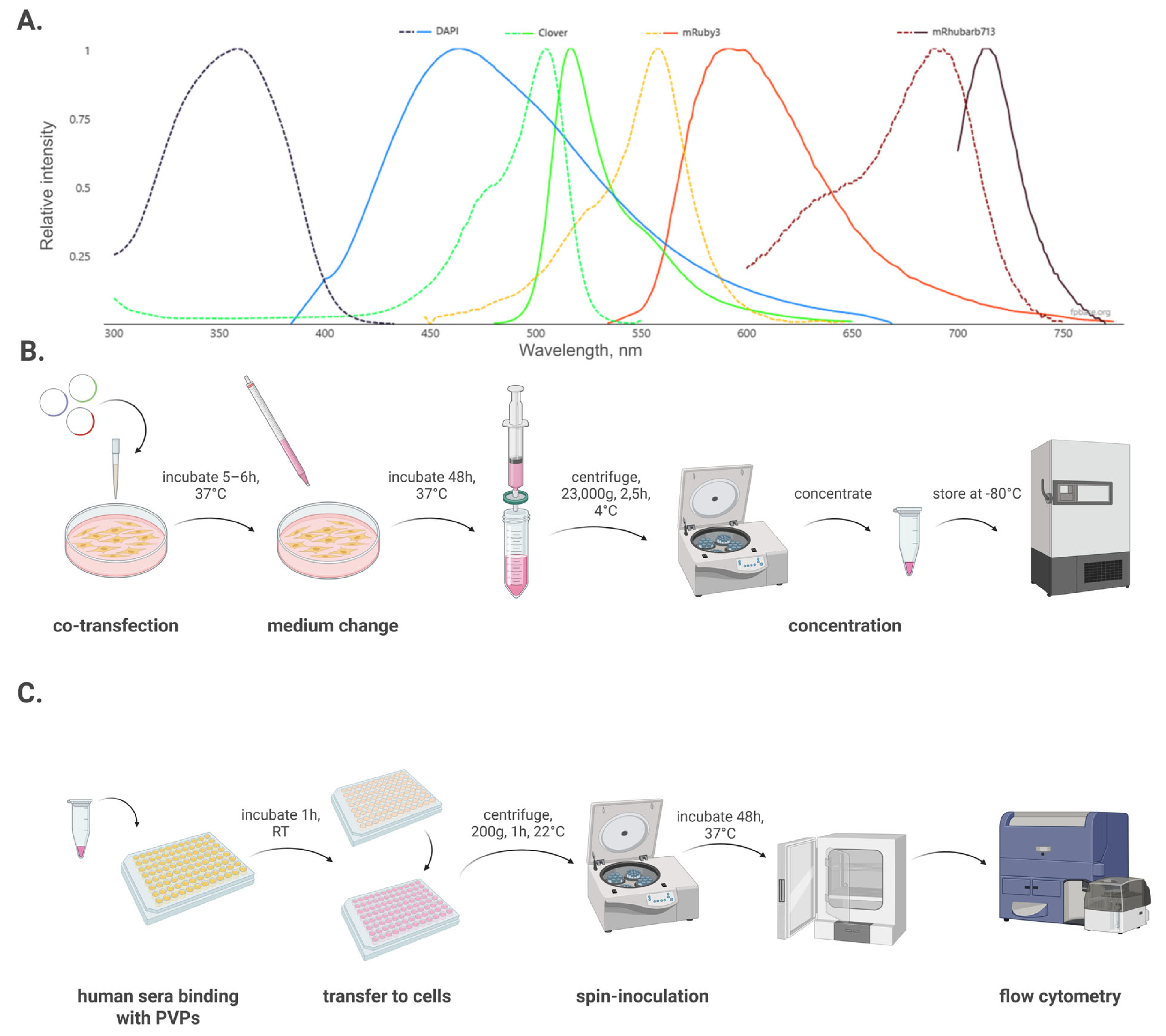
DMEM with 5% FBS, 2 mM L-glutamine, 100 IU/mL penicillin and 100 μg/mL streptomycin, 1 mM sodium pyruvate, 20 mM HEPES and MEM-essential amino acids (M7145-100ML, Sigma-Aldrich, USA) was utilized as the PVP packaging medium. Cells were incubated for approximately 48 h, then the PVPs containing the supernatant were collected, purified with a sterile 0.45 μm PES syringe filter (SSF250-45-PES, Biocomma limited, Shenzhen, China) and concentrated by centrifugation (23,000× g, 4 °C, 2.5 h). The supernatant was removed except for 1/20 of its volume, and the pellet was resuspended in this medium, aliquoted and stored at −80 °C until use (Figure 1B).
After the transfection, the cells were collected in complete DMEM with 10% DMSO (67-68-5, Sisco Research Laboratories Pvt. Ltd., Mumbai, India) and stored at −80 °C. Frozen cells were further used to evaluate transfection efficiency with a BD LSRFortessa (BD Biosciences, San Jose, CA, USA) flow cytometer.
Quantification of SARS-CoV-2 PVPs. To quantify the PVPs expressing different fluorochromes, p24 concentrations were measured with ELISA. All samples were diluted at a ratio of 1:400 and assessed in duplicate across different production timepoints with the HIV-1 p24 ELISA Kit (Vector-Best, Novosibirsk, Russia). The amount of p24 was calculated using the 1st WHO International Standard for HIV-1 p24 Antigen (NIBSC code: 22/230). Statistical significance was assessed using a one-way ANOVA (GraphPad Prism v. 8.0.1).
SARS-CoV-2 PVPs transduction assay. HEK-hACE2 cells were seeded in a 96-well plate at 1.2 × 10⁴ cells per well in DMEM/F12 cell growth medium (G4610-500ML, Servicebio, Wuhan, China) with 10% FBS, 2 mM L-glutamine, 100 IU/mL penicillin and 100 μg/mL streptomycin and incubated under standard conditions for 16–18 h. Preliminary transduction mix of the PVPs was prepared in a separate 96-well plate using DMEM/F12 medium supplemented with 2% FBS, 2 mM L-glutamine, 100 IU/mL penicillin and 100 μg/mL streptomycin and 50 μg/mL protamine sulfate. For pseudovirus stabilization and enhanced transduction, each well was supplemented with protamine sulfate at a final concentration of 50 μg/mL. The final volume in each well equaled 200 μL. Diluted PVPs were then incubated for one hour at room temperature to simulate the neutralization test workflow. After that, the cell medium in the HEK-hACE2 plate was replaced with the transduction mix and then the plate was centrifuged (200× g, 1 h, RT) [19]. The plate was incubated for approximately 48 h and then assessed by flow cytometry (Figure 1C).
For the quantification of PVP stocks, we conducted a transduction assay as described earlier. Titration started at 100 μL of PVPs in the first well and gradually decreased at 20–30 μL steps until 10 μL. The remaining volume was replenished with DMEM/F12 medium (supplements are listed in the previous paragraph). The optimal concentration of PVPs corresponded to the volume of PVPs, resulting in a minimum transduction efficiency of 10–15% for all variants. Transduction efficiency was assessed via flow cytometry and described in detail in the Flow cytometry analysis Section (see below).
Neutralization assay for multiple variants of SARS-CoV-2. To assess the serum neutralization activity, we prepared 2-fold serial dilutions of human serum samples from 1:20 to 1:320 in DMEM/F12 with 2% FBS, 2 mM L-glutamine, 100 IU/mL penicillin and 100 μg/mL streptomycin and 50 μg/mL protamine sulfate. Then we added PVPs at the optimal concentration, incubated the plate at room temperature for one hour to allow nAbs in sera to bind PVPs, and followed the PVP transduction protocol as described above. The total transduction level in the multiplexed samples usually averaged in the range of 30–50% (Appendix C, Figure A1B). Neutralization percentage was calculated with the following formula:
N e u t r a l i z a t i o n = ( 1 % s e r u m % n o   s e r u m ) × 100 %
where % s e r u m stands for the percentage of fluorescent cells in the sample with human sera, and % n o   s e r u m stands for the percentage of fluorescent cells in the sample with no human sera added. The 50% neutralization titer (NT50) was evaluated via non-linear regression analysis of GraphPad Prism Software ver. 8.0.1. We employed log(inhibitor) vs. normalized response equation with a variable slope. Pearson correlation between transfection and transduction efficiency was obtained with GraphPad Prism, as well as the correlation between the transducing unit (TU)/mL parameter and transfection rate. TU/mL was calculated with the formula:
T U / m L = ln 1 t r a n s d u c t i o n   l e v e l   % 100 % × N u m b e r   o f   p l a t e d   c e l l s × 1 V P V P s
Multiplicity of infection (MOI) was calculated with the standard formula [20]:
M O I = T U N u m b e r   o f   p l a t e d   c e l l s
To assess the difference between the singleplex neutralization percentage (monofluorescent control) and the multiplex neutralization percentage, we have also calculated the Pearson correlation in GraphPad Prism.
Flow cytometry analysis.
The samples were assessed with a BD LSRFortessa flow cytometer equipped with the necessary lasers and filters (Table 3).
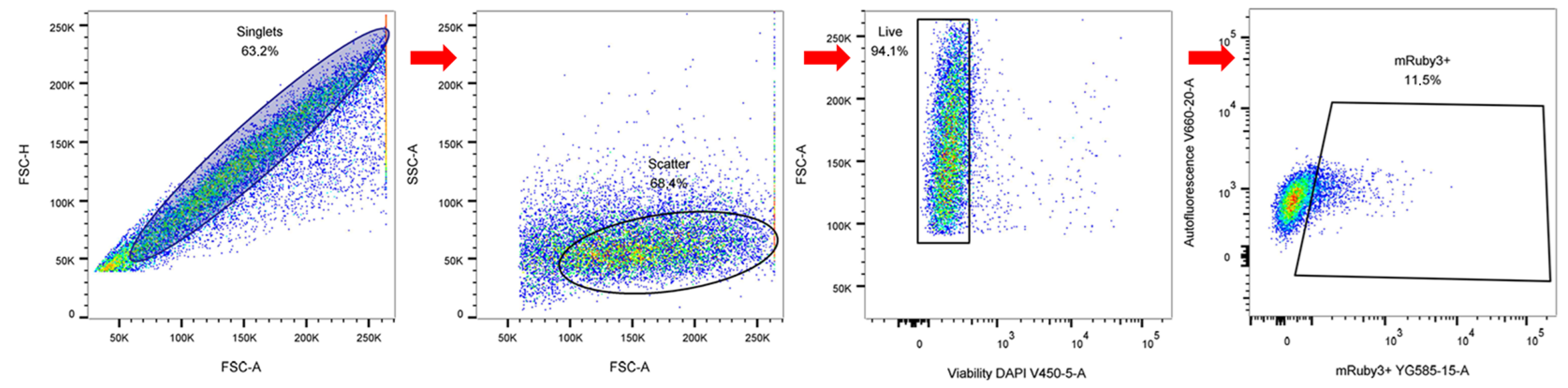
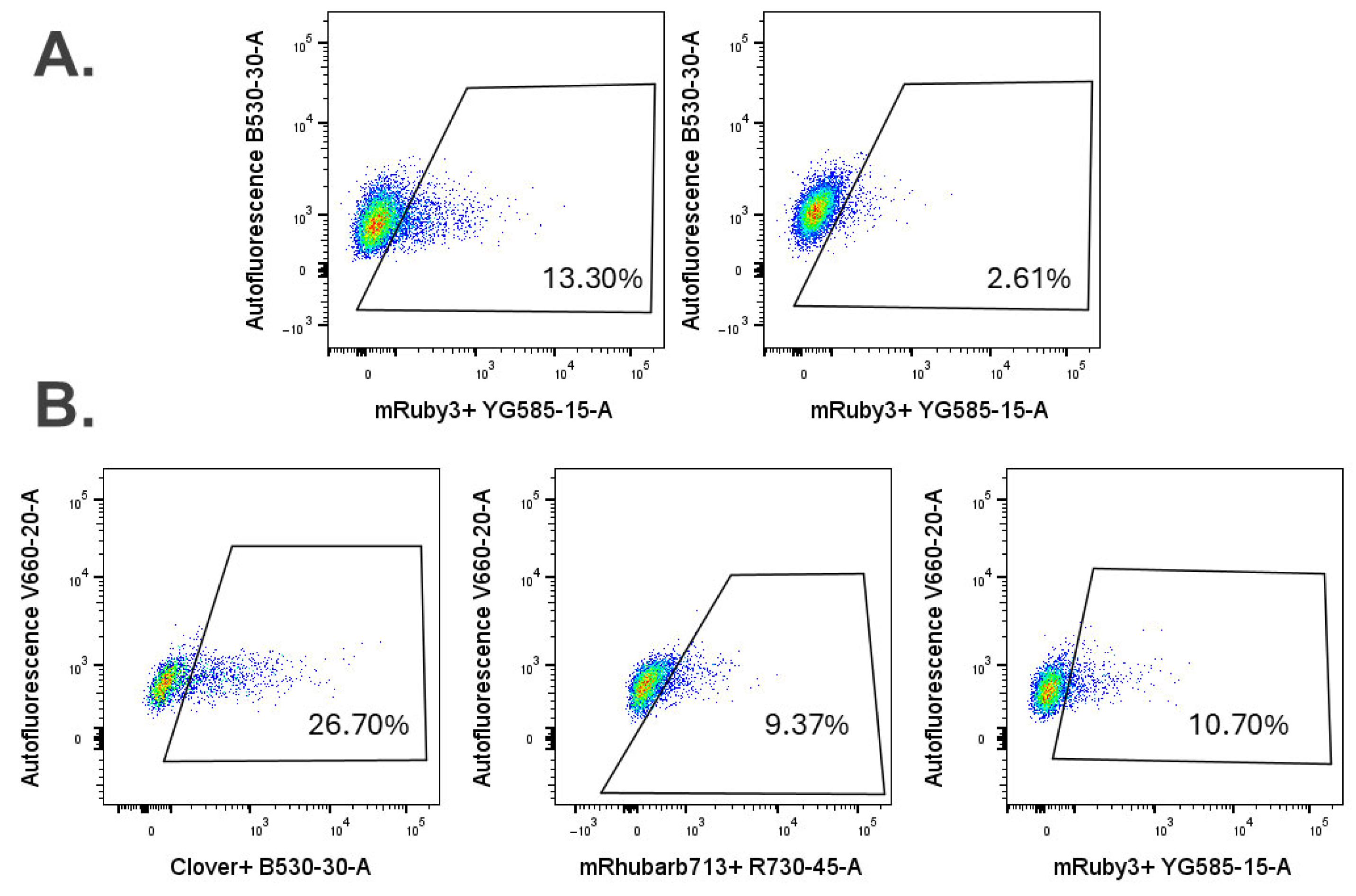
The flow cytometry data were analyzed with FlowJo ver. 10.10.0 software (BD Biosciences). At the first step, the data were cleaned from abnormalities with the FlowAI plugin (ver. 2.3.1, basic settings) [21]. Compensation was calculated using the Autospill algorithm [22]. Transduction or transfection efficiency was determined as a fluorescent protein (FP) positive event percentage of live single cells (Figure 2).

3. Results

3.1. Production Conditions for PVPs

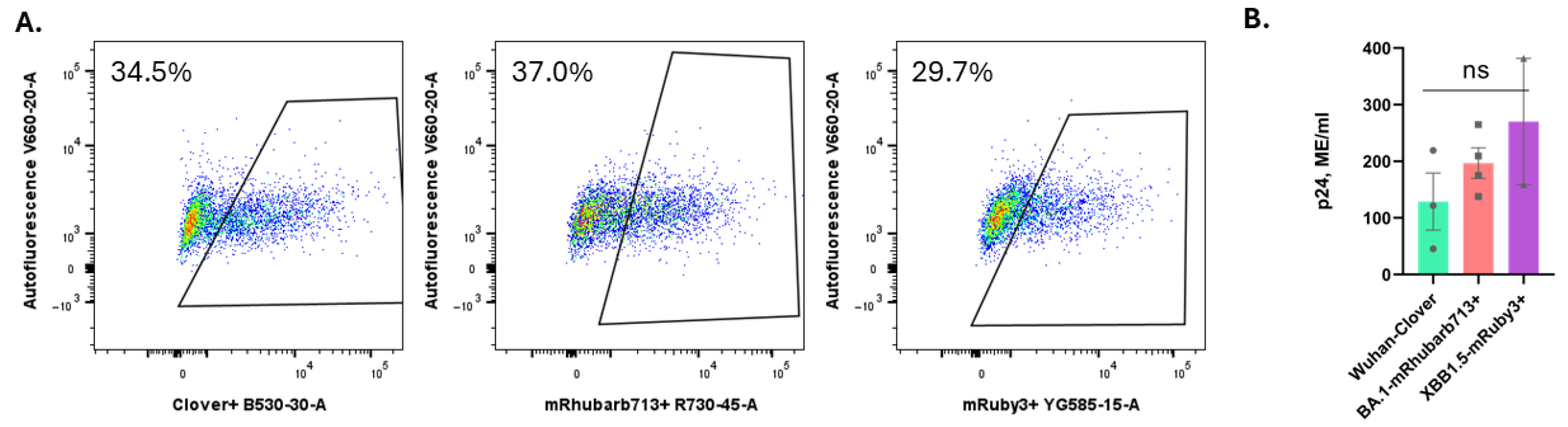
Lentiviral particles pseudotyped with SARS-CoV-2 S-protein variants were engineered to express distinct fluorescent protein transgenes (Clover, mRhubarb713, and mRuby3), enabling multiplexed detection (Figure 1A). To assess whether the choice of fluorescent reporter influenced particle production, we generated pseudoviruses bearing the Wuhan-Hu-1 spike protein encoding different fluorescent proteins. This result demonstrates that the incorporation of the different fluorescent reporters did not impact pseudovirus production efficiency (Figure 3A). We next assessed whether different plasmid combinations used for PVP production affect pseudovirus yield. To this end, PVPs incorporating different S proteins and fluorescent reporters were produced in multiple independent batches. The yield was quantified by measuring the HIV p24 antigen via ELISA. As shown in Figure 3B, we observed no significant differences in production efficiency between the various PVP variants, indicating that these variations did not impair PVP assembly or release.
All pseudotyped lentiviral particles were produced in HEK293T cells using PEI-mediated co-transfection. We optimized the DNA-to-PEI ratio (PEI:DNA = 2:1) and established a minimal transfection level (35–40%) required to generate PVPs for subsequent assays (Appendix B, Figure 3). Based on our previous experience, pseudoviral particles, independently of transfection efficiency, required at least a 20-fold concentration before being utilized in neutralization experiments. All PVPsbatches produced without concentration demonstrated low transduction efficiency relative to the concentrated ones (Appendix C, Figure A1A). To standardize the singleplex assay, we titrated each concentrated pseudovirus batch on HEK293-hACE2 target cells to determine the MOI required to achieve approximately 15–20% transduction efficiency. The MOI values for all pseudoviral particles were similar, averaging approximately 0.01. The volume of PVPs mandatory for that MOI differs based on the batch and the type of the S protein. For example, the Wuhan-Hu-1 variant typically requires a smaller volume of pseudovirus since the transduction efficiency is generally better. It is important to note that no volume of each PVP type exceeded 80 μL for the neutralization assay and the final mix of all three types of PVPs was no more than 190 μL per well (the final volume of each well was 250 μL).
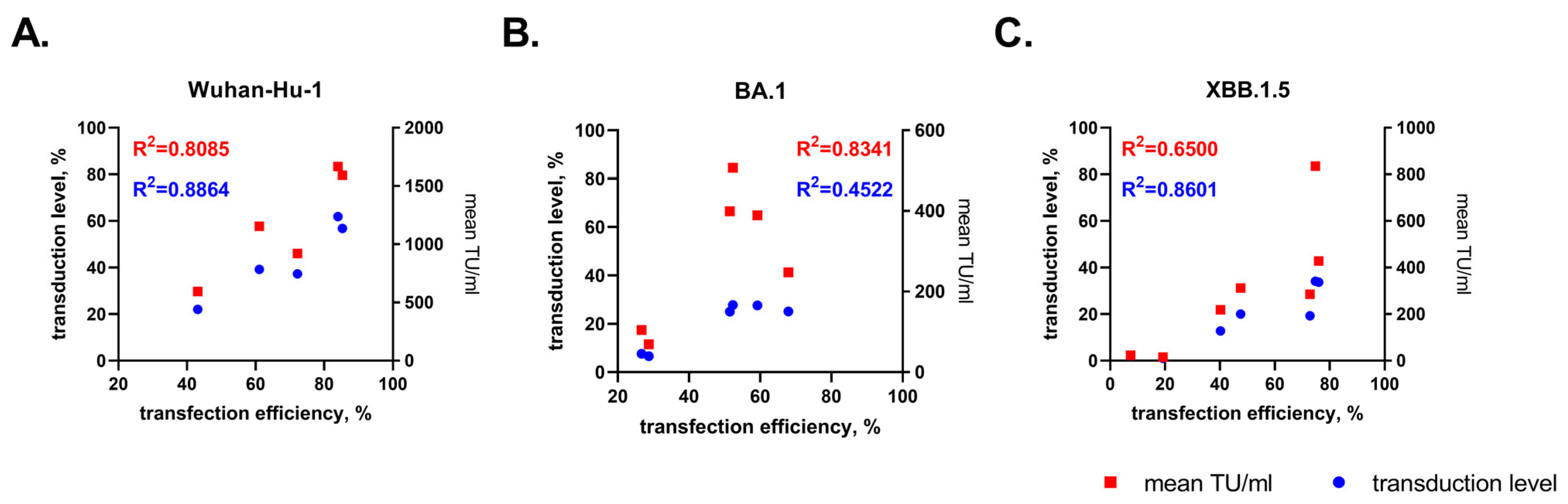
Among the three variants of SARS-CoV-2 utilized in this study, BA.1 appeared to be the most unstable one, with a substantial transduction efficiency difference between batches. Batches of PVPs produced on different dates tended to vary in transfection level. Notably, a direct correlation between transfection efficiency and the resulting TU titer was observed for all tested variants except the BA.1 variant (Figure 4). Hence, transfection efficiency around 50–60% was considered preferable for subsequent successful lentiviral transduction.

3.2. Efficiency of Neutralization Did Not Differ in Single- and Multiplex Setup

Omicron variants have heightened transmissibility and infectivity rates; there are also various studies demonstrating elicited transduction efficiency of HEK-hACE2 cells with the Omicron-pseudotyped PVPs, so we expected to record an intense signal from the PVPs pseudotyped with BA.1 and XBB.1.5 [23,24,25,26]. Unexpectedly, the Omicron-pseudotyped PVPs appeared to be less effective in lentiviral transduction, typically conceding to the Wuhan-Hu-1 variant in the multiplex system (Figure 5). Hence, the Omicron-pseudotyped PVPs required a bigger volume to successfully conduct a multiplexed neutralization assay, which makes them laborious to produce. Most likely, our deviating observations are caused by modifications in the furin-cleavage site of the S protein plasmid utilized in this study: while significantly increasing the infectivity of Wuhan-Hu-1-pseudotyped PVPs, it diminishes one of the Omicron-pseudotyped PVPs [10]. It is also plausible that the target cell line—HEK-hACE2—lacks the proteases necessary for the viral entry pathway, which nullifies Omicron advantages [27]. Consequently, the transduction level was optimized to approximately 10% for each pseudovirus, achieving an overall transduction rate of 25–35%.
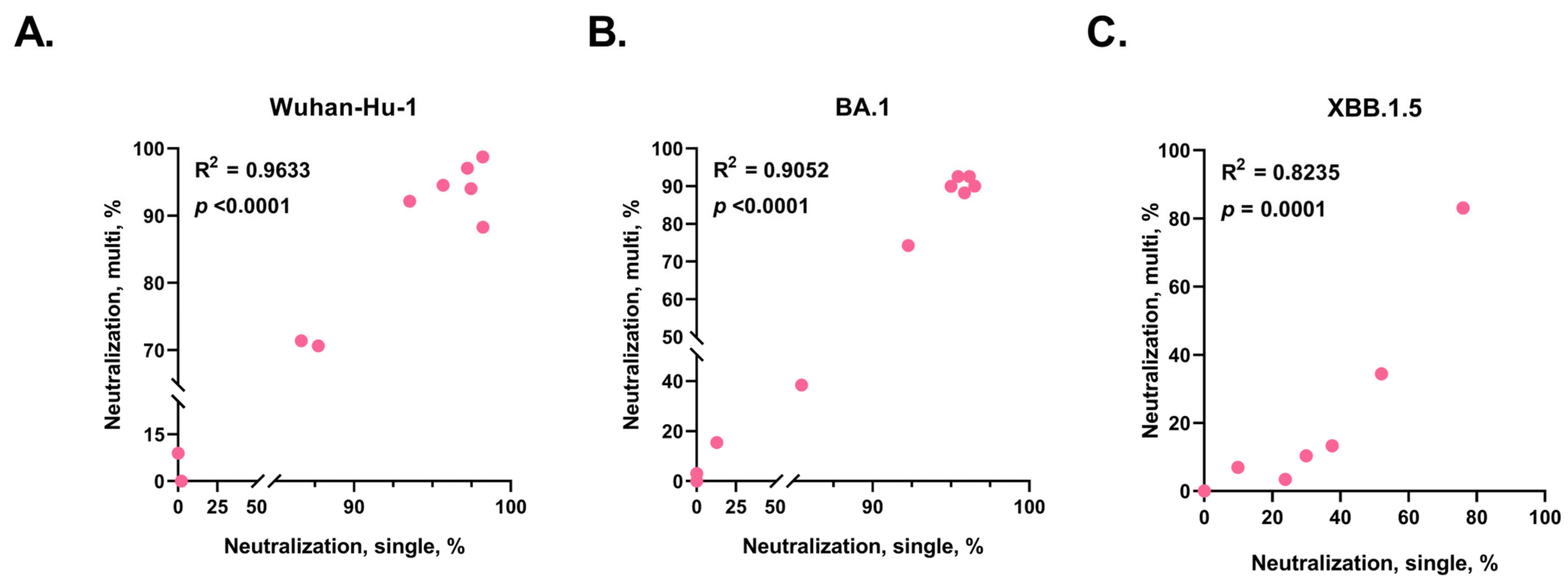
The core advantage of the developed system is the opportunity to simultaneously evaluate neutralization against three variants (Appendix D, Table A5). We noticed that the reduction in PVP transduction efficiency in the multiplexed assay compared to the singleplex format potentially constrains the dynamic range of the assay. A key validation step was that the neutralization titer measured in the multiplex assay showed no significant deviation from that obtained in the traditional singleplex assay for any of the variants (Figure 5).
The congruence of the singleplex and multiplex assays was validated by testing all serum samples at a uniform 1:20 dilution in both formats. For each sample, we conducted singleplex and multiplex assays on the same 96-well plate and at the same timepoint to obtain analyzable data. Neutralization efficiency, expressed as the percent reduction in infection, demonstrated a high degree of correlation between the two assay formats (Figure 5).
High correlation between neutralization in the singleplex assay and the multiplexed assay does not imply that multiplexed transduction is equivalent to singleplexed one; however, it provides an opportunity to interpret data obtained from the multiplexed pseudoviral neutralization assay as valid.

3.3. Analysis of Neutralization Effectiveness Dynamics Against Three Variants of SARS-CoV-2 Using a Multiplex Assay

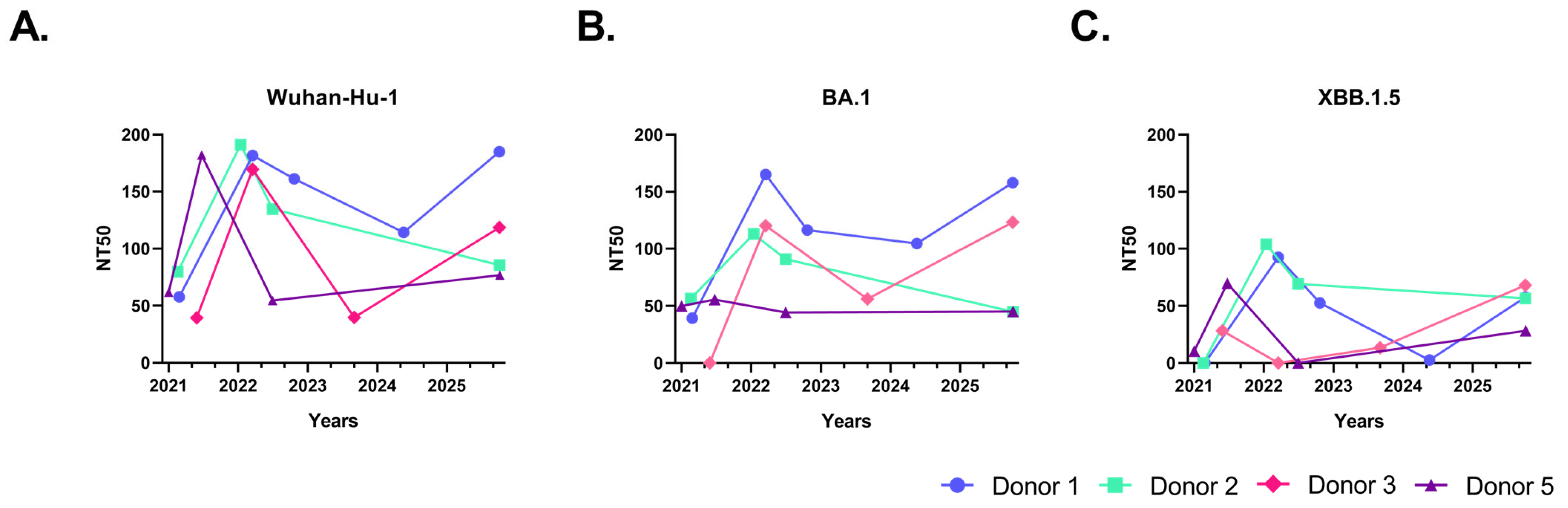
We calculated NT50 for each of the three SARS-CoV-2 variants (Wuhan-Hu-1, BA.1, and XBB.1.5) using the developed multiplex assay and analyzed its dynamics in donors’ sera obtained during the 2021–2025 period (Figure 6).
The vaccination with either Gam-COVID-Vac or ChAdOx1 nCoV-19 elicited a robust neutralizing antibody response. This is evident for the first samples collected from Donors 1, 2, and 3 in the first half of 2021, which showed high NT50 titers against the Wuhan-Hu-1 variant (Figure 6A, Table 1). Donor 4, who had a confirmed COVID-19 infection in late 2020, also presented a similar neutralization capacity against the Wuhan-Hu-1 variant at the first time point (Appendix D, Table A5).
At the early stage (2021), the NT50 against the BA.1 variant was lower than against Wuhan-Hu-1 (Figure 6B), though sera still demonstrated neutralization activity. In contrast, almost no reactivity against the XBB.1.5 variant was detected in any donor at this time (Figure 6C).
Following the spread of the BA.1 variant in early 2022, a rapid increase in NT50 against both BA.1 and Wuhan-Hu-1 was observed in Donors 1 and 2, both of whom had breakthrough infections despite revaccination. A similar boost in cross-reactive antibodies was observed in Donor 3, whose sample collection coincided with the peak of BA.1 circulation, suggesting a likely undiagnosed infection [23].
Despite the broadening immunity, neutralization of the XBB.1.5 variant remained low or undetectable in most samples until the period following the Omicron emergence and XBB.1.5 documented circulation in the Russian Federation beginning in early 2023 [28]. A sharp, transient increase in XBB.1.5 neutralization was detected shortly after BA.1 widespread worldwide, which evidently demonstrates the cross-protection of BA.1 immunity against the XBB.1.5 variant. It is imperative to note that the highest NT50 of the mentioned period belonged to Donors 1 and 2, both of whom had confirmed PCR-positive infection in February 2022. This suggests that the early cross-reactivity was likely induced by a high viral load during a specific convalescent period.
It should be noted that samples collected in late 2025 demonstrate increased neutralization of the XBB.1.5 variant, alongside a broadening of neutralizing efficacy against earlier strains.

4. Discussion

More than five years after the onset of the COVID-19 pandemic, continuous monitoring of population susceptibility to emerging SARS-CoV-2 variants remains important. Recent reports indicate the evolution of distinct serotypes, underscoring the need for precise serological tools [11,29]. Pseudovirus-based neutralization assays have become a standard tool for this purpose, as they enable quantification of the neutralizing capacity of immune sera against diverse variants. Since the initial SARS-CoV-2 outbreak, these assays have been widely employed to evaluate therapeutics targeting the viral spike protein and to measure antibodies elicited by vaccination or infection [30,31,32].
Building upon this foundation, the field has progressed from the initial singleplex format to exceedingly sophisticated multiplex systems. This evolution began with duo-plex assays and has advanced to more complicated platforms utilizing multiple fluorescent markers to enable high-throughput, simultaneous assessment of neutralization against several variants [9,33,34].
We developed a multiplexed lentiviral pseudovirus-based assay that simultaneously evaluates neutralization against three SARS-CoV-2 variants belonging to different serotypes (Wuhan-Hu-1, BA.1, and XBB.1.5). This assay utilizes pseudoviruses pseudotyped with the respective S-proteins and encoding three distinct fluorescent proteins (Clover, mRhubarb713, and mRuby3). We confirmed that the neutralization titers obtained in the multiplex format did not significantly differ from those generated by traditional singleplex assays (Figure 5).
By applying this assay to a longitudinal panel of serum samples (2021–2025), we successfully tracked the dynamics of the neutralizing antibody response. The assay correctly identified peaks in variant-specific neutralization following initial vaccination and the BA.1 Omicron outbreak. Furthermore, the data revealed distinct patterns of cross-reactivity between Wuhan-Hu-1 and BA.1, and between BA.1 and XBB.1.5 (Figure 6), providing a detailed view of the evolving humoral immune landscape and insight into the immune evasion of Omicron sublineages.
As SARS-CoV-2 continues to evolve, the developed multiplexed setup—utilizing distinct fluorophores alongside DAPI for viability staining—can be rapidly adapted to other emerging spike protein variants. This pilot study establishes and validates a robust instrumental framework, which will now be employed for longitudinal exploration of the SARS-CoV-2 herd immunity evolution from the pandemic period into the present era.
It should be noted that cell-based neutralization assays require a sufficiently long exposure time. Therefore, the ability to assess neutralization against multiple viral variants simultaneously significantly conserves research time, reduces the consumption of reagents, and optimizes the operational time of laboratory equipment. The selection of flow cytometry for the test readout was largely determined by the institute’s laboratory capabilities. Additionally, the implementation of a 96-well autosampler for the cytometer has markedly enhanced the overall productivity of the assay. Nevertheless, the multiplexed format offers significant advantages, as it not only reduces processing time but also enables the analysis of samples with limited volumes.
The findings of this study should be interpreted in light of several limitations. First, with regard to assay multiplexing capacity, the present system enables simultaneous neutralization assessment against three SARS-CoV-2 variants. Although this represents an advancement over conventional singleplex formats, recent studies have demonstrated the feasibility of quadruplex assays [34]. It is important to note that the maximum level of multiplexing is inherently constrained by the specifications of the available instrumentation, which may currently preclude the broader adoption of such tests in routine laboratory settings. Second, methodological considerations merit discussion. Flow cytometry, while offering quantitative precision, remains a relatively labor-intensive technique. Although fluorescence-based imaging platforms present certain operational advantages, the selection of a readout modality is ultimately dictated by the laboratory’s existing infrastructure. Furthermore, while all experiments were conducted in duplicate or triplicate and were replicated using independent batches of PVPs, the absence of external validation cohorts or orthogonal assay formats represents a constraint on the generalizability of the findings. Third, limitations inherent to the experimental system should be acknowledged. The sample size, despite its longitudinal design, remains modest and may limit the extrapolation of the results to broader populations. Additionally, although pseudovirus-based neutralization assays are widely employed due to their favorable biosafety profile and scalability, they do not fully recapitulate the biological complexity of authentic viral infection. Unlike live virus assays, pseudovirus systems lack other viral structural proteins and do not capture post-entry replication events. Nevertheless, such assays remain a well-validated and broadly accepted surrogate for the assessment of neutralizing antibody responses.

Author Contributions

Conceptualization, I.V.A. and A.E.E.; methodology, S.N.R., S.M.G., A.N.S., A.E.E. and A.V.P.; software, S.M.G. and A.E.E.; validation, S.N.R., A.N.S., D.A.B. and I.V.A.; formal analysis, S.M.G. and I.V.A.; writing—original draft preparation, S.M.G., A.E.E. and A.V.P.; writing—review and editing, S.N.R., A.N.S., D.A.B. and I.V.A.; visualization, S.M.G.; supervision, I.V.A.; project administration, I.V.A. All authors have read and agreed to the published version of the manuscript.

Funding

This research was funded by the Russian Science Foundation, grant number 24-25-20139.

Institutional Review Board Statement

The study was conducted in accordance with the Declaration of Helsinki, and approved by the Bioethics Committee of the Sirius University Independent Nonprofit Organization of Higher Education (protocol dated 5 February 2021 and protocol dated 27 September 2024) for studies involving humans.

Informed Consent Statement

Informed consent was obtained from all subjects involved in the study.

Data Availability Statement

The original contributions presented in this study are included in the article. Further inquiries can be directed to the corresponding authors.

Acknowledgments

The authors are grateful to N. Kruglova, D. Mazurov and A. Gorchakov for their assistance in adapting the methodology and for providing the target cell line and plasmids for pseudovirus production. We also thank O.N. Demidov and S.A. Nedospasov for their scientific support and for discussing the project.

Conflicts of Interest

The authors declare no conflicts of interest.

Appendix A. Plasmid Constructions

To generate a panel of plasmids encoding various fluorescent proteins, the previously described pUCHR-IR-GFP plasmid was used [10]. The eGFP gene was removed from the pUCHR-IR-GFP vector by double restriction at the BstXI and PspXI sites. Then, by annealed oligonucleotide cloning, AgeI and PacI restriction sites were added to the vector for subsequent cloning of selected fluorescent proteins: mRhubard713, mRuby3 and Clover (Table A1).
Table A1. List of the used primers.
NameSequence (5′–3′)
For_AgeI-PacI-additionATGGACCACCGGTGCTTAATTAAACCCC
Rev_AgeI-PacI-additionTCGAGGGGTTTAATTAAGCACCGGTGGTCCATGGTT
The following plasmid vectors were used as DNA templates for amplification of the listed genes: pLL3.7m-Clover-Geminin(1-110)-IRES-mKO2-Cdt(30-120) (Addgene plasmid # 83841; http://n2t.net/addgene:83841 (accessed on 24 November 2023); RRID:Addgene_83841); cyto-Ruby3-iATPSnFR1.0 (Addgene plasmid # 102551; http://n2t.net/addgene:102551 (accessed on 24 November 2023); RRID:Addgene_102551); and pET-DUET-1-mRhubarb713-HO (Addgene plasmid # 141199; http://n2t.net/addgene:141199 (accessed on 24 November 2023); RRID:Addgene_141199). The fragments of interest were amplified by PCR with gene-specific primers containing AgeI and PacI restriction sites (Table A2), digested with the appropriate enzymes and ligated into a vector (restriction/ligation cloning).
Table A2. List of the primers for molecular cloning.
NameSequence (5′–3′)
For_clover_AgeI cloningATTACCGGTATGGTGAGCAAGGGCGAGGAGCTG
Rev_clover_PacI cloningATTTTAATTAATTACTTGTACAGCTCGTCCATGCCATGTG
For_mRuby3_AgeI cloningATTACCGGTATGGTGTCTAAGGGCGAAGAGCTG
Rev_mRuby3_PacI cloningATTTTAATTAATTACCCACCAAGATTGGAGTACTTGGCAACTG
For_mRhubarb713_AgeI cloningATTACCGGTATGGCTGAAGGATCCGTCGCC
Rev_mRhubarb713_PacI cloningATTTTAATTAATTACTCTTCCATCACGCCGATCG
All cloned genes were verified by Sanger sequencing (Table A3).
Table A3. List of the sequencing primers.
NameSequence (5′–3’)
pUCHR-IR-AgeIPacI_seq-forGCTGAAGGATGCCCAGAAGGTAC
Clover-seq1-revGGCGCGGGTCTTGTAGGT
Clover-seq2-forGCAGCACGACTTCTTCAAGTCC
mRhubarb713-seq1-revCCCGATCGAAGCCGGTAATCT
mRhubarb713-seq2-forTCCGCCACACCAACAGC
mRuby3-seq1-revCCCTCAGACCACCATCTGCTG
mRuby3-seq2-forCCCTCCAATGGTCCCGTGA

Appendix B. PEI Titration

To optimize PEI-mediated lentiviral transfection, we conducted PEI titration each time a new batch of PEI solution was started. We also compared transfection efficiency of PEI solutions (408727-100ML, Sigma Aldrich, St. Louis, MO, USA or G1802-1ML, Servicebio, Wuhan, China). We conducted HEK293T cell transfection at the same time and under the same conditions with the same plasmid stocks. Wuhan-Hu-1 pseudotyped viral particles were produced according to the aforementioned protocol as the Wuhan-Hu-1 variant PVPs usually resulted in the highest transfection rate relative to Omicron pseudoviral particles and varied relatively little across batches. Results of the experiment are listed in Table A4.
Table A4. Transfection mean depending on PEI:pDNA ratio and PEI solution origin.
PEI:pDNA RatioPEI OriginTransfection Mean, %
1:1Sigma Aldrich, St. Louis, MO, USA62.7
Servicebio, Wuhan, China53.9
2:1Sigma Aldrich, St. Louis, MO, USA48.0
Servicebio, Wuhan, China63.1
3:1Sigma Aldrich, St. Louis, MO, USA19.8
Servicebio, Wuhan, China61.3
The obtained data were evaluated with a paired parametric t-test in GraphPad Prism and no significant difference was observed. The PEI solution (Servicebio, Wuhan, China) consistently resulted in a high transfection mean independently of the PEI:pDNA ratio. The decision was made towards PEI (G1802-1ML, Servicebio, Wuhan, China) with the ratio of PEI:pDNA = 2:1.

Appendix C. Neutralization Percentage Data

Transduction-level comparisons of the concentrated and non-concentrated PVPs were performed to optimize the PVP production protocol. The 20-fold PVP concentration demonstrated a substantial increase in transduction levels, so all subsequent batches of the PVPs were concentrated (Figure A1A).
Figure A1. (A) Comparison of transduction levels of concentrated and not concentrated PVPs by flow cytometry analysis. PVPs were produced from the same batch and were pseudotyped with XBB.1.5 S-protein; PVP volume of 90 μL was used; (B) signals of the multifluorescent control (no human sera added) in three channels.
Immuno 06 00017 g0a1

Appendix D. Neutralization Percentage Data

Neutralization percentage (Table A5) was calculated according to Equation (1). Despite thorough preparation and careful pipetting, some data points diverged from the whole dataset, i.e., the neutralization level suddenly increased at 1:160–1:320 serum dilutions in several samples. We considered such points outliers and intentionally removed them from the dataset for the following analysis. As for the 1.1 sample, 1:160, 1:320 dilutions were conducted at the 12th row of the 96-well plate. Therefore, these samples had an extremely low number of events in flow cytometry measurements and were excluded from the analysis, so we decided to avoid using edge rows in further tests.
Table A5. Mean of the neutralization percentage for each sample.
DilutionWuhan-Hu-1BA.1XBB.1.5
SingleplexMultiplexSingleplexMultiplexSingleplexMultiplex
1.11:2010.78%39.87%0.00%0.00% *0.00%0.00%
1:40 15.76% 7.93% 15.29%
1:80 22.36% 12.35% 0.00%
1:160 0.00% 0.00% 0.00%
1:320 0.00% 0.00% 0.00%
1.21:2094.12%72.79%95.45%93.24%23.79%47.21%
1:40 94.77% 91.15% 35.13%
1:80 91.83% 89.03% 17.40%
1:160 86.17% 78.76% 32.36%
1:320 63.21% 60.09% 3.71%
1.31:2091.50%89.63%80.92%87.72%75.98%79.56%
1:40 89.56% 87.79% 56.95%
1:80 90.40% 80.59% 29.50%
1:160 94.27% 82.11% 12.94%
1:320 82.47% 74.60% 19.47%
1.41:2097.46%84.25%96.51%92.84%0.00%28.13%
1:40 72.42% 72.89% 5.23%
1:80 81.19% 68.74% 18.38%
1:160 53.67% 61.47% 27.40%
1:320 50.01% 23.77% 20.55%
1.51:20No data92.96%No data95.79%No data93.20%
1:40 91.94% 96.41% 64.80%
1:80 90.91% 89.62% 46.06%
1:160 86.13% 72.54% 20.44%
1:320 46.80% 46.49% 17.27%
2.11:2087.72%70.62%0.00%3.07%0.00%0.00%
1:40 79.64% 3.75% 2.72%
1:80 54.96% 2.39% 0.00%
1:160 32.60% 10.20% 8.65%
1:320 30.93% 10.46% 16.69%
2.21:2097.24%97.13%95.00%88.55%52.02%33.28%
1:40 97.86% 90.35% 54.18%
1:80 88.64% 78.33% 63.27%
1:160 91.44% 64.34% 36.19%
1:320 49.92% 52.34%
2.31:2098.22%76.37%95.86%90.70%29.94%22.27%
1:40 92.65% 82.53% 27.40%
1:80 81.93% 64.91% 14.65%
1:160 69.75% 37.83% 12.87%
1:320 49.65% 26.32% 12.12%
2.41:20No data95.53%No data92.46%No data36.17%
1:40 90.67% 90.26% 66.07%
1:80 73.28% 44.10% 13.45%
1:160 69.05% 44.82% 33.85%
1:320 56.13% 48.41% 40.42%
3.11:200.00%17.82%0.00%0.00%0.00%0.00%
1:40 6.57% 13.14% 0.00%
1:80 0.00% 0.00% 0.00%
1:160 0.00% 0.00% 0.00%
1:320 0.00% 0.00% 0.00%
3.21:2095.69%94.52%96.18%92.59%37.58%13.28%
1:40 91.74% 90.48% 12.41%
1:80 91.20% 79.63% 0.00%
1:160 60.34% 26.19% 0.00%
1:320 9.94% 6.26% 6.35%
3.31:2098.23%88.30%85.47%38.38%0.00%0.00%
1:40 56.12% 17.98% 0.00%
1:80 29.72% 27.20% 26.01%
1:160 27.26% 32.35% 14.21%
1:320 25.66% 20.64% 15.82%
3.41:20No data94.07%No data95.38%No data81.41%
1:40 88.22% 93.00% 60.82%
1:80 75.57% 85.44% 47.72%
1:160 25.89% 49.59% 25.50%
1:320 28.06% 32.56% 17.70%
4.11:2067.24%44.90%61.02%33.44%39.31%10.11%
1:40 34.87% 42.95% 22.31%
1:80 18.79% 47.69% 16.57%
1:160 7.48% 29.87% 3.23%
1:320 8.28% 29.87% 0.00%
5.11:20No data77.69%No data52.82%No data41.50%
1:40 63.71% 44.39% 50.34%
1:80 37.28% 27.65% 31.02%
1:160 29.66% 23.86% 21.19%
1:320 20.12% 28.21% 38.67%
5.21:20No data93.04%No data78.31%No data17.99%
1:40 94.08% 53.95% 13.82%
1:80 83.44% 22.88% 8.36%
1:160 71.71% 10.82% 0.00%
1:320 20.12% 2.35% 0.00%
5.31:20No data78.62%No data46.53%No data0.00%
1:40 58.13% 30.04% 0.00%
1:80 16.80% 1.43% 0.00%
1:160 0.64% 0.00% 0.00%
1:320 0.00% 0.00% 0.00%
5.41:20No data95.01%No data88.65%No data45.67%
1:40 95.67% 74.48% 0.00%
1:80 74.01% 35.17% 0.00%
1:160 66.72% 34.80% 0.00%
1:320 69.24% 36.36% 12.80%
* Outliers.

References

  1. Popova, A.Y.; Smirnov, V.S.; Egorova, S.A.; Melik-Andreasyan, G.G.; Atoyan, S.A.; Milichkina, A.M.; Drozd, I.V.; Palozyan, G.H.; Ivanov, V.A.; Ramsay, E.S.; et al. Herd Immunity to SARS-CoV-2 Among the Armenian Population in the Second Half of 2022. Epidemiologia 2025, 6, 29. [Google Scholar] [CrossRef] [PubMed]
  2. Tasew, G.; Abdella, S.; Bejiga, B.; Ejeta, E.; Gizachew, L.; Lisanwork, L.; Bati, F.; Abate, E.; Negash, L.; Bonger, Z.; et al. Seroprevalence of SARS-CoV-2 Antibodies in Ethiopia: Findings from the 2022 National Population-Based Survey (Second Round). BMC Infect. Dis. 2025, 25, 1126. [Google Scholar] [CrossRef] [PubMed]
  3. Nishigaki, A.; Kinoshita, R.; Sakuraba, S.; Sugihara, J.; Suzuki, T.; Suzuki, M.; Yoneoka, D. Comparison of Infection-Induced SARS-CoV-2 Seroprevalence Across Large-Scale Residual Samples From Blood Donors, Commercial Laboratories, and Health Checkups in Japan, 2023. Open Forum Infect. Dis. 2025, 12, ofaf415. [Google Scholar] [CrossRef] [PubMed]
  4. Singhal, T. The Emergence of Omicron: Challenging Times Are Here Again! Indian J. Pediatr. 2022, 89, 490–496. [Google Scholar] [CrossRef]
  5. Fan, Q.; Nie, Z.; Xie, S. Panorama of Breakthrough Infection Caused by SARS-CoV-2: A Review. Medicina 2022, 58, 1733. [Google Scholar] [CrossRef]
  6. Haque, A.; Pant, A.B. Mitigating COVID-19 in the Face of Emerging Virus Variants, Breakthrough Infections and Vaccine Hesitancy. J. Autoimmun. 2022, 127, 102792. [Google Scholar] [CrossRef]
  7. Yeganeh, A.; Kalantar, E.; Ghaffari, A.; Keramatinia, A.; Yeganeh, F. Seroprevalence and Determinants of SARS-CoV-2 Anti-Nucleocapsid IgG in a Vaccinated Iranian Adult Population: A Cross-Sectional Study, Summer 2023. Hum. Vaccin. Immunother. 2025, 21, 2560063. [Google Scholar] [CrossRef]
  8. Rizatdinova, S.N.; Ershova, A.E.; Astrakhantseva, I.V. Pseudotyped Viruses: A Useful Platform for Pre-Clinical Studies Conducted in a BSL-2 Laboratory Setting. Biomolecules 2025, 15, 135. [Google Scholar] [CrossRef]
  9. Ashley, C.L.; Bloul, M.; Alca, S.; Smith, L.; Jin, W.; Khoury, D.; Counoupas, C.; Davenport, M.; Triccas, J.A.; Steain, M. Optimisation of a Multiplexed, High Throughput Assay to Measure Neutralising Antibodies against SARS-CoV-2 Variants. J. Virol. Methods 2025, 332, 115073. [Google Scholar] [CrossRef]
  10. Kruglova, N.; Siniavin, A.; Gushchin, V.; Mazurov, D. Different Neutralization Sensitivity of SARS-CoV-2 Cell-to-Cell and Cell-Free Modes of Infection to Convalescent Sera. Viruses 2021, 13, 1133. [Google Scholar] [CrossRef]
  11. Du, P.; Li, J.; Kong, T.; Lu, B.; Li, R.; Gao, G.F.; Wang, Q. Defining the Serotypes of SARS-CoV-2 Subvariants up to December, 2024. Lancet Microbe 2025, 6, 101124. [Google Scholar] [CrossRef] [PubMed]
  12. Hu, S.; Wu, C.; Wu, X.; Ma, X.; Shu, C.; Chen, Q.; Zheng, A.; Yang, H.; Lu, J.; Du, P.; et al. Classification of Five SARS-CoV-2 Serotypes Based on RBD Antigenicities. Sci. Bull. 2023, 68, 3003–3012. [Google Scholar] [CrossRef] [PubMed]
  13. Simon-Loriere, E.; Schwartz, O. Towards SARS-CoV-2 Serotypes? Nat. Rev. Microbiol. 2022, 20, 187–188. [Google Scholar] [CrossRef] [PubMed]
  14. Lobas, M.A.; Tao, R.; Nagai, J.; Kronschläger, M.T.; Borden, P.M.; Marvin, J.S.; Looger, L.L.; Khakh, B.S. A Genetically Encoded Single-Wavelength Sensor for Imaging Cytosolic and Cell Surface ATP. Nat. Commun. 2019, 10, 711. [Google Scholar] [CrossRef]
  15. Rogers, O.C.; Johnson, D.M.; Firnberg, E. MRhubarb: Engineering of Monomeric, Red-Shifted, and Brighter Variants of IRFP Using Structure-Guided Multi-Site Mutagenesis. Sci. Rep. 2019, 9, 15653. [Google Scholar] [CrossRef]
  16. Bajar, B.T.; Lam, A.J.; Badiee, R.K.; Oh, Y.-H.; Chu, J.; Zhou, X.X.; Kim, N.; Kim, B.B.; Chung, M.; Yablonovitch, A.L.; et al. Fluorescent Indicators for Simultaneous Reporting of All Four Cell Cycle Phases. Nat. Methods 2016, 13, 993–996. [Google Scholar] [CrossRef]
  17. FPbase. Available online: https://www.fpbase.org/spectra/ (accessed on 10 September 2024).
  18. BioRender: Scientific Image and Illustration. Available online: https://www.biorender.com/ (accessed on 3 October 2025).
  19. Thimmiraju, S.R.; Villar, M.J.; Kimata, J.T.; Strych, U.; Bottazzi, M.E.; Hotez, P.J.; Pollet, J. Optimization of Cellular Transduction by the HIV-Based Pseudovirus Platform with Pan-Coronavirus Spike Proteins. Viruses 2024, 16, 1492. [Google Scholar] [CrossRef]
  20. Abedon, S.T.; Bartom, E. Multiplicity of Infection. In Brenner’s Encyclopedia of Genetics, 2nd ed.; Maloy, S., Hughes, K., Eds.; Academic Press: San Diego, CA, USA, 2013; pp. 509–510. [Google Scholar]
  21. Monaco, G.; Chen, H.; Poidinger, M.; Chen, J.; de Magalhães, J.P.; Larbi, A. FlowAI: Automatic and Interactive Anomaly Discerning Tools for Flow Cytometry Data. Bioinformatics 2016, 32, 2473–2480. [Google Scholar] [CrossRef]
  22. Roca, C.P.; Burton, O.T.; Gergelits, V.; Prezzemolo, T.; Whyte, C.E.; Halpert, R.; Kreft, Ł.; Collier, J.; Botzki, A.; Spidlen, J.; et al. AutoSpill Is a Principled Framework That Simplifies the Analysis of Multichromatic Flow Cytometry Data. Nat. Commun. 2021, 12, 2890. [Google Scholar] [CrossRef]
  23. Gulova, S.M.; Veselkina, U.S.; Astrakhantseva, I.V. Adaptation of the Vaccine Prophylaxis Strategy to Variants of the SARS-CoV-2 Virus. Vaccines 2025, 13, 761. [Google Scholar] [CrossRef]
  24. Willett, B.J.; Grove, J.; MacLean, O.A.; Wilkie, C.; De Lorenzo, G.; Furnon, W.; Cantoni, D.; Scott, S.; Logan, N.; Ashraf, S.; et al. SARS-CoV-2 Omicron Is an Immune Escape Variant with an Altered Cell Entry Pathway. Nat. Microbiol. 2022, 7, 1161–1179. [Google Scholar] [CrossRef] [PubMed]
  25. Meng, B.; Abdullahi, A.; Ferreira, I.A.T.M.; Goonawardane, N.; Saito, A.; Kimura, I.; Yamasoba, D.; Gerber, P.P.; Fatihi, S.; Rathore, S.; et al. Altered TMPRSS2 Usage by SARS-CoV-2 Omicron Impacts Infectivity and Fusogenicity. Nature 2022, 603, 706–714. [Google Scholar] [CrossRef] [PubMed]
  26. Denis, K.J.S.; Hoelzemer, A.; Iafrate, A.J.; Naranbhai, V.; Balazs, A.B. mRNA-Based COVID-19 Vaccine Boosters Induce Neutralizing Immunity against SARS-CoV-2 Omicron Variant. Cell 2022, 185, 457–466.e4. [Google Scholar] [CrossRef]
  27. Le, K.; Kannappan, S.; Kim, T.; Lee, J.H.; Lee, H.-R.; Kim, K.K. Structural Understanding of SARS-CoV-2 Virus Entry to Host Cells. Front. Mol. Biosci. 2023, 10, 1288686. [Google Scholar] [CrossRef]
  28. Pochtovyi, A.A.; Kustova, D.D.; Siniavin, A.E.; Dolzhikova, I.V.; Shidlovskaya, E.V.; Shpakova, O.G.; Vasilchenko, L.A.; Glavatskaya, A.A.; Kuznetsova, N.A.; Iliukhina, A.A.; et al. In Vitro Efficacy of Antivirals and Monoclonal Antibodies against SARS-CoV-2 Omicron Lineages XBB.1.9.1, XBB.1.9.3, XBB.1.5, XBB.1.16, XBB.2.4, BQ.1.1.45, CH.1.1, and CL.1. Vaccines 2023, 11, 1533. [Google Scholar] [CrossRef]
  29. Liu, Z.; Lu, L.; Jiang, S. Receptor-Binding Domain-Associated Serotypes of SARS-CoV-2. Emerg. Microbes Infect. 2024, 13, 2309968. [Google Scholar] [CrossRef] [PubMed]
  30. Wang, X.; Jiang, S.; Ma, W.; Li, X.; Wei, K.; Xie, F.; Zhao, C.; Zhao, X.; Wang, S.; Li, C.; et al. Enhanced Neutralization of SARS-CoV-2 Variant BA.2.86 and XBB Sub-Lineages by a Tetravalent COVID-19 Vaccine Booster. Cell Host Microbe 2024, 32, 25–34.e5. [Google Scholar] [CrossRef]
  31. Plante, J.A.; Liu, Y.; Liu, J.; Xia, H.; Johnson, B.A.; Lokugamage, K.G.; Zhang, X.; Muruato, A.E.; Zou, J.; Fontes-Garfias, C.R.; et al. Spike Mutation D614G Alters SARS-CoV-2 Fitness. Nature 2021, 592, 116–121. [Google Scholar] [CrossRef]
  32. Qu, P.; Xu, K.; Faraone, J.N.; Goodarzi, N.; Zheng, Y.M.; Carlin, C.; Bednash, J.S.; Horowitz, J.C.; Mallampalli, R.K.; Saif, L.J.; et al. Immune Evasion, Infectivity, and Fusogenicity of SARS-CoV-2 BA.2.86 and FLip Variants. Cell 2024, 187, 585–595.e6. [Google Scholar] [CrossRef]
  33. Sievers, B.L.; Gelbart, T.; Tan, G.S. A High-Throughput SARS-CoV-2 Pseudovirus Multiplex Neutralization Assay. STAR Protoc. 2022, 3, 101835. [Google Scholar] [CrossRef]
  34. Chen, J.; Huang, Z.; Xiao, J.; Du, S.; Bu, Q.; Guo, H.; Ye, J.; Chen, S.; Gao, J.; Li, Z.; et al. A Quadri-Fluorescence SARS-CoV-2 Pseudovirus System for Efficient Antigenic Characterization of Multiple Circulating Variants. Cell Rep. Methods 2024, 4, 100856. [Google Scholar] [CrossRef]
Figure 1. The general scheme of the experiment. (A) Excitation and emission spectra of fluorescent proteins and viability stain (DAPI) utilized in the study. mRhubarb713 protein and DAPI are presented with an absorption spectra except excitation spectra; Excitation and absorption spectra are depicted with dotted line; (B) PEI-mediated co-transfection workflow; (C) SARS-CoV-2 neutralization assay based on lentiviral transduction workflow. Spectral properties were obtained with a spectra viewer tool of FPbase website; the figure is created in BioRender. Sofia Gulova. (2026) https://app.biorender.com/illustrations/canvas-beta/68e3ddc1af1678bdbaf2d0d4 [17,18].
Immuno 06 00017 g001
Figure 2. An example of gating utilized in the flow cytometry data analysis. FP-positive cells were gated on a cytogram FP vs. autofluorescence, with live single cells as a parent population.
Immuno 06 00017 g002
Figure 3. Functional validation and quantification of SARS-CoV-2 PVPs. (A) Transduction efficiency of Wuhan-Hu-1 pseudotyped PVPs with three different fluorescent proteins: Clover, mRhubarb713, mRuby3 (from left to right). PVPs were produced at the same timepoint under the same conditions. Plasmid coding Wuhan-Hu-1 S protein and backbone plasmid were the same for each type of PVPs shown. (B) Quantification of PVPs by p24 ELISA (n = 3 for Wuhan-Hu-1-Clover PVPs, n = 4 for BA.1-mRhubarb713 PVPs, n = 2 for XBB.1.5-mRuby3 PVPs). Batches were produced at different timepoints and were tested in duplicate. No significant variance was detected between groups (ns; one-way ANOVA, GraphPad Prism).
Immuno 06 00017 g003
Figure 4. Correlation between transfection efficiency and pseudovirus titer. Pearson correlation between transfection rate and pseudovirus transduction level and mean value of TU/mL for the volume of 100 μL of PVPs were calculated: (A) correlation for Wuhan-Hu-1-pseudotyped virus particles (n = 5, p = 0.0168 for transduction level, p = 0.0378 for TU/mL); (B) correlation for BA.1-pseudotyped virus particles (n = 6, p = 0.0109 for transduction level, p = 0.1433 for TU/mL); (C) correlation for XBB.1.5-pseudotyped virus particles (n = 7, p = 0.0026 for transduction level, p = 0.0285 for TU/mL).
Immuno 06 00017 g004
Figure 5. Correlation of neutralization percentages between singleplex and multiplex assay setups. Data for each dot was obtained at the same timepoint with the same PVP batch. Neutralization efficiency against the (A) Wuhan-Hu-1, (B) BA.1, and (C) XBB.1.5 variants was measured in parallel using both singleplex (monofluorescent) and multiplex assays. The analysis includes all available time points from three donors (n = 10 total samples). All samples were tested in duplicate, mean values were used for statistical comparison. Statistical significance was assessed using the Pearson correlation in GraphPad Prism.
Immuno 06 00017 g005
Figure 6. Longitudinal analysis of NT50 of four donors against SARS-CoV-2 variants. NT50 was measured against the (A) Wuhan-Hu-1, (B) BA.1 (Omicron), and (C) XBB.1.5 (Omicron) variants in 2-fold serial serum dilutions of samples collected between 2021 and 2025 from four donors. Each dot represents a single sample. NT50 values were calculated using a non-linear regression (log(inhibitor) vs. normalized response) algorithm (GraphPad Prism).
Immuno 06 00017 g006
Table 1. Donors’ characteristics.
Donors GenderVaccination StatusPositive PCR TestSample ID (Date of Collection)
1FGam-COVID-Vac date 1—12 February 2021, date 2—15 March 2021, date 3—26 January 20224 February 20221.1 (31 March 2021)
1.2 (20 April 2022)
1.3 (24 November 2022)
1.4 (20 June 2024)
1.5 (5 November 2025)
2MGam-COVID-Vac date 1—29 January 2021, date 2—20 February 2021, date 3—19 October 20215 February 20222.1 (23 March 2021)
2.2 (16 February 2022)
2.3 (3 August 2022)
2.4 (6 November 2025)
3MChAdOx1 nCoV-19 date 1—16 March 2021, date 2—28 May 2021, Gam-COVID-Vac date 1—17 December 2021, date 2—4 February 2022No data3.1 (1 July 2021)
3.2 (20 April 2022)
3.3 (5 October 2023)
3.4 (5 November 2025)
4FNone27 December 20204.1 (31 March 2021)
5MGam-COVID-Vac date 1—1 June 2021, date 2—22 June 20215 September 20205.1 (3 February 2021)
5.2 (27 July 2021)
5.3 (3 August 2022)
5.4 (7 November 2025)
Table 2. Plasmids’ quantity for the transfection.
PlasmidMass Per 10 cm Dish, μg
pCMV-dR8-25.00
pCG1-SARS-2S3.33
pUCHR-IR-FluorProtein6.67
Table 3. Fluorochromes, the flow cytometer’s laser lines and bandpass filters used for the detection.
FluorochromeExcitation Max., nmEmission Max., nmLaser Line, nmBandpass Filter
DAPI354456405450/50
Clover505515488530/30
mRuby3558592561610/20
mRhubarb713690713640730/45
Disclaimer/Publisher’s Note: The statements, opinions and data contained in all publications are solely those of the individual author(s) and contributor(s) and not of MDPI and/or the editor(s). MDPI and/or the editor(s) disclaim responsibility for any injury to people or property resulting from any ideas, methods, instructions or products referred to in the content.