
Article

Possible Protective Effect of Immunomodulatory Therapy on Development of Pulmonary Hypertension in Centromere Positive Systemic Sclerosis

1
Department of Medicine, University of Iowa Hospitals & Clinics, Iowa City, IA 52242, USA
2
Institute for Clinical and Translational Science, University of Iowa, Iowa City, IA 52242, USA
3
Department of Internal Medicine, Kaiser Permanente, Los Angelos, CA 90027, USA
4
Division of Immunology, Department of Internal Medicine, University of Iowa Hospitals & Clinics, Iowa City, IA 52242, USA
*
Author to whom correspondence should be addressed.
Immuno 2026, 6(1), 16; https://doi.org/10.3390/immuno6010016
Submission received: 22 January 2026 / Revised: 24 February 2026 / Accepted: 5 March 2026 / Published: 10 March 2026

Abstract

The primary objective is to determine predictors of pulmonary hypertension (PH) development in patients with centromere antibody (ACA) positive systemic sclerosis (SSc) and to assess survival in patients with and without PH. This was a retrospective cohort study that included both prevalent and incident SSc patients with ACA. Clinical characteristics, mortality and immunomodulatory use were compared between SSc-ACA+ patients with and without PH. Univariable and multivariable logistic regression models, along with a univariable Cox proportional hazards model, were used to assess predictors and survival of PH, respectively. Of 146 SSc-ACA+ patients, 25 (17.1%) developed PH. Patients with PH had more frequent obstructive sleep apnea (36% vs. 12%), heart failure (44% vs. 7.4%), arrhythmias (32% vs. 12%), valvular heart disease (VHD) (32% vs. 8.3%), and chronic kidney disease (36% vs. 12%) than those without PH. In the multivariable logistic regression analysis, VHD was associated with an increased risk of PH development (OR = 7.79), while immunomodulatory use before PH was associated with a reduced risk of PH (OR = 0.34). Patients with PH who received immunomodulatory therapy had a better survival than those with PH without immunomodulatory treatment (p = 0.0008). PH is associated with high mortality in patients with SSc-ACA+. Immunomodulatory use may lower the incidence and mortality of PH in patients with SSc-ACA+ disease. Further randomized studies are needed to confirm this assumption.

1. Introduction

Autoantibodies in systemic sclerosis (SSc) assist in risk stratification and may predict the clinical phenotypes of this very heterogeneous disease [1]. Three main antibodies are most commonly seen in SSc: anti-Scl-70 (topoisomerase), anti-RNA polymerase III antibody, and anti-centromere antibody (ACA) [2]. ACA is detected in ~30% of White SSc patients and is strongly associated with limited cutaneous SSc [3]. In addition, ACA is associated with pulmonary hypertension (PH) [4], which is estimated to occur in about 10–20% of SSc-ACA+ patients [5,6]. Reductions in the diffusing capacity of the lungs for carbon monoxide (DLCO) without major changes in lung volumes are seen in SSc-ACA+ patients without a formal diagnosis of PH, likely reflecting the early microvascular changes in this particular SSc phenotype [7].
Several lines of evidence support the idea that inflammatory changes may play a key role in the vascular remodeling that then increases pulmonary vascular resistance (PVR) [8,9]. Autoantibodies such as ACA inhibit the centromere protein B-induced secretion of interleukin-8 by pulmonary artery smooth muscle cells, contributing to the pathogenesis of PH [10]. Altered immunity is increasingly being recognized as a feature of PH, which underscores the potential role of immunosuppressive agents in the prevention and possibly even reversal of the disease. Immunosuppressive agents have been shown to be beneficial for PH in pre-clinical animal models and in some small case-based series; however, there are currently no approved medications for PH that predominantly target immunomodulatory pathways [10,11].
Visceral organ involvement (lungs, heart, esophagus, and kidneys) is a major factor determining prognosis in patients with diffuse SSc [12]. While lung involvement remains the most common cause of death in patients with diffuse SSc, PH is the leading SSc-related cause of mortality in patients with SSc-ACA+ [1,13]. PH in SSc has a high mortality rate, with a 3-year survival rate ranging from 50% up to 75% [13,14,15,16] and portends a worse prognosis compared to PH from idiopathic or other autoimmune causes [17]. Therefore, early diagnosis is critically important in determining prognosis and guiding management. Screening guidelines for PH rely on DLCO and transthoracic echocardiogram (TTE), but there are limitations in both of these areas, which makes predicting clinical features important.
The treatment of SSc can be challenging given the heterogeneity of the disease. Contemporary treatment recommendations are based on organ system involvement. Mycophenolate mofetil is the preferred first-line immunosuppressive agent for skin fibrosis and SSc-associated interstitial lung disease. Cyclophosphamide is typically reserved for selected patients with severe or rapidly progressive disease. Biologic agents are also recommended in certain clinical phenotypes, with tocilizumab considered in early, inflammatory diffuse cutaneous disease with lung involvement and rituximab as an option for progressive skin or interstitial lung disease, particularly when there is inadequate response or intolerance to conventional immunosuppression. Older agents such as azathioprine and methotrexate are now generally used as alternative or adjunctive therapies rather than first-line disease-modifying treatments [18]. The role of immunomodulatory therapy in PH in patients with SSc remains unknown. There is a growing body of research that seeks to answer this question, suggesting that immunomodulatory treatment may benefit by decreasing the incidence and slowing the progression of PH [19]. To further elucidate this hypothesis, the principal objective of our study was to determine the differences in clinical features and survival in patients with SSc-ACA+ who did and did not develop PH, with a focus on identifying predictors of pulmonary hypertension.

2. Materials and Methods

2.1. Study Design and Population

This was a retrospective cohort study that included both prevalent and incident SSc-ACA+ patients followed at the University of Iowa Hospitals & Clinics (UIHC) Rheumatology Clinic from 23 June 2000 to 12 March 2024. All patients met the 2013 classification criteria for SSc [20]. Patients with known PH at the first evaluation were included in the study. Data, including demographics, disease characteristics, appropriate laboratory and imaging studies for organ manifestations, and medication history, were obtained through chart reviews of electronic medical records.
Patients were included in the PH subgroup if their mean pulmonary artery pressure (mPAP) was ≥20 mmHg on right heart catheterization (RHC), along with a clinical context supporting the diagnosis and agreement among treating physicians. For the World Health Organization (WHO) Group 1 PH (PAH: pulmonary arterial hypertension), additional criteria included pulmonary vascular resistance (PVR) ≥ 3 Wood units, pulmonary capillary wedge pressure (PCWP) ≤ 15 mmHg, and absence of a severe chronic condition known to contribute to PH, such as chronic obstructive pulmonary disease (COPD) [21]. One exception was a patient who had an mPAP of <20 mmHg at rest but exhibited significant symptoms. RHC with exercise demonstrated a PVR > 3 Wood units and PCWP ≤ 15 mmHg. Based on clinical judgment and physician consensus, these patients were classified as all having Group 1 PH (PAH). All patients with PH had equal access to PH-approved medications.
This study was approved by the Institutional Review Board (IRB) of the UIHC (IRB#202003670). The requirement for individual patient consent was waived because this study was a retrospective chart review without intervention. To ensure patient confidentiality, all data were de-identified and securely stored in compliance with institutional and regulatory guidelines.

2.2. Study Measures

The collected variables included demographics at the first visit to the rheumatology clinic, comorbidities, SSc disease characteristics, immunomodulator medication history, and survival. Severe systemic disease was defined as serious SSc organ involvement, including related involvement of cardio-pulmonary, vascular (digital ulcers and digit loss), gastrointestinal (gastro-esophageal reflux with strictures and small bowel or colonic dysmotility leading to malnutrition), and musculoskeletal systems (severe destructive inflammatory arthritis, contractures of digits). None of the patients in the study cohort had evidence of myositis.
Immunomodulators were defined as any documented use of hydroxychloroquine, methotrexate, mycophenolate mofetil, azathioprine, colchicine (inhibits activation of the NLRP3 inflammasome), minocycline, d-penicillamine, rituximab, intravenous immunoglobulin, calcineurin inhibitors, tumor necrosis factor inhibitors, tocilizumab, cyclophosphamide, and glucocorticoids.
Vital status of the patients was determined based on the electronic medical record review.

2.3. Statistical Analysis

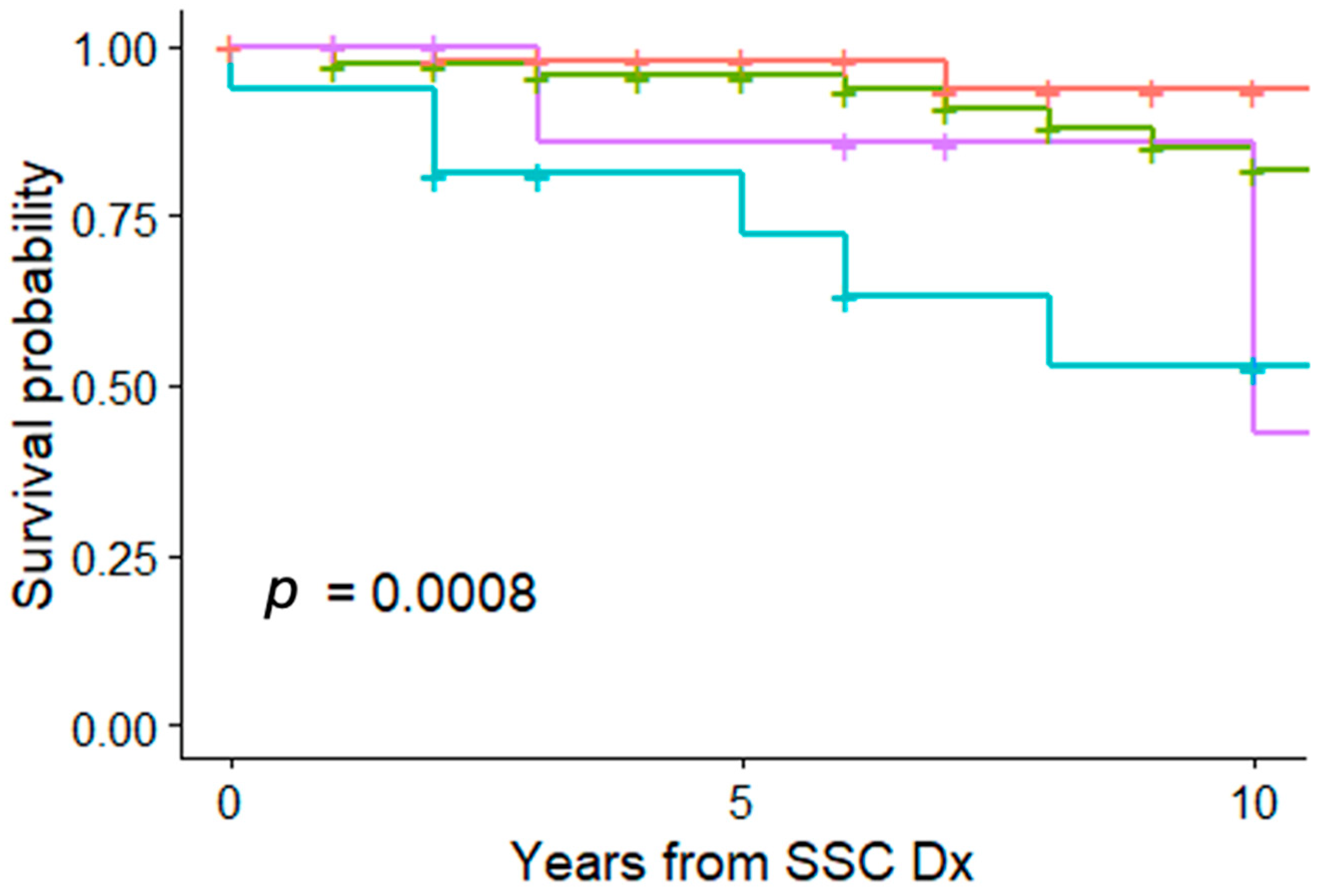
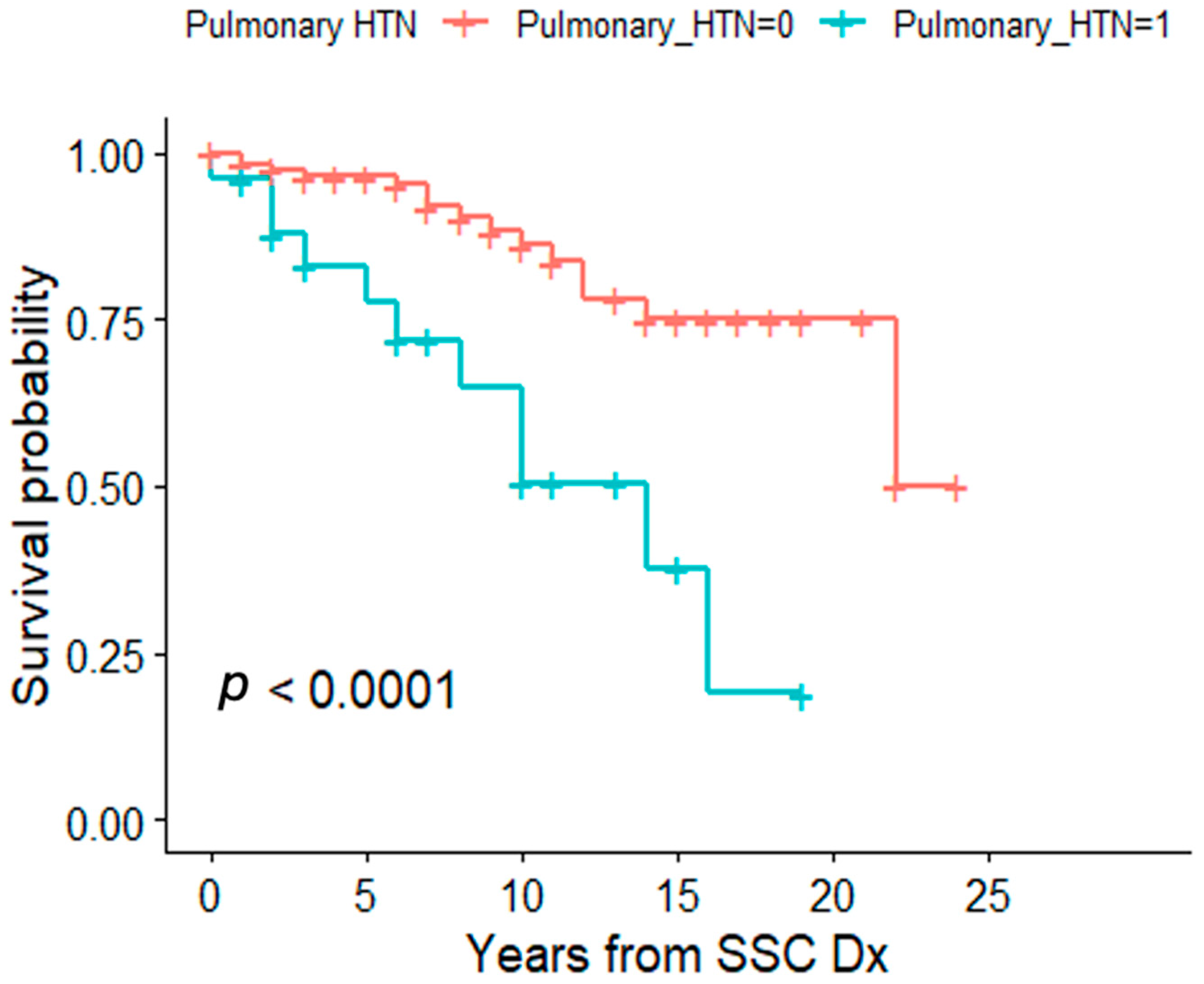
The baseline characteristics of patients with SSc ACA+ in the presence of PH were summarized using descriptive statistics. Comparisons between those with and without PH were performed using Fisher’s exact test for categorical variables and Wilcoxon rank sum tests for continuous variables. A univariate Cox Proportional Hazards model was constructed to evaluate the relationship between PH and survival. Schoenfeld residuals were tested to ensure that the Cox Proportional Hazards model was an appropriate choice. Kaplan–Meier curves were generated to visualize the survival probability after SSc diagnosis in patients with and without PH (Figure 1), as well as in subgroups based on immunomodulation and PH status (Figure 2). An additional univariate Cox proportional hazards model was constructed to assess the effect of immunosuppression on time to pulmonary hypertension (Table 4). This model used interval censoring such that immunosuppression could be treated as a time-varying covariate. Patients who initiated immunosuppression between SSc and the end of the period during which they were monitored were split into two intervals: the first being an observation ending with censoring when they received immunosuppression, and the second being an observation beginning on the date they received immunosuppression and ending with pulmonary hypertension or censoring. Differences between groups were assessed using the log-rank test, with a significance threshold of p < 0.05. Univariable logistic regression models were constructed to assess the factors associated with PH, and a multivariable model with this same outcome was constructed using a forward stepwise selection procedure oriented toward minimizing the model’s Akaike Information Criterion (AIC). The multivariable model fixed immunosuppression as a predictor and was then limited to two additional predictors due to the number of PH instances observed in our study. The AUC values were reported for both the univariate and multivariate models. p-values less than 0.05 were considered statistically significant, and R, version 4.4.1, was used for all analyses.

3. Results

3.1. Study Participants

One hundred and forty-six SSc-ACA+ patients were included in the study. Table 1 shows the demographic and clinical characteristics of the 146 patients, as well as the two subgroups: PH (n = 25, 17.2%) and non-PH (n = 121, 82.8%). The median age at the baseline visit to UIHC Rheumatology was 58 years (IQR 49,68), with the majority of patients being female (92%) and self-identified as White (91%). There was a significant difference between the subgroups in smoking history, with current and former smokers being more prevalent in the PH group (p = 0.031). Patients who developed PH also had more frequent hypertension (64% vs. 41%, p = 0.048), hyperlipidemia (68% vs. 43%, p = 0.028), obstructive sleep apnea (OSA) (36% vs. 12%, p = 0.005), heart failure with preserved ejection fraction (HFpEF) (44% vs. 7.4%, p < 0.001), arryhthmias (32% vs. 12%, p = 0.03), valvular heart disease (VHD) (32% vs. 8.3%, p = 0.003), and chronic kidney disease (CKD) (36% vs. 12%, p = 0.007). Among the nine (36%) patients with PH who had CKD, only four had a diagnosis of CKD greater than or equal to three years prior to PH diagnosis (16% vs. 12%, p = 0.7). There were no significant differences in the prevalence of diabetes mellitus, cardiovascular disease (CVD), heart failure with reduced ejection fraction (HFrEF), venous thromboembolism (VTE), chronic obstructive pulmonary disease, chronic liver disease, or cancer between the two groups. The median follow-up time was 6 (IQR 3, 11) years.
Regarding disease-specific characteristics of SSc, the majority (138 patients, 94.5%) of the cohort had limited cutaneous SSc. Very few patients (seven patients, 4.8%) had interstitial lung disease. Severe systemic disease was present in 75 (62%) of patients without PH. The median age at onset of Raynaud’s phenomenon (RP) differed between PH and non-PH patients, with ages of 53 (IQR 42, 58) and 46 (IQR 34, 56) years, respectively (p = 0.069, Table 1). The median age at diagnosis of SSc was similar between subgroups, with ages of 59 (IQR 53, 69) and 56 (IQR 46, 64) years, respectively (p = 0.2). The median times from RP to SSc diagnosis and from SSc diagnosis to PH diagnosis were 5 years (IQR 2, 15) and 3 years (IQR 0, 10), respectively. While PH is thought to be a late complication of SSc, in two cases, PH was actually the initial presenting feature, with SSc being diagnosed thereafter. The median age at PH diagnosis was 66 (IQR 57, 73). Immunomodulator use was comparable between the groups, with 59% of non-PH patients and 60% of PH patients receiving treatment (p > 0.9, Table 1). Among patients with PH who were treated with an immunomodulator (n = 15), nine started the immunomodulator prior to their diagnosis of PH, and six started it thereafter. When assessing immunomodulatory use before PH development, it was noted that among those who never received or only received immunomodulators after the PH diagnosis (n = 66), 16 (24%) developed PH, whereas among those who received immunomodulators before PH or had been treated but never developed PH (n = 80), only 9 (11%) developed PH (p = 0.0475, Table 2). Table 3 includes invasive hemodynamic data from right heart catheterizations for the 25 patients with PH. All patients met the criteria for diagnosis of WHO Group 1 PH. The overall mean mPAP was 38 mmHg, with a mean PCWP of 11 mmHg; mean PVR was 5.4 WU by Fick and 6.1 WU by thermodilution.

3.2. Predictors of PH

Several characteristics were found to be associated with increased risk of PH (Table A1) in univariable analysis, including hypertension (OR = 2.52, 95% CI: 1.05–6.40, p = 0.042), hyperlipidemia (OR = 2.82, 95% CI: 1.16–7.38, p = 0.026), OSA (OR = 4.30, 95% CI: 1.57–11.6, p = 0.004), HFpEF (OR = 9.78, 95% CI: 3.49–28.6, p < 0.001), arrhythmias (OR = 3.33, 95% CI: 1.19–8.95, p = 0.018) and VHD (OR = 5.22, 95% CI: 1.78–15.2, p = 0.002). Age at RP onset (OR = 1.42, 95% CI: 1.00–2.09, p = 0.056) and time interval from RP onset to SSc diagnosis (OR = 0.95, 95% CI: 0.88–1.00, p = 0.11) were not associated with PH development.
In the multivariable model, after adjusting for potential confounders, VHD (OR = 7.79, 95% CI: 2.41–25.97, p < 0.001) and OSA (OR = 7.57, 95% CI: 2.48–24.11, p < 0.001) remained as independent predictors of PH (Table A1). Treatment with immunomodulatory medication showed a reduced risk of PH (OR 0.34, 95% CI 0.12–0.89, p = 0.033). AUC values for the clinical characteristics ranged from 0.5 to 0.7, and the AUC for the multivariable model was 0.72.
The Cox proportional hazards model analyzing the time from SSC diagnosis to PH (Table 4) found that treatment with immunosuppression tended to decrease the risk of developing PH, although this effect fell short of statistical significance (HR 0.46, 95% CI: 0.20–1.05, p = 0.064).
Table 4. The effect of immunosuppression on time to pulmonary hypertension.
CharacteristicNHR95% CIp-Value
Immunosuppression Status148
Never Treated or Treated After PH --
Treated & No PH or Treated Before PH 0.460.20, 1.050.064

3.3. Survival

Patients with PH had a significantly higher mortality rate (44% vs. 12%, p < 0.001) than those without PH (Table 1). Of the 15 patients with PH who were treated with immunomodulatory medications, those who were started on an immunomodulator prior to PH diagnosis had a trend toward decreased mortality (33% vs. 67%); however, this did not reach statistical significance (p = 0.32, Table 5). Kaplan–Meier survival analysis demonstrated significantly reduced survival in patients with PH (Figure 1). When separated by overall immunomodulatory use, regardless of before or after PH diagnosis (Figure 2), patients with PH without immunomodulator use had worse survival over 10 years from SSc diagnosis (p < 0.001). Univariate survival analysis showed that the hazard ratio (HR) for mortality in patients with PH was 4.27 (95% CI: 1.93–9.41, p < 0.001), indicating a more than fourfold increased risk of death.
Figure 1. Kaplan–Meier survival curve for patients with and without pulmonary hypertension in systemic sclerosis.
Immuno 06 00016 g001
Figure 2. Kaplan–Meier survival curves by immunomodulatory treatment and pulmonary hypertension status in systemic sclerosis.
Immuno 06 00016 g002

4. Discussion

While exploring the predictors and survival of PH in SSc-ACA+ patients, we noted that PH was associated with a four-fold increase in mortality compared to those without PH. Interestingly, there was a tendency toward a reduced risk of PH development and mortality in individuals who were on immunomodulatory medications. VHD, as in the general population, was associated with increased risk of PH development.
PH defines a group of heterogeneous diseases characterized by elevated mPAP. In SSc, PH can be multifactorial due to widespread collagen deposition affecting a variety of internal visceral organs, including the heart and lungs, as well as the propensity for thromboembolic conditions. When inflammation and intimal fibrosis occur in the pulmonary vessels themselves, this leads to progressive remodeling of small and medium-sized vessels with smooth muscle hypertrophy and increased PVR, known as PAH. This is thought to be the most frequently encountered PH subtype in all patients with SSc, affecting up to 12% of all patients with SSc [22,23,24].
PH is very difficult to diagnose at an early stage, as early symptoms are either non-specific or very vague despite recently developed algorithms for predicting who may need right heart catheterization [25]. Non-invasive tests, including DLCO and TTE [26,27], are useful for detecting possible PH; however, the sensitivity for early changes is lacking, and there are notable limitations [28]. In a prospective study of patients with SSc, a DLCO below 43% of the predicted value had the highest sensitivity of just 67% for detecting definite PH [29]. Although progress has recently been made in developing an SSc disease activity index, which incorporates a 24-item index (with a maximum score of 140) [30], no sufficiently sensitive markers (i.e., 6 min walk test, N-terminal pro-brain natriuretic peptide) exist to detect subtle changes in PH-related disease activity. More recently, platelet factor 4 (CXCL4) serum level correlated with skin and lung fibrosis, as well as with PAH in a study by van Bon et al., and was predictive of progression of SSc [31]. Further studies are needed to determine whether CXCL4 can be used to predict PAH in SSc-ACA+ patients.
The role of immunosuppression in modifying disease progression is not yet well understood. Our study found that immunomodulatory therapy before PH diagnosis was associated with a lower likelihood of developing PH, as evidenced by the statistically significant difference between the treated and untreated groups (p = 0.0475). These findings suggest a potential protective role for immunomodulatory therapy against PH development in patients with SSc-ACA+. Currently, it is unclear whether a similar protective effect can be observed in patients with other forms of systemic sclerosis (i.e., in patients with either RNA-Pol III, topoisomerase, Th/To, U3-RNP or other SSc-specific autoantibodies). Although there is a theoretical rationale for immunomodulatory therapies in PH development and progression, the evidence base remains limited. Rituximab, for instance, failed to show any effect on SSc-PH treatment (not assessed for prevention). More recently, a large European SSc cohort of ~600 patients reported that immunomodulatory exposure, particularly mycophenolate mofetil, was associated with a lower risk of PH, while hydroxychloroquine use correlated with improved survival in SSc-PH [32].
A number of studies have investigated the benefits of immunosuppression on PAH in other connective tissue diseases, particularly in SLE [18,33,34,35]; however, only a few studies have explored the impact of immunosuppression specifically in SSc-PH. Immunosuppressants such as cyclophosphamide, mycophenolate mofetil, and methotrexate have been shown to provide benefit in skin and lung disease associated with SSc, with increased effectiveness if used earlier in the disease course [36]. A retrospective study conducted by Steen et al. revealed that treatment with d-penicillamine improved skin symptoms associated with SSc and also decreased the rate of visceral organ involvement [37]. Additionally, B-cell depletion has been studied in SSc-PAH, with rituximab specifically showing a beneficial effect on six-minute walk distances in a double-blinded clinical trial [38]. A 2023 European Scleroderma Trials and Research Group (EUSTAR) scientific abstract by Bruni et al. found a reduction in morbidity and mortality with rituximab and a reduction in mortality with tocilizumab for patients with SSc-PAH [39]. A previous multicenter randomized controlled trial evaluating anti-IL-6 antibody use in SSc discovered that tocilizumab appeared to preserve lung function in patients with elevated acute-phase reactants and SSc-ILD [40]. In one of the largest retrospective cohorts of patients with SSc-PAH, immunosuppression was also found to be associated with improved survival [11].
This study is limited by its retrospective design, which makes it susceptible to missing data and potential confounding variables, weakening the internal validity of the findings. The cumulative analysis of patients limits our ability to describe the disease progression in detail. Additionally, as the study population consisted of patients from a tertiary care center, the findings may have limited generalizability and may be influenced by referral bias.
The overall prognosis of SSc-PAH remains poor, and the response to vasodilator therapy and other therapies in patients with documented PH is often minimal [1]. Our study supports the unfortunate fact that PH in SSc continues to have low survival despite recent advances in clinical correlates and diagnostic algorithms. The possible benefits of immunomodulatory therapy have been suggested in several case reports, a recent retrospective cohort study [11], and in one double-blinded clinical trial [36]. Our study adds to the growing body of literature suggesting that early immunomodulation may prevent the progression of PH. Larger multicenter studies that evaluate biomarkers for early disease detection and explore the potential benefits of immunomodulatory therapy in SSc-PAH are greatly needed.

Author Contributions

Study conception and design were performed by P.L. and G.A. Data Collection was performed by G.A. Data analysis was performed by L.W. and P.T.E. The first draft of the manuscript was written by G.A. and E.S. The manuscript was reviewed and edited by G.O. All authors have read and agreed to the published version of the manuscript.

Funding

Dr. Lenert’s work was in part supported by a grant from the Kelting Foundation. Additionally, research reported in this publication was supported by the National Center for Advancing Translational Sciences of the National Institutes of Health under Award Number UM1TR004403.

Institutional Review Board Statement

The study was approved by the Institutional Review Board of the University of Iowa (IRB#: 202003670).

Informed Consent Statement

The requirement for individual patient consent was waived because this study was a retrospective chart review without intervention.

Data Availability Statement

Data is available on reasonable request to the corresponding author.

Conflicts of Interest

The authors declare no conflicts of interest.

Abbreviations

The following abbreviations are used in this manuscript:
SScSystemic sclerosis
ACAAnti-centromere antibody
PAHPulmonary arterial hypertension
DLCODiffusing capacity of the lungs
PVRPulmonary vascular resistance
TTETransthoracic echocardiogram
UIHCUniversity of Iowa Hospitals & Clinics
mPAPMean pulmonary artery pressure
RHCRight heart catheterization
WHOWorld Health Organization
PCWPPulmonary capillary wedge pressure
COPDChronic obstructive pulmonary disease
AICAkaike information criterion
OSAObstructive sleep apnea
HFpEFHeart failure with preserved ejection fraction
VHDValvular heart disease
CKDChronic kidney disease
CVDCardiovascular disease
HFrEFHeart failure with reduced ejection fraction
VTEVenous thromboembolism
HRHazard ratio
CXCL4Platelet factor 4
EUSTAREuropean Scleroderma Trials And Research Group

Appendix A

Table A1. Univariable and multivariable logistic regression analysis for predictors of pulmonary hypertension.
CharacteristicNOR195% CI1p-Value
Univariable
Sex146
   Female --
   Male 0.420.02, 2.300.4
Smoking history146
   Current -
   Former 1.050.27, 5.23>0.9
   Never 0.330.08, 1.720.2
Co-morbidities146
   Hypertension 2.521.05, 6.400.042
   Type 2 diabetes 0.790.12, 3.160.8
   Hyperlipidemia 2.821.16, 7.380.026
   OSA 4.301.57, 11.60.004
   CVD 1.230.44, 3.150.7
   HFrEF 3.990.74, 19.30.083
   HFpEF 9.783.49, 28.6<0.001
   VTE 0.660.10, 2.600.6
   Arrythmias 3.331.19, 8.950.018
   VHD 5.221.78, 15.20.002
   COPD 2.080.61, 6.210.2
   Chronic liver disease 0.660.10, 2.600.6
   Cancer 1.130.35, 3.140.8
Age at RP onset, 10-year increase1231.421.00, 2.090.056
Age at SSc dx, 10-year increase1461.270.9, 1.820.2
Time from RP onset to SSc dx, y1230.950.88, 1.000.11
Severe systemic disease146Not Estimable 0.00>0.9
Severe RP1461.080.39, 2.740.9
Prior Immunomodulator treatment1461.060.44, 2.61>0.9
Multivariable146
Prior immunomodulator treatment
   Never Treated or Treated After PH
   Treated & No PH or Treated Before PH 0.340.12, 0.890.033
VHD 7.792.41, 25.97<0.001
OSA 7.572.84, 24.11<0.001
1 OR = odds ratio, CI = confidence interval

References

  1. Stupi, A.M.; Steen, V.D.; Owens, G.R.; Barnes, E.L.; Rodnan, G.P.; Medsger, T.A. Pulmonary hypertension in the crest syndrome variant of systemic sclerosis. Arthritis Rheum. 1986, 29, 515–524. [Google Scholar] [CrossRef]
  2. Tan, E.M.; Rodnan, G.P.; Garcia, I.; Moroi, Y.; Fritzler, M.J.; Peebles, C. Diversity of antinuclear antibodies in progressive systemic sclerosis. Arthritis Rheum. 1980, 23, 617–625. [Google Scholar] [CrossRef]
  3. Cavazzana, I.; Vojinovic, T.; Airo’, P.; Fredi, M.; Ceribelli, A.; Pedretti, E.; Lazzaroni, M.G.; Garrafa, E.; Franceschini, F. Systemic Sclerosis-Specific Antibodies: Novel and Classical Biomarkers. Clin. Rev. Allergy Immunol. 2023, 64, 412–430. [Google Scholar] [CrossRef]
  4. Mitri, G.M.; Lucas, M.; Fertig, N.; Steen, V.D.; Medsger, T.A. A comparison between anti-Th/To– and anticentromere antibody–positive systemic sclerosis patients with limited cutaneous involvement. Arthritis Rheum. 2003, 48, 203–209. [Google Scholar] [CrossRef]
  5. Mierau, R.; Moinzadeh, P.; Riemekasten, G.; Melchers, I.; Meurer, M.; Reichenberger, F.; Buslau, M.; Worm, M.; Blank, N.; Hein, R.; et al. Frequency of disease-associated and other nuclear autoantibodies in patients of the German network for systemic scleroderma: Correlation with characteristic clinical features. Arthritis Res. Ther. 2011, 13, R172. [Google Scholar] [CrossRef] [PubMed]
  6. Hudson, M.; Mahler, M.; Pope, J.; You, D.; Tatibouet, S.; Steele, R.; Baron, M.; Canadian Scleroderma Research Group; Fritzler, M. Clinical Correlates of CENP-A and CENP-B Antibodies in a Large Cohort of Patients with Systemic Sclerosis. J. Rheumatol. 2012, 39, 787–794. [Google Scholar] [CrossRef]
  7. Gunn, J.; Pauling, J.D.; McHugh, N.J. Impact of anti-centromere antibodies on pulmonary function test results in patients with systemic sclerosis without established or suspected pulmonary disease. Clin. Rheumatol. 2014, 33, 869–871. [Google Scholar] [CrossRef] [PubMed]
  8. Li, C.; Liu, P.; Song, R.; Zhang, Y.; Lei, S.; Wu, S. Immune cells and autoantibodies in pulmonary arterial hypertension. Acta Biochim. Biophys. Sin. 2017, 49, 1047–1057. [Google Scholar] [CrossRef] [PubMed]
  9. Salerni, R.; Rodnan, G.P.; Leon, D.F.; Shaver, J.A. Pulmonary Hypertension in the CREST Syndrome Variant of Progressive Systemic Sclerosis (Scleroderma). Ann. Intern. Med. 1977, 86, 394–399. [Google Scholar] [CrossRef]
  10. Wang, R.-R.; Yuan, T.-Y.; Wang, J.-M.; Chen, Y.-C.; Zhao, J.-L.; Li, M.-T.; Fang, L.-H.; Du, G.-H. Immunity and inflammation in pulmonary arterial hypertension: From pathophysiology mechanisms to treatment perspective. Pharmacol. Res. 2022, 180, 106238. [Google Scholar] [CrossRef]
  11. Sarı, A.; Satış, H.; Ayan, G.; Küçükşahin, O.; Kalyoncu, U.; Fidancı, A.A.; Ayvalı, M.O.; Ata, N.; Ülgü, M.M.; Birinci, Ş.; et al. Survival in systemic sclerosis associated pulmonary arterial hypertension in the current treatment era-results from a nationwide study. Clin. Rheumatol. 2024, 43, 1919–1925. [Google Scholar] [CrossRef] [PubMed]
  12. Gabrielli, A.; Avvedimento, E.V.; Krieg, T. Scleroderma. N. Engl. J. Med. 2009, 360, 1989–2003. [Google Scholar] [CrossRef]
  13. Steen, V.D.; Medsger, T.A. Changes in causes of death in systemic sclerosis, 1972–2002. Ann. Rheum. Dis. 2007, 66, 940–944. [Google Scholar] [CrossRef]
  14. Mukerjee, D.; George, D.S.; Coleiro, B.; Knight, C.; Denton, C.P.; Davar, J.; Black, C.M.; Coghlan, J.G. Prevalence and outcome in systemic sclerosis associated pulmonary arterial hypertension: Application of a registry approach. Ann. Rheum. Dis. 2003, 62, 1088–1093. [Google Scholar] [CrossRef]
  15. Launay, D.; Sitbon, O.; Hachulla, E.; Mouthon, L.; Gressin, V.; Rottat, L.; Clerson, P.; Cordier, J.-F.; Simonneau, G.; Humbert, M. Survival in systemic sclerosis-associated pulmonary arterial hypertension in the modern management era. Ann. Rheum. Dis. 2013, 72, 1940–1946. [Google Scholar] [CrossRef]
  16. Kolstad, K.D.; Li, S.; Steen, V.; Chung, L.; Bolster, M.B.; Csuka, M.E.; Derk, C.T.; Domsic, R.T.; Fischer, A.; Frech, T.; et al. Long-Term Outcomes in Systemic Sclerosis-Associated Pulmonary Arterial Hypertension From the Pulmonary Hypertension Assessment and Recognition of Outcomes in Scleroderma Registry (PHAROS). Chest 2018, 154, 862–871. [Google Scholar] [CrossRef]
  17. Le Pavec, J.; Humbert, M.; Mouthon, L.; Hassoun, P.M. Systemic Sclerosis-associated Pulmonary Arterial Hypertension. Am. J. Respir. Crit. Care Med. 2010, 181, 1285–1293. [Google Scholar] [CrossRef] [PubMed]
  18. Del Galdo, F.; Lescoat, A.; Conaghan, P.G.; Bertoldo, E.; Čolić, J.; Santiago, T.; Suliman, Y.A.; Matucci-Cerinic, M.; Gabrielli, A.; Distler, O.; et al. EULAR recommendations for the treatment of systemic sclerosis: 2023 update. Ann. Rheum. Dis. 2025, 84, 29–40. [Google Scholar]
  19. Ding, Y.; Qian, J.; Zhang, S.; Xu, D.; Leng, X.; Zhao, J.; Wang, Q.; Zhang, W.; Tian, X.; Li, M.; et al. Immunosuppressive therapy in patients with connective tissue disease-associated pulmonary arterial hypertension: A systematic review. Int. J. Rheum. Dis. 2022, 25, 982–990. [Google Scholar] [CrossRef]
  20. Van den Hoogen, F.; Khanna, D.; Fransen, J.; Johnson, S.R.; Baron, M.; Tyndall, A.; Matucci-Cerinic, M.; Naden, R.P.; Medsger, T.A., Jr.; Carreira, P.E.; et al. 2013 Classification Criteria for Systemic Sclerosis: An American College of Rheumatology/European League Against Rheumatism Collaborative Initiative. Arthritis Rheum. 2013, 65, 2737–2747. [Google Scholar] [CrossRef] [PubMed]
  21. Galie, N.; Humbert, M.; Vachiéry, J.-L.; Gibbs, S.; Lang, I.M.; Torbicki, A.; Simonneau, G.; Peacock, A.; Noordegraaf, A.V.; Beghetti, M.; et al. 2022 ESC/ERS Guidelines for the diagnosis and treatment of pulmonary hypertension. Eur. Heart J. 2022, 43, 3618–3731. [Google Scholar] [CrossRef]
  22. Lefèvre, G.; Dauchet, L.; Hachulla, E.; Montani, D.; Sobanski, V.; Lambert, M.; Hatron, P.; Humbert, M.; Launay, D. Survival and prognostic factors in systemic sclerosis-associated pulmonary hypertension: A systematic review and meta-analysis. Arthritis Rheum. 2013, 65, 2412–2423. [Google Scholar] [CrossRef] [PubMed]
  23. Chaisson, N.F.; Hassoun, P.M. Systemic Sclerosis-Associated Pulmonary Arterial Hypertension. Chest 2013, 144, 1346–1356. [Google Scholar] [CrossRef] [PubMed]
  24. Launay, D.; Sobanski, V.; Hachulla, E.; Humbert, M. Pulmonary hypertension in systemic sclerosis: Different phenotypes. Eur. Respir. Rev. 2017, 26, 170056. [Google Scholar] [CrossRef]
  25. Coghlan, J.G.; Denton, C.P.; Grünig, E.; Bonderman, D.; Distler, O.; Khanna, D.; Müller-Ladner, U.; Pope, J.E.; Vonk, M.C.; Doelberg, M.; et al. Evidence-based detection of pulmonary arterial hypertension in systemic sclerosis: The DETECT study. Ann. Rheum. Dis. 2014, 73, 1340–1349. [Google Scholar] [CrossRef]
  26. Janda, S.; Shahidi, N.; Gin, K.; Swiston, J. Diagnostic accuracy of echocardiography for pulmonary hypertension: A systematic review and meta-analysis. Heart 2011, 97, 612–622. [Google Scholar] [CrossRef]
  27. Mukerjee, D.; George, D.S.; Knight, C.; Davar, J.; Wells, A.U.; Du Bois, R.M.; Black, C.M.; Coghlan, J.G. Echocardiography and pulmonary function as screening tests for pulmonary arterial hypertension in systemic sclerosis. Rheumatology 2004, 43, 461–466. [Google Scholar] [CrossRef]
  28. Carreira, P.E.; Carmona, L.; Joven, B.E.; Loza, E.; Andreu, J.L.; Riemekasten, G.; Vettori, S.; Allanore, Y.; Balbir-Gurman, A.; Airò, P.; et al. Clinical determinants of elevated systolic pulmonary artery pressure measured by transthoracic Doppler echocardiography in early systemic sclerosis. Clin. Exp. Rheumatol. 2017, 35, 114–121. [Google Scholar]
  29. Ungerer, R.G.; Tashkin, D.P.; Furst, D.; Clements, P.J.; Gong, H.; Bein, M.; Smith, J.W.; Roberts, N.; Cabeen, W. Prevalence and clinical correlates of pulmonary arterial hypertension in progressive systemic sclerosis. Am. J. Med. 1983, 75, 65–74. [Google Scholar] [CrossRef]
  30. Ross, L.; Baron, M.; Nikpour, M. Defining Disease Activity in Systemic Sclerosis. Curr. Treat. Options Rheumatol. 2025, 11, 4. [Google Scholar] [CrossRef]
  31. Van Bon, L.; Affandi, A.J.; Broen, J.; Christmann, R.B.; Marijnissen, R.J.; Stawski, L.; Farina, G.A.; Stifano, G.; Mathes, A.L.; Cossu, M.; et al. Proteome-wide Analysis and CXCL4 as a Biomarker in Systemic Sclerosis. N. Engl. J. Med. 2014, 370, 433–443. [Google Scholar] [CrossRef]
  32. Rodolfi, S.; Ng, C.C.M.; Bejerano, A.M.R.; Kanitkar, M.; Ong, V.H.; Denton, C.P. Impact of immunosuppression on development and outcome of systemic sclerosis-associated pulmonary arterial hypertension. Clin. Exp. Rheumatol. 2025, 43, 1492–1498. [Google Scholar] [CrossRef]
  33. Thoreau, B.; Mouthon, L. Pulmonary arterial hypertension associated with connective tissue diseases (CTD-PAH): Recent and advanced data. Autoimmun. Rev. 2024, 23, 103506. [Google Scholar] [CrossRef]
  34. Bruera, S.; Sreedhar, A.; Agarwal, S.K.; Muthukumar, V.; Geng, Y.; Lopez-Olivo, M.A. Immunosuppression for the treatment of pulmonary hypertension in patients with systemic lupus erythematosus: A systematic review. Int. J. Rheum. Dis. 2023, 26, 1022–1028. [Google Scholar] [CrossRef]
  35. Hennigan, S.; Channick, R.N.; Silverman, G. Rituximab treatment of pulmonary arterial hypertension associated with systemic lupus erythematosus: A case report. Lupus 2008, 17, 754–756. [Google Scholar] [CrossRef] [PubMed]
  36. Katsiari, C.G.; Simopoulou, T.; Alexiou, I.; Sakkas, L.I. Immunotherapy of systemic sclerosis. Hum. Vaccines Immunother. 2018, 14, 2559–2567. [Google Scholar] [CrossRef]
  37. Steen, V.D.; Medsger, T.A.; Rodnan, G.P. D-Penicillamine therapy in progressive systemic sclerosis (scleroderma): A retrospective analysis. Ann. Intern. Med. 1982, 97, 652–659. [Google Scholar] [CrossRef] [PubMed]
  38. Zamanian, R.T.; Badesch, D.; Chung, L.; Domsic, R.T.; Medsger, T.; Pinckney, A.; Keyes-Elstein, L.; D’Aveta, C.; Spychala, M.; White, R.J.; et al. Safety and Efficacy of B-Cell Depletion with Rituximab for the Treatment of Systemic Sclerosis–associated Pulmonary Arterial Hypertension: A Multicenter, Double-Blind, Randomized, Placebo-controlled Trial. Am. J. Respir. Crit. Care Med. 2021, 204, 209–221. [Google Scholar] [CrossRef]
  39. Bruni, C.; Tofani, L.; Fretheim, H.; Weber, Y.; Hachulla, E.; Carreira, P.; Giuggioli, D.; Airò, P.; Siegert, E.; Müller-Ladner, U.; et al. OP0238 Immunosuppression with Targeted Dmards Reduces Morbidity and Mortality in Pre-Capillary Pulmonary Hypertension Associated with Systemic Sclerosis: A Eustar Analysis. Ann. Rheum. Dis. 2023, 82, 157–159. Available online: https://ard.bmj.com/content/82/Suppl_1/157.2 (accessed on 4 March 2026).
  40. Khanna, D.; Lin, C.J.F.; Furst, D.E.; Goldin, J.; Kim, G.; Kuwana, M.; Allanore, Y.; Matucci-Cerinic, M.; Distler, O.; Shima, Y.; et al. Tocilizumab in systemic sclerosis: A randomised, double-blind, placebo-controlled, phase 3 trial. Lancet Respir. Med. 2020, 8, 963–974. [Google Scholar] [CrossRef]
Table 1. Characteristics in SSc-ACA+ patients with and without pulmonary hypertension *.
VariablesTotal
N = 146
PH
N = 25
No PH
N = 121
p-Value
Age at baseline visit to UIHC Rheumatology, y (IQR)58 (49, 68)60 (55, 70)56 (46, 67)0.057
Female, n (%)134 (92)24 (96)110 (91)0.7
Race and ethnicity, n (%) >0.9
  White133 (91)25 (100)108 (89)
  Black2 (1.4)0 (0)2 (1.7)
  Hispanic3 (2.1)0 (0)3 (2.5)
  Asian3 (2.5)0 (0)3 (2.5)
  Other5 (3.4)0 (0)5 (4.1)
Smoking history, n (%) 0.031
  Current12 (8.2)3 (12)9 (7.4)
  Former54 (37)14 (56)40 (33)
  Never80 (55)8 (32)72 (60)
Comorbidities, n (%)
  Hypertension66 (45)16 (64)50 (41)0.048
  Type 2 diabetes14 (9.6)2 (8.0)12 (9.9)>0.9
  Hyperlipidemia69 (47)17 (68)52 (43)0.028
  OSA23 (16)9 (36)14 (12)0.005
  CVD36 (25)7 (28)29 (24)0.8
  HFrEF7 (4.8%)3 (12%)4 (3.3%)0.10
  HFpEF20 (14%)11 (44%)9 (7.4%)<0.001
  VTE16 (11)2 (8.0)14 (12)>0.9
  Arrhythmias23 (16)8 (32)15 (12)0.030
  VHD18 (12)8 (32)10 (8.3)0.003
  COPD18 (12)5 (20)13 (11)0.2
  CKD24 (16)9 (36)15 (12)0.007
  Chronic liver disease16 (11)2 (8.0)14 (12)>0.9
  Cancer27 (18)5 (20)22 (18)0.8
Age at RP onset, y (IQR)47 (35, 56)53 (42, 58)46 (34, 56)0.069
Age at SSc dx, y (IQR)56 (48, 66)59 (53, 69)56 (46, 64)0.2
Time from RP onset to SSc dx, y (IQR)5 (2, 15)3 (2, 8)6 (1, 16)0.2
Severe RP, n (%)39 (27)7 (28)32 (26)>0.9
Severe systemic disease, n (%)100 (68)25 (100)75 (62)<0.001
Outcome, n (%) <0.001
  Alive101 (69)14 (56)87 (72)
  Deceased26 (18)11 (44)15 (12)<0.001
  Lost to Follow-Up19 (13)0 (0%)19 (16)
Immunomodulatory use, n (%)86 (59)15 (60)71 (59)>0.9
* The values are presented as median (IQR) unless indicated otherwise. UIHC: University of Iowa Hospitals & Clinics; OSA: obstructive sleep apnea; CVD: cardiovascular disease; VTE: venous thromboembolism; VHD: valvular heart disease; COPD: chronic obstructive pulmonary disease; CKD: chronic kidney disease; RP: Raynaud’s phenomenon; SSc: systemic sclerosis; dx: diagnosis.
Table 2. Incidence of pulmonary hypertension in patients treated with immunomodulators before pulmonary hypertension diagnosis.
Immunomodulation StatusPulmonary Hypertension PresentPulmonary Hypertension Absent
Never treated (or treated after PH)5016
Treated before PH719
Fisher’s exact probability test: p-value = 0.0475; PH: pulmonary hypertension
Table 3. Invasive hemodynamic data from right heart catheterization for patients with pulmonary hypertension.
PatientmPAP (mmHg)PCWP
(mmHg)
PVR, Fick
(WU)
PVR, Thermodilution (WU)CO, Fick
(L/min)
CO, Thermodilution (L/min)
145117.612.51.91.2
234117.4 2.3
3571411.711.92.42.3
4351532.75.15.5
544133.43.84.84.3
6299 5.4 2.4
730123.43.23.13.3
82946.34.622.7
925153.23.92.92.4
103865.56.23.12.7
113365.16.62.92.2
1225122.732.82.6
136767.111.163.8
1429143.14.83.42.1
15301232.6 3.4
16 *1871.71.53.63.2
1742108.110.12.42
1822122.53.42.82
1925623.54.62.7
20681514.614.92.22.1
215815 11.4 1.8
22451574.92.33.3
2337133.643.53.1
2439153.63.73.83.8
2533485.82.12.9
* One exception was a patient who had an mPAP of <20 mmHg at rest but exhibited significant symptoms. RHC with exercise demonstrated a PVR > 3 Wood units and PCWP ≤ 15 mmHg. Based on clinical judgment and physician consensus, these patients were classified as having PAH or Group 1 PH.
Table 5. Survival in patients with pulmonary hypertension based on immunomodulatory use before or after the PH diagnosis.
CharacteristicNo Immunomodulator Prior to PH, N = 6 1Immunomodulator Prior to PH, N = 9 1p-Value 2
Outcome 0.32
  Alive2 (33%)6 (67%)
  Deceased4 (67%)3 (33%)
1 n (%); 2 Fisher’s exact probability test.
Disclaimer/Publisher’s Note: The statements, opinions and data contained in all publications are solely those of the individual author(s) and contributor(s) and not of MDPI and/or the editor(s). MDPI and/or the editor(s) disclaim responsibility for any injury to people or property resulting from any ideas, methods, instructions or products referred to in the content.