

Variables of Negative Impact on Mental Health in the LGBT Population: Identification of Measurement Scales—A Systematic Review


 , and
, and
Abstract
1. Introduction
2. Materials and Methods
- P: LGBT population (lesbians, gays, bisexuals, and transgender people).
- E: negative attitudes (homophobia, lesbophobia, transphobia, biphobia).
- O: validated psychometric scales/instruments and negative consequences on mental health because of negative attitudes.
2.1. Selection Criteria
2.2. Search Strategy
2.3. Inclusion and Exclusion Criteria
2.4. Data Extraction
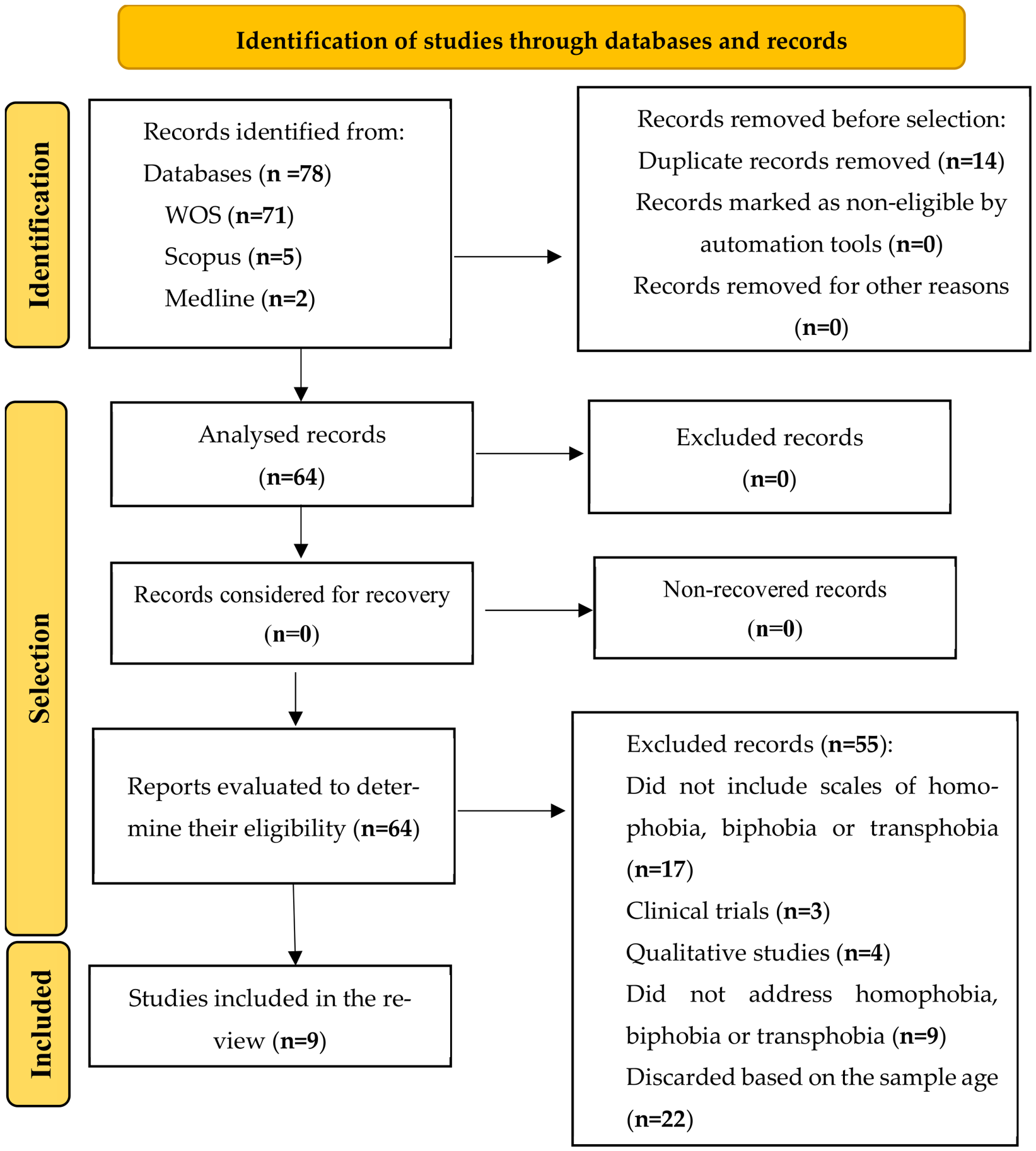
2.5. Presentation of the Results: Adherence to Quality Initiatives (PRISMA)
2.6. Quality Evaluation

| Articles | COMPONENTS ** | ||||||
|---|---|---|---|---|---|---|---|
| 1 | 2 | 3 | 4 | 5 | 6 | Global Score * | |
| García-Sánchez et al., [29] | M | W | M | W | S | S | W |
| López-Sáez et al., [38] | S | W | S | M | S | S | M |
| Henderson et al., [45] | M | W | M | W | S | S | W |
| Katz-Wise et al., [39] | M | W | M | M | S | S | M |
| Meanley et al., [40] | S | M | M | M | S | S | M |
| Conn et al., [41] | S | M | M | M | S | S | M |
| Vance et al., [42] | S | W | M | M | S | S | M |
| Lin et al., [43] | M | W | M | M | S | S | M |
| García-Berbén et al., [44] | M | W | M | M | S | S | M |
3. Results
3.1. Selection of Studies and Data Extraction Process
3.2. Characteristics of the Studies: Results Synthesis
3.3. Identified Scales on Sexual Minority Stigma
3.4. Biopsychosocial Consequences Derived from Homophobic, Lesbophobic and Transphobic Attitudes
- Mental health problems:
- Depression, anxiety and low self-esteem: it has been observed that internalised transphobia is related to depression and anxiety symptoms among transgender and gender-diverse youths [41]. LGBT people face high levels of verbal, physical and sexual harassment. These result in social exclusion and thus a deterioration of mental health. Henderson et al. [45] reported that homophobic and transphobic bullying generates profound emotional consequences that may lead to depression and low self-esteem. In addition, the internalisation of homophobic and transphobic attitudes may significantly reduce self-esteem and generate an internal conflict with respect to one’s own sexual identity, which increases the risk of mental health problems [40].
- Borderline personality disorder (BPD): Lin et al. [43] demonstrated that victimisation by homophobic bullying during childhood is associated with BPD symptoms in early adulthood. It begins with depression, and the lack of family support worsens these conditions.
- Substance consumption:
- Use of alcohol and drugs: rejection toward certain minorities and suffering this discrimination may increase the probability of alcohol and marihuana consumption and smoking in adolescents [39].
- Suicidal ideation:
- Vance et al. [42] found that transgender/non-binary Black and Latin youths showed higher rates of depression and suicidal ideation compared to their White counterparts due to lower gender affirmation and greater social rejection.
- Social and relational problems:
- Social exclusion and marginalisation: people who experience homophobic and transphobic attitudes often encounter social rejection and exclusion, which has a negative impact on their interpersonal relations and psychological well-being [45].
4. Discussion
Clinical, Public Health, Research, and Pedagogical Implications
5. Conclusions
Supplementary Materials
Author Contributions
Funding
Institutional Review Board Statement
Informed Consent Statement
Data Availability Statement
Conflicts of Interest
References
- Kass, L.R. Life, Liberty and the Defense of Dignity: The Challenge for Bioethics; Encounter Books: New York, NY, USA, 2002. [Google Scholar]
- Hurtado, J. Group Processes and Psychology of Integration; CieaSypal Quirón: Caracas-Bogotá, Colombia, 2006. [Google Scholar]
- Zambrano, C.; Ceballos, A.; Ojeda, D. Recognition of homosexual sexual orientation. Psicoespacios 2017, 11, 60–78. [Google Scholar]
- Barr, E.; Popkin, R.; Roodzant, E.; Jaworski, B.; Temkin, S.M. Gender as a social and structural variable: Research perspectives from the National Institutes of Health (NIH). Transl. Behav. Med. 2024, 14, 13–22. [Google Scholar] [CrossRef] [Scilit] [PubMed]
- National Academies of Sciences, Engineering, and Medicine. Measuring Sex, Gender Identity, and Sexual Orientation; National Academies Press: Cambridge, MA, USA, 2022. [Google Scholar] [CrossRef] [Scilit] [PubMed]
- Hove, M.J.; Hove, S.A. Biological Psychology, Revised ed.; Rotel Pressbooks: Montreal, QC, Canada, 2024; Available online: https://rotel.pressbooks.pub/biologicalpsychology/ (accessed on 1 January 2025).
- El Khoury, N.B.; Bassil, K.N.; Khalil, B.A.; Chahine, G.; Kahil, K.; Semaan, W.; Hajj, W. Biological, genetic, neurological and environmental factors in sexual orientation. Front. Behav. Neurosci. 2025, 19, 1574713. [Google Scholar] [CrossRef] [Scilit] [PubMed]
- Pew Research Center. The Global Divide on Homosexuality Persists; Pew Research Center: Washington, DC, USA, 2020; Available online: https://www.pewresearch.org/global/2020/06/25/global-divide-on-homosexuality-persists/ (accessed on 1 January 2025).
- Flores, A.R. Social Acceptance of LGBTI People in 174 Countries: 1981 to 2017; The Williams Institute, UCLA School of Law: Los Angeles, CA, USA, 2019; Available online: https://williamsinstitute.law.ucla.edu (accessed on 1 January 2025).
- Council of Europe. LGBTI Equality and Human Rights in Europe and Central Asia; Council of Europe Publishing: Strasbourg, France, 2022; Available online: https://www.coe.int (accessed on 1 January 2025).
- European Union Agency for Fundamental Rights. A Long Way to Go for LGBTI Equality; Publications Office of the European Union: Luxembourg, 2020; Available online: https://fra.europa.eu/en/publication/2020/eu-lgbti-survey-results (accessed on 1 January 2025).
- ILGA World. State-Sponsored Homophobia Report: Global Legislation Overview Update; ILGA World: Geneva, Switzerland, 2024; Available online: https://ilga.org (accessed on 1 January 2025).
- Human Rights Watch. World Report 2023: Events of 2022; Human Rights Watch: New York, NY, USA, 2023; Available online: https://www.hrw.org/world-report/2023 (accessed on 1 January 2025).
- Mendos, L.R.; Botha, K.; Lelis, R.C.; de la Peña, E.L.; Savelev, I.; Tan, D. State-Sponsored Homophobia 2020: Global Legislation Overview Update; ILGA World: Geneva, Switzerland, 2020; Available online: https://ilga.org/downloads/ILGA_World_State_Sponsored_Homophobia_report_global_legislation_overview_update_December_2020.pdf (accessed on 1 January 2025).
- Amnesty International. Annual Report 2022/23: The State of the World’s Human Rights; Amnesty International: London, UK, 2023. [Google Scholar]
- Herek, G.M. Beyond “homophobia”: Thinking about sexual prejudice and stigma in the twenty-first century. Sex. Res. Soc. Policy 2004, 1, 6–24. [Google Scholar] [CrossRef] [Scilit]
- Herek, G.M. Confronting sexual stigma and prejudice: Theory and practice. J. Soc. Issues 2007, 63, 905–925. [Google Scholar] [CrossRef] [Scilit]
- Gao, Q.; Antfolk, J.; Santtila, P. An experimental study using a sexual strategies explanation to reduce homophobia toward gay men among lay people and healthcare professionals in China. Front. Psychol. 2023, 14, 1143584. [Google Scholar] [CrossRef] [Scilit] [PubMed]
- Barragán Medero, F.; Pérez Jorge, D. Educación de la sexualidad: Libertad (delito y castigo) y paraíso. In ¿Qué Estamos Haciendo mal en la Educación? Reflexiones Pedagógicas para la Investigación, la Enseñanza y la Formación; de la Herrán Gascón, A., Valle López, J.M., Villena Higueras, J.L., Eds.; Octaedro: Barcelona, Spain, 2019; pp. 95–108. [Google Scholar]
- Klesse, C. Biphobia. In The SAGE Encyclopedia of LGBTQ Studies; Goldberg, A.E., Ed.; SAGE Publications: Thousand Oaks, CA, USA, 2016; Volume 3, pp. 119–122. [Google Scholar]
- Mizock, L.; Lewis, T.K. Trauma in transgender populations: Risk, resilience, and clinical care. J. Emot. Abus. 2008, 8, 335–354. [Google Scholar] [CrossRef] [Scilit]
- Poteat, V.P.; Yoshikawa, H.; Calzo, J.P.; Gray, M.L.; Han, G.; Mahmoud, S.; Mereish, E.H.; Phillips, G.; Soundararajan, R.; Shaw, M.P. Contextualizing gay-straight alliances: Student, advisor, and structural factors related to positive youth development among members. Child Dev. 2020, 91, 548–567. [Google Scholar] [CrossRef] [Scilit] [PubMed]
- Newcomb, M.E.; Mustanski, B. Internalized homophobia and internalizing mental health problems: A meta-analytic review. Clin. Psychol. Rev. 2010, 30, 1019–1029. [Google Scholar] [CrossRef] [Scilit] [PubMed]
- Mădžarević, M.; Soto-Sanfiel, M.T. The roles of sexual orientation beliefs, religiosity, perceived social roles, and social media use in explaining homophobia among heterosexual adults in Romania. Front. Psychol. 2023, 14, 1219442. [Google Scholar] [CrossRef] [Scilit] [PubMed]
- Meyer, I.H. Prejudice, social stress, and mental health in lesbian, gay, and bisexual populations. Psychol. Bull. 2003, 129, 674–697. [Google Scholar] [CrossRef] [Scilit] [PubMed]
- Hendricks, M.L.; Testa, R.J. A conceptual framework for clinical work with transgender and gender nonconforming clients. Prof. Psychol. Res. Pract. 2012, 43, 460–467. [Google Scholar] [CrossRef] [Scilit]
- Testa, R.J.; Habarth, J.; Peta, J.; Balsam, K.; Bockting, W. Development of the Gender Minority Stress and Resilience Measure. Psychol. Sex. Orientat. Gend. Divers. 2015, 2, 65–77. [Google Scholar] [CrossRef] [Scilit]
- Hatzenbuehler, M.L. How does sexual minority stigma “get under the skin”? A psychological mediation framework. Psychol. Bull. 2009, 135, 707–730. [Google Scholar] [CrossRef] [Scilit] [PubMed]
- García-Sánchez, J.R.; Gago-Valiente, F.J.; López-López, M.J.; Segura-Camacho, A.; Saenz-de-la-Torre, L.C.; Moreno-Sánchez, E. Variables with a negative impact on the quality of life of gays and lesbians in Spain: Evaluation of homophobic and lesbophobic indicators to guide youth education. Front. Psychol. 2024, 15, 1323208. [Google Scholar] [CrossRef] [Scilit] [PubMed]
- Balsam, K.F.; Molina, Y.; Beadnell, B.; Simoni, J.; Walters, K. Measuring multiple minority stress: The LGBT People of Color Microaggressions Scale. Cult. Divers. Ethn. Minor. Psychol. 2011, 17, 163–174. [Google Scholar] [CrossRef] [Scilit]
- Worthington, R.L.; Dillon, F.R.; Becker-Schutte, A.M. Development, reliability, and validity of the Lesbian, Gay, and Bisexual Knowledge and Attitudes Scale for Heterosexuals (LGB-KASH). J. Couns. Psychol. 2005, 52, 104–118. [Google Scholar] [CrossRef] [Scilit]
- Page, M.J.; McKenzie, J.E.; Bossuyt, P.M.; Boutron, I.; Hoffmann, T.C.; Mulrow, C.D.; Shamseer, L.; Tetzlaff, J.M.; Moher, D. Updating guidance for reporting systematic reviews: Development of the PRISMA 2020 statement. J. Clin. Epidemiol. 2021, 134, 103–112. [Google Scholar] [CrossRef] [Scilit] [PubMed]
- Bramer, W.M.; Rethlefsen, M.L.; Kleijnen, J.; Franco, O.H. Optimal database combinations for literature searches in systematic reviews: A prospective exploratory study. Syst. Rev. 2017, 6, 245. [Google Scholar] [CrossRef] [Scilit] [PubMed]
- Page, M.J.; McKenzie, J.E.; Bossuyt, P.M.; Boutron, I.; Hoffmann, T.C.; Mulrow, C.D.; Shamseer, L.; Tetzlaff, J.M.; Akl, E.A.; Brennan, S.E.; et al. The PRISMA 2020 statement: An updated guideline for reporting systematic reviews. BMJ 2021, 372, n71. [Google Scholar] [CrossRef] [Scilit] [PubMed]
- Arana-Álvarez, C.; Gómez-Asencio, D.; Gago-Valiente, F.J.; Cabrera-Arana, Y.; Merino-Godoy, M.D.; Moreno-Sánchez, E. Virtual Pedagogy and Care: Systematic Review on Educational Innovation with Mobile Applications for the Development of Healthy Habits in the Adolescent Population. Nutrients 2023, 15, 3966. [Google Scholar] [CrossRef] [Scilit] [PubMed]
- Tomás, B.H.; Ciliska, D.; Dobbins, M.; Micucci, S. A process for systematically reviewing the literature: Providing research evidence for public health nursing interventions. Cosmovisiones Evid. Enfermería Basada 2004, 1, 176–184. [Google Scholar] [CrossRef] [Scilit]
- Antúnez-Blancat, A.; Gago-Valiente, F.J.; García-Iglesias, J.J.; Merino-Navarro, D. The Role of Nursing in the Management of Chemotherapy Extravasation: A Systematic Review Regarding Public Health. Healthcare 2024, 12, 1456. [Google Scholar] [CrossRef] [Scilit] [PubMed]
- López-Sáez, M.Á.; García-Dauder, D.; Montero, I. Correlate attitudes toward LGBT and sexism in Spanish psychology students. Front. Psychol. 2020, 11, 2063. [Google Scholar] [CrossRef] [Scilit] [PubMed]
- Katz-Wise, S.L.; Sarda, V.; Austin, S.B.; Harris, S.K. Correction: Longitudinal effects of gender minority stressors on substance use and related risk and protective factors among gender minority adolescents. PLoS ONE 2024, 19, e0304725. [Google Scholar] [CrossRef] [Scilit] [PubMed]
- Meanley, S.; Brennan-Ing, M.; Cook, J.A.; Brown, A.L.; Haberlen, S.A.; Palella, F.J.; Shoptaw, S.J.; Ware, D.; Egan, J.E.; Friedman, M.R.; et al. Psychometric assessment of a homophobia management scale among cisgender sexual minority men in midlife and older adulthood. Psychol. Sex. Orientat. Gend. Divers. 2024, 11, 316–327. [Google Scholar] [CrossRef] [Scilit] [PubMed]
- Conn, B.M.; Chen, D.; Olson-Kennedy, J.; Chan, Y.M.; Ehrensaft, D.; Garofalo, R.; Rosenthal, S.M.; Tishelman, A.; Hidalgo, M.A. High internalized transphobia and low gender identity pride are associated with depression symptoms among transgender and gender-diverse youth. J. Adolesc. Health 2023, 72, 877–884. [Google Scholar] [CrossRef] [Scilit] [PubMed]
- Vance, S.R., Jr.; Chen, D.; Garofalo, R.; Glidden, D.V.; Ehrensaft, D.; Hidalgo, M.; Tishelman, A.; Rosenthal, S.M.; Chan, Y.M.; Olson-Kennedy, J.; et al. Mental health and gender affirmation of Black and Latine transgender/nonbinary youth compared to white peers prior to hormone initiation. J. Adolesc. Health 2023, 73, 880–886. [Google Scholar] [CrossRef] [Scilit] [PubMed]
- Lin, H.-C.; Chang, Y.-P.; Chen, Y.-L.; Yen, C.-F. Relationships of Homophobic Bullying Victimization during Childhood with Borderline Personality Disorder Symptoms in Early Adulthood among Gay and Bisexual Men: Mediating Effect of Depressive Symptoms and Moderating Effect of Family Support. Int. J. Environ. Res. Public Health 2022, 19, 4789. [Google Scholar] [CrossRef] [Scilit] [PubMed]
- García-Berbén, A.B.; Pereira, H.; Lara-Garrido, A.S.; Álvarez-Bernardo, G.; Esgalhado, G. Psychometric Validation of the Portuguese Version of the Modern Homonegativity Scale among Portuguese College Students. Eur. J. Investig. Health Psychol. Educ. 2022, 12, 1168–1178. [Google Scholar] [CrossRef] [Scilit] [PubMed]
- Henderson, E.R.; Sang, J.M.; Louth-Marquez, W.; Egan, J.E.; Espelage, D.; Friedman, M.; Coulter, R.W.S. “Words Aren’t Sup-posed to Hurt, But They Do”: Sexual and Gender Minority Youth’s Bullying Experiences. J. Interpers. Violence 2022, 37, NP8747-NP8766. [Google Scholar] [CrossRef] [Scilit] [PubMed]
- Raja, S.; Stokes, J.P. Assessing Attitudes Toward Lesbians and Gay Men: The Modern Homophobia Scale. Int. J. Sex. Gend. Stud. 1998, 3, 113–134. [Google Scholar] [CrossRef] [Scilit]
- Rodríguez-Castro, Y.; Lameiras-Fernández, M.; Carrera-Fernández, M.V.; Vallejo-Medina, P. Validación de la Escala de Homofobia Moderna en una muestra de adolescentes. Anales de Psicología 2013, 29, 523–533. [Google Scholar] [CrossRef] [Scilit]
- Barragán-Medero, F.; Pérez-Jorge, D. Combating homophobia, lesbophobia, biphobia and transphobia: A liberating and subversive educational alternative for desires. Heliyon 2020, 6, e05225. [Google Scholar] [CrossRef] [Scilit] [PubMed]
- Gamarel, K.E.; Neilands, T.B.; Dilworth, S.E.; Taylor, J.M.; Johnson, M.O. Smoking, internalized heterosexism, and HIV disease management among male couples. AIDS Care 2015, 27, 649–654. [Google Scholar] [CrossRef] [Scilit] [PubMed]
- Yen, C.-F.; Yang, P.; Wang, P.-W.; Lin, H.-C.; Liu, T.-L.; Wu, Y.-Y.; Tang, T.-C. Association between school bullying levels/types and mental health problems among Taiwanese adolescents. Compr. Psychiatry 2014, 55, 405–413. [Google Scholar] [CrossRef] [Scilit] [PubMed]
- Costa, A.B.; Bandeira, D.R.; Nardi, H.C. Systematic review of instruments measuring homophobia and related constructs. J. Appl. Soc. Psychol. 2013, 43, 1324–1332. [Google Scholar] [CrossRef] [Scilit]
- Nguyen, J.; Anderson, J.; Pepping, C.A. A systematic review and research agenda of internalized sexual stigma in sexual minority individuals: Evidence from longitudinal and intervention studies. Clin. Psychol. Rev. 2024, 107, 102375. [Google Scholar] [CrossRef] [Scilit] [PubMed]
- Muñoz-Hernández, J.I.; Pichardo-Galán, J.I.; Sepúlveda-Sanchis, M. Evaluating attitudes toward affective-sexual and gender diversity in education: A systematic review of assessment tools. Soc. Psychol. Educ. 2026, 29, 6. [Google Scholar] [CrossRef] [Scilit]
- Tudor-Sfetea, C.; Topciu, R. Systematic review of evidence-based interventions targeting mental health in LGBTQ+ populations. Int. J. Environ. Res. Public Health 2024, 21, 1–22. [Google Scholar]
- Balsam, K.F.; Martell, C.R.; Jones, K.P.; Safren, S.A. Affirmative cognitive-behavioral therapy with sexual and gender minority people. In Culturally Responsive Cognitive-Behavioral Therapy: Practice and Supervision; Iwamasa, G.Y., Hays, P.A., Eds.; American Psychological Association: Washington, DC, USA, 2011; pp. 287–314. [Google Scholar]
- Abreu, R.L.; Kenny, M.C. Cyberbullying and LGBTQ youth: A systematic literature review and recommendations for prevention and intervention. J. Child Adolesc. Trauma 2018, 11, 81–97. [Google Scholar] [CrossRef] [Scilit] [PubMed]
- Wright, M.F.; Wachs, S. The buffering effect of perceived parental social support in the longitudinal relationship betweenhomophobic cyberbullying and LGBTQIA adolescents’ health outcomes. J. Early Adolesc. 2022, 42, 1152–1174. [Google Scholar] [CrossRef] [Scilit]
- Hurtado-Mellado, A.; Rodríguez-Hidalgo, A.J. Homophobic bullying, traditional bullying, cyberbullying, and health-related quality of life (HRQoL) in adolescents according to their sexual orientation. Behav. Sci. 2024, 14, 729. [Google Scholar] [CrossRef] [Scilit] [PubMed]
- Gower, A.L.; Rider, G.N.; Coleman, E.; Brown, C.; McMorris, B.J.; Eisenberg, M.E. Perceived gender presentation among transgender and gender-diverse youth: Analytic approaches and associations with bullying victimization and emotional distress. LGBT Health 2018, 5, 312–319. [Google Scholar] [CrossRef] [Scilit] [PubMed]
- Marshall, S.A.; Allison, M.K. Midwestern Misfits: Bullying Experienced by Youth Perceived as Sexual and Gender Minorities in the Midwestern United States. Youth Soc. 2017, 20, 0044118X1769788. [Google Scholar] [CrossRef] [Scilit]
- Garby, L. Direct bullying: Criminal act or imitation of what has been learned. Educación 2013, 133, 448–450. [Google Scholar]
- Kosciw, J.G.; Greytak, E.A.; Zongrone, A.D.; Clark, C.M.; Truong, N.L. The Experiences of Lesbian, Gay, Bisexual, Transgender, and Queer Youth in Our Nation’s Schools; Survey: The 2017 National School Climate; GLSEN: New York, NY, USA, 2018. [Google Scholar]
- Ouellet-Morin, I.; Danese, A.; Bowes, L.; Shakoor, S.; Ambler, A.; Pariante, C.M.; Arseneault, L. A discordant monozy-gotic twin design shows reduced cortisol reactivity among bullied children. J. Am. Acad. Child Adolesc. Psychiatr. 2011, 50, 574–582. [Google Scholar]
- Linehan, M. Cognitive-Behavioral Treatment of Borderline Personality Disorders; Guilford Press: New York, NY, USA, 1993. [Google Scholar]
- Haltigan, J.D.; Vaillancourt, T. Identifying trajectories of borderline personality traits in adolescence: Antecedent and interactive risk factors. Can. J. Psychiatr. 2016, 61, 166–175. [Google Scholar]
- Russell, S.T.; Pollitt, A.M.; Li, G.; Grossman, A.H. Using a chosen name is associated with reduced depressive symptoms, suicidal ideation, and suicidal behavior among transgender youth. Salud Adolesc. 2018, 63, 503–505. [Google Scholar]
- Chodzen, G.; Hidalgo, M.A.; Chen, D.; Garofalo, R. Minority Stress Factors Associated With Depression and Anxiety Among Transgender and Gender-Nonconforming Youth. J. Adolesc. Health 2019, 64, 467–471. [Google Scholar] [CrossRef] [Scilit] [PubMed]
- Reisner, S.L.; Biello, K.B.; White Hughto, J.M.; Kuhns, L.; Mayer, K.H.; Garofalo, R.; Mimiaga, M.J. Psychiatric Diagnoses and Comorbidities in a Diverse, Multicity Cohort of Young Transgender Women: Baseline Findings From Project LifeSkills. JAMA Pediatr. 2016, 170, 481–486. [Google Scholar] [PubMed]
- Dinno, A. Transgender homicide rates in the United States: 2010–2014. Am. J. Salud Pública 2017, 107, 1441–1447. [Google Scholar]
- American Psychological Association. APA PsycInfo. 2024. Available online: https://www.apa.org/pubs/databases/psycinfo (accessed on 1 January 2025).

| Reference Citation; Country | Study Design | Comparisons | Study Objectives | Participants | Measured Variables (Measurement Scales) | Interventions | Results/ Conclusions |
|---|---|---|---|---|---|---|---|
| [29]; Spain | Quantitative, descriptive and cross-sectional study | A single study group (Andalusian population aged 18–80 years). | Identify homophobic and lesbophobic attitudes in a young Spanish population, analysing the relationship of these attitudes with sociodemographic, cultural, political and personal variables. | The participants of the study were 325 people aged 18–30 years (214 women and 111 men). | Homophobia and lesbophobia (Modern Homophobia Scale by Raja and Stokes). | A validated scale was virtually administered to the study population, and the study variables were analysed. | The men showed a more negative attitude toward gay and lesbian people compared to the women. The participants with a higher education level presented more positive attitudes toward gay and lesbian people. The youngest participants with heterosexual orientation showed more negative attitudes toward gay and lesbian people. The participants with a right-wing political tendency showed a greater percentage of negative attitudes toward LGBT people. |
| [38]; Spain | Quantitative, analytical, descriptive, cross-sectional and correlational study | A single study group (population aged 17–49 years). | Evaluate the correlations between sexism, homonegativity, binegativity, pro-trans attitudes, political affiliation, contact with LGBT people and perceived stigma among psychology students. | 655 cis women (471 heterosexual, 179 bisexual and lesbian) and 174 cis men (120 heterosexual, 54 bisexual or gay). | Contemporary negative attitudes toward gays and lesbians (Modern Homonegativity Scale). Negative attitudes toward bisexuality (Biphobia Scale). Negative attitudes toward trans people. (Transgender Attitude and Belief Scale). | All participants completed a validated scale online. The answers were gathered and analysed. | In general, the groups of men and heterosexuals obtained higher negativity scores and lower acceptance scores, with significant correlations being more frequent in the heterosexual group. The predictive models confirmed the literature about social and ideological conservatism. |
| [45]; USA | Descriptive and qualitative study | A single study group (population composed of adolescents aged 14–18 years). | Qualitatively describe the ways in which young people of sexual and gender minorities (SGMY) experience bullying victimisation. | 20 participants (10 bisexual, 6 lesbian and 4 gay). | Semi-structured interviews for the gathering of detailed data about bullying victimisation experiences (validated interview developed by the authors). | Semi-structured interviews were administered online through social networks to the recruited population of participants. The data were gathered and analysed. | A high prevalence of bullying victimisation was observed in SGMY. The different types of bullying identified were verbal, physical, sexual, gender vigilance, and other actions aimed at excluding the participants. |
| [39]; USA | Longitudinal and quantitative study | A single group (trans adolescents aged 13–17 years). | Examine the longitudinal effects of the stressful factors of gender minorities on substance consumption in adolescents, as well as the associated risk factors and protective factors derived from internalised transphobia. | 30 trans adolescents (11 female trans, 15 male trans and 4 non-binary). | An 8-item subscale of the “Gender Minority Stress and Resilience Measure (GMSR)” was used to evaluate internalised transphobia in adolescents. This subscale is used to measure how internalised transphobia affects adolescents and how it is related to substance consumption and other risk and protective factors. | Online questionnaires were administered to the participant population every six months for two years. The data were gathered and analysed. | Exposure to stressful factors of gender minorities was associated with greater probabilities of alcohol consumption. In all models, internalised transphobia, resilience and gender-related pride were the most significant mediators in the relationship between stressful factors and substance consumption. Family and social networks significantly moderated the association between stressful factors of gender minorities and alcohol consumption, although only at the lowest stress levels. |
| [40]; USA | Multicentric cohort study | A single group composed of middle-aged and older men of sexual minorities. | Evaluate the psychometric properties of a homophobia management scale. | The sample included 798 cisgender middle-aged and older men of sexual minorities (91.5% homosexual). | Psychological resilience and psychological attachment toward gay people and capacity of gay and bisexual men to manage homophobia (Homophobia Management Scale, Internalised Homophobia Scale). | The data were gathered through self-administered questionnaires that could be completed in paper or on a Tablet. The results were gathered and analysed. | The participants who reported greater levels of psychological resilience and stronger attachment toward the gay community tended to better manage homophobia and stress and presented a greater capacity to face discrimination. |
| [41]; USA | Quantitative, cross-sectional and descriptive study | A single group of transgender young people aged 12–20 years who wanted to initiate hormone therapy. | Examine the association between internalised transphobia and the symptoms of depression and anxiety, as well as whether higher levels of gender-identity pride may reduce the association between internalised transphobia and the symptoms of depression. | The sample consisted of 315 transgender and gender-diverse (TGD) young people [60.3% male trans, 33.7% female trans; 3.8% non-binary, 1.3% gender-fluid and 1% other]. | Symptoms of anxiety (Revised Children’s Manifest Anxiety Scale), symptoms of depression (Beck Depression Inventory-II) and stress and resilience associated with gender identity (Gender Minority Stress and Resilience Measure for Adolescents). | A convenience sampling was conducted among young people who wanted to initiate hormone therapy through pediatric clinics. The selected sample completed the study scales online. The data were gathered and analysed. | Greater internalised transphobia poses an increase in the symptoms of depression and anxiety. Gender-identity pride moderates the relationship between internalised transphobia and the symptoms of depression. Parental support was associated with lower levels of depression and anxiety. |
| [42]; USA | Quantitative, observational, cross-sectional and comparative study | Transgender and non-binary young people aged 12–20 years who had initiated hormone therapy. Two groups: -BLTY: Black/Latino youths. -WTY: White youths. | Compare the symptoms of mental health and gender affirmation between Black/Latino (BLTY) and White (WTY) transgender/non-binary young people; establish associations between gender affirmation and symptoms of mental health and whether these associations are different according to race/ethnicity subgroup. | 262 transgender/non-binary young people (92 BLTY and 170 WTY). | Presence of depression and its severity (Beck Depression Inventory-II), symptoms of anxiety (Revised Children’s Manifest Anxiety Scale, Second Edition), parental support (Perceived Parental Acceptance Subscale) and stress and resilience associated with gender identity (Gender Minority Stress and Resilience Measure for Adolescents). | The participants were recruited from the cohort of the hormone therapy and gender affirmation study Trans Youth Care United States between 2016 and 2019. Self-administered questionnaires were completed online. The data were gathered and analysed. | No significant differences were obtained in the symptoms of depression and anxiety between transgender and non-binary Black, Latino and White youths. The White youths presented a greater suicidal tendency. No significant differences were detected in parental acceptance, non-affirmation, internalised transphobia or community connectivity. The greater the parental acceptance, the lower the probability to suffer from depression. Not living with the affirmed gender was associated with a greater probability of depression. Greater levels of non-affirmation and internalised transphobia were related to a greater probability of depression, suicidal ideation, and anxiety. |
| [43]; China | Quantitative and cross-sectional study | A single group composed of gay and bisexual young people aged 20–25 years. | Analyse the associations between homophobic bullying victimisation during childhood and the symptoms of borderline personality disorder (BPD) in early adulthood and explore the mediating effect of depression and perceived family support. | The study population was composed of 500 gay and bisexual men from Taiwan aged 20–25 years. | Homophobic bullying in childhood (Mandarin Chinese version of the School Bullying Experience Questionnaire), homophobic cyberbullying in childhood (Cyberbullying Experiences Questionnaire), borderline personality disorder (Mandarin Chinese version of the Borderline Symptom List), symptoms of depression (Mandarin Chinese version of the Centre for Epidemiologic Studies Depression Scale), and family support (Mandarin Chinese version of the Family Adaptation, Partnership, Growth, Affection, and Resolve (FAPGAR) scale). | The participants were recruited through adverts published in social networks such as Facebook, Twitter, and LINE, online bulletin boards, and three health promotion and counseling centres for lesbians, gays and bisexuals (LGB) in Taiwan. The participants responded to the online questionnaires after sending their written informed consent. The data were gathered and analysed. | Homophobic bullying in childhood (physical, verbal, social and cyberbullying) was significantly associated with an increase in BPD symptoms. Homophobic bullying in childhood was related to a greater probability of developing symptoms of depression, which also contributed to symptoms of BPD. Family support moderates these symptoms of depression and BPD. |
| [44]; Portugal | Quantitative, cross-sectional and psychometric validation study. | A single group composed of Portuguese students aged 18–27 years. | Adapt and validate the Portuguese version of the Modern Homonegativity Scale (MHS) and analyse modern homonegativity among Portuguese university students, evaluating the sociodemographic differences. | 641 Portuguese university students (82.2% heterosexual). | Contemporary negative attitudes toward gay and lesbian people (Modern Homonegativity Scale), general attitudes toward homosexual people—gays and lesbians (Attitudes Toward Lesbians and Gay Men Scale). | The participants were recruited through adverts in social networks and e-mails sent to coordinators of BSc and MSc degrees in different universities and polytechnic centres in Portugal. The data were gathered online and analysed. | MHS showed a strong and positive correlation. The men showed a greater modern homonegativity toward gays and lesbians. The heterosexual participants presented higher levels of modern homonegativity. Although the participants who practised a religion showed higher levels of modern homonegativity, the differences were not statistically significant. |
| Scale | Abbreviation | Reliability (α) | Factor Structure | Target Population | Cross-Cultural Validation | Strengths | Limitations |
|---|---|---|---|---|---|---|---|
| Modern Homophobia Scale | MHS (Raja & Stokes) | α = 0.92–0.95 | 2 parallel unidimensional subscales (MHS-G and MHS-L). 5-point Likert scale. | Heterosexual adults | USA, Chile, Spain, Portugal | Measures modern homophobia (institutional and subtle); parallel versions by gender target (gay/lesbian); extensive international track record. | Does not assess bisexual or transgender individuals; designed for heterosexual respondents only; variability in reverse-scored items across adaptations. |
| Modern Homonegativity Scale | MHS (Morrison & Morrison) | α = 0.85–0.93 | 12 items, two parallel forms (MHS-G and MHS-L). Unidimensional (~45–47% variance explained). | General adults | Canada, Ireland, USA, Brazil, Spain, Portugal | Measures modern prejudice (not moral/religious); parallel instruments by gender target; robust evidence across multiple languages. | Requires administering two separate scales; 12-item model fit sometimes questionable; reverse-scored items problematic. |
| Biphobia Scale | BS | α = 0.95/ω = 0.96 | Single factor. Validated with Spanish sample (n = 466). | General population (adults) | USA (original); Spanish adaptation (López-Sáez et al.) | Excellent internal consistency; unidimensional and easy to use; one of the first validated instruments in Spanish for biphobia. | Validation almost exclusively in a Spanish sample; no data in adolescents or clinical samples; does not assess internalized biphobia in bisexual individuals. |
| Transgender Attitude and Belief Scale | TABS | α = 0.88–0.98 | 29 items, 3 factors: interpersonal comfort, gender identity beliefs, human value. | General adults | USA, Spain, Canada (nurses) | Nuanced conceptualization beyond simple transphobia; high internal consistency replicated across countries; linguistically updatable without compromising psychometric properties. | Gender identity beliefs subscale shows low variability in homogeneous samples; primarily used in university settings; does not differentiate attitudes toward trans men vs. trans women. |
| Gender Minority Stress and Resilience Measure (adults) | GMSR | α = 0.62–0.89 | 9 subscales: discrimination, rejection, victimization, non-affirmation, internalized transphobia, negative expectations, non-disclosure, pride, community connectedness. | TGNC adults | USA, Spain, Mexico (Tijuana), Hungary | First psychometrically validated measure for gender minority stress (multidimensional); captures distal/proximal stressors and resilience; strong theoretical foundation (Meyer’s minority stress model). | Complex scoring (dichotomous + Likert); discrimination subscale consistently shows low reliability; not designed directly for adolescents. |
| Gender Minority Stress and Resilience Measure (adolescents) | GMSR-A | α = 0.69–0.89 | Adaptation of the 9 adult GMSR subscales with minimal rewording. One additional victimization item added. | TGNC adolescents (ages 12–18) | USA (pediatric gender clinics) | First psychometrically validated adaptation of the GMSR for individuals under 18; demonstrated clinical utility; theoretical coherence with the adult version. | Validation primarily in US gender clinics (predominantly White sample); no cross-cultural validation outside the Anglo-Saxon context; complex scoring system retained from adult version. |
| Homophobia Management Scale | HMS | α = 0.69 | Unidimensional. 6 items. CFA confirmed single-factor structure. | Middle-aged and older sexual minority men | USA only (MACS study) | First validated scale measuring active management of homophobic stigmatization; brief (6 items) and theoretically grounded in proactive coping model; useful for aging and health research. | Modest internal consistency (α = 0.69); validated only with cisgender middle-aged/older men; no validation outside the USA. |
| Internalised Homophobia Scale | IHP/SIHS | α = 0.80–0.90 | Unidimensional. 10 items (Likert 0–4). Some reverse-scored items. | Gay and bisexual men | USA, Turkey, Eastern Europe and Central Asia | Widely used and replicated internationally; high internal consistency; theoretically grounded in the internalized stigma construct. | Developed with gay/bisexual men; requires linguistic adaptation for lesbian women; may not capture contemporary subtle forms of internalized homonegativity; first-person items may elicit socially desirable responses. |
| Perceived Parental Acceptance Subscale | PAGES-Y | α = 0.87 | 14 items, 2 subscales: perceived parental non-affirmation and perceived parental acceptance. Derived from EFA in a clinical sample. | Trans/gender-expansive adolescents and young adults (ages 12–24) | USA only (pediatric gender clinic, Midwest) | Specifically designed to capture parental attitudes toward the adolescent’s gender expression; differentiates parental non-affirmation from active parental acceptance; validated in specialized gender healthcare samples. | Preliminary psychometric evidence with relatively small sample; no validation outside the USA or in other languages; limited generalizability beyond specialized clinical samples. |
| School Bullying Experience Questionnaire (Mandarin Chinese version) | C-SBEQ | α = 0.77–0.82 | 6 items, 2 factors: verbal ridicule/relational exclusion; physical aggression/theft of belongings. 4-point Likert scale (0–3). | Adult gay and bisexual men (retrospective) | Taiwan (Mandarin Chinese-speaking population) | Contextualized for school bullying in Chinese-speaking settings; distinguishes types of bullying (verbal–relational vs. physical); brief and easy to administer retrospectively. | 3-item subscales with modest internal consistency; possible memory bias from retrospective recall; validated primarily with adult gay/bisexual men in Taiwan. |
| Cyberbullying Experiences Questionnaire | CEQ | α = 0.79–0.82 | 3 items: negative online comments, posting of disturbing images/videos, spreading rumors. 4-point Likert scale (0–3). | Adult sexual minority men (retrospective) | Taiwan (Mandarin Chinese-speaking context) | Captures cyberbullying as a distinct form of victimization; adapted to the current technological context (social media, blogs); brief and easy to incorporate alongside other measures. | Only 3 items; potentially insufficient content coverage; retrospective validation with adults only; limited generalizability (sexual minority men in Taiwan). |
| Family APGAR (Mandarin Chinese version) | C-FAPGAR | α = 0.80–0.85 | 5 items (one per dimension: Adaptation, Partnership, Growth, Affection, Resolve). Unidimensional. 3-point Likert scale (0–2). | General adults; gay and bisexual men in Taiwan | Widely adapted across multiple languages (Spanish, Chinese, Portuguese, among others) | Very brief (5 items); low administration burden; extensive evidence base for the original instrument; well-known in primary care and community health. | Only 5 items on a 3-point scale; assesses subjective perception of family functioning, not actual functioning; limited psychometric evidence specifically for sexual minority populations. |
| Attitudes Toward Lesbians and Gay Men Scale | ATLG | α = 0.85–0.96 | 20 items (ATG: 10; ATL: 10). Short versions of 3, 4, or 5 items with r > 0.95 with full versions. Hierarchical third-order model confirmed. | Heterosexual adults | USA, Netherlands, Chile, Brazil, China, Singapore, Turkey, Spain | Most widely used scale internationally for measuring attitudes toward gay and lesbian people; short versions maintain excellent psychometric properties; free to use in non-profit research. | Does not assess attitudes toward bisexual, transgender, or other gender/sexual identity individuals; some items contain anachronistic legislative references; designed for heterosexual respondents; item ordering effects observed in telephone surveys. |
Disclaimer/Publisher’s Note: The statements, opinions and data contained in all publications are solely those of the individual author(s) and contributor(s) and not of MDPI and/or the editor(s). MDPI and/or the editor(s) disclaim responsibility for any injury to people or property resulting from any ideas, methods, instructions or products referred to in the content. |
© 2026 by the authors. Licensee MDPI, Basel, Switzerland. This article is an open access article distributed under the terms and conditions of the Creative Commons Attribution (CC BY) license.
Share and Cite
García-Sánchez, J.-R.; Gago-Valiente, F.-J.; Arana-Rodríguez, A.; Moreno-Sánchez, E. Variables of Negative Impact on Mental Health in the LGBT Population: Identification of Measurement Scales—A Systematic Review. Psychiatry Int. 2026, 7, 146. https://doi.org/10.3390/psychiatryint7040146
García-Sánchez J-R, Gago-Valiente F-J, Arana-Rodríguez A, Moreno-Sánchez E. Variables of Negative Impact on Mental Health in the LGBT Population: Identification of Measurement Scales—A Systematic Review. Psychiatry International. 2026; 7(4):146. https://doi.org/10.3390/psychiatryint7040146
Chicago/Turabian StyleGarcía-Sánchez, José-Rufino, Francisco-Javier Gago-Valiente, Andrés Arana-Rodríguez, and Emilia Moreno-Sánchez. 2026. "Variables of Negative Impact on Mental Health in the LGBT Population: Identification of Measurement Scales—A Systematic Review" Psychiatry International 7, no. 4: 146. https://doi.org/10.3390/psychiatryint7040146
APA StyleGarcía-Sánchez, J.-R., Gago-Valiente, F.-J., Arana-Rodríguez, A., & Moreno-Sánchez, E. (2026). Variables of Negative Impact on Mental Health in the LGBT Population: Identification of Measurement Scales—A Systematic Review. Psychiatry International, 7(4), 146. https://doi.org/10.3390/psychiatryint7040146